JANE EYRE WAS HERE? Or was she?

P1050620

I struck straight into the heath; I held on to a hollow I saw deeply furrowing the brown moorside; I waded knee-deep in its dark growth; I turned with its turnings, and finding a moss-blackened granite crag in a hidden angle, I sat down under it. High banks of moor were about me; the crag protected my head: the sky was over that.

Jane Eyre Charlotte Brontë 1847


Most people, who know anything about the Brontë family, will know that they lived in a gloomy vicarage in Hawarth, West Yorkshire, on the edge of the rugged Pennine uplands. Most of us, too, will have seen the windswept ‘Cathy come home’ film clip renditions of scenes from Emily Brontë’s dark romance Wuthering Heights. And so, if we think of it all, we probably imagine that Charlotte Brontë’s Jane Eyre is set in her home county too.

And we’d probably be wrong. Circumstances and too many clues suggest that it was Hathersage and its environs in Derbyshire’s Dark Peak that informed the landscape of Charlotte Brontë’s imagination as she wrote Jane Eyre.

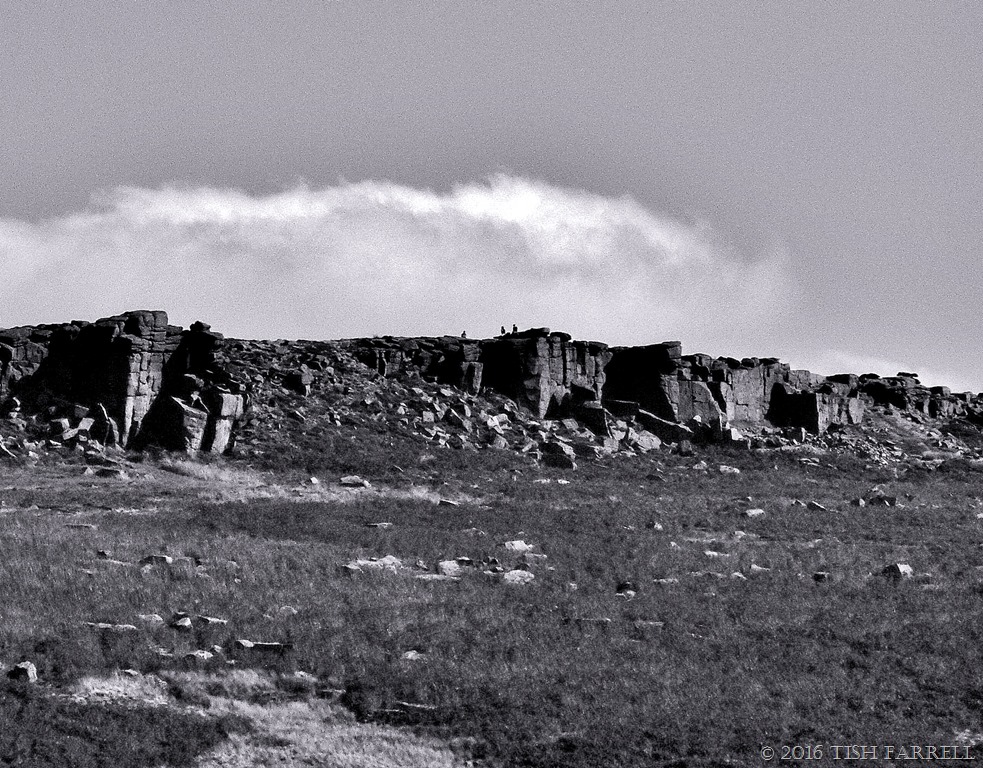
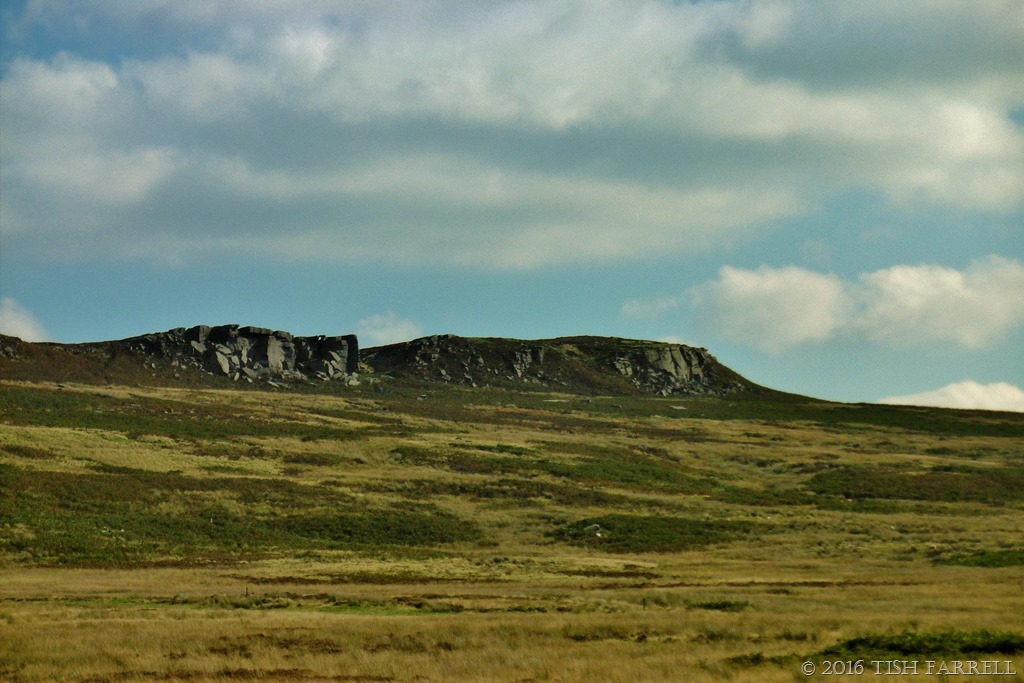
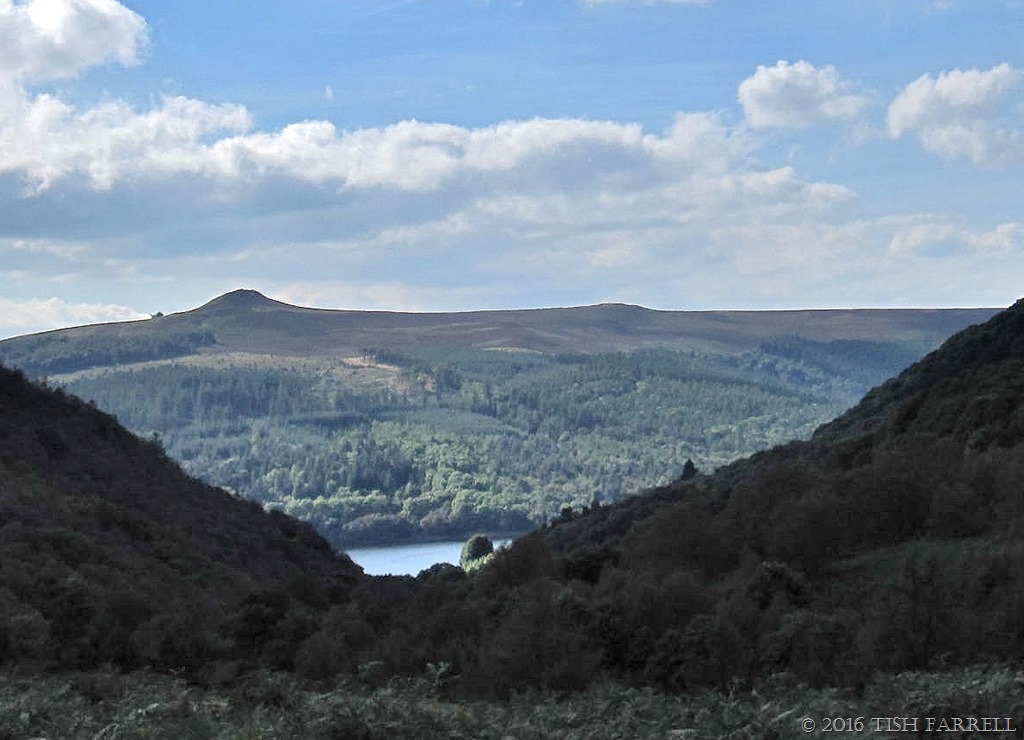
If you read my last post on the Seven Stones Bronze Age circle on Hordron Edge you will have seen the above vista – Stanage Edge above Moscar Moor. The path to this part of the moor begins at Cutthroat Bridge on the Glossop – Sheffield road just south-west of the old boundary stone at Moscar Cross. From here the hills fall away to the Derwent Valley and the vast Ladybower Reservoir built in the 1930s. You can just see a glimpse of the reservoir in the next photo taken from Hordron Edge.  It would have been a steep river valley in Brontë’s time. At the reservoir the road divides – west for Glossop and Manchester, and south for Bamford and Hathersage.
IMG_3310

This next quotation is one of the possible ‘real location’ clues. It describes Whitcross, the place that many now identify as Moscar Cross. This isolated spot is where Jane Eyre is dropped by the coachman because she hasn’t enough money to pay for the onward journey. So begins her desperate wandering and lonely night out on the moors. She has just run away from Thornfield Hall and her thwarted marriage plans. Husband to be, Edward Rochester, has been exposed. He is already married to a lunatic wife whom he keeps locked in the attic. Jane’s sense of shock, loss and emotional distress are heightened as she loses herself physically, choosing to walk away from all identifiable landmarks and into the wild unknown:

Whitcross is no town, nor even a hamlet; it is but a stone pillar set up where four roads meet: whitewashed, I suppose, to be more obvious at a distance and in darkness. Four arms spring from its summit: the nearest town to which these point is, according to the inscription, distant ten miles; the farthest, above twenty. From the well-known names of these towns I learn in what county I have lighted; a north-midland shire, dusk with moorland, ridged with mountain: this I see. There are great moors behind and on each hand of me; there are waves of mountains far beyond that deep valley at my feet.

And why, you might ask, are people so keen to think that Whitcross is Moscar Cross? Does it even matter?

Of course it doesn’t. That a writer was drawing on what they knew of actual places when creating their fictional settings doesn’t necessarily add to our enjoyment of the story. On the other hand, to know that they had a definite somewhere in their mind’s eye may offer a few insights into the nature of the creative process.

I’ve written elsewhere about the importance of PLACE in fiction, and that SETTING is more than just a location. In the best stories the evocation of place can be as crucial as the conjuring of believable characters to occupy it.

Writers need to do their world-building homework very carefully – the outcome of which is likely to be more successful if they are summoning places and situations that have already stirred their creative impulses. When they come to write, they are already firing on all senses: can walk in their character’s shoes; feel through their skin; see through their eyes.  And if the narrative warrants something more complex, there can be, by way of dramatic or comic irony, further interplay between what the reader may ‘know’ of the place and what the protagonists are seen to experience.

Of course all creative people make up things, but they also start their imagining from what they know: from people, places, things that have struck or affected them.

But to return to the Hathersage connections and Jane Eyre  and the real reason why I’m indulging in this piece of literary tourism. For those of you who have read my recent posts you’ll know that the small Peak District town of Hathersage has personal family connections. My ancestors farmed on its outskirts from at least the late 1600s to 1892 (see Stepping Stones Through Time and Ancestor Sleuthing in Derbyshire ).

My great great Fox uncles and aunts of Callow Farm were exact contemporaries of Charlotte Brontë, and some of them would have been around in 1845 when the writer spent three weeks in Hathersage, staying with her very close friend from school days, Ellen Nussey.

Ellen was the vicar’s sister, and he, Henry Nussey had just got married and was away visiting his mother with his new bride. At some stage Charlotte had apparently refused a marriage proposal from Henry (he who apparently liked to draw up lists of attributes for any potential wife) and so his absence was perhaps taken advantage of by Ellen. In any event, the two women spent this time going out and about and visiting local notables.

And while I don’t for a moment think that these outings included afternoon tea at Callow, I am quite enjoying the notion of them sharing the ‘same air’. In fact Callow may well have been a sad place in the summer of 1845. In March of that year, my 3 x Great Grandmother, Mary Ann Fox nee Williamson, had died of ‘general dropsy’ at the age of 57. She is a bit of mystery, possibly ‘a London lady’ who in circumstances unknown became engaged to local bruiser and fist-fighter, Robert Fox of Callow. They were wed by marriage bond in Southwell Minster in 1812. She was anyway survived by four daughters and three sons, and although some of the girls look to have been employed in households outside the area around this time, I’m thinking there may have been Fox family members at Hathersage church on those Sundays in July when Charlotte and Ellen doubtless attended.

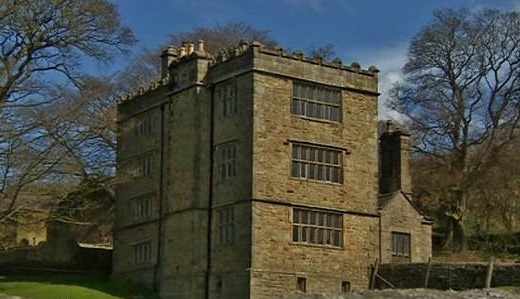
One of the places the two women definitely did visit on several occasions was North Lees Hall, below Stanage Edge, near Hathersage. It was lived in at the time by members of the very populous Eyre dynasty whose antecedents had built it in the 1500s.
North Lees BBC2Photo credit: BBC

The Eyres had occupied many such houses in the area over the previous several hundred years. In fact my Fox family legend (totally unsubstantiated) has it that the first ancestral Derbyshire Fox was the steward of the vanquishing Eyre who came to England with William the Conqueror in 1066, and that this relationship continued down the ages – from which you may also surmise that some of my ancestors told rather good, if dodgy tales. In fact they were still telling this one when Great Great Grandfather George sold up at Callow in 1892. I know, because it was picked up at the time and featured by several local and regional newspapers.

Nor was Charlotte apparently averse to recycling tales. North Lees came with its own legend that told of one Agnes Ashurst, a mad woman who was confined to a room on the second floor. This room had padded walls to stop her injuring herself, but like Rochester’s wife, Bertha, she also died in a fire.

Definitely it was too good a yarn not to re-use and develop then. It also well illustrates another aspect of the on-going writerly process – the jackdaw syndrome of gathering in every shiny fragment and titillating curiosity just in case such treasured little nuggets may one day serve some plot.

Anyway, I will finish this present ramble with the Jane Eyre description of Thornfield Hall. Take a look again at the photo of North Lees. What do you think – a convincing source for Rochester’s domain of dark secrets and the scene of Bertha Rochester’s shocking demise?

I stepped over the threshold. It was a fine autumn morning; the early sun shone serenely on embrowned groves and still green fields; advancing on to the lawn, I looked up and surveyed the front of the mansion. It was three storeys high, of proportions not vast, though considerable: a gentleman’s manor-house, not a nobleman’s seat: battlements round the top gave it a picturesque look.

copyright 2016 Tish Farrell
Disconnected Sunday: Plane…Sheep…Cloud…And Then…?

P1050650

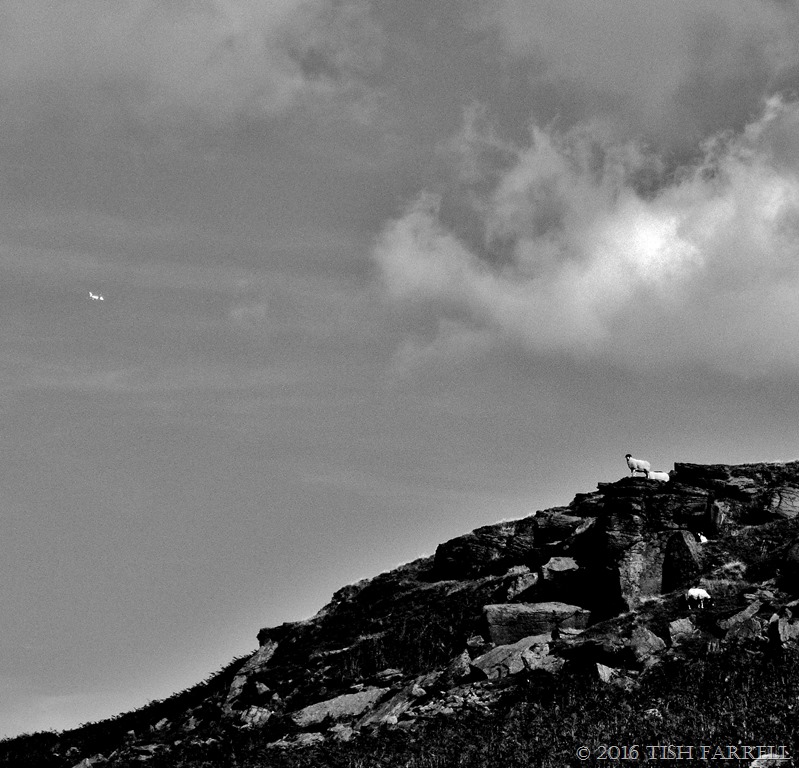
I was attracted by the sheep doing an ovine impression of Landseer’s Monarch of the Glen –  as spotted last week during our short break in the Derbyshire Peak District. Its posing place of choice is Hordron Edge, below Moscar Moor and Stanage Edge. We were walking up here on what he-who-is-usually-the-team-leader suspected would turn out to be a Tish-type wild goose chase. In short we, or rather I was in pursuit of a Bronze Age Stone Circle, otherwise known as the Seven Stones despite the fact that there are apparently eleven stones in the circle, and three more besides nearby.

I should admit straight off that I’m not renowned for my accurate map-reading, and so once we’d passed the sheep, walked for ages in surprisingly hot sunshine for late September, and then found ourselves on a path which kept wending onwards and upwards with absolutely no sign of a megalithic monument anywhere on the sky-line where I was expecting it, even I began to think I’d misread the map, and that we were definitely on a wild goose chase. Worse still, we’d left the lunch picnic in the car, so there wasn’t even the possibility of making the best of a bad job. And it was just the day for a moorland picnic too, not a state of affairs you can rely on in England’s uplands whatever the time of year.

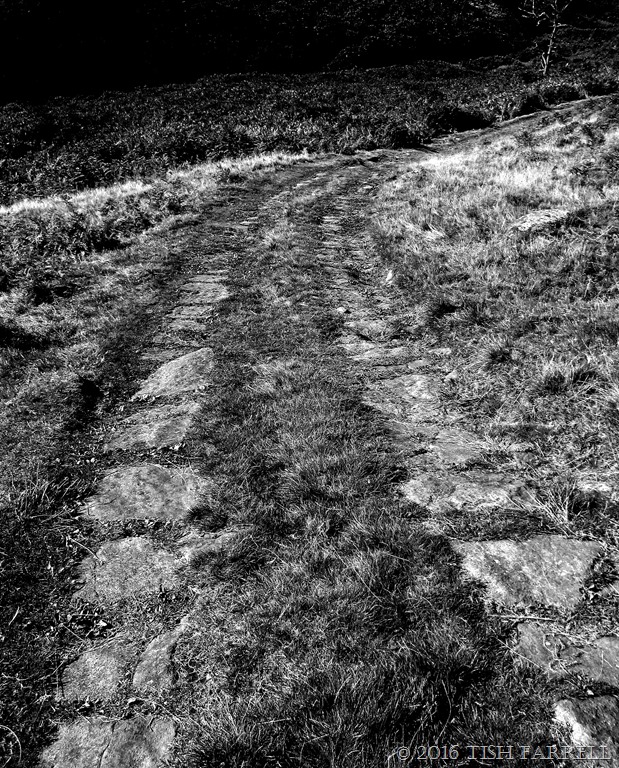
‘We’ll just go to the next bend’ – I said – ‘so we can see over the brow of the hill’. But as always happens in such situations, we never came to the bend’s end. In fact the path began to rise very steeply. Then we noticed that exposed here and there beneath the turf were signs of a stone-paved trackway. Very puzzling in this middle of nowhere, but at least it suggested that we were headed somewhere. (I surmised later that it must be the relic of an old packhorse road up to Stanage Edge whither the locals once went quarrying to make millstones and grind stones).

And so as we pushed on, drawn on by the stone road, and quite unexpectedly Moscar Moor and Stanage lay before us. It is an awe-inspiring landscape, and so it is scarcely surprising that this whole area is rich in prehistoric cairns, circles, and settlement remains.

Also, by now I could see that my map-reading had been spot on, although the stone circle really took some finding in the heather.

P1050637 (2)

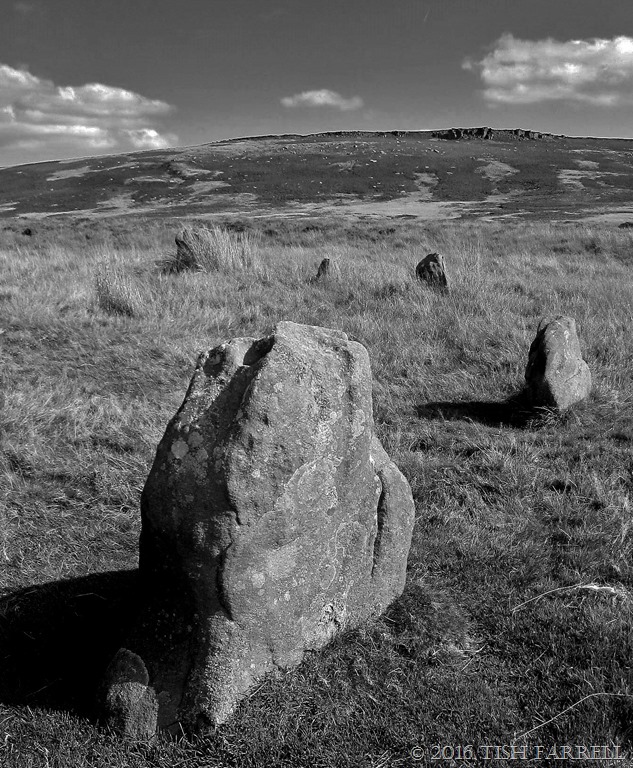
So I hope you weren’t expecting Stonehenge. Because here it is – the Seven Stones Circle of Hordron Edge, probably dating from around four thousand years ago.

IMG_3319

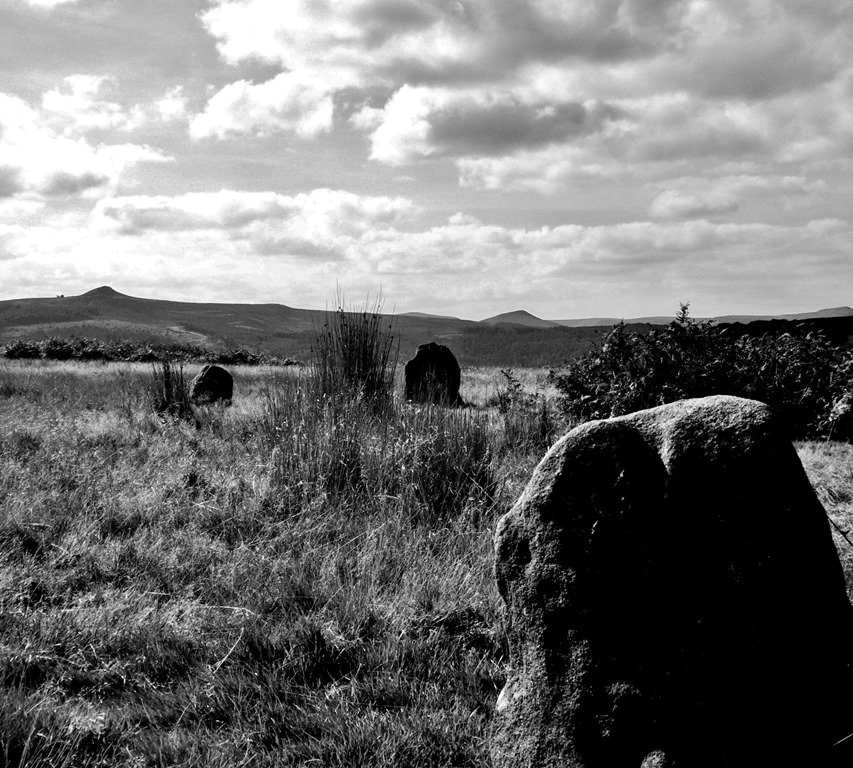
The tallest stone is the one seen here in the foreground, and is about 1 metre high. It stands on the south west edge of the 16 metre circle, and has been dubbed the Fairy Stone. You can see it on the far right in the middle ground of the next photo. P1050638

Its particular significance is taken to be its relationship to the two conical hill tops, Win Hill on the left and Lose Hill on the right, the top of the stone possibly mirroring the landscape features. Peak District archaeologist John Barnatt has apparently observed that at the traditional start of winter and spring, the times of age-old festivals, the setting sun appears to roll down Win Hill.

Perhaps the placement of stone had something to do with the gathering of sun-power? Or the marking of the seasons in relation to the farming calendar? We can never know. All we can be sure of is that these monuments were important to the people who created them – gathering places for discourse, rituals, trade, or all of these. More recent local folklore has its say too – hence the naming of the Fairy Stone, and tales of strange lights being seen around about it.

And what do these monuments say to me? Well the main thing is that we should never underestimate the capacities of our ancient antecedents. Also that we should never equate current technological whizz-kidery with intellectual superiority. These people  of the past  knew how to make a life in this challenging territory – a life charged with meaning and a deep sense of their place in the landscape. I feel too, we have lost much of our ancestors’ capacity for poetry and metaphor – the exchange between fellow humans that relied almost exclusively on language – the songs sung, the tales unfolded, the riddles set, the nuances of double and treble meanings.

But before I get too carried away with highfalutin notions, we decide that lunch is now too far away for comfort. We retrace our steps down the old stone trackway. It perhaps does date from much more recent medieval times. I’ve been unable to find out anything about it, although there is medieval packhorse road along the top of Stanage Edge.

As I descend the steep hill on a sunny Indian Summer day I wonder what it must have been like to urge pack horses up this route in a blizzard, the wind slicing under your cape, threatening to snatch your bonnet, the biting cold, the darkness. Just imagine…

IMG_3311 - Copy

copyright  2016 Tish Farrell

Hordron Edge Circle
Bronze Age Stone Circle
East of Ashopton, Derbyshire  OS Map Ref SK21528685
OS Maps – Landranger 110 (Sheffield & Huddersfield), Explorer OL1 (The Peak District – Dark Peak Area)

Thursday’s Special: Double Trouble?

P1040105

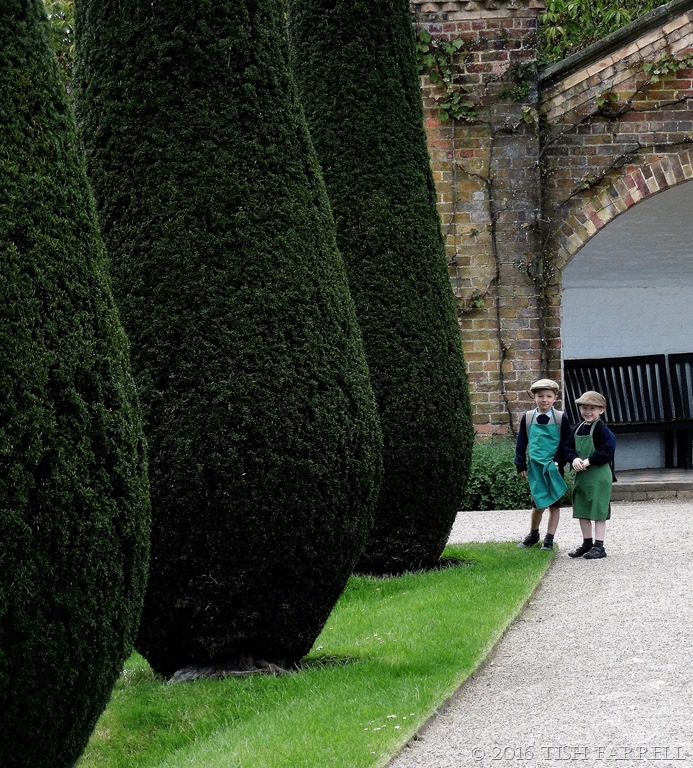
I was in the formal garden of Erddig stately home, thinking of photographing the avenue of shapely yews when these two young men walked into the frame. They lingered, clearly wanting to be photographed in their costumes as 1900s serving lads. Then the kitchen maids arrived  to send them back to their duties, and they were gone. On the other hand I could have captured a time slip: a  pair of fleeting Edwardian ghosts?

Now here’s the yew avenue I was aiming to snap.

P1040104


Thursday’s Special: Double

#ThursdaysSpecial

Changing Seasons: September And The Rook Ballet

101_0365

No one quite knows why they do it. Or they didn’t the last time I pursued the matter. But as summer ends so the rooks begin their twilight dancing. There is a large rookery in the wood behind the house. Many scores of birds. Jackdaws live there too. Now each evening, as the sun slips behind Wenlock Edge we watch the rook and jackdaw ballet. Flock after flock flies in, flies out, sweeps up, round, back, spirals, dives in sequences so swift and coordinated that there must surely be some corvid dance-master somewhere orchestrating the moves. The show may last for many minutes, subside into the treetops, then burst out and start all over again. Finally, as the light goes, every bird finds its perch, and the wood subsides into companionable darkness and gentle rook chatter.

 *

To join in this challenge please visit Changing Seasons Monthly Challenge over at Cardinal Guzman’s

TheChangingSeasons_6367

Clandestine Capture & Ancestor Sleuthing In Derbyshire: Thursday’s Special

P1050619

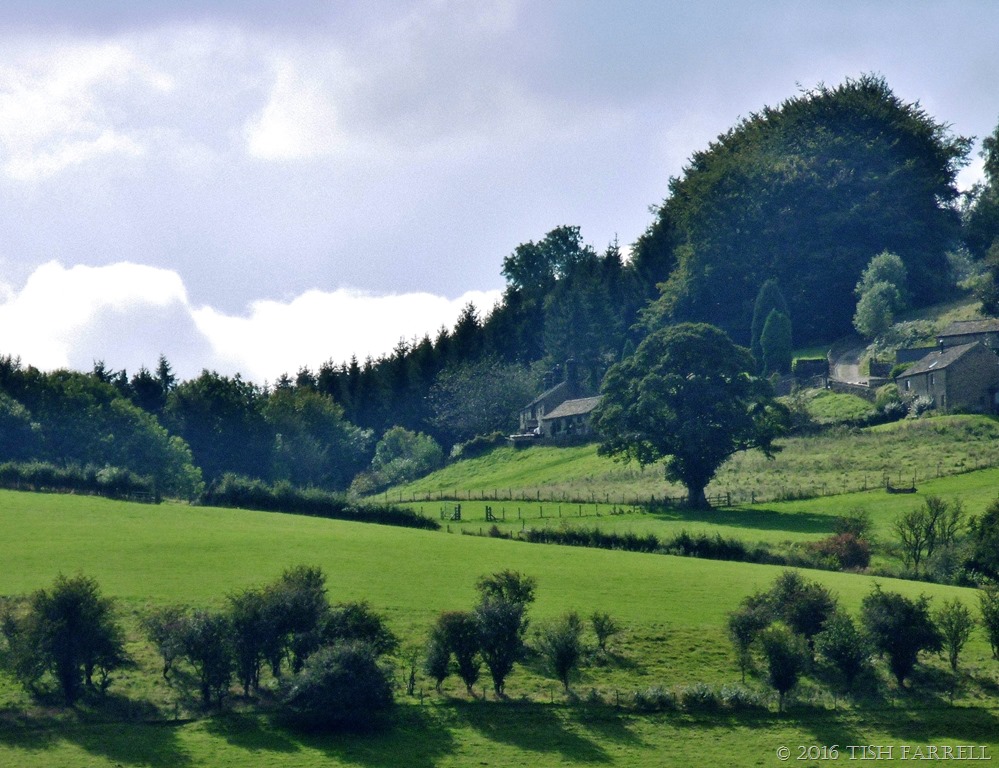
This was where I was last Thursday morning – not posting on Thursday’s Special, but trying to find a good spot on a field path outside Hathersage so I could photograph Callow Farm. This was the place where four generations of my Fox family ancestors were tenant farmers from around 1700 to 1892. Before that, during the late 1600s, they rented another Duke of Devonshire farm, The Oaks, up on the wilder heights of Offerton Moor, not far from Callow.

As you can see, the house (centre) is covertly situated, in the lee of the hill beside the wood. I had to use a lot of zoom, hence the hazy look, though such haziness is perhaps fitting for this piece of ancestral snooping. The more readily visible buildings on the right are the farm’s barns, now an upscale holiday let.

If you go to the previous post Stepping Stones Through Time you’ll find more of the story behind this photo. This was the reason why I  had hoped to cross the stepping stones, to achieve a closer view than this one. Ah well. Maybe next time.

*

There’s still time to take part in last week’s Thursday’s Special. Paula says ‘Pick a word in September’. Choose from: populated, time-sensitive, companionable, burgeoning, clandestine, but first go and see her gallery of photos and be inspired.

#thursdaysspecial


Stepping Stones Through Time

P1050609

This photo may serve better as an idea than an actuality. It’s the layers that attract me – not only of light and shadow, surface reflections and leafy river bed, but also of present and past: the stones that,for two and more centuries, my maternal ancestors used to cross the River Derwent.

Or at least so goes the family tale, the one my great grandmother, Mary Ann Fox, passed on to my grandmother, Lilian Hickling, who passed it on to her daughter, my aunt, Miriam Wilkinson, who passed it on to me. The photo, then, could be taken as a physical rendition of Chinese Whispers. Well, aren’t all family histories like this, word of mouth down the generations? There are bound to be omissions, distortions, total fabrications even.

But there are some certainties too.

Great grandmother Mary Ann was a Derbyshire lass, born and raised at Callow Farm, the child of tenant farmer George Brayley Fox and lead miner’s daugher Mary Ann Bennett. The land all around belonged, as it does still, to the Dukes of Devonshire. The stone-built farmhouse was (is) tucked high into the hillside below Highlow Hall and Offerton Moor. From Callow’s garden wall, the fields fall steeply down to the River Derwent. The stepping stones crossing was the quickest route from the farm into the Peak District village of Hathersage across the river, and the path there, across Callow’s meadows, still survives on OS maps. And so we have a scene, relayed to me by aunt via grandmother, of a young wife and mother living in the close and gloomy streets of industrial Farnworth. There she conjures her girlhood life, telling her four town-born children how, if she needed to buy the slightest thing she would have to traipse across many a field before reaching the stepping stones to Hathersage.

Other scraps have reached me. There is one that now lurks in my memory like a small haunting. For it seems my grandmother often told my aunt that Mary Ann was ‘a sad woman’. Nor is this surprising. She was widowed twice: at 30 and at 41. After the first loss, and with four young children to raise, she took up inn keeping beside the Manchester Ship Canal at Hollinfare. Grandmother said that as Mary Ann moved about the inn, she recalls the waft of her black silk dress always carried the scent of lily of the valley; a touching image until you learn the scent was dabbed on to cover the smell of gin.

But before the sorrow, I have a sense that, as a young woman, Mary Ann was headstrong and passionate. Though it may well be that those very characteristics were precisely  the source of some poor decision-making. In 1886, aged twenty two she went against family wishes and married Thomas Shorrocks, a spindle and flyer manufacturer, who worked with two brothers and a widowed mother in the family firm in Farnworth, Bolton, part of Greater Manchester. His first wife, Mary Ann Wright, had died around the time their first child was born, leaving Thomas with a young son. How Mary Ann Fox in Derbyshire met Thomas Shorrocks of Farnworth, Lancashire is still a mystery. Grandmother’s only surviving comment on the matter was that her mother fell for the first man she saw wearing a stove-pipe hat, that she was a country girl swept off her feet by a townie. Grandmother also said she scarcely knew her father. He had no time for children and kept away from home until they were asleep, staying on at the works or at his club. And then too, he died very young. Around 1891-2 the family firm of Robert Shorrocks & Co was in grave financial difficulties. The machinations to keep the business afloat involved a high profile court case, but then all was lost anyway. By 1893 Thomas Shorrocks was dead. He was only 39.

But how did Mary Ann adapt to life in industrial Farnworth?

Her first married home, 8 Kildare Street, Farnworth, was not far from the Shorrocks works on Bridgewater Street. It was a modest terraced villa with a small front garden and a back yard – a far cry from the sweeping high-moors vistas around Callow. And if she did not see much of Thomas during daylight hours, was she abandoned to her own devices? We know from the 1891 census that she did at least have the company of Lucy Stubbs, a young Derbyshire girl from Grindleford Bridge employed as a domestic servant. There were also other Shorrocks households along Kildare Street, including mother-in-law at number 23. Mary Ann also formed a close friendship with her husband’s younger sister Mary, though it was in every way subversive. Mary was being wooed by one John Hamer (later to become an wealthy mill owner), but Thomas and the Shorrocks family in general disapproved of him. It was Mary Ann who allowed the couple to meet in secret at Kildare Street, a kindness that was long remembered; for in the end John Hamer did marry Mary Shorrocks, and after Mary Ann died it seems they did much to support her children.

It also seems Mary Ann did not fall over herself to fit in with Farnworth mores either. There’s a clue in another of Grandmother’s snippets. She told my aunt that the traditionally dark clad women of Bolton and Farnworth looked askance when Mary Ann went abroad in her bright print country frocks. Did she ever back down, I wonder. Or did she flaunt? In my mind’s eye I see the flash of free-spirited obstinacy that brought her to that place. Much like the light flickering through the riverbank trees and onto the Derwent stepping stones.

The collapse of Shorrocks’ fortunes coincided in 1892 with Mary Ann’s father’s decision to leave Callow Farm where his family had been tenant farmers for four generations. Derbyshire farmers were having a hard time in the early 1890s: prices for crops were low, and rents were high, and landowners unwilling to compromise on the rents. It seems likely that some of the proceeds of the farm sale of stock, crops, horses and household belongings were used to secure the licence for the inn in Hollinfare, Cheshire, where Mary Ann began a new life as innkeeper.

My aunt said the Fox family had decided that taking the inn was the best means of securing a home and living for her with three young children and an adolescent stepson. It  stood on the south bank of the great Manchester Ship Canal, which linked the vast industrial heartland of northwest England with the port of Liverpool. It had only recently opened in 1895 when she took over the inn. In every way the Foxes must have thought it a shrewd decision, anticipating plenty of passing trade.

Mostly what it brought, and pretty rapidly too in January 1895, was another marriage to another widower – one Charles Rowles, a ship’s pilot on the canal and a former sea captain. My grandmother disliked him, although she adored her young stepbrother, Giles, born in 1896. She said it was only once her mother had married him, that Charles Rowles produced two teenage daughters from his first marriage. These young women apparently moved into the inn and tried to rule the roost which, I know for sure, would not have gone down well with my grandmother. If any roosts were to be ruled, she would be doing it.

When I tried to discover more about these interloping young women, I found a hint of scandal. It very much looks as if Mary Ann’s younger brother, George Fox, then aged 26, eloped with one of his sister’s new stepdaughters. Hannah Louisa Rowles was probably only 15 when she married George, although she claimed to be 18  on the marriage licence. At the time, November 1895, there were both living on York Street, Manchester. The following August their daughter Dorothy was baptised although she does not survive. In 1901 the census indicates that George was running ‘on his own account’ a large public house on Oldham Street, Manchester. By 1908 he had died, and in the 1911 census his young widow is listed as a servant, working in another Manchester pub. What happened to her remains to be discovered.

As for Mary Ann, in 1905 after ten years of marriage, Charles Rowles died. She survived him only by another four years, dying in the Manchester household of her stepson, Robert Shorrocks. She was 46. Her youngest child Giles was about 12 years old at the time. The 1911 has him living with a widowed Rowles aunt in Cardiff and employed as an apprentice shipping agent. He was to die at Gallipoli in 1915. Nineteen years old and buried at sea somewhere off Lemnos.

Now as I look at the stepping stones photograph, these are the thoughts that run through my mind. It is all too easy to look back to Mary Ann’s growing up at Callow Farm and see a rosy past. It’s how we tend to view things: the glamour of an imagined rural idyll – the stepping stones back to happier days. I had hoped to cross here too. I badly wanted a closer view of the farmhouse. But on the day of my visit there had been heavy rain, making the Derwent far too active to attempt to cross without rubber boots and a stout stick for support. A quest then, for another time? Perhaps.

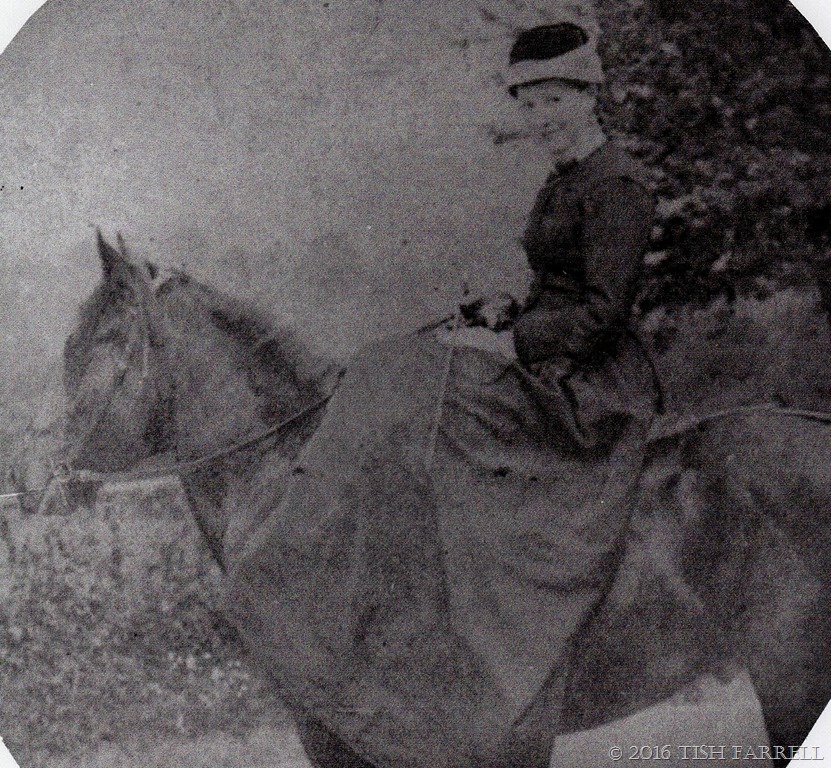
Mary Ann Williamson Fox of Callow b.1863

Mary Ann Fox (1863-1909) sometime before her marriage, and before her father sold her pony. He had threatened to do this if she persisted in jumping the farm gate on horseback. She did not listen. You can tell that she would not just by looking at her.

Copyright 2016 Tish Farrell

Spirit of the Past: Black & White Sunday

holiday 029

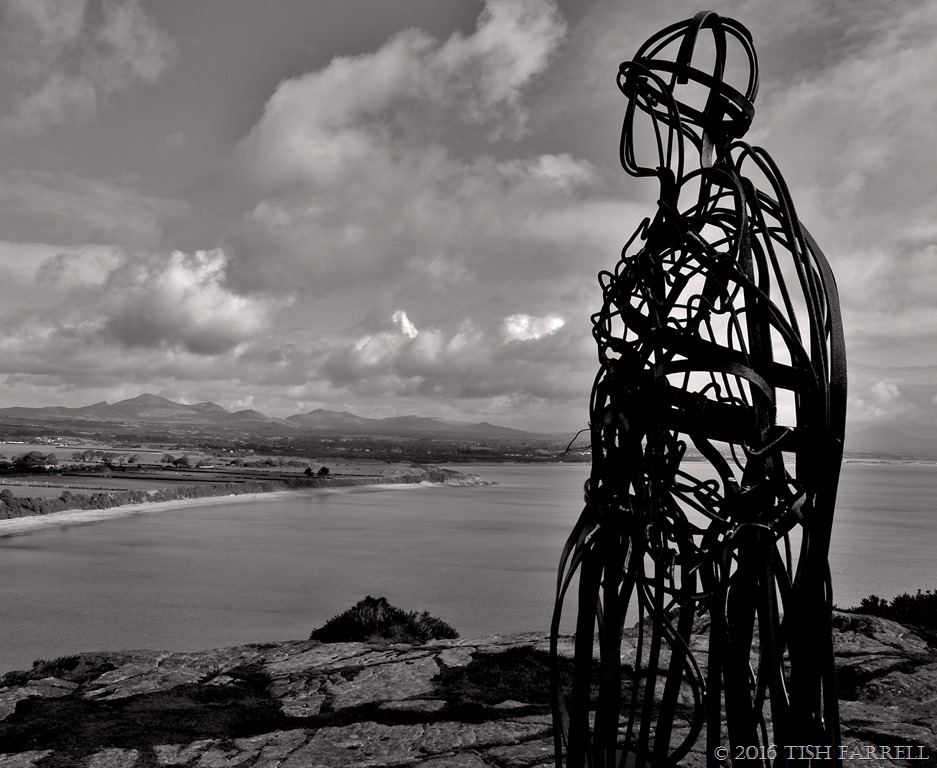
I’ve written about the Iron Man of Llanbedrog in other posts. (Personally I think it could be a woman – Boudica perhaps, the last of Britain’s Celtic warrior women). I’ve also posted variously edited versions of this shot before, but not this one exactly. This week at Black & White Sunday, Paula is reprising the popular Traces of the Past challenge, and I thought that although this iron figure is not especially old, everything about it speaks of the ancient Celtic spirit. And of course there are the ‘rocks of ages’ just visible in the distant mountain range of Snowdonia. In many senses, then, Wales is an old, old land, and the traces of the past are everywhere across the landscape.

 *

You can read more of the Iron Man’s story at Warrior Wind-Singer Of Llyn

Blown-Away Opium Poppy: Thursday’s Special

IMG_1812

Paula has truly set us a challenge this week: DECONSTRUCTION. So as my stab at this school of philosophical thought, here is an abstracted opium poppy, its stamens and petals being blown off in the wind: caught in the act of deconstruction then: from flower to seed capsule. The cycle of life in all its parts.

Thursday’s Special: Deconstruction

Shore, Reef, Ocean, Sky: Edge On Edge

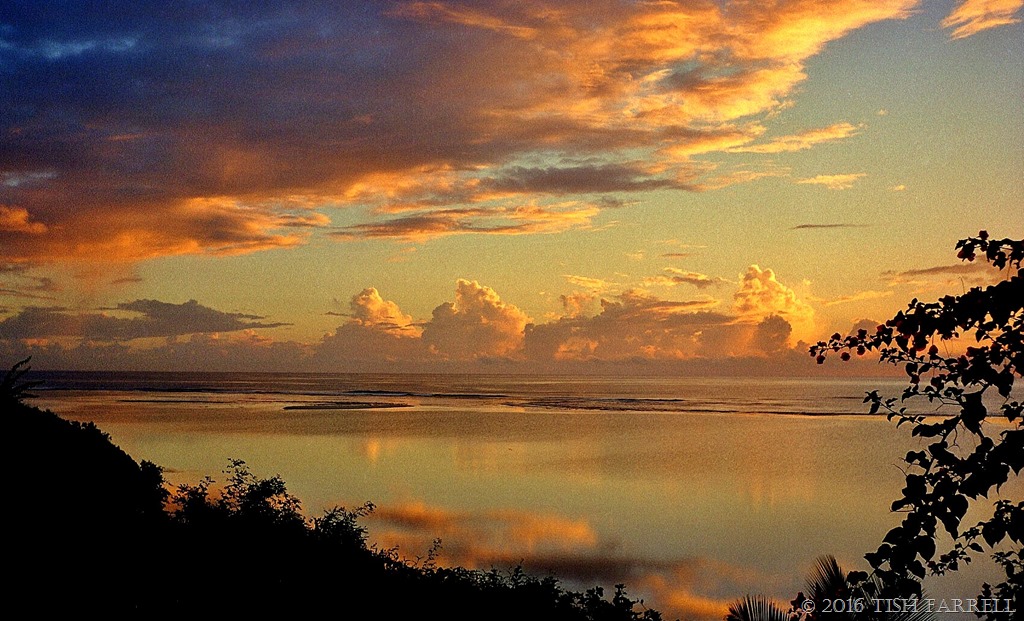
dawn over Tiwi lagoon more contrast - Copy

Some of you will have already read the essay below. It won first prize in a Quartos Magazine competition years ago. The magazine is no more, but I’m posting the piece again for those of you in need of  a long, soothing wallow beside an African beach. Enjoy!

 Going to the Dogs on Mombasa’s Southern Shore

It’s a dog’s life on Tiwi Beach, the white strand where ocean roars on coral and trade winds waft the coconut palms; and where, best of all, as far as the local canines are concerned, there are quiet coves sparse in holidaymakers. It means they may do as they please. After all, it is their own resort, and every morning they set off there from the beach villages along the headland, nose up, ears blown back in the breeze, ready for the day’s adventures.

But the dogs are not churlish. They can take or leave the odd pale human wrestling to right his windsurfer on the still lagoon; ignore the sentinel heron that marks the reef edge beyond; pay no heed to the etched black figures of the Digo fishermen who search the shallows for prawns, parrot fish, or perhaps a mottled lobster or two.

But in this last respect at least, the dogs are smug. For the fishermen come down to the beach only to make a living. And when they are done hunting, they must toil along the headland from beach village to beach village, then haggle over the price of their catch with the rich wazungu who come there to lotus eat. Hard work in the dogs’ opinion.

The dogs know better of course; know it in every hair and pore. And each morning after breakfast, when they take the sandy track down to the beach, they begin with a toss of the head, a sniff of the salt air, a gentle ruffling of the ear feathers in soft finger breezes. Only then do they begin the day’s immersion, the sybaritic sea savouring: first the leather pads, sandpaper dry from pounding coral beaches, then the hot underbelly. Bliss. The water is warm. Still. Azure. And there can be nothing better in the world than to wade here, hour on hour, alongside a like‑minded fellow.

There’s not much to it; sometimes a gentle prancing. But more likely the long absorbing watch, nose just above the water, ears pricked, gaze fixed on the dazzling glass. And if you should come by and ask what they think they’re at, they will scan you blankly, the earlier joy drained away like swell off a pitching dhow. And, after a moment’s condescending consideration, they will return again to the sea search, every fibre assuming once more that sense of delighted expectation which you so crassly interrupted. You are dismissed.

For what else should they be doing but dog dreaming, ocean gazing, coursing the ripples of sunlight across the lagoon and more than these, glimpsing the electric blue of a darting minnow? And do they try to catch it? Of course they don’t. And when the day’s watch is done, there is the happy retreat to shore ‑ the roll roll roll in hot sand, working the grains into every hair root.

And if as a stranger you think these beach dogs a disreputable looking crew, the undesirable issue of lax couplings between colonial thoroughbreds gone native: dobermanns and rough‑haired pointers, vizslas and ridge‑backs, labradors and terriers, then think again. For just because they have no time for idle chit-chat, this doesn’t make them bad fellows: it’s merely that when they are on the beach, they’re on their own time. But later, after sunset, well that’s a different matter. Then they have responsibilities: they become guardians of the your designer swimwear, keepers of your M & S beach towel, enticing items that you have carelessly left out on your cottage veranda.

By night they patrol the ill‑lit byways of your beach village, dogging the heels of a human guard who has his bow and arrow always at the ready. And when in the black hours the banshee cry of a bush baby all but stops your heart, you may be forgiven for supposing that this bristling team has got its man, impaled a hapless thief to the compound baobab. It is an unnerving thought. You keep your head down. Try to go with the flow, as all good travellers should.

But with the day the disturbing image fades. There is no bloody corpse to sully paradise, only the bulbuls calling from a flame tree, the heady scent of frangipani, delicious with its sifting of brine. You cannot help yourself now. It’s time to take a leaf out of the dogs’ book, go for a day of all‑embracing sensation ‑ cast off in an azure pool.

And in the late afternoon when the sun slips red behind the tall palms and the tide comes boiling up the beach, the dogs take to the gathering shade of the hinterland and lie about in companionable couples. Now and then they cast a benign eye on you humankind, for at last you are utterly abandoned, surrendering with whoops and yells to the sun‑baked spume. They seem to register the smallest flicker of approval: you seem to be getting the hang of things.

copyright 2016 Tish Farrell

Edge