
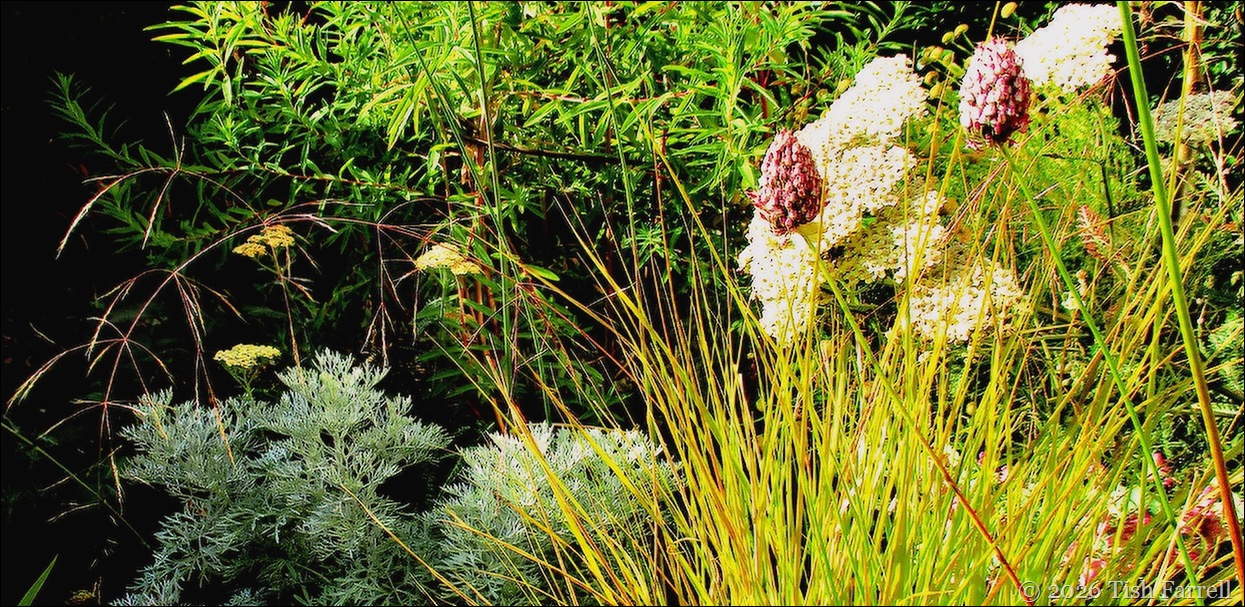
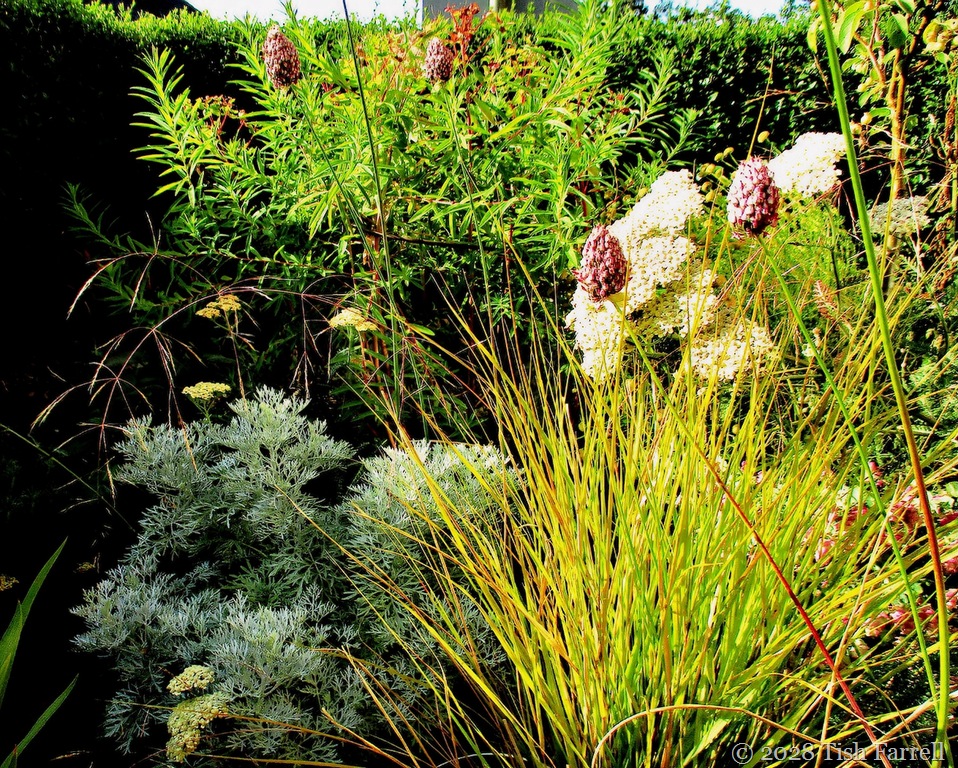
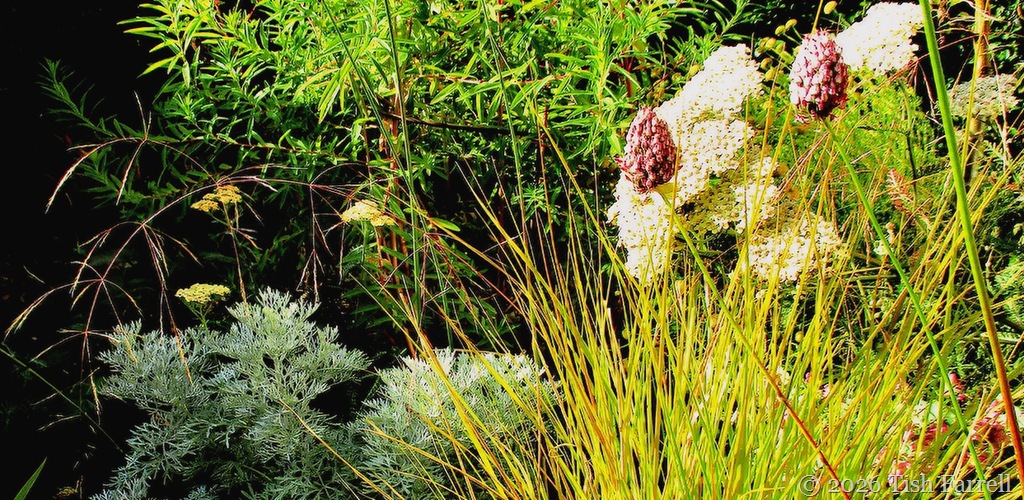
This morning at 8 a.m. the front garden had drowsing looks, the borders brimming with sun and bee-hum. For the first time I noticed that the pheasant’s tail grass, (Anemanthele lessoniana) had put out long and lovely flower stems. Such delicate structures. They caught the light, like the glint of spider’s webs.
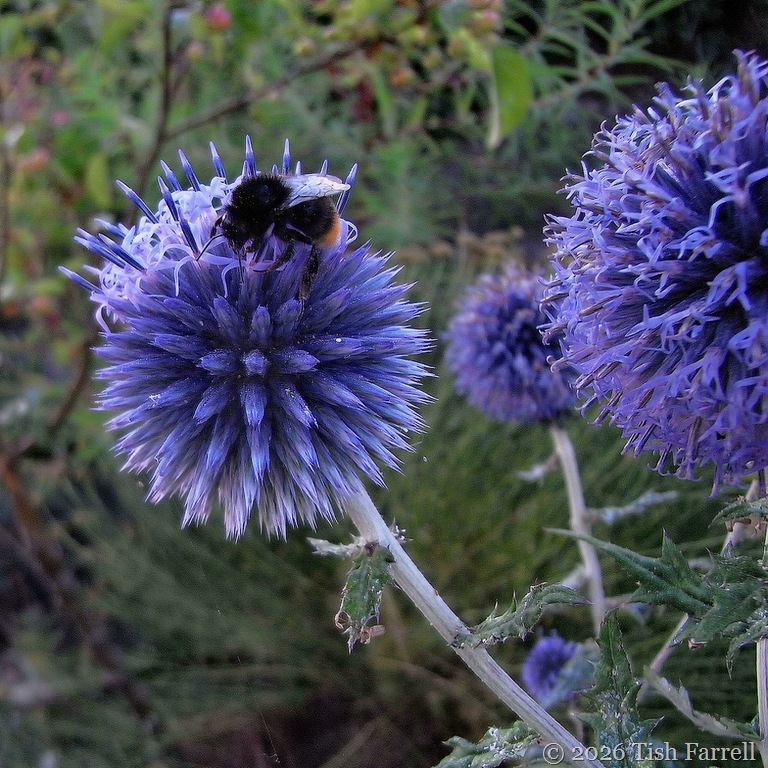
I also noticed that the Artemisia Powys Castle was looking rather fine after a very slow start. The Echinops, too, in front of the living room window, had sprung up tall. Last year it was blighted by aphids, but now the flowers are at nose-height and full of bees.
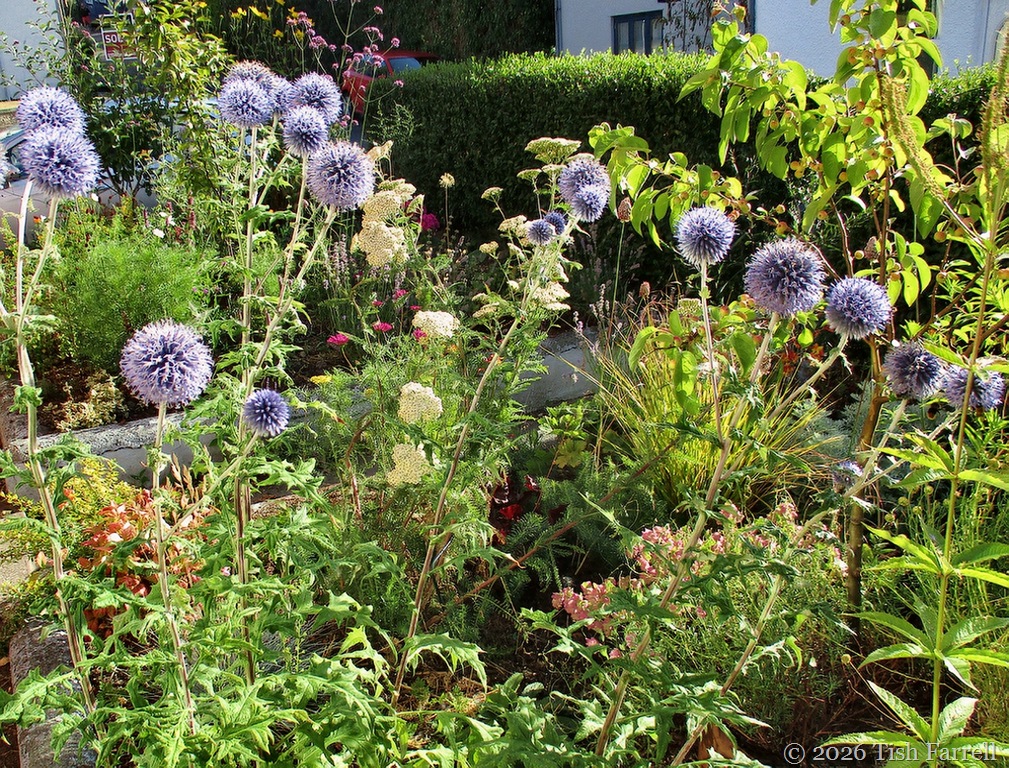
But there’s a sense that something has changed. The sun is hot, rebounding off our red-brick house, and yet there’s the strangest chill too, as if a tranche of Arctic air has just floated in. For a brief time a huge black cloud loomed over the town. It made me think of rain, but actually it looked more like snow. Curiouser and curiouser. Anyway, it was soon gone, leaving us with sunshine and a brisk, cool wind.
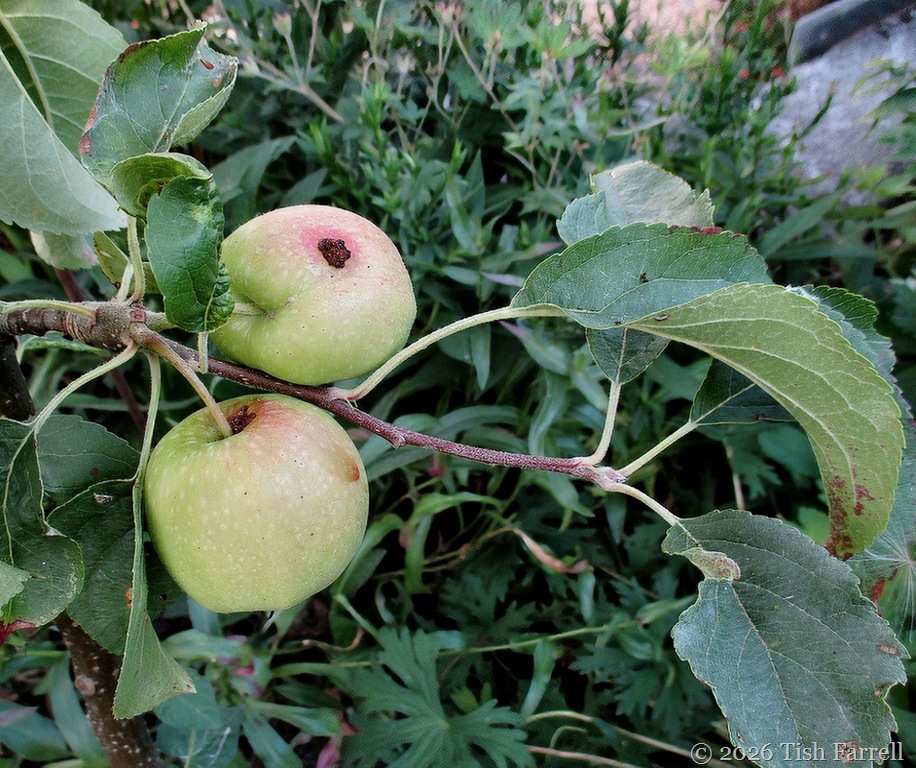
Earlier in the week I was feeling fed up with the garden – not only with the heat and drought effects, but also with my general gardening M.O. Too much randomness and ad hocism, so much short termism. Where was the overall plan? I was also especially cross to find that many of our young apples were already spoiled. I pointed out the damage to the man in our house, he who builds sheds and car ports that aren’t car ports and is presently engaged in constructing a work table from his extensive collection of waste-wood. Summoned from shed and power saw, he duly dusted off his plant pathologist’s hat, and informed me that the Christmas Pearmains and Red Devils have been zapped by codling moths. Nothing can be done about it, says he. Hmph and double hmph.
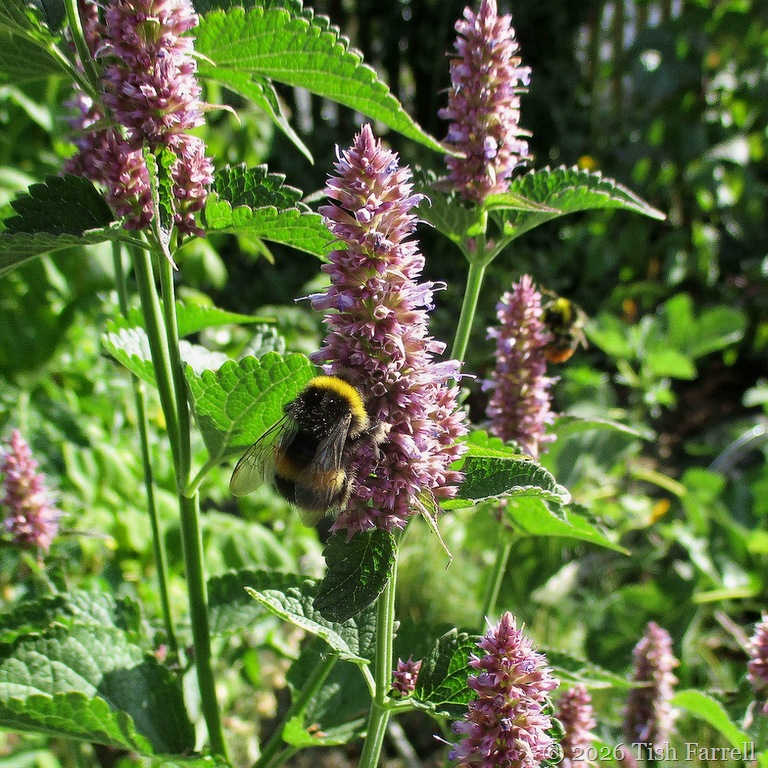
But then there’s always something to be pleased with in the garden, once you start looking. It was then I noticed how well the Agastache AKA Korean Mint was doing. It is another of my happenstance plantings. I grew the original plants from seed two years ago. They were vigorous specimens while they lasted, and although they did not survive the cold, wet winter, they did leave the makings of many, if discreetly settled, offspring. There’s one monster growing beside the greenhouse. I think it stole all the rhubarb’s muck, leaving the rhubarb to wither away.

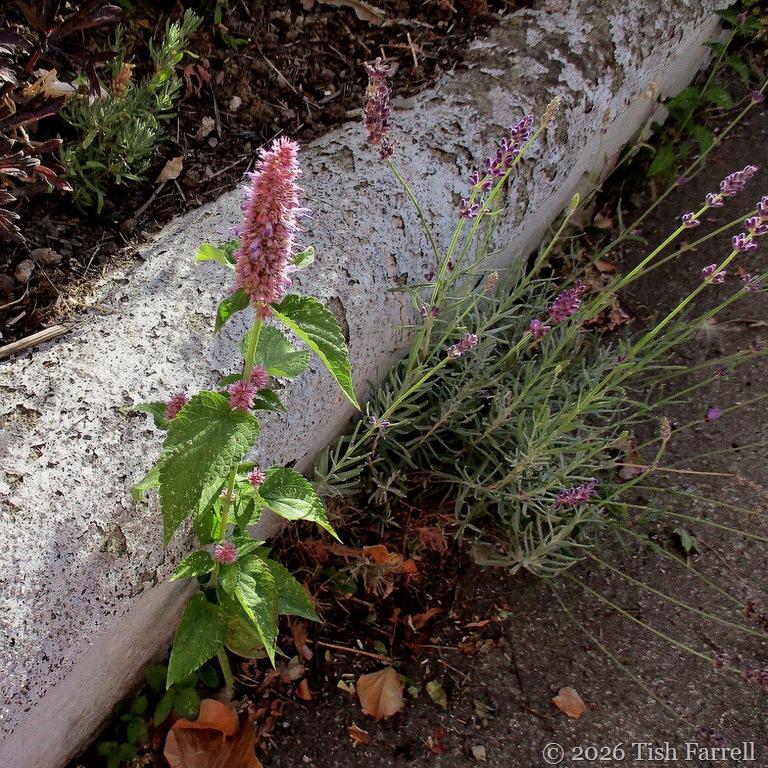
Other seeded plants are growing well in what, to me, seem most inhospitable spots, including between the cement front path and border wall. Here one example is keeping company with a similarly seeded lavender. Bees and butterflies love this plant, and I can see why. I’ve been cropping and chopping some of the tender flowering side shoots and adding them to salads. Agastache also comes in many pleasing colours…so there’s a thought…
*
Given the heat and drought, I’ve been surprised to have had some success with plants that I actually meant to grow from seed this spring. Just now making its presence felt is Dyer’s Chamomile (Anthemis Tinctoria). It is one of the most cheerful high-summer plants, and especially now as much of the garden colour is on the fade. I have it in various places, including a pot with some snapdragons and small hover flies on the back garden steps.
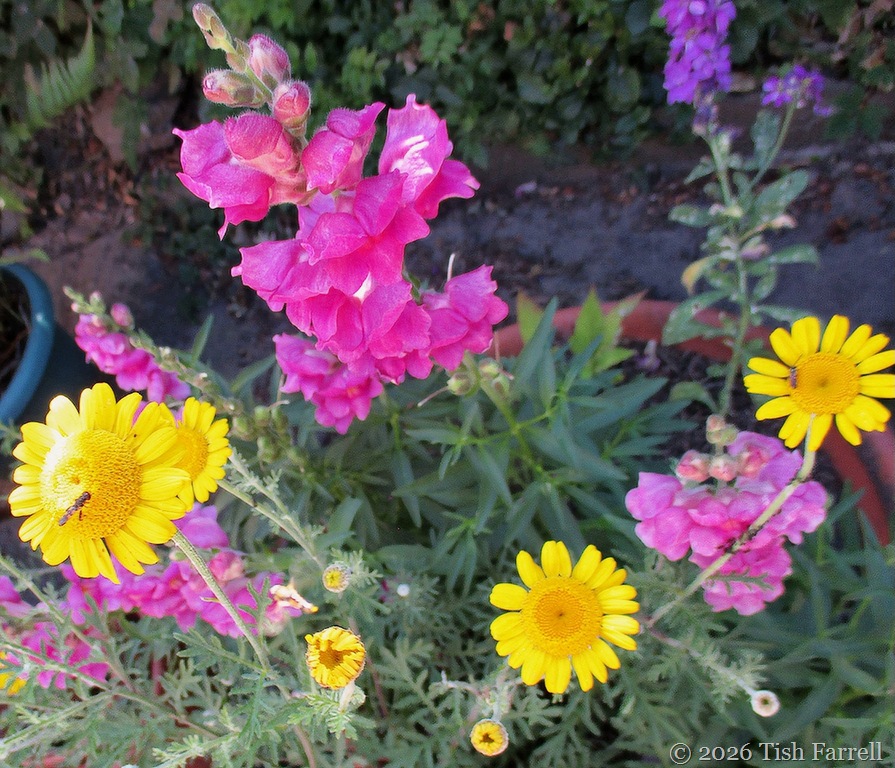
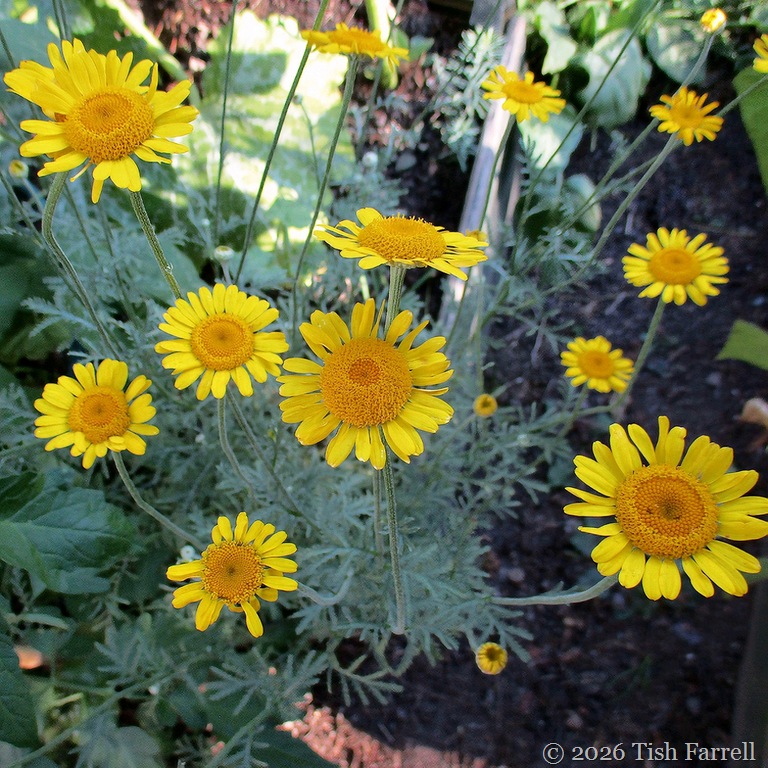

The bushiest clump is sharing the corner raised bed with a few butter beans, a courgette and self-grown sunflower. The above photo also includes the male blackbird. It stalks me in a slightly creepy manner, and when I’m not in the garden, spends its time tossing mulch out of the borders. We have had words.
But my star plant of the week is Lemon Bee Balm (Monarda Citriodora). The ones I’ve grown are still pretty small. I’d not been paying them much attention, beyond keeping them alive, and only yesterday did I consult the growing info that told me I should have pinched out the tops several times, and not just once, i.e. if I wanted them to bush out.
And now that I see their flowers, I long for them to be bigger and better AT ONCE. What fascinating floral structures they have, even by monarda standards. (As ever, note to self: read all the instructions).
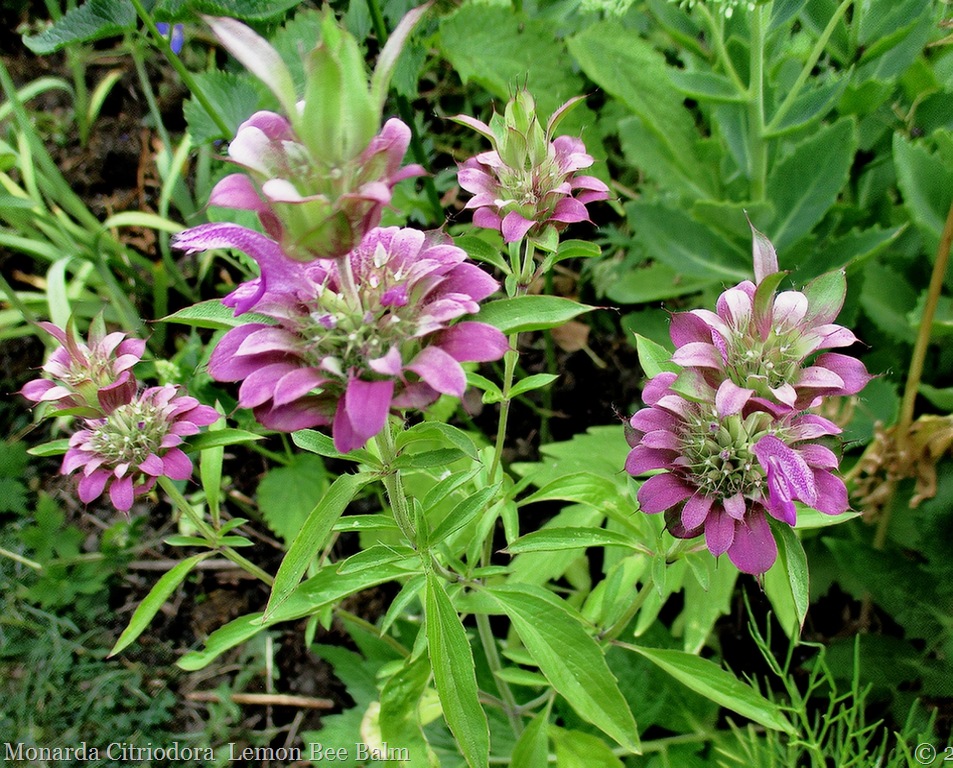
When I did finally get to them, the growing instructions also told me that this plant is known to attract humming birds. Now how wonderfully fantastical would that be. And do you know – I think they just might…
*
Copyright 2026 Tish Farrell
Six on Saturday This week a scarlet zinnia and deep blue agapanthus are among the stars in Jim’s garden domain.

Some relief – regarding what’s happening
Sorry about the codling moth, but you have plenty to be pleased with. I think this time of year, whatever the weather, is a bit of a come down for us gardeners. Every year I feel the same as you, as if it is suddenly completely out of control and there is no way back from it. Too dramatic? Probably! Love, love, love the agastache and the echinops are amazing.
Yes, lots to be happy with. One thing I’m definitely happy about is that I haven’t still got a 70 foot allotment plot to deal with 😉
I am in love with the Monarda! That one is apparently not native to my state, but I love it. Weirdly, it is in Michigan and Illinois. Is it prone to powdery mildew? A lot of people growing M fistulosa complain of PM, but I find it just gives the leaves a greyish patina, and does not affect anything else as far as i can see. My rhubarb has also succumbed to drought and lack of adequate watering, but I think it will be fine, it just look rough.
I’m surprised how perky the flowers have been looking during our weird weather. No sign of mildew so far. The standard herbaceous monarda look totally roasted on their tops, which happened almost as soon as they started to flower. I’m not liking the looks of them, but the bees don’t mind, and are foraging the lower levels.
I’m loving looking at your garden, especially since we will be in triple digits F all next week! Keep posting pictures of your beautiful garden.
Oh heavens, triple digits. Will be thinking of you, Anne.
I do whatever needs to be done in the morning and stay home or go shopping in the afternoon. We do have air conditioning. I feel like I’m living in southern Arizona!
AC must be a blessing.
Not only a blessing; a necessity!
Large dark cloud?? Maybe a mothership checking out your garden…which I might add is still looking good to me.
That’s just what that cloud looked like, Beverly. A Vogon constructor ship straight out of Hitchhiker’s Guide to the Galaxy.
“They” say they are out there.
Lovely photos. 🌸
Thanks, for sharing.
Thank you.
You’re welcome.
I think we all go through stages at being somewhat fed up with our gardens and planting. I haven’t got many changes in mine this year. All the annuals I was going to sow didn’t get done, just a pack of mixed seeds tossed into some bare soil which turned out to be mostly verbena bonariensis, that I have a ton of anyway! Both raised beds need sorting out come the autumn with new herbs to replace those that are no longer. I do like your monarda – I think I have grown that one.
Part of my problem is impatience, together with doing the planting with very young plants that take ages to become themselves so it’s hard to tell if the effect aimed for is likely to happen. All part of the gardener’s challenge of course. I do often wonder what my head gardener grandfather would make of all my mucking around though, to say nothing of my unoiled implements.
Amazing to see your garden looking so good Tish. We’ve pretty much given up on ours and will wait to see if anything returns next year. We actually had two hours of steady rain Thursday night which put a few inches in the dry water buts, enough to keep the pots going for a few days.
Glad to hear you’ve had some rain, Brian. It does get wearing wondering how long the drought will continue. But then also thinking it will be back to mud and deluges in no time at all. I have been watering my vegetables and pots, only emergency deliveries to other things. All I can say is mulch, mulch and more mulch has kept the front garden alive. Once we could cut the front hedge, the clippings went round the plants as well.
your garden is beautiful
Thanks, Beth.
well, it seems, no matter which end of the planet we live in, we get to a stage when it becomes too much (summer) or not enough (winter). I am experiencing the latter although I too can feel the change. your Echinops are amazing…..I have one solitary plant and I’m not sure if it is going to survive its first winter. Agastache is also lovely and I do love the pots of colour. Too bad about the apples.
Apple commiserations much appreciated, Cath. It’s the first year of producing for both miniature trees, and so there weren’t many apples to begin with. Ah, well. Come autumn we rarely go short of apples in the UK. There’s always several someones along the street giving excess away.
That’s terrific. I live in an apple growing region in Tasmania. We have several trees ourselves as do most homesteads….never a shortage of apples….or cherries 😋
A real shame about the moths attacking your apples, but otherwise your garden seems to be looking great! I love the photo of the bee on the Echinops! The cheerful chamomile flowers are lovely and I like all the different greens in your opening shot 🙂
I was drawn to all those greens, Sarah. Sort of an Indian Summer feel about the colours – old brocade.
Lots of colour in your garden and I love your Echinops too. I must find some for next year as I’m told the Hummingbird hawk moths love them. 🙂
Hummingbird hawk moths – now that is one very good reason for adding Echinops to the garden.
It’s interesting how Mother Nature has her own agenda about the garden, often making changes every year. Your flowers are beautiful. I especially like what I call the purple pom-pom flowers. What a shame about the apples, but next year could be very different.
You’re right, Jennie. Part of one’s brain is always looking ahead to next year – another do-over 🙂
Exactly!
Some plants certainly thrive in the heat. Is it customary to have watering systems or do you hand water? 💦
I hand water, which isn’t ideal. We might need to think about a water system though.
Your blackbird sounds like a real character!
Agastache is an interesting one. It looks like it grows quite happily in part shade? Maybe we should try this in our community garden square.
I think it mostly likes the sun, or dappled sun. But otherwise it is a very easy plant. I bought some giant white agastache plugs in the spring, and after weeks of not doing much, they’re really putting on a growth spurt now, and of course the bees are in amongst them. I would think they’d be excellent for a community garden – statuesque but without bullying tendencies.
I suspect your garden is much better than you admit.
It looks great to me (who never does anything in the garden!)
Sorry about the moths… Any possible prevention for next year?
Plus, how long have you been in that new house? 2-3 years?
Kwaheri sassa Memsahib.
Three years this month, Brieuc. How nice of you to remember. And how time does fly. As well as the moths. I’m told there isn’t much to be done about them, protection-wise. Pests of all kinds like to make hay during droughts so maybe we’ll have better luck next year.
We also have a couple of old trees, presently laden with cooking apples (and I know this isn’t altogether a concept that makes sense to the French who do many creative things with varieties we wouldn’t usually cook). In other words, we won’t be going short, although the cooking apples also have diseases. But then they grow so huge one can work round the sickly bits.
One tries to remember. (Where are my memory pills?)
Cooking apples now? I didn’t know there was such a thing. Can they be used for cider too?
There tend to special varieties of apple for cider. I imagine the same in Normandy? Cooking apples, which can be big as grapefruit, tend to be less sweet/sometimes quite sharp, and also reduce to a fluffy pulp once cooked. The famous English cooking apple is the Bramley. I gather you can use ‘cookers’ to make cider, if you know what you’re doing!
I wouldn’t know! 😉 (Though I would like the idea of harvesting one’s apples to… “brew” cider. A sort of literary idea…)
Well your garden just shows there are plenty of plants that enjoy endless sun and agastache is certainly one of them. I grow quite a few different ones but unfortuately they are not hardy. But they are easy from cuttings. I love the monarda, one to look out for. Humming birds? Where do you actually live? Mind you I have had quite a few Humming Bird Hawk Moths in the garden this year.
Sadly, we live nowhere near hummingbird territory. Was having a magical thinking moment. Must be the heat!