
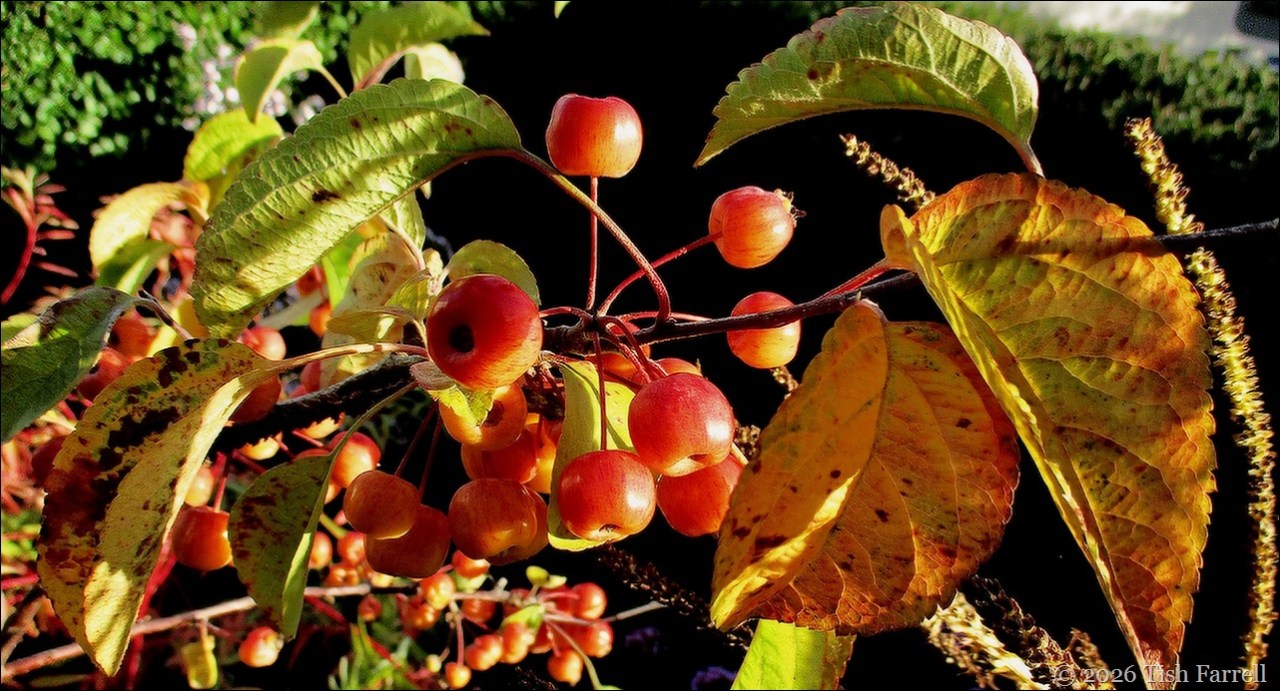
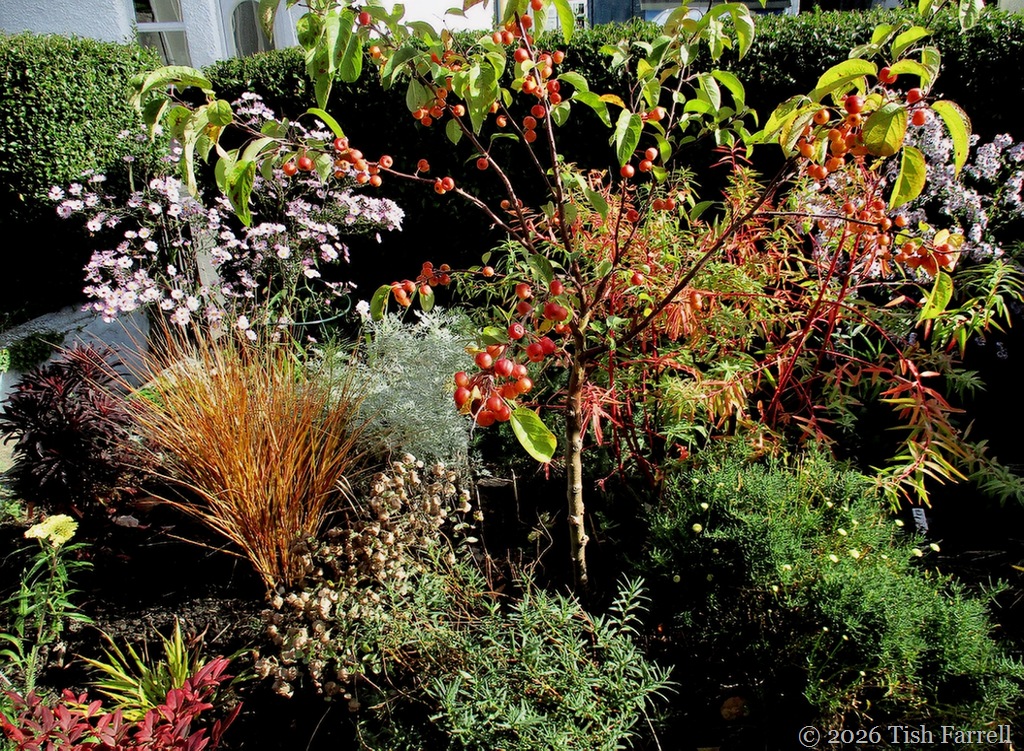
This week the back garden is looking pretty dishevelled after some days of stiff winds, but the front garden is holding its own: lots of reds and golds and russets, plus a touch of pale lavender-pink.
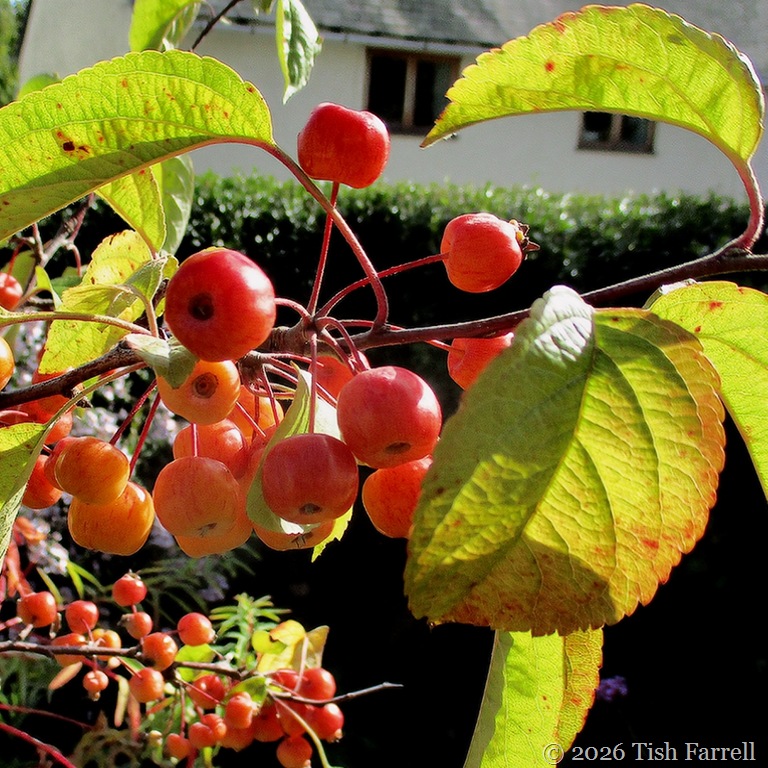
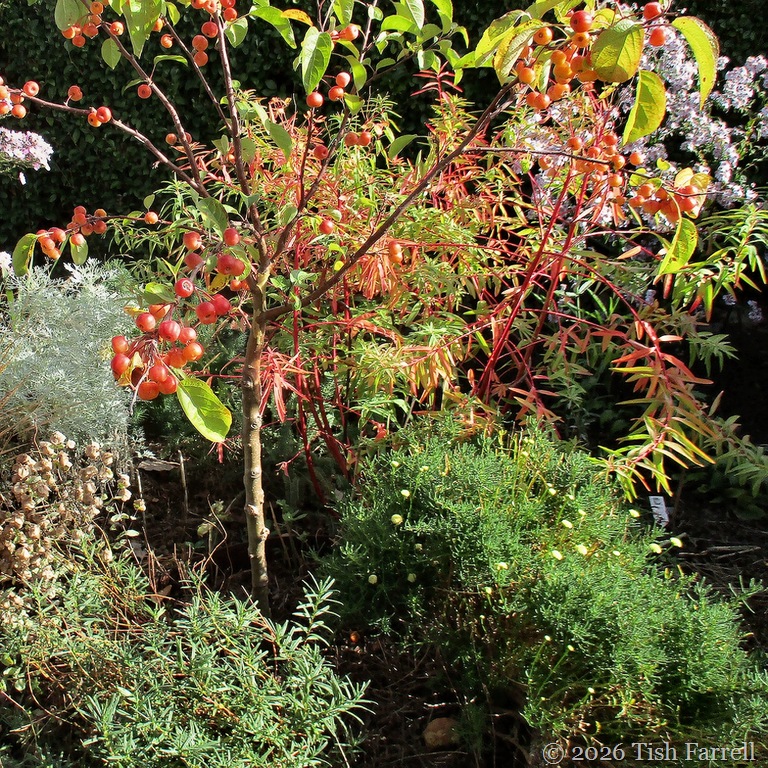
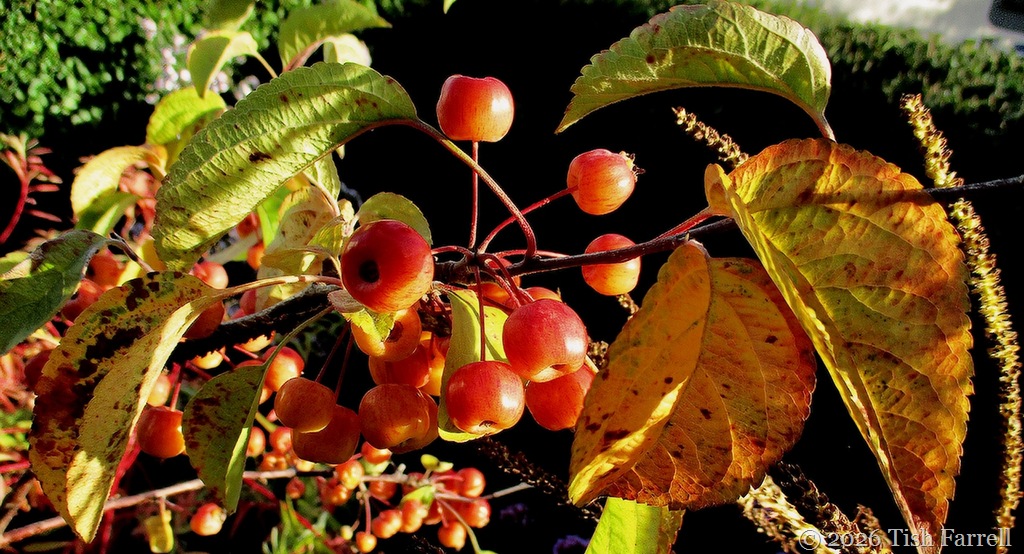
The miniature Evereste crab apple is probably the star. Those tiny apples seem to glow.
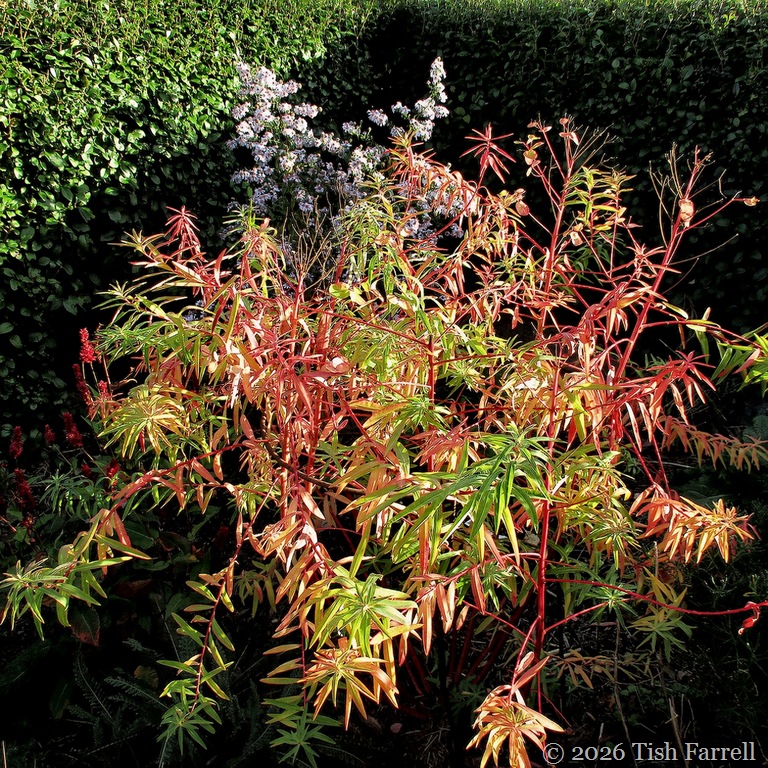
Behind it, and utterly living up to its name (as well as complementing the crab apple’s colours) is Euphorbia griffithii Fireglow. Quite a blaze, isn’t it.
*
Calming things down at the back of the border, in front of the privet hedge, is a pale cloud of Symphyotrichum Les Moutiers. This is its first year of flowering and I love its airy looks. Also that the daisies’ yellow centres turn bright russet red when they have been fertilised.
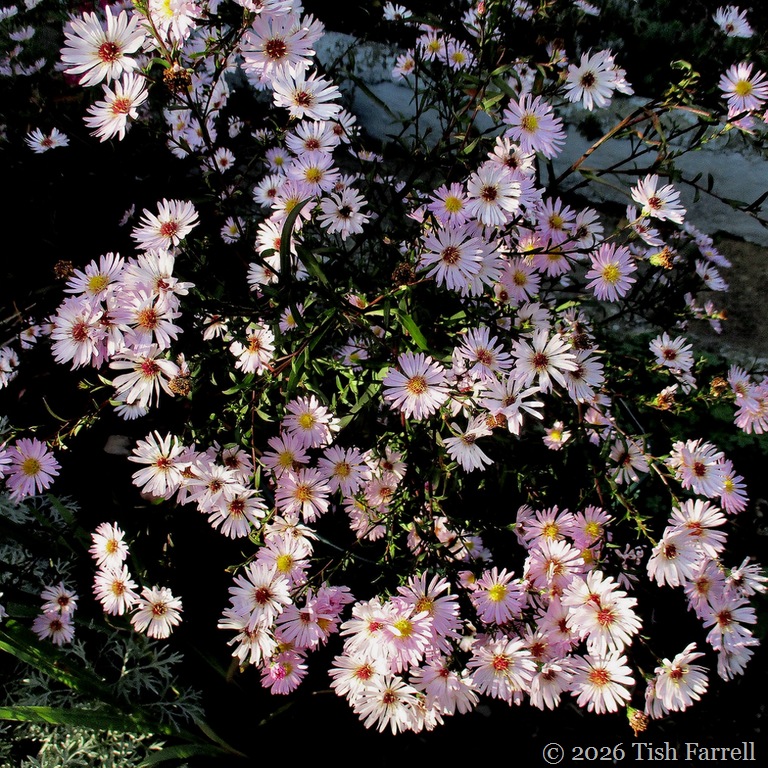
I have another Great Dixter Symphyotrichum in the opposite corner (just glimpsed in the main photo. I’ve lost the label, but I think it’s Laterifolium, also pale lavender and flowering for the first time. For now it’s rather put in the shade behind the Fireglow.
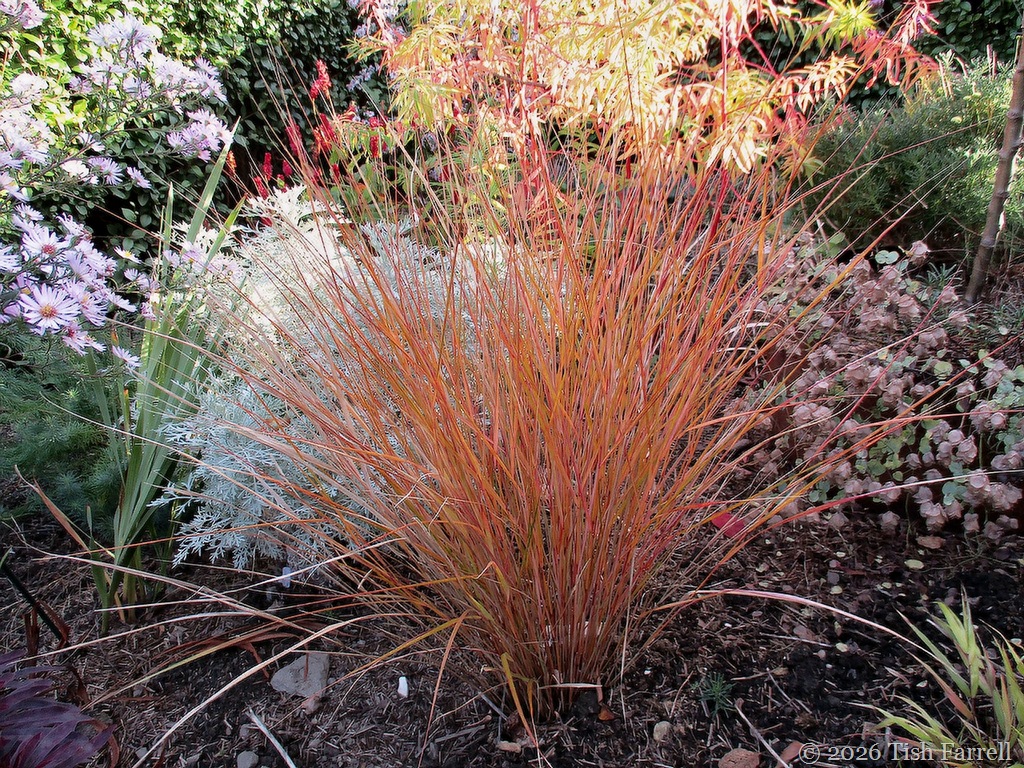
Another fiery feature is the Pheasant’s Tail Grass (Anamenthele lessoniana), now around two years old and continuing to do its own rendition of a Roman Candle.
*
Several of the summer flowering plants are on the rebound. The evergreen Cotton lavender (Santolina rosmarinifolia) (bottom right) has just produced some new yellow buttons. It’s growing under the crab apple along with a Wisley White Helianthemum (centre) and Kent Beauty origano (far left now very faded):
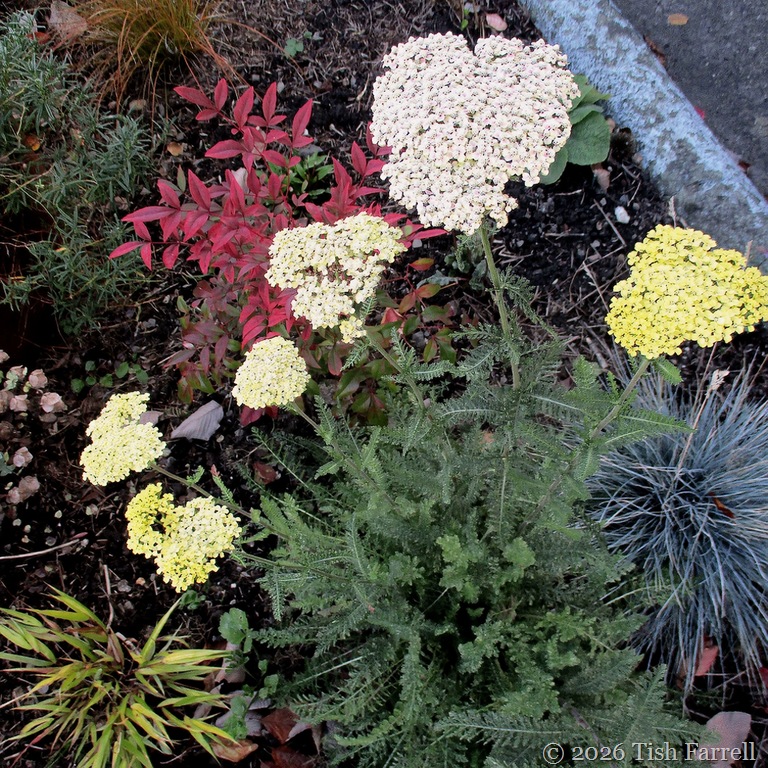
And finally the Achillea Moonshine is coming out for a third showing (Nandina Obsession with the bright crimson leaves behind)
And that’s it from our Bishop’s Castle garden. Please call in at Garden Ruminations to see what Jim’s been up to.
Six on Saturday 17 October 2026
Copyright 2026 Tish Farrell

All looking rather splendid Tish. You have several plants that I would love to have. And I really should buy that Cotton lavender. I had one with silver leaves but it rarely flowered and this year I lost it to the winter wet.
The cotton lavender is amazing in summer. It was covered in buttons for ages even through the drought. The tree and it are in a corten steel ‘raised bed’, so lots of potential for drying out. In fact I’ve had to prune it back rather savagely.
Everything’s looking rosy, Tish xx
Nothing like a rosy glow, Jo 🙂
Tish, your garden is just beautiful in Autumn.
Many thanks, Anne. The front garden is fairly sheltered so I’m hoping it will keep up its good looks a bit longer.
You’ve done a wonderful job of making your garden lovely in fall/autumn, Tish.
Thank you, Janet, very much a work in progress though, learning which plants like living on our windy street.
Some splendid colours of Autumn, Tish
Thanks, Sue. It’s v. heartening after the dry summer when so many plants were looking stressed.
Very!
I just love your weekly post, seeing what’s thriving in your garden (as opposed to ours) and admiring your beautiful photography. Thank you! pp
Appreciate you appreciative response, Pam.
Dishevelled? If you say so. It just looks like Autumn at its glorious best to me.
Ha! I didn’t show you the dishevelled quarters, only my best bits of gardening 🙂
Your blog. Your privilege 😉
🙂
Dear Tish
You caught autumn’s glorious colours perfectly. 👍 👍
Thanks for sharing
The Fab Four of Cley
🙂 🙂 🙂 🙂
Thank you, Fab Four, for calling in at Bishop’s Castle 🙂
Your crab apple is very nice. I am trying to decide if mine is fading. It may be 60 years old – no idea when it was planted, but it has lost two large limbs in the last six years, however the tree seems to respond well to having less wood. Mine had the most enormous crop of apples ever this year. Squirrels eat them, maybe voles too. I saw a red tailed hawk eating a meaty mouthful in the form of a vole in the backyard yesterday, which made me happy. Somehow the more my yard feels like habitat the happier I am. Plus I have to fill in holes all the time from the little beasts.
That’s a lovely vision, your garden as habitat. I would be thrilled to see a raptor in mine. It’s only happened once when a sparrow hawk missed its target and sat on my fence for minute or two pretending it hadn’t made a mess of things. As to crab apples, I think they’re pretty long-lived. Yours certainly sounds a pretty tough specimen.
Your autumn garden is fabulous. I love all crab apples but ‘Evereste’ is a real winner.
Many thanks, Chloris. This tiny version of what is anyway a small tree is very pleasing.
beautiful photos. the colours of this season never get old and each successive year i photograph it seems to bring different angles and iterations of experiencing the scene. also, thanks for labeling the plant life as well. there are times when there’s so many things I see but would like to know exactly what I’m looking at.
Many thanks for calling in here, Michael. I’m pleased you find the plant names useful. It’s often a challenge for me to remember some of them 😉
We’ve had a couple of days of near-gale-force winds and all the autumn colour is scattered across the grass. 🙂
Well that’s a shame, Widders – gone before you know it sort of thing.
Hello Tish…wow, I just love those crab apples. The photos are amazing. I planted Achillea for the first time this year and really looking forward to seeing them grow and flower.
Hello, Cath. Achillea are such stalwart plants. I grew some mixed pastel shades from seed this year, but they were held up with the summer drought so most haven’t flowered yet. Which means waiting a while to see what colour they are. They have a long, long history of medicinal usefulness.
You really captured the autumn mood in your beautiful photos.
Many thanks, Rabirius. Much appreciate your comment.
Gorgeous! Autumn is a wonder.
It is!
Your garden is gorgeously showing all the fall beauty!
Many thanks, Bernie.