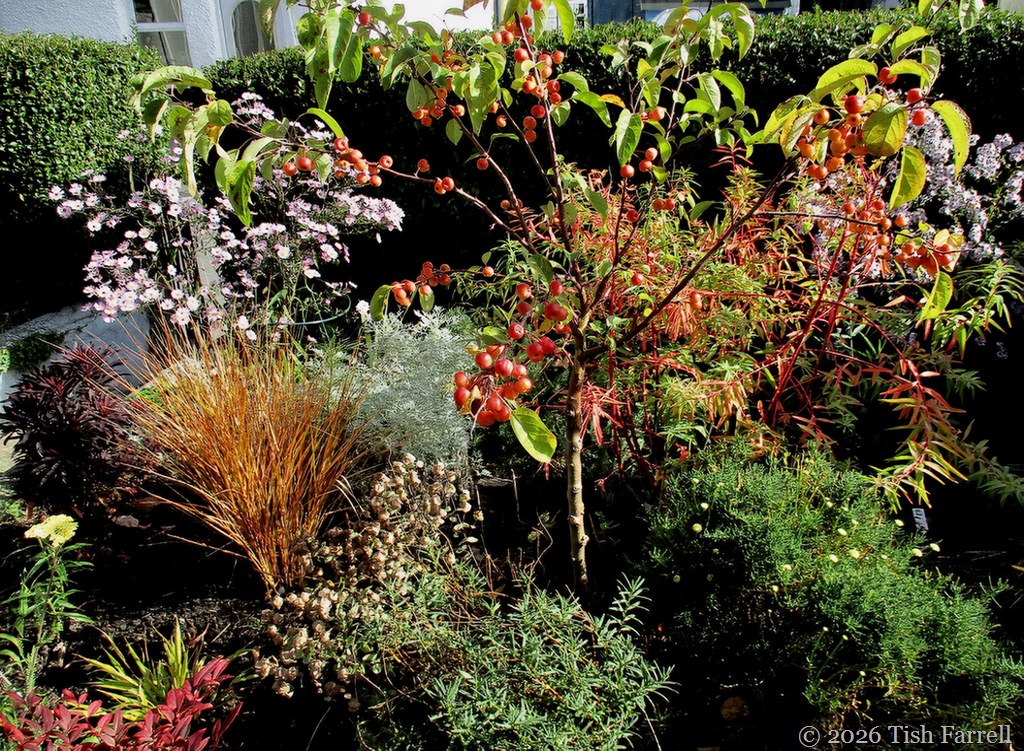
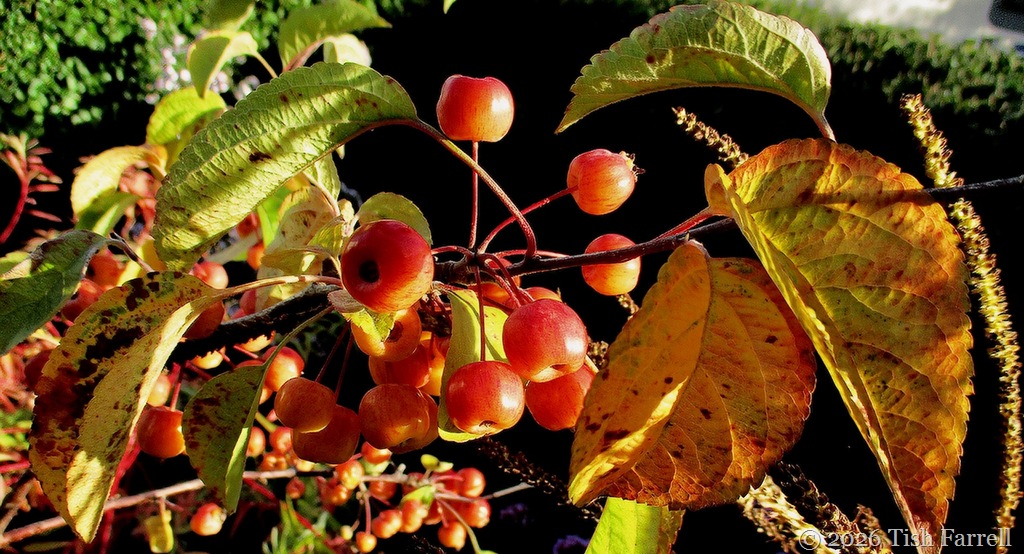
This week the back garden is looking pretty dishevelled after some days of stiff winds, but the front garden is holding its own: lots of reds and golds and russets, plus a touch of pale lavender-pink.
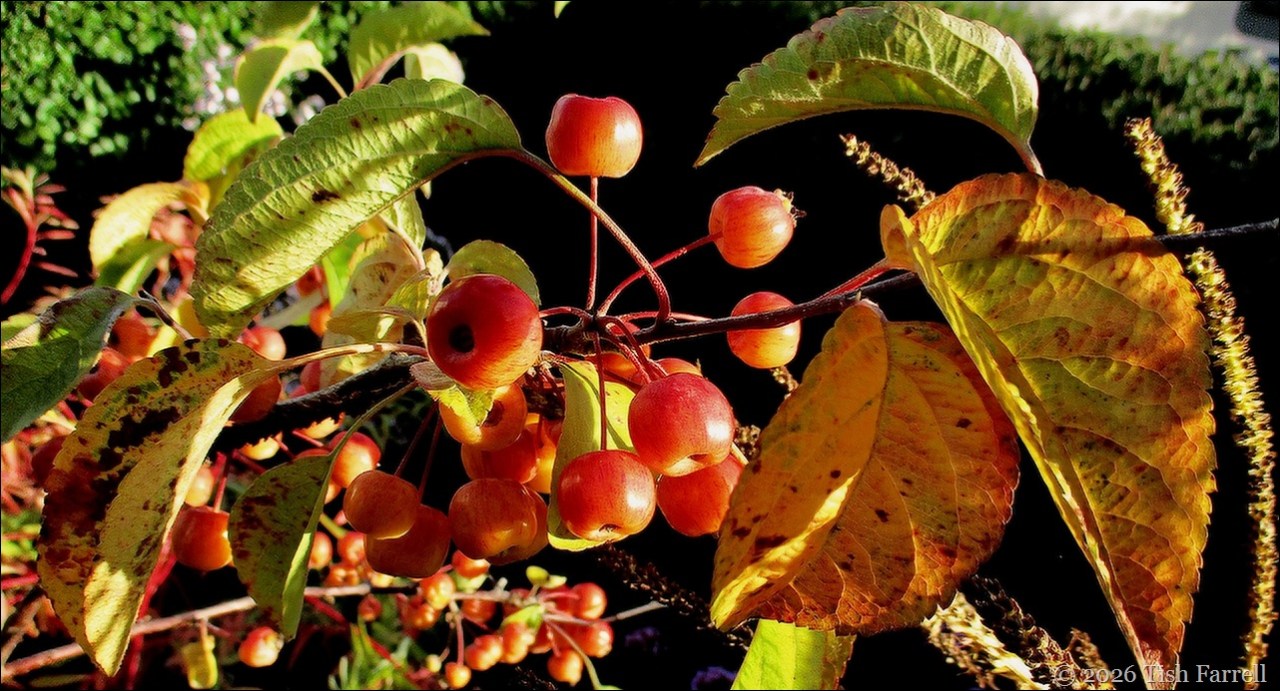
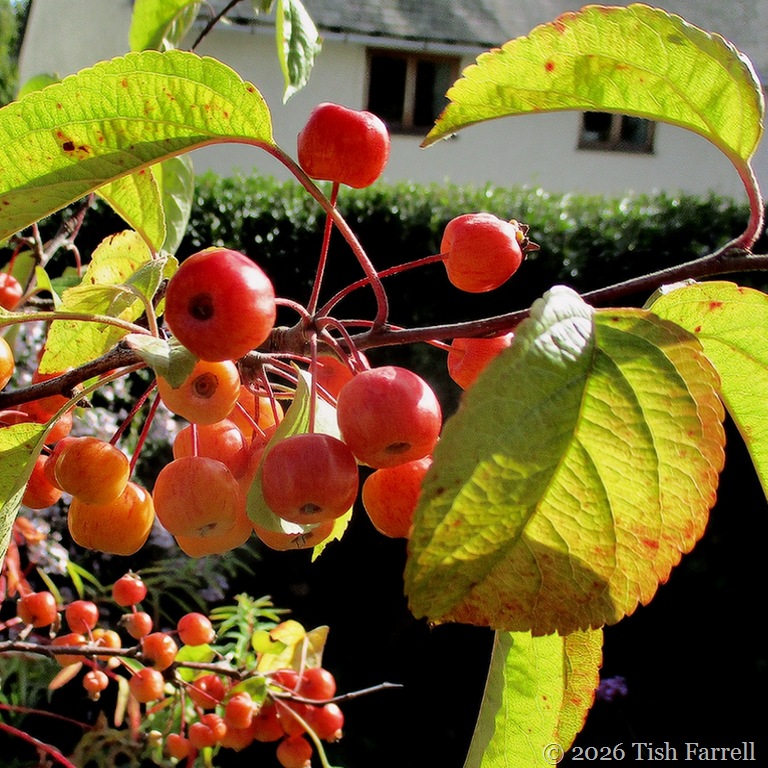
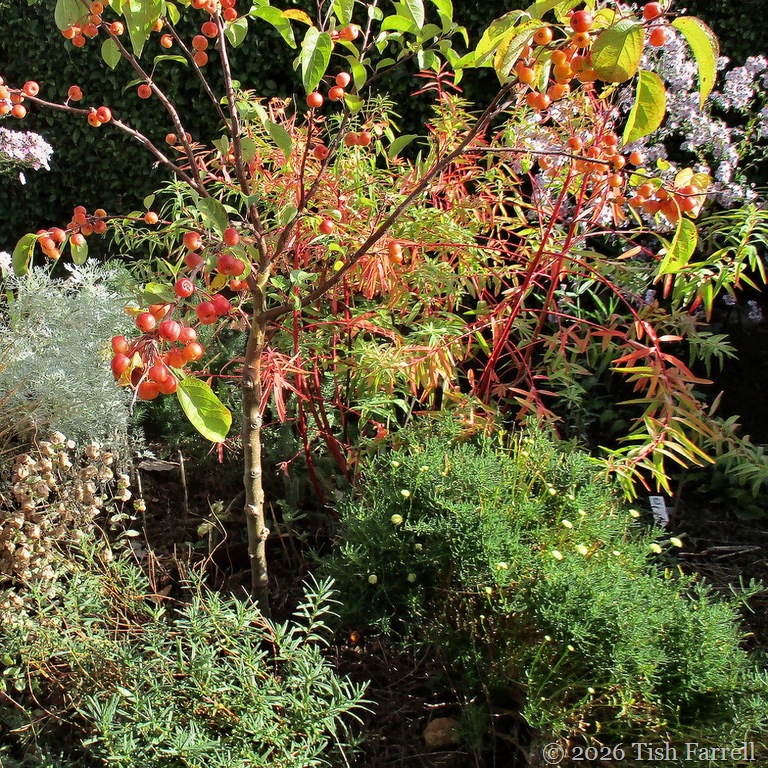
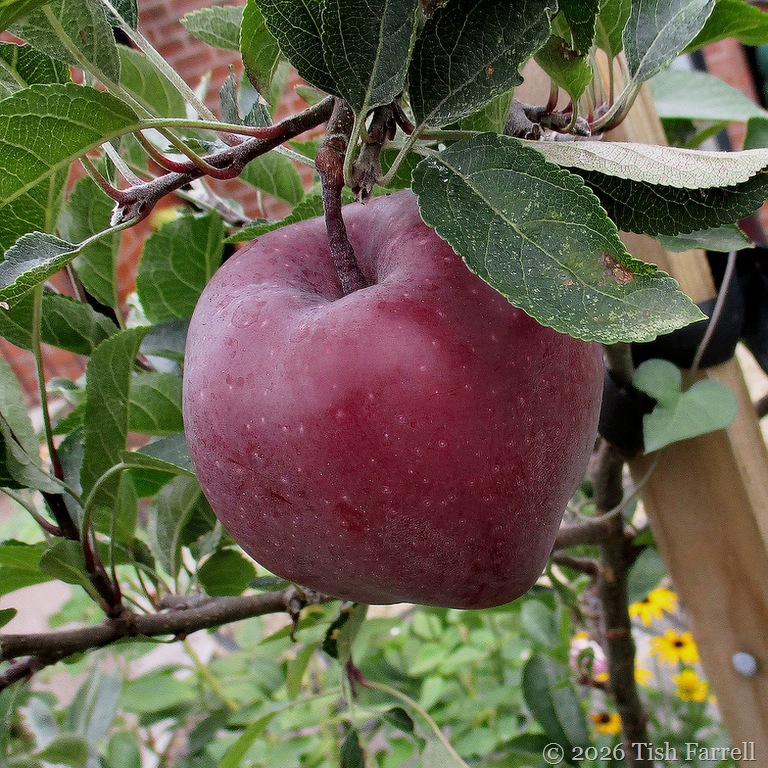
The miniature Evereste crab apple is probably the star. Those tiny apples seem to glow.
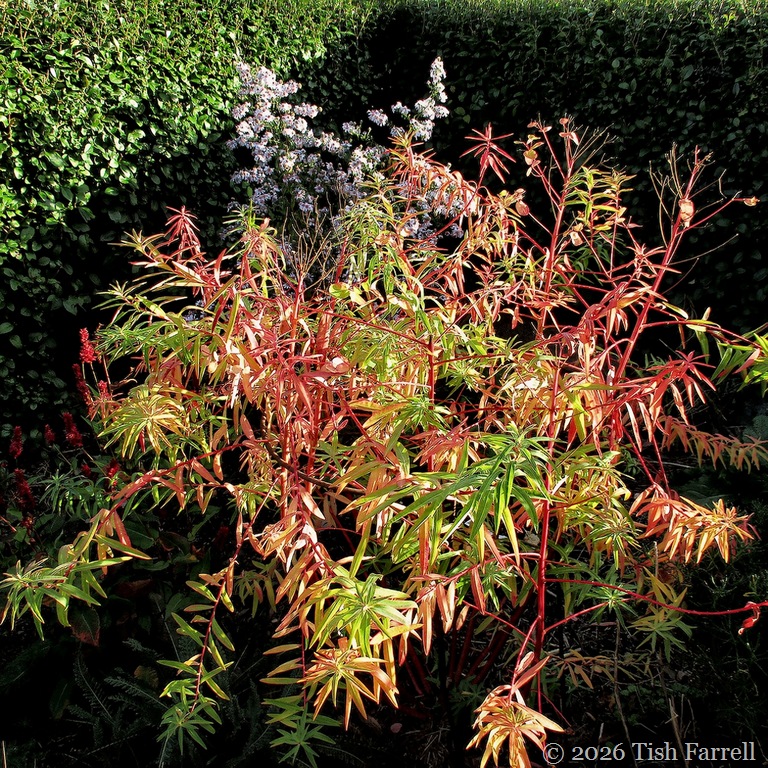
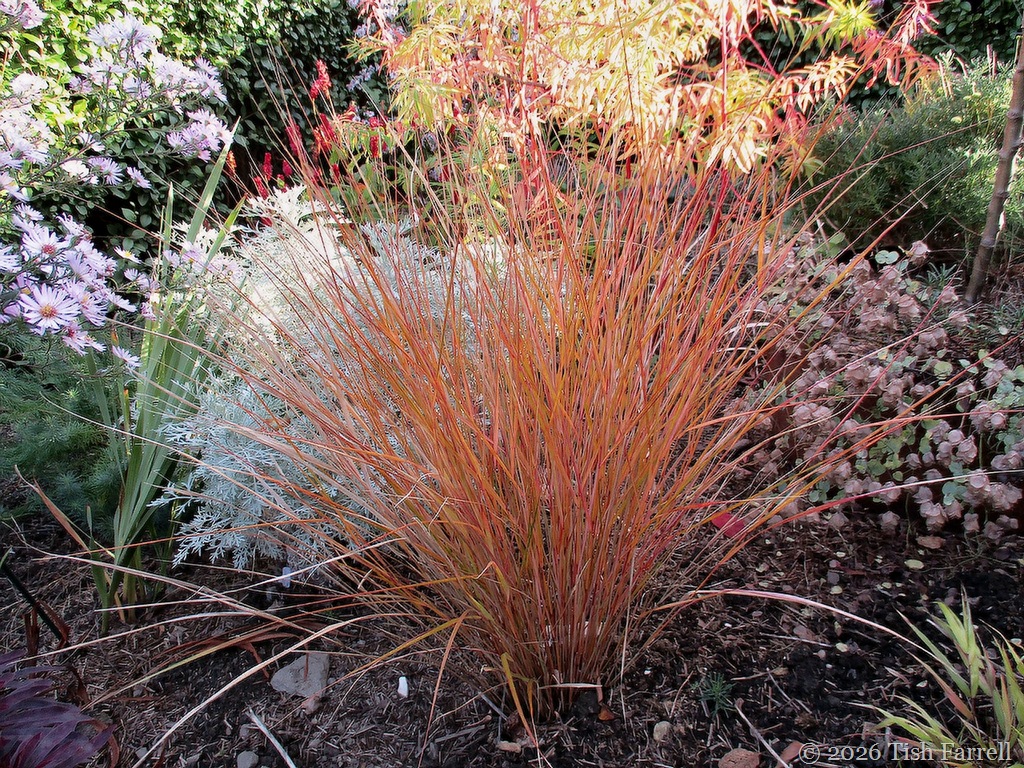
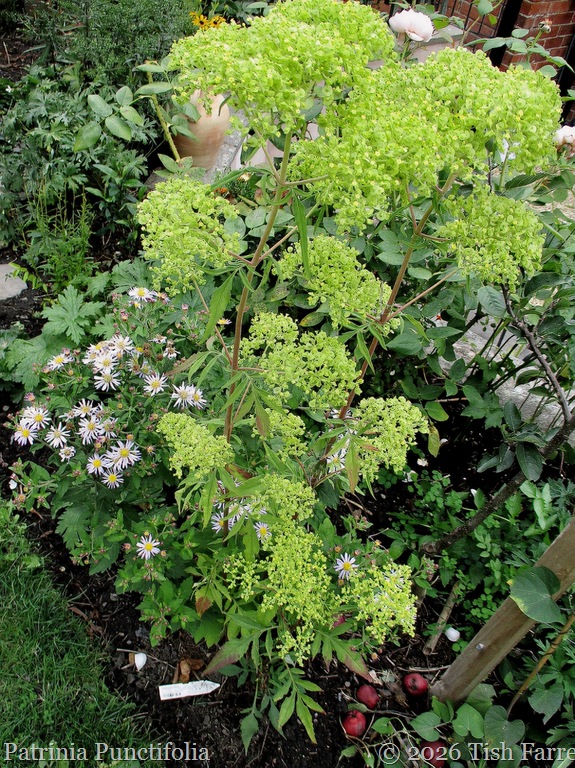
Behind it, and utterly living up to its name (as well as complementing the crab apple’s colours) is Euphorbia griffithii Fireglow. Quite a blaze, isn’t it.
*
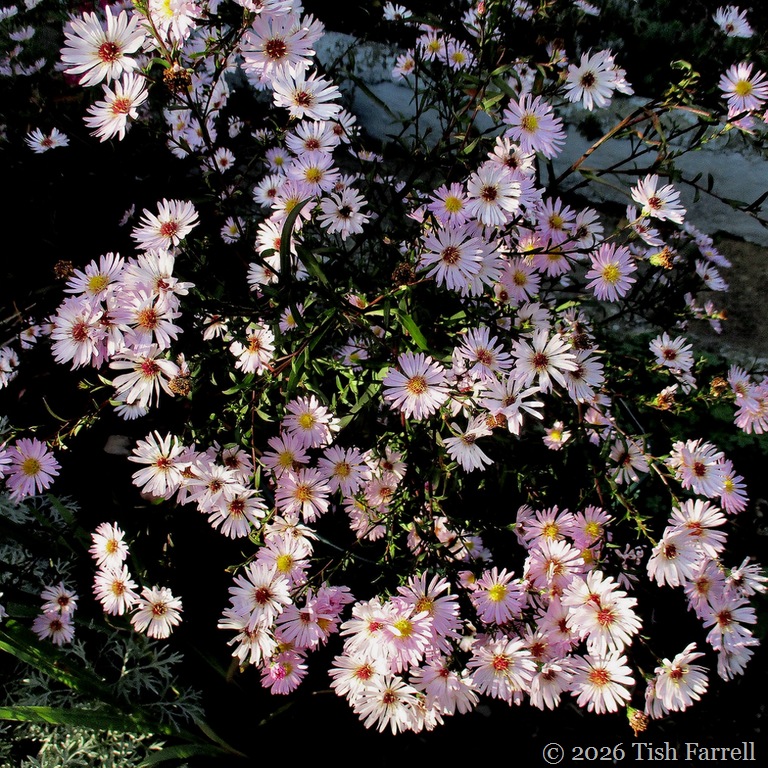
Calming things down at the back of the border, in front of the privet hedge, is a pale cloud of Symphyotrichum Les Moutiers. This is its first year of flowering and I love its airy looks. Also that the daisies’ yellow centres turn bright russet red when they have been fertilised.
I have another Great Dixter Symphyotrichum in the opposite corner (just glimpsed in the main photo. I’ve lost the label, but I think it’s Laterifolium, also pale lavender and flowering for the first time. For now it’s rather put in the shade behind the Fireglow.
Another fiery feature is the Pheasant’s Tail Grass (Anamenthele lessoniana), now around two years old and continuing to do its own rendition of a Roman Candle.
*
Several of the summer flowering plants are on the rebound. The evergreen Cotton lavender (Santolina rosmarinifolia) (bottom right) has just produced some new yellow buttons. It’s growing under the crab apple along with a Wisley White Helianthemum (centre) and Kent Beauty origano (far left now very faded):
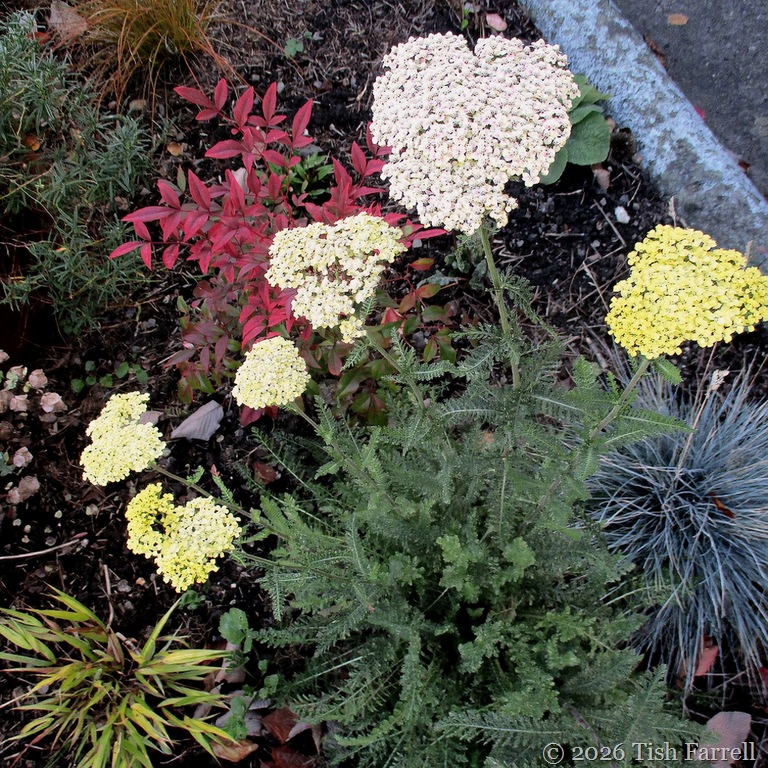
And finally the Achillea Moonshine is coming out for a third showing (Nandina Obsession with the bright crimson leaves behind)
And that’s it from our Bishop’s Castle garden. Please call in at Garden Ruminations to see what Jim’s been up to.
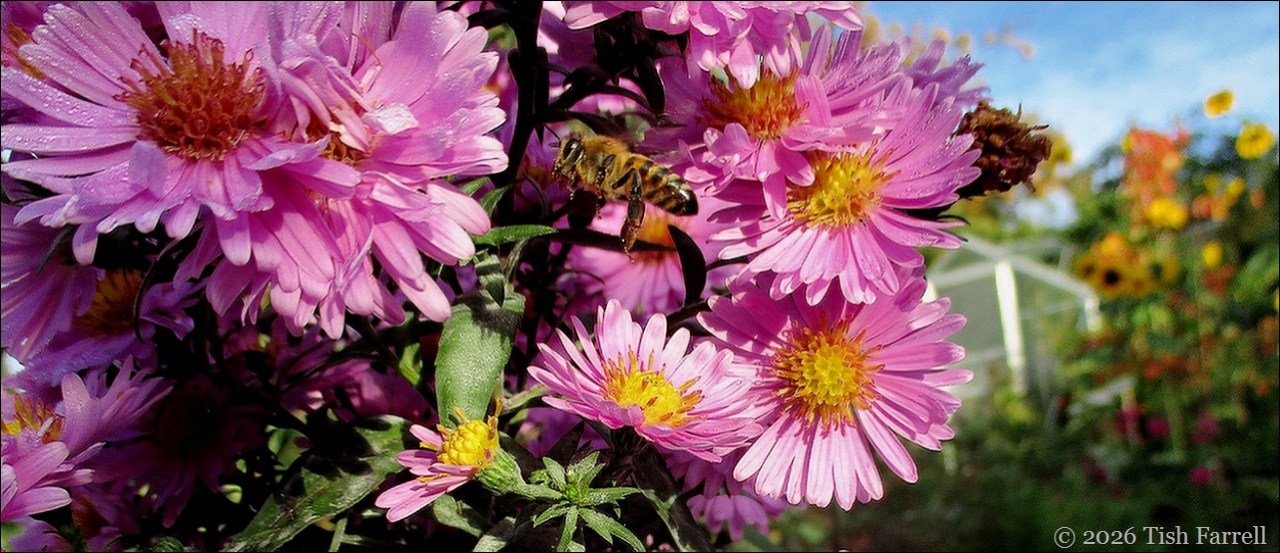
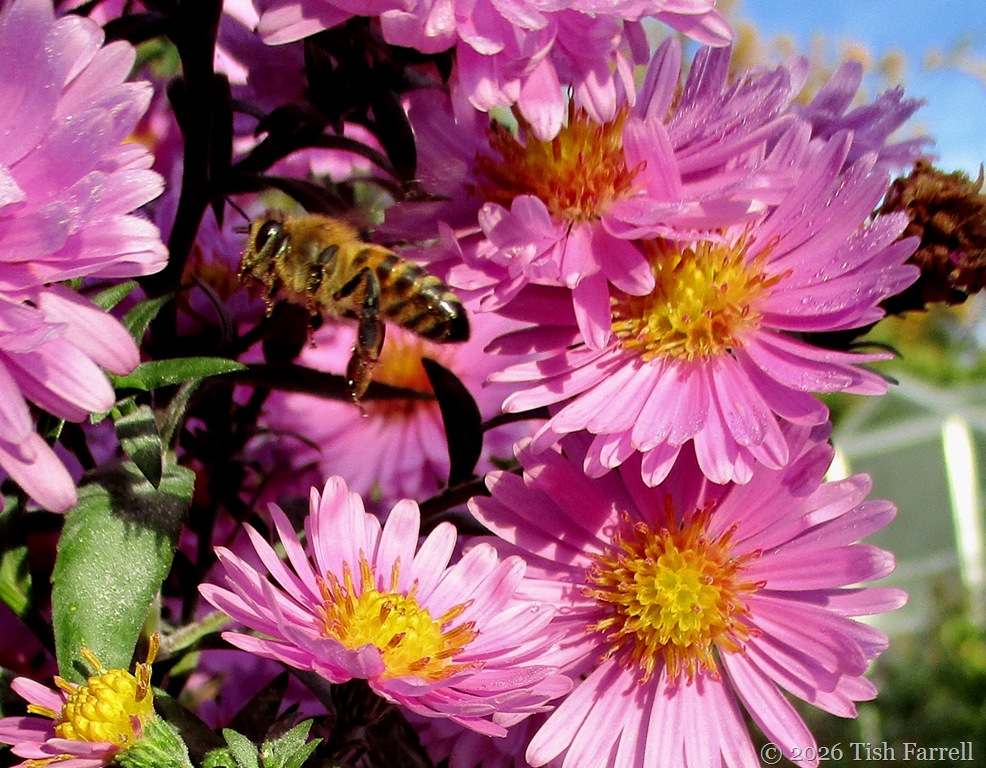
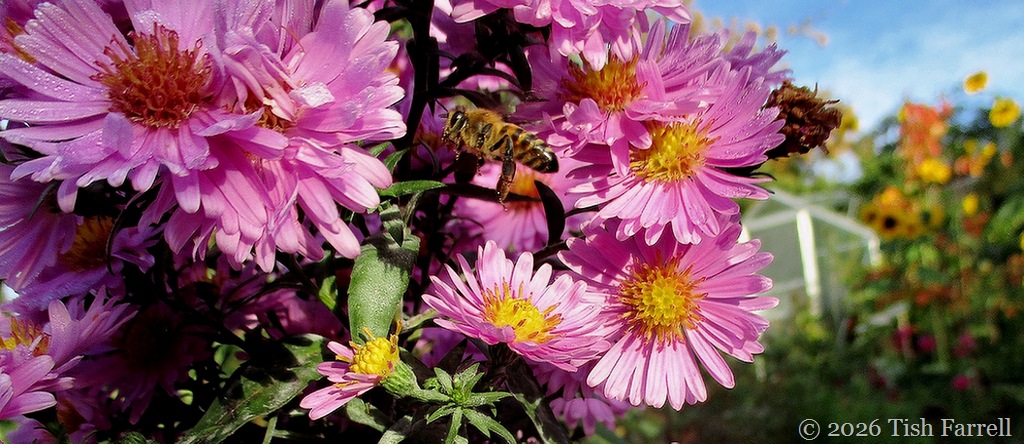
Asters, Symphyotrichums, Michaelmas Daisies, whatever you call them, they’re a cheering sight as summer ends. I even overlook my inkling to dislike the pinkish-purple shades that so many versions come in. I much prefer the mauve range. Anyway, here’s another good reason to grow them: bee food. Now’s the time honey bees are stoking up reserves to get them through winter.
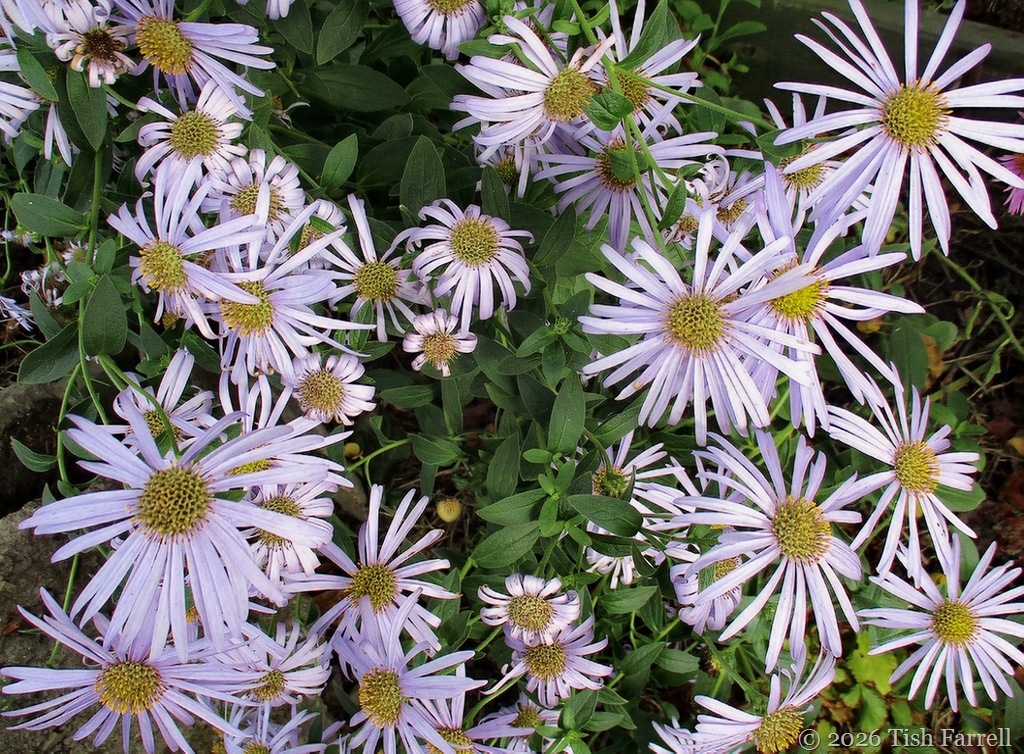
And talking of mauve asters, the Monch in the corner of the garden (which I’ve mentioned before) is still going strong. The flowers may have paled, but they’re still coming – three and half months after the first opening.
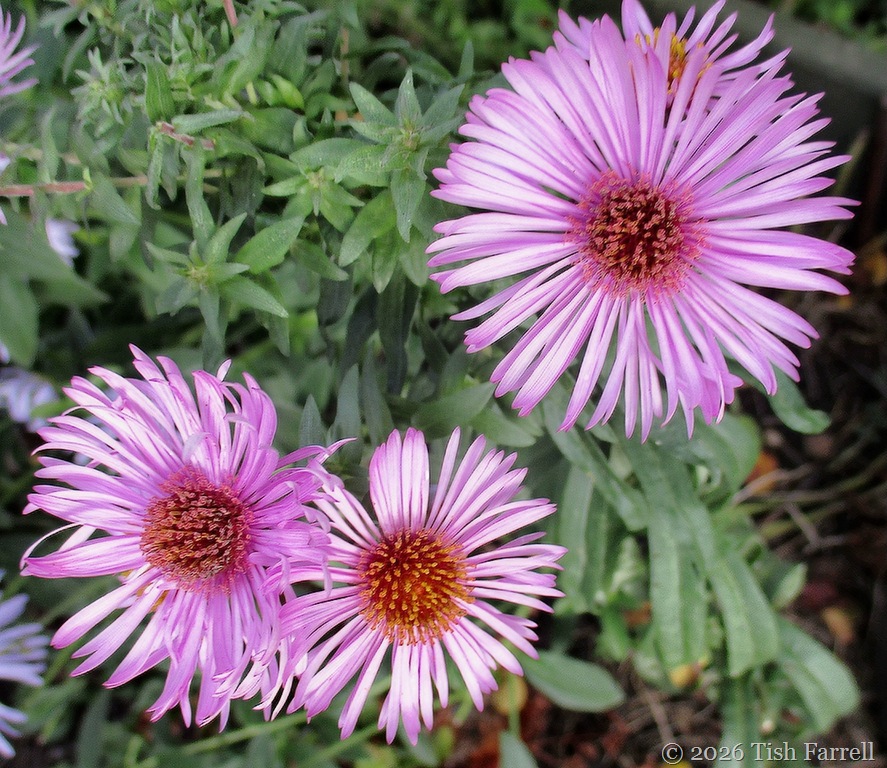
Growing beside Monch is a single stem of an unknown aster. I’d rescued it from somewhere else in the garden, where it was the only surviving sprout of a failed purchase, its label vanished. For once, I’m rather pleased with its pinkness, and the large size of the flowers. Some further nurturing required.
*
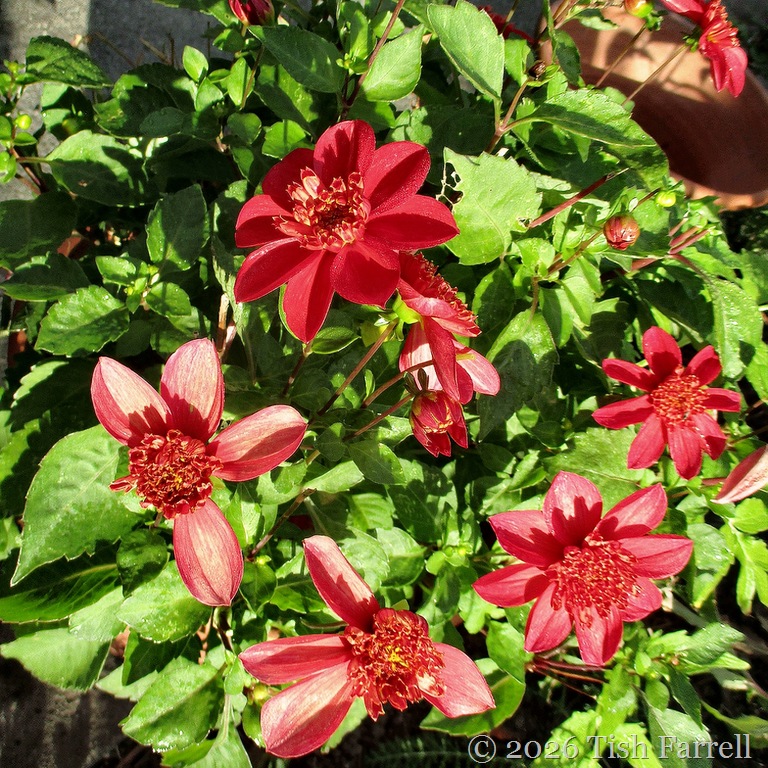
Other bright sparks include Anemone Dahlia Inca which is now on its third flush. It’s definitely putting its neighbour, the Bishop of Llandaff to shame. That particular Dahlia did not like the summer heat one bit. Its first flowers only started opening this week, sporadic, very small and deeply unimpressive for a bishop.
*
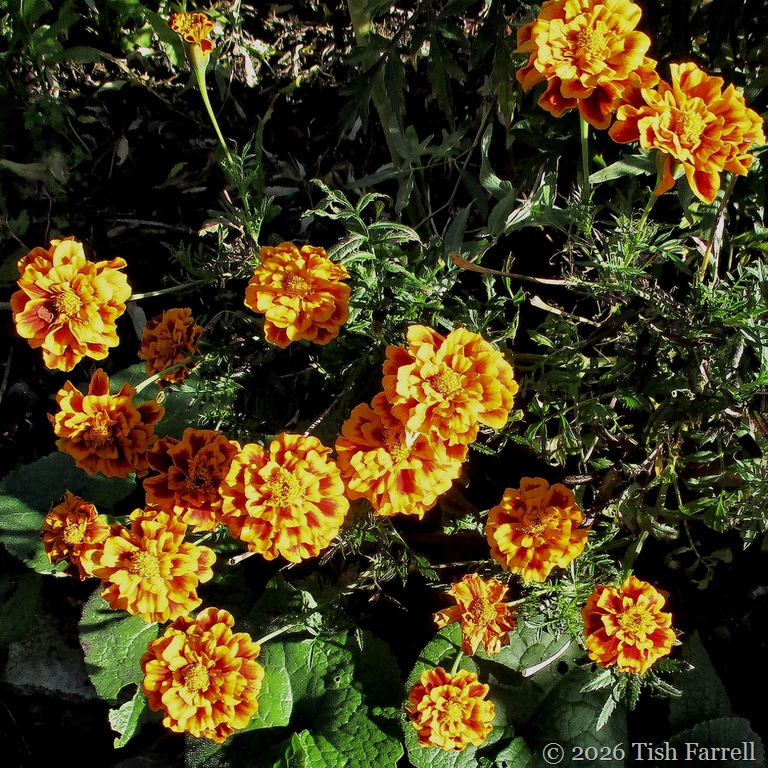
And then there are the Tagetes – French Marigold Brocade which is in the same big tub as the Bishop and more than making up for his deficiencies…
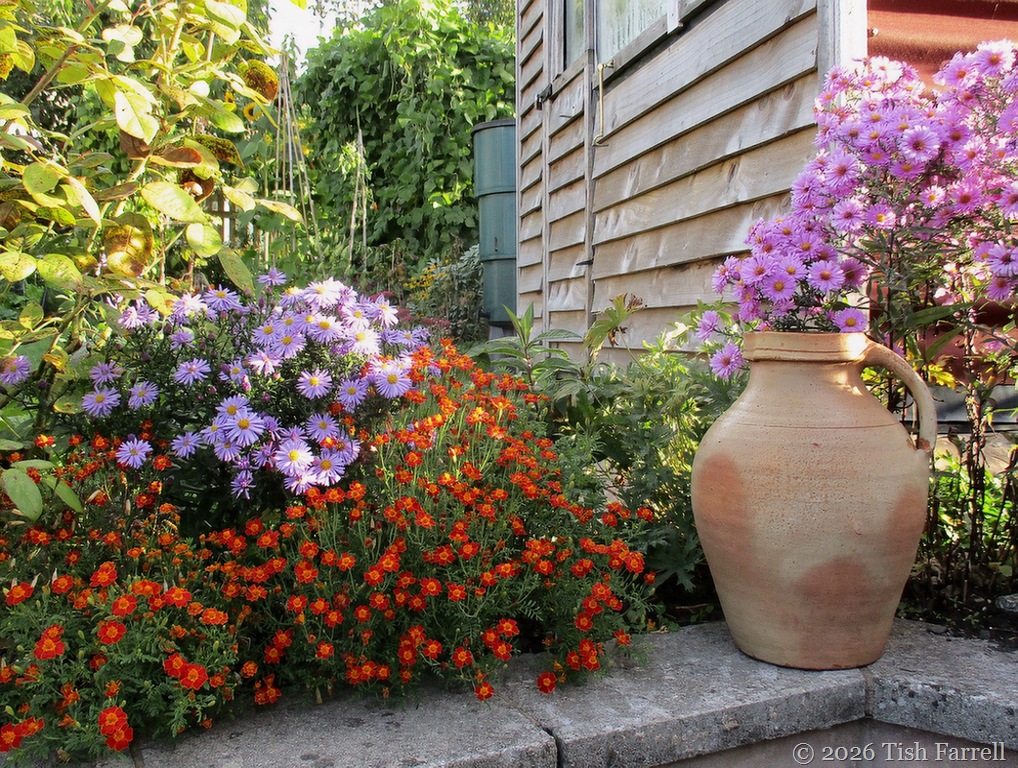
…and a ground cover, tiny flowered Signet Marigold, called Red Gem (Tagetes tenuifolia). I grew both marigolds from seed but the Red Gem struggled during the heat, being shallow rooted. In recent weeks, though, it’s been blazing away in a rather garish setting with a mauve aster. An unintended pairing at the time of planting.
*
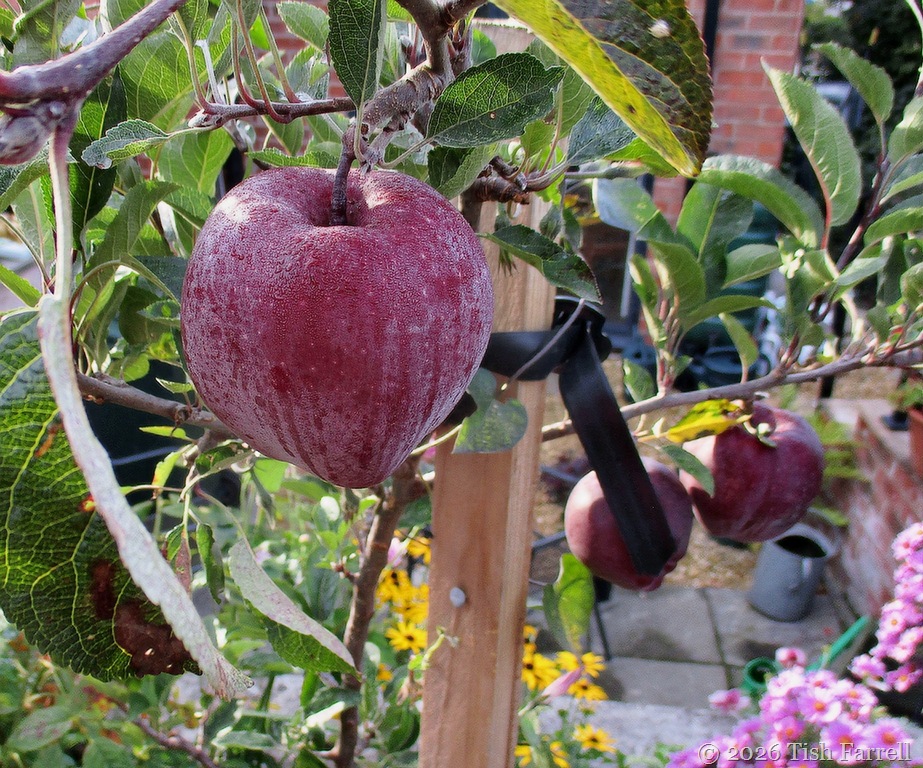
Our dwarf Red Devil apple tree finally managed to produce three apples that don’t look to have been codling mothed. We ate the biggest one this week. It was perfect – deliciously sweet and crunchy. A shame about the infestation.
*
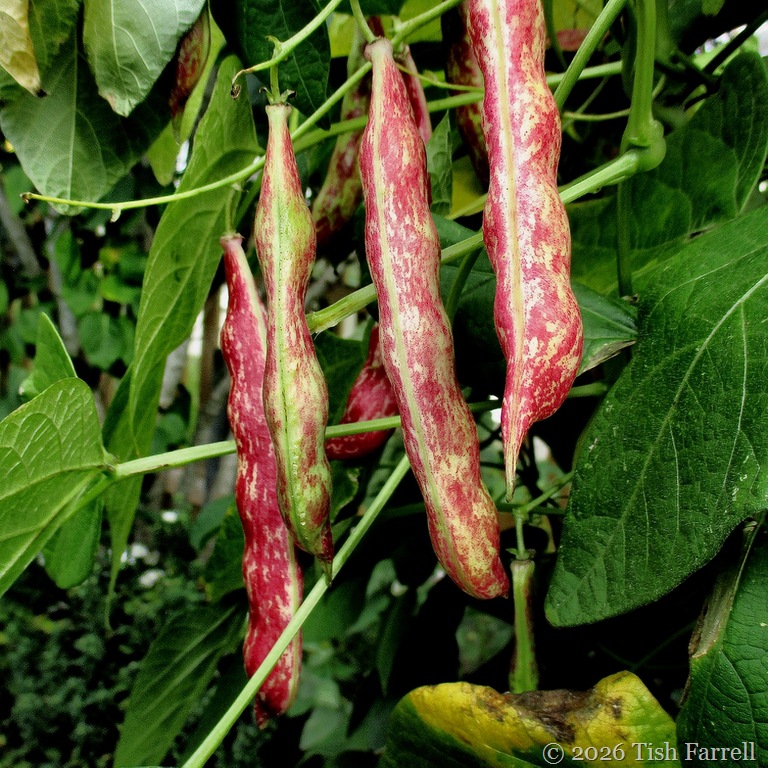
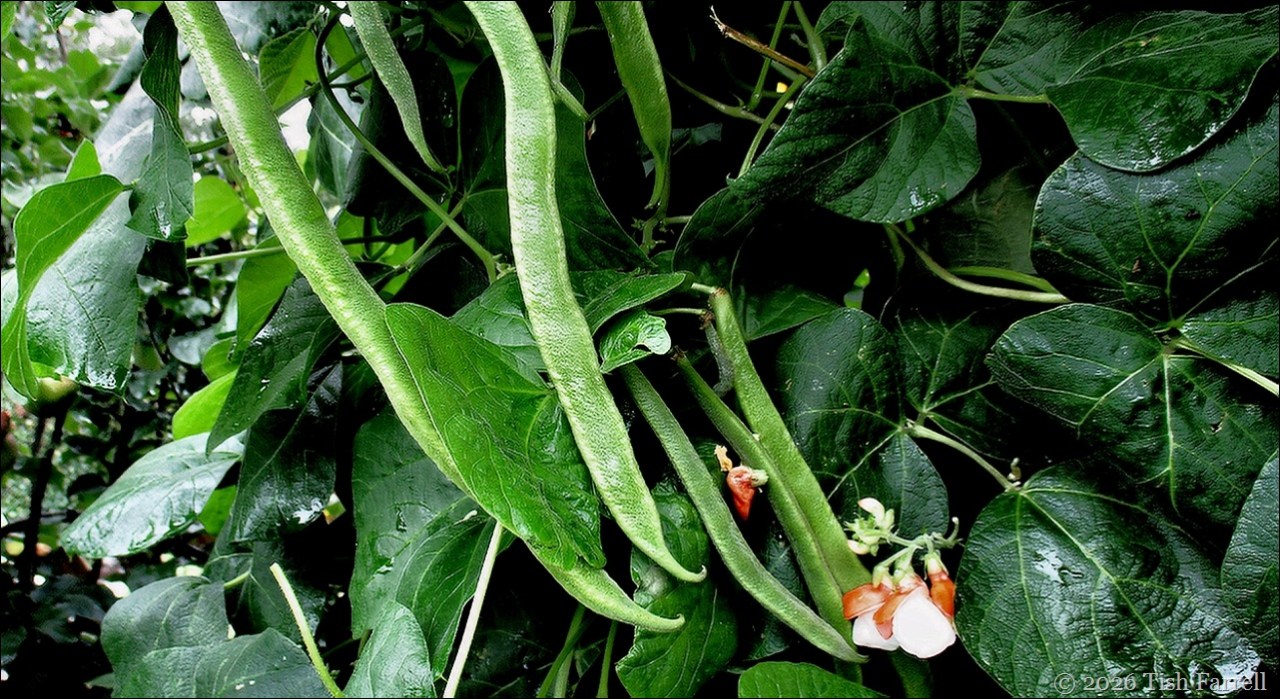
In the vegetable department, the runner beans suddenly revived themselves and produced further modest crops, sufficient to make a few pots of chutney. But now it looks as if they will be overtaken by the Borlotti beans. I hadn’t been holding out much hope for them. The plants did not develop well during the drought, this despite regular watering. And then they went and made a huge amount of foliage so I couldn’t really see what was going on underneath. But now, as the leaves dry and blow away, all is being revealed. I love them for their fiery pods alone.
*
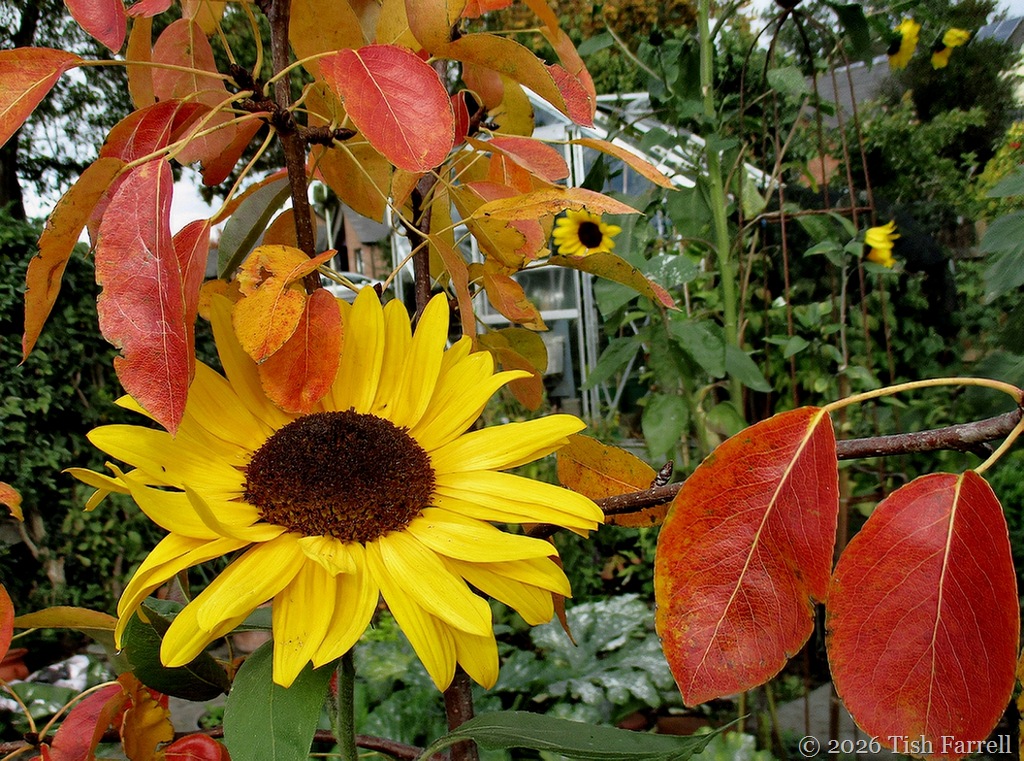
And finally, an image to mark the seasonal change: a sunflower in our dwarf pear tree: summer and autumn together.
Copyright 2026 Tish Farrell
*
Six on Saturday 10 October 26: Please call in on Jim to see what’s happening in his lovely Cornish garden this week. For one thing, he has some stunning Nerines.
Even though I was keeping the row well watered, and had earlier dosed plants with seaweed feed, the runner beans went on strike for most of August. It didn’t help that the sparrows were using them as an afternoon playground, rampaging through the stems. When I consulted the Royal Society of Horticulture website it told me that sparrows like to peck at the flowers, deforming the structures and making it difficult for pollinating insects to gain access. So much for feeding the little dears all winter.
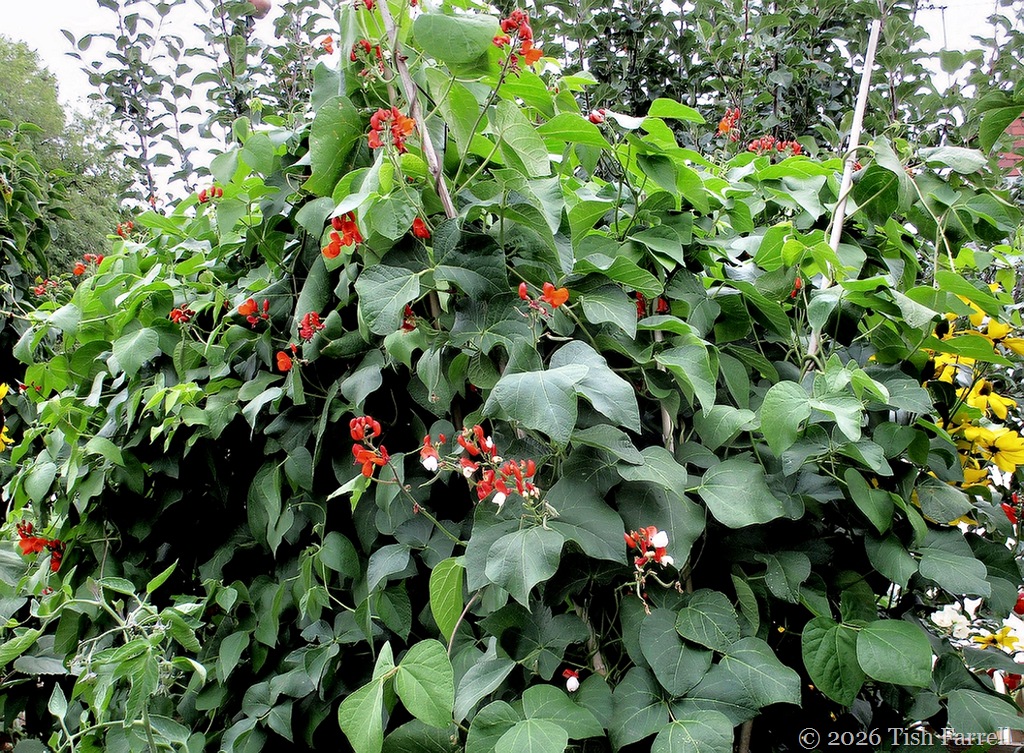
But now, with the rain and cool temperatures, the runners are a jungle on sticks. We even had a handful of good sized beans this week, and there are signs among the returning flowers of tiny beanlets. But will they have time to develop? Who knows?
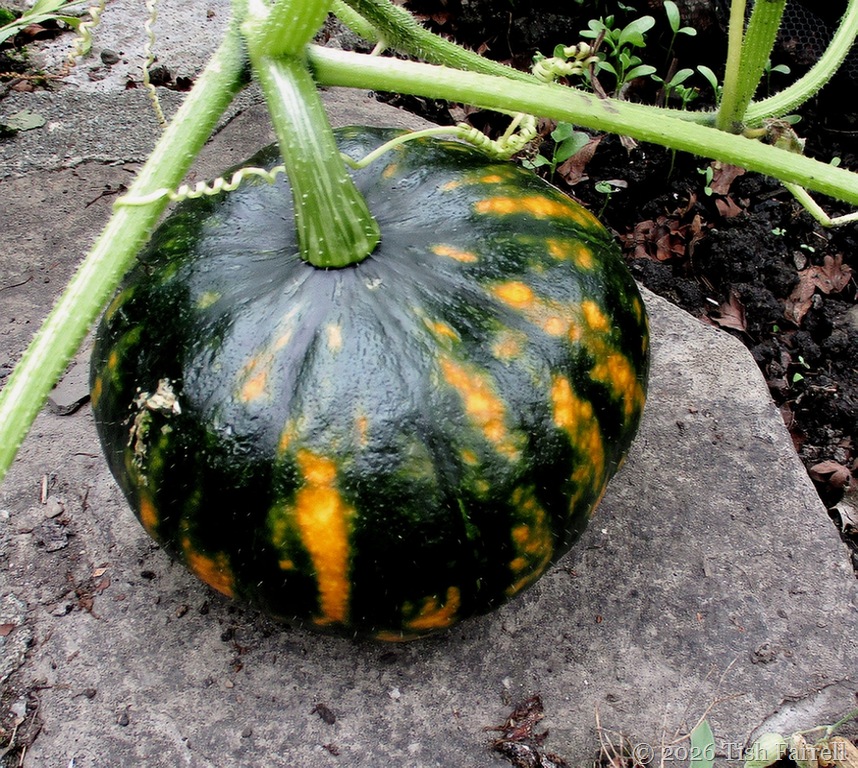
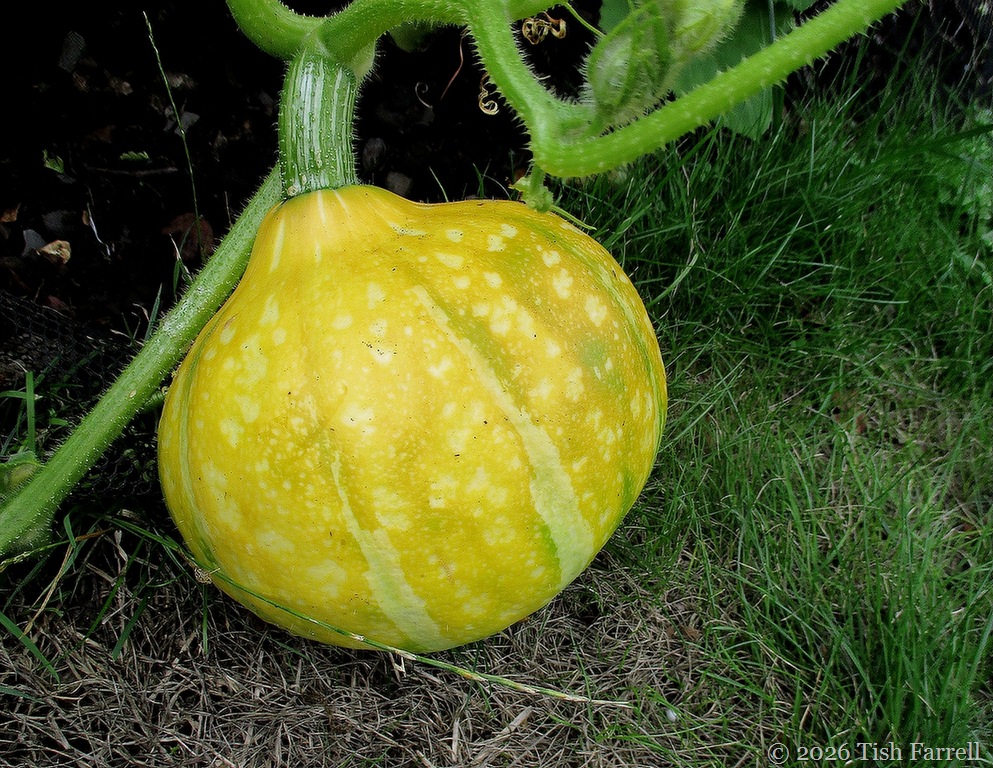
Not quite Uchiki Kuri
I kept some seeds from last year’s Uchiki Kuri Japanese squash. I only produced two. The fruits were very bright orange and oval as they should be. Not so their offspring, sown in late spring, one each from two separate plants.
A Perfect Red Devil?
We thought all the apples on our miniature Red Devil tree had been zapped by codling moths. After the July drop there are four left, this one the least scathed and best developed. But would it entice Snow White?
Some strange sunflowers
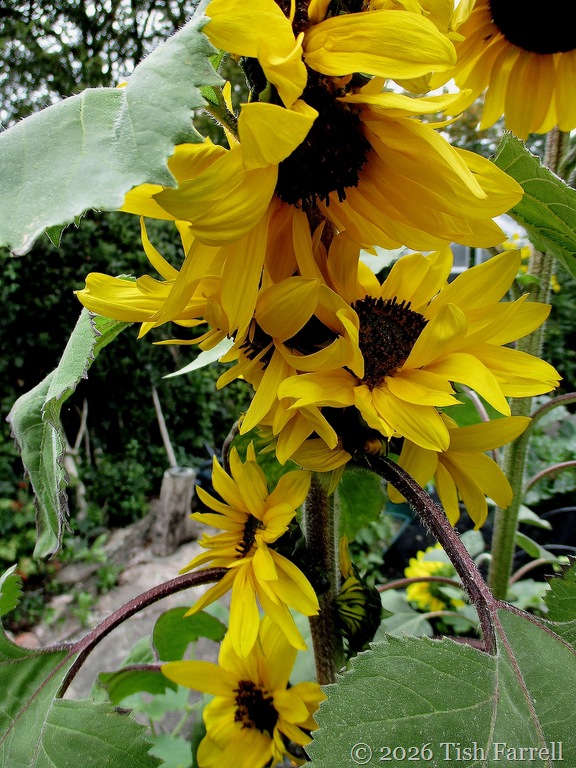
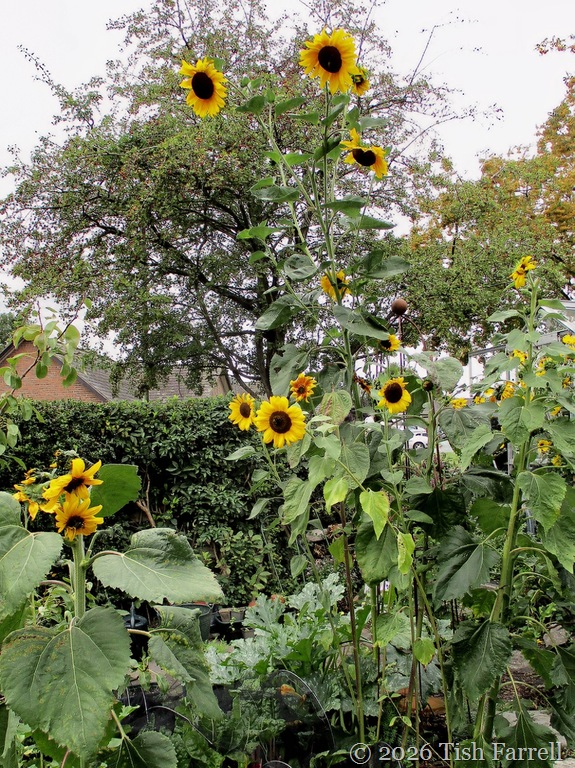
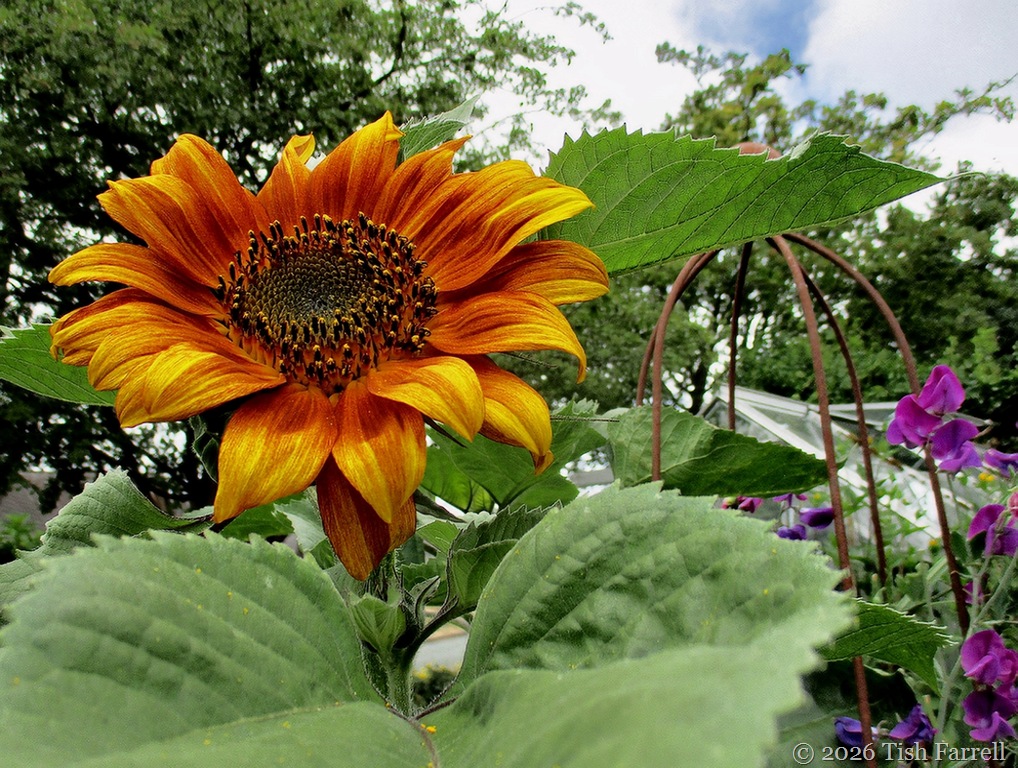
The sunflower flock that arose from last year’s dropped seed is still going strong. It also includes several forms that I don’t recall growing in the first place, and one with multiple flowers growing up the stalk which is distinctly odd. The tallest, we reckon, is about 3 metres. I have it tethered to the obelisk where we had the sweet peas, whence it looms down at us. I’ve already dead-headed it once. That took some doing with a pair of tree loppers.
No, this definitely isn’t a Selinum seedling
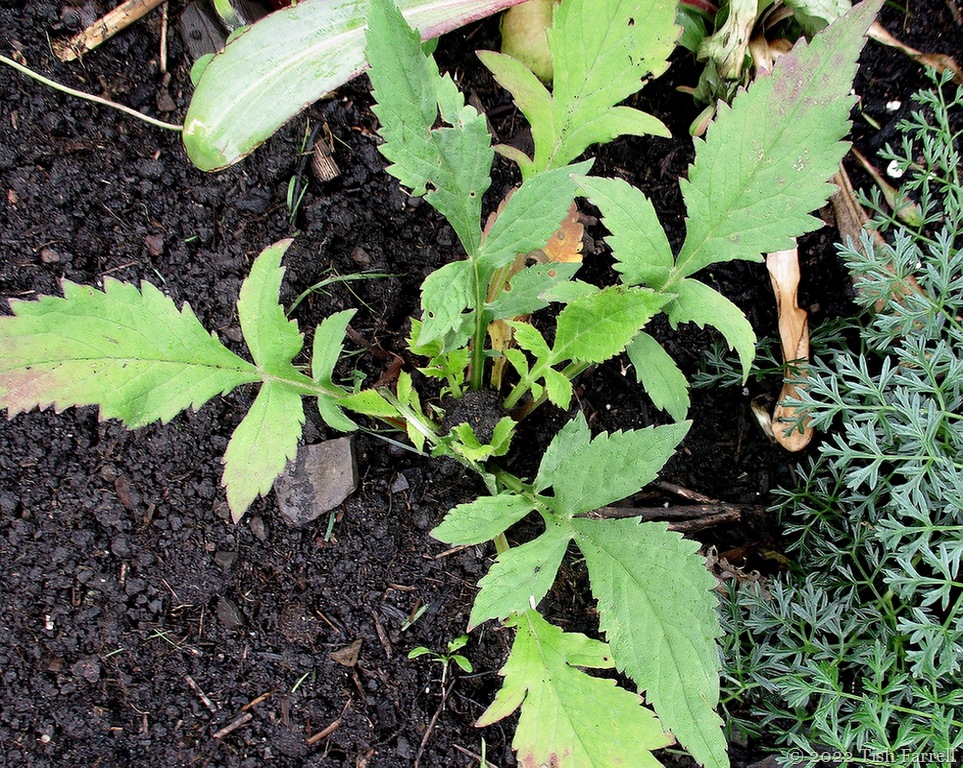
I distinctly remember saving some seed from the Selinum in the upstairs garden. All through the winter there was a pot of seeds on the kitchen shelf. Definitely umbelliferous in looks. Must be the Selinum. In the spring I sowed them in modules in the greenhouse and for a long time nothing happened. And then it did, and I couldn’t think what on earth I had grown. Not the feathery leaflets expected, something altogether more fleshy and pointy. What on earth…?
For a time I wondered if they were Rudbeckia, suddenly making an appearance after what I thought to be a failed sowing back in the autumn. This rather made up for them not being Selinum so I let them grow on, and eventually planted out half a dozen in various spots around the garden. They survived the drought, but didn’t expand much.
Cut to a visit to Wildegoose Walled Garden and Nursery, as featured here in last weeks SoS. I came away with a young Patrinia Monandra plant. (Some may be aware that I have a thing about Patrinia, first met with at Wildegoose during one of their rare winter opening weekends. It is tall, graceful, discreetly clumping and flowers into November when the seedheads then reflect any late autumn sunlight.)
I already have two Patrinia Punctifolia, bought last year from Great Dixter nursery (one of which I nearly killed this summer in my careless feeding of a nearby plant). But the survivor is currently flowering beautifully. And still the penny did not drop.
You could say it was a ‘be careful what you wish for’ moment, although in this case I would delighted to have a garden with lots of Patrinia. And so now I do. The seed I’d saved must have come from a handful snaffled from the winter visit to Wildegoose. Suddenly I saw the plants I had grown and the one I’d bought looked – well- identical. Probably the Monandra version then.
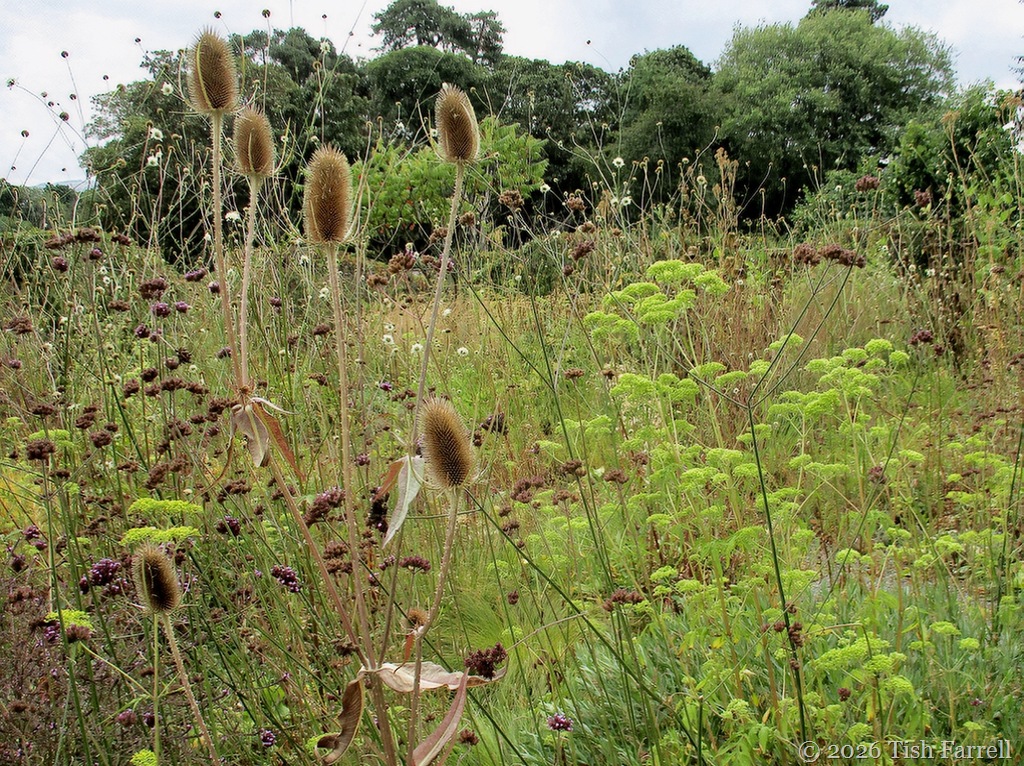
Patrinia as seen at Wildegoose in late August, just beginning to flower.
*
Heaven knows what happened to the Selinum seeds. Try again this year.
*
An unexpectedly pleasing delivery
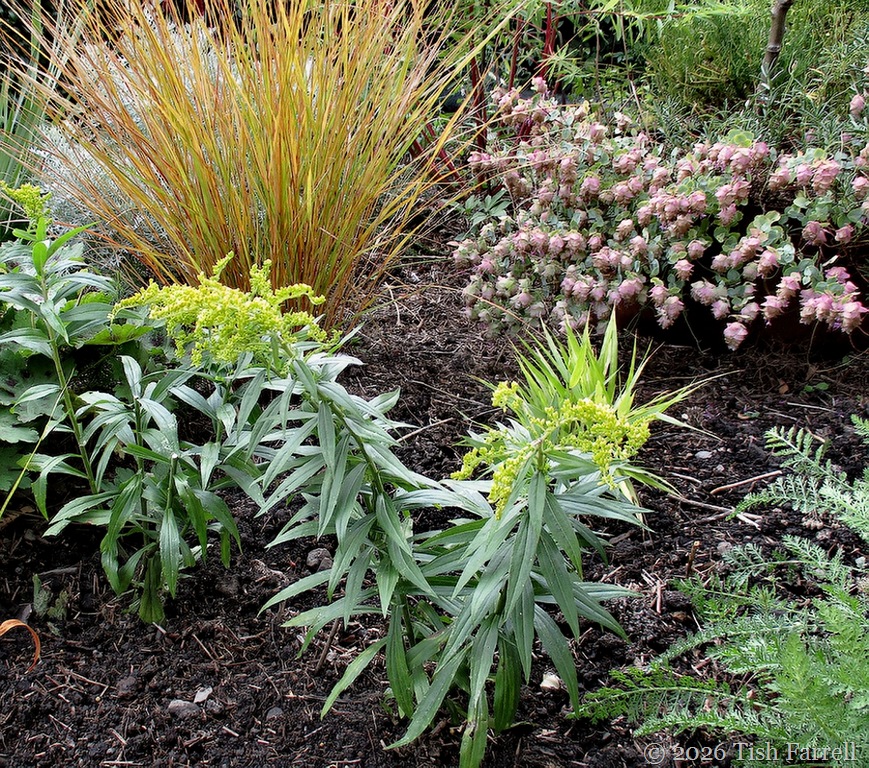
There are some lovely plantspeople selling on-line. And so trawling the net in search of yet another plant seen at Wildegoose, but one which they don’t appear to sell, or haven’t in stock, I discovered Solidago Golden Dwarf at Crossgate Nursery in Cornwall. Here it is just after arrival. The plants had been carefully folded to preserve the stems that are just about to flower. I expect they’ll straighten out. But anyway, here it is in the front garden. There are several ‘dwarf’ varieties I now discover, ones that don’t get out of hand and flop, and also have more lemony coloured flowers.
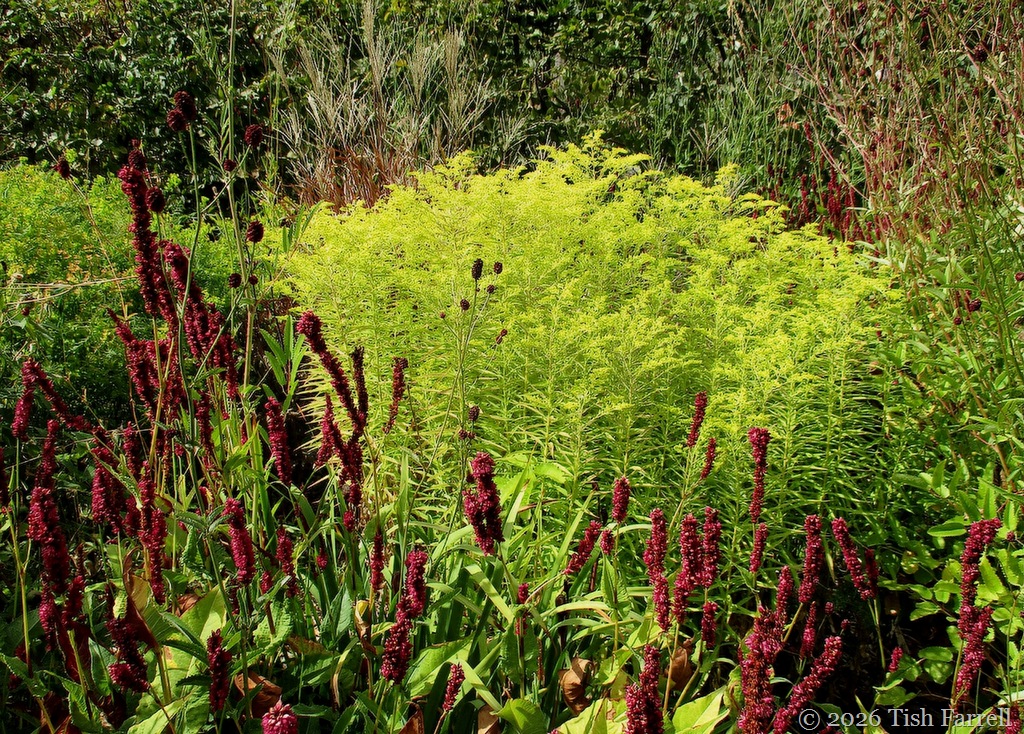
Here’s another repeat photo from the Wildegoose visit where I spotted a spread of lemony, just-out solidago with some Persicaria.
A good week then, all in all. And rain and sun too. Happy gardening, folks.
Copyright 2026 Tish Farrell
*
Six on Saturday It’s a wise gardener who labels their seed envelopes. Please visit Jim for more garden doings and some fabulous coleus.
Still hot today, but there are promises of a degree or two cooler than yesterday. And please, please, please can we have the breeze back. For now, the phlox paniculata are gently roasting, especially the large petalled magenta/purple varieties. Only Adessa ‘Pink Star’ is keeping her cool, here seen alongside the starry Neptune’s Gold Sea Hollywhich doesn’t appear to mind the heat.
*
In the back garden, most of the border plants are fading fast, apart from the bergamot/bee balm/monarda. Over the last few days, it has burst into life and bees, although I’m sorry to see the individual flower parts are soon turning crispy round the edges. (But then aren’t we all!)
*
The peripheries of the garden don’t suffer full-on sun until after mid-day, and this is where I have the beans – French climbing Violette, and a few Borlotti and Butter Beans, growing up canes and obelisks. The runner beans are growing alongside the compost bin, mostly Enorma but also a few St. George. They are now providing a pleasing seasonal screen along this short section of garden which overlooks the road.
Actually, I love bean flowers (almost as much as the beans):
*
Behind the runners, in the old apple tree corner, is a raised bed with the butter bean obelisk, a courgette plant and a self-grown sunflower. Today, the courgette plant has a quartet of blooms, plus one courgette ready for picking.
*
You can see this week’s number six in the photo above, on the right, beyond the courgette leaves. It just happens to feature in today’s newsletter from Beth Chatto’s Plants and Gardens. So here we have Aster x Frickatii Monch as it starts its season, and rather sooner than expected.
In the newsletter, granddaughter, Julia Boulton, who now runs Beth Chatto’s says of it:
“Absolutely the best Michaelmas daisy, for long display and sheer beauty: does not need staking, and is not affected by mildew. Deserves the best soil and position in the garden.” Its further statistics are: height and spread: 1m x 45cm; conditions: full sun, rich and fertile soil; flowering: Aug | Sep | Oct.
I’m not sure why I planted it in front of the apple tree. That spot does get dappled sun and then full-on glare at the end of the day, but there are much sunnier spots in the garden where it could show itself off to better effect. (Added to the re-do file).
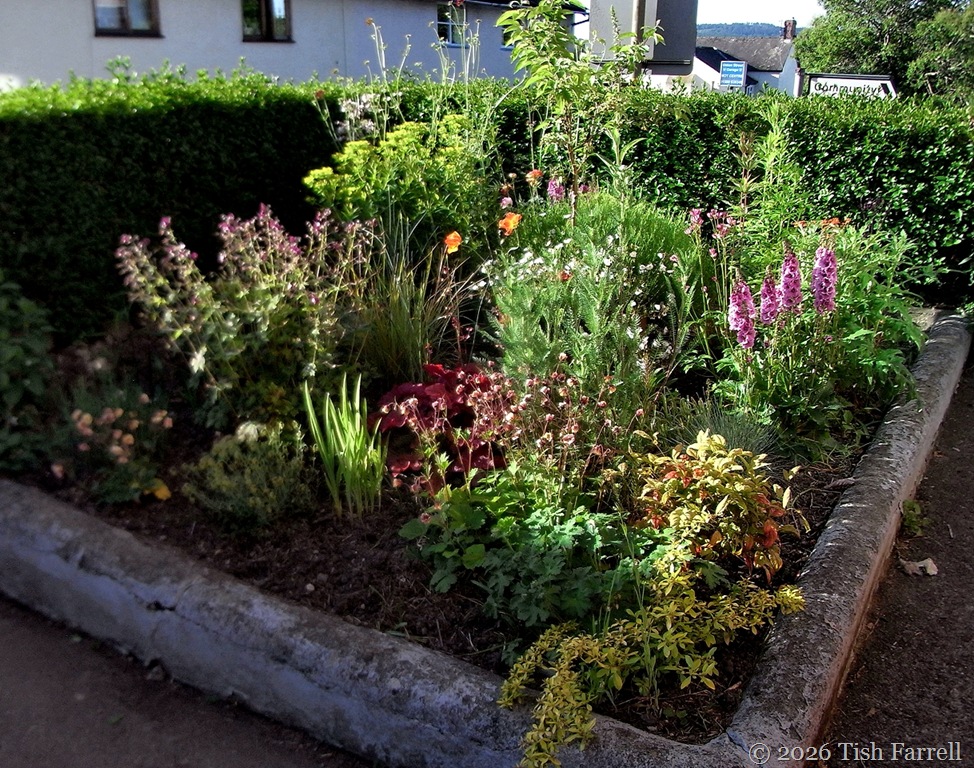
Finally, a view of the a front garden bed, just to show it’s coping with 33 degree C plus days – the achillea ‘Moonshine’ drying on the stem, the allium drumsticks still doing their stuff, Artemisia Powys Castle, very much containing herself alongside a rather weedy apricot coloured Achillea, (Lachsshonheit) which I thought I’d lost, and a young Crocosmia Harlequin (bottom left) about to flower. Background support from Euphorbias, Santolina rosmarinifolia, Pheasant’s Tail grass, and crimson leaved heucheras :
Copyright 2026 Tish Farrell
Six on Saturday: For more views of Jim’s fabulous and mindfully curated plant collection.
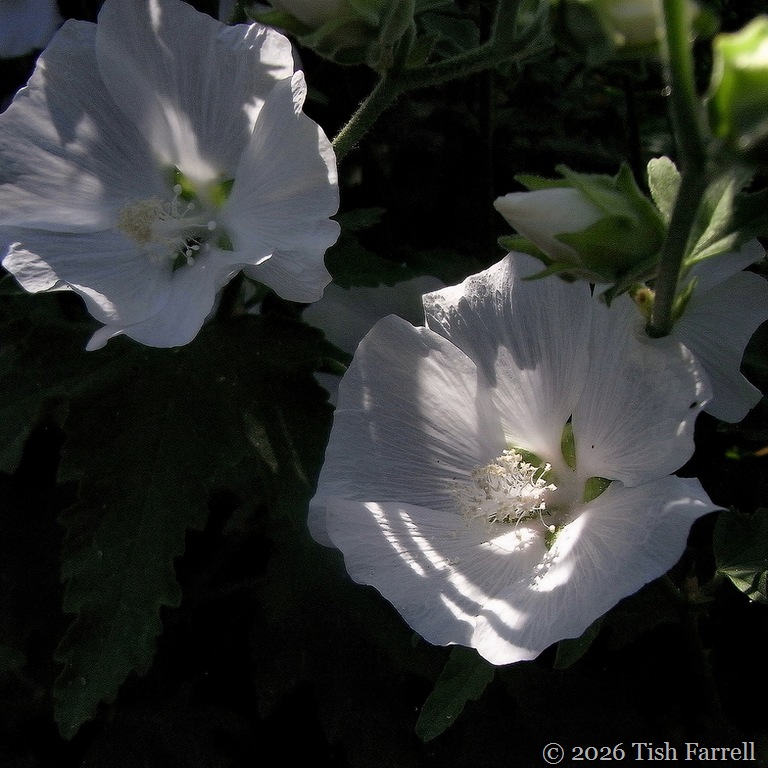
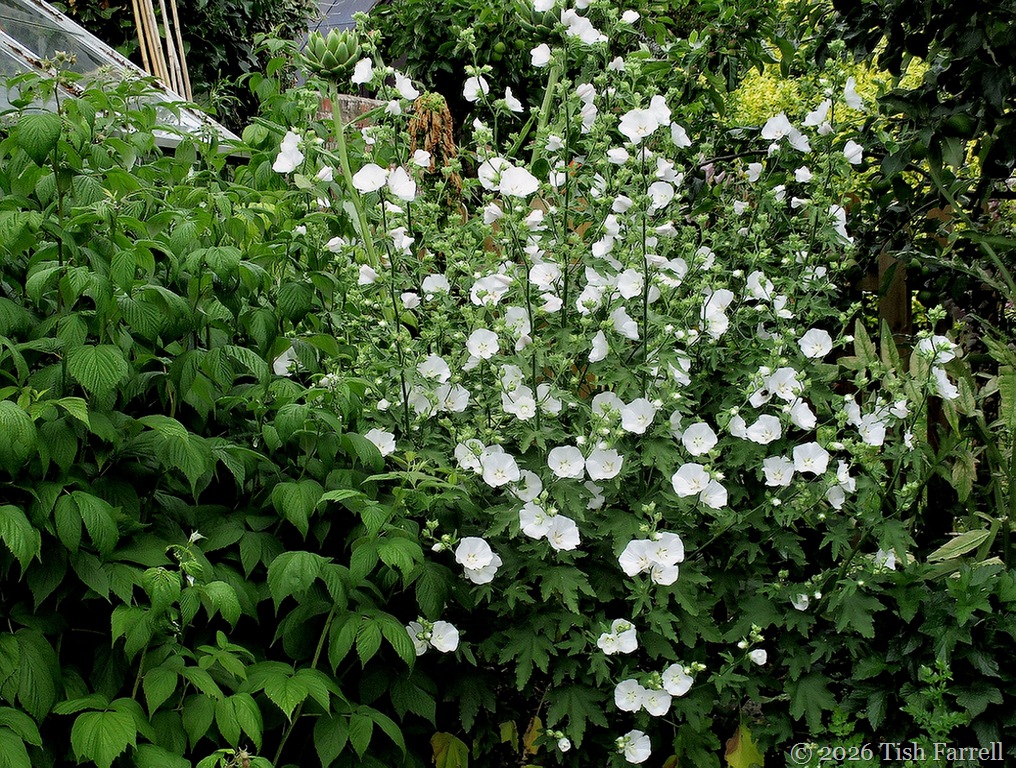
Come July and, in the bottom corner of the garden, the mallow Ice White has burst into flower. It’s supposedly a compact variety, and I’m hoping it has reached its limit. At the moment it is contesting space with the Polka raspberries, both parties clearly making good use of the farmyard manure deposited on the raspberry bed back in early spring. The individual mallow flowers are very beautiful. I forgive the plant for being pushy.
***
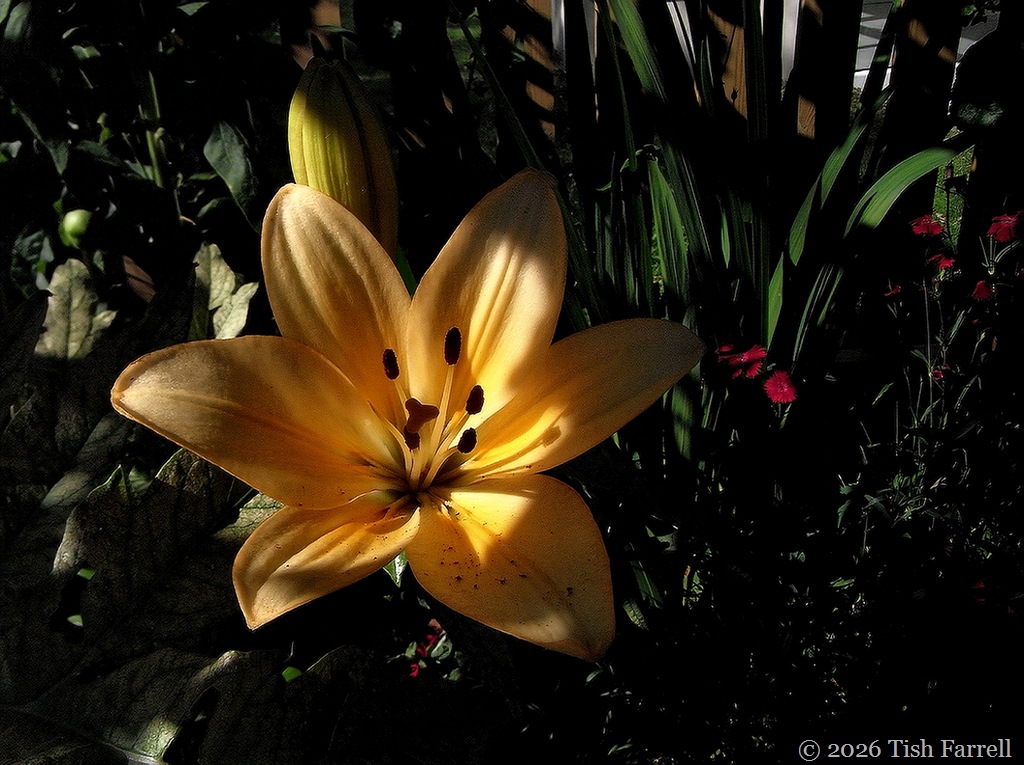
Another bright bloomer in the bottom of the garden is this orange Asiatic lily.
Last summer I received the bulbs by mistake (as mentioned last week). The chap who had mixed up the on-line order told me to plant them, rather than return them. Not to look gift horses in mouths, but at the time, this was easier said than done. I couldn’t think where to put them, or if I really wanted them enough to solve the location problem. In the end I planted the ones I most liked the sound of in a big pot, and popped the remainder under the apple tree, not expecting them to do much in a dry and overshadowed spot.
In fact I’d forgotten I’d done this. Anyway, now it’s flowering, I’m warming to it somewhat. It does look lovely in the late afternoon sunshine.
***
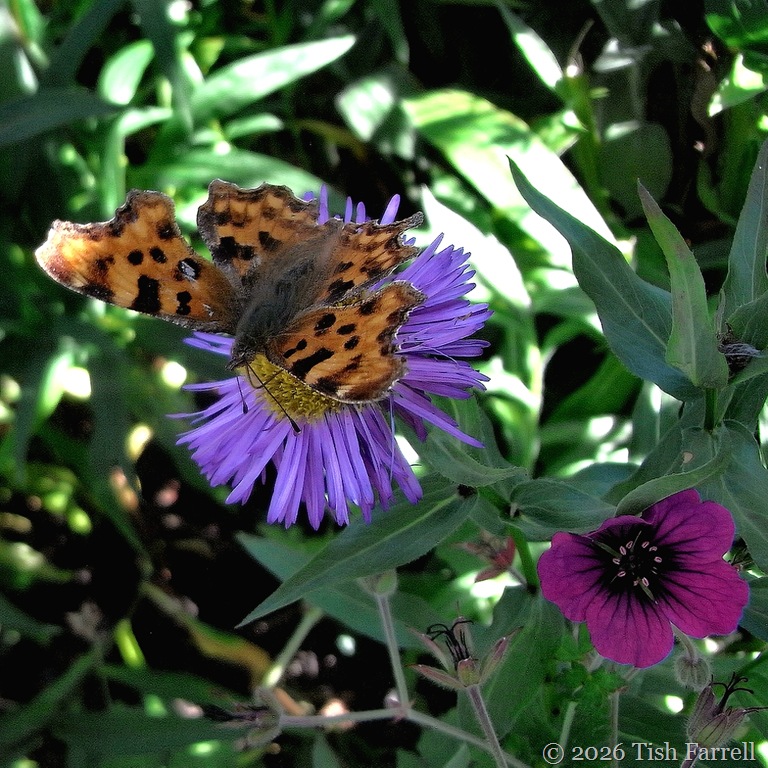
These days we’re seeing more butterflies in the garden– not only the annoying cabbage whites (hopefully the greens are sufficiently well netted) but also Painted Ladies, some returning Holly Blues and yesterday this lovely Comma butterfly.
It was zipping around the back garden at high speed, impossible to photograph, but then was finally captivated with the Erigeron Azure Fairy , staying just long enough to have its portrait taken. (Ann Thomson geranium looking on).
***
Since the late June hot spell, the weather has been comfortably tepid. The downside though is that we’ve hardly had a spit of rain. Now I’m panicking over the news of next week’s repeat frying. The recent return of blustery wind doesn’t help either. The surface soil is dry as dust and much of the earlier mulch seems to have disappeared.
I’ve been spot-watering plants that look stressed. Now, though, I’m in the middle of mining my compost bin. The grass cutting deposits from our neighbours’ very mossy lawn have kindly rotted down to produce some loamy stuff that looks suitable for another mulch campaign. The digging out and the spreading of same is giving the blackbirds much joy. They scuttle around after me, peeping happily, as they rake up worms and grubs.
***
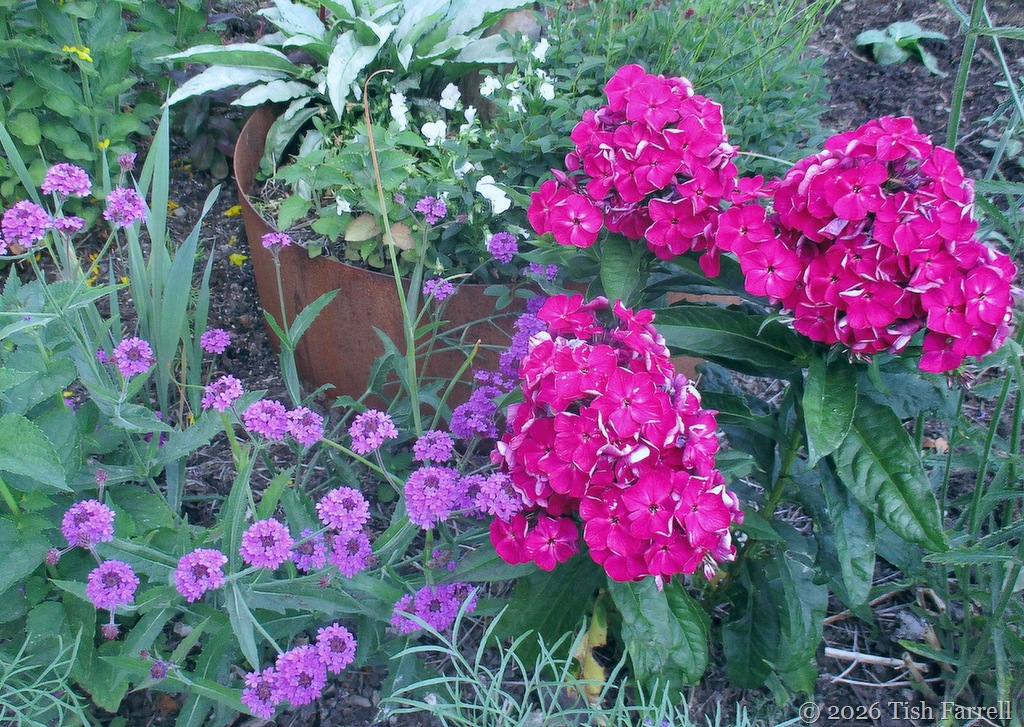
July is also phloxpaniculata time, probably my favourite summer flowers (if forced to choose). At the moment I seem to have purple-pink ones all over the place. I’m not sure how this happened. I suspect I’d put in a number of large plugs not long after we moved into The Gables. They certainly didn’t do much over the last couple years, succumbing to slugs and mildew, but now they have begun to bulk up well, looking good alongside Verbena. Their colour in the photo doesn’t really do them justice. They actually have richer, more wine coloured tones.
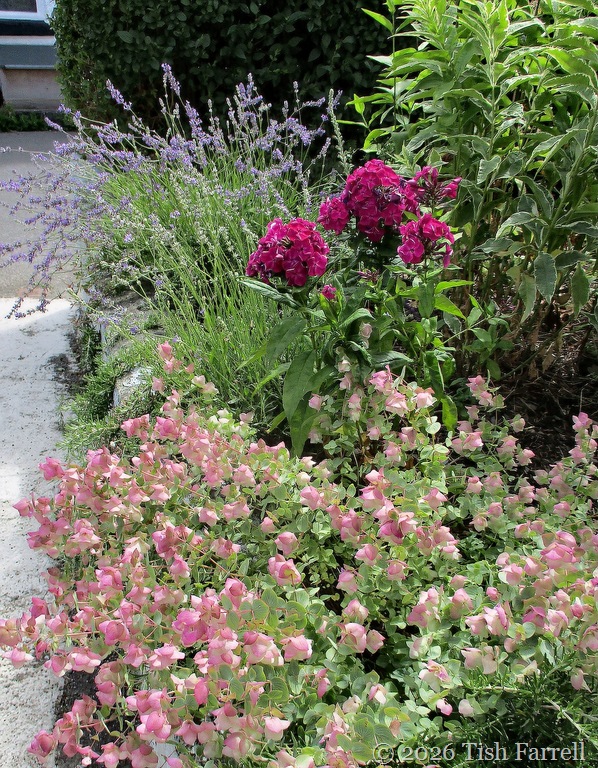
Also here on the front drive border between Oregano Kent Beauty and Lavender. Behind the deep red phlox is a clump of the taller variegated phlox, Nora Leigh, yet to flower.
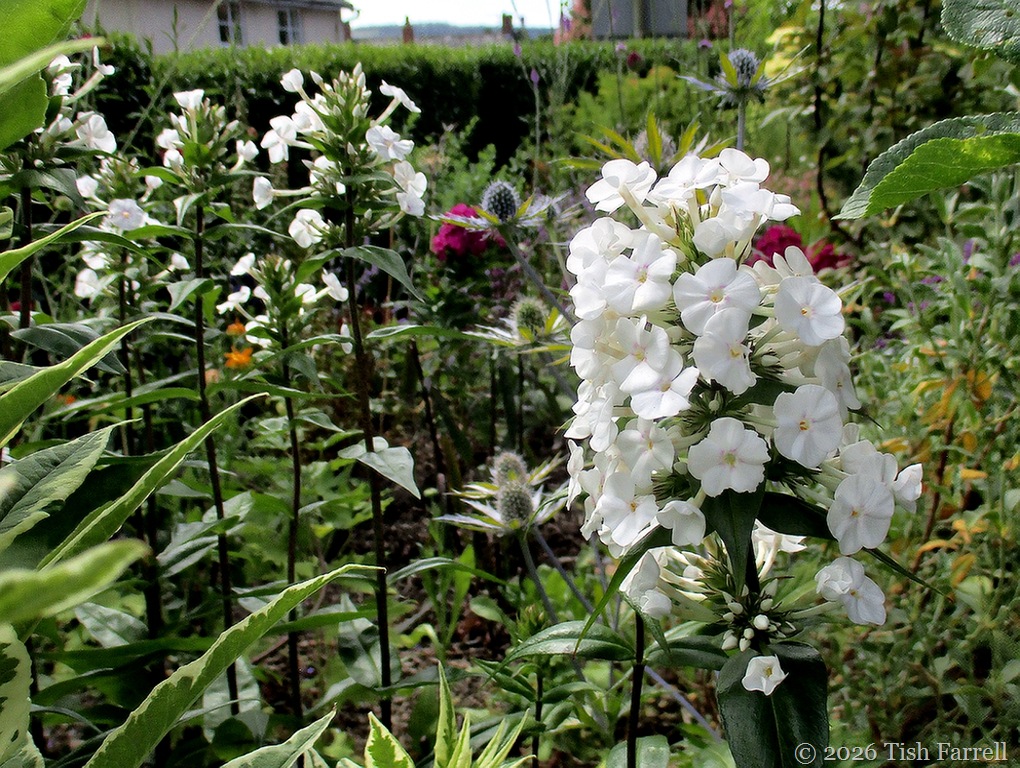
And behind Nora Leigh, is Phlox Adessa, a delicate smallish-flowered white with a tiny pink eye, just starting out:
***
I also mentioned in earlier posts that last year’s several varieties of sunflowers had seeded themselves all over the garden. The tallest one by the old apple tree is at least 8 feet and still going. Then by the sweet pea obelisk there are at least six more sturdy plants (not so tall). I meant to transplant them, but they grew too large before I remembered to attempt it. And then I thought, they’ll be great to follow on from the sweet peas, and I can tether them to the obelisk if need be. Hopefully, they will keep going into the autumn.
This is the first one to flower. (Parentage uncertain).
copyright 2026 Tish Farrell
Six on Saturday 4th July Among other wonderful things, Jim has some stunning tiger lilies on show this week.
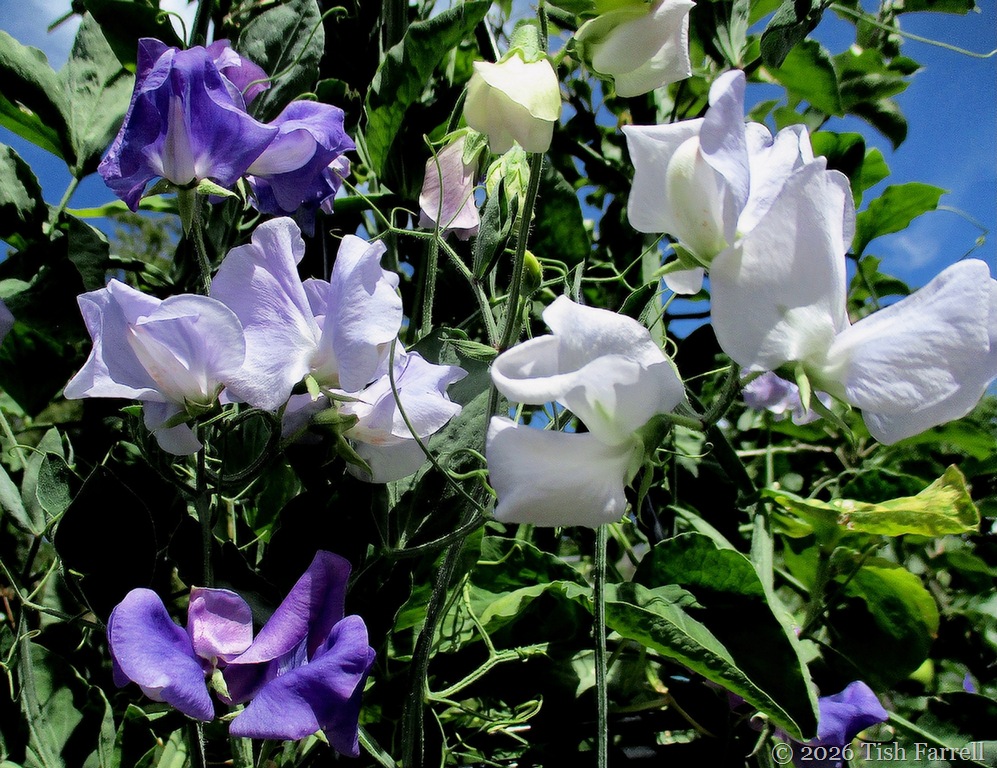
The stars in this week’s sun-baked garden have surely been the sweet peas. This when you might expect the heat to quickly wilt their delicate petals. No so. Over the past week I’ve cut one and two bunches a day. The house smells delicious. And yet back in the spring I’d been complaining about pigeons chomping all the main stems. The rotters were using the obelisk struts as convenient take-away perches. But it hasn’t mattered, and I haven’t even bothered to water them. But I did plant them out quite early in March, and I can only conclude they made some very strong, deep roots.
*
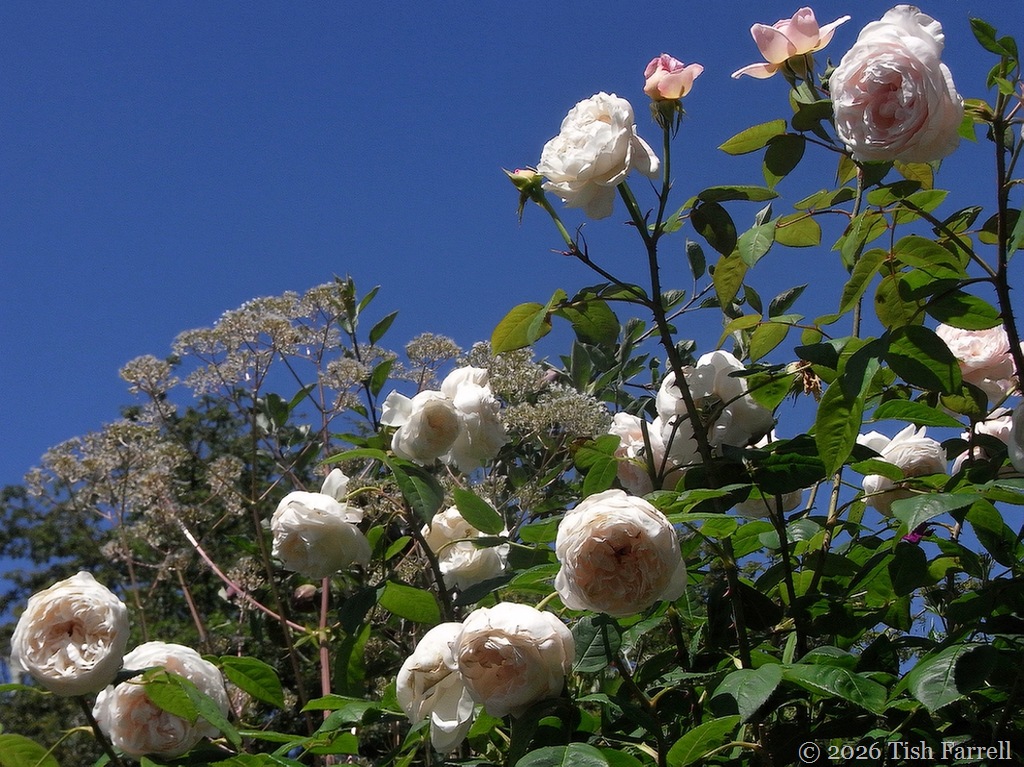
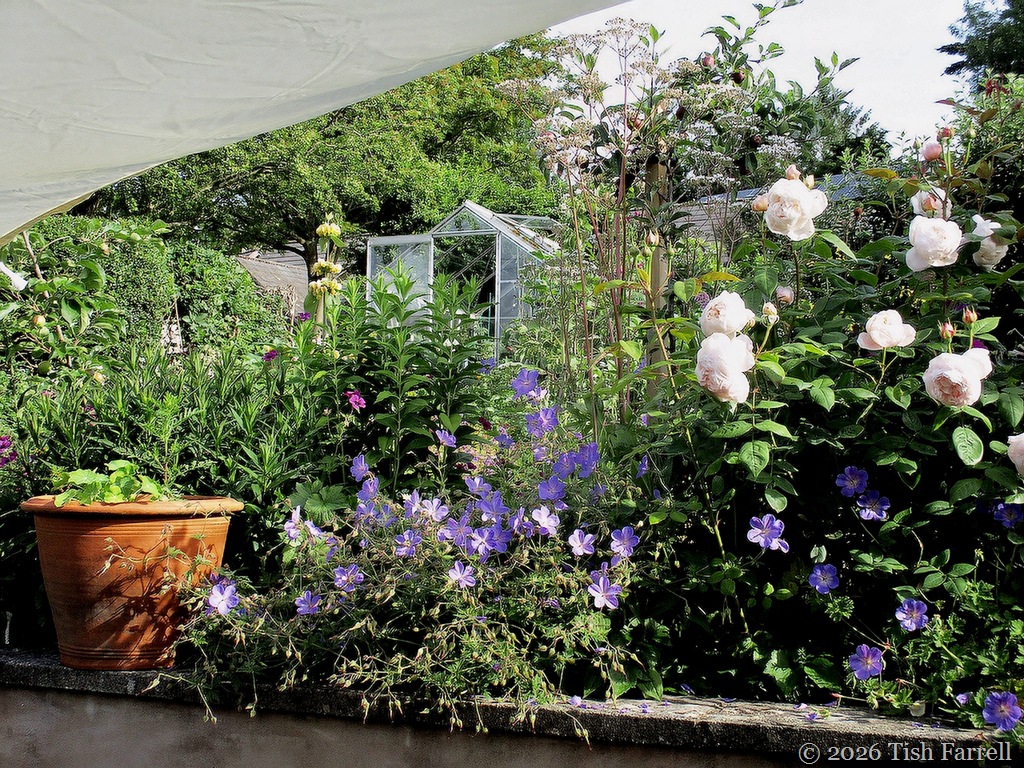
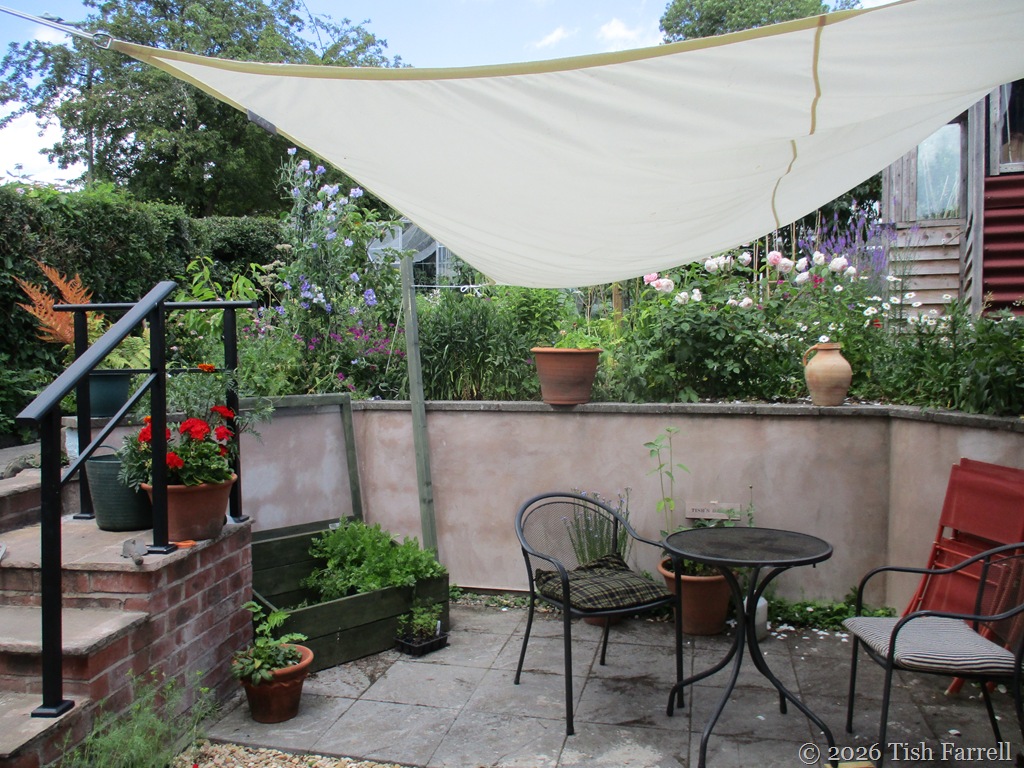
The latest rose to bloom is St. Cecilia, a repeat flowering David Austin small shrub creation with hints of myrrh fragrance. She’s growing on top of the back garden wall, where we have a wing canopy tethered, (between the wall and the kitchen double doors). We’ve been enjoying the soothing rose scent while eating outside.
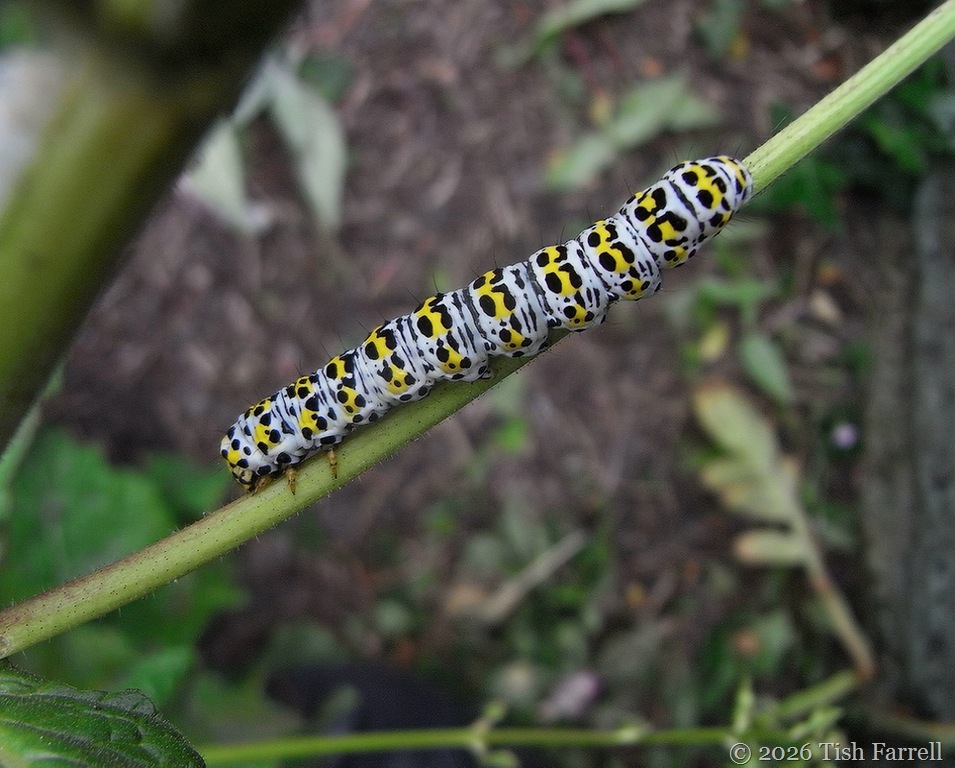
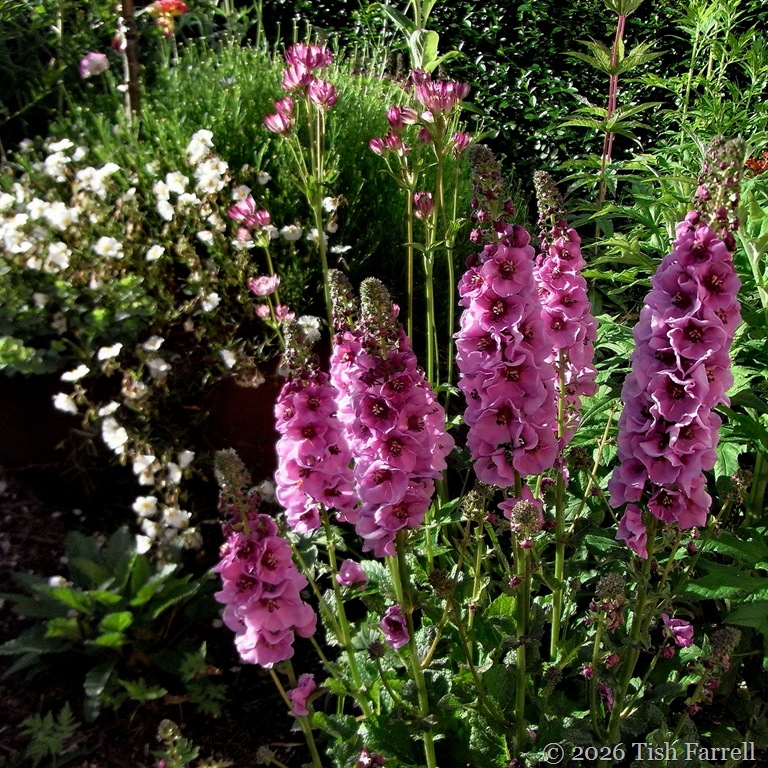
The heat certainly didn’t suit some flowers. The blue geraniums began fading fast and the starry petalled astrantia soon turned crispy. This called for some general tidying. And while I was deadheading around verbascum Lavender Lass I found this…
…a mullein moth caterpillar. I’ve known them wreak havoc in verbascum chaixii Wedding Candles, and also in the tall wild flower mullein, so I was pleased to see it hadn’t eaten too much of Lavender Lass. She should flower again later this year. The caterpillar, though, is the most spectacular beastie, especially when I find it turns into something resembling a piece of crumpled bark.
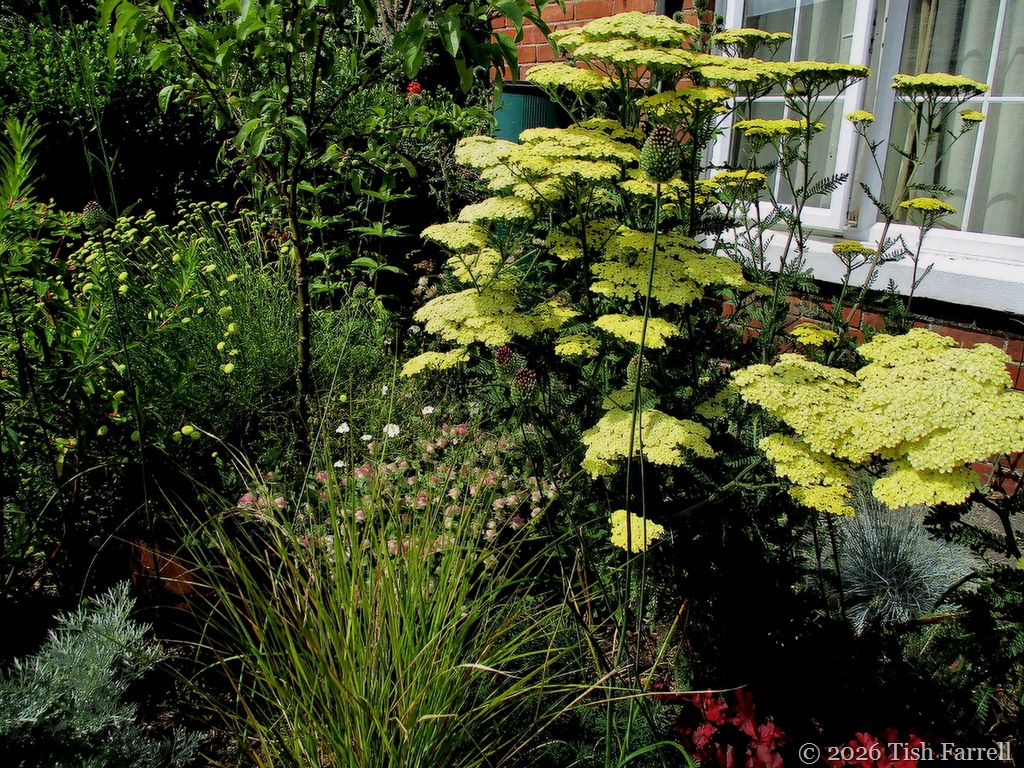
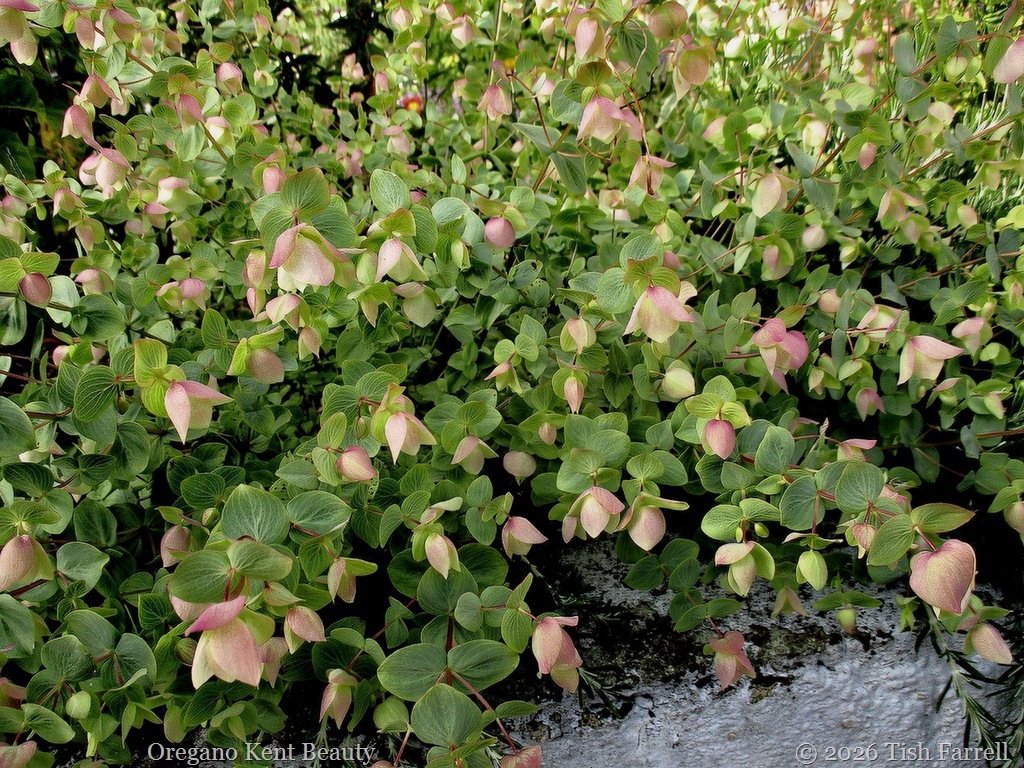
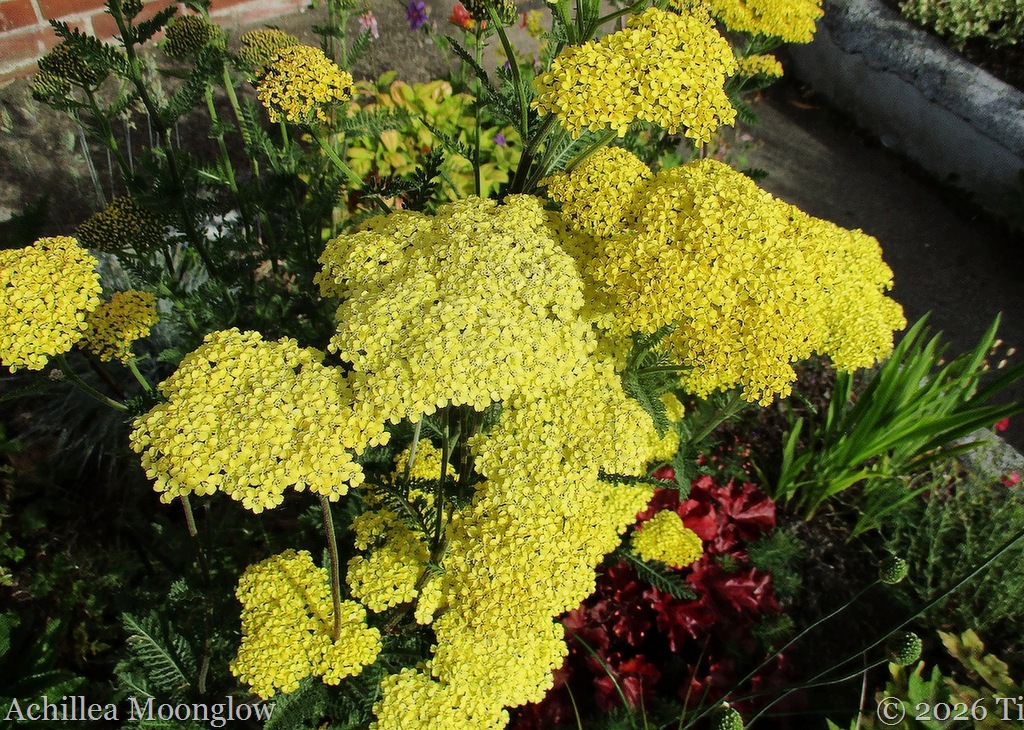
The front garden has been surviving hours of full-on sun for over a week now, so I’ve been very glad of all the Strulch mulching that I did last autumn. I’ve only had to water a few newly planted out annuals and also the two small raised beds with the dwarf crab apple trees in them. Two plants that have otherwise been coming into their own with no attention from me are: Achillea Moonglow and Oregano Kent Beauty.
The oregano is trailing from the raised bed to the left of the Achillea (above). I also have some cascading over the ugly front wall where it keeps company with the recumbent rosemary. It’s thanks to Jude at Cornwall in Colours that I learned of its existence, and then to discover that there are other lovely ornamental oreganos. It will keep flowering now into autumn, the colours growing more vivid through the season. And of course, it’s also appealing to insects.
*
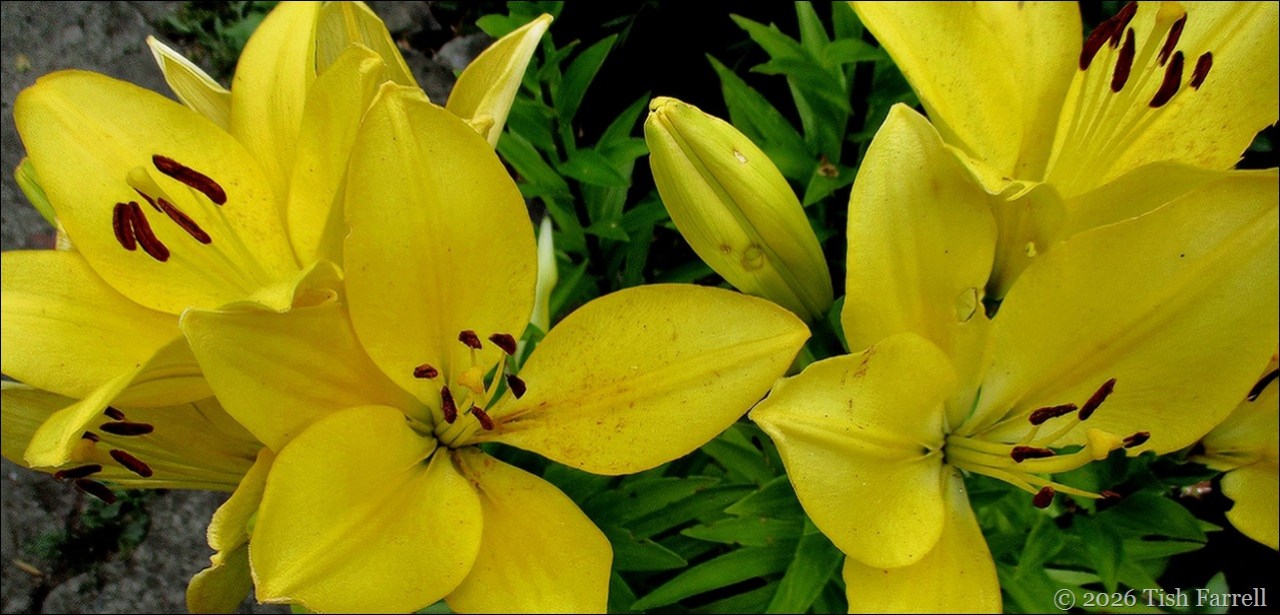
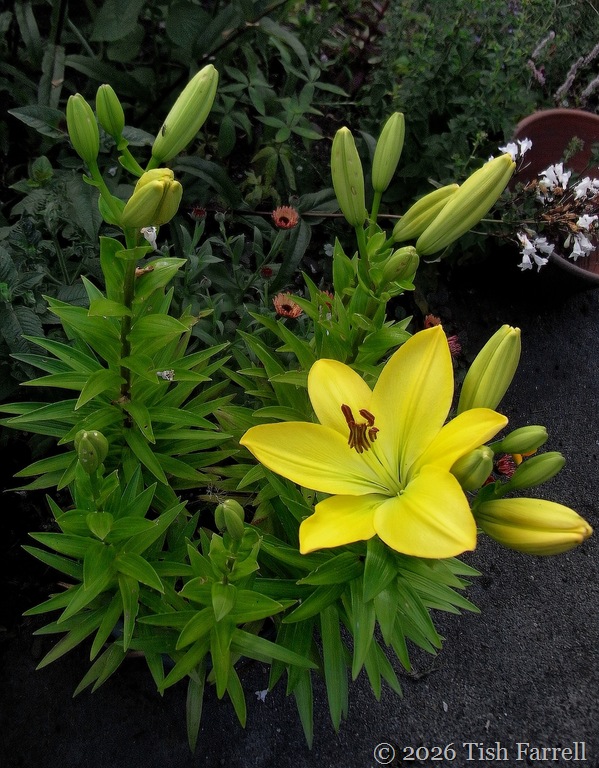
And finally, ‘hot from the press’ and opening just this morning, a very striking lily. I can’t remember what she’s called. She was anyway an on-line purchasing mistake late last summer, the plant seller getting their orders confused. When this was pointed out, he told me to keep the bulbs and plant them. I have to say, I wasn’t altogether thrilled. I’m not very keen on lilies. And I’m certainly not keen on the lily beetles that too often come with them. So I put them in pot and forgot them.
Which just goes to show. I shouldn’t have been so mean-spirited about an unexpected gift, even if I did find a nasty red beetle on it yesterday.
Happy gardening, folks, however it comes!
*
Copyright 2026 Tish Farrell
Six on Saturday Please hop over to Jim’s garden and see what’s happening there.
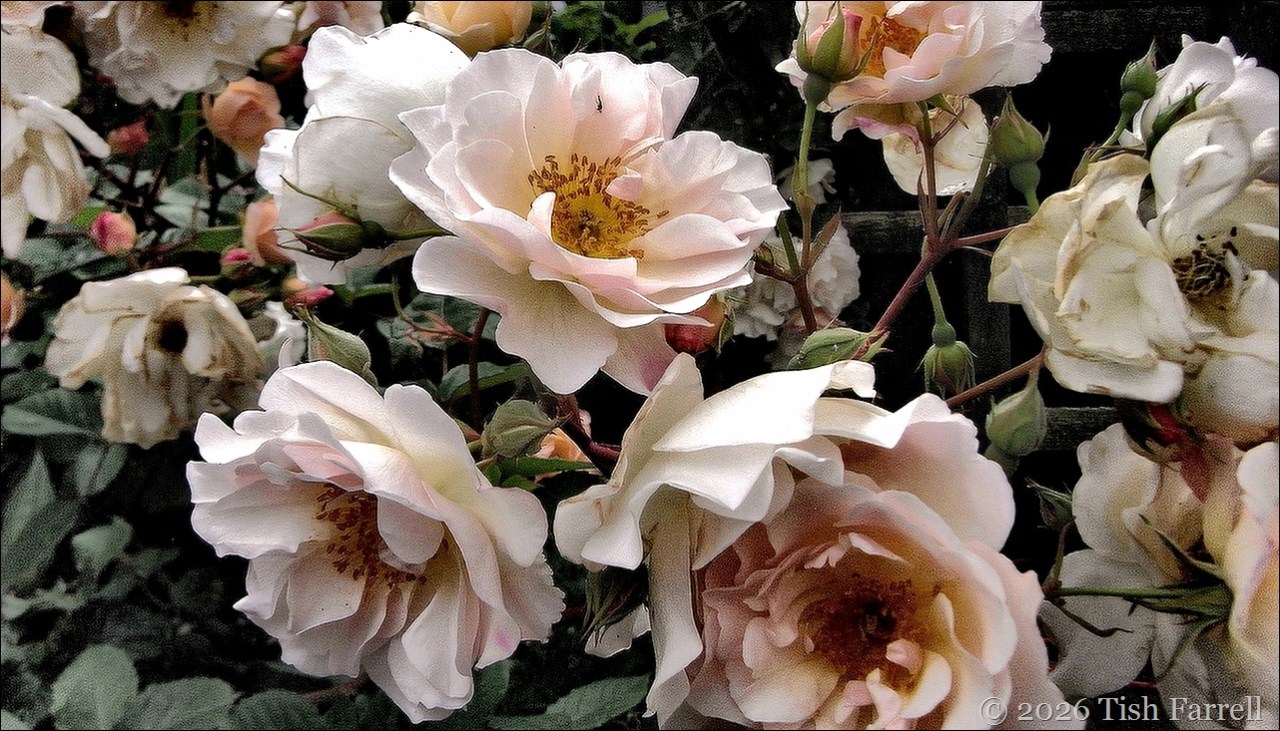
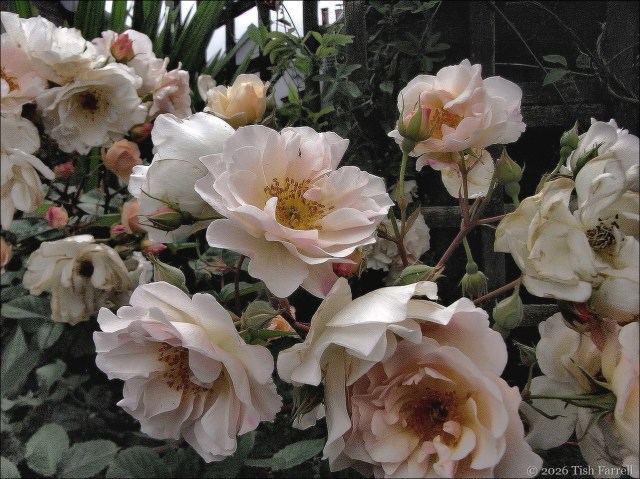
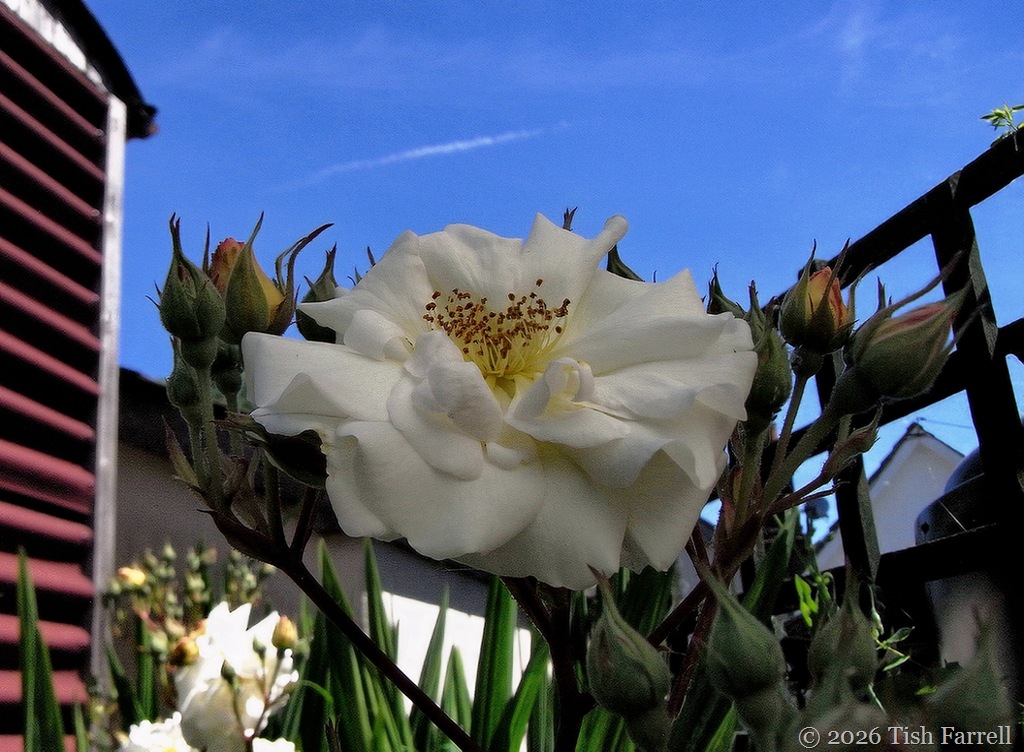
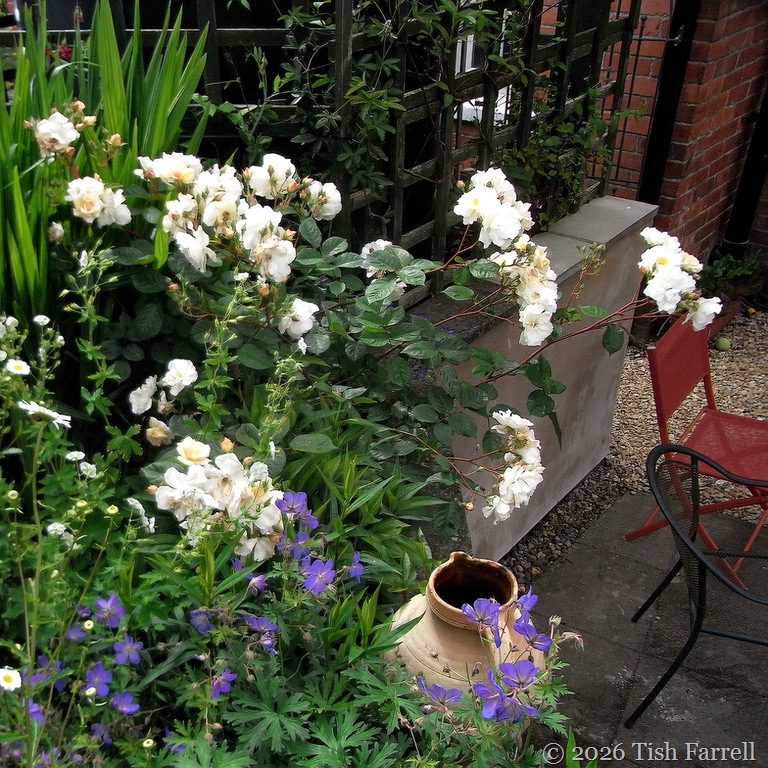
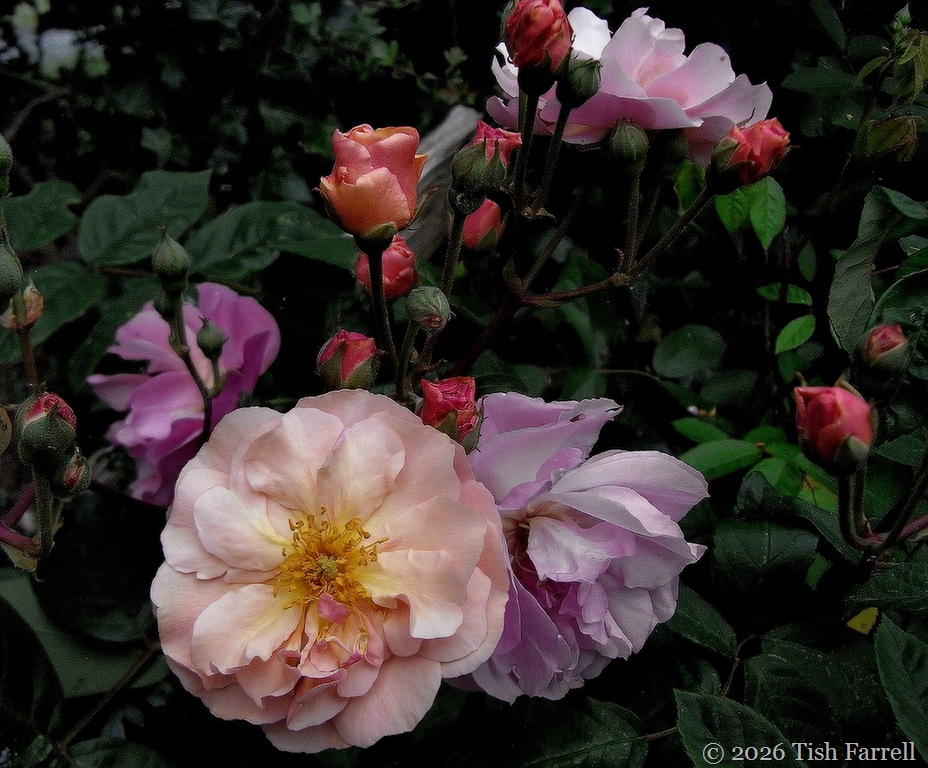
Come gusts and squalls, the roses have been holding their own. And then, in late afternoon, if we have some sunshine, they tumble luminously over the terrace wall and look glorious come supper time.
The constant wind, though, is tedious. When did England become so never-endingly blustery? I’ve tried searching on line for an answer, but the sites that deal with weather don’t appear to think it remarkable. As someone who has gardened for over half a century, I know we did not have perpetual wind mashing up herbaceous plants and blowing the new runner bean plants off their sticks.
Perhaps it’s to do with ‘the cold blob’ also bizarrely known as North Atlantic Warming Hole, a region of ocean to the south of Greenland that has been cooling over the past century while the surfaces of the earth’s other oceans have been warming up. Scientists have argued over the possible causes, some citing a weakened Atlantic Meridional Overturning Circulation (AMOC), the system that plays a significant role in the earth’s global climate.
Perhaps the AMOC stole our much vaunted heat wave. If it did, many thanks.
And of course there is much to be pleased about.
Bee happy
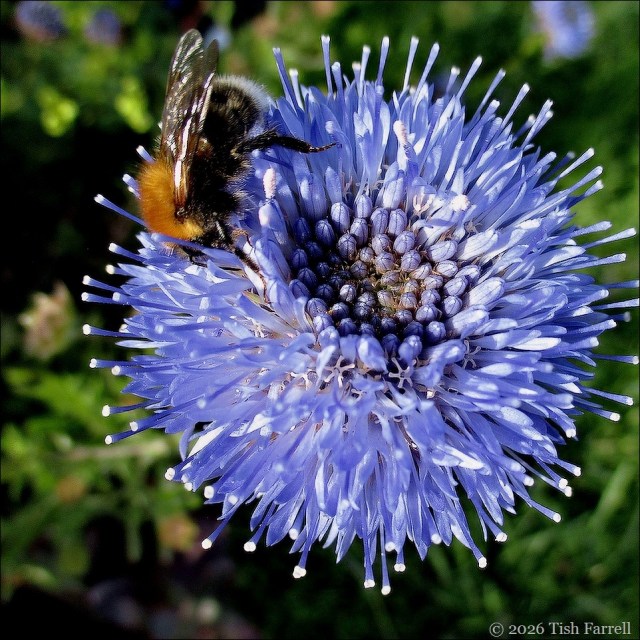
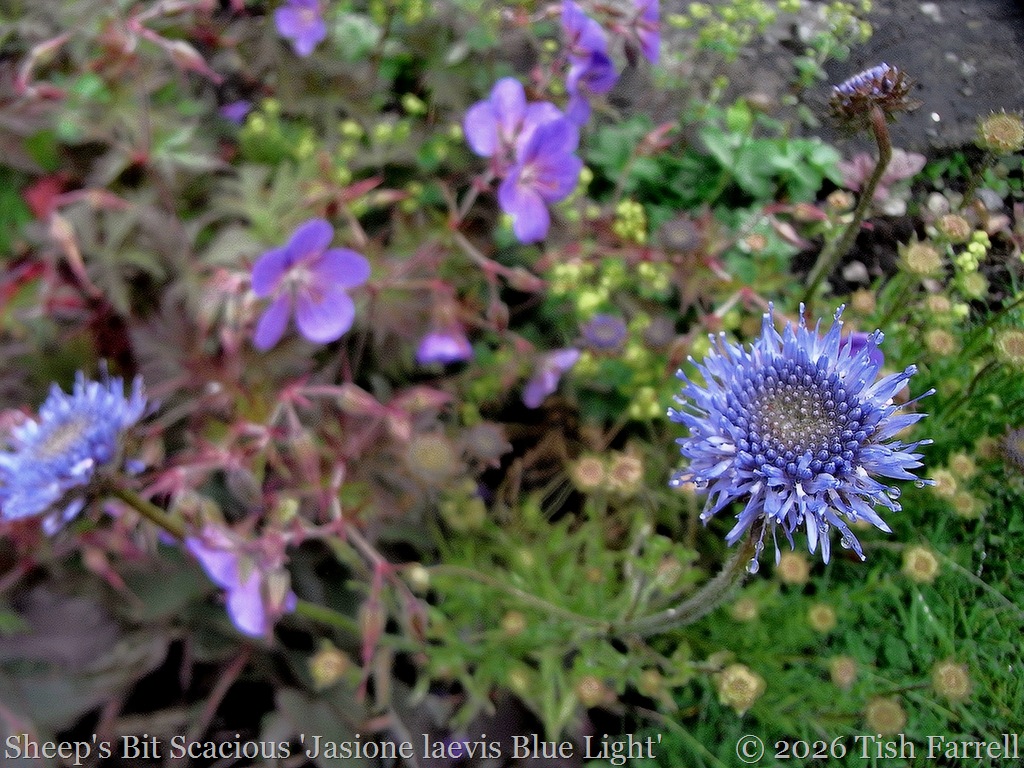
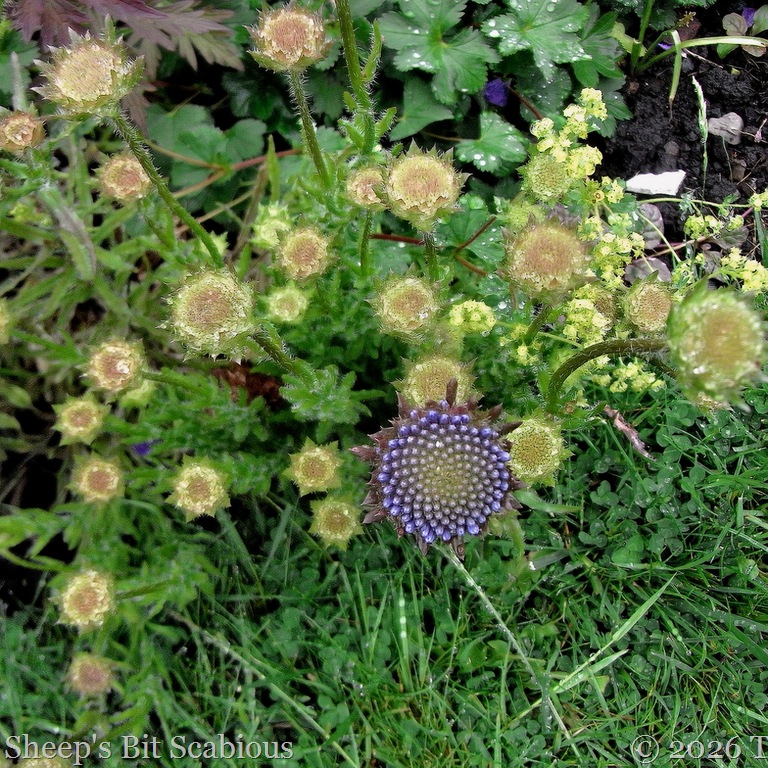
For one thing there are so many bees in the garden, this after a long quiet spring insect-wise. They definitely approve of the sheep’s bit scabious, harvesting the flowers for ages, which makes them easy to photograph.
In a bind
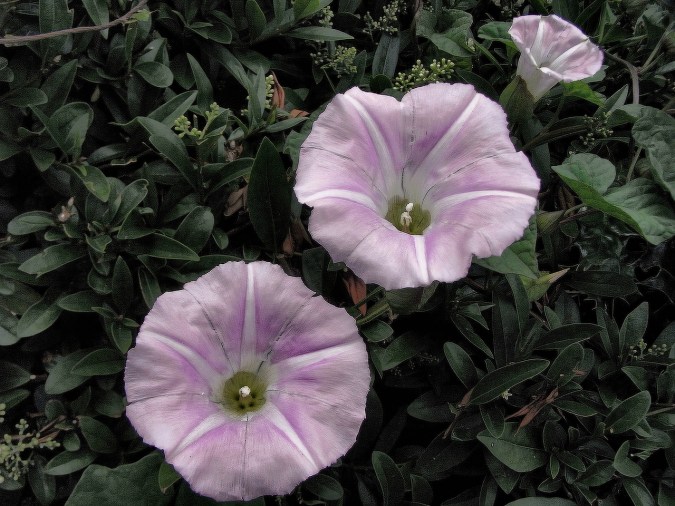
It’s usually a weed that provokes gardener’s fury, but the large flowered pink and white striped convolvulus that has just re-appeared in our otherwise horrid hedge is a welcome sight. For a bindweed, it is most circumspect in its habits, and only spreads here and there.
An urge for spurge
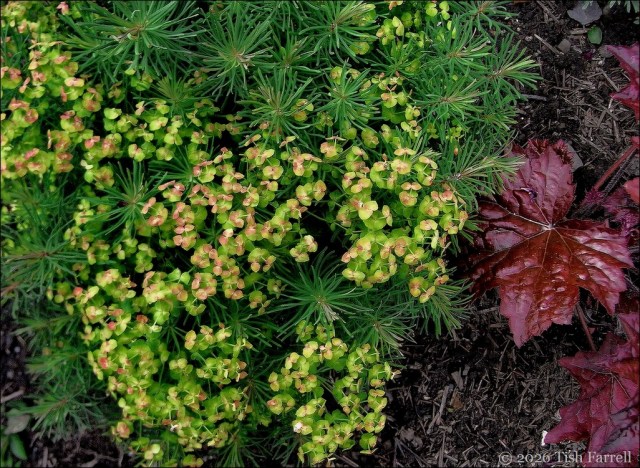
Another spreader, presently flowering is the pretty, low-growing spurge, Euphorbia cyparissias Fens Ruby. Its stems look like miniature conifers, and the tiny flowers several colours of green and russet. It likes to nudge up picturesquely with other border plants and, in that sense, it is a very weedy entity, but then any excess is easily removed. Here it is with a coppery coloured heuchera.
Reasons to be cheerful 5 and 6
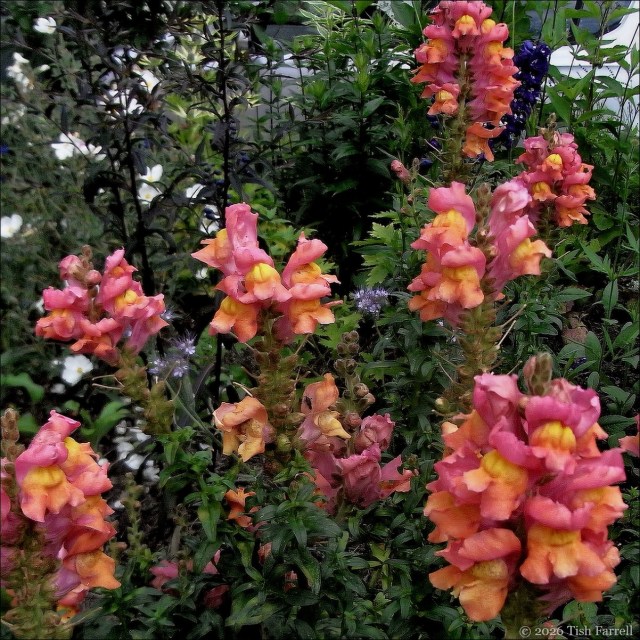
Then there are the self-gardening regulars that seem to return each year, and with ever more flourish. I love these snapdragons. I don’t mind how much they seed themselves. The plants themselves are shrubby and don’t seem to mind the wind and rain. But most of all, their sun-rise shades brighten the dullest day.
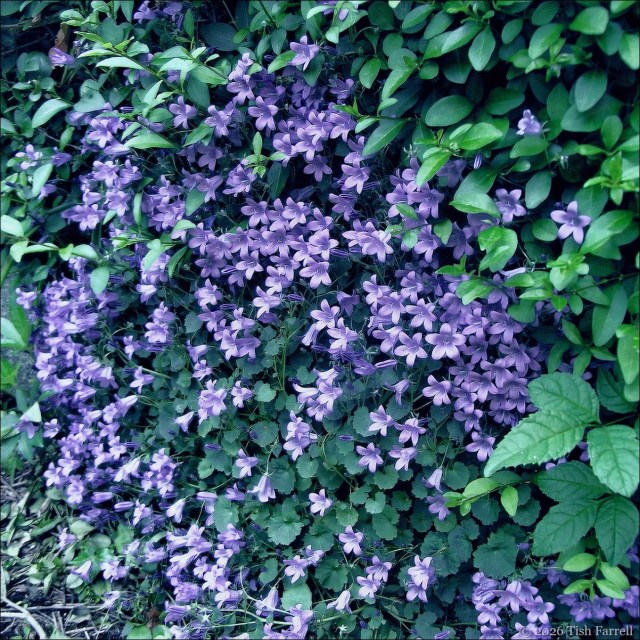
Likewise, the campanula. Over the past few years it has colonised many dull and unpromising quarters of the front garden – growing up the hedge, out of concrete walls, and along the path. It flowers its purple-blue socks off.
Here it is improving the looks of the privet hedge that surrounds the front garden borders. It’s another plant that copes brilliantly with weird weather, wet or dry.
Copyright 2026 Tish Farrell
Six on Saturday 13 June 2026 Please call in on our host, Jim. As ever, he has some wonderful plants to show us this week.
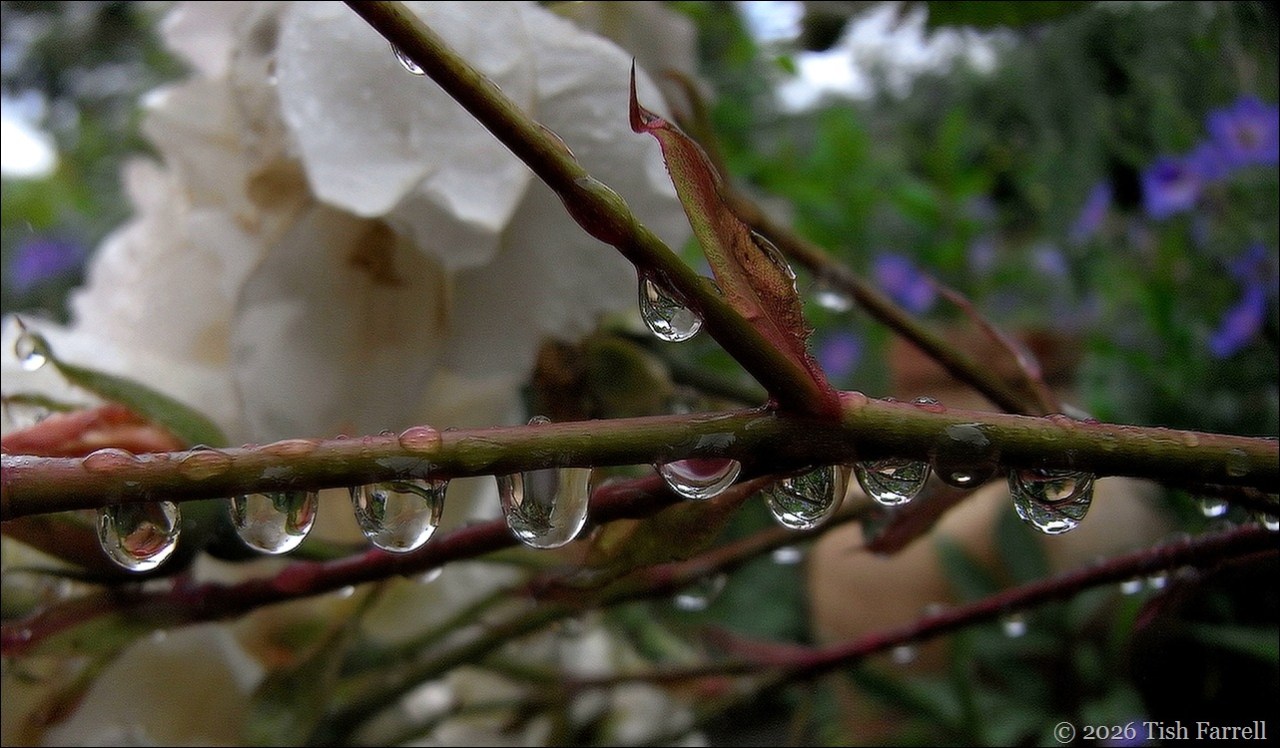
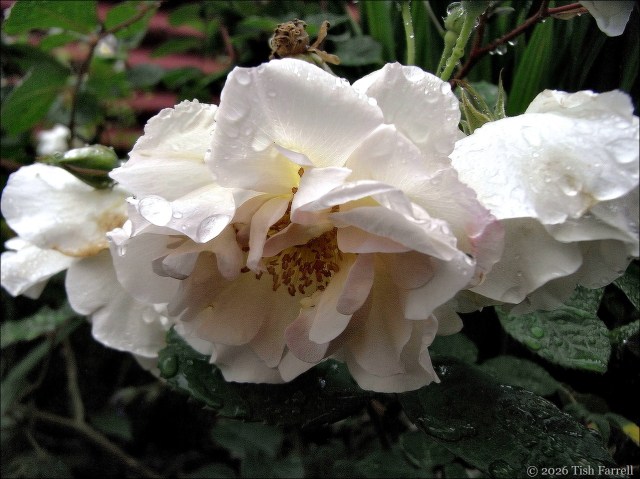
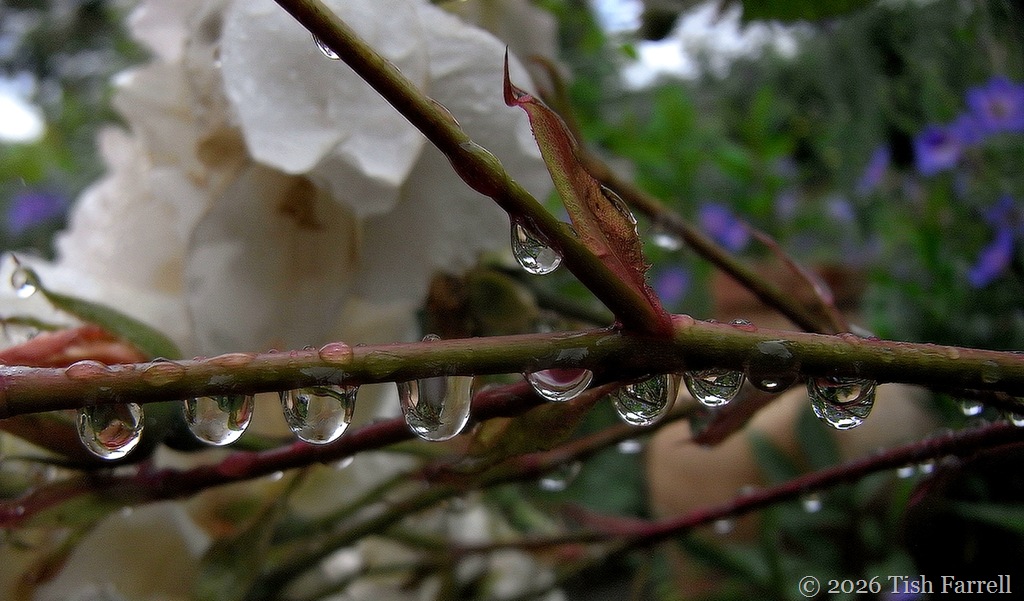
Today it’s more like October than June. We’re back to grey skies, gusty wind and rain between showers. But the Peneloperoses are bearing up, even if their frocks are soaked and their flounces crumpled.
Here’s a photo from earlier in the week during a sudden sunny spell. The plant itself is a tending-tall, rather floppy shrub rose that can be trained as a short climber if you only have a short wall. I’m hoping that in time she will simply arc gracefully down the terrace wall without much in-put from me. She’s already doing her best.
***
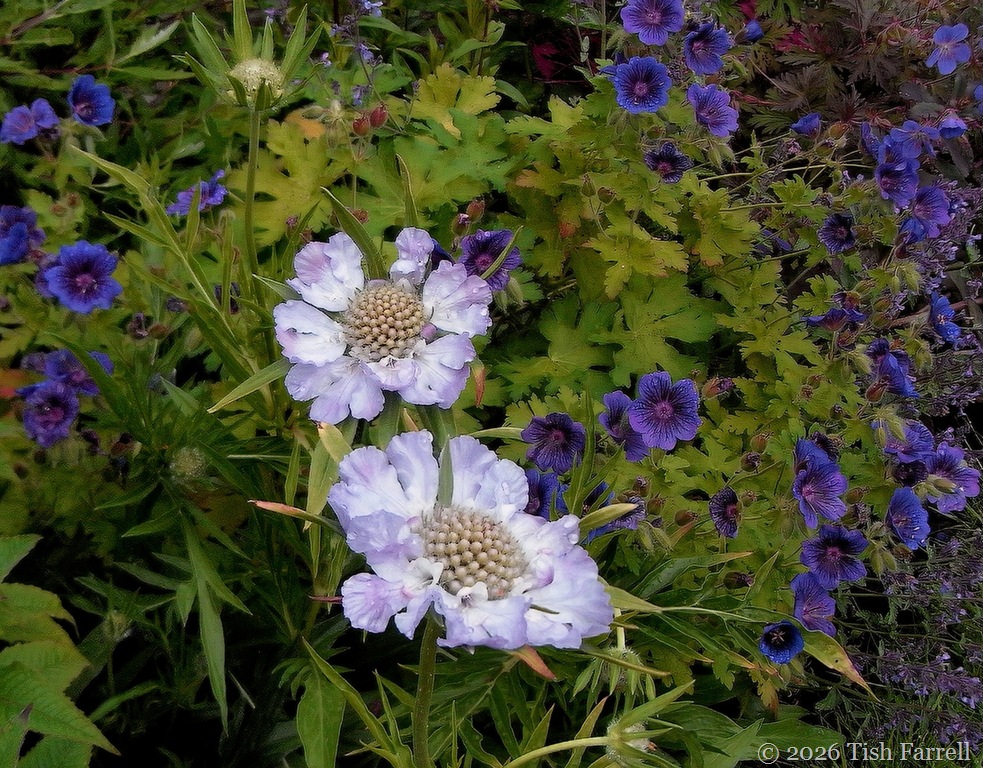
In the back garden the scabious are just beginning to flower – both the usual herbaceous border version which I bought as large plugs three years ago, but are only now performing, and a Sheep’s Bit variety called Jasione laevis Blue Light, which went in as a young plant last September. Both are presently keeping company with various hardy geraniums, but the Blue Light is already making a pleasing low clump on the border edge near the path.
***
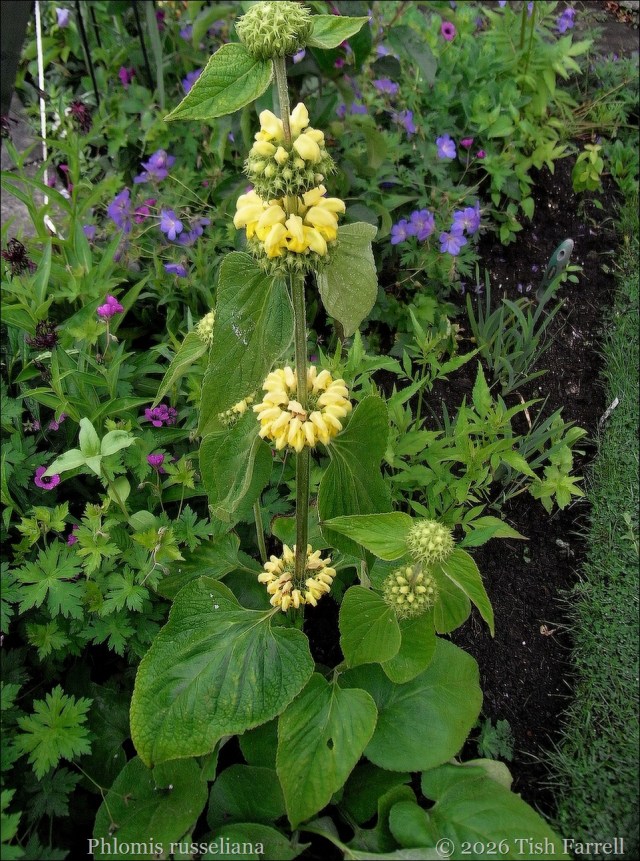
Another first-time performer in the garden is the yellow Phlomis russeliana. I bought it because it’s drought tolerant, bee friendly, will bloom all summer and the dead flower heads still look good in winter. Last year, however, it sat out the long drought, and only made big leaves. It’s making up for it this year. I’m thinking that in due course it will need to move to the side wall bed, where it can keep the yellow rudbeckia and helianthus company.
***
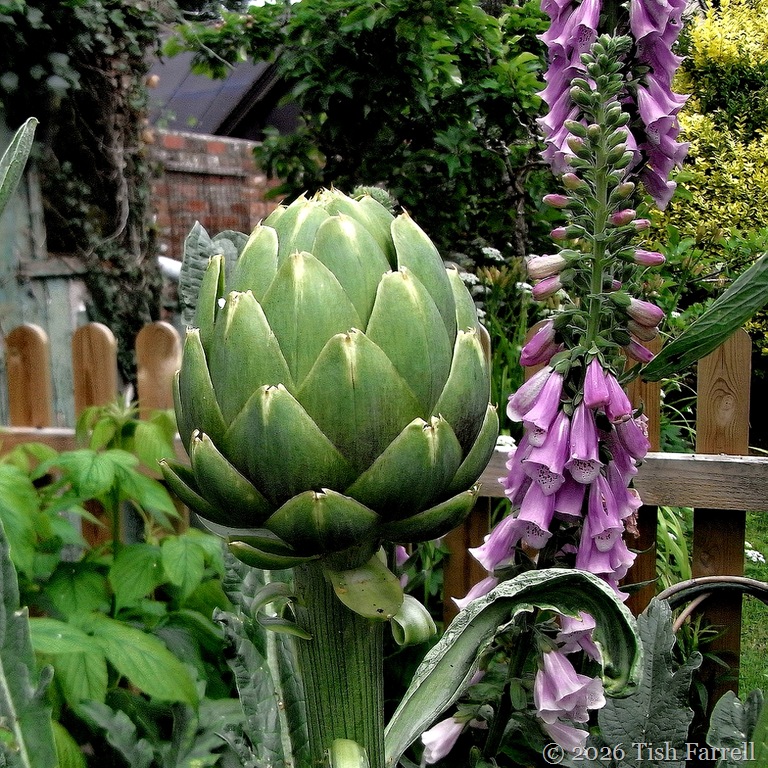
On the edible front, the globe artichokes are making their presence felt. One of the plants has grown up hugely in a most annoying spot, squashed in between the Polka raspberries and the Jelly King crab apple tree. I know I did grow it from seed but somehow it escaped me during the planting phase and dug itself in. Anyway, the rain has brought it on, and it’s about to be eaten. I usually cut artichokes in half to remove the choke, and then steam them. Halves obviously don’t need so much cooking time as wholes, and it’s easier to see if they’re done. Garlicky butter to serve.
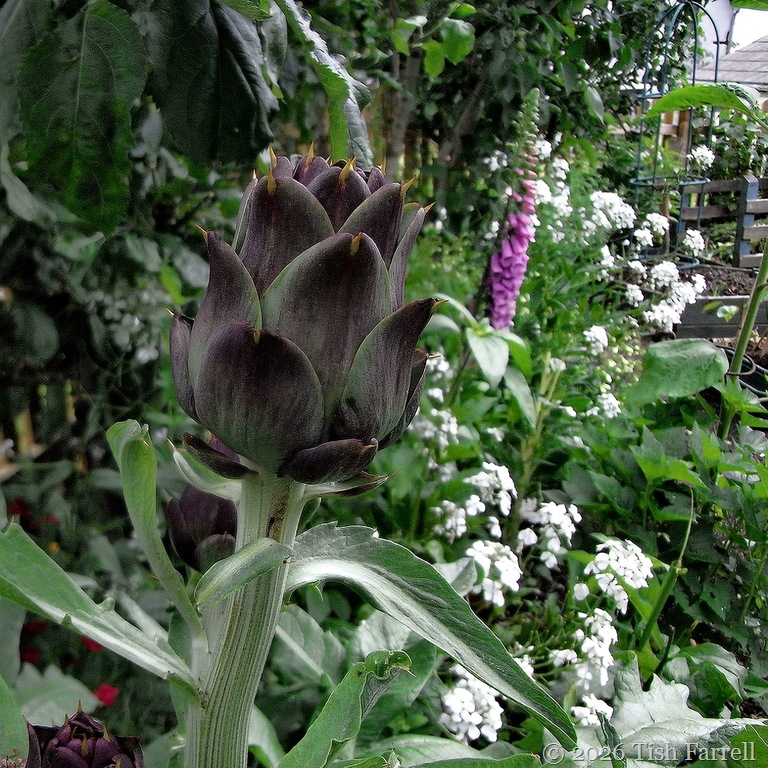
Also in the bottom border is a a purple headed variety. It’s strikingly ornamental growing alongside the sweet white rocket and foxgloves.
***
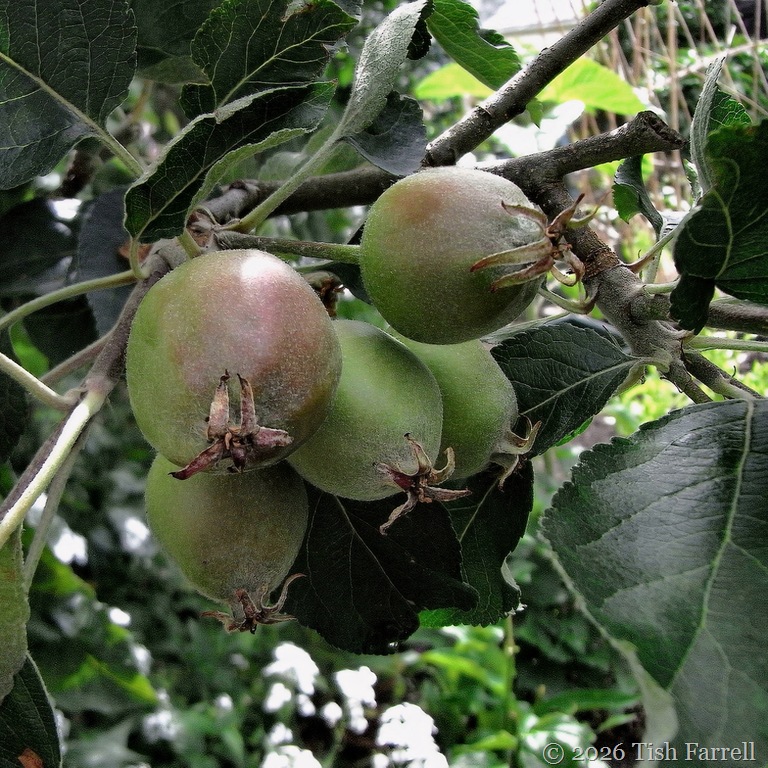
While I was inspecting this end of the garden, which takes some doing, what with the mammoth size of the artichoke leaves, I was pleased to see that the neighbouring old cooking apple tree looks to be bearing far more apples than we were expecting. The blossom came and went so fast in cold and windy weather, it seemed unlikely that much of it would be fertilised. But not so! We don’t know the variety, but the fruits are big and rose blushed and need no sugar when cooked.
***
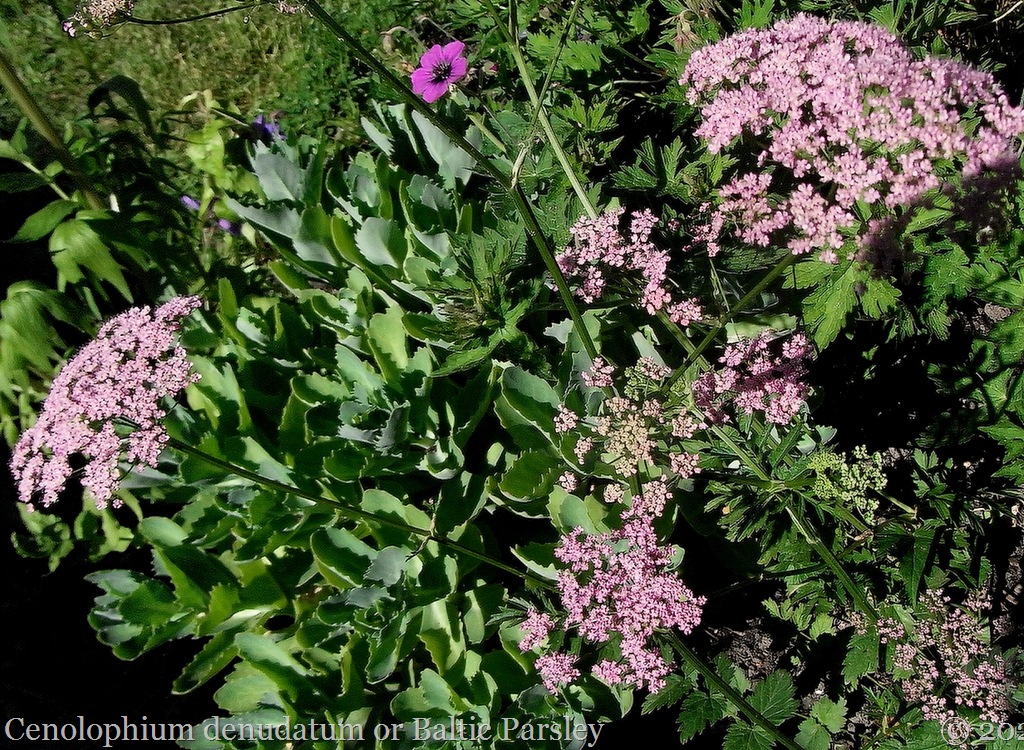
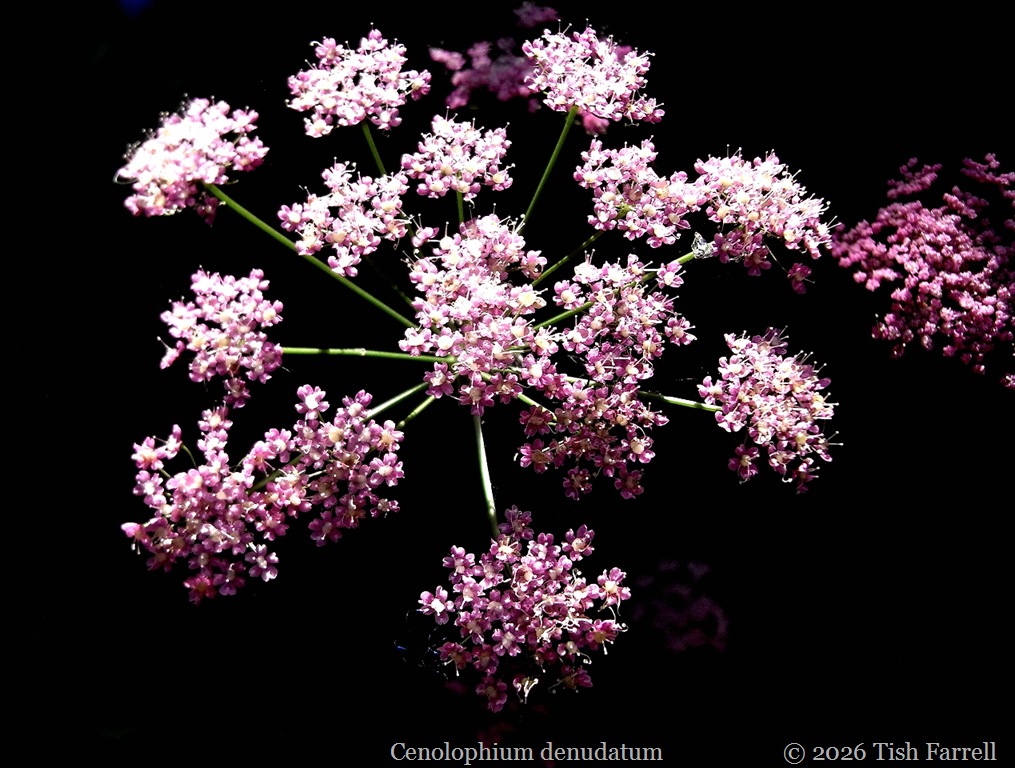
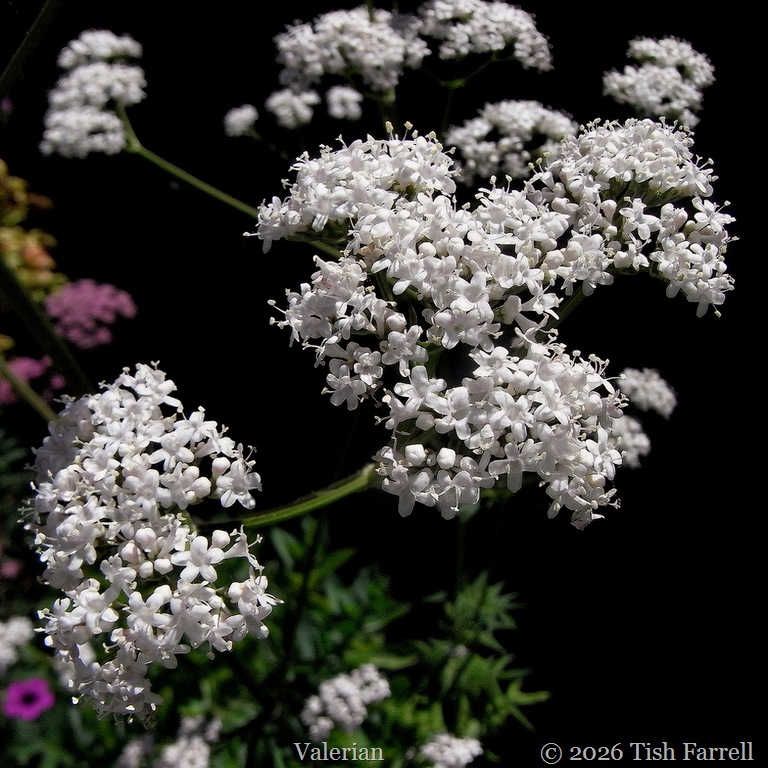
And now back to my new favourite, as mentioned in two recent posts – Cenolophium denudatum, aka Baltic Parsley. Coming up is the version I have already settled in the bed along the top of the terrace wall. It grows rather like Cow Parsley/Queen Anne’s Lace, and indeed it was supposed to be white, according to the Great Dixter Nursery catalogue. Mine, however, turned out to be pink. I don’t mind. It looks good with the valerian whose massed umbels are hint-of-pink white.
***
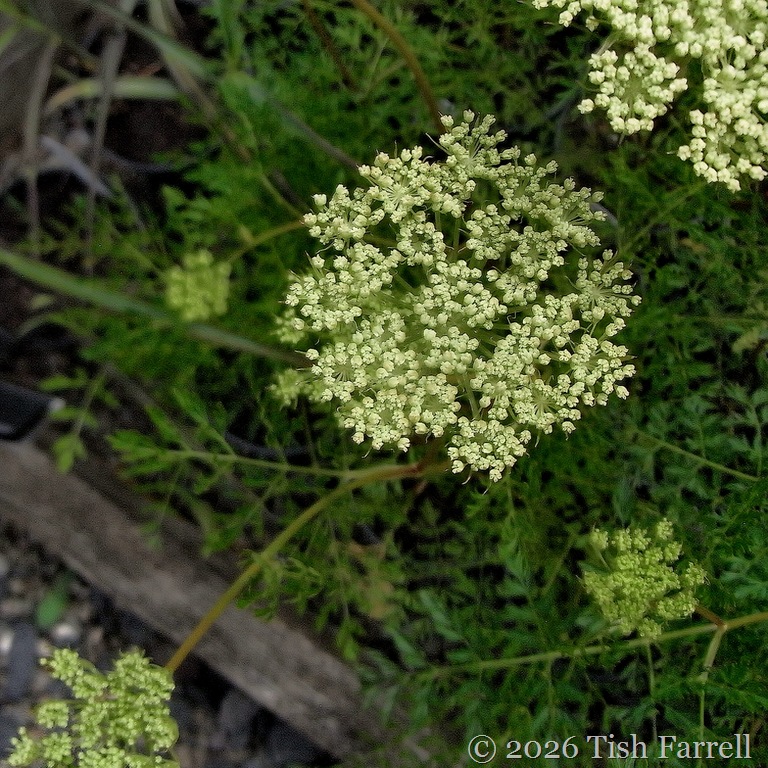
But then yesterday we were having a splendid day out in the walled garden at Wildegoose Nursery in the Corve Valley. And there I found a pale lemony version. It had to come home with me.
***
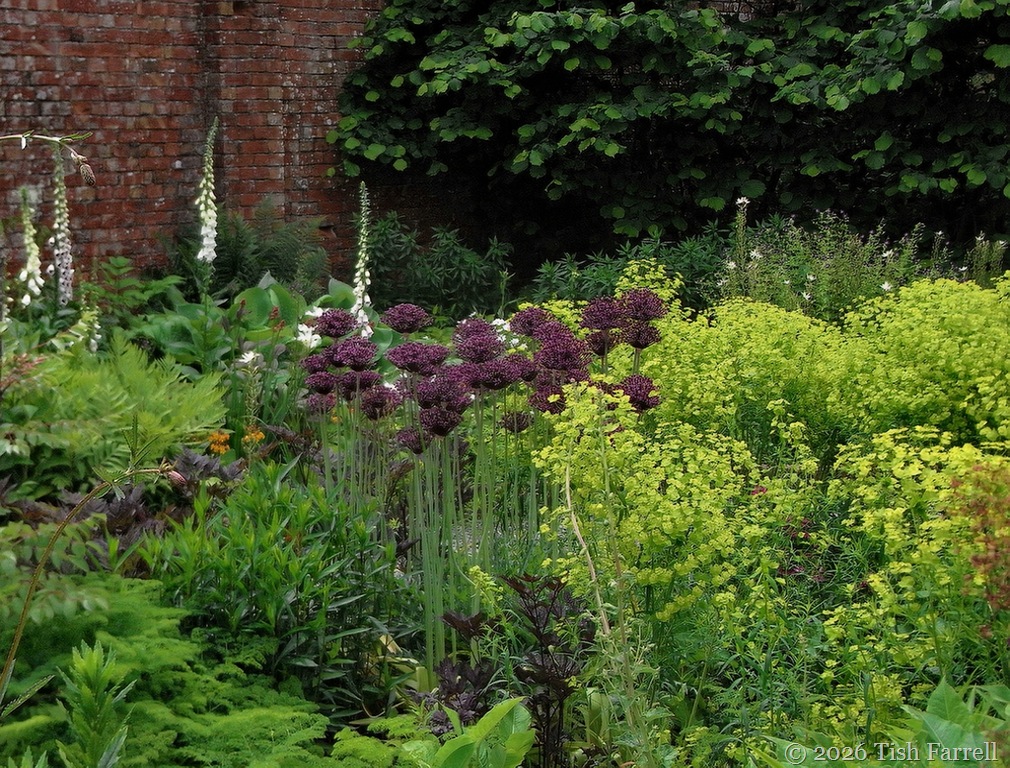
And to finish a shot of Wildegoose walled garden where I discovered it (along with a dozen or three other plants that roused acute spasms of gardener’s greed).
It’s been pretty darn hot this week in Shropshire, but nearly 9 degrees cooler now. On the whole, the garden, the gardener, and the gardener’s other half have weathered the sudden roasting, but the water butts are empty, one or two plants are looking frazzled, and the hot days have finished off the lovely ranunculus which, until last Saturday, had been blooming wonderfully, making the most of the long, cool spring. Also, some flowering plants like the Perry’s Blue iris, came and went very swiftly, while over the hedge, hawthorn tree’s blossom fried. We now have siftings of crisp brown petals everywhere.
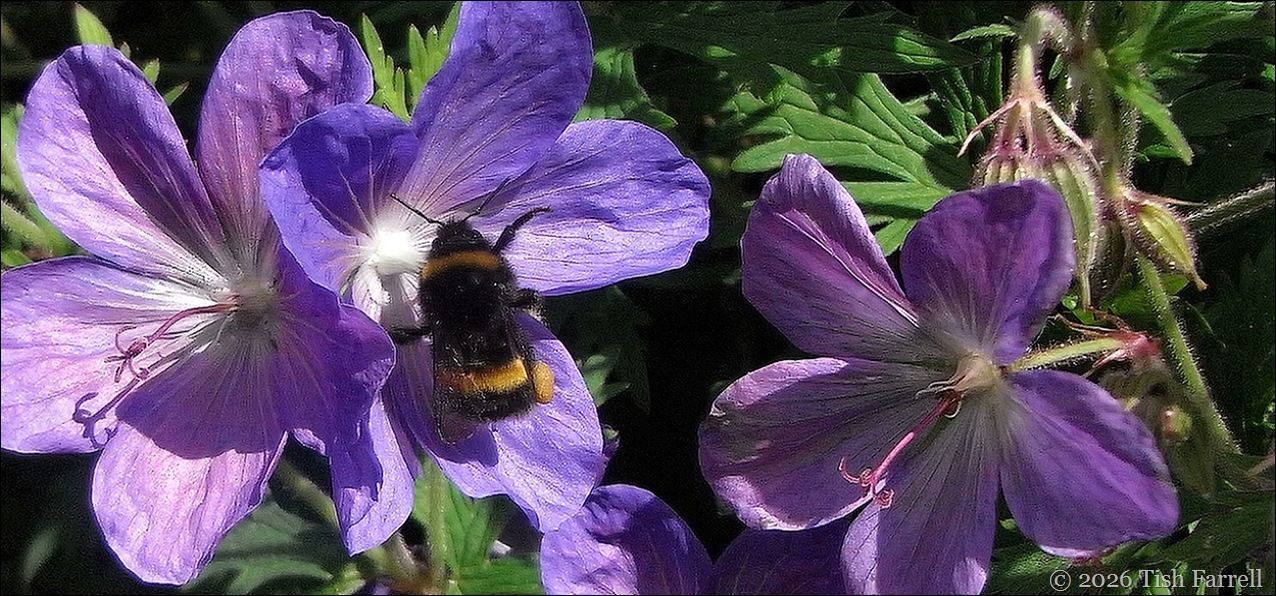
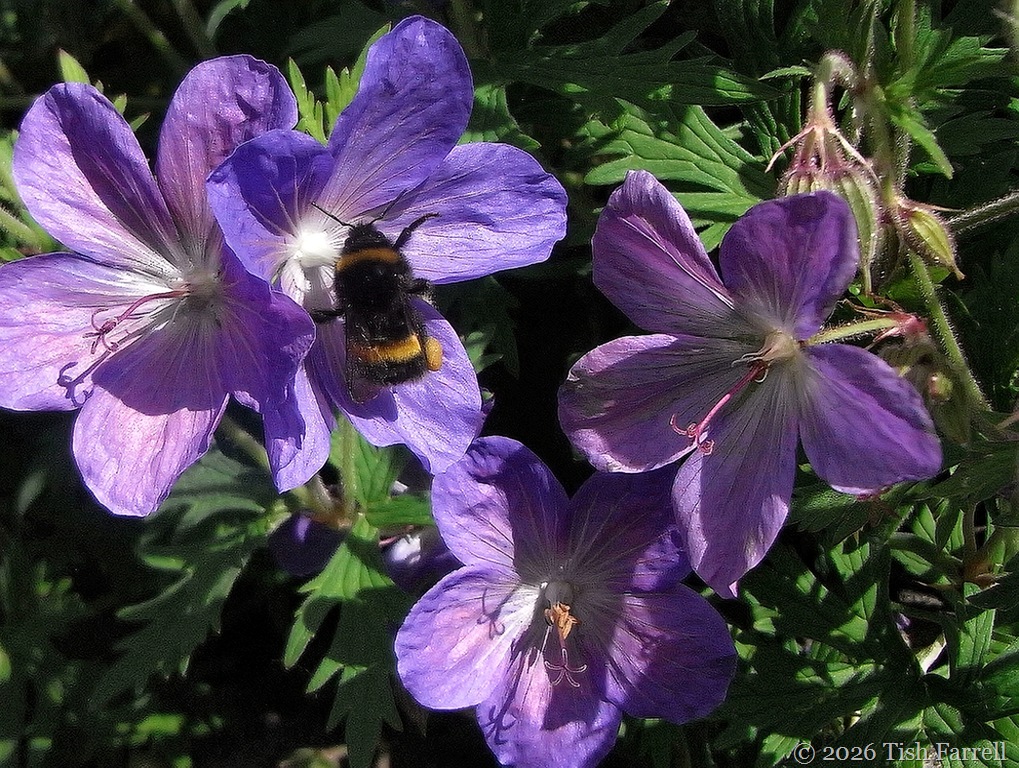
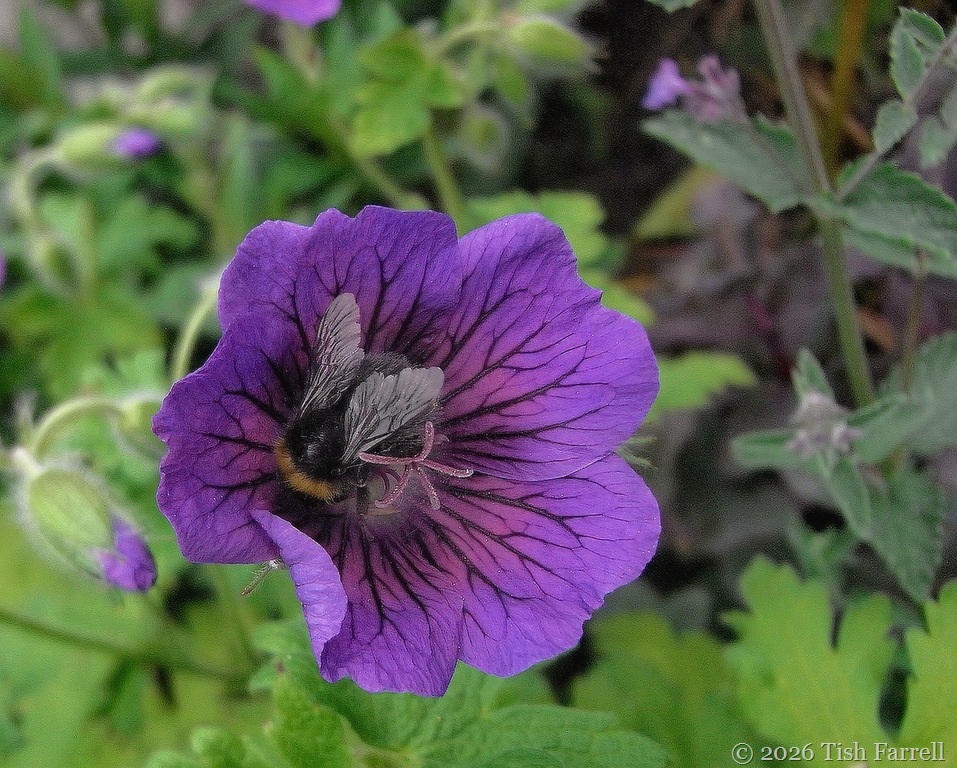
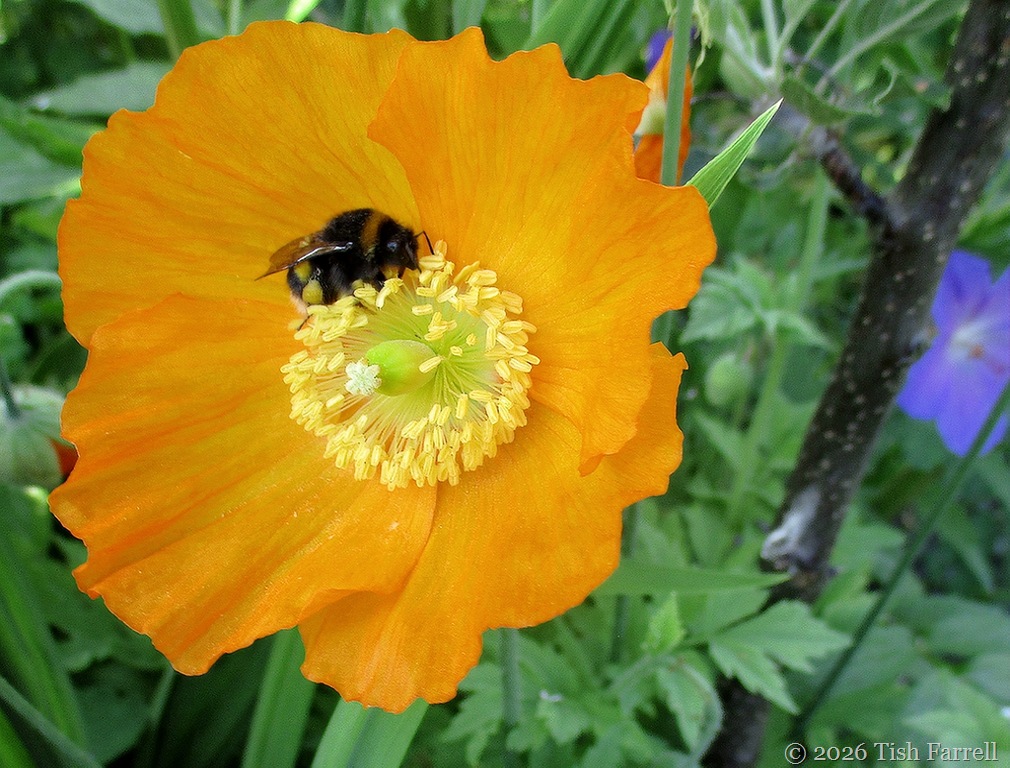
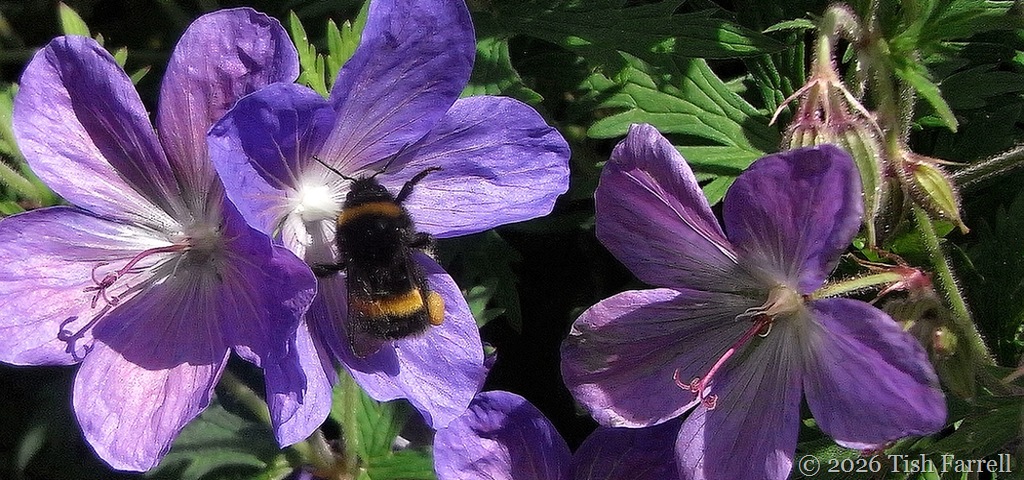
One real hot-weather bonus is that the bees (1), worryingly absent earlier in the month, are now back in the garden, feeding voraciously on the hardy geraniums, Welsh poppies and foxgloves. They seem to be making up for lost time.
***
In the back garden border the umbels (2) are the rising attraction. I’m always pleased when the valerian starts flowering, but this year it has a companion, one very like it, if more pink and more sweetly scented. Its common name, Baltic Parsley, sounds most unpromising for such an airy, delicate plant, but then this is hugely preferable to its tongue-twister botanical title of Cenolophium denudatum . I bought two young plants on-line last autumn from Great Dixter Nurseries, whose curated collections are altogether too tempting for the ever greedy gardener.
***
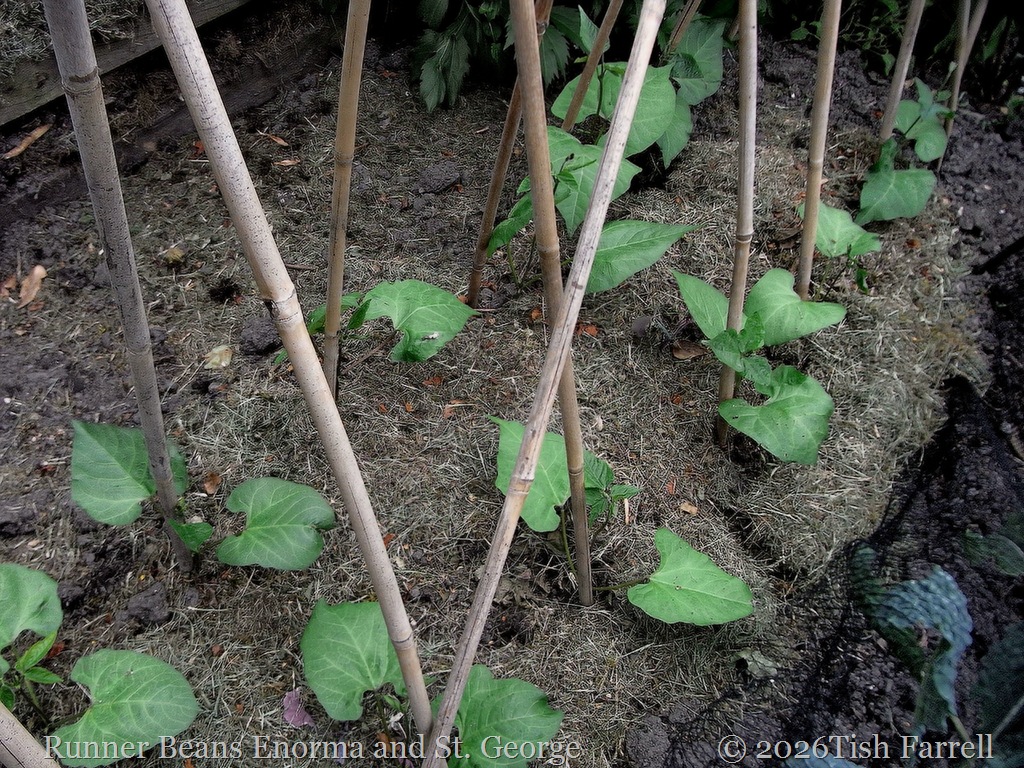
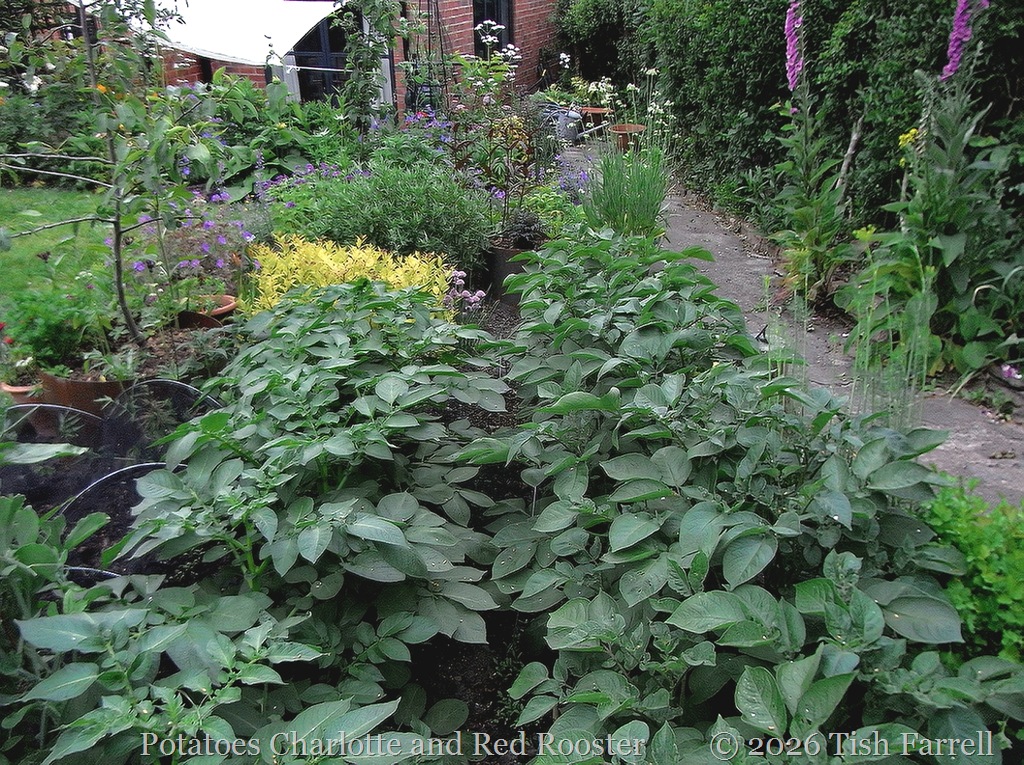
This year I’ve decided to rein in the vegetable growing (3). Limited space is one factor, but the main reason is not liking all the ugly netting defences needed to keep the pigeons and sparrows from eating everything. I’m still growing herbs, salad stuff, carrots in containers, a couple of rows of potatoes, some strawberries and raspberries, tomatoes in the greenhouse and also beans – all of which don’t need too much if any protection.
For several of the hot days I dithered about whether or not to plant out the large runner bean seedlings. In the end I decided it was better for them in the ground than drying out in their pots. I surrounded them with an emergency mulch of grass cuttings. Our neighbour had kindly just deposited a load over the fence and into our compost bin. I don’t usually use them for mulching, not wanting either crusts or a smelly, squidgy pan, but they soon dried out and the blackbirds have since been turning them over.
Meanwhile on the other side of the garden, the potatoes are looking pretty good. The Charlotte row is thinking of flowering.
***
And talking of mulch, my number (4) this week is a shout-out for the benefits of applying Strulch. This is very much for the small-garden gardener who doesn’t have access to masses of home-made compost. It’s a mineralised fine straw that comes in easy-to-move 9 litre bags. Last autumn I bought 2 bags and spread them over the two front garden beds, spots that are both exposed from the north in windy weather, but also sun-traps during heat-waves. There was still enough strulch left over to scatter less generously around some shrubs in the back garden. The stuff is not cheap, but you can find good deals on-line.
Apart from anything else, I’ve hardly had any weeds, and the herbaceous plants are emerging nicely to do their early summer stuff. I covered the entire soil surface, about an inch/2 cms deep.
***
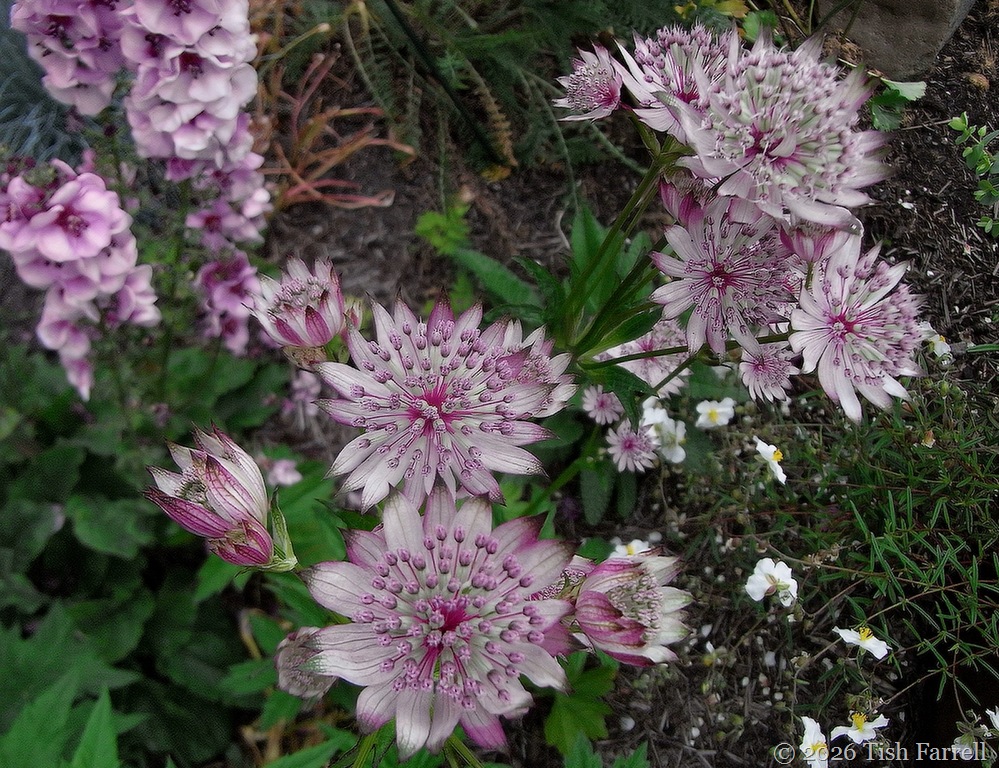
From left to right: Helianthemum Wisley White, Astrantia Sparkling Stars middle, Verbascum Lavender Lass front. And a closer look at the Astrantia. Isn’t she lovely?
***
Not everything is going so well. Unseen pests (5) have been busy, most notably in the sweet peas, amongst which something, probably pigeons, have been gnawing off whole chunks of stems. For once, I’d grown some pretty chunky plants, and put them out early to grow up obelisks. But once they started growing, large parts began to go missing. I still have some flowers, but it’s not the display envisaged. I’ve never had this problem before, and can’t think how to protect them – i.e. that won’t end up in a big tangle of netting. (Note to self. The obelisks are probably the problem. Ideal perches for pigeons).
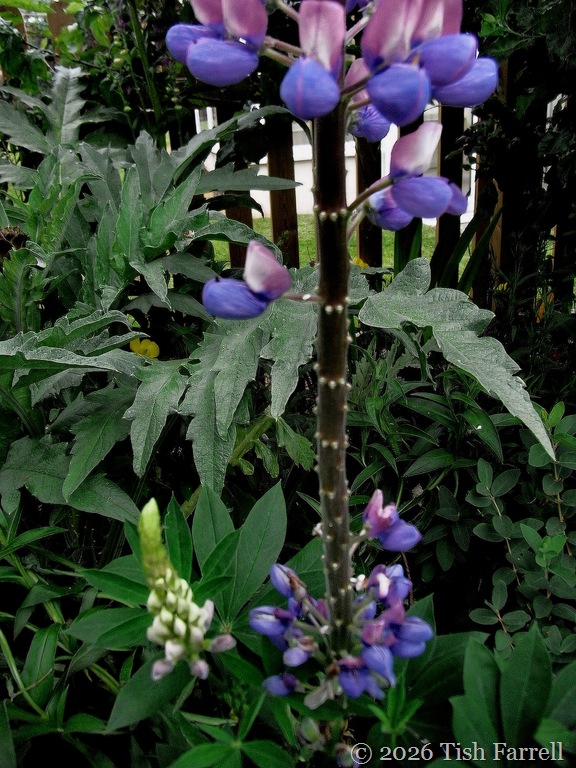
The other casualty, one that’s ongoing despite moving the plant to different locations, is the lovely blue-mauve lupin. Something keeps stripping the flowers. One minute they’re there, and the next time I look…
***
But to end on a high note, and a deliciously fragrant one too – Cornelia Rose (6). She burst into flower this week. More power to her little pink petals. She’s growing by my greenhouse so I see a lot of her.
Copyright 2026 Tish Farrell
Six on Saturday Despite the heat-wave down in Cornwall, host Jim has some spectacular things on show in his garden, to say nothing of the magnificent Poplar moth in the greenhouse.
I can well understand why small beings like blackbirds need to keep stoking up with fresh food supplies. Not only are there chicks to feed, but our spring days persist on the frosted side of chilly. He who is currently casting his own coping stones for the terrace wall tells me that the high pressure over the Atlantic and low pressure to the north and east is causing Arctic air to be sucked down upon us, thus creating the UK’s coldest May in five years.
And the upshot: the winds that the weather people have been telling us are ‘fresh’ have been, and continue to be bone piercingly frigid. Nor does it help that our street is aligned due north, thus greatly facilitating the funnelling of icy blasts to our doorstep.
In consequence we’re still in winter woollies. Also, we’ve continued to keep the hedge bird feeder well stocked with fat balls, this on the grounds that the sparrows et al still need energy for gathering food for their young. They’ve certainly been getting through them.
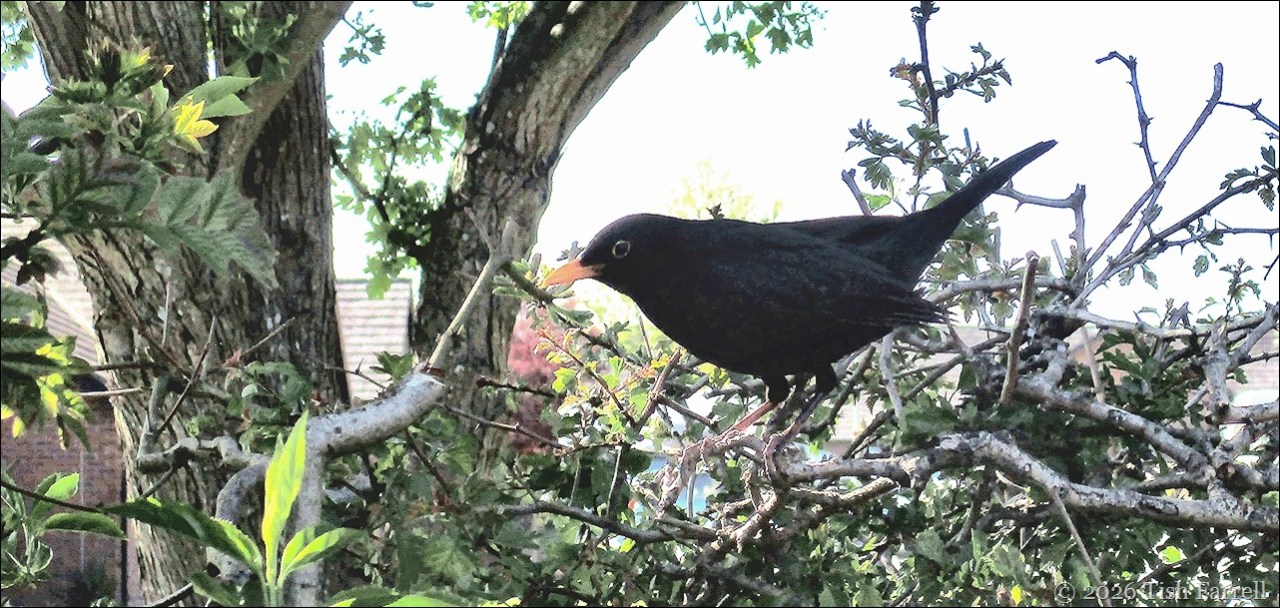
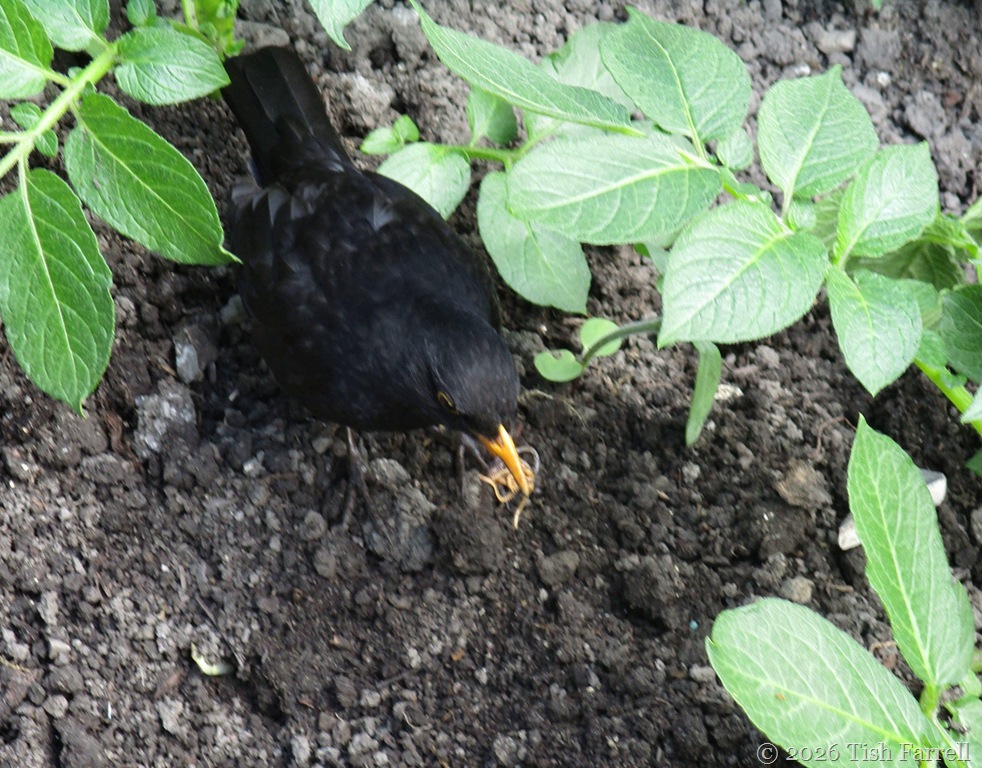
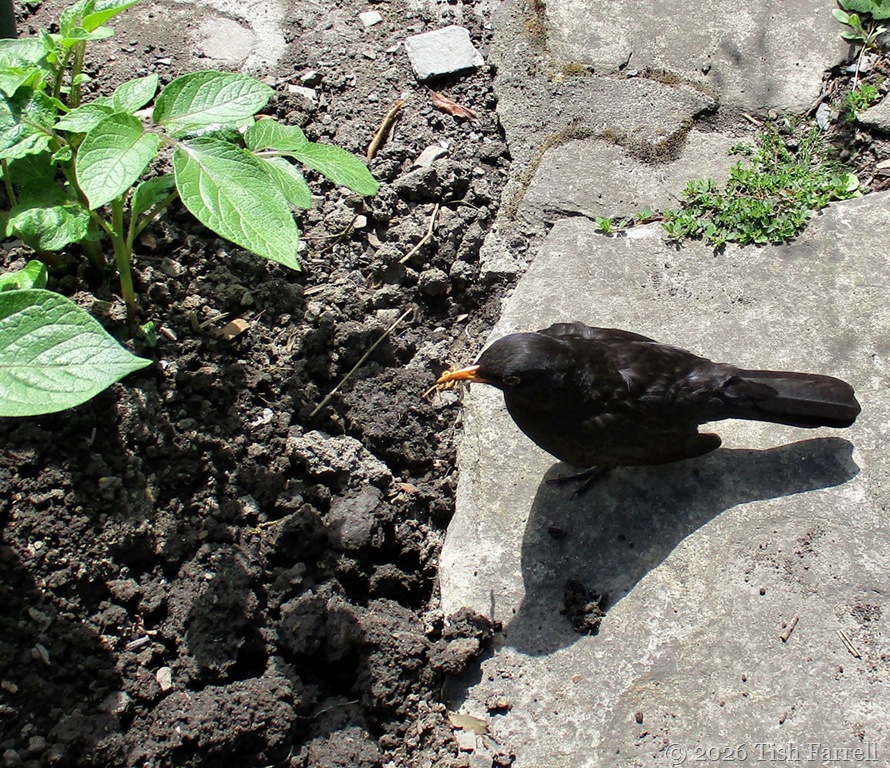
Out in the garden the blackbirds have other strategies. This male blackbird starts chivvying me the moment he spots me. If I don’t respond at once, he moves in very close, finding a perch whence he can fix me with those beady eyes. And if this still doesn’t receive the desired response, he starts shouting.
And I must say, I do feel a touch affronted – to let myself be bullied by a small bird.
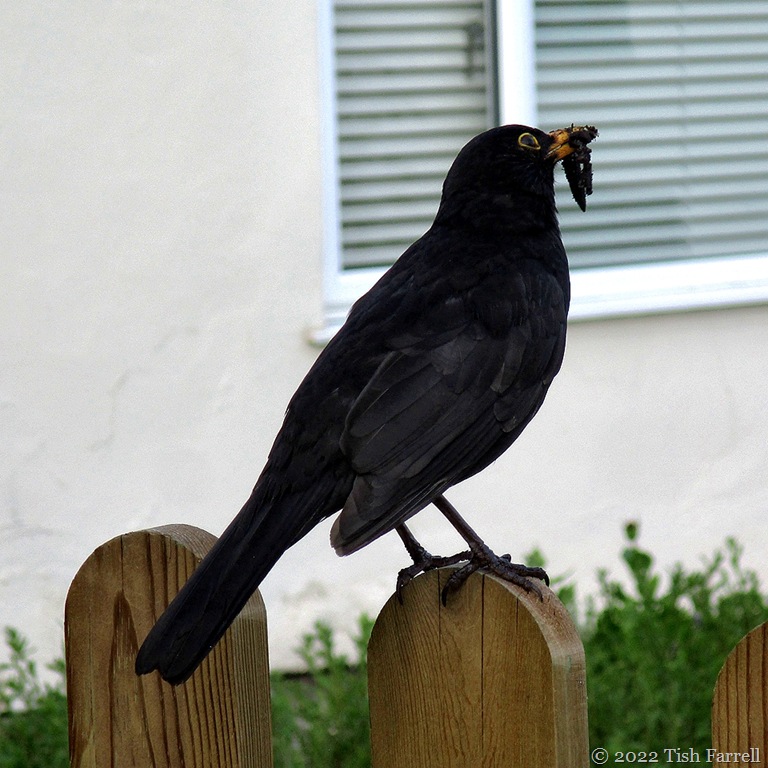
But needs must. The other day when I started earthing up the potatoes, both mister and missus swooped in, combing through the disturbed soil, chuntering in tones of unalloyed blackbird ecstasy. I have yet to spot exactly how they manage to hoover up quite so many small worms in one beak full. It all happens so fast.
[Spoiler alert: not for the squeamish.]
*
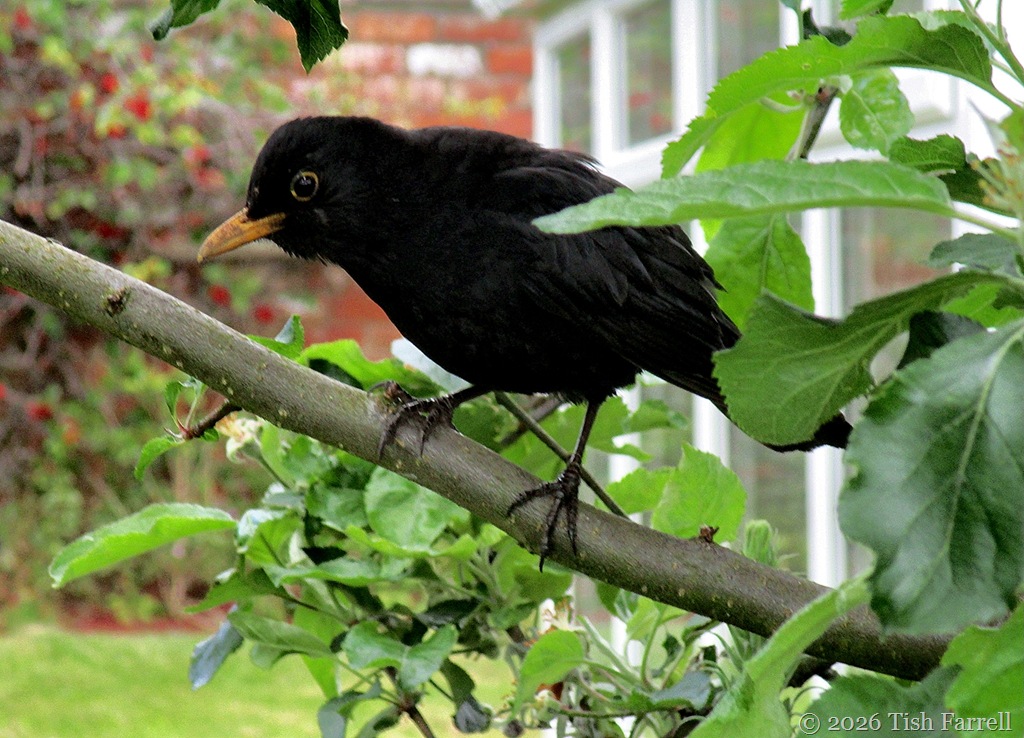
This morning I spotted the male in the apple tree, not far from my left ear. As ever he gave me the eye. The rain had moved in and I was late on parade. But today it seemed he’d managed to gather his worms without my intervention. More surprising though, he also managed to give me song without opening his beak. No worm was lost.