
There’s not much happening in the home garden this week, but wonder of wonders, we have some serious rain. After two months standing empty, the water butts are brimming, and every watering can is full. And so comes the dilemma: lots of rain still coming and nowhere to store the excess; nor any need to use it outside the greenhouse. At least for the next week.
Anyway, this still has me thinking about cultivating a more drought-resilient garden, and so prompted by last week’s return visit to the Wildegoose walled garden (last seen in late June),and see how the nursery’s extensive herbaceous-ornamental grass borders have fared without rain.
I should perhaps explain that Wildegoose (location in Munslow in South Shropshire’s Corve Valley) is both a specialist nursery (for violas in particular) and is also a garden attraction in its own right, complete with a very pleasing cafe that makes use of the kitchen garden’s fruit and vegetables.
This leaves a very large portion of the walled garden which is given over to herbaceous plants and ornamental grasses (especially Calamagrostis and Miscanthus species), with different areas framed by paths, sections of hedging, some statement shrubs and small trees. There is also a fabulously restored Georgian glasshouse.
With such big spaces to cultivate, the schemes have been devised with much emphasis on height and visual structure. Plants are left to go to seed over the winter, with the further objective of tracking particular plant responses to weather extremes.
N.B. These areas are not watered during the growing season.
*
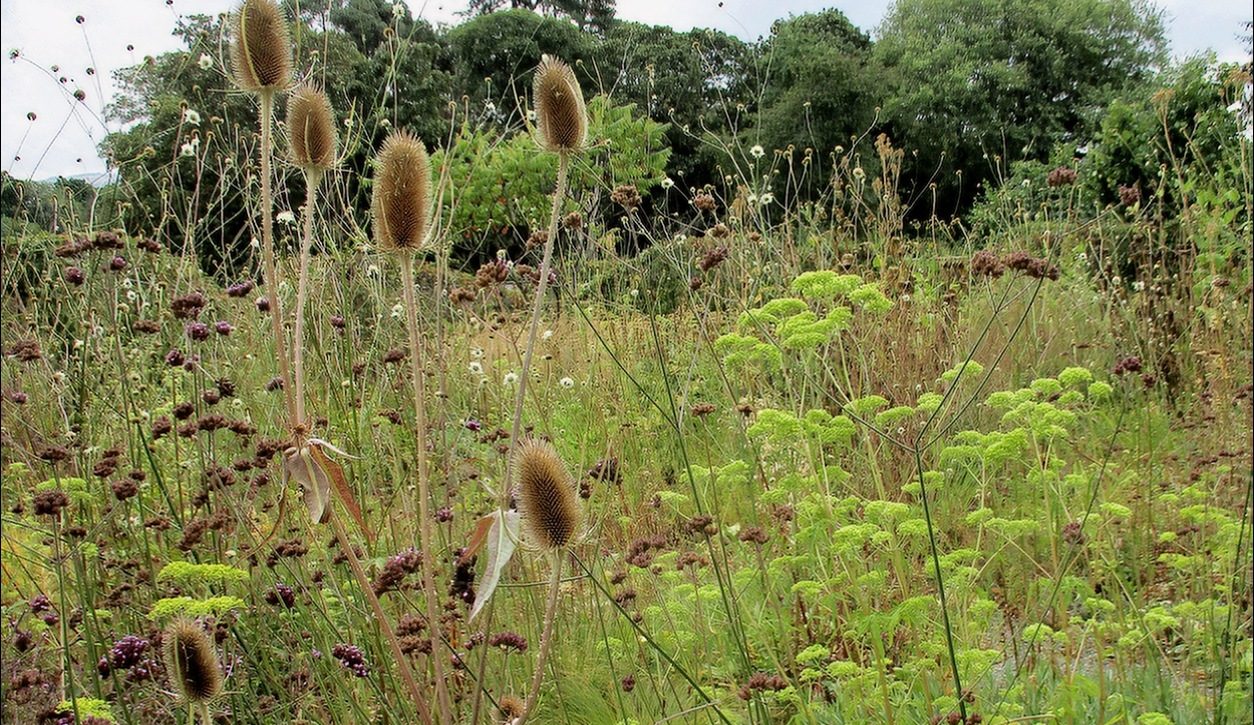
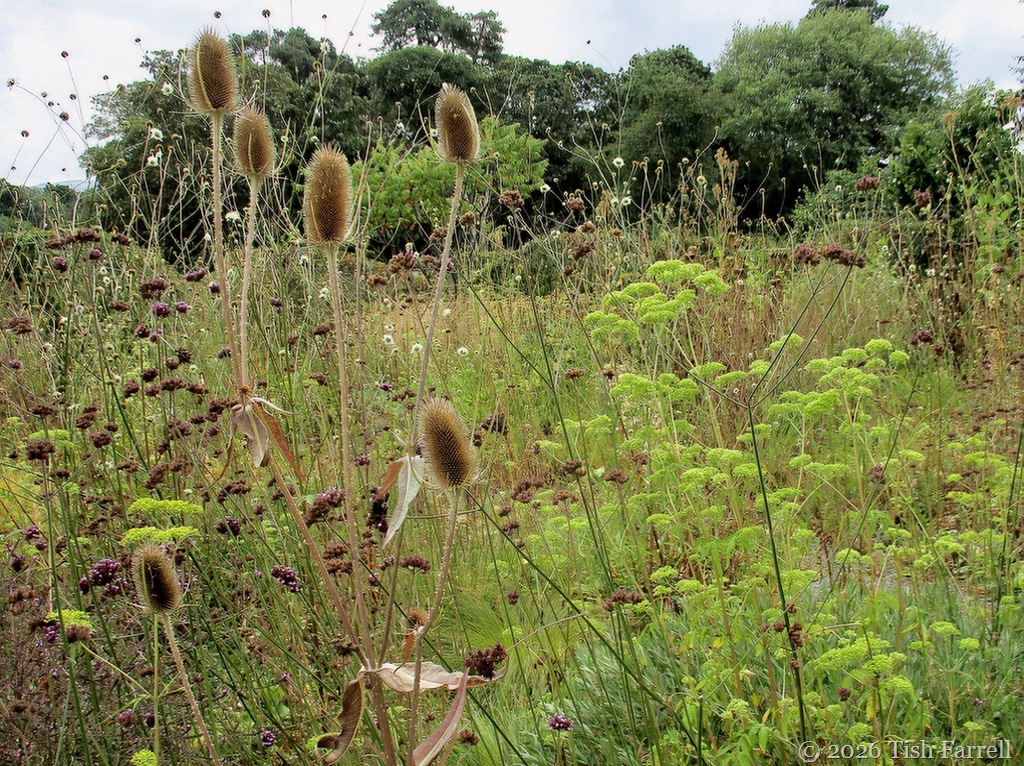
When we arrived a week ago (21 August) it was clear some plants had truly suffered. All the phlox, for instance, had been cut down. But there were also many picturesque, dried-on-the-stem ornamentals like the teasels in the header photo. Gone-over eryngiums of several varieties also added to the general look of scenic desiccation. Likewise the seed heads of many varieties of allium (especially Drumsticks), dark rusty spires of foxgloves and the tall wafting stems of giant yellow scabious Cephalaria dipsacoides. And then there were the many grasses, short and tall. All added to the gentle soundscape of breeze-in-the- leaves.
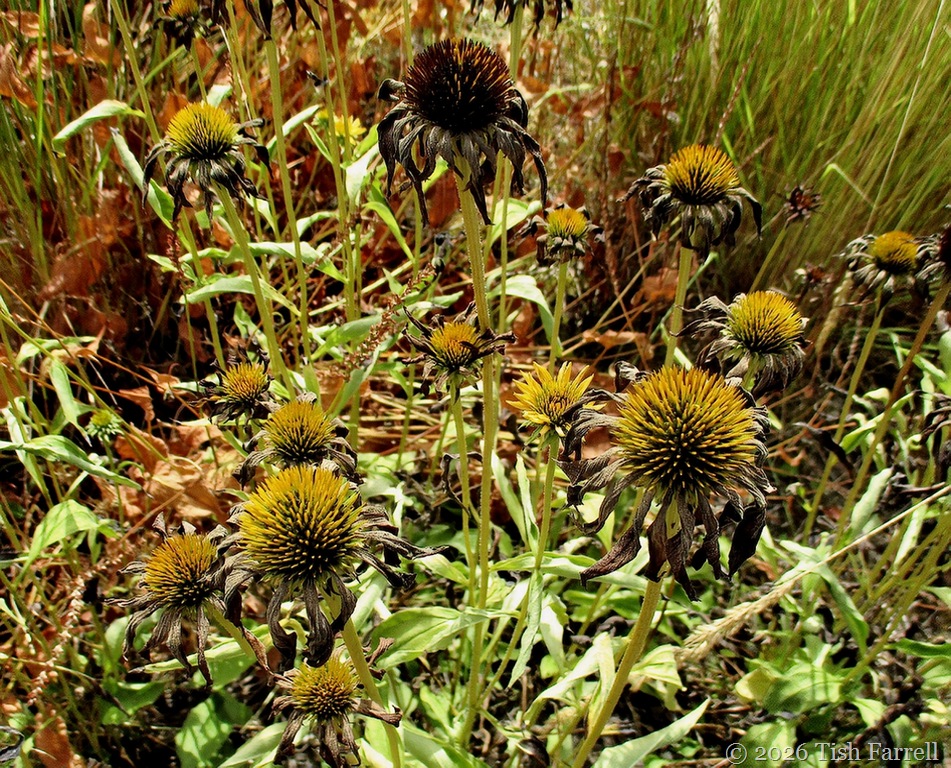
As we wandered up and down the paths, the dead-head coronets of Echinacea Leilani (1) caught my eye. Such smouldering looks in decay.
But it was the surviving and thriving that most interested me. In one quarter of the garden several Gaura were looking especially wonderful, outspread graceful stems of airy blossom, with nearby clumps of evening primroses and tall euphorbias that had clearly been putting on a good show, some flowers still remaining. Then there were the Verbenas, especially, bonariensis and hastata, and the Rudbeckias maxima and fulgida still going strong.
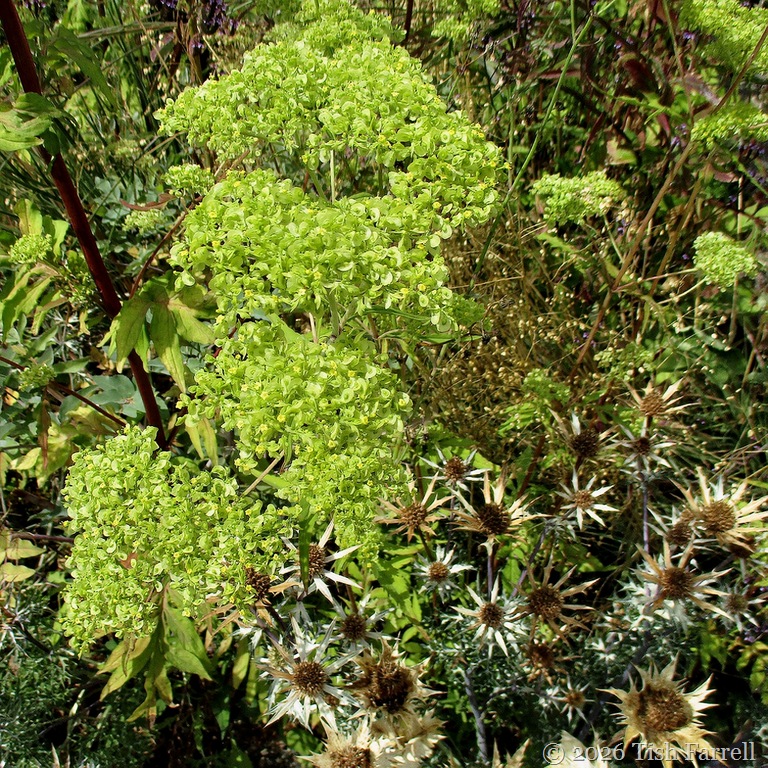
Unsurprisingly, many thrivers had Mediterranean origins. One, in particular, the umbelliferous Patrinia (2), particularly stood out and up among the grasses. It has been allowed to self-seed throughout the garden, the stems stately and self-supporting, some flowerheads a sprightly apple green (also see header photo), others going over in a haze of pale gold.
Here it is keeping company with some very crispy sea holly:
*
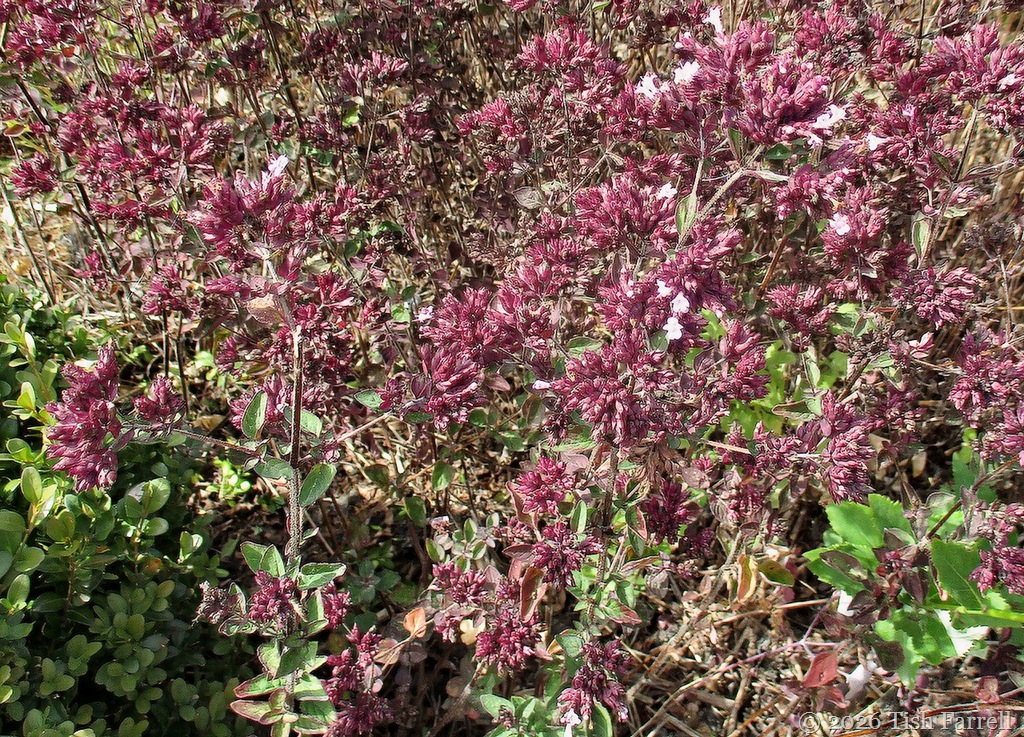
Other happy plants included various members of the origanum family. I succumbed to a pot of Oreganum Gentle Breeze (3) on the basis that you can’t have too different varieties, and they work well in a small garden.
Gentle Breeze appears to be a later flowering variety and was still a mass of dark purple buds.
*
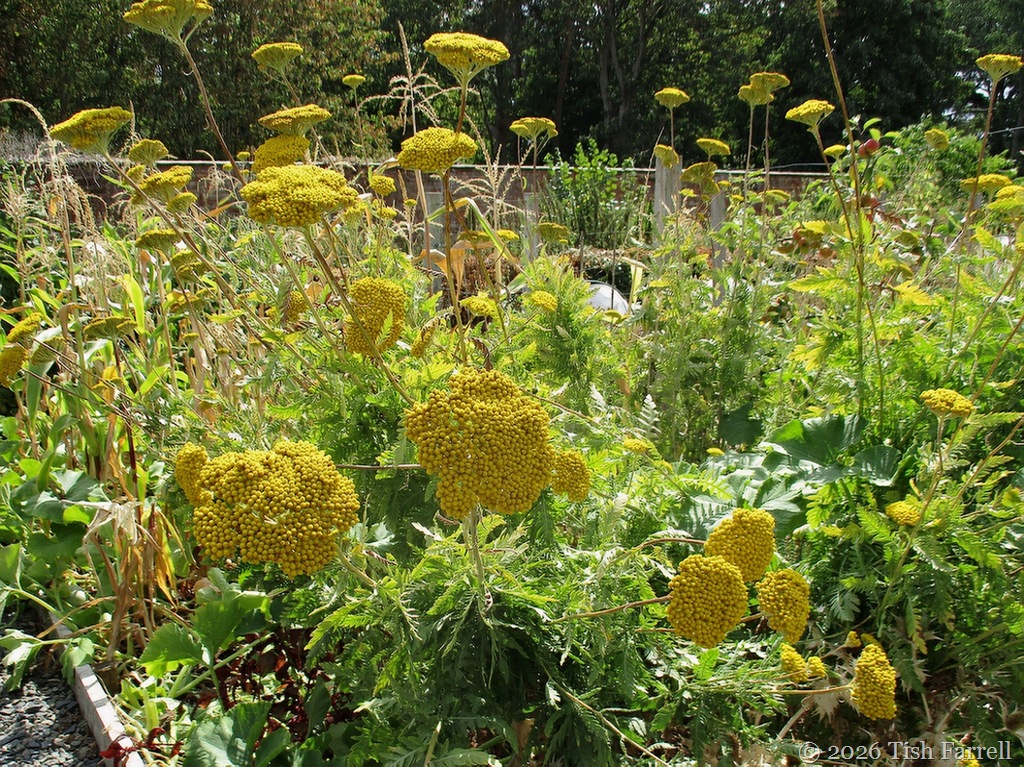
And then there were the Achilleas (4) – Filipendula Cloth of Gold drying nicely beside the vegetable garden…
…and then the very creamy faced, in her prime, Hella Glashoff…
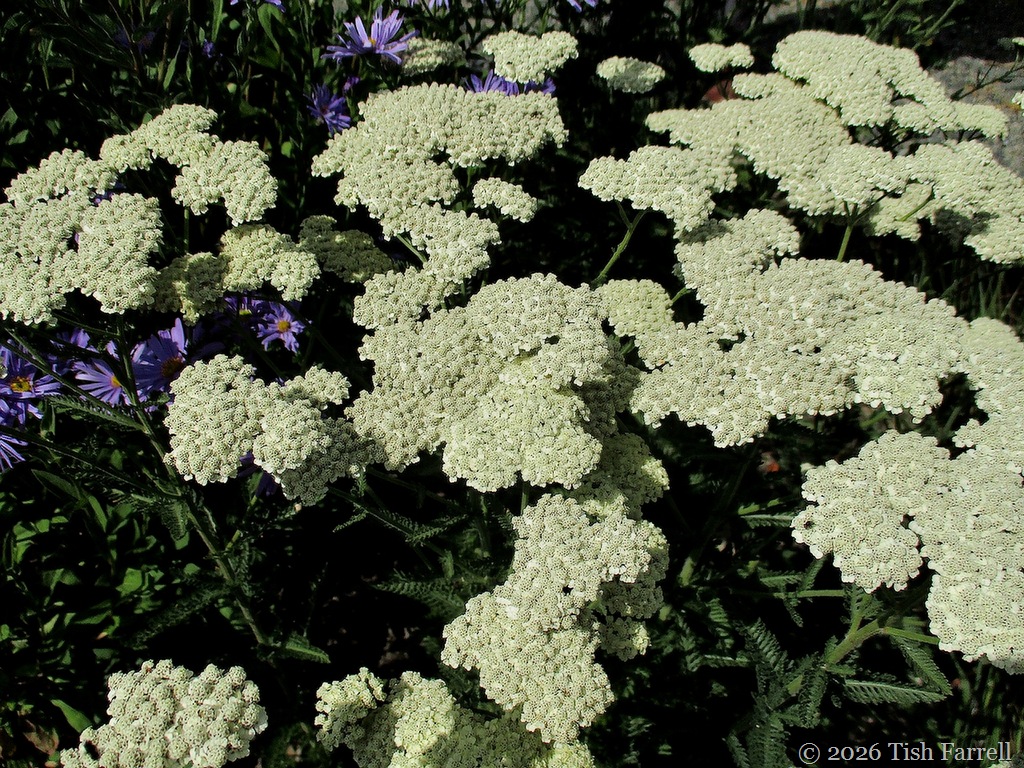
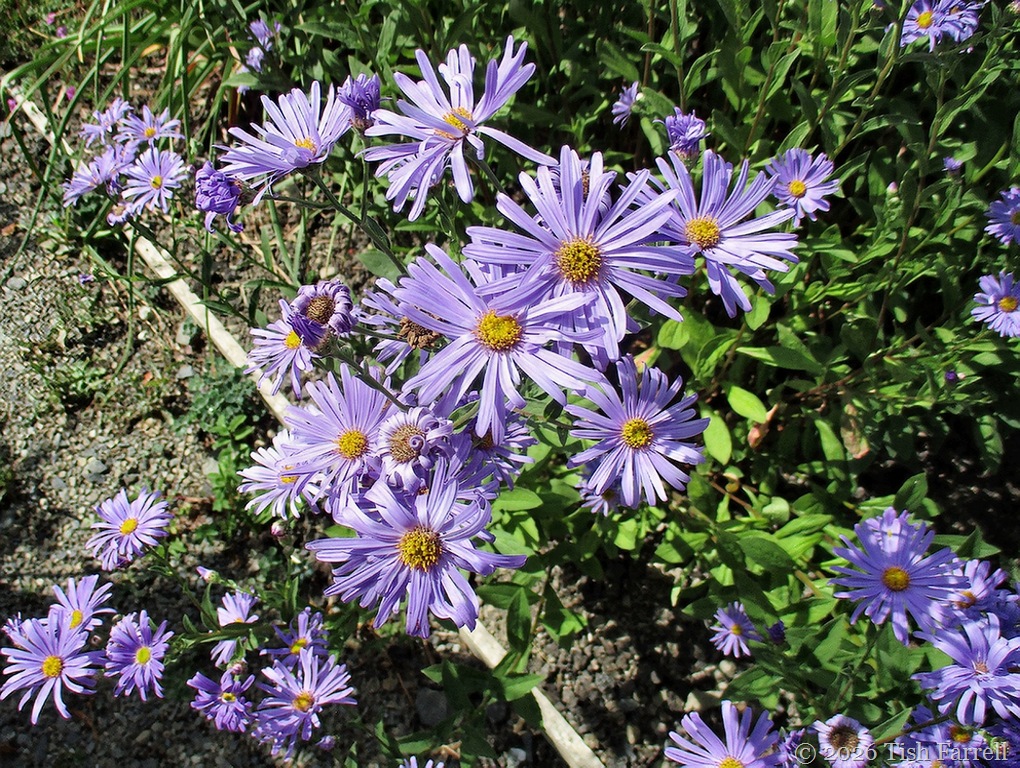
…seen growing alongside some flourishing Asters, probably thomsonii or x. frikartii Monch (5):
But the over-all winner for its vibrant colour and seeming late summer staying power has to be the Persicaria/Bistorta amplexicaulis (6). There were at least two varieties, the most striking probably the Amethyst. I think this is it in the next photo, shown to great advantage with a backdrop of just-opening golden rod (probably Little Lemon). What a glorious late summer combination.
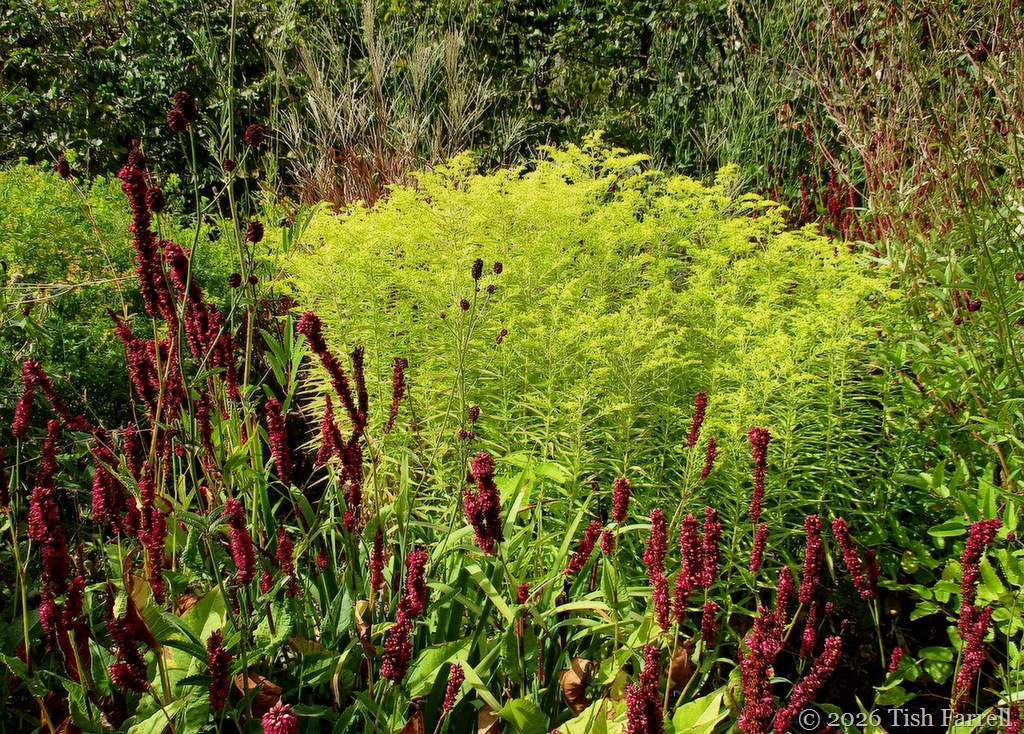
And to finish, another longer view. These particular borders are very well mulched:
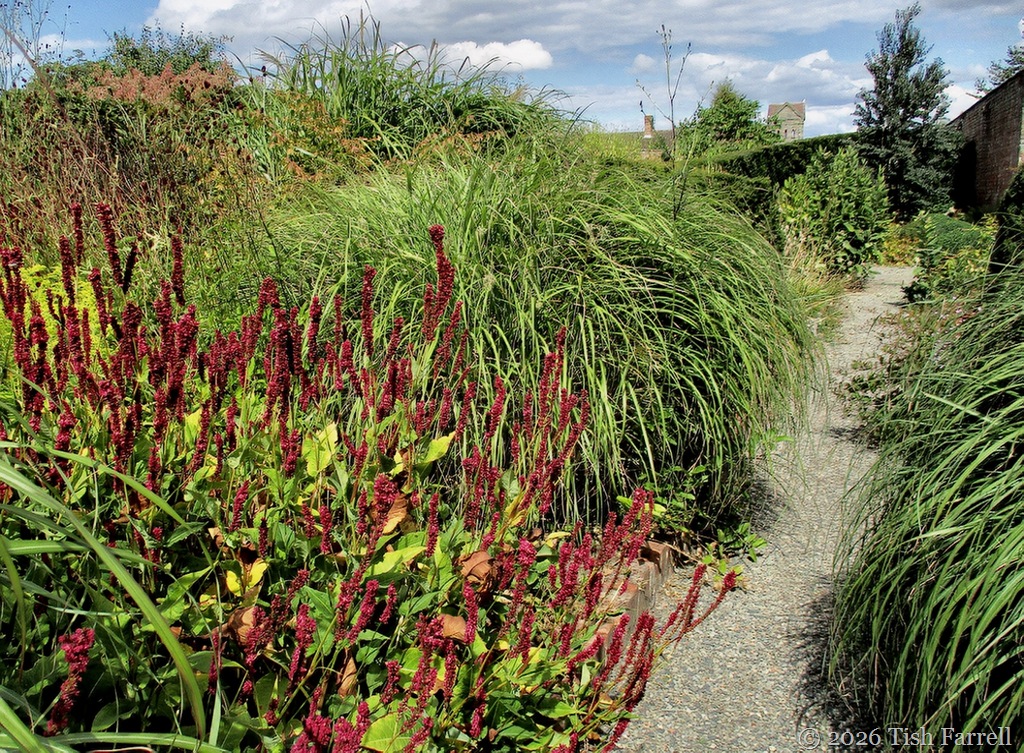
Copyright 2026 Tish Farrell
*
Six on Saturday Over at Garden Ruminations Jim is assessing the good and bad of Cornwall’s rainless summer. But the best news is: he has hedgehogs!

I like the sound of Wildegoose, one for my list should I ever be in the area. Lovely achillea and patrinia, some nice planting combos and a cafe too!
It’s a v. engaging enterprise in a very lovely part of Shropshire. Opening mostly in the growing season, apart from possible odd weekends out of season. And if you can’t visit, the website shop is anyway worth a scan.
Oh, I’ll take a look …..
Marvellos – some seed heads can be most attractive
They can , Sue. Thanks.
Looks delightful, I must admit that I am loving the grasses in my own garden. Unfortunately I have never managed to grow / overwinter Achilleas (though the wild yarrow is happy enough) or Gaura. It will be interesting to see what affect the winter wet has on those drought stricken plants.
Yes, the effects of one extreme to the other – how will it turn out? At Wildegoose a lot of the prairie planting is on deep gravel, and then the beds are heavily mulched. And of course it was pretty dry for much of last summer as well. They have their own microclimate of course with the high surrounding walls.
That’s probably what I should have done. Removed the topsoil and put in a deep layer of gravel before replacing the topsoil. Better drainage, though my soil is very stony which you would think would help.
I think it really is hard creating the best planting medium. I lost some things during last winter, and yes, I’m sure it was the continual wetness. Our soil is quite heavy even with the added remains of broken roof tiles (from the re-roofing) and old mortar from removed paving stones.
It’s amazing how nature survives. We are getting some needed relief from the triple digit F temperatures we’ve been having–in the high 90s and 80s F. With autumn on the way, we should see some weather change.
Good to hear the temps are going down, though it still sounds too hot for most of us Brits.
It’s beautiful this morning–sunny, breezy and cool. Wish it would last!
Thanks for this review, Trish.
We have had unusual weather but, for the first time in 16 years, we have had the rain which used to be normative. Phila has a new garden close to city center designed by Piet Oudolf, the Dutch landscaper whose garden designs are a joy throughout the year. We have spoken of him once before and he comes to mind now again because it is likely that he also has thought about the effect of changing weather. He may have advice to gladden the eye. Good luck to you and your heartening work!
Thanks for the Piet Oudolf reminder, Sarah. I recall seeing his work featured in the High Line NYC. He also worked with UK Beth Chatto, doyenne of the dry garden. Her granddaughter still runs her business with v. informative newsletter.
Good to hear you’ve had some rain. Perhaps it was ours 😉
I gather our tilting planet has some (maybe considerable) effects on weather patterns.
There’s always a way, Tish xx
Yes, my way of thinking too 🙂
This looks an interesting garden to visit – one to remember if we’re ever in the area. The planting reminds me a lot of the new Queen Elizabeth II memorial garden in Regents Park which has been designed to be ‘climate-resistant’.
It’s a lovely spot, Corvedale.
Teasels! I’ve not thought about those in ages. When I was a tad, every year in the autumn we’d have a craft project at Sunday School using Teasels. Great post! pp
Thanks, Pam, The teasels are wonderful to look at, both in flower and as seed heads, but they are rampant self-seeders and quite hard to evict 🙂
I love the effect of the planting in your header but it seems to me it needs to be done on quite a large scale and in an almost completely unshaded area. I get the impression you are coming to see beauty where you might not have in the past, “Such smouldering looks in decay”; me too, up to a point.
Thanks for that thoughtful response, Jim. I agree about the need for scale for this kind of planting, though it’s made me think a bit how can use certain plants for a more wafty/height varying effect. (I will resist the notion of digging up the entire back garden which has hardly any shade!) But yes, learning to look with fresh eyes. There is always something new 🙂
This looks like a beautiful space to visit! And I think it’s a great idea to feature the plants that best survive the drought. I love Persicaria and Achillea, both of which have thrived in my own garden this summer, too.
All about looking on the bright side I guess, Kathrin. Good to hear you have some happy plants 🙂
We’ve noticed many plants which have somewhat weathered the heat on our recent travels through UK gardens. Your garden looks like it’s held its beauty.
Nature can be very resilient.
It is, Jennie. More than we often realise.
Many thanks – we’ve known of Millichope for some time (passed it many times) – a reminder that we need to pay a visit.
So pleased to hear I’ve provided ‘a nudge’, Geoff. You need to check the website though. It’s not open every day and it does close for the winter.