Bunting, Banners, A Zip-Up House…?

IMG_3860ed1

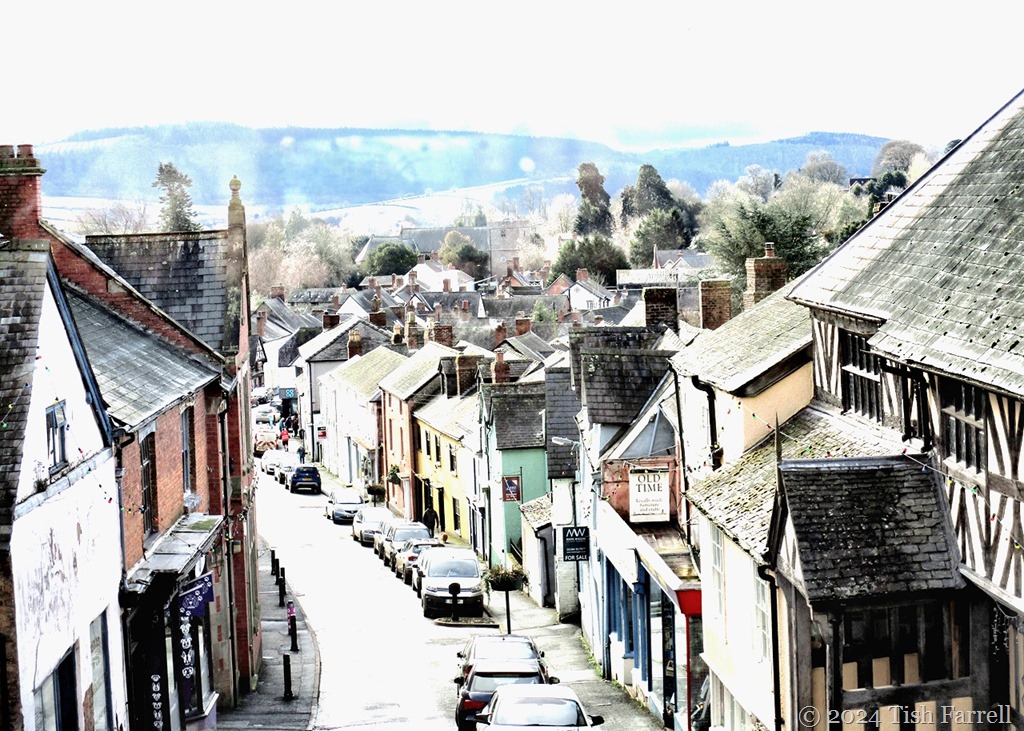
Display is this week’s theme from Ann-Christine at Lens-Artists, so I thought I’d show you a few more views of Bishop’s Castle. It seems like a town that wants to party, or it might do, if it could stop feeling so sleepy. But then somnalent or not, it puts on a bright face.

IMG_3841ed

And yes, the Six Bells inn truly is that vibrant shade of coral. It’s the first building you see as you enter the town.

IMG_3842ed

*

There’s also a welcoming sign on the wall to any passing elephant who might fancy a pint of this hostelry’s best brew:

IMG_3907ed

*

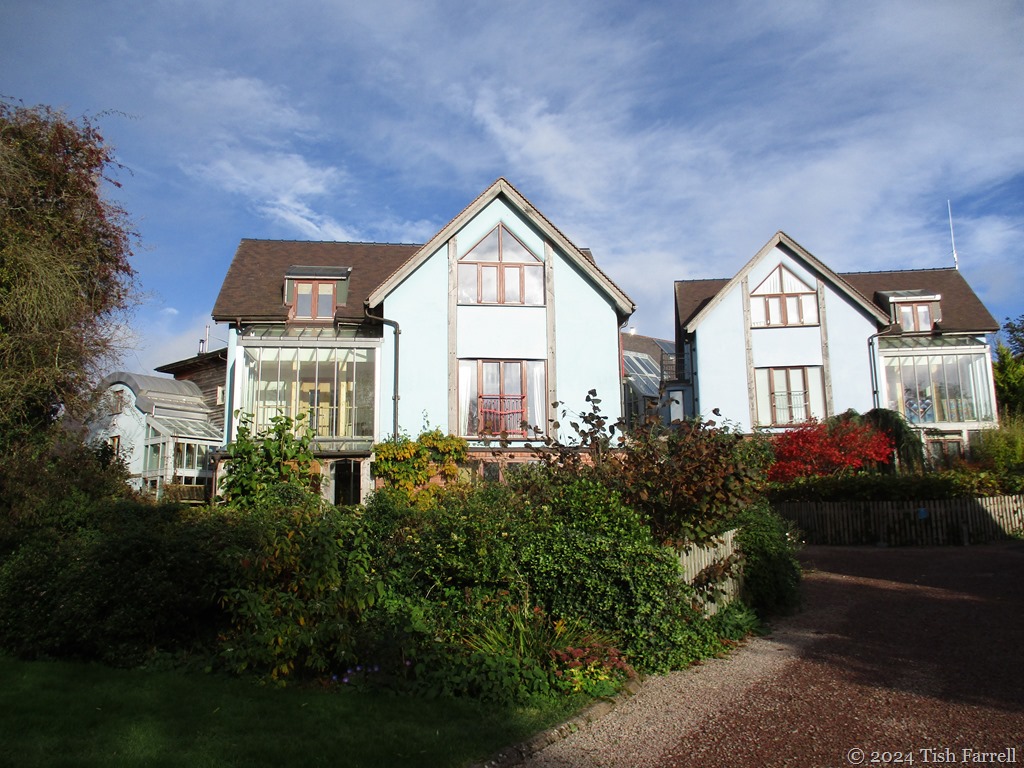
Across the street the houses cut quite a dash, colour-wise. This pair comes joined at the zip, so to speak:

IMG_3910ed

*

And then next door is a bit of a puzzle:

IMG_3839

*

IMG_3642

Back up the hill into town there’s another coral-fronted tavern…

And three doors up, opposite the Town Hall, is Bishop’s Castle’s very own Poetry Pharmacy, an independent bookshop emporium wherein a carefully curated selection of poetry and fine prose works are on sale to heal whatever ails. It has a cafe too, and a physic garden with a writing cabin that may be reserved at no cost. The poetry pharmacist also offers personal consultations, with suitable verses prescribed. I’m sure I’ll be writing more about this nourishing alternative health service.

IMG_3644

*

And one last image: this from a cottage at the bottom of our street. I’ve posted it before, but it gives me a lift whenever I pass it. Up, up and away…

IMG_3670

Lens-Artists: On display  Please go and view Ann-Christine’s lovely images for this challenge. They’re a real treat.

From The Grave Of The Good Burgess ~ Speaking Truth To Power

IMG_3897cr

My last post featured a recent visit to Bishop’s Castle’s parish churchyard and the mystery surrounding the grave of an unnamed African who died in the town in September 1801. This week I returned to the visit another intriguing grave. It stands in sight of the great Norman tower of 1291, and marks a death that occurred in May 1802, a few months after I.D.’s burial, and also the year of a general election.

And what an epitaph it is. What a swingeing ticking off of the town’s ‘worthies’; very much in the vein of ‘you know who you are’.  (And doubtless everyone else in the town knew too).

Here’s what the headstone says:

To the memory of Matthew Marston. He departed this life May 29th 1802 aged 81, the oldest Burgess of the Borough.

His steady and uncorrupt conduct presents an examples to his brother Burgesses for perpetual imitation and a useful lesson to the Parliamentary Representatives of the Borough that Opulence and Power cannot alone secure universal suffrage.

*

IMG_3903ed

*

And to what particular corrupt practice is the Marston stone referring?

Bribes for votes, that’s what, and the fact the town’s burgesses controlled the electoral roll. Only they could vote in elections, and only they had the power to admit new burgesses to the roll. And these were the men who managed all aspects of the town’s affairs, from market trading to judicial and coroner’s courts.

In 1802, when there were around 170 burgesses on the roll, the going rate for a vote was 25 guineas – well over a thousand pounds by today’s values, and enough then to buy 2 horses or 5 cows or employ a skilled tradesman for 173 days (National Archives currency converter).

For a small rural town, Bishop’s Castle seems to have earned itself a big reputation for shady political dealings: a ‘rotten borough’ from 1690-1763, and a ‘pocket borough’ from 1763 – 1832. During these years the town returned two parliamentary representatives, all members of the landowning class, or in the case of the pocket borough, all relatives or favoured associates of Robert Clive. (He had returned from India, where he had risen from lowly agent in the East India Company to Governor of the Bengal Presidency, amassing a fortune equivalent to 48 million pounds). Only with the Reform Act of 1832, did the parliamentary borough of Bishop’s Castle meet its end. We now have 5 regional county representatives.

During the rotten and pocket eras, parliamentary representatives were obviously intent only on furthering their own and sponsors’ interests and causes. This situation was compounded by the fact that several times the entire manor of Bishop’s Castle changed hands with the new owners seeking to secure a seat for their own man. In 1683 it featured in a marriage settlement between one Anne Mason and the Earl of Macclesfield. It was Anne’s ne’er-do-well cousin Richard Mason, seemingly the Earl’s ‘placeman’, who then bribed and bullied his way to Parliament, standing as M.P. for 30 years.

In 1718 the new Bishop’s Castle owners, the Harleys, appalled that their own candidate had failed to win a seat, roundly condemned the town’s burgesses (‘profligate wretches’) for their ‘villainous roguery’ and ‘perfidy’ in voting for Mason. They sold the manor on to the Earl of Carnarvon (Duke of Chandos)  who then, after considerable expense, secured his own placeman at the next by-election. His purposes doubtless served, he then sold the manor to his nephew, local landowner, John Walcot of Walcot Hall, who then found the means to further his interests through favoured candidates.  And so it went on. On and on.

But what of Bishop‘s Castle’s ordinary folk? Over all these centuries of political vested-interest, one might well wonder how did life go for the ploughman, dairymaid, tavern keeper, clerk, cowhand and stonemason, or for the cooper, brewer, carpenter, apothecary, farmwife, cook, curate and chamber maid? How indeed?

You can well see that the Marston family had a point when they erected this headstone to their kinsman, the good burgess: a lone voice of integrity?

IMG_3900ed

previous post The Man from Africa: I.D. unknown

source: The Story of Bishop’s Castle eds David Preshous, George Baugh, John Leonard, Gavin Watson, Andrew Wigley  2018 Logaston Press


The Man From Africa ~ I.D. Unknown

IMG_3848ed

Last week I went to pay my respects to I.D. He is one of Bishop’s Castle’s mysteries – the man from Africa, who was laid to rest in the parish churchyard of St John the Baptist on the 9th September 1801. Origins and life story unknown.

IMG_3846ed

Here lieth the Body of I.D.

A Native of Africa who died in this Town Sept 9th 1801

God hath made of one Blood all nations of Men  Acts 17 verse 26

*

I’ve written about him before, but the mystery continues to niggle, and especially now that I’ve come to live in the town. Who was this man? Where did he come from, and how had he arrived in the isolated small farming town of Bishop’s Castle? What led to his death? Was he slave, originally from West Africa or the Congo, and a possession of some Shropshire plantation-owning grandee. Or was he a free man; or employed as a servant?

The headstone, if sparse in details, is a fine one; it suggests a certain status; someone must have paid for it. There’s also a presumption that the deceased was a baptised Christian since the grave is sited in a prominent spot beside a well used path.

If the man had been a well regarded servant, then one might expect more personal details; a name at least; the years of his service and the name of his employer. (Slaves were usually given their owner’s names.) If he were merely a passing traveller who happened to die in the town, then who took it upon themselves to give him a decent burial? The parish records throw no light on the matter, and only repeat the text on the stone.

But there is a clue in the biblical quotation: God hath made of one blood all nations of men. This was a trademark text used by campaigners for the abolition of slavery.

At the time, Shropshire had its own fierce anti-slavery movement, driven by the dogged determination of one Archdeacon Joseph Plymley who lived not far away at Longnor. From 1791 until abolition in 1807 he worked tirelessly, alongside his sister, Katherine Plymley, travelling the county, raising petitions, urging Salopians to boycott sugar. So perhaps a local abolitionist sympathiser paid for the funeral. And perhaps, too, that well-wisher had the sensibility not to bury the man with his full slave name, but not knowing his birth name, chose to identify him solely by the initials I.D.

So many questions about a man, identity unknown, cut off from family, culture and community, lying in this quiet, but alien burial ground at the foot of the town, late summer cyclamen under the trees, the drift of cool air in from the hills and fields. Africa far far away.

IMG_3843ed

September Harvest

IMG_3868ed

Warm winds this afternoon, and a flurry of Red Admiral butterflies about the garden. Also out on the lawn, the alcoholic waft of gently fermenting apples – windfalls from our gnarly trees. The trees are in need of serious remedial work – if reclaiming them is even possible. Most of the fruit is spoiled before it falls – lots of pests and diseases, and some very spotty articles. But that said, there’s been enough good fruit to make a few pots of cinnamon and honey poached apple. And more to come.

As for this Red Admiral, it was spending a lot of time supping from a very rotten apple. I wonder if butterflies get squiffy. It might account for all the whirling about that was going on as I hacked away on project-liberation-greenhouse. It’s almost free from the overbearing hedge, but a lot of broken panes where hawthorn and ivy branches have leaned too heavily. For now, though, it’s good enough to shelter two bucket-planted tomato plants brought from Broseley. They’re still fruiting, if sporadically.

Our other tomatoes are an outdoor container variety, Tumbling Tom. They ripened very nicely on the terrace wall during our week of hot September weather. Here they are doing just what it says on the packet: cascading from their pots in profusion – out of summer and into fall.

IMG_3702ed

Raptor Rapture: Meet The Sparrowhawk

sparrowhawk

photo credit: https://www.goodenberghleisure.co.uk/sparrow-hawk-at-the-hide/

*

I couldn’t have taken this photo, or one very like it, for all sorts of reasons. I’d just popped outside to do some qigong and soak up a bit of late-day sun.  All was still in Bishops Castle: the light dreamy; the glow of old gold. There was of course the quarter-hour chime of the townhall clock, and then from across the street, the tones of convivial chatter between two neighbours’ were also finding their way into the garden.

And so to qigong. I was more than halfway through the shibashi set, performing ‘wave hands like clouds’, when the hawthorn tree over the hedge suffered a missile strike. Swift crash through vegetation. Something aerial shot down our path and landed on the rail by the garden steps. And there it stayed – only a few yards away, while I froze mid-cloud waving, right arm skywards, flamenco-style.

Posed thus, I of course thought of my camera. Silly. It was in the house, and I dared not move. So instead, I watched, while the sparrowhawk (a young male I think) sat on our fence, looking like it owned the place, from time to time turning its head as if to eavesdrop on the chatter across the road. It ignored me though, yet it surely must have spotted me with those sharp raptor eyes.

On the other hand, it was possibly busy gathering itself after a failed assault on some lucky bluetit. I watched for several minutes. Until it wheeled off over the hedge into town, the distinctive barred tail feathers, spread like a fan against the sun.

IMG_3704

The Farrells’ new back garden. There’s an awful lot to sort out, but in the meantime, visiting sparrowhawks are a welcome addition. Some days we have red kites too, wafting high overhead.

You can find out more about sparrowhawks HERE.

Enter The Dragon

IMG_3813ed

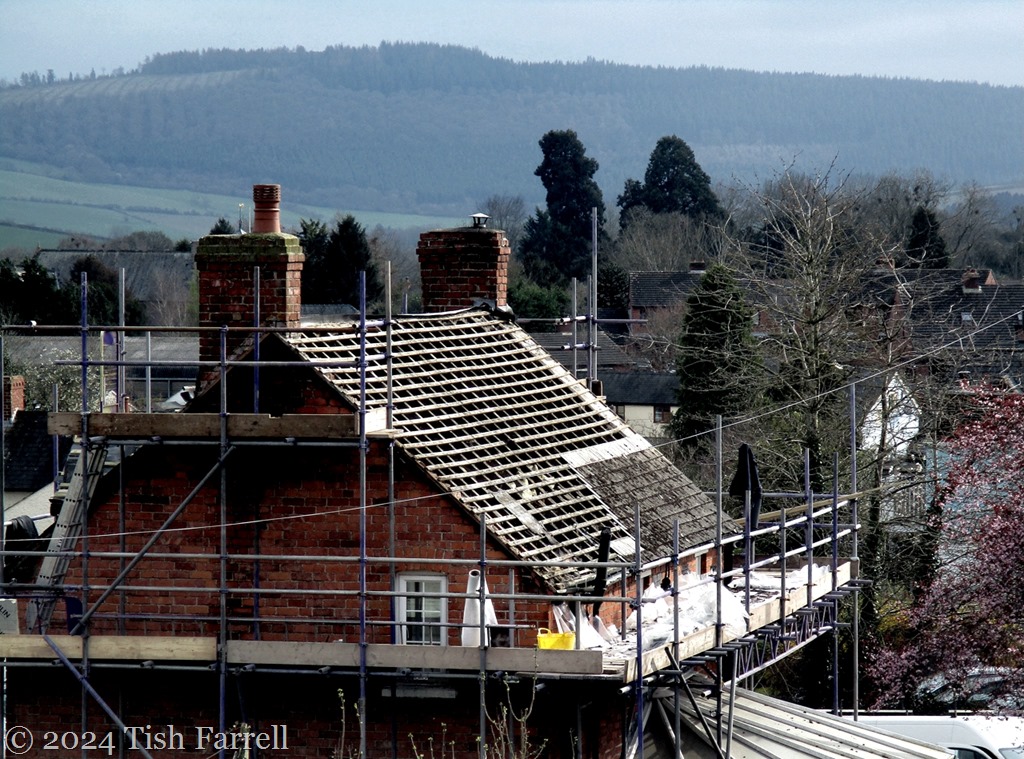
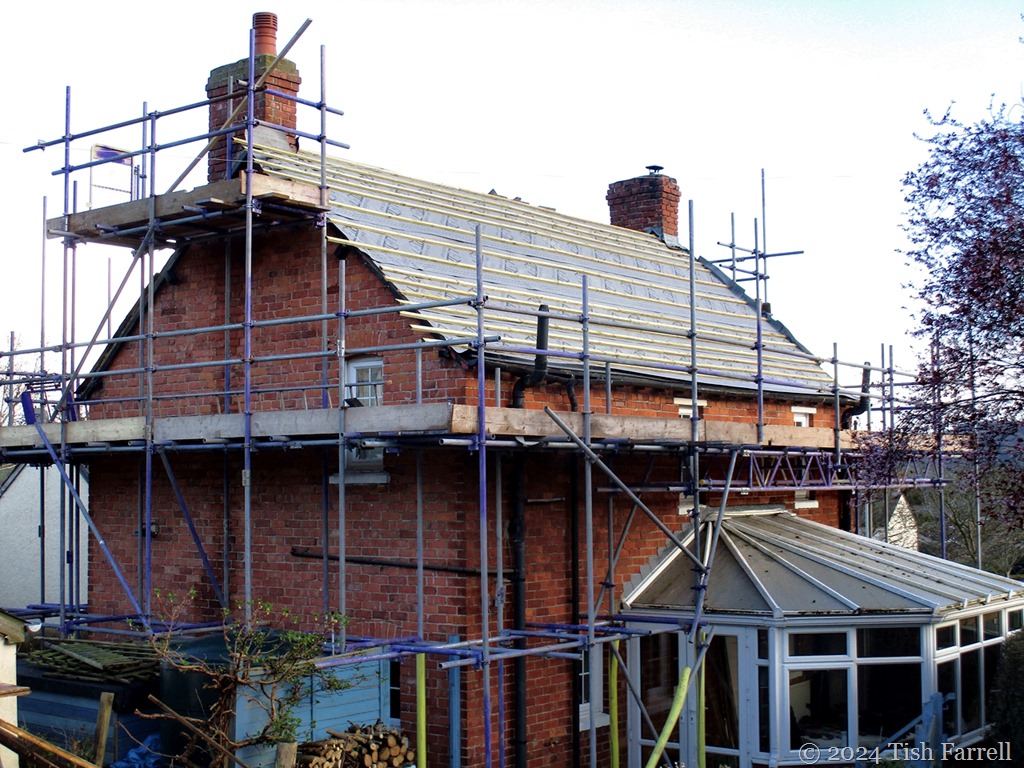
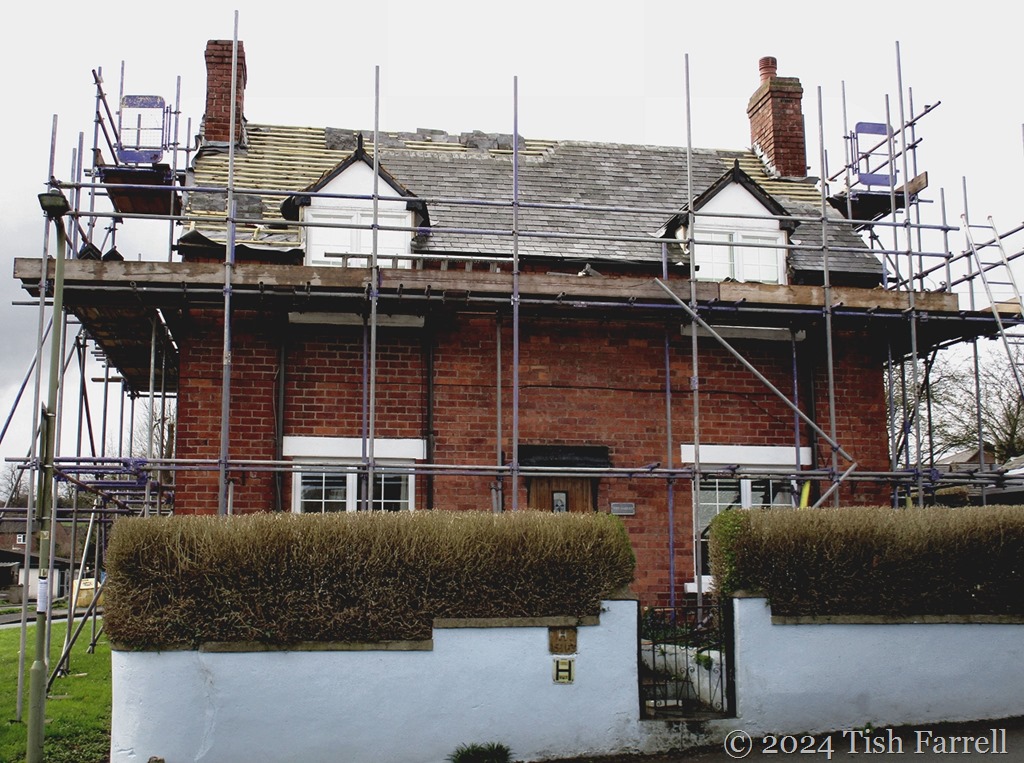
We’ve been ‘moving in’ to our new Bishops Castle home for a month now; more an ongoing state of flux than a settling in. There’s a lot to do and for months ahead, including work on roof and chimneys.  And so not a little frazzled, it was a relief to abandon the house and head for the streets.

Yesterday was Michaelmas Fair day. Time to find out what kind of a town we’d moved to. Time to mingle with our new community and connect. After all, it’s what humans most need beyond basic sustenance – connection. And when we think we don’t (because there’s just too much to do), it’s probably when we need it most.

Proceedings kicked off at noon with street stalls and roaming performers, bands on the Town Hall stage; classic cars lined up on the High Street – primped and prepped; fleet of steam traction engines huffing coaly steam in the cattle market, waiting on the 3 o’ clock grand parade.

IMG_3777ed

IMG_3768ed

IMG_3759ed

But as you can see, it was a dull old day – autumnal mist and drizzle plus intermittent showers, so we dipped in and out of the afternoon’s programme, met some new neighbours, reprised earlier introductions (yes, I do remember your name), bought a very fine rudbeckia, caught the Shropshire Bedlams Morris Dancers, but then listened to Jane the town’s singing florist (much amplified) while installing the new plant in the front garden. It was the evening’s events we wanted to go to.

The Lantern Procession began at 7.45. We stood at the top of the town to welcome it, wondering why the street was so sparse in humanity. (Was everyone in the pub? It surely looked like it. The nearby Vaults inn was full to bursting). And then down the hill the drumming began. Then out of the gloaming, the sinuous twists and twirls of the Hung Gar Light Dragon. And strung out behind him, the town’s lantern-bearing children and all their friends and relations.

IMG_3789ed

IMG_3791ed

IMG_3794ed

Now we understood. Most of Bishops Castle had been busy making lanterns in the Church Barn. They were all in the procession. What a throng.

And so as the dragon and Chinese drummers climbed the hill, so the Broseley Beats Samba Band struck up at the top. (I wish we’d discovered them when were living Broseley). A drumming play off then, the beats ripping from toe to crown. No choice. The body says, DANCE!

Then just when we thought the show over, the dragon came whiffling back round the Town Hall, heading off down the hill. Followed by the samba band. Followed by us and everyone else, the descent choreographed by the drummers, stopping at intervals to give a bravado performance.

IMG_3820ed

IMG_3832ed

*

When we reached the King’s Head at the bottom of the town, we (somewhat astonished) came on a line-up of several steaming traction engines outside the pub door. What a hoot, and literally too. One owner was a tad whistle-happy. I trust he wasn’t driving home.

IMG_3827ed

*

So there you have it, a fine finale to the Michaelmas Fair. All good spirits restored. And a taste of good things to come? I should think so.

Lens-Artists: recharge    This week Egidio sets the theme as he hikes Colorado’s fabulous trails.

Old As The Hills: That Would Be 570,000,000 years

100_9277ed

I recall being told by my geography teacher (aeons ago) that the Shropshire uplands comprised some of the world’s most venerable rocks i.e from the Precambrian era. The hills in question lie either side the Church Stretton fault, just across the Long Mynd from where we live now in Bishop’s Castle. On the east of the Stretton Valley are Lawley, Caer Caradoc and Ragleth, all formed from volcanic lava and ash around 570 million years ago. The Long Mynd lies to the west and began forming a little later with the build up of mud- and sandstone sediments in shallow seas.

Most astonishing of all, this whole process began when the earth’s crust beneath the land on which I now live was sited south of the Antarctic Circle. I’ll say that again: South Shropshire once lay south of the Antarctic Circle. Which obviously means this part of the British Isles has travelled from one end of the globe to the other.

On that journey, over millions of years, sea levels rose and fell; tectonic plates collided as continents shifted and shunted; uplifted landmasses were compressed, folded, tilted.

Then a succession of Ice Ages knocked the hills into shape. The Long Mynd is probably the most dramatic example – seen here in the the next photos taken in Carding Mill Valley, near Church Stretton. From 2.4 million years ago to 20,000 years ago glaciers shifted around the Mynd. When the ice sheets melted during interglacial periods, streams fed by melt water and rain carved out deep valleys, locally known as ‘batches’.

How mind-bogglingly amazing is this for a piece of landscape sculpting: water power plus the passage of time.

P1030461ed

P1030466resixws

IMG_6743ed

P1030464ed

P1030457

Lens-Artists: Time

Stiperstones Trail: Not For The Tender Footed

P1050992ed

*

In the last post you saw the Stiperstones in brooding monochrome. Those photos were taken on a dull and windy summer’s day. It was our first attempt to reach the Devil’s Chair. I had never seen it at close quarters. But in the end, the lack of light and the high wind across the tops put an end to the expedition.

The big problem on this particular trail is the surface. The higher you climb, the worse the path becomes, forming a devilish spread of upended pointy cobbles, designed to turn ankles and gouge soles, even when the walker is shod with sturdy footwear. The wind only made navigation harder: hard to focus with watering eyes. At one point I tried deviating through the heather, but it was a struggle to stride over; and it meant walking twice as far, and the rocks still ambushed me. A retreat was called.

We then made another attempt on a windless sunny day, when these photos were taken, but again were defeated by the terrain; nobbled by the cobbles. Still, despite hazy skies, there were some good views of the South Shropshire Hills as we headed down. And there is no doubting: this is one dramatic landscape, the quartzite rock of the the tors and outcrops laid down 480 million years ago, then fractured and shattered during recurrent freeze and thaw phases of the last Ice Age, 15,000 years ago. Back then, the ice sheet that covered much of Britain lapped against these hills.

It’s quite a thought: the repeated cycles of warming and cooling, cooling and warming that planet earth has gone through over many million years. And here we are in a warmish interglacial (it was apparently warmer in Britain in the Bronze Age, during Roman times and in the Middle Ages), and we’re probably due another cooling, since the geological timetable appears remarkably consistent, or at least it does when one’s dealing in millennia. I’m not sure we’ll like it though, the cooling.

 P1050981ed

P1050999ed

P1050988ed

Cee’s Which Way Challenge: walks

Mysterious In Monochrome: The Shropshire Borderlands

P1030697sepia

This week at Lens-Artists, Anne from Slow Shutter Speed asks us to think about monochrome and black and white photography. Click on the link below to see her post.

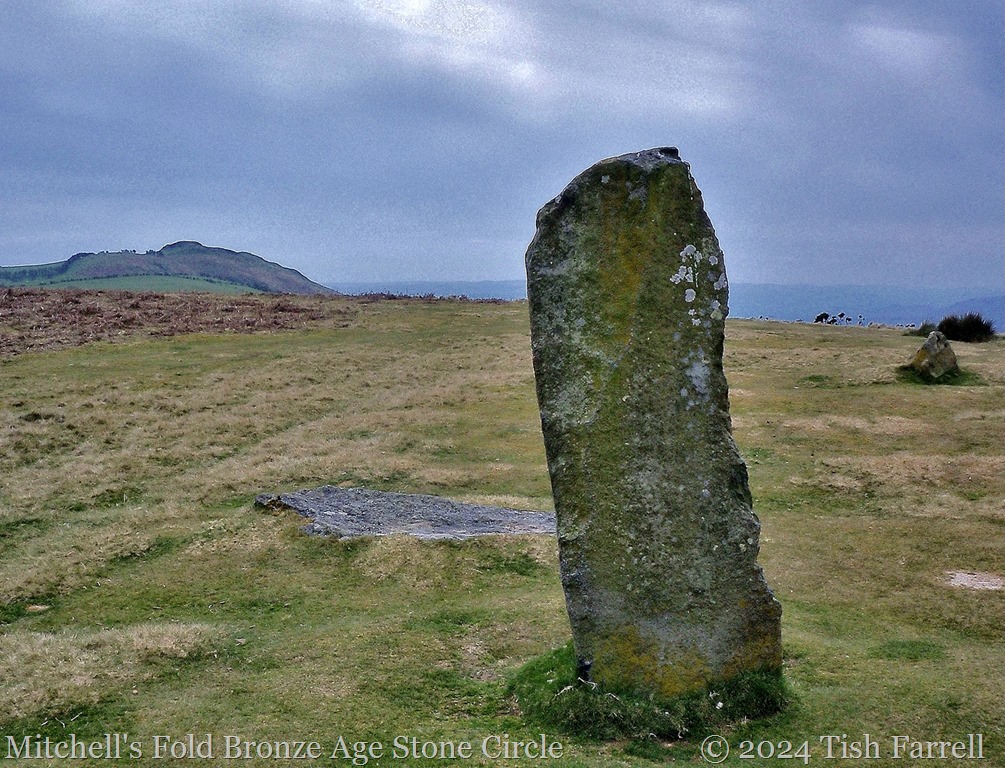
My first photo here was edited from a colour image, although however it comes, it’s an odd composition. It was taken at Mitchells Fold, the Bronze Age stone circle on the border with Wales, and I was only aware of the passing figure as I snapped the shot. I neither saw him arrive, nor leave the scene. Gives one a bit of a shiver.

These next two shots were taken with my Lumix point and shoot (before it gave up the ghost), using the ‘dynamic monochrome setting’. It was midday, and in high summer, but the light was penumbral; as if the sun had been switched off. Again very strange, although you can well see why these hills inspired tales of the Devil and gatherings of evil ones whenever mist shrouded the heights.

sepia

P1080542mono

*

This last photo was again taken on the Stiperstones, but on a brilliantly sunny day – a view of the Devil’s Chair (edited from colour). It looks like a ruined citadel, the quartzite rocks catching the sunlight.

IMG_0542bw

Related post: To Shropshire’s Mysterious Stiperstones

Lens-Artists: Black & White or Monochrome Please visit Anne at Slow Shutter Speed. She’s given us a snappy little essay on this topic.

Over The Hills And Far Away…

IMG_3673

At last. We’ve landed. I’m back. And on a whole new edge; no longer Wenlock, but on the border between Shropshire and Wales. And although we are finally here in body, there’s still a sense of too long in transit; a Rip Van Winkle dislocation in time and space. So just so you and  we know where we’ve come to (from Broseley in the east to the county’s south-west corner just north of Clun), here are some maps.

03b9b2d507fc78c58ec9a4fcc2a4bbc5-2720297223

shropshire-travel-map-407x430-1174062181

*

Here we are, then, in the midst of Shropshire’s hill country, not far from the Long Mynd and the Stiperstones. Nor far either from the Welsh uplands. Bishop’s Castle also sits on its own steep hill.

IMG_3642

This is the Town Hall, not quite on the summit. The clock chimes the hours and quarter hours, the plangent tones (when one is half asleep) evoking vague notions of Dylan Thomas’s Under Milk Wood, for although we lack the slow black, crow black fishing boat bobbing sea, I feel sure I will discover some equivalent.

Here’s the downwards view:

IMG_3641

*

This is the High Street. Curiously perhaps, it features tributes to elephants here and there along its length. The most dramatic and near life-size version is just above the Town Hall:

IMG_3640

*

But half way down the hill we find a whole herd:

IMG_3658

IMG_3657

*

And on the corner with Union Street, our new-home road:

IMG_3668

IMG_3669

*

And why the elephants, you ask?

Well, there are two reasons.

1) In the 18th century, the rapacious Robert Clive aka Clive of India, returned to England with his haul of Subcontinental booty and became Member of Parliament for the rotten borough of Bishop’s Castle. Yes, he bought the votes, folks; married into the Earls of Powys dynasty and included an Indian elephant in his coat of arms (seen here at the top of the town)

P1050898

P1050899

*

2) Across the road from the coat of arms is the Castle Hotel. During World War 2 its stables were used to shelter a number of circus elephants, keeping them safe from bombing raids. When peace resumed and the elephants returned to their owners, it is said that one remained unclaimed and continued to be a familiar sight on the town’s byways.

The Elephant Gate House where the elephants lived has been refurbished and these days is a welcoming holiday retreat for humankind.

And now there’s an elephant I haven’t mentioned, but certainly featured in earlier blog posts on Bishop’s Castle. Please meet Clive, the mascot of the town’s Michaelmas Fair which is due to happen in two weeks time (I shall report back). Meanwhile here’s a photo of him from an earlier fair day:

100_7181ed

*

While I’m here, I’d like to thank all of you who wished us well with second house move since March. Those kind thoughts surely worked, and all went smoothly, and without the snowstorms of the first move. Though on the leaving day I was mightily caught out. Such is the fickleness of the human heart, but I felt more sad about leaving Broseley after a mere six months than ever I did about leaving Wenlock after sixteen years. Goodness! Where did that come from?

But then I probably do know. I fell in love with Broseley’s Jitties, the town’s meandering alleys and pathways that resonated with centuries of people history – of miners and iron workers, potters and clay pipe makers, water carriers and maypole dancers; and all discovered in a place I thought I knew.

It’s a lesson to carry onward. Don’t take things for granted. Look beyond the obvious. And I know very well that Bishop’s Castle has a myriad of tales to tell, from the ancient and antique to the quirkily new. It’s certainly home to many busily creating people.

And on that note, here’s a cheery (elephant-free) artwork from the end of our road. You  can’t help but smile:

IMG_3670

*

PS: the header photo is the view from our bedroom window – if I stand on tiptoes.