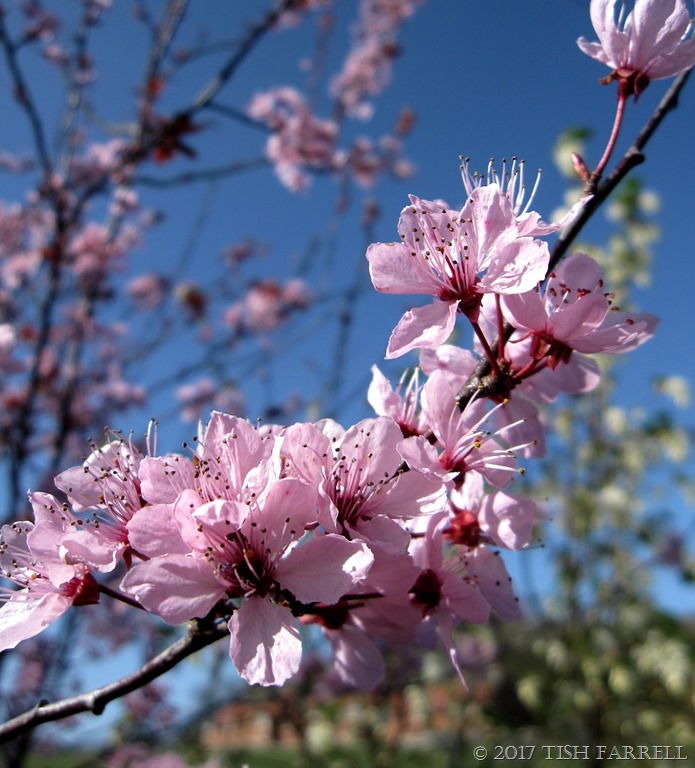
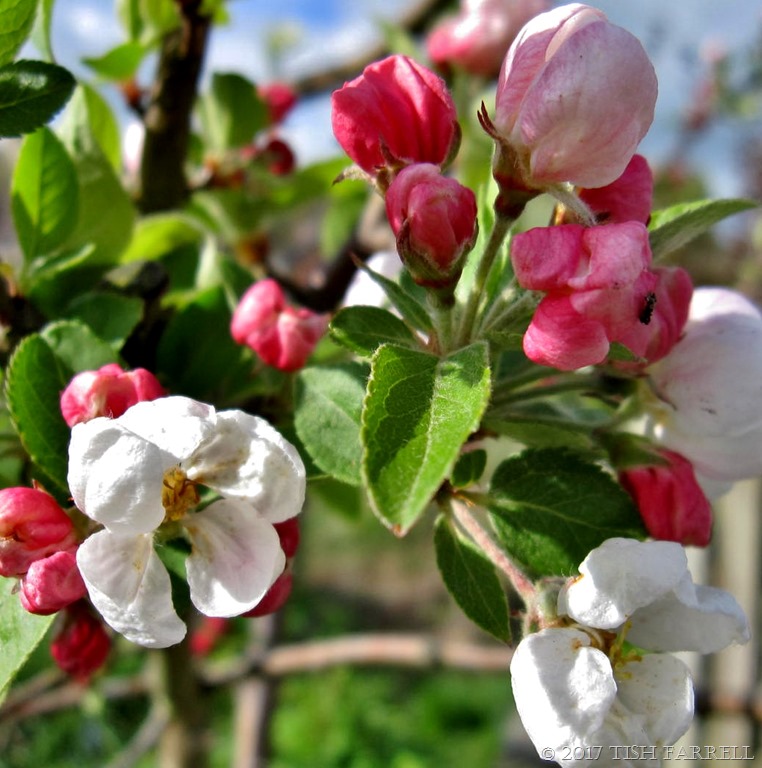
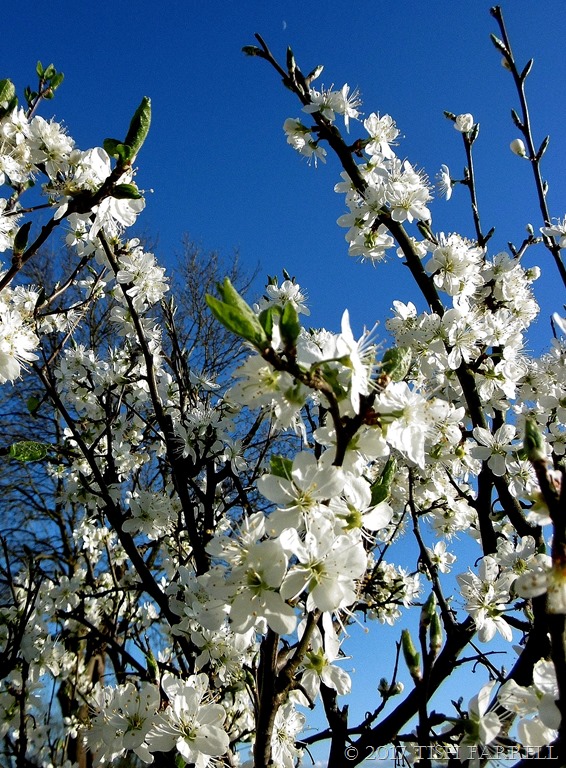
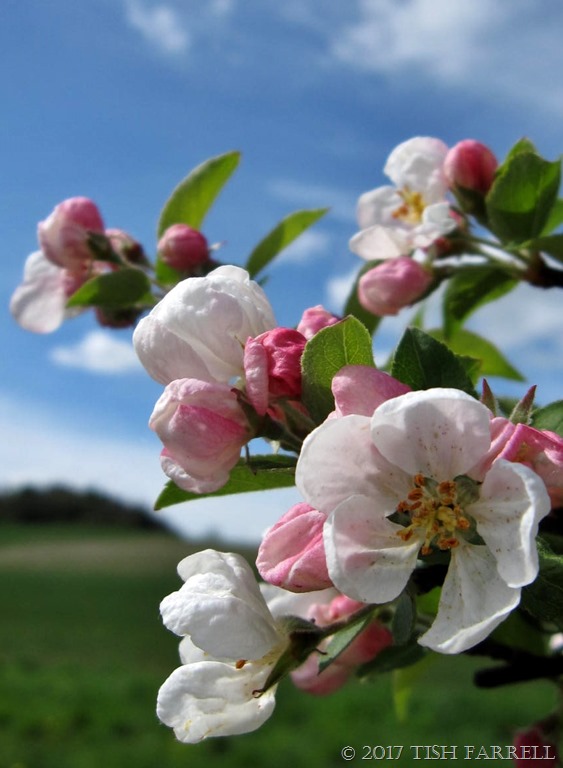
This week at Lost in Translation Paula’s theme is ‘vernal’ and she is calling for our spring compositions. So here are a few scenes from my Wenlock garden. Things have been a bit slow this year because we’ve had no rain for weeks and weeks. But today we did – and the garden has come alive with aquilegias and alliums. And I had no time to take photographs because I had a hundred other things to do. Hey ho. So the photos here were mostly taken back in March/early April: ornamental cherry, crab apple, and damson – the flowers of fruit to come.
photography
Tulips’ Last Hurrah And A Gardening Legend
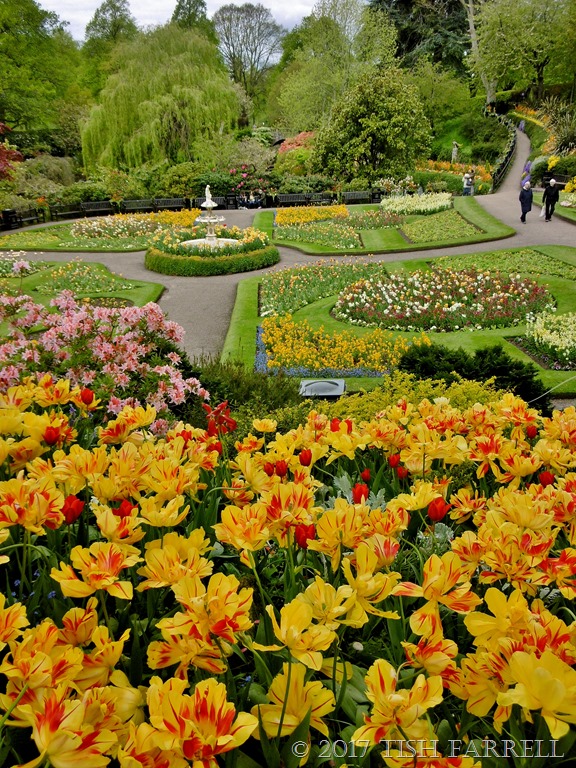
What show-offs – the lot of them. But what a joyous display and just at the moment when most of the other tulips are fading. I spotted these yesterday on a chance visit to The Dingle, in the Quarry, Shrewsbury town’s lovely riverside park. This place was a popular haunt in my teenage years – for meeting up with friends and for the covert smoking of cigarettes. (Naughty us, polluting the place with Consulate smoke).
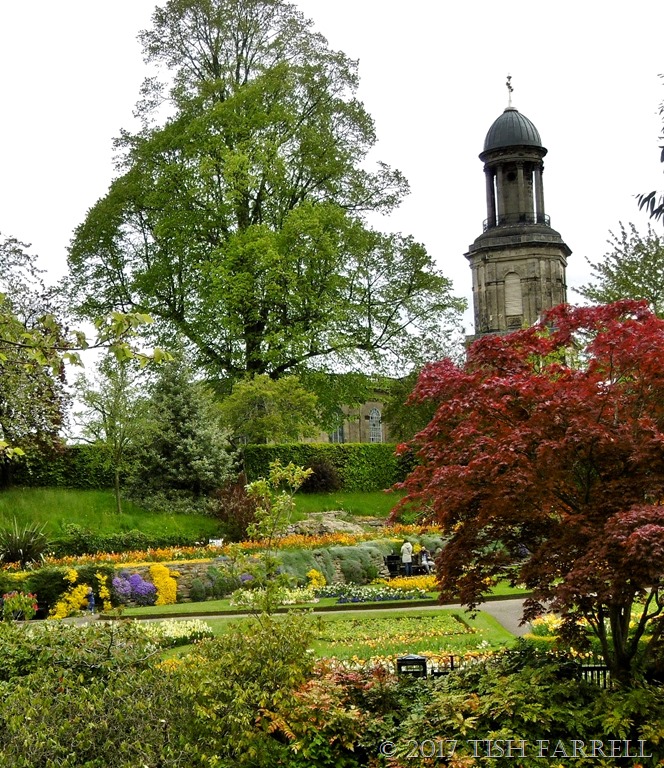
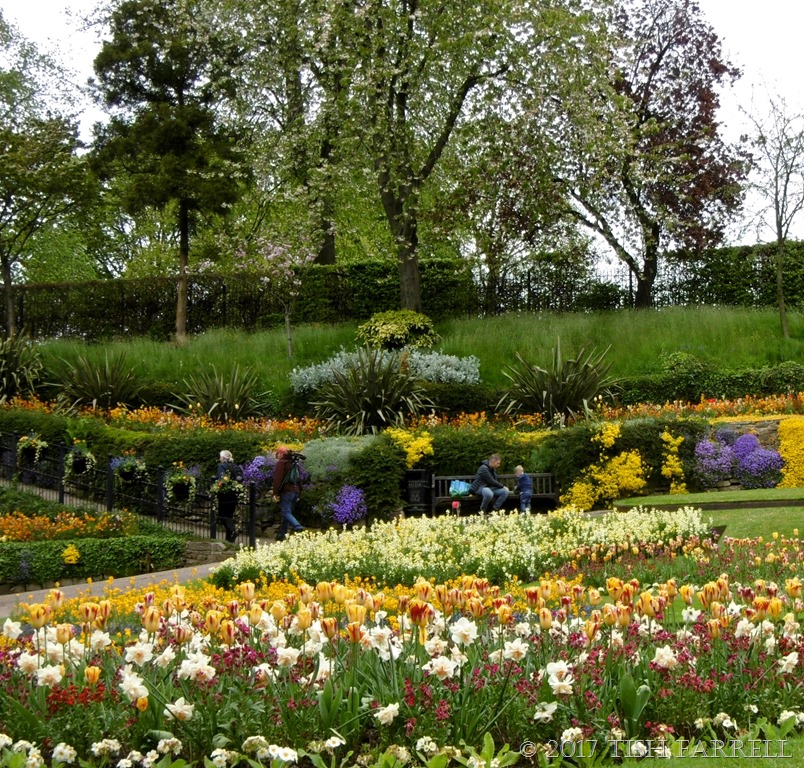
The Dingle was made out of an old stone quarry, and in many ways is very much a municipal garden with its regimental planting of bulbs and bedding plants. The bosky-dell setting works its magic though, and there was certainly no denying the cheeriness of the colour-scape under yesterday’s gloomy sky. BTW that’s St. Chad’s church in the background – in case you’re wondering. It is notable for having the country’s largest circular nave. Also Charles Darwin was christened there in 1809. Less notably, my Priory Girls Grammar School, along with the Priory Boys, used to traipse here every November for our founder’s day service. It goes without saying that the most exciting thing about the event to us girls was BOYS.
But back to the gardens.
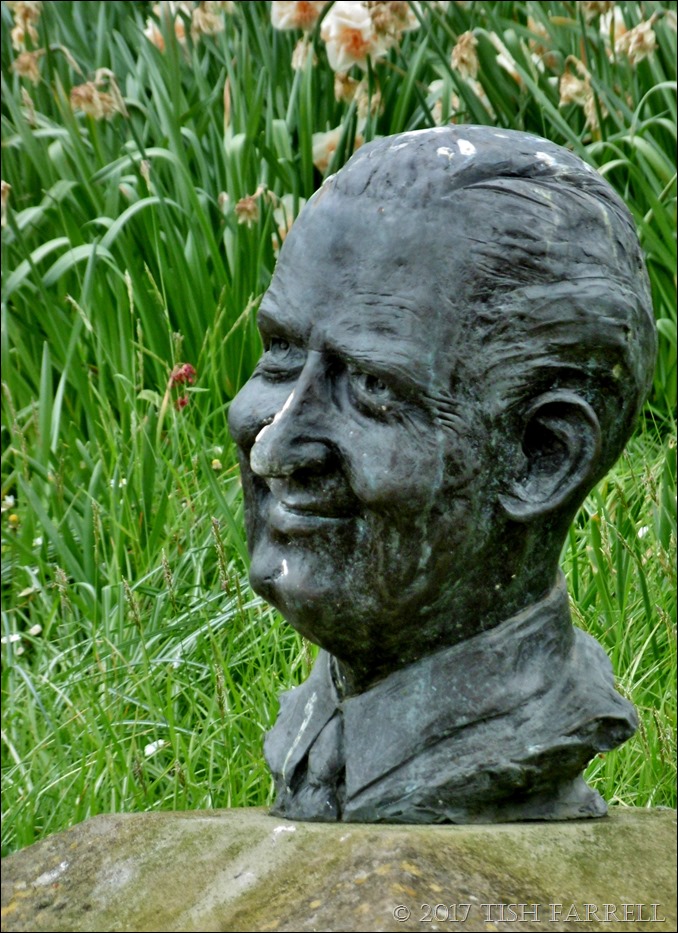
The Dingle’s formal layout was created by Britain’s first TV celebrity gardener, Percy Thrower. He was Shrewsbury Parks Superintendent from 1946-1974 and very much associated with the famous annual Shrewsbury Flower Show which is still held in the Quarry every August. As a fifties child I remember watching Percy on the BBC. My father was a great admirer, so I followed suit and held Mr. Thrower in high regard even if I didn’t need the gardening advice. At that stage I was into growing oak trees from acorns, and he didn’t seem to cover that particular topic. Mostly I learned to associate gardening with kindliness and a genial practicality, qualities that the sculpture in the next photo captures too. I was touched to find him smiling out over his creation. And that his collar and tie were just as I remembered them.
![]()
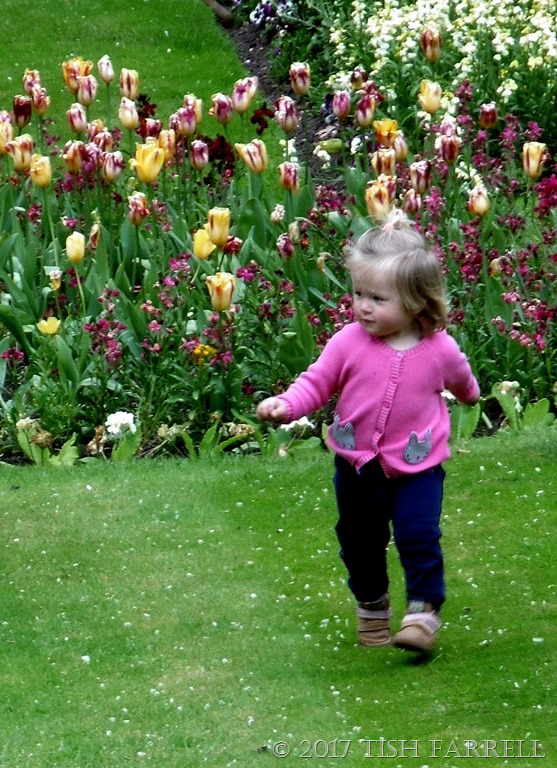
I think he would be pleased that there has been no attempt to veer from his original concept and ‘update’ the planting scheme. And although, in the main, this is not my style of gardening, I can still admire it. I could also see how much pleasure it was giving to people of all ages – a truly hidden haven since there is no view of the interior from the surrounding park. You have to step inside one of several gateways to ‘discover’ it.
It makes me think: every person on the planet needs access to a garden – whether it be untouched wilderness, manicured parkland, cultivated arbour or even a window box. We need to keep in touch with the growing world that heals, soothes, inspires and nourishes us. Which also makes me think that good old Percy Thrower, who did so much to encourage everyone to garden and to appreciate plants was truly a bit of a hero. Please go and say hello to him if ever you are in Shrewsbury.
Jo’s Monday Walk If you haven’t yet joined Jo on one of her fabulous walks (and you never do know where she’ll be going next), then please put on your hiking boots and follow the link.
A Good Crop All Round ~ Thursday’s Special At Hopton Castle And Brampton Bryan
This week at Lost in Translation Paula asks us to show her photos that we have cropped to reveal detail or improve the composition. I have to say that I crop most of my photos, and certainly architectural subjects almost always benefit from a trim.
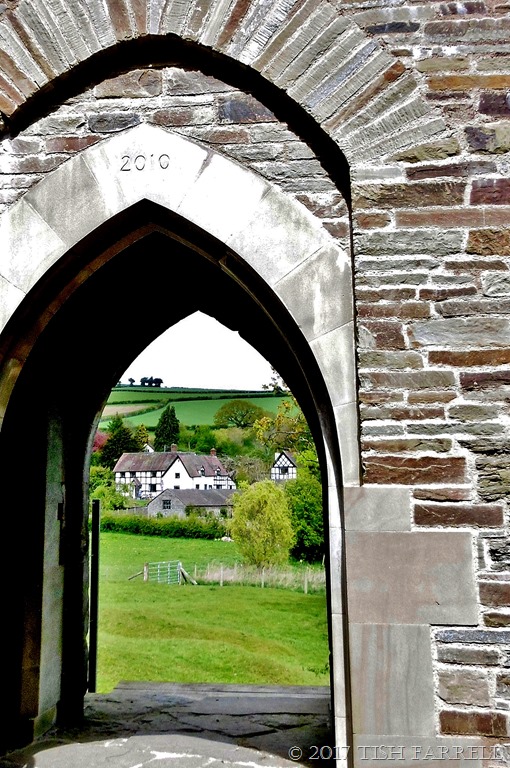
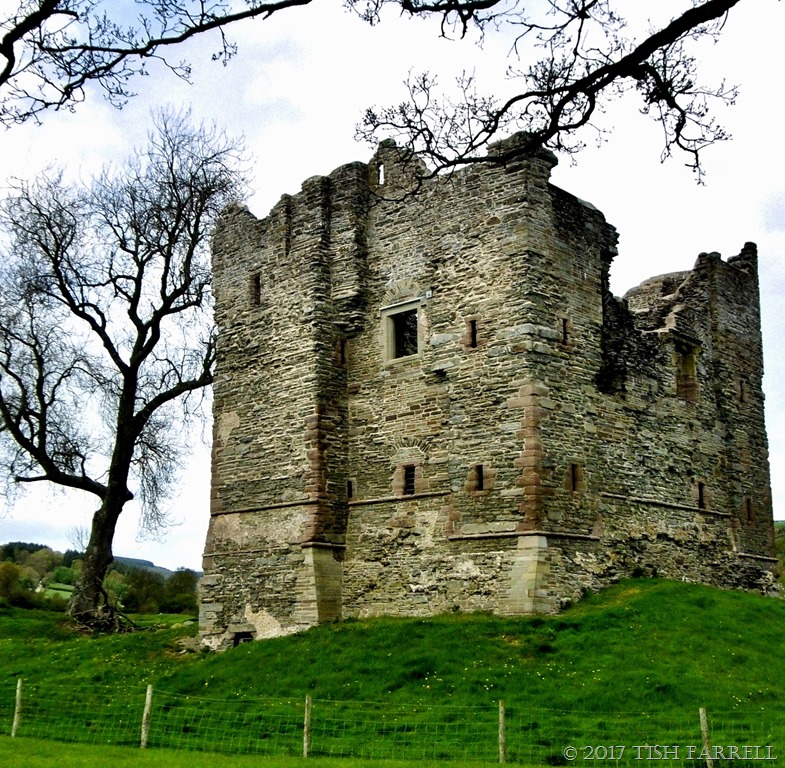
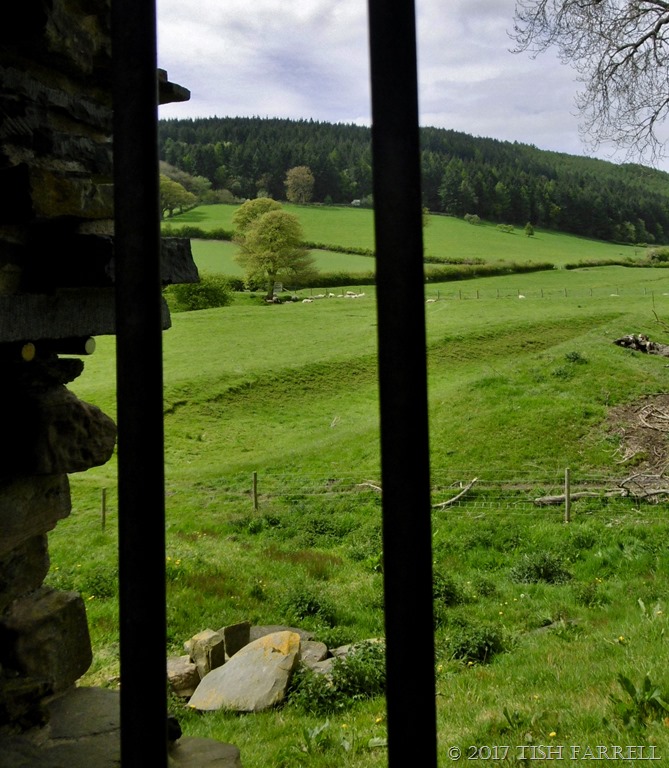
Here are some cropped shots in and around Hopton Castle. This mediaeval ruin stands in a rural and rather remote corner of Shropshire near the Herefordshire border, one of a cluster of castles built either to keep the Welsh neighbours in their place or as a piece of lordly showing off. Today, Hopton is romantically and rustically picturesque, although once it was the site of a bloody Civil War siege. In one of my earlier Thursday’s Special posts I featured the restoration of the monument.
*
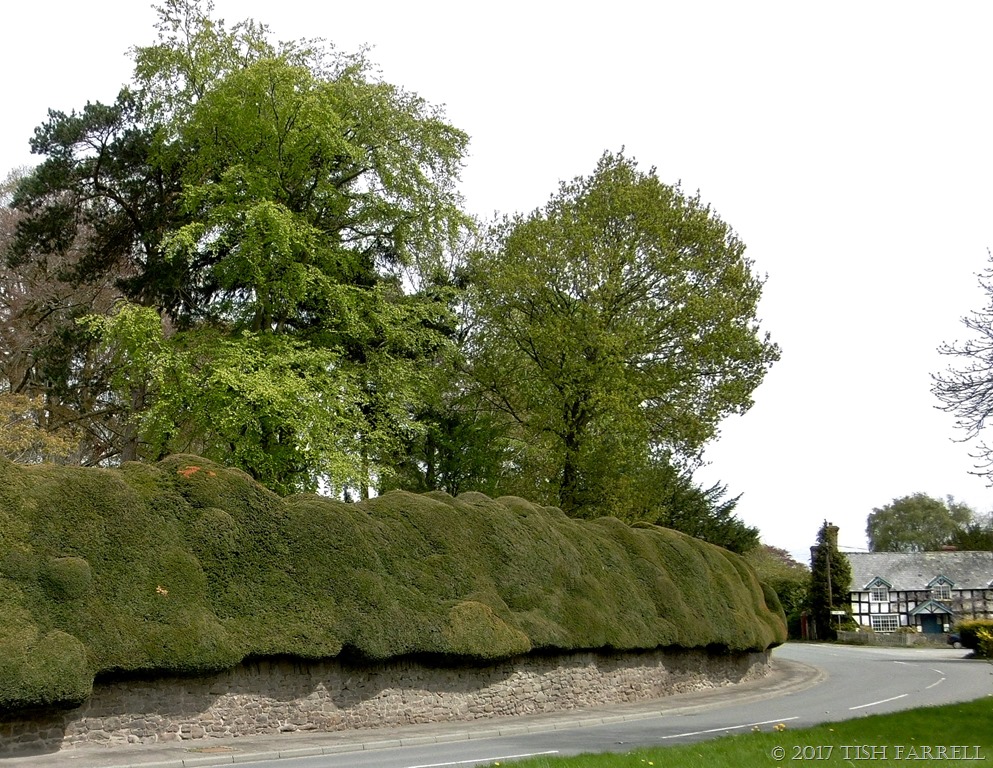
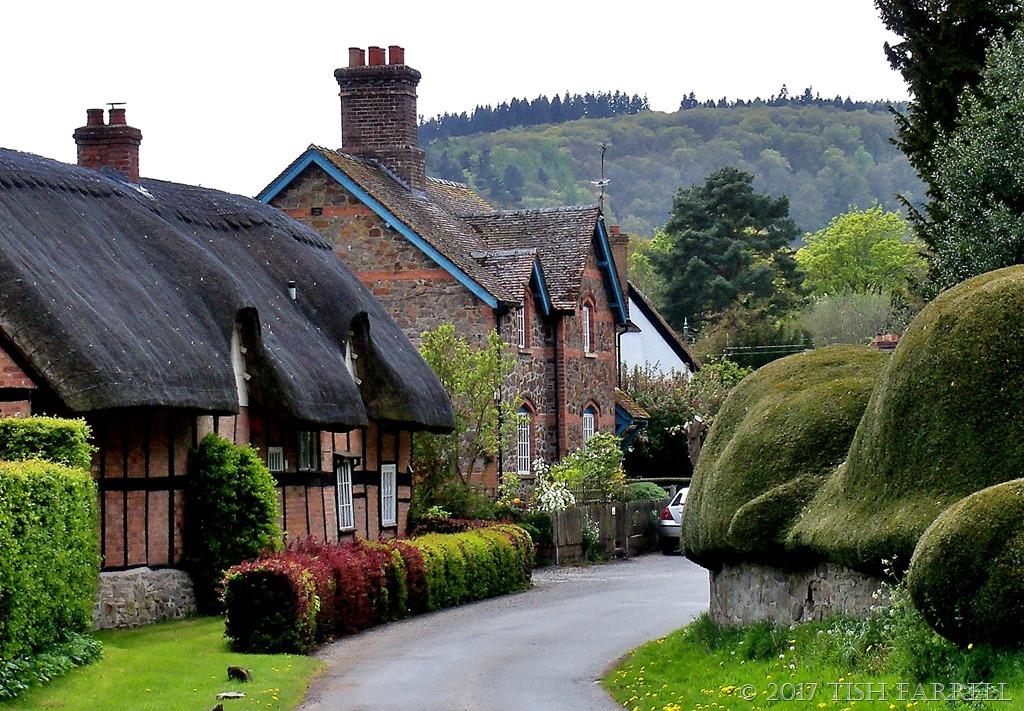
Not far from Hopton and just over the border into Herefordshire is the little village of Brampton Bryan. One of its most noteworthy features is the free-form yew hedge that shelters the owners of Brampton Bryan Hall from the gaze of passing hoi polloi and the inhabitants of the pretty estate village. The light was not good, but I think cropping the images has made them passable – at least for ‘guided tour’ general nosiness purposes:
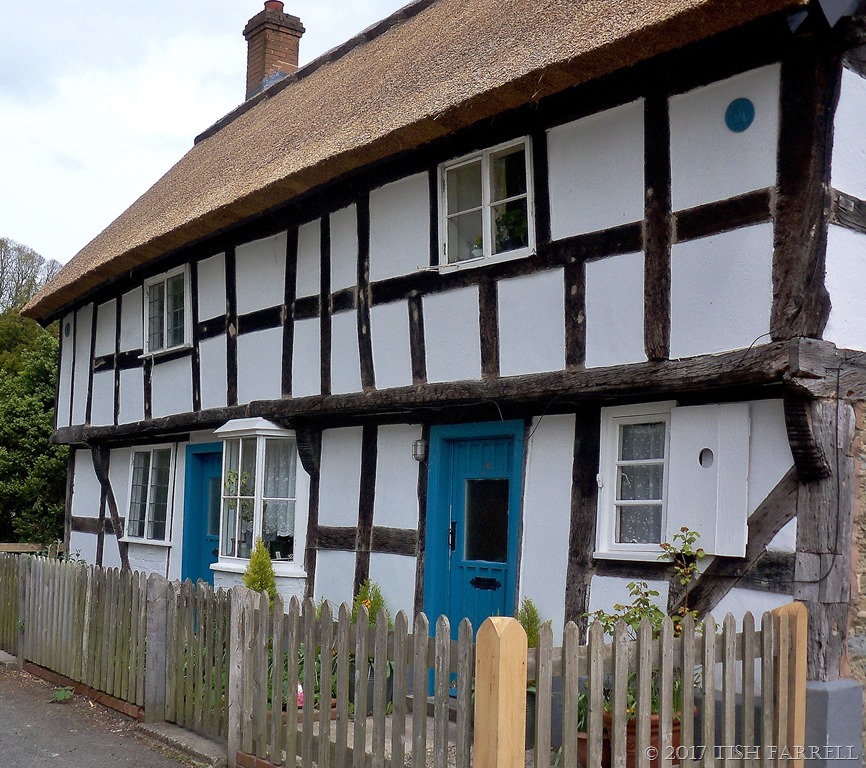
The Harley family who own the estate, including the village properties with their blue doors, has been around the place since Domesday. Their present home behind the hedge was built after the Civil War in 1660, and remodelled in the 18th century. I snatched a glimpse over the rear churchyard wall, but though imposing it was not very captivating, at least not compared with this next view of their own personal castle ruin. It is not open to the public so I couldn’t get a better photo.
I can’t help thinking how very wonderful it would be to have one’s own castle ruin out in the apple orchard, never mind the stately pile.
Collision Course? Present And Past In Conwy
This week at Black & White Sunday Paula asks us for an ‘After and Before’ – i.e. a colour photograph converted to monochrome. She wants us to use this device to look at our work with fresh eyes. It is an interesting exercise.
This shot was very spur of the moment’, and into the sun to boot – taken as the bus to Llandudno swung round a sharp bend down and past Conwy’s mediaeval town walls. But I liked the juxtaposition of ancient and new, the impressively static versus the transient. For some reason I also like the ‘one way’ traffic road sign – as if it might mean something other than the obvious.
Overall, as a composition I’m not sure what to make of it, but I keep looking at it just in case it might have something important to say, and I think the monochrome version has a certain drama. The first version is in ‘Cyan tone’ according to my Microsoft editing programme. This next one is what happens when you press the ‘Black & White’ option:
And here’s the original:
Now over to Paula’s at Black & White Sunday for more ‘Afters’.
Tulips Raising The Roof At Attingham
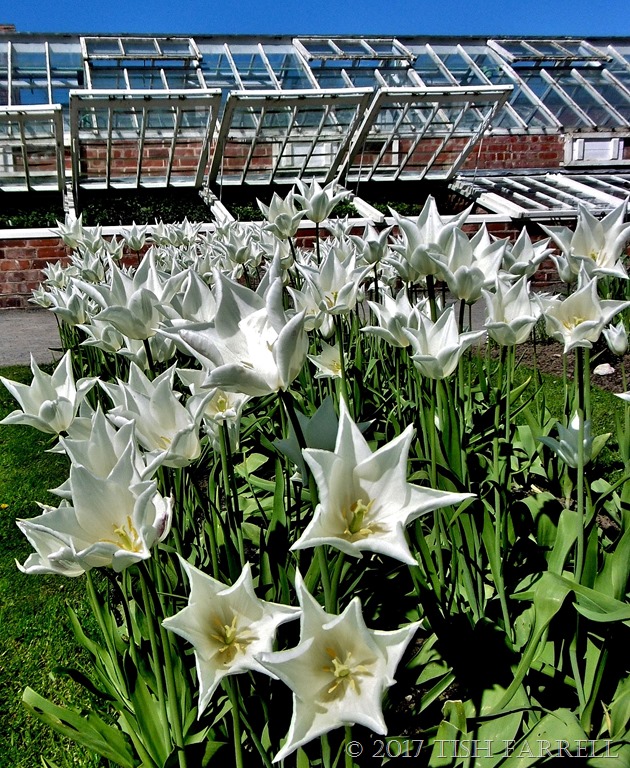
We thought we’d make the most of the sunny day and popped over to Attingham Park at lunch time. Half the world had the same idea and the place was alive with happy families and happy dogs roving over the parkland. There were fallow deer to see, bluebell woods, trees burstingly green, stream banks golden with marsh marigolds, and in the walled garden’s frame-yard these very shouty tulips. My goodness but they had a lot to say for themselves.
#SixWordSaturday #6WS
I Will Survive! Blooming Transplanted Crab Apple
Back in the autumn I mentioned we had been forced to move a much loved crab apple tree. Her name is Evereste and she is a small tree of the Japanese sort. She was originally planted in the corner of an ugly raised bed and beside some increasingly dangerous garden steps. The bed needed to go, and Graham planned to remodel the steps so we would not break our necks on them in the upcoming years of decrepitude, or after a glass too many of Prosecco out in the garden. Evereste thus had to be relocated to a much nicer spot on our fence boundary, but before that she had to undergo some very serious pruning with the aim of reducing the stress of being moved. She went from being a billowy, branchy tree to a very neat and upright tree.
However, I’m sure she will return to her billowy self in a year or two, and the good news is she is flowering wonderfully NOW. I love crab apple trees. We recently bought a stunning weeping one for my sister’s birthday – Royal Beauty . And it was while I was tracking down suppliers that I learned you could make a hedge using low growing crab apple trees. A hedge that flowers and fruits. How beautiful is that – and how the wildlife would love it. It’s making me think that Evereste might need some company along the garden fence.
Black & White Sunday: A Spot Of Dog Walking And A Dastardly Outbreak Of Clothes Moths
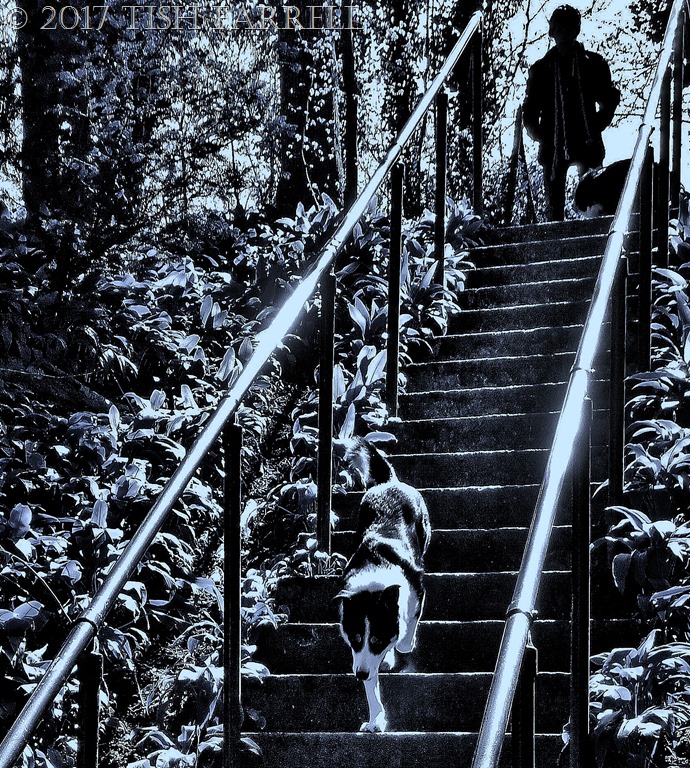
Here is a dog who knows just where he’s going, taking the steps down to the old railway line that runs besides the Linden Walk. I caught him by chance in a beam of sunlight. This rather makes him look as if I stuck him on later. I also like the way his master has become a silhouette at the top of the steps. One my photo-accidents that turned out quite well.
While I’m here I’d like to wish you all a Happy 16th April in whatever capacity you are enjoying or celebrating it. As for me, I’m waging a campaign against moths – cleaning out my closet and putting all my fine wool items into the freezer for a fortnight. It’s just as well the stock of frozen allotment beans and raspberries is now dwindling and I have a spare drawer for assorted Indian shawls. And in case you think this very odd behaviour for an Easter Sunday, my other half tells me that this is the only way to ensure my woollies are moth egg-free without the application of noxious chemicals. Apparently there is quite an outbreak of clothes moths in the UK just now. I’m wondering if this isn’t due to all the buying of cashmere jumpers that people have been indulging in; it’s ideal moth food. Anyway, it does have its uses being married to an entomologist.
Black & White Sunday Please visit Paula to see her mesmeric stairwell. If you follow her steps down and down, they could well take you to a parallel universe.
Waiting At The Severn Valley Railway
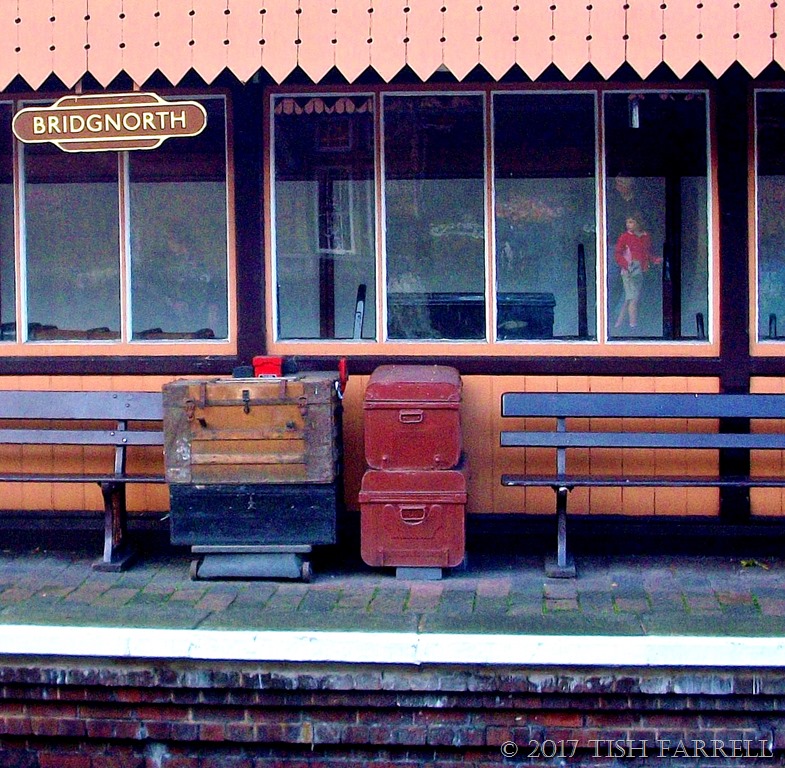
Ghosts of travellers past, or reflections from across the track? I truly cannot say.
This week’s Thursday’s Special cue is WAITING. Paula’s stunning piece of graffiti made me think about trains, and how, as a child, I seemed to spend a lot of time waiting for them, and mostly on Crewe Station. Anyone who knows about the history of railways will know that Crewe is the railway junction, gateway to the north-west of England, and one of the world’s first railway stations (completed in 1837). Being a country child, I used to find it all a bit alarming: shunting, clanking, whistles, whooshing, hissing, porters, trolleys, oil, iron, coal, steam, strangers…
By contrast, the Severn Valley Railway, seems like a dream, although all the same ingredients are there – relics of the age of steam. Strange to think that this includes me too.
In Search Of Lost Time In Eyam And An Outbreak Of Plague
This very unusual wall sundial is to be found above the Priest’s Door on the east side of Eyam parish church in Derbyshire. It dates from 1775, and was designed and made locally. I discovered it when were in the village doing a spot of family history research – not researching in any organised way I might add – more a matter of walking ancestral paths and acquiring a sense of place. Eyam is anyway a village with an awful lot of history, not least the story of how its inhabitants dealt with an outbreak of bubonic plague in 1665-1666 by imposing a cordon sanitaire around the village boundary, and for over a year sticking to it so as not to spread the disease to neighbouring communities.
Over the fourteen months that the outbreak persisted, 280 out of the 800 population died. It is thought the infection arrived in a parcel of fabric, sent in late summer from London to the Eyam tailor, Alexander Hadfield. The package was opened by his assistant, George Viccars, and it was he who was the first to fall ill and die. Thereafter, the disease spread rapidly throughout the autumn, slowed over the winter, and returned in full force in the following spring and summer. In the worst month of August 1666 seventy eight villagers died.
Eyam’s self-imposed quarantine was managed by the young village rector, Reverend William Mompesson, and Nonconformist minister Reverend Thomas Stanley. It was agreed that every household would bury their own dead and, in a bid to maintain morale and give comfort to survivors, church services were held in the open air so people could gather together, but not too closely. Local landowner, the Duke of Devonshire, and others from neighbouring villages saw that supplies of food and other necessities were left at the village boundary.
It is a harrowing episode that demonstrates great human resilience and bravery, not least by the Reverend Mompesson, whose own wife was among the last victims. And today, as you wander around the village, the event continues to be marked by commemorative plaques outside the cottages that were once the homes of the families who were particularly afflicted.
It could seem mawkish, crass even, to make a visitor attraction from this horrific episode, but somehow it isn’t. The village quietly embraces you in a reflection on shared humanity – now and back through time. In fact the sun dial says it all: Induce animum sapientum – cultivate an enquiring mind. And then on the two supporting stone corbels, which you can’t quite read in the photo: ut umbra sic vita – life passes like a shadow.
I especially like the way that when it is noon in Eyam, the sundial shows the relative times in Calicut, Mecca and Panama, to name but a few of the far-flung places inscribed on the dial. It also includes a chart for longitudinal adjustments of local True Sun Time to Greenwich meantime, and throughout the year. Somehow it is uplifting to feel that in this isolated Derbyshire village, and over the centuries, the gaze of its inhabitants has extended to a world beyond its village boundaries.
So far I haven’t mentioned why we were visiting Eyam or explained presumed family links with this locality. Researches into the Fox family of Callow in Hathersage (covered in other posts) suggest that a possibly direct ancestor, one Robert Fox, yeoman farmer and lead miner, was living in the area between 1678 and 1699. I have a copy of his will and household inventory, so I know he owned 13 cushions and several field beds in one or more parlours. There were no Fox plague victims in Eyam, although Robert Fox’s second wife, Margaret Mower, had lost an uncle, Rowland Mower. His will is included in the 1842 book by local historian, William Wood, The History and Antiquities of Eyam ~ with a full and particular account of the Great Plague.
The Fox family connection is all a bit of a yarn, which may never be unravelled. So for now some more views of the village:![]()
Eyam Parish Church and its 8th century Saxon Cross complete with Celtic influences.
*
*
*
This is Eyam Hall, very much post-plague, and built between 1671-6 and incorporating a much smaller existing property in the heart of the village. Its builders were newcomers, the land-owning-merchant Wright family, and their arrival signified revival, and an increasing interest in developing the lead mining potential the area. Landowners large and small were keen to exploit this highly valued mineral. And although lead had been mined across Derbyshire since Roman times, there is almost a ‘gold rush’ feel about the exploitative zeal from the late 17th century.
It is possible that post-plague opportunities around Eyam attracted the likes of putative ancestor, Robert Fox. My band of fellow Fox-hunters has not been able to establish if he was an incomer or if there were existing family connections with Eyam. His father was a tenant farmer at The Oaks, near Highlow, a few miles away, and he and Robert’s brothers may also have been involved in the lead business, possibly smelting.
Robert owned four small parcels of lead-bearing land in Foolow, two of which adjoined Wright land. When he thought he was dying in 1691 and wrote his will, he was very concerned to make it clear he had ownership of them, and that the proceeds of his property should be managed by his brother and brother-in-law for the upbringing and education of his four children – James, William, Mary and Robert. In fact he did not die until 1699, and it is not clear what happened to his family. We think the eldest James became a shoemaker in Eyam, and that Robert was possibly a very successful joiner in Wirksworth, the lead mining capital of Derbyshire. William is the one we have our eye on as the possible ancestor for the Callow Foxes, but his baptismal record has so far proved elusive, which is most annoying when we know that his three siblings were baptised in Eyam church. Ah, well. Such are the fascinations and frustrations of tracking down traces of families long past.
From: William Wood The History & Antiquities of Eyam 1842
Black & White Sunday: Traces of the Past
JOSEPH SIDDALL
P.S. A number of readers have asked what became of 3 year old Joseph Siddall. The Eyam Museum researches seem to indicate that there were in fact two surviving Siddall children, and they went to live with relatives in Sheffield, not that far from Eyam. There is quite a dynasty of Siddalls in the Eyam-Stoney Middleton area of Derbyshire, so they would not have been left without any family connections.
After The Rain It’s Party Time!
You simply can’t beat tulips for exuberance. They are presently bursting from pots and beds in my back garden – the result of a couple of cheap packs of bulbs from my local market stall bought back in the autumn.
I like the tulips that most resemble the wild forms – lily like, low-ish growing, and with several flower heads per bulb. These are one of the praestans varieties – possibly Bloemenlust. I threw the pack label away before pressing enter on the memory save button. Anyway, they are beautiful, whoever they are. And I especially love the way they throw their petals wide to catch the sun.
Six Word Saturday Please visit Debbie at Travel With Intent. She is the new host of SWS with the new rule of Six Words Only In The Title.