Strawberry vodka and the benefits of using a tripod

100_6074

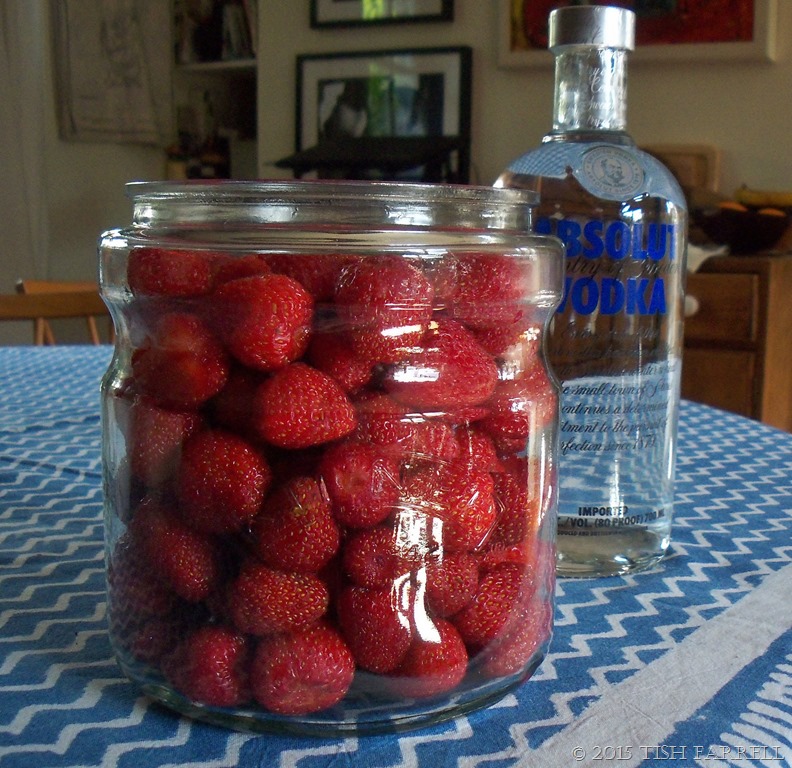
This story doesn’t begin here, although this is my first ever photograph shot using a tripod (plus a Kodak EasyShare M380 on macro setting). You do not, however, need the tripod for the recipe coming up below, although it could come in handy for balance if you’ve sampled too much of the end product some months hence.

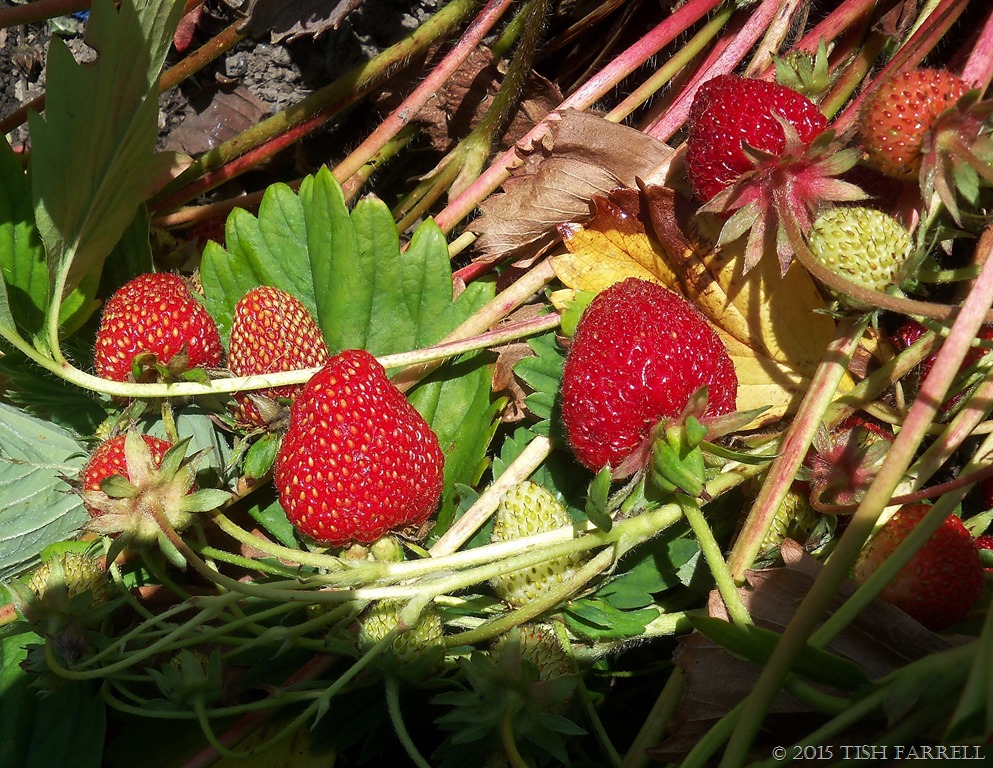
So: the story actually begins at the allotment, and a case of TOO MANY strawberries. Gilly at Lucid Gypsy has also been suffering from the same dilemma. In fact as I was picking all these juicy fruits under a very hot sun, I was wondering if this was indeed a subject for some serious philosophical debate. I mean, can you have too many strawberries?

(N.B. These next two photos did not involve a tripod, only a hot and bothered biped in ‘pick ‘n shoot’ mode.)

100_6032

100_6033

So can you have too many strawberries?

It is the sort of question that inevitably leads me to Jane Grigson’s Fruit Book (the companion to her Vegetable Book). She is just the cookery writer you need when you have any excess produce. And it is thanks to her that I will pass on this morning’s activity at the kitchen table in Sheinton Street.


Strawberry Vodka

  • You will need strawberries, fair trade unbleached caster sugar, a  bottle of vodka (or gin if you prefer), and a big jar with a lid that seals.
  • Select DRY strawberries that do not need to be washed, and fill your chosen clean, dry vessel. I used a 2 litre kilner jar (4 pints).
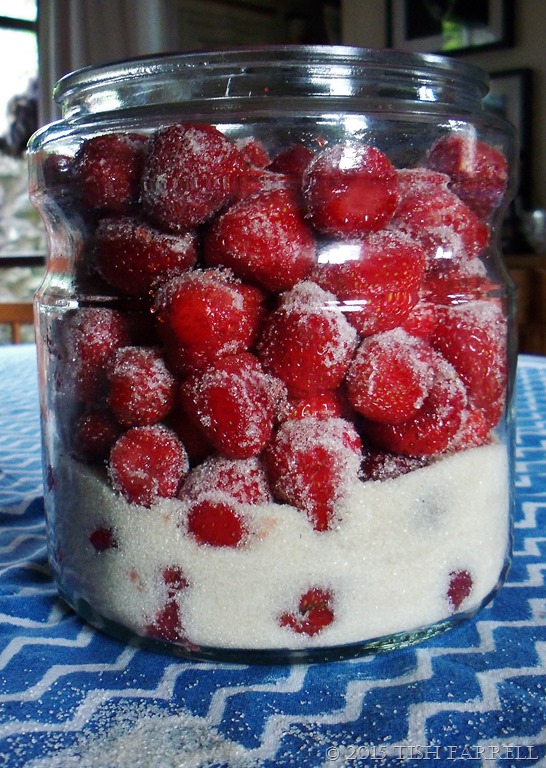
  • Then sprinkle in fair trade caster sugar so it comes a third the way up the jar (I used about 150 gms, 2/3 cup).
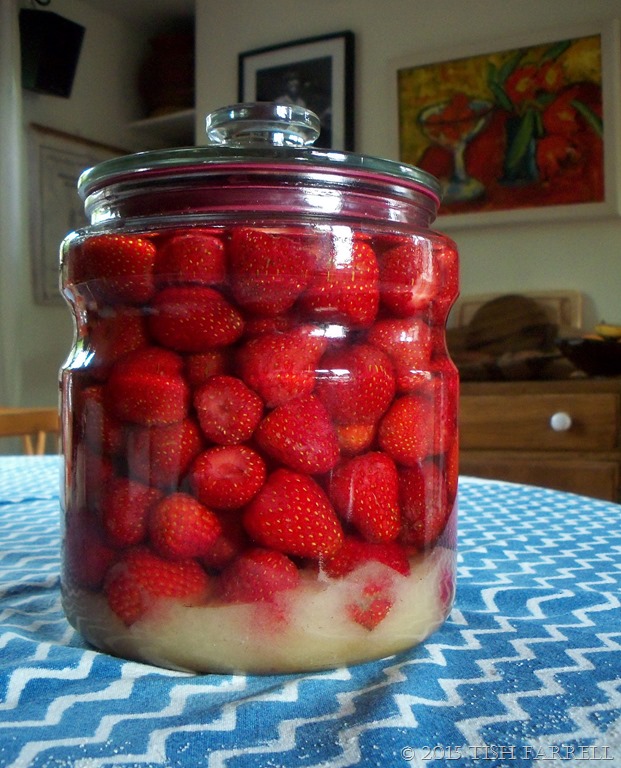
  • Fill the jar with vodka so that all the fruit is covered and seal.

100_6080

100_6086


Jane Grigson’s instructions then are that you place the jar in a cool, dark place, and turn it over from time to time. After a month the strawberries will look wan and floppy, and you can then strain the lot into a new jar, using a double layer of muslin. Or you can leave the fruit as it is for several months more.

The resulting cordial can then be drunk as a liqueur, and used to pep up sorbets, fools and mousses. My mind is tending (albeit perversely so on this steamy July day)  towards thoughts of Christmas trifle.

I should add that I have never tried this before, but so far it is looking good, and that’s where the tripod came in. I shall definitely be using it again. As to the strawberry vodka, only time will tell.

copyright 2015 Tish Farrell

Catching the wave: learning to shoot lying down

100_5992

Photography-wise, you could say this is a case of learning from one’s subject.

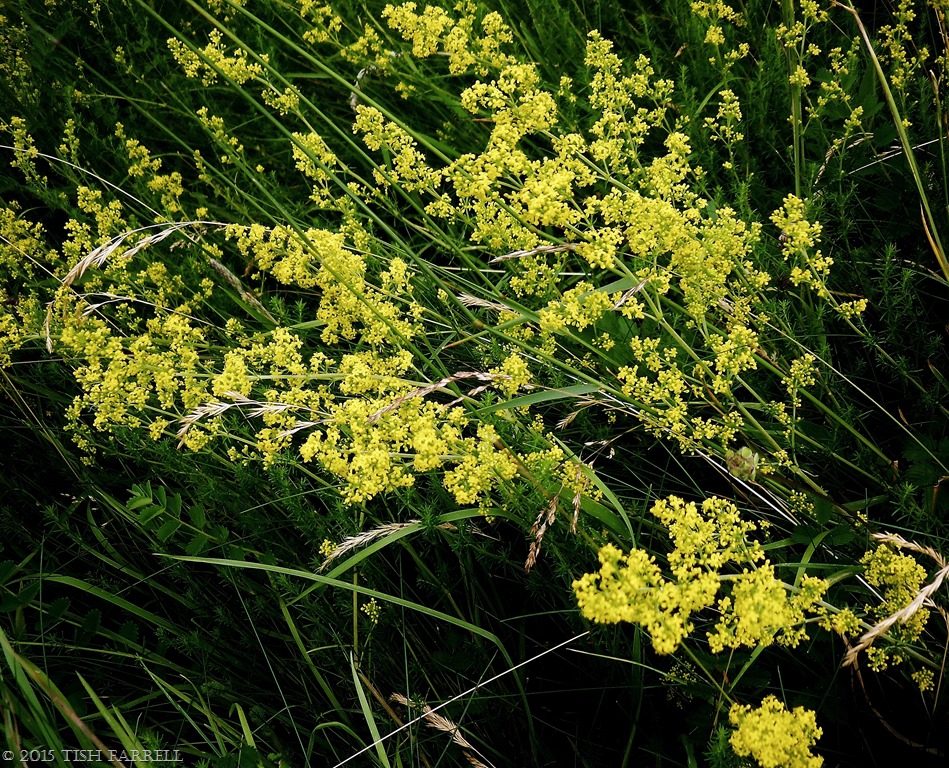
Anyone who joined me on last week’s walk around Windmill Hill, will probably know  that this drift of yellow is commonly known as Lady’s bedstraw or Lady’s tresses (Galium verum). When dried it smells of freshly mown hay, and so was once added to mattresses. Given these supine associations it seemed fitting that the only way to capture its essence was to lie down with it in the grass.

And lying down certainly reduces operator wobble, although there wasn’t much I could do about the summer breeze.  So I caught that too. And since I have yet to devise a ‘scratch and sniff’ widget, you must now use your imagination to summon a fragrance with subtle notes of gardenia plus a dash of fresh acacia honey. Mmmm. I don’t know about you, but I’m feeling a snooze coming on, borne away on a tsunami of sweet, golden, flowers. Happy dreams.

copyright 2015 Tish Farrell

Inspired by Jennifer Nichole Wells One Word Photo Challenge: tsunami  Go here to see Jennifer’s fascinating miniature world, and other bloggers’ interpretations for OWPC.

I’m also linking this to Lucile de Godoy’s Photo Rehab at Bridging Lacunas. Please visit her and her community of photo bloggers for a great boost to your creativity.

Bird’s Eye View of Shela Village, Lamu

Scan-140802-0003 (2)


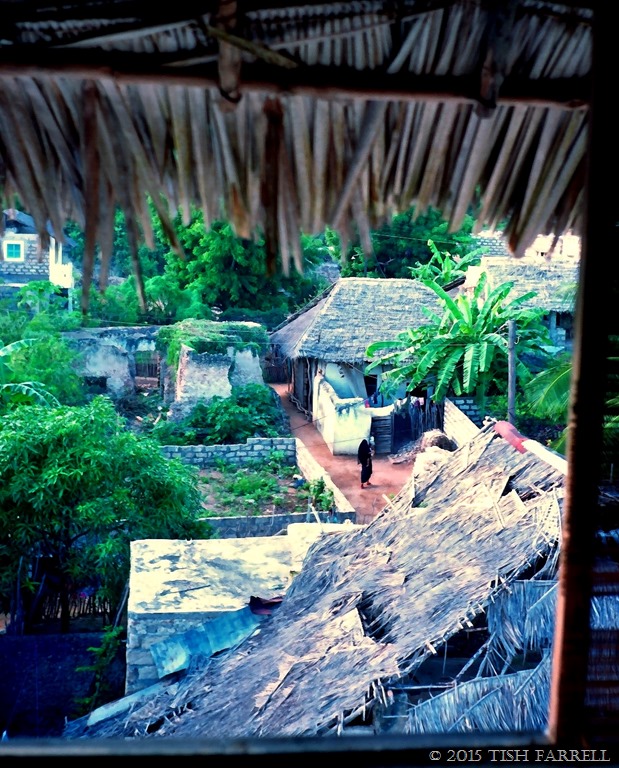
This week at Thursday’s Special, Paula has asked us to interpret ‘a bird’s eye view’. I’m not sure that four storeys up in Shela’s Island Hotel  quite constitutes a bird’s eye view, but it’s as high as I’m going. I’ve written about our stay on Lamu in other posts. One thing I will say here is that we had a room that was ideal for someone as nosy as I am. Three sides were entirely available for nosiness, overlooking the centre of the village. I didn’t know which way to look first.

In the next photo you can see the village square with its donkey park under the thorn tree. There was only one vehicle on Lamu at the time of our visit – an aged Land Rover, and donkeys were used for all forms of land transportation. They were left under the tree until someone needed one to move something. In the bottom corner you can see blocks of quarried coral rag used for house building.

Scan-130428-0138


Please visit Paula at Thursday’s Special for more views.

Return to Windmill Hill: Of Grasshopper Stalking, Lady’s Bedstraw And Other Random Discoveries

100_6008

Today I thought it was time to check on the floral happenings in our remnant of limestone meadow up on Windmill Hill. It’s a few weeks since I was last up there, and the spring flowers are giving way to summer species. Perhaps one of  the most pleasing finds were these drifts of Lady’s Bedstraw,  seen here below the windmill.

It is also called Lady’s Tresses, and  it smells of honeyed summer pasture. Once it would be gathered and dried and included with the straw that was used to fill mattresses. It was often chosen for the beds of pregnant women, so surrounding those in their confinement with soothing wafts of sweet hay scents.

I think this is a practice we could revive, not that we are allowed to harvest wild flowers. I’m envisaging now a pillow filled  with golden stems. Surely it would be just the thing to send us sleep-fractured souls back to dreamland. And even if it didn’t, it would make being wakeful a pleasure.

100_5898

The spotted orchids  I first found last month for Meg are nearly over (by the way, you should see Meg’s sundews found in Australia’s  Stanthorpe granite country over at Snippetsandsnaps). But following on from the common spotted are the pyramidal orchids, which range in colour from lipstick pink to purple. I also discover from plantlife.org.uk that these, like many orchids, require the presence of a particular fungus in the soil in order to flower.

100_5892

I also discover from Richard Mabey’s treasure of a book, Flora Britannica,  that when the Victorian art critic, John Ruskin, learned that the name orchid derived from the Greek word orkhis  meaning testicle, he urged that the flower’s name be changed to wreathewort. Personally, I don’t think this any sort of improvement. The man was a prude. Besides, the reason that orchids are named after testicles is because their roots’ appearance do a pretty good impersonation of same. Doubtless this was why they were long considered a useful remedy for a lapsed libido – a herbal fancy and fallacy I imagine, so do  not try this at home.

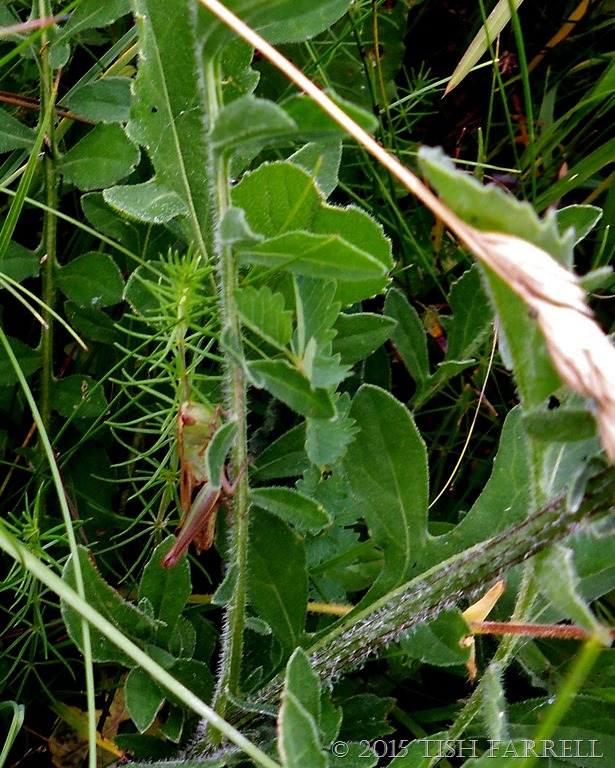
While I was scrabbling around on my knees in the grass, thinking what strange things I have started doing since joining WordPress, I became distracted by a grasshopper. This is not the greatest shot. He is lurking on the leaves of greater knapweed, Centaurea scabiosa. Very well camouflaged I thought.

100_5972

100_5968

While I was down there, because believe me, once you get down on your knees you need to make the most of it, I also discovered some Lady’s Bedstraw caught inside a web. It looks like a shroud. You can just see the tiny spider due south of the flower:

100_5993

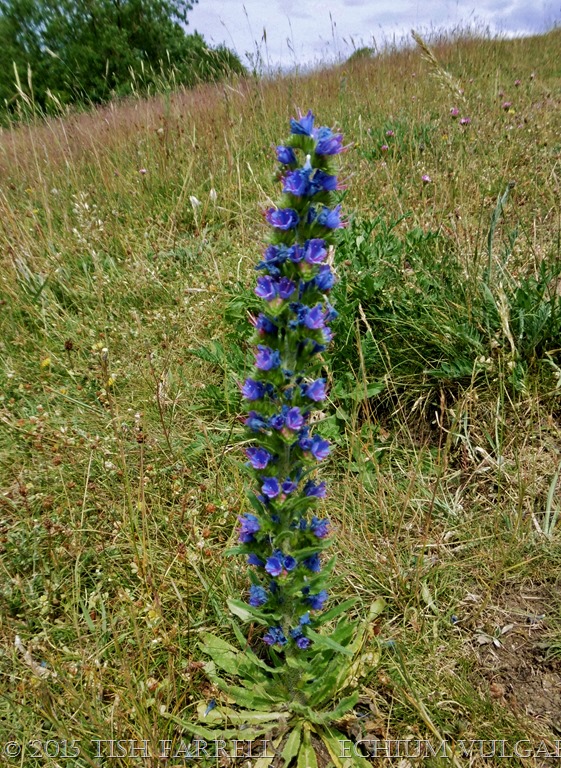
And now here is one of Windmill Hill’s  more sinister-looking plant specimens, – the very upright prickly spires of Viper’s bugloss. Apparently the flower’s fruits resemble adders’ heads, and other names include adderwort and snake flower. As well as colonising limestone areas, you will also find it growing on chalky and industrially contaminated soils. Like other members of the Echium family, which includes borage and comfrey, it is attractive to bees.

P1010611

And here’s another bee favourite – Wild Thyme:

100_5950

Thyme is of course a must in the kitchen. It is also a common medicinal herb. All forms of the plant contain the volatile oil thymol, a powerful antiseptic, which is often included in cough mixtures. I use thyme (fresh or dried) steeped in hot water with honey and fresh lemon juice when I have a cold or cough.

And talking of thyme, it’s time to head for home. So I’ll leave you with one last view of the windmill and some more flowers named after testicles. Not that it’s in any way connected, but I had to lie down in the grass to take this shot – a fine way for the minuting secretary of Much Wenlock Civic Society to conduct herself. It was just as well there were none of the usual walkers and their dogs around for me to frighten:

100_5981

This excursion, but naturally not the bit about the orchid’s etymology, was inspired by Jo’s Monday Walk. Please join her there for some fascinating rambles.

copyright 2105 Tish Farrell

Last Night From My Garden: A Fire Rainbow ~ Or Is It?

100_5851

There’s clearly something in the air over Wenlock Edge. Last night as we were sitting on the garden bench watching the sun go down – with our glass of wine and pot of olives – there it was. A rainbow. And it had absolutely nothing to do with rain. Most of the day had been hot and fine.

Fire rainbows are rare and technically called circumhorizontal arcs, and thus they are HORIZONTAL. i.e. More like this one, faintly seen, a little later and slightly north of the first iridescent cloud.

100_5859

But if this isn’t a ‘fire rainbow’, but part of an ordinary rainbow, then the colours are the back to front, more as if this is part of a double rainbow, but with only the reflection visible. Curiouser and curiouser, but a wonder to see over one’s garden fence. Perhaps it is a Wenlock Edge phenomenon, the angle of the setting sun in relation to the cloud above it.  Anyway, this is what was going on in the rest of the sky over the bean field. Someone has clearly been sky painting.

Happy Monday everyone.

100_5858

The Leaning Tower of…er…Bridgnorth?

100_6830

100_6829

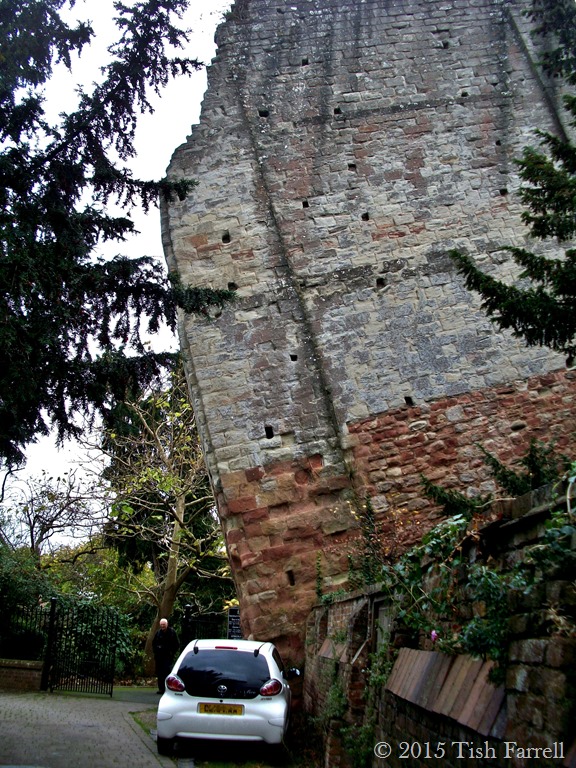
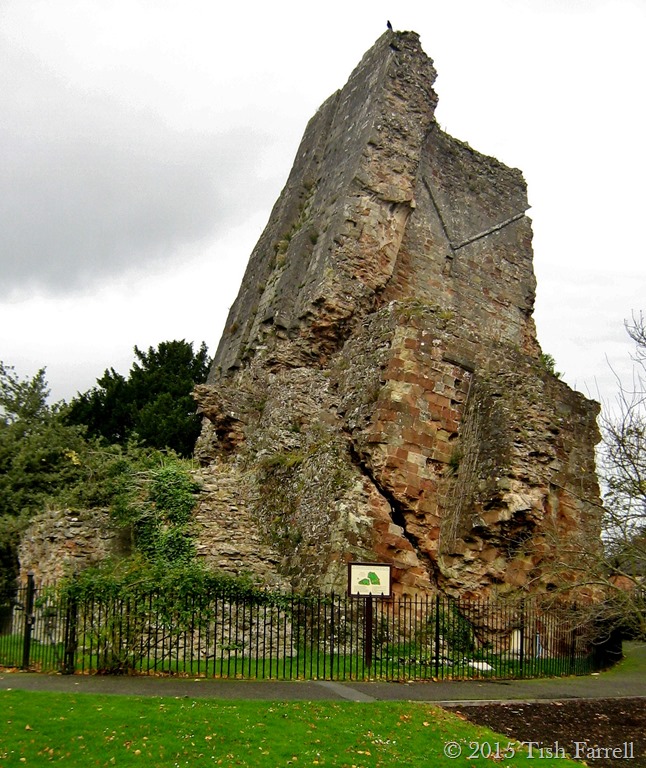
At 15 degrees this castle has ‘more lean’ than the leaning Tower of Pisa, although all that remains of this 900-year-old Norman castle is this blown up tower. It is now now a feature in the sedate Castle Gardens  in Bridgnorth, Shropshire, my nearest market town.

The ruins have been in this state since Britain’s Civil War in the 1640s, when Oliver Cromwell’s Parliamentarian forces laid siege to this key Royalist stronghold. The Royalists meanwhile had set fire to the town before retreating into the castle. The fire then reached the Roundheads’ gunpowder store just outside the castle wall. This duly exploded, and the upshot of all the firing and blasting was that the Royalists surrendered, and Oliver Cromwell ordered the complete destruction of the castle. As you can see, the tower defeated the demolition gang, and so there it stands, apparently defying gravity for the last 368 years.

IMG_1870

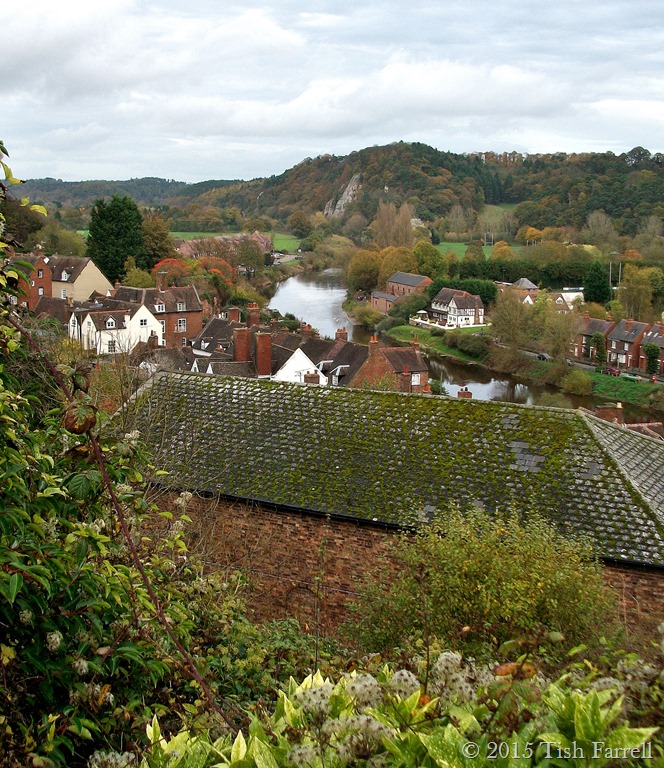
Below is the view over the River Severn that you  might once have had from the castle keep. When Charles I first visited the place, he is reputed to have pronounced it “the finest view in all my Kingdom.” Sadly for him, he did not live too much longer to enjoy either the view or the kingdom.

100_6848

copyright 2015 Tish Farrell


This week at Paula’s Thursday’s Special, she is inviting us to share Traces of the Past. She has a truly impressive castle to show us, one that was being built at much the same time as the Bridgnorth stronghold.

All the colours of the rainbow in the creations of poet-painter Marc Chagall

“My hands were too soft. I had to find some special occupation, some kind of work that would not force me to turn away from the sky and the stars, that would allow me to discover the meaning of life.”

100_1302

Noe et l’ Arc-en-ciel       Musee National Marc Chagall, Nice

100_1303

Le Paradis     Musee National Marc Chagall, Nice


I took these photographs in the Musee National Marc Chagall in Nice. This gallery has to be one of the finest little galleries in the world: the setting, the building and the art fusing in dreamy synergy that captures the humanity, joyousness, and all round good spirits of Marc Chagall. He was a man who created in all media. He saw his work  “not the dream of one people but of all humanity”.

Or as André Breton put it, “under his sole impulse, metaphor made its triumphal entry into modern painting.”

And then there is his use of colour. Picasso probably has the last word on that: “When Matisse dies, Chagall will be the only painter left who understands what colour really is.”

Marc Chagall (1887-1985)

ROY G. BIV

The Night Guards, Downtown Harare

Harare night guards waiting to go on duty

A big thanks to Yvette who is Paula’s guest over at Thursday’s Special for giving me the chance to post this photo again. Her challenge is street portraits, and this is one of my favourites, taken on a brief trip to Harare in Zimbabwe.

We were living in Zambia at the time, and had driven down to Harare to meet friends who were flying in from the UK  to spend two weeks with us in Zim and Zam. At the time, life was a bit tense in Zambia. The first year of multi-party democracy had already yielded one attempted coup. Destabilisation by stirring up a crime wave was part of the strategy. The national football team had been killed in an air crash and left the country devastated (see link * below for this story). There was cholera in the townships and members of the unpaid Zairian army were coming down to Lusaka on looting sprees. It was thus a relief to find ourselves in a city where the atmosphere felt so open after Lusaka. This was in 1993 I might add. I know Zimbabwe’s seen some bad times since, and Zambia’s fortunes have greatly improved. Things can change so rapidly on the African continent.

But it’s the spontaneity of the security guards’ reaction that I love. I’d just crossed the road from the post office, and they were about to start the night shift and waiting for a lift.  Smiling faces like these are what I remember most from our eight years spent living in Zambia and Kenya.

copyright 2015 Tish Farrell


Related:

Letters from Lusaka part 1

Letters from Lusaka part 2

Once in Zambia: in memoriam*


Street Portraits Lost in Translation

Obsessive Compulsive Compost Disorder and why you should have it, or at least help someone who does (and that would be me)

100_4954

I truly cannot help it. I gather anything and everything that will go into my allotment compost bins. This includes not only our vegetable waste, but other people’s. My neighbours along Sheinton Street may indeed wonder how it is that the garden mowings and clippings that they throw over their back hedges can disappear so fast. I don’t really want to go round to their front doors and discuss it with them on the basis that my perceived eccentricity quotient in the town is already quite high enough. But they clearly don’t want the stuff, and they leave it in such handy piles beside the field path. I simply scoop them up on my way to the vegetable plot.

Compost foraging, however, does have its small hazards. It can, for instance, involve a close encounter with a slow worm – a copper and black snakish looking reptile that is actually a limbless lizard. They are quite harmless, but I still leap back in alarm when I touch one unexpectedly. I ought to know by now. They love warm piles of things to bask in during the day. They are to be treasured too, since they eat slugs. And yes I know that in the cycle of things slugs have their good points, and probably are useful in compost heaps, but I am utterly prejudiced against them, and admire anything that disposes of them. Toads are thus also heroes, though sadly in rather short supply.

P1010390

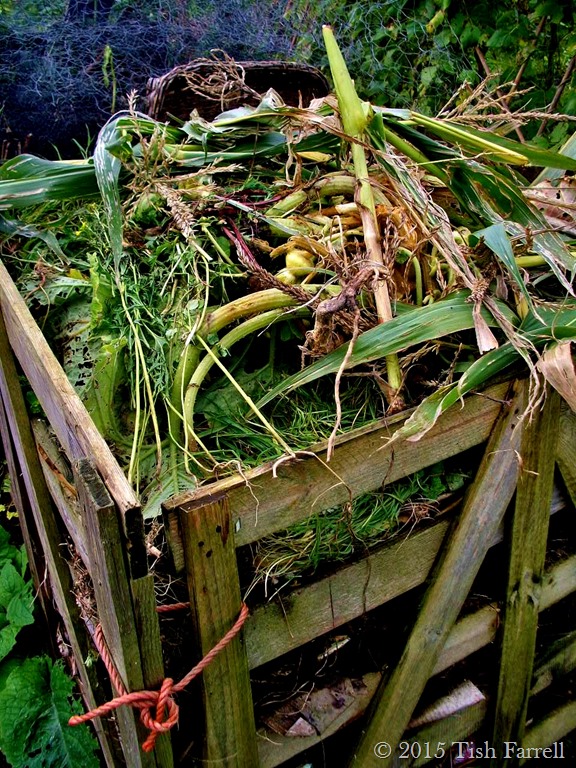
The manner of composting as formerly done by me, and displayed in the first photo is not to be emulated. A dedicated composter, and I am now trying to do this, chops big stems and stalks into short lengths to speed up the rotting down process.  It is also good have mixed layers e.g. brown, dry matter such as scrunched up pieces of brown corrugated cardboard, paper, wood shavings, leaves and small twigs. The aim is about 50:50 brown to green matter. This allows air into the mix, and so prevents a sour and smelly squidge.

Grass  mowings and animal manure will heat things up, and also aid decomposition. The heat kills any weed seedlings.  Other additives in my compost include tea bags, egg shells, vegetable parings, allotment weeds, turves from ground clearing, wood ash, hoover contents, and brown paper carriers. Every now and then I also add a layer of comfrey since it also a good compost activator.

*

IMG_1138

Comfrey is a good compost activator. It also makes an excellent plant food, keeps the bees happy, and helps mend human bones and inflamed tissues. The leaves can be made into tea or added to soup. The flowering tops contain vitamin B12 (source: Herbal Therapy for Women by Elisabeth Brooke MNIMH). Can you spot the bumble bee in the top photo? (Just testing).

100_5359

*

Ideally, the contents of the compost bin should be turned over during the growing season to aerate them, but if this is too daunting a task, and if there’s space, then three or four bins are the answer. The rotting down process will be slower, but when full, the first one is  simply left for a couple of years while the others are being filled. It’s also common practice to put a piece of old carpet over the top to help things along. My largest bin is made of four wooden pallets tied together.  It is easy to open once full, and the contents can be tipped out and turned over.

And why am I so keen on compost? Well, apart from the obvious that it feeds and improves the soil, it is also useful as a mulch, and MULCHING is my current theory on how to deal with  our increasingly ERRATIC WEATHER systems. The only problem is you need masses of it.

But applying a good deep layer around plants and between rows of crops, not only nurtures the plants, it gives them some protection in heavy rain, and stops the soil drying out in times of drought. To retain moisture it should thus be applied after watering/rain, and it will then reduce the amount of watering needed in the future. Strong, healthy, UNSTRESSED plants mean less pests and diseases. A sturdy cabbage will even withstand some slug damage.  For added protection, cover the lot with enviromesh.

My objectives for composting, however, are small potatoes compared with the goals of The Global Compost Project. Scientists involved with this brilliant initiative believe composting can mend the mess we’ve made of the planet, AND help reduce climate change. Here’s what they have to say:

“It also turns out that one easy, natural human invention is very important to boosting photosynthesis and cleaning up the mess we created.  It is Composting!

Fertilizer feeds plants nitrogen and compost feeds soil carbon.

According to Lawrence Berkeley National Laboratory and Marin Carbon Project, by spreading just 1/2 inch (1 cm) of compost on grazed rangelands, soil naturally starts to sequester more carbon out of the air via renewed photosynthesis at the rate of 1 ton per acre per year for up to 30 years.  This study was performed jointly by both organizations over a 7-year period, which clearly demonstrated proof of concept.

The results are delighting water conservationists, microbiologists, and climate change scientists around the world.  Compost replenishes the soil carbon  to balanced levels.  It is as if the eco-systems are rebooted, and within one year native grasses and wildlife rebound.  The carbon intake,  forage capacity, and water retention all fall into normal rhythms.”

For more about The Global Compost Project go HERE. And HERE for info on domestic composting from the Royal Horticultural Society.

*

And now excuse me while I go off to do some more compost foraging. Perhaps, after all, I should be enlisting my neighbours’ help. They might chuck me more stuff over their hedges instead of putting it in their recycling bins. But either way, recycling is good. So: Obsessive Compulsive Composting anyone? Just to encourage you, and to show off, here’s some of my last year’s summer and winter produce:

100_4197

P1000281

copyright 2015 Tish Farrell