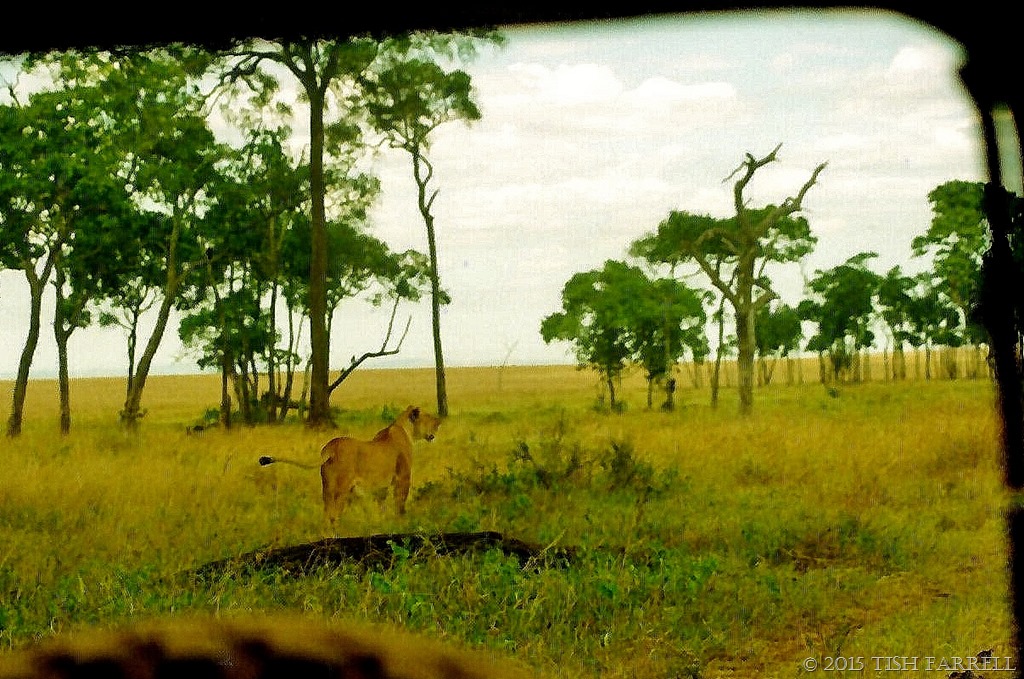
A little blurred on the road to Lunga Lunga

Scan-130603-0018

And blurred is often how we felt after driving down the Nairobi-Mombasa highway to Tiwi on Mombasa’s south coast. We used to spend Christmas down there. It was a three hundred mile trip, descending from the air-conditioned high plains of Nairobi to the  wet-hot steaminess of the coastal strip.  On a good day it would take around five hours. Other times we’d break the journey, staying at Tsavo Inn or Taita Hills. Sometimes the road was hardly there at all, washed out by December rains.  You never knew until you got there. The final leg of the trip also always involved the infamous Likoni Ferry  that carries traffic from Mombasa Island to the southern mainland.

To catch it, you first had to drive through Mombasa, negotiating mad matatu drivers and throngs of push-cart guys, shunting impossibly huge loads of cooking oil, coconuts, pineapples, coca cola. Then came the broiling wait for the ferry. If you timed it badly, the traffic tailed back into town.  Being tetchy Brits who do not bear overheatedness well, we did not welcome being sitting ducks for all the street traders, despite the fact that roasted cashew nuts were a favourite. Grumpy old us.
But then, when we found ourselves close enough to the head of queue to see the in-coming ferry, it was all change. Suddenly the excitement hit. This place was Africa with bells and whistles, and in every sense. All of life swarmed by as the ferry spilled out its trucks, multi-coloured matatus and crowds and crowds of humanity. The burst of colours under the tropic sun set the brain afire – the women in their vibrant kanga wraps, men in kanzus and embroidered kofia caps, the youth sporting the rich world’s recycled tee-shirts with every imaginable corporate slogan draped from skinny shoulders.

There was always a frisson of anxiety as we boarded. Would we make it to the other side? After all, the ferry had been known to cut loose and drift off towards the Indian Ocean. But no. It never happened to us.

Even so, the final glide up the mainland slipway always seemed a minor miracle. We’re here! And here was Likoni market – throbbing with rhumba rhythms, and hooting-whistling matatu crews. Ramshackle stalls line the road – hoteli, hair salons, tailors’, fruit and veg sellers, Chinese multi-coloured enamel ware and plastics. There are smells of steaming market waste, hot mandazi donuts, joss sticks, cheap perfume, diesel and dust.

351

The foot passengers poured around us. We crawled through the melee. Until – at  last – the open road – the long straight causeway that runs south through Kwale District to  Lunga Lunga, the last town in Kenya before the Tanzanian border.

This road is lined with coconut plantations, the palms all leaning with the sea breeze.  Cattle graze beneath baobabs and kapok trees. There are guest houses, and small-holdings, schools and tiny mosques. The homes have corrugated iron or palm thatch makuti roofs. The walls are coral rag or wattle and daub. Verandahs feature. There are more trading centres, curio carvers, furniture makers, general stores, charcoal sellers, second hand clothes, kangas flying in the breeze like flags.

Scan-130603-0022

Scan-130603-0021

We never went as far as Lunga Lunga. Tiwi was far enough. To arrive at Maweni, the little beach village perched above the Indian Ocean, to immerse in clear waters, and finally unblur with bottle of Tusker beer – bliss.

dawn on Tiwi with dugout - Copy


copyright 2015 Tish Farrell

Blur

The Poetree at Much Wenlock’s Poetry Festival

IMG_1116

 the perfect place for poetry

And that would be Much Wenlock, or so says Carol Ann Duffy, Britain’s Poet Laureate, and the festival’s founding patron. Not only that, Wenlock’s Poetry Festival is one of the best of its kind in the UK. Now into its sixth year, it was the creation of Anna Dreda, owner of the town’s lovely Wenlock Books, and in a few weeks’ time our streets will be teeming with poets and poetry lovers. For three whole days there will be events of all kinds and for all ages and tastes. There poems in shop windows, poetry breakfasts, and readings of their work by some of the best British poets of our time. This year there will be a closing gala event with Dame Carol Ann Duffy, Imtiaz Dharker, Jean Atkin & Little Machine. One of the side-show attractions is always the Poetree on the Church Green. Every year people can break briefly into verse and hang their words on the tree for others to read. Last year the tree was so happy it reciprocated by bursting into bloom. What more can one ask for? IMG_1050 IMG_1042 You can find out more about events at this year’s Much Wenlock Poetry Festival   It takes place all over the town on Friday 24th to Sunday 26th April 2015. And now here’s a poem I found while out window shopping at last year’s festival: IMG_1026 Jennifer Nichole Wells One Word Photo Challenge: shamrock   #WenlockPoetryFestival
Reflected glory? Putting myself in the picture

P1000801 P1000806 - Copy Well it had to be done, didn’t it – that selfie. Besides which, my hat matched the reflected paintings. Anyway, this is the wonderful work of  Jacob Chandler Shropshire Artist and Sculptor, and it’s on show at Jenny Gunning’s  gallery, Ironbridge Fine Arts and Framing Limited.

Jenny has recently moved into these new premises, one of the nineteenth century warehouses on the banks of the River Severn in Ironbridge, home of the world’s first cast iron bridge (see previous post). It’s actually on the site of another world wonder, the Merrythought Teddy Bear Factory, the family-run business that since the 1930s has been making the best bears ever. But that story will have to wait.

For now please enjoy Jacob Chandler’s Layers of the Mind complete with passing strange woman in a hat. Also, if you can, visit Jenny’s gallery. Not only does it show the work of local artists, but Jenny and her father, David Gunning are both famous print makers. You can see their latest work there, and buy one of David Gunning’s bespoke printing presses.

This week at Lost in Translation Paula’s Thursday’s Special challenge is reflection.


#JacobChandler  #JennyGunning  #DavidGunning

Bridge, what bridge? Only the world’s first cast iron one

P1000838

I love the way this little girl is much happier to play on  the railings than notice the wonder of this bridge,  a bridge that in its day was considered a world wonder. Nothing like it had been constructed before. It was opened to the public on New Year’s Day 1781, and right from the start was a visitor attraction, seized on by both coach operators and hotel proprietors to boost their trade. In the summer of that year The Swan Inn (which is still in business today, and for much the same reason) pronounced in an advertisement that is was:

situate near the most incomparable piece of architecture, the Iron Bridge.

One of the companies for the Shrewsbury to London route also made much of the fact that travellers would be passing:

that striking specimen of Art and so much admired object of travellers.

Today the bridge may seem quaint, and the manner of its construction somewhat bizarre, since it utilises wood joinery techniques in its iron rib-work.  But for all that, we are talking major, life-changing innovation: something akin to the technology boot-up begun in Silicon Valley. Here, though, we have a rural Shropshire valley, otherwise known as the Severn or Ironbridge Gorge in Coabrookdale. It is just a few miles from my house and, with its steep banks of hanging woodlands, and the mostly tranquil river below, it seems an unlikely location for epoch-changing events.

Yet this bridge was the first of its kind in the world, and thus a proving ground for what could be achieved with hitherto untried applications of cast iron.  It led to the iron framed factories of the Industrial Revolution, and was a step on the way to the sky scraper. The growth in demand for iron and steel products for shipping and steam engines and weapons put the great in Great Britain. Iron made the country rich, and gave it the wherewithal to set off conquering the planet.

P1000838

From the outset then, the Iron Bridge was very much as a PR stunt, and although there were practical considerations – including replacing a very dangerous ferry crossing wherein Severn coracles were used to transport people (mostly large numbers of workers) between the town of Broseley on one bank and Coalbrookdale on the other, the main object was to prove the worth and usefulness of cast iron. Its builder was Abraham Darby III, the third generation of the Quaker iron founding dynasty that operated in Coalbrookdale from the early 1700s . The other Darby family claim to fame was Abraham I’s discovery of how to cast iron using coke instead of charcoal, which did much to halt the decimation of the nation’s forests, and was a piece of technological mastery that had been called for back in the reign of Queen Elizabeth I. In fact she offered a prize for anyone who could do it. She needed timber for her navy. She did not want it going up in smoke in furnaces and forges.

But back to the Iron Bridge. The design was roughly based on drawings by Shropshire architect Thomas Farnolls Pritchard, but there were many changes in the course of construction, and he did not live to see the finished project.  The site was not only difficult, but the bridge builders had further set themselves the task of creating a single span that was high enough to allow large Severn sailing trows to pass beneath without the nuisance of lowering their masts as they had to do for all the River Severn’s other bridges. This objective alone could have scuppered the project. The raising of the iron ribs proved an epic undertaking on a river that is prone to massive floods, and whose banks are not stable.

Visitors came from all over Europe to see the finished product. They included artists, princes and Swedish industrial spies. The Severn Gorge was likened to Hell with its burning lime and coke kilns, furnaces and forges. The eighteenth century tourists came and gawped with horrid fascination. I will leave you with one such response made in 1801 by popular song writer, Charles Dibdin:

…if an atheist , who had never heard of Colebrook Dale, could be transported there in a dream, and left to wake at the mouth of one of those furnaces, surrounded on all sides by such infernal objects, though he has been all his life the most profligate unbeliever that ever added blasphemy to incredulity, he would infallibly tremble at the last judgment that in imagination would appear to await him.

P1000838 - Copy - Copy


P1000846 - Copy

This post was prompted by Sally at Lens and Pens Phoneography & Non-SLR Digital Devices Challenge. Week 5 of any given month is about editing/processing images on a theme of choice, in this case architecture. The first image was cropped and  then played with in Windows Photo Gallery. I rather like the sepia version. I included the final image to show the construction techniques in more detail. It was taken in ‘Dynamic Monochrome’ on my  Lumix point and shoot, and then cropped and histogrammed to achieve this final look. Given the subject, it thus makes a virtue, I think, of the sunburst on the bridge parapet. It makes me think of blast furnaces and the way the iron was produced.

copyright 2015 Tish Farrell

In my garden change happens

100_5703

The showy petals of Patty’s Plum oriental poppy give way to the tight buds of  Black Elder (Sambucus nigra). And so it is that one thing leads to another. And although the prospect of change often worries us, there can be great beauty in transience. There is excitement too, if we allow it: of a ‘what will happen next?’

copyright 2015 Tish Farrell

Ephemeral

Flamingos in the Mist ~ Dawn on Lake Elmenteita

IMG

The light changes every second across the lake. From dawn till dusk there is always something to watch at Elmenteita in Kenya’s Great Rift. There are over 400 species of birds to spot for one thing – among them the endangered white pelican that breeds there. The main stars, though, are the surely the huge flocks of flamingos, both lesser and greater varieties, that turn swathes of the lake to rose-petal  pink. Even a passing glimpse  from the nearby  Rift highway  is enough to catch the breath. A pink lake – how can that be?

This story continues at: On watch at Elmenteita – the lake that blows away

Over at Paula’s Lost in Translation the challenge for this Thursday’s Special is ‘multitude’

Kind of Mauve not Blue at Plas yn Rhiw

100_4853

Looking back, it was a mauve sort of a day, the day we went to visit the old Welsh farmhouse of Plas yn Rhiw on the Llyn Peninsula. The sea in the bay below the house was peaceful, and the air still and dreamy. If you listened hard you  might hear echoes of the past along this ancient pilgrims’ path to Bardsey Island, the place the Welsh call Island of Currents. It was late September, and Wales was very much in end-of-season mode with many places closed; or if they were open, then looking as if they wished they were closed. It’s often like that in Wales. Even the stalwart National Trust, that now has care of Plas yn Rhiw, was slow to open up. We had to go away and come back. In fact that was a bit of good luck. Further down the peninsula in Aberdaron we were taken by surprise at Y Gegin Fawr, The Big Kitchen cafe, where the owner was enthusiastically hospitable.

IMG_0690

It turned out that she was keen to uphold  a 700 year-old tradition of feeding pilgrims. We had some very excellent hot chocolate there, not something the saints would have recognised. Or if they had, and if they had seen Graham’s mug overtopping with whipped cream, they would surely have pronounced it a sin of the flesh, and to be eschewed at all costs.

100_4805

Back at Plas yn Rhiw we stepped into another time-warp.

100_4858

100_4822

Here, the seventeenth century farmhouse had been lovingly restored from ruin by the three Keating sisters, who at the urging of friend and architect, Clough Williams-Ellis (he of Portmeirion fame) scraped up the funds to buy the place in 1938. They lived there until they died, filling the house with personal treasures. When you wander from room to room, there is a feeling of benign, if eccentric spirits. They don’t seem to mind us peering at their books and nick-nacks…

 copyright 2015 Tish Farrell

For more of this story:

Gazing into Hell’s Mouth at Plas yn Rhiw


Jennifer Nichole Wells One Word Photo Challenge: Mauve

Eclipsed in Much Wenlock on World Happiness Day and Taking a Solar Selfie

100_5065 Here I am on top of Windmill Hill, Much Wenlock’s landscape landmark, and this is the only way I could see the partial eclipse – with my back to it, and camera at the ready. We had such clear skies, and the sun was so bright that we remained bathed in sunshine throughout this cosmic event, although it did seem very cold. Lots of people who were out walking their dogs had gathered  at the windmill too, one lady monitoring the process through a pin-hole viewer. This is the scene before me as I take the photo over my shoulder: windmill and pointer. Had the eclipse actually happened? P1000779 P1000764 P1000788 Aftermath. I caught the sun in the trees as I walked home across the Linden Field. This, incidentally, was the place where the Much Wenlock Olympian games were, and are still held every year. They were devised in 1850 by the town’s physician and herbalist, Doctor William Penny Brookes, and went on to inspire the founding of the modern Olympic Movement. Windmill Hill provided the natural viewing platform where spectators sat to watch the events. See how this little town of ours spread its good hearted influence around the world. Wishing everyone joy on this, International Day of Happiness   #eclipse #International Day of Happiness

Out in the Midday Sun: Running Ostrich and Ngong Hills

197

This week over at Paula’s  Thursday’s Special she is inviting us to break rules with our photo taking. This shot of a camera-shy, and thus fleeing male ostrich was taken in Nairobi National Park. I expect when I started to focus on him, he was facing the other way; after all, who wants a snap of an ostrich bum. (I should say that ostriches, so G tells me, are the only birds with external genitalia, and believe me they are surprisingly impressive when glimpsed, though thankfully not visible here).

Also one of the main rules of photography in Africa, particularly when  you are close to the Equator, was simply not to bother trying during the middle of the day. All colour tends to leach away; there may be a heat haze and also dust in the air; and the landscape maddeningly flattens out and stops looking magnificent.

But that is all very well. What else can you do when you find yourself in a Kenyan game park is in the middle of the day. It’s the kind of thing mad dogs and English persons do. Photos had to be taken, and of course later discarded.

The thing I like about this photo, being hooked on Karen Blixen’s Out of Africa, and the ‘I had a farm in Africa, at the foot of the Ngong Hills’ line, was that while I was concentrating on the ostrich, I inadvertently captured the Ngong Hills in distant blue profile. Though largely static, earth tremors apart, they were also hard to photograph. Here, though, I caught them, and you can well appreciate how they got their name, derived from a Maasai word meaning  fist. See those four clenched knuckles.

Otherwise, nothing much is in focus here except perhaps for big bird’s blousy white feathers. All sense of movement is truncated, ‘frozen’ in time under the fierce tropic sun. I still like the photo though.


copyright 2015 Tish Farrell

Elephant tribe versus Man tribe: and how the bees are helping

We’ve been watching a very heartening series on BBC i-Player The Secret Life of Elephants. It followed the magnificent conservation work being carried out by Save The Elephants, a charity that operates in Samburu, Northern Kenya, and relies on the cooperation between  the nomadic Samburu people, local smallholder farmers and scientists from Kenya and beyond.  One of the key initiatives is to put tracking collars on the matriarch leaders of particular elephant clans, and also on the large bulls who, outside the breeding season, lead more solitary lives.

Elephants may cover vast distances in the course of their annual migrations. But once they leave the national parks they are more vulnerable to poachers, and also to irate farmers who are tired of having their year’s livelihood consumed in a single night. By tracking and mapping the herds’ movements on computers, and  maintaining channels of communication with the pastoralists and farmers, Save The Elephants researchers  are working out ways to lessen conflicts, and present solutions, and above all, to secure the future for wild elephants.

The Samburu pastoralists have always been wise enough to respect elephants, and are now anxious to do what they can to protect them. This is their view on the matter:


The first man said the elephant is like us, like our brother, and we have to live together, not hunt elephant. That’s what we say we were told at the beginning. That’s what we still believe. The elephant has always been, and will always be, special to us. This is why we protect it now.

Samburu people on the importance of elephants


Scan-130608-0001


For farmers it is a very different matter. People are often killed trying to drive elephants out of their crops.  And so one of STE’s objectives is to work out the best place to erect elephant fencing so that elephants can be channelled away from farming communities as they pass by on their seasonal trek between the river where they congregate to breed,  and the mountain forests where they go to browse.

Fencing, though, is not always the total solution it seems. Elephants are not daft. The old bulls have learned  how to open gates onto the vast European wheat farms that lie to the west of Mount Kenya. But while the large-scale producers can tolerate some elephant grazing, smallholders cannot. For them it is a matter of living or starving.

One of the STE researchers, Dr. Lucy King has come up with a very simple, low-tech and productive approach to keeping elephants out of Kenyan farmers’ cabbage fields.  It began with the discovery that elephants will move off if they hear the sound of bees buzzing. African bees are especially aggressive, and on a very short fuse temper-wise. She thus came up with the notion of placing beehives around farm fields.

Traditional African beehives are made of lengths of hollowed-out tree trunks that are then suspended in trees. These were hung at intervals on the field perimeters, and connected up by tripwires. When the elephants tripped the wires, the hives were duly shaken and out would swarm the angry bees. Elephants would then beat a retreat, leaving farmers with both their crops and a new source of income from the honey.

As Colonel John ‘Hannibal’ Smith was so often wont to say in The A-Team: “I love it when a plan comes together.” In this case, though, it is clearly the work of the B-Team.

Copyright 2015 Tish Farrell


Related:

I’ve written more about elephants in Elecommunication: So Many Connections

And last but never least, thanks to Paula at Lost in Translation and her guest challenger, photographer Guilhem Ribart. TRIBE is the prompt. For more interpretations, please also follow this link.  I should add that my photos here were taken in Lewa Downs which is part of Save The Elephants’ sphere of operations. The original negatives are very degraded, but seem to have a new lease of life translated into B & W. In fact they also seem to capture the elephantness of elephants rather better than the colour originals, which is interesting when you think about it.