Looking for Smut on Kenya’s Highland Farms

For those of you who read my recent post Valentine’s Day Runaway this is one of the things Team Farrell got up to next; it had a lot to do with smut. And no: it’s not what you think.
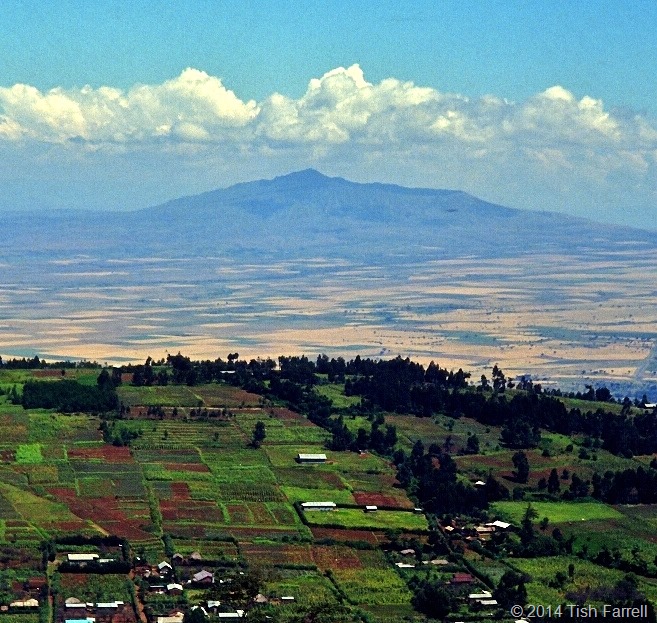
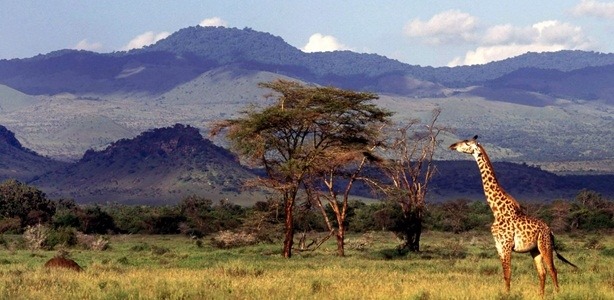
Rift Valley from Escarpment

Smallholder farms on the Great Rift Escarpment, Kenya

*

For most of the 1990s we were based out in Kenya, where Team Leader Graham, food storage expert and all-round fix-it man, was one of several  British scientists running a crop protection project alongside Kenyan scientists at the National Agricultural Research Laboratories (NARL). This work was funded by DFID, Britain’s Department for International Development, which in turn is of course funded by British taxpayers.

image

Most of Kenya’s farmers are women. Their efforts feed their families and feed the nation.

*

Many of the project’s programmes of work were done on farms, and involved helping farmers to devise their own research methods for controlling the numerous pests that attack their crops both before and after harvest. Since just about every Kenyan, from the President down, is some kind of farmer, or has a farm in the family, this was an important project, and just about everyone was interested in the outcomes. (Next time you are buying French beans or mange tout peas in the supermarket, look where they have come from. Much of this kind of produce is grown under contract on small farms like the ones below.)
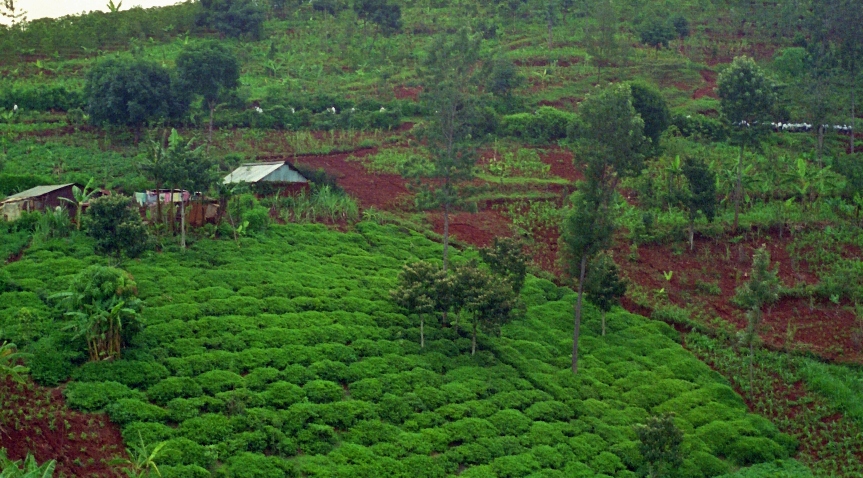
clip_image002

A typical farmstead in the Kenya Highlands north of Nairobi. The volcanic soil is very fertile, but also susceptible to erosion.

*

Today Kenya is undergoing a massive hi-tech revolution through the proliferation of cell phone and computer technology, but it still relies on agriculture for survival. When you discover that only 15% of Kenya’s landmass has enough rain or is fertile enough for arable production you may begin to see the scale of the problem for a nation that is only now beginning to industrialize. There are of course the big multinational outfits that grow wheat, coffee, tea, flowers and pineapples, but most of the food that Kenyans eat is grown on thousands of tiny farms, many less than an acre in area.
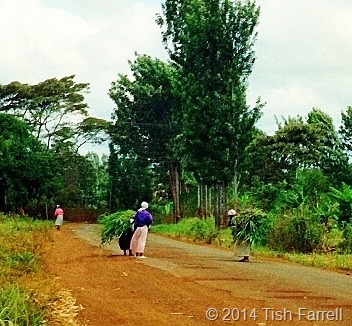
Escarpment lane

Gathering Napier Grass from roadside plots to feed ‘zero-grazed’ dairy cows. Most farms are so small that cattle are kept in small paddocks and their food is brought to them: yet another daily chore, along with gathering cooking fuel and attending to children and fields.

Kikuyu lane with woman carrying napier grass

Furthermore, most of Kenya’s farmers are women. Providing most of the the country’s food, they are in every sense the backbone of the nation. They stay in their rural homes, tending the crops and bringing up the children while husbands work away to earn extra cash to repair homes, buy fertilizer, educate their children and fund small business enterprises.

These men usually head to the cities where they work as security guards, clerks, hotel staff, house servants and drivers. Most take their annual leave at harvest and planting times so as to be back on their farms to help with the year’s most arduous tasks. So however you look at it, everyone in Kenya works very hard. Certainly in the nineties even most professional Kenyans believed that owning a plot of land to work at weekends was an essential insurance policy in a nation with no social services.
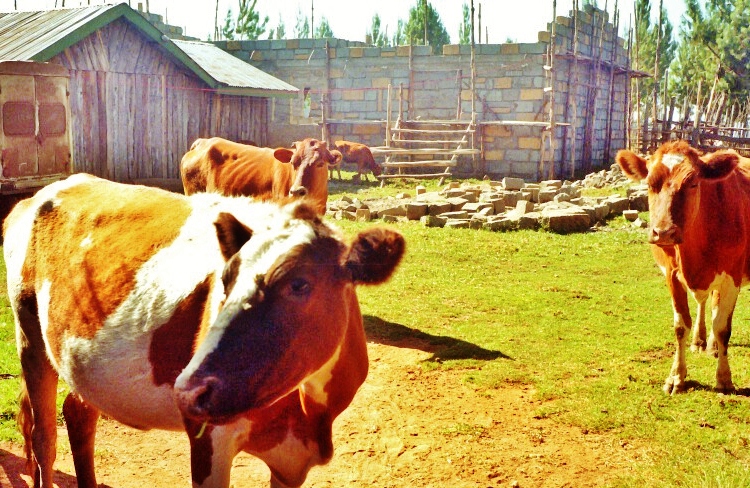
clip_image005

Most of the milk from smallholder’s cows is sold to provide cash to pay for children’s education and medical bills. While primary education has been free over the last few years, there are still expensive books and uniforms to buy, and secondary education is not free. On this farm the owner is also using any disposable income to bit-by-bit replace his timber farm house with a good stone house.

Kikuyu farmstead 24

*

So back in 1998, as part and parcel of protecting Kenya’s agricultural production, Team Leader Graham invited Nosy Writer (me) to accompany him on a fact finding mission around the farms north of Nairobi. We were on a quest to plot the incidence of SMUT, a fungal disease that was affecting Napier Grass, an important fodder crop. Most smallholders kept a small number of dairy cows because the selling of milk provided a valuable supplement to their income, helping to pay for school fees and medical expenses.

Most farms are too small to include pasture and so the cows are ‘zero-grazed’, that is, kept in small paddocks and their fodder (mostly Napier Grass) brought to them. This grass, if well-tended, grows into huge perennial clumps that can be cut at intervals. It can also be usefully grown on vertical banks to consolidate field terraces, or wherever the farmer can find a space, often on roadside verges. However, once smut gets a hold, the plant will gradually weaken and its food value decrease. Not only that, smut spores blow on the wind, and infect other plants. The only remedy is to root up the infected plants and burn them.

Graham and Kungu delighted to find smut on Waiyaki Way

Nothing pleases plant pathologists more than to find a nicely diseased plant. After a morning spent searching for smutted plants out on the farms, Doctors Graham Farrell and Jackson Kung’u are amused to spot a case back in the city. Here it is on a highway verge near the National Agricultural Research Laboratory in Nairobi. Smut lives up to its name and turns the flowering stems a sooty black. The fungus gradually weakens the plant and reduces it in mass and nutritional value.

*

My job on the smut quest was to hold the clip-board and the other end of the measuring tape while we sampled farm plots. Our third, and  most essential team member, (in fact he was the real team leader) was Njonjo. He was the one who heroically drove us up and down the hilly Kikuyu lanes that had recently been ravaged by torrential El Nino rains.
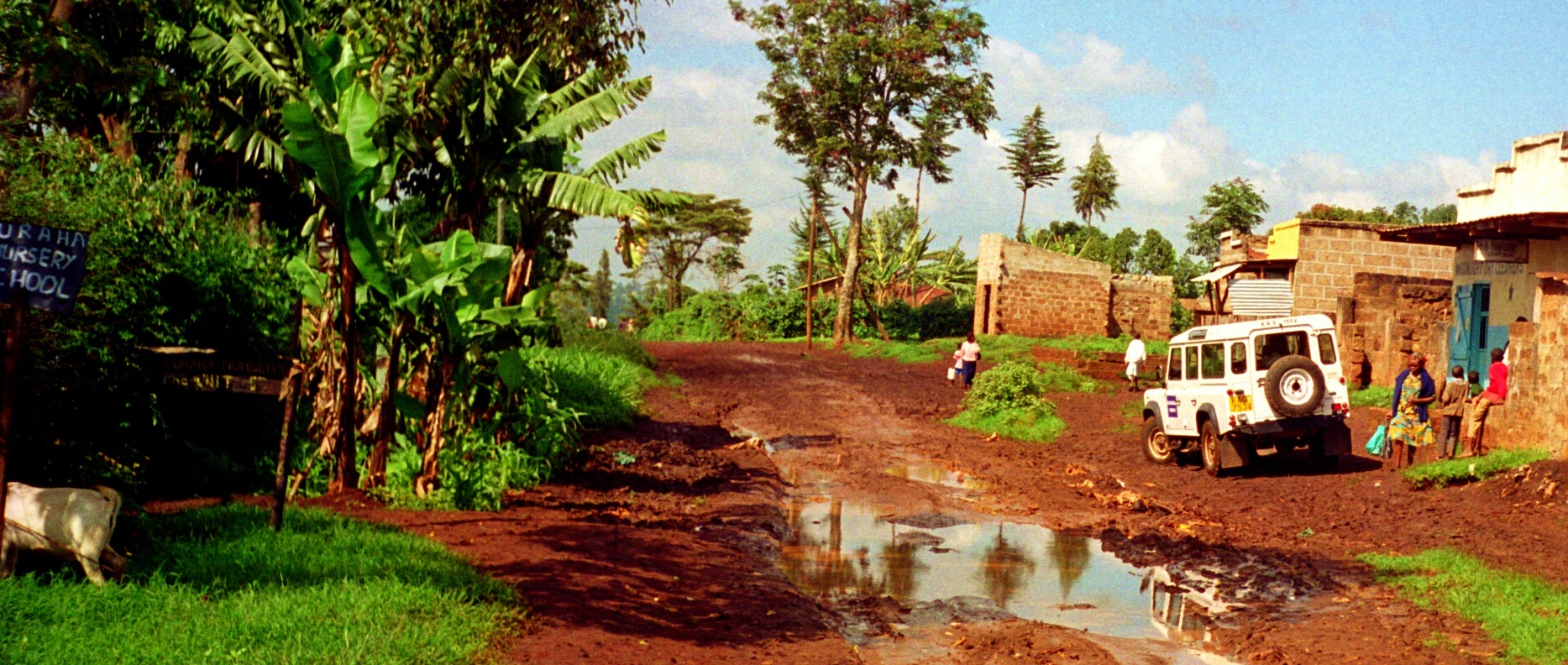
clip_image009

Rift lane after July downpour

As well as being one of NARL’s top drivers, Njonjo was himself a farmer, and so had a vested interest in getting to the bottom of the smut infestation. Since Graham’s Kiswahili was a bit rusty, and many of the older farmers preferred to speak Kikuyu, Njonjo provided them with on-the-spot lectures on what they should do with their smut-infected plants. He also talked our way onto every farm, where we welcomed in with huge courtesy, despite arriving uninvited.

clip_image011

Njonjo and Margaret the farmer. She was busy making compost when we arrived on her farm.

Kikuyu farmer and sugar cane

This farmer was so grateful to be told about his smutted Napier Grass he presented us with some sugar cane. We also came home with chickens, maize cobs and bags of pears

*

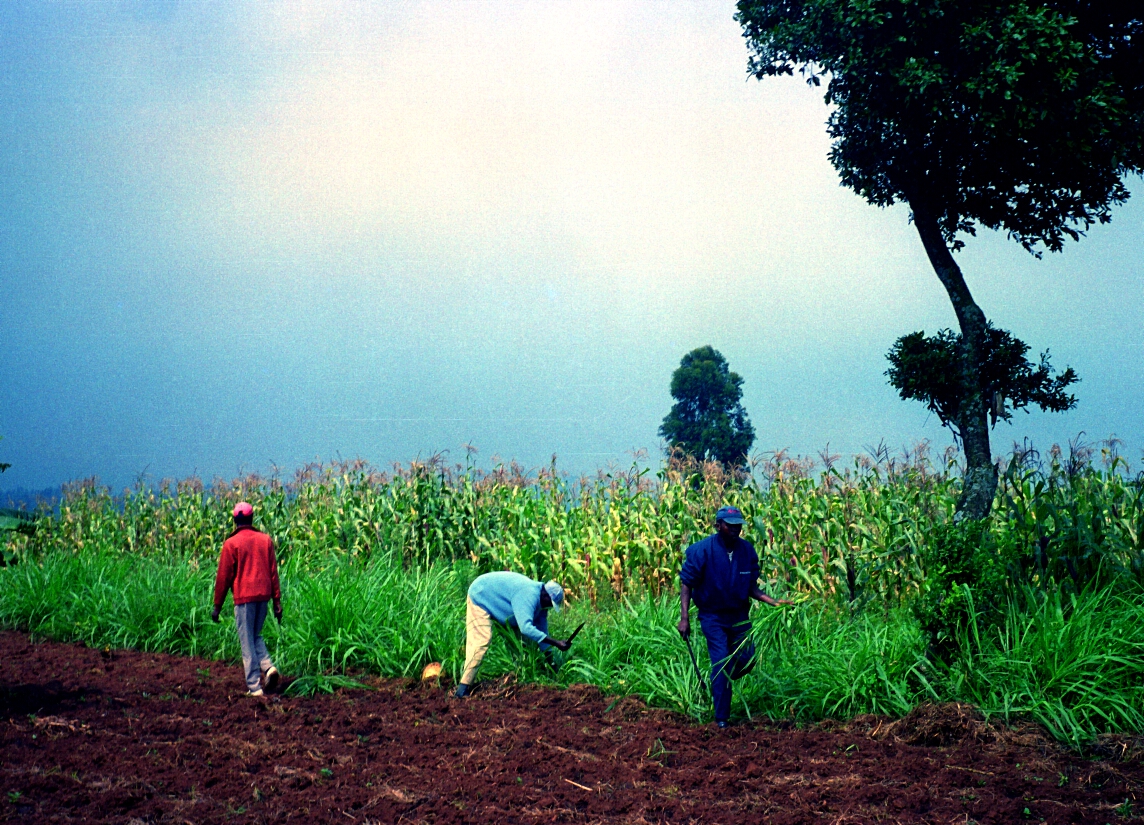
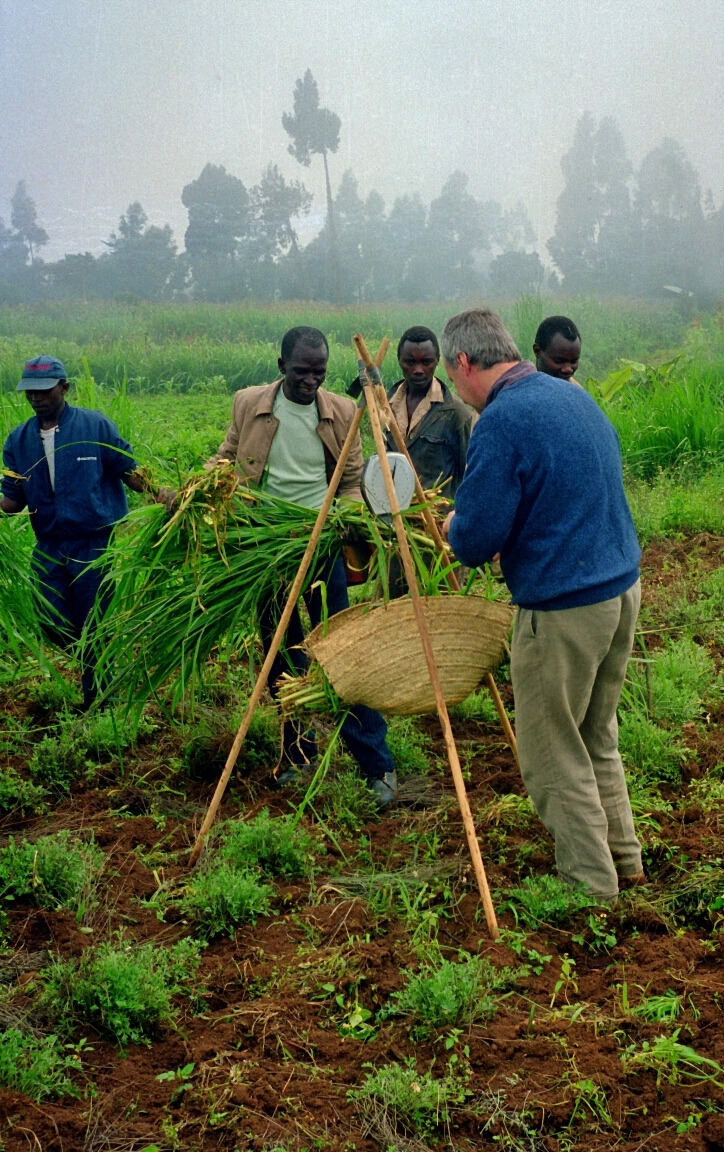
One of our tasks on the farm was to sample farmers’ Napier Grass plots to see how far they were infected, and to what extent the affected plants had lost mass. Njonjo organised a team of unemployed lads to help with the sampling.
clip_image015

clip_image017

clip_image019

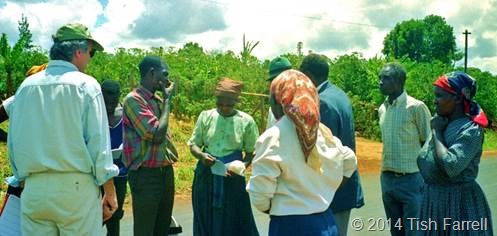
Before the cell-phone revolution of recent years, farming information was hard to come by. Here Njonjo delivers his Smut Lecture to an impromptu gathering of smallholders who have spotted our arrival in their district and want to know what we are up to.

*

And here are three good reasons why Kenyans work so hard…
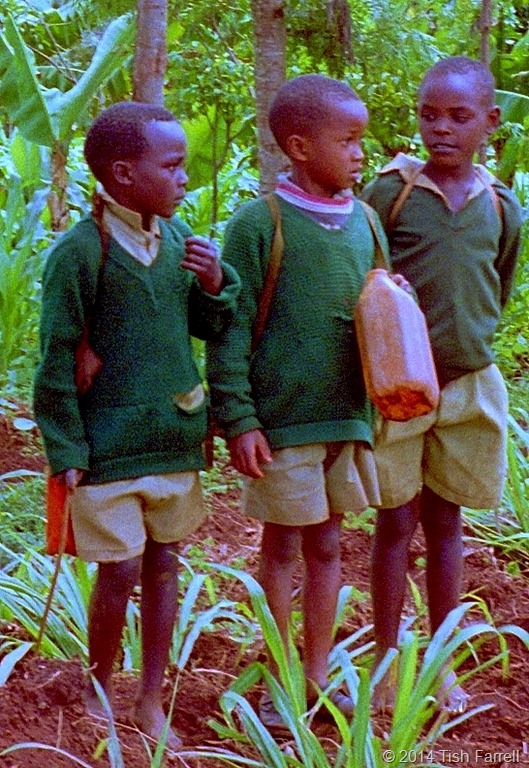
Kikuyu schoolboys

…education, education, education.

© 2014 Tish Farrell
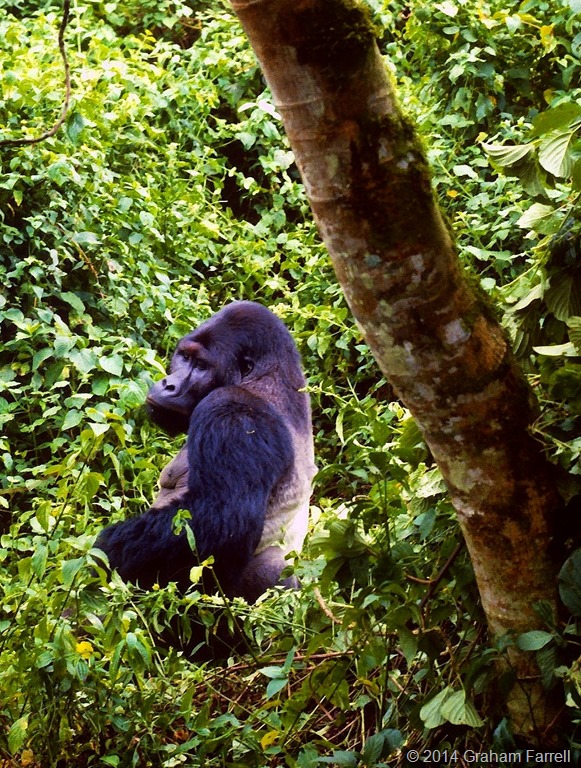
 

Gorilla Guards in Virunga

Scan-130703-0012

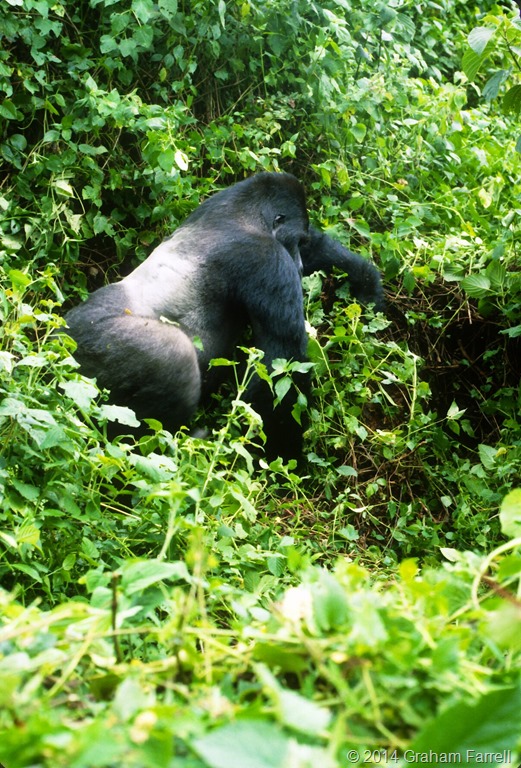
I’ve been rifling through the Team Leader’s photo file again, and trying not to wish I had taken these shots. As I said in an earlier post about the Congo, Graham went on an Africa overland trip a long time ago. He calls this era TBT – Time before Tish. He knows that I am deeply aggravated not to have visited all the countries he travelled through back then. Still, it means that you and I can at least enjoy these glimpses of one of the world’s most magnificent creatures.

Scan-130703-0004 (5)

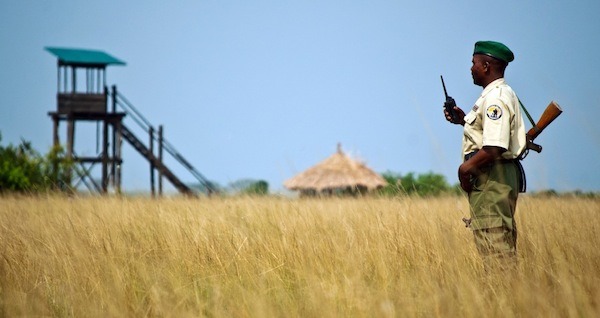
These photos were taken in the Virunga National Park, in the north east corner of the Democratic Republic of Congo. They were taken in peaceful times. Tragically, in the last few decades since the Rwandan genocide of 1994, this vast park has become a haven for armed militias. (The background to this situation is covered in the Congo post).  By 2008 it looked as if Virunga, one of the most  bio-diverse places on earth, had been destroyed. But since then the park has been restored and much of this is down to the brave Congolese rangers who continue to risk their lives to protect the wildlife, including nearly 500 mountain gorillas. Parts of Virunga are even safe once more for tourism.

Virunga ranger

Photo: Gorilla.CD  Virunga National Parks official website

*

The Gorilla.CD site is the best place to go for up-to-date reports on the Virunga National Park and its gorillas. Also see their gorilla blog for more fantastic pictures. And take a look at the fund-raising projects which need everyone’s support. Some one hundred and fifty rangers have been killed by militias. The most recently reported attack was in January this year (Virunga National Park Ranger Killed in DRC). Gorilla.CD has a project to support the rangers’ widows and children.

And yes, I did say it: tourism in this area is being revived. It takes place in part of the park where there is no militia threat. The Virunga National Park (3,000 square miles) is run by the Institut Congolais pour la Conservation de la Nature and is a UNESCO world heritage site. May be one day I will go there too.

© 2014 Tish Farrell

Frizz’s Tuesday Challenge: tagged ‘G’

Valentine’s Day Runaway

Scan-130608-0038

Friday February 14 1992 was the day I ran away to Africa. I was finally fleeing a marriage with too many guns in the closet, and much else besides. And I was leaving behind home, possessions, an aged father and three much loved labradors. The springer spaniel, though, I would not miss. The little beast was demented and I wished the husband joy of her.

At the time of departure I had very little money, and I had left a legal aid solicitor to handle my divorce. (With guns in the closet I discovered that such matters are swiftly expedited). When I boarded the airport bus in Wolverhampton bound for Heathrow all I had with me was one canvas grip stuffed with some summer clothes, and a small cabin bag containing paperbacks, my Olympus-trip, a mini cassette player and Joni Mitchell’s Night Ride Home. I also had an Air France ticket to Nairobi and a stash of anti-malaria tablets.

Scan-130510-0034

Long ago at Mzima Springs – the way I was then…

*

I was off to be with the man with whom I was smitten, an entomologist working out in Kenya on a three-month contract to control an introduced crop pest, the Larger Grain Borer. I knew little about him, and still less about my destination. Years before, in a frigid Scottish university, I had written a masters thesis on the socio-economic relations between Mbuti hunters and Bantu farmers of the Congo. I had never been to Africa, nor wanted to go there. I had read too much about forest buffaloes, ants and yaws in the Ituri Forest to find the idea appealing. I was not the sort of person who craved adventure or who had travelled much. I was a museum researcher and an armchair anthropologist. When I set off from rural Shropshire on that dank and gloomy day, it was to meet up with the flesh-and-blood man who had sent me the plane ticket. I did not expect to look out of a plane window somewhere over Somalia, and fall in love with a continent.

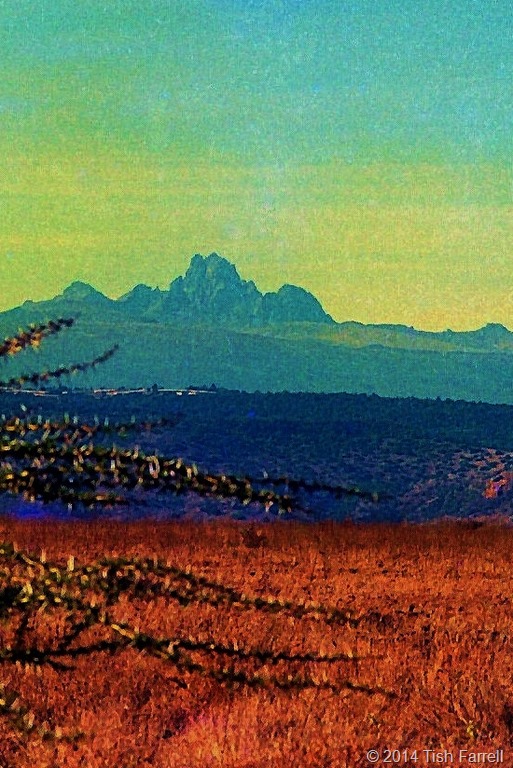
It was un coup de foudre as the French say. Ludicrous and nerve-shattering. Perhaps I should not have flown Air France, (although with hindsight I have to say it was one of my best flights ever). But as we approached Nairobi the condition only grew worse. It seemed there was a plane jam at Jomo Kenyatta International; the 747 could not land. Instead, it circled and circled Mount Kenya. I could not believe it: this god’s eye view of the vast exploded volcano presented to me again, again, and again. Then, as a final flourish to this extraordinary entrée, we made our descent over the green highlands of Kikuyuland, the smallholder farms so lush from the short rains.

Those landscapes fused onto my retina, bedded in my cerebral cortex, and I was changed.

Scan-130520-0003

My man in Mombasa – the way he was then…

*

When I finally met G at the airport, he seemed like a stranger. I noticed that his hair needed cutting and he was wearing a short-sleeved shirt with an oddly tropical look, this when I had only known him in the thick jumpers and anoraks so essential for surviving winter in rural Shropshire. It was a disquieting discovery to see that I did not know him at all in this landscape. As he drove me into the city I gazed out at the plains bush country around the airport, found myself blinking at the crowds and traffic chaos in downtown Nairobi. Someone had turned the colours up: it was all too bright, the road reserves dazzling with pink bougainvillaea, yellow cassia trees; the bright clothes and brown faces, the white smiles. When I arrived at the Jacaranda Hotel in Westlands I was still in tourist mode. I thought I had come to Kenya for a couple of months at most. Neither of us could have guessed that we would not live again in England for another eight years, or that our Africa journey had only just begun. And so yes, to thieve a line from Ms Brontë, and one so apt for this Valentine’s occasion – “Reader, I married him”; I married the man who bought me a plane ticket to Africa. How could I not?

napier grass on the Rift

Kenya’s highland farms in the rains

© 2014 Tish Farrell

Related:

Carnations, Crooks and Colobus at Lake Naivasha

On Kenya’s Farms

No way back from Africa: the road to Hunter’s Lodge

 AILSA’S TRAVEL THEME: ROMANCE

DP CHALLENGE

Weekly Writing Challenge: My funny Valentine for more bloggers’ stories. The ones below especially caught my attention:

Waiting on a Word

Aliabbasali

Words We Women Write

Yellow Peril? Some Cut and Thrust Tactics on Kenya’s Matatus

002 (2)

Going down the Great Rift

*

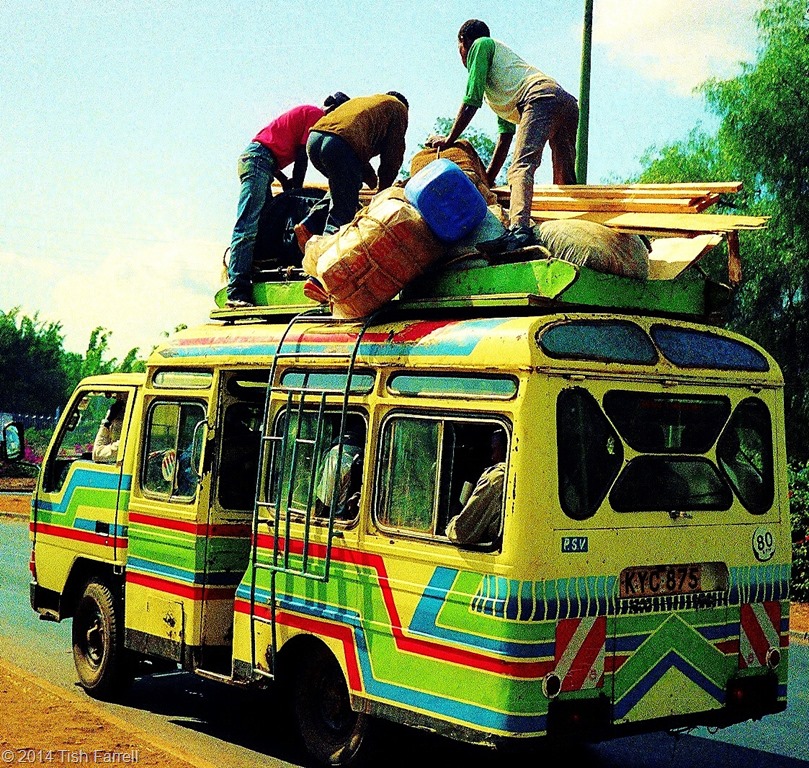
Meet the matatu, one of Kenya’s 24,000 privately owned and operated mini-buses. They are the country’s main form of public transport, taking 12 million Kenyan commuters to and from work each day. It can often be a grit-your-teeth-and-hope-to-live-to-tell-the-tale form of transport. The decrepit state of some of the vehicles, reckless driving and overloading are  frequent causes of the country’s large numbers of road deaths.

Government attempts to regulate the industry regularly stall. But whatever their shortcomings, there is always a matatu to be had, and their fares are relatively affordable. They provide the only means for many traders to transport their goods to market.

In fact you could say that matatus are an example of free market enterprise at its most vibrant/rampant – depending on your stance. This is especially true in the country’s capital Nairobi, now home to 3 million souls and counting. The competition to secure key commuter routes across the unregulated urban sprawl can be cut throat. Matatu owners hire young men as drivers and touts, and since they earn a cut of the takings, the inclination to make the maximum return from every journey, and to beat competitors  to the queue of waiting passengers, can lead to hair-raising practices. ‘Undertaking’ or cutting up on inside lanes and pavements is a particular Kenyan driving style. When we lived in Nairobi there were also anguished  letters to the local press from matatu users, saying how they had been physically ‘kidnapped’ by touts, forcing them to ride a particular bus when the did not want to.

And not only that, when it rains, the fares go up.

Scan-130603-0058

Matatu stop in Westlands, Nairobi

*

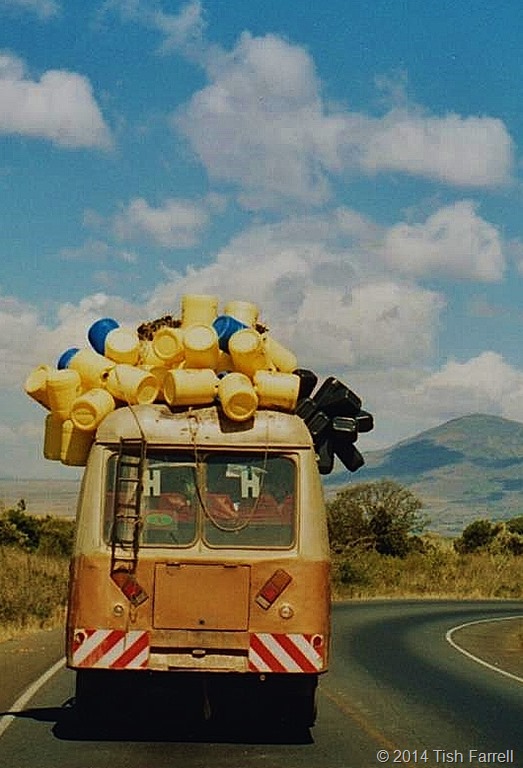
These two photos of yellow matatus were taken in the late ‘90s and are bit old hat when it comes  to the exterior paintwork. But even back then many buses were mobile art galleries. In recent times a vehicle’s ‘look’  has become part and parcel of the competition war. Owners commission the hottest young graffiti artists to paint their matatus’ livery.  The expectation is that a well ‘pimped’ vehicle will up the takings. And this is the vibrant side of the matatu business. It is creating employment opportunities for educated and creative young Kenyans who finish school but cannot find work. They have a lot to say for themselves and considerable flair. Their style is increasingly sophisticated and western influenced. Go matatu spotting and you will soon grasp what is trending in popular culture and political opinion.

Photo: Cheki.co.ke

*

Then there is the loud music, especially hip hop. This is another ‘on board’ feature designed to attract and secure clientele. The touts say it brings in the beautiful girls and stylish guys, and is all about creating a cool atmosphere.  Needless to say, the Kenyan Government has also attempted to ban the music, but enforcement is another matter.

The intense competition for business has been taking the matatu in other directions. Over 1,000  Nairobi matatus have recently gone high-tech. Commuter journeys from the city suburbs can take up to 2 hours, so providing free wi-fi has been proving a significant draw. Vuma Online was launched last April by Kenya’s biggest telecom company, Safaricom. Now passengers can pass the time stuck in the capital’s notorious traffic jams on their smart phones – checking emails and watching the news. People with particular views of what goes on in African countries may be surprised at the particular sophistication of this commuter facility. They shouldn’t be. Kenya is the East African hub of telecoms interconnectivity. This is the country that has pioneered the M-Pesa mobile phone money transfer and micro-financing system that is now facilitating so many small businesses.

But enough from me. If you want a flavour of what city life is like for ordinary Kenyans, take a look at these two short films.

Ailsa’s Travel Theme for more yellow entries besides these that caught my eye:

Melissa Shaw-Smith

Travel Words

Figments of DuTchess

PDJPIX

The Changing Palette

Photos by Emilio

The Tsavo Big Game Show: it’s a dangerous pursuit

lone elephant at twilight

Night comes swiftly in the African bush but never quietly. As the sun drops behind the Chyulu Hills, so the pipe and whirr of frog and bug ratchet up a few decibels. It is like a million high tension wires being pinged and twanged. If you listen with both ears it can drive you mad. Likewise, if you allow yourself to succumb to the night’s sticky heat and the hypnotic scents of thorn flowers, then do not be surprised when the sudden scream of a tree hyrax stops your heart.

But we are not going mad. And our hearts are just fine. We think we have cracked this Africa lark. Well sprayed with insect-repellent, all accessible parts covered as can be, anti-malarials ingested, it seems safe to sit out on our veranda at Kilaguni Lodge  and do some night-time big game watching. 

Below our room is a barren stretch of red volcanic earth, and a water-hole lit up by two search lights. The illuminated circle that the lights create is like a stage set. It seems we are seated in a mysterious wildlife theatre waiting for the cast to appear.

The contrast is disturbing. By day, this self-same set is furnace red, littered with volcanic spoil; it is the haunt of the cadaverous-looking marabou storks and the occasional zebra. By night, all is softer, surreal. You feel you might dissolve through the light into perpetual darkness; for out there the night goes on forever, doesn’t it?

And so we go on gazing at the scene. It takes some time to realize that small groups of impala are emerging from the gloom. Their stillness is mesmerizing. Perhaps they are not there at all.

And then…

And then…

The impala are wary. You can almost see the charge of anxiety ripple through the herd. We hold our breath and stare into the dark behind the lights.

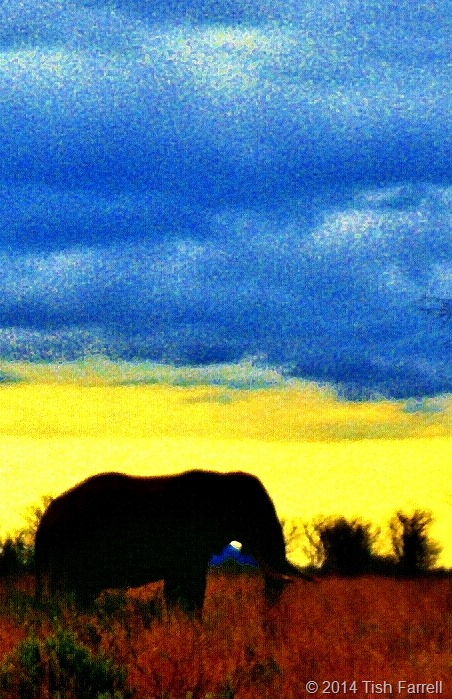
And then we see them – black hulks gliding through the thorn trees. Elephants. They have come so silently, walking always on tiptoes, their heels cushions of fat to muffle their footfalls. Slowly they move in from the bush. Even in the dimness beyond the pool, their hides glow red, irradiated by the igneous dirt they have blown over themselves.

In the wings the elephants pause. It is hard to say how many are there. After a few moments two peel away and the rest of the group retreats again into darkness. Two large matriarchs now head for the pool. At the water’s edge they part, and in matched strides stake out the water-hole from opposite directions. There’s an angry trumpeting when an impala fails to withdraw fast enough, and only when the entire bank is clear do the elephants go down and drink. But they have hardly taken a couple of gulps when they move back and take up guard duty, one at each end of the mud bank.

We are transfixed. We cannot fathom the plot, but note that, despite the elephants’ aggressive stance, there has been a concerted gracefulness to their routine. It crosses my mind that the great choreographer, Balanchine, once made a ballet for elephants. Now we see they have dances of their own.

And so we wait.

Slowly the rest of the group reappears, moving as one in the tightest huddle. As they enter the spotlight we understand. Tucked safely between the legs of four large cows are three infants. Like precious celebrities surrounded by an escort of heavies, the youngsters are guided to the water. There, with tiny trunks they cannot quite control, they drink their fill. The whole thing takes only a few minutes. Then, with this life-and-death task accomplished, the sentinels re-join the group, and the small herd leaves as silently as it came, melting into the backdrop.

So: this drama is over; the stage empty. After the thrill there is anti-climax, a strange sense of banishment; depression even. We go to bed, suddenly overcome by the heat and with too many insects on the brain.

Inside, though, the room is hotter still; windows shut fast against malarial mosquitoes. Even so, and despite the rock-like pillows, we sleep for a time. At midnight it is the menacing whine of a mosquito that rouses us to a bleary-eyed seek and destroy mission. At 2 a.m. we are awake again as two waterbuck lock in high-snorting combat below our veranda.

G. huddles back in bed. I press my nose to the window. It’s at times like this that Africa looms largest, that you know you are out of your element. Night stretches ahead like a herculean trial. I stare once more at pale stage in the bush. The impala have drifted back to the pool again, but they barely move. It is like watching a Samuel Becket play where nothing much happens.

And yet…

Suddenly the antelope are on full alert – rigid stance, ears pricked, noses twitching. I stare and stare. At last I spot movement, a sinuous shape pressing through the low scrub. The impala rise on hoof-tips, torn between staying and fleeing, and then the lioness steps out from the grass and pads down to the water.

The impala draw back, still unsure of the big cat’s agenda. The lioness parades around the waterhole, but does not drink. Instead she finds a clump of grass and lies down, head up, still as stone, commanding the pool  – a heraldic lion couchant. Now it is clear. None of the animals can drink. The tension is visible. This is a new kind of drama: feline power play.

But I cannot wait for the denouement. Worn out, I return to my hard pillow and tangled sheet.

The next time I wake it is light enough to know that I can abandon all efforts to sleep. It’s a huge relief. While G. slumbers on, I step out into cool of the veranda. In the dawn light I see that last night’s set has mystically expanded into a vast new backdrop. Now the Chyulu Hills rise above the dry plains, a vision of impossible greenness that belies the violence of their birth. For these hills are new, erupting around the time Sir Francis Drake was bowling off Plymouth Hoe and ignoring news of the advancing Armada. It’s hard to believe.

But this is not all. To the west, the snow-capped crown of Kilimanjaro breaks free of the earth and floats high on a wreath of pink clouds. It makes me want to hoot with laughter. Who does this Africa think she is? Does she really expect me to be taken in by  all her absurd illusions? Poof! The mountain snuffs out and leaves only sky. (Is this possible?) And I, like the victim of some worming parasite, know I am becoming infected. All our defences are useless. This land is creeping under my skin and invading all my senses. More likely than not I will never be the same again.

© 2014 Tish Farrell
Kenya; Chyulu Hills; Campi ya Kanzi - Giraffe in the Chyulu Hills

Chyulu Hills. Photo: Abercrombie & Kent

Daily Post Prompt: write here, write now


Mao at the Met: a disturbing juxta-position?


“My idea of a good picture is one that’s in focus and of a famous person.”

Andy Warhol


New York 129

Mao Zedong by Andy Warhol (1928‑1987)

Metropolitan Museum of Art, Manhattan

*

Andy Warhol became interested in China in 1971. “I have been reading so much about China. They’re so nutty. They don’t believe in creativity. The only picture they ever have is of Mao Zedong. It’s great. It looks like a silkscreen”.

The following year he began work on the portrait, which grew into ten variations, all based on the portrait that appears in Little Red Book: the thoughts of Chairman Mao.

In 2012 the portraits were part of the touring art show ‘Andy Warhol: 15 Minutes Eternal’.  The exhibition, organised by the Andy Warhol Museum, Pittsburgh, marked the 25th anniversary of Warhol’s death. The Mao portraits, however, did not make an appearance in either Beijing or Shanghai when the show went to Asia in 2013.  The official Chinese view was that the portraits were disrespectful in suggesting that the former leader wore make-up. All the same, Mao Zedong’s legacy is currently undergoing some re-evaluation in China. There are even admissions that mistakes were made. It is a start…


For more juxtapositions go to Weekly Photo Challenge

Bright Fields on Llyn: windows in time, mind and space and other stories from Cymru

 The-bright-field-cropped_thumb9.jpg

Oh all right, I confess. My take on the WP photo challenge is a little tangential. Also I have combined it with Ailsa’s travel theme ‘illuminated’ and Frizztext’s ‘B’ challenge (links below). But for me, photographs are windows in their own right, focusing the eye, mind and sensibility. The ones in this post seem to reveal a glimpse of something that require my special attention. And while some shots do in fact include actual windows, most are about those tiny ah-ha moments: the event, image, artefact that opened a window in my mind, whether a crack, or a full-blown throw-back-the-shutters moment.

And so it was stormy September, and the holiday-season well and truly over when Nosy Writer and the Team Leader headed to Wales for a few days. G. had a brand new camera to learn. I, as ever, was happy to snap whatever caught my eye.

We stayed in an odd, but well-meant  B & B in Llanbedrog, and set off each day to explore North Wales’ Llŷn Peninsula. The weather was deeply discouraging. Wales has much wet weather, and, with it, an oppositely equal lack of indoor places to visit, especially out of season. The first day it rained so hard there was no choice but to head for the nearest large town in hopes of finding something to do under cover.  We drove up the coast to Caernarfon,and once there sat  in a car park for an hour while the rain teemed down on the windscreen. Finally, it eased off enough to venture out. By then, the ludicrousness of coming on holiday to sit in a Welsh car park watching supermarket deliveries was beginning to grate.

100_4474

Swathed in raingear we trailed around an impressive but dreary Caernarfon Castle, the remnant expression of Edward I of England’s systematic oppression of the Welsh people. In 1283 he extended a small Norman motte and bailey castle into a massive fortress – all the better to assert English rule over the Welsh and their princes. In design it is said to recall the walls of Constantinople, seat of Roman imperial power, thus invoking memories of more ancient times when the Romans also subdued the Welsh. These earlier invaders built the nearby fort of Segontium and, like the castle, it commanded the Menai Straits and the island of  Ynys Môn (Anglesey) beyond.

Segontium was built in AD77 by the Roman governor of Britain, Gnaeus Julius Agricola, in preparation for the capture Anglesey (see Island of Old Ghosts). Over a thousand years later the castle was built as one in a circle of mighty fortresses to control the people of North Wales. In 1284 Edward’s heir,  later Edward II, was born there, and thus proclaimed the first English Prince of Wales. Though English born and bred, I find this hard to swallow.

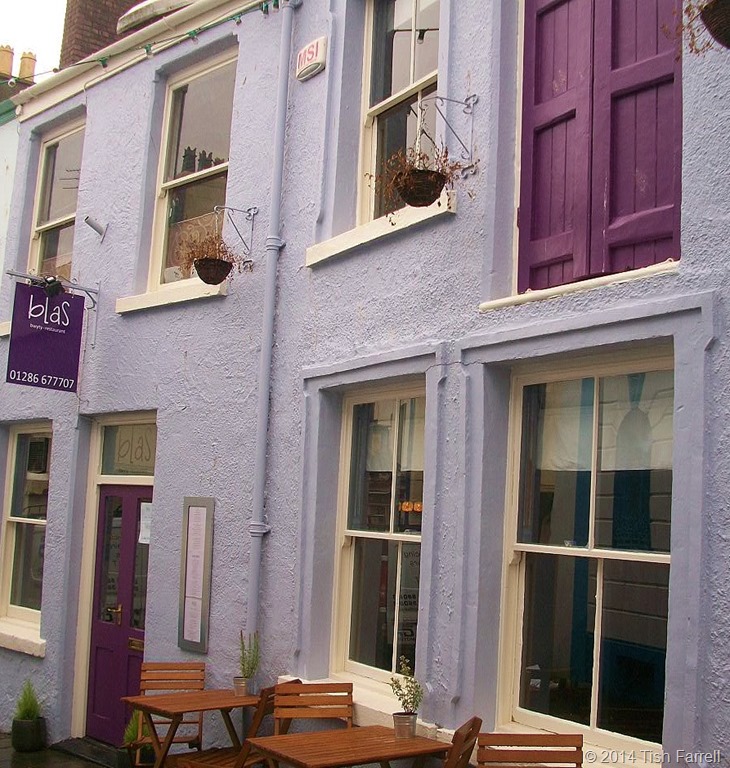
And so I think I would have found Caernarfon Castle depressing even in broad sunshine – too much death and domination. The best part of the day was definitely lunch in one of the town’s meandering back-streets. At the bistro Blas they welcomed us in from another downpour, and kindly allowed us to drip on their carpet while feeding us delicious food. Not only that, it was so soothingly lavender, both inside and out.

100_4493

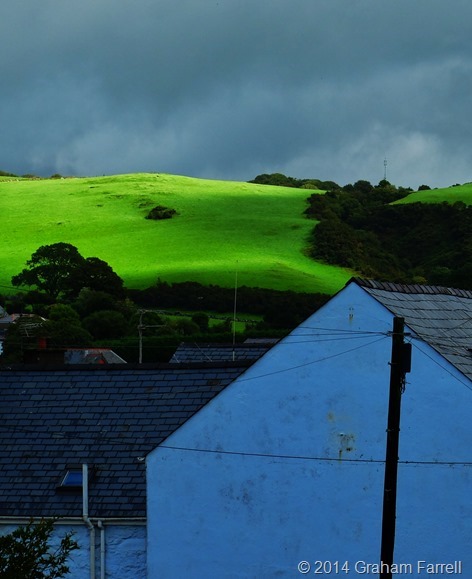
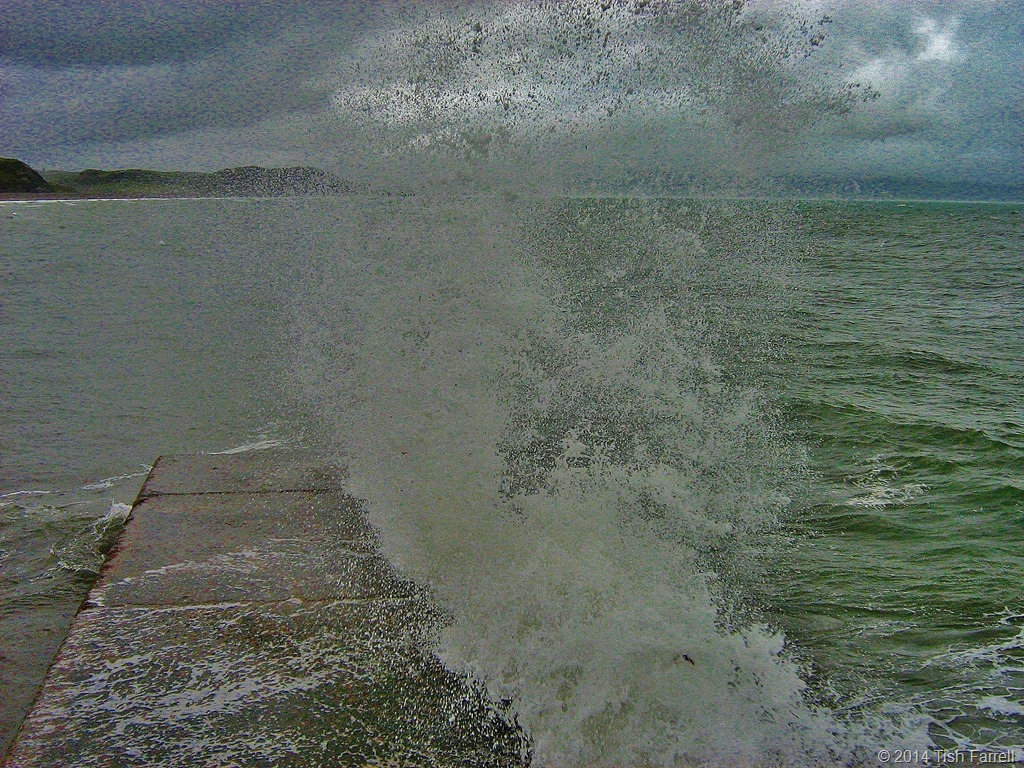
It was the next day, with the rain abating and the sea roiling over the Cricieth breakwater (beneath another Edward I castle) that we spotted the bright field in the first photo. G. thought it was a good opportunity to start getting to grips with his Fujicamera. I snapped the sea.

IMG_0620

But seeing that bright field, so astonishingly luminous against the grey sky, reminded me of the poem of the same name, written by the great Welsh poet-priest R.S.Thomas. This craggy, slab of a man was as redoubtable as one of Edward Longshanks’ castles.

In fact he might have been hewn  from the bed-rock of his native Wales. And like all such formations he had his fissures, faults and flaws. Many thought him morose, cantankerous, and rife with ambiguity and contradiction. For one thing, he abhorred the Anglicisation of Wales, yet he wrote in English despite being a Welsh speaker. In 1996 he was nominated for the Nobel Prize for Literature, but  lost out to Seamus Heaney. 

As a priest he was kindly and sympathetic to the hardships of his parishioners, although this would not stop him from hectoring them from the pulpit, urging them to foreswear any yearning for consumer durables such as refrigerators and washing machines. He could also be judgemental and, as a fierce Welsh Nationalist and political activist, withering about the failure of the Welsh to resist being swamped by Englishness.

Thomas’s poetry, then, can be both trenchant and transcendent. While I do not subscribe to his religion, I honour the spirit of his words. His poems are among those I love most. Here it is then:

The Bright Field

*

I have seen the sun break through

to illuminate a small field

for a while, and gone my way

and forgotten it. But that was the pearl

of great price, the one field that had

the treasure in it. I realize now

that I must give all that I have

to possess it. Life is not hurrying

*

on to a receding future, nor hankering after

an imagined past. It is the turning

aside like Moses to the miracle

of the lit bush, to a brightness

that seemed as transitory as your youth

once, but it is the eternity that awaits you.

R.S. Thomas

*

On our final day it was with R.S. Thomas in mind, and with a little sun at last, we drove down the narrow lanes of the Llŷn Peninsula  to Aberdaron where the poet served as a parish priest between 1967-78.

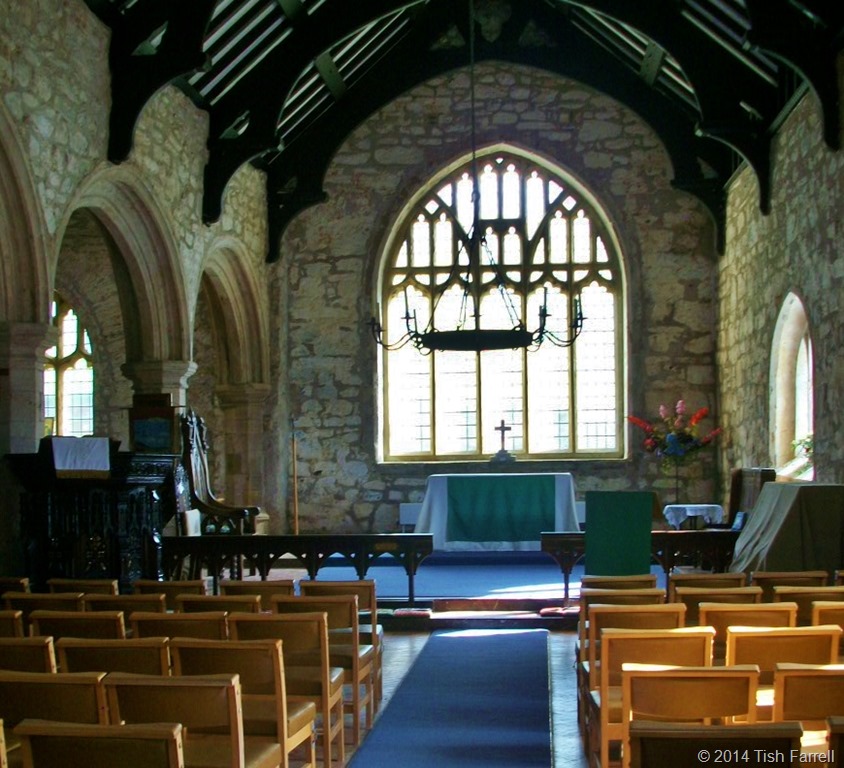
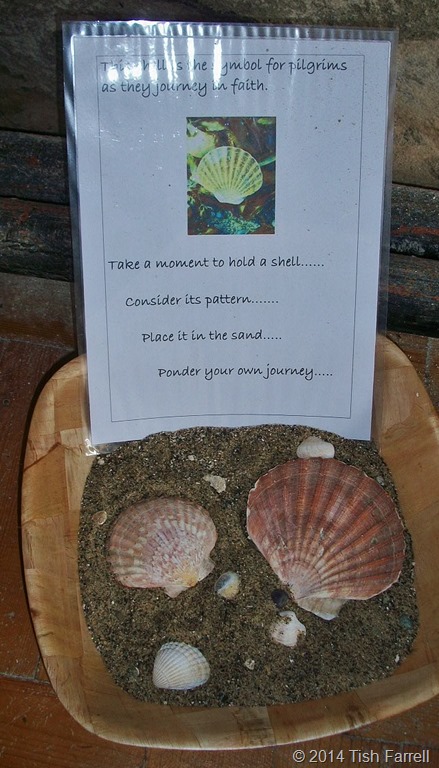
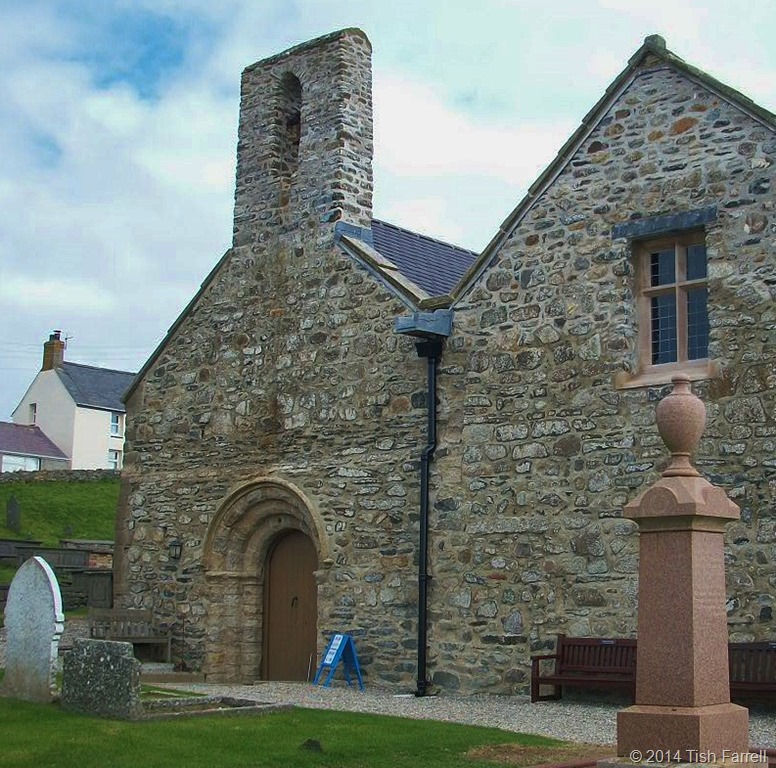
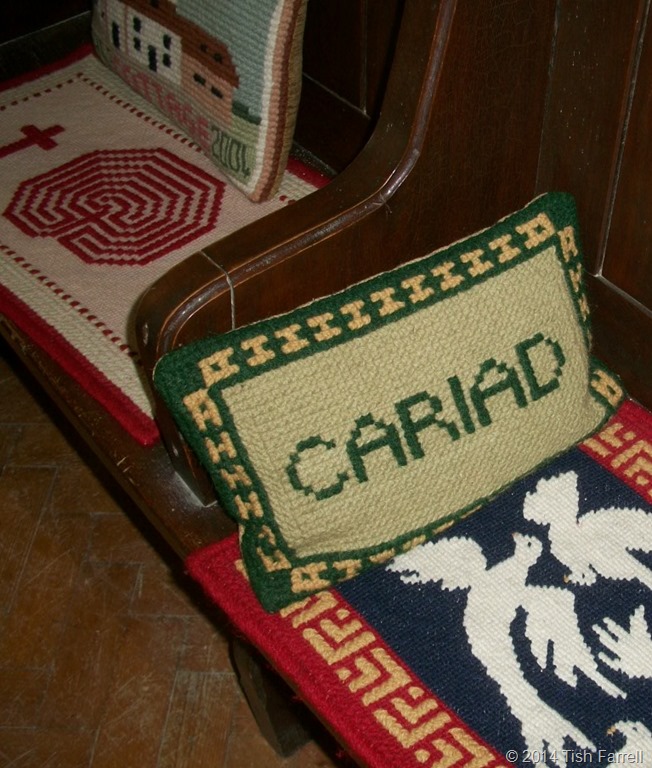
The ancient church of St. Hywyn’s stands right beside the sea. Since the Middle Ages, pilgrims have come there on their way to Bardsey Island, Ynis Enlli, Island of 20,000 Saints. Inside the church are two ancient grave stones belonging to Christian priests of the late 5th/early 6th century. There is also a welcome there: a bookshop full of R.S. Thomas’s poetry books; even a poem to take away. There are also piles of sea pebbles, shells for contemplating your journey, a kneeler that has been stitched with the single word cariad, beloved.

100_4798

100_4782

100_4779

100_4791

100_4797

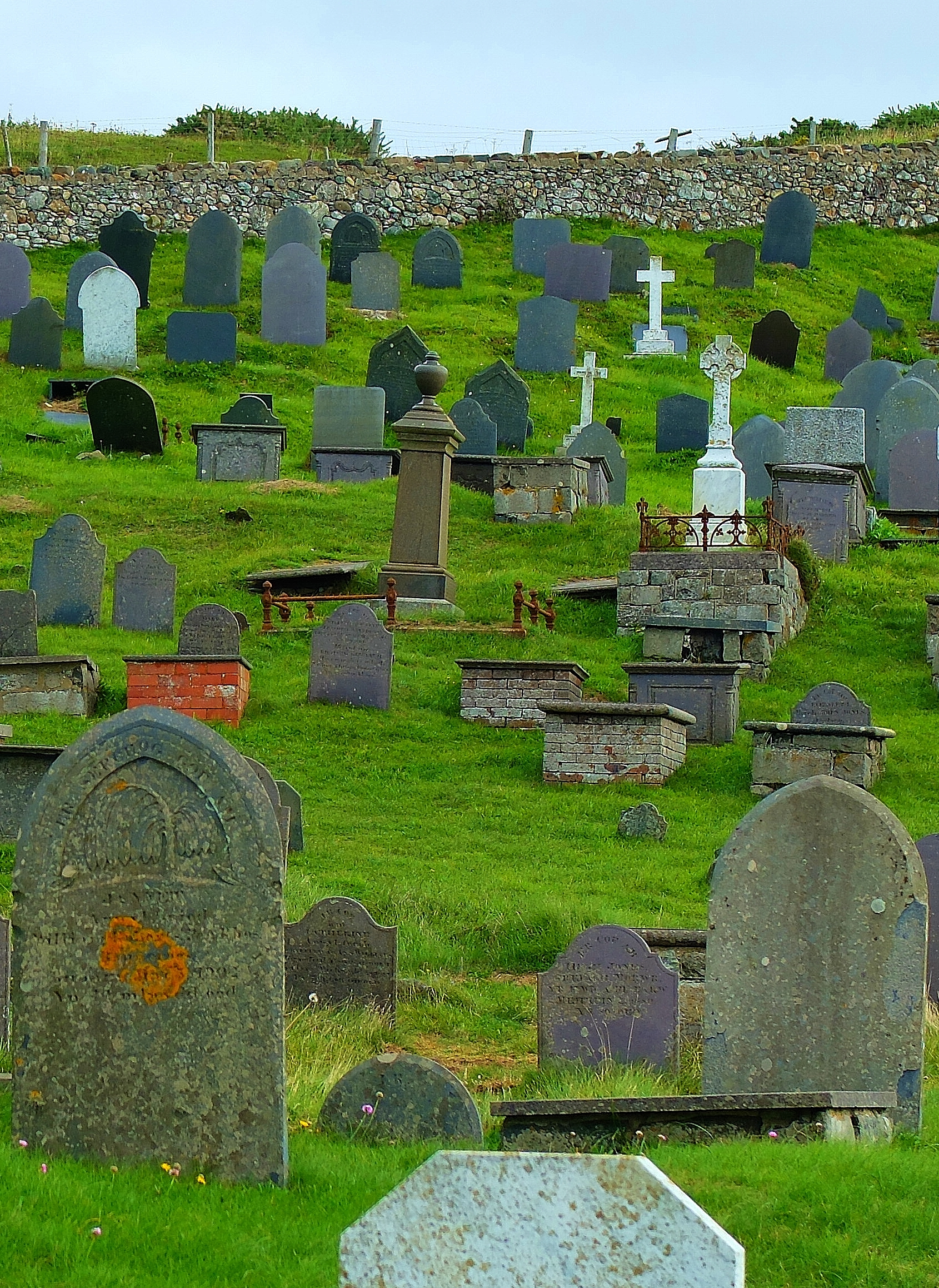
And beside the knave the clear glass window that needs no further embellishment looks out on the sea and islands of Gwylan Fawr and Gwylan Fach. And outside in the sea wind is the graveyard whose stones seem to cluster like a meeting of villagers in their own bright field. And so it is, as we ponder on all these things that our creedless souls, one atheist, one agnostic, know that we too are on a pilgrimage – to seek out the things that truly matter.

holiday 130

RS Thomas

R.S. Thomas 1913-2000 Photo: BBC Cymru Wales Walesart

See this brief biography of the poet, made in 1996 when it was thought he would win the Nobel Prize for Literature.

Related: Warrior Wind-Singer of Llŷn

© 2014 Tish Farrell

Flikr Comments Tagged ‘B’

Weekly Photo Challenge: Windows 

Ailsa’s travel theme: illuminated

Anthology Baobab: African Story Tree


“Knowledge is like a baobab tree; one person’s arms cannot encompass it.”

Ghanaian proverb

South Luangwa - mighty poachers' baobab 2

This baobab in Zambia’s South Luangwa was used as a poachers’ look-out

*

At the moment I’m working on a short story that includes a large and very ancient Adansonia digitata – in other words, a mighty baobab tree. These extraordinary trees have a way of finding their way into my stories (Mantrap, A Hare Who Would Not Be King amongst others). In fact, with so many legends about them, baobabs are nothing if not arboreal storybooks.

They are also like no other tree I can think of, although they are related to kapok trees. They grow in the hot lowlands of Africa and Madagascar and also in Vietnam and Australia. Their capacity to store vast quantities of water in their trunks has earned them the name Tree of Life.  A single tree can hold up to 4,500 litres /1,189 gallons.

In my story, however, the baobab has no such mundane function. It is a place of ritual – a spirit home on the Swahili coast, for here, as in other parts of Africa, it is believed that baobabs harbour the souls of the dead. And that is all I am revealing of my story  except to say that it also involves murder, unquiet spirits and unrequited love.

*

As for the trees, in real life they have a mass of practical, medicinal and nutritional uses – for humans and wildlife alike. It all begins with the pollination of these oddly striking flowers.

image

For nine months of the year, the baobab has no foliage. When the leaves come they are eaten like spinach by humans and browsed by both domestic and wild animals. The flowers, too, are short-lived. The bloom first at night, their pungent smelling nectar attracting bush babies and fruit bats which then pollinate the flowers. Bees also feed on the nectar, and farmers often hang their barrel beehives up in the branches of a baobab. Photo: Tuli Lodge, Botswana

image

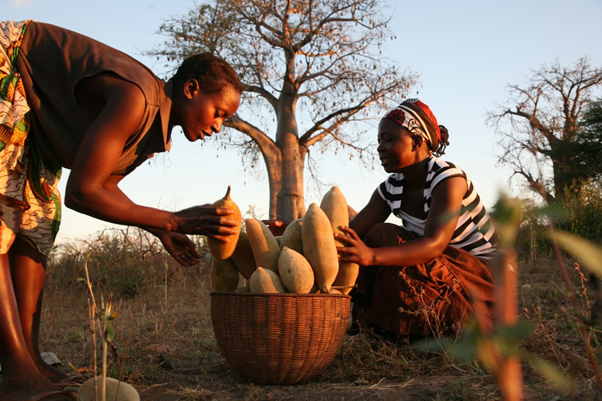
The resulting woody capsules enclose many seeds within an edible pulp. Both seeds and pulp are high in potassium, calcium and magnesium and are ideal foods for pregnant and breast-feeding women. The pulp is also rich in vitamin C, thiamine and antioxidants. Being high in pectin, it is useful for jam making and creating refreshing drinks. The seeds produce a fine oil that is used by the cosmetics industry. They can also be ground to make a coffee substitute. And so with all these attributes, the baobab has been classified as a superfood. Its many by-products are now sold worldwide. Photo: http://www.ifood.tv/blog/the-latest-superfood-from-africa-baobab

*

image

http://www.ifood.tv/blog/the-latest-superfood-from-africa-baobab

*

image

The growing world-wide demand for the baobab’s phyto-nutrients mean that seed harvesting has become a valuable source of income for many African families. This is one man’s story:

“My name is Andrew Mbaimbai and I am 63 years old. I live in Mtimbuka, a village in southern Malawi, with my wife, four daughters and eight grandchildren. In 2005, I heard that a new company was buying baobab and I knew this was a good opportunity for me.

“I collect and process baobab in my spare time because I also have a job as a cook. After gathering the fruit, I go to the processing centre, crack the shells and separate the fruit powder from the seeds. Then I sell it.

“I use the money to pay for my grandchildren’s school fees and to buy clothes for my family. Sometimes if a family member falls ill, I use the money to pay hospital bills. Without the money from selling baobab, I would not be able to meet all my family’s needs.”

http://baobabsuperfruit.com/andrew-mbaimbai/

As a consequence of ethically managed initiatives like the Eden Project’s programme in Malawi you will now find many baobab-derived products on line and in your local health food shops. Here is one of them. It can be added to anything and everything, creating, apparently, a  zesty flavour.

Baobab Fruit Powder Pouch

The Eden Project’s baobab powder.

*

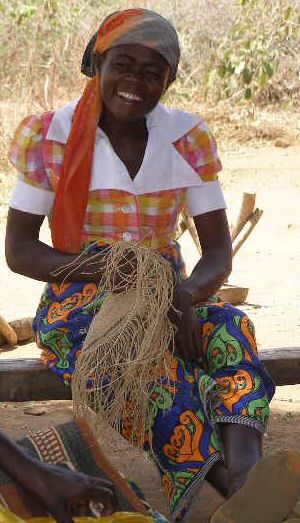
Then there are the baobab bark products. The trunk of the baobab is very fibrous and can be processed into cloth, twine and ropes. Kenyan women are famous for their kiondo bags which they make both from baobab and (increasingly) sisal string. You will see women walking along the road weaving these lovely baskets, and I can attest that they last for decades. I have at least four. In time the leather handles might need replacing,  but the baskets endure, becoming more beautiful as their pigment dyes fade.

image

Photos: africablogs

image

A Kenyan kiondo woven from baobab fibre.

*

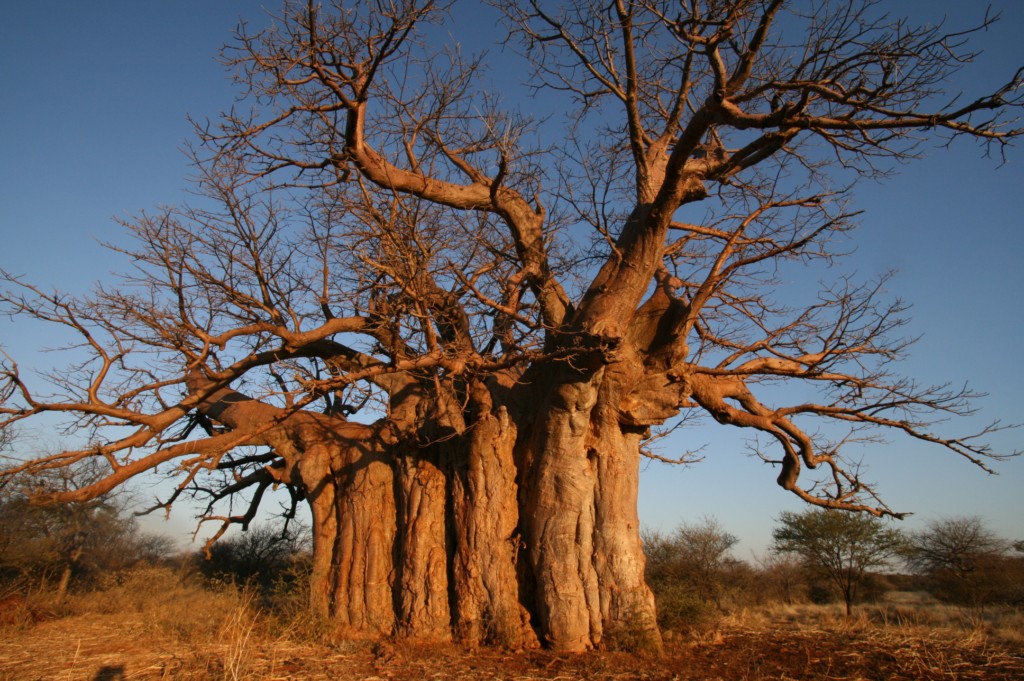
Baobabs can of course grow to massive proportions  and into the oddest shapes. They may be thousands of years old.

The Legend of the Upside-down Tree

Photo: Eco Products

With age, many become hollow, creating large spaces within that are variously used as barns, churches, places to give birth, and for the burial of griots as in West Africa. In Botswana one was once used as a jail, the adjoining trunks for male and female prisoners.

image

Kasane, Botswana, now has a new prison but the architect ensured that the original one was preserved: http://www.ofm.co.za/article/67788/Voices

Big Baobab

Sunland Baobab

*

At Sunland Farm, Limpopo, South Africa, this baobab is used as a bar and wine cellar. It is believed to be the largest example in the world. It is 47 metres around (154 feet) and has a carbon date of around 6,000 years.  Below  are four of us trying to surround a much younger Kenyan baobab. This one is at Maweni on Tiwi Beach, South Mombasa.

023

*

And now for some of those baobab legends I mentioned. There are many variations of these tales throughout Africa.

I

When Creator was busy creating the world, the animals came to him and asked if they could help him finish his work. Creator was doubtful and said there were only the trees left to make. But the animals persisted, so Creator handed out specific seed types to each animal species, and they went away and planted them. Finally, only the baobab seeds remained, and these Creator handed to the hyenas. The outcome, of course, was to be expected, given the stupidity of hyenas. They planted the seeds upside down, and that is why the baobab always looks as if it has its roots in the air.

II

Long, long ago the very first baobab sprouted up beside a small lake. When it saw the other trees with their tall, smooth trunks and bright flowers and large leaves, it thought how beautiful they were. Then one day, when the lake surface was smooth as glass, the baobab caught sight of itself, and oh, what a shock. Its flowers were so pale, and its leaves so small. But worst of all, it was appallingly fat, and its skin looked like the wrinkling hide of an old elephant.

The baobab cried out to Creator, complaining of its lot. Creator in turn was huffy. Many things had been made that were not quite perfect, he said. He retreated behind a cloud. But the baobab did not stop whining and whingeing. Finally, Creator grew so cross that he leaned out of the sky, and yanking the baobab from the ground, replanted the tree upside down. And so ever since, the baobab has lived on in silence, unable to see its reflection in the lake, but making up for its transgression by doing many good deeds for humankind.

*

And if these baobab tales have not quite cheered you up, here are some clips from the life-enhancing Orchestra Baobab. This band from Senegal has had two lives, one back in the ‘70s, and now the current reprise which includes many of the original line-up, among them the Togolese guitarist, Barthélémy Attisso, who in the interim went away to become a lawyer. If you get the chance to see them live, go for  it.

© 2014 Tish Farrell
Frizztext’s ‘A’ Challenge

The birds: who, where, when?

100_2835

Evelyn Mary Ashford 1923-2013

*

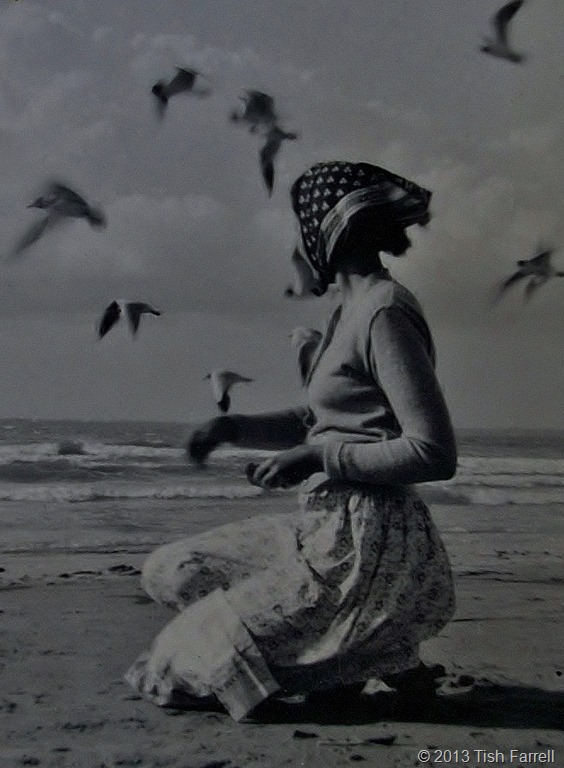
Some time-travelling is definitely called for  to unravel the context of this photo. It was scanned from a tiny loose snap found inside in my Aunt Evelyn’s photo album. Frustratingly, there were no accompanying details. I am sure, though, that it is Evelyn. Also the girlish pose would suggest late teenage years. Since she lived in Cranleigh, Surrey, and nowhere near the sea, and as I’m assuming that working people did not go on holiday during war-time, my guess is that this photo was taken sometime before the summer of 1939.  There is no clue either as to location, or who the photographer might have been. There is only this frozen moment in time as Evelyn throws bread to the gulls, the paper it was wrapped  in pressed by the breeze across her knee.

Evelyn died this autumn at almost 90 and a half. She lived a good and creative life despite many set-backs. Somehow this striking shot of her amongst the wheeling birds captures much of her spirit.

For  more of Evelyn’s story see earlier posts:

Grand girl, great prospects…?

The Many Faces of Evelyn Mary Ashford

Eve trig 1

© 2013 Tish Farrell

For more birds:

Ailsa’s Travel Theme Birds
MAX510’S BLOG

Zebra Designs and Destinations

Figments of a DuTchess

vackrare.com

Postcards from home and away…

Edge of the Forest

Wind in the palms on Kenya’s coral shores

Scan-130603-0061

Tiwi Beach, South Mombasa

*

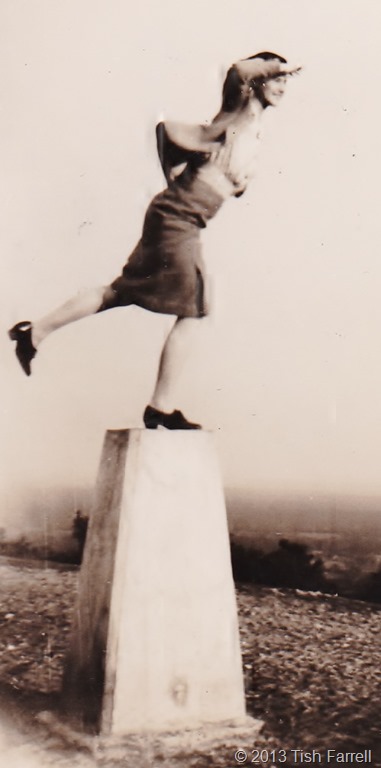
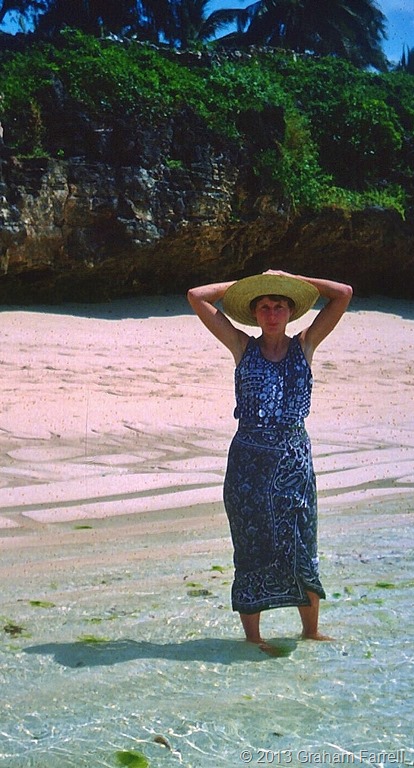
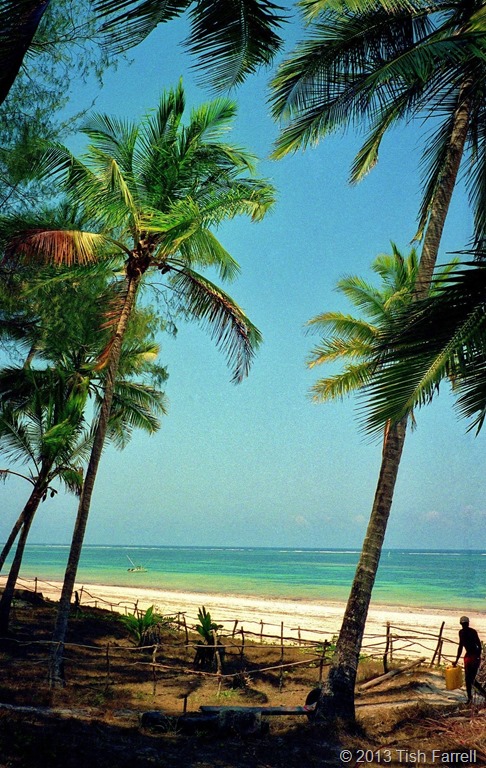
These leaning coconut palms and the photo of me holding on to my hat remind me that there is nearly always a breeze on Tiwi Beach. You need it too. In the hot season, around December to February, it makes the sticky tropical humidity bearable. It also keeps malarial mosquitoes at bay.

Scan-130520-0018

Don’t let go! Me, at Capricho Cove, too many years ago

*

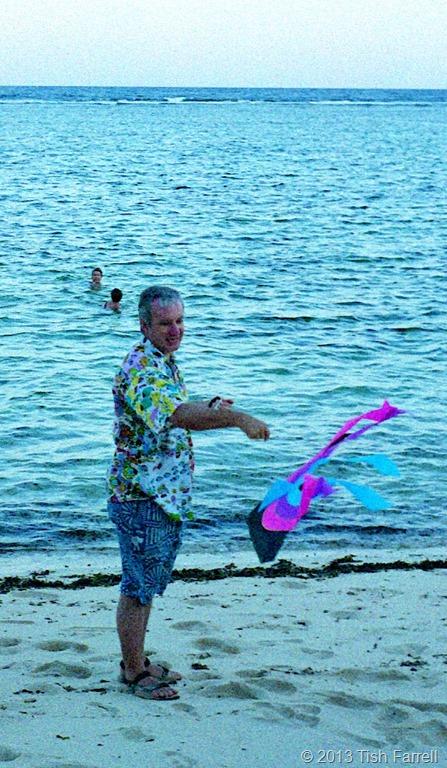
But the tropical breeze is not so good for kite launching. The team leader never did get his kite airborne.; the wind endlessly beating it into the sand. No matter. I think we decided that kite flying was probably too active an activity, even at the day’s end. Much better to crack open a Tusker beer, one almost chilled in

Graham tries to fly his kite

Graham not flying his kite at Maweni Cove.

*

the beach cottage’s rackety  refrigerator.

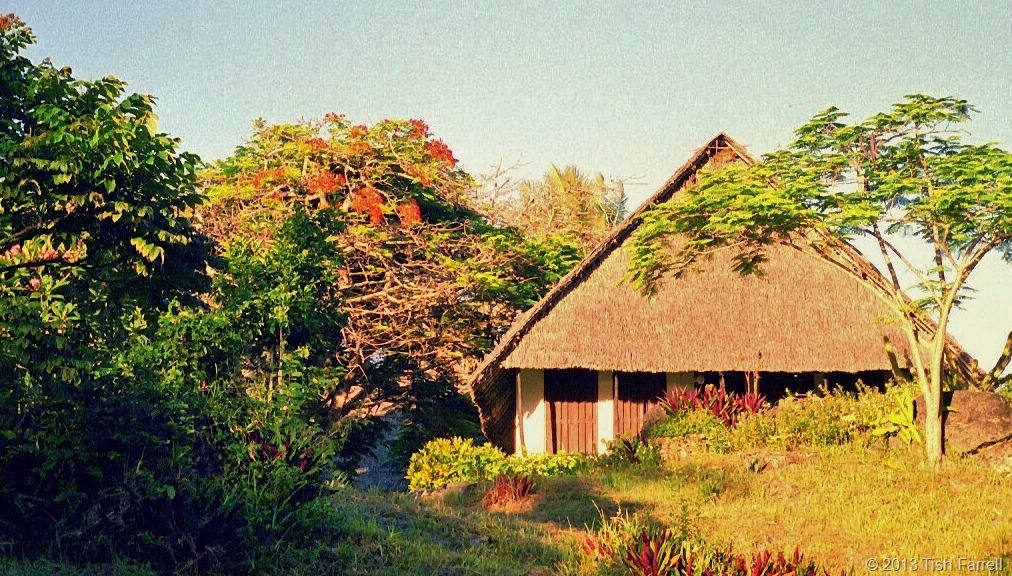
Maweni cottage at sunset

Maweni Cottages built in the Swahili style.

*

In the holiday season, and especially at Christmas, these beach villages tend to be the haunt of expatriates (especially aid workers), and mixed race families who do not always receive the best of treatment in Kenya’s fancy beach hotels. The cottages are designed to keep out too much sun and let in maximum draught: coral rag walls, high makuti  thatch, glassless windows and shutters with moveable slats. This is of course a European take on indigenous Swahili architecture.

I have written in another post about Swahili culture and how it might be said to have been shaped by the monsoon winds: the north-easterly Kaskazi that for centuries brought Arab merchant ships down the coast of Africa; the south easterly Kusi that blew them away again after a windless sojourn during which sailing dhows were beached and repaired and liaisons with African communities forged.

From this age-old congress between Arab seafarers and Bantu farmer-traders, came a blending and melding of body, mind and spirit that evolved into the urban coastal people whom we know as the Swahili. Their language, KiSwahili, is also a fusion: of Arabic and Bantu vernaculars, and as such, presents a fascinating exemplar of multicultural integration that has forged a distinct identity of its own. That’s something to ponder on, isn’t it: how different races can create together; how it took the monsoon wind to bring them together?

Salamu (Greetings)

Scan-130429-0098

A Word A Week Photo Challenge: Wind: go here for more wind stories and see the ones below:

http://irenewaters19.com/2013/12/19/a-word-a-week-wind/

http://hamburgundmeehr.wordpress.com/2013/12/18/a-word-a-week-photograph-challenge-wind/

http://geophiliac.wordpress.com/2013/12/18/a-word-a-week-photography-challenge-wind/

http://bambangpriantono.wordpress.com/2013/12/18/a-word-a-week-photograph-challenge-wind-angin-the-wind-blown-flag/

http://schelleycassidy.wordpress.com/2013/12/17/a-word-a-week-challenge-wind/

http://mang0people.wordpress.com/2013/12/17/a-word-a-week-photograph-challenge-wind/

http://emiliopasquale.wordpress.com/2013/12/16/a-word-a-week-photograph-challenge-wind/

http://sillarit.wordpress.com/2013/12/16/a-word-a-week-photograph-challenge-wind/

Related:

Weekly Photo Challenge: Culture (The Swahili)

Travel Theme: Beaches (Mombasa)