
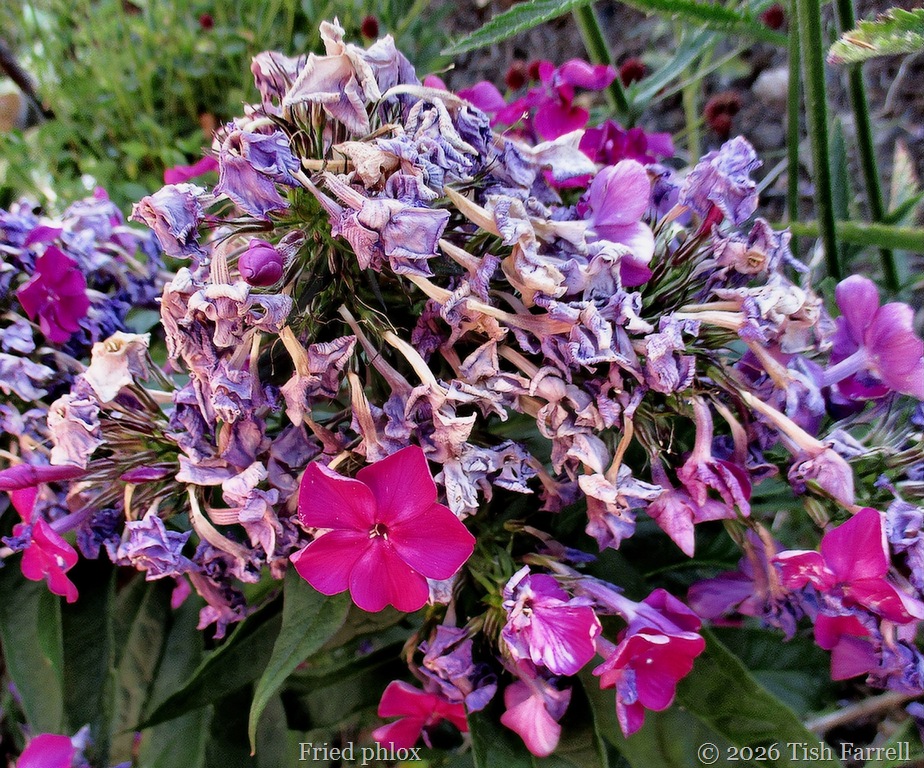
Another week of hot-garden days and no drop of rain. I’m beginning to wonder if I need to rethink the planting for next year, i.e. focus on the drought tolerant varieties I have already, and stop trying to grow things that scorch easily; or at least move the susceptible ones, like the phlox paniculata from the front garden to the back garden, where there’s scope for creating less exposed conditions.
In hot weather, our front garden simply bakes, caught in a heat trap between the house, the road and the cottages opposite. Also the beds themselves are surrounded by low concrete walls, plus there’s an old cement path between. And then there’s the privet hedge along the front, sucking up moisture and holding in the heat. But at least I’m now finding the clippings useful for covering bare soil.
Perhaps I’m panicking unduly. The lavender, oreganos and verbenas look to be thriving. Also the euphorbias, montbretia, yarrows, grasses and mulleins, sea holly and echinops are holding their own. But then I find myself staring at a forlorn looking cistus…isn’t it supposed to cope with this kind of weather? Maybe my shilly-shally bouts of watering have much to answer for…shall I, shan’t I…
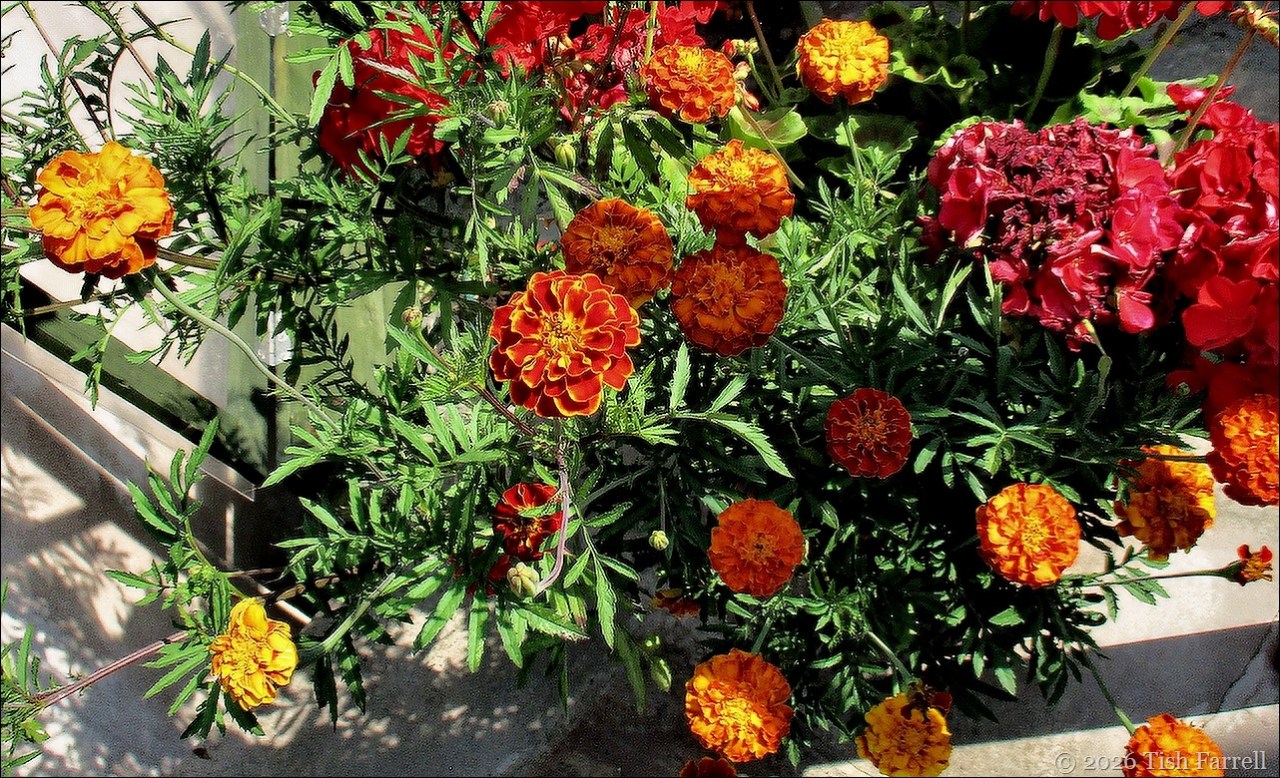
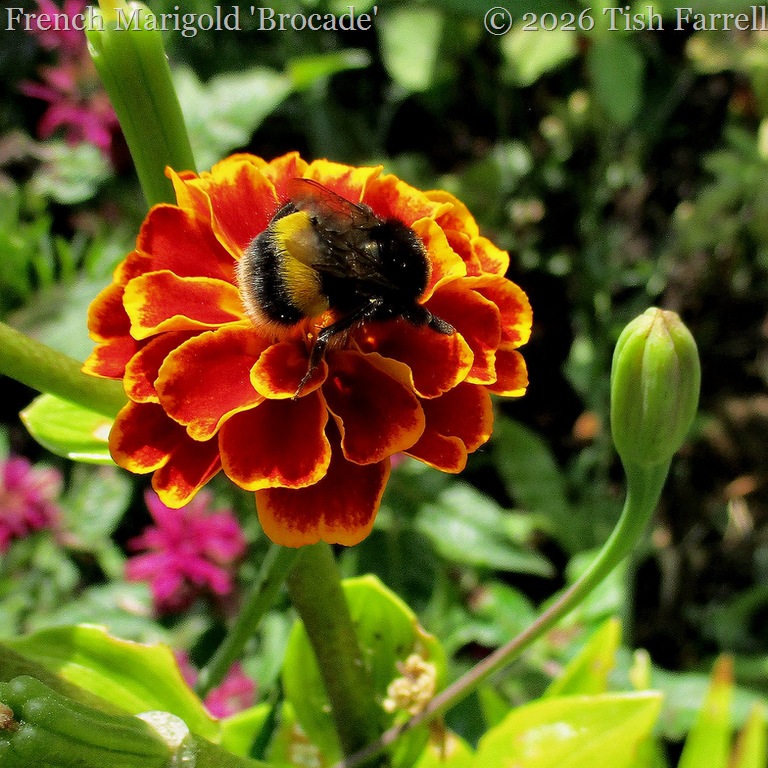
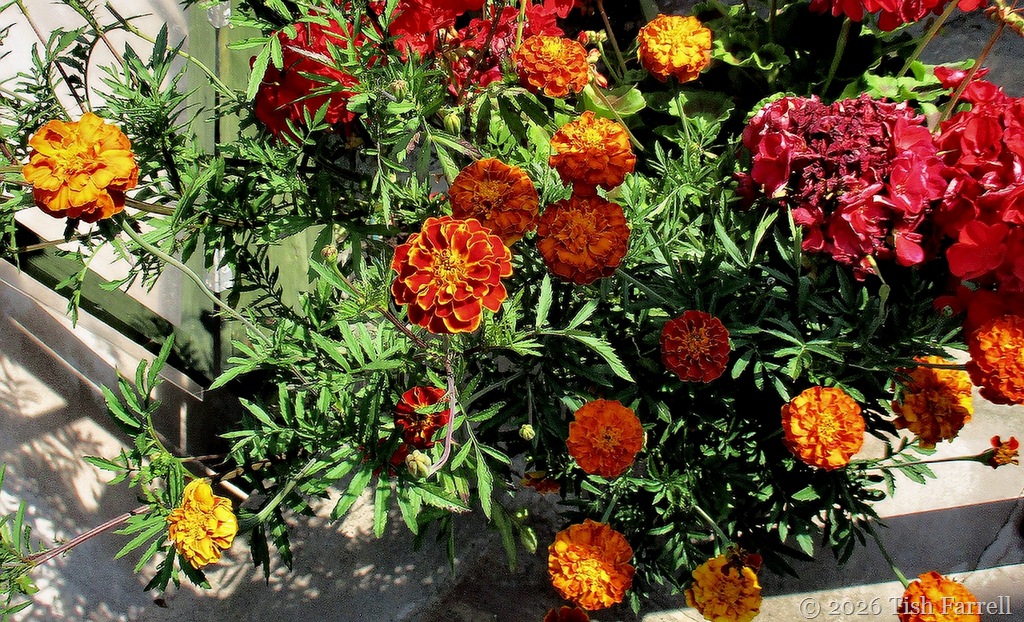
Anyway, the prize for best looks surely goes to the unruffled, but multi-ruffed French marigolds ‘Brocade’ (1). The seeds came from the Bishop’s Castle Community Seed Bank Library. Local members share their seeds, neatly packeted and displayed in a tray on the counter at the actual library. You can pay what you like, and all donations are welcome. You are of course encouraged to share your own seed. This is part of a much bigger project relating to local food resilience, and run by Daphne Du Cros from a regenerative farm at Little Woodbatch, near Bishop’s Castle.
*
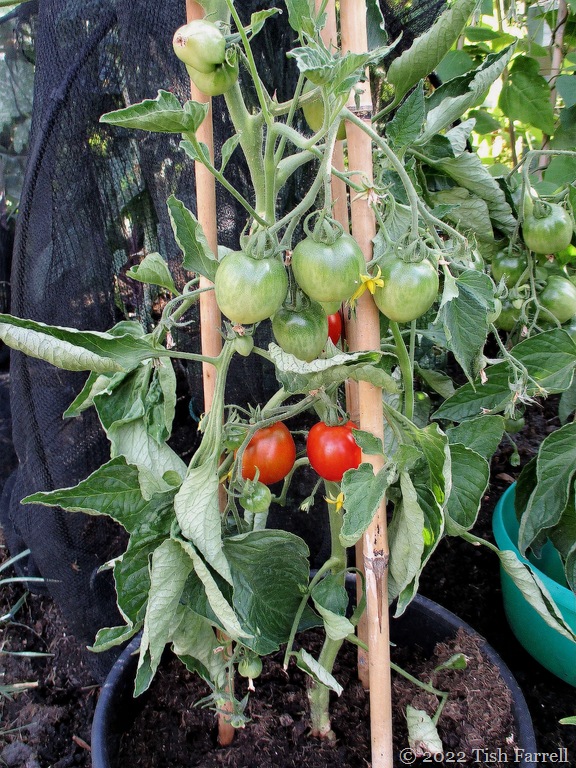
Another hot-weather plus: – outdoor tomatoes actually growing, ripening and tasting as they should. I only wish I’d planted out more than two Bloody Butchers (2). It’s an heirloom, early ripening variety. Usually my outdoor tomatoes are pretty disappointing.
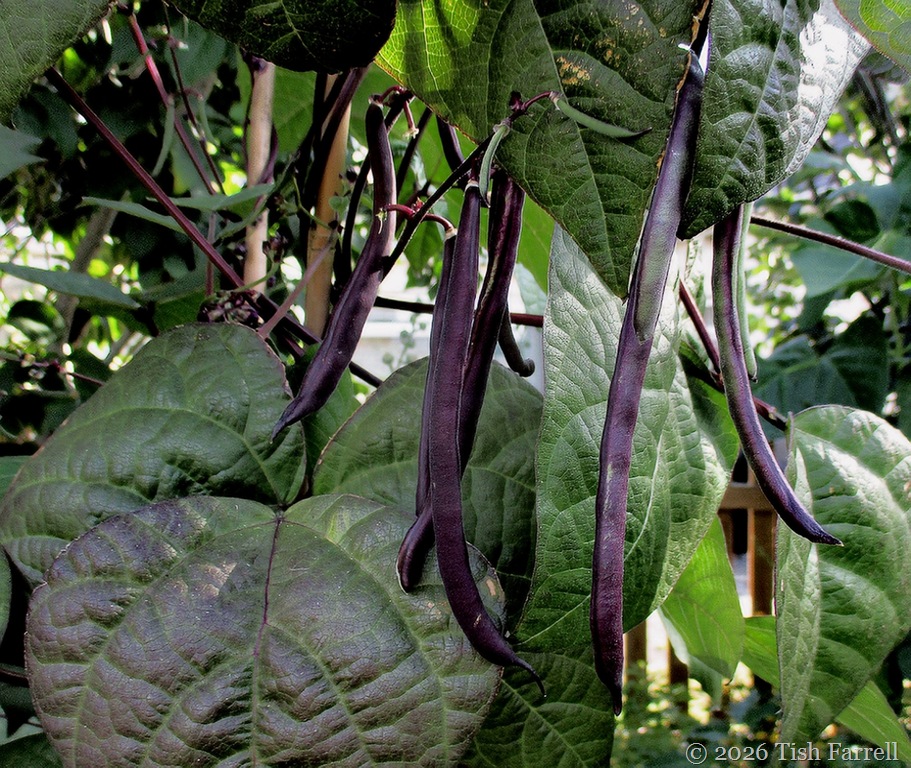
The French Beans, Cosse Violette (3), climbing and dwarf, are also performing well. Only a few plants needed. Any crop gluts to be passed on to neighbours.
*
For some reason I usually get into a muddle growing basil, even though it’s a kitchen favourite. In the greenhouse it often succumbs to white fly, or gets roasted. Or we have a dismal summer (remember those?). So I’ve learned to grow a back-up.
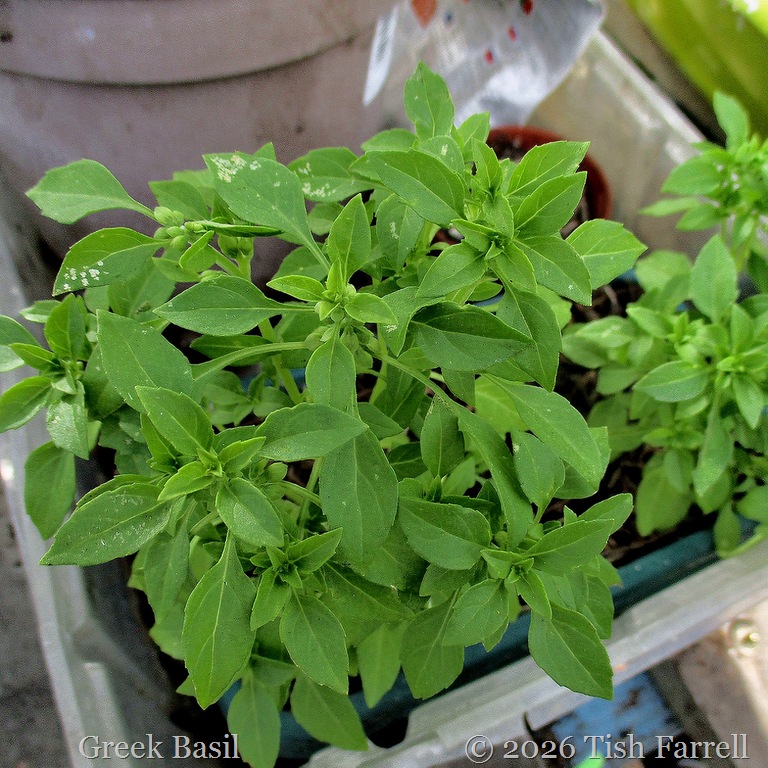
Greek Basil (4) is a small-leaved, bushy variety, and an amenable, if not perfect stand-in. An eager grower in fact.
*
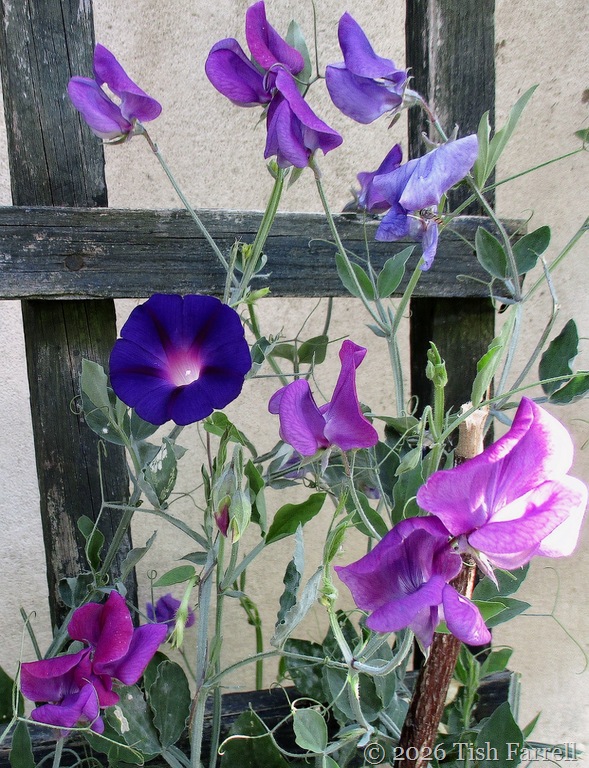
The obelisks of sweet peas are over. They have flowered to bursting since May. Finally, this week, the stems and leaves were dried to a crisp so I cut them down, trying not to uproot the young morning glory plants that I’d inter-planted and have so far been struggling. I’m hoping they’ll grow on, now they have some space and I can see them. But I was sad about the sweet peas finishing, and then remembered the few later-grown seedlings I’d planted out on our boundary wall. A pleasing find between our woodstore and next door’s garage wall: sweet peas and morning glory (5)
*
The sedums AKA hylotelephium (6) are exhibiting an interesting weather response. Instead of the wide flat-top flowerheads, they’ve opened wide, like gone-to-seed cauliflowers.
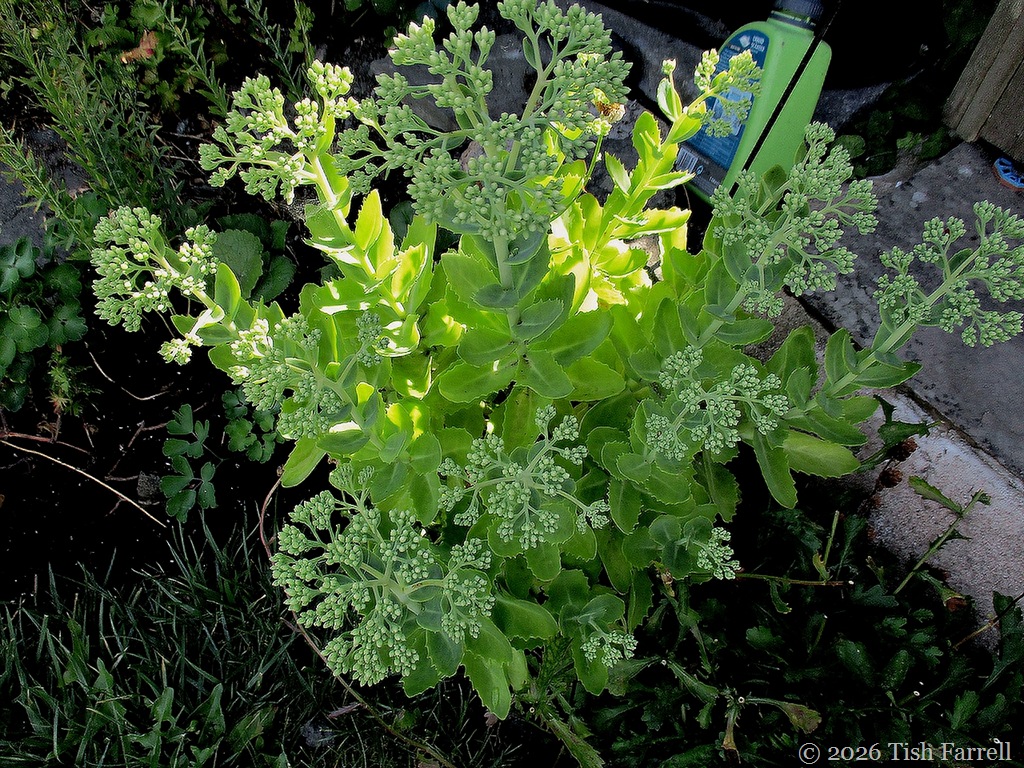
Their splayed stance looks like a plea for mercy, but the plant itself seems fine. It also has me thinking, stirrings of gardener’s plant lust. Sedums – known for drought-tolerance and adaptable responses – now there’s a group of plants to consider with fresh eyes…
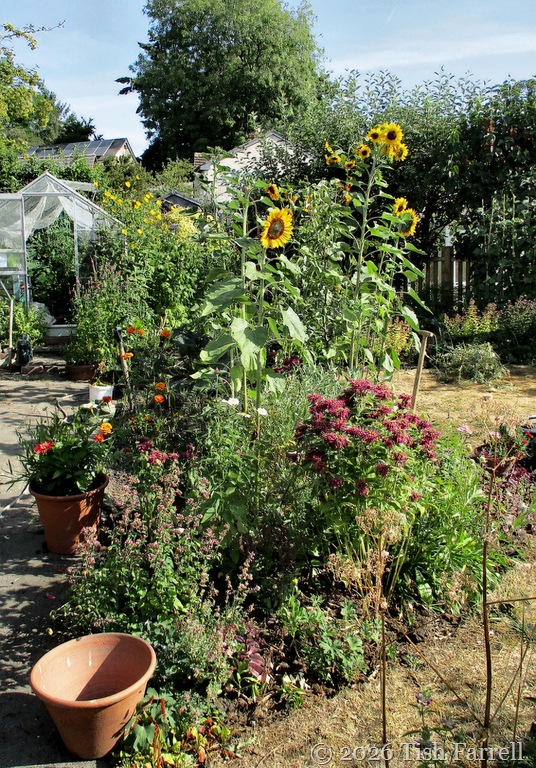
But for now, a view of this week’s back garden:
Copyright 2026 Tish Farrell
*
Six on Saturday Still much to admire in Jim’s garden despite struggles with the watering.
*

I think your garden’s looking good, especially in the circumstances. We went to Newby Hall yesterday: actually for a concert, but also because its gardens are wonderful. Correction. Were wonderful. Large areas of flowers were just plain dead, or changing themselves into hay meadows. They’re going to have to have massive rethink, I imagine.
But we don’t really know if this is the norm yet or if it’ll be wet again next summer. Not really the England we know and love to complain about at present, is it? Those sunflowers look great, Tish, and your veg are magnificent xx
You’re right Jo, but sadly, I think climate change is here to stay.
Didn’t mean to like that! We could be moving to Scotland xx
Really? Tell us more …. xx
Joking… xx
Never do that to me Jo. I’m famously gullible.
We do what we can in this crazy weather but I love the fat little bee in your header photo.
It is a nice fat bee, Beverly. And here, all of a sudden, the heat has switched off. It’s breezy and overcast and a bit of shock.
There’ve been some intriguing studies (particularly on global shipping lanes) on how our cleaner air/emissions have significantly reduced cloud formation, so increasing our sun exposure.
I hadn’t seen that. Emissions not all bad then …
Ironically, it seems not. Cloud behaviour hasn’t been included in climate models because it’s pretty hard to pin down, and so its effects have not been factored in.
You’re very well informed!
I listen to talks by emeritus Prof Will Happer – atmospheric physicist. He’s been studying climate related matters since the 1980s. Also closely monitors CO2. I think he, and even more distinguished scientist, Freeman Dyson, now no longer with us, devised the first climate model, which they later disavowed.
I’m impressed. I still haven’t got into podcasts, and finding out what’s interesting out there.
I agree, Jo. This is weather, and the weather changes. We’ve had long, hot summers before. I remember one around 1985/6 which no one else seems to. Weeks and weeks of sunshine. And ’76 of course, though I was living in Aberdeen at the time where the heat wasn’t so hot there due to stiff sea breezes. Anyway, geologists suggest we’re still in a warming up period after the last glaciation.
Gosh it’s an age since I went to Newby – but I can imagine the looks of those long long borders. So yes, I needn’t complain about our garden.
The borders are just about OK. It’s in the wider grounds that the situation becomes a bit dire.
I expect they have generations of sound mulching which gives protection.
Tish, you are so dedicated to your garden and receive much joy from it. It is beautiful.
Many thanks, Anne.
😍
We are stuck in wildfire weather. The AQI ranges from moderate to unhealthy and with high temps shifting towards high and dry tending to the garden is not easy. The lavender is faded, the petunia baskets are wilting, and we are resigned to having a brown lawn until the fall rains. That bumbler is quite the shot.
I was v. pleased with that bee, Pam. But sorry to hear you’re stuck in wildfire weather. And not much to be done about it. Take care.
Definitely the perfect year for growing sunflowers! And tomatoes. I only wish I had some. Sorry about your phried phlox. Mine isn’t doing too bad, but I think my temperatures haven’t been as severe as yours. The problem I have is keeping things that like the heat and dry soil alive over the wet winters, which is when my plants die from rotting roots. So those that like the wet survive only to fry in the summer. Dilemma!
There’s always something for a gardener to take issue with, isn’t there? Is this why we like gardening? The continual challenge. But then when things go really well – oh, the excitement 🙂
It’s a challenge alright! I think most of my joy comes from seeing insects and birds in the garden and growing the plants they like.
Yes, that’s certainly one of my key motivations too.
I love that shot of the bee on the marigold. Your beans and tomatoes look great, I wish I had grown some now. Pluses and minuses indeed, it is important to remember that, some plants are loving all this sun.
I keep thinking there are ways and means of mitigating high temp conditions – with some concerted forward planning/creative thinking, but then when we have all those autumn-winter months of rain and greyness, one simply gives way to ‘oh, it probably won’t happen’ and the notion of actually doing something constructive falters. When we lived in Kenya we learned that growers had all sorts of knacks for dealing heat and drought.
Lovely. Much rain here but no blooms worth sharing.
Am assuming it’s ‘good’ rain, Flower 😉
Four and three quarter inches in two weeks
Ooh, not so much, but I’d still like some of it in my water butts.
You have a beautiful garden, Tish. I can imagine the hard work.
Thanks, Rupali. It’s not very hard work; more about paying attention 🙂
The marigolds are clearly thriving and that bee seems very happy with them 🙂 The seed library sounds a great idea! I’ll need to go and look at our sedums to see if they’re behaving the same way.
I read yesterday that sedums are known for changing their shape in response to conditions. Who knew!
I had a look at ours and they’re the same as yours!
My sweet peas were dismal because of the mauling the slugs gave them back in our cold wet spring; hard to believe now. It’s difficult to garden without planning ahead and hard to plan ahead with such uncertainty as to how things are going to go. Yet carrying on the same seems the least sensible option of all.
My sweet peas went in quite early, escaped the slugs, but when they were a metre or so tall had most of their main stems chomped. I remember being cross, but then it seemed to encourage them !!?
As to weather issues, it’s pretty good that you can capture so much rainwater. Historical accounts have instances of several years together where there are intense droughts, or conversely sunless, cold summers when all crops failed; or winters that didn’t seem to end, followed by the disappearance of those famous Frost Fairs. Lots of alternating weather times in the 19th century. So what to do in one’s own particular space, that is the question?
The edibles look delicious! Especially the Tomatoes. Your first photo of the bumblebee on the Marigolds is so nicely composed. I know what you mean about reevaluating plants and plant positions based on climate change. I’m finding that I have very little patience for Hydrangeas during droughts. Hope we both get some rain. Happy “Six”!
We lived in Kenya for several years, so I really ought have a grip on what works during long rainless, hot seasons. The smallholder farmers took care to have lots of garden flowers around their farmsteads: especially hardy trailing geraniums, roses, acanthus, agapanthus, lantana, canna lilies, lots of succulents…
Here, we definitely need some stronger rain-making spells. We’ve had a tiny splash on our roof this morning, which is some ways is even more annoying than none. Ah well, onwards and upwards. Cheers, Beth.
I wouldn’t say you were ‘panicing unduly’, just being realistic about the extreme weather events that are here for the foreseeable future.
Thanks for your thoughts, Widders. ‘Foreseeable’ is THE notion isn’t it. Our ancestors spent much time trying to pin it down.
Your garden, Tish, despite the lack of rain is looking wonderful. 🌺
Thank you, Flavia. It’s holding on.