Can You Have Too Many Strawberries? [Six Word Saturday]

IMG_5092

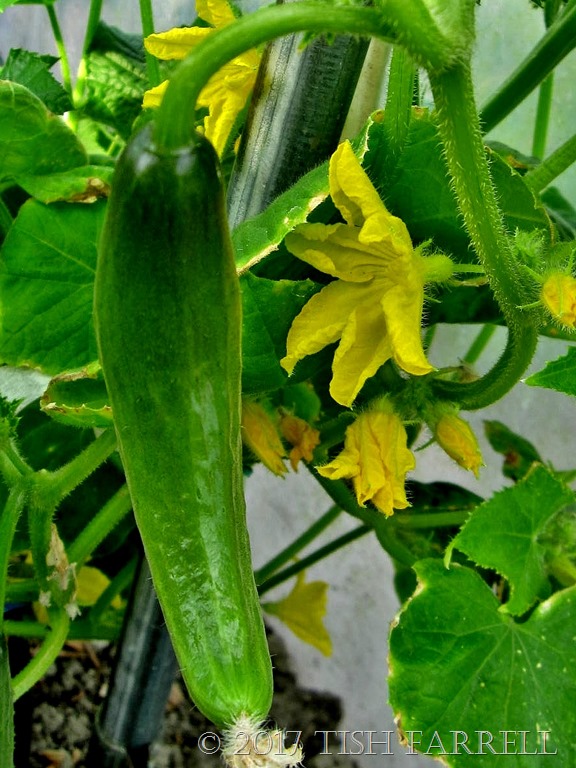
Up at the allotment the strawberries are cropping like crazy. Two weeks in (and despite having only a new, and quite small bed) we are a bit overwhelmed. We’ve already been sharing big bowls full with the neighbours. Fortunately said neighbours say they are more than happy to relieve us of the ‘problem’. But I can see that jam making might have to happen next, although today it’s far too hot to even contemplate standing over a pan of hot bubbling fruit. Maybe strawberry ice cream then. Now that’s more like it. I can stand over my  little ice cream maker, and chill while all is creamily churning. Aaah…
 

Six Word Saturday

#SixWordSaturday  #6WS

Early Morning Elephants In The Mara ~ All Very Much In Order

The thing is, they are noiseless as they move, their footfalls cushioned by pads of fat behind their toes. Of course there are the low frequency stomach rumbles that maintain lines of communication across the herd, but we weren’t close enough to hear those. Or maybe we were too intent on our own stomach rumbles. We had driven out of the Mara River Camp at first light, after only a 5.30 cup of tea. Breakfast was still a distant prospect when we found ourselves among this large, slow-moving herd.

They paid us no attention whatsoever. All we sensed was a wave of communal intention as they headed on through the thorn brush. In fact we were so beneath their notice, Daniel, our driver-guide, decided it would be fine to stop the truck and eat our picnic breakfast as the elephants moved on by.  I remember thinking how incongruous it was to be standing out on the Mara plains eating a hard boiled egg while these majestic creatures slowly passed me.

This is not to say that elephants cannot be dangerous; sometimes murderous if they bear a grudge for some harm done them; or if the bulls are in musth. But nothing was amiss this day. It was like one big family outing, the epitome of good elephantine order wherein mothers and children always come first.

Scan-131109-0004

Scan-131109-0026

copyright 2017 Tish Farrell

Daily Post: Order

Looking Out From Wenlock Edge ~ One Subject Two Formats

P1050952

P1050954

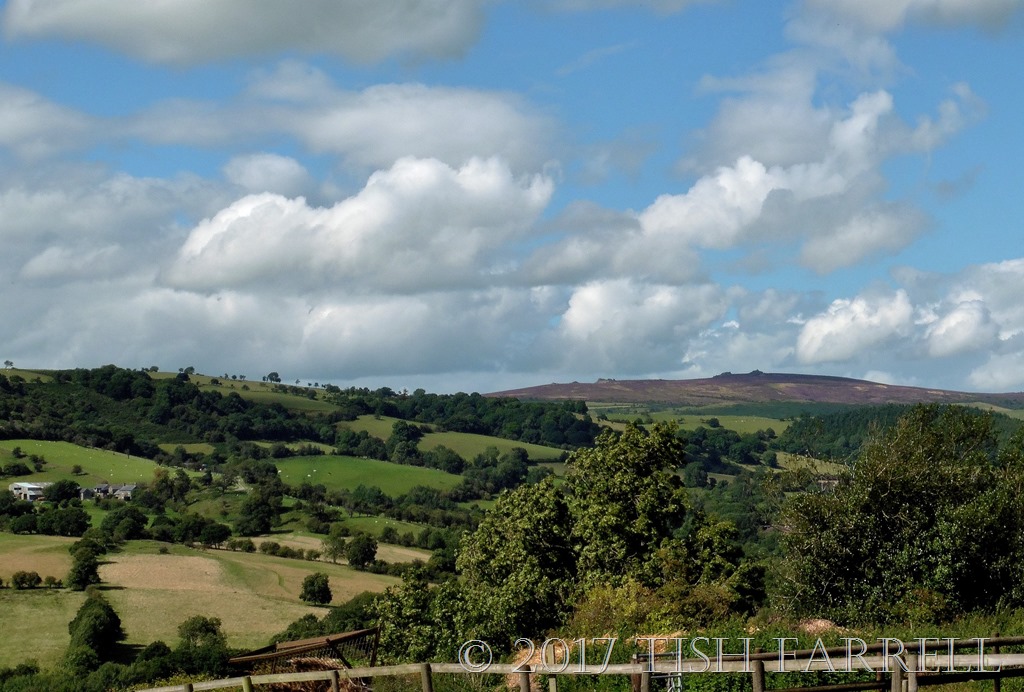
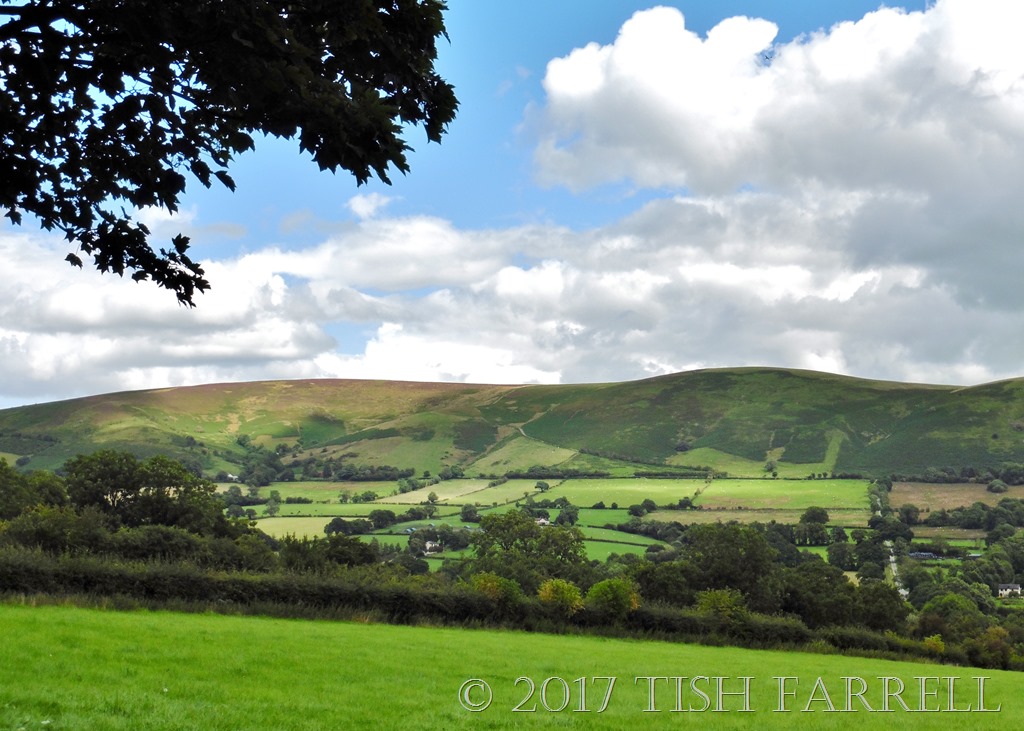
You can see why this part of Shropshire falls within an Area Of Outstanding Natural Beauty. These shots were taken on the viewpoint just past Hilltop on Wenlock Edge and I’m looking south-west towards the Shropshire Hills. You can see, too, why poet, A E Housman called them ‘blue remembered hills’. They seem like a memory even if you have never clapped eyes on them before.

And so when presented with the kind of blissful panoramic views that the Edge provides, it is tempting to try to capture all of it. And that usually does not work, not unless the light is perfect, and your photographic skills are considerably greater than mine. Even this landscape view is only a small segment of the 180 degree vista. I chose it because I liked the visual flow of man-made fields towards the grassy uplands, and the here-and-there accents of hedgerow and woodland; the many shades of green.  Also, despite the millennia of human intervention here, you can still discern the landscape’s natural rhythms beneath the pastoral surface.

It’s a soothing scene to look AT. But the portrait version, I feel, is doing something rather different. It invites you into the landscape as if stepping through a door; it is therefore more actively affecting. Just my thoughts anyway. Also a thank you to Paula for stirring us up to think about the different effects of landscape and portrait composition.


Thursday’s Special: Portrait vs Landscape

All Friends At Nairobi’s Elephant Orphanage

When it comes to the survival of orphaned elephant infants, loving friendship is the only thing that works. Baby elephants need continuous loving, tactile affection as much as they need food. Without it they quickly die.

Kenya’s Dame Daphne Sheldrick, pioneer in elephant orphan rescue and rehabilitation, learned this the hard way. For years she strove to create a rich formula to substitute for mother’s milk. But in her efforts to keep orphans physically alive, she also learned that the emotional ties between baby and surrogate mother were crucial to the baby’s survival.

At her orphanage on the edge of Nairobi’s National Park she has developed an astonishing survival regime for all the young animals brought to her. Every orphan has its ‘mother’ i.e. one of the green-coated keepers seen in the photos. Every keeper is on full time duty with his charge, and this includes sleeping with the baby in its stall.

By day there is feeding, mud bathing and playing to be done. The blanket strung on a line in the top photo is there to simulate the overshadowing side of an elephant mother. The keeper feeds  his baby, holding the bottle down behind the blanket. The babies are also wearing blankets – at 5000 feet above sea level, Nairobi can be cool in July when this photo was taken, and in the wild small babies would anyway have the constant warmth and shelter of mother and aunts.

IMG_0029

The ultimate objective of the Sheldrick Wildlife Trust is to re-introduce the orphans to the wild. This is a painstaking and precarious procedure, recreating communities in the absence of wild matriarchs who are the custodians of herd memory.

Tsavo East National Park is one of the main locations for the rehabilitation process. This is the park where Daphne Sheldrick’s husband, David, was warden until 1976. During their time together at Tsavo, the Sheldricks pioneered the rehabilitation of many wild animals that had been reared in captivity. On David’s early death in 1977, Daphne set up the Trust in his memory. Forty years on some 150 elephants have been saved, along with rhinos and other species.

If you want to read about the elephants in detail there are keepers’ daily diaries HERE. You can find out what is going on in the nursery with the youngest orphans, or discover how the adolescents are faring at various forest locations as they learn to live again in the wild. A study of dedicated friendship in action then.

IMG_0033

If you are ever in Nairobi, then the orphanage is open to visitors for an hour each day. You can also donate to the Trust or foster an orphan. There are more details HERE.

Daily Post: Friend

Thursday’s Special ~ Pick-A-Word At Penmon Point

P1060605 (3)

This buoy at Penmon Point, on the Menai Strait in Anglesey tells shipping to be vigilant – the channel between the main island and Puffin Island is too shallow for passage. The lighthouse says so too in a big notice on its topmost white stripe (out of shot):

P1060580

P1060566

This month Paula’s pick a word at Lost in Translation includes: branching, vigilant, pomp, hooked and continual. So I’m laying claim to them all – distantly branching wind turbines off the Great Orme, the need to be vigilant in these waters, the hooked profile of the bay, and the continual ebb and flow of the tide. And as for pomp, well I think the lighthouse has plenty of it.

But for a truly outstanding interpretation of these prompts, please visit Paula, and enjoy her Venetian gallery.

Oh No! The Poppies’ Frocks Are Blowing Off

Last night as I was snapping the foxgloves outside the garden, a keen wind blew up. Inside the garden the oriental poppies were in complete disarray – a veritable strip-tease was going on. Of course it often happens – just when the poppies are looking their best, we have gale or deluge, and the garden party ends up a complete wash-out: everyone with draggled skirts, hair-dos shot and mascara smudged.

IMG_4946

IMG_4936

IMG_4943


But the good news is – when I got up this morning…


P1080167

P1080165

…there were new girls on the block, including one in lipstick pink. How could I have forgotten  that she would be coming along? Although how she got herself in with the salmon pink crowd I do not know.

While I’m here, I’ll pass on an oriental poppy gardening tip for those of you that grow them, and may not know: if, when the poppies have finally finished flowering, you cut the plants right down to the ground, you will be treated to a late summer flush.

Cee’s Flower Of The Day  Please visit Cee to see her lovely flower shots, and leave links to your own.

Tonight Over The Garden Wall ~ The Foxglove Garden

A week ago the wilderness garden behind our house was all columbines. They went to seed very quickly and now it’s the foxgloves’ turn – along with the Dame’s Violets and the slender spires of purple toadflax. All self-sown and grown. I’m rather taken with the foxglove on the right, the one  with creamy lips. I must remember to collect some seed, though there’s no knowing how its offspring will turn out.

P1080140

P1080135

The white foxgloves are lovely too. They have lime green speckles inside each flower.

P1080156

And finally a view looking out over the garden wall as the sun goes down over Wenlock Edge.

The Big Digger Driver And The Kindness Of Strangers

P1060816 - Copy

P1060816 - Copy - Copy

I think I’ve mentioned that here in Much Wenlock we’re in the throes of having a couple of attenuation ponds dug above the town – this in a bid to reduce flood risk.  We are in what the Environment Agency calls a ‘Rapid Response Catchment Area’. This means that if a severe storm hits our part of Wenlock Edge, then we have about twenty minutes warning before a flash flood reaches the town. There are other factors involved too. Flash flooding is more likely if the ground is already sodden from periods of prolonged rainfall. Or if it is frozen hard.

Our last bad flood was in the summer of 2007 when over fifty homes were affected. Due to the steepness of our catchment, any flood is usually quick to leave, but even so, it can cause a lot of damage.

One of the attenuation ponds, currently nearing completion, is in the top corner of Townsend Meadow behind our house. Earlier in the year, and in preparation for the excavation work, a number of small trees were felled and shredded into heaps around the pond perimeter. Yippee, I thought on discovering them by the path on the long way round to the allotment. More chippings for paths and weed suppression.

I duly went to collect a few bags full, but it was harder work than I expected. For one thing there is quite a haul up the path from the pond, and then once at the top of the hill and into the wood, another haul down the field boundary to the allotment.

Meanwhile, my chippings collecting habit had not gone unnoticed. Late one afternoon in April, and after the working day was over, I was plodding up the path with a full bag when a truck pulled up on the field track that the construction crew were using. It was the digger driver in the photo. A very Welsh digger driver. At first I didn’t quite grasp what he was saying. I thought he’d come to tell me off. But that wasn’t it.

When I explained what I was doing and where I was going with the chippings, he said it would be no problem for him to move the chippings piles to the top of the hill. In fact I think he would have delivered them to the allotment if there had been suitable access. He drove off down the track, and I carried on with my bag, and rather forgot about the digger man.

Sometime later (I was pottering around in my polytunnel) fellow allotmenteer, Dave, came to tell me that he had  been surprisingly hallooed from the neighbouring field by a very Welsh man who was going on about chippings and some woman he’d met on the path. After some thought, Dave had concluded I was the woman in question, and so we went up the field to investigate, and there at the top of the track was a huge pile of wood chips – enough for all my paths, and more to compost over the winter. There was no sign of the digger man. I expect he’d gone home for his tea, but Dave helped me fill my big blue IKEA bags and carry them back to the plot.

So lucky me! Two very kind men in one day. And a nice new path between the polytunnel raised beds, which incidentally were made by a third kind man who lives in my house.

IMG_4380


Black & White Sunday: After and Before    This week Paula asks us to give a colour shot a monochrome edit.