Vision Of Things To Come ~ Thursday’s Special

100_4930

The endless envisioning of how plants will grow and crop is what keeps us gardeners gardening. In the face of failure we regroup, and start again – perhaps a different variety is required, or more careful cultivation techniques; maybe weather conditions were against us, so prompting us to think how we might come up with new strategies to reduce the worst effects if the same thing happens next year.

So it becomes an on-going pursuit of forward thinking, learning, re-learning and visualizing. I find it also helps to try and see things from the plant’s point of view. If I were it, am I getting everything I need: food, appropriate levels of moisture, protection from extremes (which among others can include ravages by aphids, pigeons, drought and tempest). With climate change we may have to rethink entirely the kinds of fruit and vegetables we grow.

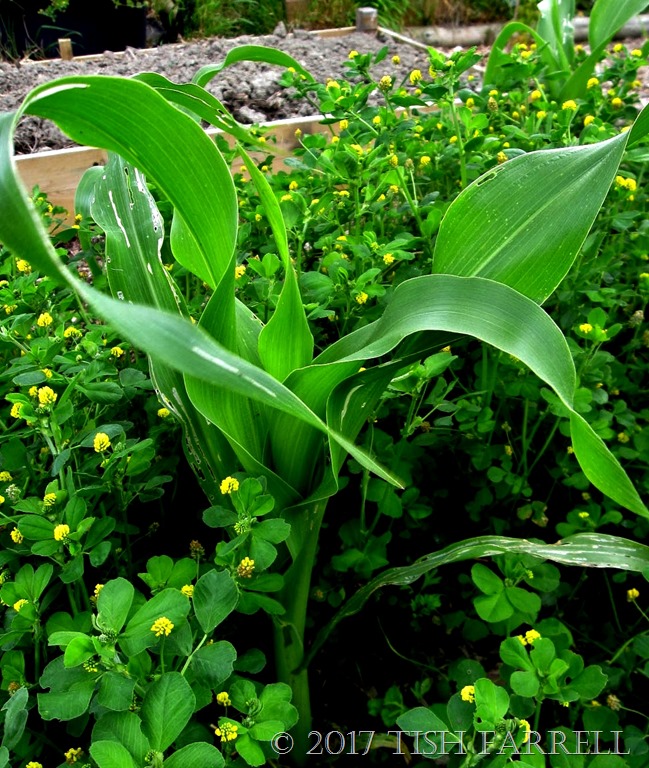
This year I am probably growing too many sweet corn plants. I thought the first lot of seedlings were set to fail after being assaulted by several days’ torrential rain while I was away. Just in case, I sowed more seed. But then the shredded little efforts rallied, and the second sowing burgeoned, so now I have about three dozen plants on the go.  They are greedy crops too, and also need lots of watering, which is hard work up at the allotment where cans have to be filled and hauled from the water tank. The site is also very exposed, and its heavy soil prone to turning to concrete at the slightest hint of a drought.

To cope with this I have adopted two different approaches. The later batch of plants has been planted out in a bed of deep litter from a dismantled compost heap. Hopefully this will both shelter and feed the plants as they get going and stop them drying out or needing quite so much watering.

The earlier batch I set out in a plot where I have overwintered trefoil and fenugreek still growing. I sowed these plants at the end of last summer as a green manure, and had meant to dig them in this spring. Then I had a much better idea, one that relieved me of much digging. When it came to plant out the sweet corn, I simply popped the seedlings in amongst the green manure plants.

There are all sorts of advantages to this. The fenugreek and trefoil are nitrogen fixing so should nurture the sweet corn. They also act as weed suppressants as well as providing shade and shelter to the developing plants.

So far this seems to be working quite well. I’m also trimming back the trefoil and fenugreek as the corn grows, so acquiring a crop of green stuff for the compost heap and to use as mulch around the beans, which also like to keep their roots cool and moist.

IMG_5104

So now my vision is of summer’s end and lots of juicy golden cobs – perhaps enough for us and all my allotment neighbours. We’ll see…


Thursday’s Special: vision

Looking Out From Wenlock Edge ~ One Subject Two Formats

P1050952

P1050954

You can see why this part of Shropshire falls within an Area Of Outstanding Natural Beauty. These shots were taken on the viewpoint just past Hilltop on Wenlock Edge and I’m looking south-west towards the Shropshire Hills. You can see, too, why poet, A E Housman called them ‘blue remembered hills’. They seem like a memory even if you have never clapped eyes on them before.

And so when presented with the kind of blissful panoramic views that the Edge provides, it is tempting to try to capture all of it. And that usually does not work, not unless the light is perfect, and your photographic skills are considerably greater than mine. Even this landscape view is only a small segment of the 180 degree vista. I chose it because I liked the visual flow of man-made fields towards the grassy uplands, and the here-and-there accents of hedgerow and woodland; the many shades of green.  Also, despite the millennia of human intervention here, you can still discern the landscape’s natural rhythms beneath the pastoral surface.

It’s a soothing scene to look AT. But the portrait version, I feel, is doing something rather different. It invites you into the landscape as if stepping through a door; it is therefore more actively affecting. Just my thoughts anyway. Also a thank you to Paula for stirring us up to think about the different effects of landscape and portrait composition.


Thursday’s Special: Portrait vs Landscape

Thursday’s Special ~ Pick-A-Word At Penmon Point

P1060605 (3)

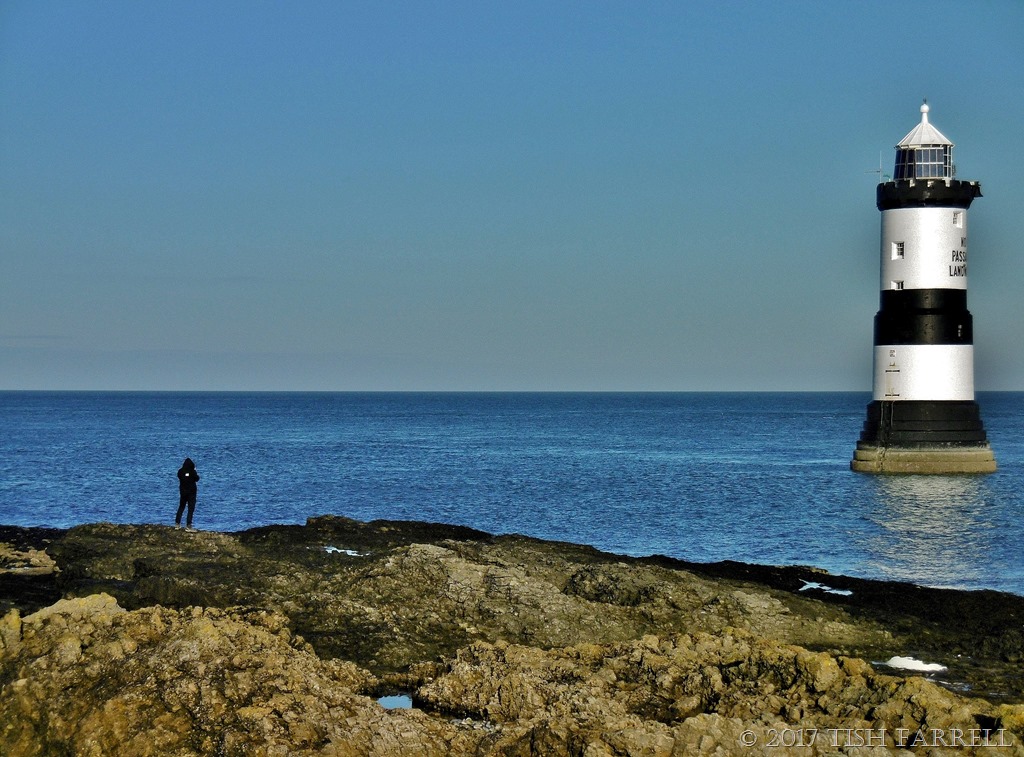
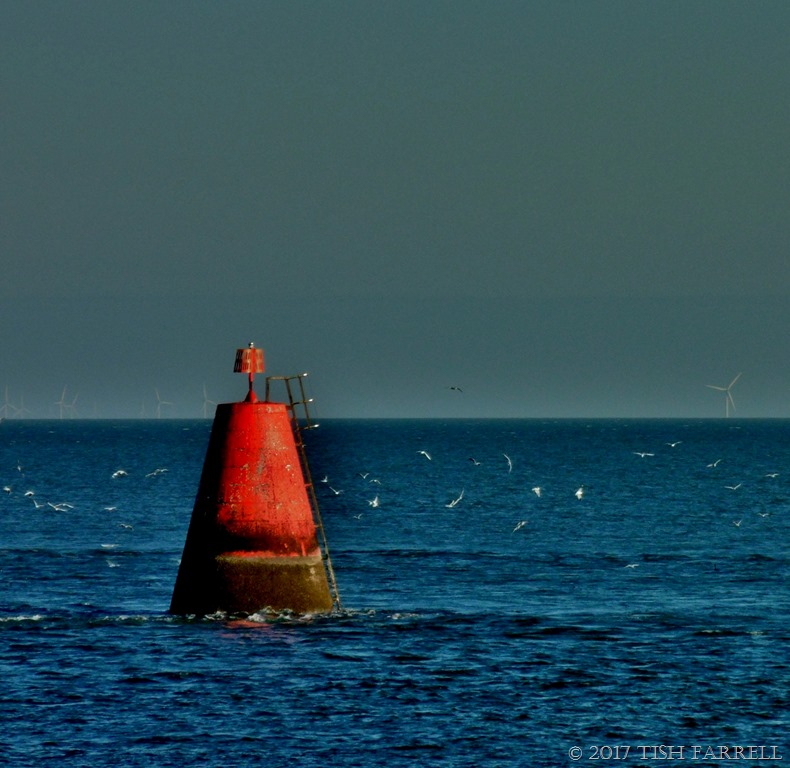
This buoy at Penmon Point, on the Menai Strait in Anglesey tells shipping to be vigilant – the channel between the main island and Puffin Island is too shallow for passage. The lighthouse says so too in a big notice on its topmost white stripe (out of shot):

P1060580

P1060566

This month Paula’s pick a word at Lost in Translation includes: branching, vigilant, pomp, hooked and continual. So I’m laying claim to them all – distantly branching wind turbines off the Great Orme, the need to be vigilant in these waters, the hooked profile of the bay, and the continual ebb and flow of the tide. And as for pomp, well I think the lighthouse has plenty of it.

But for a truly outstanding interpretation of these prompts, please visit Paula, and enjoy her Venetian gallery.

Of Men Turned To Stone And A Cup Of Gold

P1070982

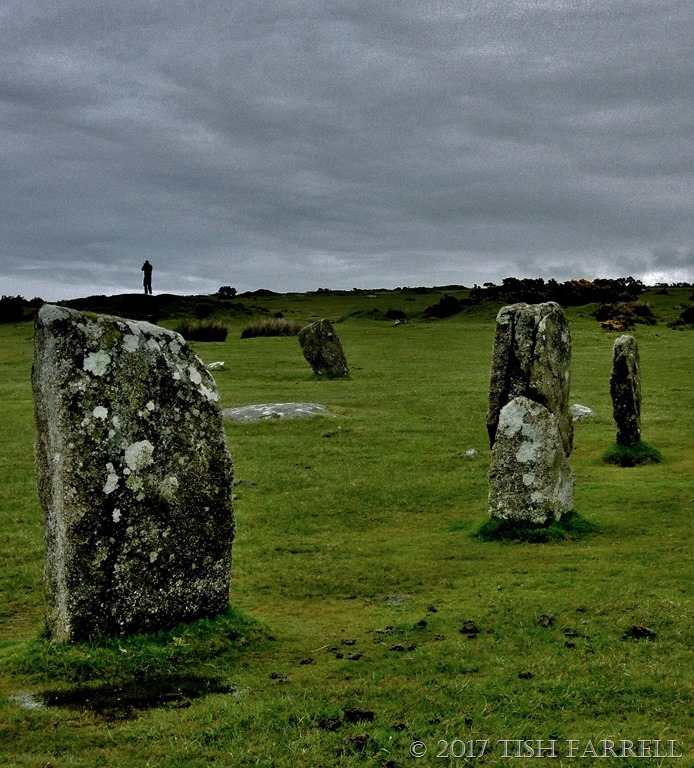
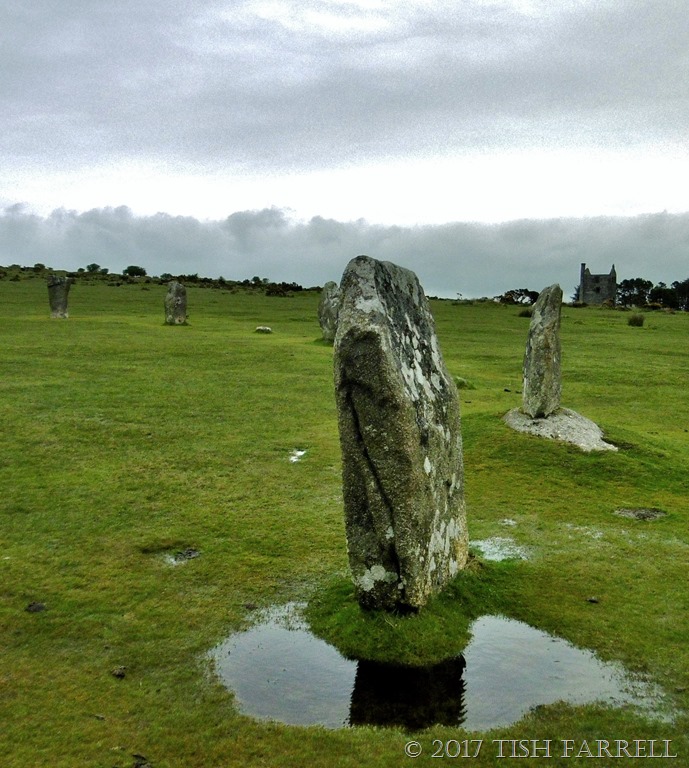
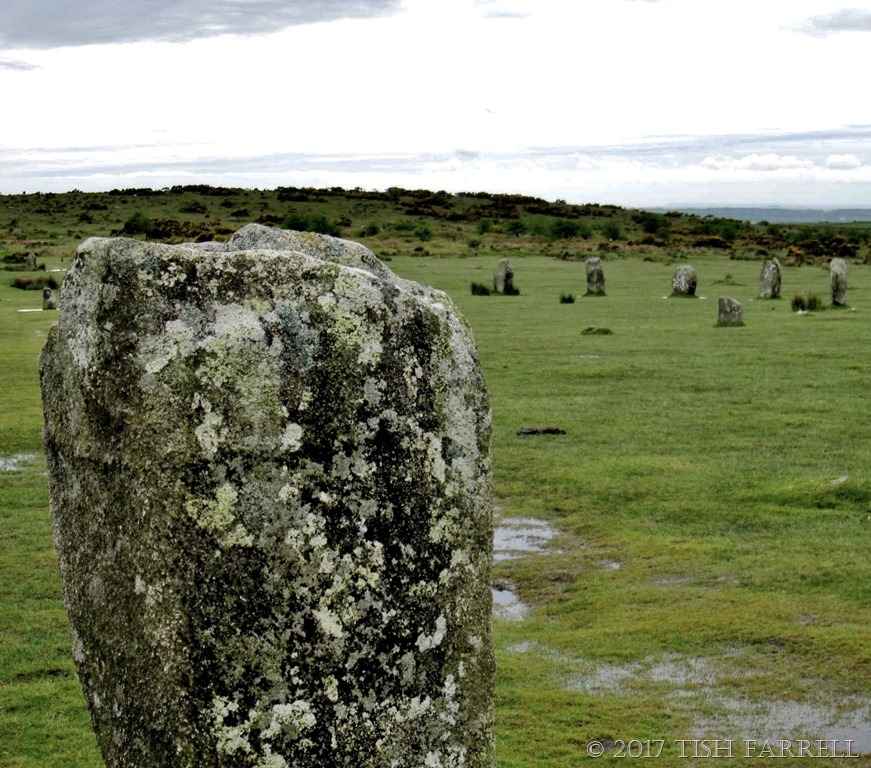
We were spending a few days in south-east Cornwall last week and, in between downpours, we managed a trip up to Bodmin Moor to visit The Hurlers. This unique prehistoric site comprises three stone circles set out in a row, and dating from the Late Neolithic or Early Bronze Age. This would make them around 4,000 years old. It is impossible to capture the full complex without aid of  hot air balloon or hang glider, so here are some piecemeal shots. Also the light, as you can see, was pretty poor.

The local explanation for the origin of these stones is that they are petrified men – turned to stone in punishment for playing hurling on a Sunday. (Cornish hurling is an ancient team game played with a silver ball. See the link for more details. And no, I don’t think that is an ancient hurler on the skyline).

P1070972

IMG_4692

The circles are 33, 42 and 35 metres in diameter (108, 138  and 115 feet respectively), and none have all their stones intact. The central circle is the best preserved with 14 standing stones and 14 marker stones. This circle and the one to the north of it align with the huge Bronze Age Rillaton Barrow, visible on the skyline to the north-east. It was here that one of the British Museum’s most precious treasures, the Rillaton Gold Cup was discovered during excavations in 1837. At that time it was passed as treasure trove to King William IV and so remained in the royal household. It was only a hundred years later, after the death of George V in 1936 that its full historical significance was recognised. HRH had apparently been using it as a receptacle for his shirt and collar studs.

779px-Rillaton_Cup[1]

Photo: Creative Commons      Rillaton Gold Cup circa 1700 BC


Thursdays’ Special: Traces of the Past – Please visit Paula to see her dramatic view of San Geremia church in Venice, plus other bloggers’ posts of relics of times past.

Thursdays Special ~ Spring In My Garden

IMG_4027

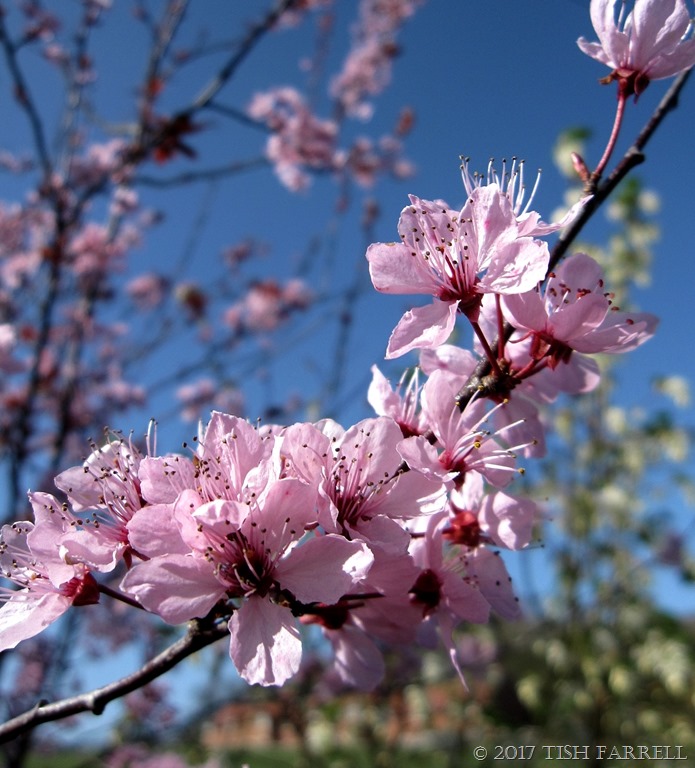
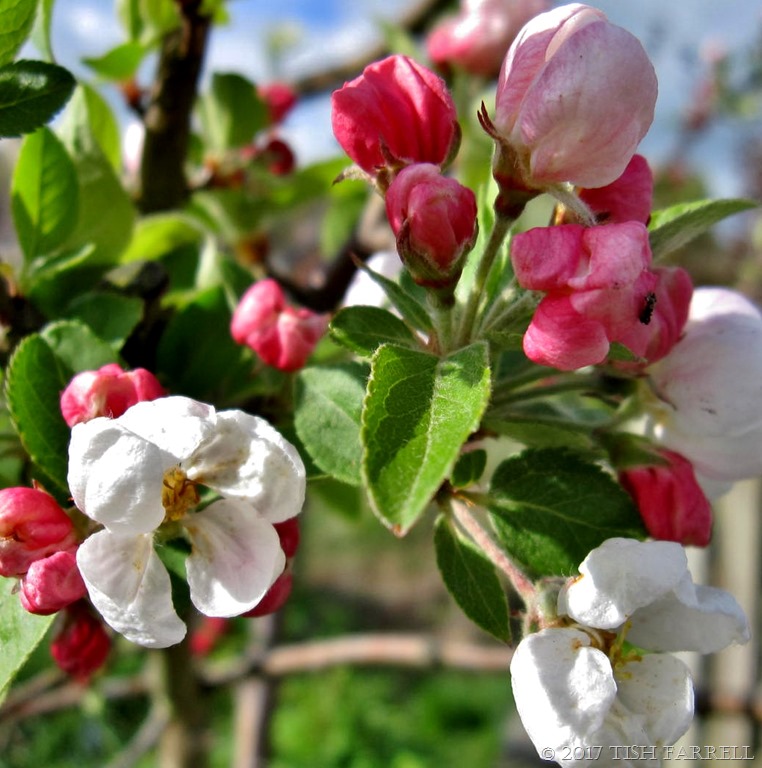
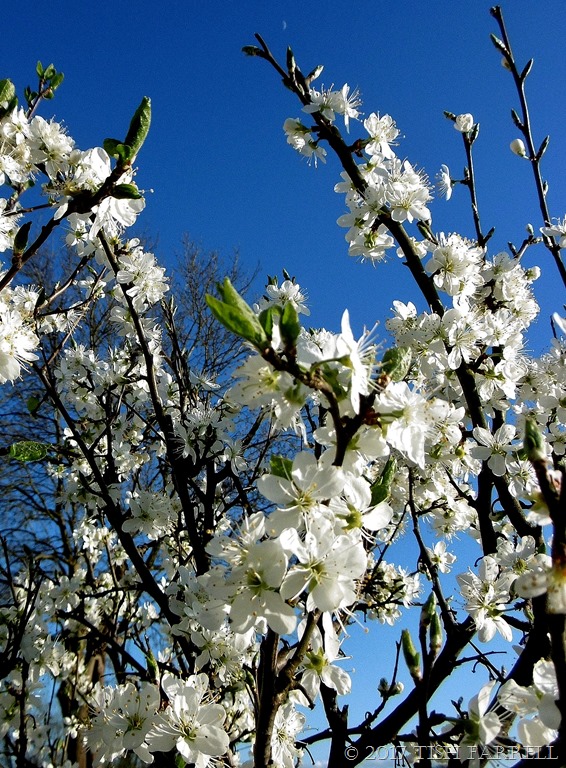
This week at Lost in Translation Paula’s theme is ‘vernal’ and she is calling for our spring compositions. So here are a few scenes from my Wenlock garden. Things have been a bit slow this year because we’ve had no rain for weeks and weeks. But today we did – and the garden has come alive with aquilegias and alliums. And I had no time to take photographs because I had a hundred other things to do. Hey ho. So the photos here were mostly taken back in March/early April: ornamental cherry, crab apple, and damson – the flowers of fruit to come.

IMG_4318

P1070556

Hafren, Sabrina, Severn ~ Please Meet Our Local Goddess Plus A Tale Of Madcap Daring

P1070722

She is most usually known by the Roman version of her name: Sabrina goddess of the River Severn. I told her story in the previous post, but thought this close up view fitted the bill for Paula’s ‘pick a word’ at this week’s Thursday’s Special. The five prompts are: confined, jazzy, patulous, momentous and serene. So I’m going for the first and  last – Sabrina serene but confined to her plinth in a pool in Shrewbury’s Dingle.

It also seems she is confined in other ways too.

The statue was the work of Birmingham sculptor Peter Hollins (1800-1886), and made for Shropshire worthy, the Earl of Bradford in 1846. I thought she was carved from stone, but a little googling reveals that the Public Monuments and Sculpture Association National Recording Project ( who knew of such a body?) thinks she may be cast in some sort of metal and then covered with plaster. They also say she is afflicted with a biological growth – so that has ‘patulous’ covered too, though they don’t say what it is. I’m wondering if it’s responsible for the vaguely luminous areas. Poor nymph.

The scarcely legible quotation underneath her comes  from John Milton’s Comus , a mask in which  Sabrina is one of the main characters. This  work also has Shropshire connections having had its premier showing at Ludlow Castle in 1634, presented before another worthy,  ‘the Earl of Bridgewater, then President of Wales.’

Sabrina fair,
listen where thou art sitting
under the glassie, cool, translucent wave,
in twisted braids of lilies knitting
the loose train of thy amber-dropping hair;
listen for dear honour’s sake,
goddess of the silver lake,
listen and save.

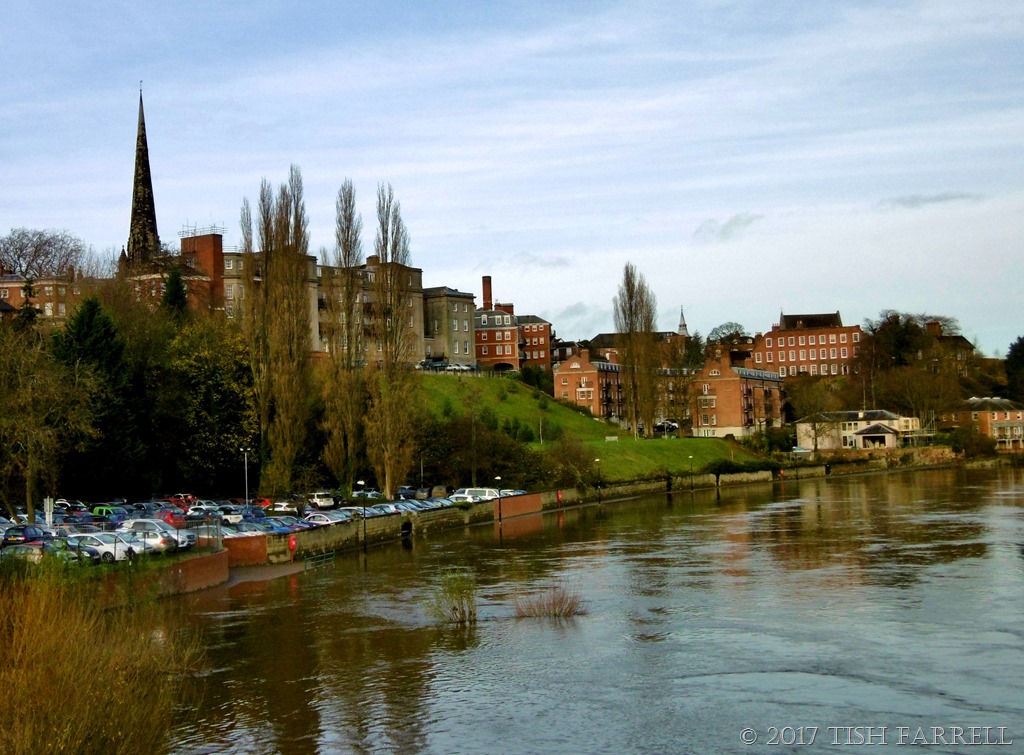
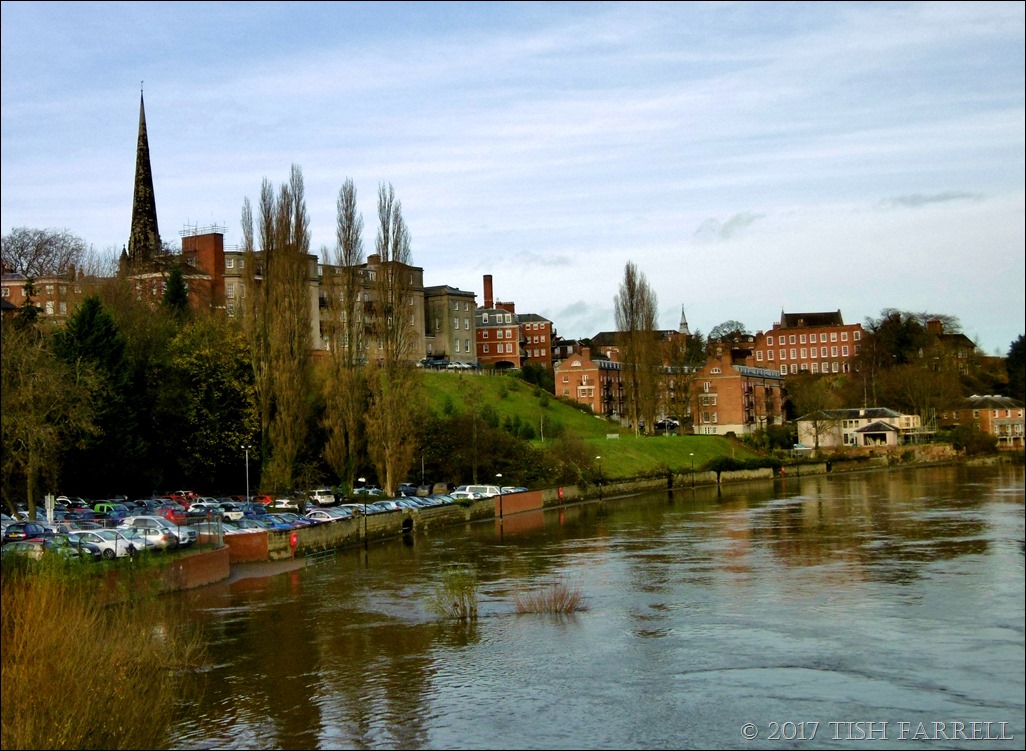
And if you find these words far too gluey and overwrought, then here’s an edgier Sabrina yarn, though I must warn you – it does not end well. It was the Public Monuments entry that put me on to it. It begins with a church spire – specifically the one atop St Mary’s Church in Shrewsbury and also one of the tallest spires in England.  This church has graced the town’s skyline for over 500 years, although parts of it are far older than this, dating back to Saxon times c AD 960. Also some of its stones were apparently cut by Roman masons, and carted in from the abandoned Roman city of Wroxeter some miles away.

P1020453

I think you might call the spire momentous – even before we get to what happens next.  It is over 200 feet tall.

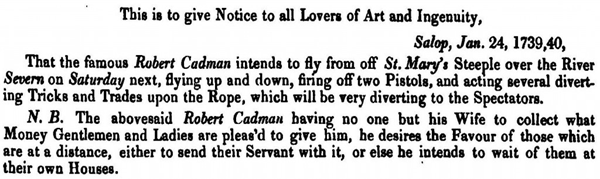
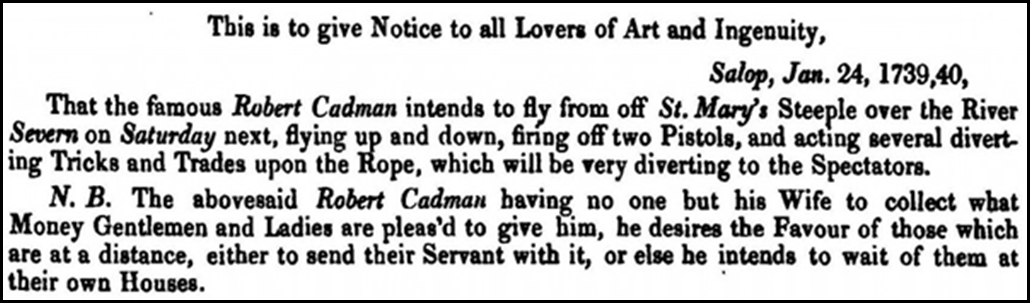
Enter one Robert Cadman, steeplejack and mender of weather cocks. It is the winter of 1739, time of the Great Frost, and Cadman has been employed to put right St. Mary’s weather cock that has been blown askew. He duly does the job, but he has further plans for the church spire. For Robert Cadman is also a stuntman and, for his daring descent from the cupola of London’s St Paul’s cathedral, blowing a trumpet while sliding down a rope,  he has already earned the nickname ‘Icarus of the Rope’.

He has handbills printed and spread about the town:
image

The History and Antiquities of Shrewsbury From Its First Foundation to the Present Time, Comprising a Recital of Occurrences and Remarkable Events, for Above Twelve Hundred Years, Volume 1, 1837

*

The River Severn is frozen solid, and so the Great Frost becomes an occasion for fun and festivities. An engraving of the time shows  skaters and people playing table tennis out on the frozen river; there are tents; there are sheep being roasted; several of the great Severn trow sailing barges are ice-bound; there’s even a printing press out there too. All in all, then, Sabrina is providing the perfect arena for the spectacle Cadman has planned.

He attaches an 800 foot rope (240 metres) through a window on St. Mary’s spire. The other end is anchored across the river at Gay Meadow – (well out of shot on the right of the next photo). The show begins with Cadman’s walk up the rope towards the spire:
P1020440
His usual act is to ascend bare-chested, performing all kinds of stunts as he goes. When he performed in Derby this walk took around an hour. The return descent, or flight as it was termed then (since there was apparently quite a yen for this kind of flying  in the early 18th century), would be swift. For this part of the act our intrepid performer puts on a wooden breastplate which has a groove cut down the middle. He then lies on the rope and hurtles down, headfirst, blowing a trumpet, and accompanied by a stream of smoke as his breastplate burns with the friction of the rope. Whew!

But on this day, when Cadman reaches the spire, he decides the rope is too tight and signals across the river for it to be loosened. There is a misunderstanding. The rope is tightened, and half-way down, the rope snaps – whipping up in horrible coils as Cadman hits the iron-hard ground, his body apparently rebounding several feet in the air. Accounts have it that Cadman’s wife, who has been moving among the crowd of spectators collecting money, runs stricken to his corpse, throwing away the money as she goes.

Robert Cadman was buried at the foot of the spire and the sorry tale is commemorated in a plaque by the main door of St Mary’s church:

Let this small Monument record the name
of Cadman, and to future time proclaim
How by’n attempt to fly from this high spire
across the Sabrine stream he did acquire
His fatal end. ‘Twas not for want of skill
Or courage to perform the task he fell,
No, no, a faulty Cord being drawn too tight
Harried his Soul on high to take her flight
Which bid the Body here beneath good Night
Feb.ry 2nd 1739 aged 28

*

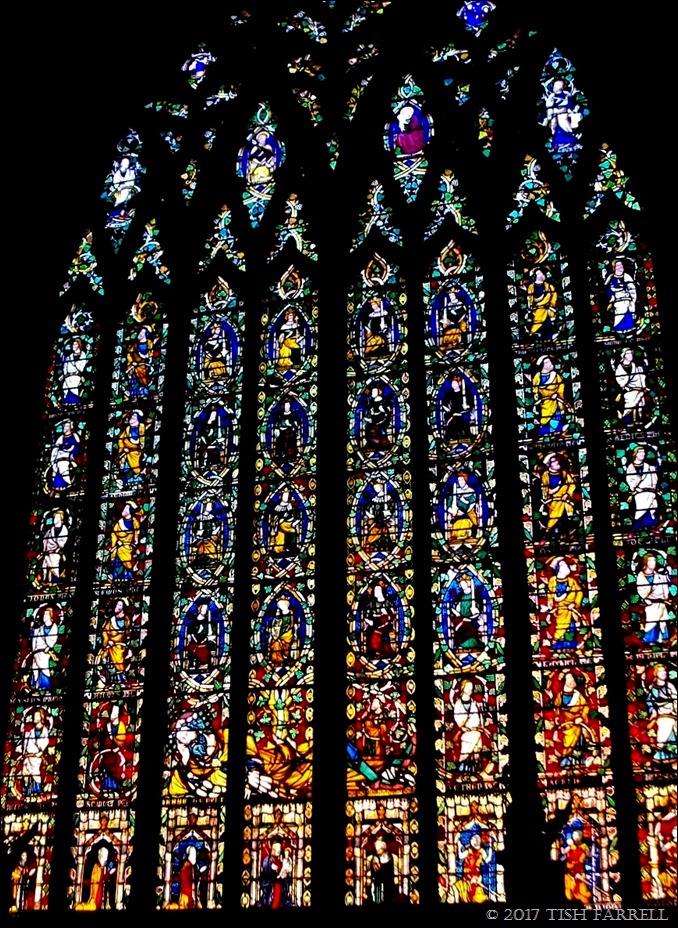
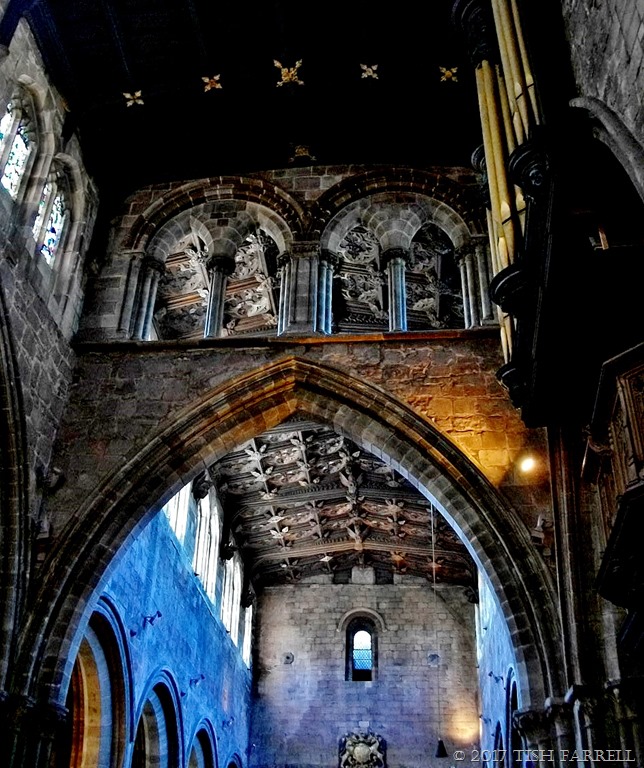
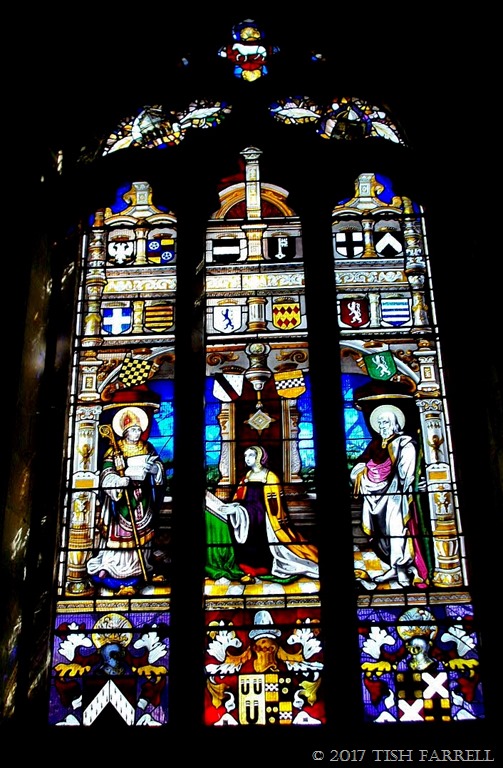
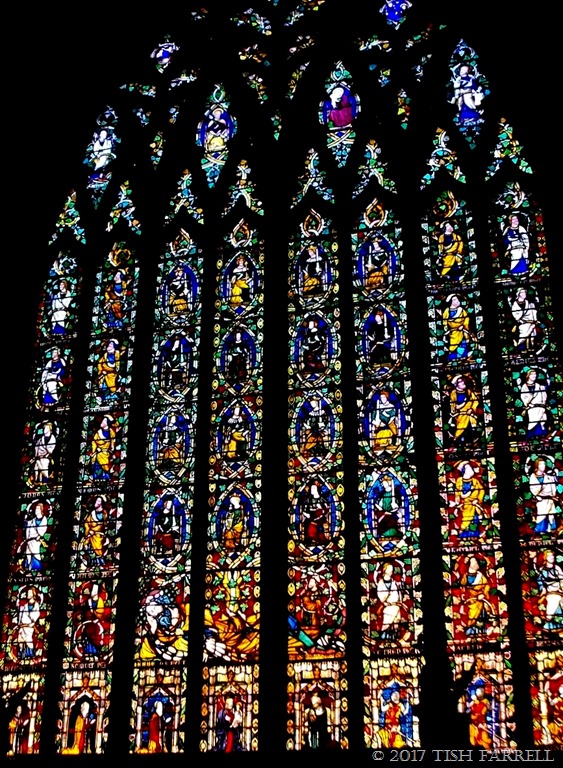
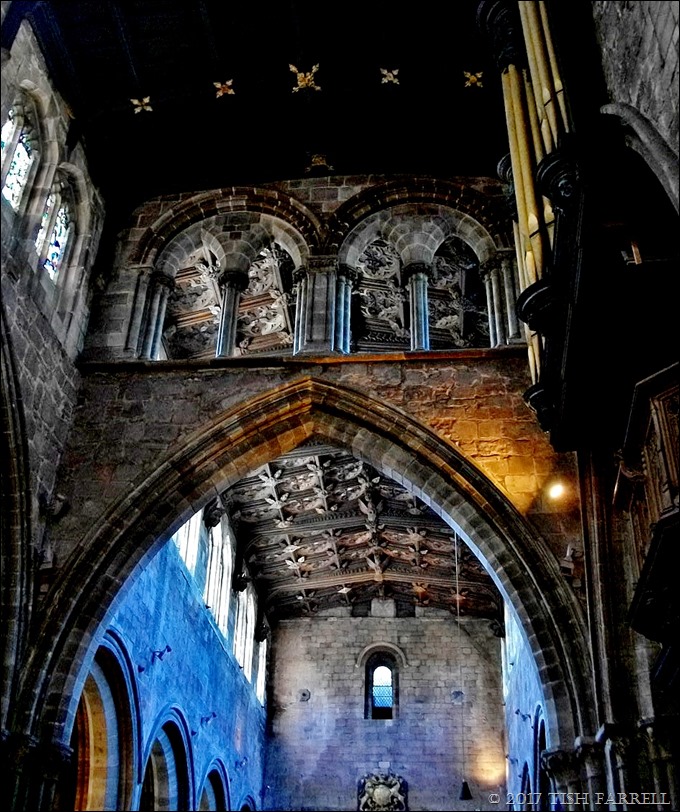
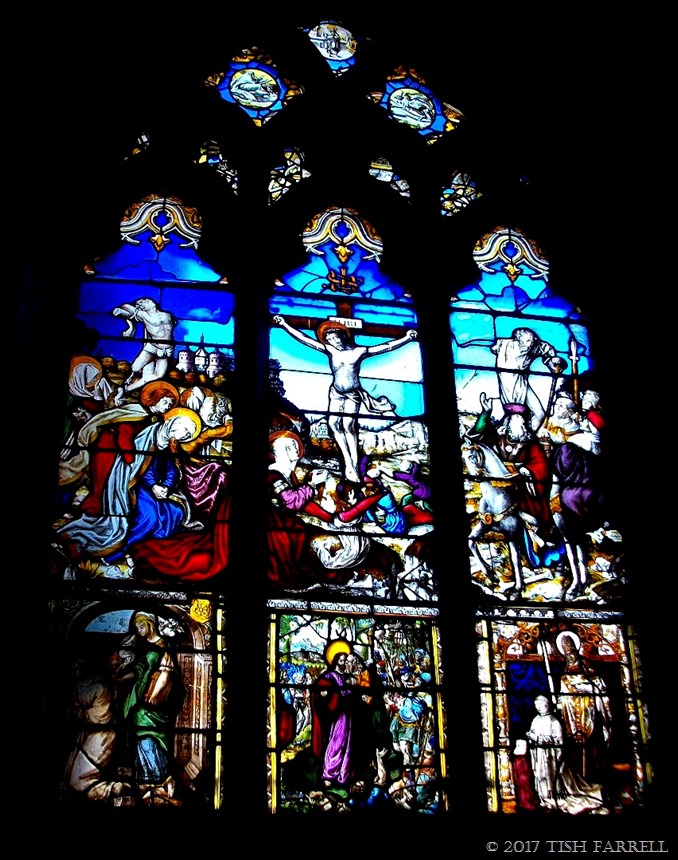
And now just to restore some sense of serenity, here are some shots of St. Mary’s interior. The church is now redundant, but it does have a very good cafe. It also contains some wonderfully ancient stained glass windows. The final image of the set is the Jesse window above the altar and dates from between 1330 and 1350.
100_5536

100_5537

100_5528

100_5534

copyright 2017 Tish Farrell
Juxtaposing The Old, New And Re-Purposed In Manchester’s Northern Quarter

100_5280

It’s hard to believe it’s a year since we were up in Manchester. Lovely niece Sarah had bought tickets for the Buena Vista Social Club’s Adios Tour. We went up by train. Astonishingly there is a direct service from rural Church Stretton to Manchester Piccadilly. The venue was The Bridgewater Hall. It was a great night out: Omara Portuondo, still singing at 85, gave us her all. But it was a little sad too, with film tributes on screen, commemorating past members of this life-affirming ensemble; it left one with a bit of a hum-ho feeling.

And the antidote to such feelings is a trip round the city’s Northern Quarter.

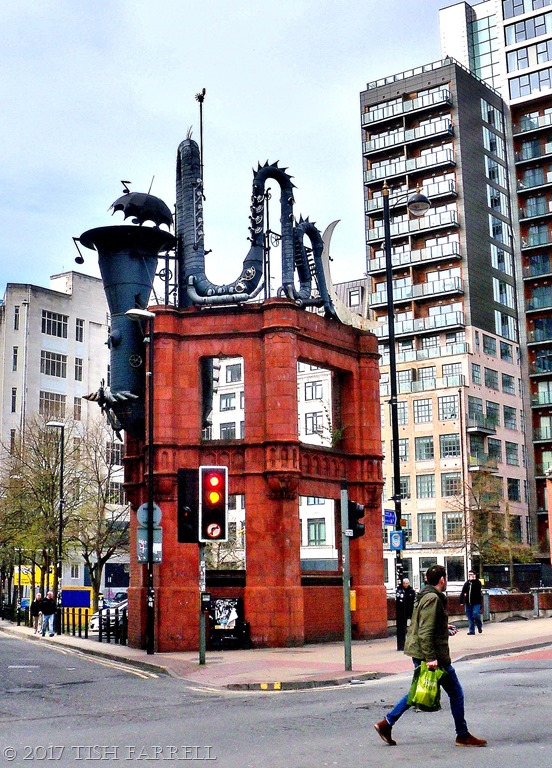
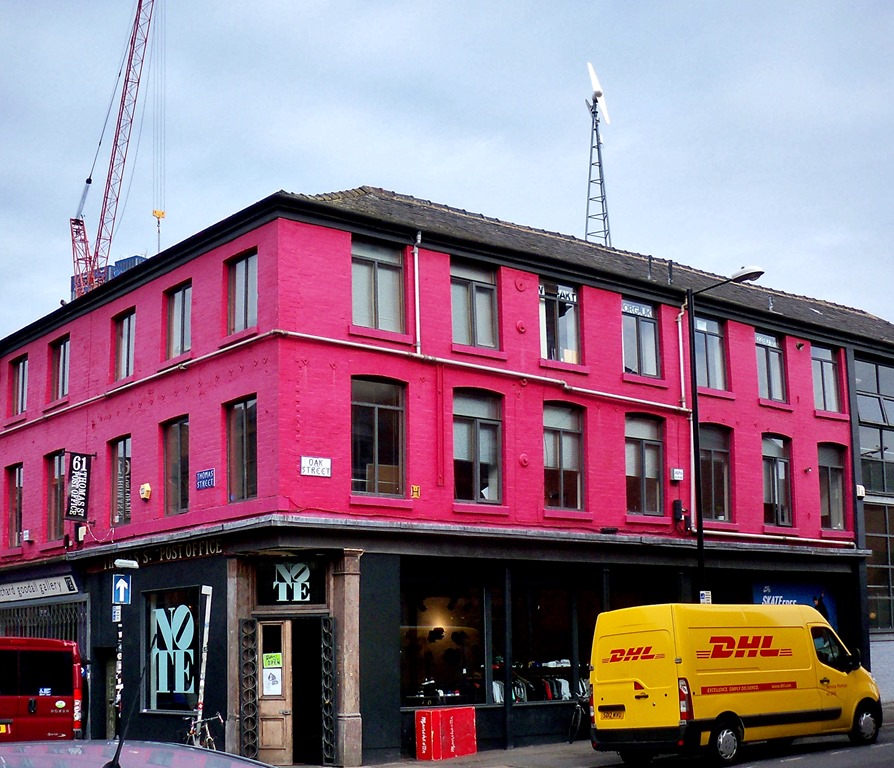
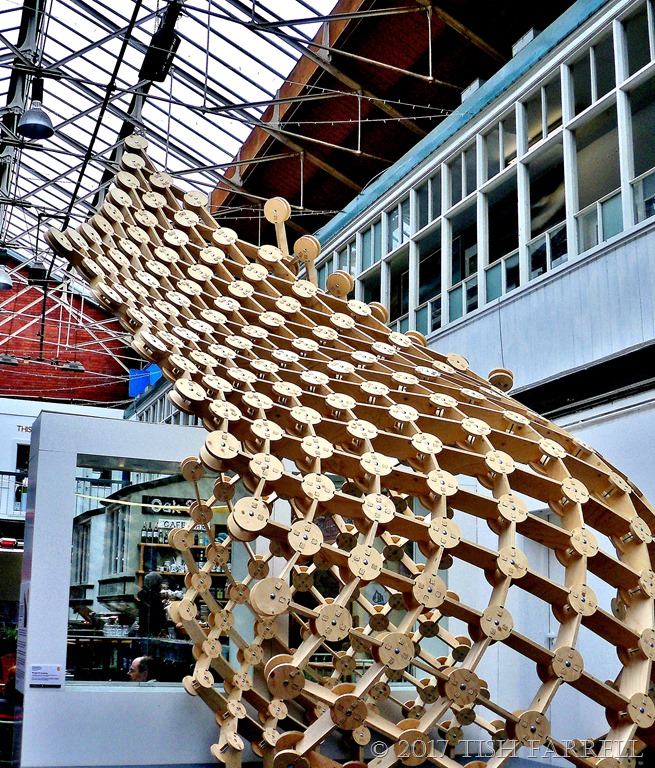
Early on the following Monday morning we set off there. It was once the heart of Victorian Manchester’s cotton trade (there are family connections here: my Hickling grandfather and great grandfather were cotton merchants), now it is a hive  of quirky, alternative, creative, innovative, vintage, left-leaning city living. As in the first photo, there is a lot of what architectural conservationists (if they were feeling generous) might call ‘adaptive re-use’.

100_5282

100_5307

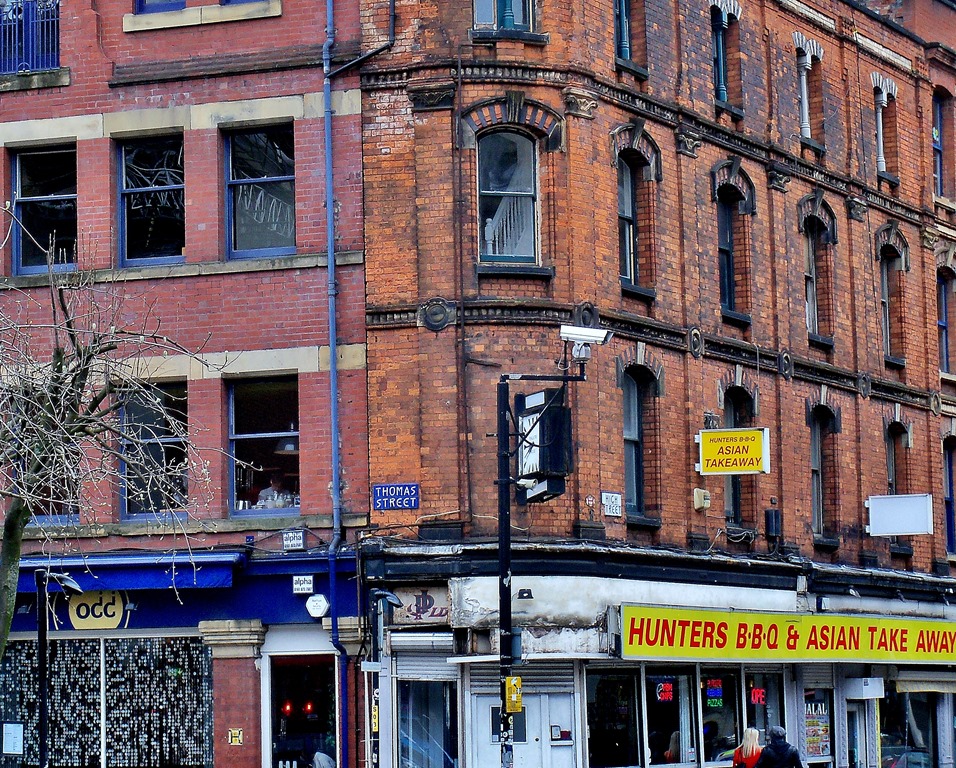
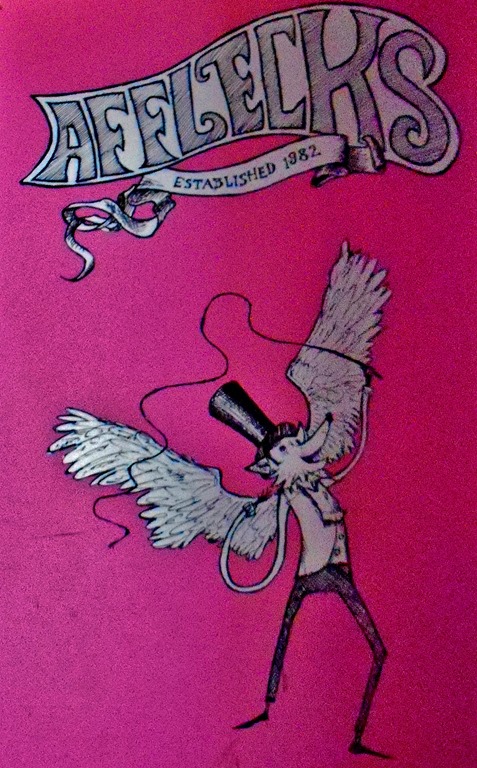
There is still much recycling to do and the place is not pretty. The streets display layers of multi-period dilapidation from the nineteenth century onwards. But there is a vibe here, in the same way there is a vibe in London’s Camden Market. People are doing interesting and creative things. There are independent boutiques and craft-beer bars. If you are into vintage then there are many shopping opportunities, and most especially at Affleck’s Palace emporium:

100_5309

100_5311

100_5313

100_5312

*

If you are a maker then Fred Aldous provides a whole department store of art and craft materials to keep your fingers busy.  And if you want to see what local artists and designers are up to, then the Manchester Craft & Design Centre, located in a former Victorian fish and poultry market, showcases their work:

100_5297

100_5298

100_5299

*

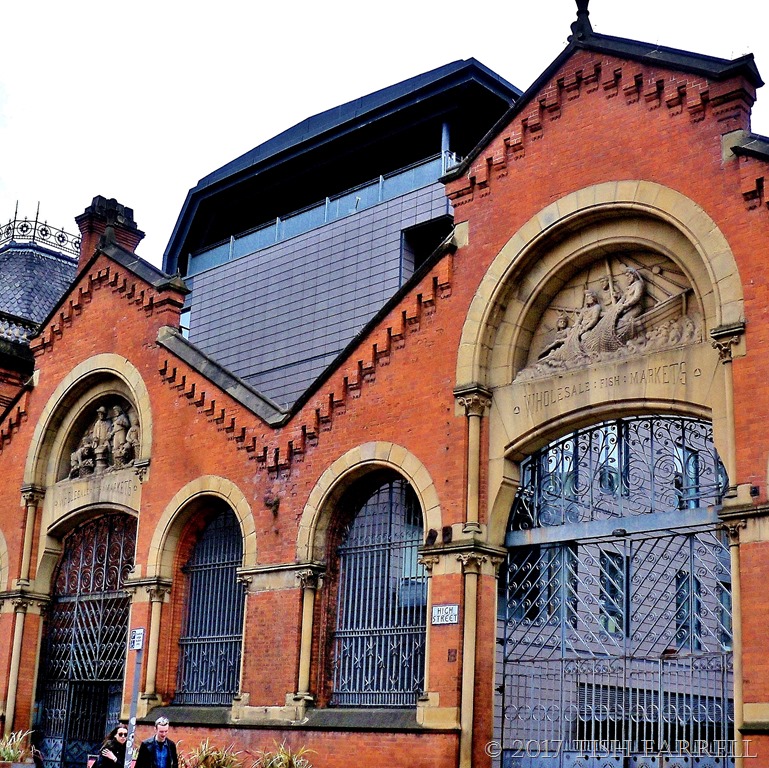
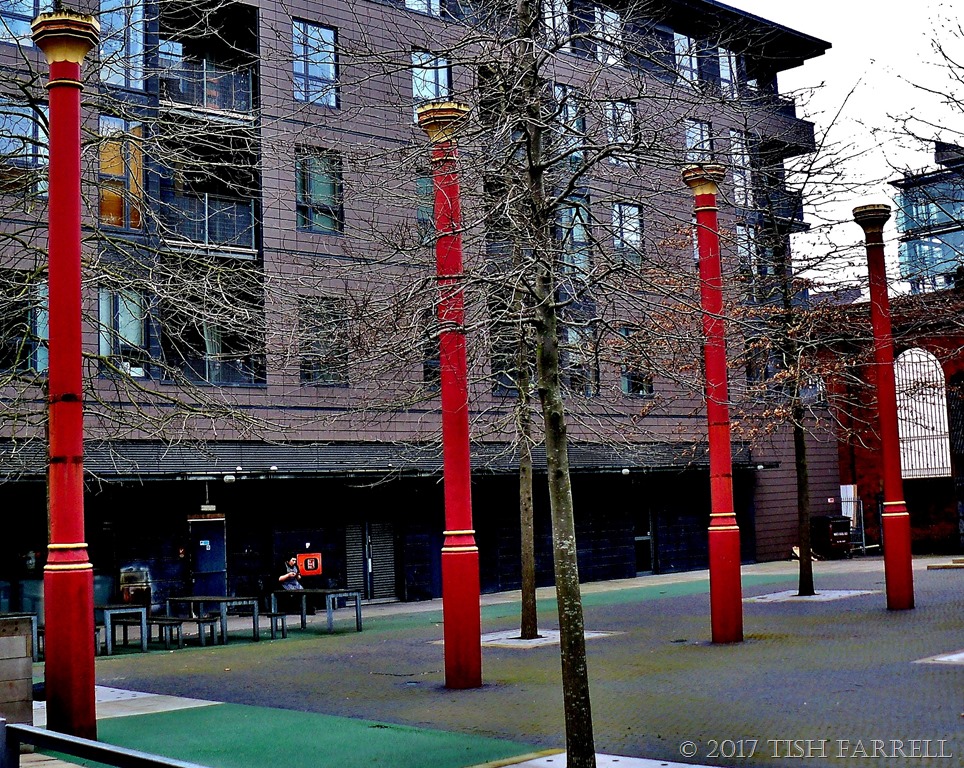
But my favourite piece of juxtaposing is the new development that allowed the survival of the facade of the old wholesale fish market. Aesthetically some might say it’s uneasy union of old and new. But I like it. Mostly because someone had the wit to think it possible. If you look inside the entrance you can see the apartment block has a courtyard garden that has retained the original cast iron columns of the market hall:

100_5303

100_5304

*

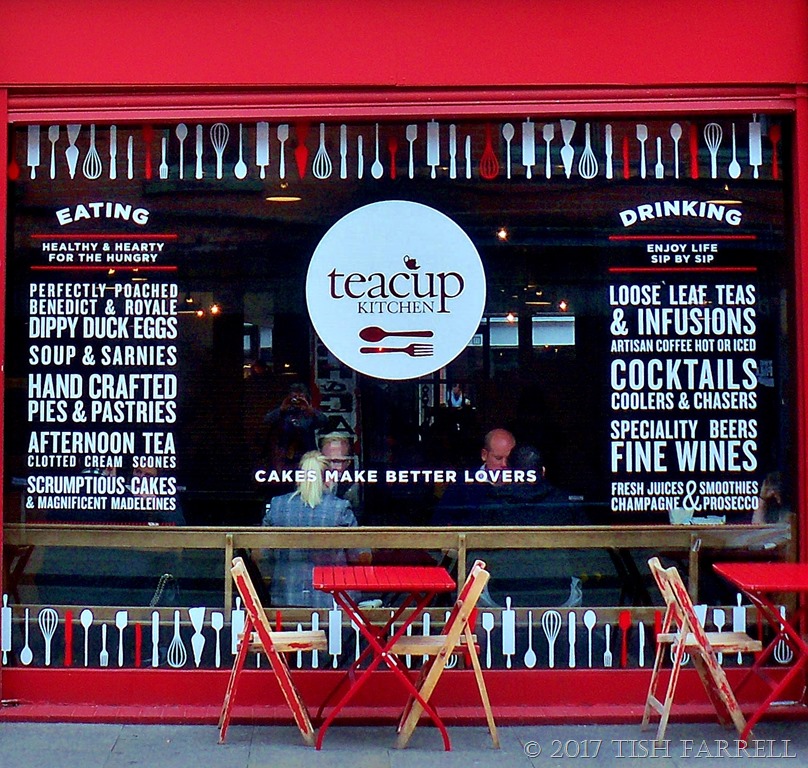
And finally, after all the hiking around, what is most needed is a nice cup of tea with some of the finest cakes on offer. In fact they cater for all tastes and food requirements at the Teacup Kitchen.

100_5296


Thursday’s Special: Juxtaposition

Waiting At The Severn Valley Railway

100_6763

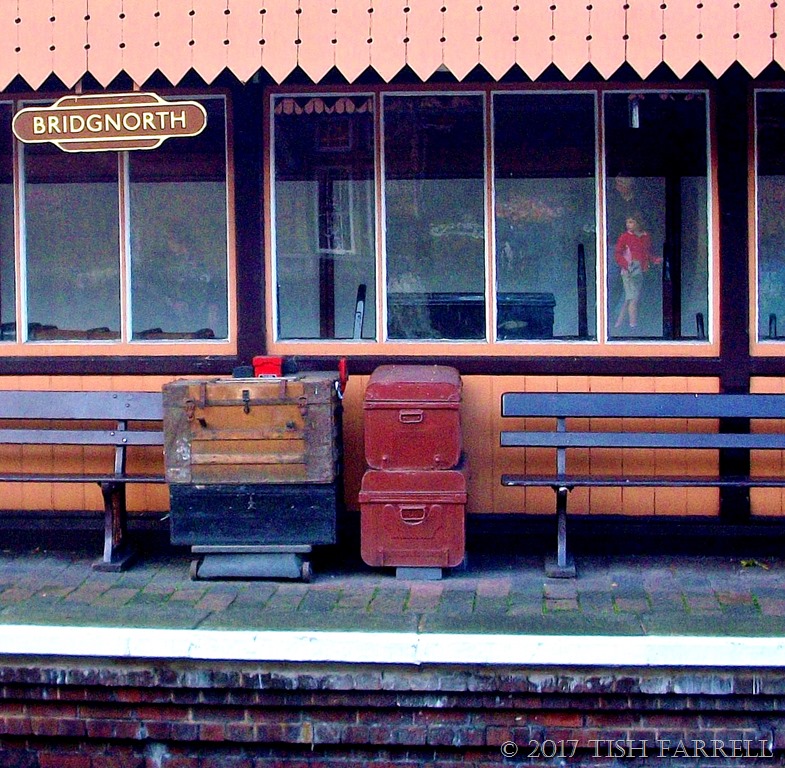
Ghosts of travellers past, or reflections from across the track? I truly cannot say.

This week’s Thursday’s Special cue is WAITING. Paula’s stunning piece of graffiti made me think about trains, and how, as a child, I seemed to spend a lot of time waiting for them, and mostly on Crewe Station. Anyone who knows about the history of railways will know that Crewe is the railway junction, gateway to the north-west of England, and one of the world’s first railway stations (completed in 1837). Being a country child, I used to find it all a bit alarming: shunting, clanking, whistles, whooshing, hissing, porters, trolleys, oil, iron, coal, steam, strangers…

By contrast, the Severn Valley Railway, seems like a dream, although all the same ingredients are there – relics of the age of steam. Strange to think that this includes me too.