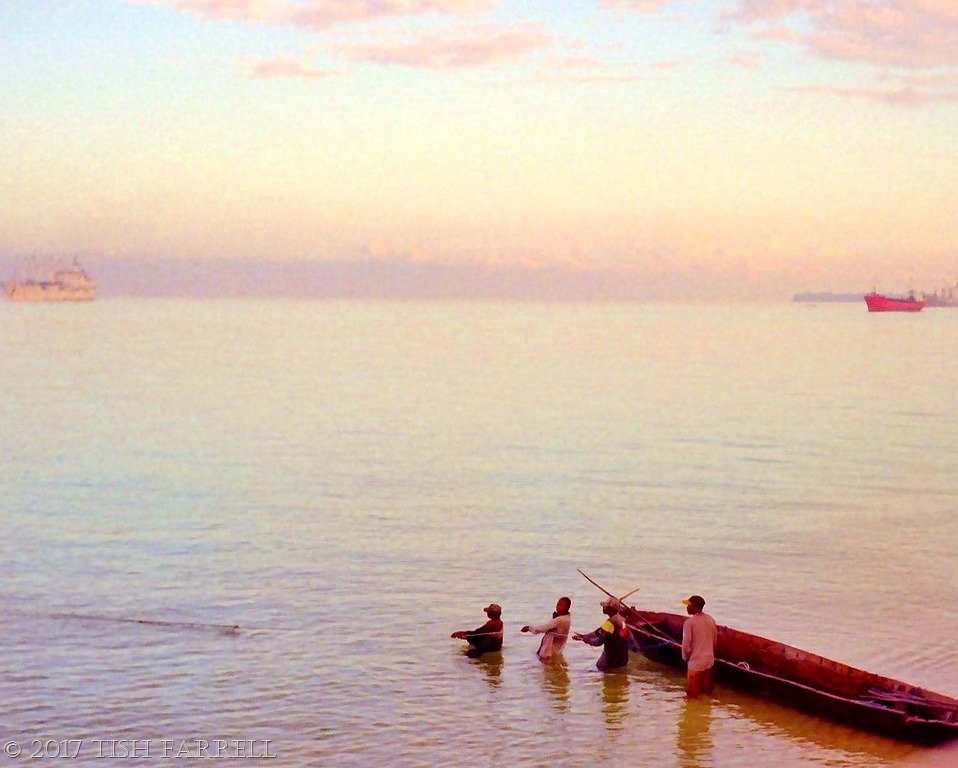
Perhaps I was never there at all. Perhaps I never saw this early morning scene. A figment of my imagination then.

Perhaps I was never there at all. Perhaps I never saw this early morning scene. A figment of my imagination then.
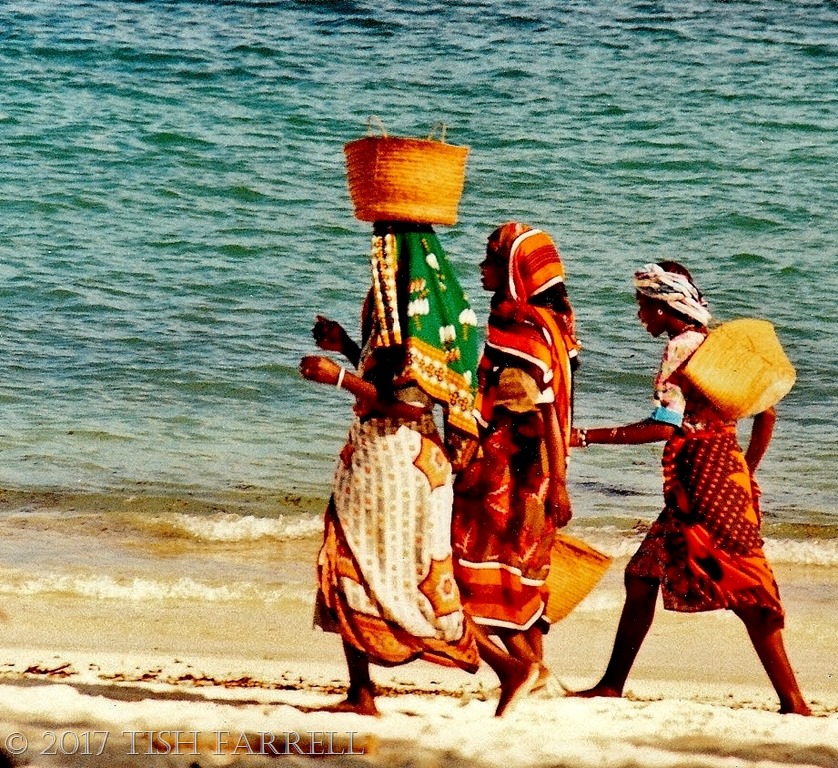
Another shot from the old Africa archive. I love the grace and energy captured here with a single click. What style.
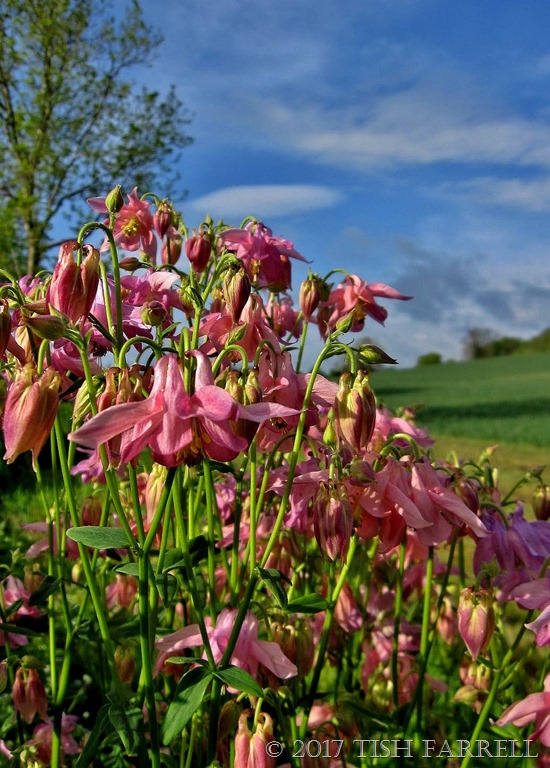
You can’t have too many, can you? Aquilegias that is, aka Columbine or Granny’s Bonnets. They self-seed all over our garden, and also outside the back fence where we have a self-gardening border between us and the field. Dame’s violet, feverfew, purple toadflax, moon daisies, corn cockle and foxgloves are the other vigorous self-sowers. The Dame’s violet in particular is welcome for its fabulous scent. This year most of the plants have come up white. Last year they were mostly pinky-mauve as the plant in the next photo. I like the way they give us a change of scheme:

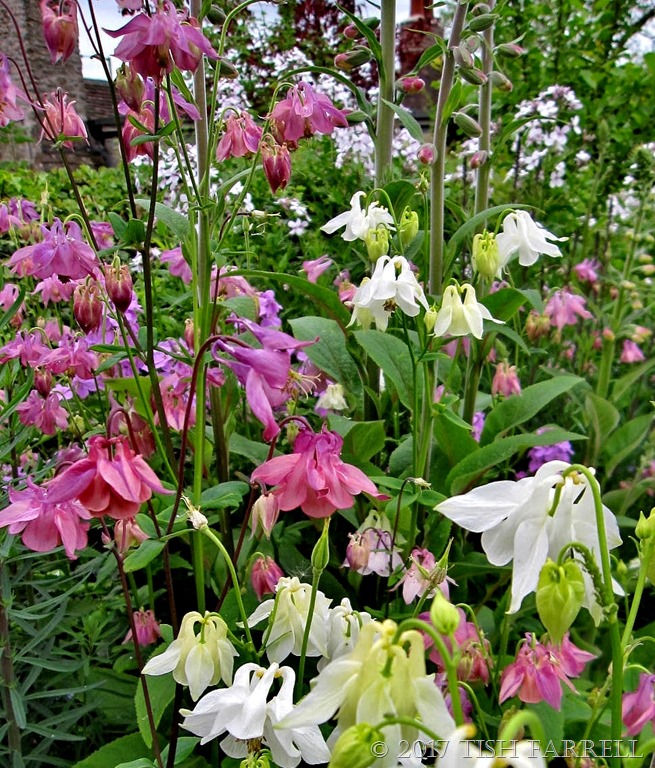
The border isn’t entirely made up of DIY flora. I have put in a few perennials, along with spreading useful herbs – various mints, oregano, lemon balm and marjoram. This year too, some left over allium bulbs put in 18m months ago, are making a nice show – quite unplanned planting scheme-wise. They were planted in the places where I could get my trowel in the soil.
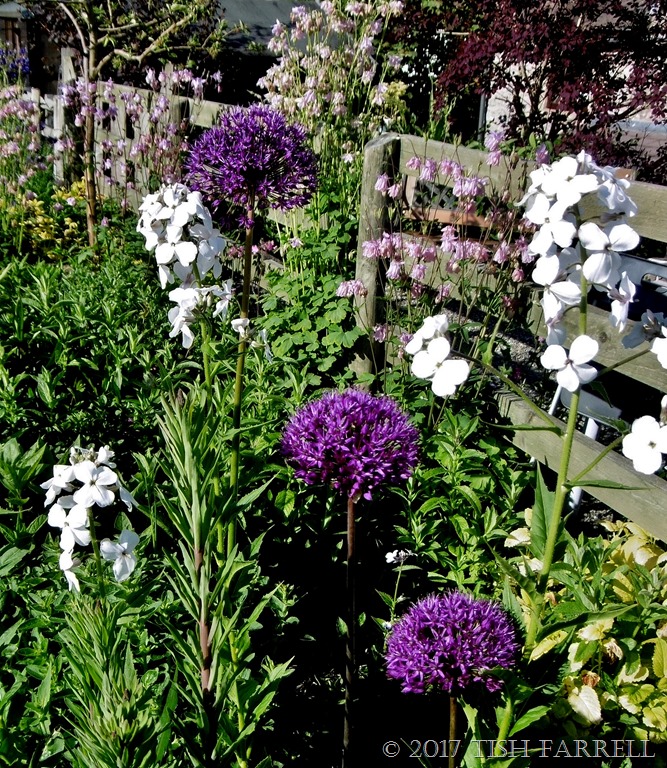
You can also glimpse the transplanted crab apple tree in the top left corner. It’s just coming into full leaf. Next on parade will be the foxgloves. They are opening today under a sudden heat wave – so pictures to come. I’m also wondering if the invasion of opium poppies will be repeated this year. It’s nice to be kept guessing and to have a good garden fence to lean on – to watch and wait, and see what this unofficial garden will do next. It’s certainly keeping the bugs and bees happy.
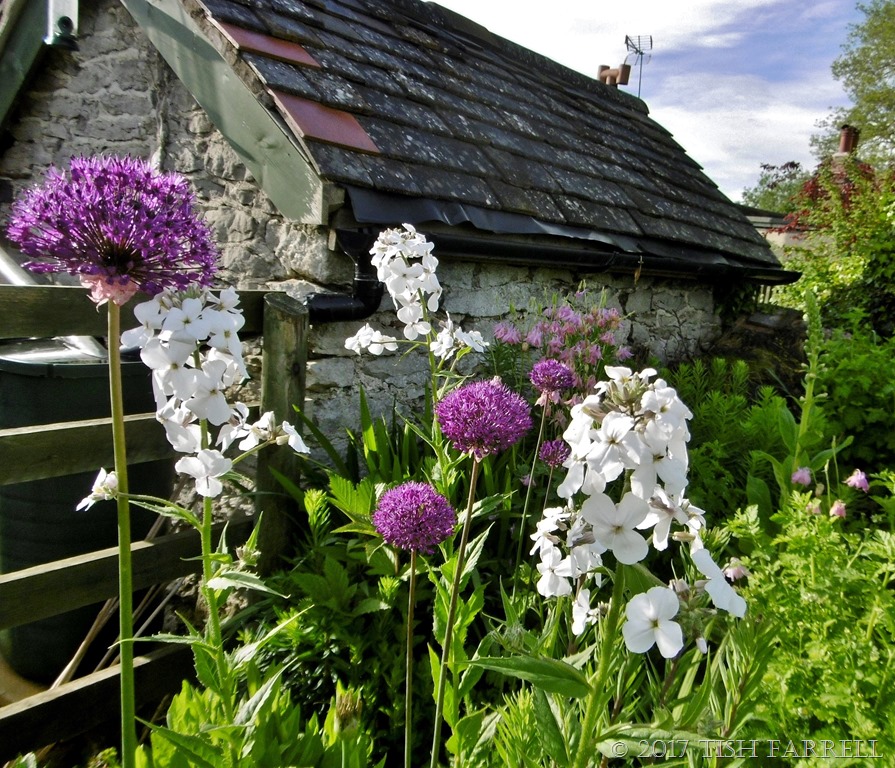
Cee’s Fun Foto Challenge: Gardens Please visit Cee for more lovely plants and gardens.
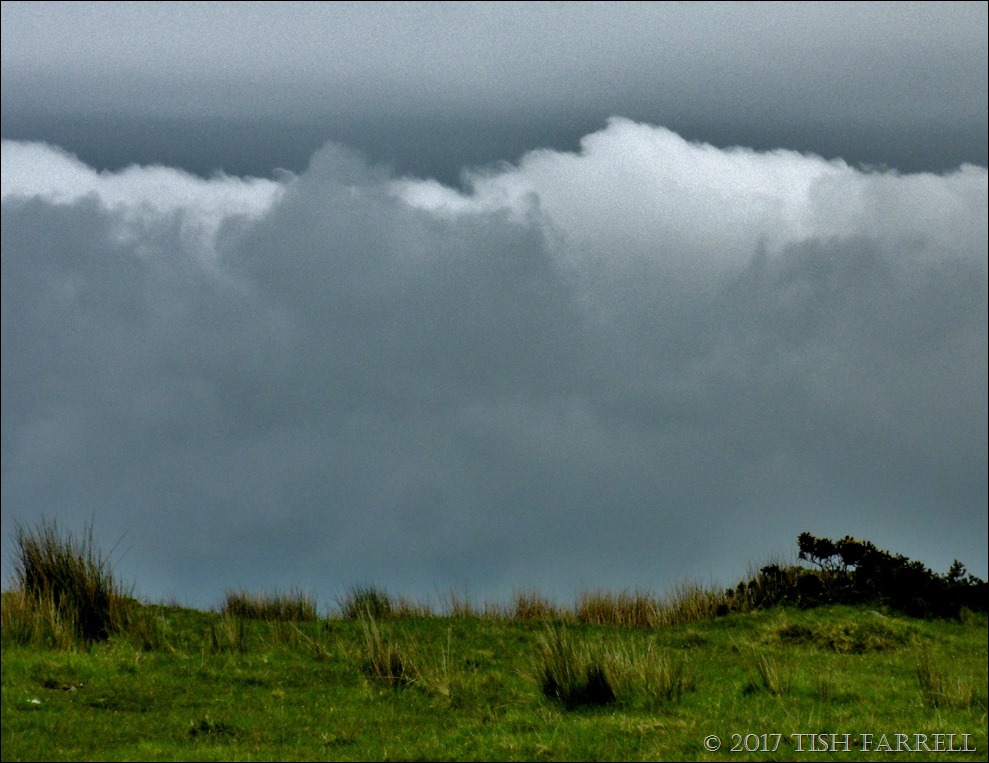
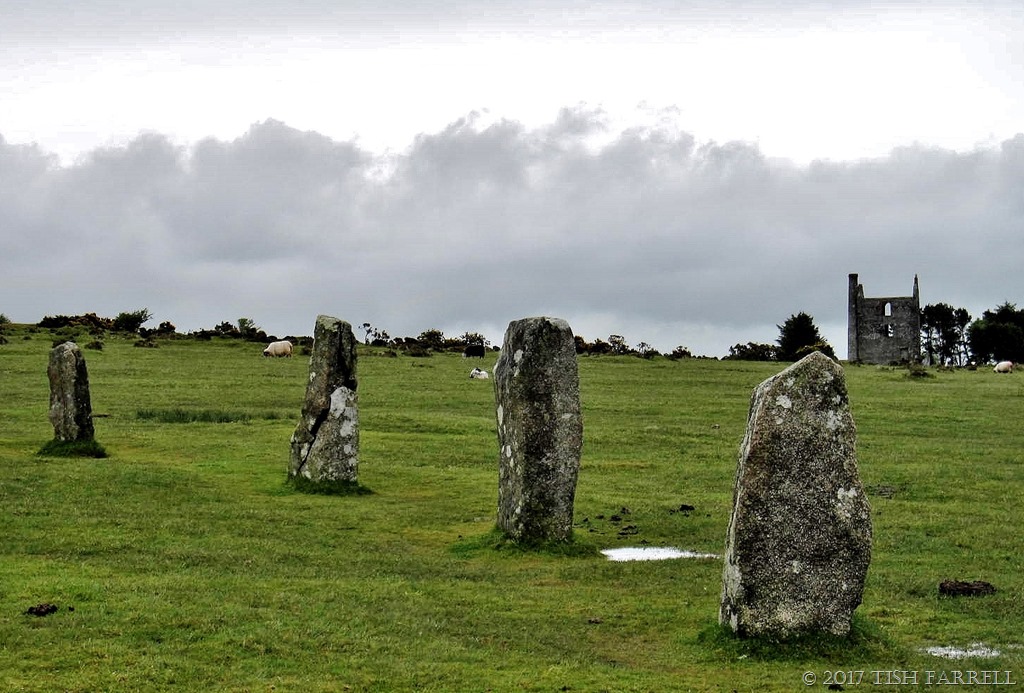
In the last post I featured The Hurlers stone circles near the Cornish village of Minions on Bodmin Moor. Here they are again, if only a small segment. They date from the late Neolithic or Early Bronze Age, around 2,000 years BCE.
The landscape around is exposed and bleak, itself a product of the human intervention that began at least 6,000 years ago, when the first Neolithic farmers, equipped only with stone axes, began the systematic clearance of the forested uplands.
It is an arresting thought that, armed only with stone-based technology, we humans were already consciously rearranging the planet’s surface. Early farmers carried out shifting ‘slash and burn’ cultivation, clearing ground, then moving on to virgin territory when the farm plots lost fertility. By such means the earliest farmers cleared great swathes of forest right from one end of Europe to the other. On Bodmin, any chances of forest regeneration were then reduced by stock grazing, which through subsequent millennia finished what Neolithic communities had started, creating the windswept moorland we see today.
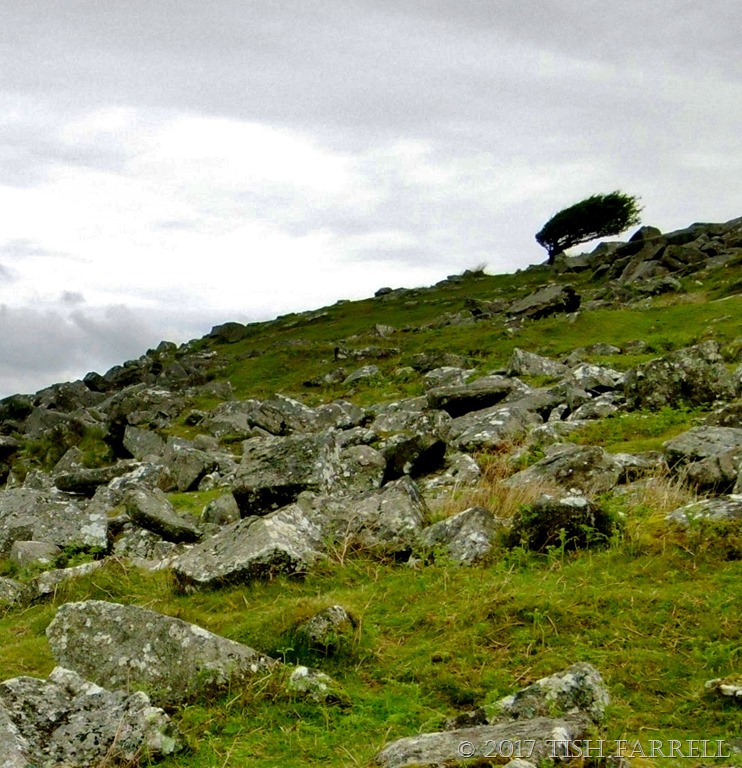
Of course these days we know that removing tree cover contributes to climate change and environmental degradation, by altering rainfall patterns, and accelerating soil erosion. But in this case global climate change was also a factor. During Neolithic-Early Bronze Age times it seems the climate was much warmer, with these uplands offering a more benign environment than today. A quick look at an ordnance survey map shows that Bodmin was a very busy place back then. There are numerous hut circles, burial cairns and tumuli, tor enclosures, stone-walled field systems, ceremonial stone circles and standing stones.
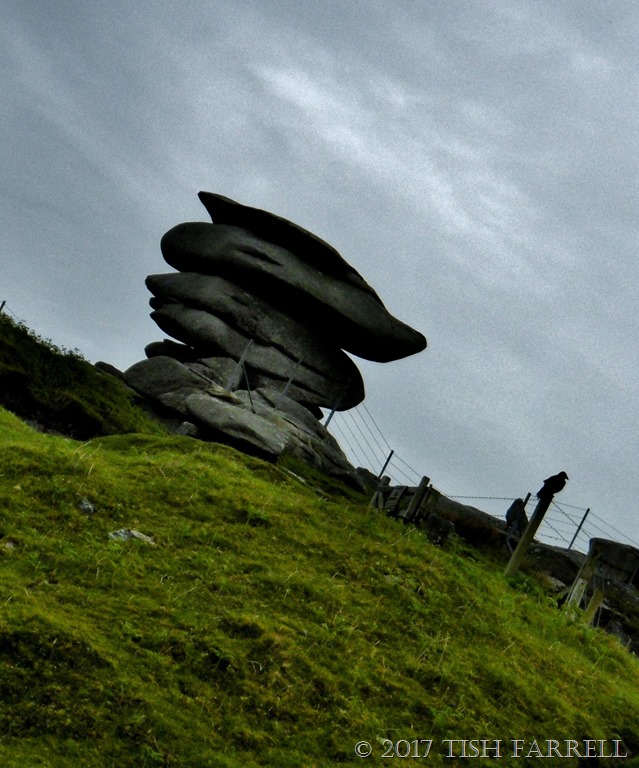
The siting of burial monuments, in particular, was very important – often on the skyline to be seen from one monument to another; or else related to a naturally prominent feature such as one of the stone tors. The Cheesewring Tor is a good example. It lies due north of The Hurlers circles. You will soon see why this weathered granitic pile of rocks captured the imagination of the ancestors, just as it captures ours today.
But there may also have been practical considerations too. When it came to the gathering of clans and families for important occasions, the visibility of man-made and natural features in a landscape without highways would have been the prehistoric equivalent of SatNav.
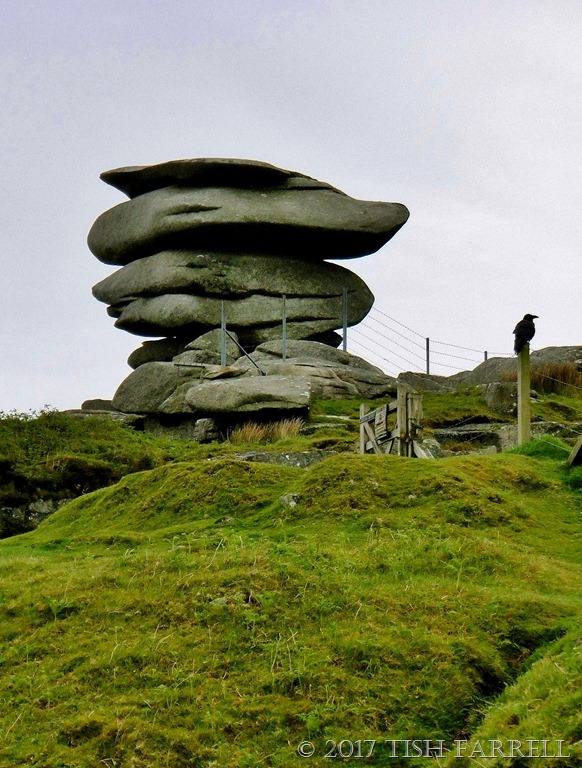
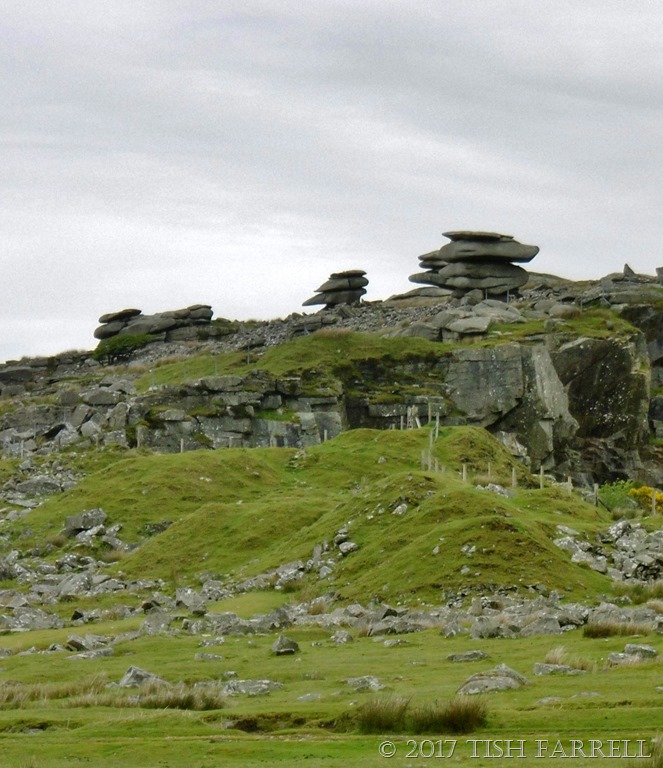
Looking southwest from the Cheesewring this is what you see on the skyline beyond the quarry: a series of round barrows:
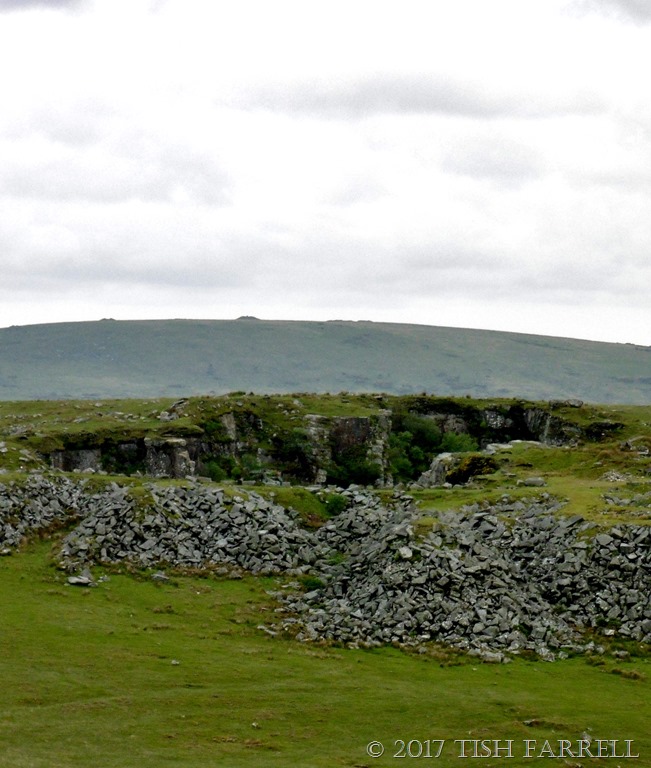
But sometime around 2000 years BCE, the climate began to deteriorate and humanity moved to settle more low-lying areas. It is an interesting irony that the combination of human action and natural climate change which rendered the abandoned uplands unsuitable for anything other than grazing, thereby led to the survival of so many of the prehistoric remains.
Farming, though, is not the only agency of landscape change in this area. Shunt forward to the mid-nineteenth century and you will spot the evidence for quite a new kind of invasion. There’s a clue in that first photo of The Hurlers. Here’s another glimpse:
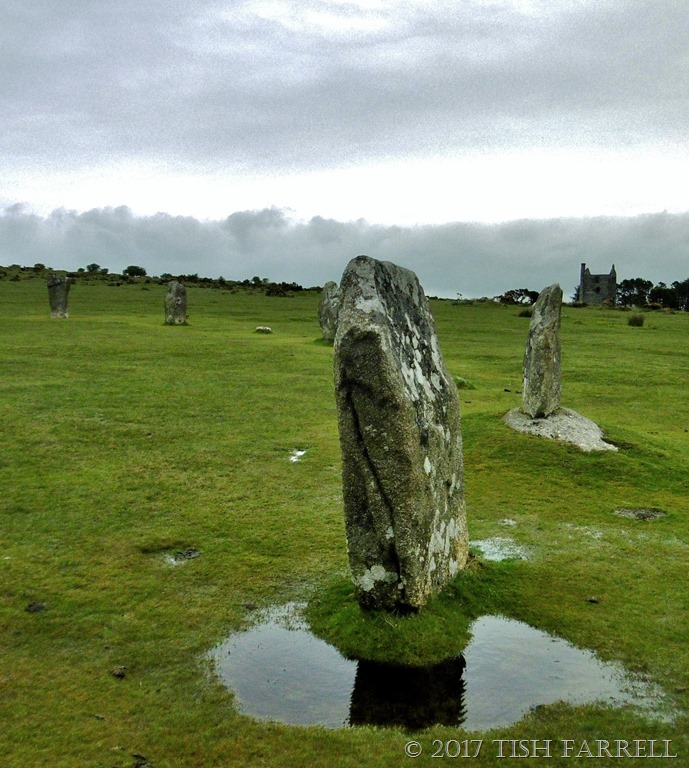
And closer still:
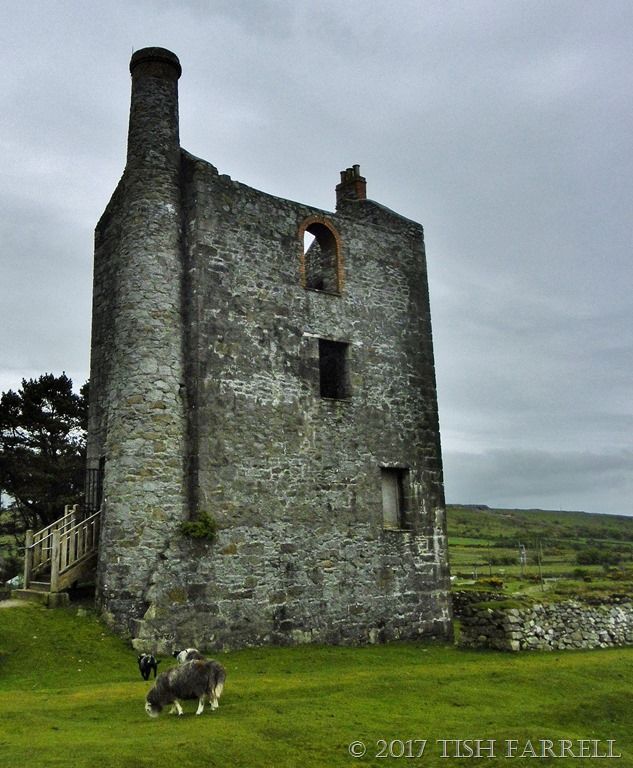
This is the Houseman’s engine house, part of South Phoenix Mine, now partially restored as the Minions Heritage Centre. It one of many such mines in the locality, their ruins as dramatic in their way as the stone circles and tors. For fifty years, between the 1840s-1890s, Minions was the centre of a booming copper mining industry. Over 3,000 people were employed here, including women and children.
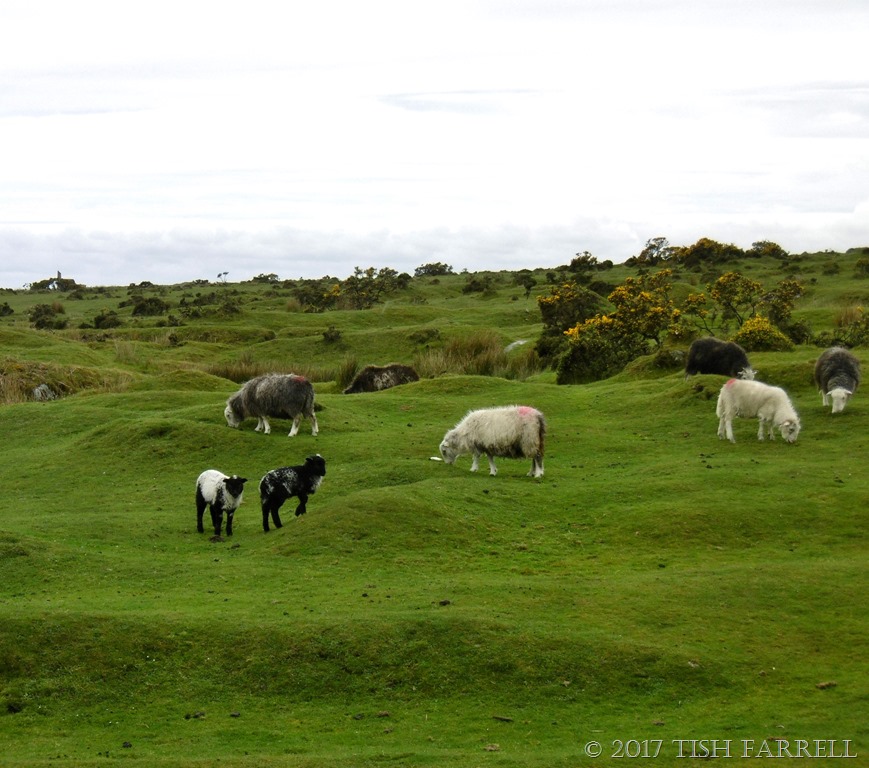
Hundreds and thousands of tons of copper ore was extracted, and exported down to Liskeard and the coast at Looe by means of the ‘Cheesewring Railway’ otherwise known as the Liskeard & Caradon Railway. It was opened in 1844, operated initially by gravity and horsepower, and also carried granite and tin. You can just see part of the granite quarry below the Cheesewring tor. Other signs of Minions’ industrial heyday of miners, quarrymen and railway workers are the humps and bumps of abandoned spoil heaps. The nearby settlement of Minions is also evidence of the industry – it grew up around the junction of several branch lines to house the influx of workers. It is the highest village in Cornwall, and today has a rather desolate air.
And now for another kind of heritage: legend. There are all sorts of stories connected with Bodmin’s man-made and natural features. I mentioned the origin of The Hurlers in the last post. The Cheesewring tor has also inspired all manner of explanations. One story tells how it was created by Giants and Saints at the time in the early Dark Ages when Christianity was spreading through the land.
The Giants, who were used to tramping about their domain, and doing just what they pleased, were fed up with the Christian Saints invading their land, putting up stone crosses, and declaring all the wells holy. They called a council to decide how to rid Cornwall of the nuisance.
And to this council there dared to come the frail St. Tue. He challenged Uther, the strongest of the Giants, to a trial of strength. They would have a rock hurling contest.
Rock hurling was one of the Giants’ favourite pursuits. Also, seeing the slightness of Saint Tue, the Giants were sure they would win.
Saint and Giant thus then took turns to throw six very large quoit shaped rocks across Craddock Moor and onto Stowes Hill, but to Uther’s surprise the little Saint soon proved a formidable opponent. By the time the Giant came to throw his last rock, his strength was failing. To the sounds of much Giantly groaning, his stone tumbled from the pile. Tue then went to make his final throw. The rock was huge, but just as it seemed that the task was beyond him, an angel appeared and placed the rock on top of the pile. The Giants were so overawed by the sight of angel wings casting their golden glow about the place, they conceded to the Saints, and by this means Cornwall became a Christian land.
Another yarn has it that if you visit the Cheesewring at sunrise, you will see the top stone turn three times. This is more up my street myth-wise, and I truly would like to be there at dawn to see what happens, and also to hear the wind on the stones making them resound and mutter.
copyright 2017 Tish Farrell
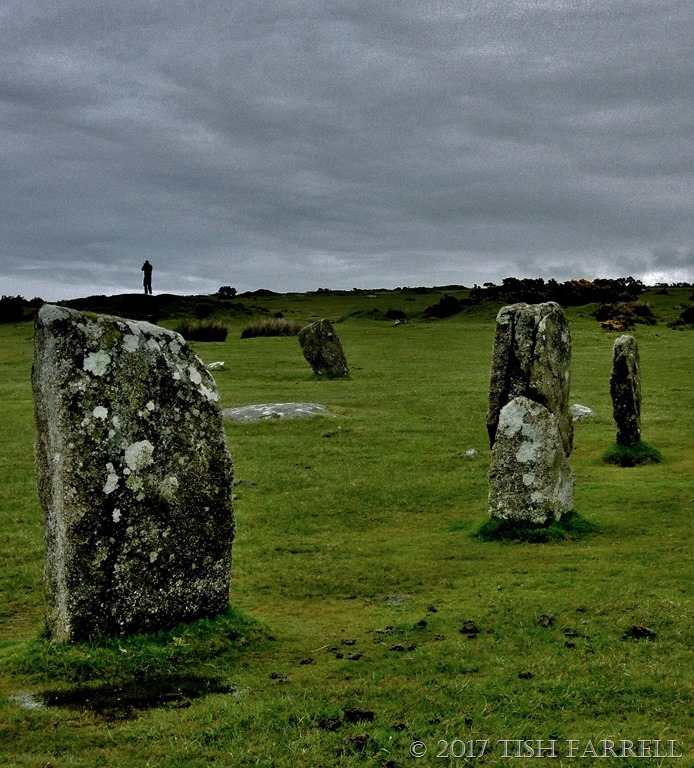
We were spending a few days in south-east Cornwall last week and, in between downpours, we managed a trip up to Bodmin Moor to visit The Hurlers. This unique prehistoric site comprises three stone circles set out in a row, and dating from the Late Neolithic or Early Bronze Age. This would make them around 4,000 years old. It is impossible to capture the full complex without aid of hot air balloon or hang glider, so here are some piecemeal shots. Also the light, as you can see, was pretty poor.
The local explanation for the origin of these stones is that they are petrified men – turned to stone in punishment for playing hurling on a Sunday. (Cornish hurling is an ancient team game played with a silver ball. See the link for more details. And no, I don’t think that is an ancient hurler on the skyline).
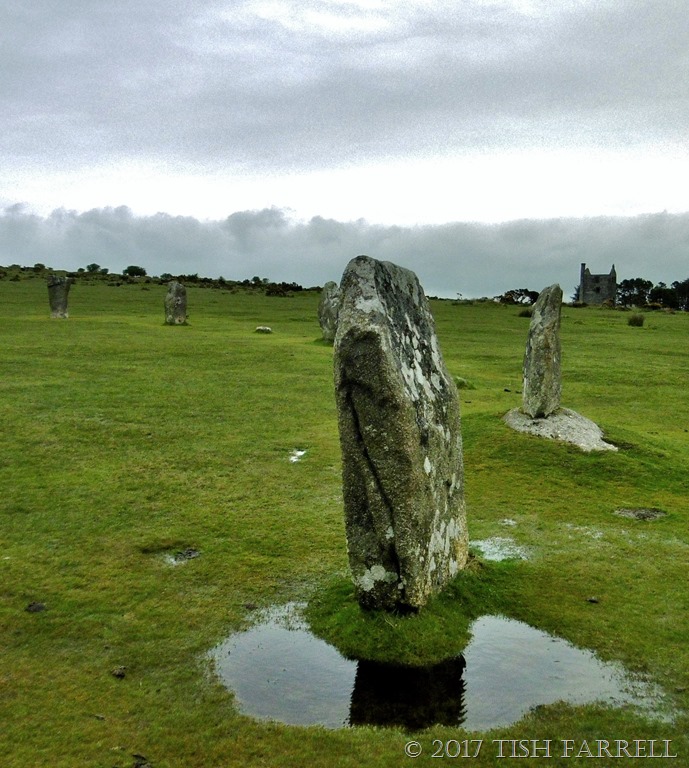
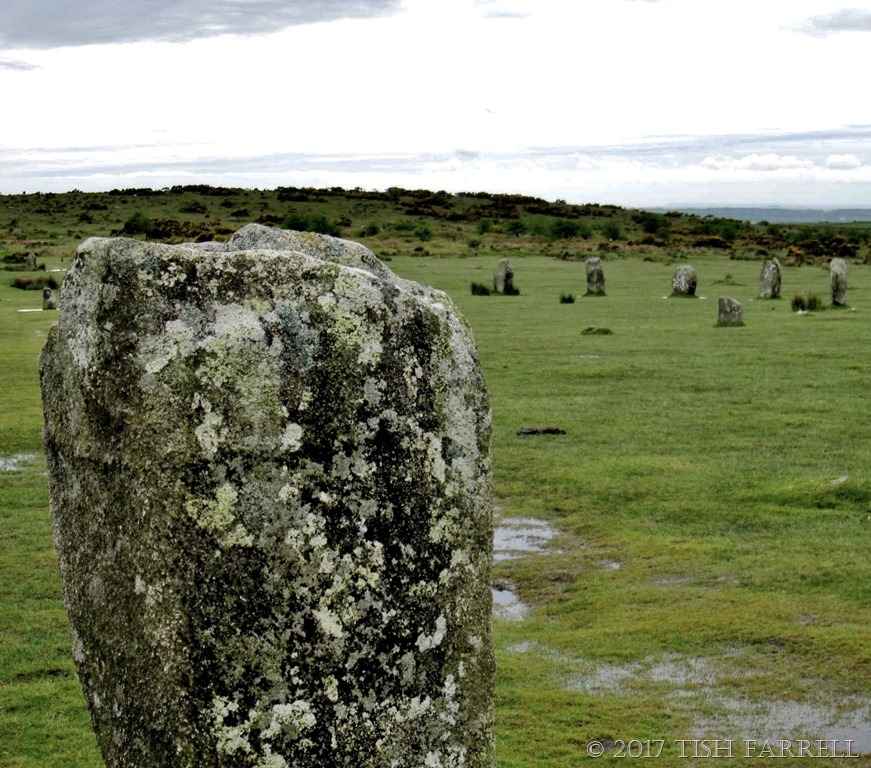
The circles are 33, 42 and 35 metres in diameter (108, 138 and 115 feet respectively), and none have all their stones intact. The central circle is the best preserved with 14 standing stones and 14 marker stones. This circle and the one to the north of it align with the huge Bronze Age Rillaton Barrow, visible on the skyline to the north-east. It was here that one of the British Museum’s most precious treasures, the Rillaton Gold Cup was discovered during excavations in 1837. At that time it was passed as treasure trove to King William IV and so remained in the royal household. It was only a hundred years later, after the death of George V in 1936 that its full historical significance was recognised. HRH had apparently been using it as a receptacle for his shirt and collar studs.
![779px-Rillaton_Cup[1]](https://tishfarrell.com/wp-content/uploads/2017/05/779px-rillaton_cup1.jpg "779px-Rillaton_Cup[1]")
Photo: Creative Commons Rillaton Gold Cup circa 1700 BC
Thursdays’ Special: Traces of the Past – Please visit Paula to see her dramatic view of San Geremia church in Venice, plus other bloggers’ posts of relics of times past.
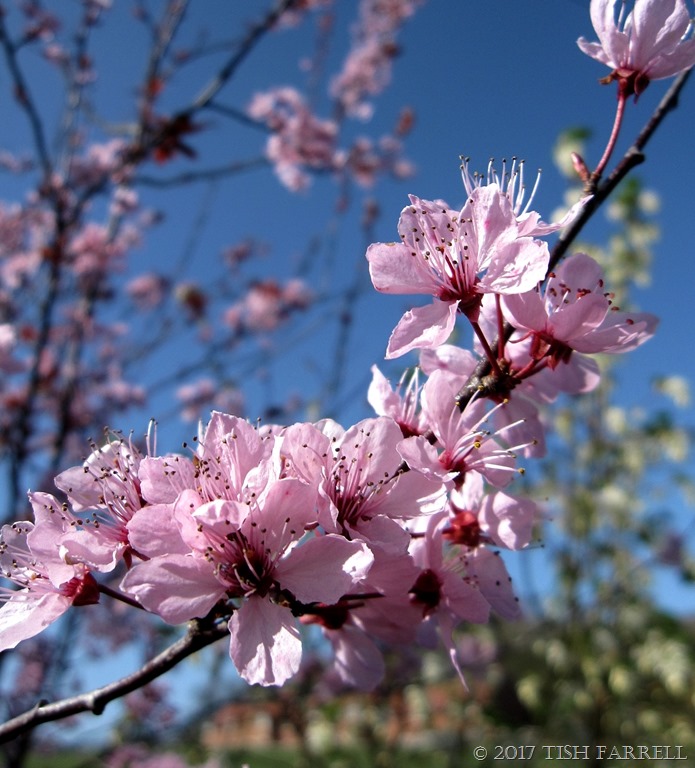
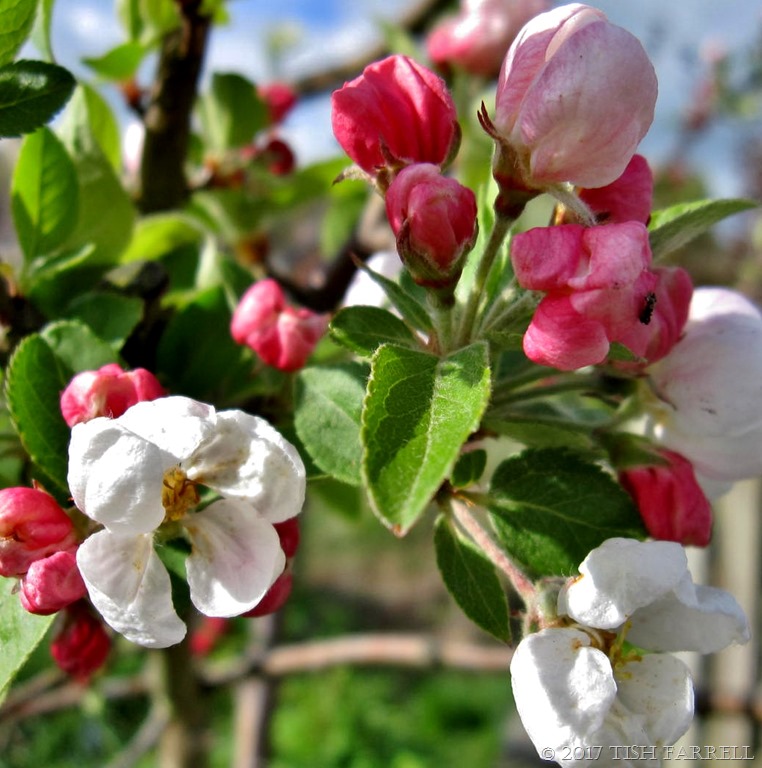
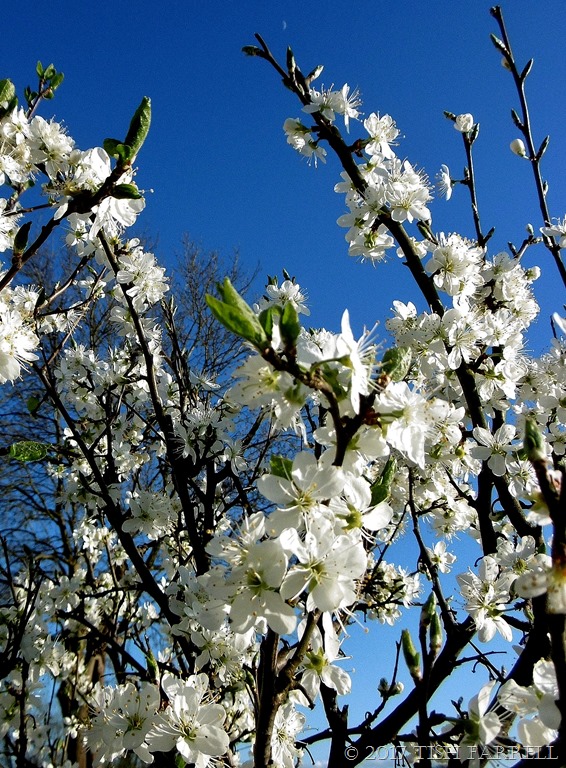
This week at Lost in Translation Paula’s theme is ‘vernal’ and she is calling for our spring compositions. So here are a few scenes from my Wenlock garden. Things have been a bit slow this year because we’ve had no rain for weeks and weeks. But today we did – and the garden has come alive with aquilegias and alliums. And I had no time to take photographs because I had a hundred other things to do. Hey ho. So the photos here were mostly taken back in March/early April: ornamental cherry, crab apple, and damson – the flowers of fruit to come.

She is most usually known by the Roman version of her name: Sabrina goddess of the River Severn. I told her story in the previous post, but thought this close up view fitted the bill for Paula’s ‘pick a word’ at this week’s Thursday’s Special. The five prompts are: confined, jazzy, patulous, momentous and serene. So I’m going for the first and last – Sabrina serene but confined to her plinth in a pool in Shrewbury’s Dingle.
It also seems she is confined in other ways too.
The statue was the work of Birmingham sculptor Peter Hollins (1800-1886), and made for Shropshire worthy, the Earl of Bradford in 1846. I thought she was carved from stone, but a little googling reveals that the Public Monuments and Sculpture Association National Recording Project ( who knew of such a body?) thinks she may be cast in some sort of metal and then covered with plaster. They also say she is afflicted with a biological growth – so that has ‘patulous’ covered too, though they don’t say what it is. I’m wondering if it’s responsible for the vaguely luminous areas. Poor nymph.
The scarcely legible quotation underneath her comes from John Milton’s Comus , a mask in which Sabrina is one of the main characters. This work also has Shropshire connections having had its premier showing at Ludlow Castle in 1634, presented before another worthy, ‘the Earl of Bridgewater, then President of Wales.’
Sabrina fair,
listen where thou art sitting
under the glassie, cool, translucent wave,
in twisted braids of lilies knitting
the loose train of thy amber-dropping hair;
listen for dear honour’s sake,
goddess of the silver lake,
listen and save.
And if you find these words far too gluey and overwrought, then here’s an edgier Sabrina yarn, though I must warn you – it does not end well. It was the Public Monuments entry that put me on to it. It begins with a church spire – specifically the one atop St Mary’s Church in Shrewsbury and also one of the tallest spires in England. This church has graced the town’s skyline for over 500 years, although parts of it are far older than this, dating back to Saxon times c AD 960. Also some of its stones were apparently cut by Roman masons, and carted in from the abandoned Roman city of Wroxeter some miles away.

I think you might call the spire momentous – even before we get to what happens next. It is over 200 feet tall.
Enter one Robert Cadman, steeplejack and mender of weather cocks. It is the winter of 1739, time of the Great Frost, and Cadman has been employed to put right St. Mary’s weather cock that has been blown askew. He duly does the job, but he has further plans for the church spire. For Robert Cadman is also a stuntman and, for his daring descent from the cupola of London’s St Paul’s cathedral, blowing a trumpet while sliding down a rope, he has already earned the nickname ‘Icarus of the Rope’.
He has handbills printed and spread about the town:
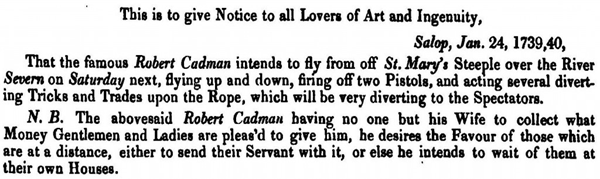
The History and Antiquities of Shrewsbury From Its First Foundation to the Present Time, Comprising a Recital of Occurrences and Remarkable Events, for Above Twelve Hundred Years, Volume 1, 1837
*
The River Severn is frozen solid, and so the Great Frost becomes an occasion for fun and festivities. An engraving of the time shows skaters and people playing table tennis out on the frozen river; there are tents; there are sheep being roasted; several of the great Severn trow sailing barges are ice-bound; there’s even a printing press out there too. All in all, then, Sabrina is providing the perfect arena for the spectacle Cadman has planned.
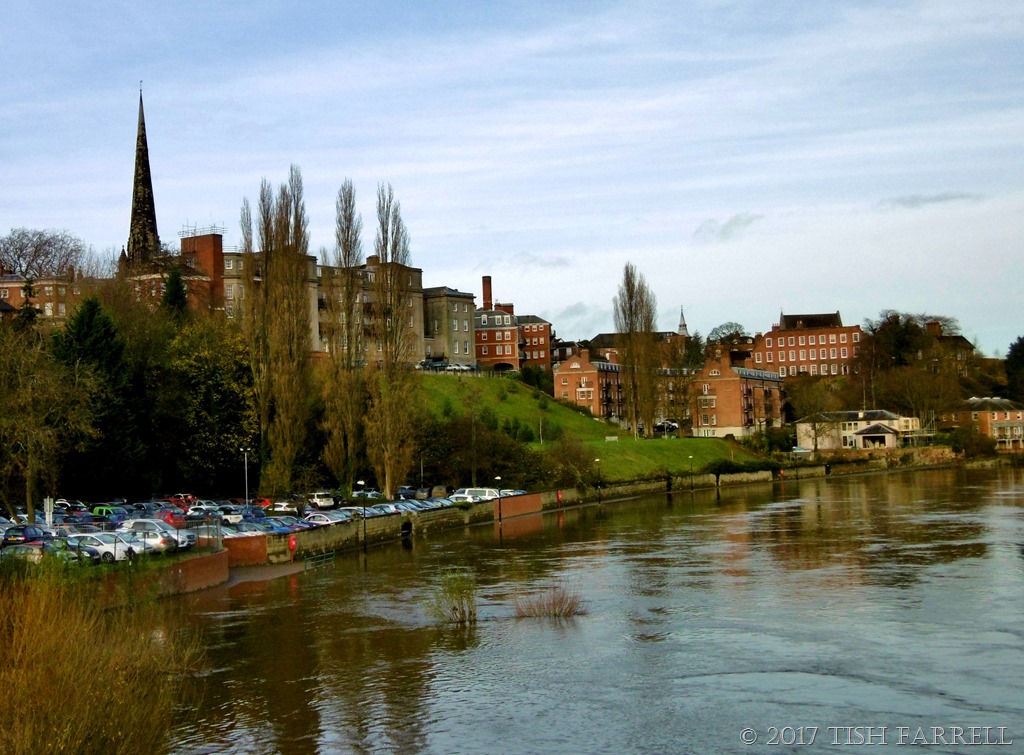
He attaches an 800 foot rope (240 metres) through a window on St. Mary’s spire. The other end is anchored across the river at Gay Meadow – (well out of shot on the right of the next photo). The show begins with Cadman’s walk up the rope towards the spire:
His usual act is to ascend bare-chested, performing all kinds of stunts as he goes. When he performed in Derby this walk took around an hour. The return descent, or flight as it was termed then (since there was apparently quite a yen for this kind of flying in the early 18th century), would be swift. For this part of the act our intrepid performer puts on a wooden breastplate which has a groove cut down the middle. He then lies on the rope and hurtles down, headfirst, blowing a trumpet, and accompanied by a stream of smoke as his breastplate burns with the friction of the rope. Whew!
But on this day, when Cadman reaches the spire, he decides the rope is too tight and signals across the river for it to be loosened. There is a misunderstanding. The rope is tightened, and half-way down, the rope snaps – whipping up in horrible coils as Cadman hits the iron-hard ground, his body apparently rebounding several feet in the air. Accounts have it that Cadman’s wife, who has been moving among the crowd of spectators collecting money, runs stricken to his corpse, throwing away the money as she goes.
Robert Cadman was buried at the foot of the spire and the sorry tale is commemorated in a plaque by the main door of St Mary’s church:
Let this small Monument record the name
of Cadman, and to future time proclaim
How by’n attempt to fly from this high spire
across the Sabrine stream he did acquire
His fatal end. ‘Twas not for want of skill
Or courage to perform the task he fell,
No, no, a faulty Cord being drawn too tight
Harried his Soul on high to take her flight
Which bid the Body here beneath good Night
Feb.ry 2nd 1739 aged 28
*
And now just to restore some sense of serenity, here are some shots of St. Mary’s interior. The church is now redundant, but it does have a very good cafe. It also contains some wonderfully ancient stained glass windows. The final image of the set is the Jesse window above the altar and dates from between 1330 and 1350.
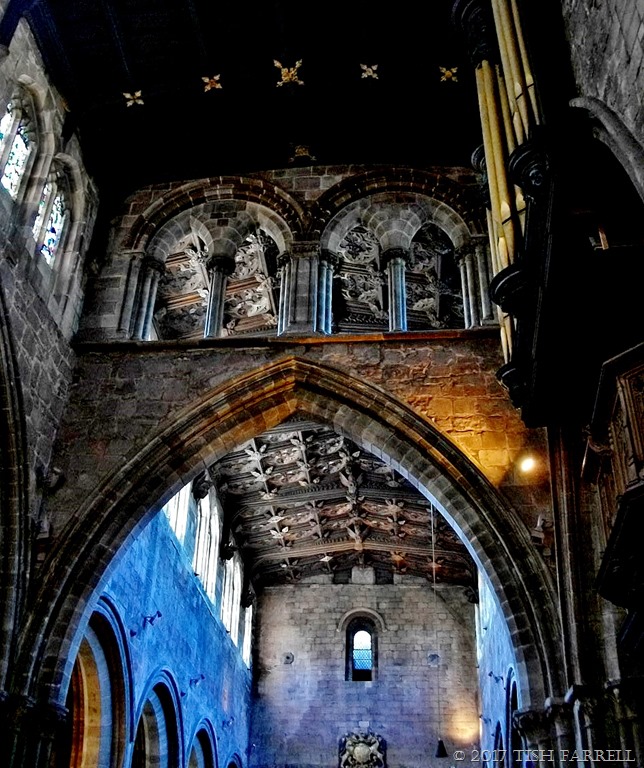

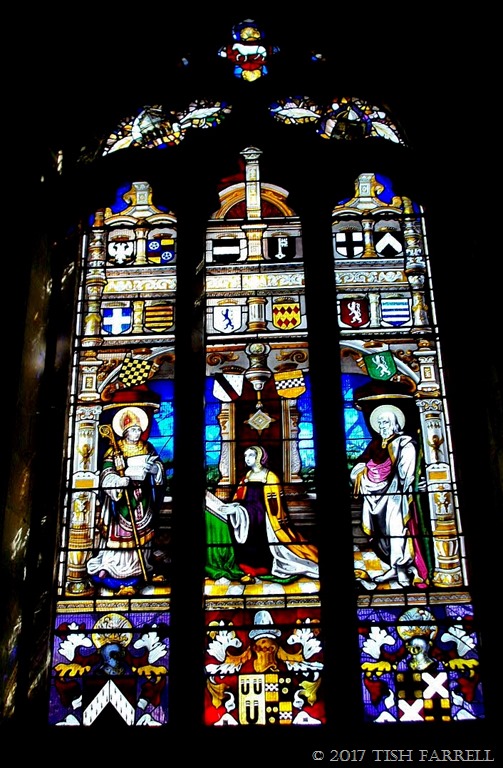
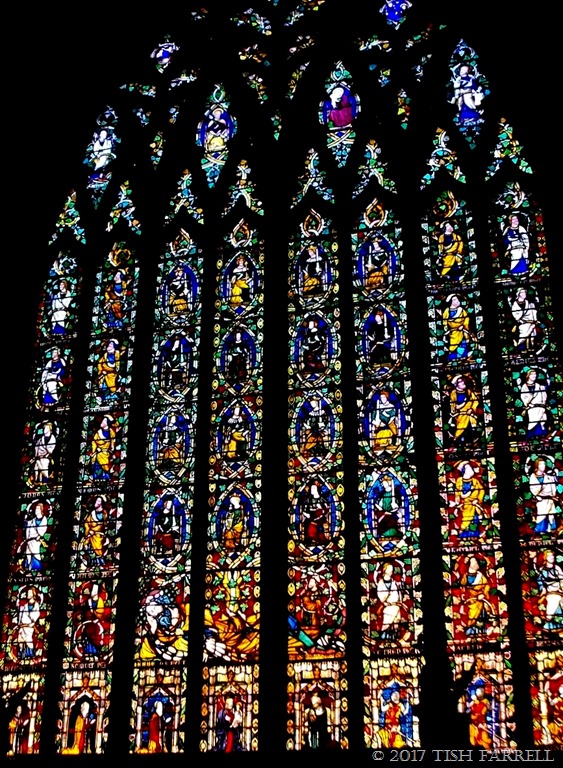
copyright 2017 Tish Farrell
Nor was it the kind of day when one might expect any of these things to cross one’s path. Truth was I was in a bit of a stew on Saturday morning. He who dismantles wooden builder’s pallets and shares my house was off to Shrewsbury on a half-day’s book-binding course. I thought this very excellent. It always makes a good change putting things together rather than taking other things apart (otherwise known as pallet scrattling, although I should add that some of the scrattled pallets have been recycled into various sizes of book press and spine stitching frames so, unlikely as it sounds, there is congruence between the two activities).
The reason I was in a bit of a stew was because I had decided that, since he was headed for the big bad town, albeit to the suburbs, he could drop me off somewhere near the centre for a few hours’ shopping. The source of my concern was that scrattling and binding skills do not necessarily add up to a navigational facility. I was thus at pains to devise routes that could be followed in my absence. And no, we do not have Sat Nav. And yes, I think it’s time we did.
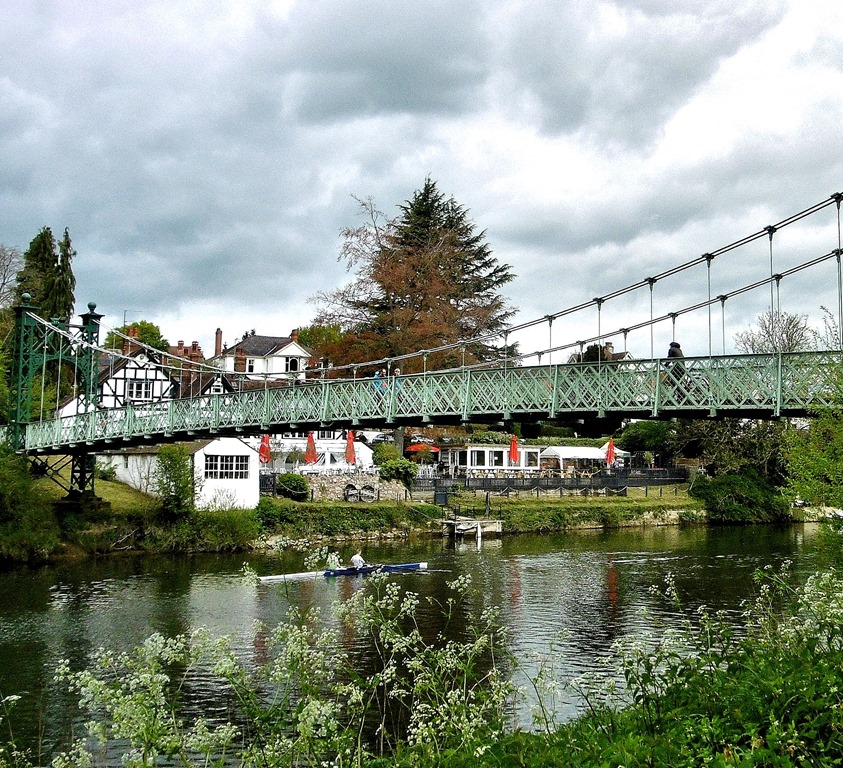
Except, if it had not been for my overanxious machinations, which made for a simple non-deviating route for him, and a long walk for me, I would not have opted to be dropped off by the Porthill Bridge, one of the town’s several Victorian suspension bridges (Shrewsbury is on a hill within a loop of the River Severn), and I would not have had all these unexpected encounters in Shrewsbury Quarry, otherwise known as the town park.
Here’s the footbridge. It’s rather fine, apart from the earth-tremor sensation when you reach the middle:
*
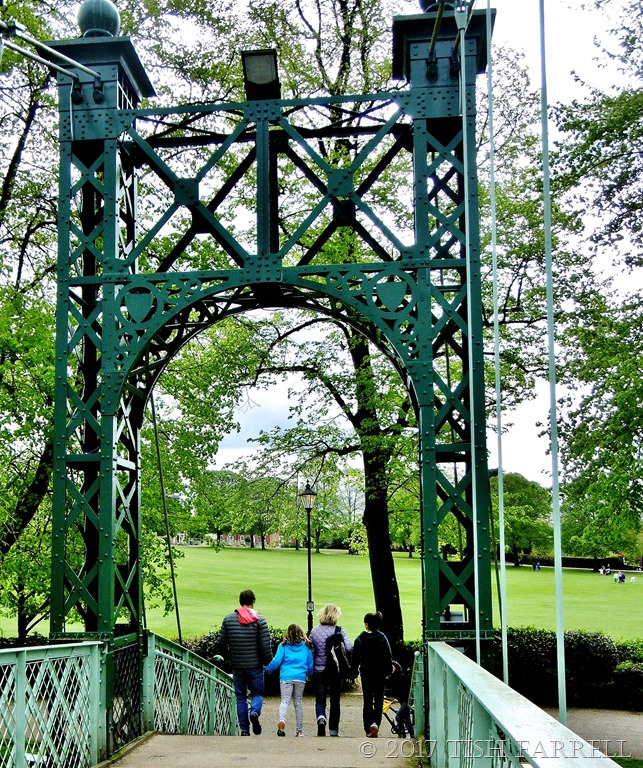
And here’s the first glimpse of The Quarry once you’ve recovered from vertigo:
*
And another view looking towards the river, complete with Victorian bandstand:
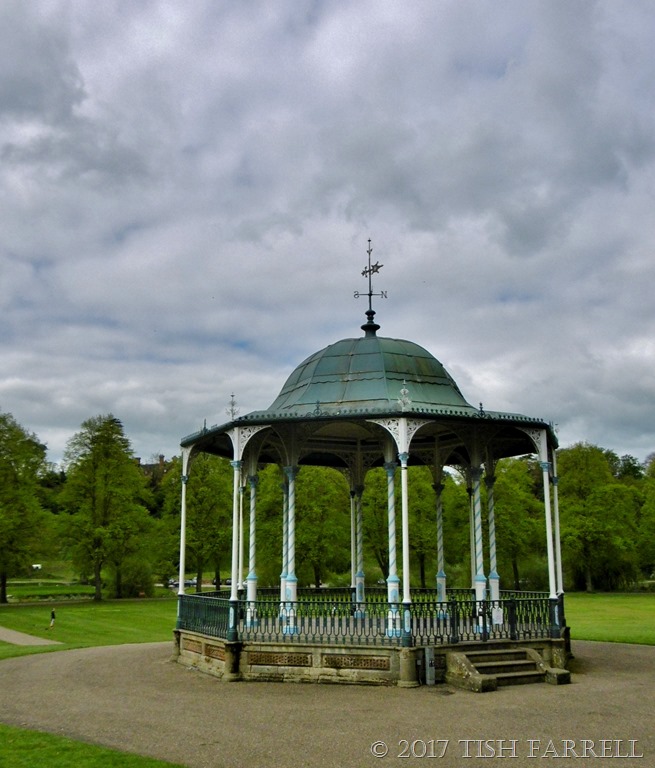
As you can see the park is mostly swathes of grass crisscrossed by pleasing avenues. The riverside walk is the nicest, and enables you to access one end of the town from the other without meeting a car, though watch out for the bicycles. For two days in August (this year the 11th and 12th), Shrewsbury Flower Show covers the whole park. In fact it is quite a legend – the world’s longest running flower show. It has its origins in the medieval guildsmen’s annual celebrations – more of which in a moment.
For now please conjure tents, pavilions and marquees, a floral riot of three million blooms, some astonishing displays of vegetables, the bandstand bursting with serial military bands, and each day topped off with a stupendous firework display.
Uphill from the bandstand is one of several gateways into the Dingle as mentioned in the last post. This submerged garden with its small ornamental lake was made from an abandoned stone quarry back in Victorian times, but today’s planting very much celebrates the life and times of Percy Thrower, Britain’s first TV gardener who was Superintendent of Shrewsbury Parks 1946-1974.
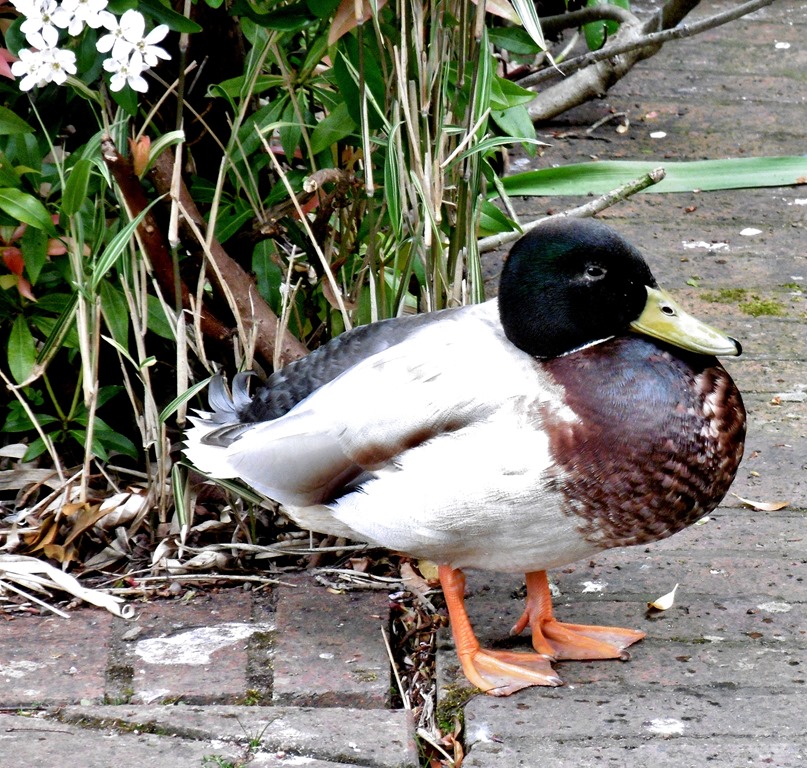
I only went in there by chance. I’d walked across the park to take a photograph of the bandstand and, by the time I’d done that, I’d rather forgotten about going shopping. Then I began to notice a gathering of chaps all clad in dark coloured anoraks. They were down by the Dingle pool and armed with photographic lenses as big as rocket launchers. There was air of enthusiast-expectation – as in train-spotters waiting for the Flying Scotsman to steam by. Twitchers, I thought: they who pursue rare breeds of birds to add to their list of rare birds already spotted. I looked from lenses to ornamental pool and back again. They clearly hadn’t lugged in all that kit to snap the Dingle ducks. They could leave that to me:
I stared at the island in the pool, the spot on which every lens was trained. All I could see was part of a white-grey undercarriage of what appeared to be a largish bird. It was standing very still, most of it hidden in a rhododendron. My first thought, bizarrely, was ‘penguin’ and for a daft few moments I wondered how a penguin could possibly have arrived in Shropshire. Climate change? Surely not.
Then I began to feel a touch offended on behalf of the putative penguin, and with all the peering that was going on. I decided I would not ask the twitchers what they were waiting to see, but do a circuit around the pool and see if whatever it was would reveal itself on my return. That seemed more fair, less paparazzi-like. And if it didn’t appear so be it. Poof. Talk about taking moral high ground.
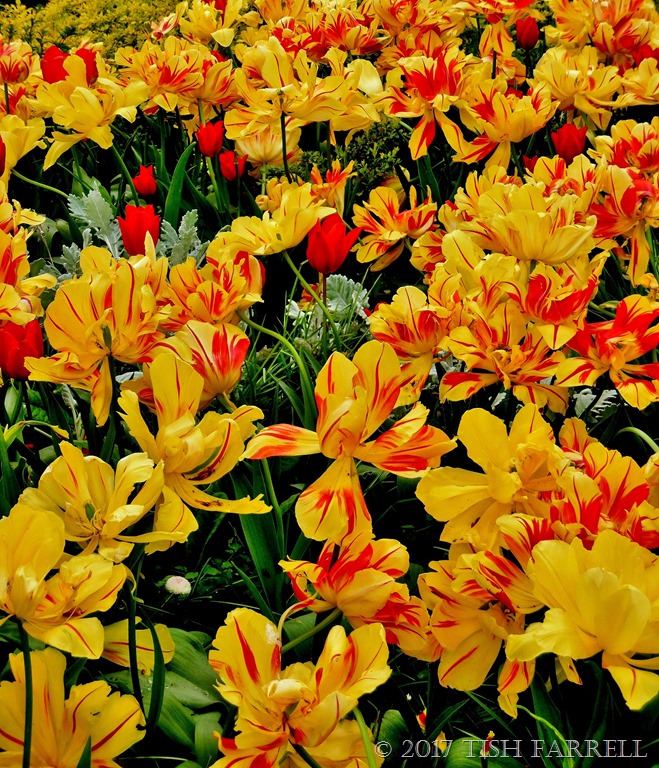
Next it was the tulips that caught my eye, as in the previous post, but you can see them again:
*
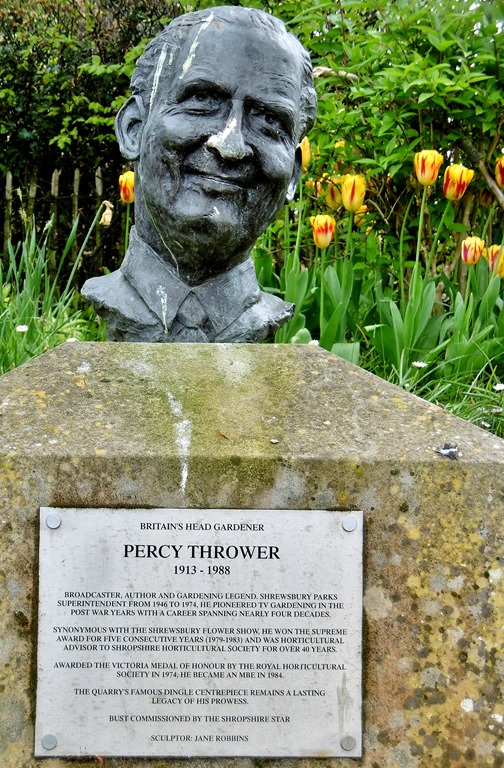
And then I said hello to Percy Thrower, and wished I had a bucket of soapy water to give his face a good wash: dirty birds!
*
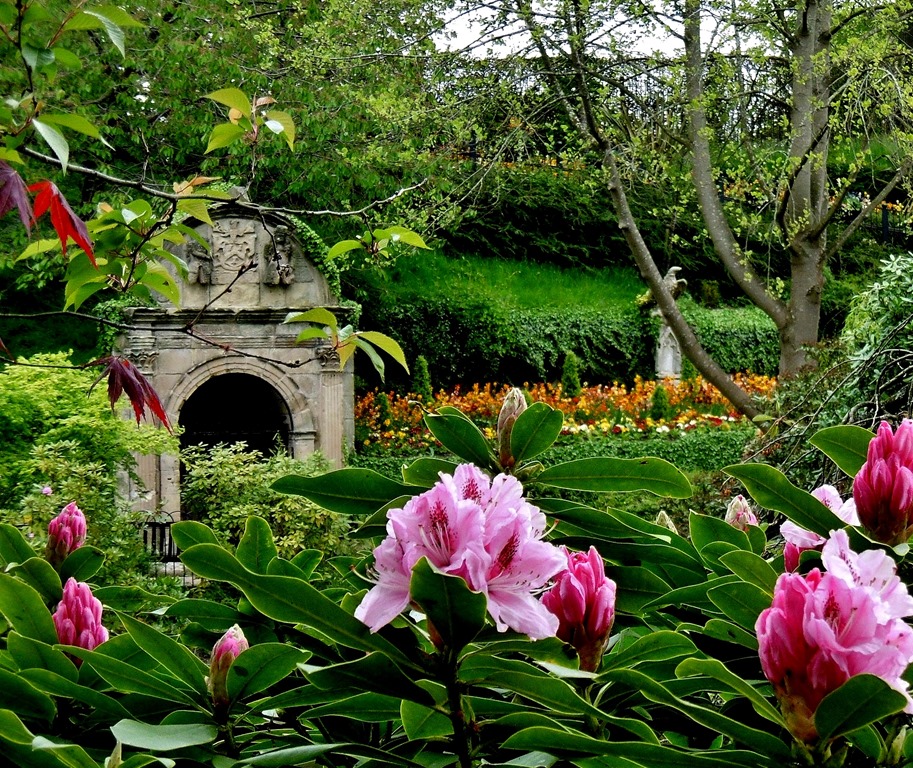
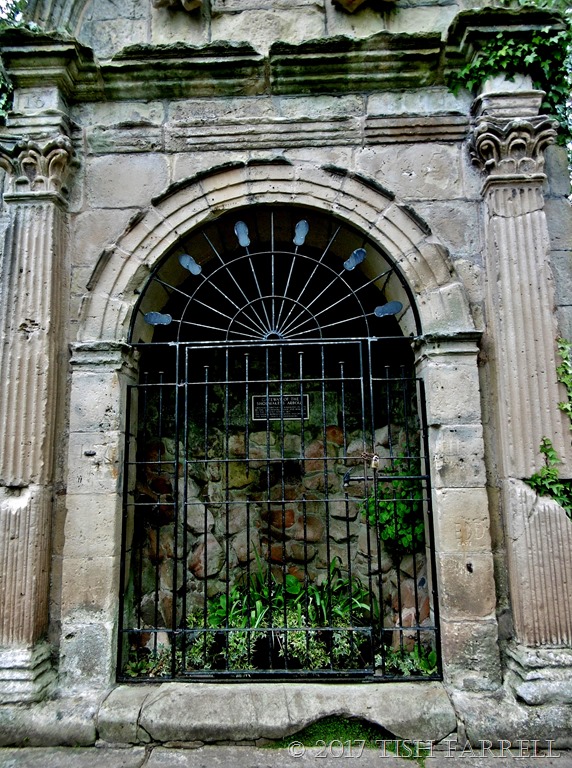
And next I wandered round to the Shoemakers’ Arbour, a place that used to intrigue me as a child. No adult back then seemed able to explain exactly what it was. The plaque on the wall of the structure says that, what looks like a piece of romantically contrived garden architecture, was in fact the gateway to an arbour built by the Shrewsbury Guild of Shoemakers in 1679. It also tells me that it was originally sited across the river in Kingsland, but moved to the Dingle in 1877. There is no further explanation, though presumably the reason it was rescued was precisely because it made a nice piece of romantically contrived garden architecture.
*
On the pediment (see also the header photo) are the remnant images of Crispin and Crispian, the patron saints of shoemakers:
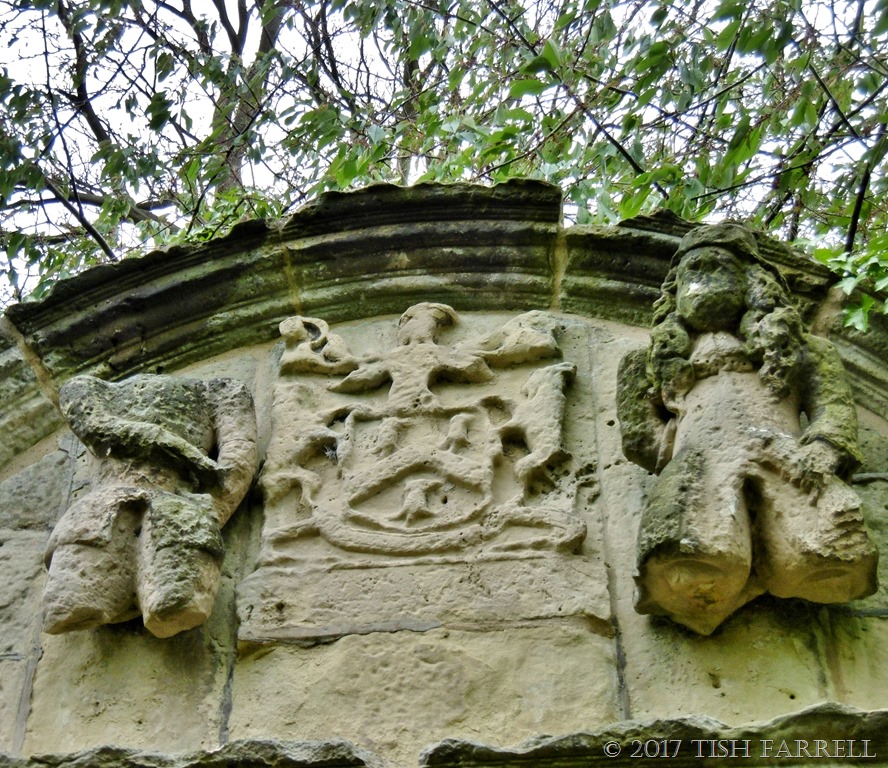
But what I wanted to know was – what was all this stuff about guilds and arbours, and what did shoemakers do inside them anyway – get well and truly cobbled?
Later, after a little delving, I discovered that celebration and jollification were indeed the purpose, and all part of the annual town celebrations, the very same that gave rise to the present day Shrewsbury Flower Show.
So the story is this.
Across the River Severn from the Quarry is a part of the town called Kingsland (now an enclave of grand Edwardian houses and Shrewsbury School). In the late middle ages it was common land administered by the town corporation. Here the town’s guilds would erect arbours for an annual gathering. In the early days these arbours were wooden framed pavilions, but by the 17th century the guilds were allowed to build permanent single storey structures – much in the style of medieval feasting halls. Each also had a cottage with a court and hedged garden.
On show day – always the second Monday after Trinity Sunday – and after the guilds had processed through the town, all would repair to their various arbours for much merrymaking. Here too each guild would entertain the mayor and his officers, and one imagines that the worthies may well have been legless by the time they had visited all eleven guild arbours.
The Shoemakers’ Arbour thus shared the ground with, among others, the guilds of bakers, tailors, carpenters, glovers, weavers and joiners. You can read more about medieval guilds here, but they were basically trade associations, or cartels formed by skilled artisans with the intention of guaranteeing craft standards and setting wages somewhat like a trade union.
Now that’s all sorted, back to my wander round the Dingle, and just in case you are now imagining a large rambling place, it truly only take five minutes to walk round if you don’t stop to look at things. Which makes it all the more odd that after I’d moved on from the saintly shoemakers I found myself in a part of the garden I did not remember. (How could that be? I spent so much of my youth in this place.) Anyway, I had taken a little off-shoot from the main path, and this brought me to a small pool. And here she was: Sabrina – the River Severn’s very own goddess:
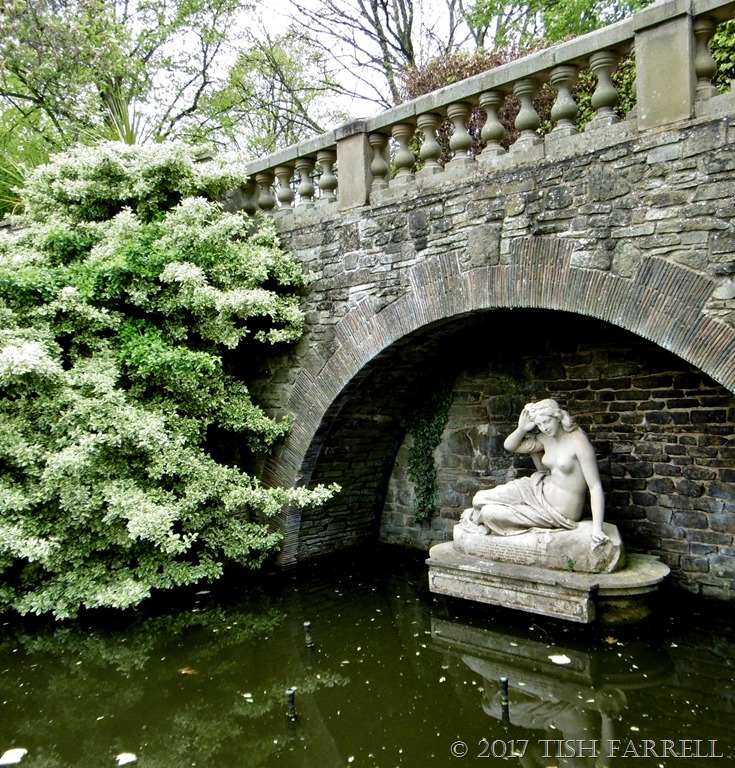
Sabrina is her Roman name, but the two main stories associated with her are of pre-Roman origin and told by 12th century historian Geoffrey of Monmouth. The Celtic tale tells of three sisters, water nymphs who meet on Plynlimon (Pumlumon in Welsh), the highest point of the Cambrian Mountains in mid-Wales. They each decide to pursue their own route to the sea. One sister wants to reach it as quickly as possible and sets off due west, so forming the Ystwyth River. The second sister prefers the rolling hill country, and wends her leisurely way, so becoming the Wye. And the third, Hafren, takes the longest route of all, 180 miles, and becomes the Severn. She wants to have a good look at all the fine towns and cities and stay close to the haunts of humankind.
Hafren is the Welsh name for the River Severn. A single ‘F’ is pronounced as ‘V’ in Welsh. She is the Welsh goddess of healing. And the other story about her is rather grim. It is very ancient, and tells of an early English king, Locrinus, who marches to the North England to fight off the invading Huns. Amongst his prisoners is a German girl, Estrildis, with whom he falls in love. But he is pledged to Gwendolen, and a king must keep his promises. Being king though, he also devises a way to keep Estrildis as his mistress, and for seven years hides her away from his queen in a subterranean dwelling. They have a child of course – Habren or Hafren.
And then Locrinus makes a big mistake, and runs off with his beloved. The enraged Gwendolen raises an army and marches against him. He is slaughtered and Estrildis and Hafren are ordered to be drowned in the Severn. In tribute, however, to the guiltless child, the queen orders that the river be named after her. So there we have her: Hafren, Severn, Sabrina.
The notions of her healing powers may go back to earliest Celtic times, since we know that water played an important part in the Celts’ spiritual thinking. The Romans too honoured watery places and often adopted the deities of the occupied peoples. You will find a more detailed and fascinating discussion of the myths and legends associated with the River Severn HERE
The statue was carved by Peter Hollins of Birmingham in 1846 and donated to the people of Shrewsbury by the Earl of Bradford in 1879.
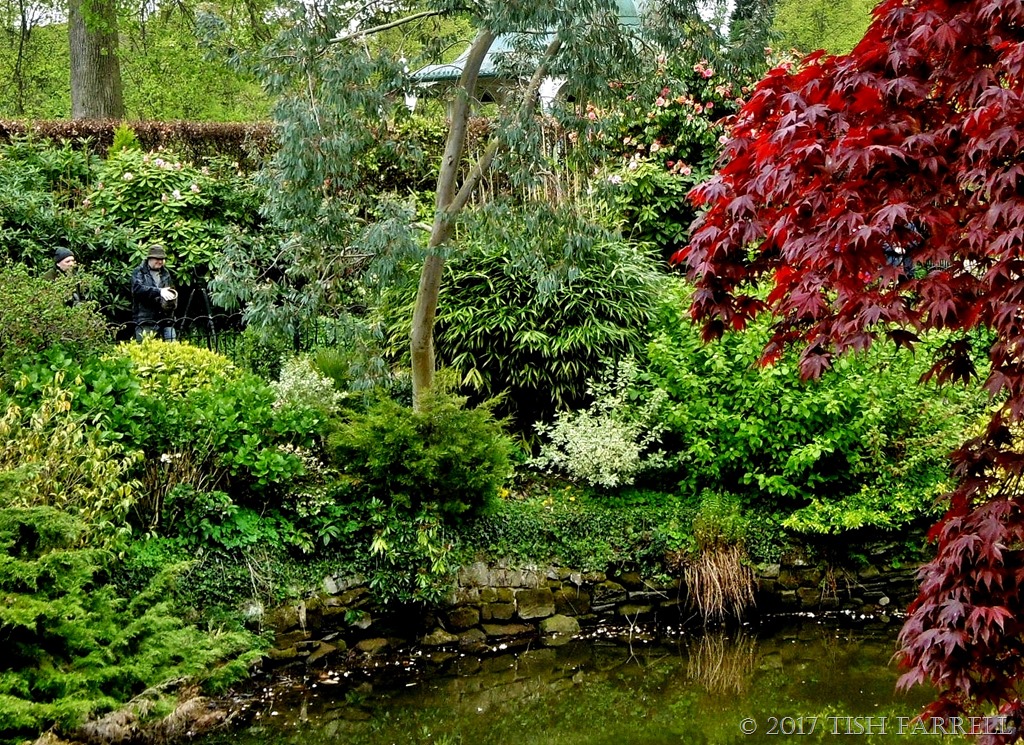
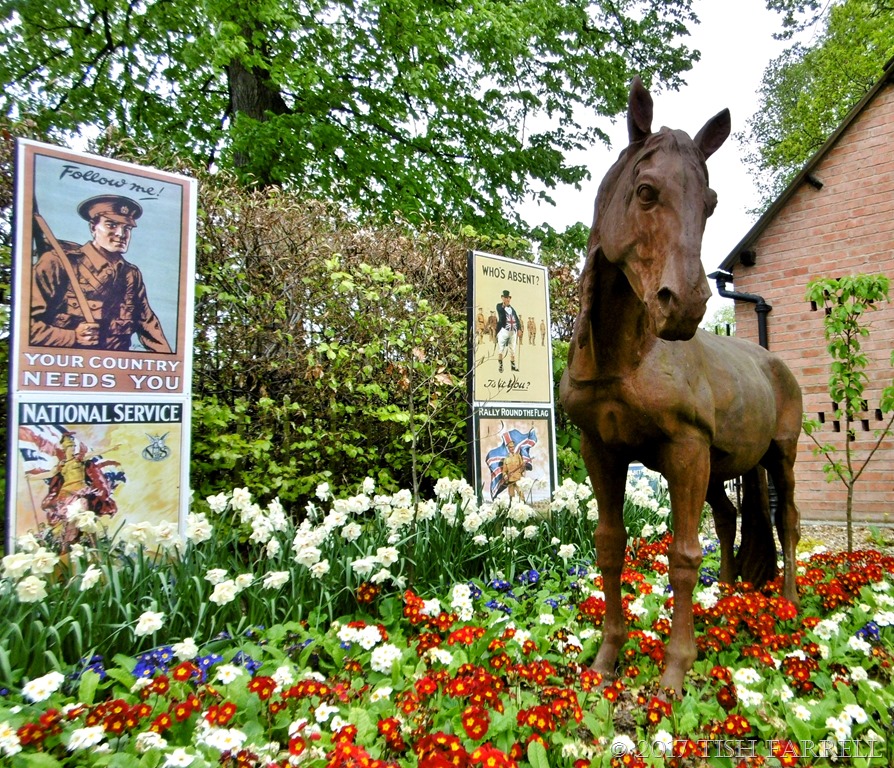
By now I’m back with the twitchers. Can you spot a couple of them? But there is still nothing happening on the penguin front and I am now diverted by a life-sized iron horse, and can’t think how I missed her on the way into the Dingle. There she is amongst the municipal rows of polyanthus, the town’s commemorative tribute to Flanders Field of the Great War, and of course to all the brave horses who served man and country.
But suddenly things are stirring behind me. The twitchers are all a flutter. Hey-up! I hear. The penguin must be on the move.
I’m disappointed though. I’m only armed with a little Lumix, so these next shots are pretty poor, though good enough to show that the penguin theory was indeed very silly.
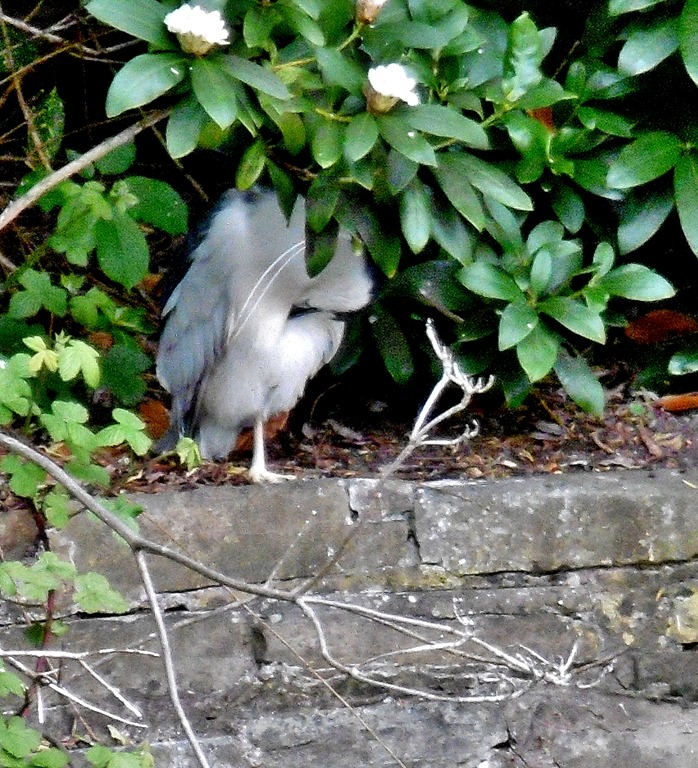
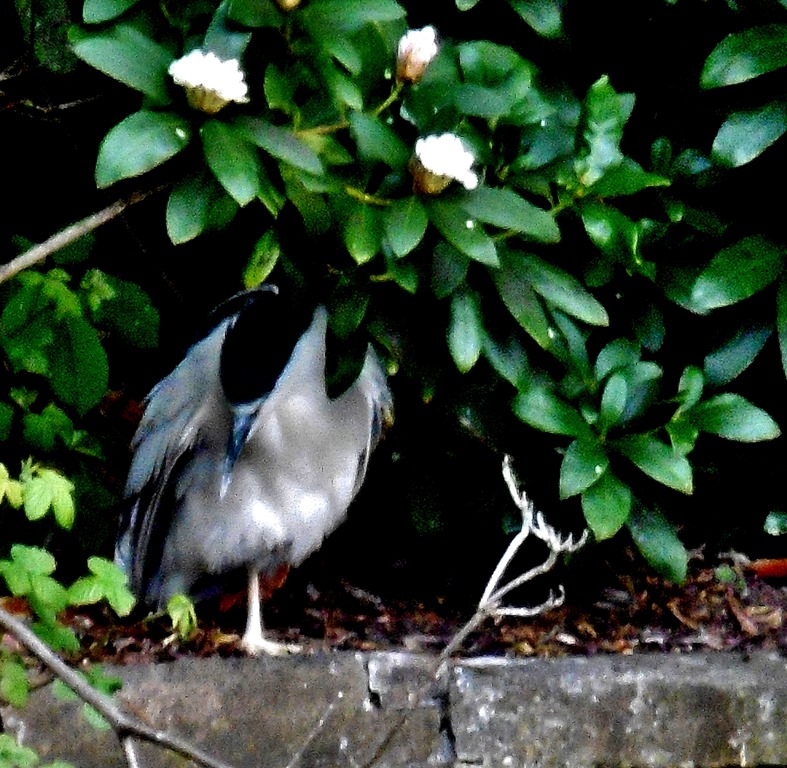
What we have here is Nycticorax nycticorax – a Night Heron, and indeed a most unusual visitor on UK shores. It is more usually found in warm, tropical regions and I think the first and last one I saw was at Hunter’s Lodge in Kenya. I didn’t wait to see if the penguin it was prepared to reveal itself fully. I decided the clue was in the name. The entry for Night Heron in my Field Guide to Birds of East Africa says: ‘Mainly nocturnal, keeping to dense waterside cover by day.’
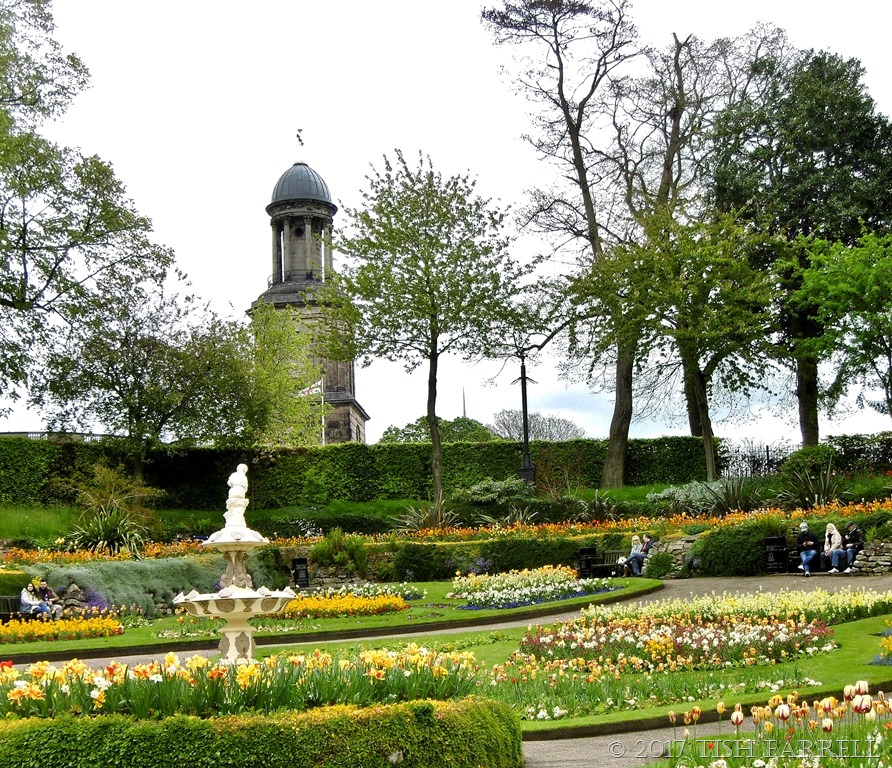
But at least the mystery is solved. I cut back across the Dingle, skirting around Percy’s ‘parks & gardens’ flower beds, the tower of St. Chad’s on my horizon:
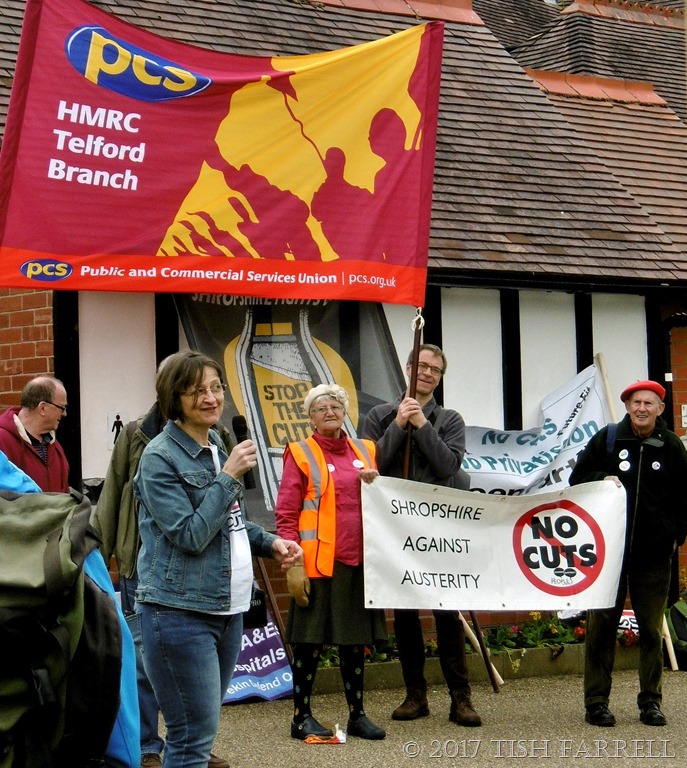
And out again in the Quarry, I next find myself joining in with an ‘Anti-Austerity’ – Labour Party Rally outside the Horticultural Society’s park lodge . Here are people who want to stop cuts to state schools that are lowering teaching standards and to protect all that is good about the National Health Service. I look around the assembled crowd. They look like decent people. Their words are sincere, heartfelt. I stick around and do some clapping. Shopping? What shopping?
copyright 2017 Tish Farrell
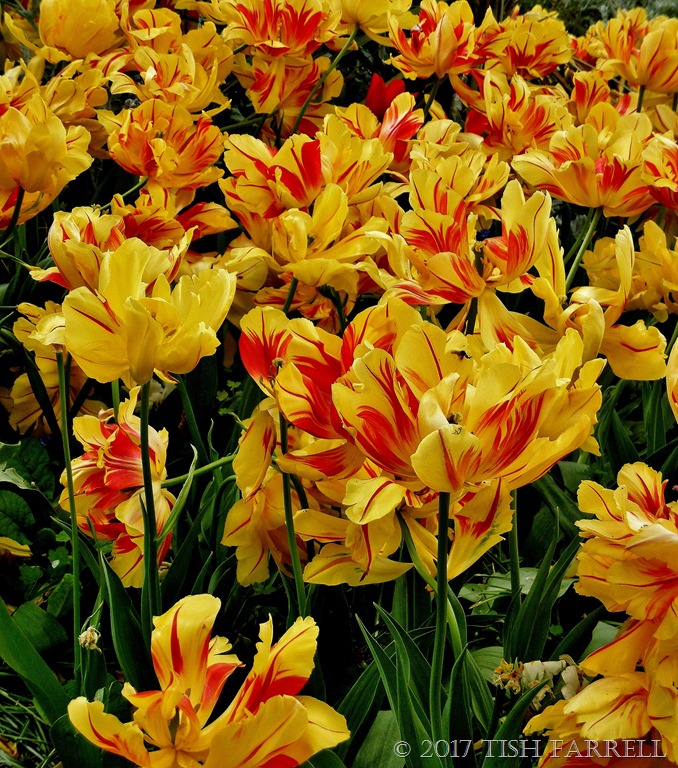
What show-offs – the lot of them. But what a joyous display and just at the moment when most of the other tulips are fading. I spotted these yesterday on a chance visit to The Dingle, in the Quarry, Shrewsbury town’s lovely riverside park. This place was a popular haunt in my teenage years – for meeting up with friends and for the covert smoking of cigarettes. (Naughty us, polluting the place with Consulate smoke).
The Dingle was made out of an old stone quarry, and in many ways is very much a municipal garden with its regimental planting of bulbs and bedding plants. The bosky-dell setting works its magic though, and there was certainly no denying the cheeriness of the colour-scape under yesterday’s gloomy sky. BTW that’s St. Chad’s church in the background – in case you’re wondering. It is notable for having the country’s largest circular nave. Also Charles Darwin was christened there in 1809. Less notably, my Priory Girls Grammar School, along with the Priory Boys, used to traipse here every November for our founder’s day service. It goes without saying that the most exciting thing about the event to us girls was BOYS.
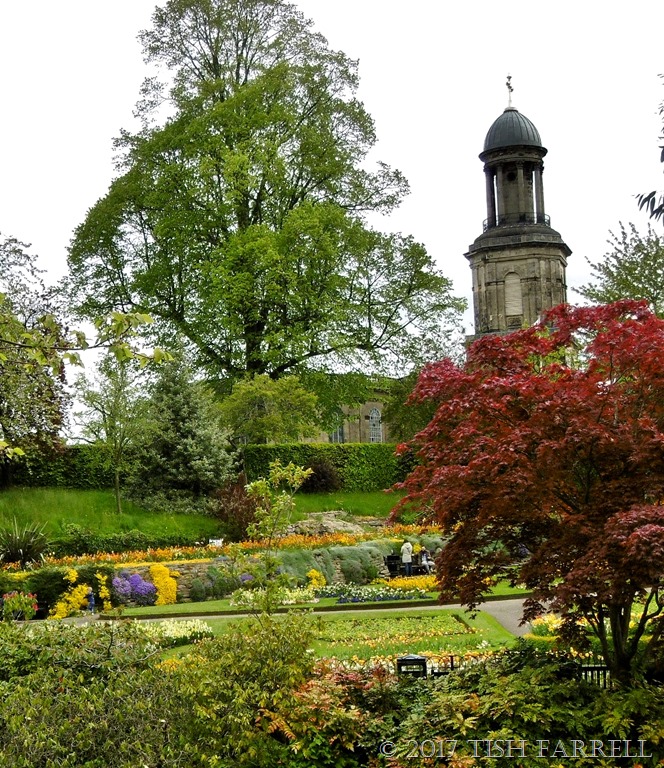
But back to the gardens.
The Dingle’s formal layout was created by Britain’s first TV celebrity gardener, Percy Thrower. He was Shrewsbury Parks Superintendent from 1946-1974 and very much associated with the famous annual Shrewsbury Flower Show which is still held in the Quarry every August. As a fifties child I remember watching Percy on the BBC. My father was a great admirer, so I followed suit and held Mr. Thrower in high regard even if I didn’t need the gardening advice. At that stage I was into growing oak trees from acorns, and he didn’t seem to cover that particular topic. Mostly I learned to associate gardening with kindliness and a genial practicality, qualities that the sculpture in the next photo captures too. I was touched to find him smiling out over his creation. And that his collar and tie were just as I remembered them.
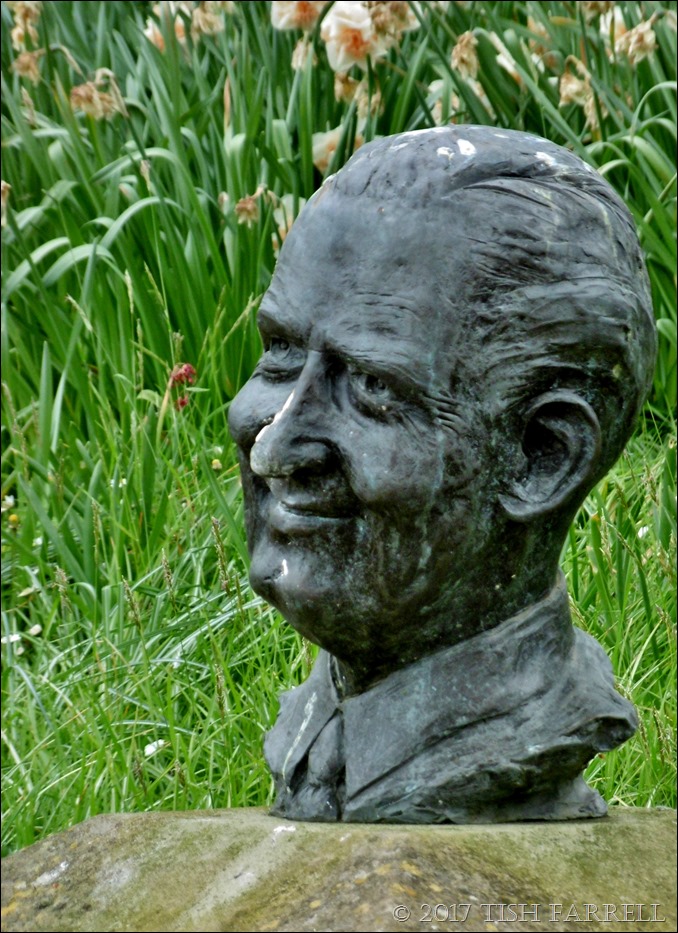
I think he would be pleased that there has been no attempt to veer from his original concept and ‘update’ the planting scheme. And although, in the main, this is not my style of gardening, I can still admire it. I could also see how much pleasure it was giving to people of all ages – a truly hidden haven since there is no view of the interior from the surrounding park. You have to step inside one of several gateways to ‘discover’ it.
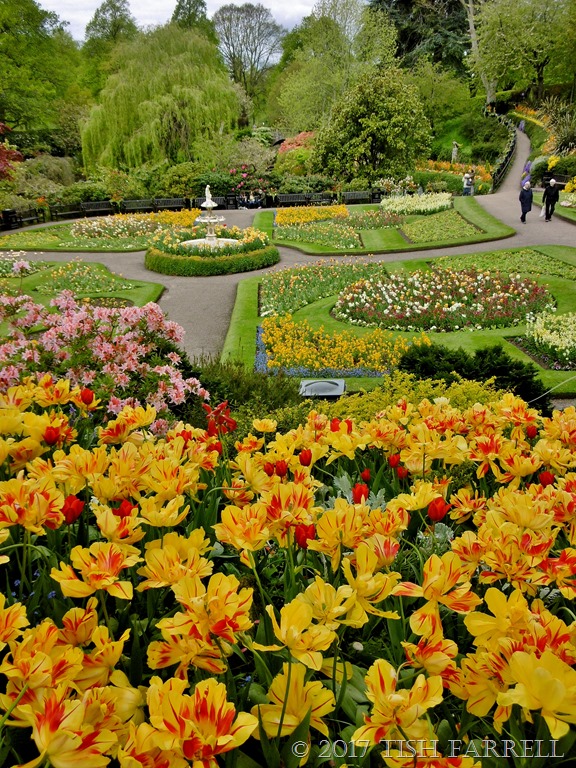
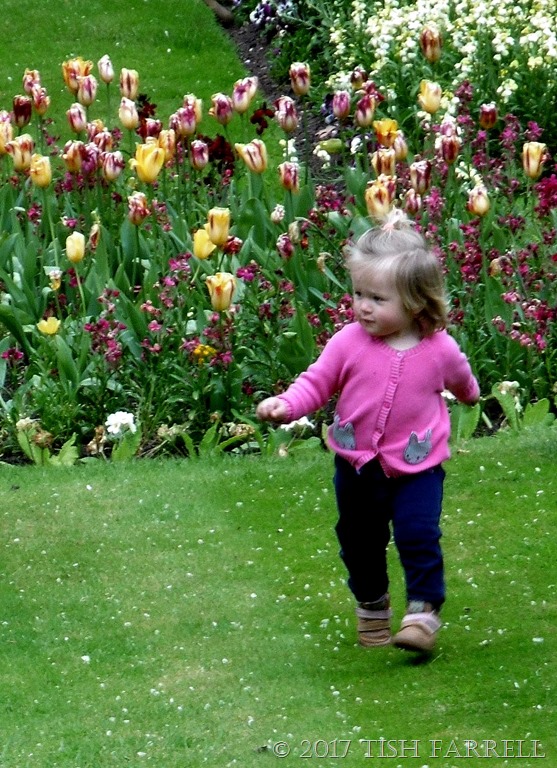
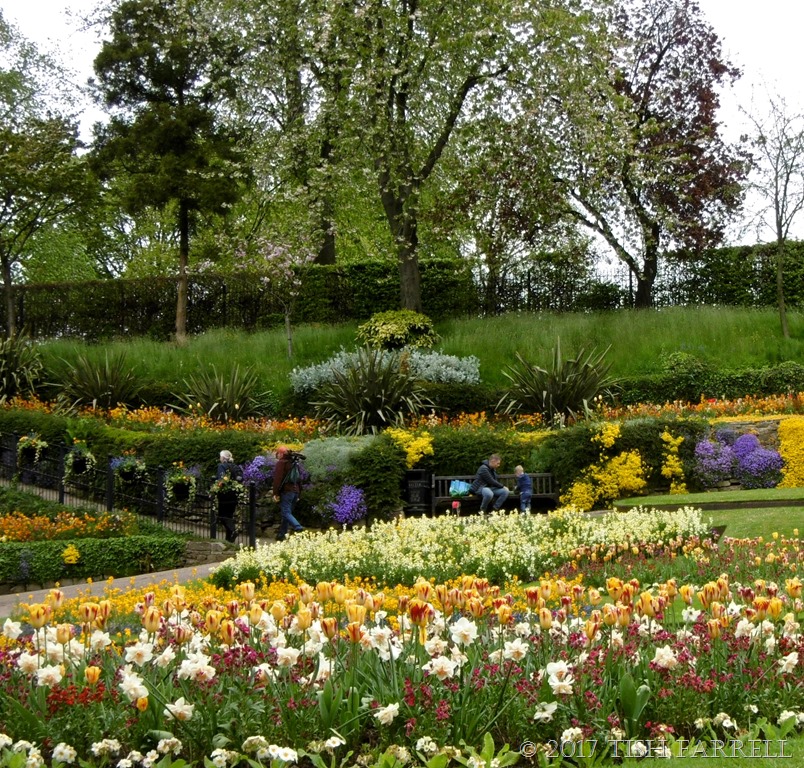
It makes me think: every person on the planet needs access to a garden – whether it be untouched wilderness, manicured parkland, cultivated arbour or even a window box. We need to keep in touch with the growing world that heals, soothes, inspires and nourishes us. Which also makes me think that good old Percy Thrower, who did so much to encourage everyone to garden and to appreciate plants was truly a bit of a hero. Please go and say hello to him if ever you are in Shrewsbury.
Jo’s Monday Walk If you haven’t yet joined Jo on one of her fabulous walks (and you never do know where she’ll be going next), then please put on your hiking boots and follow the link.
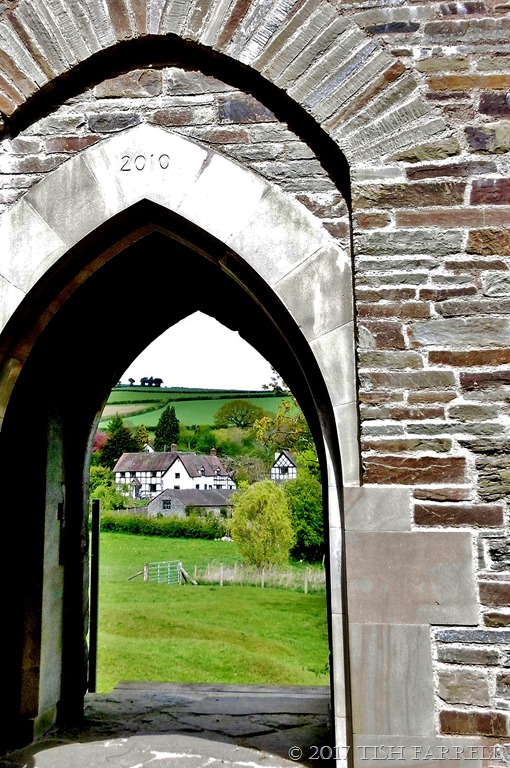
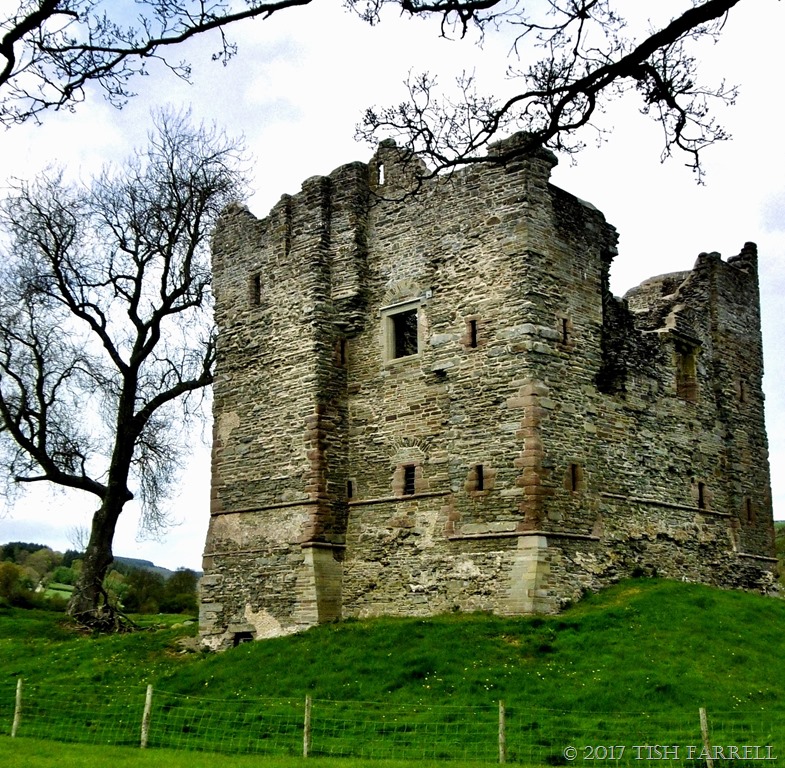
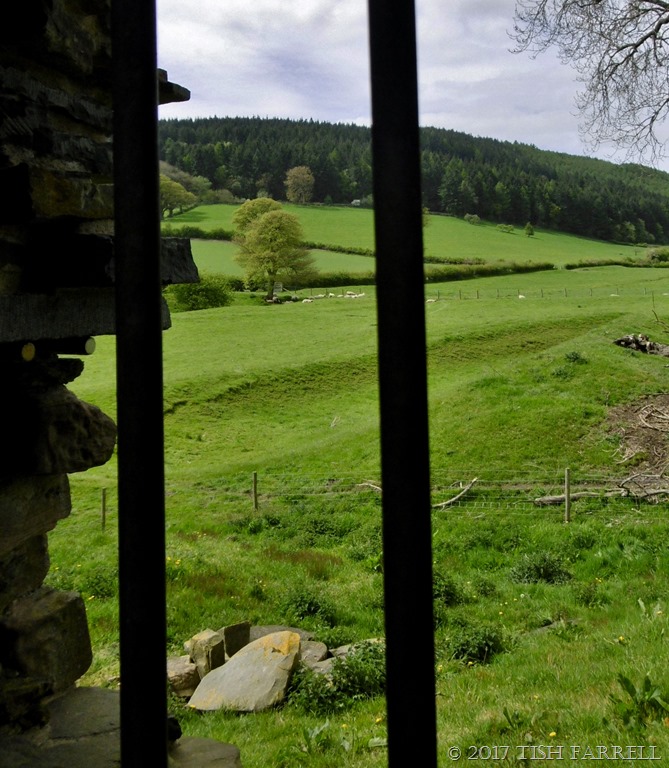
This week at Lost in Translation Paula asks us to show her photos that we have cropped to reveal detail or improve the composition. I have to say that I crop most of my photos, and certainly architectural subjects almost always benefit from a trim.
Here are some cropped shots in and around Hopton Castle. This mediaeval ruin stands in a rural and rather remote corner of Shropshire near the Herefordshire border, one of a cluster of castles built either to keep the Welsh neighbours in their place or as a piece of lordly showing off. Today, Hopton is romantically and rustically picturesque, although once it was the site of a bloody Civil War siege. In one of my earlier Thursday’s Special posts I featured the restoration of the monument.
*
Not far from Hopton and just over the border into Herefordshire is the little village of Brampton Bryan. One of its most noteworthy features is the free-form yew hedge that shelters the owners of Brampton Bryan Hall from the gaze of passing hoi polloi and the inhabitants of the pretty estate village. The light was not good, but I think cropping the images has made them passable – at least for ‘guided tour’ general nosiness purposes:

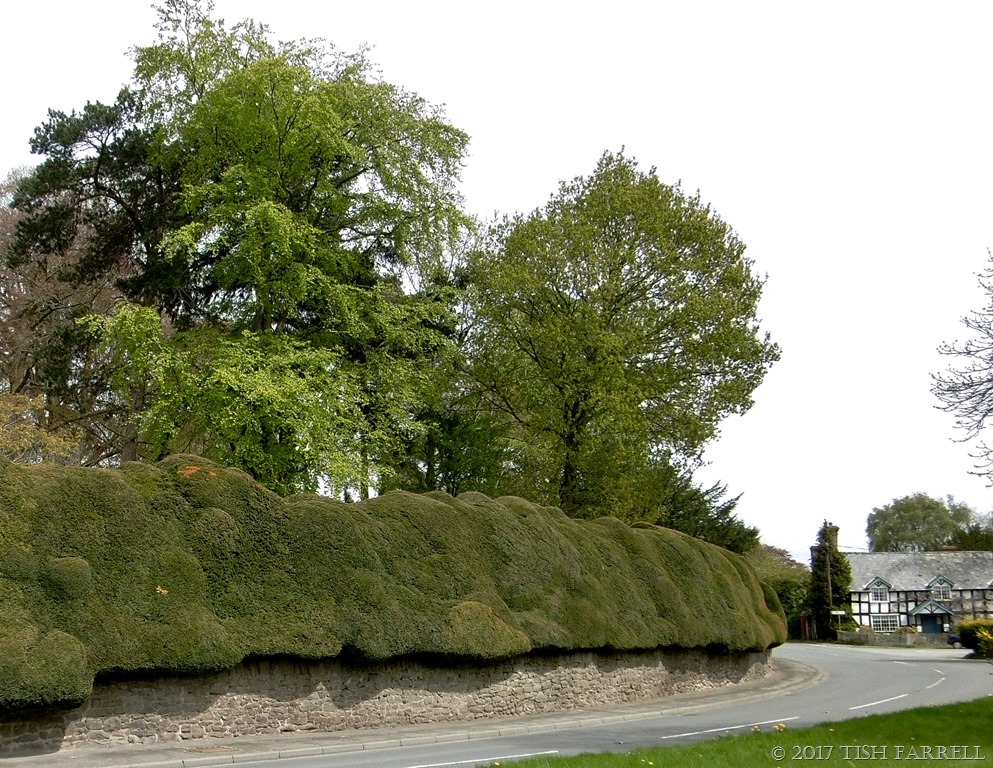
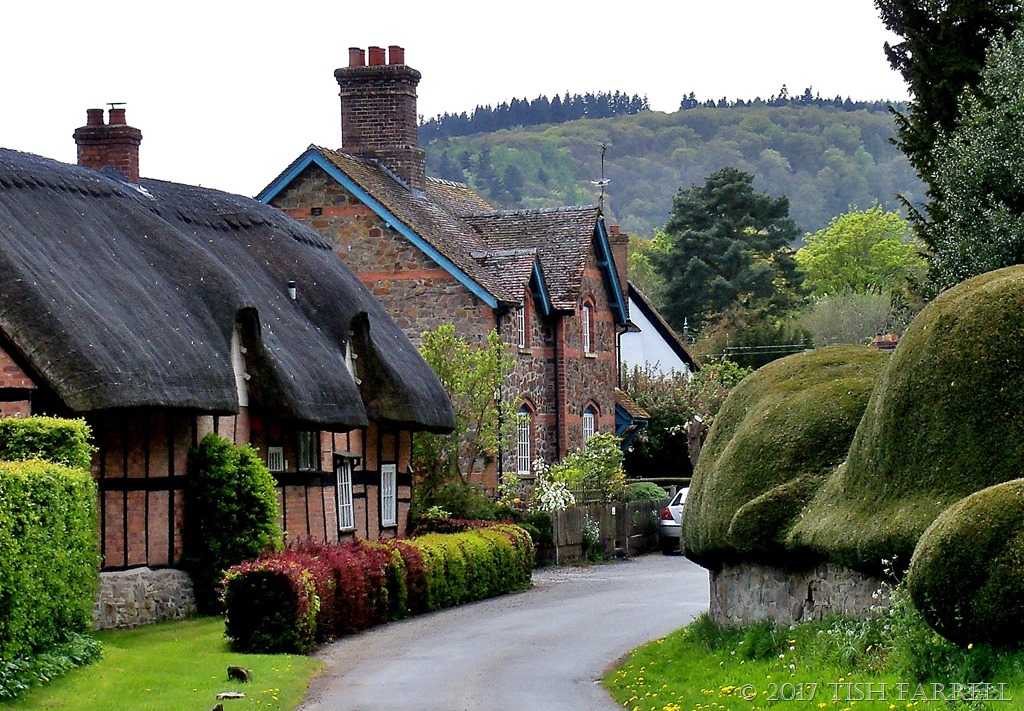
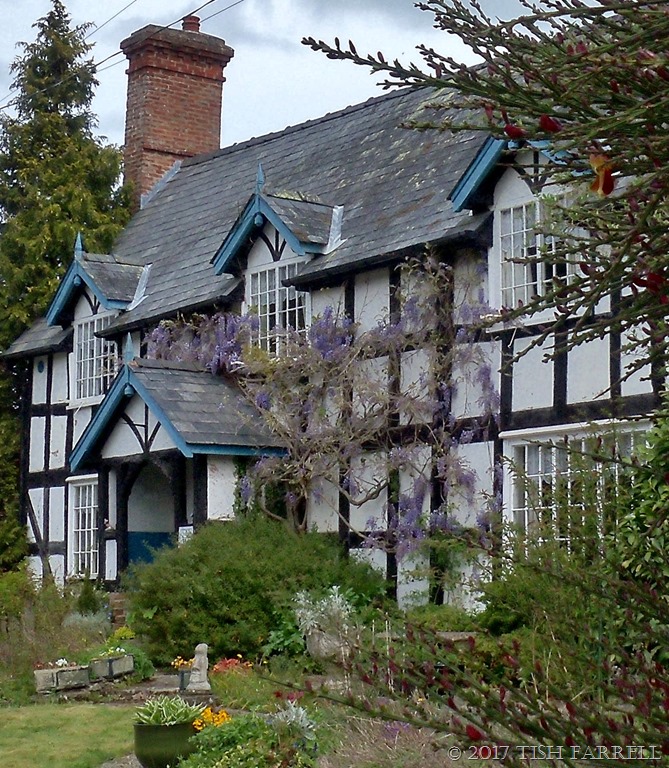
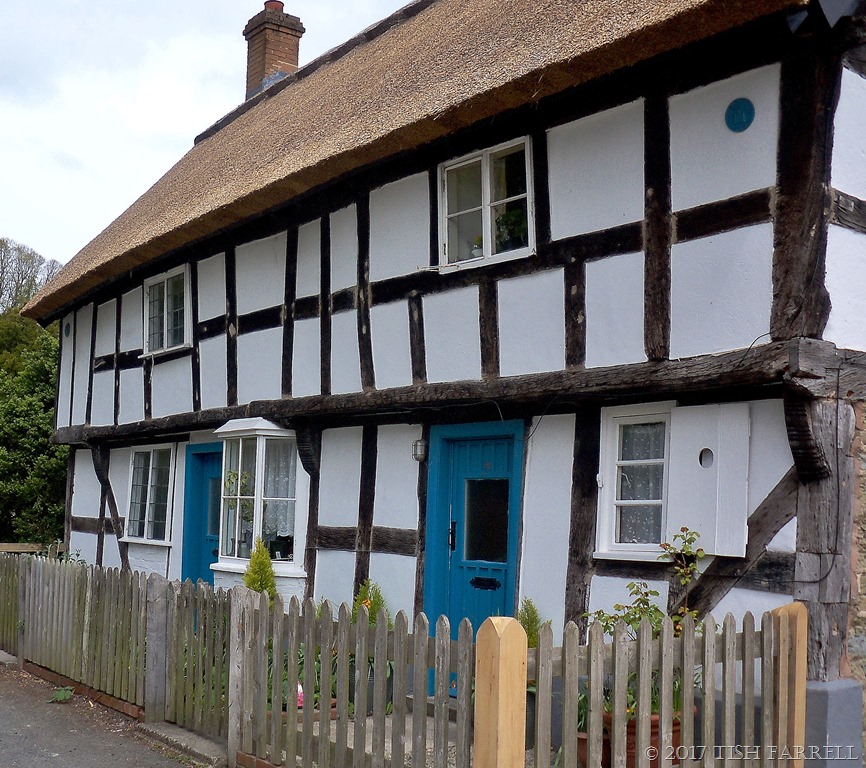
The Harley family who own the estate, including the village properties with their blue doors, has been around the place since Domesday. Their present home behind the hedge was built after the Civil War in 1660, and remodelled in the 18th century. I snatched a glimpse over the rear churchyard wall, but though imposing it was not very captivating, at least not compared with this next view of their own personal castle ruin. It is not open to the public so I couldn’t get a better photo.

I can’t help thinking how very wonderful it would be to have one’s own castle ruin out in the apple orchard, never mind the stately pile.
