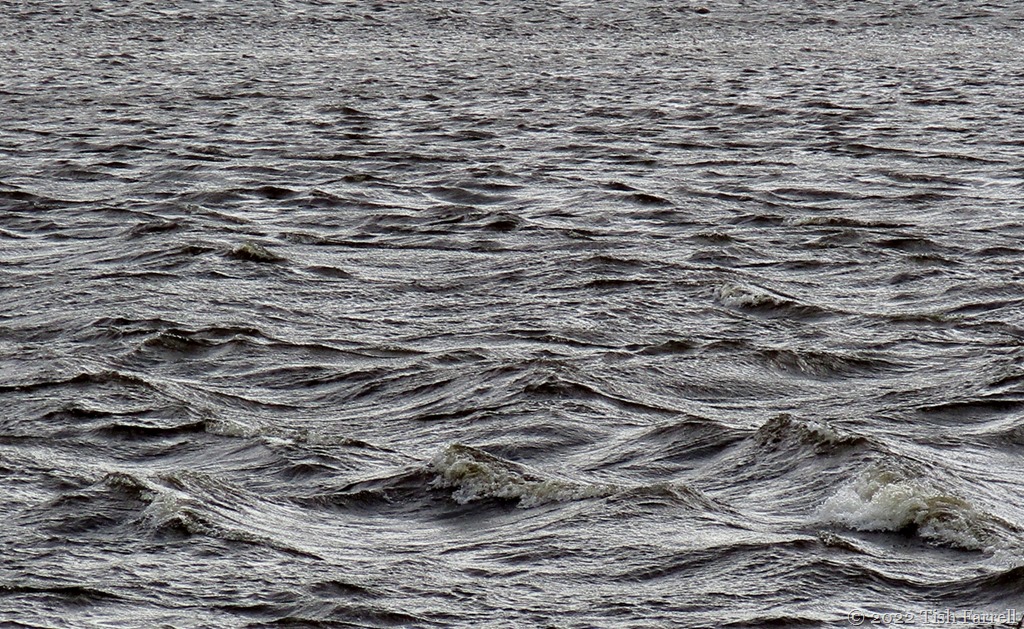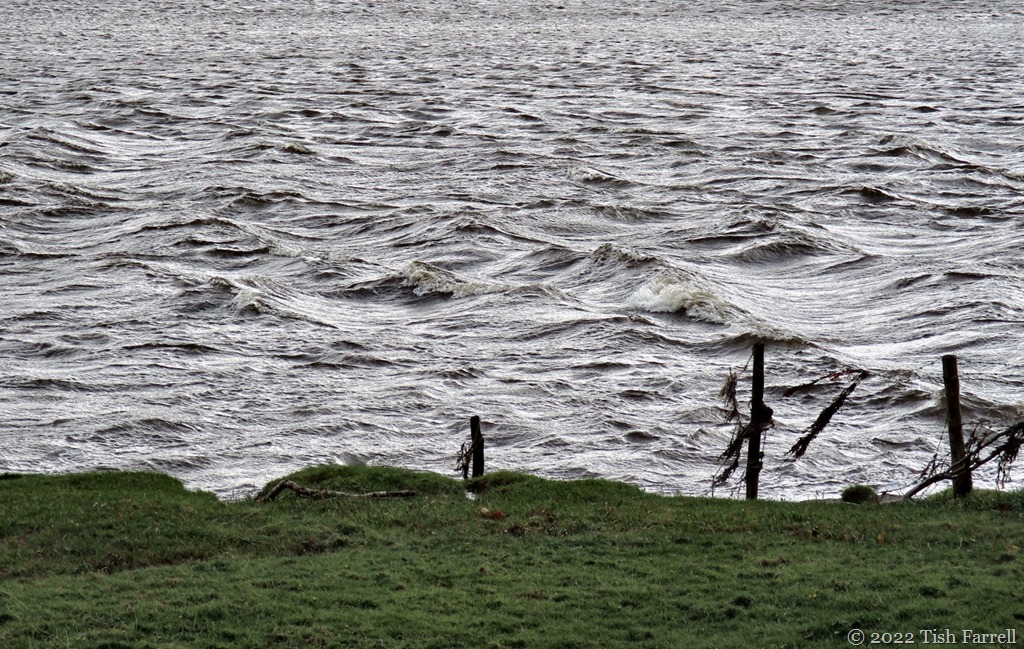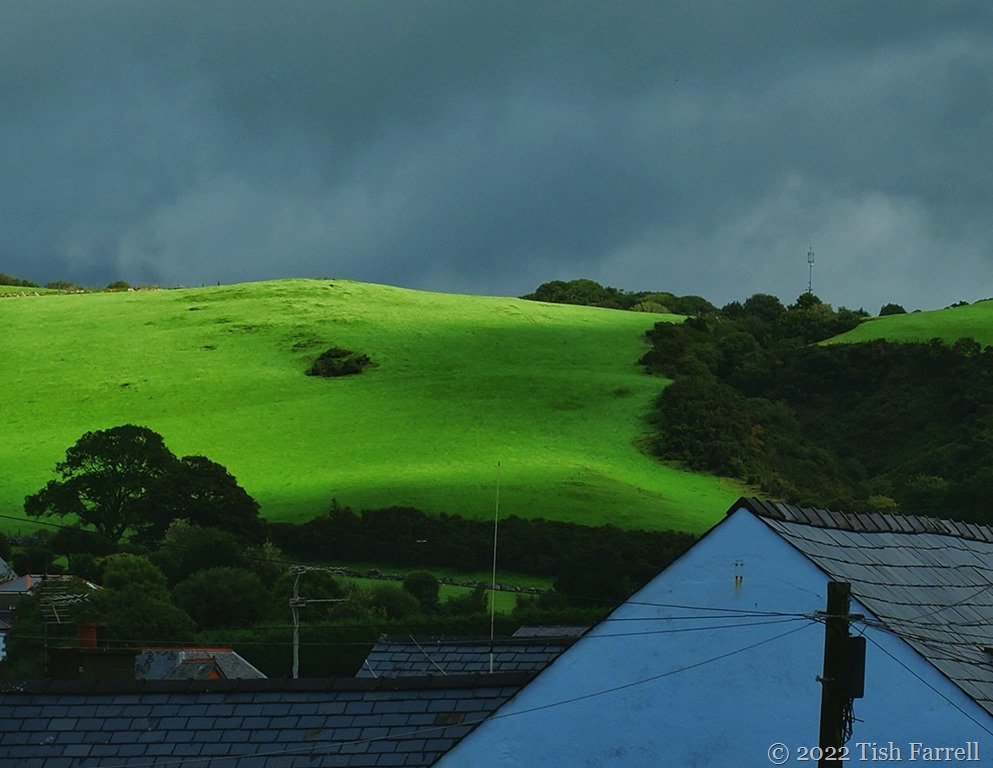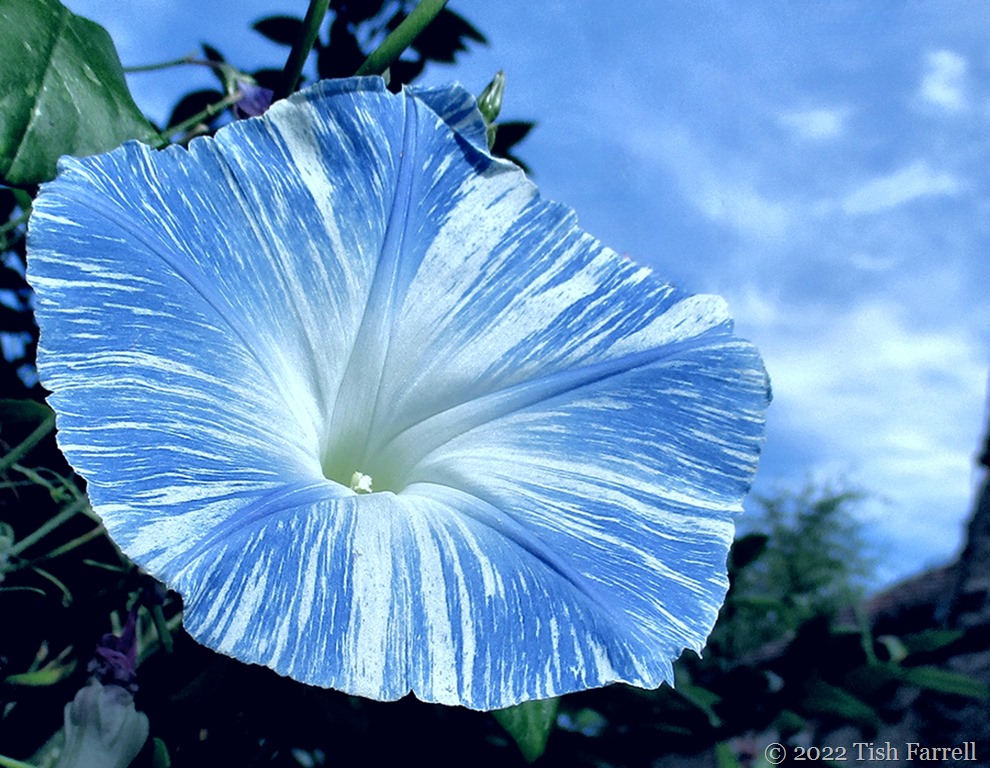
This week at Lens-Artists, Tina shows us many creative ways to interpret her chosen theme ‘opposites’. I thought I’d choose just one photo – a chance weather moment in Wales – one of those hard-to-credit solar beams piercing a storm-heavy sky. I mean to say, how can that field be so luminously green when the town of Harlech below is so deep in shadow, and the clouds above so full of rain? I even desaturated the image a notch or two. Of course there are other opposites here too: townscape-landscape; manmade-natural; urban-rural.
Tish Farrell Writer
A Flower Made Of Sky?
Iced
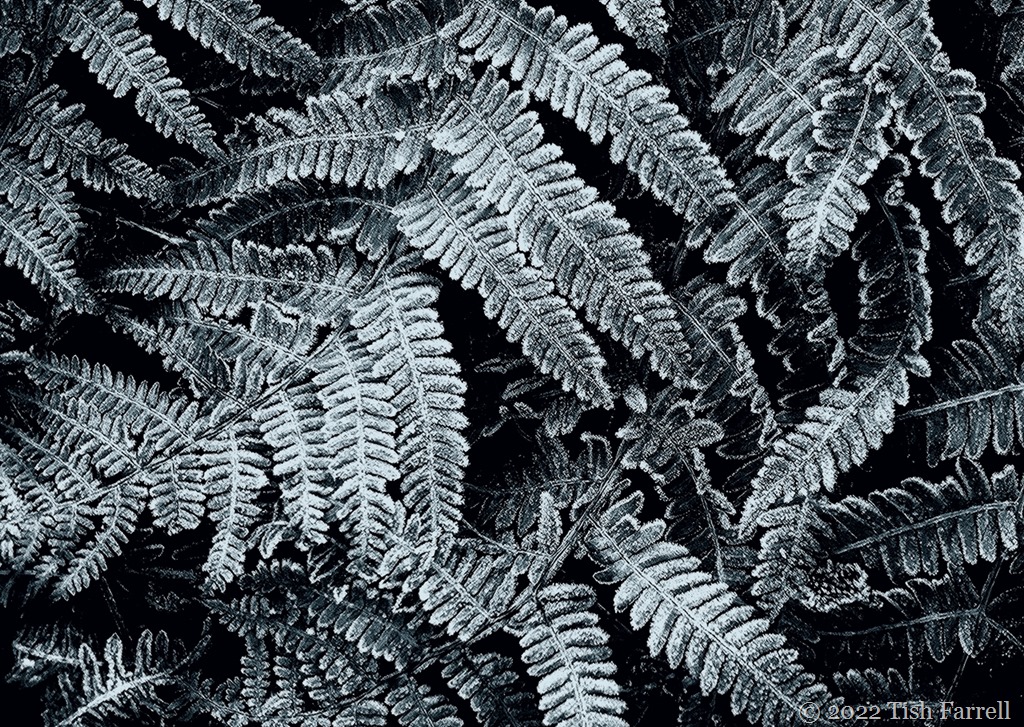
For anyone currently suffering any kind of over-heating, herewith some cooling images of frosted ferns. These photos were taken a few Decembers ago during a sudden frigid spell in Hay-on-Wye, widely known as the book capitol of the world. We’d planned a long weekend there – a brief trip out of Shropshire and into Powys. It was only an hour or so’s drive. Up to the moment we set off, we’d had mild winter weather, but even as we stopped for a cup of tea half way in scenic Eardisland, we could feel the bank of cold, cold air closing in.
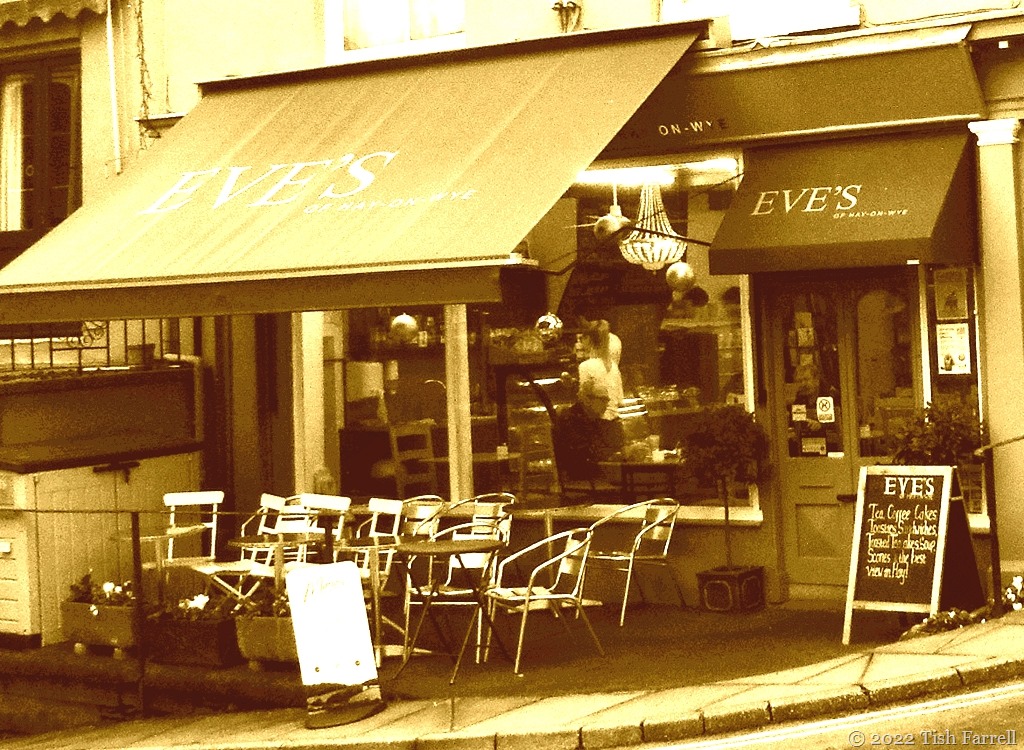
And so it proved to be three nights of cold comfort. On one of them the central heating system in our inn failed altogether. In between times a gale blew through the place as no one thought to shut the doors. Nor thought to light the log burning stove in the bar while we ate our evening meal. Street wandering could only be undertaken in small doses. Or at least that was our excuse for popping into Eve’s for regular rescue infusions of hot chocolate. Thank goodness, too, for Hay’s many hostelries that were far more welcoming than ours and for Richard Booth’s bookshop with its big squidgy sofas to camp out in.
Too Hot To Mooooo-ve
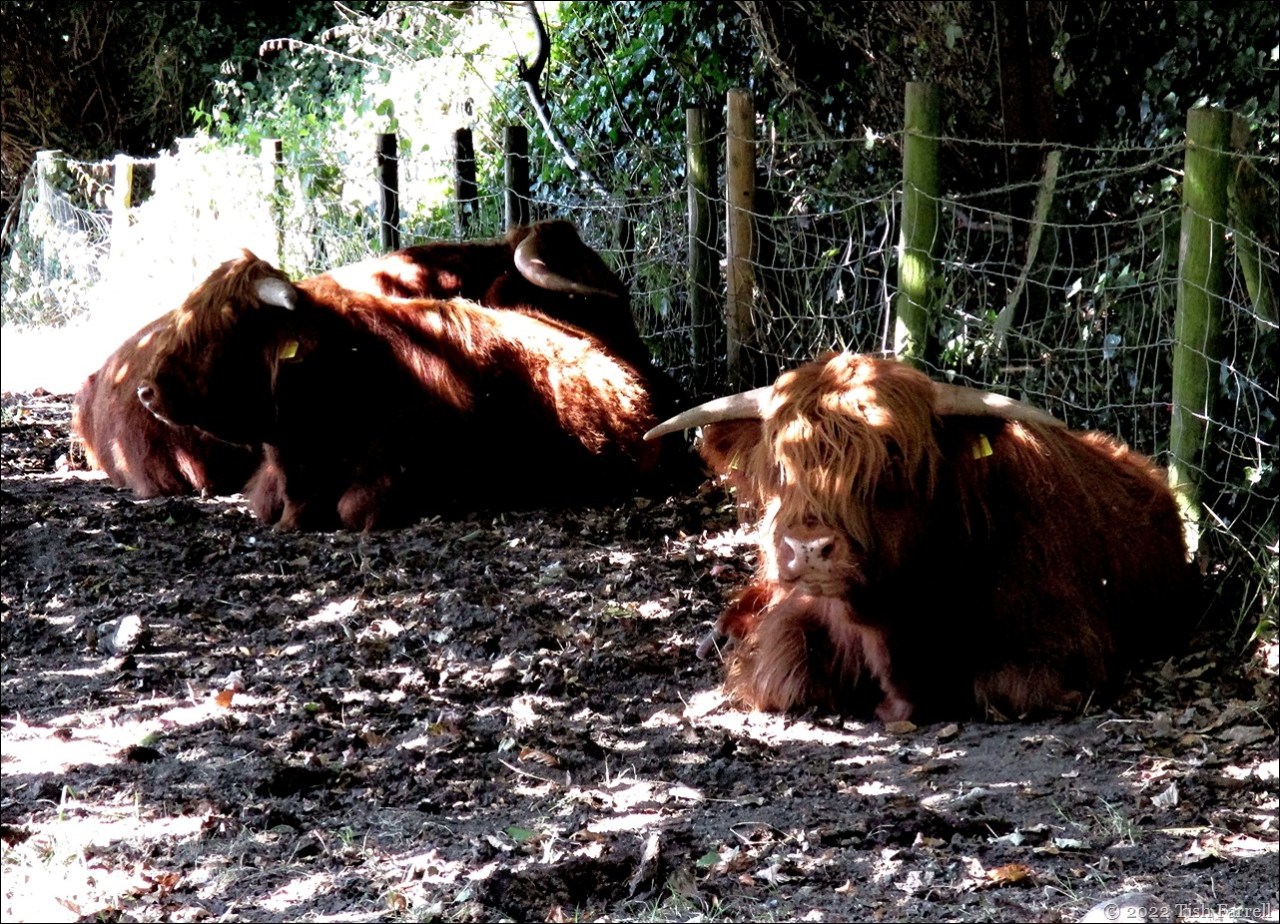
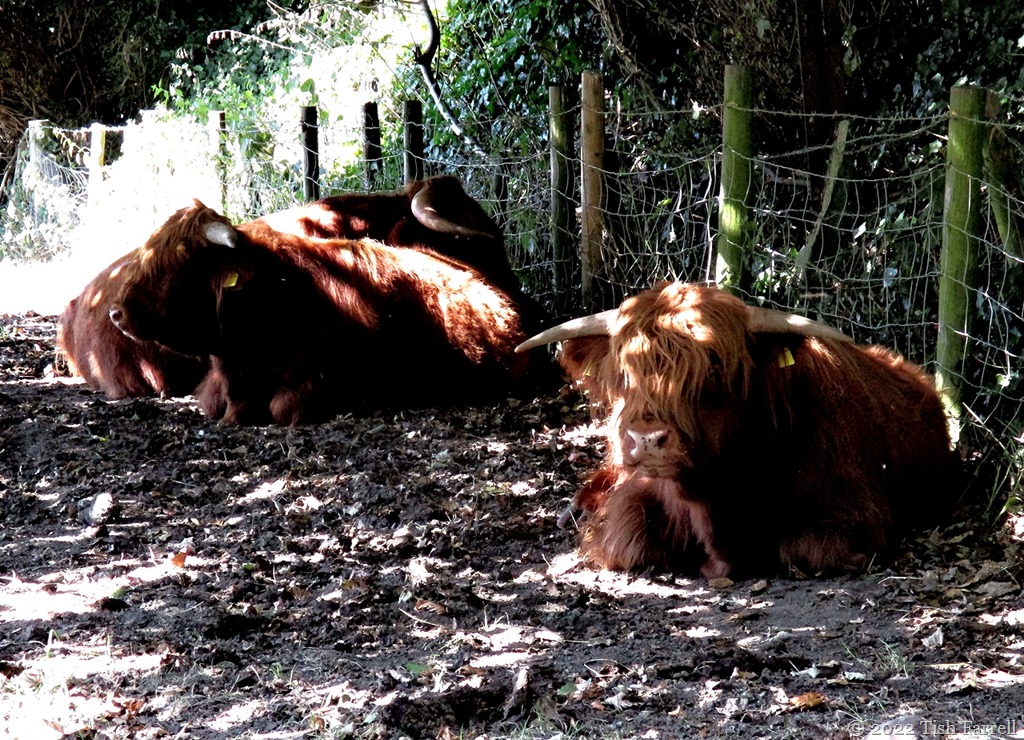
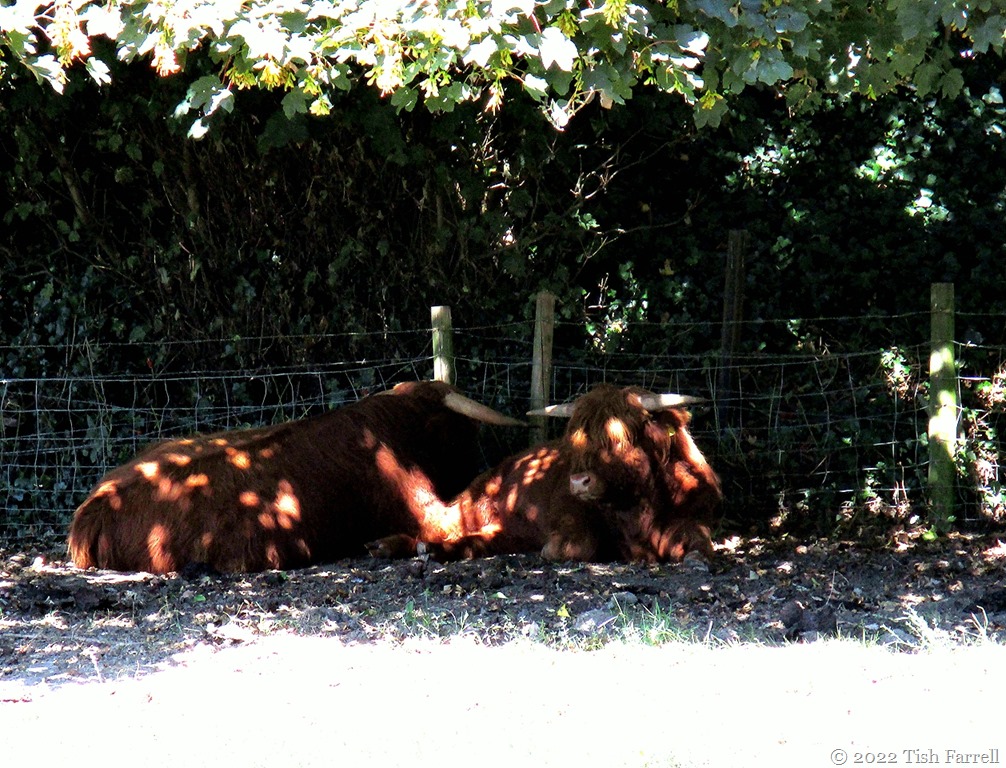
Our present wave of Mediterranean weather is not being kind to our shaggy coated Highland Cattle. Today my PC tells me it is 30 ‘ C / 86 ‘ F. Phew for us as well as for them. They probably wish they were in Reykjavik where, according to the Norwegian YR Weather site, it is a cool 12 ‘C / 54 ‘ F. Greenland, on the other hand, is probably too cold for comfort, even by MacMoo standards of insulation. It seems to be sunny there today, but the temperature is between MINUS 18 and –20 ’C / –4 ’F.
Apparently July and August are the warmest months in Greenland with temperatures between 0‘ C and 10’C. So: not much summer in the Arctic at present. It’s much like life really. For every high, somewhere there’s a corresponding low. Meanwhile the MacMoos slumber on in Cutlins meadow in whatever shade they can find.
The Red Balloon ~ Ups And Downs Last Night Over Wenlock
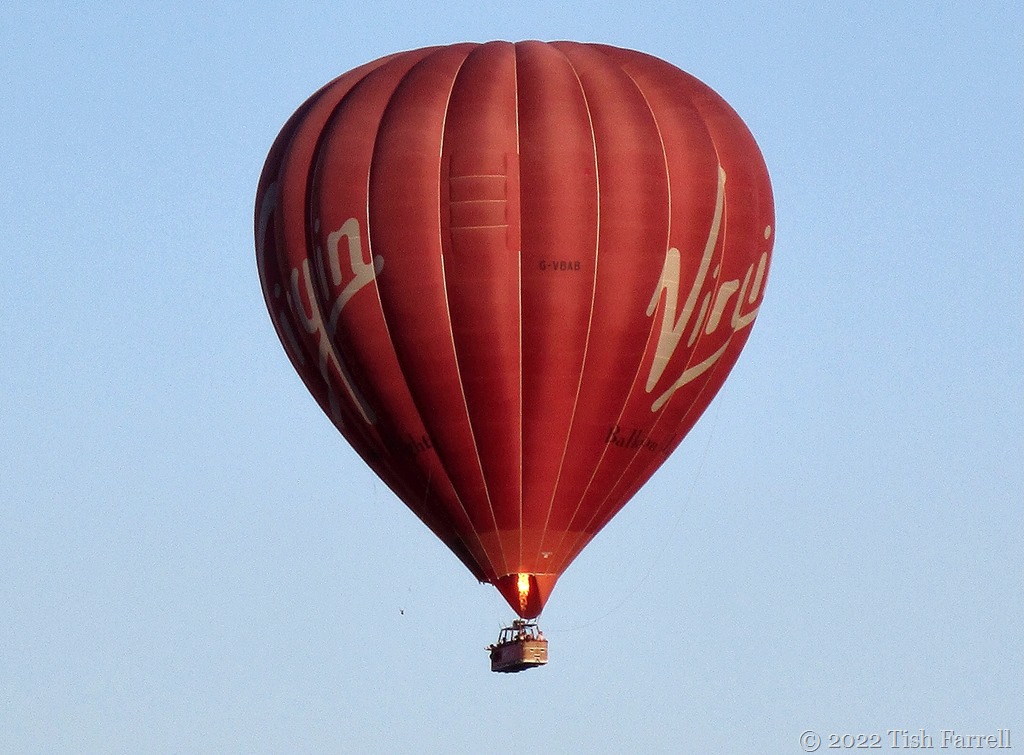
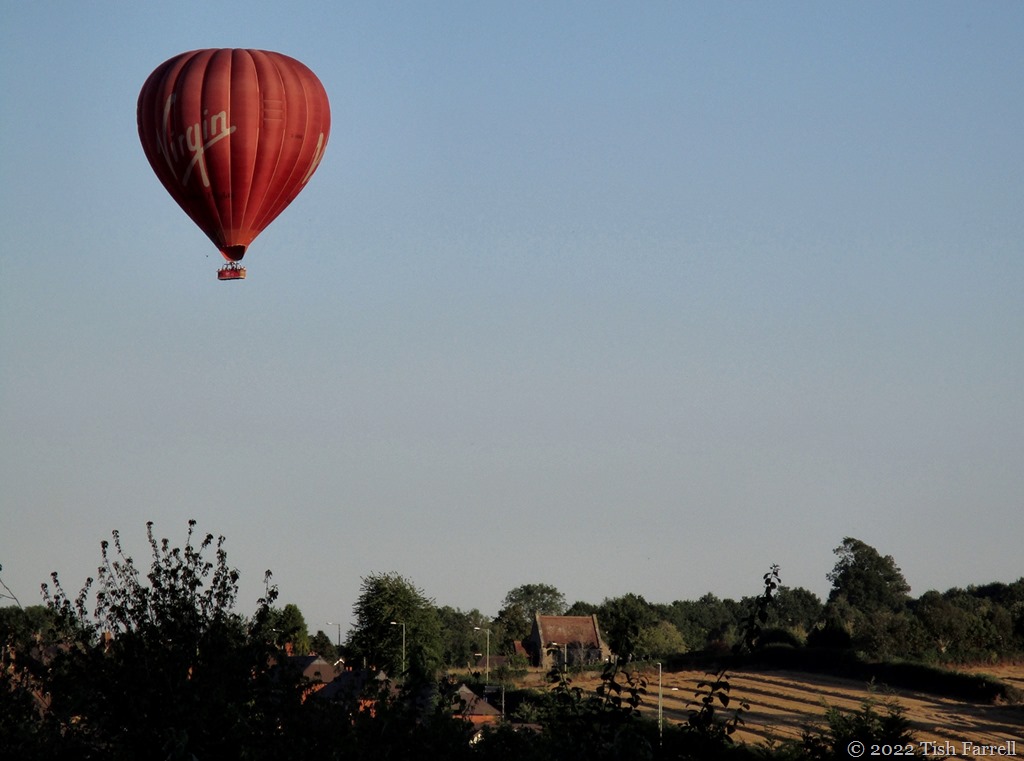
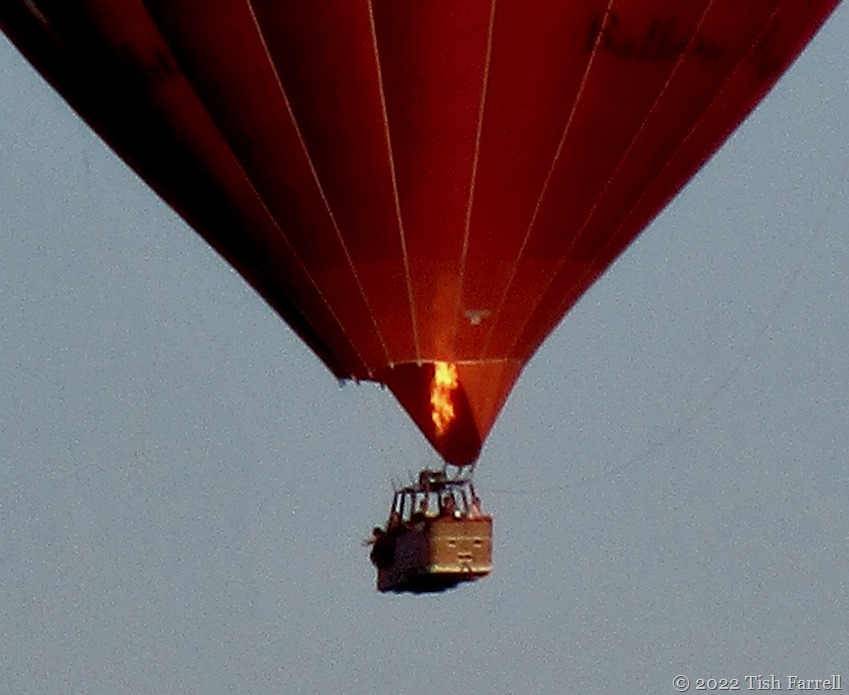
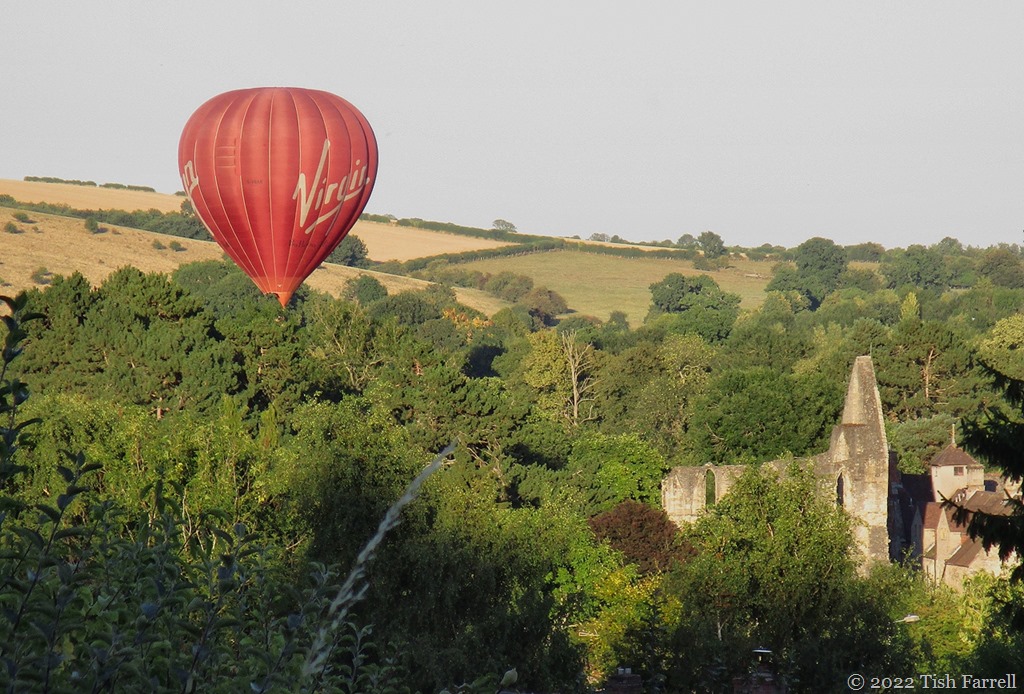
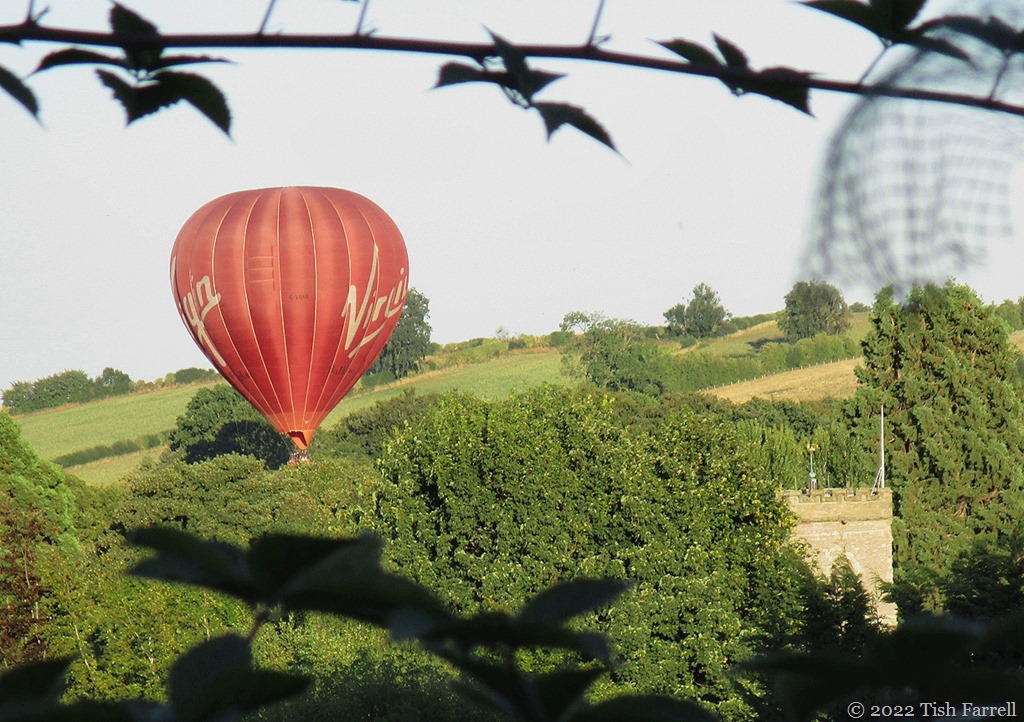
I was watering wilting vegetables at the allotment, when I glanced up and caught sight of this hot air balloon coming my way. It was floating over Windmill Hill. But as it drew closer I could hear it huffing, and it was soon obvious that staying airborne was not so easy. Not enough air currents perhaps; too much external hot air?
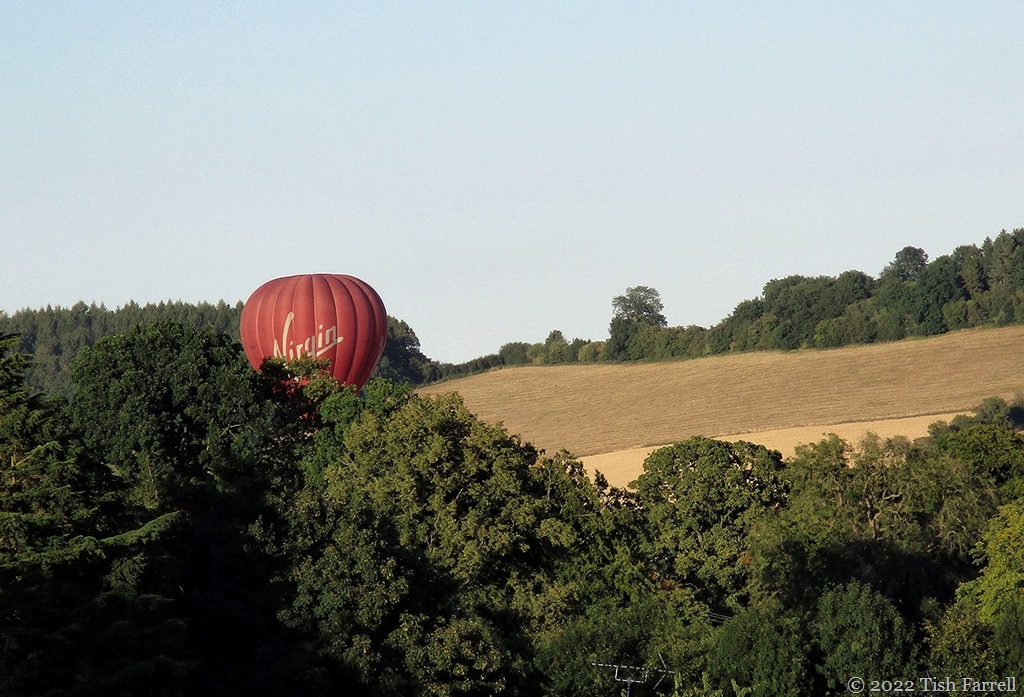
Anyway, the next I looked it was coming down somewhere behind Down’s Mill.
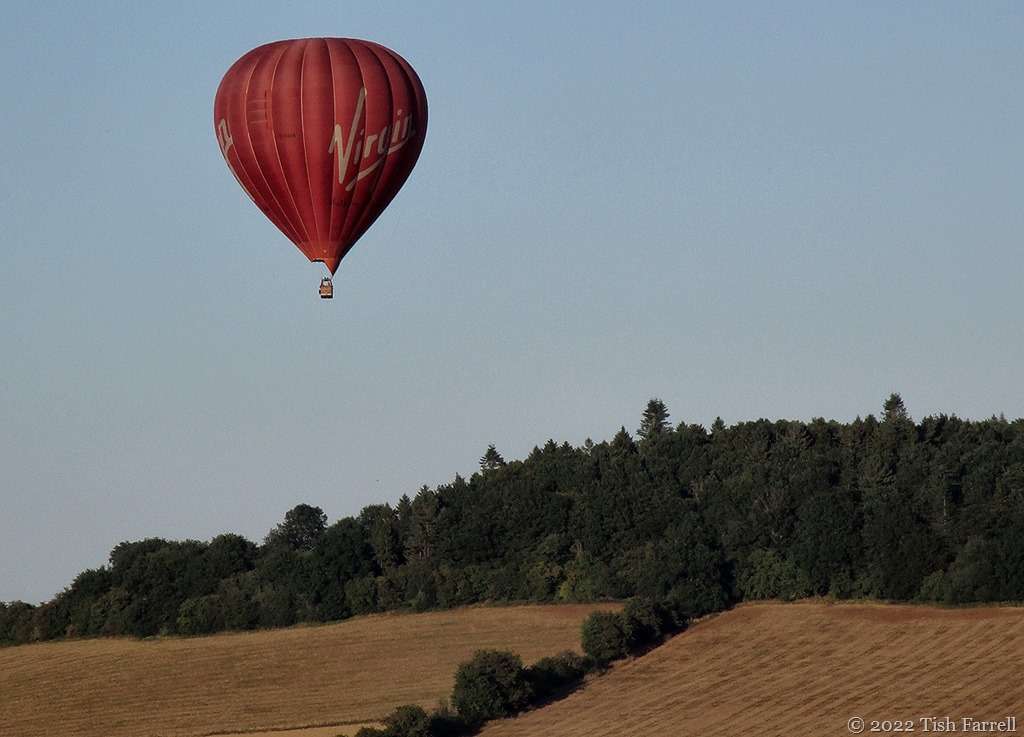
And then it was up again:
*
But not quite high enough: the Priory ruins were looming:
*
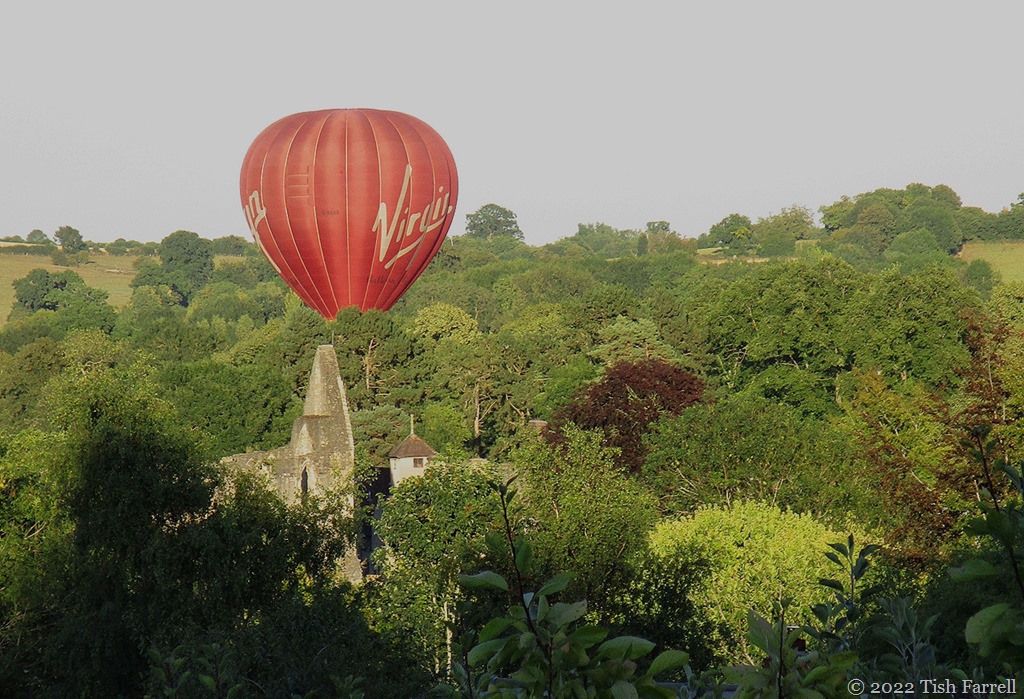
And then the church tower, this view taken through fellow allotmenteer, Ron’s raspberry canes:
*
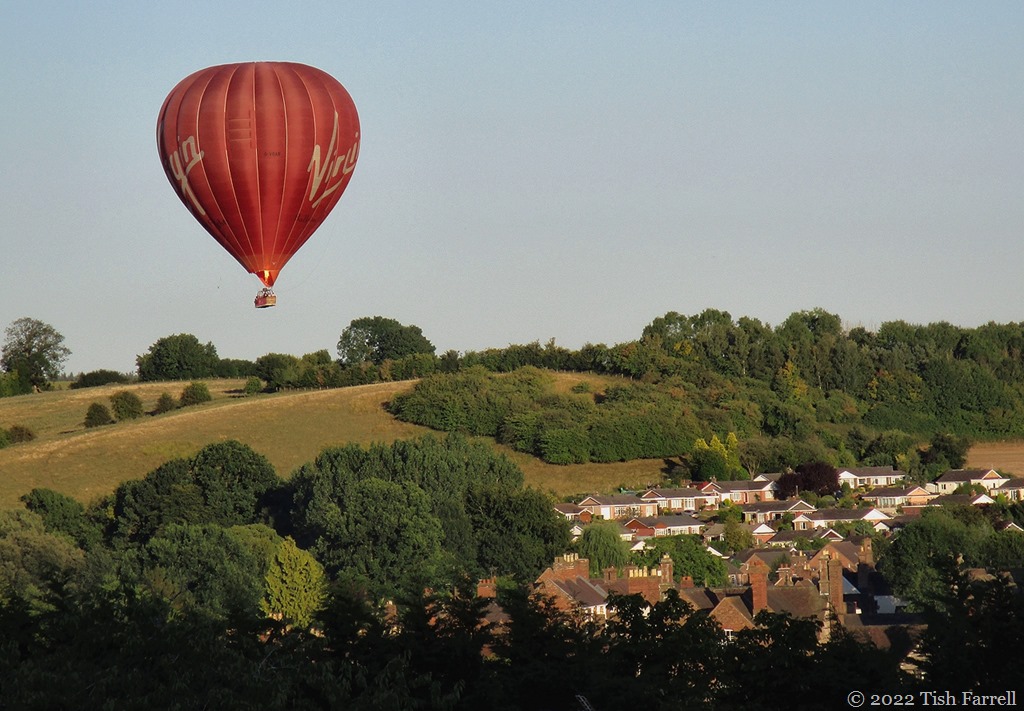
Finally as it traversed the town, the balloon gained more height, and floated majestically over Walton Hills:
*
The last I saw it was off towards Callaughton, flying over the cemetery chapel:
*
An exciting ride for all those aboard:
*
And watching this had me thinking. How many of you know/remember the short French film Le Ballon Rouge/The Red Balloon 1956.
I was entranced when I first saw it donkey’s years ago. It’s on YouTube of course. If it plays in your region, welcome to 1950s Paris. Enjoy!
https://www.youtube.com/watch?v=VexKSRKoWQY
Trio Of Photo-Favourites From ‘The Old Africa Album’
This first photo of Mzee Lali having a nap, with three full-sail Lamu dhows in our wake has to be my absolute favourite photograph. It was sheer chance that a) the scene composed itself so beautifully, b) I was alert enough to snap it and c) my Olympus-trip was not on the wrong setting.
It was Boxing Day and we had been out cruising the Manda Strait for several hours. In the morning some of our small party went in for a spot of snorkelling out on the reef. Next, using baited lines, we caught a few little fish which Lali and his nephew Athman scaled and cleaned. At noon when we were moored off Manda Island, Lali waded ashore and knelt down on the beach to pray. Then lunch was prepared, the fish grilled on a portable charcoal (jiko) stove and served up with freshly chopped coleslaw. Delicious.
In the afternoon we meandered back along the strait between the mangrove forests, waiting for the wind to pick up. We passed a large dhow taxi, utterly becalmed, engine stalled. It was brimful with laughing, chattering passengers, all hopeful that some time or other they would finally reach Lamu mainland to visit their relations.
*
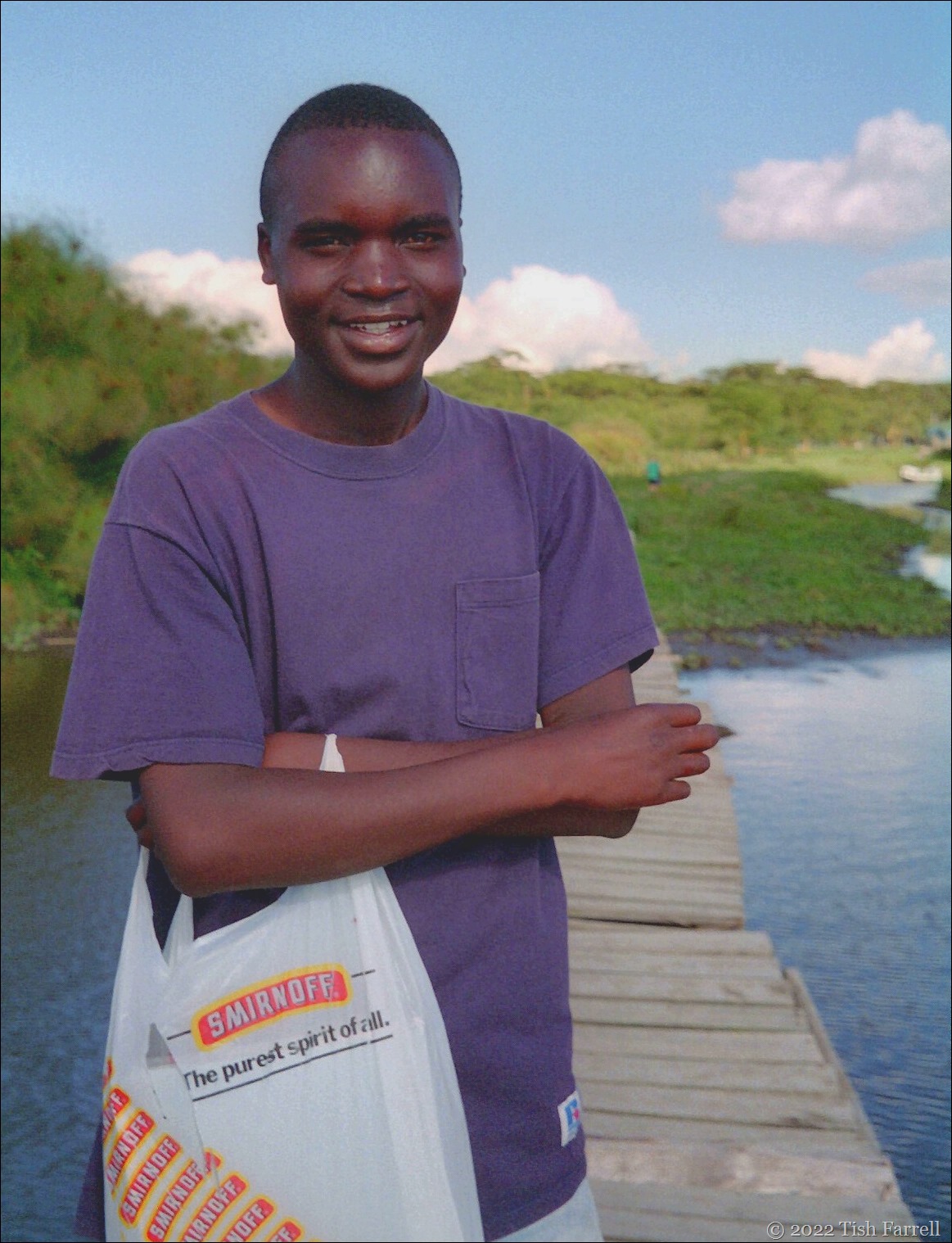
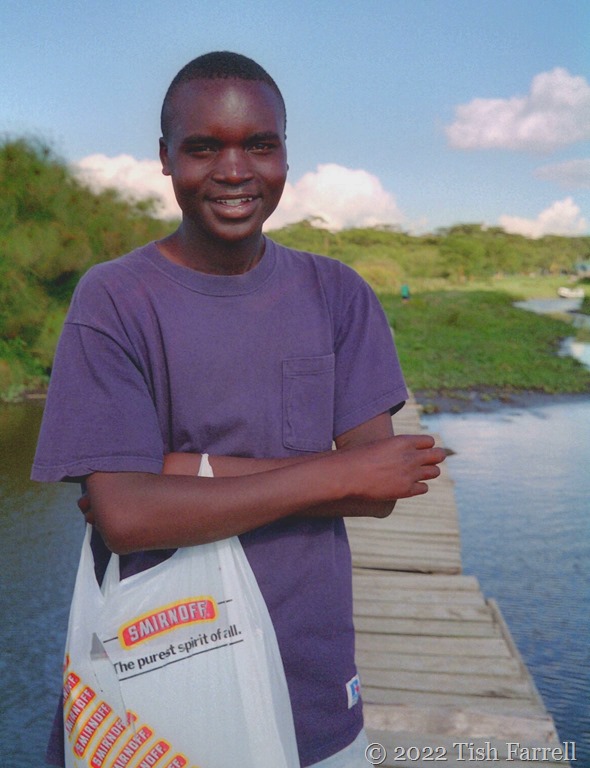
This photo was taken a few years later. It’s a favourite because it was a chance meeting that pretty much sums up all that is so powerfully positive about young Kenyans. We were staying at Safariland Lodge on the shores of Lake Naivasha. Graham was hosting a conference of international crop pest scientists, and I was spending the days wandering around the place, bird watching. One afternoon I met Robert Omondi on the hotel mooring. He sold me one of the hand written booklets he had made, its topic the ecology of Lake Naivasha and the water sources that fed into it. He was visiting all the hotels and lodges along the lake, selling copies where he could, and so raising funds for his next term’s school fees.
*
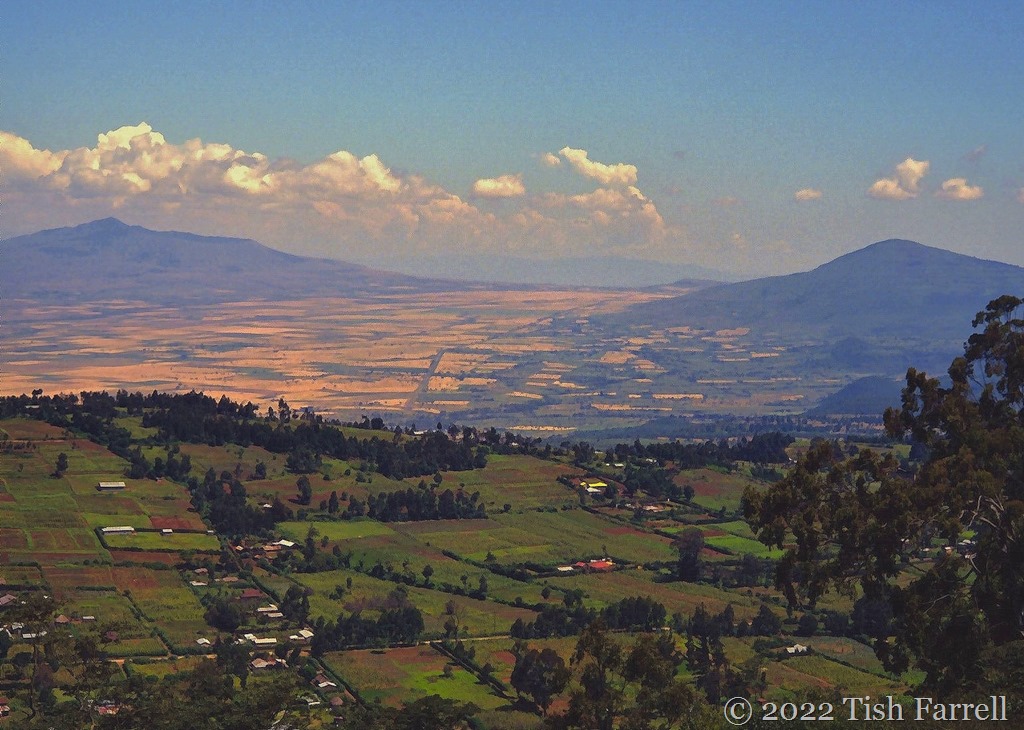
And finally a photo to prove to myself I was actually there, although even at the time I took it, it was hard to believe. Besides which, the Great Rift Valley is almost impossible to photograph and give any true sense of scale or depth. If there isn’t a heat haze, there is often a fog. I was standing somewhere north of Nairobi, on the east escarpment highway which runs up to 9,000 feet above sea level. Below, in the foreground, is Escarpment location, a community of smallholder farmers. The bright green of the plots suggests it must be the main growing season after good rains. In the Rift bottom are the wheat and barley fields of larger-scale farmers, the crater of defunct volcano, Longonot on the left. The low road to Lake Naivasha runs north beneath it along the valley floor.
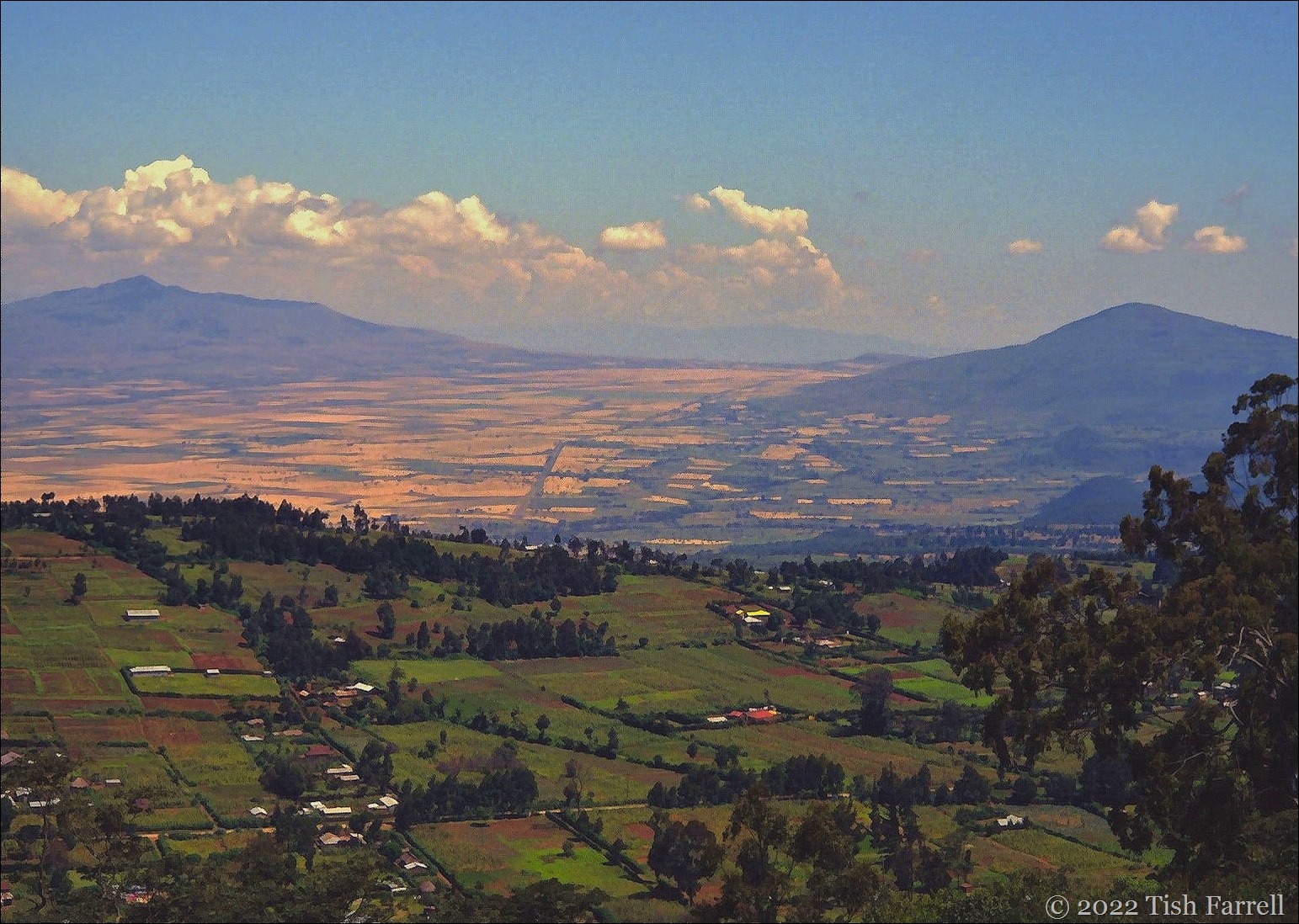
Lens-Artists: picking favourites This week Sarah at Travel With Me invites us to choose three favourite photos (not necessarily absolute favourites). Please go and see her three stunning choices.

Roadside Creations
It’s back to the old Africa album for Cee’s ‘made by humans’ theme because it was while I was thinking what to post, that I suddenly remembered here was something I really missed from our years living in Kenya and Zambia: the roadside artists and artisans who, day in and day out, made some truly wonderful creations. In fact we did most of our best shopping on the pavement – from the decorative to the solidly functional.
The header photo is a young soapstone sculptor in downtown Harare, taken during a road trip to Zimbabwe from Zambia. Meanwhile in Lusaka, here are the furniture makers who made beds of every kind, including ours, from repurposed air freight cases:
*
And while I’m here, a more recent shot of one of my favourite baskets, made by the Tonga women of Zambia’s Southern Province. I use it for storing sewing and knitting bits and bobs.
Stranger Than Fiction
And Shropshire’s Stiperstones with its brooding Devil’s Chair outcrop has indeed provided the setting for several works of fiction: the novels of Mary Webb, Malcolm Saville’s still popular Lone Pine adventure stories for children, and also D.H. Lawrence’s novella St. Mawr. And naturally, given its dramatic looks, it also features in local myths and legends, particularly those associated with Wild Edric, the Saxon earl who refused to surrender his lands to the Norman invaders and stirred up rebellion, allying himself with the Welsh princes of Gwynedd and Powys just over the border.
In real life it is an utterly strange place. These photos were taken on a summer’s day, but somehow, when we reached the hilltop, the light leached away. Even so, the grey-white quartzite outcrops seemed to have an unsettling luminosity. The photos I took using the monochrome setting on my camera are especially other worldly. There also appears to be an odd patch of mist on the next photo. I can’t explain it.
*
And in colour, too, the landscape’s disturbing presence is scarcely diminished:
*
Lens-Artists: Surreal This week Tracy challenges us to post some surreal images, and believe me, she has her own very original take on the topic. Go see for yourselves.
Cool Cool Convolvulus But Hot On The Plot
We’re having a two-day heatwave here in the UK, temperatures in the 30s. That our summers for the last few years have been fairly heat-free seems to have erased memories that in times past we also had heatwaves. I remember baking to a crisp day after day on a Welsh beach back in the mid-1950s, and that was in May. And then there was the prolonged drought of 1975-76 when, due to severe water shortages, bathing with a friend was the catch phrase du jour. Wikipedia says this about that year:
Heathrow had 16 consecutive days over 30 °C (86 °F) from 23 June to 8 July[ and for 15 consecutive days from 23 June to 7 July temperatures reached 32.2 °C (90 °F) somewhere in England. Furthermore, five days saw temperatures exceed 35 °C (95 °F). On 28 June, temperatures reached 35.6 °C (96.1 °F) in Southampton, the highest June temperature recorded in the UK. The hottest day of all was 3 July, with temperatures reaching 35.9 °C (96.6 °F) in Cheltenham.
Whatever the weather, this gardener usually tries to avoid going away during the main growing season. At the best of times, watering the allotment vegetable plots and polytunnel seems too big an ask of fellow allotmenteers, and especially so during a dry spell. Summer for me, then, means garden watch. And so with the promise of a hot day ahead, this morning I was off to the allotment at 6 a.m. to see what rescue remedies might be needed after yesterday’s heat.
I needn’t have worried. The polytunnel (a sweat-inducing structure even in coolish weather) was fine. I’d left both doors open and the tomatoes, cucumbers and aubergines, lettuce and herbs looked happy enough. Meanwhile out on the plot, and since I was there, I damped down the mulch around the climbing peas and beans, courgettes and sweet corn, then picked raspberries that were looking a bit cooked, and gave vulnerable beetroot and leek seedlings a good soak.
*
And then I wandered around and took these photos, and was home by 8 a.m., by which time it was definitely warming up. The BBC forecast says 35 C now at midday, though the Norwegian Met Office site YR (which I usually follow as it’s pretty good) says 34. In any event, it will be a much cooler 22C max tomorrow, and in the 20s for the rest of the week. I just hope we get some meaningful rain showers along with the returning coolness.
*
*
Back in the home garden, the borders are definitely struggling through lack of rain. I can’t begin to water everything. The driest area is over the back fence in the guerrilla garden. Plants there simply have to take their chances, but even so, the tansy and golden rod are running rampant, towering over my head, and the late flowering Michaelmas daisies and helianthus are catching up. Meanwhile Ann Thomson geranium is holding her own against the lot of them. She may get cooked each day, but she’s still comes back flowering each morning. Oh, for such repeat resilience.
And this summer in the garden I’m really pleased to find that one of my favourite wild flowers, yellow toadflax, has decided to colonise the upstairs path. I grew it from seed a couple of years ago, and now it’s taken off. I first fell in love with it as a child, on trips into the Shropshire hills where it grows along the lane verges in high summer…
*
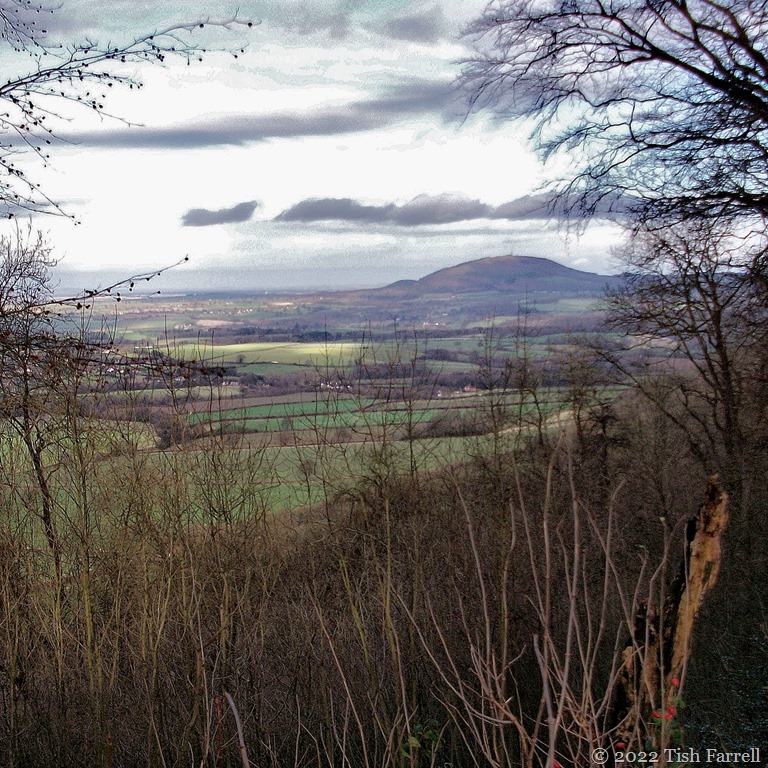
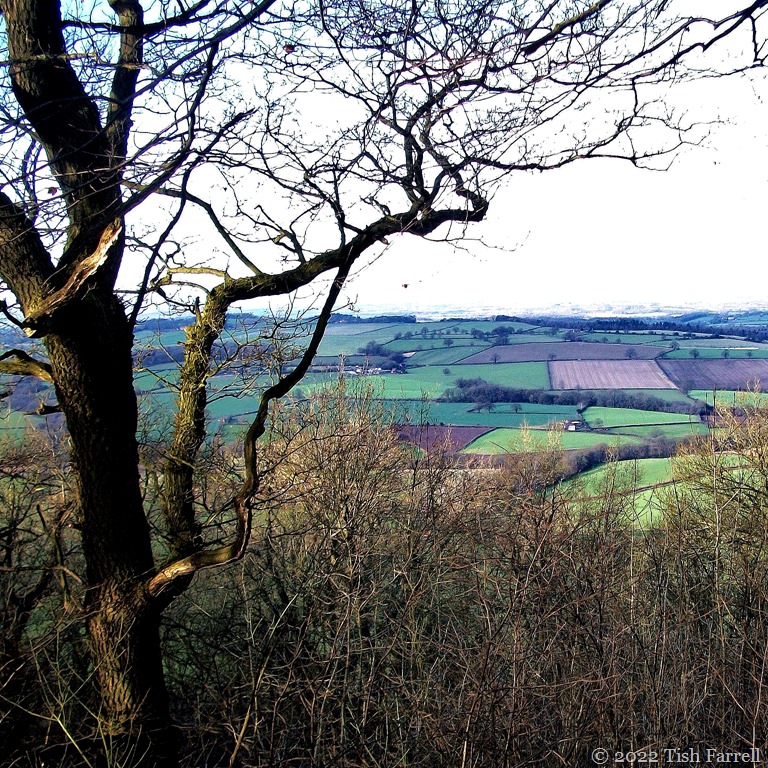
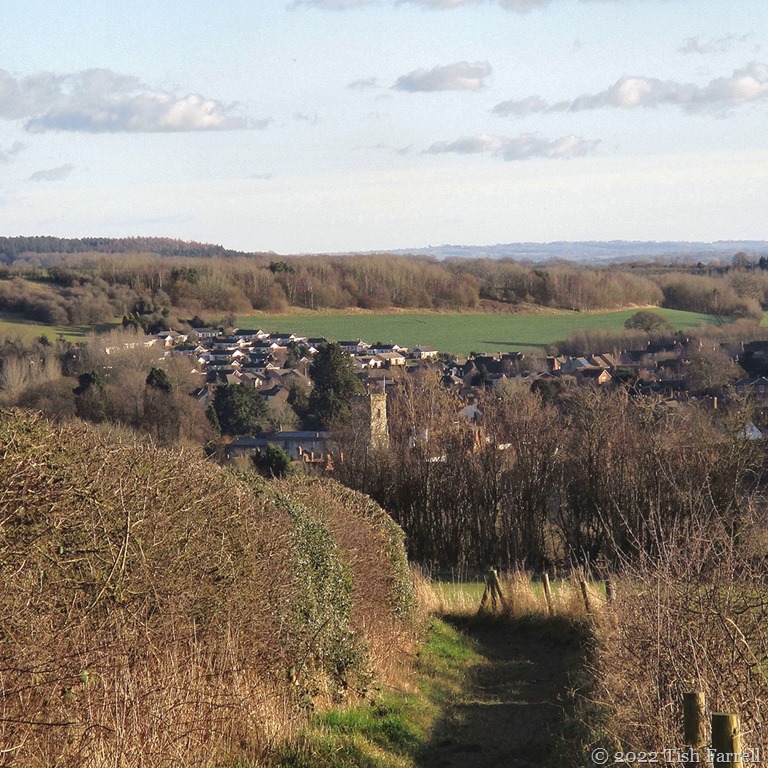
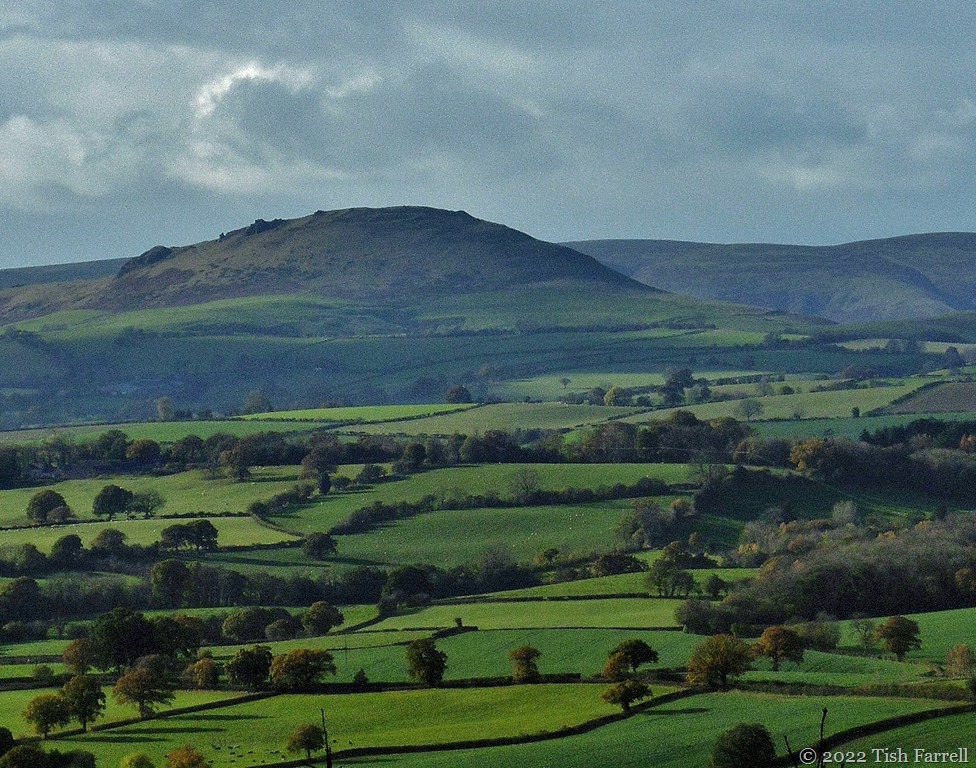
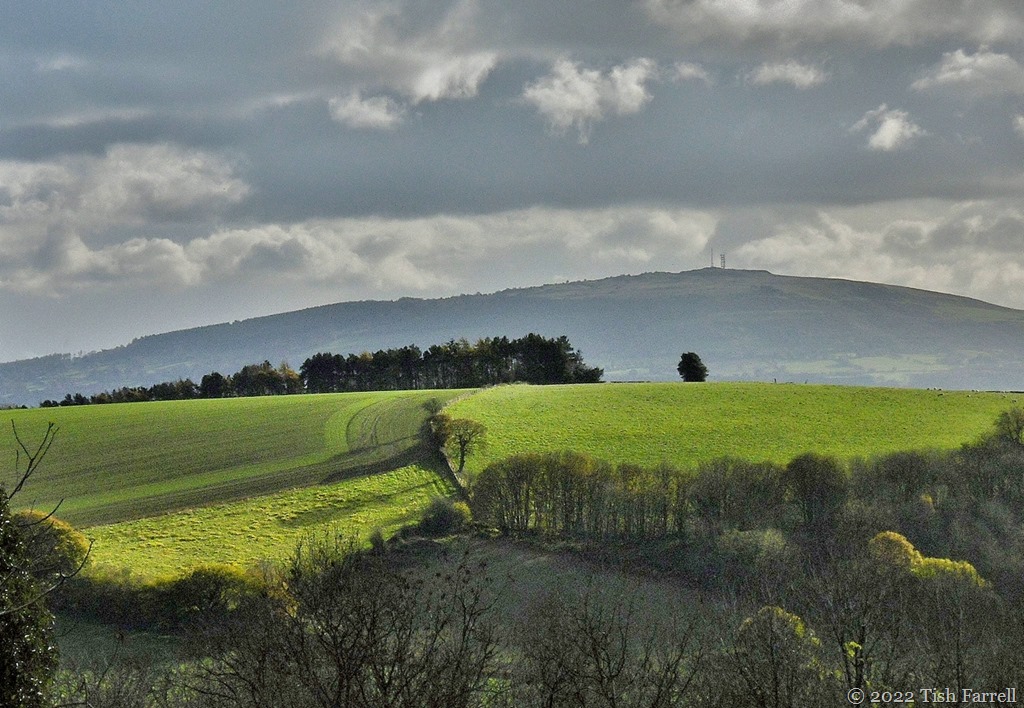
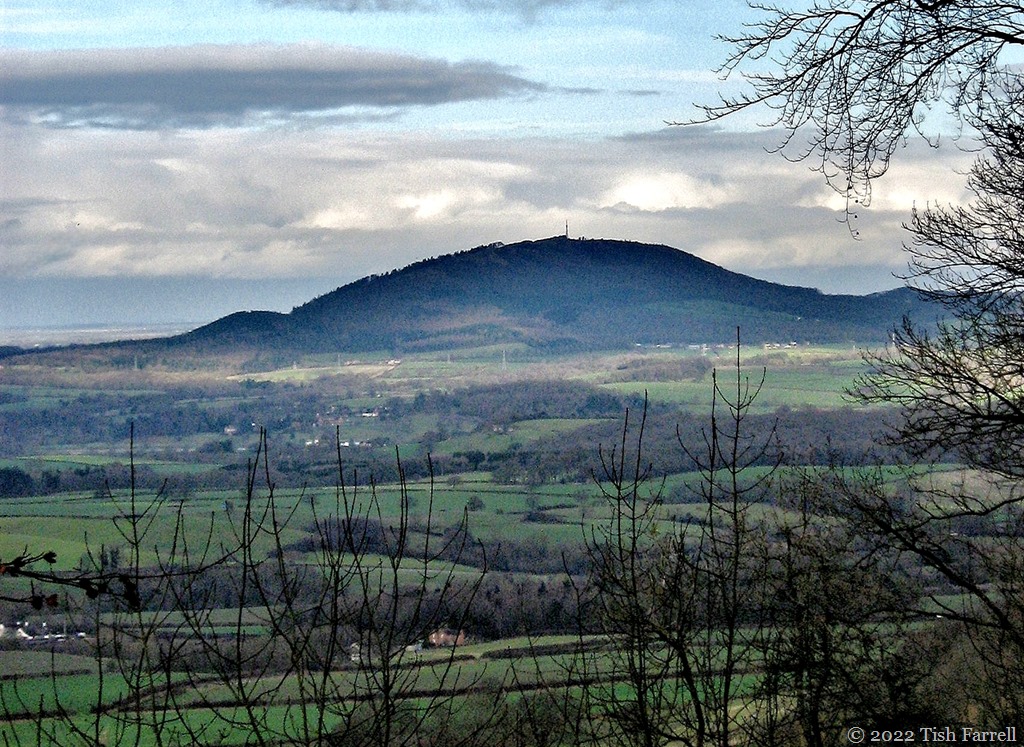
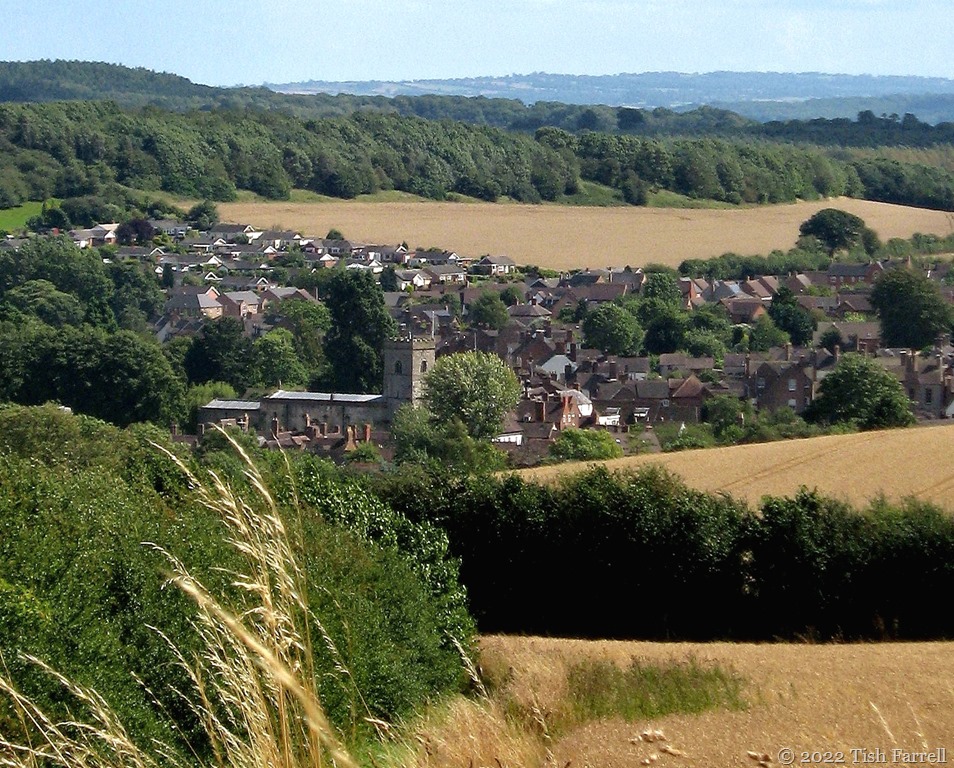
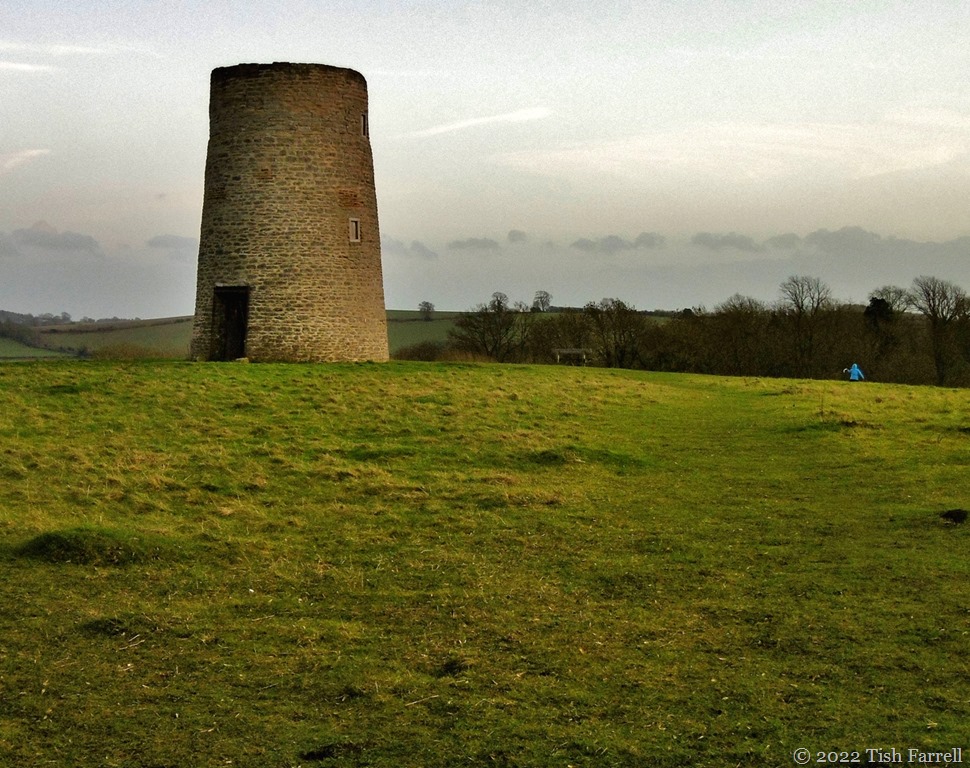
And talking of the Shropshire hills, I’ll leave you with summer views of the Shropshire-Wales borderland, taken a week or so ago on a visit to Mitchell’s Fold prehistoric stone circle.
This week Solaner has set the challenge.
Centred At Wenlock Priory
Of course for centuries Much Wenlock Priory was the centre of things for the ordinary folk who lived along Wenlock Edge and across the River Severn beyond Ironbridge. And I don’t only mean for the saving of their souls or temporal spiritual guidance. Successive priors were effectively CEOs of a large agricultural and industrial business enterprise. They ruled over an extensive landed estate in much the same way as powerful feudal lords of the manor ruled over their serfs and villeins.
The Priors laid down the law. They exacted rents, tithes and substantial death duties from the community, while the peasant smallholders, who were their rent-paying tenants, were obliged to provide a considerable amount of their labour – ploughing, harvesting, transporting goods. The Priory was also a big wool producer and it was involved in industrial enterprises such as quarrying, milling, extracting coal, operating an iron-making bloomery in Coalbrookdale, and so presumably relying on members of the 18 local serf families to do much of this work.
The Priory also did very nicely when anyone died. One third (a terciar) of the value of the deceased person’s moveable goods would be claimed. In 1377 when John Brice a local lord of the manor died, his executors had to pay out 5 oxen, plus a further third in value of 5 cows, 7 horses, 132 sheep, 90 ewes, 75 lambs, 2 silver spoons, and 3 drinking bowls with silver decoration. Other terciar records indicate that people’s every last possession was weighed up (in all senses). This might include the value of meat in the larder, the iron parts of a plough, corn in the barn, pans and axes, a worn out harrow all converted to monetary worth and paid in coin (Wenlock in the Middle Ages W F Mumford).
It is thus pleasing to know that there were moments when the Prior’s powers were well and truly challenged. In 1163 the villeins rebelled and ‘threw down their ploughshares’, calling for the repressive Prior to be deposed. The monks’ response was to excommunicate the lot, a truly horrifying penalty at the time. This only led to a riot. The church was besieged and knights called in to save the monks. But in the end the Prior was forced to hold an enquiry before a committee of knights and monks who, it seemed, listened to the villeins’ grievances and effected a compromise. In the following centuries, as the villeins’ own economic power grew, they were more and more able to demand payment for their services (A History of Much Wenlock Vivien Bellamy).
But with all this taxing and tithing, you can well see why in 1540 Thomas Cromwell wanted to get his hands on, as in liberate, the accumulated wealth of nation’s monastic houses. And here in Wenlock we still have the end result, nearly 6 centuries on – the dissolved relics of one of Europe’s most prestigious monasteries.