Musings On Time Past ~ What Do We Make Of It?

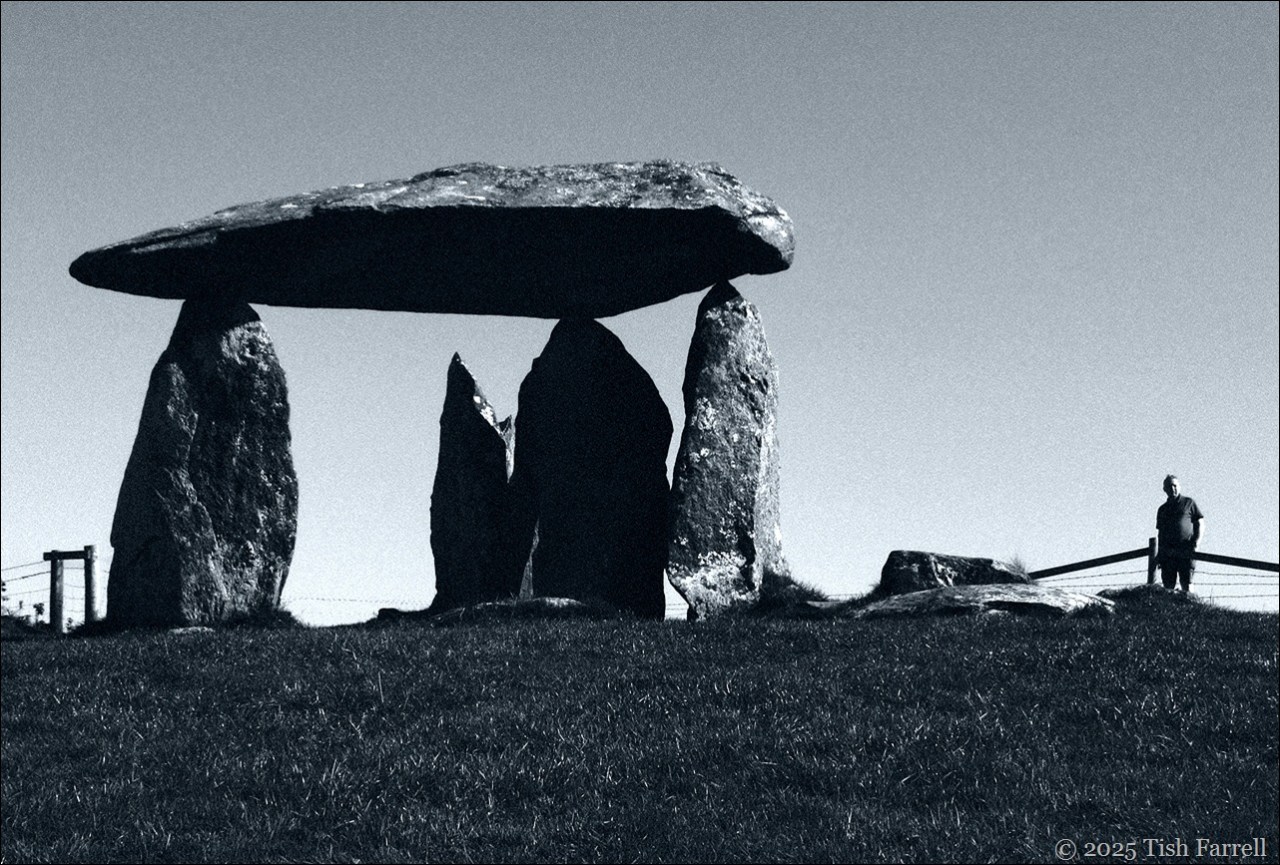
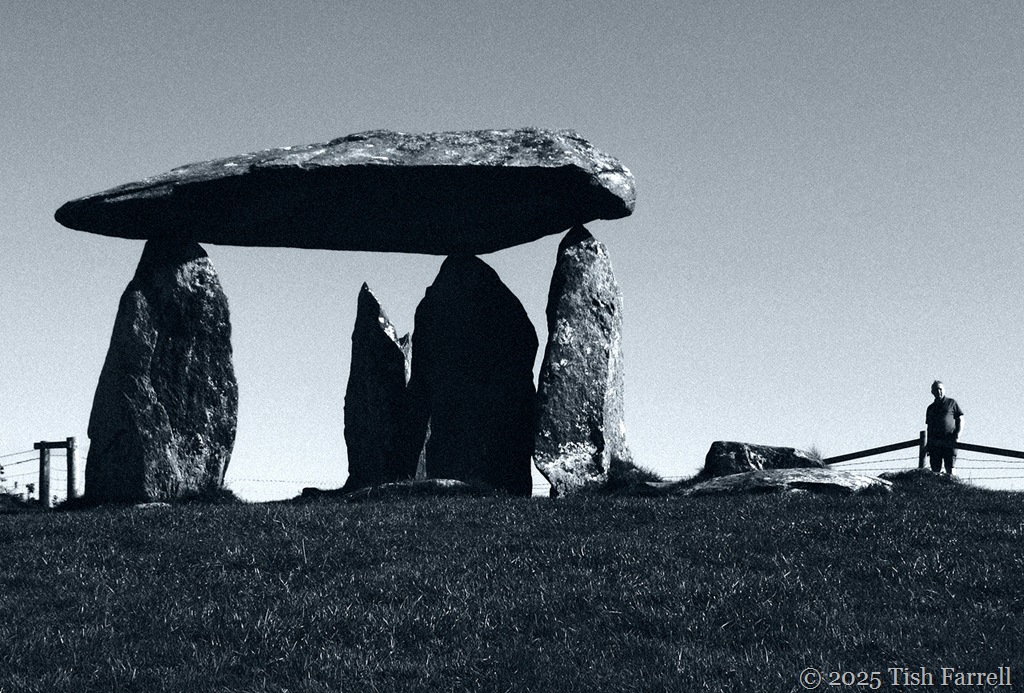
pentre ifan

Remains of Pentre Ifan chambered tomb, Newport, Pembrokeshire c. 3,500 BCE

*

We humans have problems with time: too much of it; not enough; the wrong kind for a planned action or pronouncement; then there’s ever that tale of elders who forget what they had for breakfast, but recall in minute detail events of decades past.

We try to pin it down of course, have long done so with all manner of devices. Most likely the late ‘Stone Age’ people who constructed Pentre Ifan above, had contrived the means to keep track of it. For instance, the placement of so-called standing stones, the particular configuration of megalithic circles, the siting of tomb entrances, whence to observe the movement of stars, the angle of the sun, and so know where they stood in relation to the earth’s perceived cycles. A time to plant; to make a journey; to hunt; to trade; mark seasons for rites and festivals.

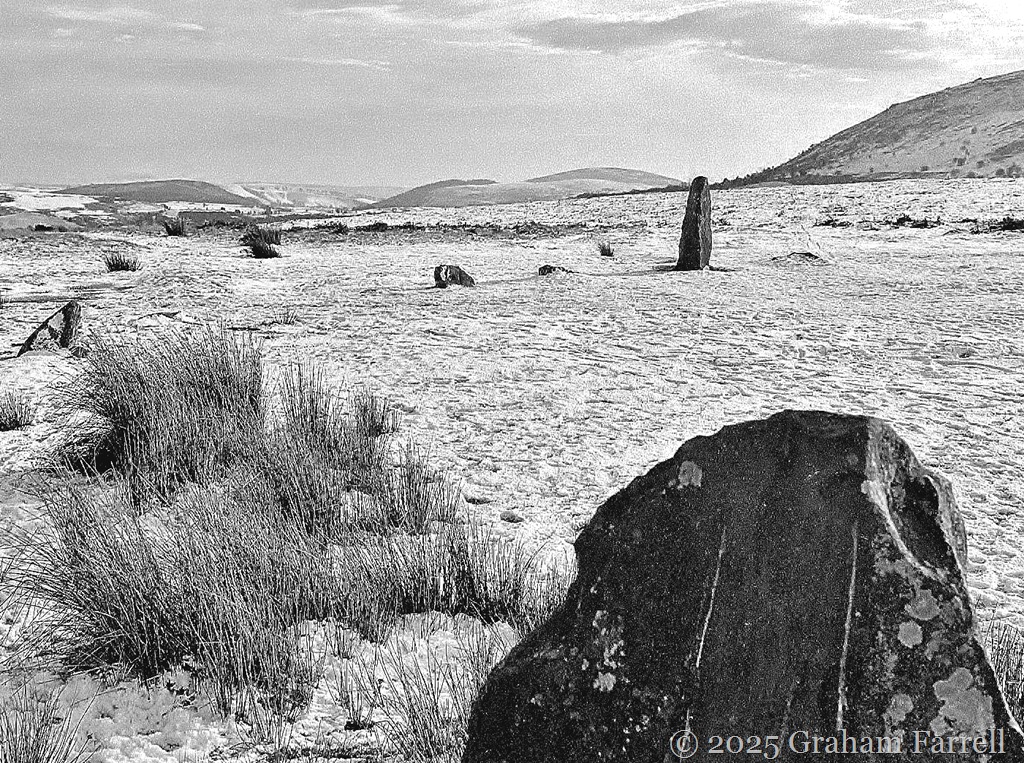
Mitchells Fold

Mitchell’s Fold Bronze Age stone circle, Shropshire-Powys border

*

We don’t know who these prehistoric (pre-literate) people were. There is no apparent connection between us and them. How do we even begin to grasp what five and half thousand years actually means. Most of us, unless we spring from some dynastic household that records family pedigrees down the centuries, or derive from some close knit community where little has changed for generations, cannot name our four pairs of great grandparents without the help of genealogy.com. We certainly have no true idea of how they lived day to day, unless they kindly left us their diaries; and even then…

As L.P. Hartley says in the opening of his novel The Go-Between: ‘The past is a foreign country; they do things differently there.’ And for most of us, too, our generations of ancestors left no mark, but were ever caught up in ‘big people’s’ histories; the machinations of church and state.

*

There are anyway far bigger pasts than our human one. Here in my home county of Shropshire, in the borderland known as the Welsh Marches we have  some of the planet’s oldest parts. Seven hundred million years old, in fact.

Set against such a monumentally unimaginable timescale, the history of humanity, including that of our primate ancestors, is not even a magnified dot on the horizon.

This is what Peter Toghill has to say about the Marches geology:

The beautiful landscape of the Welsh Marches
is underlain by a rock sequence representing ten of
the twelve recognised periods of geological time…
This remarkable variety, covering 700
million years of Earth history, has resulted from
the interplay of… (1) erosion and
faulting which have produced a very complex
outcrop pattern; (2) southern Britain’s position near
to plate boundaries through most of late
Precambrian and Phanerozoic time; and, most
importantly, (3) the incredible 12,000 km, 500
million year, journey of southern Britain across the
Earth’s surface from the southern hemisphere to
the northern, caused by plate tectonic processes
.

An introduction to 700 million years of earth history in Shropshire and Herefordshire

*

P1030691

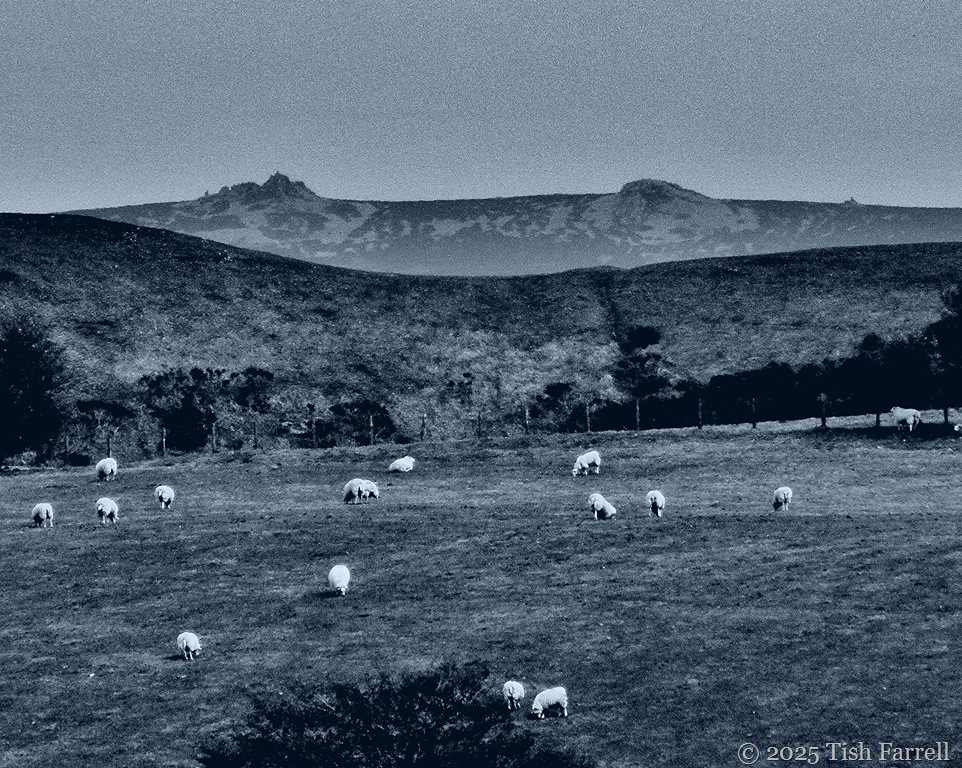
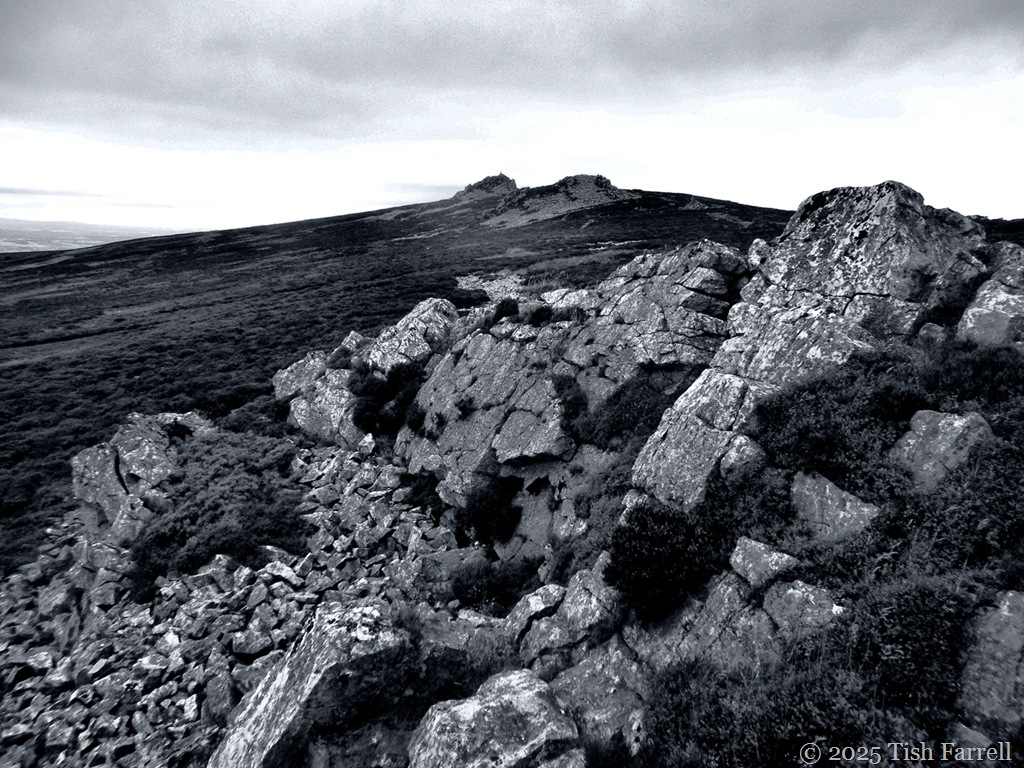
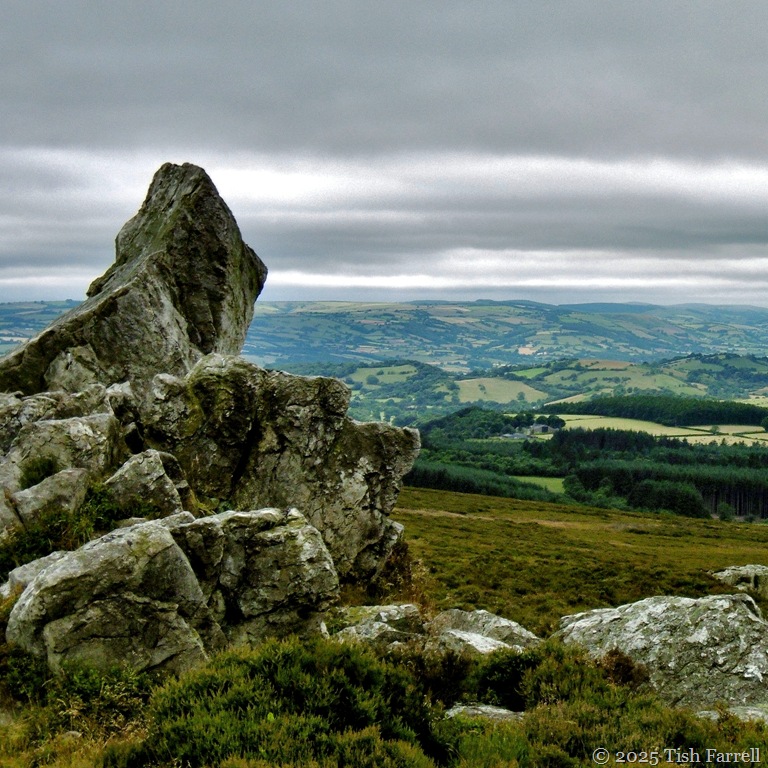
This distant view of the Stiperstones from Mitchell’s Fold stone circle, shows two of the Ice Age tors along the five mile summit, (Manstone the highest point on the left). This hill was probably formed from the laying down of quartzite sand when the whole of Southern England lay in the southern hemisphere, somewhere near the Comoros Islands in the Indian Ocean. That was around 500 million years ago, about the time when it began to move north. The tors themselves were exposed far more recently, by the repeated freezing and melting of glaciers that nudged up against them during the last Ice Age (115,000 to 12,000 years ago).

*

Stiperstones shaped by ice sheets freezing and melting

P1080553cr

Makes me think we humans sometimes think too much of ourselves and what we think we have achieved. Maybe the planet has the edge on us by a few hundred million years. It’s certainly done some momentous shunting and shifting.

Lens-Artists: Ancient

Scavenging The Old Africa Album

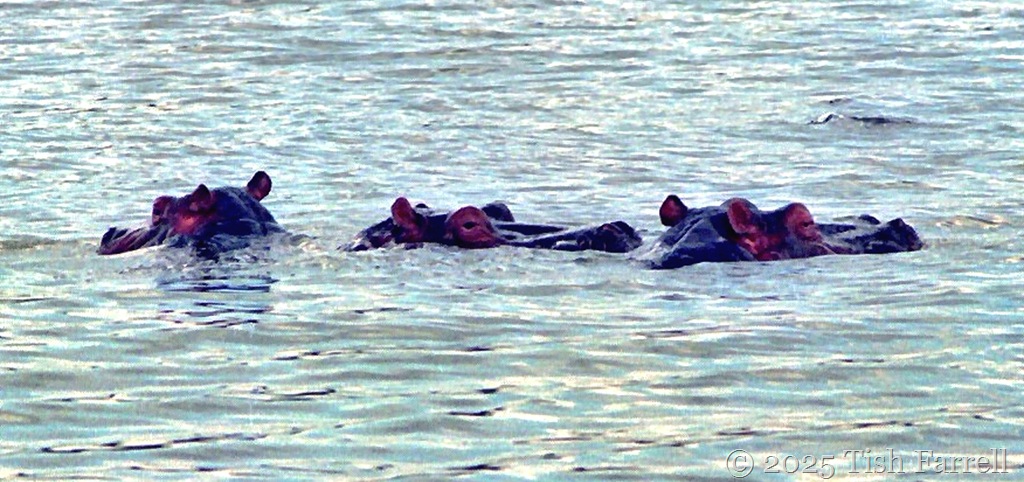
Hippos Naivasha

This week at Lens-Artists, Anne from Slow Shutter Speed sends us on a virtual scavenger hunt. I haven’t been in the old Africa album for a while, so I thought I’d have a rumage there. A virtual mini safari as well then.

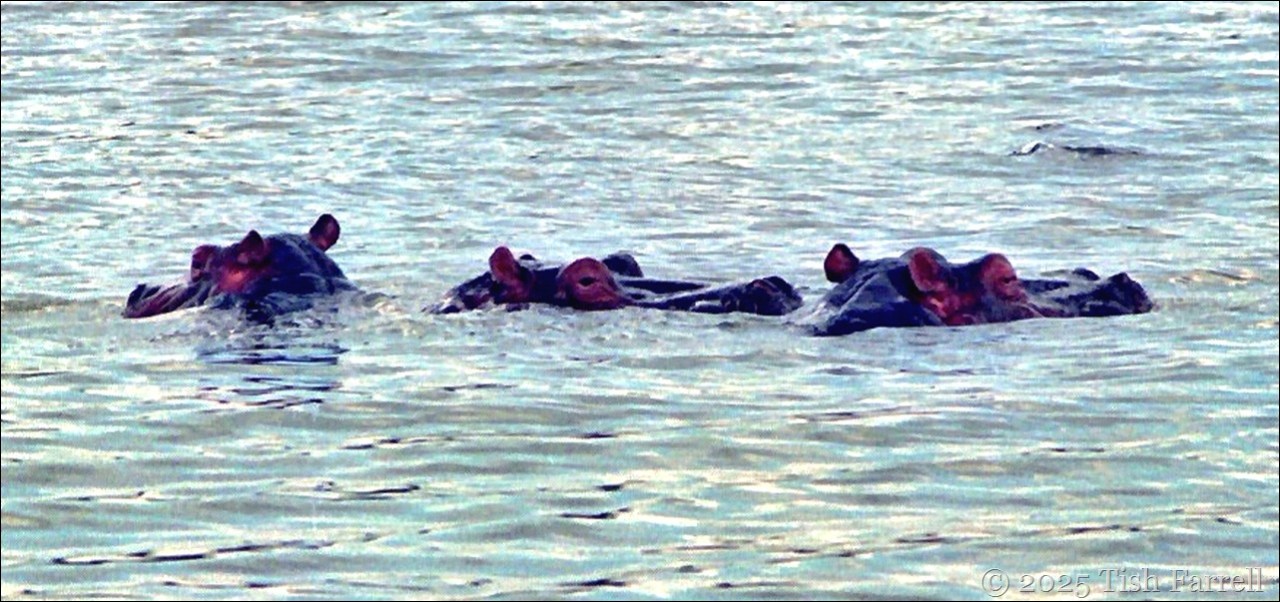
‘Wavy lines’ tops the list. The header thus features a wavy profile of hippo ears, eyes and noses in a wavy Lake Naivasha in the Kenya Rift Valley.

*

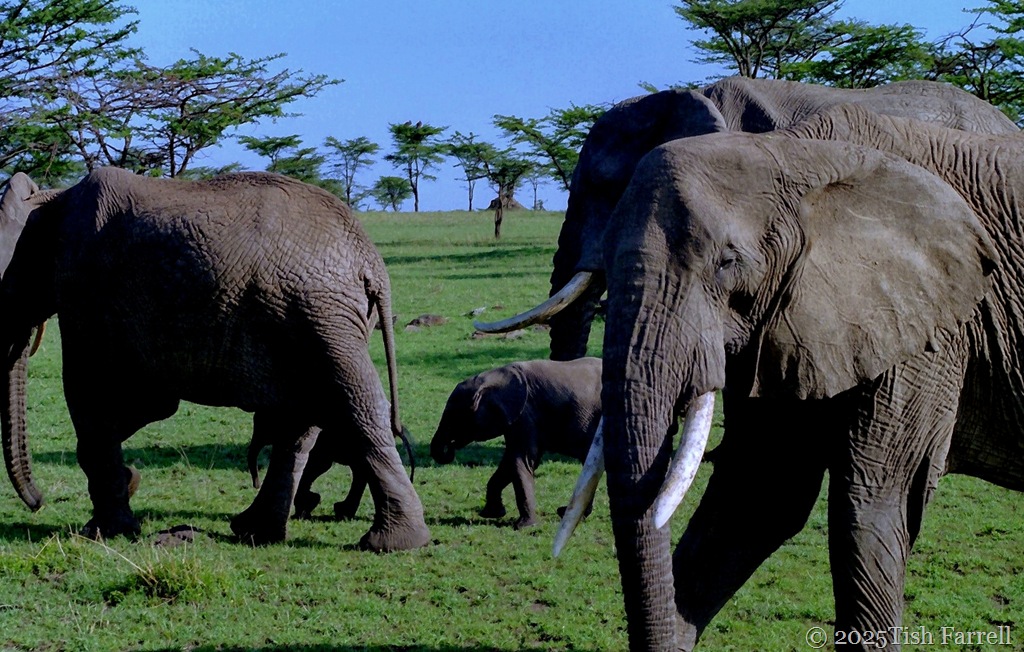
Maasai Mara elephants

This herd of Maasai Mara elephants was in a very peaceable mood. They walked around us as we were parked up eating a picnic breakfast. I’m thinking elephant hide would feel pretty ‘bumpy’ should one ever dare to try it, especially the trunks.

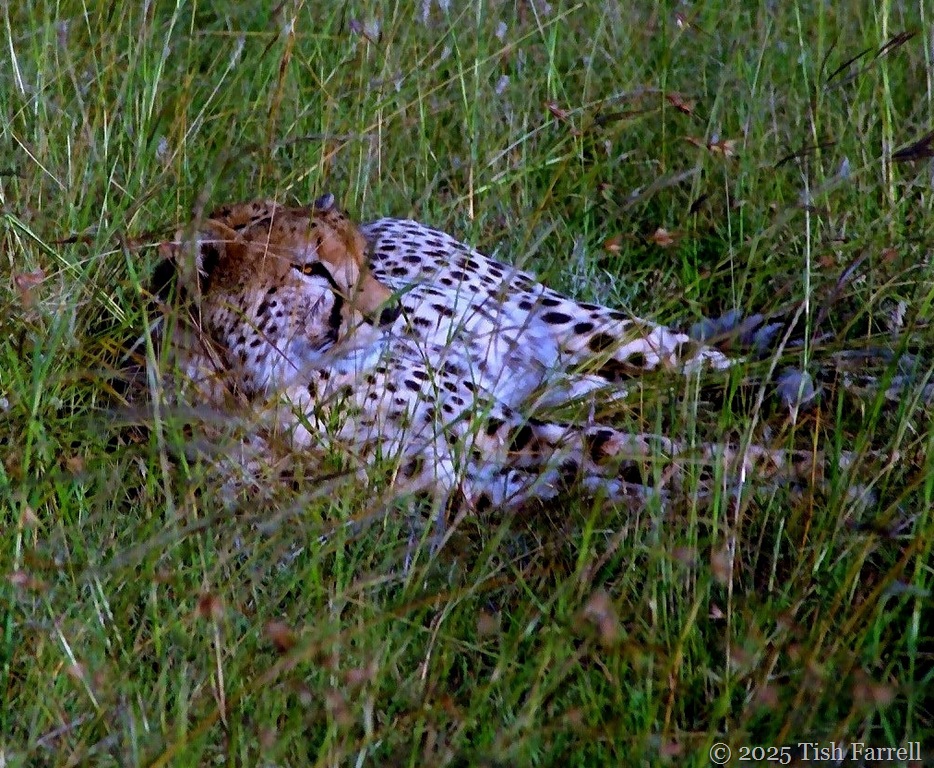
Whereas cheetahs must be wonderfully ‘soft’. They also wear nice ‘circular’ spots. This female was having an afternoon siesta when we pulled up beside her in a safari truck. She didn’t look at us, but simply posed like a professional, well used to having her photo taken.

cheetah

*

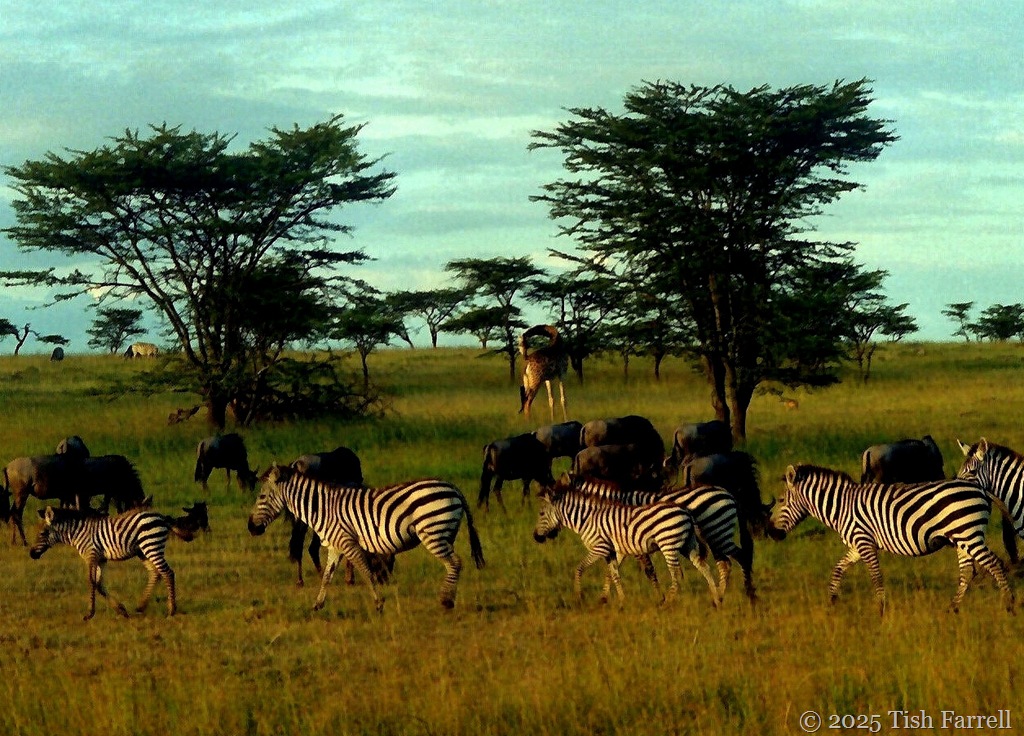
And more ‘patterns’. This time stripes. Zebras come with wavy ones:

Zebra sunset Maasai Mara

And then there’s another Kenyan speciality, patterns-wise:

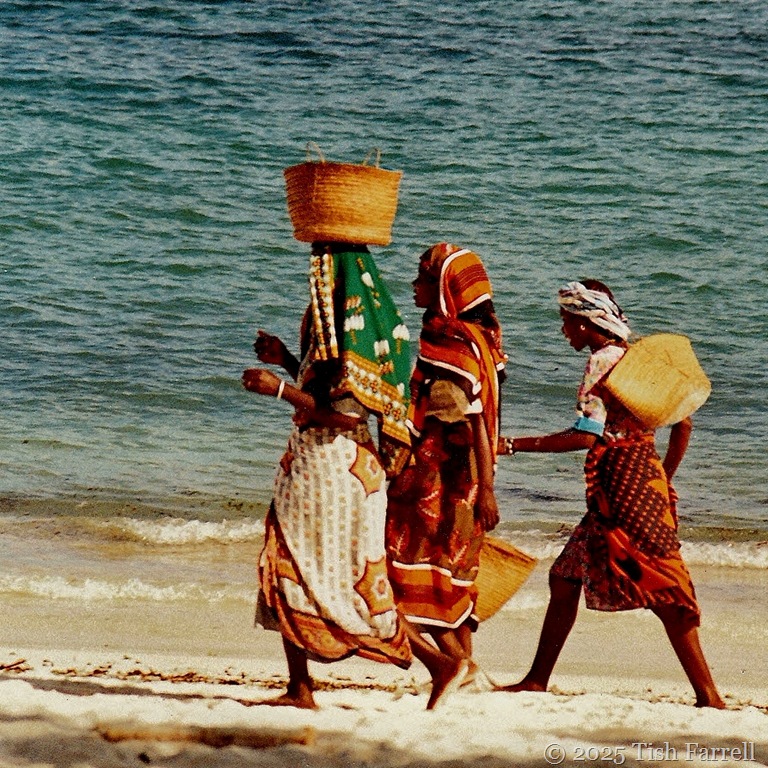
Digo girls in kanga wraps

Cotton kanga wraps come in pairs with vivid designs and snappy Swahili slogans on the hems, here worn by Digo girls on Mombasa Beach.

*

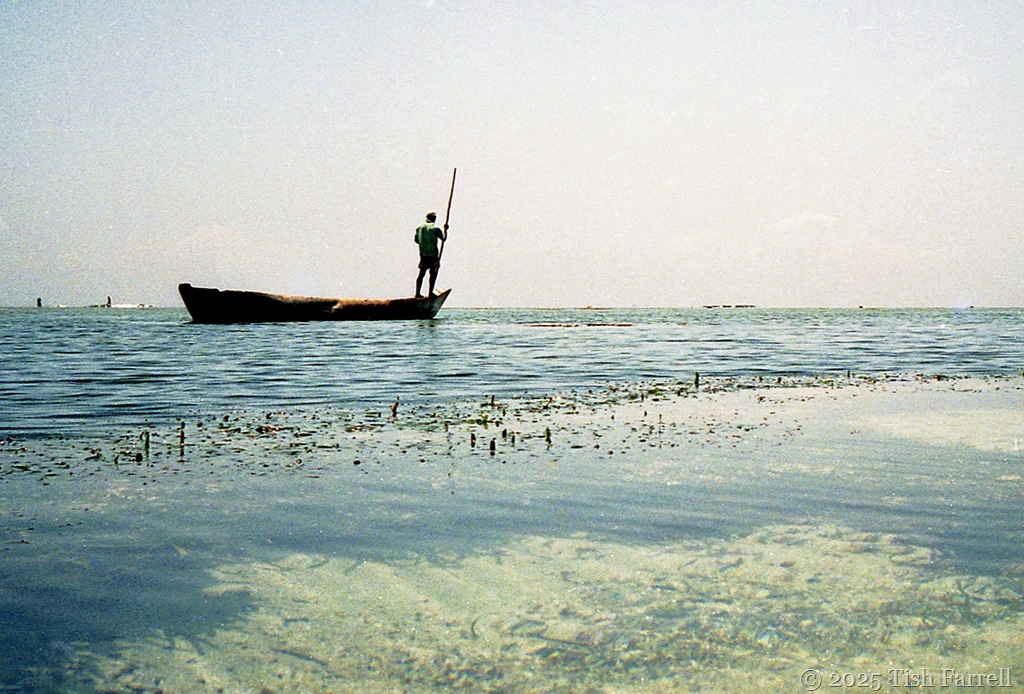
Tiwi fisherman

Now for ‘smooth’ water and a smooth dug-out canoe on Tiwi lagoon. A Digo fisherman under the midday sun. I’m guessing he’s looking for reef lobster.

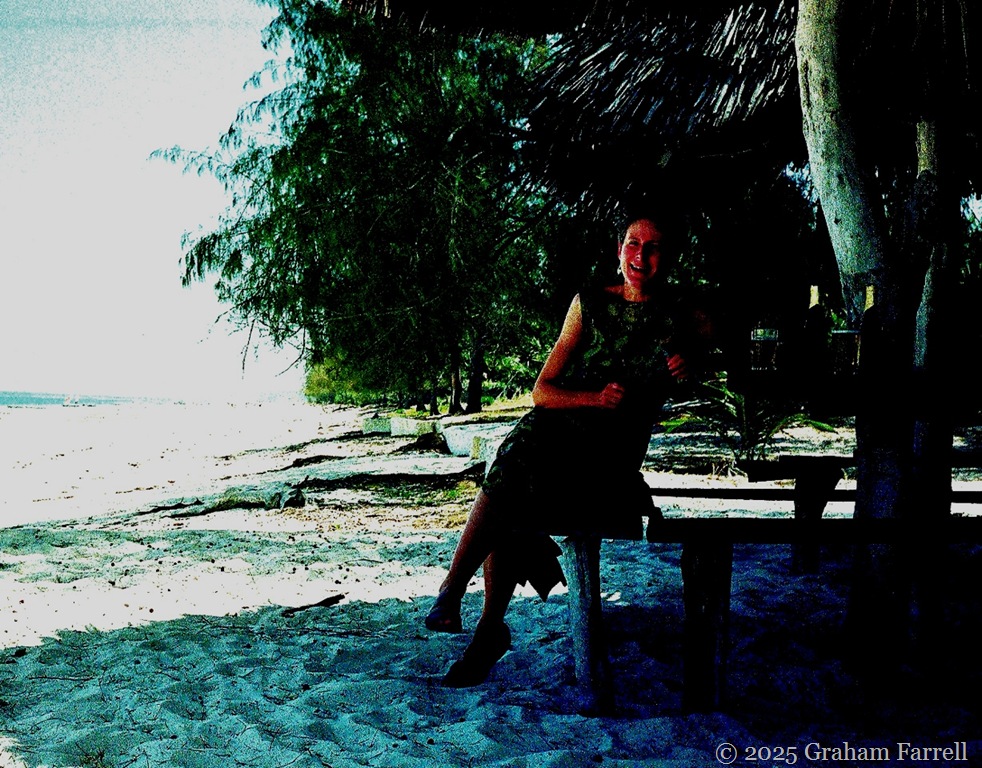
And as for ‘cool shadows’,  here’s me escaping to some at a Tiwi beach bar. Not so much too hot, as too bright to see out on the white coral sand. Aaah! Those were the days.

Cooling shadows

*

Lens-Artists: Virtual Scavenger Hunt  This week Anne at Slow Shutter Speed sends us on a photo quest, five to ten of the following: wavy lines, bumpy or soft texture, patterns, things circular, rectangular, smooth, made of glass, something with water in it, with green eyes, a wheel, a camera, cool shadows or jewellery…

Hippos Naivasha header

After The Harvest: Of Stubble And Straw

BC lines

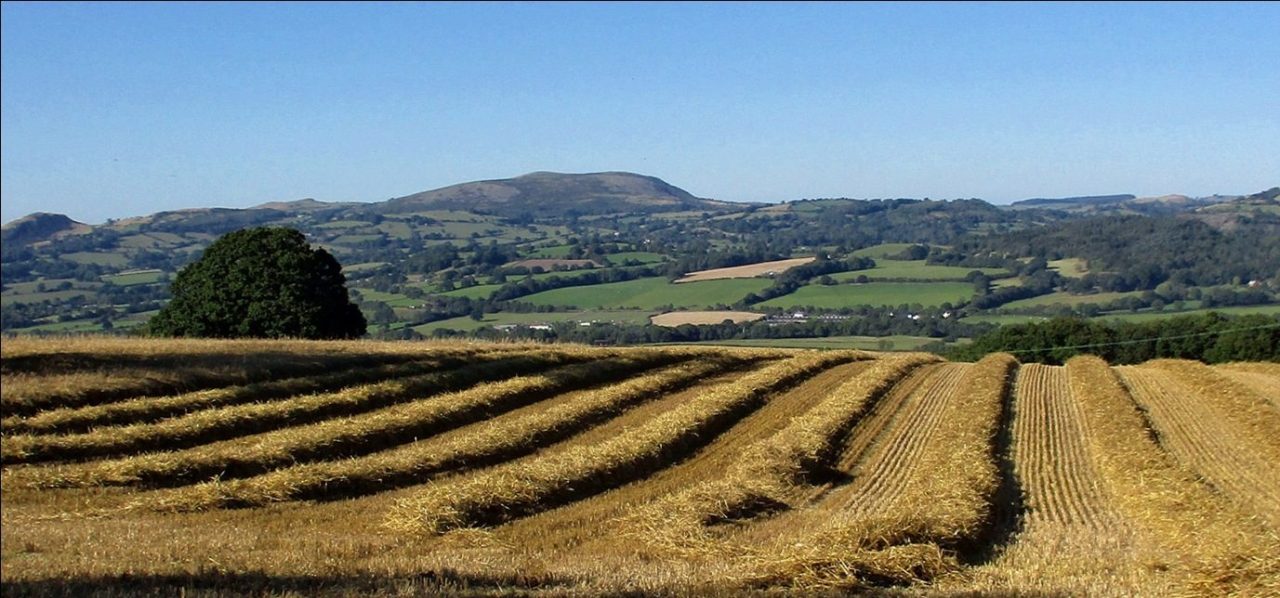
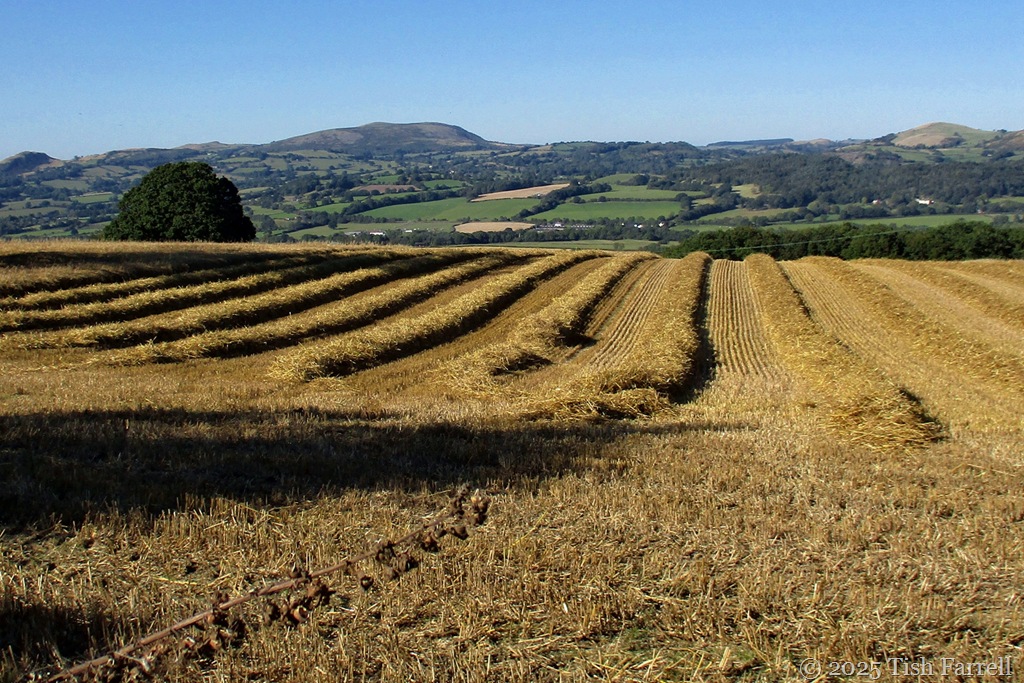
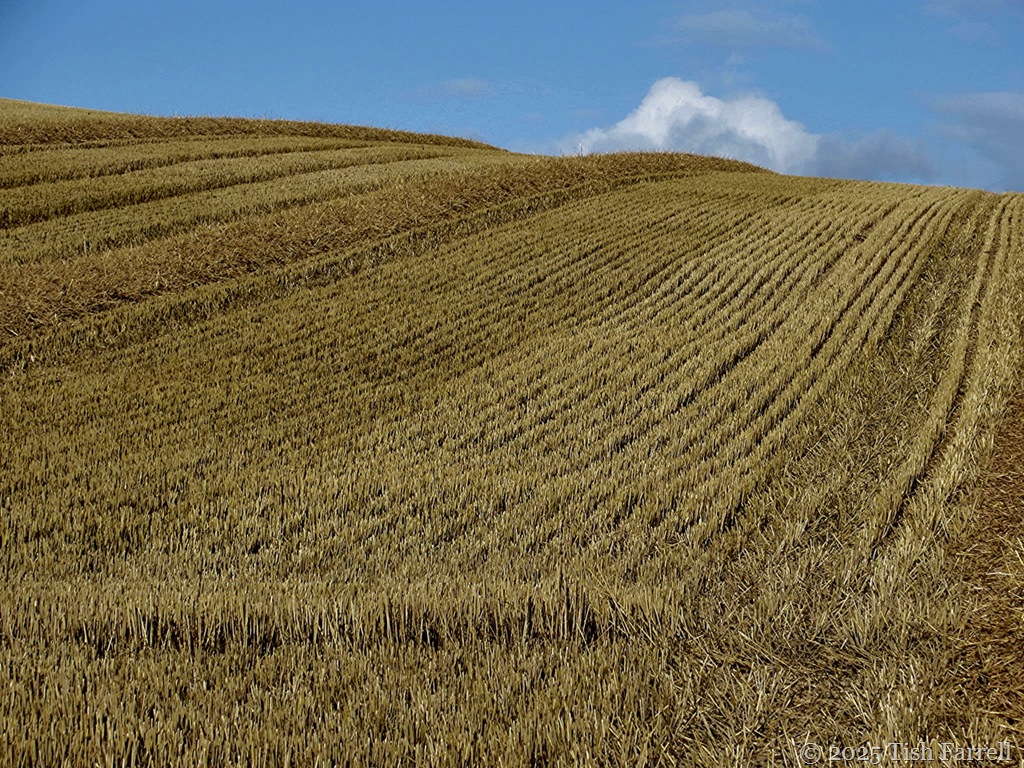
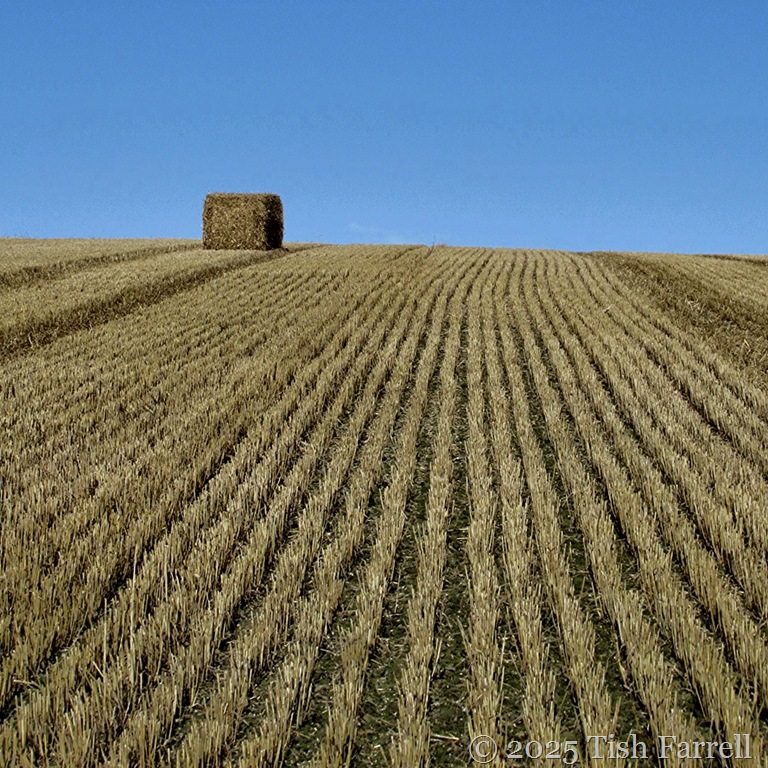
Come August and this year’s harvest has already been and gone. A good month earlier than usual. And somehow we missed it, we who live in the midst of rural Shropshire. In fact, when we drove out of Bishop’s Castle last Saturday, it was quite a shock: wherever you looked the wheat and barley fields lay shorn, the straw baled, or rolled in roundels, the remnant stubble pale and parched. Fields stripped.

How could we have missed so much activity and industry. Did we not hear the combines’ drone?

Along the lanes, too, the hedgerows had that dull and dusty out-grown look of late September. Dock and hogweed gone to seed: russet and deep umber shades of autumn. And again: how could this be? Had we been asleep, Rip-Van-Winkel-like, and lost a chunk of summer? Or had time skipped a month or two?

No. Simply distraction on the home front, gardening and household pursuits. Letting the world pass us by through weeks of day-on-day sun and rainlessness, which of course is the reason why the harvest was so early.

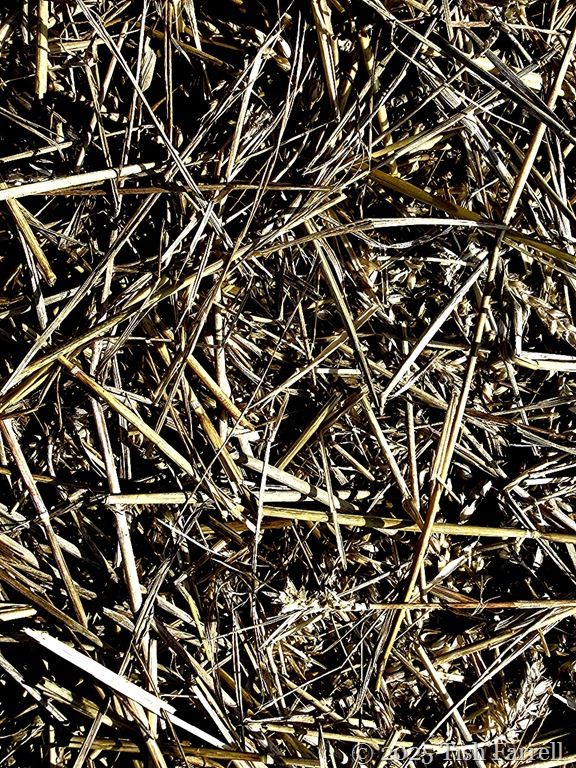
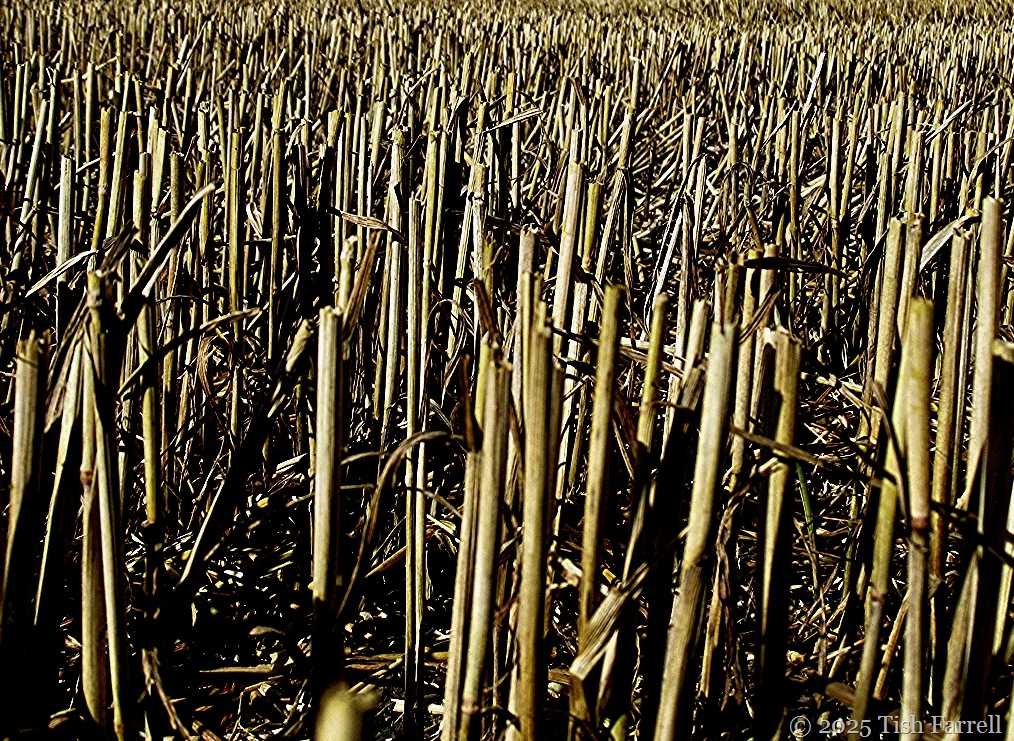
But now it has me reflecting on the beguiling looks of stubble fields, and thus a posting of photos of harvests past, of pared down textures, bare lines and simple colour palette of monocrop farming. I find myself attracted to the spareness of these humanscapes, although wary, too, of the high high-techery that produces such results. This is not the kind of farming I grew up with, the cut wheat stacked in stooks to dry, the arrival of the threshing machine, a monstrous sight over our garden wall, the contraption that, hung in sacking shrouds, throbbed and shuddered, spewing out clouds of chaff as it garnered precious grains from stalks and husks.

Hey-ho. More time slippage.

[The header and final photos were taken mid-September last year above Bishop’s Castle. The in-between shots are from Townsend Meadow, below Wenlock Edge]

lines 3

IMG_3993ed

lines stubble

lines 2

IMG_6231ed

Lens-Artists: Lines, colours, patterns  Johnbo asks us to explore these tools of photo composition.

Waiting For Rain…In Kenya Past And Shropshire Present

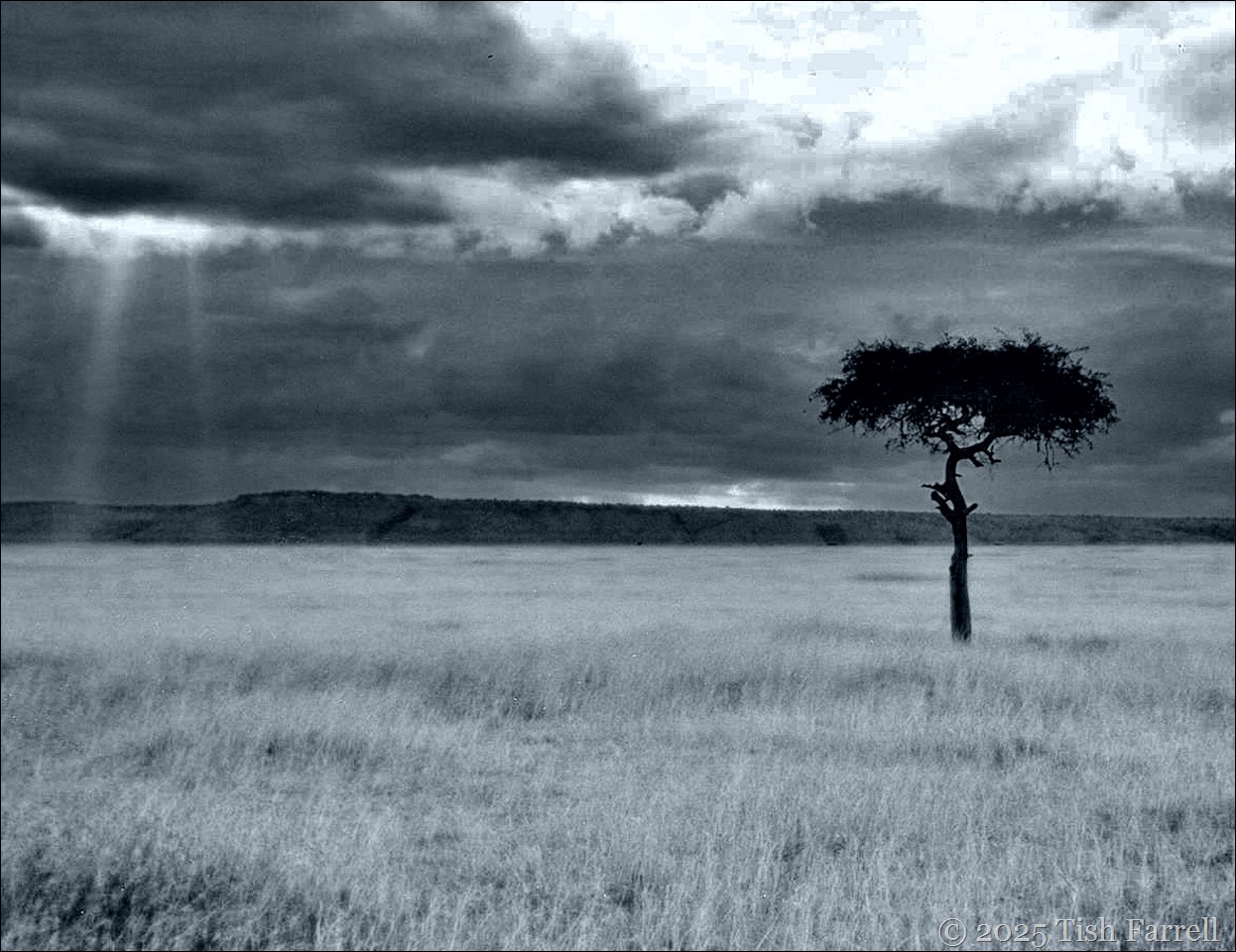
desert date mulului tree

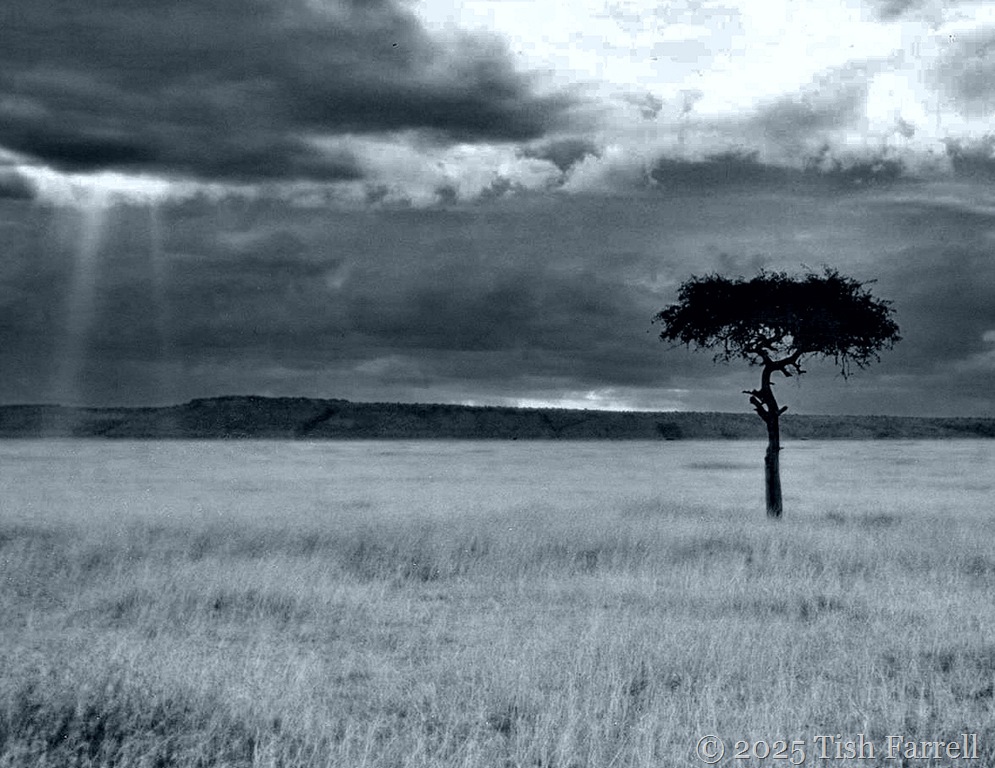
Maasai Mara with desert date tree

*

We’ve been living back in the UK since 2000, our years in Africa increasingly faraway. And yet…

And yet this spring and summer in Shropshire we’ve been very short on rain. The temperatures, too, have recently risen after a cold and windy spring. My gardening self grows anxious. Several times a day I do the rounds of my vegetable plots, checking on the kales, chard, beans and potatoes, the onions and leeks, examining the greenhouse tomatoes and cucumbers for signs of stress. My hands are always dirty, soil crushed under nails, as I prod the soil, testing for moisture levels around the plants.

It makes me think of Kenya days, pastoralists like the Maasai depending on rain to replenish the grasslands for grazing, cattle their life-blood in every sense;  village farmers waiting for the November-December small rains for sowing; for the long rains March to May to bring the crops to harvest: lives and livelihoods dependent on monsoon weather systems that are nothing if not capricious.

Nor is this new. Oral history accounts, some going back two or more centuries, make reference to periods of drought and famine. One type of oral record is the memorized male circumcision list that survives in some communities. The rite  was carried out every ten years or so, and the given year commemorated by some notable event. Food shortages were often inferred.

For instance the list for Maragoli in Western Kenya has 1760 as the time of Kgwambiti. Our Maragoli house steward, Sam, interpreted this as people behaving selfishly like animals, suggesting a food shortage. Likewise Vuzililili  for the year 1800, a time when small insects fed on large insects. Then in 1900 Olololo-Lubwoni – refers to a time when jigger fleas (olololo) infested people’s feet, implying that that households were dusty and not swept properly. Lumbwoni is a very thin sweet potato, also suggesting drought and lean times.
img120 ed

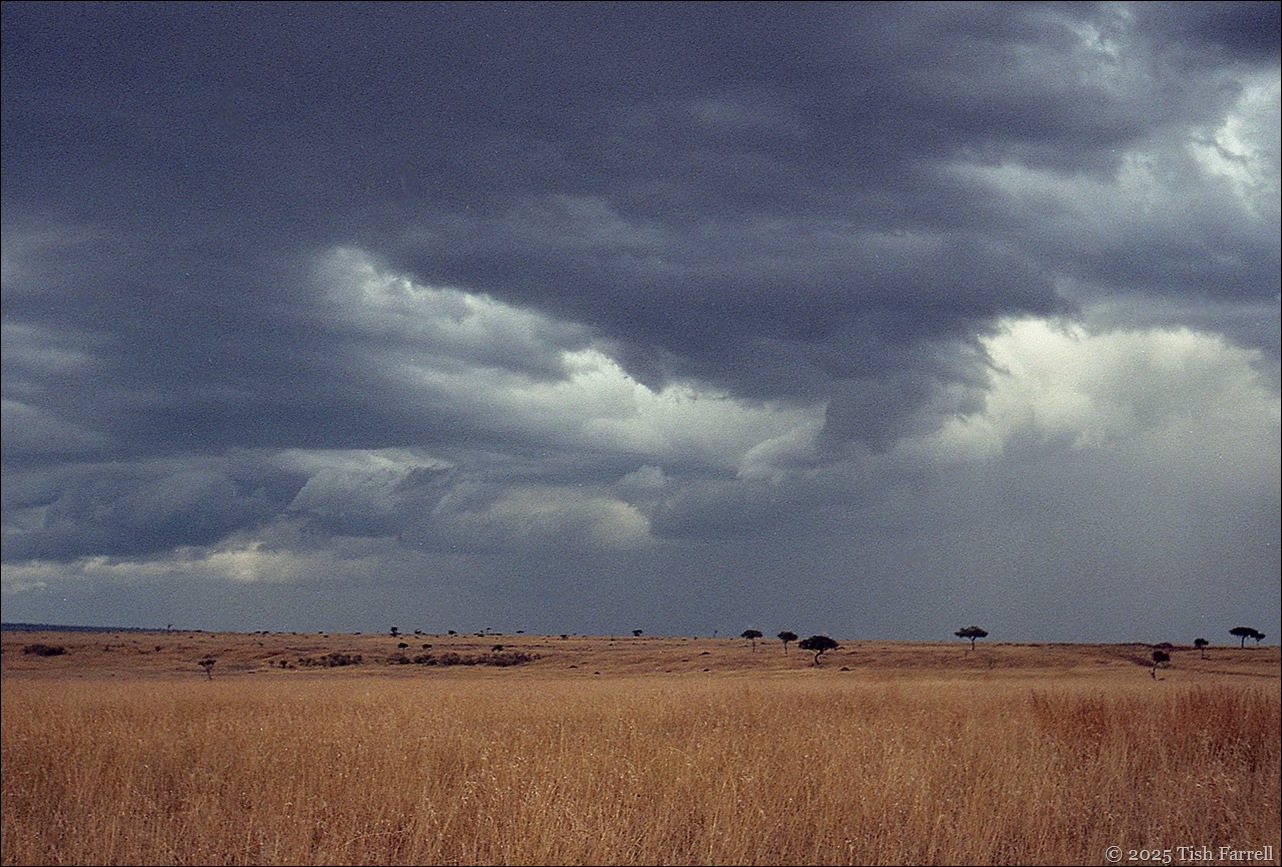
Another remarkable source of rains failure evidence is the revised historical events calendar used in the enumerators’ guide to the 1969 Kenya census. At this time many rural householders would have been born in the 19th century, or else reckoned family chronology according to particular past occurrences. For semi-arid Ukambani, a drought-prone region in southern Kenya, it was generally agreed that there had been six significant periods of famine in the 19th century: Ngovo (1868); Ngeetele (1870); Kiasa (1878); Ndata (1880); Nzana (1883) and Ngomanisye or Muvunga (1898).

In the past, too, it transpired that the Akamba people had established emergency strategies via extended kinship allegiances. This involved moving from the worst stricken areas and, for a time, living with relatives who were not so badly affected, or who had their own water-holes. Rules of reciprocity of course applied; this was not charity.

It was important, too, that in pre-colonial times the Akamba had a sphere of far-flung connections through their hunting and trading activities, one that extended into what is now Tanzania. This increased the scope for finding sanctuary from drought-stricken regions, but of course was curtailed when the colonial administration consigned each ethnic group to a designated reserve, basically drawing a line around the territory that each community apparently occupied at the time when the British arrived; self-determination being duly cancelled by a line on a map.

But perhaps the most compelling evidence for the enduringly random state of weather across East Africa is the deeply embedded cultural phenomenon of the rainmaker. Every community had them; perhaps still does. They were often rich and powerful individuals. And contrary to what may be imagined, the forecast of rain was mostly based on informed careful observation of natural phenomena, including the movement of clouds, wind directions, dew formation, the behaviour of particular hygroscopic plants and trees that respond to rises in ground water, the arrival of particular species of birds and insects. Such observations informed planting decisions, the particular crops chosen, the times and places they were sown.

It’s tempting to think our Met Office could learn and thing or two.

And so I ponder again on our lack of rain. Our lives do not depend on the success of our garden produce. The Co-op’s daily deliveries of fresh food are two minutes’ walk from the house. I anyway have an outside tap and a clutch of watering cans. The water is always there. (Or at least it is for now). A luxury however you look at it. But even so, the daily sight of parched soil does seem to trigger some bred-in-the-bone alarm system, all those generations of farmers and gardeners in my family tree worrying…

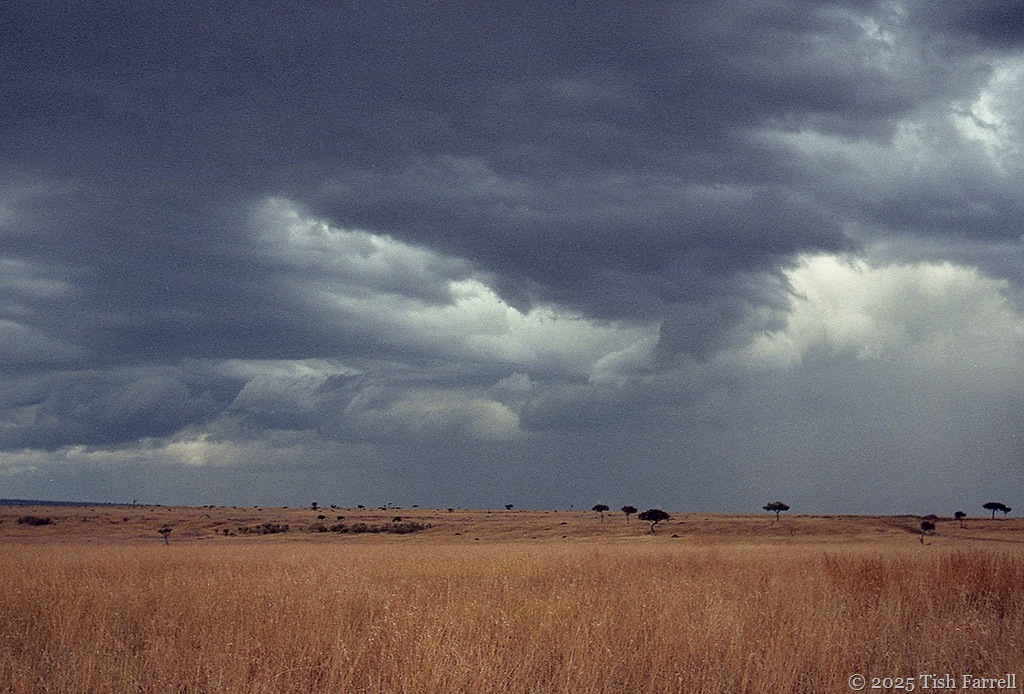
And so the sky-watching continues, the hopeful eyeing up of every darkening cloud.

And probably also, in the not too distant future when the rain comes, there will be the ungrateful complaint that it doesn’t seem to know when to stop.

*

copyright 2025 Tish Farrell

Lens-Artists: Stormy This week Beth wants to see scenes of storminess.

Hippos Under The Carpet…

img039ed2

This past week at Lens-Artists, Tina has wanted to know what we were thinking as we took our photos. This led me back to the old Africa album of vintage slides and photos from when we lived in Kenya.
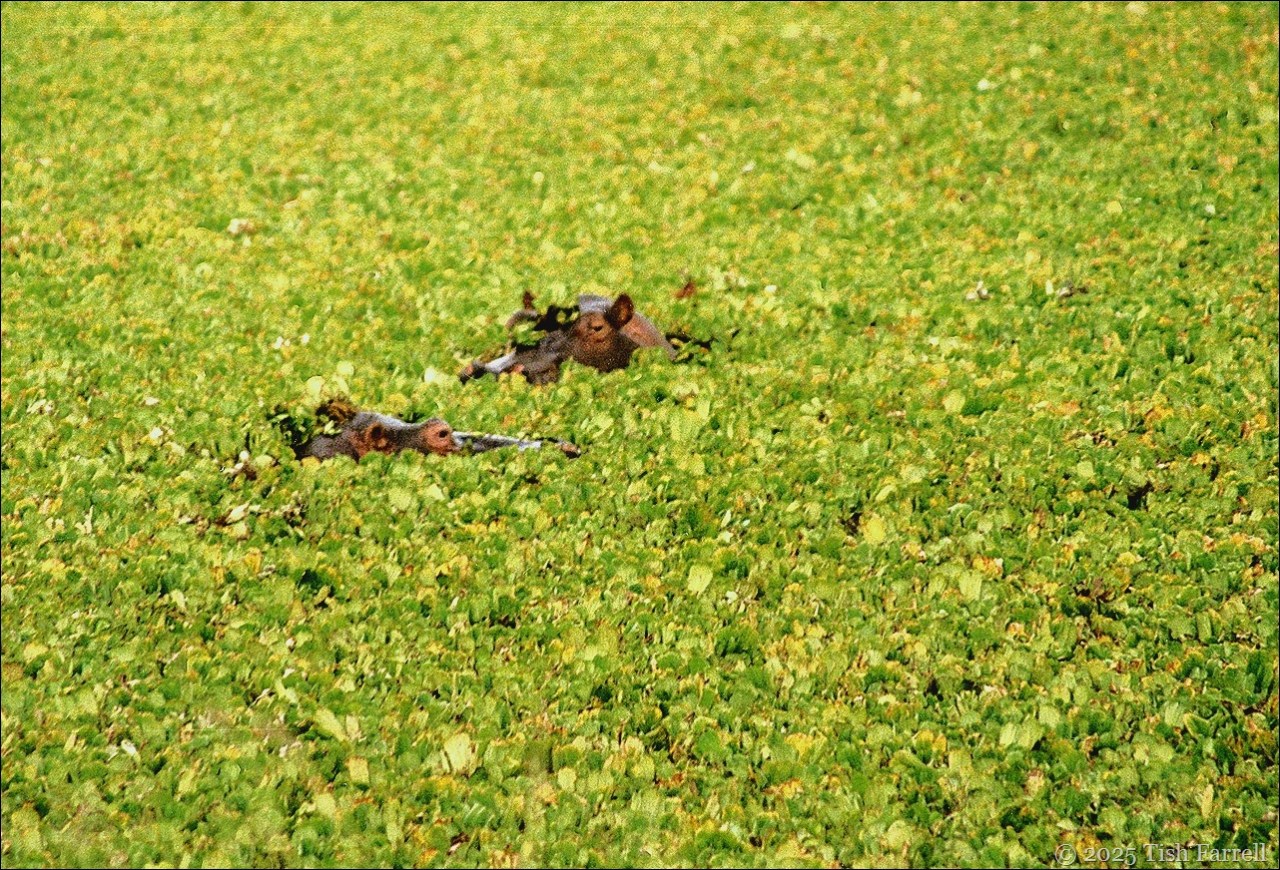
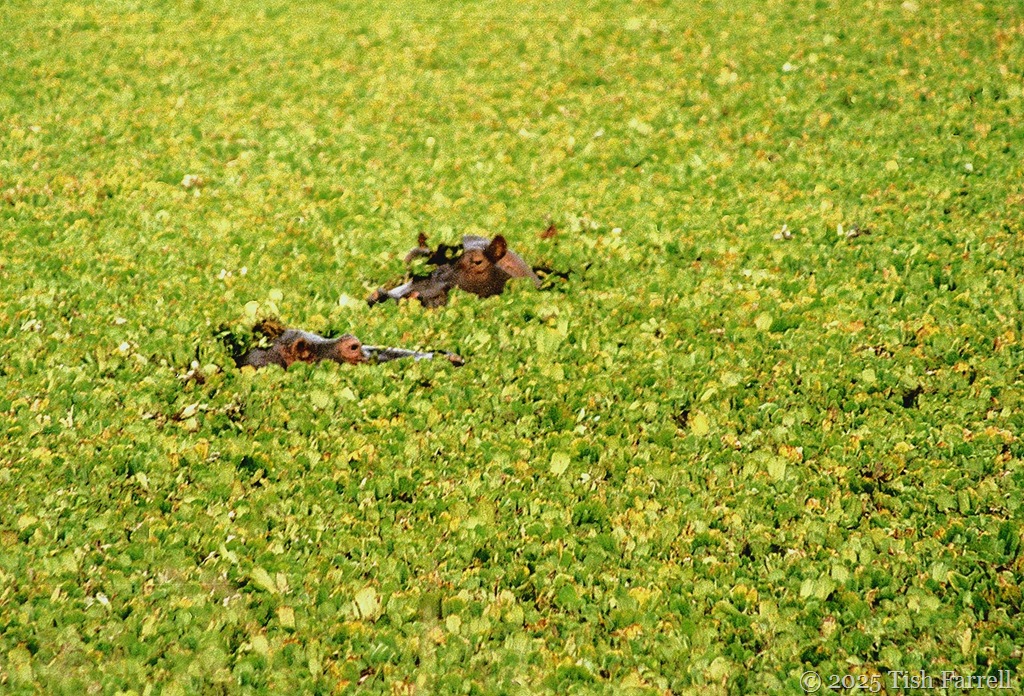
The header photo did not scan too well, but it was such an unexpected moment, it still makes me laugh.

There we were driving along a dry savannah track in the Maasai Mara, the only water (or so we thought) some distance away in the Mara River, when suddenly we were alongside an even spread of water-loving cabbage weed. Weirdly, it seemed to be growing on a level with the grassland. No sign of the water underneath though, and so no sense of depth…

…until up popped the hippos to give us the once over as we passed. It was hard to take in. How could such huge animals have squeezed themselves under this seeming thin layer of weeds. It conjured a surreal image of a large living room with a huge pile rug and numberless unseen hippos lurking underneath.

*

maasai mara_0004ed

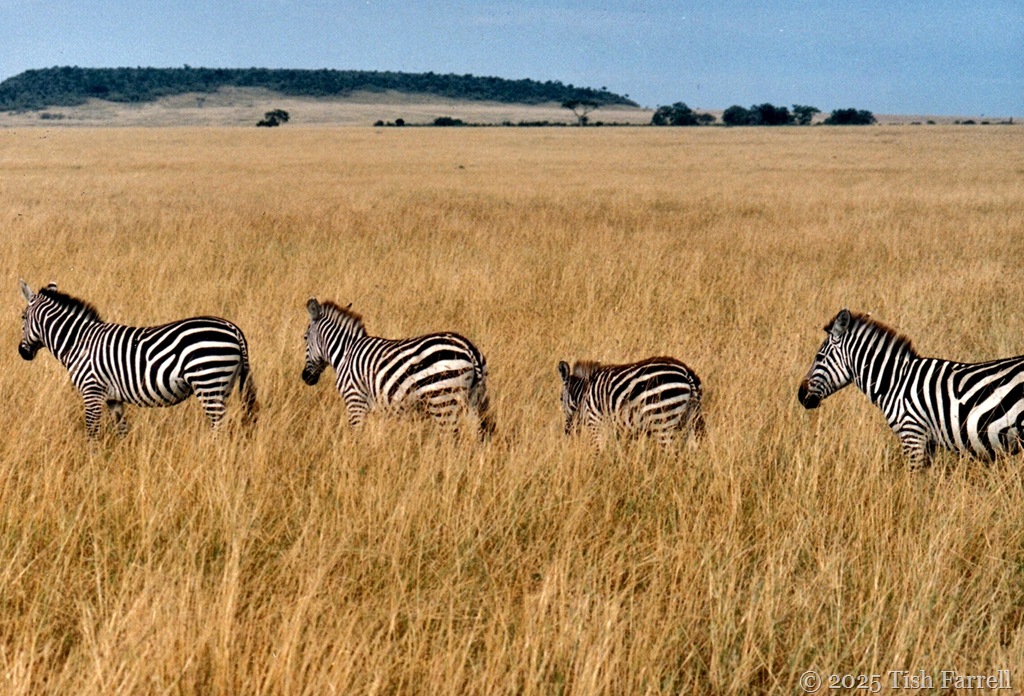
Of course you can tell what I was thinking here: African plains with zebra crossing.

*

cheetah 6

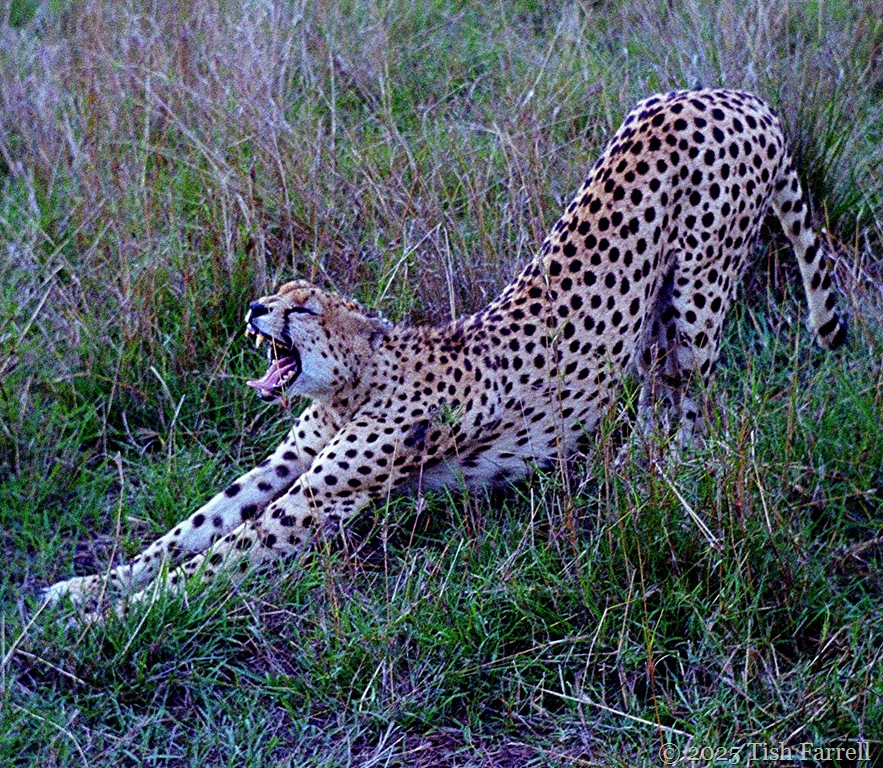
A spot of yoga anyone?

*

Mara 8

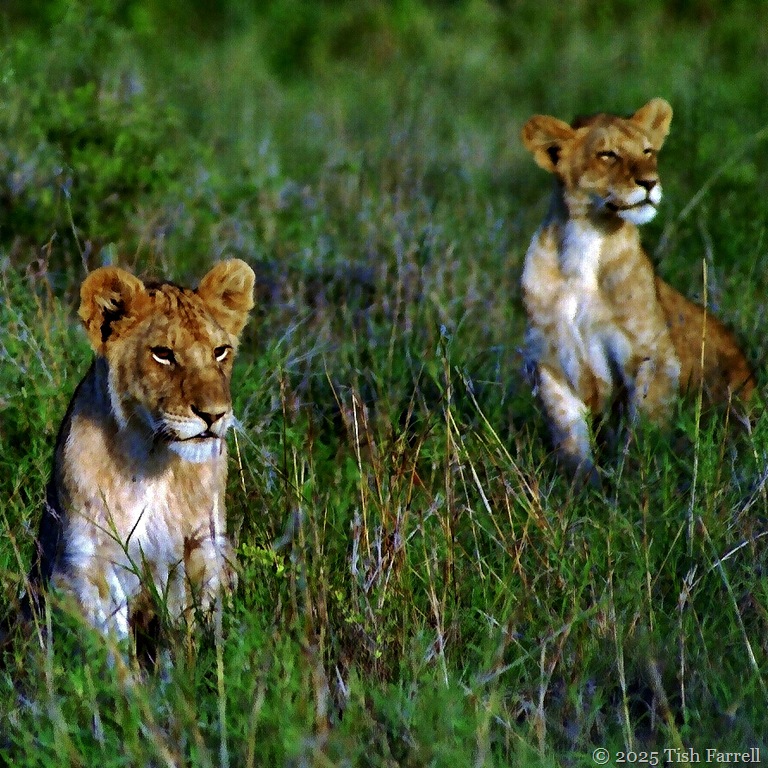
And now who remembers the Bisto Kids advert? That young lion on the right seems to be savouring some delicious aroma; probably not gravy…Aaah! Wildebeest!

Lens-Artists: The first thing I thought of…  This week Tina sets the challenge. What were you thinking when you took the photo.

Serenity ~ Inside And Out

P1060459 - serenity

There are vistas that manifest serenity – at least as seen through human eyes. (I mean who knows what fervid biological imperatives are playing out beneath the calm surfaces of things).

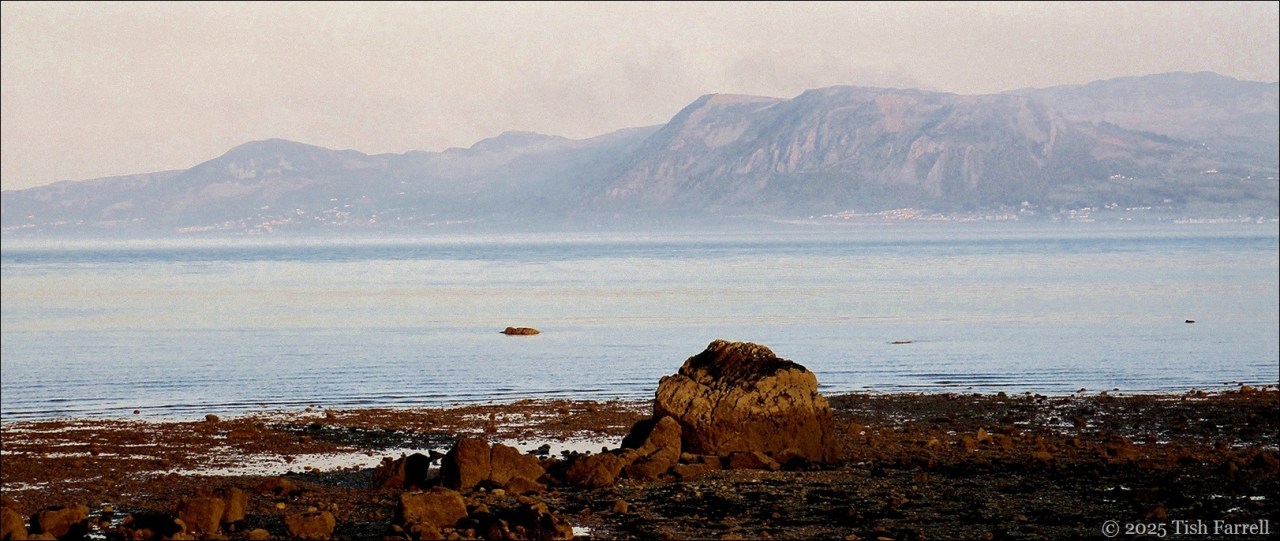
This distant view of the Great Orme from Anglesey was shot on a late December day, the air so still there is barely the hint of a tide. No clouds either, and the sun warm enough to go coatless and believe the seasons have fast-forwarded to June.

*

Another ‘still waters’ scene. An end-of-summer sunset in Kalamata. I watch a naked man wade into the rose-tinted shallows of the Messenian Gulf, talking on his cell phone.

serenity

*

And a third sea-serenity scene: another December, this time long ago, a tropic summer afternoon on the Manda Strait; Lamu, dhow captain Mzee Lali dreams.

Scan-140801-0001serenity

*

Then there are things that induce a sense of serenity in me. This unruffled cloud for instance…

IMG_6932

*

The close-up view of hawthorn blossom and the scent of lilac…

IMG_7582

*

The gentle fragrance of bean flowers and pleasing thoughts of beans to come…

IMG_7640

*

And the all embracing company of trees…

100_5864ed

*

…whatever the season…

P1050998ed

P1030637

Lens-Artists: Serenity  This week Egidio at Through Brazilian Eyes sets the theme. Please pay him a visit.

Breaking the rules: more by accident than on purpose…

P1060350ed

I’m not sure what was going on when I took this photo. An unintended composition, methinks: camera aslant; subject leaving the scene; shooting into the sun.  An all round combination of errors, but then I also quite like the end result.

*

P1060737 (2)n

Here both the camera person and the subject were on the move, in other words, me snatching this shot of an uphill cyclist through the car windscreen; caught on a bend in the  Llanberis Pass, North Wales.

*

Next at Plas Newydd, Anglesey in late December, taking a photo when there wasn’t enough light and leaving a twig in the way:

P1060709

*

IMG_7108

Taken on Newborough Beach back in March: too much negatives space; subject out of focus and also leaving the frame. But then that’s kite-flying for you.

*

And camera on the wrong setting for a winter’s day on Seaton Beach, Cornwall. It seems to have created an oil painting effect:

P1020711ed

And last but not least of strange creations:

IMG_2134ed

It took me a while to work out what I’d done here. Basically it’s a photo of a frosted spider’s web stretched outside the window of other half’s old Wenlock shed. But you can see both the shed interior and the reflection off the window which seems to show neighbouring rooftops and some of the garden.

Lens-Artists: Break the rules  This week Ritva tells us to break the rules. See her post for some inspiration.

Cinematically Cornish

P1080012cheesewring Bodmin

This week at Lens-Artists Sofia calls for a cinematic approach to our photography.

This is what she says:

“There are a few things that give a photo that cinematic feel: camera angles, bold and high-contrast colours, light, locations, just to name a few. The main objective is to take a shot that is part of a story, there’s mood and a sense of location; our image is but a snapshot of a much wider situation.”

The first four photos here were taken one bleak spring day on the edge of Bodmin Moor near Minions in Cornwall. This, Great Britain’s most south-westerly county is a land of dramatic vistas: of high moors and rugged shore-lines. There are stories everywhere, layered through time like the ‘pillows’ of this granite tor, known locally as the Cheesewring.

The tor has its own stories of course. The first is one of weathering over millions of years, wind and rain driving into its crevices. Then there is the Dark Ages tale, from the post-Roman times when Christian missionaries  were beginning to make their presence felt. The proponents of new faith were not always welcomed, and so the formation of the Cheesewring is explained as the result a quoit-throwing contest between Uther the giant and a saintly missionary named Tue. If Uther won, then the Christian must go. Th giant lost of course.

The Cheesewring name itself has different derivations – either a straining device for making cheese, or else relating to cider brewing wherein the press of apples to a pulp is referred to as cheese.

There also some mystical notions, for it’s said that if you come to the Cheesewring as day dawns you will see the top ring turn three times. Which makes me wonder if that crow might have something to say on the matter.

*

Below the Cheesewring we step back into the remnants of a prehistoric landscape: three Neolithic stone circles called the Hurlers. But as to that figure apparently hovering on the horizon – who knows what time stratum he belongs to.

P1070982ed

P1080022ed

Looking through the Neolithic circle we come to another narrative: one belonging to the 1850s – 1890s when the South Phoenix Mine was churning out train loads of copper, a time when over 3,000 people were employed here – women and children included.

P1070983ed

There is more about these stories at an earlier post: ‘Hurlers and Miners: 6,000 years of heritage on Bodmin Moor’ HERE.

*

Cornwall does have its own cinematic history. Several Cornish based novels by Daphne du Maurier have made it to the big screen, some in duplicate versions – Rebecca, Frenchman’s Creek, Jamaica Inn, My Cousin Rachel. Her deeply disturbing short story,The Birds, is also set in Cornwall, although Hitchcock chose to transpose it to San Francisco. Du Maurier’s works are usually classed as romances, but they also have dark undercurrents, sometimes touching on the paranormal, their settings the wilds of Bodmin Moor, brooding mansions, sheer-drop sea cliffs, rocky coves and crashing surf.

So here are some more Cornish photos, taken one gloomy December, and with a little nod to Daphne du Maurier’s sensibilities.

P1020701ed

*

P1020927 ed

*

P1020611ed

Lens-Artists: Cinematic This week Sofia at Photographias sets the theme.

We’ve Been Having Blue Sky Days…

IMG_7302 blue

*

They arrived with the spring equinox on March 20th…

IMG_7303 blue

*

… days hot in the sun, but ice-cold in shade, as if the air came straight off a snow field…

IMG_7307 blue

*

…yet so enlivening, it had us one day walking (instead of driving) to the builders’ merchants on the edge of town…

…spotting, as we went, wild cherry blossom, the bright white blackthorn that is everywhere in drifts on farm hedgerows, and then the distant green of wheat fields and fresh grassland.

IMG_7311 blue

*

Meanwhile, the town lanes and gardens have been aglow with magnolias, daffodils, pussy willow, forsythia, camellias, fire-red japonica…

IMG_7300 blue

IMG_7284

IMG_7287 blue

IMG_7326 blue

…and the cherry plum by the house has day by day been turning from pink to bronze, as blossom flutters off and gives way to leaves.

*

And so the Shropshire countryside has been drowsing in a haze of vernal glamour: an earth dream of a perfect spring come to life.

The blue sky days turned into weeks, three to be exact. Long enough for us to grow used to blissful weather, to think it ours forever.

In the garden, our faces turned often to the sun, we noted the little pear tree begin to flower…

IMG_7317 blue

*

…and the old apple tree by the compost bin burst with buds…

IMG_7361

…that then begin to open…

IMG_7366

*

…just in time for Sunday’s full moon and a complete change in the weather…

IMG_7372

*

Today there is grey sky, racing rain clouds and a piercing wind that gusts down the chimneys. It feels like winter when we walk to the shops, clad in sweaters, quilted coats and woolly hats. We’re cast adrift in seasonal confusion. Bereft. Abandoned by spring. How could she do this when we so loved the sun, the light, the crisp air?

Ah, well.  The weather people say the wind should lessen tomorrow, all but doubling temperatures from 6 to a soaring 11 degrees C. There might also be a view of the sun on Easter Sunday morning, but little to see in the following week. Instead, there will be rain, of which this gardener and the nation’s farmers are much in need. So it goes. All chop and change. Perhaps blue sky spring will be back in May.

copyright 2025 Tish Farrell

Lens-Artists: abandoned  This week Anne sets us the topic ‘abandoned’. Please see her post for more serious cases of abandonment.

Weather’s Untamed Ways…

IMG_6969 ed

…from heavenly ethereal to eerily supernatural:

IMG_7161ed

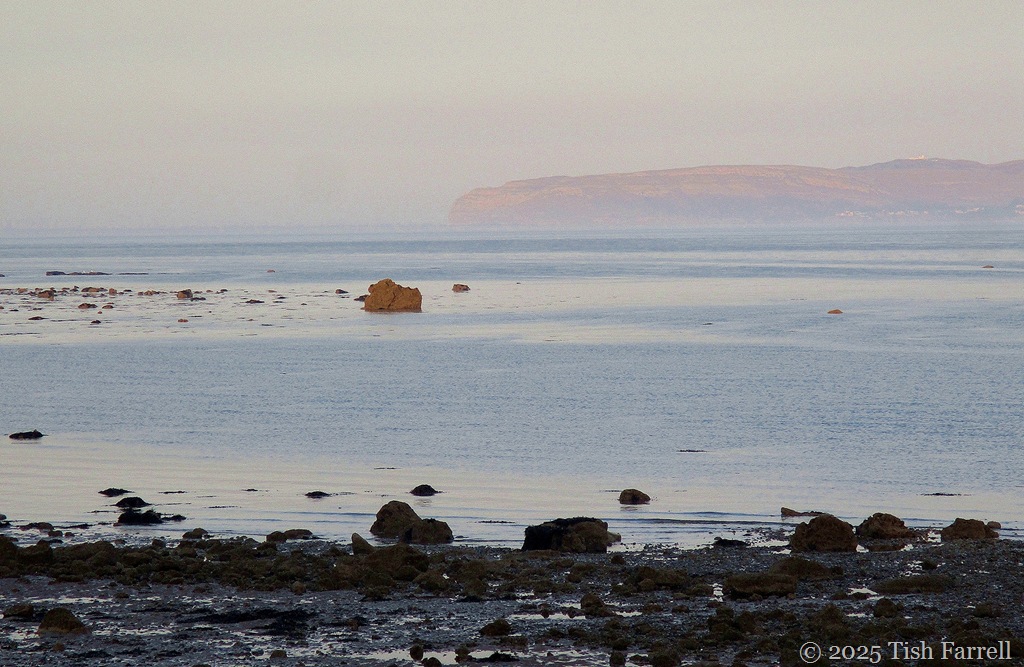
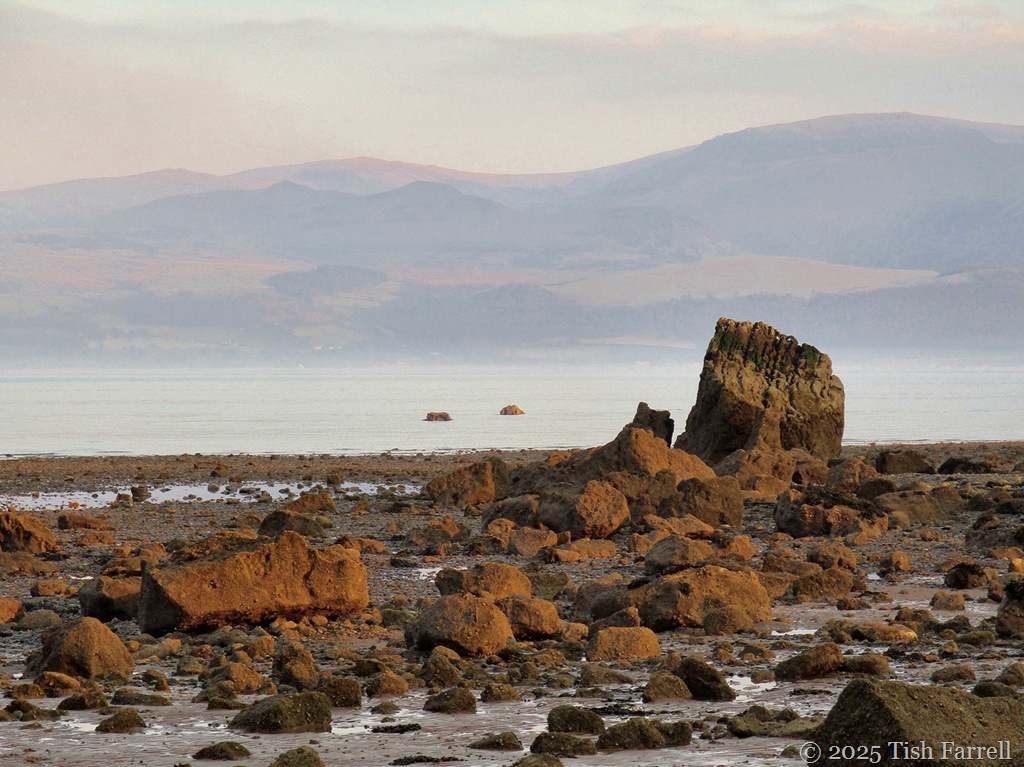
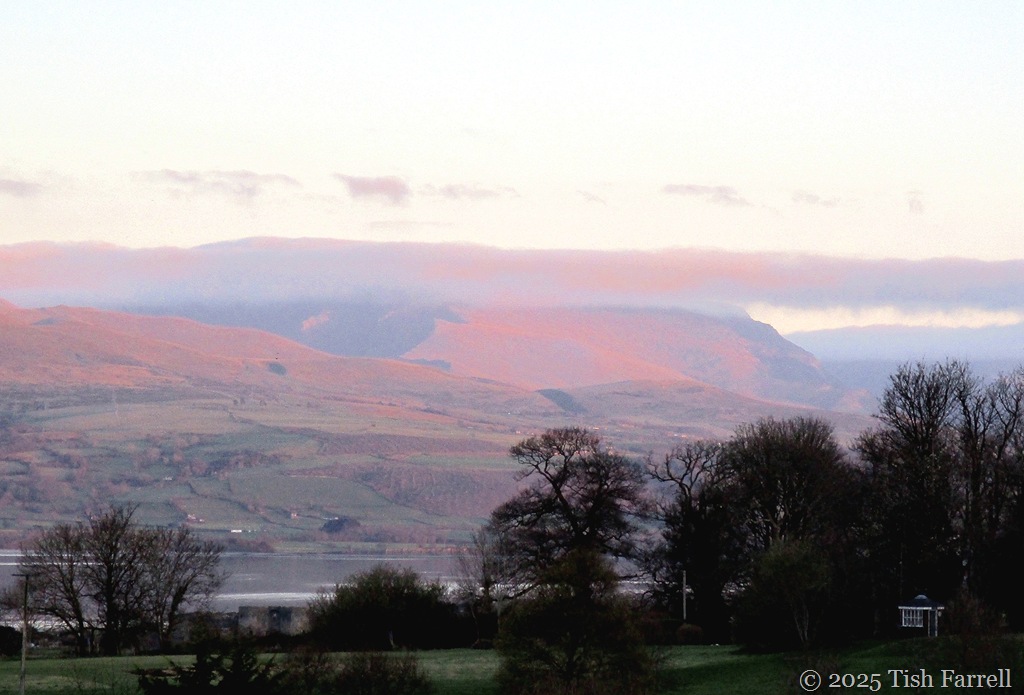
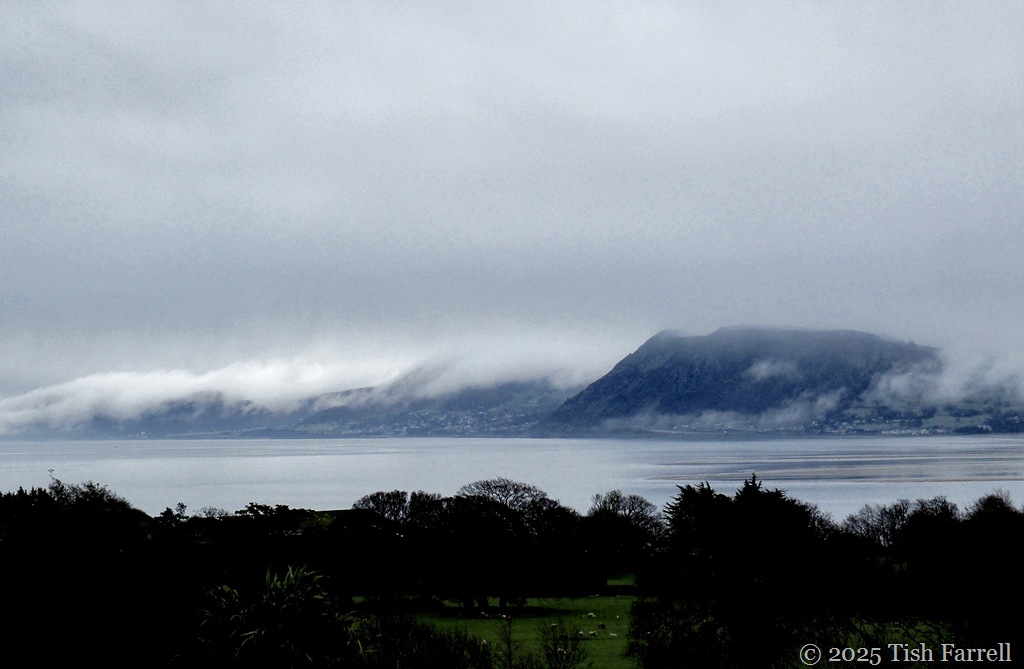
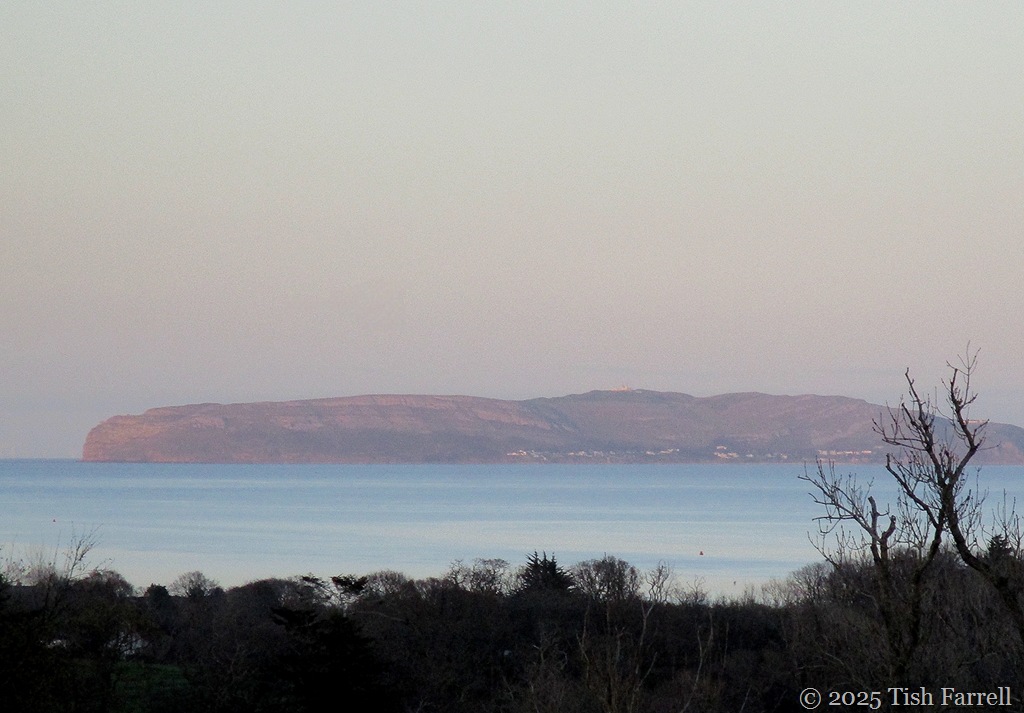
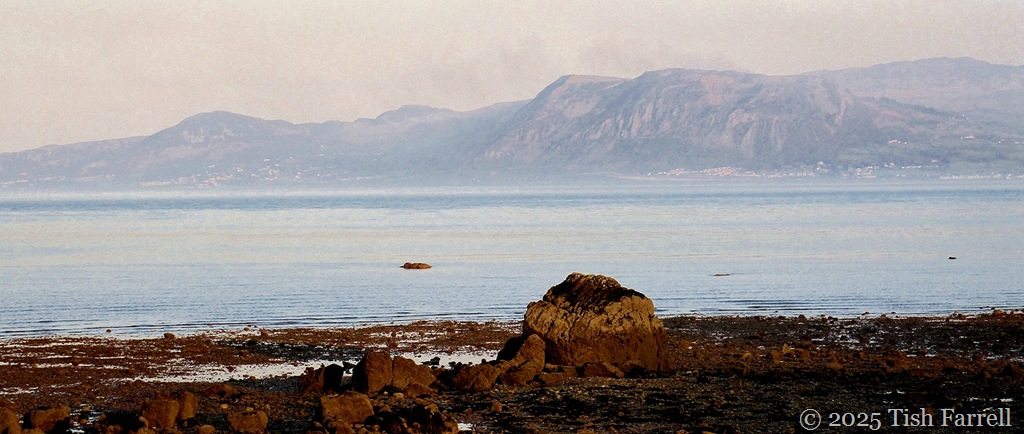
Herewith some recent views across the Menai Strait – from the island of Anglesey above Beaumaris to the Welsh mainland.

We’ve just returned from a week’s stay on Ynys Mon. It was our first March visit to the island, our usual time-slot being late December, and our arrival coincided with both the spring equinox and a spring tide. In fact we had never seen the low tides so low. When the sea went out, sand banks never glimpsed before, became exposed.

You can just make them out in the first photo.  This reminded me of the tales of the Roman invasion of Anglesey around 60 CE and how Governor Suetonius Paulinus equipped his army with flat bottomed boats to deal with the uncertain depths across the strait. But it is possible, too, that there are/were low-tide paths, known only to locals. Perhaps Suetonius Paulinus found himself an informer. The conquest anyway was bloody: the object to smash the power of the Celtic tribes’ druid priests who made their last stand on the island.

There’s more about this at an earlier post: Island of Old Ghosts.

For the mystically or meditatively inclined, you can see how weather watching can enthral; you never know what may happen next; all the elemental forces conspiring: the ever changing light, coastal winds, cycles of convection and condensation, the lunar-solar ebb and flow of tidal waters.

So much weather in a week on this tiny corner of the planet. We had hot sun, biting winds, cloudless blue skies, deep gloom, rain (though not so much for Wales), drizzle, mist, stormy and glass glittering seas.

IMG_7159ed

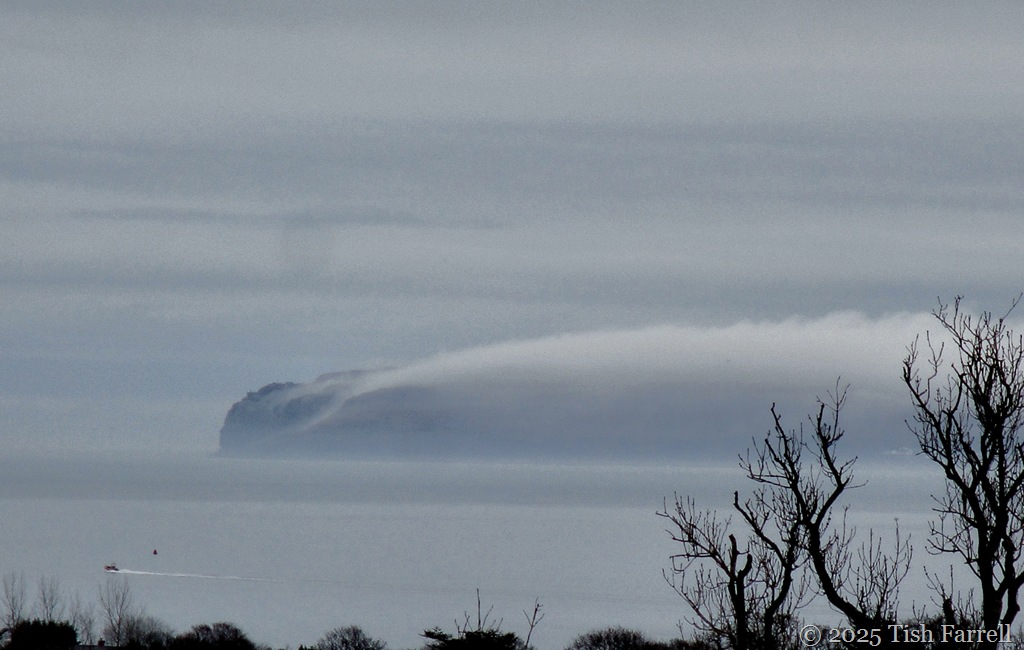
Late one afternoon we watched, with some sense of awe, as this white cloud moved low along the mainland shore, spilling out like dry ice till it reached the Great Orme headland.

And then one evening…

IMG_6971ed2

*

At other times the mainland looked gauzy. It could be a mirage. Or there again it reminded me of the magic painting books we had as children – the wash of colours emerging from the empty page.

IMG_6967ed

IMG_7184ed

Copyright 2025 Tish Farrell


Lens-Artists: Wild  This week Egidio at Through Brazilian Eyes wants to know what wild means to us. Go see what wild means to him.