
A real hoar frost too. Finally, after all the recent seasonal prevarications, this feels and looks like winter.


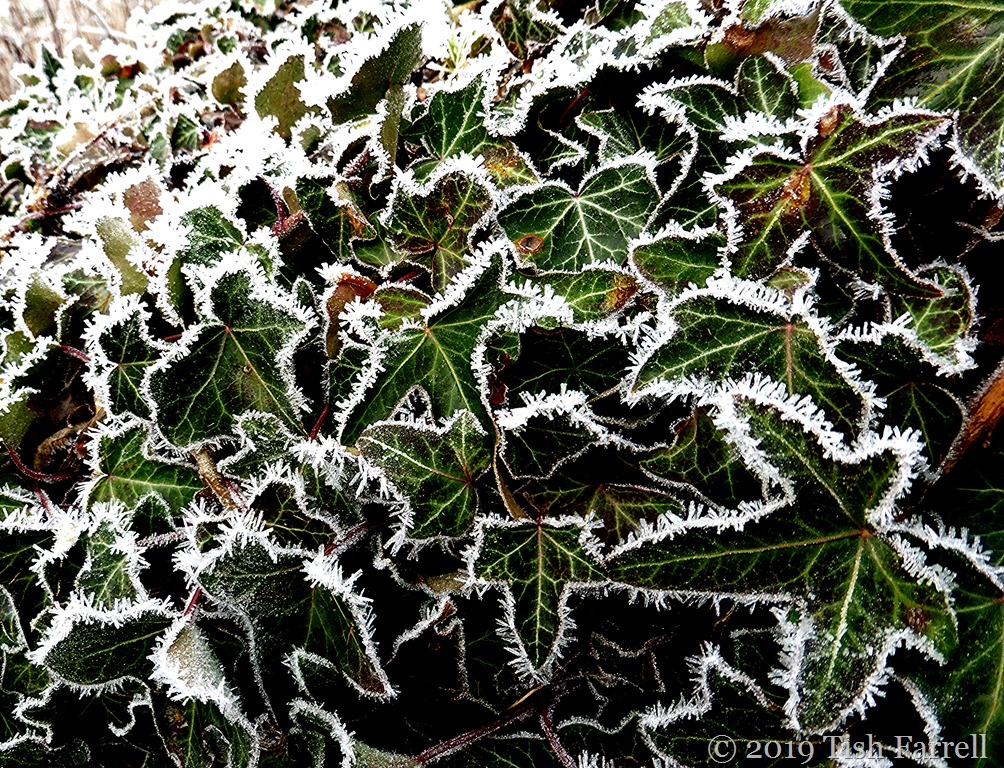
A real hoar frost too. Finally, after all the recent seasonal prevarications, this feels and looks like winter.
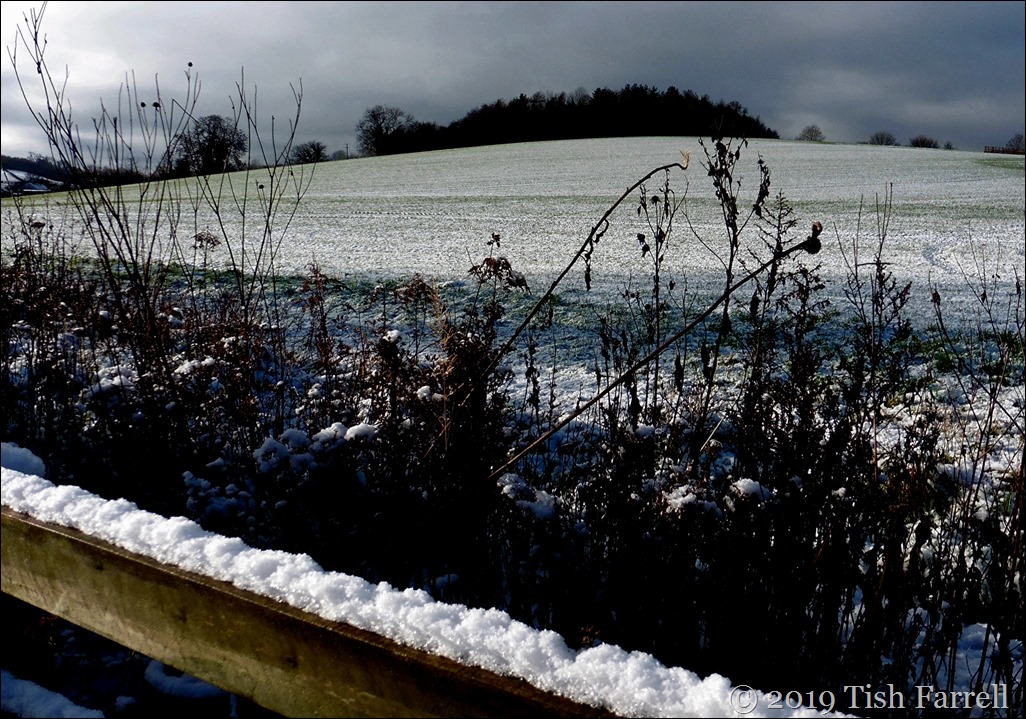

There is more seasonal confusion to report this month. I continue to be astonished by this Dyer’s Chamomile, aka Golden Marguerite (Cota tinctoria). It’s growing in the guerrilla garden behind the back fence, and has been flowering for months. I’ve heard the plant described as ‘a hardy but weak perennial’ because it fizzles out after its second year. Well that’s as may be. This particular exemplar hasn’t reached its first birthday yet, but so far at least is looking remarkably resilient after Tuesday night’s snowfall. Nor is it alone. A tender trailing geranium that I had abandoned in its garden pot at summer’s end has recently started to flower again. It didn’t seem to mind the snow either.

Admittedly it wasn’t much of a fall. By Wednesday morning it was already melting, and a quick wander round the garden now reveals many signs of spring. There are breaking leaf buds on the roses, flowering currant and honeysuckle; the columbines and centaurea are making vigorous new growth; bulbs are sprouting; hellebores flowering; along the lanes the snowdrops are out in force, and the winter wheat is greening all the fields around the town. Even the birds are singing spring songs. Will it all go horribly wrong one wonders? Better enjoy it while we may then, this summer-spring-winter.


The Changing Seasons ~ January 2019 Please visit Su to join in this monthly challenge.
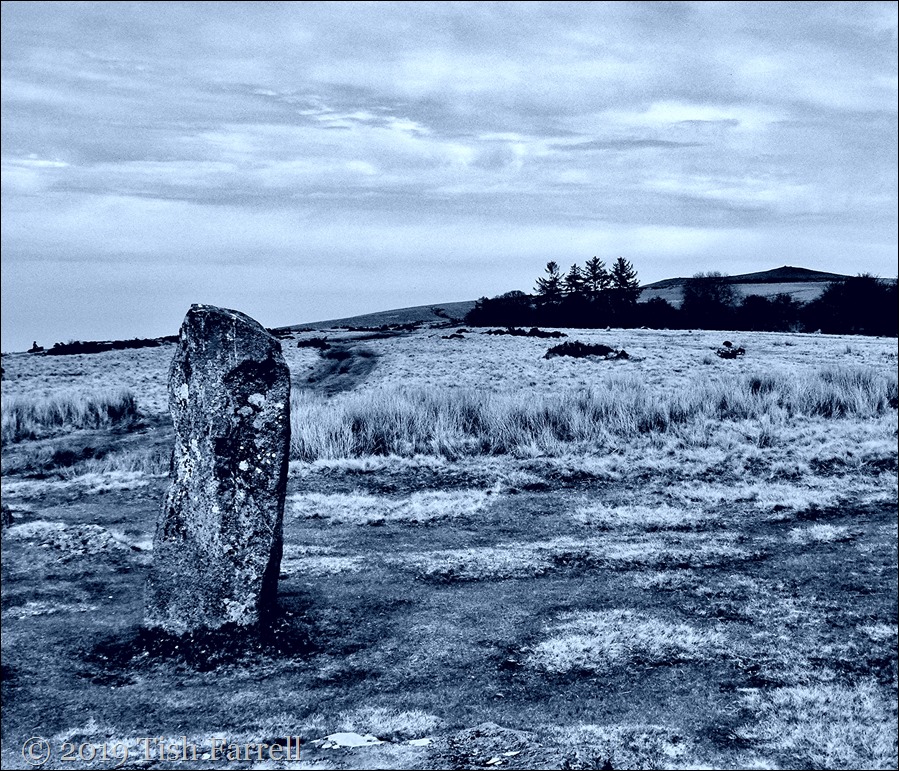
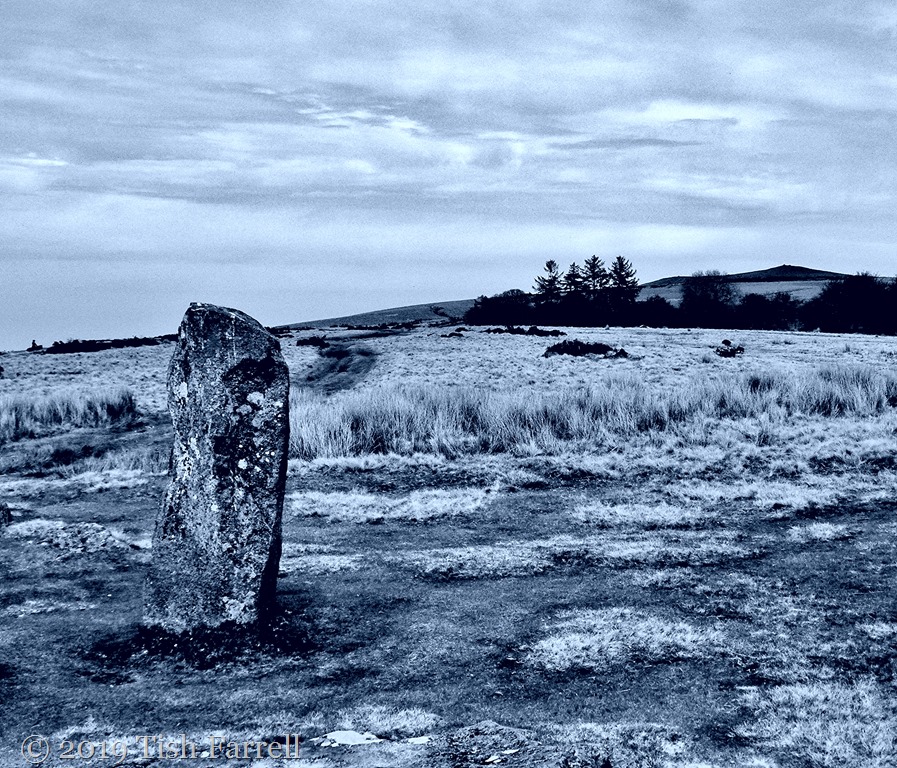
We’re in border country here – between the Shropshire Hills and Wales and I’m standing inside a Bronze Age stone circle, Mitchell’s Fold, looking in a northerly direction. And if the circle is a little raggedy after three millennia, then its location is surely still impressive.
*
Here is the southerly view towards Corndon Hill on whose flanks are the remains of several prehistoric burial cairns. To the right are the hazy Welsh uplands.

*
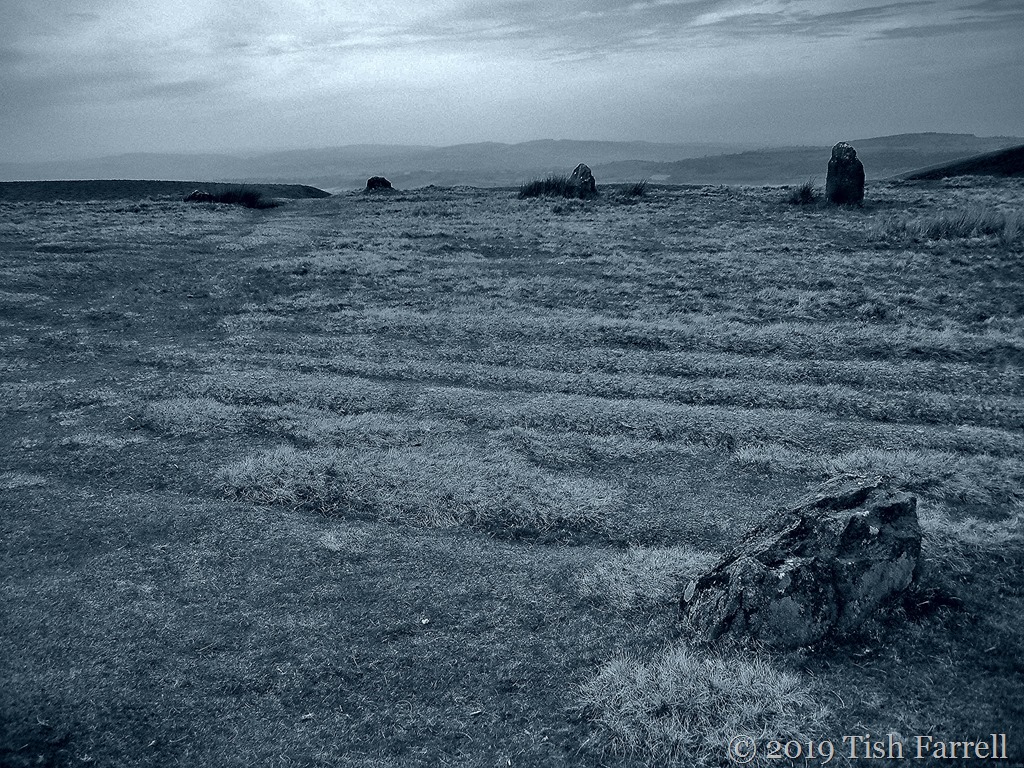
This westerly view towards Wales shows more of the Bronze Age circle. Several of the stones have been laid flat or damaged, and this apparently happened long ago. Perhaps when the land through the circle was being worked. You can see here the rig and furrow outlines of medieval fields. I think the climate must have been milder back then or they grew very tough crops.
*
Now looking east, the furthermost ridge is one of Shropshire’s most mysterious and curiously named hillscapes: the Stiperstones with its lunar Manstone and Devil’s Chair outcrops. This ridge is formed from quartzite laid down some 480 million years ago.

All these places loom darkly in local legends and folklore. I’ve told the story before of Mitchell, the wicked witch for whom Mitchell’s Fold is named. You can read about her grim deeds and sticky end in an earlier post: Witch Catching in the Shropshire Wilds which also comes with snow-scene photos courtesy of he who no longer uses his camera.
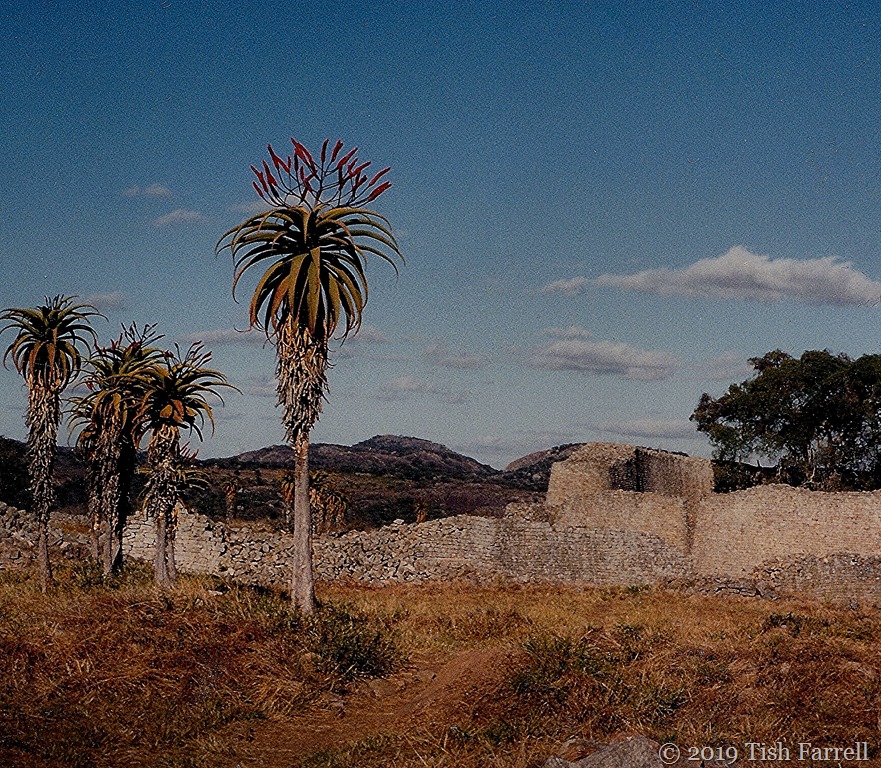

Among the gold mines of the inland plains between the Limpopo and Zambezi Rivers…a fortress built of stones of marvellous size, and there appears to be no mortar joining them. This edifice is almost surrounded by hills, upon which are others resembling it…and one of them is a tower more than twelve fathoms high. The natives of the country call these edifices Symbaoe, which according to their language signifies court.
Captain Vincente Pegado, Portuguese Garrison of Sofala, 1531
This scan of a photograph from our 1993 trip to Zimbabwe looks like one of those hand-coloured postcards from the days before colour film was invented – a fitting medium perhaps for these medieval ruins (and yes it’s probably appeared in earlier posts). Anyway by the time Captain Pegado was reporting from his base in Sofala, Great Zimbabwe had been in decline for a century and more. It was begun in its stone-built phase by the cattle owning Shona people around 1200 CE. In its heyday (mid 14th century) it seems the rulers of Great Zimbabwe were controlling the passage of high value goods (certainly gold and copper, and probably also ivory, slaves, textiles) across the Zambezi valley, and exporting them by caravan to Sofala on Africa’s east coast (present day Mozambique).
By this time, Sofala had long been a trading centre for Zambezi and Limpopo gold, and was subject to the great Swahili city state of Kilwa to the north (present day Tanzania). Thus the merchants of Great Zimbabwe, through their contact with the Arab-Swahili dhow merchants, were part of a trading network that extended across the Indian Ocean to China, and north to the Arabian Gulf and thence into the Mediterranean and Europe where African gold was much in demand during the Middle Ages. This last factor was responsible for tempting the Portuguese around the Cape to come and fetch it for themselves, hence the presence of Captain Pegado in Sofala.
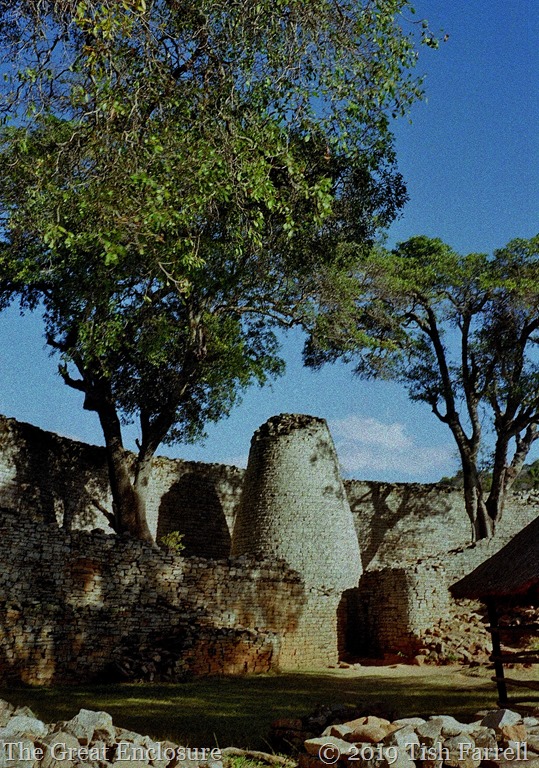
Of course when the ruins of Great Zimbabwe were re-discovered by Europeans in the late 19th century, specifically by one Carl Mauch, it was thought that the city could not possibly be the work of indigenous people. Surely it was the lost kingdom of Ophir whence King Solomon received regular cargos of gold, silver, apes and peacocks. Even in the 1970s when Zimbabwe was still colonial Rhodesia, all the considerable evidence (revealed by a series of archaeologists over previous decades) that showed it was built by the local African people was officially censored by the Smith regime.
Quite apart from perverting the course of scholarship and its all round offensiveness, the stance seems somewhat odd when you discover that Great Zimbabwe was not a ‘one off’. There are scores of similar medieval stone-built complexes across southern Africa, including Chisvingo and others in Zimbabwe. When Great Zimbabwe fell into decline at the close of the 15th century, another centre of power grew up at Khame, near Bulawayo in Matabeleland. It was the capital of a royal dynasty that lasted some two hundred years, all of which is food for thought on days when one cares to re-adjust one’s picture of the history of African peoples before the white folks arrived.

The stone built complex of Great Zimbabwe originally covered 1,800 acres (730 hectares). There were also several enclosures on the hilltop where I’m standing to take this photo, including one that revealed evidence of gold smelting. The gold items found on the site were worked into coiled wire, small rods and discs or cast into beads – all highly portable. Copper was also worked, either cast in soapstone moulds to produce ingots for trade, or made into ceremonial spears (ceremonial because unalloyed copper is too soft a metal to be militarily functional).
Finds that demonstrate the city’s external trading contacts include glass beads commonly used in the medieval Indian Ocean trade, glass shards from vessels made in the Near East (13th-15th century), and pieces of Chinese celadon export ware from the Ming (1368-1644) and earlier dynasties.
The classic work on the excavations is Peter S Garlake’s Great Zimbabwe. It also makes detailed reference to related sites.

English allotments are too often rackety sorts of places, and ours on Southfield Road is far from beautiful. The accumulations of tat on some neglected plots go back decades – broken glass, old bricks, shreds of plastic, rusting tools. Bit by bit they are being tidied up, the detritus carted off to the tip, aka the local recycling and waste disposal centre, this being done by one or two good souls who have more than enough to do on their own plots. But despite the overall unloveliness of the place, it does provide some interesting visual moments. The top photo was taken last spring – damson blossom and barbed wire with distant ash tree.
And here are some more views taken on my camera’s monochrome setting. A touch surreal I’m thinking:



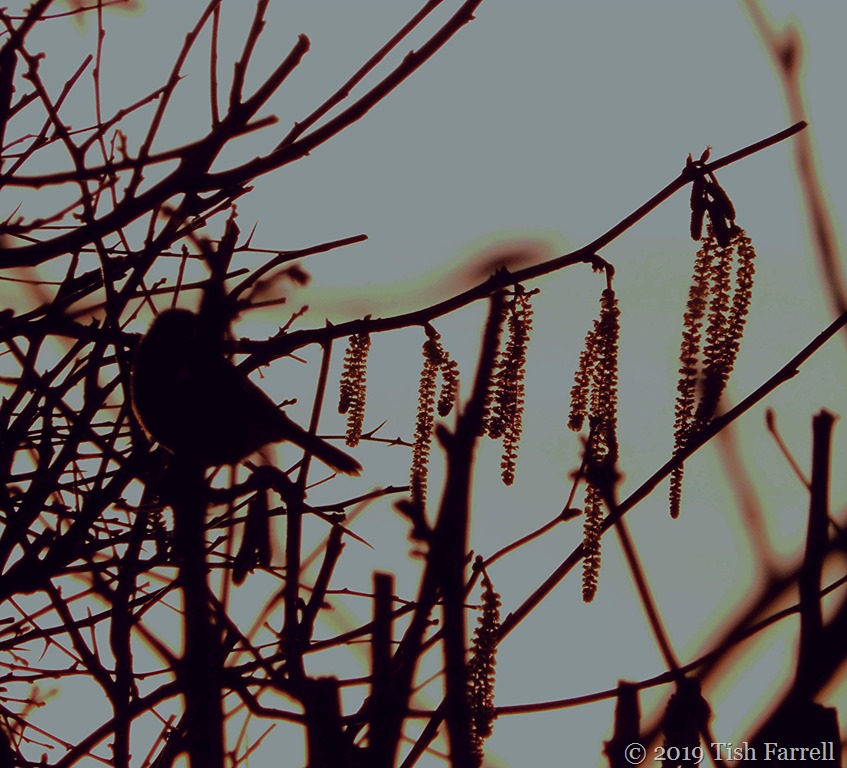
I was in the kitchen, faffing not writing, when the light through the hedge at the top of the garden caught my eye. Hurrah – a project! I dashed outside with my camera to capture the high definition catkins against the sunset, and caught this little bird as well – probably a dunnock; it’s hard to tell. But whatever it is, I like the tiny curve of sunlight against her breast.
Lens-Artists #Curves Please visit Tina to see her fine gallery of curves.
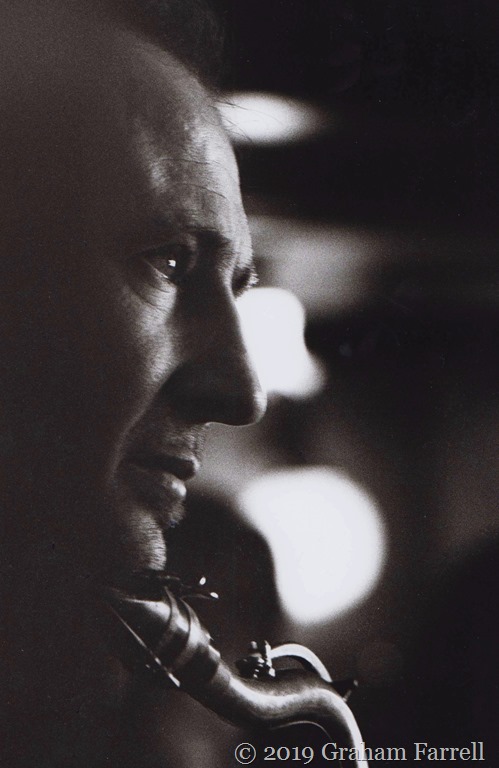
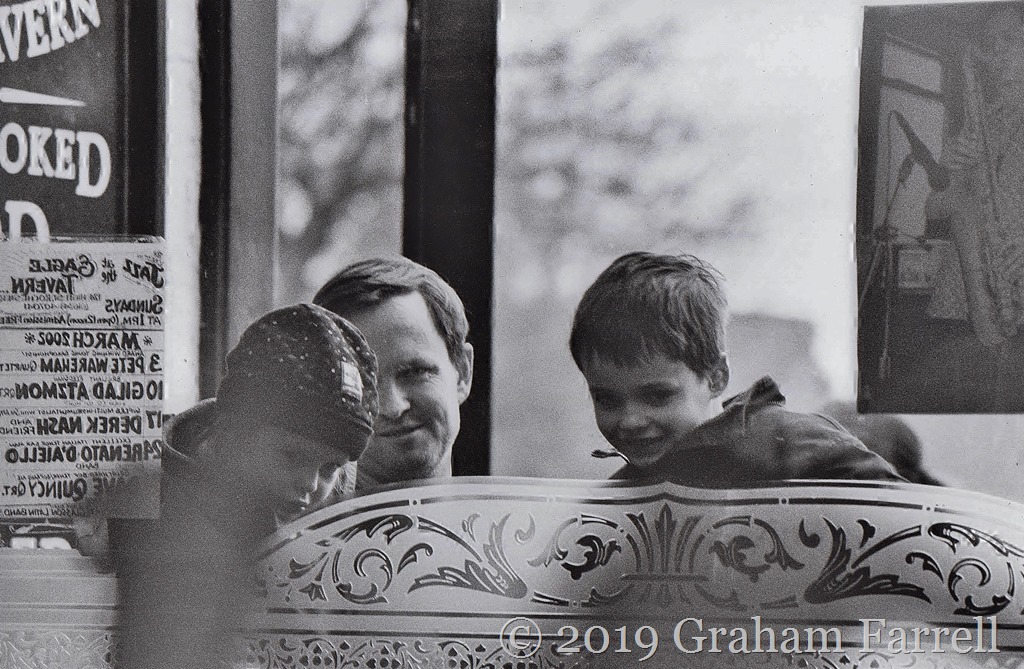
In 2000 we arrived out of eight years in Africa and into Kent, settling for several years on the banks of the River Medway in the ancient town of Rochester. Centuries as a port town and close proximity to the historic Chatham Docks and several Napoleonic forts ensured the place had plenty of old inns, including the Eagle Tavern. On Sundays, from midday to late afternoon there was live jazz in the bar, and performances from jazzworld’s rising stars. The musicians used the venue to warm up for their night-time gigs in nearby London. They charged nothing, though we usually bought their latest CDs.
Back in those days he who binds books returned briefly to his camera to take a series of black and white jazz portraits. This first shot of Renato D’Aiello is one of my favourites. And here’s another: an impromptu audience looking in; also a back-to-front gig list:

Posting this photo has set me off on a little train of thought, creative writing-wise. For one thing I’m reminded how my artist friend Sheilagh Jevons once expressed surprise at how predominantly visual my blog often is. ‘But you’re a writer,’ she said. ‘I didn’t expect to see so many images.’
I didn’t really have a good answer at the time, but I have often pondered on her remark since. It’s an interesting paradox: a writer who struggles to translate into words the fictional worlds she summons as if she were watching them; as if she were there, taking part in the narrative.
This is not to say that the envisioned people, places and events arrive in-brain in sharp focus. Far from it: the circumstances are often very blurry, slippery even; all that is viewed is presently in the foreground; the overall context hazy, unformed. But something in an imagined scene will have caught my mind’s eye; triggered the story alert. It is usually a person, never anyone I know, but always a particular someone who belongs to particular place and thus could be from nowhere else; although this is not to say that they might not be, in some sense, displaced when I first notice them. Otherwise, I probably don’t know much about them, only their general looks plus a certain something that snags my attention.
I know at once I should follow them. I may already know their name, and even if that name should later change, the ‘fact’ of their existence will not change. Once fixed on, these people subsist forever in conscious memory (as real to me as my relatives or neighbours), lingering there and waiting for their story to be told. Some have been waiting a good long time.
So what happens next? Fantasy and Science Fiction writers call the process world building. But then I feel that all story telling involves world building: the subtle articulation between physical circumstances (setting in time and space) and the events in a character’s life; their reactions, the ‘what happens next?’. This construction must be seamless; appear authentic; have ‘the ring of truth’; integrity; whatever you wish to call it. It is a bit like conjuring, but with much substance. And, to pursue the magician image, it is also a grand performance, the sustainedly active ‘suspension of disbelief’ wherein the audience/reader/viewer should be so engaged as to not start wondering: How did that rabbit come out of the hat.
And here is where the looking comes in; or perhaps a better way of putting it is schooling oneself to see (and by ‘seeing’ I mean engaging all the senses); honing the skill of it in the real world as a piece of daily practice; learning how to express the experience in another medium (in my case the written word, but it could be any of the arts). Such exercise develops world-building muscles, refines powers of discretion; helps you know what to look for in the fictional environment; where to shine the spotlight, how to manipulate light and shade, enhance texture, condense or expand detail in order to give a scene (in some sense) reality.
It is a lot to think about. And for those of you struggling with your own powers of creativity, no matter the medium, here is some wonderfully creative play to spur you on. It is a New Year’s gift this morning from blogging chum and artist, Janet Weight Reed. Please pop over there and have some fun. Who knows where it might lead you next, or what blocks it may release.
copyright 2019 Tish Farrell
#HowIWrite
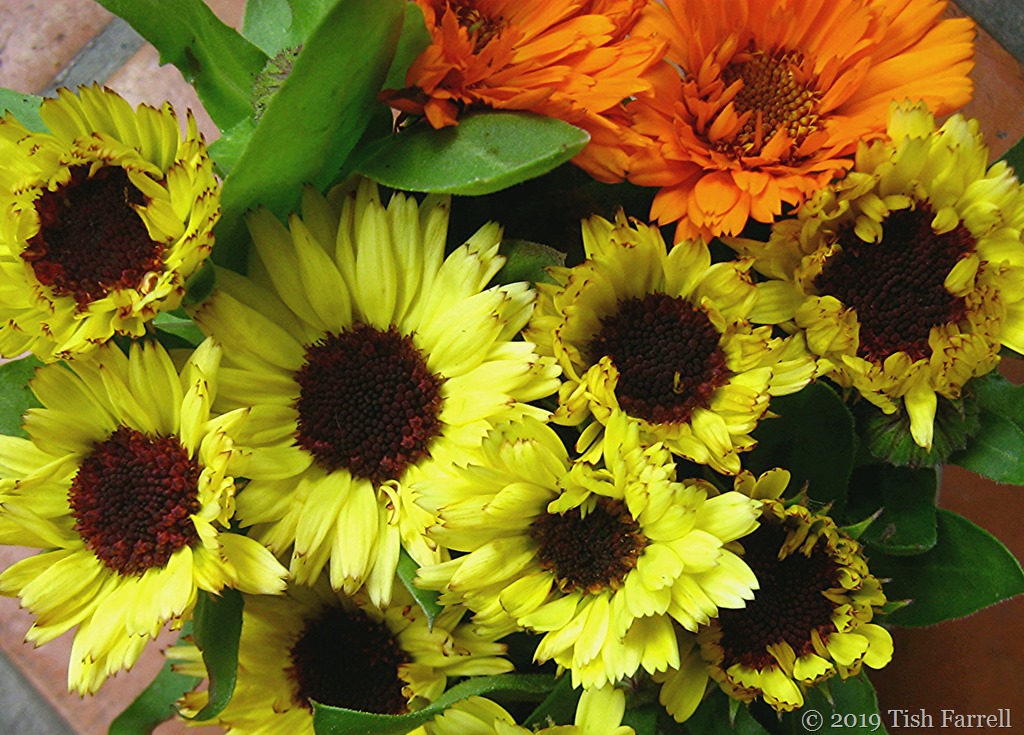
January can be a dreary time up at the allotment: cold claggy soil, weedy peripheries, bare trees and a general sense of neglect and of plots too long abandoned. And yet…and yet…when I slip-slide around my raised beds I find there is still plenty to harvest: leeks, parsnips, Tuscan kale, Swiss chard. The slugs have even left us some carrots (the voracious little gastropods are especially fond of the sweet and stubby rooted Paris Market variety), but I manage to find a bunch that have not been too gobbled.
There are also some golden beetroot to pluck, some as big as turnips. From the outside they do not look too promising – over-weathered and their skins suggesting woodiness within. But to my surprise, they are still good – delicious chopped into cubes and roasted till they start to caramelize, and even better with added quartered onions (Sturon still going strong from the summer cropping) and cloves of garlic kept in their papery jackets (so they can be popped out later, if squidgily, and accompanied by much finger licking).
Down by the raspberry bed, the purple sprouting plants, long nurtured through the summer drought and now wrapped in netting against pigeon attack, are looking stout and lush-leaved. I see that they are beginning to yield, and manage to find half a dozen fat florets. Hopefully, the plants will keep cropping now into the spring.
And then as I make for home with my muddy bag filled with veggies, I spot the marigolds (Calendula officinalis). There they are, back in flower after their December lull, and making their own sunshine on a dull and chilly day. I feel a bit guilty about picking them, but then I think some sunshine on the kitchen table would be a cheering sight for He Who Is Presently Coughing His Socks Off. And of course a scatter of petals, therapeutic little entities that they are, would be just the garnish for a dish of roasted golden beetroot.
copyright 2019 Tish Farrell
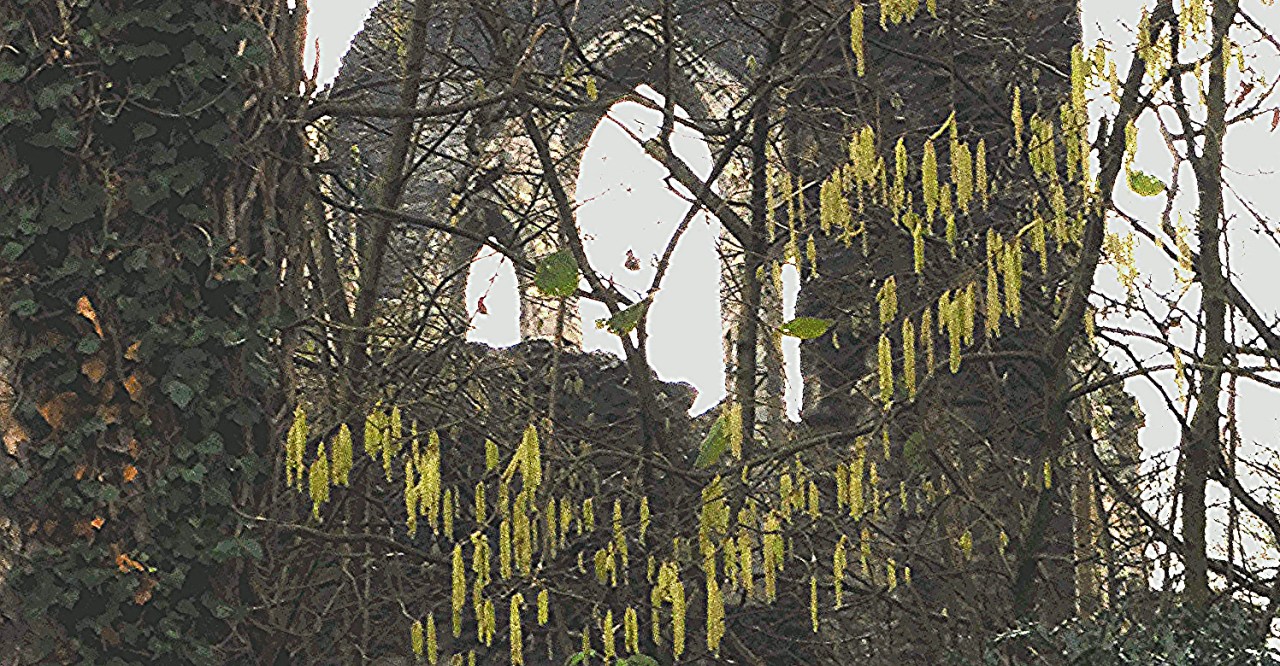
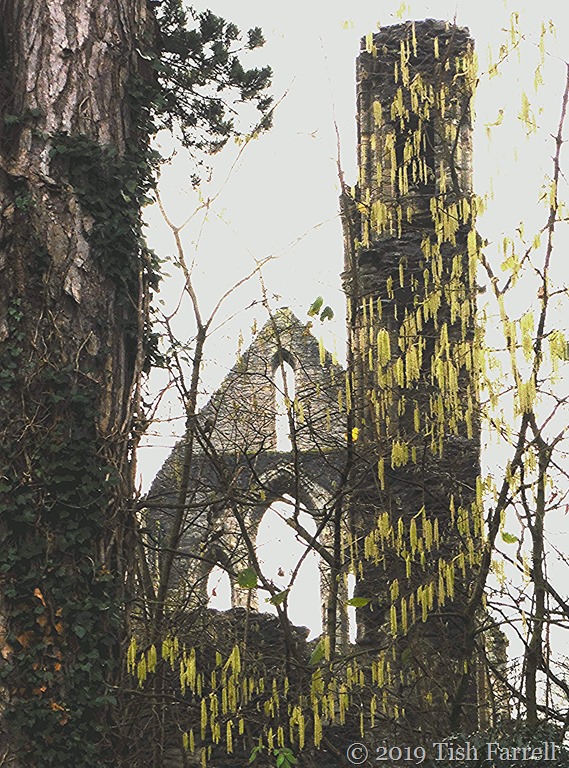
Present and past conjoined in silence across eight centuries.
*
P.S. Starting the New Year with my one thousandth blog post or so WP tells me.
