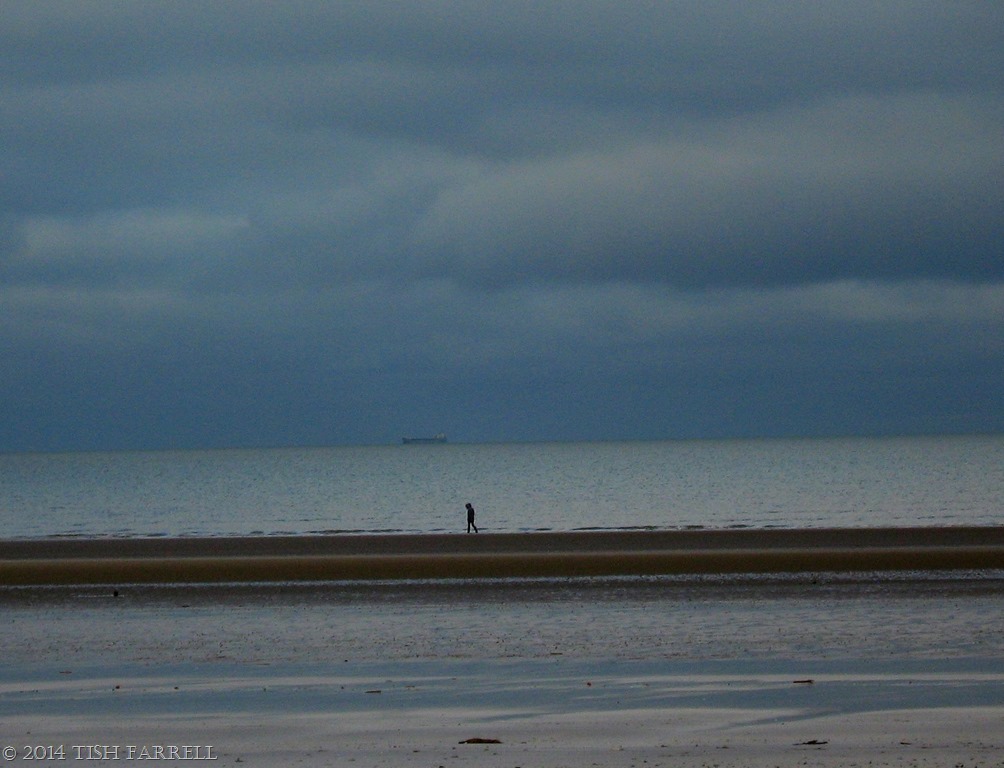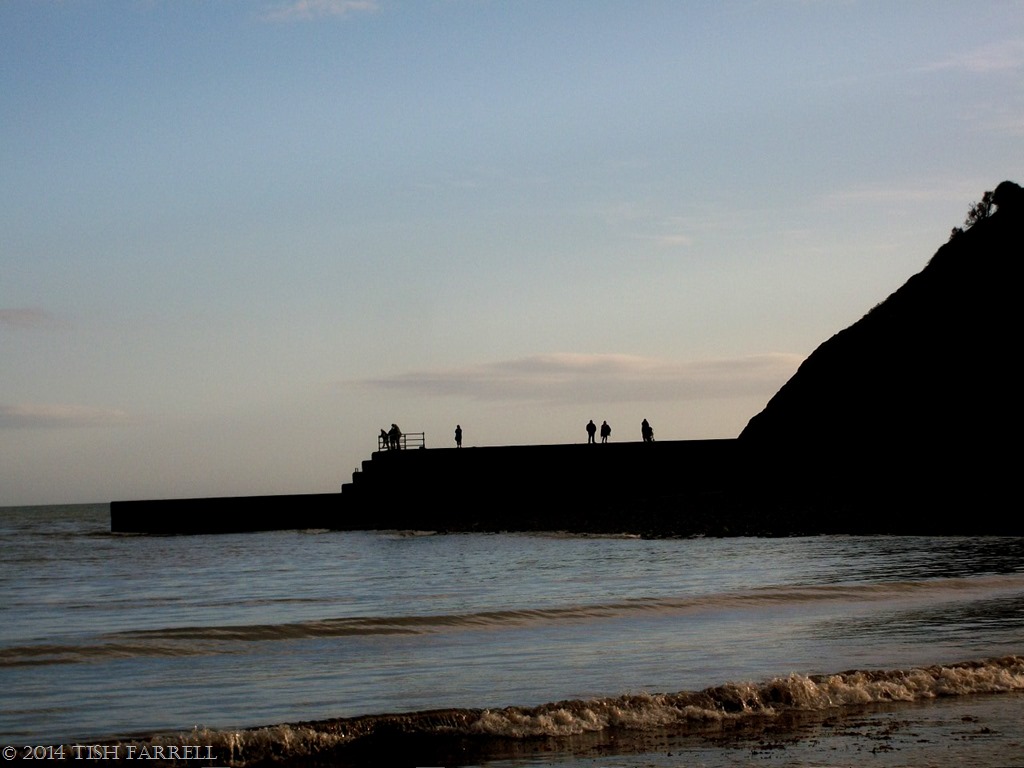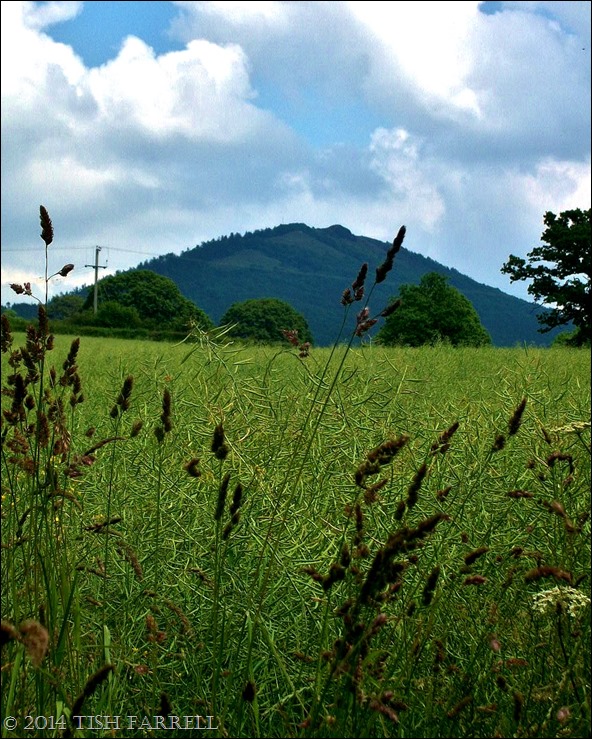
Life Entwined at Ogunquit

111


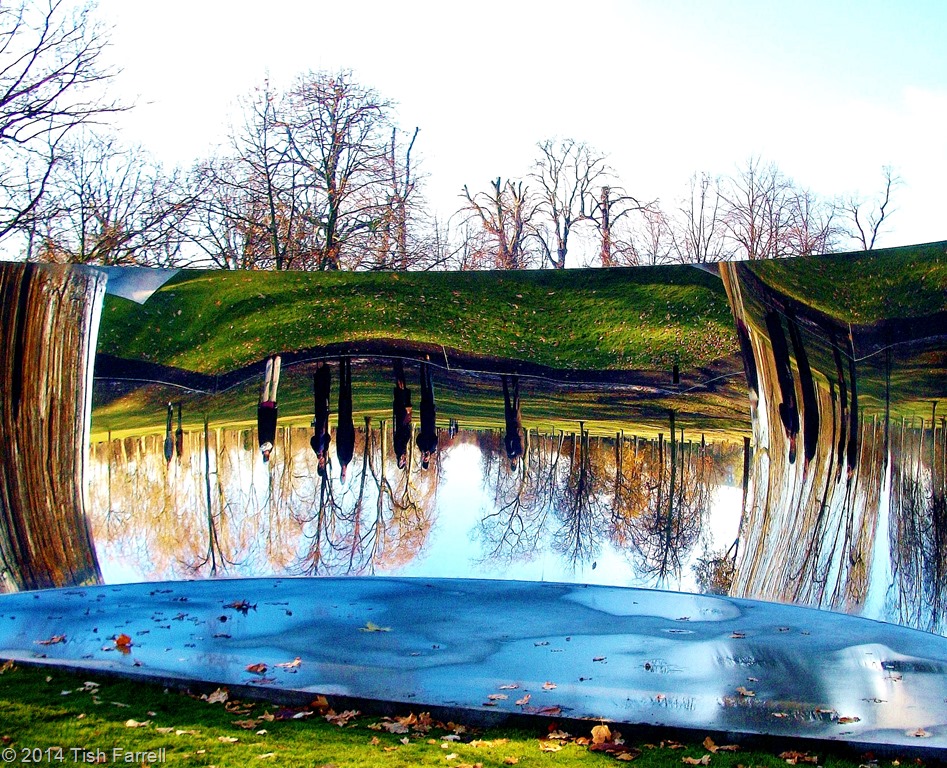
Cee’s ‘Circles and Curves’ challenge is giving me the chance to  show again this work by New England sculptor Antoinette Prien Schultze. ‘Life Entwined’ is circular in every way – suggesting not only the cycle of human life and love, but also the turn of the seasons, the circle of time itself.

It is made from Vermont Danby marble and weighs 4 tons. You can see it in the beautiful shore-side garden of the Ogunquit Museum of American Art in southern Maine. I have written more about the Museum HERE. It is one of the most beautifully situated galleries in the world, and well worth a visit for the setting alone.

Another fine thing about Ogunquit is the Marginal Way, a cliff top path along the rugged shore. It was here I found this natural sculpture which also fits the challenge.

100E3309

copyright 2014 Tish Farrell

*

For more about Ogunquit Museum of American Art see my earlier post:

Only One Ogunquit: the little gallery by the sea

*


Click on the image for more bloggers’ circles and curves

A Long Time Ago in Africa


Scan-130520-0013 (2)

Well this is what happens when you fiddle about in Windows Live Picture Gallery. I rather like the effect – posterized for posterity, an arty rendition of UK expatriate in 1990s Kenya. The original shot is thus pretty old, just like me. I was standing in the back garden of our house in Mbabane Road, in Nairobi’s leafy Lavington district, under the loquat trees. The house is gone now, and I can see from Google Earth that Madison Insurance who owned the compound, have given it over to some development of upscale townhouses. Across the road was  the run-down state primary school. I imagine it is still run down. My days back then had a daily soundtrack of children’s voices – chanting times tables mostly.

In the photo I’m wearing a self-made suit (tunic and pants) of batik cloth created at a workshop by street boys trying to get their lives together. And I’m wearing a string of Kazuri Beads, glazed ceramic beads, made by women trying build themselves and their kids a future. Kazuri means small and beautiful. The little factory in Karen, Nairobi was a joy to visit. The workshop shelves were lined with glass jars of bright beads, rather like a picture book sweet shop, while at benches in the the airy room, women created beads and threaded necklaces in colour schemes of their choosing. I’m only sorry that I seem to have no photos, but if you go to the link you can see the factory today – much expanded and employing men too.

100_5882

I still have the beads and the suit, and still wear them too, although the batik cloth is a little thin, while I, sadly, am not.

And now here’s a picture of our house – home for seven years.

003 (2)

It came with the usual services that accompany the living quarters of TCOs (Technical Cooperation Officers) working for Her Majesty’s Department for International Development. These included a well secured compound perimeter with lights, a 24/7 security guard, house alarms (checked monthly), internal security gate, barred windows, guard dog, and regular applications of pesticide by Rentokil. Phew. We did not like any of  this much, although we did like Patrick, our day guard, such a tall and gentle man. It was hard to imagine him fending off intruders. He had a farm back home in Western Kenya where his wife stayed in the good stone house he had built for her, along with their three children. He used to go home twice a year to plant or harvest his maize crop.

011

To make up for all the oppressive security, during the day I used to walk around the district on foot, roaming along the avenues. I wasn’t sure what it was I supposed to afraid of, although I did know that people did have their homes broken into, and that expats who insisted on driving large new Land Cruisers were often relieved of them (on their own compounds) by guys with AK47s, and strangely enough, soon after said expats (usually diplomats) had arrived in country and taken possession of the new vehicles via customs and imports at Mombasa port. The word on the street was that these robbers were highly connected. Very highly connected. This situation frequently reminded me of one of my father’s favourite sayings: the fish goes rotten from the head, although one would have been foolish to say this too loudly, or even at all back then.

Farrell Team Leader, Graham, had a works Land Rover for work, but otherwise we drove a battered Suzuki jeep. It had some interesting features. A previous owner had cut a hatch over the back seats, and made a fibre glass lid to go over the top. For game viewing you could simply unclip it. I didn’t drive it much, because that was the really scary thing – Nairobi driving. I often used to ponder if I could get to places by driving on the very wide pavements. Once when I forgot I was in Kenya and slowed at a zebra crossing on a city highway to let a pedestrian cross, the poor woman looked as if she would faint. I was lucky that  the Suzuki and I didn’t get flattened by a Tusker beer truck, while I and the woman stared at one other in a state of frozen confusion, neither of us able to move.

The other thing that used to scare me about driving was that parts used to fall off the Suzuki. G’s nonchalant response to my concern was, ‘Well if you were still going, you obviously did not need it, whatever it was.’

On the whole, then, it was better walking. I could peep through the cracks in the big steel gates that protected ambassadorial and diplomatic residences, and count the excessive number of garbage bags put out for BINS, the private refuse removal company. I’d see street kids and Maasai, greet the security guards who sat out on the neatly trimmed verges and chatted house to house. I was intrigued by the barber who had turned a fallen flame tree into a salon, and  I liked the smells of all the garden trees – cypress, frangipani, the warm musky smell of fever trees. When the rains came the streets would be filled with silvery clouds of termites on their nuptial flight. At dusk, the frogs in the Nairobi River way below our house would strike up frog songs that resounded across the valley. The crescent that adjoined Mbabane Road was called Applecross – a bizarrely English name that evoked pastoral perfection of the sort that had never existed outside colonial settlers’ minds.

When we took over the house from G’s predecessor we also took on the resident house steward, Sam, whose homeland was in Maragoli in Western Kenya. He had long worked for expatriates, but back home and also on the borders of Nandi he had small farms – three in all. His first wife lived on his ancestral land in what had been the Maragoli tribal reserve in colonial times. He still called it ‘the reserve’. He said he had poor relations on the other smallholdings, but they were not looking after the land properly and this caused him much concern. Apart from home leave, he stayed in Nairobi with his second wife, living in the servants’ quarters at the bottom of the garden. One reason for staying in Nairobi was so his three youngest children and a grandchild who had come to live with him could go to school across the road.

Now meet Sam, with guard dog Kim. We eventually had to hand Kim over to a vet, this after he started attacking children who came to play with Sam’s children on our compound. The vet told us that some German Shepherds were prone to this behaviour, and once begun, this was not a habit that could be broken. She told us she would try to send him to a rescue centre that kept such dogs, but otherwise he must be destroyed.

002 (2)

We did not ask which of these had been the outcome, but after having one sweet little girl’s face stitched up at the hospital we could not risk it happening again. Luckily the dog missed the child’s eye and the wound healed well. Here she is then, Sera, fully recovered with only a hint of a scar under the right eye.Zaina and Sera 2

And next comes Silas, Sam’s youngest son.

012 (2)

And Sam’s grand daughter, Zaina playing badminton with Silas on the back lawn.

002

Then Sam off-duty out on Mbabane Road. He only worked half days as we didn’t have enough house work.

010

*

And  this is Francis, who stood every day on the corner of Mbabane and James Gichuru and sold us The Standard and Nation newspapers. He turned the newspaper round deliberately because it was featuring the British envoy, a man somewhat outspoken on Moi regime corruption.

007 (2)

And finally me again, not looking quite so postered  (but oh, so much younger) with poor old Kim, and those Kazuri beads again. Interesting days.

Tish and Kim the dog

copyright 2014 Tish Farrell


Related:

Looking for Smut: Work on Kenya’s Highland Farms

Valentine’s Day Runaway


Flickr Comments ‘A’ words – go here for more bloggers’ ‘A’ tales and photos

Zanzibar: time’s twists and turns


…a gateway to Africa. Through its portals passed not only slaves, spices and ivory, but also missionaries, explorers and conquerors.  

Abdul Sheriff, Professor of History, Dar es Salaam University

Scan-130429-0054

Zanzibar  – it’s all in the name – the Indian Ocean shores where Arab merchants met with African farmers and created a new people: the Swahili. In the Arabic Kilwa chronicles of the Middle Ages, the word Zanj denotes non-Muslim black people, and the word bar means coast, and the term back then referred to much of the East African seaboard – to wherever the dhow traders seasonally put in to haggle with Bantu farmers for ivory, leopard skins, rhino horn, iron, ambergris and mangrove poles.  These, then,  are the shores of the Sindbad (Sendebada) tales, but today the term ‘coast of the blacks’ survives only in the name of the Zanzibar archipelago (Unguja and Pemba Islands), now part of Tanzania.

These days too, Zanzibar Island, more properly known as Unguja, is seen as the heartland of Swahili culture, and the place where the purest form of KiSwahili is spoken. Once, though, there were many other powerful Swahili centres – independent city states that included Manda, Lamu, Malindi and Mombasa in Kenya, and Sofala far to the south in Mozambique. Such states, with stone towns built of coral rag, began evolving from at least the early 800s CE (Manda),  by which time KiSwahili was already a fully developed language, albeit with many regional forms.

100_3629

*

In fact the trade along East Africa had been going on from well before the 9th century. The Periplus of the Erythraean Sea, a Greek account of Indian Ocean trade written around 60 CE, indicates that the people of the kingdoms of Yemen and Arabia already had well established trade routes as far south as Mozambique. The Romans had also been here, doubtless making use – as all the seafarers did – of monsoon winds that in season carried them south down the African coast, or east to India, and then, with the change in the wind,s northwards and homewards to the Gulf.

Scan-130510-0008

*

The earliest traces of a stone town  on Unguja date from the 12th century when merchant princes from Shiraz in Persia settled on the island.  Over successive centuries this settlement  was destroyed twice by the Portuguese (who, after Vasco Da Gama discovered  he could sail round Africa in 1498, seized control of the Indian Ocean trade) and once by the Omani  Arabs whom the Swahili sultans of the Kenya coast called in on several occasions to help rid them of the European tyrants. The Portuguese were ousted from Zanzibar and the Swahili mainland at the close of the 17th century, and thereafter, until the British declared Zanzibar a protectorate in 1890, it was the Omani Arabs who controlled the surviving Swahili states.

Scan-130429-0102

Scan-130429-0095


The Stone Town we see today dates mostly from the nineteenth century when the place was at its most prosperous. Abdul Sheriff describes the scene:

“Zanzibar was then a cosmopolitan metropolis. Its harbour teemed with square-rigged ships from the West and oriental dhows with their lateen sails from many countries in the East, carrying all the colours of the rainbow. Here Yankee merchants from New England drove a hard bargain with Hindu traders in their large crimson turbans or  Khojas in their long coats, exchanging ivory for American cloth; the Marseillais haggled with the Somali for hides and sesame seeds from Benadir; Hamburg entrepreneurs shipped tons of cowrie shells to West Africa, where they served as currency; and Arab caravans rubbed shoulders with their African counterparts from the Mountains of the Moon.”  (The History and Conservation of Zanzibar Stone Town 1995).

Scan-130429-0027

Beit al-Ajaib, The House of Wonders, was built by Sultan Barghash in 1883 to host ceremonial events. He was an extravagant man and, before his death in 1888, built 6 palaces across the island of Unguja. After the 1964 Zanzibar Revolution when the Omanis, along with many Indian residents, were killed or expelled, the building was used as government offices. When we visited in 1999 it was abandoned, but for one of the last sultan’s  cars (candy pink in colour) parked inside the atrium near the front door. A good friend who visited the House of Wonders recently tells me it is still there.

*

Trade was given much impetus in 1830 when the Sultans of Oman moved their capital to Zanzibar to oversee what turned out to the short-lived boom in clove production.  They and other Indian and Arab landowners owned many clove and coconut plantations  on the archipelago, and these were worked by African slaves.

The slave trade, then, was another source of the island’s prosperity. By 1860 the archipelago had some 60,000 slaves, not only working the plantations, but also fulfilling domestic and labouring tasks, and providing new wives for the sultan’s harem. And it is worth noting here that the slaves in Zanzibar were not generally ill treated in the way they were in the Americas; it was not unknown, after long service, for them to inherit their master’s land and property. The children of the harem slaves were also acknowledged by the sultans who fathered them, and treated as royal children with appropriate titles.

During the 19th century it is reckoned that some 50,000 slaves a year were being sold in the Zanzibar slave market. It was only in 1873 that the slaving was abolished, this after much pressure from the British who had first made a treaty with the Sultan Said in 1822 in an  attempt to kerb the trade. That treaty had produced little effect. There was too much demand. The French, in particular, needed slaves for their tropic island plantations.

And to meet the demand the Swahili and Arab slaving expeditions would set off from Zanzibar for the African mainland, taking their caravans of porters along well-walked slave paths through Tabora in Tanzania, and down into Zambia, or travelling up present day Kenya to the Great Lakes regions. The notorious Swahili slaver, and plantation owner, Tipu Tip, roved as far as the Congo , terrorizing villages across the territory.

Scan-130429-0020

Finding some way to end the trade was one of the motivations that drove the missionary-explorer David Livingstone ever onwards on his gruelling explorations across Africa. It was thought that if the continent was opened up to civilizing Europeans, then the ‘filthy trade’ could be stopped.  But then like the slavers, he and other European explorers (Burton, Speke, Stanley, Cameron, Thomson) started their journeys from Zanzibar. All such travellers, including  missionaries, relied on  the expertise of porters and seasoned safari guides who otherwise worked on the slave caravans.  In 1866, before his last expedition, Livingstone stayed at the house above. It had not long been built by Sultan Majid. Now it is the office of the Zanzibar Tourist Corporation.

001 (2)

From John Hanning Speke’s Journal of the Discovery of the Nile 1863

*

The slaving and ivory  trades worked in tandem. Newly captured slaves were not only driven on forced marches across the continent to the coast, but they were also made to carry supplies, and these included any elephant tusks that the slavers had procured – ivory destined for the production of piano keys and billiard balls for the European market.  It was only in 1897 that all slaves on Zanzibar were given their freedom. The Anglican church stands on the site of the slave market, beside the now famous sculptures commemorating the years of abuse. It is horrifying to consider what the cost of this trade has been for Africa: generation upon generation of  the strongest, brightest and  most  beautiful young people robbed from their communities.

Scan-130429-0005

Naturally the British could congratulate themselves on finally stopping the trade on Zanzibar, although I believe it continued well  into the 2oth century at Lamu. Today, too, slave mongering thrives, and under our very noses in Europe, only now the abused are not necessarily black, so perhaps we don’t think it’s the same thing – the brutal deprivation of liberty and dignity, along with forced labour?

But back to 1890, the end of the Sultans’ control and Britain’s laying claim to Zanzibar. Because now we come to a whole new angle. For this was also the year of the Heligoland-Zanzibar Treaty, an agreement between the Germans and the British, whereby (in return for Heligoland, the strategic North Sea island), the Germans waived rights to Zanzibar, Witu on the mainland coast, and to the territory now known as Kenya across which the British were planning to build the Uganda Railway. (Bismarck apparently called this deal swapping the trousers for a button). 

Suddenly, then, Zanzibar has a very particular purpose for the British Empire. It will become the spring board for the claiming of extensive East African territory, and it will start with that mad, mad railway from Mombasa to Lake Victoria. Of course, with slavery being outlawed, some new mechanism of harnessing native power will need to be thought up. Something civilized and civilizing. I know – we’ll call it colonialism, and enclose indigenous people in their own territory, make reserves of their own homes, which they can’t leave unless they have a pass. Then we’ll introduce hut and poll taxes so forcing them to work for Europeans…

For more of the colonial story go to an earlier post Vulcanicity HERE. In the meantime below are some more soothing views in and around Stone Town, now a World Heritage site. Life is not so grand as it was in the days of the finely robed Omanis. Fishing, ferrying, farming (growing spices, coconuts and vegetables), curio trading, boat building, mangrove pole harvesting and tourism are the main sources of income. As in all African countries, people work hard to educate their children, and this is their number one priority.

Stone Town is also a devoutly Muslim community, and sometimes this does not sit well with tourist inclinations to behave in ways not considered either respectful or respectable by Zanzibaris. There are over 50 mosques of several different Muslim persuasions, but most are unobtrusive buildings without minarets, and are scarcely noticeable among the domestic dwellings. There is also a Catholic cathedral as well as the Anglican church. The streets are maze-like and shadowy, but we met with nothing but gracious hospitality when we wandered along them.  The place may seem run down (although here and there restoration is in progress), but in the sudden whiffs of jasmine the Sinbad romance lingers on…

(For more about the Swahili see an earlier post HERE.)

Scan-130429-0110

Scan-130429-0129

Scan-130429-0149

Scan-130429-0131

Scan-130429-0046

Scan-130510-0002

Scan-130429-0123

Scan-130429-0081

Scan-130429-0122


AILSA’S TRAVEL CHALLENGE: TWIST

FLICKR COMMENTS TAGGED ‘Z’

copyright 2014 Tish Farrell


Cloud shadow: contrasts II


IMG_0834

The light, the clouds, the sun do extraordinary things over the Menai Straits, the narrow sea channel between the island of Anglesey, Ynys Môn, and mainland Wales. This photograph was taken at midday in late December.  I was standing on Beaumaris seafront and looking towards the mainland. To the southwest the mountains of Snowdonia were frosted with a light cover of snow. It was all very dreamlike. And it made me think that  it was no accident that the Druid priests of the ancient Celtic tribes made the island their sacred stronghold, or that after the Romans withdrew from Britain, the early Celtic Christian missionaries established their sanctuaries and churches on the island. Whatever your faith, or even if you have none, such glorious vistas surely speak straight to heart, spirit and soul.

For more images of Ynys  Môn see my earlier post Island of Old Ghosts.

100_5196

© 2014 Tish Farrell

Weekly Photo Challenge: Contrasts

Yesterday’s Shining Star? The Restoring of Artist Mildred Elsi Eldridge (1909-1991)

www.glendwr.ac.uk (2)

Self Portrait Mildred Elsi Eldridge. Photo: Glyndwr University www.glyndwr.ac.uk

*

It has to be asked, this burning, niggling question, but why on earth do we forget women artists so readily? Why is it that their work is less exhibited, less revered or, if noticed at all, only grudgingly accorded a modicum of the status enjoyed by male artists?

I leave it to you to supply the answers to these questions. I only note that this same enquiry was the driving force behind Professor Amanda Vickery’s recent BBC2 series The Story of Women and Art. In this too brief historical exploration of  forgotten/hidden/suppressed  and otherwise invisible women artists, Professor Vickery introduced us to the breath-taking creativity of (among others) Sofonisba Anguissola, Berthe Morisot, Johanna Koerten, Properzia de Rossi and Artemisia Gentileschi.  I will be forever grateful for the introduction.

Now, though, I have a very particular question. It relates to the work you are about to see – details from a great mural that, until fairly recently, was hidden from view.


All photos: Glyndwr University www.glyndwr.ac.uk

DSC06549[1]

*

panel 6 glendwr


*

DSC06941[1]

*

DSC06556[1]


So my question is this. What was in the minds of the people when they took down and concealed from sight this work of lucent genius by Mildred Elsi Eldridge; how did they feel when they stowed away the Dance of Life?

Sorely deflated? Bereft? As if the light had gone out?

The work was originally commissioned in the early 1950s by the Hospital Management Committee of the Robert Jones Agnes Hunt Orthopaedic Hospital, Gobowen near Oswestry in Shropshire. A new nurse’s home had been built and the  mural was to hang in the dining hall. The hospital’s Doctors Menzies and Salt had recently been to Sweden and seen how art was being introduced to hospitals to enhance the healing process.

The fee for the commission was £500 and the work took M E Eldridge around five years to complete (Gwydion Thomas in Life and Times of M E Eldridge). In 1999, after being on display for forty years, the mural was put into storage. The hospital was undergoing development. But once consigned to custodial care, it was over a decade before moves were made to restore the panels and find them a new home. 

Elsi’s son, Gwydion Thomas, was a child when the panels were being painted  (see the boy with the monkey above). He says the work was created in their home, in the drawing room of Manafon Rectory, Montgomery. He says that, as there was not enough wall space to hang the work in progress, Elsi rolled up completed portions as she went along, hanging others over doors as she was painting. He says the work wound many times around the room. It is a sharp glimpse into this woman’s focus, vision and determination.

DSC06558[2]

The mural’s overarching theme explores how we industrialized human beings have become detached from the natural cycles of life and death. There are depictions of alienation and loss. Yet the work inspires hope, too, through the reclaiming of forgotten wisdom and traditional ways of living and healing. And so, despite the dark undercurrents, the work is hugely elevating. Joyous.  Transcendent. Full of verve. When fellow artist, Stanley Spencer, saw it in 1958 he wrote to Elsi: “Just one look at the heavenly sheep panel would remove all fear and gloom.”

Art Historian, Peter Lord, has described the work as “a masterpiece on so many levels”, while pointing  out not only the technical ambitiousness of so large a project, but also the fact that Elsi completed the work without a suitable studio.

It is good news, then, that Dance of Life has now been released from custody, restored and put on permanent view at Glyndŵr University’s Centre for the Creative Industries in Wrexham. It can be viewed by visiting the main University Reception (tel: 01978 293950). 

DSC06663[1]

Restoration by Vanessa Andrew in progress at Glyndwr University www.glyndwr.ac.uk

*

DSC06933[1]

Gwydion Thomas speaking at a private view of the restored panels

Photos: Glyndwr University www.glyndwr.ac.uk

DSC06936[1]*


*

So: you have seen some of her work, including that self-assured self-portrait at the start of this post, but what of the artist M E Eldridge? Why isn’t she better known?

Mildred Elsi Eldridge

She was born in Wimbledon in 1909, the daughter of a pawn- broker turned  jeweller. She studied at Wimbledon College of Art and then at the Royal College of Art, where her teachers included Eric Ravilious, Edward Bawden and William Rothenstein. She was one of the RCA’s star pupils. In her autobiography she says of this time:

A free studentship in 1931 took me to the RCA which in those days was attached to the Victoria and Albert Museum. There were huge doors from the V&A into the College which were kept securely locked but as there was always one of the museum keepers on duty on the other side of the doors, special signs and knocks could be made so that after signing on at the RCA entrance desk it was possible to escape into the V&A and make drawings of the splendid treasures in the museum, or experimental drawings of one’s own which would probably have received severe criticism from the RCA staff. From there, sallies could be made to the Science Museum across Exhibition Road or to the Natural History Museum to make studies of animals, plants and fungus.

In 1934 The Rome Scholarship competition was held – the subject Music. I submitted the 5′ x 5′ Telling the Bees which later became the central part of the first panel in the mural in the Dining Hall of theNurses’ Home at the Gobowen Orthopaedic Hospital. 

M. E. Eldridge Autobiography

meeautobees[1]

This was the piece that won her the prestigious Travelling Scholarship to Italy and opened the doors to the art world. When she returned to London she soon established herself, being the only artist to sell all her work at 1936 Royal Academy exhibition. The next year she had a one-woman show at the Beaux Arts Gallery, and with the proceeds of the sales, including several to major collectors and large metropolitan art galleries, she bought herself a Bentley car. And then –

She turned her back on the glitter, and headed off in her Bentley for  the Shropshire-Wales borderlands to teach at Oswestry High School and Moreton Hall School for Girls in Shropshire. She lodged just over the border in Wales, in Chirk near Wrexham, and it was in the house where she was staying that she met the fellow lodger, a young curate, who was to become known to the world as poet, R.S. Thomas. She made this portrait of him in 1940, the year of their marriage.

1940 yr of marriage

It would be easy to say that the growing fame of RS eclipsed or stunted Elsi’s talent. He apparently took no interest in her work or did anything to encourage her. There is a revealing interview in the New Welsh Review issue 64 in which Gwydion Thomas says that after Elsi’s death in 1991, his father wondered if Elsi would have “gone on painting properly” if, as they moved from rectory to rectory across Wales, he had ever bothered to arrange for a house with suitable work space for her. RS admitted, too, that he should never have expected her to live at Sarn y Plas in Rhiw (see the previous post) after he retired  from the priesthood, and the church authorities would not allow them to buy the Aberdaron rectory with its pleasant rooms and fine views.

cover_64[1]

Gwydion describes her room at the house in Rhiw: so dark with two tiny windows, and damp too. She had to keep her paintings in black plastic refuse bags to protect them from the water that  dripped through the walls. It was so cold, that as she painted, she kept her feet inside a cardboard box, along with a two-bar electric heater, and so was frequently burned. The room also had a low loft which she reached by means of a ladder. Here, with the company of mice, she both slept and worked. Tellingly, the new room that the Thomases built at Sarn y Plas served RS as bed-sitting room.

Elsewhere, Gwydion describes Elsi as

a remarkable and talented woman. She painted, and sold, some 2,000 finished pictures and produced innumerable studies…She was a weaver, a sculptor, a clothes maker – she made me clothes out of rabbit and mole skins – and a knitter, a teacher, a writer and illustrator of children’s books…She designed altar cloths, stained glass windows and wrought-iron chandeliers. She designed and planted four gardens, raised a child, cooked for my father: four meals a day, every day, for 50 years.

He did not know why she stopped painting landscapes, and took to churning out what he calls  ‘pretty’ paintings and illustrations. But he does say something that is perhaps illuminating. He says that when his parents first met, RS was writing “dreadful imitations of soppy Georgian poetry”, and full of dreams of Celtic romance. Then along comes this vibrant, shining, well read, well travelled and sophisticated young woman who can introduce him to other kinds of literature, and to the wider world besides.

When it comes to Elsi’s influence on the poet, R S Thomas scholar, Jason Walford Davies, calls her a catalyst, a promoter, the one who made things possible, and helped RS realize a career as poet. She certainly inspired him to write some of his most humane and moving poems.

Marriage

We met
under a shower
of bird-notes.
Fifty years passed,
love’s moment
in a world in
servitude to time.
She was young;
I kissed with my eyes
closed and opened
them on her wrinkles.
‘Come,’ said death,
choosing her as his
partner for
the last dance, And she,
who in life
had done everything
with a bird’s grace,
opened her bill now
for the shedding
of one sigh no
heavier than a feather.

R S Thomas

rst


And so perhaps, in a sense, R S Thomas was also one of Elsi’s creations, a co-creation certainly. She gave him the gift of possibility, and that is a great gift indeed. Her artist self may indeed have been diminished by the marriage, although she strikes me as a woman who knew her own mind and made her choices accordingly. Perhaps she had painted out all her best thoughts, and felt she had nothing more to add in terms of ‘great works’. She anyway never stopped creating, making paintings for Medici greetings cards for instance, and she was working still when she could barely see.

There seems to be no single explanation, then, as to why M E Eldridge, after such a glittering start, is not better known today. Clearly she had some hand in this when she decided  to drive away from her London career, and head for the Welsh Marches. But then to leave in a Bentley, that most self-aggrandizing of vehicles? It is all so playfully enigmatic.

And so instead of answers, I leave you, in like vein,  with this alluring abstract study called ‘Gwydion’s treasures 1952’. I love the shining light in the marbles: what a heart-felt evocation of childhood freedom, and not a shred of sentiment. Only wonder at the cycle of life and death to be observed upon the sea shore, and seen through the endlessly enquiring eyes of a child. Her child.

abstract 1952 httpwww.bbc.co.uknewsuk-wales-21714220

*

For further discussion of overlooked women artists:

Jeanne de Montbaston Women, Art and Authority: The Language of Exclusion

#artbywomen

Text © 2014 Tish Farrell

Gazing into Hell’s Mouth at Plas yn Rhiw

100_4811

Surely Plas yn Rhiw is too lovely a place for visions of Hell? The ancient Welsh domain  on the road to Aberdaron has a benign and slumbering air; here are  gentle and delicate spirits.And it is not simply in the subtle shapes of the garden’s planting or the soft hues and scents of fading flowers;

100_4861

100_4865

or in the  cobbled paths and woodland walks where wild strawberries and ferns grow alongside fuchsias and hydrangeas;

100_4822

or in the fabric of this old, old house whose stones reflect the end-of-summer sky and the steely blue-greys of the sea below.

100_4824

Even the air around the house feels strangely soft. It is the kind of late September softness that makes you want to lie down in the grass and dream for days and years, listening only to insect hum and the chatter of sparrows.  The setting anyway is blissful; all enclosed by woodland at the foot of Mynyth Rhiw Mountain, and embraced by the seeming sheltering curve of Hell’s Mouth Bay (Porth Neigwl). So now you have it, an inkling that the tranquil surface overlays some deeper, darker currents.

100_4830

Hell’s Mouth lies on the southerly tip of Llyn Peninsula, overlooking the broader sweep of Cardigan Bay. The calm view from Plas yn Rhiw  is transfixing. How can it have such a name? Yet watch this space and see a different scene. For when the south westerly gales come roaring in, this bay becomes a death trap. Over the years it is said that some thirty ships have been run aground, their holdfast anchors dragging before the driving storm. Wrecks include the Transit that foundered with a cargo of cotton in 1839. In 1840 it was the Arfestone carrying gold. An Australian ship was lost there in 1865, and in 1909 the sailing ship Laura Griffith was wrecked. And there is more.

100_4862

Reel back to the 8-900s AD and Llyn was the scene of bloody raids. At this time the Vikings occupied coastal Ireland across the bay. Llyn was then part of the Welsh Kingdom of Gwynedd and  Powys and its prominent position made it seem an easy target from  over the Irish Sea.  The Welsh, under Rhodri Mawr (Rhodri the Great 844-878 AD)  fought valiantly to keep the raiders at bay, although accounts of the time attest to their terrifying attacks. But whatever the truth, the sight of a raiding party,  sixty five ships strong, and coming  fast into  the bay must have truly chilled the blood. By the 10th century Llyn was still holding its own against Viking incursion, but only through constant vigilance. And this is where Plas yn Rhiw comes in. Local history  has it that Meirion Goch, great-grandson of Rhodri Mawr, was instructed to build a fortified house at Rhiw and  hold the coast against invasion. It is also thought that this stronghold occupied the site of the present house, although no provable traces have been yet been found. The descendants from this royal dynasty appear then to have occupied Plas yn Rhiw for the next thousand years, eventually adopting, in  the English fashion, the surname Lewis. IrishSeaReliefmap[1] (2) The Llyn Peninsula is the finger of land above Cardigan Bay. Hell’s Mouth is due north of the ‘d’ in Cardigan. The port of Dublin in Ireland was founded by the Vikings, along with other coastal towns that they used as raiding bases. (Map: Creative Commons).

*

100_4819

The house we see today, then, has its own stories – cycles of re-building, abandonment, decay, renewal. Now , as a National Trust property, it is frozen in time; as if its last elderly inhabitants, the Keating sisters, have simply popped out to the shops and left you to gaze upon their hats and gloves, and recently received letters. But more of these sisters in moment. First a quick history of the house. The lintel over the French window is carved with the date 1634, which probably marks the re-modelling of an existing medieval house by the then owner John Lewis. In 1820 the house was further extended and the grand Georgian facade and a further storey added. But in 1874 the long connection with the Lewis family ended and the house was sold for the first time in its existence. The new owner then let it to a succession of tenants, and it was possibly one of these, Lady Strickland, who created the gardens. She apparently also introduced the first bath tub to the district. And there is a tale of a ghostly visitation during her tenancy – a drunken squire roaming the house in search of a drink (lost spirits perhaps?). But by 1938, when the house was once more for sale, it was in a sad state of repair. The nearby millstream had left its bed and was running through the hall, rotting the staircase, brambles blocked the front door and the garden was a jungle. Enter the saviours,  Welsh conservationist  and architect, Clough Williams-Ellis (creator of Portmeirion ) and his friends the Keating sisters.

www.rhiw.com

In this newspaper photo of 1960 (www.rhiw.com/) we see Eileen, Lorna and Honora Keating at Plas yn Rhiw. It is down to them that Llyn does not have a nuclear power station. They bought up coastal land to prevent it, and than gave the land to the National Trust. They also opposed overhead power lines and caravan parks, and in 1939 Honora received an OBE for her work for the National Council for Maternity and Child Welfare. They were the daughters of a Nottingham architect who was killed in a traffic accident when they were small. Their 32-year old mother Constance was left to bring them up, and she ensured, among other things, that they received a good education. Every year  from 1904 the family spent their summers in Rhiw. In 1919 they bought a cottage above Hell’s Mouth, and it was from here that they first saw Plas yn Rhiw. In 1934, after Constance became an invalid, the sisters settled permanently with her in Rhiw. There are tales of them shunting mother around the locality in a wheeled bed.  By this time Plas yn Rhiw was abandoned, and although there were hopes of saving it, the owner could not be found. Then in 1938 a FOR SALE notice went up. Six hundred pounds was the asking price, and it was Clough Williams-Ellis who alerted Honora. He sent her a telegram: “Will you invest savings Plas”. She replied: “Yes, but haven’t got much.”

100_4845

The sisters bought the house, along with 58 acres of land that were all that remained of the original estate. With Clough Williams-Ellis to help and advise, the restoration began, and the following year the Keatings moved into the house. They then set about buying back the estate’s former land, which they gave to the National Trust in 1946 in memory of their parents. The house was donated in 1952, although the sisters lived there for the rest of their lives, the last and youngest sister, Honora, dying in 1981. Inside, the house has no pretensions to grandeur, although it is filled with personal treasures – everything from fine Meissen figures to the cottage vernacular of a Welsh spinning wheel.  Along with the family portraits and antique furniture are paintings by Honora who studied at the Slade, and  also works by M E Eldridge, the often overlooked artist wife of the poet R S Thomas. (When Thomas retired from being parish priest at nearby Aberdaron, the Keatings leased to him Sarn Rhiw, a stone cottage in the grounds below the house).

100_4836

The Yellow Bedroom

100_4827

100_4829

*

100_4838 - Copy

Honora’s room – alongside the Victoriana there is in the fireplace a c.1916 Royal Ediswan electric fire which operated by means of 250-watt bulbs. Beside the bed is an early Pifco Teasmaid.

100_4838

100_4825

*

100_4858

100_4871

100_4823

Today the National Trust is continuing to restore the house while staying true to the Keating sisters’ aesthetic sensibilities and conservation principles. The garden has its striking seasons: carpets of wild snowdrops along the woodland walks in winter, a magnificently flowering Magnolia mollicomata in spring, the early summer azaleas, the September cascades of crimson magnolia fruits and fuchsias. So perhaps the final words should be left to Clough Williams-Ellis. In a letter  that now hangs framed in the hall, he writes to the sisters: “In these serene spring days your little kingdom must be heavenly indeed.”

100_4854

Related: Arch Wizard of Wales: Clough Williams-Ellis Bright Fields on Llyn Warrior Wind-Singer of Llyn   Post inspired by Sue Llewellyn’s A Word A Week: Delicate  

Losing Kui ~ an extract

Losing Kui-1First published as El Nino and the Bomb, Cicada Magazine 2008, now a Kindle e-book

artwork: Kathleen Collins Howell


MONDAY

First light, Kimiti Farm, Ingigi

Kui wakes – a golden starburst in her head. When she opens her eyes the idea is there. She does not know where it comes from, but it seems to have something to do with Baba, her Daddy Julius, whom she rarely sees because he works in the city, far away from their village.

Thinking of Baba gives her a sickly, sinking feeling. Yesterday he came when she and Mummy were on their way to church. Kui spotted him first. There he was, so smart in his dark city suit, picking his way up the muddy lane. She wondered why he did not have on rubber boots as she and Mummy did, or carry a brolly since it had started to rain again. She wanted to run and hug him, but Mummy gripped her hand more tightly saying, ‘No, Kui. Stay under the umbrella. You will spoil your best clothes.’ And then Baba was there, standing over her, but before Kui could open her mouth to greet him, he and Mummy were face to face, and it was all stabbing words and hard eyes.

‘I am taking Kui to church,’ Mummy said, speaking the words in a way that gave Kui a crushing feeling in her chest. ‘We will return at supper time.’

Baba made a cross face. ‘You know what I think about that.’

Then Mummy said, ‘Yes, Julius. Your godless views are well known to me.’

That did it. Kui tried to twist her hand free and run back to the house, but Mummy’s hand gripped like iron claws. Next Baba was shouting, ‘For God’s sake, Faith. I’ve come to see you, don’t you understand? I’ve spent good money on fares and now you say you’re taking the child to wail and pray all day. Well dammit woman, I’m going to the pub.’ And he did too, striding off in the opposite direction towards the village shops. Kui watched him go, picturing him stepping inside Jimmy Mwangi’s bar where she knew many of the village men went on Sundays.

And so that was that. Baba had gone. No hello. No bye-bye. He did not even notice her new church dress that Granny had bought for her. For the rest of the day she kept thinking she had done something very bad. Pastor Benson’s loud shouting did not help. Sins came flocking round her head like swarms of biting flies, and the priest’s cries of Repent! Repent! sounded like curses.

When she and Mummy came home from church it was nearly night-time, and the rain had turned to a misty drizzle. While Mummy made their evening meal, Kui took Mummy’s big umbrella and went back to the farm gate to wait. In the growing darkness she heard the frogs in the hedgerows pipe louder and louder, and the crickets chatter like crazy, but Baba did not come. She and Mummy ate their ugali and greens alone as they usually did, and then Kui went to bed. For ages she lay very still in her little room, listening out for him. Then the songs of bugs and frogs filled up her head and she stopped listening.

It was the slamming house door that woke her. Then the rain came beating on the roof, and then there was a bad row with Mummy’s voice rising above the rain noise:

‘Drinking away Kui’s school fees again-

‘Treating the whole bar-

‘How can you be so irresponsible, Julius?

‘My God. Kui is five. She should be in school-’

At first Baba did not say much. Then he let out a roar that sounded just like Lois, Mzee Winston’s old cow, who often stood by their fence and bellowed like that when she was unhappy.

‘I’ll kill you, slut. Insulting me…your…your husband…how dare you-

‘Peasant. Whore

‘How’d I know that child is mine?’

Then the fight really started and Kui had to wrap her head in the blanket to shut it out. The next time she woke there was only the pounding rain and blackness and Baba snoring loudly next door.

Now, though, there is light at her window and she is wide awake, the idea shining like the Wise Men’s star. She will go and live with Granny. Then she will never again wake up to find a stranger-ugly-Mummy leaning over her bed with swollen eyes and crusty blood on her lips. Also if she stays with Granny, Baba will stop hurting Mummy, and Mummy can come on the bus and visit her at Granny’s house.

Kui’s heart flutters like a small bird against her ribs. She must hurry. Already Jo-Jo the cockerel is crowing good morning on the shed roof. Any moment Mummy might come to help her dress. But she does not need help, does she? She is a big girl now. Soon she will be going to school. Granny will take her. She slips out of bed, shivering in her vest and pants, and quickly pulls on the church frock she was wearing yesterday. She cannot reach all the buttons, but never mind. Granny will say Ah! My little princess, as soon as she sees her. The pale blue satin is soft as silky sky and the net petticoats float like clouds around her legs. As she pulls on the long white socks and fastens the straps on the patent shoes she thinks she is just like Cinderella going to the prince’s ball. Then she spots the big pink cardigan on her shelf. Granny made it for her birthday, along with the matching bonnet with its big fluffy tassel. She puts them on.

Next she wonders how to leave the house. She can tell from Baba’s snoring that he is on the sofa by the front door. If she creeps by on tiptoe he will not wake, but she doesn’t want to smell his breath. She turns to the window. One bar of the thief-grille is broken. It is wide enough to squeeze through. She climbs onto her bed and opens the window, then hitching up her skirts, wriggles through, and climbs down onto the wooden bench outside. Pleased at her escape, she waves at Jo-Jo, puts her finger to lips (Ssssh), then jumps lightly into the mud that make ugly splashes up her socks. Oh dear. She rubs the stains worse, then skates off down the rain-soaked path. She is glad she has on her best church shoes instead of the ugly rubber boots. The slippy soles are good for mud-skating, and Mummy is not there to tell her off.

Out on the lane it is foggy, but the rain has gone. She passes no one, although there are some big boys climbing the mango tree outside Mzee Winston’s gate. Then down at the corner by the tea collecting shed she sees the minibus Joybringer taking on passengers. She knows it is Joybringer because it has golden rain round the back window and Mickey Mouse is waving to her. She also knows that this is the bus that she and Mummy take when they go to see Granny. While the tout is on the roof tying down a bicycle, she slips aboard, dodging between a mama with a basket of eggs and a man waiting to load a large iron roof sheet. She worms her way through the forest of legs and bundles to a corner space on the back seat.

She has no money for the fare, but she will tell the tout that Granny will pay when she gets off. Also, she is not sure which stage to ask for except that Granny always meets them at the big shopping centre past the coffee farm. Kui looks forward to that bit of the journey. The shop by the bus stop has beautiful pictures of black and white cows painted on its walls, and Mummy tells her that the pictures are there so everyone can know it is the butcher’s shop, even people like Kui who cannot read yet. Granny will be waiting by the cows, and when she sees Kui she will cry, ‘See what joy the Joybringer brings me’ and give Kui a big hug. Then they will go hand in hand down the windy track to Granny’s little wooden house, and Granny will stir the coals on her hearth of three rocks and make the special porridge that she always makes, and give Kui a big cup of milky, sweet tea from her thermos flask.

Kui licks her lips, then hugs herself with excitement as Joybringer speeds off through the village. How glad she is to be visiting Granny. How grown up she is to be travelling on a bus all by herself.

~

5.30 a.m. Kiarie Farm, Ingigi

Even as daylight sifts through the bedroom curtains, Winston Kiarie knows there is something wrong. The worry that has haunted him for weeks now roots like a jigger under a toenail. All night he has lain awake, listening and wondering – on and on, as the clock ticked off the hours. All night the rain has burst like gunfire on his iron roof, boiling out his gutters, threatening to explode expensive window glass. In the black hour before dawn, with Rahab snoring beside him, he finally understood the meaning of water on the brain. He had it. Lying there in his own bed, trapped like a man inside a waterfall – the drenching, drumming deluge. Where did such rain come from? Never in his long life had he known weather like it, the short rains becoming long rains, the long rains forgetting to stop.

Then the jigger-fear started up. ‘They’re unnatural,’ it nagged, ‘these rains they call El Niño. Now is the time of soft mists to ripen winter maize, not of flood and tempest to devastate the land. Mark my words. Some great evil is abroad.’

And in the darkness Winston found himself muttering, ‘Yes. Yes. It’s what I thought. Some even say it’s the end of the world.’ This thought made him tremble, and quickly he probed the dark for more rational explanations. Fear, he knew, always loomed largest at night. The jigger was probably exaggerating. By day its pronouncements might not seem so ominous.

Yet with the dawn Winston finds that the word ‘unnatural’ still running round his head. He watches the curtains lighten by degrees. Hears the rain stop hammering, but still the fear is there. Sighing, he hauls himself from the bed where Rahab still snores, gently tucks the blanket round her. Not even the jigger fears can put off the morning routine: a trip to the latrine, milking, then a big mug of tea.

Through the crack in the curtains he can see that all is greyness out in the yard. He struggles stiffly into pants, shirt and the bright blue pullover that Rahab made for him in the days when she could still conjure knitwear from two steel pins, a fat ball of yarn and some secret inner vision that he could never fathom. At the kitchen door he pulls on the old English sports coat, up-ends and shakes his rubber boots before putting them on (so clammy on bony old feet) then, unbolting the door, steps into the yard.

Outside, his hands fly skywards. Thank Ngai. No rain. Only wet mist, and that at least is seasonal. He slip-slides through farmyard mud, heading for the path to the long-drop latrine. In the slow-going he thinks that, at their age, he and Rahab could probably do with one of those modern indoor bathrooms that may be found in smart hotels. But then it would be costly to build, and the drainage hard to manage with the farmhouse perched as it is above the Great Rift. Besides, the long-drop is conveniently downwind; it serves well enough if it is dug out regularly, although the thought of this chore makes him sigh. Like much else these days, such jobs get no easier.

Shunting across the yard, his boots are soon so caked with mud that they are hard to lift. This gives him the oddest sense of moving forwards only to slide back to where he started. For a moment he stands still to check progress and, glancing back to the kitchen door, suddenly sees the funny side.

Ha! Moving forward to slide back? Sounds like some joke government slogan. Well, isn’t that how life is now: everyone striving, but then ending up worse off than before? He must tell Rahab over their breakfast cuppa. Even she will see the humour of it. At least he thinks she might. Yes. Moving forward to slide back. What a joke.

He stops at the cattle pen to scrape the excess mud from his boots. At this rate he might never reach the privy in his lifetime. Two Ayrshire cows and three Jerseys push their faces at him over the fence. Five lots of breath make white plumes in the mist. Winston briefly pats each dewy nose in order of seniority: Lois, Lola, May, Primrose, Mumbi. All present. All correct. And yet?

He turns and looks around the farmyard, scanning the acanthus hedge where the fog hangs in shrouds. But it is not the fog that disturbs him; it is something else. It is silence. Not even a dove or starling calling. After the night’s thundering rain so much quietness is uncanny. He thinks of Rahab then, and wonders if she is awake yet. She sleeps so much these days; not even last night’s din disturbed her. Sometimes she seems to slip into another world, as if she is submerged in an old-age, silent fog all her own. He wonders if the endless rain is to blame (water on the brain?). All he can do is hope that she will come back to herself.

He presses on slowly across the yard, telling himself that he is not the only one to be worried by weather. Two days ago, during a lull in the rain, he and Rahab walked to Ingigi’s general store. They needed tea and maize meal. Along the lane the lantana bushes steamed under a misty sun, and people stopped to commiserate over the general quagmire. Not everyone was complaining though. Outside their neighbour’s Faith Muthoni’s place little Kui and another child were playing shop. They were having a fine time shaping rounds of mud and mango leaves, and setting them out on a banana leaf.

‘Mud pies,’ Kui cried when she saw them. ‘I will give you a good price.’ Then she dissolved into shy giggles when Rahab sparked into life and ordered ten. Winston at once repeated the order, trying to join in the children’s fun. The only problem was he could not be sure if Rahab was joking.

Further on at the market crossroads they found a big crowd trying to shunt Joybringer out of the mudslide that had spilled down the plum orchard above the bus stop. While the windows sparkled with old Christmas tinsel and Mickey Mouse grinned like a mad thing, tempers began to fray. City-bound travellers were suddenly sprayed in mud from a spinning back wheel, and this was the moment that Sergeant Njau turned up and tried charge the bus driver for causing a public nuisance. It was very poor timing on the sergeant’s part. Also Winston was astonished to learn there was such a crime. But Sergeant Njau had pressed his luck too far this time. The passengers, furious that any fine would be added to their fares, turned on him. The officer, faced with a mob of such unexpected ferocity, muttered something about ‘mitigating circumstances’, and quickly retreated to the Police Post.

Meanwhile Jimmy Mwangi, the local bar owner, caught Winston’s eye.

‘It’s like the Plagues of Egypt,’ he said, nodding at Sergeant Njau’s departing back. ‘If we’re not scourged by flood or drought or bugs eating our crops, it is swarms of bloodsuckers like him. Making money from other people’s misery. I ask you.’ But before Winston could think of a suitably non-committal reply, since he had learned from past experience not to voice opinions about officials in public, Samwel the butcher chipped in, ‘End of the world, that’s what this El Niño means. God is reminding us to repent, sending us these mudslides and floods. The Millennium will soon be upon us.’

By then Winston wished that he and Rahab had stayed at home, away from such alarmist forecasts. Even when they reached Quality General Store, Mrs. Kuria wailed that there had been no maize meal delivered and surely God was sending an absence of ugali to punish them for their wicked ways.

Winston could summon no suitable response to this either. Now, though, he thinks the doom-mongers may have a point, but only so far. God, he is sure, is not the culprit. Recently he has been reading the newspapers more carefully. He has learned, for instance, that the felling of the highland forests is changing the Rift Valley’s climate, lowering the water table, and loosening the light tropical soils so that they wash away with every rainstorm. On top of this, everyone knows that officials have been plundering the valuable hardwoods for years, and then clearing the rest for charcoal burning and bhang farming. And so, with the sacred soil thus exposed, El Niño strips the land as a slaughterman flays a carcass.

He knows where that soil ends up too. He discovered this quite by chance, three weeks ago when he called in at Jimmy Mwangi’s for a glass of home brew, something he did not usually do. As he stepped into the bar, there on the T.V. was a scene that stopped him in his tracks. An aeroplane was flying over the Tana Delta, and filming the vast red slick as it spread into the Indian Ocean. It did not take him long to realize that this was the outpouring of their very own river that rose in the High Rift hills; their own good earth flowing into the sea. The image of a severed artery sprang to mind. He began to feel faint. And that is when he knew. The homeland he had fought for in his youth was simply bleeding to death – kwisho and bye-bye. He turned on his heel and went home without ordering the drink.

Even now, recalling that scene gives him a stabbing feeling in his guts. He hurries onwards. When he reaches the drier ground of the hillside path he strides out, sidestepping the chickens coming the other way. (How the devil have they got out?) But there’s no time to think about that now. He throws back the wicket gate at the end of the path, takes the long-drop key from his trouser pocket, and steps into the field. But as lifts his hand to the place where the door should be, he finds there is no lock to open. No door either. Winston’s hand hangs in space. The latrine is gone. The ground it stood on too. Nothing left but a bloody mud slick.

It takes another second to sink in. Ngai, help him. Now he knows what the jigger meant. His life’s work is gone – the plots of coffee, tea, maize, the terraced banks of cattle grass – all swept away by a massive landslide from the hills above. Only the red subsoil remains. And something else. A big rusty egg lying in the dirt where the latrine should be.

Winston drops his trousers just in time. Dear Lord. Then finishing fast, he runs to warn Rahab. He knows what that giant egg can do. Forty-four years it must have been lying there on his farm. Forty-four years waiting to blow.

‘Rahab. Woman. Move!’


Losing Kui -Final

Available in Kindle at:

Amazon.co.uk

Amazon.com

YOU DON’T NEED A KINDLE READER TO READ OR DOWNLOAD E-BOOKS.

GET A FREE KINDLE READER APP FROM AMAZON FOR ALL OF YOUR DEVICES HERE


Secrets, conspiracies, tragedy, dark comedy – a fast-paced novella of interwoven tales set somewhere in East Africa

Things are going from bad to worse in Ingigi village. No one knows why five-year old Kui has gone missing. Nor does Sergeant Njau want to find out. He has his own problems, pressing matters that are far from legal. Then there is the endless rain. Will it never stop? Some Ingigi folk think it means the end of the world. Old man, Winston Kiarie, has other ideas. He senses some man-made disaster, and when it happens, it is worse than his worst imaginings. The fierce storms are causing landslides and throwing up British bombs, unexploded for forty years. Their discovery is giving the Assistant Chief ideas: how to make himself very rich. And then there’s young Joseph Maina and the primary school drop-outs thinking they have found treasure, and about to do something very foolish. Meanwhile, is anyone looking for Kui?


Available also on ePub Bud for Nook, iPod/iPhone etc HERE 

© 2014 Tish Farrell


Strawberry & Rhubarb Cordial


100_4110

This photo did not involve much travel on my part, only a tramp across the field to my allotment where the juicy, chin dribbling strawberry season has just begun.  Nor am I being very original since I posted this recipe this time last year. But on the basis that many of you may have missed it, or forgotten it – here it is again. Also since the previous posting I have indeed tested it (several times) with prosecco  and can thus confirm that it does beat a bellini hands down. I froze some of the cordial too, and it was still just as delicious in our Christmas cocktails. I also think you could churn it in an ice cream maker and make a delicious sorbet, or turn it into ice lollies or lovely pink ice cubes to drop into champagne. Here it is then:


Strawberry and Rhubarb Cordial

4 sticks of rhubarb chopped

300 gm/10 oz ripe strawberries, hulled and cut in half

320gm/11oz caster sugar

1 litre/1.75 water

juice of 2 lemons

Place the fruit in a heavy based pan, add sugar and simmer on low heat for 10 minutes until the fruit begins to soften.  Add water and increase the heat slightly. Cook gently for a further 15 minutes until the fruit is completely soft.

Leave to cool then strain through a sieve, pressing the pulp into the syrup. Add lemon juice and store in the fridge.  For non-alcoholic moments, dilute with chilled sparkling water, and add a sprig of mint.

Enjoy…

100_4182

copyright 2014 Tish Farrell


Ailsa’s Travel Challenge: Fresh