Clandestine Capture & Ancestor Sleuthing In Derbyshire: Thursday’s Special

P1050619

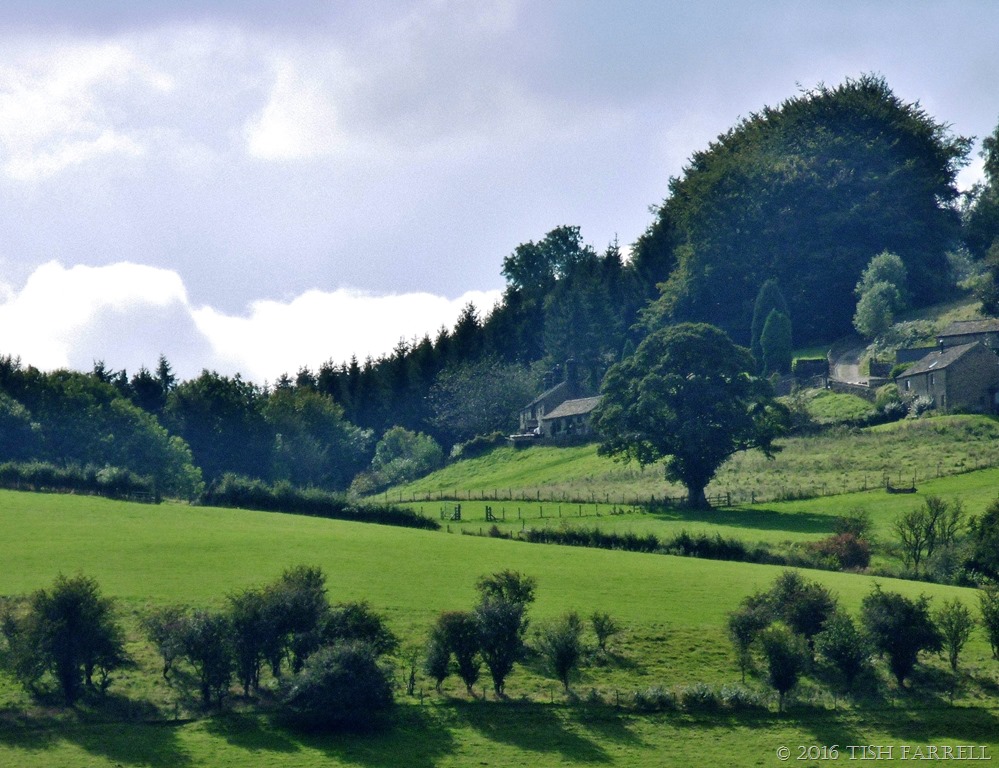
This was where I was last Thursday morning – not posting on Thursday’s Special, but trying to find a good spot on a field path outside Hathersage so I could photograph Callow Farm. This was the place where four generations of my Fox family ancestors were tenant farmers from around 1700 to 1892. Before that, during the late 1600s, they rented another Duke of Devonshire farm, The Oaks, up on the wilder heights of Offerton Moor, not far from Callow.

As you can see, the house (centre) is covertly situated, in the lee of the hill beside the wood. I had to use a lot of zoom, hence the hazy look, though such haziness is perhaps fitting for this piece of ancestral snooping. The more readily visible buildings on the right are the farm’s barns, now an upscale holiday let.

If you go to the previous post Stepping Stones Through Time you’ll find more of the story behind this photo. This was the reason why I  had hoped to cross the stepping stones, to achieve a closer view than this one. Ah well. Maybe next time.

*

There’s still time to take part in last week’s Thursday’s Special. Paula says ‘Pick a word in September’. Choose from: populated, time-sensitive, companionable, burgeoning, clandestine, but first go and see her gallery of photos and be inspired.

#thursdaysspecial


Blown-Away Opium Poppy: Thursday’s Special

IMG_1812

Paula has truly set us a challenge this week: DECONSTRUCTION. So as my stab at this school of philosophical thought, here is an abstracted opium poppy, its stamens and petals being blown off in the wind: caught in the act of deconstruction then: from flower to seed capsule. The cycle of life in all its parts.

Thursday’s Special: Deconstruction

Nightfall Over Wenlock Edge

100_5021

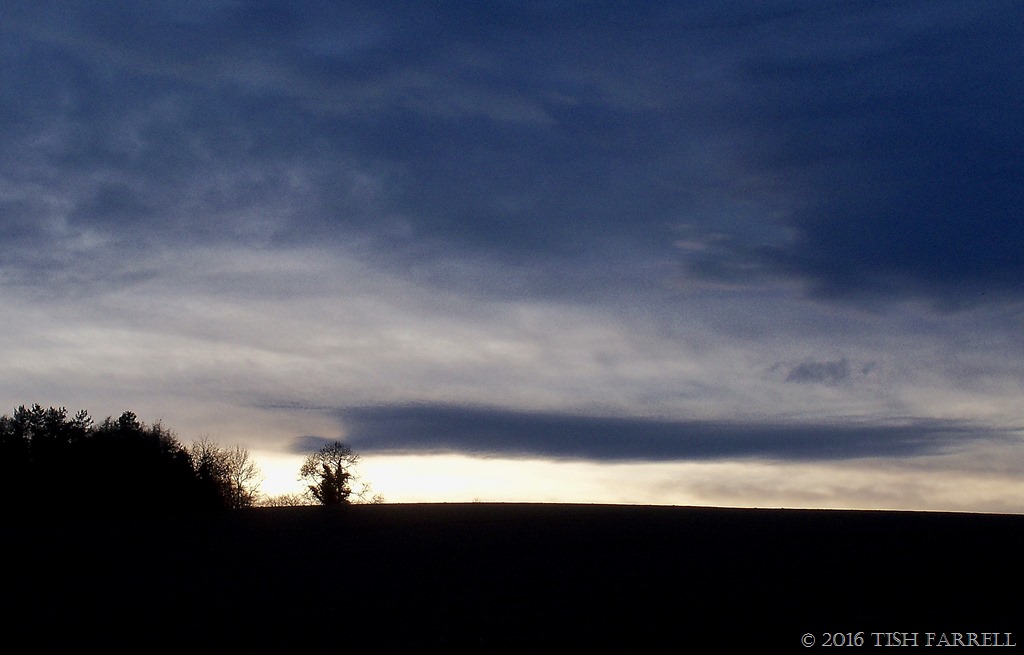
This photo was taken from the field path in Townsend Meadow behind our house, a scene captured one day last winter when I was late home from the allotment. I often stop at this  point on the path to take photos. The ash tree silhouette always catches my eye, whatever the season, and I love the way the day seems to slip behind the hill as night shuts down on top and shadows creep up to meet it. It’s a bit like a stage set. Or it could be Rip Van Winkle Land.

*

Be inspired by things of the night over at Paula’s Thursday’s Special: Nocturnal


As High As An Elephant’s Eye

Scan-131109-0004

And it’s a wise eye. A knowing eye. And it’s a privilege to have been allowed to sit and watch a great herd move by us and around us. So quietly. Measured footfalls. Moving across the Mara thornland. Infants. Adolescents. Mothers. Aunties. The big bulls. All moving as one. To their own rhythm.

*

Thursday’s Special: Eye contact

Thursday’s Special: Seaside Disorder

IMG_0788

For some reason we mostly go to the seaside at Christmas, and not at all in high summer. Of course a beach can be a dramatic place any time of the year – changing and unchanging all at once, figuratively and physically. How we treat with it reflects our current mood or emotion – heightening  or lowering it, depending on our inclinations.

This photo was taken on Ynys Mon,  the island of Anglesey in North Wales. It was Boxing Day. The wind was perishing yet spirit-filling too, but then I always find ‘going to the beach’ exciting, in much the same way as I did when I was four. You just never know what you will find there in the margins between land and sea.

So here we have a tumble of razor shells embedded in a beach stream that was running off the marshy hinterland. I think there’s a viscid quality about the stream in the winter’s light, as if the shells have fixed there by the water rather than by the shift of sand.  I like the slashes of greyish-white across medley of ochre shades. An intriguing state of disorder, then: the beach endlessly creating its own artwork.

Thursday’s Special

Sun And Shadows On The Linden Walk And Olympic Games Connections

P1040386

The Olympic Games begin in Rio today – cue views of Copacabana Beach and Corcovado Mountain with its astonishing statue of Christ the Redeemer. Now switch scenes to a small town in rural England, to a meadow in Much Wenlock, and turn back the clock to 1850, for this is where it began – the source and the inspiration for the modern Olympic Movement.

The town’s physician, Dr William Penny Brookes was the man behind the revival of the ancient Athenian games. His objective was clear:

for the promotion of the moral, physical and intellectual improvement of the inhabitants of the town & neighbourhood of Wenlock and especially of the working classes, by the encouragement of out-door recreation, and by the award of prizes annually at public meetings for skill in athletic exercise and proficiency in intellectual and industrial attainments.

He had already started the Agricultural Reading Society and been hard at work raising funds from Shropshire’s gentry to establish a working man’s reading room, while lobbying every famous writer of the day to donate copies of their works to the cause. Much of the library still exists in the town’s archives and includes some heavy-going and esoteric histories of far-flung lands. It is hard to guess the appeal of such books to farm hands and quarrymen after their long day’s labours, but at least they would have had decent light to read by. Brookes was also behind the founding of the town’s gas works.

Wenlock’s Olympian Society grew out of the Agricultural Reading Society. The very first games were held on the town’s race course but in later years took place (as they still do every year) on the field below Windmill Hill, now known as the Gaskell Recreation Ground, or as Penny Brookes himself called it, the Linden Field.

Nor was it any rustic village fete affair. The local MP J M Gaskell provided seating on Windmill Hill to give everyone a fine view, and the event was heralded with much ceremony, the town streets decked out from end to end, a parade of competitors, flag bearers and officials all marching with the local band. From the start, then, pageantry was a key part of the games, lifting people from their humdrum, hardworking existences. And although there were many fun contests and traditional country sports, the athletic events were taken seriously, and attracted competitors from all over the country. Prizes included silver cups and ink stands presented by local worthies and Penny Brookes designed elaborate medals – gold, silver, bronze, and had them made at his own expense.

News of the games spread far and wide, and indeed were spoken of in very high places. In 1890, when the French aristocrat Baron Pierre de Courbetin had been charged with finding ways to improve the fitness of the French Army, he was advised to go and see the Wenlock games. He stayed in Brookes’ house on Wilmore Street during his visit, and what he saw and also learned from Brookes inspired him to found the International Olympic Committee. The IOC held their first games in Athens in 1896, and although Brookes did not live long enough to see the extent of his influence, de Courbetin gave him due recognition:

If the Olympic Games which modern Greece did not know how to establish again is revived today, it is not to a Greek that one is indebted, but to Dr. W P Brookes.

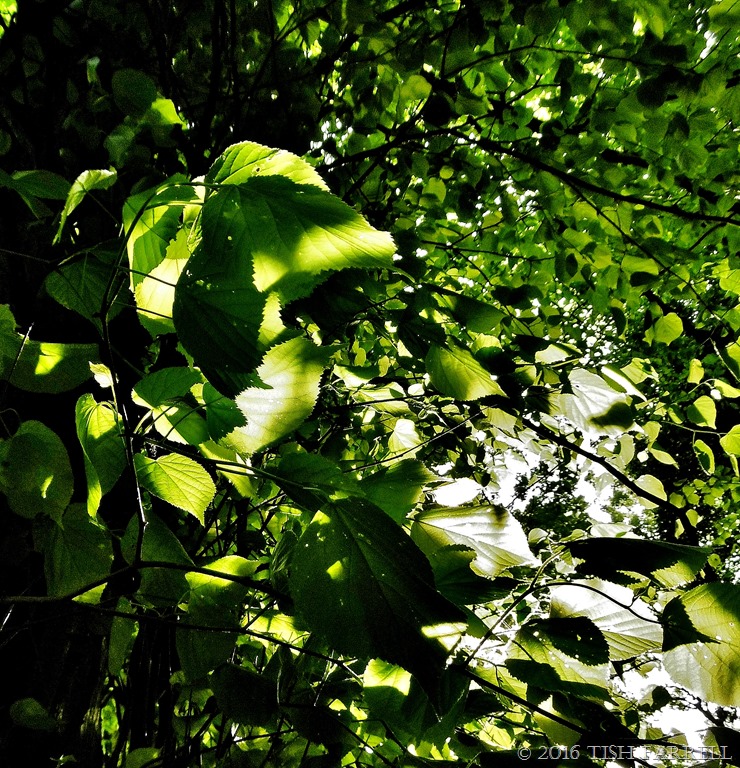
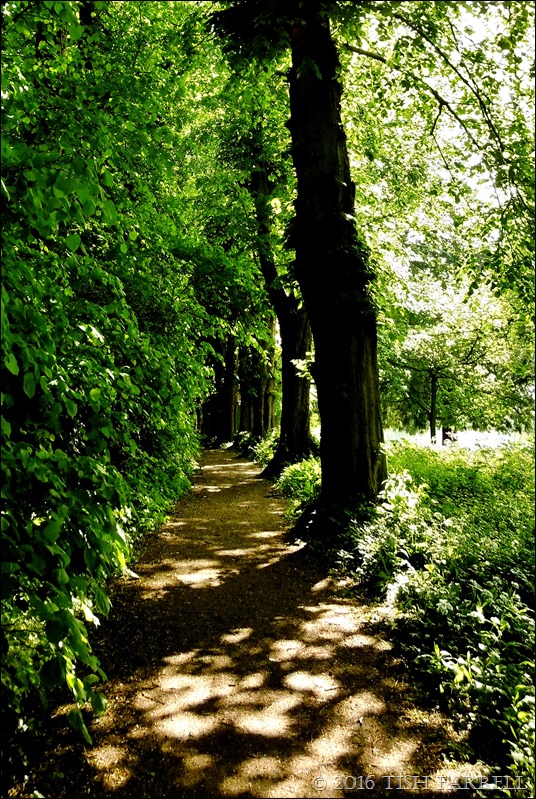
We the people of Much Wenlock are also indebted to Dr. Brookes for his planting of the lime tree avenue alongside the Linden Field where the games took place. As I’ve said before, it is one of the town’s enduring treasures. The trees are over 150 years old, and still in fine form. There is no time of the year when this avenue is not beautiful. In winter it is deeply mysterious, a colonnade to another reality. But whatever the season, there is always a play of light and shadow. And there is windrush in the high canopies, and crow call. And in summer the soporific scents of tiny green lime tree flowers.

Here, then, are a few more views, and so when you see the grand and glamorous opening of the Rio Olympics, give a thought also to this place and the Shropshire doctor, who with the well being of his townspeople in mind, inspired the modern Olympic Movement:
P1040407

101_0301

100_8822

P1040025

P1000514


This post was inspired by Paula’s Thursday’s Special theme ‘shadow’. Please visit her blog and join in this week’s challenge.

#2016OlympicGames

A Peculiar Pursuit? Listening In On Star Land

100_5332

It was a frequent and rather sinister feature of my childhood: Sunday afternoon drives around the Cheshire lanes. Always winter. Flat fields empty of their dairy herds. Neat hedges and the metal railed fences typical of this county. Then the sudden glimpse of it – the great grey dish in the sky: the disturbing scaffold-like armature that held it aloft – sometimes the dish tilted one way; other times in quite another position. So that the first sight of it across the flatlands would always be a shock to the system. Science Fiction in action then. Scenes I remember only in black and white.

But if the sight of it aroused feelings of vague anxiety, as a five-year-old I was also quick to register the awe and excitement in my parents’ voices. It might be worrying to me but, I concluded, this monstrous machine was clearly ‘a good thing’.

This, the Jodrell Bank steerable radio telescope, had only just been completed. It was the largest in the world back in 1957 – the dish 250 feet (76 metres) in diameter. Sir Bernard Lovell – a radio astronomer at Manchester University – was its creator. He had worked on the development of radar during World War 2, and now wanted to study cosmic rays. The gun turret parts of two British warships were apparently re-purposed to drive the telescope.

It became operational in time for the launch of Sputnik 1 in October 1957. This was the world’s first artificial satellite launched by the Soviet Union. My parents were very excited about this too. While Jodrell Bank tracked the path of Sputnik’s booster rockets, my parents were staying up into the small hours, standing in the garden of Love Lane House, Sputnik spotting. They saw it too, and got their names in the local paper. Whizzy spinning sputniks on strings were, for some time to come, the toys to have. I received several. Cardboard ones came free in Cornflakes packets. In fact Sputnik was a frequently uttered word in our house. Perhaps it’s what predisposed me to want to learn Russian a decade later.

In 1966 the Soviet Union actually asked Jodrell Bank to track their Luna 9 moon lander spacecraft. Thus it would seem that the Cold War had its lukewarm moments, although relations were not so well fostered afterwards when the British Press got hold of, and published the Jodrell Bank photos ahead of the Russians giving their permission.

Later, in concert with US surveillance, the telescope was used to monitor Soviet spy satellites. And yes, in between spying activities, there was also some serious scientific research – time spent observing those esoteric out-of-space entities – pulsars, quasars and gravitational lenses. And please expect no further explanations of these matters. My studied viewings of the TV programmes by the very excellent theoretical physicist Professor Jim Al-Kalili have left no residue of knowledge in my brain cells, or at least none that I am aware of.

Today, the Lovell telescope has been joined by several others on the site – all part of Manchester University’s Jodrell Bank Centre of Astrophysics. It has a visitor centre, and all manner of exciting things going on there. This photo, by the way, was captured by chance last year when I happened to look out of the window of the Manchester to Crewe train. A veritable blast from the past then, but this time in full colour. I still find it worrying though – that great grey dish eavesdropping on space.

And before I go, there’s also a literary connection with Jodrell Bank. As a pre-teen I was a huge fan of Cheshire children’s writer Alan Garner, and in particular of his 1960s titles The Weirdstone of Brisingamen and its sequel The Moon of Gomrath. Garner didn’t think much of the first book, and it was only in 2012 that the third volume of the originally planned trilogy was published. But then Boneland is not for children. It is a fusion of science, prehistory, fantasy and psychotherapy whereby Colin of the first two books is now a professor at Jodrell Bank, trying to resolve the loss of his twin, Susan, and the loss of his memory. It’s a haunting work with many layers. Perhaps, like me, Alan Garner found Lovell’s Telescope a disturbing sight on the Cheshire Plain, raising more questions than the ones it was intended to answer.

copyright 2016 Tish Farrell

100_5333

For more Thursday’s Special posts please visit Paula at Lost in Translation. She asks us to pick a word from the following: Pursuit, Veneration, Effervescent, Personal, Peculiar. And then post a photo or photos. I think I’ve scored the 3 ‘p’s’ in this post plus a bit of veneration for Alan Garner.

Ludlow Castle In Its Autumn Glory

100_6732 - Copy

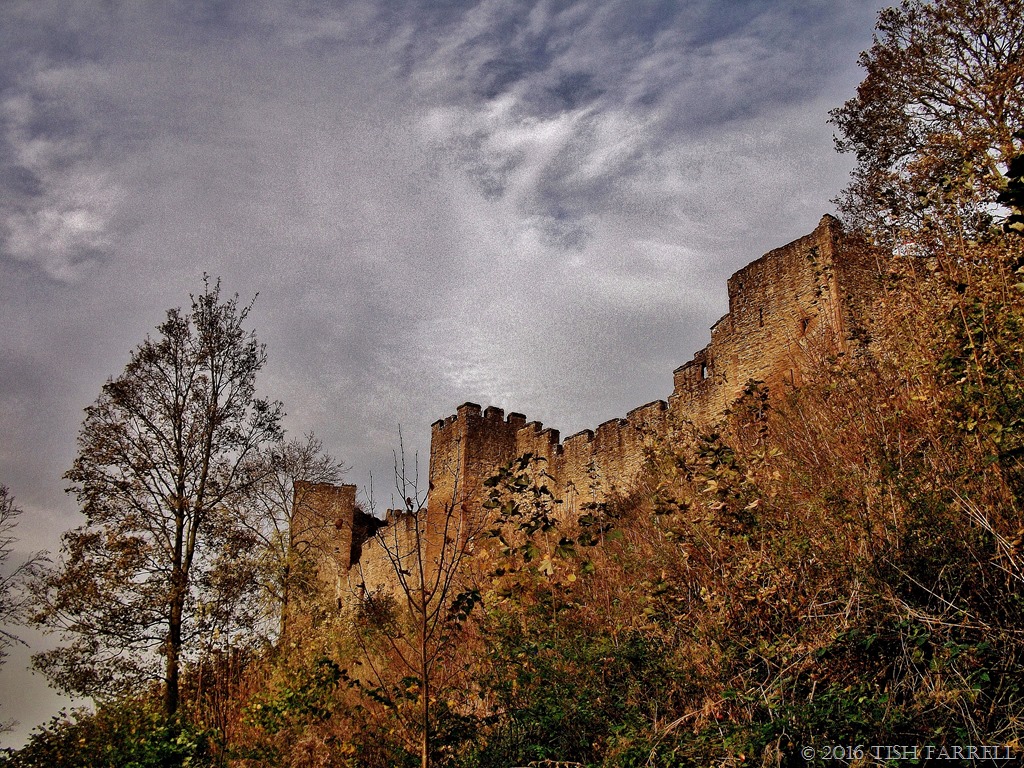
I recently posted a dramatic black & white photo of this thousand-year old castle – one of Shropshire’s finest. Here are the perimeter walls from a different angle, on their clifftop eyrie above the River Teme. It must have been a daunting sight for any peasant foot soldier commanded by his lord to get on and besiege the place.  It might explain why so much of the castle is still standing.


Traces of the past is the theme over at Paula’s Thursday’s Special.