This photo may serve better as an idea than an actuality. It’s the layers that attract me – not only of light and shadow, surface reflections and leafy river bed, but also of present and past: the stones that,for two and more centuries, my maternal ancestors used to cross the River Derwent.
Or at least so goes the family tale, the one my great grandmother, Mary Ann Fox, passed on to my grandmother, Lilian Hickling, who passed it on to her daughter, my aunt, Miriam Wilkinson, who passed it on to me. The photo, then, could be taken as a physical rendition of Chinese Whispers. Well, aren’t all family histories like this, word of mouth down the generations? There are bound to be omissions, distortions, total fabrications even.
But there are some certainties too.
Great grandmother Mary Ann was a Derbyshire lass, born and raised at Callow Farm, the child of tenant farmer George Brayley Fox and lead miner’s daugher Mary Ann Bennett. The land all around belonged, as it does still, to the Dukes of Devonshire. The stone-built farmhouse was (is) tucked high into the hillside below Highlow Hall and Offerton Moor. From Callow’s garden wall, the fields fall steeply down to the River Derwent. The stepping stones crossing was the quickest route from the farm into the Peak District village of Hathersage across the river, and the path there, across Callow’s meadows, still survives on OS maps. And so we have a scene, relayed to me by aunt via grandmother, of a young wife and mother living in the close and gloomy streets of industrial Farnworth. There she conjures her girlhood life, telling her four town-born children how, if she needed to buy the slightest thing she would have to traipse across many a field before reaching the stepping stones to Hathersage.
Other scraps have reached me. There is one that now lurks in my memory like a small haunting. For it seems my grandmother often told my aunt that Mary Ann was ‘a sad woman’. Nor is this surprising. She was widowed twice: at 30 and at 41. After the first loss, and with four young children to raise, she took up inn keeping beside the Manchester Ship Canal at Hollinfare. Grandmother said that as Mary Ann moved about the inn, she recalls the waft of her black silk dress always carried the scent of lily of the valley; a touching image until you learn the scent was dabbed on to cover the smell of gin.
But before the sorrow, I have a sense that, as a young woman, Mary Ann was headstrong and passionate. Though it may well be that those very characteristics were precisely the source of some poor decision-making. In 1886, aged twenty two she went against family wishes and married Thomas Shorrocks, a spindle and flyer manufacturer, who worked with two brothers and a widowed mother in the family firm in Farnworth, Bolton, part of Greater Manchester. His first wife, Mary Ann Wright, had died around the time their first child was born, leaving Thomas with a young son. How Mary Ann Fox in Derbyshire met Thomas Shorrocks of Farnworth, Lancashire is still a mystery. Grandmother’s only surviving comment on the matter was that her mother fell for the first man she saw wearing a stove-pipe hat, that she was a country girl swept off her feet by a townie. Grandmother also said she scarcely knew her father. He had no time for children and kept away from home until they were asleep, staying on at the works or at his club. And then too, he died very young. Around 1891-2 the family firm of Robert Shorrocks & Co was in grave financial difficulties. The machinations to keep the business afloat involved a high profile court case, but then all was lost anyway. By 1893 Thomas Shorrocks was dead. He was only 39.
But how did Mary Ann adapt to life in industrial Farnworth?
Her first married home, 8 Kildare Street, Farnworth, was not far from the Shorrocks works on Bridgewater Street. It was a modest terraced villa with a small front garden and a back yard – a far cry from the sweeping high-moors vistas around Callow. And if she did not see much of Thomas during daylight hours, was she abandoned to her own devices? We know from the 1891 census that she did at least have the company of Lucy Stubbs, a young Derbyshire girl from Grindleford Bridge employed as a domestic servant. There were also other Shorrocks households along Kildare Street, including mother-in-law at number 23. Mary Ann also formed a close friendship with her husband’s younger sister Mary, though it was in every way subversive. Mary was being wooed by one John Hamer (later to become an wealthy mill owner), but Thomas and the Shorrocks family in general disapproved of him. It was Mary Ann who allowed the couple to meet in secret at Kildare Street, a kindness that was long remembered; for in the end John Hamer did marry Mary Shorrocks, and after Mary Ann died it seems they did much to support her children.
It also seems Mary Ann did not fall over herself to fit in with Farnworth mores either. There’s a clue in another of Grandmother’s snippets. She told my aunt that the traditionally dark clad women of Bolton and Farnworth looked askance when Mary Ann went abroad in her bright print country frocks. Did she ever back down, I wonder. Or did she flaunt? In my mind’s eye I see the flash of free-spirited obstinacy that brought her to that place. Much like the light flickering through the riverbank trees and onto the Derwent stepping stones.
The collapse of Shorrocks’ fortunes coincided in 1892 with Mary Ann’s father’s decision to leave Callow Farm where his family had been tenant farmers for four generations. Derbyshire farmers were having a hard time in the early 1890s: prices for crops were low, and rents were high, and landowners unwilling to compromise on the rents. It seems likely that some of the proceeds of the farm sale of stock, crops, horses and household belongings were used to secure the licence for the inn in Hollinfare, Cheshire, where Mary Ann began a new life as innkeeper.
My aunt said the Fox family had decided that taking the inn was the best means of securing a home and living for her with three young children and an adolescent stepson. It stood on the south bank of the great Manchester Ship Canal, which linked the vast industrial heartland of northwest England with the port of Liverpool. It had only recently opened in 1895 when she took over the inn. In every way the Foxes must have thought it a shrewd decision, anticipating plenty of passing trade.
Mostly what it brought, and pretty rapidly too in January 1895, was another marriage to another widower – one Charles Rowles, a ship’s pilot on the canal and a former sea captain. My grandmother disliked him, although she adored her young stepbrother, Giles, born in 1896. She said it was only once her mother had married him, that Charles Rowles produced two teenage daughters from his first marriage. These young women apparently moved into the inn and tried to rule the roost which, I know for sure, would not have gone down well with my grandmother. If any roosts were to be ruled, she would be doing it.
When I tried to discover more about these interloping young women, I found a hint of scandal. It very much looks as if Mary Ann’s younger brother, George Fox, then aged 26, eloped with one of his sister’s new stepdaughters. Hannah Louisa Rowles was probably only 15 when she married George, although she claimed to be 18 on the marriage licence. At the time, November 1895, there were both living on York Street, Manchester. The following August their daughter Dorothy was baptised although she does not survive. In 1901 the census indicates that George was running ‘on his own account’ a large public house on Oldham Street, Manchester. By 1908 he had died, and in the 1911 census his young widow is listed as a servant, working in another Manchester pub. What happened to her remains to be discovered.
As for Mary Ann, in 1905 after ten years of marriage, Charles Rowles died. She survived him only by another four years, dying in the Manchester household of her stepson, Robert Shorrocks. She was 46. Her youngest child Giles was about 12 years old at the time. The 1911 has him living with a widowed Rowles aunt in Cardiff and employed as an apprentice shipping agent. He was to die at Gallipoli in 1915. Nineteen years old and buried at sea somewhere off Lemnos.
Now as I look at the stepping stones photograph, these are the thoughts that run through my mind. It is all too easy to look back to Mary Ann’s growing up at Callow Farm and see a rosy past. It’s how we tend to view things: the glamour of an imagined rural idyll – the stepping stones back to happier days. I had hoped to cross here too. I badly wanted a closer view of the farmhouse. But on the day of my visit there had been heavy rain, making the Derwent far too active to attempt to cross without rubber boots and a stout stick for support. A quest then, for another time? Perhaps.
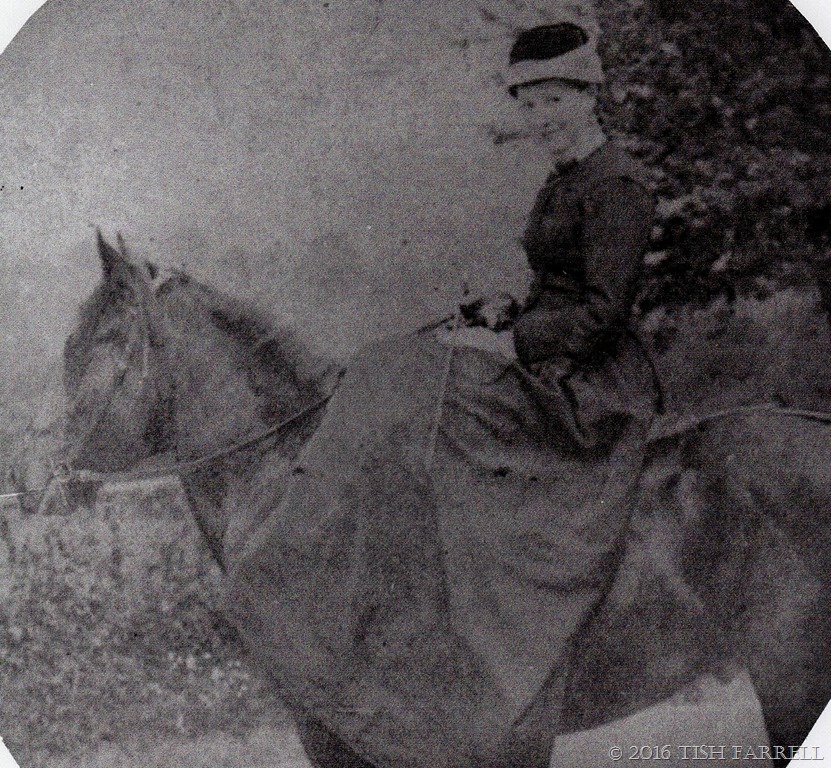
Mary Ann Fox (1863-1909) sometime before her marriage, and before her father sold her pony. He had threatened to do this if she persisted in jumping the farm gate on horseback. She did not listen. You can tell that she would not just by looking at her.
Copyright 2016 Tish Farrell