Opium Poppies caught out on a blustery day.
For once I wasn’t using my Lumix Dramatic Monochrome setting when I took this photo on Wenlock’s Linden Walk back in early June. But I think the manual colour version-turned black & white has come out quite well despite the deep shadow and lots of zoom.
The next photo was taken on a winter’s day using the monochrome setting. It’s the path that runs from the field behind our house and up onto Wenlock Edge. The horizontal line of tree tops marks the top of the Edge. (I like the strange effect of false horizons). When you stand up there the land falls away from you rather hair-raisingly, dropping almost vertically through ancient hanging woodland. In winter, through the bare trees you can just make out the rooftops of Homer village way below.
*
This is the footpath to Bradley Farm. It lies on the far side of the town away from the Edge. Also a change in seasons here: this was taken in full sun last August just as the wheat was ripening.
Windmill Hill sunset. I think it’s early autumn because the little ponies that are brought in to graze the hill have not yet been moved to their winter quarters.
*
I take lots of photos of the hill on Down’s Farm. It’s an interesting shape and the spinney on top gives added character. But with distant views I always like some structure in the foreground too, in this case the Windmill Hill bench. I took the next photo with same idea in mind.
The subject here is the cricket club’s shed on the Linden Field. It stands between the lime tree avenue and a line of Wellingtonia or Giant Sequoias. From this angle I think it looks rather mysterious. A Tardis type portal of some kind. It simply pretends to be the place where Wenlock’s cricketers keep the lawn mower.
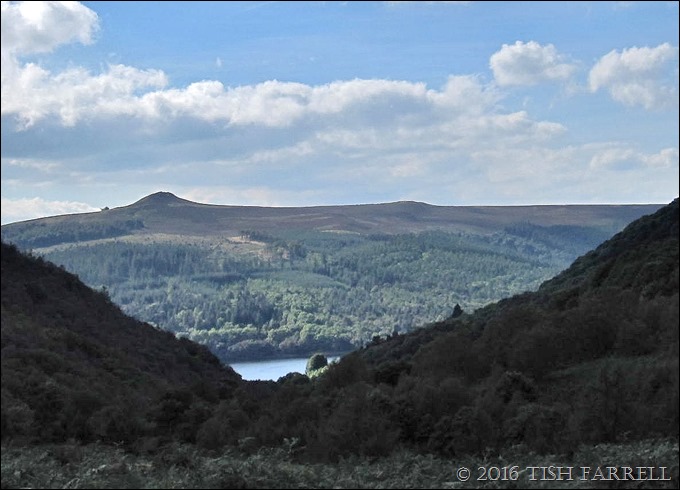
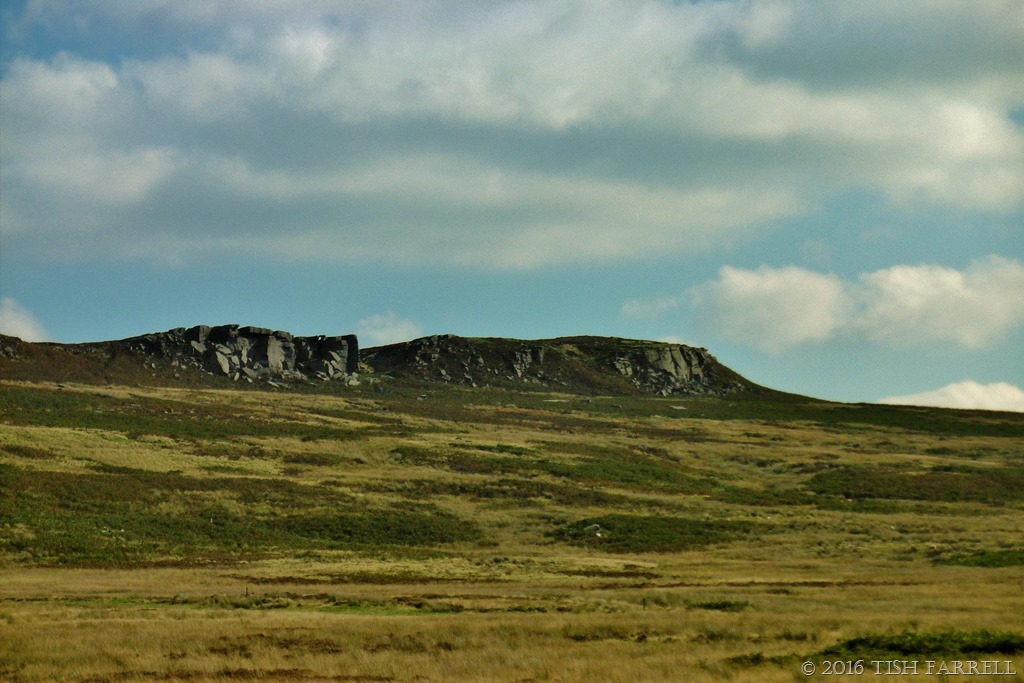
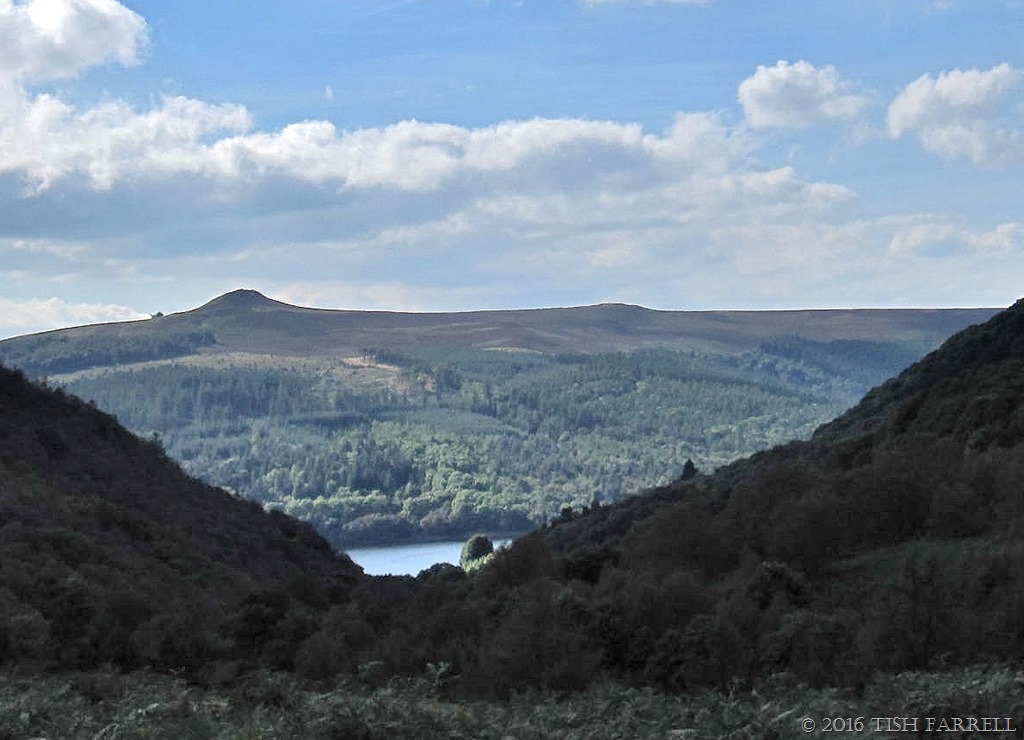
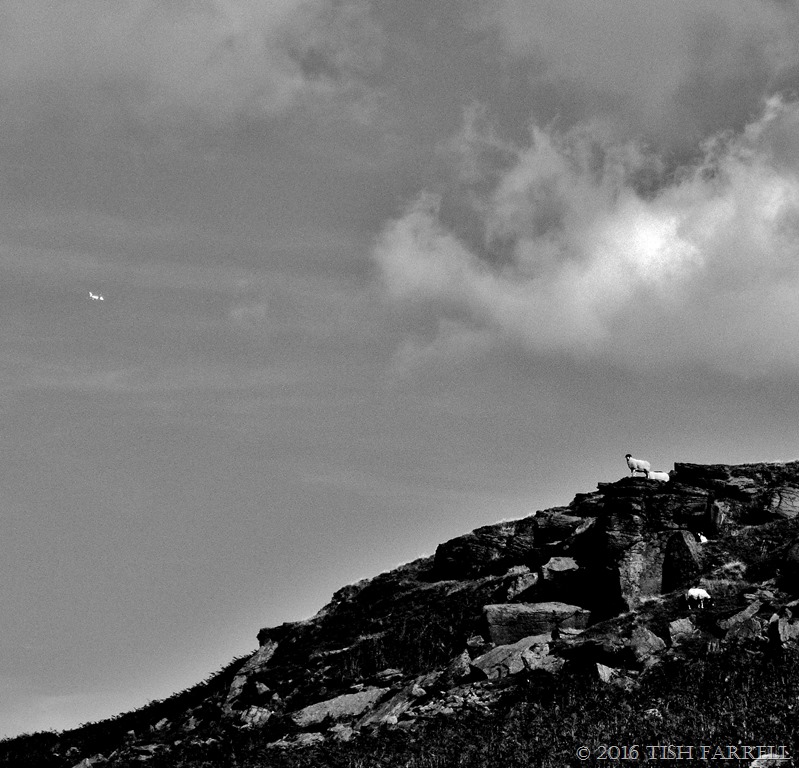
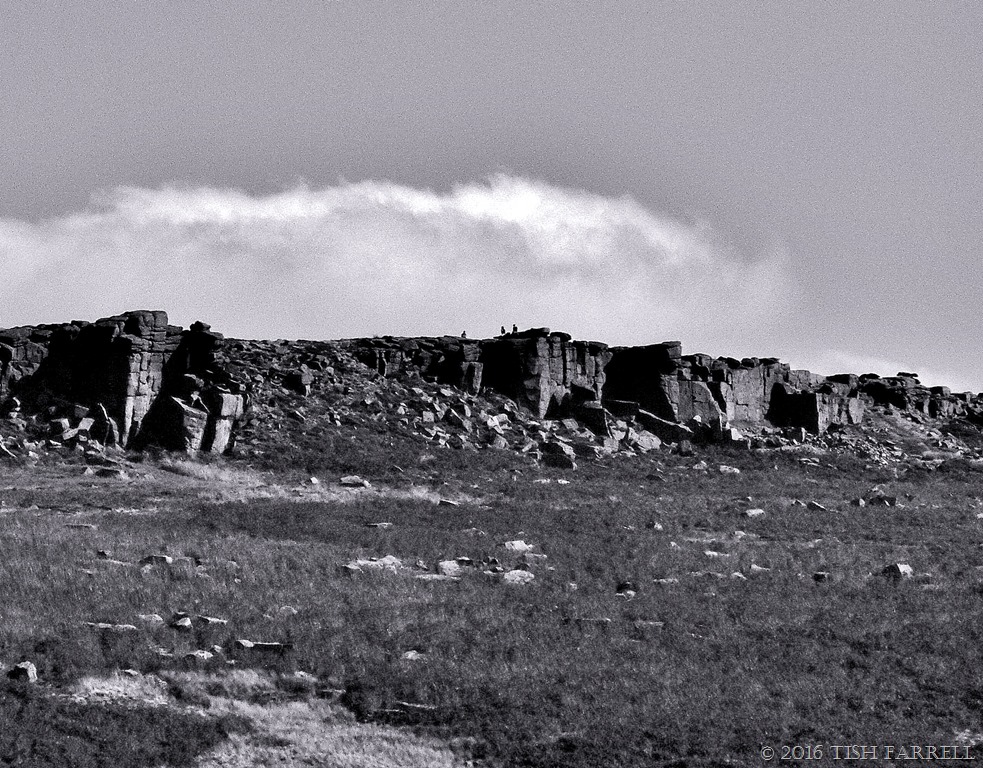
Cee’s Black & White Challenge: In the distance
Please visit Cee for more distant compositions.
It makes you want to burst into song. You know, that cheesy Oklahoma number: There’s a bright golden haze on the meadow. There’s a bright golden haze on the meadow.*
When I was small, and we still lived in Love Lane House in the midst of the Cheshire countryside, my mother would always sing as she went around the house doing chores. This song was a favourite: Oh what a beautiful morning, Oh what a beautiful day. She had a nice voice and always sang with great gusto. This in turn provided much needed reassurance on days when Miss Goodwin put in an appearance. Wednesdays. She was mother’s home help, and she came once a week to clean the acres of red quarry tile floors that ran throughout the house.
To a child she was an alarming gnome-like figure. Her straggle of black, limp hair had much in common with the wet floor mop that she wielded with dogged determination. As she twisted the mob head in the bucket, she would peer down at me through round, black-rimmed spectacles that made her eyes stand out on stalks. I thought she was probably a witch. I also associate her with green liquid soap – a cleaning product of times past. It had a repellent smell.
But mother went on singing, and all seemed well apart from the line about the corn being as high as an elephant’s eye.
This was a mystifying notion for a country child who, though surrounded by farm fields, had never seen elephants there, nor crops that grew so tall. My father worked for an agricultural merchants, and early on I learned the difference between the grain crops he dealt in. In those days we did not know much about American corn, which we anyway call maize, and corn was a word commonly used to refer to wheat.
A case of cereal confusion then.
Many decades later when I was out and about on Kenyan farms, and wondering at the height and vigour of some of the maize plots, I could well see how you might lose an elephant or two in there. In fact African elephants are very partial to scoffing poor farmers’ white maize crops just as they are ready to harvest. They can eat in a night produce that would have lasted a family half a year.
Anyway, there are clearly no elephants in the wheat/corn in the photo. It is only half a metre tall. But the light is truly extraordinary. A false dawn ripening since in reality the crop is still green with only the barest signs of turning. I kept my eyes open long enough to frame the shot and then went back to bed, inner sight still glowing from the vision: did I really see that strange light, and does this happen on other mornings when I’m not awake?
Mother’s voice comes winging back across the years: I’ve got a wonderful feeling/ Everything’s going my way. Did I ever believe this back then? Mother was someone who ever came with undercurrents, despite the nice singing. For some reason the cornfield elephant I now picture has eyes the colour of summer-blue skies, which is odd. All of which is to say, childhood impressions, layer on layer, randomly and silently absorbed in the presence of unaware adults, can run deep. Like elephants in cornfields, you just never know when they’re going to ambush you.
~
*Lyrics by Oscar Hammerstein II, music by Richard Rogers copyright 1943 Williamson Music
We didn’t invite them, but this crowd of opium poppies showed up anyway, pushing in behind the garden fence along with several other blooming gate-crashers. There’s a whole bunch more behind the garden shed. Papaver somniferum – the sleep bearing poppy, Asian in origin but now naturalised in Britain on waste ground and in field margins. And in case you are wondering, in our cool climate it does not produce the latex from which opium is derived. Better to get high by looking at them. And what a cheering sight it is on a Monday morning. So poppies, we’re glad you came. Please feel free to make yourselves at home here.
For more 4th July blooming visit Cee at Flower of the Day.
Some people – otherwise known as Graham – think I have secret ambitions to take over the whole of Wenlock’s Southfield Road allotment. He couldn’t be more wrong, although whenever I protest my intention to contract operations and reduce my current domain of one and half plots to a single half plot with polytunnel attached, he gives me that look. Oh yeah? The problem is, just like Britain leaving Europe, my exit strategy is complicated. But unlike Brexit, at least I do have a strategy for reducing my plot occupation. Indeed in this era of foolish contraction we could even call it Plexit.
The story of my initial expansionist tendency begins nine years ago, not long after we moved to Wenlock. I had known the town for much of my life, and lived for a long time in a neighbouring parish, but I had not known that the town had an allotment. It is well hidden behind a row of houses, a relic of much earlier times when a railway ran by our neck of the Edge, and railway workers had the right to demand that their company provide, along with their houses, some sizable garden plots on which to grow their own food.
It was a chance remark at a neighbour’s Christmas party that made me realize that the shed roofs that I could just see across the field from our new home were not in a row of private gardens as I had first thought. The hunt for a plot was on. When I finally tracked down the chairman of the Wenlock Allotment Society it was March, and I was champing at the get-gardening bit since our cottage garden was not big enough for vegetable growing. Though charming, the chairman told me all the plots were taken, and he would add me to the waiting list that already had several people on it. He did not sound hopeful, and disappointment descended. Yet by April he was on the phone saying that I clearly had a fairy godmother: my pumpkin dreams had come home to roost. Several plots had been unexpectedly surrendered, and there was a half plot left if I still wanted it. The rent was £20 per annum. So I said yes, site unseen, and we arranged for a convenient moment a few days later when he might introduce me to my new land holding and collect the rent.
Thus began allotment my life – with an inherited leaning shed, an ancient greengage tree just then in bloom, and a plot full of couch grass, sow thistle, docks, dandelions and buttercups that the previous incumbent had clearly been nurturing for some considerable time.
And that’s the problem with allotments. Too many would-be cultivators take them on only to find themselves overtaken by the amount of labour involved. Yet the idea of allotment growing remains beguiling, and so time passes as they decide whether or not to abandon the plot. The upshot of this is that everyone gets the fall-out from the weeds on neglected plots. Also the general tendency to disorder that breaks out in such communal enterprises provides havens and harbourage for pests and diseases that then become endemic. It takes much gritting of teeth not to resort to a host of chemical applications.
The upside of allotments is of course the camaraderie – the like-minded people who will be there to commiserate over one’s sorrow at slug and allium weevil devastation, or to swap ideas for pest control, share the joy of success and in the ensuing excesses in crops, or generally to keep an eye on neighbours’ plots while they are away. All good stuff.
Also when I first started, there was one old gardener still hard at work. Crook-backed, and slightly crippled, he travelled by bus from another village. This also involved him in quite an uphill hike from the bus stop which he could only accomplish very slowly, and with a few stops for a cigarette. But once on the allotment he tended three full 20 by 5 metre plots on behalf of other elderly tenants or their widows who lived on Southfield Road. He was there most days too, and I think he had probably been there for centuries. He gardened in the way my grandfather would have done.
Often in the winter, when we still had a few really cold ones, we would be the only people there, and I would take the opportunity to quiz him over his tried and tested methodologies. I especially took note of when he sowed particular crops. His repertoire was limited, but he grew in bulk: broad beans, runner beans, beetroot, onions and potatoes. I don’t remember his growing much else. He knew what worked best, and he knew those crops that were within his capacities to manage on such a scale.
And that’s another big lesson to be learned at the allotment. When you have your first plot – which can seem so large and roomy – and you have finally cleared all the weeds, it’s too easy to assume that anything will grow there. It won’t . Not unless you have been lucky to take on a well worked, and hugely well composted and sheltered site. It took me a while to learn that it’s best to start by taking a good look at what the seasoned growers are growing; see what thrives in the face of endemic pests, the plot’s micro-climate, the general environmental conditions, and soil structure limitations. That way you can be sure to get one or two decent crops of something, and these successes will keep you going while you get to grips with your plot’s potential and/or deficiencies.
For instance another experienced allotmenteer showed us newbies that the only way to grow decent carrots and parsnips on our heavy soil was to dib individual root shaped holes at sowing time, fill them with good compost and then sow the seeds on top. It’s a rather time-consuming process but worth it if you don’t want to waste packets of seed. For carrots it also reduces the need for a lot of thinning, and the plants can be left to grow throughout the season covered by horticultural fleece, so avoiding attacks by carrot root fly. I have now adapted this idea by using moveable raised bed, which Graham originally made for me as a cold frame. I place it on top of the existing soil level. Fill it with a good six inches of fine compost mixed with coir fibre and sow into that, and then cover the lot with enviromesh.
In those first years it was tough going. I thought I was a moderately experienced gardener, but there was much unforeseen trial and error. The plot took monumental amounts of clearing, digging, and composting. Crop successes were patchy, apart from colossal amounts of black currants and broad beans. The heavy soil proved almost impossible for sowing anything other large seeded vegetables, and even then there was a tendency for them to rot if we had a spell of cold, wet weather. Or if they germinated, the roots became compacted and the plants effectively bonsai-ed themselves, and then got eaten by slugs or infested with aphids.
All the time I was casting covetous eyes on the other half of the plot. It had clearly been well cultivated over the years, and the soil looked lighter and much more promising. I saw it produce masses of strawberries and fine looking French and runner beans. It was also nearer the water point, a serious consideration given our erratic weather patterns which often involve a spring or summer drought. I watched two other gardeners come and go there before finally making my bid for it. At last. Now I could grow decent potatoes, strawberries, runners beans, leeks, carrots, and leave the old plot to produce what it did best – raspberries, blackcurrants, rhubarb, artichokes, and swathes of very useful comfrey for feeding the rest of the plot.
The half plot I began with nine years ago, this year growing cover crops of field beans. I should perhaps have dug some of them in before they flowered – this as a green manure. But I didn’t, and the blossom kept the bees very happy. And now I have tons of mini broad beans – to eat, and to dry for autumn sowing.
*
So now I had 70 feet of plot, and I had only just begun to get the measure of it when I rather recklessly found myself with a further half plot. This was two years ago. I was so fixated on taking over the polytunnel that Bob and Sally had erected there the previous season that I neglected to notice that it stood on an especially wide piece of ground that had once been the domain of the aforesaid aged gardener, and thus long neglected. And so quite apart from learning the new art of polytunnel cultivation, it was back to tackling another dense carpet of dandelions, buttercups and couch grass.
Even I could see the daft side. He who disbelieves in Plexit (that would be Graham), simply raised his eyebrows and saw (as with Napoleon’s invasion of Moscow) only evidence of wilful territorial overreach. ‘You’ve taken on too much,’ the look said.
‘But I have a plan,’ I said. ‘I mean to contract. It’s my ultimate objective.’
More raised brows.
‘It’s raised beds that I really need,’ I said. ‘Then I can start the retreat from the old plot.’
Being the kind soul he is, Graham agreed to making me some beds, though leaving me with the distinct impression that he was humouring a mad woman.
Last year then, and before I’d discovered ‘no dig gardening’ approach (see earlier post HERE), I started clearing the new plot, basically by skimming several inches of weedy compacted ground off the top and dumping it in compost bins where it might just rot down by the end of the century. I covered the bare ground with the limited amount of compost I had available, sowed some trefoil for a green manure and inter-planted it with sweet corn, which to my surprise grew a magnificent crop of large cobs. I also planted out brassicas next to the corn and produced some rather fine purple cauliflowers, which also surprised me. Meanwhile Graham set about on the first consignment of raised beds, made from recycled pallets which he picked up for free from work.
The new plot in early spring this year. Beds provided by Plexit sceptic, and planted with over-wintering onions, lamb’s lettuce and winter purslane. Behind the polytunnel the open bed has not been dug apart from some spot-weeding of dandelions, but covered with six inches of recycled soil from the allotment’s communal heap of ages (see next photo). It has been planted with Early Onward peas (just being harvested this week. See second photo above). These were pre-grown in 4 inch pots, five or so seeds to a pot, to avoid mouse devastation. I find that transplanted peas do really well, although it’s a bit of a faff having loads of pots. They also need to be well defended from pigeons as soon as they are planted out.
This heap was apparently some 40 years in the making. At the end of the winter, before some of us began to recycle it, it extended beyond the weeds on the right, and was 6 or 7 feet high. I suspect I have moved around 100 barrow loads. Unavoidably, given that the allotment is a weed haven, the soil is filled with weed seeds, but at least it is lighter and more free draining, and gives crops a chance to get going. So far the crops in the new raised beds, or on areas where I’ve not dug, but covered the soil with several inches of stuff from my own compost heaps, are far superior to anything grown on existing dug-over soil. And while no-dig proponents claim that this method means fewer weeds, I don’t think this holds for a very weedy allotment, but at least perennials like dandelion and nettle are easier to remove from lighter soil.
This year’s Lark sweet corn, growing next to the peas on a no-dig plot.
Nautica French beans in a raised bed on recycled compost heap soil. So far so good, though a few nettle seedlings popping up.
*
And now for Plexit, and my plan for plot downsizing.
Ideally in terms of work load it would have been better if I had already relinquished the half plot I first started with nine years ago – along with the leaning shed and the greengage tree that only fruits every nine years. Despite all my compost input, pony poo additions and green manure growing, the ground is still the least promising. The only remedy would be to cover it with the rest of the communal soil heap, but then I reckon that (along with effort needed to move it) it would be far better deployed on the new plot where I’ve just started making a no-dig experimental bed by covering the weedy, long uncultivated ground with cardboard and six inch layer of soil, and then sowing it with cover crops – fenugreek and phaecelia. I’ve no idea how this will turn out. It’s also adjacent to my other experimental section of cardboard covered by 6 inches of tree shreddings – another unknown quantity with regard to next year’s cultivation potential.
But the main block to immediate downsizing is the fact that the much loved raspberry patch is at the top of the old plot, and I can’t give it up until I’ve got a new bed going. The present one keeps us in fruit the year round, so can’t be surrendered lightly. I started a new bed behind the polytunnel last winter, but the canes are being very slow to get going, and I may need to replace some of them – all of which will put Prexit on hold.
Nor am I keen to give up the bottom half of the old plot just yet because it’s doing rather well, and I also have my three massive compost heaps there, and several leaf mould silos. And anyway it provides plenty of room for potatoes and winter veg. And then well…
In the end I suppose it’s more than obvious. The Prexit sceptic has a point: I won’t be yielding territory any time soon. But then that’s my point. I’m busy negotiating, doing essential groundwork, ensuring that what I give up will be in reasonable shape when I do so. Only when conditions are the best they can be, or I’ve run out of steam, will I start the retreat. Makes you wonder about Brexit, doesn’t it?
In the meantime, if don’t have a garden…
Lots of vegetables grow well in containers – leeks, garlic, carrots, spinach, salad stuff, tomatoes. A bucket with a few holes in the bottom makes an easily portable garden.
copyright 2016 Tish Farrell
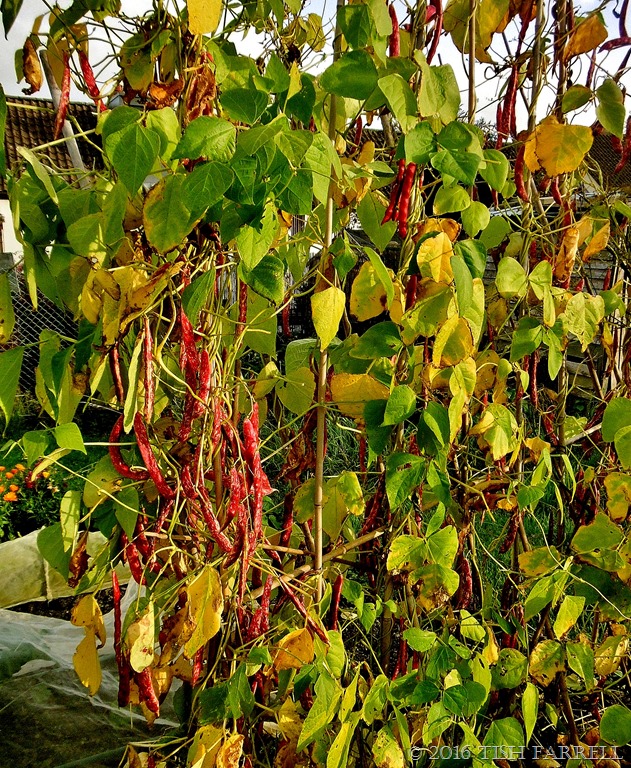
Related: Trying not to dig the plot and 30 minutes of weird weather
This month Jude at The Earth Laughs In Flowers wants to see photos of the edible garden. Visit her to find out more and see her splendid allotment gallery.
Take two steam enthusiasts
*
It has to be the best day out in Wales – a trip on the historic narrow gauge Talyllyn* Railway, setting out from Tywyn on the west coast and meandering up the hills to Nant Gwernol. The line was built in 1864 when the McConnell brothers of Manchester decided to branch out from cotton spinning into slate mining. The railway brought in supplies for the miners, and later carried a few passengers between the various valley communities. But mostly it delivered slate wagons which, from the railhead in Nant Gwernol, were winched on cables up mind-boggling inclines to the the heights of the slate quarry, and thence returned laden with slate for export from the port of Aberdovey.
As a preserved line, Talyllyn is the world pioneer. The Preservation Society was set up in 1951, and ever since has run with the help of passionate volunteers who have supported the small corps of paid staff. One of the early volunteers was the Reverend W V Awdry who wrote the Thomas the Tank Engine books, still much loved by children big and small. But Thomas apart who cannot fail to fall in love with a locomotive that looks like this? It’s an original Victorian engine too.
For our first trip on the line we had booked to go on the special Victorian Train Experience, a four-hour potter on an original period train which departed Tywyn Wharf at 11.15 am and aimed to return around 3.20 pm in time for a cream tea in the station restaurant. Our guide, David Leech (seen here in his guard’s uniform) informed us that we would spend that time “wombling around” on the line, fitting in between scheduled services which we would have to give way to at various points. He also explained that the train would stop in several scenic locations so we could get out and photograph it. This also included having the train reverse a mile or so back down the track so we could position ourselves on, or above bridges and catch it on the return, steaming at us for all it was worth.
It was all extremely silly, but thus enormous fun. And we didn’t even mind that it kept pouring with rain. We shared our carriage with a retired British Rail signal man and his wife, and a young extant signal man with his mate. For the first leg of the trip David Leech sat with us telling us daft anecdotes – Tales of the Talyllyn Railway. He had once been the railway’s traffic manager as well as being a life-long volunteer.
The entire Talyllyn enterprise is infused with the most enormous goodwill, humour and enthusiasm. It embraced us from the moment of our departure, and went on hugging round us as we rattled up into the hills to Dolgoch Falls and beyond. At Abergynolwyn we stopped for lunch in the Quarryman’s Tea Rooms where we were warmly welcomed by the serving staff who were dressed in Victorian costume while managing to not look naff.
After lunch we had to wait on Abergynolwyn Station while another train came through so the platform was crowded with waiting passengers just like a main-line railway – the difference being the palpable excitement was all for the train ride itself rather than the destination. While we waited, and rain pummelled the platform roof, the Station Master told us jokes.
All this and the beautiful Welsh landscapes. A steaming good day all round.
Taking on water at Dolgoch Falls
*
End of the line at Nant Gwernol and the incline ahead; the slate trucks were winched up and down here to and from the Bryn Eglwys quarry. Sometimes the winch cable broke.
*
Looking down on Abergynolwyn village from the train. It began as a slate miners’ community in the 1860s.
*
Our driver taking a break while we wait for another train to pass on the line.
*
Heading back to Tywyn. The Brynglas crossing.
*
At Brynglas Station, and behind the slate fence, is the Talyllyn Railway’s Memorial Garden. The ashes of supporters may be interred here. Those attending the funeral service get go there by train. What a send off.
*
* ‘ll’ in Welsh is roughly pronounced ‘cl’
copyright 2016 Tish Farrell

Daily Post Challenge: Partners
#RheilforddTalyllynRailway
I had no idea until this week when the BBC aired Giraffes: Africa’s Gentle Giants in their Natural World series. But in the twenty years since this photograph was taken in the Maasai Mara the continent’s giraffe population has fallen by 40 %. That’s roughly 36,000 fewer wild giraffes on the planet, out of a total remaining population of 90,000.
I’ll say that again: there are only 90,000 giraffes left in all Africa. Some populations comprise less than 400 individuals. Seven countries have lost their populations altogether.
In his voice-over, David Attenborough calls it a ‘silent extinction’; it has happened without anyone much noticing. We have been too busy worrying, and quite rightly so, about elephant numbers. But then Africa still has half a million elephants, albeit a fraction of those slaughtered for piano keys, billiard balls, and objets d’art.
One man who has been noticing the giraffe depletion is Australian scientist Dr. Julian Fennessy. From their home in Namibia, he and his wife have been studying the resident Angolan giraffes for twenty years, learning things about giraffes that no one else has bothered so far to discover. It seems that we all have thought that giraffes will always be there. If Fennessy has his way, they will be. But it’s a big call.
In many regions of Africa they have been poached for meat, or their habitats destroyed. There appears to be a further problem. It has long been known that there are several ‘races’ of giraffe across Africa – Maasai, Rothschild, Reticulated amongst others. Now Fennessy is coming to the conclusion that some of these regional variants are actually separate species. He is carrying out genetic sampling across the continent in order to find out. If his theory proves correct, then this knowledge will be crucial when it comes to maintaining viable breeding populations.
To fund operations, he and his wife run the Giraffe Conservation Foundation, the only conservation charity devoted exclusively to giraffes. The BBC film also documents the Fennessy family’s part in the extraordinary effort by the Uganda wildlife authority to translocate 20 giraffe across the Nile in order to establish a new population outside an area earmarked for oil exploration, and one already predated on by poachers. For anyone in the UK, the programme is still on BBC iPlayer.
And why should we worry about loss of giraffes. Well, like elephants, they are the natural world’s gardeners. They help to pollinate trees, so ensuring fruits and seeds for a range of other wildlife. They also spread ready-to-grow seeds in their dung, so propagating tree cover which benefits the planet. And utility aside, just the thought of them makes people happy. Perhaps happy enough to help to support the Giraffe Conservation Foundation? Follow the link to see the kind of work they do.
*
Post inspired by Paula’s theme at Black & White Sunday: Always there
copyright 2016 Tish Farrell
#GiraffeConservationFoundation
Elephant females and young spend most of their time in small family groups of ten to fifteen related individuals, ruled and guided by a matriarch. She is the equivalent of the institutional memory, and her role is to keep the family safe. These small groups gather into larger herds during the rainy season as they search for fresh vegetation. Adult elephants consume up to 400 pounds/180 kilos of vegetation a day. The two youngsters in the picture, however, will still be suckling – when they’re not busy playing that is.
I spotted the blood red field across the town from Windmill Hill on Midsummer’s Eve. Yesterday at sunset, I gave up picking field beans and strawberries at the allotment, and went to seek it out. After a dull afternoon and early evening, the sun suddenly put in an appearance and I surmised it would be shining right on the poppies, and it was.
What a glorious sight. I have never seen such a profusion of scarlet heads, pushing their way up through the ripening stems of oil seed rape.
Of course the question I ask myself – is this happenstance or has someone gone in for some guerrilla gardening on an epic scale? Either way, it cannot be rivalled as a piece of earth art. And of course with the hundred year anniversary of the Battle of the Somme upon us, it strikes other chords – the pointless waste of so much promise; of so many brave young men. Today, too, just over half of the British voting public opted to leave the Europe Union, one of whose founding objectives was the avoidance of another European conflict. I feel very sad about this outcome. I think change can be best effected by participation and engagement from within. In fact we Farrells were so fed up this afternoon we had to visit the poppy field once more to cheer ourselves up.
So here’s to poppy power and creative cultivation. A potent beautiful force.