Incy Wincy Wenlock Crab Spider For Ark: Macro Monday

IMG_1823

The flower is a wild corn cockle, and in real life it’s around an inch across,  or two and a bit centimetres in alternative dimensions. The spider is utterly minute then, and the smallest I have spotted so far in the Farrell garden on Sheinton Street. In fact I only started noticing this species at all after Ark at A Tale Unfolds introduced me to the ones in his Johannesburg garden. Please check out his blog for more of his astonishing garden photos, though be warned – some of his close up arachnid shots might give spiderphobes a turn.

Also please visit Jude at her Macro Monday slot for more wonderful work. She’s featuring geraniums whose intricate beauty we perhaps do not appreciate enough.

Now here’s a less macro shot of the spider though it’s still larger than real life: hard to spot it beside the dewdrops:

IMG_1816

Sun And Shadows On The Linden Walk And Olympic Games Connections

P1040386

The Olympic Games begin in Rio today – cue views of Copacabana Beach and Corcovado Mountain with its astonishing statue of Christ the Redeemer. Now switch scenes to a small town in rural England, to a meadow in Much Wenlock, and turn back the clock to 1850, for this is where it began – the source and the inspiration for the modern Olympic Movement.

The town’s physician, Dr William Penny Brookes was the man behind the revival of the ancient Athenian games. His objective was clear:

for the promotion of the moral, physical and intellectual improvement of the inhabitants of the town & neighbourhood of Wenlock and especially of the working classes, by the encouragement of out-door recreation, and by the award of prizes annually at public meetings for skill in athletic exercise and proficiency in intellectual and industrial attainments.

He had already started the Agricultural Reading Society and been hard at work raising funds from Shropshire’s gentry to establish a working man’s reading room, while lobbying every famous writer of the day to donate copies of their works to the cause. Much of the library still exists in the town’s archives and includes some heavy-going and esoteric histories of far-flung lands. It is hard to guess the appeal of such books to farm hands and quarrymen after their long day’s labours, but at least they would have had decent light to read by. Brookes was also behind the founding of the town’s gas works.

Wenlock’s Olympian Society grew out of the Agricultural Reading Society. The very first games were held on the town’s race course but in later years took place (as they still do every year) on the field below Windmill Hill, now known as the Gaskell Recreation Ground, or as Penny Brookes himself called it, the Linden Field.

Nor was it any rustic village fete affair. The local MP J M Gaskell provided seating on Windmill Hill to give everyone a fine view, and the event was heralded with much ceremony, the town streets decked out from end to end, a parade of competitors, flag bearers and officials all marching with the local band. From the start, then, pageantry was a key part of the games, lifting people from their humdrum, hardworking existences. And although there were many fun contests and traditional country sports, the athletic events were taken seriously, and attracted competitors from all over the country. Prizes included silver cups and ink stands presented by local worthies and Penny Brookes designed elaborate medals – gold, silver, bronze, and had them made at his own expense.

News of the games spread far and wide, and indeed were spoken of in very high places. In 1890, when the French aristocrat Baron Pierre de Courbetin had been charged with finding ways to improve the fitness of the French Army, he was advised to go and see the Wenlock games. He stayed in Brookes’ house on Wilmore Street during his visit, and what he saw and also learned from Brookes inspired him to found the International Olympic Committee. The IOC held their first games in Athens in 1896, and although Brookes did not live long enough to see the extent of his influence, de Courbetin gave him due recognition:

If the Olympic Games which modern Greece did not know how to establish again is revived today, it is not to a Greek that one is indebted, but to Dr. W P Brookes.

We the people of Much Wenlock are also indebted to Dr. Brookes for his planting of the lime tree avenue alongside the Linden Field where the games took place. As I’ve said before, it is one of the town’s enduring treasures. The trees are over 150 years old, and still in fine form. There is no time of the year when this avenue is not beautiful. In winter it is deeply mysterious, a colonnade to another reality. But whatever the season, there is always a play of light and shadow. And there is windrush in the high canopies, and crow call. And in summer the soporific scents of tiny green lime tree flowers.

Here, then, are a few more views, and so when you see the grand and glamorous opening of the Rio Olympics, give a thought also to this place and the Shropshire doctor, who with the well being of his townspeople in mind, inspired the modern Olympic Movement:

P1040407

101_0301

100_8822

P1040025

P1000514


This post was inspired by Paula’s Thursday’s Special theme ‘shadow’. Please visit her blog and join in this week’s challenge.

#2016OlympicGames

And It’s Another Bee And Poppy Photo…

IMG_2361

The opium poppies that have been growing behind our sheds (aka the old privies) are on their last gasp now – one or two blooms amongst a phalanx of seed heads. But there’s still plenty of bee forage along the fence – pale mauve spires of spearmint, purple tufts of wild knapweed, the oregano coming into flower.

And there’s also much to entice them inside the garden.

IMG_2232

These ornamental strawberry plants have colonized the gravel path. I might have to move them at the end of the summer. They definitely have world domination in mind. And although they make tasty Alpine type strawberry fruits, the blackbirds always seem to get to them first.

IMG_2496

Purple Toadflax is another bee favourite, and it also grows itself around the garden.

And finally, here we have a bee in clover, wings all of a dazzle in the midday sun:

IMG_1863


Now for some really good close-up photography, please buzz off to Jude’s Macro Monday

Traces Of The Past ~ The 330-Year-Old Hedge

P1040963

It’s hard to imagine that this gigantic bastion of ancient yew trees began three centuries ago as a formal terrace row, each tree cut into a neat, small cone or obelisk. Back then in the 1680s, when these trees were first planted, the taste in grand garden design was for the linear and geometric, following the French notion of strict plant control.

A hundred years later it was all change.  In keeping with the new romantic landscape style of English gardening, the yews were allowed to grow as they pleased. The aim was to create vistas of idealized nature.

But this more liberal attitude did not last either. Around the time of the yews’ two-hundredth birthdays, Victorian garden men armed with sickles and step ladders intervened, and began creating this  arboreal rampart of free-form topiary. Both fascinating and overbearing, I feel. The gardeners apparently hung onto to their ladders with one hand, while pruning and shaping with the other.

Today, the effect is still maintained by National Trust gardeners, now using electric hedge trimmers. Every year four of them start work in late August, and keep on trimming until mid-November – three months’ toil.

The yews are to be seen at one of the National Trust’s outstanding properties – Powis Castle, near Welshpool in Powys, just over the border from Shropshire. We called in there on our way home from our recent stay on the Mawddach Estuary in mid Wales. I’m afraid that on this occasion it was more for a good cup of coffee than for culture.

P1040976

P1040932

The castle dates from around 1200 when it was the stronghold of the last Welsh princes of Powys. In the sixteenth century ownership passed to the English Herbert family who acquired the title Earl of Powis. Indeed, they appeared to have acquired it on three separate occasions through history until the title eventually stuck fast to the family.

One of the Herbert daughters married the son of Clive of India (Robert Clive 1725-1774) – he who plundered the subcontinent under the auspices of the British East India Company. The Clive fortune paid for repair and development of the castle, and Robert Clive’s collection of valuable arts works gathered during his India days are on display there. You can tell I have very mixed feelings about this. But scruples aside, the house is well worth seeing and it contains many treasures.

The garden, though, is the best part. The setting is magnificent, with stunning views of the Welsh borderland. A whole day (and indeed several days at different seasons) could be spent exploring the many layered terraces, the lawns and woodland walks. The planting is on an epic scale with many unusual herbaceous varieties deployed. Specialist garden history talks are also available, and when energy flags (and as intimated earlier) there’s a good restaurant-tea room for re-charging purposes. Although to be on the safe, take your own picnic as well. It’s a long way from the grand lawn to the courtyard refreshment station.

copyright 2016 Tish Farrell

Please visit Paula at Lost in Translation for more traces of the past. This theme is going to be regular every-other-month challenge on her blog, which is good news. Thank you, Paula. I have lots more traces in my archive.

A Peculiar Pursuit? Listening In On Star Land

100_5332

It was a frequent and rather sinister feature of my childhood: Sunday afternoon drives around the Cheshire lanes. Always winter. Flat fields empty of their dairy herds. Neat hedges and the metal railed fences typical of this county. Then the sudden glimpse of it – the great grey dish in the sky: the disturbing scaffold-like armature that held it aloft – sometimes the dish tilted one way; other times in quite another position. So that the first sight of it across the flatlands would always be a shock to the system. Science Fiction in action then. Scenes I remember only in black and white.

But if the sight of it aroused feelings of vague anxiety, as a five-year-old I was also quick to register the awe and excitement in my parents’ voices. It might be worrying to me but, I concluded, this monstrous machine was clearly ‘a good thing’.

This, the Jodrell Bank steerable radio telescope, had only just been completed. It was the largest in the world back in 1957 – the dish 250 feet (76 metres) in diameter. Sir Bernard Lovell – a radio astronomer at Manchester University – was its creator. He had worked on the development of radar during World War 2, and now wanted to study cosmic rays. The gun turret parts of two British warships were apparently re-purposed to drive the telescope.

It became operational in time for the launch of Sputnik 1 in October 1957. This was the world’s first artificial satellite launched by the Soviet Union. My parents were very excited about this too. While Jodrell Bank tracked the path of Sputnik’s booster rockets, my parents were staying up into the small hours, standing in the garden of Love Lane House, Sputnik spotting. They saw it too, and got their names in the local paper. Whizzy spinning sputniks on strings were, for some time to come, the toys to have. I received several. Cardboard ones came free in Cornflakes packets. In fact Sputnik was a frequently uttered word in our house. Perhaps it’s what predisposed me to want to learn Russian a decade later.

In 1966 the Soviet Union actually asked Jodrell Bank to track their Luna 9 moon lander spacecraft. Thus it would seem that the Cold War had its lukewarm moments, although relations were not so well fostered afterwards when the British Press got hold of, and published the Jodrell Bank photos ahead of the Russians giving their permission.

Later, in concert with US surveillance, the telescope was used to monitor Soviet spy satellites. And yes, in between spying activities, there was also some serious scientific research – time spent observing those esoteric out-of-space entities – pulsars, quasars and gravitational lenses. And please expect no further explanations of these matters. My studied viewings of the TV programmes by the very excellent theoretical physicist Professor Jim Al-Kalili have left no residue of knowledge in my brain cells, or at least none that I am aware of.

Today, the Lovell telescope has been joined by several others on the site – all part of Manchester University’s Jodrell Bank Centre of Astrophysics. It has a visitor centre, and all manner of exciting things going on there. This photo, by the way, was captured by chance last year when I happened to look out of the window of the Manchester to Crewe train. A veritable blast from the past then, but this time in full colour. I still find it worrying though – that great grey dish eavesdropping on space.

And before I go, there’s also a literary connection with Jodrell Bank. As a pre-teen I was a huge fan of Cheshire children’s writer Alan Garner, and in particular of his 1960s titles The Weirdstone of Brisingamen and its sequel The Moon of Gomrath. Garner didn’t think much of the first book, and it was only in 2012 that the third volume of the originally planned trilogy was published. But then Boneland is not for children. It is a fusion of science, prehistory, fantasy and psychotherapy whereby Colin of the first two books is now a professor at Jodrell Bank, trying to resolve the loss of his twin, Susan, and the loss of his memory. It’s a haunting work with many layers. Perhaps, like me, Alan Garner found Lovell’s Telescope a disturbing sight on the Cheshire Plain, raising more questions than the ones it was intended to answer.

copyright 2016 Tish Farrell
100_5333

For more Thursday’s Special posts please visit Paula at Lost in Translation. She asks us to pick a word from the following: Pursuit, Veneration, Effervescent, Personal, Peculiar. And then post a photo or photos. I think I’ve scored the 3 ‘p’s’ in this post plus a bit of veneration for Alan Garner.

Never Mind Van Gogh’s Sunflowers: How About A Courgette? Or Maybe Even a Blooming Potato?

IMG_2393

During the recent heat wave I managed to get myself across the field and to the allotment by 7.30 a.m. It was wonderful up there – full of birdsong and humming bugs and bees. (Note to self: must do this more often). All the vegetables were flowering full blast, and so instead of watering and weeding, I started taking photos.

IMG_2391

The courgette (zucchini) plants had broken out into multiple suns – each one big as a dinner plate.

And then I spotted the potato flowers – I think they’re the French salad variety called ratte. (I couldn’t locate my plant label for spud leaves). Anyway aren’t they rather lovely?

IMG_2399

Then behind the potatoes the runner bean flowers were busy making the first beans of the season (thank you bees):

IMG_2408

And behind my polytunnel the Lark sweet corn was tasseling:

IMG_2423

So much excitement up at the allotment, and all before breakfast. Who’d’ve thought it.


P.S. This post was inspired not only by my vegetables, but also by Jithin at Mundane Monday #69, and Jude’s edible Garden Challenge. Please visit them for more inspiration and some very excellent photography.

Going Behind The Scenes In Wenlock Abbey

IMG_1979

We followed in the footsteps of long-gone celebrities on our recent, and I have to say, nigglingly exclusive visit to Wenlock Abbey. It was the first chance we have had to visit there, and it was done under the auspices of our Civic Society.

Without doubt this building is the architectural jewel of Much Wenlock. It lies at the heart of the town, but is usually only visible if you scramble around at the back of the church yard, and peek over the wall. It housed the erstwhile domestic quarters of the priors of Wenlock Priory and, since the Dissolution in 1540, has remained in private ownership. The adjoining priory ruins, however, belong to English Heritage, and are the town’s main tourist attraction. Somewhat confusingly the house has long been called The Abbey, although the priory from Norman times was always a priory, not an abbey. The Saxon religious house that preceded it, however, was an abbey of both monks and nuns and ruled over by an abbess.

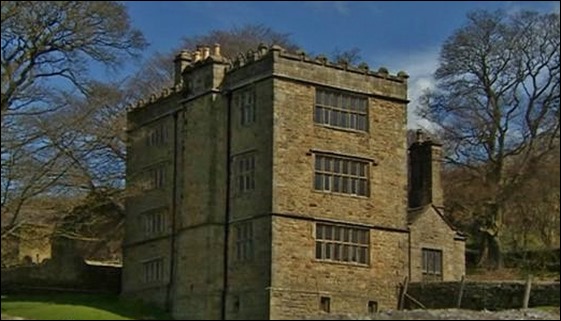
The range seen in the first photos is the most recent part of the house, built in the early 1400s. The limestone wing, just visible on the left, comprised both the monks’ infirmary and the original prior’s chambers, and are considerably older.

The present owners have spent the last three decades restoring the house, and creating interior settings that to many might seem outlandish and controversial. There will be more about this in a moment.

But first those celebrities of times past. I’ve written about his visits before, but one of the returning house guests in the days of the Milnes Gaskells’ ownership was Henry James. He came in 1877, 1878 and 1883 – and apparently drew much inspiration from the house and grounds when he was writing The Turn Of The Screw.  The little roof-top tower certainly puts in an appearance in the text.

At the time of James’ first visit, his hosts, Charles and the young Lady Catherine Milnes Gaskell, had not long been married and were expecting their first child.  The invitation had been secured through ‘lobbying’ by a mutual friend, Henry Adams, the American historian. He and Charles Gaskell had met as undergraduates at Cambridge, and before Charles’ marriage he had also been a frequent guest at The Abbey. Adams thought Charles, by then a prominent barrister, and Henry James had many interests in common and would get on well; and so it proved.

Charles’ father, James Milnes Gaskell, had been the Conservative MP for the Borough of Wenlock and had bought The Abbey (priory ruins included) in a derelict state from his wife’s cousin. The Gaskells senior appear to have held rather rustic and unconventional house parties there. (They naturally had other smarter homes elsewhere). Adams describes a visit in the autumn of 1864:

God only knows how old the Abbot’s House is, in which they (the Gaskells) are as it were picnic-ing before going to their Yorkshire place for the winter. Such a curious edifice I never saw, and the winds of Heaven permeated freely the roof, not to speak of the leaden windows. We three, Mrs. Gaskell, Gask (Charles) and I, dined in a room where the Abbot or Prior used to feast his guests; a hall on whose timber roof, and great oak rafters, the wood fire threw a red shadow forty feet above our heads. (1.)

One of the more unusual pursuits on such visits included the archaeological excavation of the Priory ruins.

IMG_1976

Adams describes his own contributions to the general exploration:

Whenever we stepped out of the house, we were at once among the ruins of the Abbey. We dug in the cloister and we hammered in the cellars. We excavated tiles bearing coats of arms five hundred years old, and we laid bare the passages and floors that had been three centuries under ground. (1.)

When Charles Gaskell took over The Abbey from his father, he and Lady Catherine set about restoring the property and making it a family home where they might energetically entertain notables from the world of arts and literature. Emphasis was on mind-improving activity, and an appreciation of the aesthetic in all its forms.  Visitors would be treated to extensive walks, drives and railway journeys to view all the surrounding great houses, and visit Shropshire’s many ancient churches and castles.  A trip to Wenlock Edge to take in the vistas was also obligatory.

Henry James documents his own many outings with Charles Gaskell in Portraits of Places.

Chapel Wenlock Abbey

The Prior’s Chapel during the time of Lady Catherine Milnes Gaskell from her book Spring in a Shropshire Abbey  1904 (available to download on Gutenberg Press).

*

The Gaskells’ other guests included In Darkest Africa explorer, Henry Morton Stanley, architect, Philip Webb, Architect and Pioneer of the Arts & Crafts Movement, and Thomas Hardy and his wife. Hardy was apparently surprised to find himself lodged in the oldest part of the house, and declared that “he felt quite mouldy at sleeping within walls of such high antiquity” (2.)

The Hardys were also taken around the county, visiting Stokesay Castle and Shrewsbury. Florence Emily Hardy recounts how one Sunday Hardy and Lady C walked until they were tired, when

“they sat down on the edge of a lonely sandpit and talked of suicide, pessimism, whether life was worth living, and kindred dismal subjects, till we were quite miserable.”(2.)

The room wherein Hardy felt so mouldy was in the infirmary wing and is indeed very old, dating from the 1100s CE.  The original prior’s chambers were built adjoining the infirmary around a hundred years later, the scale of them doubtless dictated by the need to accommodate a series of royal visits. The deeply devout King Henry III, along with his own prestigious guests, was a frequent guest between 1231 and 1241.

100_5971

This photo shows the rear view of the infirmary and original prior’s lodgings, (the limestone range on the right) together with the side elevation of the upscaled prior’s lodgings that were added in the early 1400s (multi-coloured stonework to the left).

The king, as monarchs did, would arrive with a large retinue of servants, clerks, cooks, musicians and blacksmiths, all of whom had to be housed. There must have been some pretty good parties too, since a permanently appointed keeper of the king’s wine was required to manage the contents of the priory wine cellar in readiness for any royal visit. Supplies were  brought in from Bristol ( a hundred miles away) by the Sherriff of Shropshire and a record relating to the delivery of four barrels in 1245 states that the wine was to be placed ‘safely in the cellars there against the king’s arrival as he proposes shortly to come to those parts, God willing.’ (4.)

IMG_1996

The galleried facade of the more recent fifteenth century lodgings,originally unglazed, was constructed from stone from four different quarries.

IMG_1991

The catslide roof is tiled with stone flags.

Inside, on the ground floor, is the prior’s private chapel, while upstairs is the Great Hall with its great stone fireplace and high beamed ceiling mentioned by Adams, and next to it, though scarcely less grand, the Lesser Hall. Timbers in the Great Hall roof have been dendro-dated to 1425.

The front door to the left of this range, though, is considerably older, with its characteristic Norman arch. James describes it in his travelogue Portraits of Places (3):

IMG_1997

I returned to the habitation of my companion (Charles Milnes Gaskell)…through an old Norman portal, massively arched and quaintly sculptured, across whose hollowed threshold the eye of fancy might see the ghosts of monks and the shadows of abbots pass noiselessly to and fro…for every step you take in such a house confronts you in one way or another with the remote past. You feast upon the pictorial, you inhale the historic.

It was through this doorway we also went a few  Saturdays ago. As I said, this was a private tour, and our first such visit. Since 1983 the house has been the home of Gabriella and Louis de Wet. De Wet is an artist of some renown and Gabriella is better known to the wider world as theatre and television actor Gabrielle Drake. For the last 33 years, driven by Louis de Wet’s extraordinary artistic vision,  they have been restoring the house – carrying the building’s story on into the 21st century while revealing its ancient monastic roots in strikingly original ways. The project has been an epic labour of love, and involved the dedication of consummate craftsmen, working very much in the mediaeval guildsmen tradition.

I did not take photos. So if you want to see what lies behind this door, please follow this next link. It will take you to a 2 minute trailer of a very excellent film made by Gavin Bush in 2011: In The Gaze Of Medusa . I leave you to make up your own minds about the merit of the De Wets’ prodigious and unique enterprise. It is not straight forward by any means.

For now, here’s the one photo I did take – of the library, and still a work in progress. It gives a taste of the quality of the craftsmanship involved in the restoration-creation work, the newly made shelves that will house a life-time’s collection of books on art, philosophy and history. Also niggles apart, we did appreciate the gracious hospitality of Mrs. de Wet who showed us around with such enthusiasm, and then treated our party to tea and some very delicious cakes in the Venetian Room. So very English!

IMG_1994

copyright 2016 Tish Farrell
1. Ernest Samuels Henry Adams: Selected Letters  1992 p 69

2. Florence Emily Hardy The Later Years of  Thomas Hardy  1930

3. Henry James Portrait of Places

4. Vivien Bellamy A History of Much Wenlock  2001

Lady Catherine Milnes Gaskell Spring In A Shropshire Abbey  1904

Changing Seasons ~ July’s The Time For Lady’s Bedstraw Up On Windmill Hill

P1050216

So far July in the UK has featured several seasons. We’ve had April showers, autumnal gloom, wintery downpours, mutterings about frost that just never happens around here in July, and now a heat wave of unprecedented temperatures outside the tropics. Yet three evenings ago when  I took this photo, it felt like October. There was a wild windiness about the place, and lowering skies, and that pang of melancholy that tells you summer is done.

But then as I lay in the grass to frame the shot all I could smell was the mignonette fragrance of Lady’s Bedstraw. Delicate. Hypnotic; gathering in waves across the hilltop. I can well understand why these golden flower drifts were once harvested to dry and fill mattresses. Their scent says essence of high summer. And so it proved. The next morning Octoberal tendencies had evaporated and we woke to wall to wall blue, and the overwhelming hotness, beneath whose onslaught we are currently sweltering. All this climatic chopping and changing of course suits us English. We’ve never had so much weather to talk about all at once.

This photo, by the way, was taken in low evening light conditions using the  ‘Impressive Art’ setting on my Lumix. I’d rather dismissed this setting, not liking the results of shots taken in broad daylight. But in low light the images acquire an other-worldly look – perhaps slightly sinister. I only added a touch of ‘contrast’ and  ‘highlight’ editing.


Changing Seasons July2015

Please visit the Cardinal for more about this challenge. There are two versions: use one or both. The latest version 2 features a single image/creation that sums up the month for you in some way. Version 1 is a gallery of several photos – all to be freshly shot.


#ChangingSeasons

Operation Floral Sat Nav ~ Bee Makes Bee-Line For Foxglove

IMG_1716

Yesterday at the Farrell establishment we had bees in poppies. Today it’s bees in the foxgloves, and thank you to Lynn at Word Shamble for mentioning bees and foxgloves in the comments. This reminded  me I’d taken these snaps earlier in the month just before the foxgloves went over. I was trying out my new second-hand Canon Ixus 870 – and oh, the nippy little macro setting – I’m in love with it!

Also please drop in at Lynn’s blog to read a wicked piece of flash fiction: it definitely has a sting in the tale/tail.

Now for more shots of bees. Also just look at the foxglove’s come-hither devices  – no ‘Sat Nav Map Error’ here; but an intricate systems of dots and splodges guiding in any would-be pollinator to get pollinating.  It looks like every little ‘glove’ has its own touch-pad access code:

IMG_1715

IMG_1704


Cee’s Flower of the Day

Daily Post Weekly Photo Challenge: Details

And It Was A Right Bees’ Breakfast This Morning Over My Garden Fence…


IMG_2265

It was every bee for itself over in the poppy patch behind the garden sheds this morning: the apian equivalent of a supermarket trolley dash. Honey bees, little brown bumbles, dinky stripy bumbles, blooming big scary bumbles and white-tailed bumbles diving in for the poppy nectar while the air all round filled with happy bee hum.  Some were feeding with such speed and voracity that their baggage compartments were definitely approaching the overloaded mark. Now and then they would take a feeding break on the poppy’s crown while they dusted themselves down and redistributed the pollen cargo.

IMG_2252

The gathering technique is also fascinating. They dive into the base of the flower and speed round beneath the stamens, feeding on the nectar while every part of them hoovers up pollen from the anthers. Even with the biggest bumbles, once they get into their stride, all you can see are the stamens ruffling round like curtain pelmet tassels in a stiff breeze. Whoosh, and it’s on to the next feeding station.

IMG_2282

IMG_2310

I probably don’t need to say it again to those who follow this blog, but then no chance should be wasted. The wellbeing of our planet, and of humanity, and of the continued production of much of our food depends on protecting and nurturing bee populations any way we can. Masses are being killed off by pesticides and habitat loss. So loud applause for the opium poppies that came of their own accord to our boundary fence, and are doing their bit for bee world. Rah! Rah! Hurrah, poppies!

IMG_2360

IMG_2361

IMG_1828


Daily Post Weekly Photo Challenge: Details