September in my garden

100_7062

This year, for some reason, the Japanese anemones have decided to take on their close neighbour, the Japanese crab apple tree, in a ‘let’s see who can grow tallest’ contest.

Admittedly, the tree is a small one,  three metres at most, but some of  the anemones are already two metres tall.

This is the kind of gardening I love: where the plants come up with their own ideas. I did not plant the anemones directly under the tree. They seem to have moved in there by themselves, and now use the tree’s protecting arms as they grow ever taller.

Nor is this a colour scheme I would have thought of concocting – pale pinkish-purple, russet red and green. But somehow it’s very pleasing, and especially on the dull days we’ve been having lately.

Every day, too,  I see the tiny crab apples turning a deeper shade of red: perfect Garden-of-Eden miniatures,  which reminds me of a comment made by Melanie at My Virtual Playground. One of the times I featured my crab apples she told me they were called pommes sauvages in French – wild apples – an altogether much prettier name. I agree. Although my ‘wild’ ones have been much inbred, and don’t have quite the same sense of abandon of the truly wild ones found in our field hedgerows.

100_7068

The tree is Malus Evereste by the way. It is glorious in spring too. (You’ve seen the picture). It’s growing in a tall bed which gives us an all-year good view from the kitchen French windows.

100_7104

Elsewhere in the garden things are  looking a little dreary round the edges, but there is still some stalwart blooming going on. The red geraniums look bright in the garden pots despite the recent downpours, as does this lovely penstemon:

100_7127

I think it’s my favourite version of this most obliging plant. If you cut down the stems after flowering, in a few weeks time you get another showing, perhaps more vigorous than the first. This variety is called Apple Blossom, but it makes me think of raspberry ripple ice cream – a rather shivery thought on this gloomy day.

Growing in the bed just behind Apple Blossom, you can see Teasing Georgia. She’s in bud again too. This is such a lovely rose, and opens into dense whirls and whorls of pale gold.

I’m hoping she’ll open before the weather turns weirder than it already is. Forecasters are now promising us the coldest winter ever. But endlessly prone to optimism, I’m further hoping that this is the same order of forecast that in March promised us a barbecue summer and drought. (Hands up all of you in England who managed to fit in more than one barbecue between the wind and showers).

100_7130

Our garden is all over the place and on different levels. This is because circa 1830 the house was built into a steep bank between the field behind, and the road in front.  Later occupants then dug out a rear yard, and added a tall terrace bed, and behind it, a high retaining wall.

I have yet to get to grips with gardening in so many dimensions, which is why I rather depend on the garden to follow its own design. I also notice that it is devising its own timetable. For instance, what does this June-blooming foxglove think it is doing amongst the late summer rudbeckia?

100_7116

Just to the left of the foxglove is the dead head of meadowsweet. It has a pink flower, which also surprised me this year. This is something else the garden has come up with: creating (somehow) a very vigorous hybrid from the original wild, and cream-flowered meadowsweet that I originally planted.

I shall definitely encourage the new version, and plant out any seedlings. It is a statuesque creation, very tall, and softly scented. Also Meadowsweet, apart from being used to flavour beer and deserts, has its place in Welsh legend. In the Fourth Branch of the Mabinogi, the 11th century transcription of age-old tales, there is the dark story of Blodeuwedd (flower-face), a beautiful woman created by the magicians, Math and Gwydion from the flowers of oak, broom and meadowsweet. The tale does not end well. Blodeuwedd (pronounced: blod-EYE-weth) is also the name for owl, a fact, along with a reworking of the Mabinogion story, that was famously explored in teen fiction by Alan Garner in The Owl Service.

And thinking of  flower-faces, here are two growing in a pot by the old privies (now our two dysfunctional  garden sheds – i.e much head-banging on lintels, followed by standing in one’s own light so you can’t see what’s in there). These sunflowers have taken ages to come out, but it’s nice to see them at last, and especially now the real sun has gone away. It’s hard not to smile back at them, isn’t it?

100_7117

Happy Wednesday!

Inspired by (but with added fruit)  Cee’s Flower of the Day


Bumbles in my borders

P1010778

A couple of summers ago we took out a length of hedge between our back garden and the field. It was a thicket of alien snowberry and overgrown ash tree seedlings, and a nightmare to cut. Now we have a simple fence, a rampant herb and wildflower garden that grows itself, and a view.  We also have masses of bees.

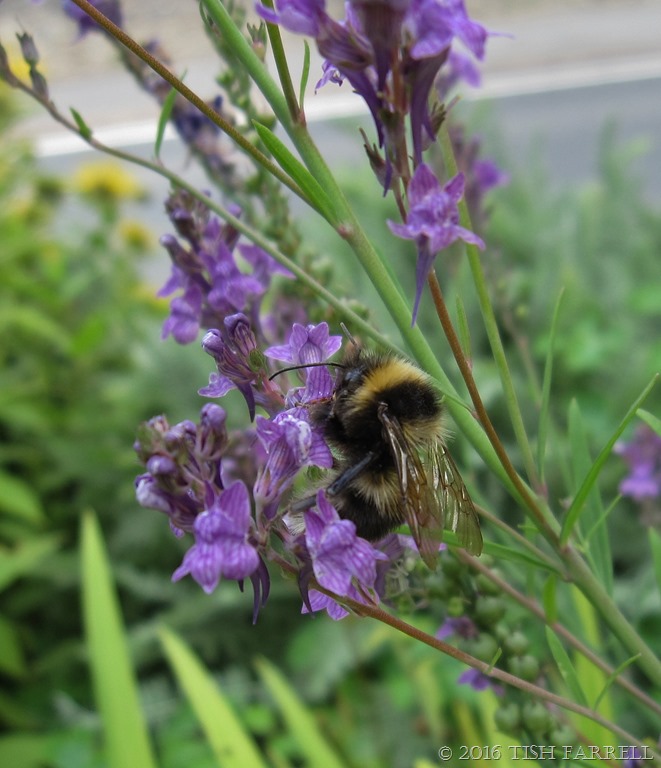
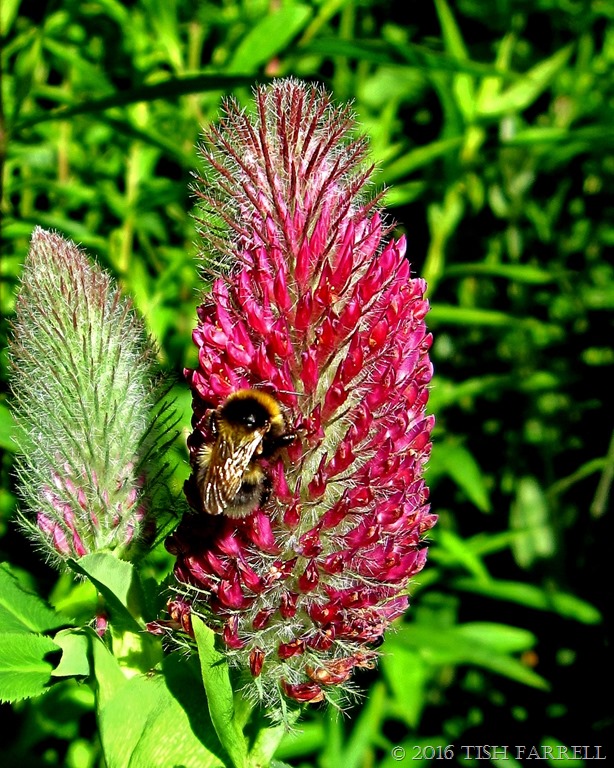
Back in the spring they foraged on the columbines; later on the spires of self-seeded purple toadflax and foxgloves. Now they are gorging on oregano and bramble blossom. I spotted at least three varieties of bumble bee this afternoon, but apart from the red-tailed bumble below, I’m having problems identifying them. For those of you who wish to try, there is an excellent identification page with a video at bumblebeeconservation.org

P1010768

100_6468

100_6453

100_6050

copyright 2015 Tish Farrell

Close Up

Thursday’s Special: Seeing Red

I’m in love with the Japanese crab apple tree in my garden at Sheinton Street. There is hardly a moment in the year when it does not give pleasure. Even now in February there are still a few tiny apples on its bare branches – minimally disposed like a left over Christmas tree that someone forgot to undress. The black bird still visits, although by now the apples have been frosted and lost their bloom.

But then I also know that by the time the last one has fallen, there will be tight rosy-red buds bursting to make the next crop, bees permitting. And while I think of it, I’m grateful to fellow blogger, Mélanie at Mon Terrain de Jeux who tells me that crab apples sound much lovelier in French, and I agree – pommes sauvages.

On the other hand, my little tree is so finely wrought and well bred, and its fruit so exquisite, that I can imagine no situation when it might be tempted to wildness – unlike its large, unruly English cousins that grow in our farm hedgerows. Those I raid in October for their not so pretty fruit to make jars of crab apple jelly. (How could I possibly pick my own pommes sauvages?). The jelly is delicious on toast and croissants, and the jars glow like jewels as the hot jelly is poured into them. Mmmm.

More things to look forward to then: blossom, bees, pommes sauvages, toast…

100_5546

For Paula’s Thursday’s Special challenge ‘Red’ at Lost in Translation

One Word Photo Challenge: Scarlet

100_3415

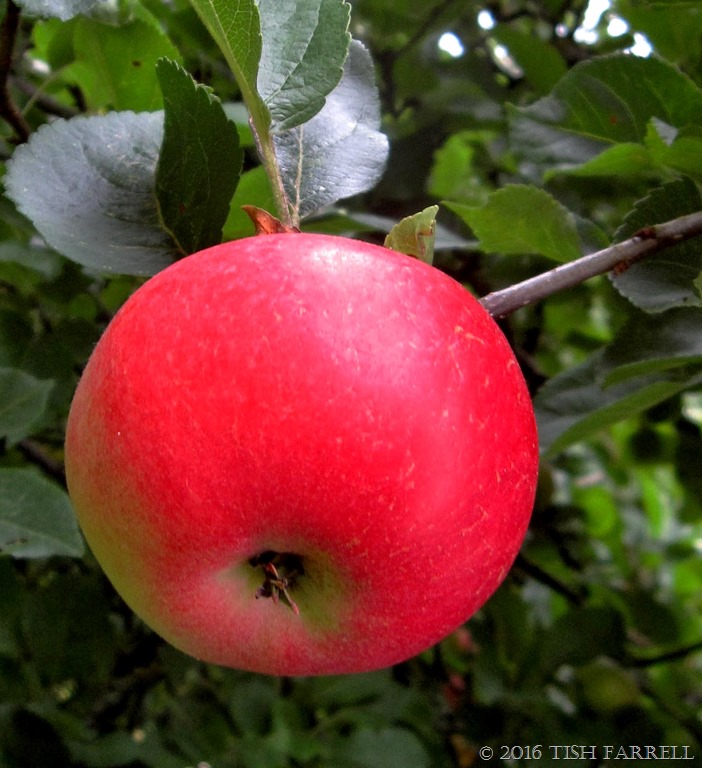
We planted the Japanese crab apple tree in the garden in 2006, not long after we moved into Sheinton Street.  Now is its season of fiery scarlet glory. Each fruit glows like a miniature lantern, brightening the gloomiest autumn day. And today is just such a day in Much Wenlock, my usual sky-view over Wenlock Edge, a blanket of grey mist. Even so, the apples glisten. I know, too, as we head into winter, we will have the pleasure of watching the blackbirds come to feed on the fruit, grey days then enlivened by their darting silhouettes foraging among the branches. Few of these tiny apples will be wasted. And then before you know it, the tree will be bursting with purple-pink buds that open in showers of pale blossom. Spring. Splendid how one thing leads to another.

copyright 2014 Tish Farrell

For more studies in scarlet, visit Jennifer at One Word Photo Challenge: Scarlet