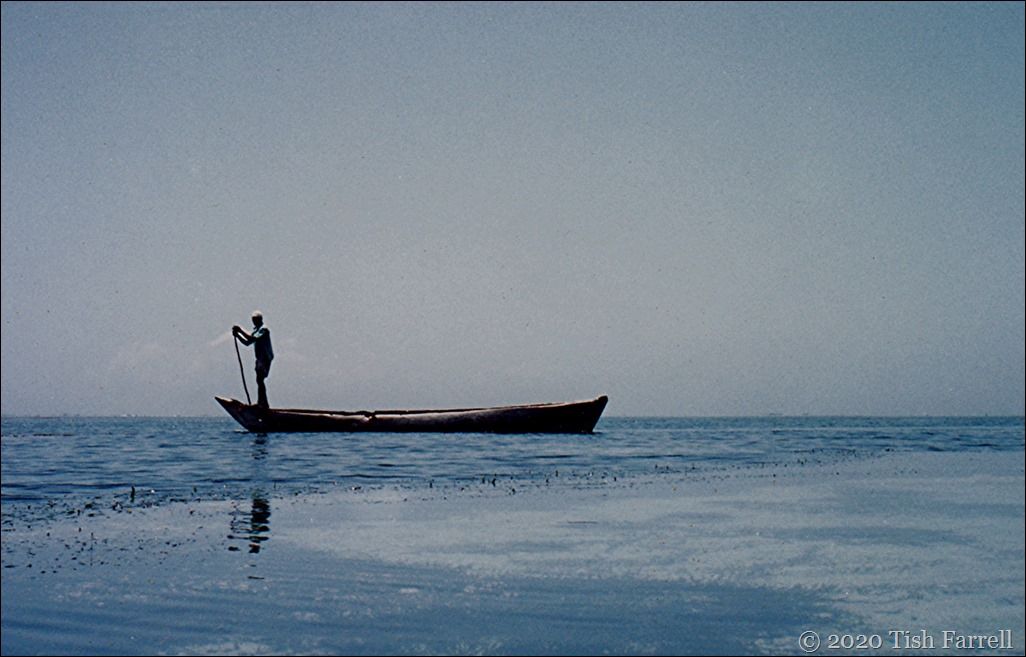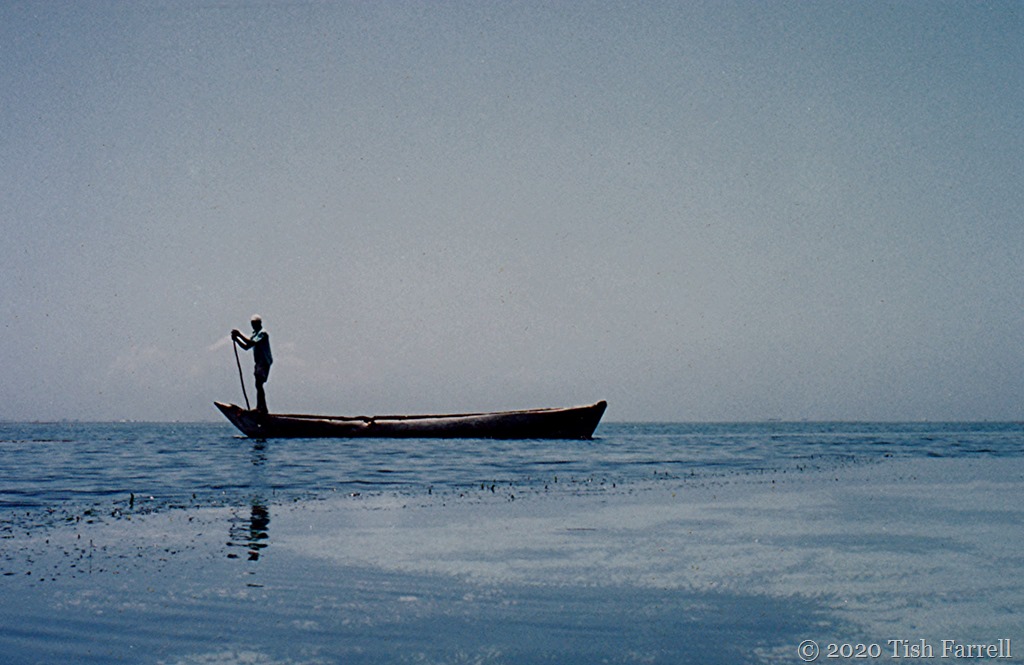
Digo fisherman plying the reef at high noon and high tide, the Indian Ocean coast south of Mombasa.
Africa
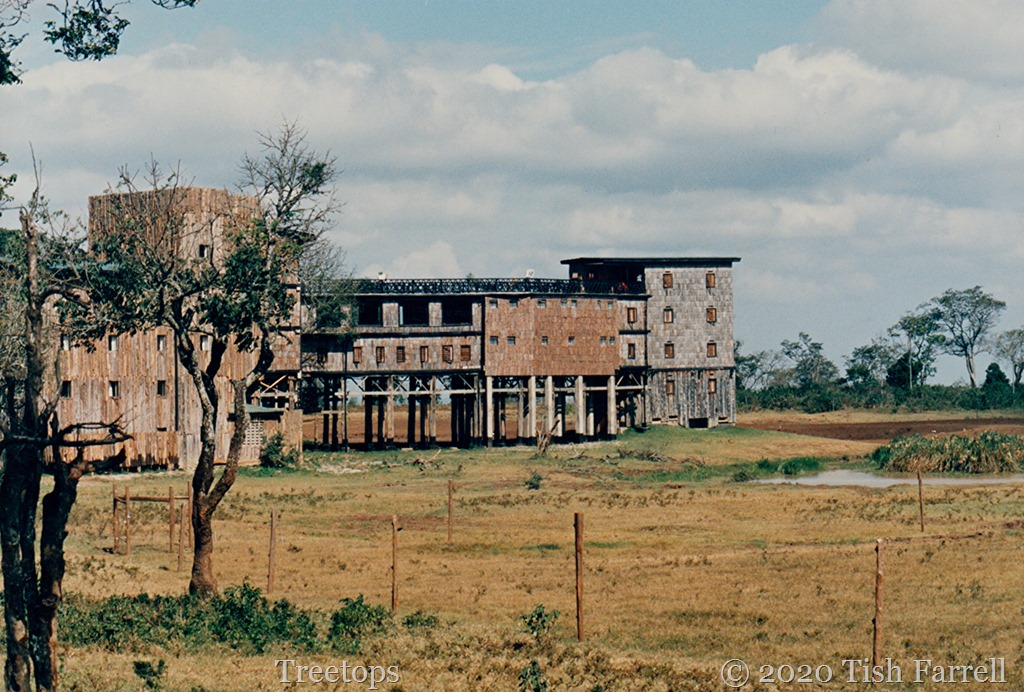
Kenya’s Treetops Hotel
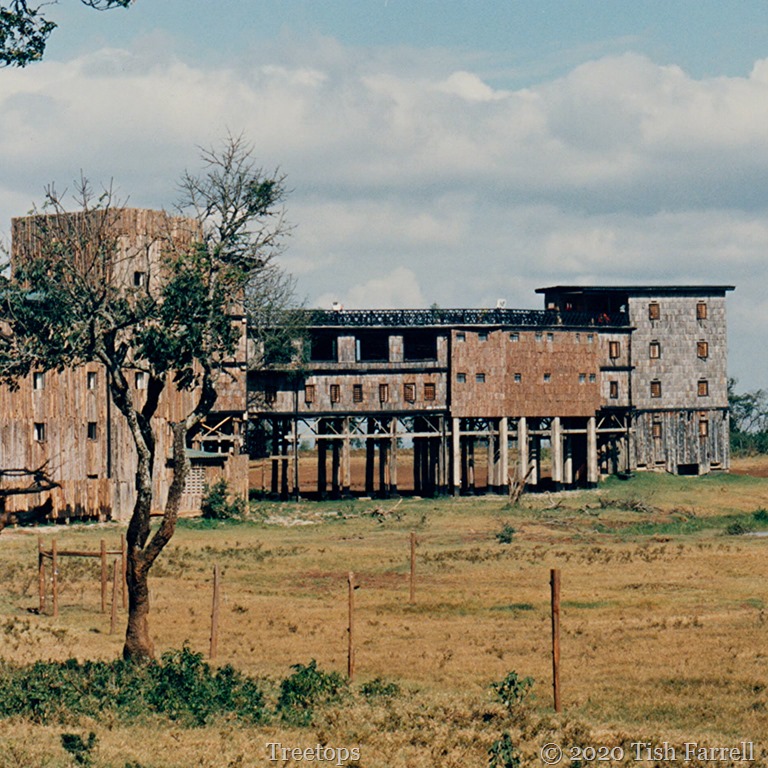
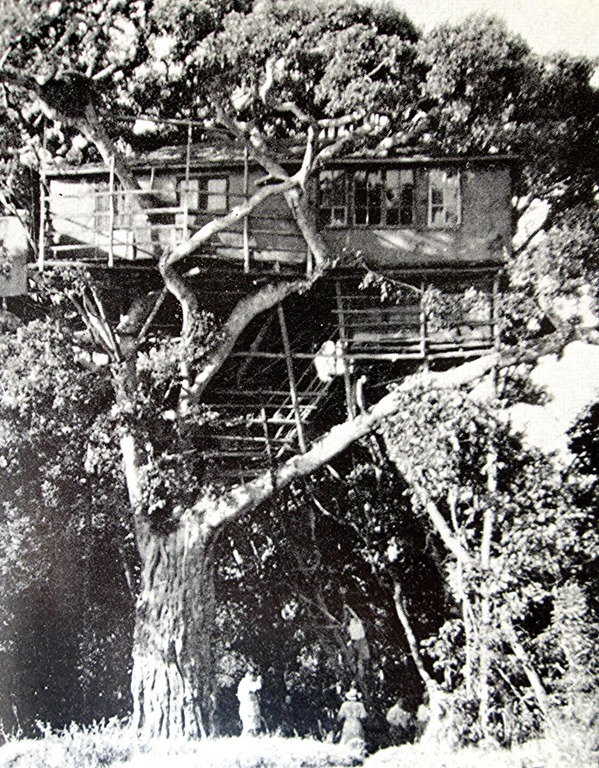
Mention of Treetops in Kenya’s Aberdare National Park inevitably brings up residue of British colonialism, and in particular the extraordinary connection with the UK’s present monarch. The original Treetops was little more than a 1930s bungalow-affair, a rickety contrivance lodged in the branches of an ancient mugumo tree, a species of wild fig which happened to be very sacred to the local Kikuyu people. Princess Elizabeth spent the night there in February 1952 and, as the well trammelled narrative goes: she went up the tree as a princess and came down a queen, although it was only later in the day that she was informed that her father, George VI had died.
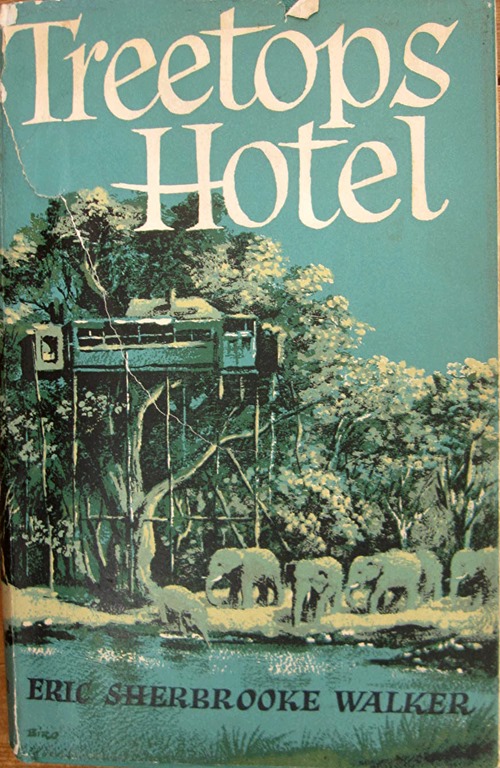
Here’s the original Treetops where the royal party stayed, taken from the book by its builder, Eric Sherbrooke Walker, Treetops Hotel.
The Sherbrooke Walkers, like most of the early settlers in British East Africa, were of the officer-gentry-aristocracy class. Eric Sherbrooke Walker had served in the Royal Flying Corps during World War 1, followed by a stint in military intelligence with the White Armies in Russia during the Bolshevik uprising wherein he earned the Military Cross and other honours. After the war, during America’s prohibition era, he took up rum running off the West Indies and made enough money to marry Lady Bettie, daughter of the Earl of Denbigh. They then set off on an adventurous trip across East Africa, which soon left them short of money and in turn led to the notion of setting up their own country house hotel.
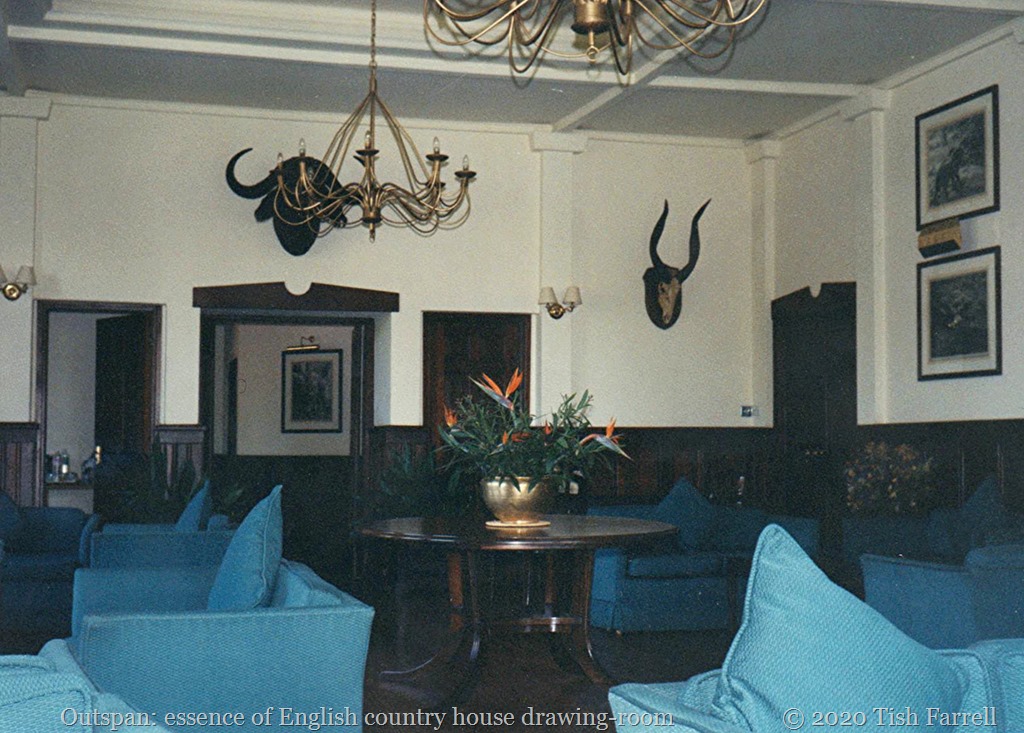
In 1926 they pitched up in Nyeri in the forested highlands of Kenya’s Central Province, bought 70 acres from the colonial government, and set about creating the genteel Outspan Hotel. By the end of 1927 they had built ten rooms and opened for business for the New Year of 1928. The big attraction to their settler guests, who though well-heeled usually had very primitive facilities on their African farms, were rooms that came with private bathrooms and running water. So began a successful enterprise of country inn-keeping in the English manner but with views of snow-capped Mount Kenya and the Aberdare range thrown in.
The 1920s was the era of the grand East African shooting safaris when the likes of Bror Blixen, Denys Finch Hatton and John Hunter acted as Great White Hunters for extravagant entourages of European (especially British) royalty and Indian maharajas. But by the 1930s, many safari goers had begun to turn their attention from trophy hunting to big game photography – an activity greatly promoted by American adventurers and film makers, Martin and Osa Johnson.
And it was this new craze that prompted the Sherbrooke Walkers to create Treetops. Small parties of guests could spend the night in the top of the mugumo tree and watch elephants, rhino and forest hogs lit up by a spotlight, do more early morning game watching over tea and biscuits before being transported back to the Outspan for hot baths and breakfast. As a unique combination of eccentric British-gentry-rustic with elephants thrown in it could not fail. As more and more visitors wanted to stay there, so rooms were added, and more props put in to hold up the tree branches.
And then in 1954 the original Treetops was burned down. This was during the so called Mau Mau uprising when it apparently became a target for the Land and Freedom Army. Later the place was rebuilt and added to over the years. The header version dates from September 1996, the fourth iteration under the ownership of Block Hotels. When we went I had been spending previous week alone at the Outspan, which still served as ‘base camp’ for Treetops, while Graham was at a seminar at the nearby Aberdares Country Club. He then joined me for the trip to Treetops.
In a letter to my aunt written shortly afterwards I told her that were among a party of 99 – (Israelis, Koreans, an international museums outing, and 40 retired Americans from the Friendship Club) all of us being ferried into the Aberdare National Park in a bus, and then deposited in the bush so we could walk the last few hundred yards to Treetops – ‘a rustic fortress between two waterholes’ was how I described it back then. Before we set off Dishon, the ranger who met us pointed out the well timbered refuges along the path, to be resorted to in case of charging buffalo or elephant. He was also carrying a rifle.
But there were no alarming encounters. In fact we saw no sign of any big game while were there, only the red billed hornbill that sat on the tree outside the dining room, baboons, buck and warthogs.
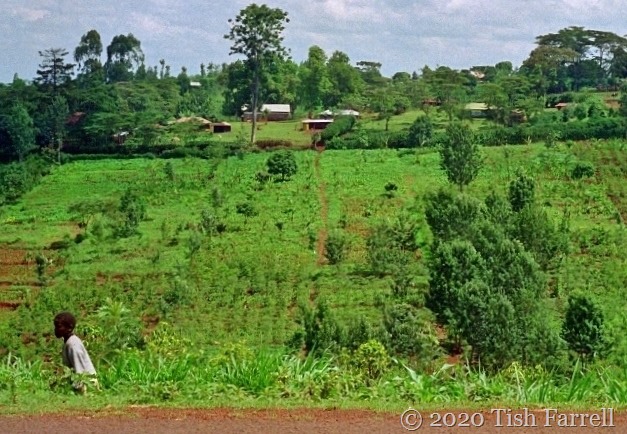
The rooms were tiny, more like cubby holes, and the building was very noisy. Many of the elderly women guests were up all night. When I could not sleep around 2 a.m. I got up and found them, of all things, putting on their make-up in the ladies’ communal washroom. When the actual ‘wake up’ call came at 6.30 a.m. the place was surrounded by an Aberdares fog. And so it seemed that whatever romance there might once had been was quite lost. The best bit was driving out of the park through the Kikuyu smallholdings. Out of the stands of maize came files of school children in coral coloured sweaters and jade green dresses and shorts, trotting off early to the local primary school.
I gather from looking at the current website that Treetops is under new management and the number of rooms much reduced in order to provide en suite bathrooms. It all looks very luxurious, but somehow also misses the point, the batty English tree-house charm of the original. Though whether that was ever at all an appropriate installation in the African highlands is another question.
Adopting The Horizontal In The African Bush
Ostrich and the Ngong Hills
*
Over at Travel Words Jude is running a photo challenge to help us develop our compositional skills. April’s topic is ‘lines’ and each week Jude asks us to consider them in particular ways. This week it is horizontal lines. Here’s what she says:
“This week’s assignment – Look for horizontal lines. In a photograph, horizontal lines in particular need to be completely level across the frame, because your viewer’s eye will perceive even a slightly skewed horizontal line as uncomfortable to look at or just incorrect.”
For obvious reasons I haven’t been out and about finding likely vistas, but as I’ve been rummaging through my old Kenya photos, I’ve noticed that things horizontal feature quite a lot. I don’t actually recall if I was registering this at the time of taking the photos, since apart from the Elmenteita view, the others were happenstance shots. Anyway, I thought I’d post them for interest’s sake.
Impala and rooftops of park rangers’ quarters, Nairobi National Park
*
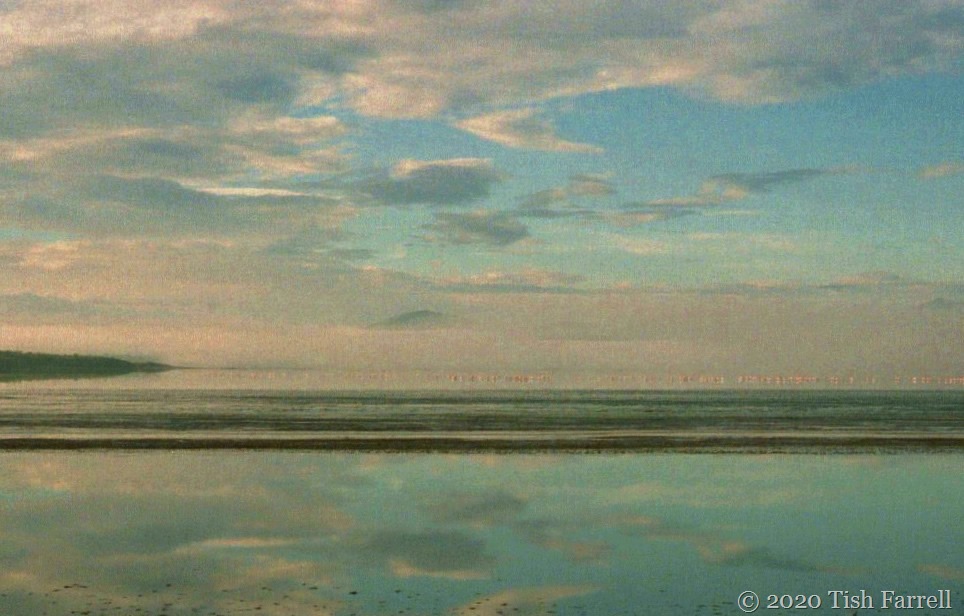
Flamingos at dawn on Lake Elmenteita
*
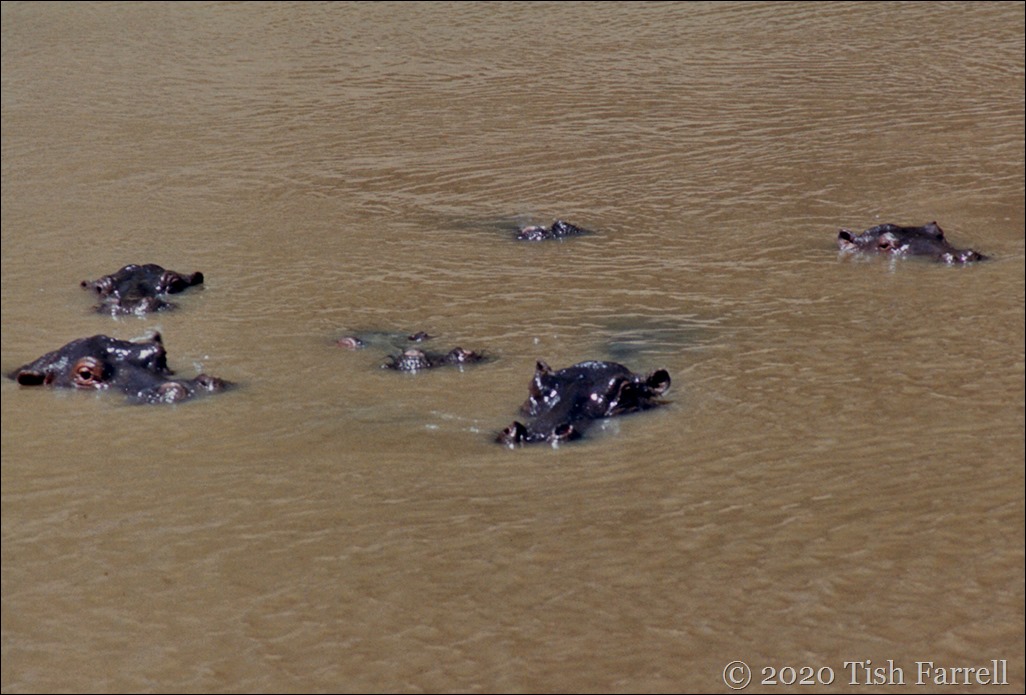
Hippos going with the flow in Lake Naivasha
*
Travel Words: Photo Challenge April Lines #1 Please visit Jude to see her examples of horizontal framing. Lots of pointers and ideas.
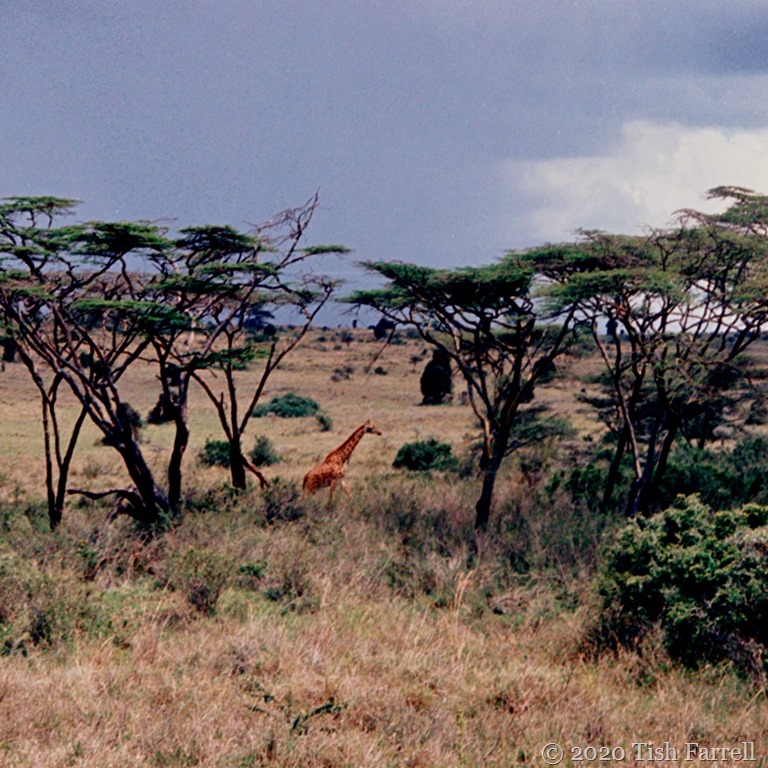
Flat Top Thorns And A Giraffe
The Flat Top Acacia or umbrella thorn is characteristic of Kenya’s wooded grasslands, especially in gullies. It tolerates drought and degraded landscapes and in traditional communities has long served in all manner of useful ways. It provides wood for fuel and charcoal making, and poles for house-building; the frondy branches make good goat fodder; the tiny puffball flowers feed bees; the bark produces edible gum; the roots are nitrogen-fixing; and the tree has medicinal qualities. My Kenyan tree book however tells me that, though quick growing and wonderfully shade providing, it is not a good idea to plant this acacia around your homestead since its branches tend to fall off.
This photo was taken in Nairobi National Park on the edge of the city centre.
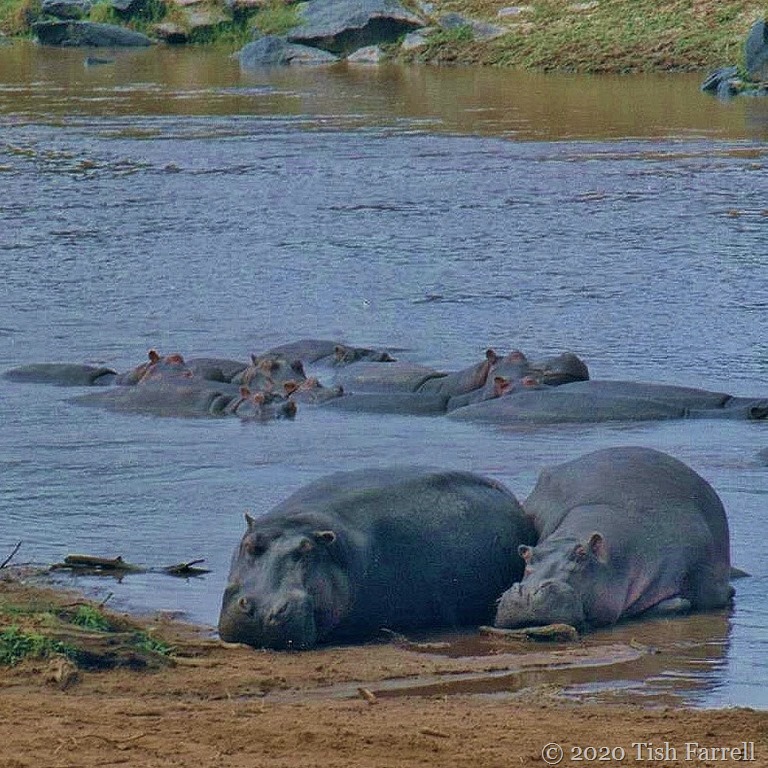
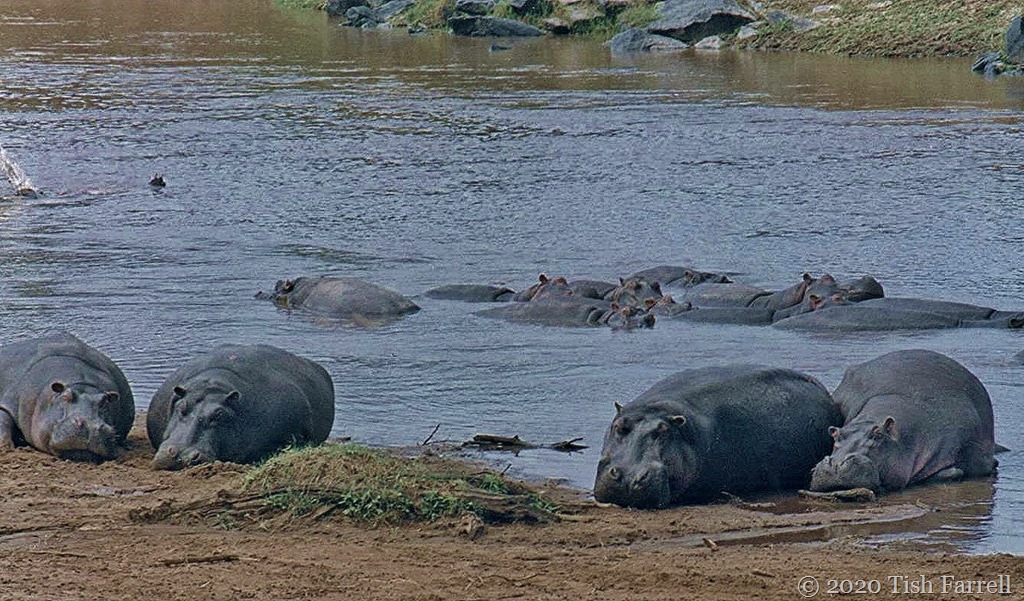
Mara Hippos ~ Sleeping Like Tops
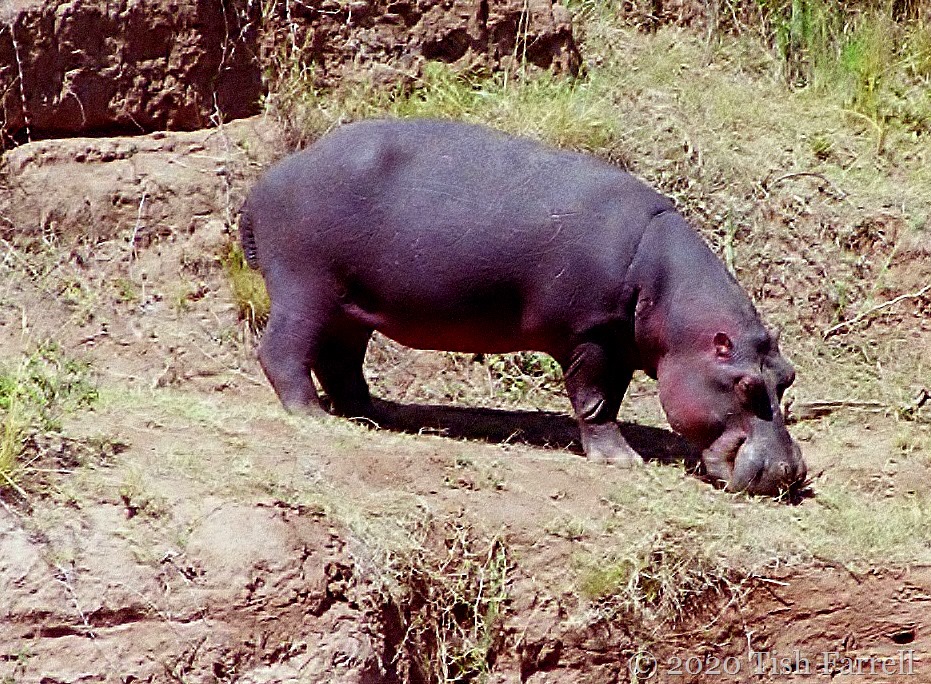
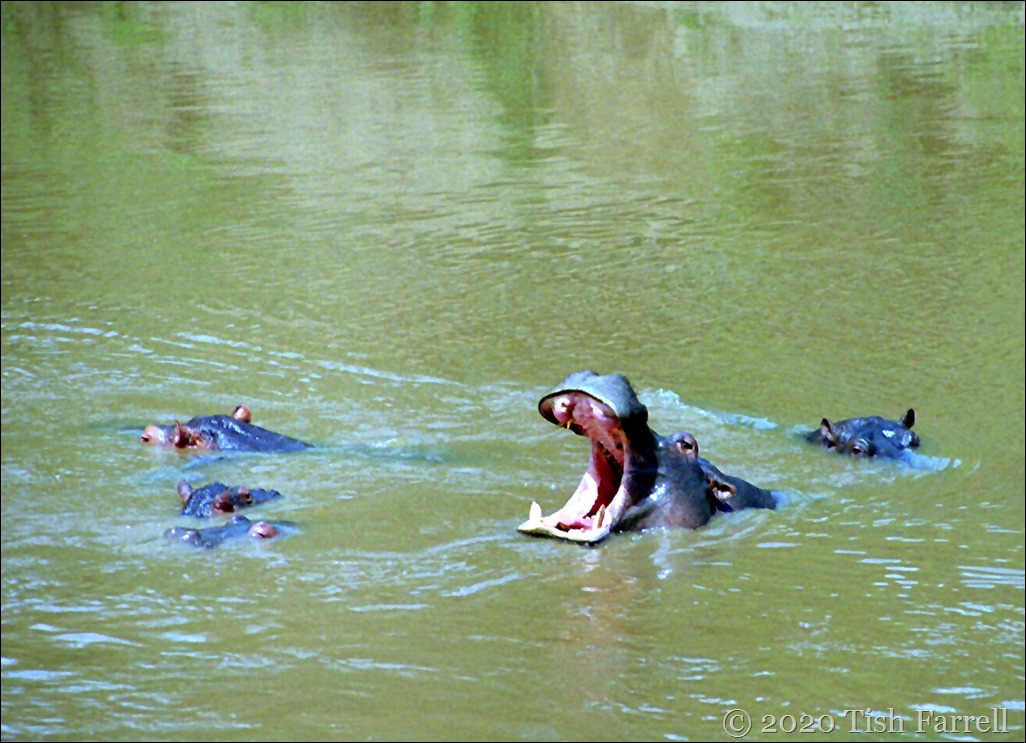
It is fairly uncommon to catch hippos like this – snoozing ashore, though they may do it on sand banks in rivers. Their usual routine is to spend the night in the bush, roving far and wide and chomping masses of grass. Then at first light they start returning to the river so they can be well submerged in their watery territory before sun up. Their hides are 2 inches (5cm) thick, and although a red oily secretion gives some protection, they are very susceptible to over-heating and drying out. It can thus be fatal to find yourself between a river and a hippo intent on swift immersion.
We had our own alarming charging hippo encounter on the Luangwa River when we were living in Zambia. That story is HERE.
These particular sleeping hippos were caught on an early morning game drive, around 7 a.m. We drove right by them along a secluded stretch of the Mara River flood plain. Not an eye’s blink from any of them.
*
And the origins of the saying: to sleep like a top?
My Dictionary of Phrase and Fable tells me it relates to the children’s toy, the traditional wooden spinning top. Once well whipped into action, there is a point when the top seems perfectly still and silent.
And here’s an early 17th century usage:
“O for a pricke now like a nightingale, to put my breast against. I shall sleep like a top else.”
The Two Noble Kinsmen a play attributed to a John Fletcher – William Shakespeare collaboration.
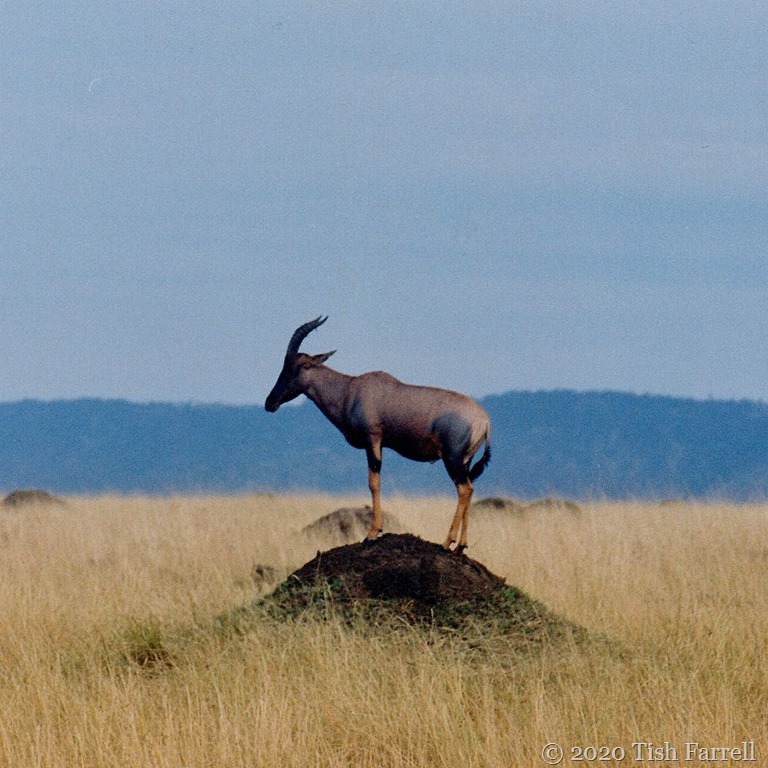
A Topi On Top

Topi can be found across Africa in various local races or subspecies. They also look like Coke’s hartebeest, but are distinguished by their handsome damson coloured thigh patches – very fetching on their chestnut coats. The males are keen on showing themselves off by posing on top of termite mounds – keeping an eye on their females (usually 10-15) and showing would-be rivals that they are on the look-out.
Square Tops #4 Becky has a very special ‘square top’ this morning.
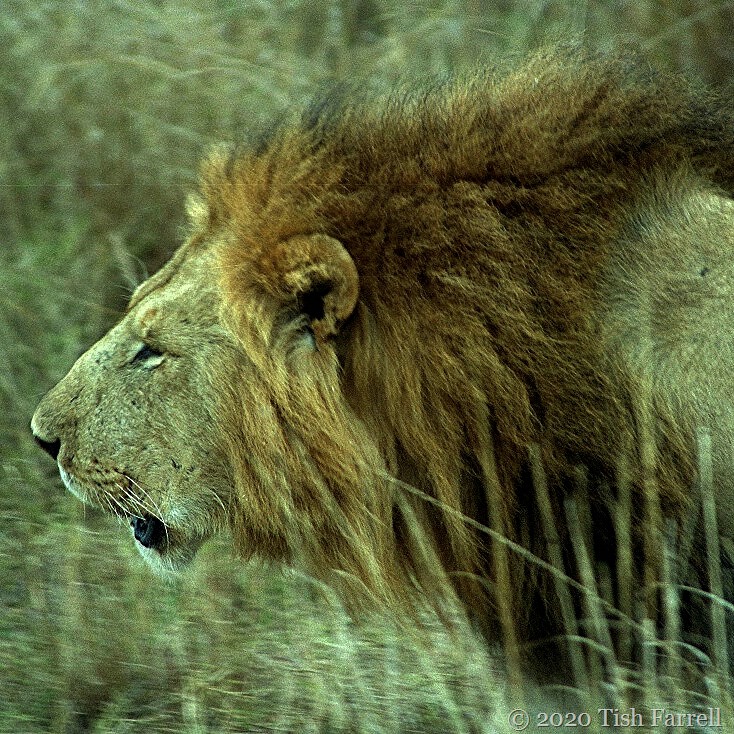
Top Cat
It’s back again to the old Africa album for today’s ‘square top’. This photo was taken on our August dry season trip to the Maasai Mara: one of the senior lions of the Marsh Pride (often featured in BBC wildlife films). He is busy calling to his brother, the growl-cum-rumble-cum-roar passing back and forth between them; sounds to make the neck hairs tingle. For their part they turned not a single hair nor gave any sign that they registered our presence as our Land Rover passed close by. Humans, what humans?
P.S. Anyone remember the Top Cat cartoons?
More From The Mara ~ Near And Far Beneath The Oloololo Escarpment
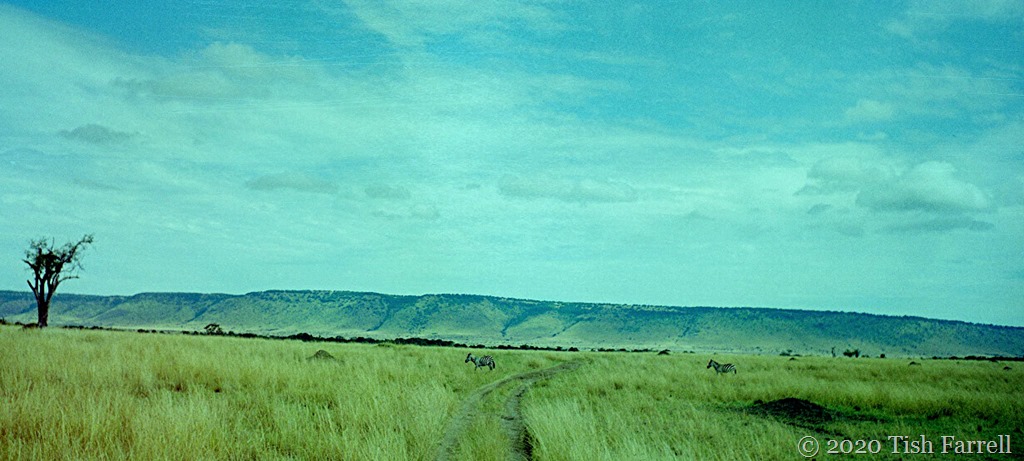
When we lived in Kenya we made three trips to the Maasai Mara, staying not at one of the luxury hotels inside the national park reserve, but at the small Mara River Camp. The camp’s landlords were the Maasai themselves, the Koiyaki Lemek Wildlife Trust, whose clan elders jointly owned three hundred square miles of plains grazing – albeit a tiny pocket of the Maasai people’s original rangeland i.e. the entire run of East Africa’s Great Rift Valley. Such jointly owned remnant land holdings are known as group ranches, though they not ranches as Europeans understand the term. Here clan members and their families live, tending their herds while also claiming daily game viewing revenue from the foreign visitors staying at the camp.
And in case anyone thinks staying outside the national park might be second best, it wasn’t. In fact there was so much wildlife to see everywhere, there was no need to go into the park proper. Die hard conservationists like to contend that wildlife and humans don’t mix, that humans have a detrimental effect on habitat. This attitude has caused, and will continue to cause extreme hardship to the world’s remaining traditional communities, people who actually know very well how to care for their own natural resources.
But back to our first game drive beneath the Oloololo Escarpment.
We set out from camp at 3.30 p.m. in a re-purposed Land Rover: six seats in the back, one per window and three viewing hatches cut in the roof. Daniel Mahinda, our driver-guide, was keen to please us. When he asked what interested us most Graham said ‘grasses’. A surprising answer in ‘big game’ territory. He had recently finished his doctoral thesis on smut disease in Napier grass, an important local fodder crop, but I suspected he was being a touch facetious. I had stopped him from taking a nap, saying he could not sleep through Africa. And he had grudgingly agreed. But, looking back, I should have left him in our riverbank tent – to be serenaded by grunting hippos. The crop protection project he was running in Nairobi was often very stressful, and for all kinds of reasons that could never be foreseen. Probably the last thing he needed was to be bumped around in the back of a Land Rover.
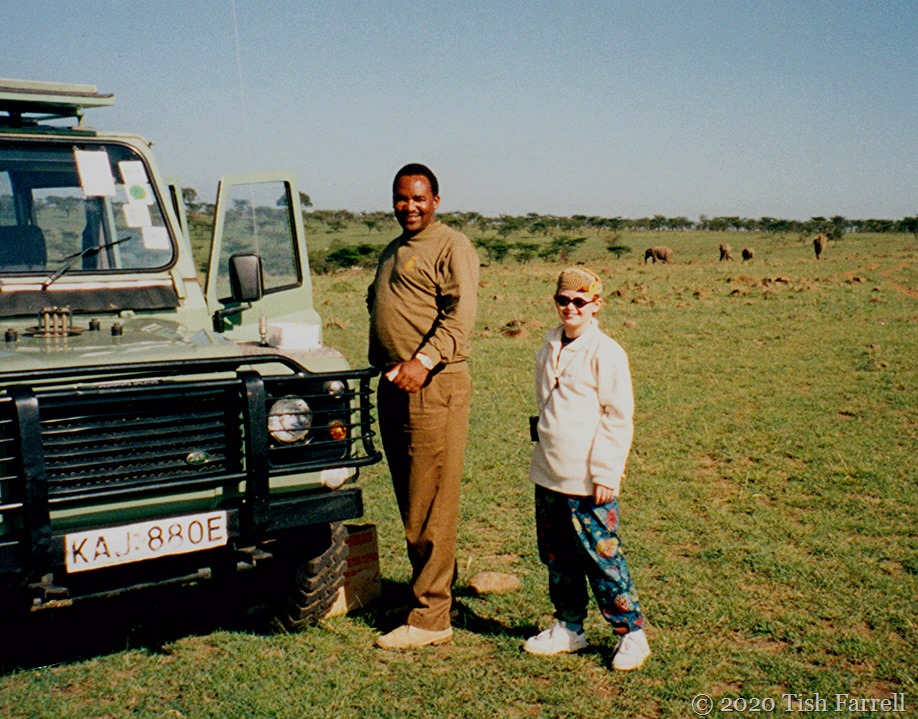
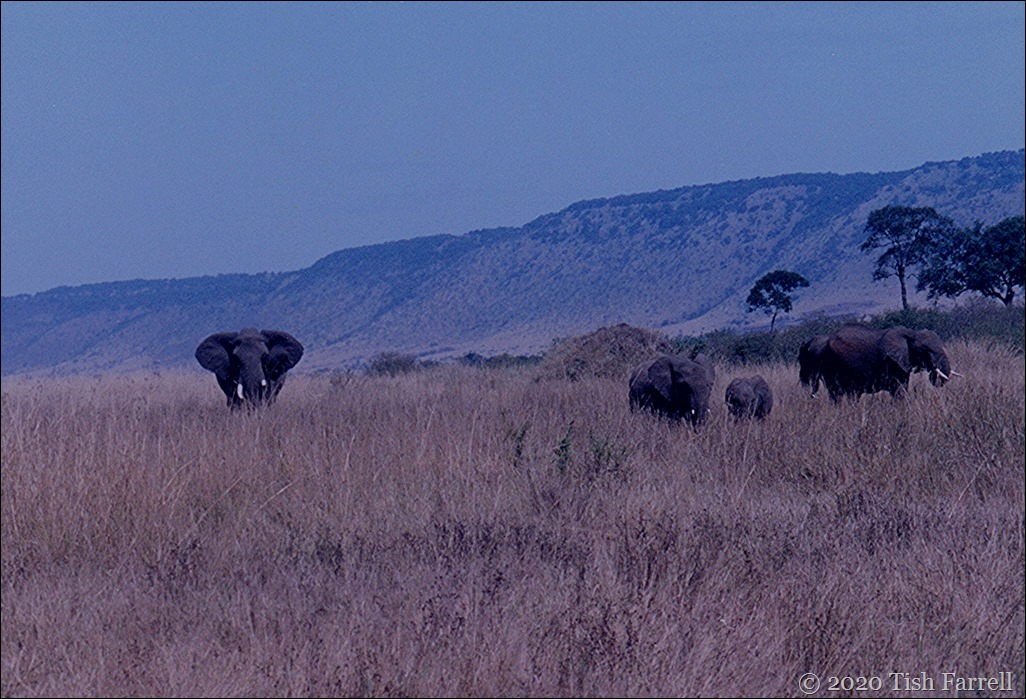
Daniel (on a later December trip) with our niece, Sarah and distant elephants
*
Anyway, Daniel took Graham at his word. Grasses it would be. This is what I wrote back then:
‘As we drive up the rocky valley out of camp there are several stops while Daniel picks us some red oat grass (characteristic of the Mara plains), pyramid grass, Maasai love grass and Bamboo grass. Then we stop to taste the leaves of the muthiga tree (the Kenya greenheart) which are very bitter, and Daniel says the tree’s twigs make good toothbrushes and the bark has medicinal properties – good for sore throats and toothache.
We look at the white tissue paper flowers that hug the ground and the tall sunbird plants (Leonotis leonotis) and the invasive thorn apple (Datura stromonium) and then Daniel picks us a pink flowering spike and says it is called devil’s whip. We also look at the clouds of white butterflies that are clustering round the thorn tree blossom. Then we forget about plants for a while and consider the sooty chat (a small bird that is a Mara speciality) and watch a huge breeding herd of impala. Then we drive along the meanders of the Mara River looking at baboons.
Daniel says there are about fifty in the troop with three alpha-males, and adds that they’re not averse to tackling a Thomson’s gazelle. We see those too. Then there is a grove of muthiga trees with every trunk bearing a series of scars (old and new) from where, over the years, small pieces of bark have been removed to make dawa (medicine). The Maasai are usually far from clinics, and so rely greatly on herbal remedies both for themselves and their cattle.
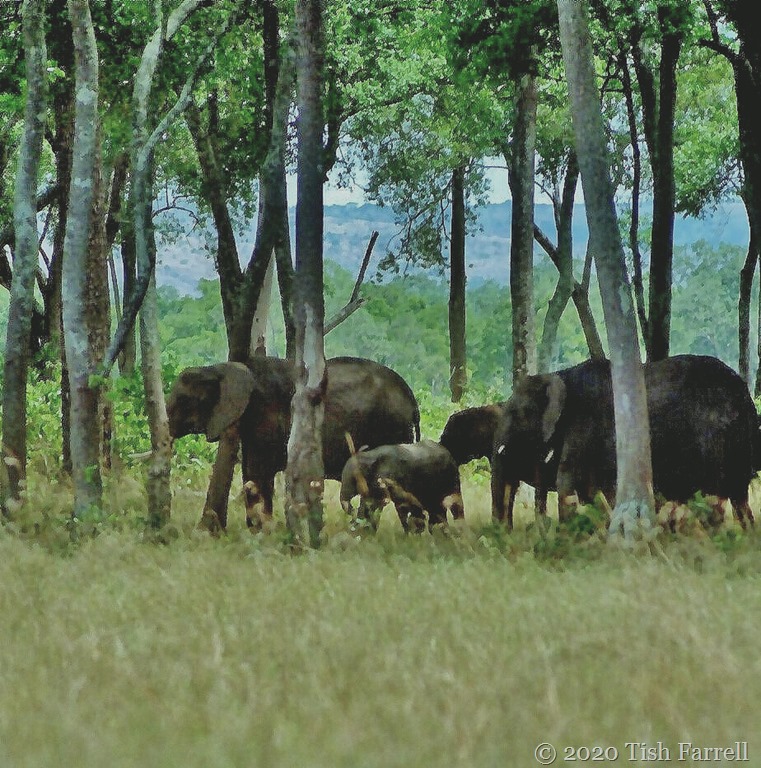
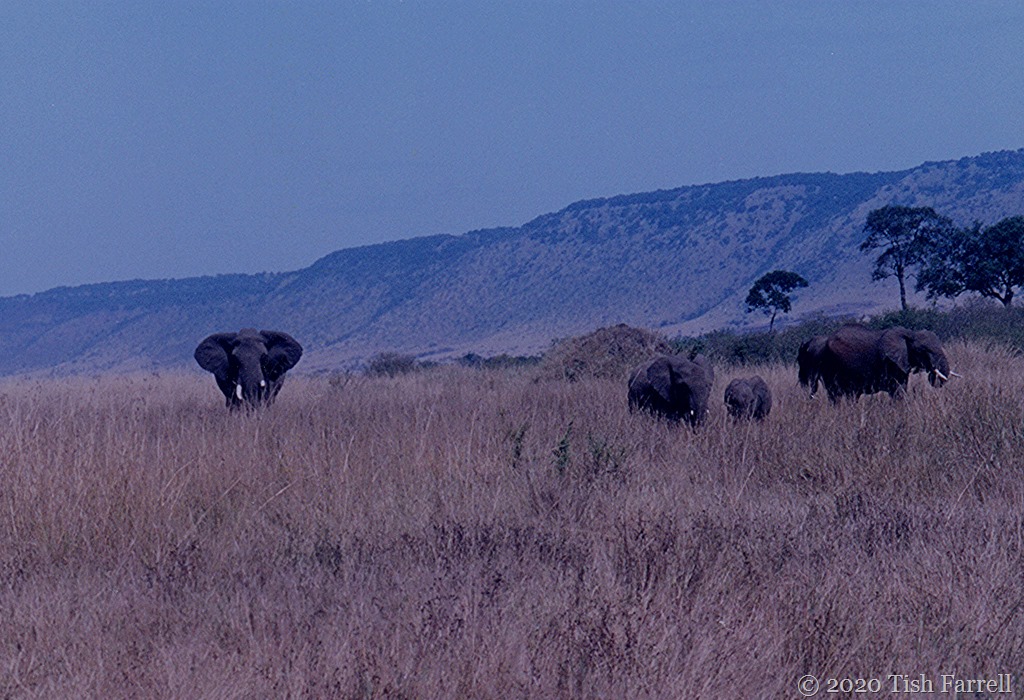
Soon after this we see elephants – first two males, one who shakes his big head aggressively as we draw near. We pause briefly for photos before driving across the marsh to see a family group whose matriarchs and young don’t mind us watching them for a while.
*
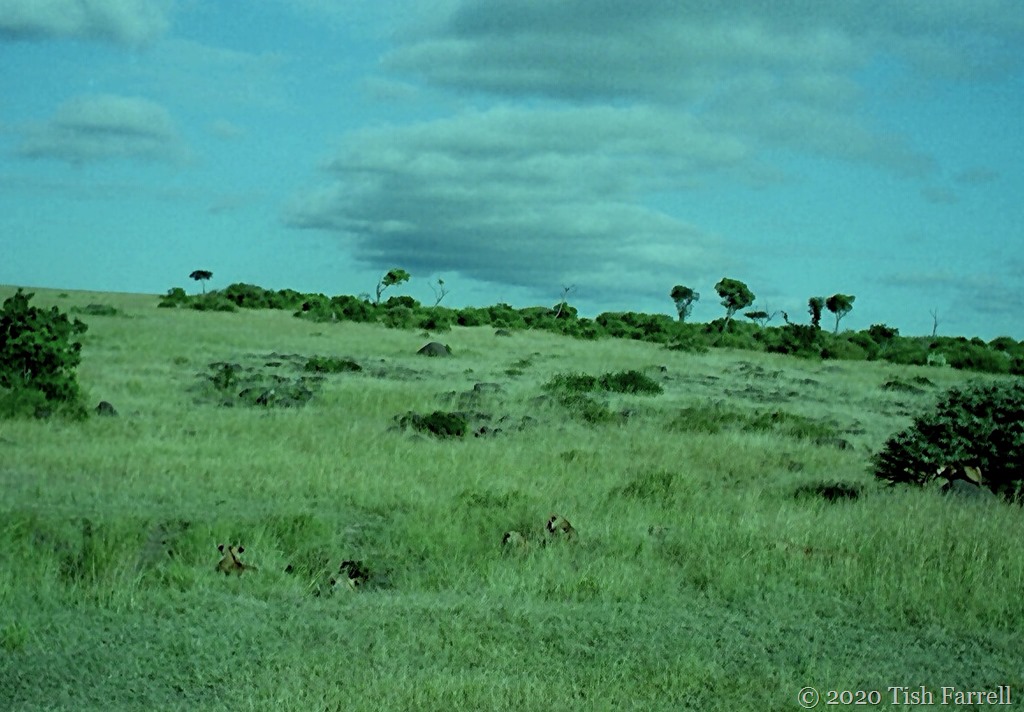
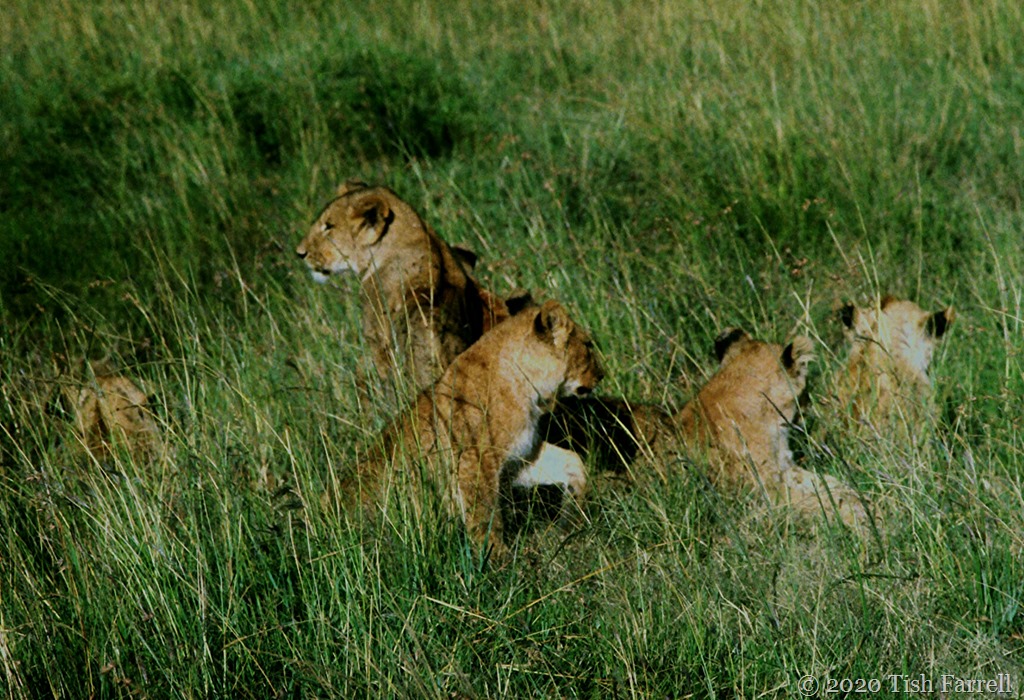
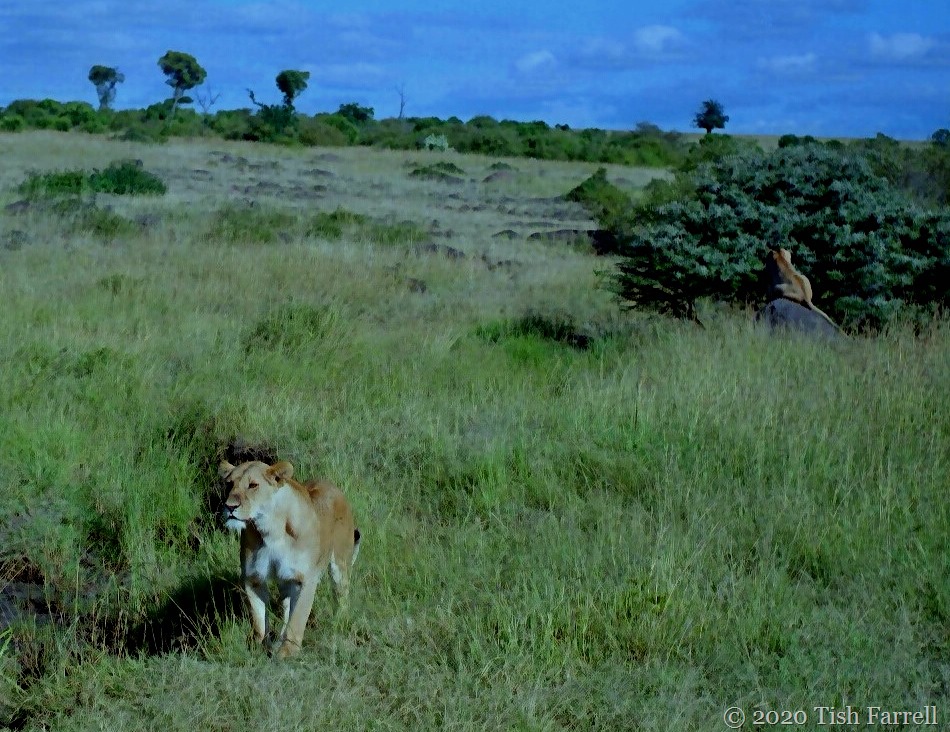
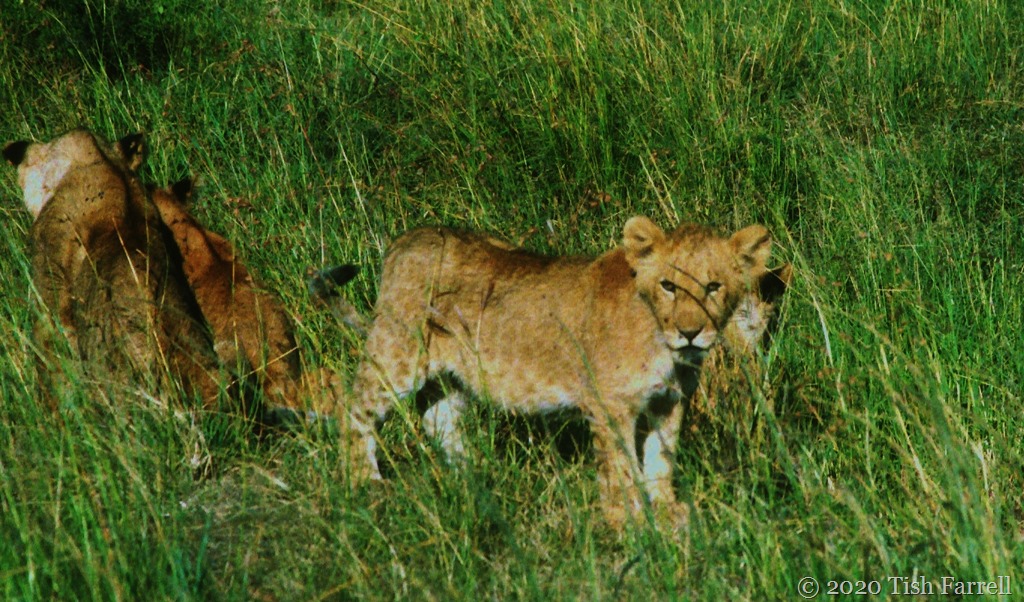
By now it is late afternoon and Daniel has been doing a lot of talking in Swahili on his truck radio. He sets off with purpose across the open grassland. After a while we see two stationary safari trucks on the horizon. We bump over tussocky ground towards them and pull up beside a swampy bank, and there they are – simba. Cubs and lionesses idling in the grass. The drivers confer over their radios, and once agreed that no hunting is in progress we move in closer. At first Daniel pushes along a grassy peninsula away from the pride and we wonder why, for all we can see is grass. But he knows where he’s going. And when a young adult lion raises his big head, I am stunned. Anyone on foot would scan this meadow-like terrain and not have one inkling that the lions were there. When the head goes down, he is gone: lost from view in twelve inches of grass.
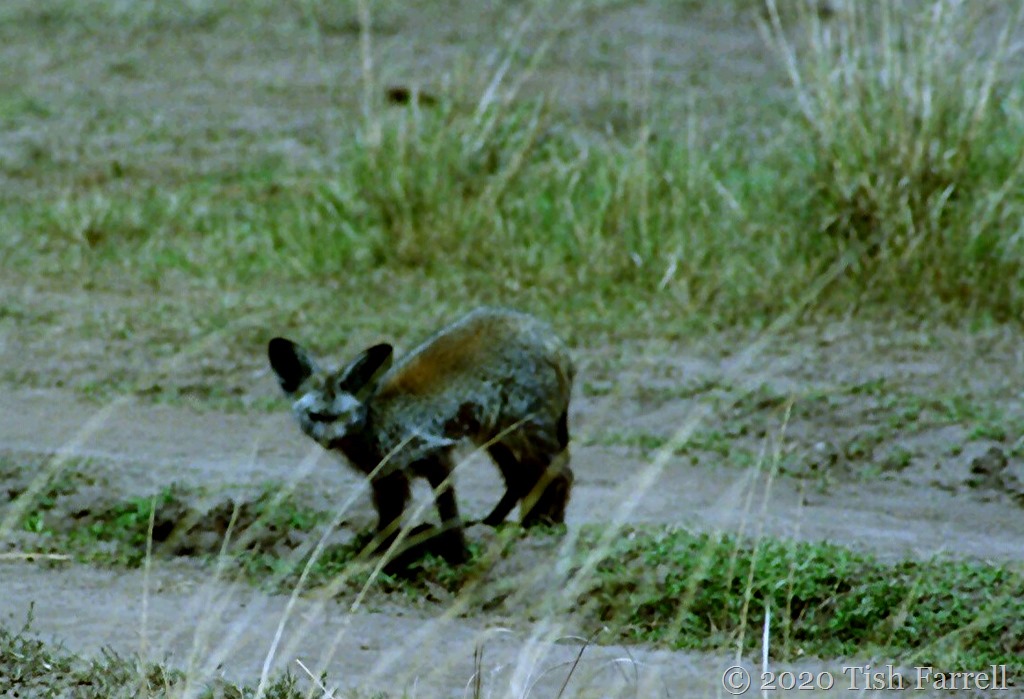
Daniel tells us there are six cubs, survivors from a litter of ten, the other four having died because the hunting has been poor; but, he adds, the wildebeest migration is about to start and these six now look likely to survive. We watch eleven big and small lions till the light fades to grainy grey and then leave them in peace. On the track not far from the camp we see a pair of bat-eared foxes – ‘Very rare,’ says Daniel. They eye us anxiously before trotting away into the grass.
copyright 2020 Tish Farrell
Lens-Artists: Distance This week Tina sets the challenge. One of the safari guide’s key skills is knowing when it’s best to keep a distance and especially when it comes to elephants and lone buffalo.
Tales From The Riverbank ~ Breakfast With Hippos
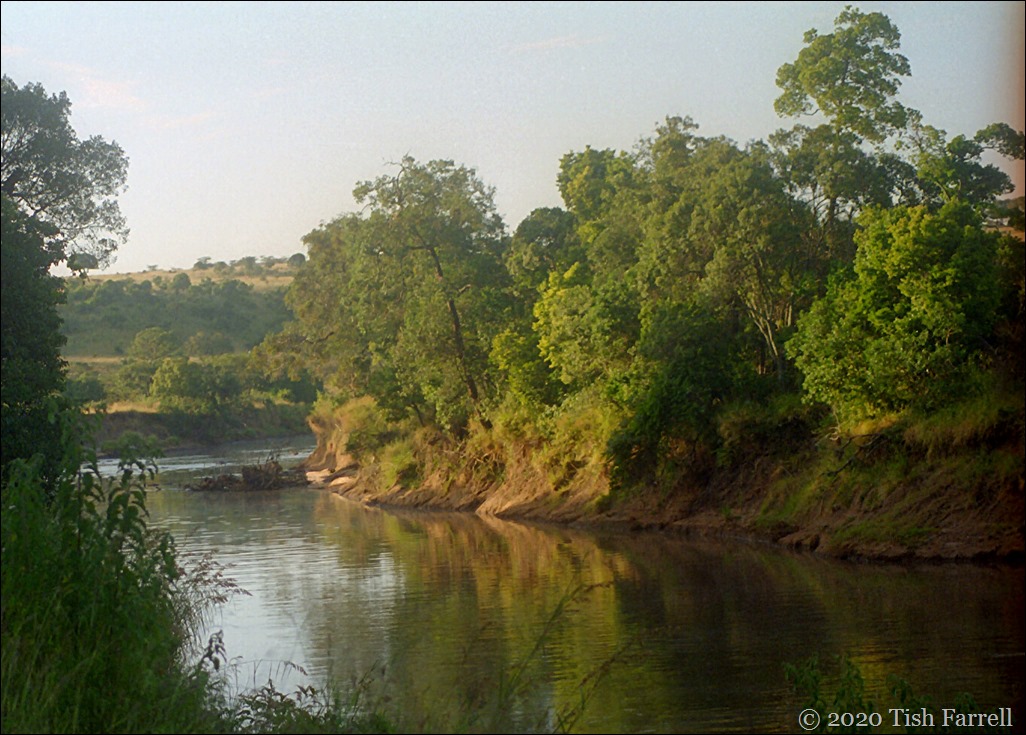
With all that is presently going on in the world, a visit to the old Africa album and the banks of the Mara River seems like a soothing thing to do – a bit of virtual safari-ing. It’s handy too because this week at Lens-Artists, Amy at has given us ‘river’ as the theme.
For six of the seven years we lived in Kenya (this was in the 1990s) we somehow managed not to go to the Maasai Mara. Then in our final year we went three times, always staying at the small Mara River Camp below the Esoit Oloololo escarpment, guests of the Koiyaki Lemek Maasai group ranch wildlife trust. It was Godfrey Mwirigi who lured us there. We came to know him at Elmenteita where he managed Lord Delamere’s Camp, but one morning in early May 1999 the phone rang in our Nairobi house. I mention this because the phone ringing was an unusual event; it was an instrument that rarely functioned.
It was Godfrey on the line. After the usual exchange of greetings I told him he sounded hazy. ‘I’m ringing from Mara River Camp,’ he says. Now I’m even more astonished – phoning all the way from the Maasai Mara when trying to ring up the next door neighbours was often impossible. He told me he had just started his new job as manager there and when I asked him how it was going he says, ‘Fine. Fine. I can see hippos from my office. It’s lovely here. We’ve had no rain yet and there’s plenty of game.’ It sounded like an invitation. It had to be an invitation. So two weeks later we set off to see him – Saturday morning flying by Fokker Dash on the regular domestic plane service out of Wilson Airport in Nairobi, whence, having negotiated the usual city traffic turmoil and checked in, the flight took only 40 minutes from city centre to touch-down on the plains’ landing strip. We were there almost before we were ready for it. Banking over the nearby marsh beside the landing strip I spotted elephants. Amazing!
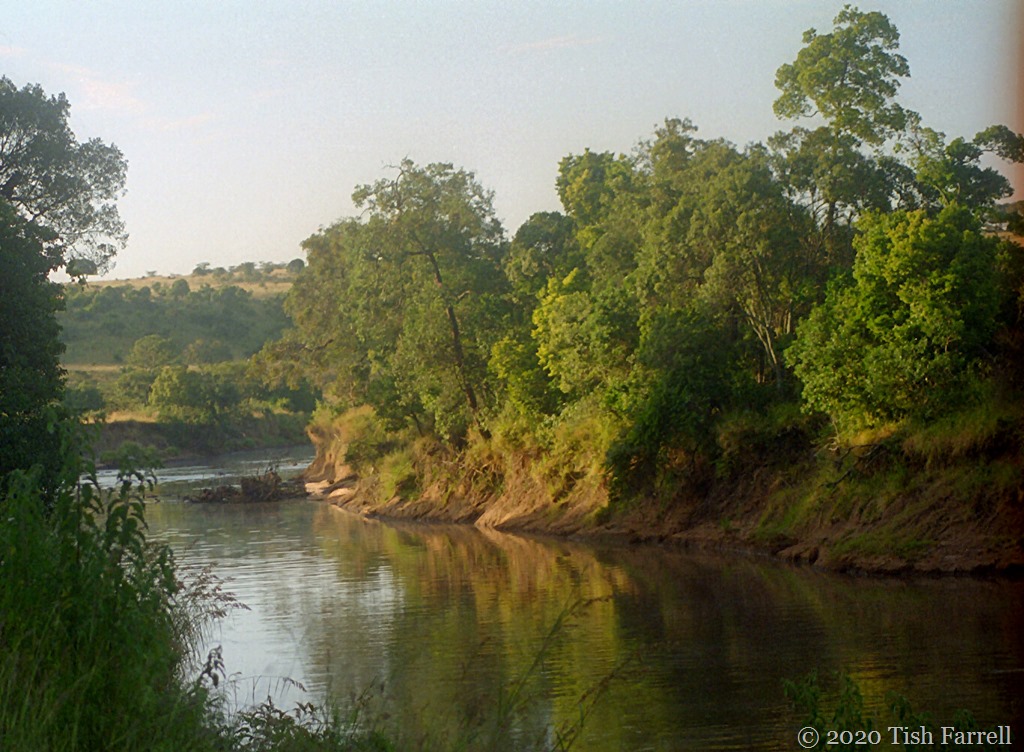
A safari truck was waiting beside the landing strip to pick us up, the camp driver and assistant manager, Tito there to greet us. Tito told us the Mara River Camp would be a further 40 minute drive over rough tracks, and she apologised for the state of them. We bumped along beneath the escarpment, following the ox-bow meanders of the river, its banks wooded with acacias, wild olives, crotons, cordia, and Kenya greenheart.
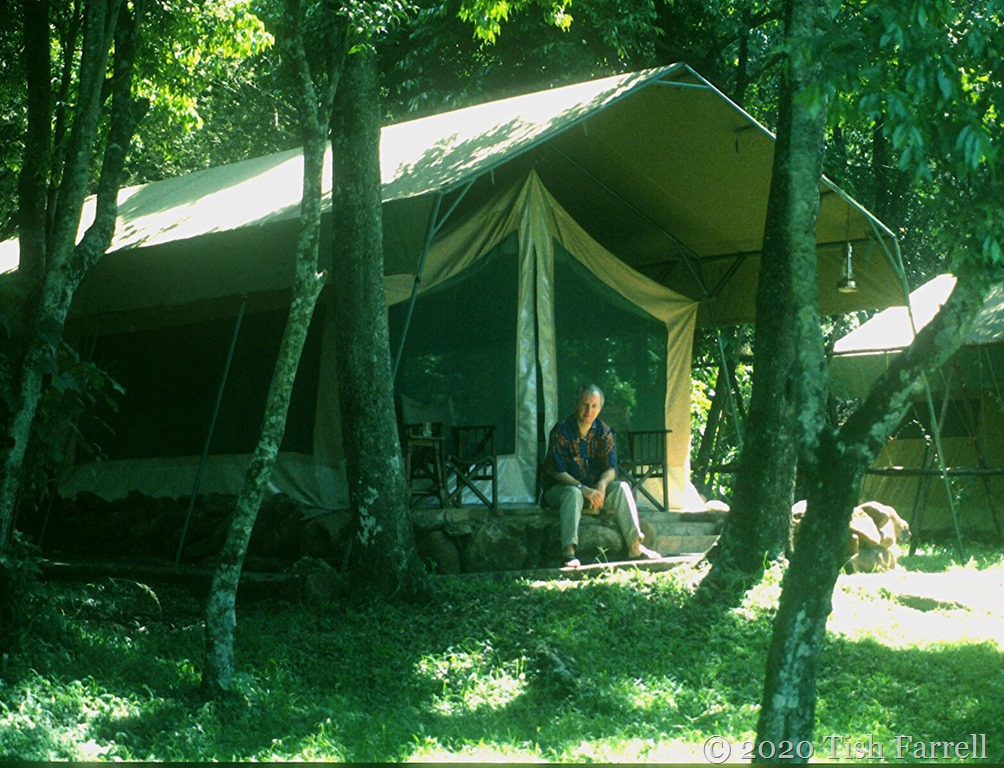
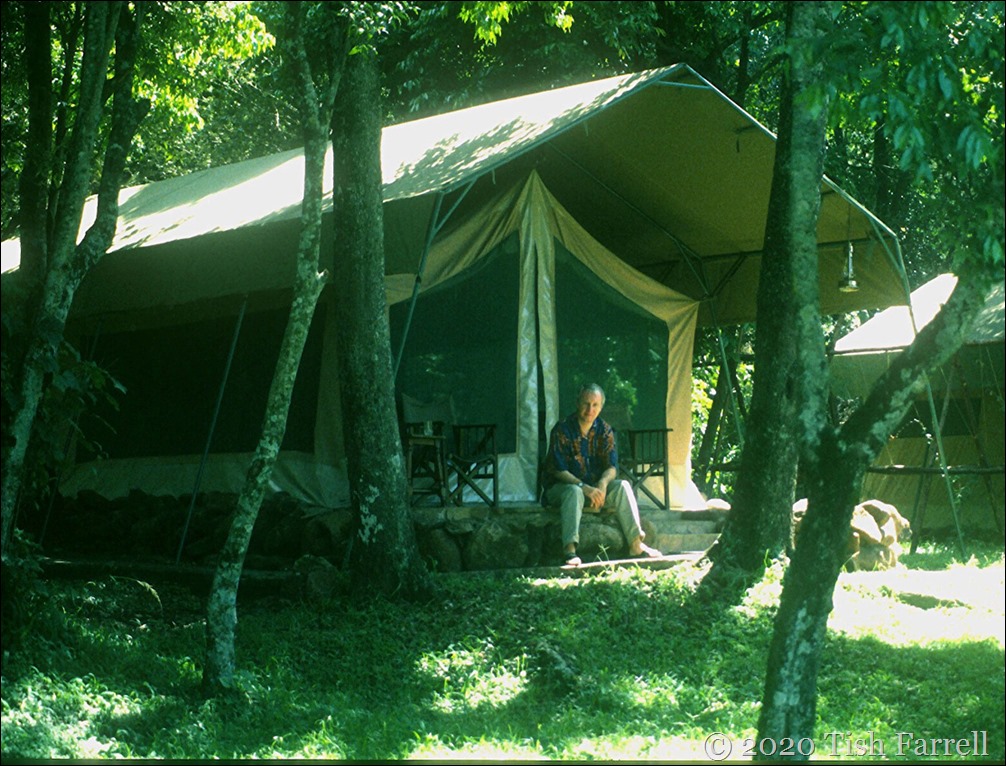
The camp itself was on a river bend, twelve large tents set under the trees. The soundscape filled with bird-chatter and the grunting of hippos, the air lemon sweet from cordia blossom. As it turned out Godfrey was astonished to see us. He flew from his office with open arms. The tour company had mixed up our names and he was expecting a Mr and Mrs Graham. He then told us that he couldn’t have come to meet us from the plane as he’d had visitors. Important ones. The Maasai elders who jointly owned the 300 square miles of ranch in which the camp stood had come to check out the new manager, to see if he came up to scratch. I asked what would happen if they didn’t like him. ‘They are very powerful,’ said Godfrey, meaning a swift transfer out. This seemed unlikely, however. I had caught sight of the departing wazee, one an imposing grizzle-headed ancient wrapped in a red blanket. The members of the little delegation were all smiling as they walked away.
[From the Kenya diary]
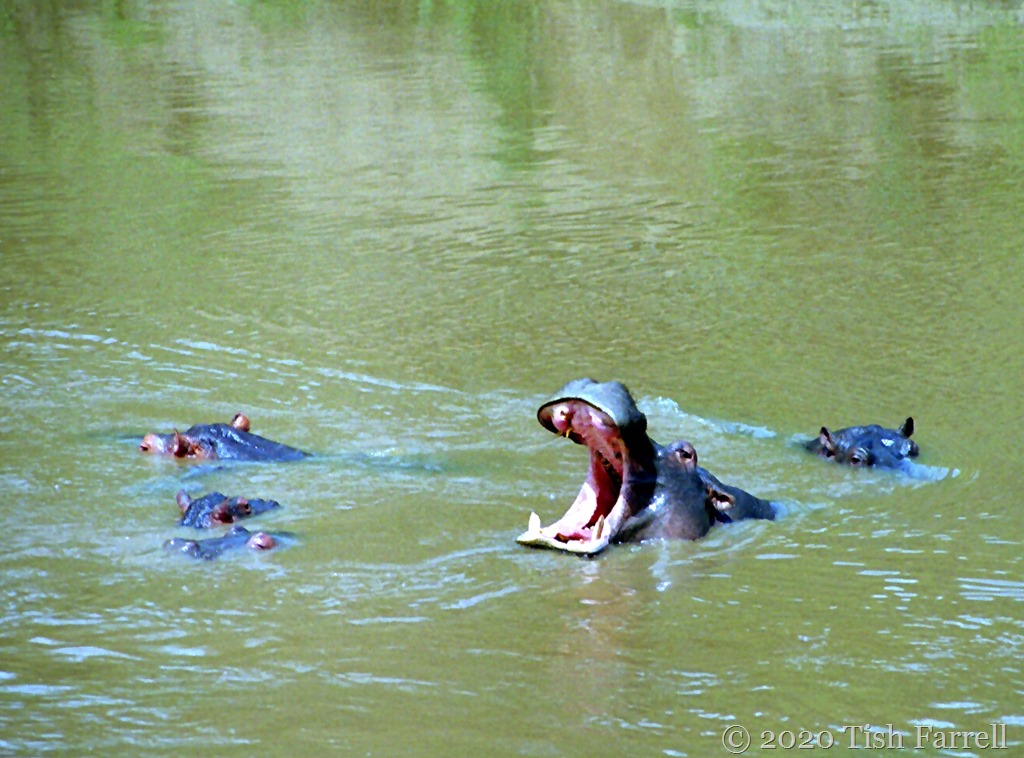
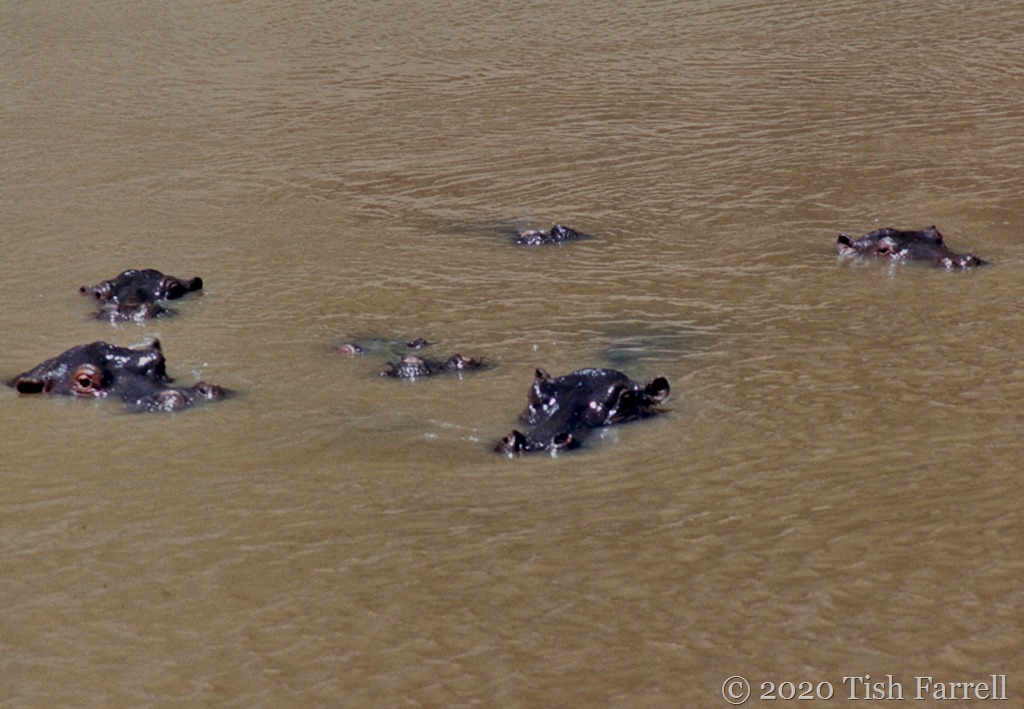
After lunch under the trees – battered lake fish and vegetables, Godfrey comes to join us on the riverbank for a spot of hippo watching. In a few weeks he has made himself at home here though his actual homeland is on the faraway flanks of Mount Kenya. I remember that when he took over as manager at Elmenteita camp he had to take the safari guide’s exam and learn to identify some 600 species of birds. I ask if there will be more exams now he has a new habitat to get to grips with. He laughs and says mammals are his next assignment, though he has two years grace before he needs to go in for the silver medal exam. Below us the hippos snort and blow, sometimes submerging completely, then rearing up like whales, bottoms first, or doing their fearsome yawns which show the teeth that can bite a tough old crocodile in two, especially if it has designs on one of their babies.
Godfrey begins to tell us about his other recent Maasai experiences, and for a moment we see that in some ways he is as much a traveller in Kenya as we are. The Maasai, he pronounces, are very interesting people with some very unusual customs. For instance the day before a group of women had come singing and dancing into the camp, and because rural Maasai rarely speak Swahili he had to ask Tito, who is Maasai, to explain what was going on. She told him they were there to collect money, because they were all childless women who needed to go to the elder for a blessing. This man had to be paid, but after the blessing had been duly delivered, the women would be free to consort with any man they chose in the hopes of conceiving a child.
Poor Godfrey was trying to get away with donating only a hundred shillings, in harambee (Kenya fund-raising) fashion, but they invaded his office waving twigs and saying it was not enough. Five thousand bob (£50) was what they needed. And it was only after a lot of persuading that he managed to convince them that he truly didn’t have it. They told him they would go off to other camps and try there. When they had gone Godfrey told Tito that if he’d known they were coming he would have gone to his tent, but she only laughed and said they would have looked for him there too.
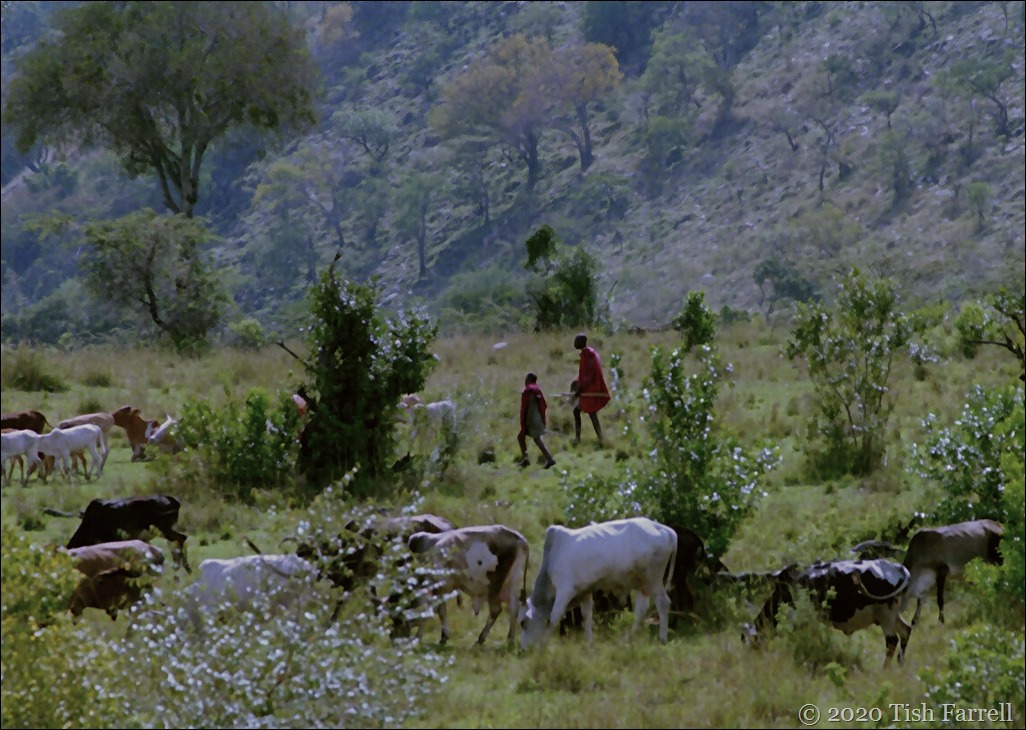
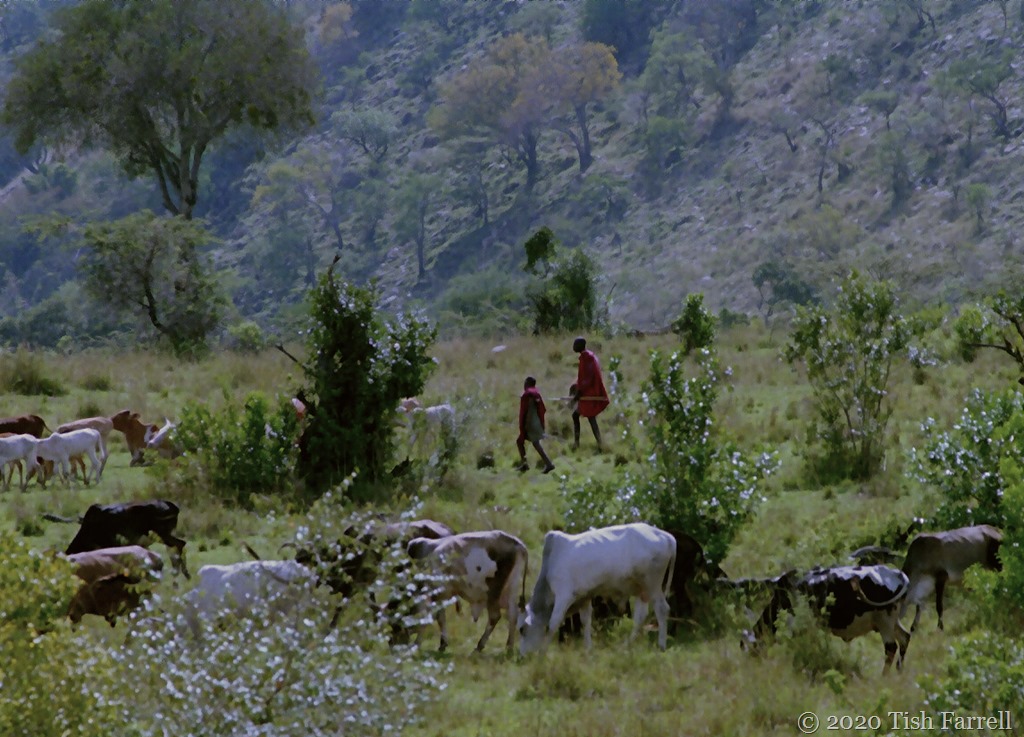
The view across the river: Maasai lads minding their herds below the escarpment.
*
30 May
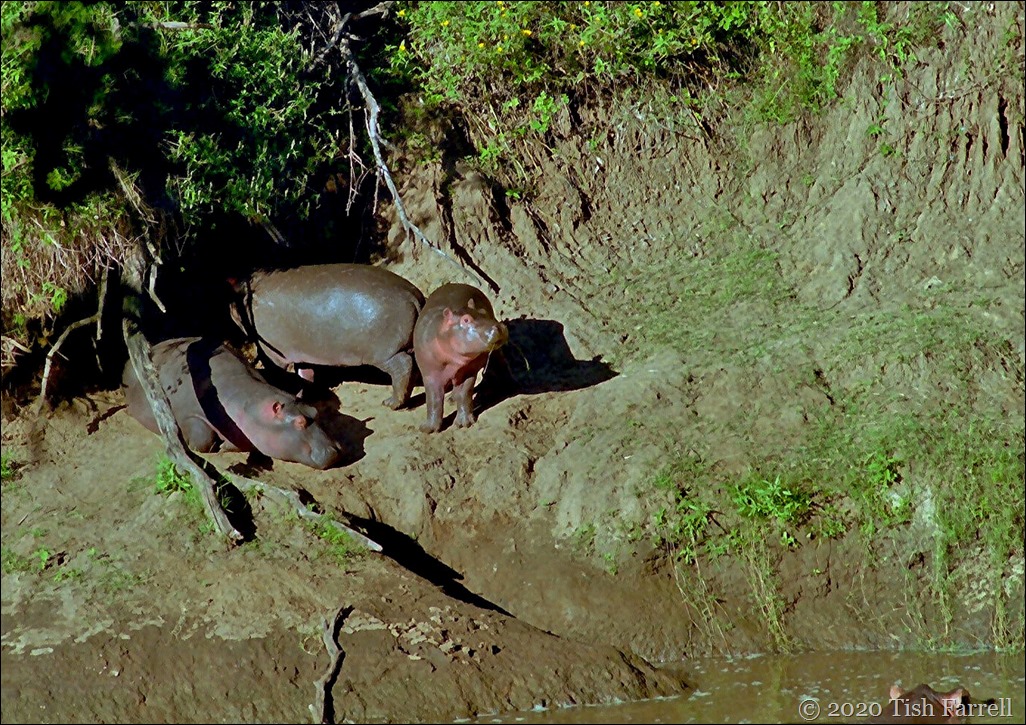
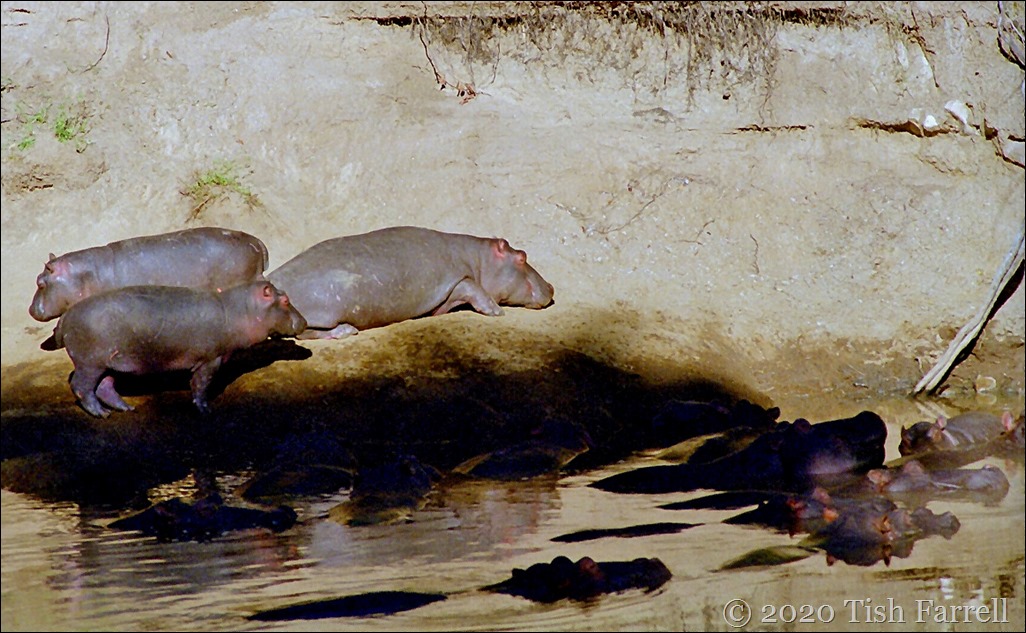
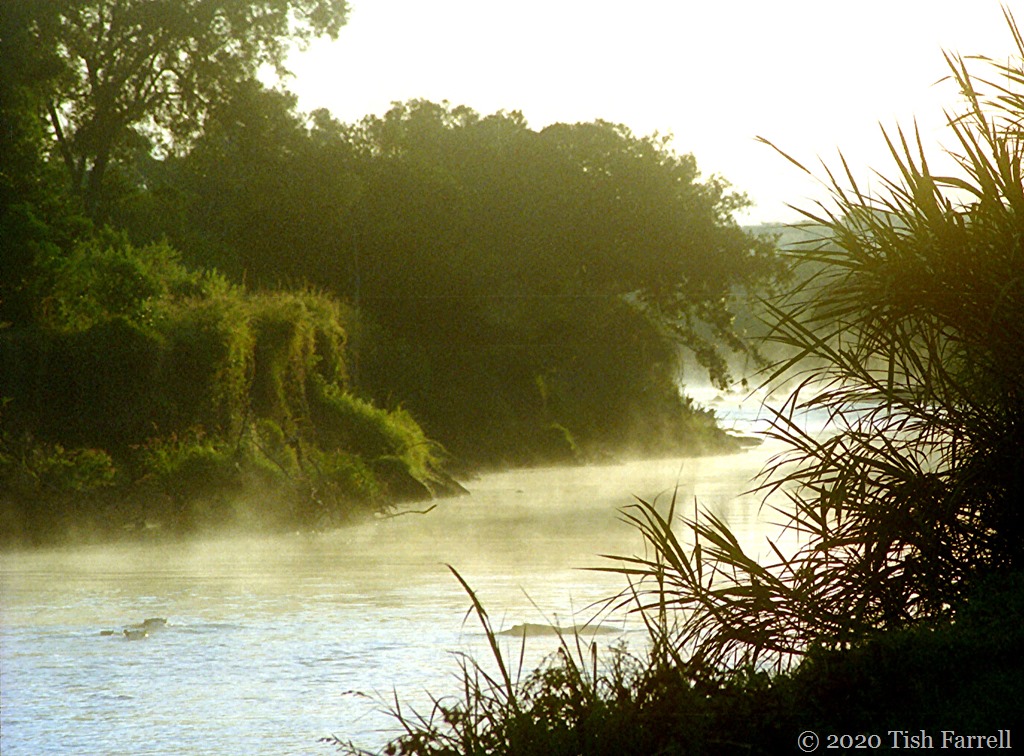
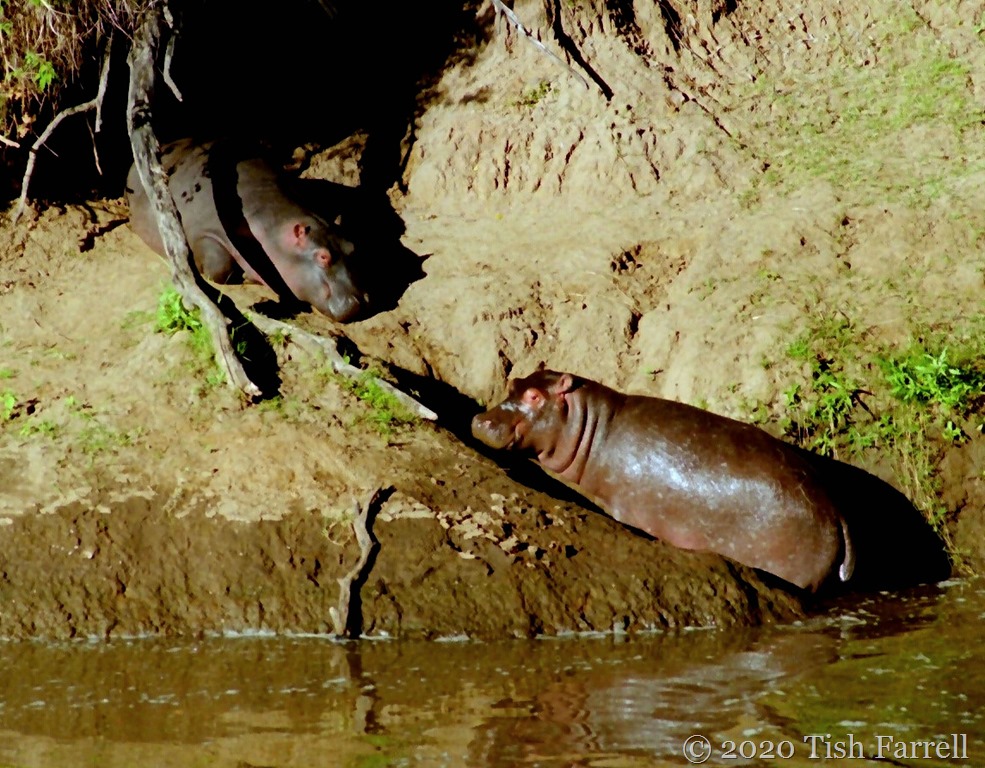
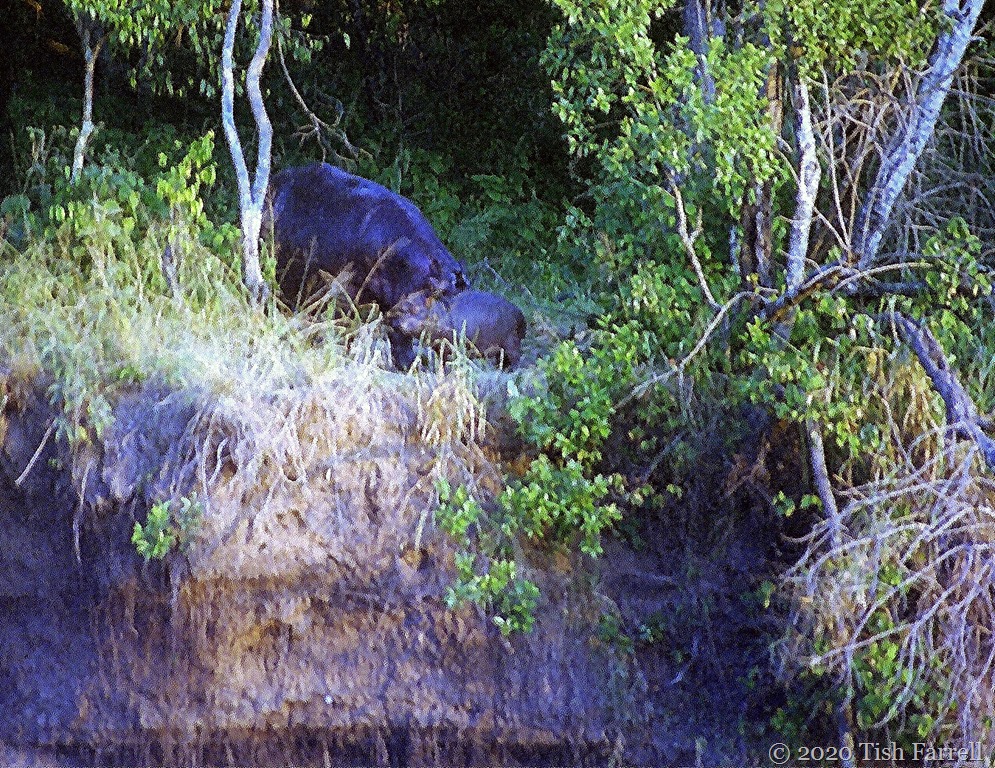
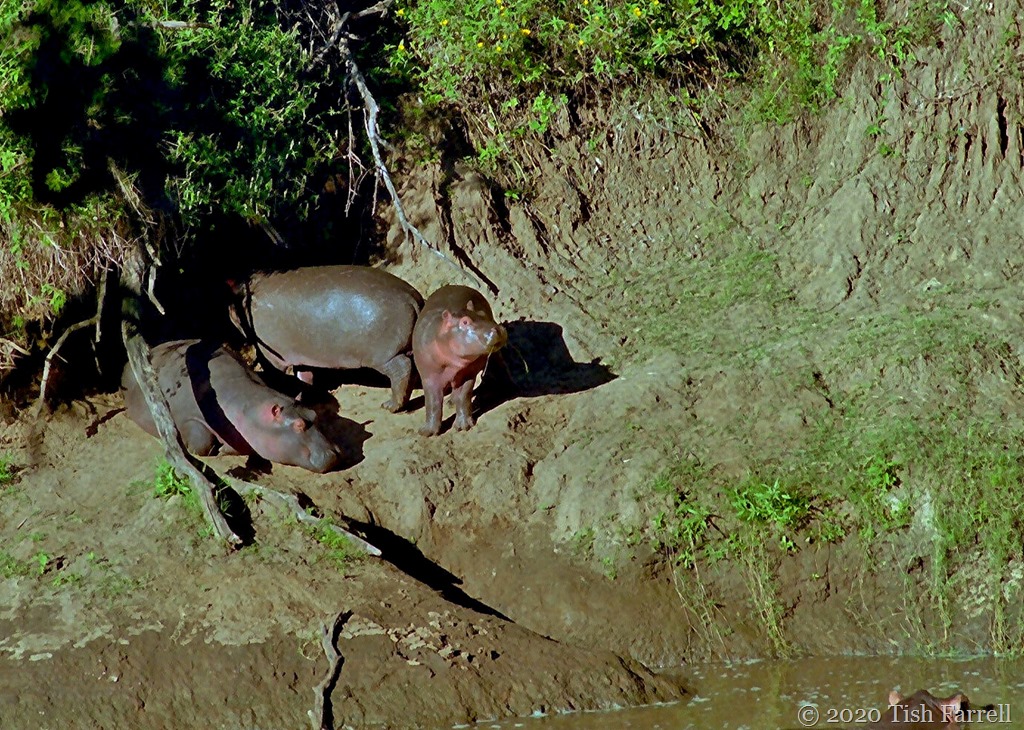
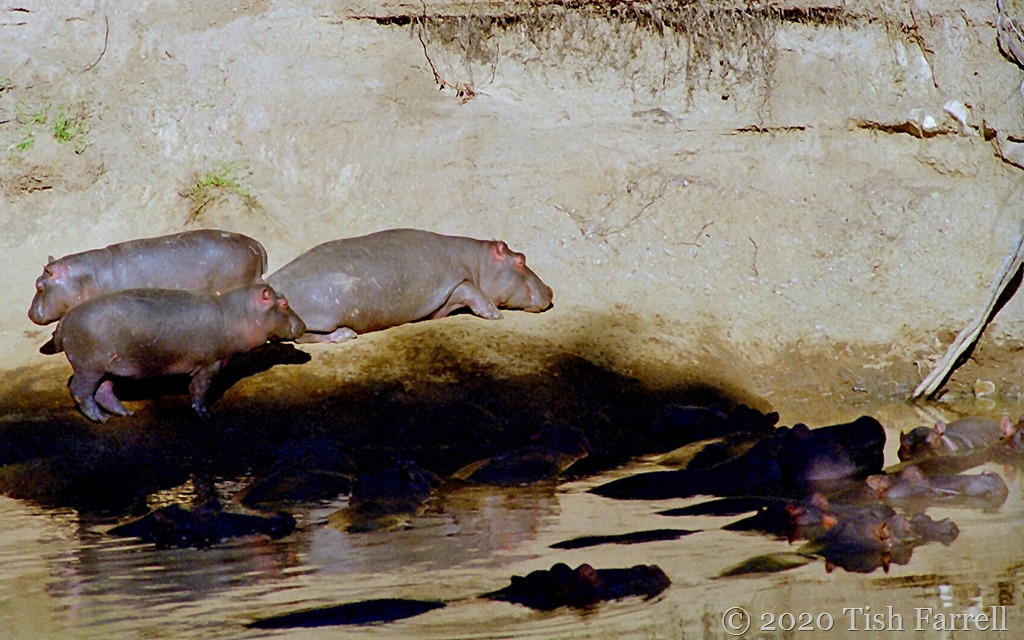
Extraordinary. I’m up and dressed by 5.30 a.m. Now is the time for hippos to return the river after a night spent browsing far and wide, and it is a foolish person who finds himself standing between a hippo and the river. They are of course intent on being submerged before the sun can overheat their sensitive skins. Round the camp the hippo slipways to the water are mostly on the far bank and I watch the huge hulks pass like ghosts through the woodland, a mother nudging her baby, before they start edging slowly, slowly, ever-so-slowly, down a deep gully and into the water. Thus does the long day of snorting and blowing and wallowing begin.
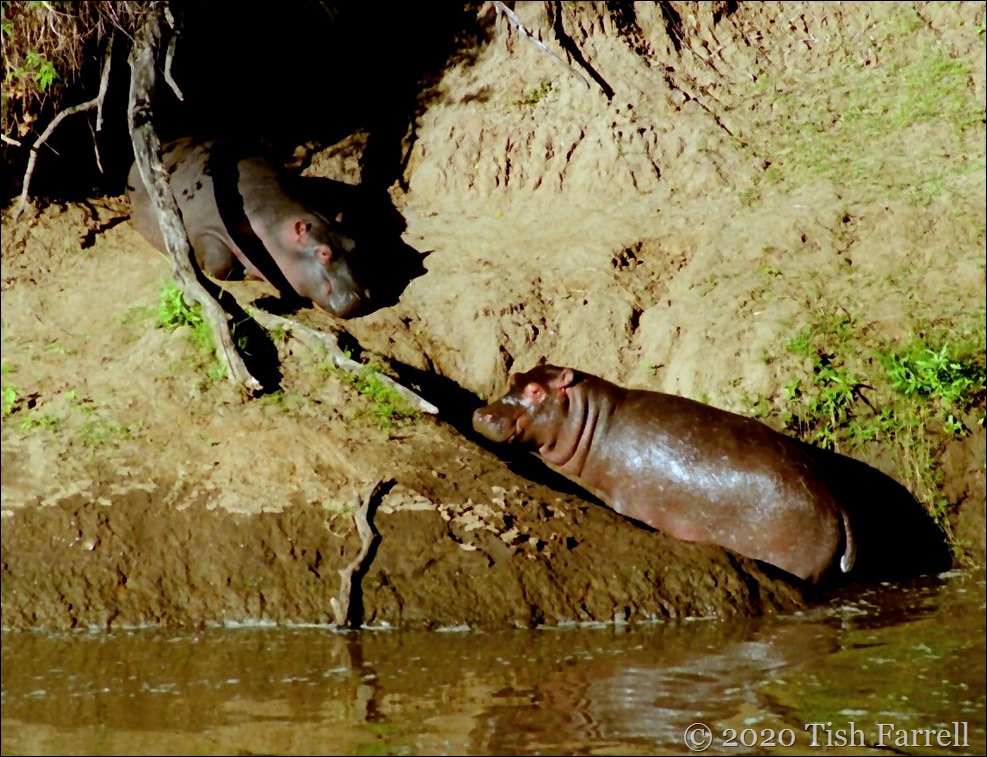
31 May
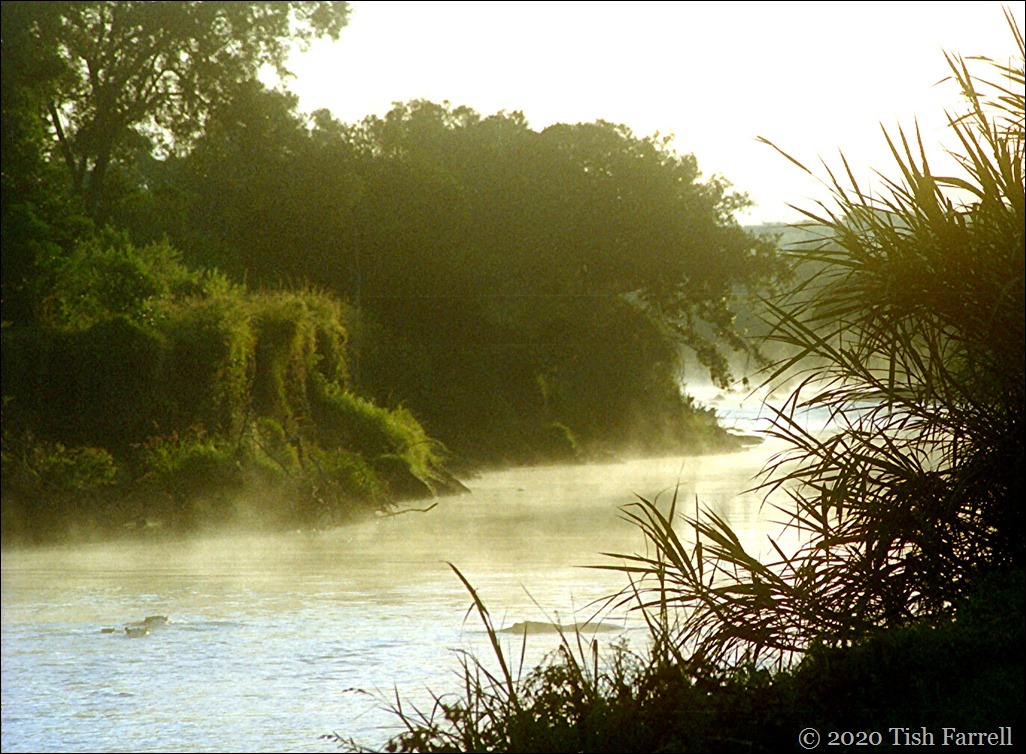
Up again before 6 a.m. Am aware of Graham’s astonishment even though he pretends to be asleep. I go hippo spotting until it’s time for my 7.30 wilderness walk with Daniel. The sun is just lighting up the river and steam rises off its slow–moving surface. This morning the hippos are ‘late going home’, as Godfrey puts it, with only two so far immersed and two others beached along the bank apparently dawn-bathing. I see the big shapes moving through the woodland. In front is a mother with a small round calf. It is not anxious to go down the hippo-chute. She nudges its bottom with her nose, and small as it is (though clearly sure of what it does or doesn’t want) it turns round and nudges her right back. For a long time they make no progress, and then the way is blocked by a big male who takes a good fifteen minutes to negotiate the gully. But then I suppose when you’re as big as he is, any untoward gathering of speed down the bank could end up with terminal burial in the river mud.
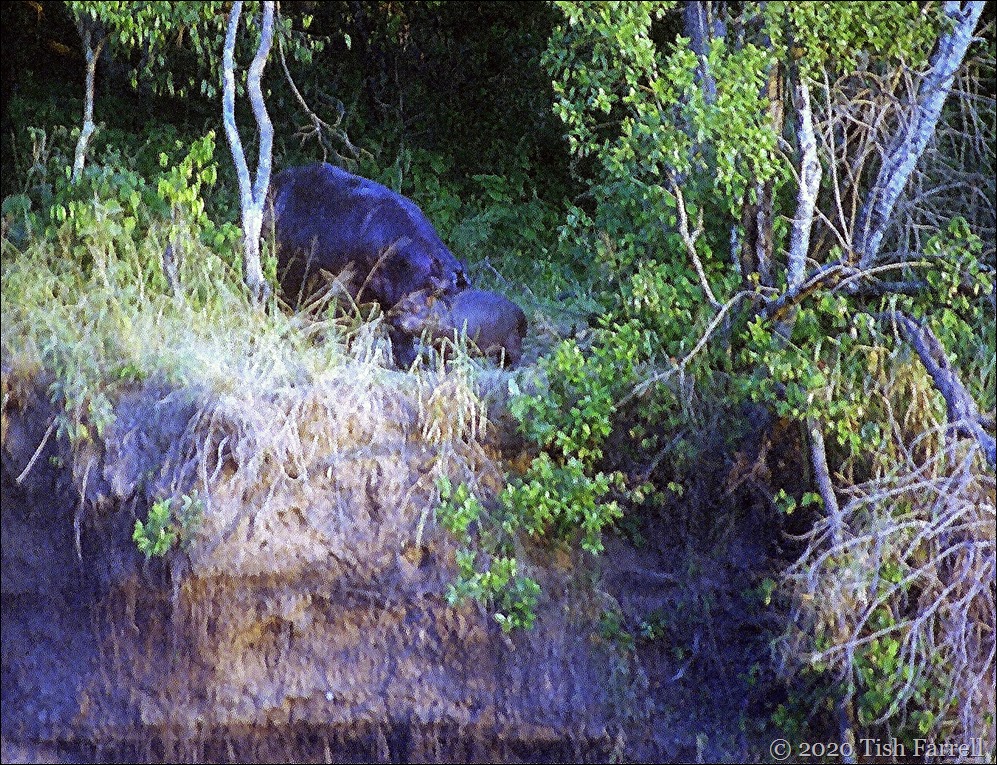
The walk along the riverbank with Daniel is uneventful. We look at plants, and see a little bee eater with its lime-green back, an immature augur buzzard, a yellow bishop. The sun is hot by 8.30 and I’m feeling hungry, but Daniel is determined to take the outing seriously. He’s brought some of his reference books too. ‘It’s not very often we get guests who are interested in plants,’ he says. ‘It’s easy to forget what you’ve learned without practice.’ To prove the point he picks a piece of the plant whose name I ask but he doesn’t know and slips it inside his Flowering Plants of East Africa book, for future identification. I forget about breakfast and continue to set him floral challenges.
On the way back to camp we see leopard prints on the track. ‘Oh yes,’ Daniel says. ‘They come round the camp at night.’
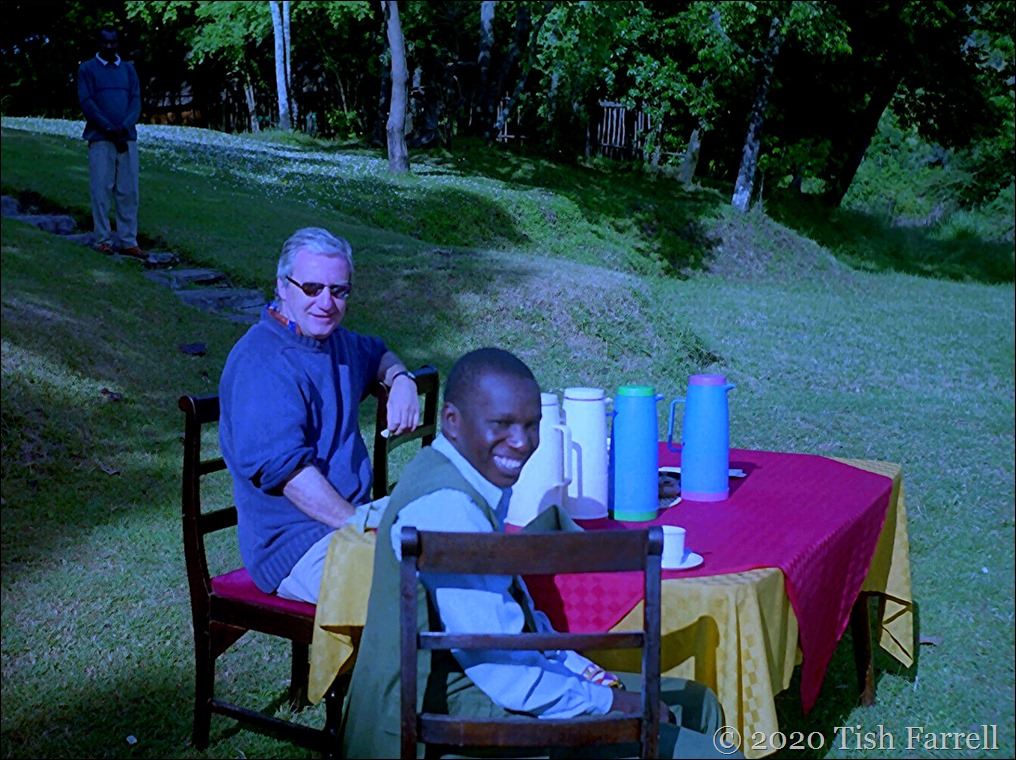
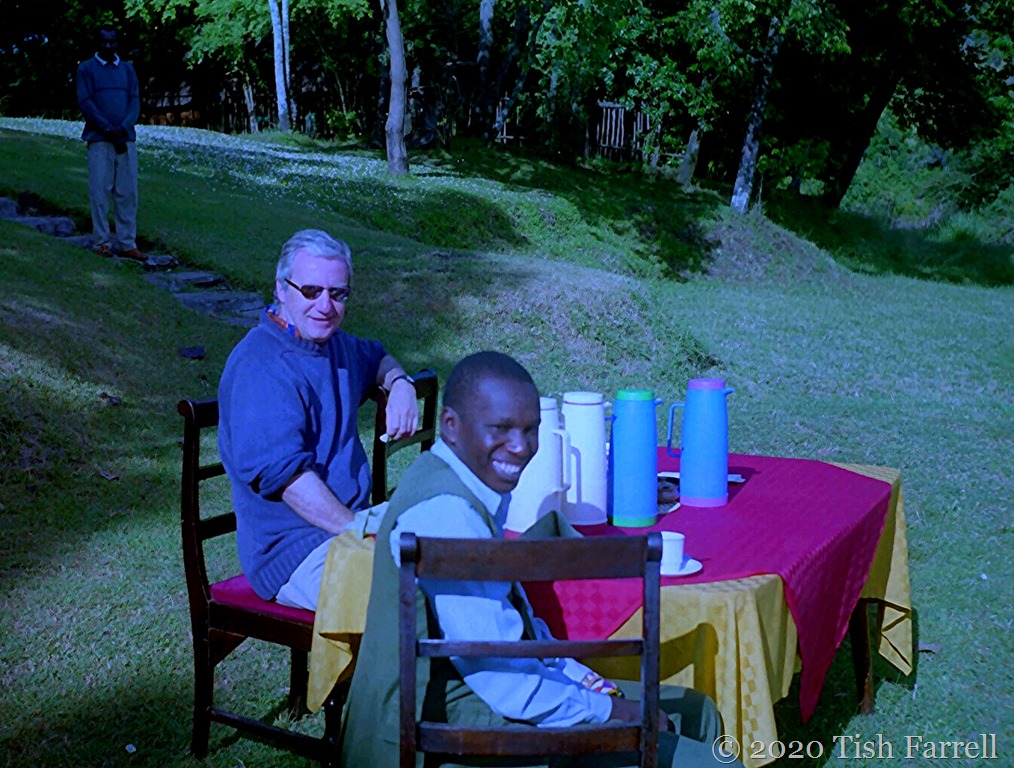
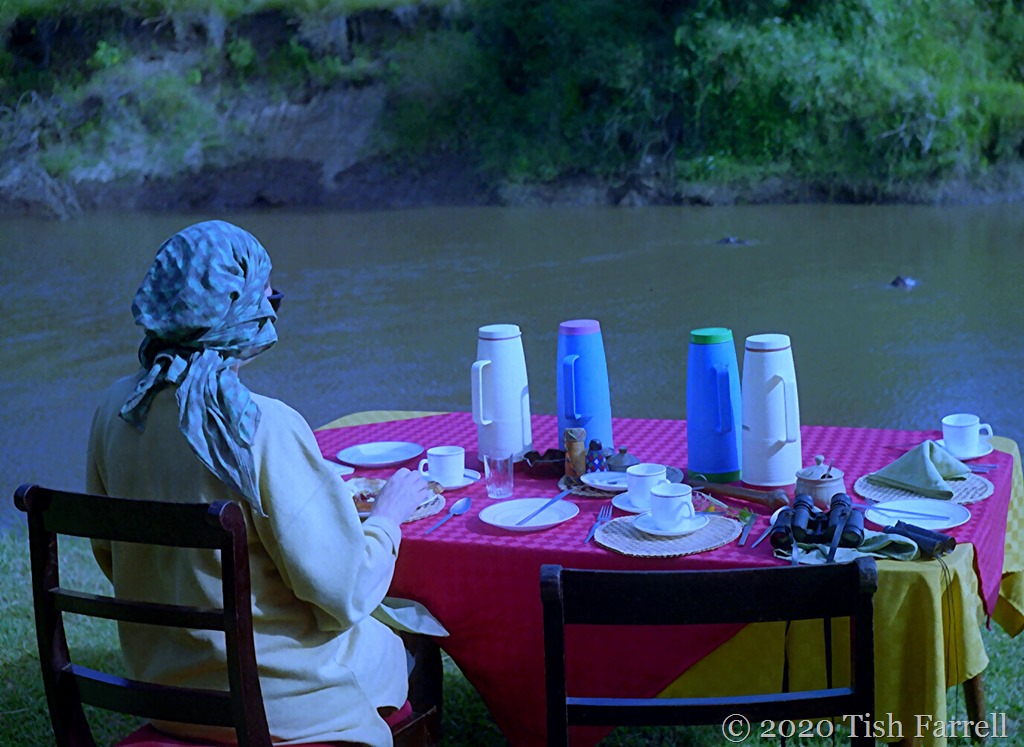
It’s nearly nine when we arrive back. I find Graham and Godfrey having a leisurely breakfast with the hippos, who are by now all safely ‘home’ in the river; or they are until one huge beast suddenly emerges and climbs ponderously back into the wood. This behaviour is so unusual we pick up the binoculars for a closer view and see that his hide is covered with bleeding scratches. It’s hard to imagine what might have caused them, other than a serious tangle with an acacia thicket. Godfrey says the fish are probably irritating the wounds, hence the unexpected exit.
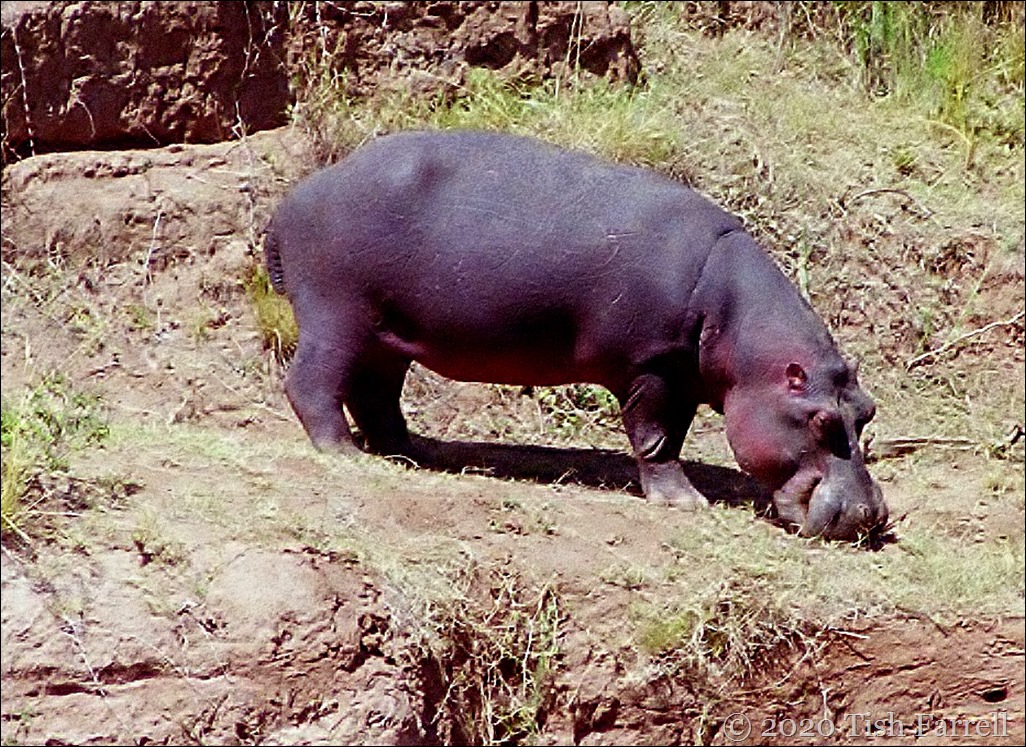
Graham and Godfrey
*
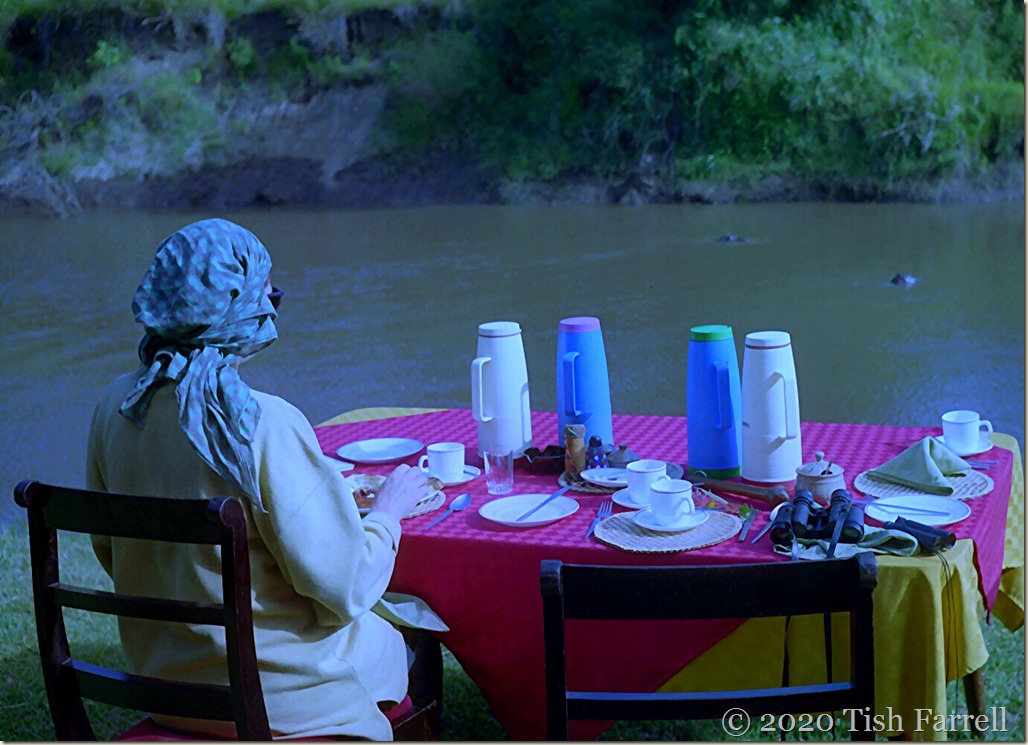
Happy days!
In Search Of Lost Time At Elmenteita ~ Back To The Old Africa album
Flamingos at dawn on Lake Elmenteita, Kenya
What better way to spend wet and windy days than trawling through old photos: scenes of times past when we lived in Kenya. So all thanks to Tina at Lens-Artists who this week sends us off on a treasure hunt through the photo files. Images may include sunsets, sunrises, birds, mountains, expressive portraits and a host of other things – in combination or otherwise. For the full list, follow the link at the end of the post and be inspired by Tina’s own treasure-hunted photos.
Meanwhile, I’ve chosen photos taken at different times but in a single place where we often stayed – a tented camp on the shores of Lake Elmenteita – a 2-hour drive up the Great Rift Valley from Nairobi. The camp had gone now, but the 46,000 acre wildlife sanctuary that surrounds the lake may still be visited. It is now the Soysambu Conservancy, the land still owned by Lord Delamere, whose grandfather, in the early 1900s, was one of first British colonial settlers in Kenya.
The Eburru massif is still volcanically active. The light here changes every second.
*
The pioneering Delamere ranch at Elmenteita was never successful, the soil too thin on volcanic bedrock and lacking in vital minerals, a fact well known to local Maasai herders who had long avoided grazing their cattle around the lake. Their name for the place could have offered further clues. In Ki-Maa Elmenteita means ‘place of dust’, their oral accounts telling of times when the lake blew away completely, leaving only a dust-plain.
These days the water levels rise and fall, but in any event the lake is both shallow and intensely alkaline, being one of a string of soda lakes along the floor of Kenya’s Great Rift. The waters are rich in crustacea and insect larvae which support large flocks of Greater Flamingos, and also blue-green algae that keep even larger numbers of Lesser Flamingos well fed. On rocky islands beneath the rugged cones and scarps of the Eburru massif pelicans breed. While around the lake, in marsh and acacia scrub, some 450 bird species have been spotted. The sanctuary is also rich in all manner of plains game: gazelle, eland, impala, waterbuck, zebra, giraffe, warthog, dik-dik, buffalo. And then there are monkeys, aardvarks, spring hares, zorillas, porcupines and rock pythons.
My memories of course are forever fixed in the 1990s, and as an antidote to the kind of nostalgia-wallowing that inevitably overlooks the modernising needs of Kenyans, I should just mention that the volcanic steam vents of the southerly Eburru hills are now being exploited on an industrial scale to generate geothermal power as part of Kenya’s greener, cheaper energy initiative.
Now for my ‘treasure’ trawl:
Who scattered those rose petals on the lake?
I’m including this photo because it shows that East Africa can have very dull weather, often for weeks in July, August and September when it can also be quite cool. The bush is very dry during this period – the main rainy seasons being the short rains in late October – November and the long rains late March – June: if they happen, that is; some years they miss altogether. This last year there have been life-threatening deluges across East Africa. The other striking feature here is the exploded volcanic cone across the lake, traditionally known as the Sleeping Warrior, but also dubbed Delamere’s Nose on account of the original pioneering lordship’s hooter that so impressed the locals.
People portraits:
Paul Kabochi, camp ethnobotanist and medical herbalist. There was not much he did not know about the wilderness, the ways of its wildlife and the healing properties of plants and trees. His animal tracking expertise was often called on by the BBC in the making of wildlife documentaries. The times I spent with him, walking through the early morning bush, or out on night drives, are fused in my heart.
Paul Kabochi and Jo Bickerton on an ethnobotany walk.
I think it was at this point that Paul invited my sister to stick her finger in the top of a harvester ants’ nest. Jo, newly arrived in Africa, but quick as a flash, balked and suggested he might stick his own finger in the nest. This is not the best of photos, but I love the body language: total engagement in more senses than one.
An unexpected portrait:
This tiny Kirk’s dik-dik is not much bigger than a hare. They are rarely spotted during the day, so I was lucky to see this one; even more that he stayed to have his photo taken. Unlike most larger antelope, dik-diks live in monogamous pairs, staying closely together, the male marking their territory with dung middens and secretions from the conspicuous glands at the front of each eye. Each couple generally avoids their immediate dik-dik neighbours, though when boundary disputes do occur they can lead to fierce combat between the males.
*