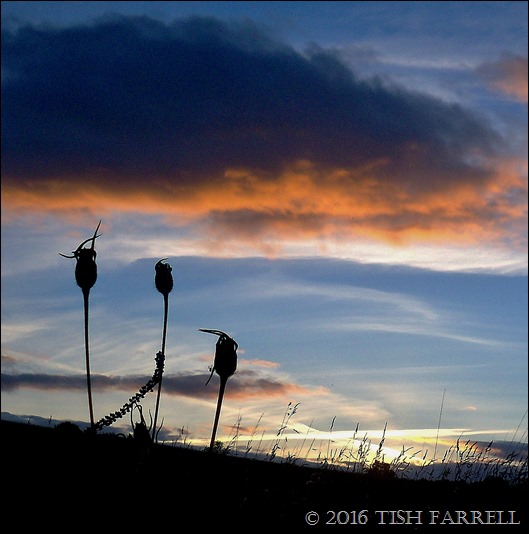
On reflection: can there be too much of it?

P1030051

Writers are past masters of diversionary tactics. This particular writer spends a considerable amount of avoiding the work in progress. She is not sure why. But staring out of the window is definitely a popular pastime. On the other hand, who wouldn’t want to stare at a sky like this, the sun going down behind Wenlock Edge.

Then I discovered something really neat as I was trying to snap it. My office has a cabin bed in the corner under the roof light. So I clambered on the bed, and opened the window to the horizontal to give myself a makeshift ‘tripod’. I then set the Lumix to sunset mode and rested it on the back of the window. And this is what happened.

Who’d’ve thought avoiding writing could be this much fun. But there’s a lesson here too. Sometimes we overthink the pieces we are working on. Sometimes we need to loosen up and play. And ask questions. Definitely ask questions. E.g. What would happen if I let my characters think for themselves, and stopped trying to control them? What if I let them go play? What might they not come with? Something magical, diverting, extraordinary? Do I have the nerve to let them go?

copyright 2016 Tish Farrell

The Bees’ Knees In Vibrancy

100_3915

This is one my favourite photos. If you look hard you can even see the bees’ wings vibrating. And yes, for those who come here often, I know I’ve posted it a few times before. But isn’t it joyous – hot red, buzzing bees, sunshine.

And how about bees in the sneeze weeds (aka Heleniums)

100_6719

Or the bee on this sunflower that was growing last summer in a pot by the shed:

100_7053

All of which is to say we need to keep thinking about bees. We cannot do without them. They pollinate many of the plants that provide us with essential foods.  In the northern hemisphere new seeds are coming into the shops, so we can all think about sowing some bee-friendly flowers. You don’t need a garden. A pot of oregano will please them, and make you happy too when you’re making spaghetti sauce.

P1010778

And then sedums will provide a valuable late summer nectar boost for honey bees. There are many varieties of this plant – large and small. They don’t need much attention and will grow in containers too:

100_7435

If you want to find out which plants are bee friendly, there are many bee sites on the web. But for local first-hand information ask your local beekeepers society. There will be one. Meanwhile the Royal Horticultural Society provides some useful guidance if you want to give your life and bee-life lots more buzz.

IN 2016 THINK BEES

Happy Wednesday Wherever You Are

Vibrant

Winter Garden From My Window

P1030045

It’s the final week of Jude’s Winter Gardens challenge over at The Earth Laughs In Flowers. This, then, is the view of my garden captured on Saturday afternoon. It’s as much as I’m prepared to show you at the moment, so dreary is it after weeks  of rain. Also there was a definite lack of gardener-input in the autumn. Things just kept on growing and it was hard to know when to chop them back.

So they didn’t get chopped, and the place now has the look of a garden version of Miss Haversham’s attic. But you may just spot (in the bottom right hand pane) a small clump of tete a tete daffodils. Even they  aren’t planted, but are sitting on top of the soil. They were tipped out of a pot bought last spring, at which point I had every intention of re-planting them. Oh well. Neglect hasn’t stopped them thriving. They started flowering at the end of December.

I have to confess that I’m a fair-weather gardener, at least where dampness is concerned. And it really is too cosy indoors. Also unlike the garden, the house is now clean and tidy, which was the real reason I took the first two photos – to document that tidiness is possible. And I’m sharing the proof with the world in an attempt to stem backsliding tendencies.

P1030043

But housework and fair-weather gardening aside, I am getting twinges of planters’ itch. My first delivery of vegetable seeds arrived earlier last week – all those crisp packets of pent-up potential, and now it is February. Hurray! Time to sow the peas and leeks in the allotment polytunnel, and start off the aubergines and sweet peppers at home.

And talking of sweet things, my first sowing of sweet peas on the kitchen window sill is already sprouting. So apologies to Jude for not quite sticking to the winter garden plot. I’m  finishing  this post with thoughts of summer, and deliciously scented blooms to come. And I know she won’t mind because she knows very well that it’s forward-dreaming that keeps gardeners going through the long winter season.

100_7878

copyright 2016 Tish Farrell

Vibrant: me on Lamu Island far too long ago


Scan-130426-0017

It was a four day trip over Christmas. We’d been living in Kenya for three or so years by then, and another five to go before we would return to the UK for good. Lamu Island  set my imagination alight. Later I began writing a teen adventure aimed at the African schools literature market. It was published by Macmillan in their Pacesetters series around the time we left Kenya in 2000.  It’s still in print, and even if I say so myself, quite a good yarn. I have a feeling my brain cells were a little more vibrant back then. Perhaps they are craving the African light…

100_3649 - Copy

Vibrant

Thursday’s Special: Organized Noise

100_8271

This week Paula’s guest at Lost in Translation is Tobias  M. Schiel. He has set us a challenging challenge entitled Organized Noise. I think I have the gist of it – and this is my take on what he says (so if I’ve got it all upside down and backwards, Tobias, please tell me) – that you can use the camera’s eye to frame everyday  ‘stuff’ and ‘clutter’ that of themselves do not have aesthetic appeal. In other words, the photograph itself endows the scene with creative interest and possibility through framing, focus and cropping. It thus exposes something intrinsically or extrinsically fascinating in a context that we might otherwise screen out as uninteresting or unworthy of particular notice. As Tobias says, this is more likely to work in the abstract.

So I’m  not sure that this photo of a stricken pine on Cornwall’s Seaton beach quite fits the bill. But I’m posting it because the scene as a whole caught my attention. The tree had been blown off the cliff.  The way it was lying suggested to me a crash-landed dragon, the peeled trunk in the foreground its snout and eye.  But with a more abstract eye, the main thing that struck me about this pile of beach debris was the vivid range of colours – materials natural and unnatural.

Maybe this next shot is a better example? – a close up of some of Seaton’s amazing geology:

100_8281

In his explanation, Tobias says that this approach is used in musical composition, but as a writer I can see that this photographic version is also a visual analog for what the best creative writing does: that is, it takes a scene, or a detail of it, something that others might miss altogether were it not for the affecting way in which the writer chooses to delineate it, often mixing heightened reality with metaphorical abstraction.

Thanks to Paula and Tobias for hosting this fascinating challenge.

copyright 2016 Tish Farrell

Through A Web Darkly ~ Inside The Old Barn

100_8881

I took this photo yesterday. The footpath we were following winds through an old farmyard, everywhere rustic dereliction. Being nosy, I had to peer in through the barn window. This shot was taken through a spider’s web, and is admittedly rather weird. My first thought is some kind of time warp or threshold. So if it inspires any of you to create a piece of poetry or prose, please feel free to link back here so I can read what you’ve come up with. No rush.

*

Many thanks to bloggers for their fun responses. So nice of you to play along:

T N Kerr   A Very Special Birthday

Sandra Conner Beyond the Web

Gerry  Sneak the Spider

Travelling Hopefully ~ The Writer’s Way

P1000424

The writing life is full of snags and snares, setbacks, tanglements, diversions and dead ends.  Written words demand so much mental application – from the writers who deal in them, and the readers who receive them. After all, before the writer’s meaning can be de-coded, willing victims readers must actively choose to engage.

Even then, nothing is certain. Reader engagement is always provisional. Only when the decision is made – that sticking with the decoding process will yield rewards, do writers have the chance to have their say.

Readers want a good pay-off from the writer’s words. But for their part, writers cannot read readers’ minds to know precisely what they expect. It’s all very precarious.

Interaction-wise, the applied and performing arts definitely have the edge. They communicate directly with an audience’s senses and emotions, often bypassing the need for intellectual effort input altogether. Reactions to such works may be superficial and fleeting, and the creators’ deepest intentions not fully grasped, but engagement at some level swiftly takes place. The experience is vivid in its fullest sense. Excitement can be instantaneous. Written texts simply cannot compete with this kind of immediacy.

Also words can be such tricky things. Lumpy. Clumsy. Rife with ambiguity. Achieving absolute clarity on the page involves hard labour, although this is only half the battle. In fiction writing plain speaking is not enough. The construction must be affecting. Fascinating. There must be mystery –at the very least the hook of: ‘how will this turn out?’ Then there is the matter of authenticity and the creation of a convincing, fully functioning reality. (Even fantasy worlds must have believable existence.)

In its crudest form, writing a story is like devising and setting a trap. How do you lure in the reader? What does it take to hold them until the final word is read?

So this means there’s a craft to be learned, and practised and practised. Then practised some more. And when you finally release your carefully worked contrivance onto the unsuspecting and uninterested world there will be rejection. (See Lynn Love’s post on this and how to murder it HERE). It is part of the learning process. It teaches you to target your work more carefully; to read more; to develop powers of objective self-appraisal; to learn from negative comments; to become better at what you do.

You also need to bear in mind that this apprenticeship may take a life-time; that success in material terms may never happen. The act of creating is a vocation; an act of faith too. But at the heart of it, you write because you must. Perhaps that should be enough. I seem to have hopes of it. It anyway keeps me going – one word at a time.


copyright 2016 Tish Farrell


Related:

Losing Kui ~ An Extract

Kui’s 5* Review on Kindle

Tish Farrell Books & Short Fiction


DP Weekly Photo Challenge: Optimistic

Go here for more hopeful responses.


Seaton Seascape

P1020706 - Copy - Copy (2)

All I can say is my Lumix point and shoot was on a very strange setting when I took this photo. I blame the gale that was blowing along Seaton Beach, though you’d hardly know it by the ‘frozen-in-time’ look of this shot.

Cee’s Black & White Photo Challenge

This week Cee says the subject can be anything beginning with the letter ‘S’. Please follow the link to see her work and other bloggers’ renditions.

The Changing Seasons 2016: January On Wenlock’s Olympian Field

We had the first hard frost of winter today and, after weeks of dreariness and both rising and falling damp, it was a great relief to feel some good crisp cold. Not only that there were clear skies. And sun. And brilliance. Up on Windmill Hill there were also fine views all round, although the midday light did have the strangest quality – creating vistas that were sharp in parts, but soft-focus in others. The landscapes I snapped looked like water colours even before I snapped them. Also the farm fields loomed in unnatural shades of green, at least for January.

As we strode home beside the Linden Walk we passed the frosty picnic tables. They looked as if they had been freshly spread with perfect white cloths, but sadly there was no sign of lunch. It seemed a long way off till summer.

This post was inspired by Cardinal Guzman’s The Changing Seasons monthly photo challenge, which now comes in two versions. Please follow the link for more details.

I’ve chosen to feature Much Wenlock’s Linden Field and nearby Windmill Hill, since this was where the modern Olympic Movement had its beginnings, and was (and continues to be) the venue for the annual Much Wenlock Olympian Games, founded by Dr. William Penny Brookes, the town’s physician, in 1850.

These days the games take place at the William Brookes School just below Windmill Hill, and on purpose built tracks, but in the old days spectators sat on the hillside and watched the events taking place in the field below. Please conjure races on penny farthing bicycles, hurdling, tilting, and all manner of athletic events – not least the Long Foot Race that was only open to Greek speakers. There would also have been cricket and football matches, and fun events such as ‘an old woman’s race’ for a pound of tea, and a blindfold wheelbarrow race.

Dr. Brookes had serious objectives however. He was a man ahead of his time, who embraced a holistic view of human health that included both physical and mental exercise. He also planted the Linden Walk, no doubt because as a trained herbalist as well as a physician, he knew of the soothing effect, and sense of well-being imparted by lime tree blossom on warm summer days. It is good to walk in his footsteps.

copyright 2016 Tish Farrell

Well Hello Hellebores!

100_8773

100_8774

Show us your hellebores, said Jo at Restless Jo – this in a chat about Jo’s last week’s hellebore post which she linked to Jude’s new  Winter Garden  photo challenge. And so thinking to oblige, and in between sleet and rain, sleet and rain, and more rain and rain,  I dashed out into the garden with the digital camera only to find the currently flowering hellebores in most reclusive mood. They all had their heads determinedly earthwards as in the next photo:

100_8776

And so the only way to capture the first two shots was for me to stand on my head, and send the camera underneath on macro setting, and press. The whole enterprise was totally discomposed, and what’s more, it had started raining AGAIN. But then that’s winter in the garden for you. Anyway, despite shooting blind I’m quite pleased with results – sort of candid-camera shots of shrinking violets hellebores.

For more bloggers’ winter gardens please visit Jude over at The Earth Laughs In Flowers blog.