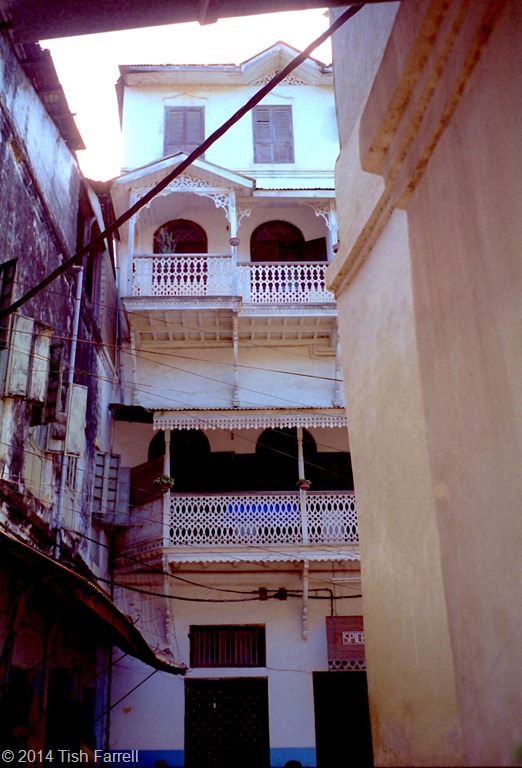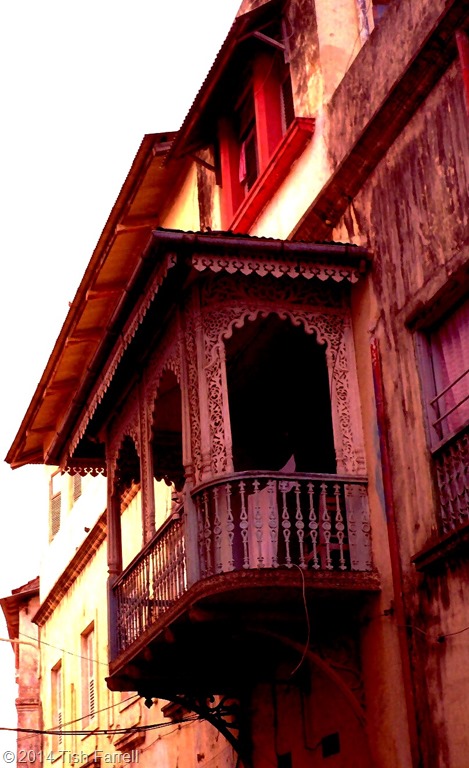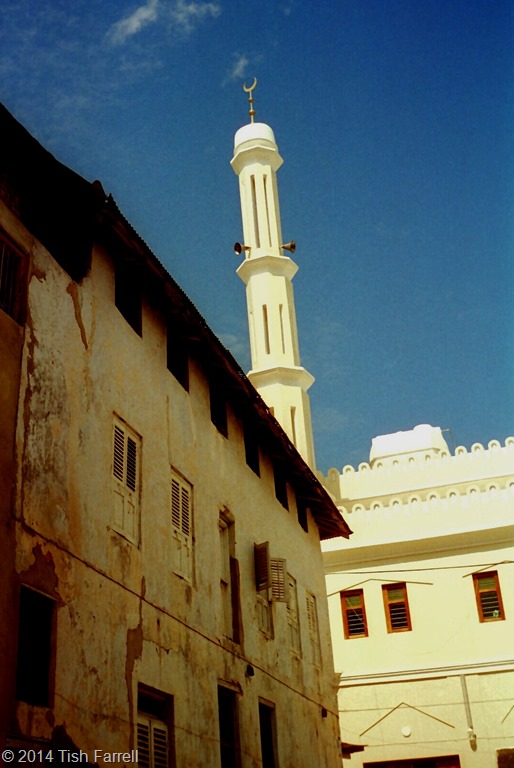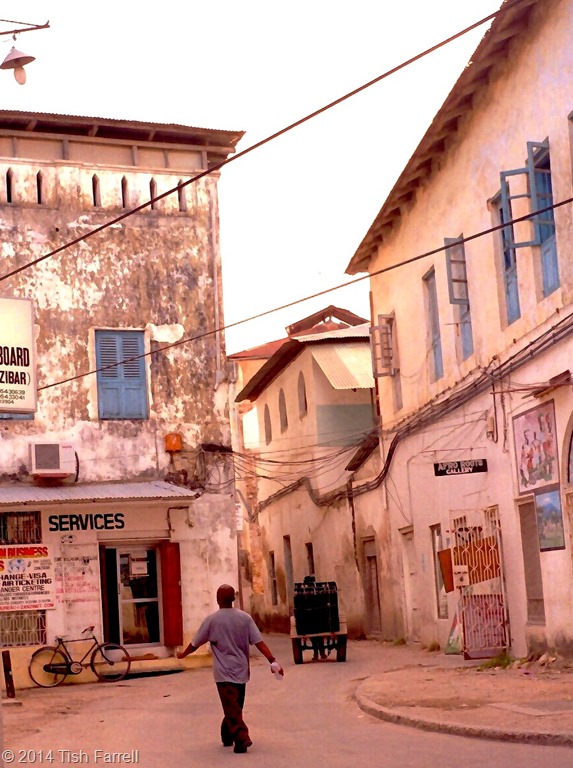
First Post Re-visited: By the Silurian Sea

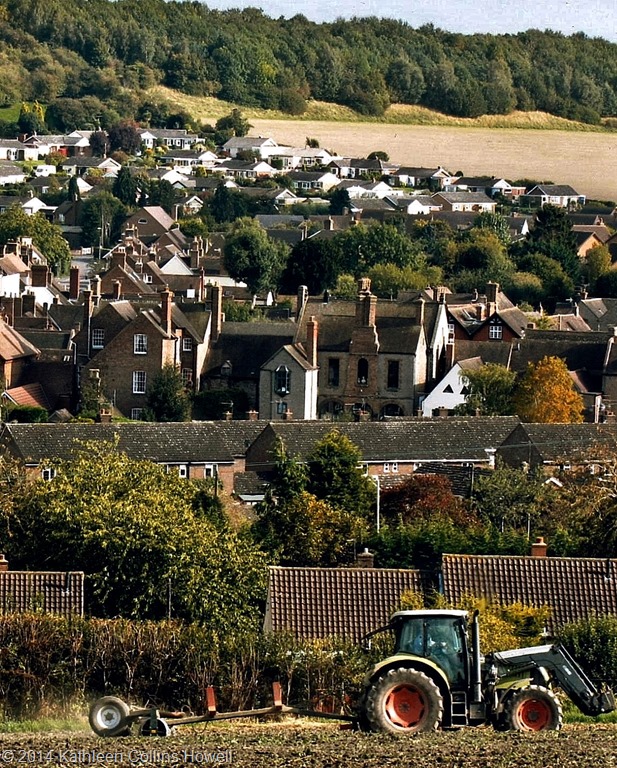
All is peripheral in the place where I live – our house beside the path, beside the field, whose name on the 1847 tithe map, Townsend Meadow, marks the old town boundary of Much Wenlock. The town, itself, is very ancient, and only in recent times has it outgrown the frontier along Sytche Brook. It anyway has a more remarkable periphery than this – the edge of Wenlock Edge under which it lies.

I cannot quite see the Edge from my house, but I see the big sky above it: the dramatic false horizon that the wooded scarp creates, and thus the endless movement of weather along it. Hours can be wasted sky watching: the breezy march of clouds across our roof lights, the flush of hundreds of rooks from Sytche Lane wood, peppering the skyscape at dusk; their raucous cries, their enigmatic feats of aerial choreography.

IMG_1147

That you cannot see the Edge from the town is something of a paradox given that its massive presence has shaped the place in so many ways, and not least in the fabric of its cottages, parish church and ancient priory. To get a proper glimpse you need to leave Wenlock – take the steep hairpin-cutting down to Shrewsbury, or the tree-lined road that strikes across the Edge top to Church Stretton, or else meander along the labyrinth of lanes beneath it. The villages down there have old world names – Church Preen, Hughley, Rushbury, Longville. Above them the wooded ridge bristles like a giant hog’s back – a long, dark spine nearly twenty miles in length. It is all unavoidably mysterious.
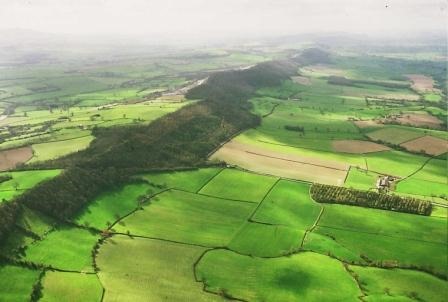
photo National Trust

Photo: National Trust

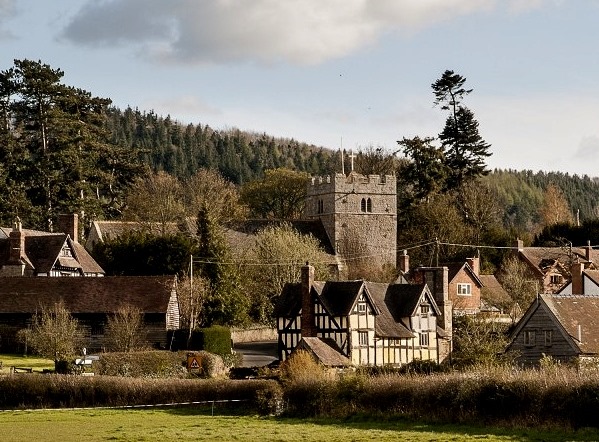
Rushbury beneath Wenlock Edge

Photo: Rushbury Village below the Edge

The limestone flanks have been dug into for centuries, creating vast gaping wounds. As you take the road over the top, there are dizzying glimpses through verge-side trees where the ground shears away. All the quarries are unworked now, but in earlier times, for a millennium and more they were the source of most of the area’s building stone.
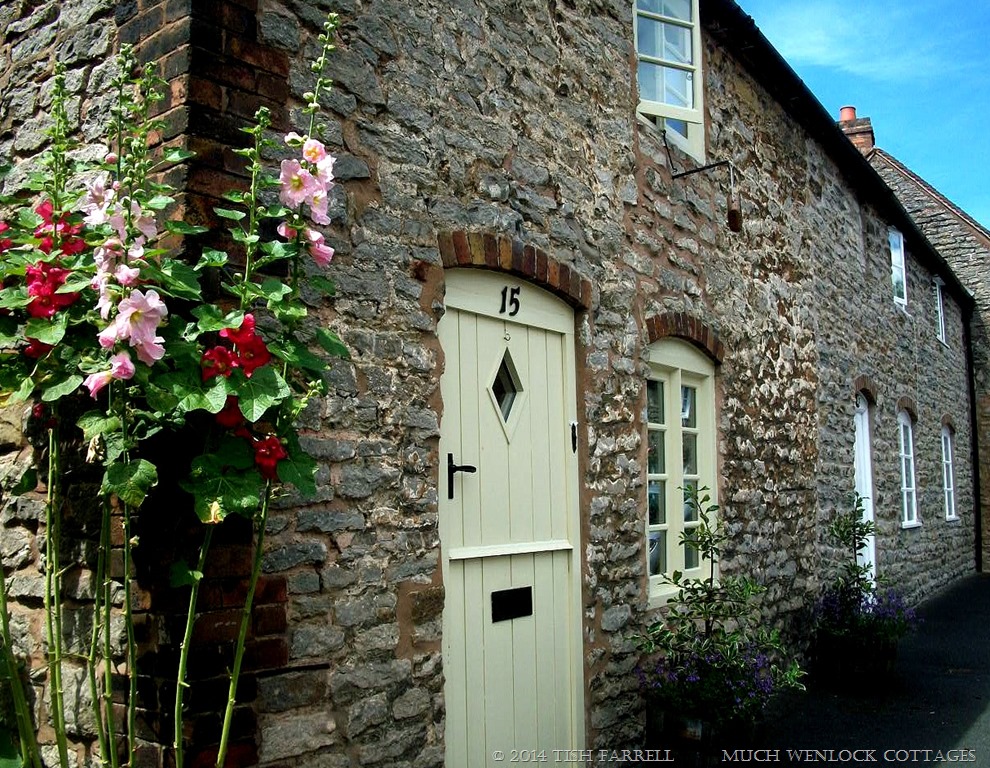
100_6035

Then there was the burning of limestone to make fertilizer – another important local industry. Lime is an essential additive to unlock the nutrients of the sticky clay soils that lie below the Edge. Today, you can still come upon the remains of many kilns on Much Wenlock’s outskirts. Once their fumes must have hung like an ill-smelling fog above the town.

But perhaps the most important use of Wenlock limestone – at least as far as the history of world technology is concerned – was the crucial part it played in the production of iron at nearby Coalbrookdale. This small Shropshire settlement, just across the River Severn from Wenlock, has been called “the birthplace of the Industrial Revolution”. It was here, in 1709, that the Quaker brass founder, Abraham Darby I, first smelted cast iron using coke instead of charcoal. Into his blast furnace went iron ore, coke and limestone, the stone to act as a flux and remove impurities that would compromise the quality of the smelted pig iron.

And this was only the start. It was in Coalbrookdale too, in 1779, that Abraham Darby III pulled off a monumental PR stunt to promote the family trade. He built the world’s first cast iron bridge across the River Severn at a place now called Ironbridge, and thereby spurred on huge innovation in construction techniques that spread around the globe – from cast iron garden seats and cannon to iron ships, railways and skyscrapers.
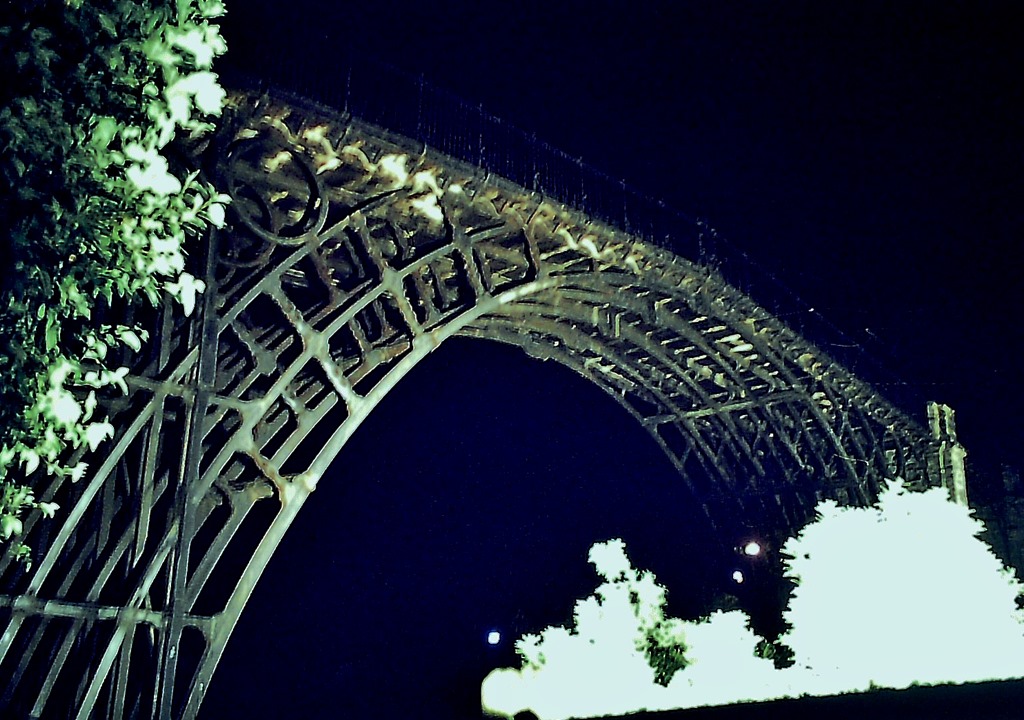
PICT0014

So it was that Wenlock limestone (from this now sleepy part of Shropshire) played its part in the great march to industrialisation.

In more recent times, only the quarry spoil has been used – crushed to produce aggregates for road building. It has been many years since Much Wenlock’s homes shuddered in a pall of white dust whenever the quarrymen were blasting, or the streets vibrated to the endless rattle of passing stone trucks.

Of course there are other sources of disturbance on our mediaeval thoroughfares – over-sized farm vehicles and garden fencing trucks. They pass by on the other side of my house, which is not so scenic, although interesting in other ways.

For instance when I’m standing in the kitchen eating toast, I might look up to meet the serially startled gazes of a tour bus party as their coach nudges past our windows, brushing hard through our privet hedge in order to wheedle a way past another HGV. It is the only way to do it on a road too narrow for two large vehicles to pass.
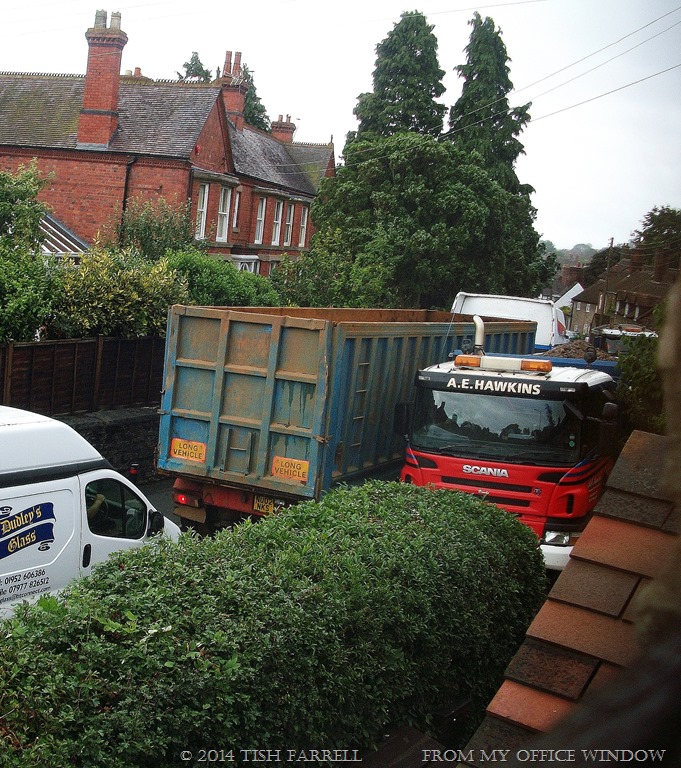
We locals amuse ourselves by taking photos of the trucks and buses that several times a day get jammed outside our homes. We send ‘the evidence’ to officers at Shropshire Council who shrug helplessly, quite unable to say what their predecessors were thinking when they upgraded a bottle-neck lane into an ‘A’ road. There’s nothing to be done, they say. It is hard to believe. One day, I tell them, a European mega-truck will drive down from nearby Telford and block the road forever. Then what will you do?

But for all the present day shove and shunt, there is still a sense of romance about the town and Wenlock Edge. Spirits from the past make their presence felt in all sorts of ways. Housman set the Edge in verse; Vaughan Williams rendered it in song; the explorer, Stanley, sat upon it, his dark heart brooding on his time in Africa as he surveyed the more benign Shropshire landscape below. Even Henry James and Thomas Hardy came visiting, James more than once, and it is said he worked on The Turn of the Screw while staying as guest of the Milnes Gaskells in the old Prior’s House. (When Henry James Came to Wenlock).

Then there is the Shropshire writer-poet, Mary Webb who spent her adolescent years living on the Edge at The Grange, and was well known about the town. When in 1949 her novel, Gone to Earth, was turned into a film by Michael Powell and Emeric Pressburger, some of the scenes were shot locally. In fact my neighbour tells me that one of the film’s extras used to live in our house, and that he was also the town’s projectionist. He would thus have shown Gone to Earth in the little town cinema that is now the museum, thrilled to bits as the scenes flickered on the screen: seeing himself and other townsfolk alongside Hollywood star, Jennifer Jones. (Jennifer Jones Comes to Wenlock).
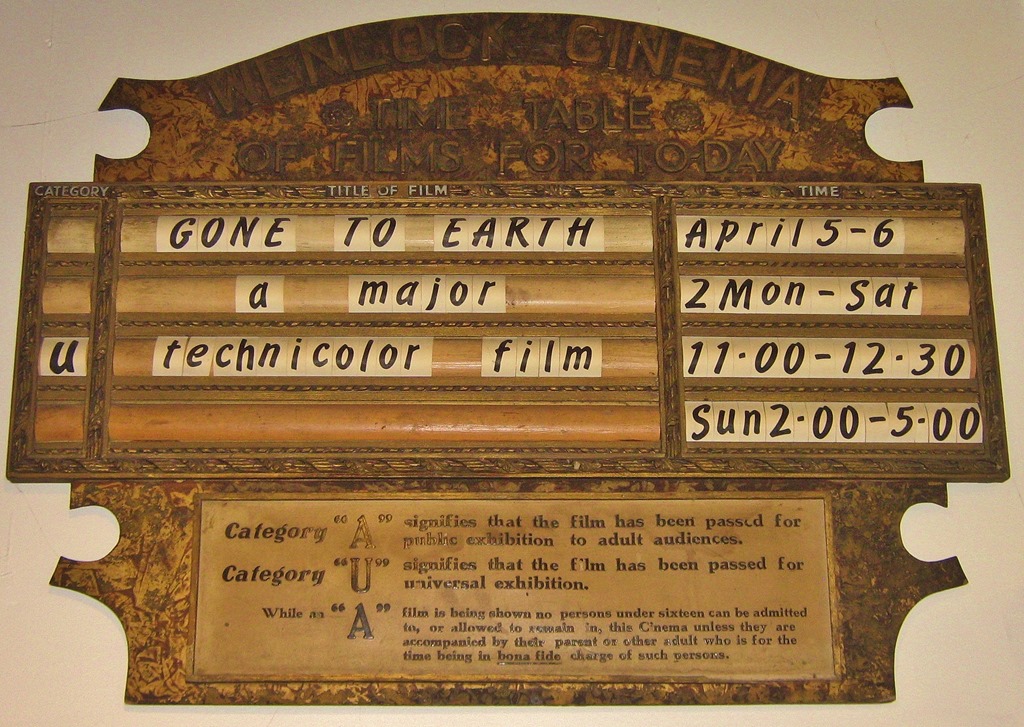
IMG_1085

But the Edge itself has far older stories than these. Back in the Silurian Age, some 430 million years ago, it was a tropic seabed, and in rare moments when my mind can embrace such vast temporal constructs, I imagine my house on the shore of the Silurian Sea. (A Solaris moment perhaps). Of course back then the ground on which my house stands was not even in the Northern Hemisphere.

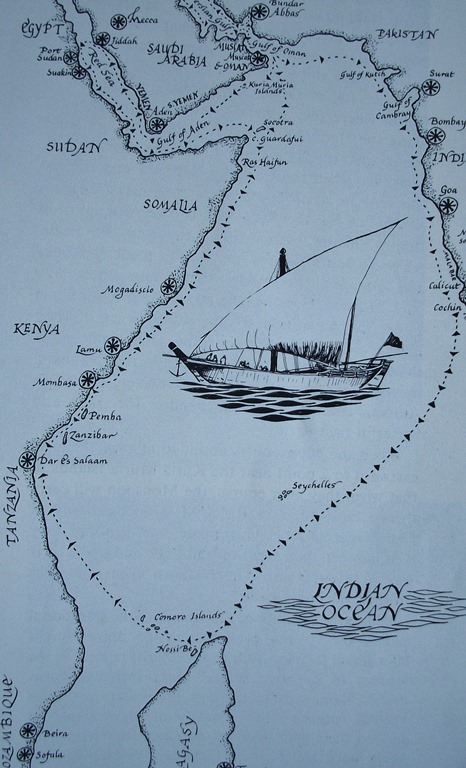
No. Back then the earth’s landmasses were still on the move, shifting up the globe from the South Pole. The English Midlands and Welsh borderlands, that I think I know so well, lay 15 degrees south of the Equator in what is now the Indian Ocean. They were part of the micro-continent of Eastern Avalonia that in turn bordered the Iapetus Ocean.

And so while Shropshire lay somewhere off Mozambique, the world warmed and the Ordovician ice caps melted, the low-lying lands filled to become the Silurian Sea. I like to imagine that, after living in East Africa for seven years, returning to settle in Much Wenlock is, in some convoluted sense, a return to the place where I was. It has a feeling of alchemy about it, and time travel, that lessens the loss of Africa.

Our much travelled escarpment is understandably a fossil hunter’s paradise and, as such, is the most famous Silurian site in the world. In its seaside days, warm, shallow waters were home to sea lilies, corals, multi-radiate starfish, trilobites, gastropods, brachiopods and fish. Indeed, somewhere over my garden hedge, there may have been some reef lagoon that hosted ammonites, squid and, horrifically, water scorpions five feet long.

My house is of course composed of these Silurian deposits, dug from those vast quarries along the Edge. I thus inhabit a re-purposed fossil seabed. There are crinoid stems and corals in the chimney-breast, all belonging to an age before the birth of amphibians or dinosaurs, or before there were mammals and birds in the world.
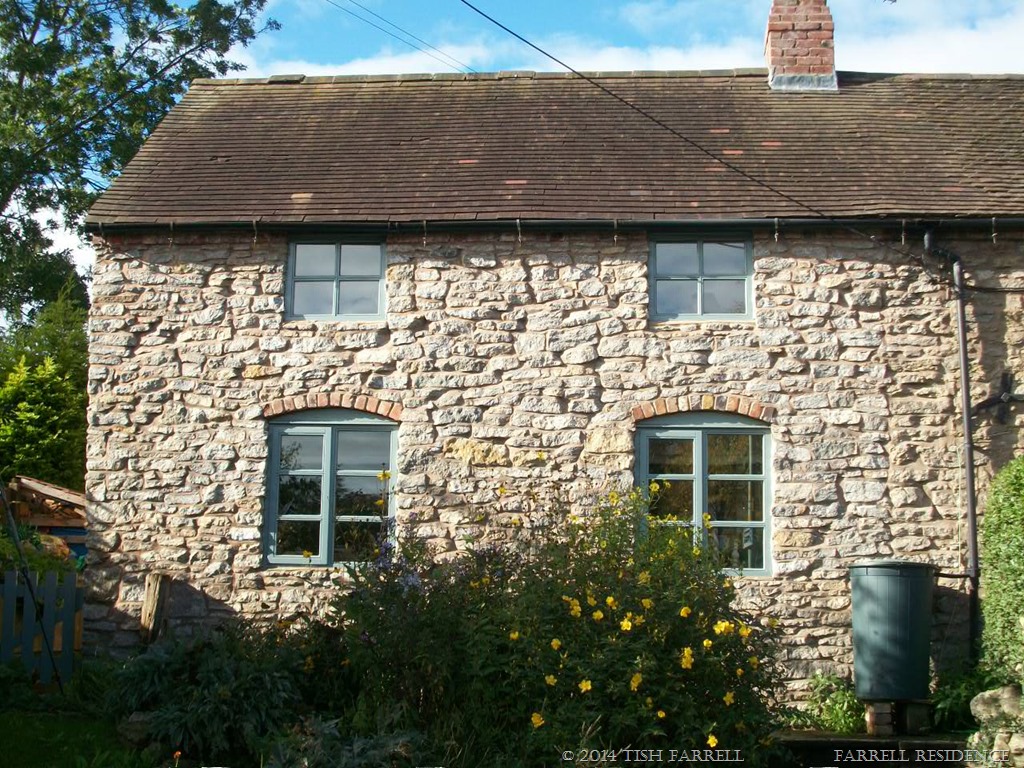
100_5035

While I can easily picture my house on a flat, gravelly shore beside a teeming shallow sea, it is hard to conjure the great absence of earth-life. We might easily imagine that the terrestrial world would have been a very quiet, still place, but this, I gather, would be a grave misconception. The land may have been lacking in life forms, but there was instead a perpetual wind. And because the paucity of land life meant there was little with which to bind the earth’s surface, the Silurian seashore would have been a dreadful place of roaring sandstorms and lashing gravel.

Not so now. Today, the farmland that surrounds the town is lush and homely. It has sheep and cattle, arable crops and pasture, woods and thickets, the old quarries and sundry ruins, remnant green lanes and farm cottages. There are deer and rabbits, foxes and rodents and also, as far as the town’s allotment owners are concerned, far too many birds. That said, though, it is good to hoe and dig to the mewing of buzzards, and cawing of rooks.
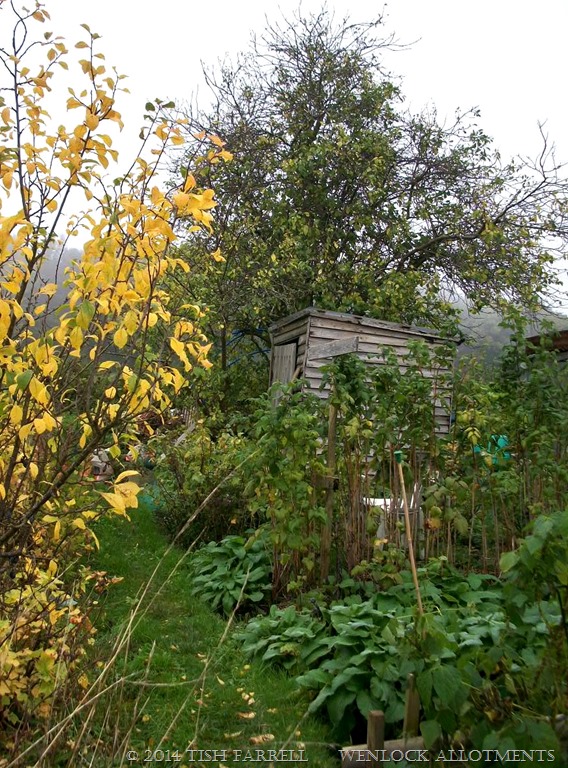
100_4944

Most of the land within the town boundary, and this includes Townsend Meadow behind our house, is still feudally owned and tenanted. It is within these little bounds of landowner imposition that the small market centre has grown up and been continuously lived and worked in for the last thousand years.

It is probable, though, that the first human settlement took place a few millennia earlier than this. Perhaps the first Wenlockians were Bronze Age Celts who, as venerators of water, would have been drawn to the many springs that rise below the limestone escarpment. The Celts were also skilled metal workers, and Wenlock Edge would have provided a natural, upland byway for itinerant smiths and metal traders going to and from the mineral-rich hills of Wales. Certainly Bronze Age hoards have been found in and around the nearby River Severn which, through many ages, was one of the country’s busiest inland trade routes.

There is certainly evidence for Roman settlement in the town – a large villa on the site of the Priory, and one which apparently had its own Romano-Christian chapel.
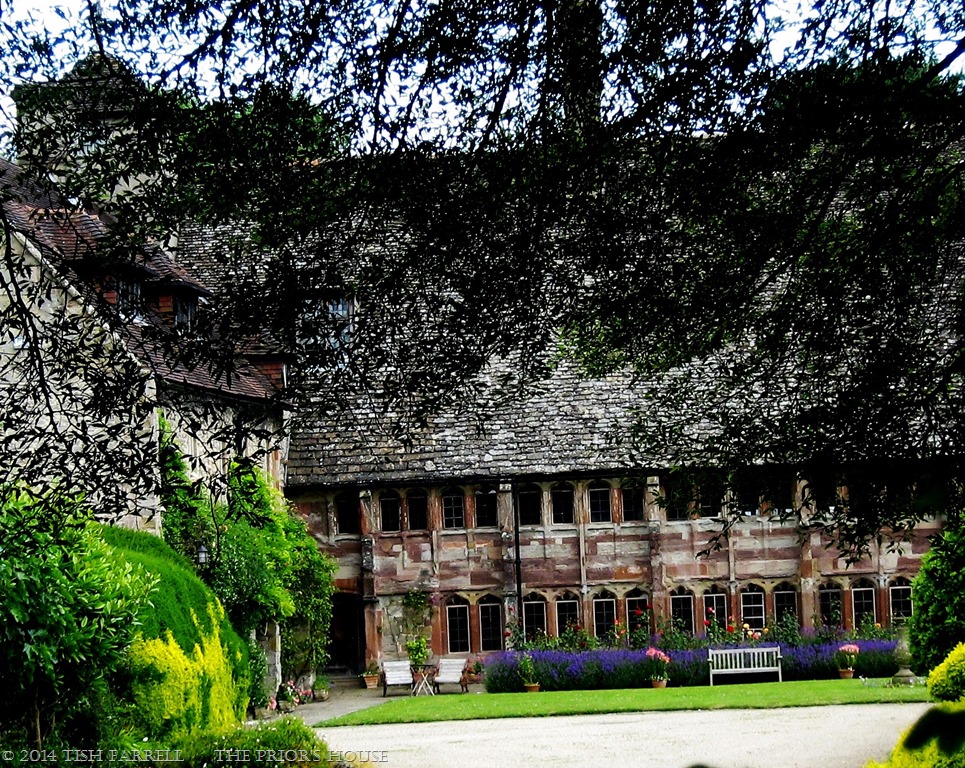
IMG_1265

Water, and sacred water at that, is another of the themes that runs through Much Wenlock’s settlement history. The town has many holy wells, including ones dedicated to St. Milburga and St. Owain. Milburga was a Saxon princess, who in 680 AD became abbess of a monastery for both monks and nuns, founded here by her father, King Merewald of Mercia. The monastery was built near the site of the Roman villa, perhaps chosen because of its already Christian associations. The invading Saxons established their authority by building chapels and monasteries. Later, the invading Normans did the same, but on a grander scale.

100_5886

The Benedictine priory that succeeded the Saxon abbey in 1079  (and whose remains you see here) was part and parcel of the Norman master plan to control all aspects of Saxon life. Much Wenlock’s age-old reputation for holiness guaranteed that the local Norman earl, Roger de Montgomery, would choose the town for a big demonstration of power and piety. He invested heavily in the priory that was to become one of the most imposing religious houses in Europe. To ensure its future prosperity, all that remained was to annexe St.Milburga’s reputation for miracles, in particular her ability to strike holy springs from the ground. A new shrine was built to honour her sanctity, so ensuring a steady influx of  pilgrims and traders throughout the Middle Ages.

Roll forwards a few centuries and the town has another claim to fame, one that has significance to all of us today. In 1850 the town’s physician and apothecary, Dr William Penny Brookes (1809-1895) founded the Wenlock Olympian games that were to become the driving force behind the modern Olympic movement. Brookes fervently believed that exercise brought moral, physical and intellectual  improvement to all who took part in it. He was a campaigner of national standing, and responsible for the introduction of physical education into British schools.

His ideas spread, and in 1890 when Baron Pierre de Coubertin came to see the Wenlock Games for himself, Brookes shared with the young man not only his visions for everyone’s health and welfare, but also his wealth of experience from running the Games. He even designed and had made at his own expense wonderful medals for the winning competitors. Sadly, he did not live to see the first modern international Olympics in Athens in 1896, although De Coubertin did give him due credit as the inspiration behind the modern Olympic Games. Tribute was also paid to his home town in the 2012 Olympics when ‘Wenlock’ was the name chosen for one of the mascots. I hasten to say that this strange, one-eyed being bore little resemblance to any living Wenlock resident.
100_6677

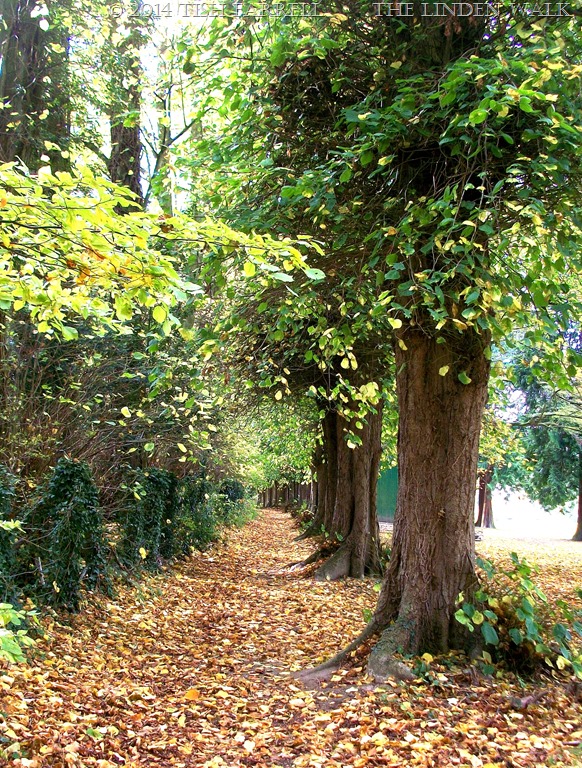
The Linden Field ,where Brook’s Olympian Games first took place, is now a public park, bequeathed by a former feudal worthy for the pleasure and recreation of the people of Much Wenlock. Every July the Games are still held here, and with competitors from all over the world.

The field is only a step from my house, and I sometimes toy with idea of running down the avenue of lime trees that Dr. Brookes planted there 150 years ago. Musing on his notions that exercise breeds mental and physical improvement, I think the activity might relieve the creative doldrums, spur on the story-telling process, help me escape the peripheries, and finally get some work done.

Of course one of the hazards of being a writer, apart from devising ever new means of diversion and prevarication, is the hoarding of story ideas. Like the Silurian seabed, they go on accreting: stuff and more stuff, piles of notes and scribble and memory sticks slowly compacting on every surface in my office. Hopefully they do  not enfolding anything as alarming as a five foot water scorpion. And now that I’ve conjured this monster, I rather wish I hadn’t, although you never know: there’s maybe a story in it.

© Tish Farrell 2014


Afterthought:

I wrote the first version of this blog’s first post as the means of showing what ‘Writer on the Edge’ was about, namely the importance of evoking place (at least in some sense) in all creative writing. It is also a portrait of the place where I live and think; it is the edge on which I reside both physically and metaphysically. For although I lived in Africa for some years, Shropshire is where my roots are. At least I think this is the case. Once you have lived in foreign places for a time, it is often hard to know where home is.


*Historical source: Vivien Bellamy A History of Much Wenlock, Shropshire Books, 2001


Related:

When Henry James Came to Wenlock

Jennifer Jones Comes to Wenlock

Songs from and Inland Sea: “On Wenlock Edge”

Old Stones of Wenlock: Repurposing the Silurian Sea


#WenlockEdge #Shropshire #TishFarrellWriter #HenryJames

Quoting Creatively: the ‘Out of Africa’ connection

Ngong Hills, view of Rift Valley to the west

I may be wrong about this, but doesn’t John Barry’s Out of Africa film score owe just a little something to George Butterworth’s Shropshire Lad Rhapsody? Both works ride on a swell of yearning for a life, a love, a land that is lost or unobtainable. Both composers are English, and Barry probably knew Butterworth’s small body of very English song-cycles. (Butterworth died in 1916, a casualty of World War 1).

Of course, the influence of one composer upon another is common enough, and could well be subconscious. On the other hand, Barry might have chosen deliberately to nod to the earlier work. There are many reasons to do so, and it all begins with that other very English creation, the collection of poems called A Shropshire Lad, by A.E.Housman, the work that inspired Butterworth’s Rhapsody and the several Housman poems that he set to music.

I have written elsewhere how this collection of ballad-type poems inspired several composers in their works, and not only Butterworth, but also Vaughan Williams and Ivor Gurney. At the time when I wrote that post, I had not thought about the Out of Africa film connection. But now I have thought of it, my interest is rather personal.

Firstly, as a writer who has worked with several illustrators, I like the way one artist’s creativity can provide inspiration for other artists’ work. Indeed, when it comes to A Shropshire Lad, there is a veritable multiplier effect of allusion and quotation in other works throughout the twentieth century. This includes Dennis Potter’s disturbing play Blue Remembered Hills (A Shropshire Lad poem XL).

Secondly, Housman’s poems, and in particular the music they inspired, make reference to Wenlock Edge and the town of Much Wenlock where I live.

Thirdly, I have also lived in Kenya, the country that inspired Karen Blixen’s Out of Africa.

And fourthly, in the script of Sydney Pollack’s film of the same name, which derives more from the biographies by Judith Thurman (Isak Dinesen) and Errol Trzebinkski (Silence will Speak) than from Karen Blixen’s book, includes two very striking quotations from A Shropshire Lad.

Both arrive towards the end of the film, and both relate, directly and indirectly to Denys Finch Hatton, Karen Blixen’s lover who died in an unexplained plane crash at the age of 44. For more of their story go HERE.

The first and most heart-rending is at the burial of Finch Hatton up in the Ngong Hills. Meryl Streep as Karen Blixen reads, not from a prayer book, but from a book of poetry, and the poem she reads is poem XIX To An Athlete Dying Young. This is the final stanza:

And round that early-laurelled head

Will flock to gaze the strengthless dead,

And find unwithered on its curls

The garland briefer than a girls.

(You can read the whole poem HERE)

While I can find no biographical reference that supports the reading of the poem at the actual burial, I can only say that it could not have been more aptly chosen. In other words, if it is a Hollywood invention, then it is a good one. It adds to our understanding of both Blixen and Finch Hatton in real life.

Denys Finch Hatton had rare glamour.  He was man who was adored and admired by men and women alike. He was a consummate sportsman, a soldier, hunter. He was an elusive adventurer and the son of an English Lord. As a great lover of poetry  he would doubtless have known A Shropshire Lad very well. More importantly, he is said to have had a pathological fear of growing old, and was ever to be seen wearing a hat once his hair began to thin.

In her biography of him Too Close to the Sun, Sarah Wheeler makes the analogy with Icarus. This too is apt. With his shocking death, burned in his plane, the self-regarding sheen of aristocratic settler life was diminished. The film’s burial scene thus prepares us for Karen Blixen’s final exile from Africa. Loss piles on loss.

Before she leaves the country, the film shows her being treated to a drink in the ‘gentlemen only’ bar of Muthaiga Country Club, a restriction which she apparently infringed when first arriving in British East Africa. The toast she gives her hosts is one said to have been used by Denys:  ‘rose-lipt maidens, lightfoot lads’.  This comes from poem LIV:

With rue my heart is laden

For golden friends I had,

For many a rose-lipt maiden

And many a lightfoot lad.

                       *

By brooks too broad for leaping

The lightfoot boys are laid;

The rose-lipt girls are sleeping

In fields where roses fade.

So where are these quotations taking us? What exactly is being evoked by their appearance in the film script?

It all comes back to the unobtainable or unclaimable: of the lost life, love and land that I mentioned in the beginning. The settlement by British and European aristocrats of British East Africa (Kenya) in the early years of the last century was an epic romance, one filled with the notion of noble master and faithful ‘noble-savage’  servants. There was the pitting of human courage and wits against the African wilderness; a wilful dance of death wherein sporting valour was supremely admired.  There was a notion of overbearing entitlement; that East Africa was their own country; that only they understood it. As a dream, it was bound to fail. It is a visceral longing for something that cannot be possessed.

For Housman the loss was for a love he could not have: another man. He was a respected academic who ultimately lived as a recluse. He wrote the entire collection of 63 poems while living in London, and without setting foot in the part of Shropshire that he evokes. Of this anomaly he makes the terse comment that, having grown up in the neighbouring county of Worcester, “Shropshire was on our western horizon which made me feel romantic about it.”

And here is where Out of Africa – book, film, and the true lives behind, find common ground with A Shropshire Lad; the ‘I had a farm in Africa, at the foot of the Ngong Hills’ moment; the sense of tragic romance, ‘The happy highways where I went and cannot come again.’ Those ‘blue remembered hills.’ The human condition of longing for something we think we had, or should have, but never can.

Scan-130429-0005

And finally then the music. Below are renditions of Butterworth and Barry. (The first begins with the song Loveliest of Trees, poem II, from which the orchestral piece derives). Compare and contrast, or simply ride the emotional tsunami – across Africa, or Shropshire, or wherever you think your lost Paradise resides.

Related:

Songs from an Inland Sea: “On Wenlock Edge”

Caught inside a Kikuyu Garden: A Memorial to Karen Blixen’s Lover, Denys Finch Hatton

A E Housman A Shropshire Lad  A Gutenberg e-book

Copyright 2021 Tish Farrell


By Tish Farrell:

Things are going from bad to worse in Ingigi village. No one knows why five-year old Kui has gone missing. Nor does Sergeant Njau want to find out. He has his own problems, pressing matters that are far from legal. Then there is the endless rain. Will it never stop? Some Ingigi folk think it means the end of the world. Old man, Winston Kiarie, has other ideas. He senses some man-made disaster, and when it happens, it is worse than his worst imaginings. The fierce storms are causing landslides and throwing up British bombs, unexploded for forty years. Their discovery is giving the Assistant Chief ideas: how to make himself very rich. And then there’s young Joseph Maina and the primary school drop-outs thinking they have found treasure, and about to do something very, very foolish. Meanwhile, is anyone looking for Kui?

Losing Kui” is a fast-paced novella of interwoven tales. There are secrets, conspiracies, tragedy and dark comedy. The setting is a fictional East African country in the late 1990s, a time when El Niño rains were causing havoc. The author lived in Kenya during most of the 1990s, and much of the story was inspired by real events. 

Kindle Edition HERE

5 star reviewed

Polytunnel Vision

100_6616

Oh all right, I know. As ambitions go, wanting to own a polytunnel might seem pretty odd. Also it’s not as if I don’t have enough housework in the house without having additional premises to tend elsewhere. But then sometimes in life you get precisely what you wish for, and most unexpectedly at that.

Ever since I took over my plot from Much Wenlock Allotment Society some seven years ago I have increasingly thought that a polytunnel was the very thing I needed. Gardening on the edge of Wenlock Edge can be challenging. The site is exposed, sloping, and often very windy. Much Wenlock is also in a frost pocket, and thus is a degree or so cooler than anywhere else in Shropshire.

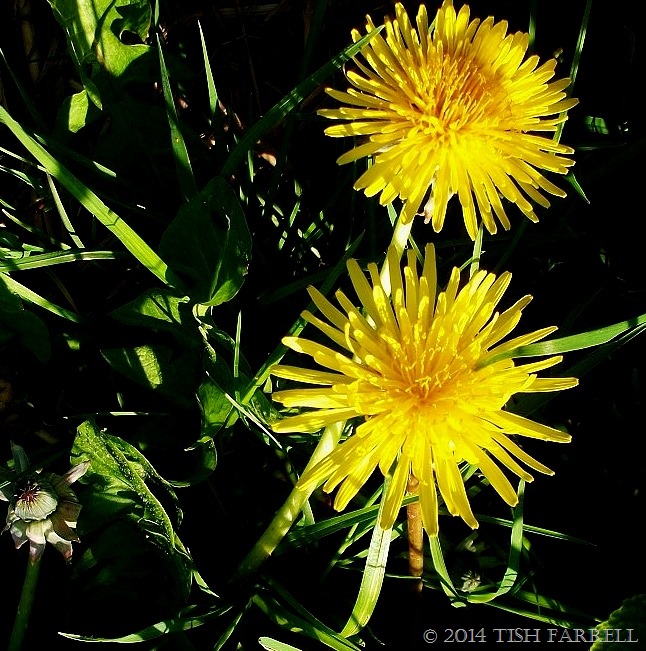
Worse still, the soil comprises a decaying fossil volcanic ash that is like wet cement when it rains, and hard baked cement when it doesn’t rain. It has thus taken seven years of digging, mulching, composting, green manuring, horse manuring, hacking and weeding to get the soil looking like something that vegetable plants might want to grow in. The dandelions, however, grow most verdantly, along with the creeping buttercups, sow thistles, docks, bindweed and couch grass. And so despite improvements, small vegetable seeds still find the soil heavy going. If they germinate at all, they struggle, the soil creating a bonsai effect on the roots, and then the slugs quickly finish them off. Most seeds thus need to be germinated under cover, and grown on before they can stand a chance after being planted out.

100_5367

And then, of course, there are the pigeons. They sit on the telegraph wires and watch what I’m doing. They especially like to eat cabbages and newly sprouted pea plants down to the roots. The rotters. In consequence I spend a lot of time making defensive systems out of environmesh and bits of wire fencing. This kind of protection also has to be applied to beds of leeks, garlic and onions due to the arrival in our part of the world of the allium beetle that likes to lay its eggs in the fleshy roots. The effect of these assaults on the leeks is especially dramatic: they unfurl in spiral fashion and develop rust-coloured stripes.

So you can see that to be an allotment gardener in Wenlock requires the same kind of pig-headed (idiot) tenacity it takes to be a writer. I have visions of deep, humus-laden beds bursting with lush, green spinach and broccoli, in much the same way I have visions of producing beautiful books that everyone wants to devour, and feel nourished by.

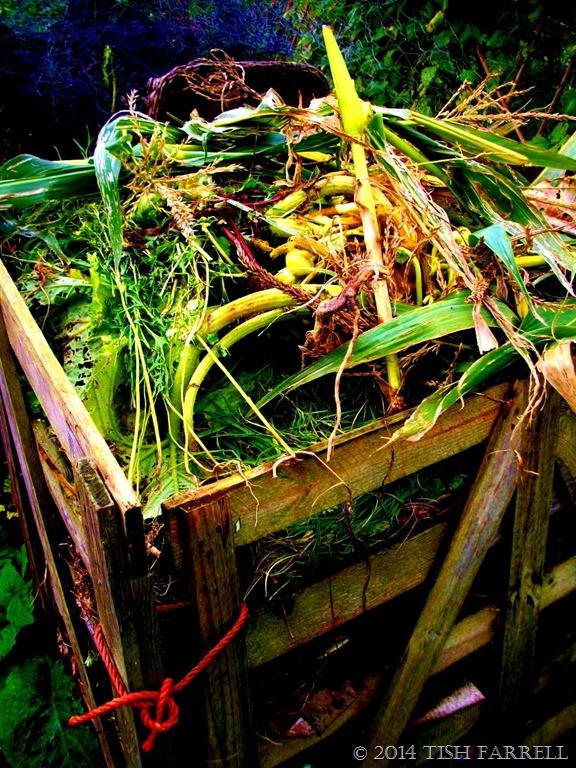
And that’s where the polytunnel comes in. I’m hoping I can crack both objectives in one fell swoop, this on the basis that if I can raise and eat more broccoli and spinach, my brain might produce writing with the requisite added enrichment. We can but hope. I might also say, as I probably have before, the contents of my writer’s brain have much in common with the contents of my compost bin, although at least they don’t smell. (Please note pallet structure installed by the Team Leader aka Graham who endlessly tries to bring order to my chaos).

100_4954

Anyway, back in the early spring when I was clearing my plot I noted, with a severe pang of envy, that my neighbours, Bob and Sally, were making preparations to erect a fourteen foot long polytunnel. I could see it was hard work, with foundation trenches to dig (in the aforementioned concrete soil) and the frame to erect. I watched them toil, hanging doors, and making beds. Next, I watched as my other neighbours, Pete and Kate, followed suit. Their installation was even more hard work, being on a slope. It took them weeks to complete. In the meantime I kept the Team Leader posted as to these events, from time to time mooting the possibility of us having a tunnel; perhaps something smaller, I hazarded.

100_5631

I have to say the response wasn’t altogether encouraging, even though we were by then falling out at home over whether the small conservatory on the back of the house was my potting shed and greenhouse, or his workshop. Increasingly my bean and sweet corn seedlings were having to compete with saws and wrenches and other man-things whose function I cannot identify. Nor was there the possibility of building either a man-shed to contain his stuff or a woman-greenhouse to contain my stuff since the garden at  home is too narrow.

Back at the allotment I watched the new polytunnels fill with tomatoes, cucumbers and peppers…I thought longingly of gazpacho that simply cannot be made from flavourless supermarket produce. Ho hum.

Then out of the blue in mid-summer, a little bird, otherwise known as ace fellow allotmenteer, Phoebe, told me that Bob and Sally were moving and were looking to sell their tunnel. She thought I should discuss terms with them.  Not long after this I received a small inheritance from my once passionately gardening Aunt Evelyn of whom I have written elsewhere.

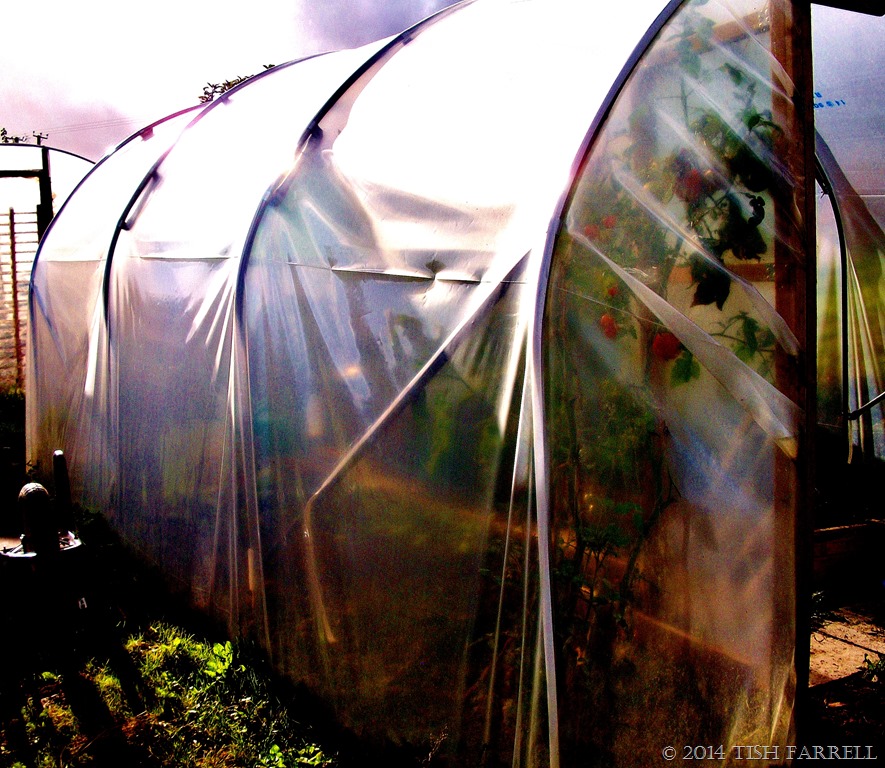
And so to cut a long story short, a week last Sunday I became the proud owner of the Auntie Evelyn Memorial Polytunnel, complete with potting bench, garden chairs and an automatic watering system. My aunt would have loved it. Bob and Sally even left me the last of their tomatoes and cucumbers. Not only that, the plot comes with a new shed that does not lean, nor provide roosting space for snails as my old one does. Already the Team Leader has added a shelf and guttering. In short, my water butt runneth over…Or will do very shortly.

100_6619

I have started clearing the tunnel’s beds and planted out lettuce and oriental vegetables to extend the salad season. But from now on, it is all new territory on the gardening front. There’s a lot to learn about tunnel cultivation and management. Planning and forethought are required. Better get cracking with that spinach and broccoli then.

Related stories about my aunt:

The Many Faces of Evelyn Mary Ashford

Grand Girl: Great Prospects

The Birds; Who, Where, When?

      copyright 2014 Tish Farrell

Please do visit Flickr Comments  to read more bloggers’ ‘P’ stories, or to add your own.

on a knife edge at victoria falls

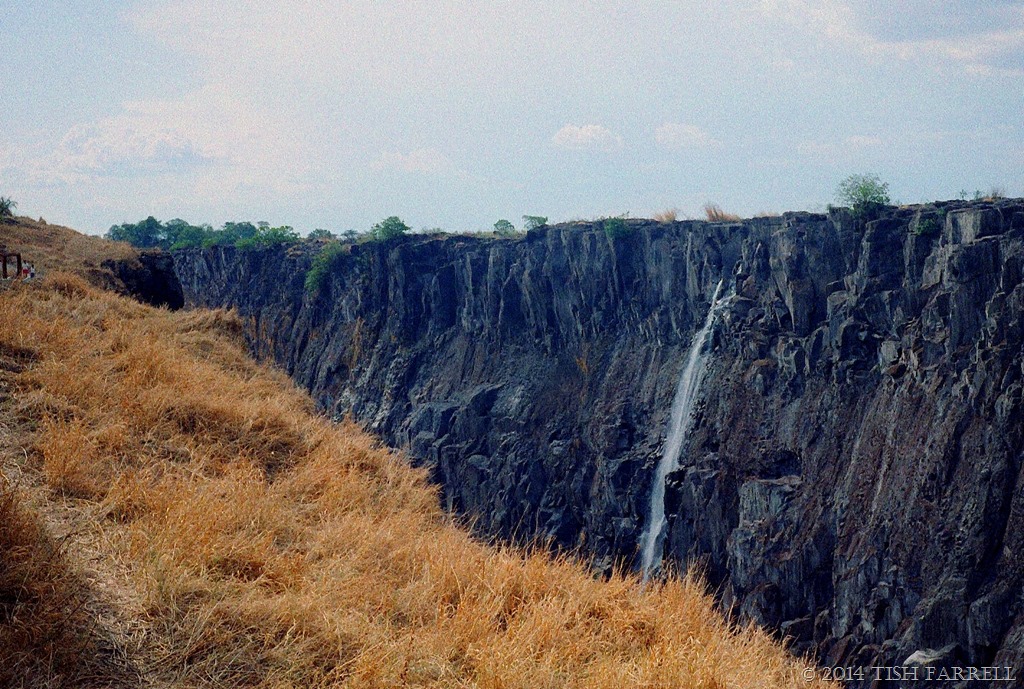
Zambia's Victoria Falls looking along knife-edge to Zimbabwe's falls

Hang-gliding over the hundred metre precipice at Victoria Falls is not to be recommended. Nor had I intended to take the plunge, my ‘sail’ being nothing more than a wet kanga-wrap, held up to fend off a tropical deluge. Somehow, though, circumstances (and a lack of sensible forward planning) had led us to the Falls’ knife-edge just as Zambia’s 18-month drought was ending, and the rains beginning. Even without  the hang-gliding it was a heart-stopping moment.

The prolonged drought across Southern Africa was of course the reason for Team Farrell’s presence in Zambia in late 1992. The Team Leader, Graham, had been seconded to the European Union Delegation to manage maize flour and cooking oil distribution to foodless villages across the nation. We had only been in the country a couple of weeks when G was directed to go down to Livingstone on the southern border to inspect a newly arrived consignment of maize. His boss suggested he should drive down on a Saturday and take me too. Naturally Nosy Writer (that’s me) was only too pleased to head off on a several hundred mile safari.

Looking back, the diplomat’s suggestion that I should go was possibly a kindness in disguise. Nothing was spelled out, since we were newly arrived, and Bernard (aka the boss) did not wish to scare us before we had found our bearings. But security in the capital Lusaka was not good. President Chiluba, the newly democratically elected leader, had been in office for barely a year, this after ousting the incumbent of decades, Kenneth Kaunda.

Later it transpired that Kaunda’s army officer son, Rezi, had been intent on destabilizing the country, and was apparently behind the city’s upsurge in violent crime. On top of that, in neighbouring Zaire (now DR Congo) President Mobutu had not been paying the army, and so gangs of gun-toting soldiers would drive down to Lusaka for a spot of night-time car-jacking and house-breaking. In a nation of impoverished people, the diplomatic quarter was the obvious target. Better, then,  that I should not be left alone. Not that I knew this then. Nor had G’s company thought to mention any of this before offering his services to the EU. As they say, ignorance is bliss.

Zambia's Victoria Falls in the dry season

And so one Saturday morning under a wide blue, and seemingly ever rainless sky we set off south. The road, once clear of the city, ran on mile after mile after mile with hardly another vehicle in sight. We passed through landscapes of rolling woodland, the tall-tree miombo which, at first glance seemed more like Europe than Africa. After nine months in Kenya the vistas, too, seemed curiously lacking in drama –until, that is, we reached Livingstone.

Our hotel stood beside the Zambezi, and after tea on the lawn in the English manner it was off to the nearby Falls. The photo above was my first view of them. I wasn’t sure whether to laugh, cry or simply stare open-mouthed. Where was the water?

The drought had much to do with it of course. But the other reason was that Zambia abstracts large volumes of water to run its hydroelectric plant.

004 (2)

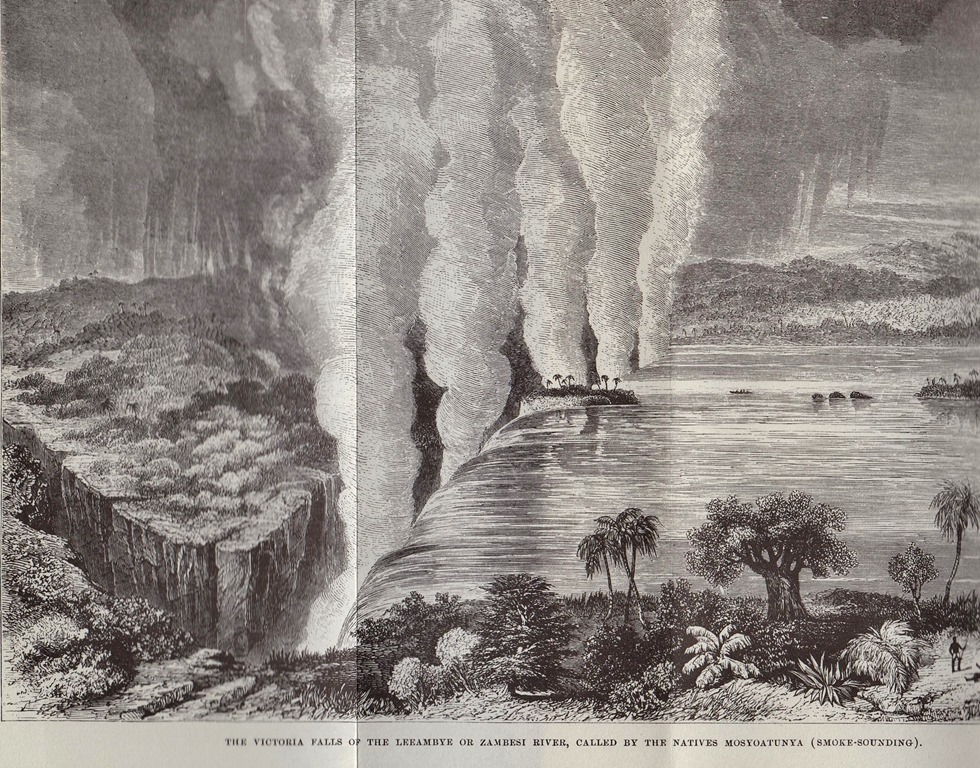
The Falls as seen (and ‘discovered’) by  David Livingstone.

Engraving from Missionary Travels and Researches in South Africa 1857

*

G told me the best view of the falls was across the border in Zimbabwe, and that if we had remembered to bring my passport we could have walked across. Most frustrating.

Instead, we walked along the path beside Zambia’s waterless gorge.  But trailing through dead vegetation while staring at the stark basalt cliff face felt more and more oppressive. It made me think of Tolkein’s Mordor. We gave it up and went back to the hotel.

Our room theoretically had a river view. In reality all we could see was its empty bed, with huge boulders and clumps of palms here and there. But on Sunday afternoon I noticed that people walking across it. “Let’s go,” I said.

The sun was shining when we set off, and soon we were joined by a boy who appeared from nowhere and offered to guide us to the best Falls’ viewpoint. We duly followed, picking our way round oily looking rock-pools, mammoth sized boulders, and piles of fresh elephant dung.

We must have scrambled on for nearly a kilometre when the sky started to turn grey. I began to feel nervous, glancing upstream and expecting a wall of water to come rolling down. Or to walk round a boulder and into an elephant.

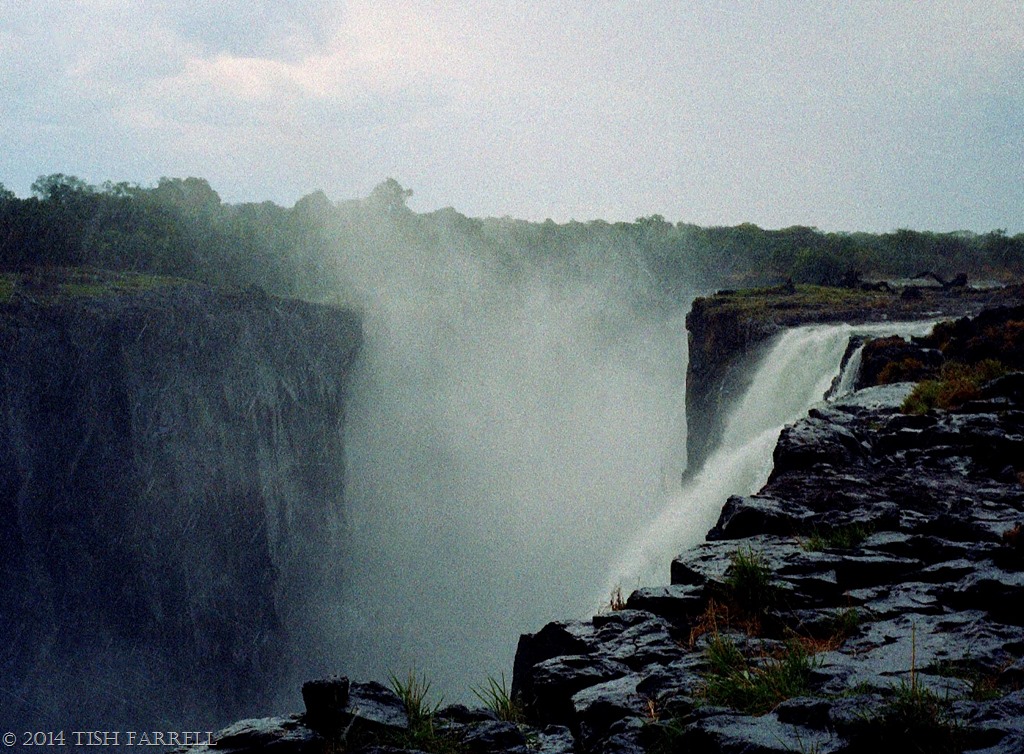
And then the rain came down. Fat freezing drops. We made a dash for cover, which happened to be some trees on Livingstone Island, the very spot from where the explorer had first viewed the Falls in 1855. We crouched for ages under dripping trees until at last, thoroughly soaked, G asked the boy if the ‘good view’ was much further. On discovering that it wasn’t we made a final dash. And here it is. The view:

Victoria Falls, looking over the knife edge in a rainstorm

Not much to be seen for the spray coming up, and rain coming down. I took this quick snap, and then held up the sodden cotton wrap that I had been wearing earlier to fend off the sun. As I stood on the knife-edge the sudden gust of wind that filled the wrap was enough to lift me towards the abyss. I stepped back in shock. I’d had more than enough of Mosi-oa-Tunya (the smoke that thunders). So had the boy.  Soon he was sprinting away without even waiting for a tip, and that really had me worried. What did he know that we didn’t? We slipped and slid, back the way we had come. More phantom elephants. More imaginary flash floods. More getting lost in outcrops of giant boulders. It seemed a long, long way back to the hotel.

It was not until several months later that we finally got to see the Falls, this time from the Zimbabwe side. On this occasion we only got drenched from the spray, while I took yet another wet and misty photograph, but thankfully avoided all inclination to hang-glide.

Victoria Falls and Zambezi

copyright 2014 Tish Farrell


Related:

The Smoke that Thunders

Letters from Lusaka I

Letters from Lusaka II

Once in Zambia – in memoriam


Daily Post Photo Challenge: adventure for more bloggers’ photo-adventures

did anyone know private victor rowles 1896-1915?

SHOT AT GALLIPOLI, BATTLE OF LONE PINE,  8TH AUGUST, 1915

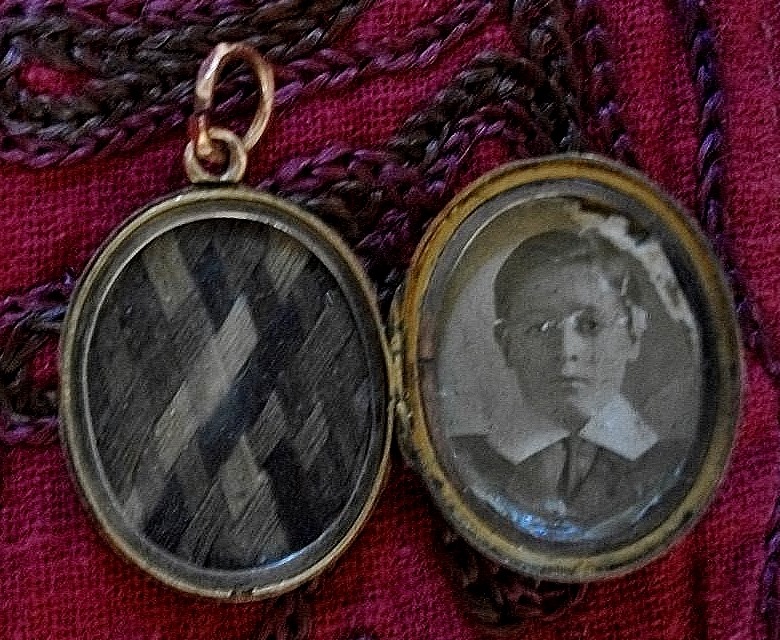
IMG_0568   My Great Uncle Giles (Victor) Rowles left little trace of himself on this earth. There is only this childhood photograph inside my great grandmother’s locket. For one thing he lived so briefly. Nineteen years. For another, he does not even have a grave. He was dropped from a hospital ship into the Mediterranean, two miles east of Mudros Harbour off the island of Lemnos. This happened around 10pm on the 10th August 1915 two days after admission. I know this only from the First Australian Imperial Force (1st AIF) records that the Australian National Archives have posted on the internet. I thank them for their dedication and care in making these records so freely available. I have written what little I know of Giles Rowles in two earlier posts, but I have reason to repeat it. On October 15th 1914, Cheshire born Giles (he later, and for unknown reasons, changed his name to Victor) enlisted in the 14th Battalion AIF in Melbourne, and then went directly for training at Broadmeadows. On 22 December 1914 he embarked for Egypt on HMAT ‘Berrima’, arriving there for further training in January 1915. In April the 14th Battalion took part in the landing at Gallipoli, and so began the hell-on-earth siege that achieved nothing but the pointless deaths of thousands of brave young men – Australian, New Zeleanders, French, British and Turkish. 480_2[1]

Landing at Anzac Cove 1915.  Photo: localhistory.kingston.vic.gov.au

*

Conditions at Gallipoli were unspeakable; it was a case of death by sniper, grenade or disease. Giles survived long enough to also take part in the August Offensive. This involved the Australian and New Zealand Army Corps moving up the coast from where they had been dug in for months to attack two peaks of the Sari Bair range while the British and French forces defended Helles. Giles it seems was hit by a Turkish sniper. In the military records he is listed as Private Victor Rowles no. 1402, admitted to the hospital ship Devanha with gunshot wounds. Two days later he was dead. There are several mysteries here. The first is how did this English lad end up volunteering with the AIF in Melbourne? The last certain record I have of Giles on English soil is from the 1911 census. He is listed as 15 years old and working as an apprentice clerk for a shipping broker in Cardiff. He is living with his widowed aunt, Louisa Rowles of 10, Despenser Gardens, where his older cousins, Beatrice a spinster, and John, a shipping agent also live. He is named after his uncle, Louisa’s late husband, Giles, a mariner. The Rowles family, it seems, have generations of seafaring connections. Giles’ own father, Charles, was a retired ship’s captain, and thereafter a pilot on the Manchester Ship Canal. He was my great grandmother’s second husband. As a young widow with three small children and a stepson, Mary Ann Williamson Shorrocks (née Fox) ran the Old Red Lion Inn and farm in Hollinfare (Hollins Green), Cheshire. Her father or brother, (both were named George Fox), had taken up the license in 1894, a year after selling up the family farm of Callow in Derbyshire. At this time Mary Ann would have still been in mourning for her first husband. He had died in his late thirties, a bankrupt shuttle manufacturer. It seems that the Fox family had secured the inn on Mary Ann’s behalf to ensure she had an income. It stood beside a then busy thoroughfare to Manchester, overlooking the new Ship Canal, which doubtless explains how the pretty young widow soon came to catch the eye of one Charles Rowles. IMG_0007

Mary Ann Williamson Fox at Callow Farm, Hathersage, Derbyshire sometime before her first marriage to Thomas Shorrocks, a Bolton spindle manufacturer.

*

The sea captain was much older than Mary Ann, a widower with two grown-up daughters. They married in 1895, but by 1903, when Giles was only seven years old, Charles Rowles lay buried in Hollinfare’s quiet little cemetery. Six years later, Mary Ann joined him. She was forty six. She had died of heart disease at her stepson’s house in Moss-side, Manchester, where her simple-minded sister, and the three Shorrocks children (including my grandmother) also lived. Whether Giles went to live with his Rowles relatives before or after his mother’s death is not known. Certainly he would have finished at Hollinfare village school at twelve years old, and the photo in the locket could well date from that time. It seems likely that the chance of a secure career in the shipping business prompted the move. In 1912 there is a passenger list record for one G. Rowles travelling as labour to Halifax, Canada on the SS Hesperian, but there is no conclusive evidence that this is Giles. I could anyway find no evidence of his arrival in Canada, although if he had signed on as crew, he could have sailed onwards to Australia. A comment by a now deceased aunt repeated the family story that he had chosen to settle in Australia, and this line of enquiry remains to be followed up. By the time Giles enlisted in Melbourne, he had changed his name to Victor. On the enlistment papers he calls himself a sailor, and responds to the question of whether he had ever served an apprenticeship, with a decisive ‘NO’. And perhaps this is the reason for the change of name. Perhaps he broke his apprenticeship, and used the knowledge gained in the shipping office to find a ship and run away to sea? The Broadmeadows medical officer records him as being eighteen years and seven months, 5 feet 5 and a quarter inches, and 135 pounds in weight. His complexion is described as ruddy, his eyes green and hair brown. His only distinguishing marks are two vaccination marks on his left arm. The reason he has given Aunt Louisa Rowles as his next of kin is also a mystery. She was not in fact a blood relative, and I know for a fact that his Shorrocks half-siblings adored him. It must have been they who had the tribute to Giles added to his parents’ gravestone in Hollinfare. DSCF9350 On his death, records say a brown paper package containing Giles’ few effects – a handkerchief, pipe, cigarette case, manicure-set, letters and photos, was later sent to Aunt Louisa, followed by his three service medals, a memorial scroll and plaque. All these items are now lost. He is nonetheless commemorated in his ill-fated name of Victor at Lone Pine Memorial, Turkey and on the Australian War Memorial at Canberra. On his parents’ and grandfather’s stone in Hollinfare it says: “Pte Giles son of the above Charles and Mary A Rowles, who died of wounds received at the Dardanelles on August 10th 1915 aged 19. He hath done what he could.” And why am I posting this story once again? Well surely someone knew Giles Victor Rowles? He must have had mates – at sea, at Broadmeadows, at Gallipoli. Did not some girl love him? Doesn’t his name occur in a fellow private’s letters home? Is there not some diary entry that mentions him? Doesn’t anyone know what happened to his medals? The photo in his mother’s locket shows a boy with determination. His gaze is direct. He looks cherished. And it is his photo in the locket, and not one of his half-siblings. On the other side of the locket, delicate strands of hair from all five children – Robert (stepson), Mary, Lilian, Thomas Shorrocks and Giles – are woven together. Mary Ann would have been able to identify each child from the varying shades of blond and brown. This small locket, then, contains the only physical evidence of Giles Rowles’ existence. 100_6264   #nogloryinwar

copyright 2014 Tish Farrell

BY ALL MEANS SHARE THIS POST, BUT PLEASE ACKNOWLEDGE MY COPYRIGHT

“Wheat…fields of wheat…” Musings on the path to the allotment


100_5994

Okay, who knows which film this quote comes from? As an extra clue I give you the line in ‘full’: “Wheat… lots of wheat… fields of wheat… a tremendous amount of wheat…”

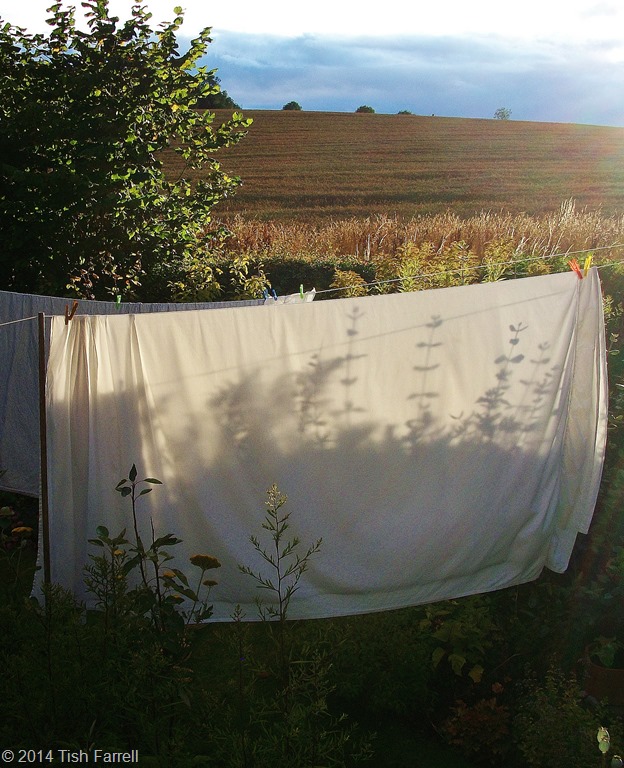
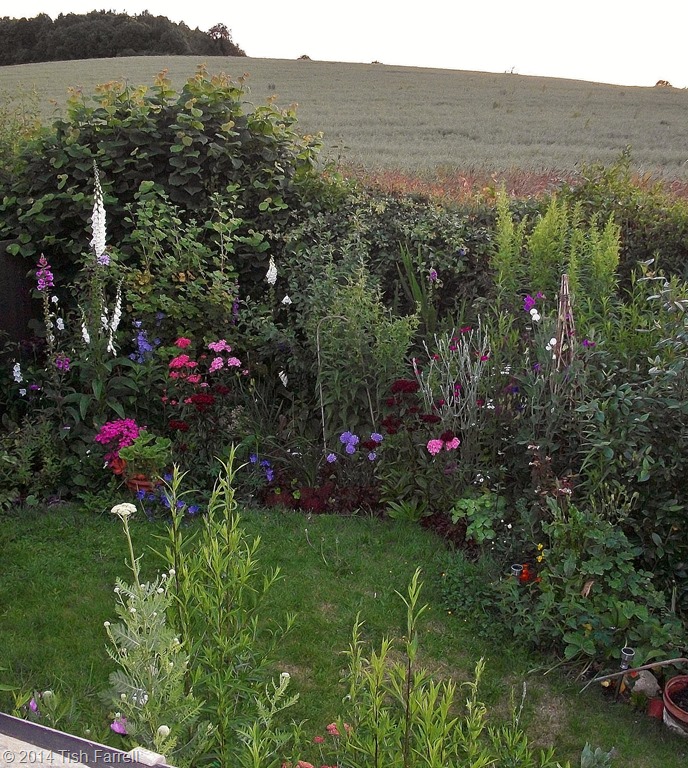
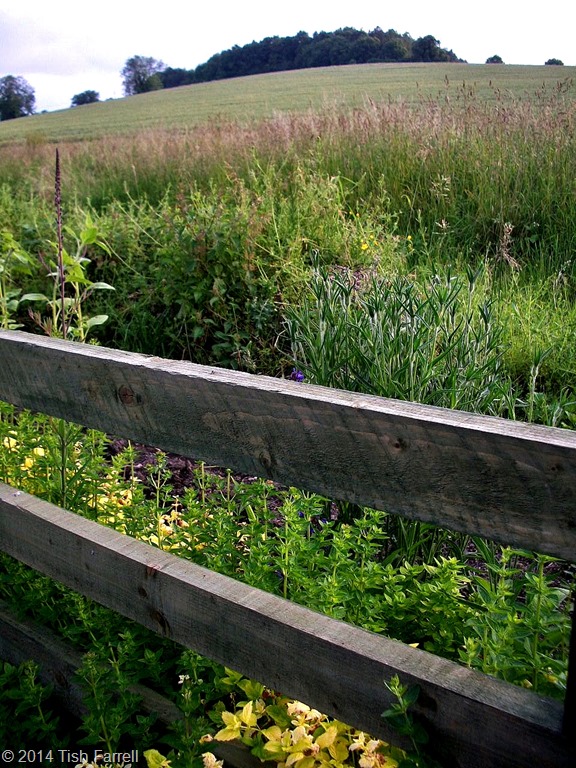
For some reason I cannot explain, this particular exhortation is rather popular in the Farrell household.  The Team Leader is wont to deliver it at unexpected  intervals and with some vigour. This habit even predates the time when we actually came to live beside  a field that often has wheat growing in it. So here is it. The field behind our house. And while I admit it might overstep the bounds of propriety to share my washing with the world, here is another view of the wheat field from our garden. I also think the flower shadows on the sheet rather fine: housework turned artwork?

077 (2)

I have written in earlier posts how our house lies on the edge of Wenlock Edge, a twenty-mile scarp formed from the upthrust bed of a tropical sea – the Silurian Sea in fact. This geological formation is a breath-taking 400  million years old – a place once inhabited by trilobites, and molluscs, and sponges and corals, although it should be made clear that when these creatures lived, the shallow sea in question was not in the northern hemisphere.  No indeed. In its tropical heyday Shropshire lay off equatorial East Africa. We are thus, for all our rustic appearance, a well-travelled county. We also have lots of geology of international importance, but  which I cannot begin to describe because the terminology and chronological expanses confound even me, a prehistorian. The Shropshire Geological Society have  a good site HERE should you wish to know more.

100_2077

The reason I’m showing you the wheat field is because my path to the allotment runs along the edge of it. I walk back and forth at least once a day. And so when I’m not writing blog posts or fiddling with my novel, this is one of the places where I’m likely to be. There is always something that catches my eye – thistles, the light, clouds, buzzards, the rooks and jackdaws, a neighbour’s three white ducks that regularly escape from their pen to eat slugs along the path, cats on the prowl, pretending I can’t see them.

Even the wheat is quite interesting. It amazes me how it manages to force its way up through a cloddy layer of grey clay that bakes to concrete after a few days with no rain. This soil, too, is a product of a geological event – a deluge of  volcanic ash from aeons ago and that has now broken down into bentonite clay.  It is the same soil in the allotment. Soft fruits seem to thrive on it. Everything else is a challenge. Wheat, though, has apparently been grown along the slopes above the town for generations, hence the name The Wheatlands for some of our now built-upon areas.

100_5840

100_5839

And talking of building, a couple of years ago when the Local Authority called for landowners to put forward development land, our local landowner proposed  this and most of the fields on the Edge side of the town, including the allotments too, gardens  that have been there since the 1940s.  Development on this scale is something that most town residents fervently  hope will not happen. We have already been threatened with up to 500 houses over the next 11 years. This in a town with antiquated drainage, severe traffic congestion, few jobs, poor public transport, and inflated house prices, and one that has seen several new developments of upmarket houses in the last few years.  More crucially, the town sits in a bowl below the Edge and has recently been designated a rapid response flood risk area by the Environment Agency.

001 (2)

More tarmac, roofs and roads that speed up run off from the hills above our homes are the last thing we need.  Some of the newest developments in the town are themselves subject to flooding.

100_5849

 100_5995

All right, I admit it. The landscape behind our house is perhaps not particularly noteworthy of itself, but the light and sky above it are. The uptilted scarp of Wenlock Edge forms a false horizon, so there is always much weather to watch. It changes every second. One day we saw a fire rainbow which we gather is quite rare.

Ironically, it it perhaps because this view from our house is ever under threat, that makes us look at it and appreciate it all the more. But it makes me angry too. I am not opposed to development, but it should be well planned, and enhance the locality, not cause problems for other people’s homes. There appears to be no mechanism in English planning that can ensure the provision of good quality housing at prices people can afford. Density seems to be the only planning criterion, not  homes with green spaces around them, and places for community orchards and gardens, footpaths and cycle tracks and areas where people of all ages can play. All things that boost wellbeing. You would wonder why it is so hard to do.

It is true that  Much Wenlock people have recently voted to have the Local Authority  accept their Neighbourhood Plan, a community compiled document that reflects our aspirations and plans for the foreseeable future. Our Conservative Party MP, Philip Dunne, tells us the Plan will deliver localism to our door, that is, we will have a say in the kind and scale of development that is proposed for our town and parish, development that will protect landscapes, open spaces and heritage while improving the quality of life for everyone. Whether it will, or not remains to be seen, particularly under a government whose recently sacked Secretary for the Environment apparently allowed for the destruction of ancient woodland as long as developers replanted elsewhere.  Bio-diversity anyone?

Which I suppose brings me back to the quote; “Wheat…fields of wheat…” You can’t get more of a monoculture than that. Hey ho. So many things to unpick. Think I’ll trundle up the path to the allotment and pick raspberries.

copyright 2014 Tish Farrell

Related:

…of Silurian Shores

Old Stones of Wenlock: repurposing the Silurian Sea

In Much Wenlock an Inspector Calls

100_4193

P.S. The quote is from Woody Allen’s Love and Death


Basket case? Tales of bravery and betrayal


100_6059

100_6050

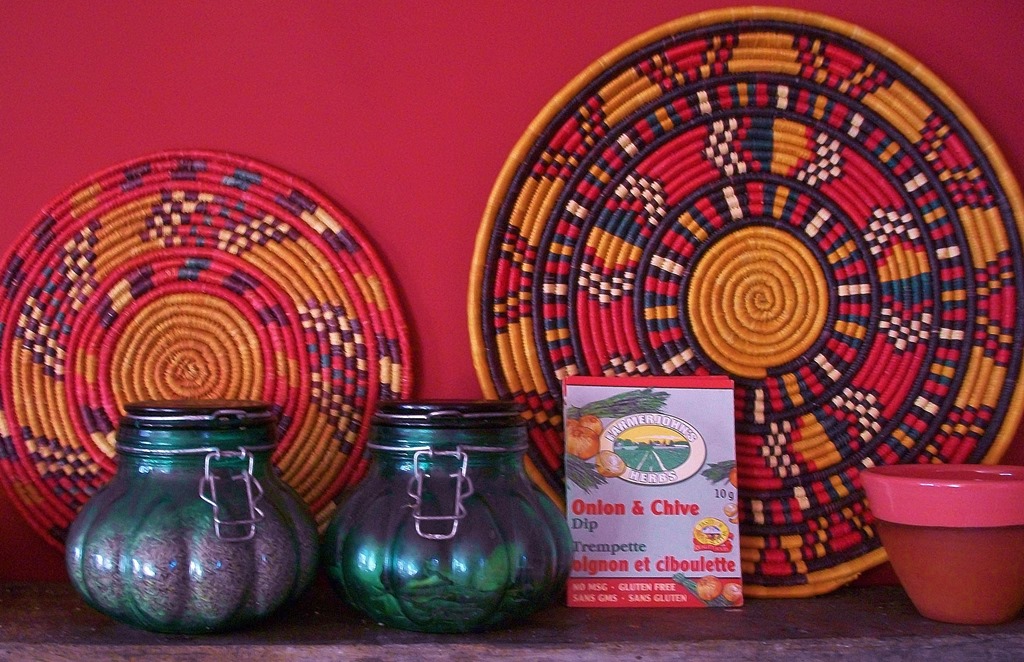
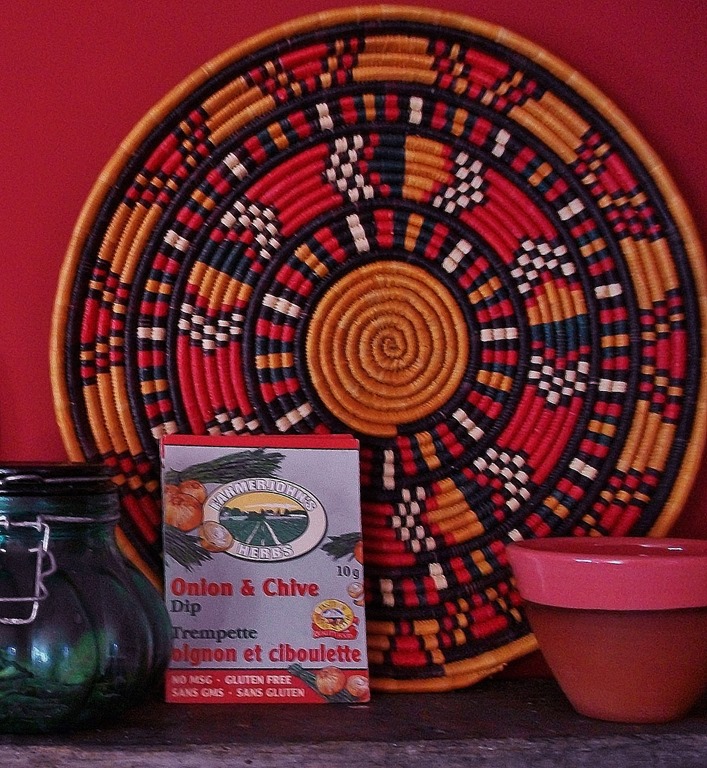
These glorious Nubian mats adorn my kitchen. They decorate our every day, their colours radiating like mini-suns however dull the weather. It is hard to imagine, then, that there is a dark tale behind their creation, a tale of statelessness and discrimination.

The makers of the mats are women from the Nubian community of Kibera, in Nairobi (Kenya). They, their parents and grandparents before them, were born in this quarter of the city suburbs. This has been the case since the early 1900s, when British colonial authorities gazetted an area of land for settlement by Sudanese Nubian soldiers of the British Army, men who had first been recruited during the 1890s when Britain was trying to establish control over the peoples and territories of East Africa.

This next photo thus shows another form of decoration – a Nubian KAR officer’s chest adorned with medals that attest to years of brave service in the cause of the British Empire.

kenyas-nubians-officer-mw19-910[1]

Copyright Kenya Nubian Council of Elders

This photo was taken in 1956, during the British colonial era. The officer is showing his invitation to a garden party at Nairobi’s Government House. The gathering was in honour of the visit to Kenya by HRH Princess Margaret of England (Kenya’s Nubians: Then and Now, Open Society Foundations).

*

The Nubian people (also known in the distant past as Kushites) have a long, long history, their homeland once stretching along the upper reaches of the River Nile in North Sudan and into southern Egypt. Much of their territory was taken in the 1960s for the building of the Aswan Dam by the Egyptians, and this was another cause of displacement. But way back in time, the Nubians were a people to be reckoned with. The earliest evidence of a metropolitan culture  (the Kingdom of Kerma) has a date contemporary with neighbouring Ancient Egypt.  Nubia was the gateway to the African hinterland, and a great trading nexus.

Dr Stuart Tyson Smith (University of California, Santa Barbara) says the Kerma culture evolved out of the Neolithic around 2400 BC. The Kushite rulers of Kerma profited from the trading such luxury goods as gold, ivory, ebony, incense, and even live animals to the Egyptian Pharaohs. By 1650 BC, Kerma had become a densely occupied urban center overseeing a centralized state stretching from at least the 1st Cataract to the 4th, rivaling ancient Egypt. Kerma was sacked in c. 1500 BC, when the entire region was incorporated into the Egyptian New Kingdom empire.” 

The Nubians and Egyptians traded, intermarried and warred with one another over many centuries, the Nubians finally ruling Egypt for half a century during the 25th dynasty (c. 750–655 B.C.E.) And though it may be a big surprise for some people to know this, there were Nubian, black African pharaohs, Nubian pyramids, and a Nubian form of hieroglyphics that were later developed into a 23-letter alphabet (yet to be deciphered). Clearly as time went on, Nubian culture was influenced by Ancient Egypt (though why not the other way around?), yet it also evolved in its own very characteristic ways.

The strikingly tall Nubian pyramids below were built at the time when Britain was a land of Iron Age farmers who lived in thatched round houses and constructed hill forts of earthen banks and ditches.

Sudan_Meroe_Pyramids_30sep2005_2[1]

Fabrizio Demartis Creative Commons

The Nubian Meriotic kingdom developed from the 25th Dynasty when Nubia ruled Ancient Egypt. It is named after its capital Meroë (begun c 800 BCE). Over 255 pyramids belonging to the Meroitic period have so far been discovered.

*

But back to more recent times, and the story behind my lovely mats. In World War 1, Sudanese Nubian forces were deployed in  defence of British-ruled Kenya along the border with  German controlled Tanganyika. This East African campaign was a brutal affair, fought over waterless, disease-ridden bush, as British forces attempted to thwart Count Von Lettow-Vorbeck’s ingenious guerrilla tactics, carried out by other Africans – the Count’s highly trained  askaris from German East Africa (now Tanzania).

The British Army, with a few exceptions late in the war, did not allow the native peoples of Kenya to carry arms at this time, so it was the Nubians who were the main combatants. Kenyans were instead conscripted into the Carrier Corps to transport army provisions since mules and horses could not survive in tsetse infested bush country.  Tens of thousands of young men died of starvation and disease in the British cause, their families often never hearing what had happened to their sons. They simply never returned from the war with Jerimani.

(For a vivid fictional version of this conflict see William Boyd’s An Ice-cream War).

In 1912 the British colonial administration in Nairobi gazetted 4,197 acres near the city for the settlement of Nubian soldiers and their families who could not be repatriated to Sudan. The Nubians called this place Kibra, the forest land.

kenyas-nubians-family-formal-mw19-910[1]

Nubian Family c1940s, photographer unknown. Copyright Kenya Nubian Council of Elders. For more wonderful photos see Kenya’s Nubians: Then and Now, Open Society Foundations

*

By this time, all British East African (Kenyan) tribes had been categorized, and the land they occupied, at the point of British incursion, designated as native reserves. Africans were not allowed to have title deeds to their own and and, in theory, European settlers (who did have title to vast acreages) were not allowed to encroach on the reserves.

The Nubians, however,  were specifically categorized by colonial authorities as ‘Detribalized Natives’, and non-natives of British East Africa. This meant they could not claim any rights to have their land made into a reserve, nor could they build permanent structures on the land.  The community, however, continued to provide further generations of soldiers who would serve in the King’s African Rifles. 

During WW2  Nubian soldiers fought for Britain, alongside other black Kenyan recruits, in Somalia, Abyssinia and in the terrifying war against the Japanese in the jungles of Burma. It is another little remembered  fact that the African troops of the King’s African Rifles played a determining role in the winning of the Burma campaign.

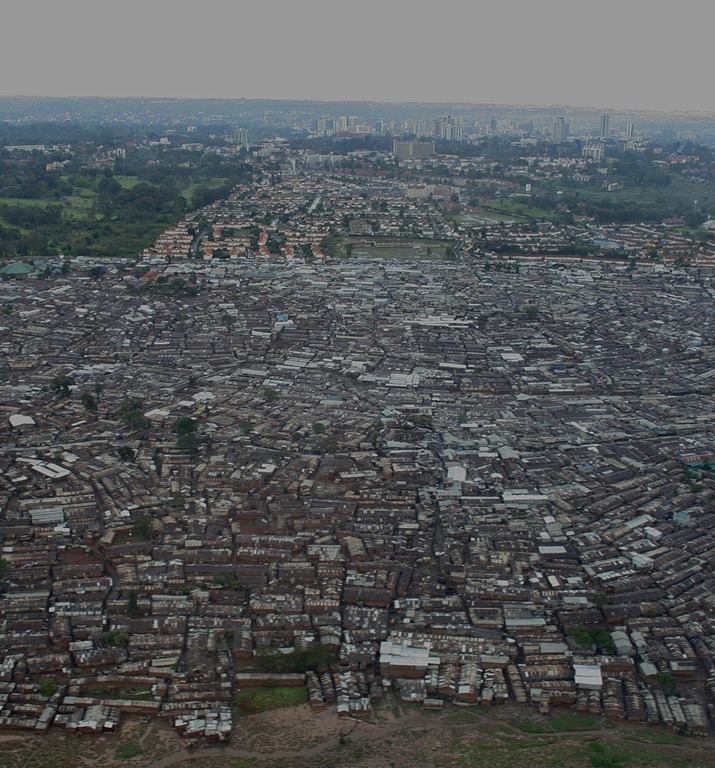
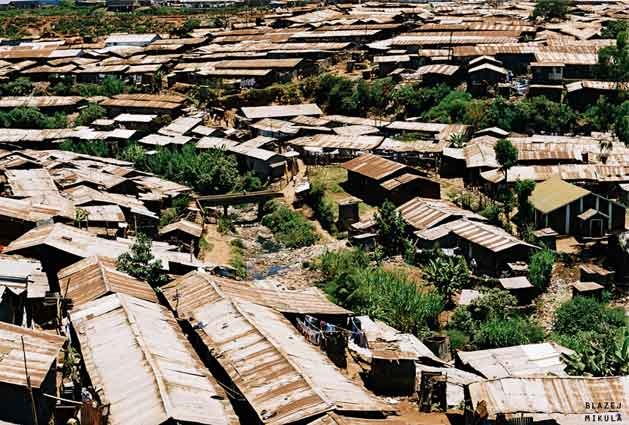
By 1955 the Nubian community of Kibra numbered 3,000. Back then it was an attractive rural village, the houses surrounded by large gardens. But in successive decades as Nairobi grew into a city, hundreds of thousands of rural Kenyans, seeking work, invaded Kibra, putting up  shanty dwellings. Kibera, as it is currently known, is now one of the biggest slums in Africa.

Kibera Schreibkraft cc

A cropped image of Kibera, Nairobi. Photo CC 2014 Schreibkraft

Kibera cc Blazej Mikula

Photo: CC Blazej Mikula

*

During colonial times, Kibra land remained the property of the British Crown. At Independence in 1963, ownership of Crown Land passed to the new government, and so became state-owned land. The new state also inherited an administration that was still largely operating under State of Emergency regulations from the 1950s Mau Mau uprising. Being able to prove  who your tribe was and the associated right to domicile were essential proofs of citizenship. The Nubians’ former colonial categorization denied them on both fronts.

From 1963 until 2009, when the Nubian community in Kenya was finally accorded official existence as a Kenyan tribe, the Nubians of Kibera and elsewhere in Kenya had been stateless. While the colonial generation did have identity cards, the post-independence generations could only acquire them, if at all, with great difficulty, and after many years of persistence.

This meant they could not be formally employed, open bank accounts, acquire title deeds, participate in the affairs of their country of birth, vote, or even leave their own homes safely, since to be caught without an identity card is a criminal offence.  The only opportunities to earn a living were in the informal sector, and for women, this included/still includes making baskets for sale through non-governmental trading operations, and Nairobi’s tourist curio shops. Hopefully now, with official recognition, the fortunes of the Nubian people will change  for the better, but there is still much ground to make up, and in all senses. For more of these people’s story see the excellent short videos below, and also the full length BBC programme about Ancient Nubia at the end.

In the meantime, back to the beautiful baskets, and a Nubian woman at work. The method of construction involves coiling lengths of papyrus stems or dried grasses then wrapping them round with coloured and natural palm leaf strips. Truly great works of decorative art, and not only that, but life-enhancingly useful too. Expressions of spirit undaunted despite lives of grave hardship unimaginable to most of us?

A-Nubian-woman[1]

Photo: http://in2eastafrica.net/home-stays-growing-ugandas-tourism/


Flavia Lanyero 2011 Uganda

Article on Nubians of Uganda: Flavia Lanyero 2011 Daily Monitor

*

text copyright 2014 Tish Farrell

Greg Constanine’s video explains the Kenyan Nubian dilemma


This brief film explains the history of Nubian statelessness in Kenya


Recent archaeological discoveries of the ‘lost’ Nubian civilization


Ailsa’s Challenge: Decoration – Go here for more bloggers’ decorative posts

A Long Time Ago in Africa


Scan-130520-0013 (2)

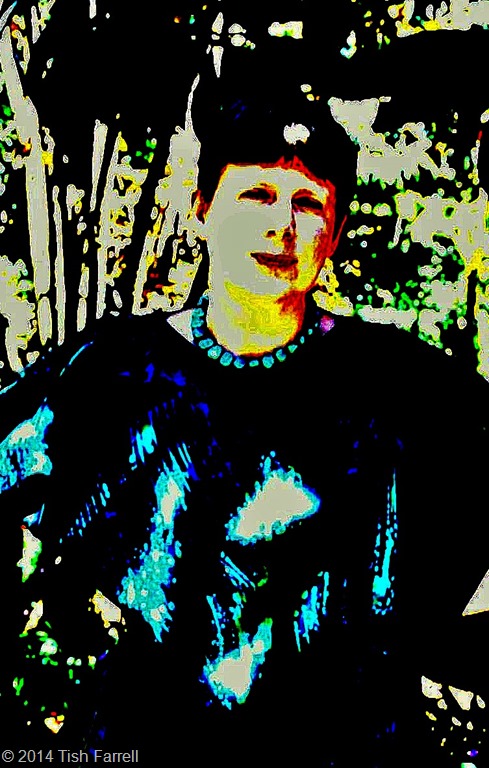
Well this is what happens when you fiddle about in Windows Live Picture Gallery. I rather like the effect – posterized for posterity, an arty rendition of UK expatriate in 1990s Kenya. The original shot is thus pretty old, just like me. I was standing in the back garden of our house in Mbabane Road, in Nairobi’s leafy Lavington district, under the loquat trees. The house is gone now, and I can see from Google Earth that Madison Insurance who owned the compound, have given it over to some development of upscale townhouses. Across the road was  the run-down state primary school. I imagine it is still run down. My days back then had a daily soundtrack of children’s voices – chanting times tables mostly.

In the photo I’m wearing a self-made suit (tunic and pants) of batik cloth created at a workshop by street boys trying to get their lives together. And I’m wearing a string of Kazuri Beads, glazed ceramic beads, made by women trying build themselves and their kids a future. Kazuri means small and beautiful. The little factory in Karen, Nairobi was a joy to visit. The workshop shelves were lined with glass jars of bright beads, rather like a picture book sweet shop, while at benches in the the airy room, women created beads and threaded necklaces in colour schemes of their choosing. I’m only sorry that I seem to have no photos, but if you go to the link you can see the factory today – much expanded and employing men too.

100_5882

I still have the beads and the suit, and still wear them too, although the batik cloth is a little thin, while I, sadly, am not.

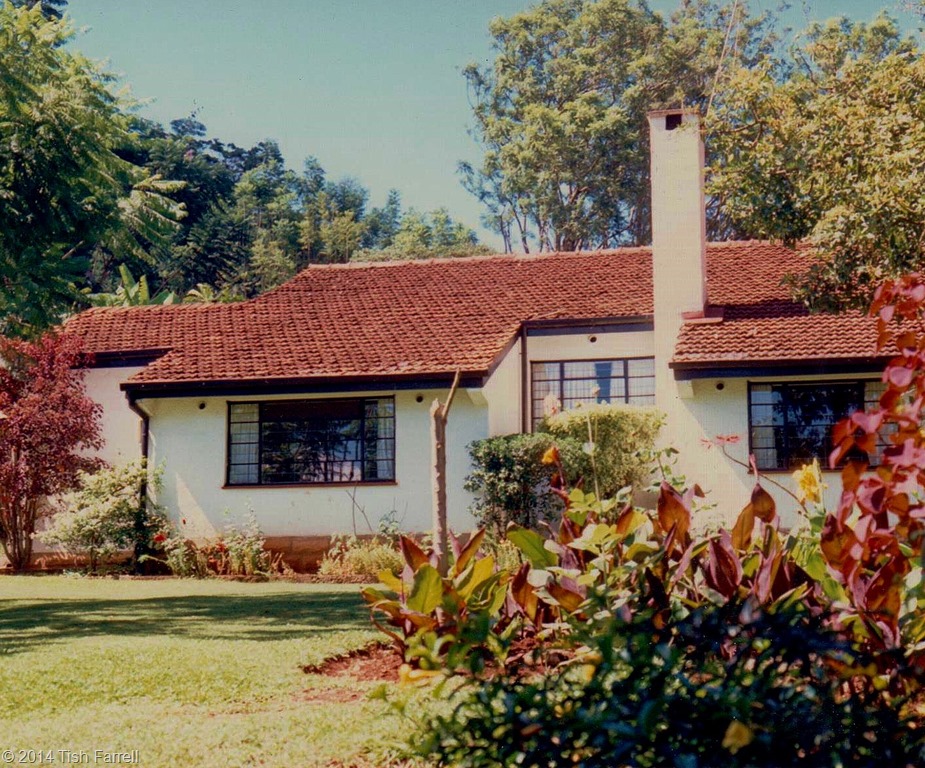
And now here’s a picture of our house – home for seven years.

003 (2)

It came with the usual services that accompany the living quarters of TCOs (Technical Cooperation Officers) working for Her Majesty’s Department for International Development. These included a well secured compound perimeter with lights, a 24/7 security guard, house alarms (checked monthly), internal security gate, barred windows, guard dog, and regular applications of pesticide by Rentokil. Phew. We did not like any of  this much, although we did like Patrick, our day guard, such a tall and gentle man. It was hard to imagine him fending off intruders. He had a farm back home in Western Kenya where his wife stayed in the good stone house he had built for her, along with their three children. He used to go home twice a year to plant or harvest his maize crop.

011

To make up for all the oppressive security, during the day I used to walk around the district on foot, roaming along the avenues. I wasn’t sure what it was I supposed to afraid of, although I did know that people did have their homes broken into, and that expats who insisted on driving large new Land Cruisers were often relieved of them (on their own compounds) by guys with AK47s, and strangely enough, soon after said expats (usually diplomats) had arrived in country and taken possession of the new vehicles via customs and imports at Mombasa port. The word on the street was that these robbers were highly connected. Very highly connected. This situation frequently reminded me of one of my father’s favourite sayings: the fish goes rotten from the head, although one would have been foolish to say this too loudly, or even at all back then.

Farrell Team Leader, Graham, had a works Land Rover for work, but otherwise we drove a battered Suzuki jeep. It had some interesting features. A previous owner had cut a hatch over the back seats, and made a fibre glass lid to go over the top. For game viewing you could simply unclip it. I didn’t drive it much, because that was the really scary thing – Nairobi driving. I often used to ponder if I could get to places by driving on the very wide pavements. Once when I forgot I was in Kenya and slowed at a zebra crossing on a city highway to let a pedestrian cross, the poor woman looked as if she would faint. I was lucky that  the Suzuki and I didn’t get flattened by a Tusker beer truck, while I and the woman stared at one other in a state of frozen confusion, neither of us able to move.

The other thing that used to scare me about driving was that parts used to fall off the Suzuki. G’s nonchalant response to my concern was, ‘Well if you were still going, you obviously did not need it, whatever it was.’

On the whole, then, it was better walking. I could peep through the cracks in the big steel gates that protected ambassadorial and diplomatic residences, and count the excessive number of garbage bags put out for BINS, the private refuse removal company. I’d see street kids and Maasai, greet the security guards who sat out on the neatly trimmed verges and chatted house to house. I was intrigued by the barber who had turned a fallen flame tree into a salon, and  I liked the smells of all the garden trees – cypress, frangipani, the warm musky smell of fever trees. When the rains came the streets would be filled with silvery clouds of termites on their nuptial flight. At dusk, the frogs in the Nairobi River way below our house would strike up frog songs that resounded across the valley. The crescent that adjoined Mbabane Road was called Applecross – a bizarrely English name that evoked pastoral perfection of the sort that had never existed outside colonial settlers’ minds.

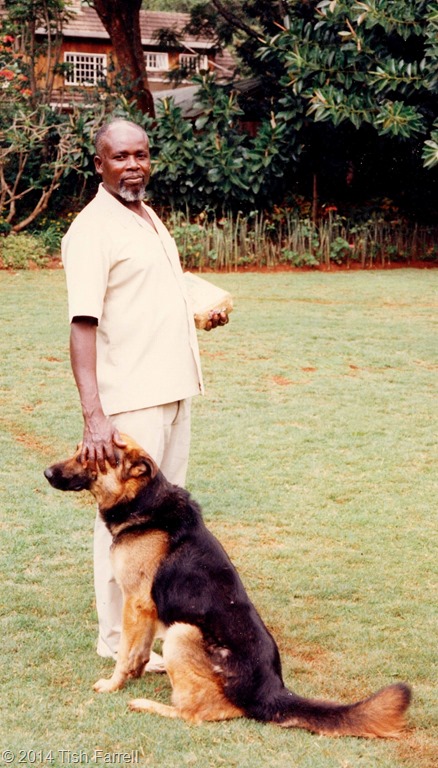
When we took over the house from G’s predecessor we also took on the resident house steward, Sam, whose homeland was in Maragoli in Western Kenya. He had long worked for expatriates, but back home and also on the borders of Nandi he had small farms – three in all. His first wife lived on his ancestral land in what had been the Maragoli tribal reserve in colonial times. He still called it ‘the reserve’. He said he had poor relations on the other smallholdings, but they were not looking after the land properly and this caused him much concern. Apart from home leave, he stayed in Nairobi with his second wife, living in the servants’ quarters at the bottom of the garden. One reason for staying in Nairobi was so his three youngest children and a grandchild who had come to live with him could go to school across the road.

Now meet Sam, with guard dog Kim. We eventually had to hand Kim over to a vet, this after he started attacking children who came to play with Sam’s children on our compound. The vet told us that some German Shepherds were prone to this behaviour, and once begun, this was not a habit that could be broken. She told us she would try to send him to a rescue centre that kept such dogs, but otherwise he must be destroyed.

002 (2)

We did not ask which of these had been the outcome, but after having one sweet little girl’s face stitched up at the hospital we could not risk it happening again. Luckily the dog missed the child’s eye and the wound healed well. Here she is then, Sera, fully recovered with only a hint of a scar under the right eye.Zaina and Sera 2

And next comes Silas, Sam’s youngest son.

012 (2)

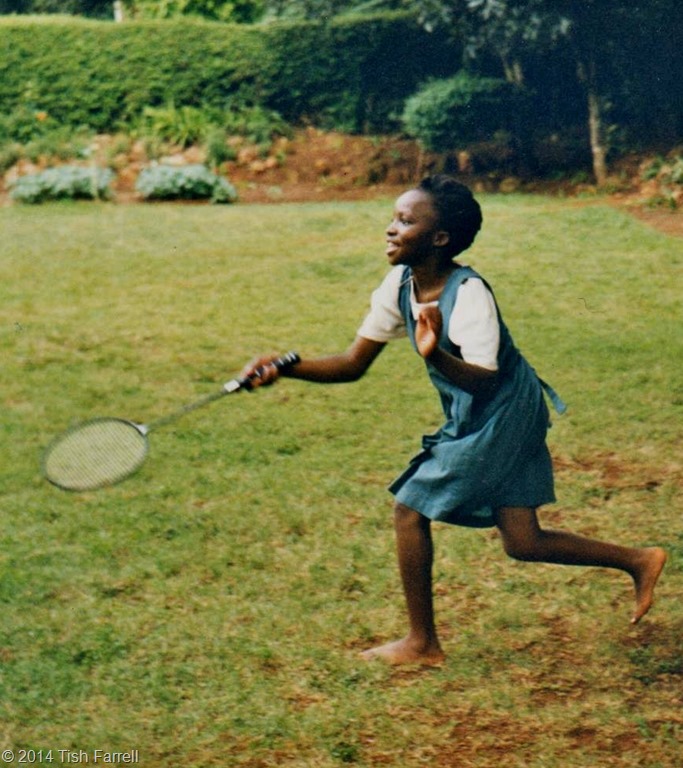
And Sam’s grand daughter, Zaina playing badminton with Silas on the back lawn.

002

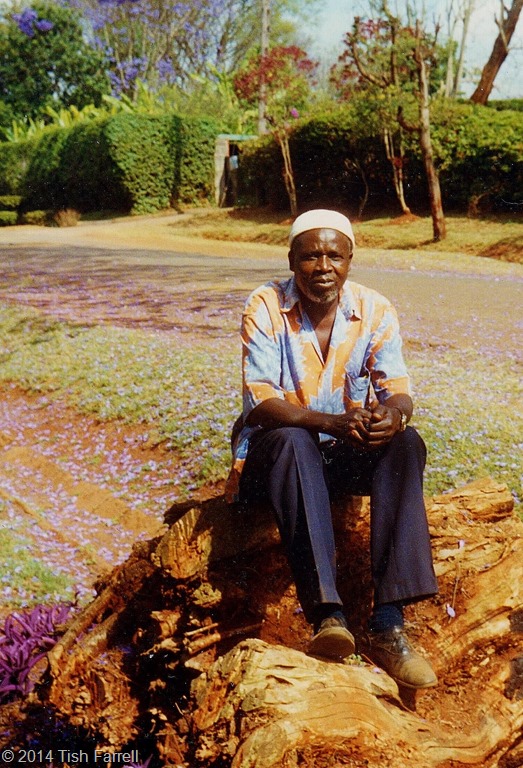
Then Sam off-duty out on Mbabane Road. He only worked half days as we didn’t have enough house work.

010

*

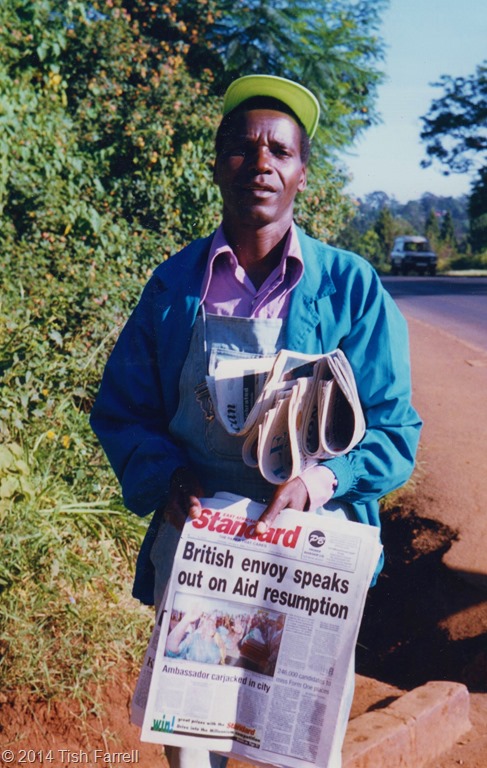
And  this is Francis, who stood every day on the corner of Mbabane and James Gichuru and sold us The Standard and Nation newspapers. He turned the newspaper round deliberately because it was featuring the British envoy, a man somewhat outspoken on Moi regime corruption.

007 (2)

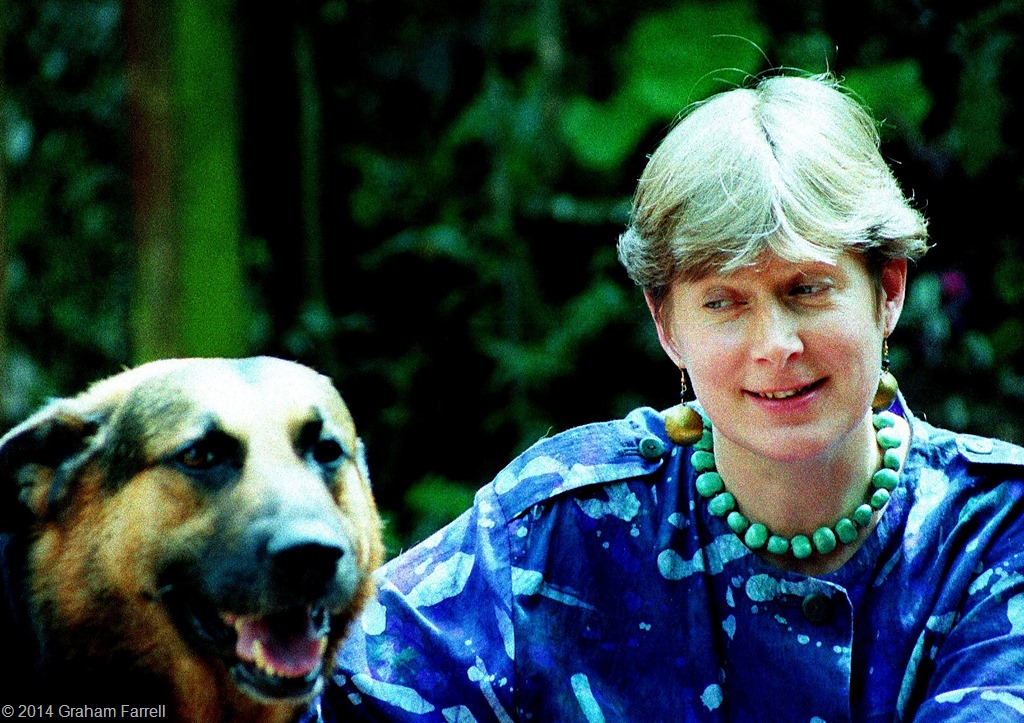
And finally me again, not looking quite so postered  (but oh, so much younger) with poor old Kim, and those Kazuri beads again. Interesting days.

Tish and Kim the dog

copyright 2014 Tish Farrell


Related:

Looking for Smut: Work on Kenya’s Highland Farms

Valentine’s Day Runaway


Flickr Comments ‘A’ words – go here for more bloggers’ ‘A’ tales and photos

Zanzibar: time’s twists and turns


…a gateway to Africa. Through its portals passed not only slaves, spices and ivory, but also missionaries, explorers and conquerors.  

Abdul Sheriff, Professor of History, Dar es Salaam University

Scan-130429-0054

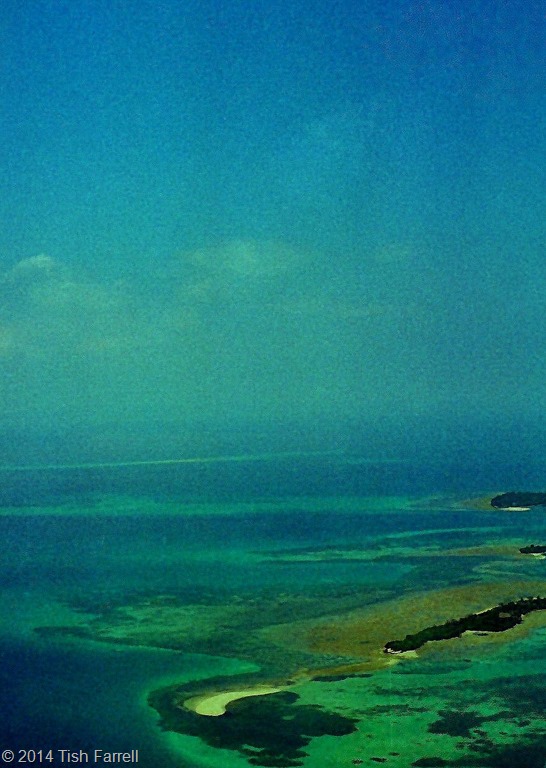
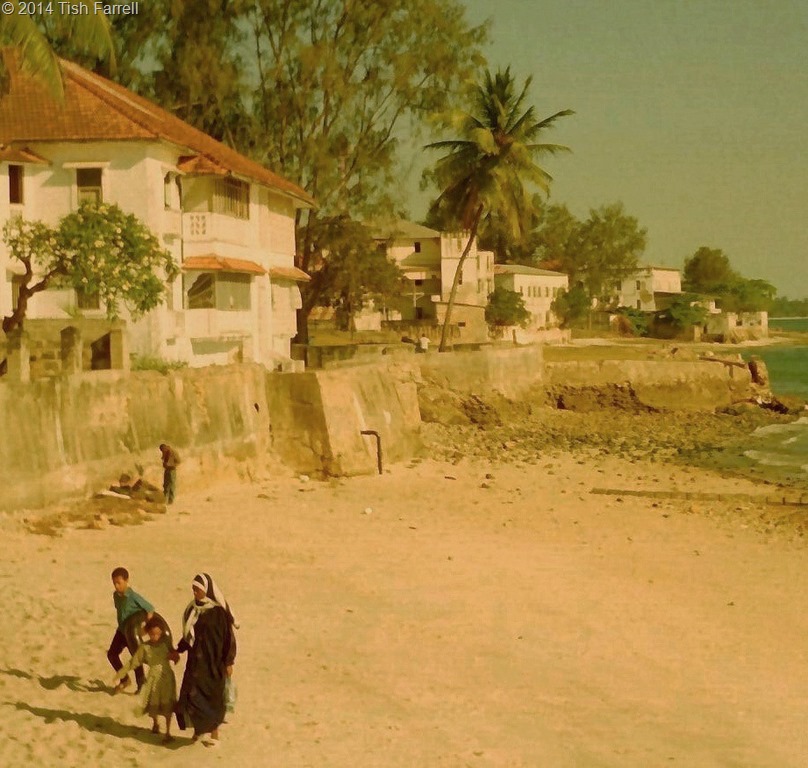
Zanzibar  – it’s all in the name – the Indian Ocean shores where Arab merchants met with African farmers and created a new people: the Swahili. In the Arabic Kilwa chronicles of the Middle Ages, the word Zanj denotes non-Muslim black people, and the word bar means coast, and the term back then referred to much of the East African seaboard – to wherever the dhow traders seasonally put in to haggle with Bantu farmers for ivory, leopard skins, rhino horn, iron, ambergris and mangrove poles.  These, then,  are the shores of the Sindbad (Sendebada) tales, but today the term ‘coast of the blacks’ survives only in the name of the Zanzibar archipelago (Unguja and Pemba Islands), now part of Tanzania.

These days too, Zanzibar Island, more properly known as Unguja, is seen as the heartland of Swahili culture, and the place where the purest form of KiSwahili is spoken. Once, though, there were many other powerful Swahili centres – independent city states that included Manda, Lamu, Malindi and Mombasa in Kenya, and Sofala far to the south in Mozambique. Such states, with stone towns built of coral rag, began evolving from at least the early 800s CE (Manda),  by which time KiSwahili was already a fully developed language, albeit with many regional forms.

100_3629

*

In fact the trade along East Africa had been going on from well before the 9th century. The Periplus of the Erythraean Sea, a Greek account of Indian Ocean trade written around 60 CE, indicates that the people of the kingdoms of Yemen and Arabia already had well established trade routes as far south as Mozambique. The Romans had also been here, doubtless making use – as all the seafarers did – of monsoon winds that in season carried them south down the African coast, or east to India, and then, with the change in the wind,s northwards and homewards to the Gulf.

Scan-130510-0008

*

The earliest traces of a stone town  on Unguja date from the 12th century when merchant princes from Shiraz in Persia settled on the island.  Over successive centuries this settlement  was destroyed twice by the Portuguese (who, after Vasco Da Gama discovered  he could sail round Africa in 1498, seized control of the Indian Ocean trade) and once by the Omani  Arabs whom the Swahili sultans of the Kenya coast called in on several occasions to help rid them of the European tyrants. The Portuguese were ousted from Zanzibar and the Swahili mainland at the close of the 17th century, and thereafter, until the British declared Zanzibar a protectorate in 1890, it was the Omani Arabs who controlled the surviving Swahili states.

Scan-130429-0102

Scan-130429-0095


The Stone Town we see today dates mostly from the nineteenth century when the place was at its most prosperous. Abdul Sheriff describes the scene:

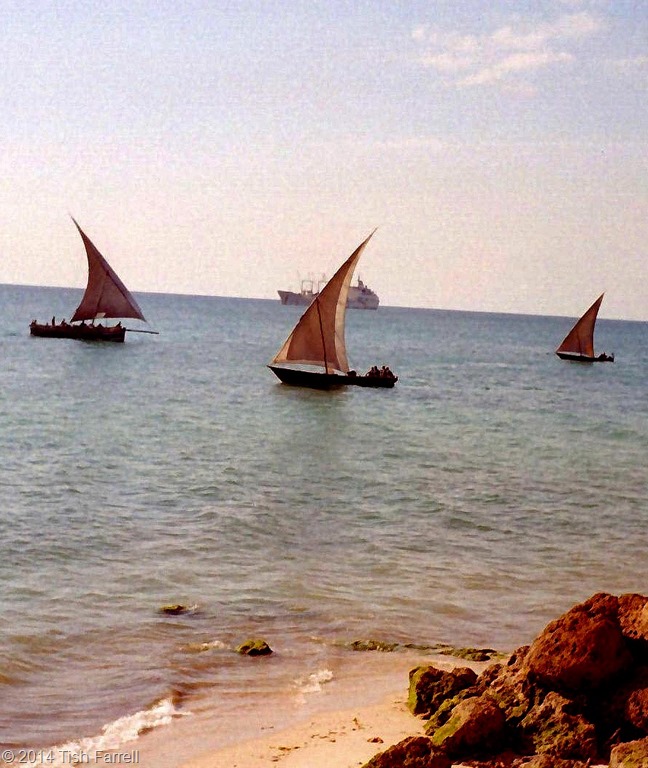
“Zanzibar was then a cosmopolitan metropolis. Its harbour teemed with square-rigged ships from the West and oriental dhows with their lateen sails from many countries in the East, carrying all the colours of the rainbow. Here Yankee merchants from New England drove a hard bargain with Hindu traders in their large crimson turbans or  Khojas in their long coats, exchanging ivory for American cloth; the Marseillais haggled with the Somali for hides and sesame seeds from Benadir; Hamburg entrepreneurs shipped tons of cowrie shells to West Africa, where they served as currency; and Arab caravans rubbed shoulders with their African counterparts from the Mountains of the Moon.”  (The History and Conservation of Zanzibar Stone Town 1995).

Scan-130429-0027

Beit al-Ajaib, The House of Wonders, was built by Sultan Barghash in 1883 to host ceremonial events. He was an extravagant man and, before his death in 1888, built 6 palaces across the island of Unguja. After the 1964 Zanzibar Revolution when the Omanis, along with many Indian residents, were killed or expelled, the building was used as government offices. When we visited in 1999 it was abandoned, but for one of the last sultan’s  cars (candy pink in colour) parked inside the atrium near the front door. A good friend who visited the House of Wonders recently tells me it is still there.

*

Trade was given much impetus in 1830 when the Sultans of Oman moved their capital to Zanzibar to oversee what turned out to the short-lived boom in clove production.  They and other Indian and Arab landowners owned many clove and coconut plantations  on the archipelago, and these were worked by African slaves.

The slave trade, then, was another source of the island’s prosperity. By 1860 the archipelago had some 60,000 slaves, not only working the plantations, but also fulfilling domestic and labouring tasks, and providing new wives for the sultan’s harem. And it is worth noting here that the slaves in Zanzibar were not generally ill treated in the way they were in the Americas; it was not unknown, after long service, for them to inherit their master’s land and property. The children of the harem slaves were also acknowledged by the sultans who fathered them, and treated as royal children with appropriate titles.

During the 19th century it is reckoned that some 50,000 slaves a year were being sold in the Zanzibar slave market. It was only in 1873 that the slaving was abolished, this after much pressure from the British who had first made a treaty with the Sultan Said in 1822 in an  attempt to kerb the trade. That treaty had produced little effect. There was too much demand. The French, in particular, needed slaves for their tropic island plantations.

And to meet the demand the Swahili and Arab slaving expeditions would set off from Zanzibar for the African mainland, taking their caravans of porters along well-walked slave paths through Tabora in Tanzania, and down into Zambia, or travelling up present day Kenya to the Great Lakes regions. The notorious Swahili slaver, and plantation owner, Tipu Tip, roved as far as the Congo , terrorizing villages across the territory.

Scan-130429-0020

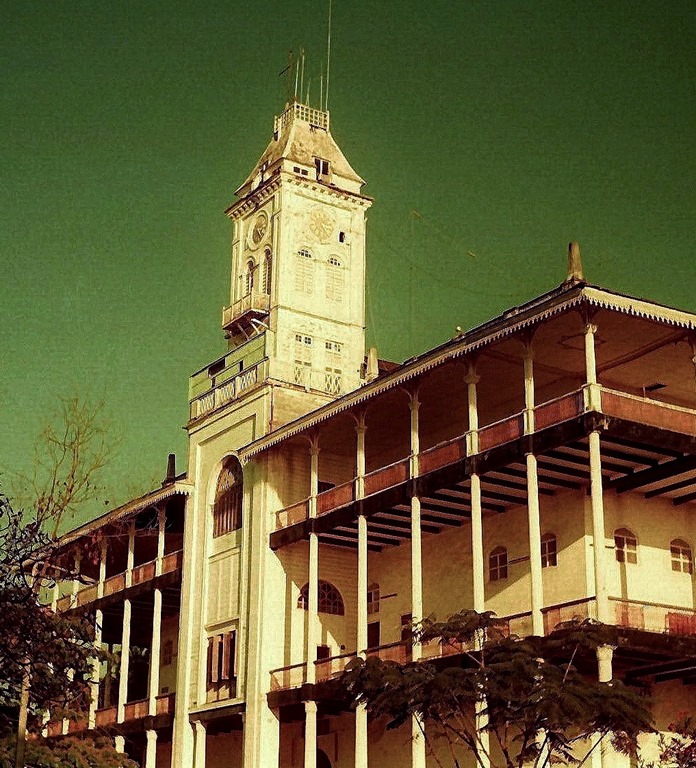
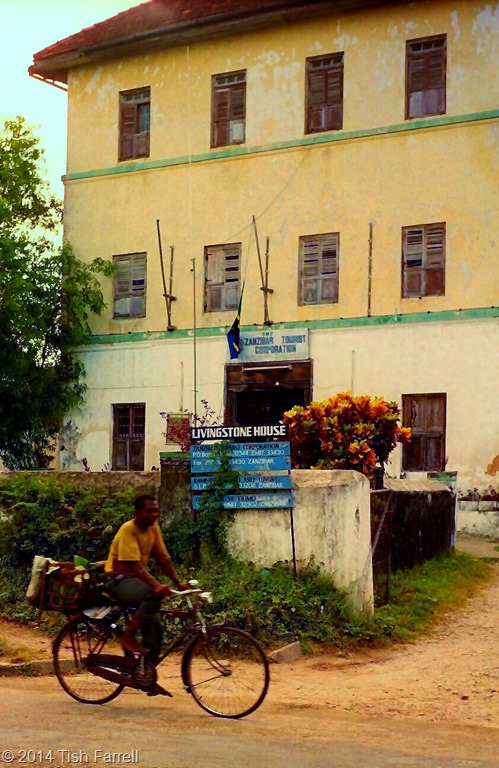
Finding some way to end the trade was one of the motivations that drove the missionary-explorer David Livingstone ever onwards on his gruelling explorations across Africa. It was thought that if the continent was opened up to civilizing Europeans, then the ‘filthy trade’ could be stopped.  But then like the slavers, he and other European explorers (Burton, Speke, Stanley, Cameron, Thomson) started their journeys from Zanzibar. All such travellers, including  missionaries, relied on  the expertise of porters and seasoned safari guides who otherwise worked on the slave caravans.  In 1866, before his last expedition, Livingstone stayed at the house above. It had not long been built by Sultan Majid. Now it is the office of the Zanzibar Tourist Corporation.

001 (2)

From John Hanning Speke’s Journal of the Discovery of the Nile 1863

*

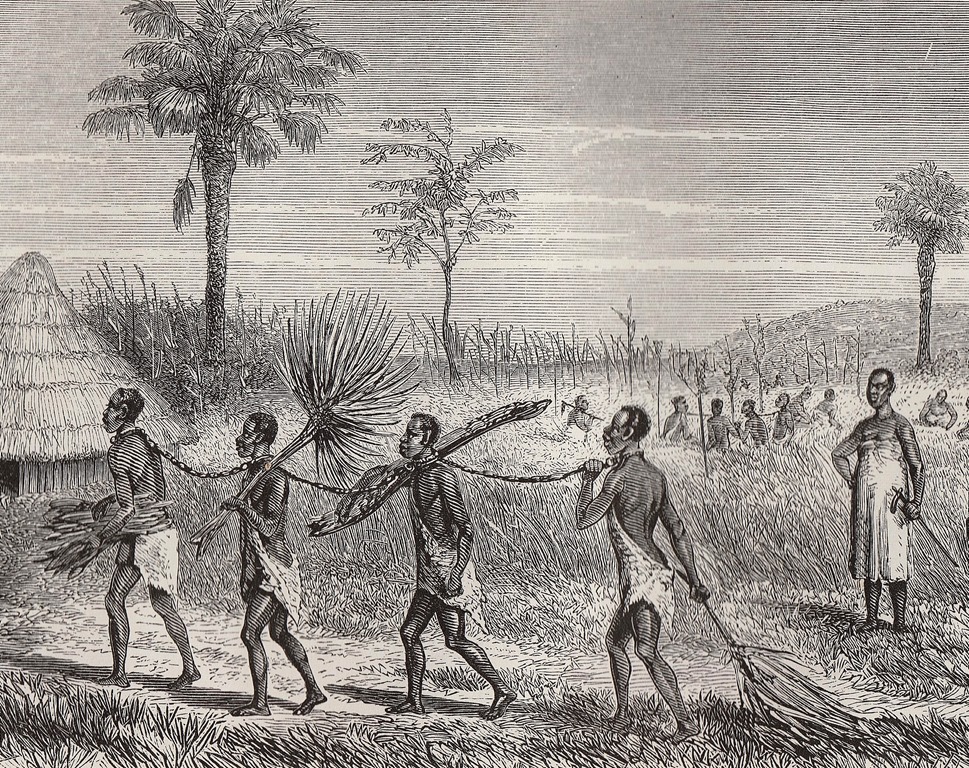
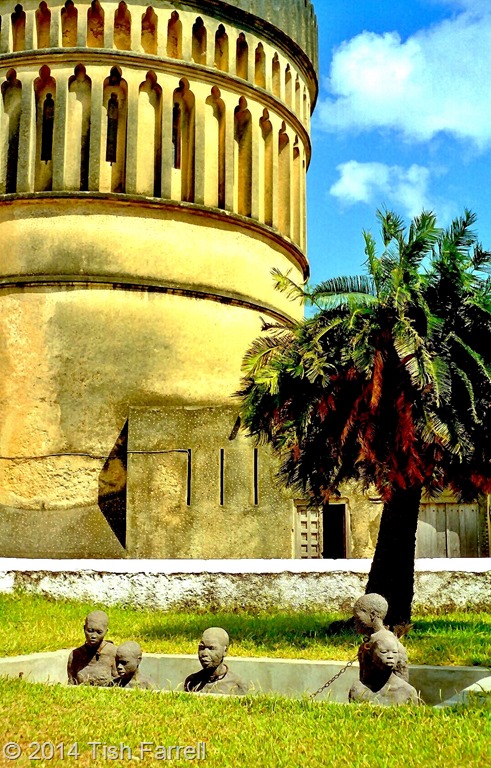
The slaving and ivory  trades worked in tandem. Newly captured slaves were not only driven on forced marches across the continent to the coast, but they were also made to carry supplies, and these included any elephant tusks that the slavers had procured – ivory destined for the production of piano keys and billiard balls for the European market.  It was only in 1897 that all slaves on Zanzibar were given their freedom. The Anglican church stands on the site of the slave market, beside the now famous sculptures commemorating the years of abuse. It is horrifying to consider what the cost of this trade has been for Africa: generation upon generation of  the strongest, brightest and  most  beautiful young people robbed from their communities.

Scan-130429-0005

Naturally the British could congratulate themselves on finally stopping the trade on Zanzibar, although I believe it continued well  into the 2oth century at Lamu. Today, too, slave mongering thrives, and under our very noses in Europe, only now the abused are not necessarily black, so perhaps we don’t think it’s the same thing – the brutal deprivation of liberty and dignity, along with forced labour?

But back to 1890, the end of the Sultans’ control and Britain’s laying claim to Zanzibar. Because now we come to a whole new angle. For this was also the year of the Heligoland-Zanzibar Treaty, an agreement between the Germans and the British, whereby (in return for Heligoland, the strategic North Sea island), the Germans waived rights to Zanzibar, Witu on the mainland coast, and to the territory now known as Kenya across which the British were planning to build the Uganda Railway. (Bismarck apparently called this deal swapping the trousers for a button). 

Suddenly, then, Zanzibar has a very particular purpose for the British Empire. It will become the spring board for the claiming of extensive East African territory, and it will start with that mad, mad railway from Mombasa to Lake Victoria. Of course, with slavery being outlawed, some new mechanism of harnessing native power will need to be thought up. Something civilized and civilizing. I know – we’ll call it colonialism, and enclose indigenous people in their own territory, make reserves of their own homes, which they can’t leave unless they have a pass. Then we’ll introduce hut and poll taxes so forcing them to work for Europeans…

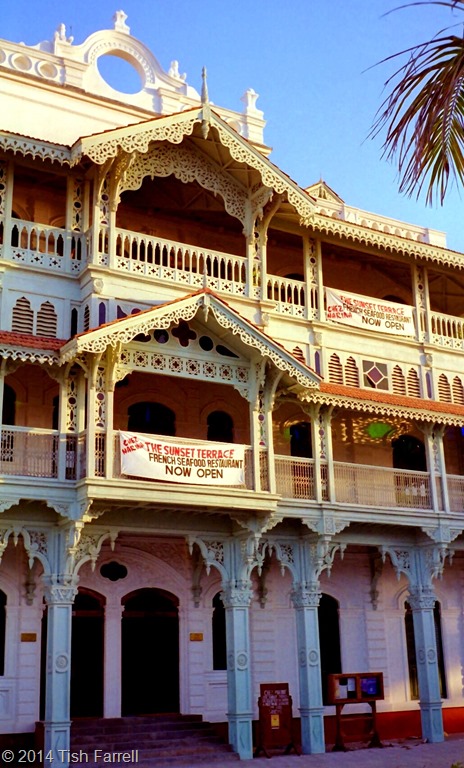
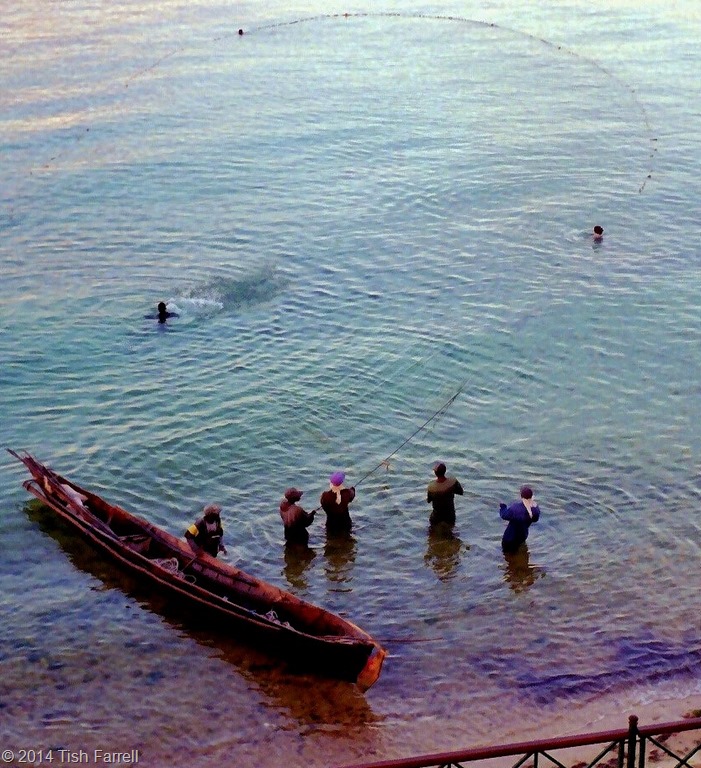
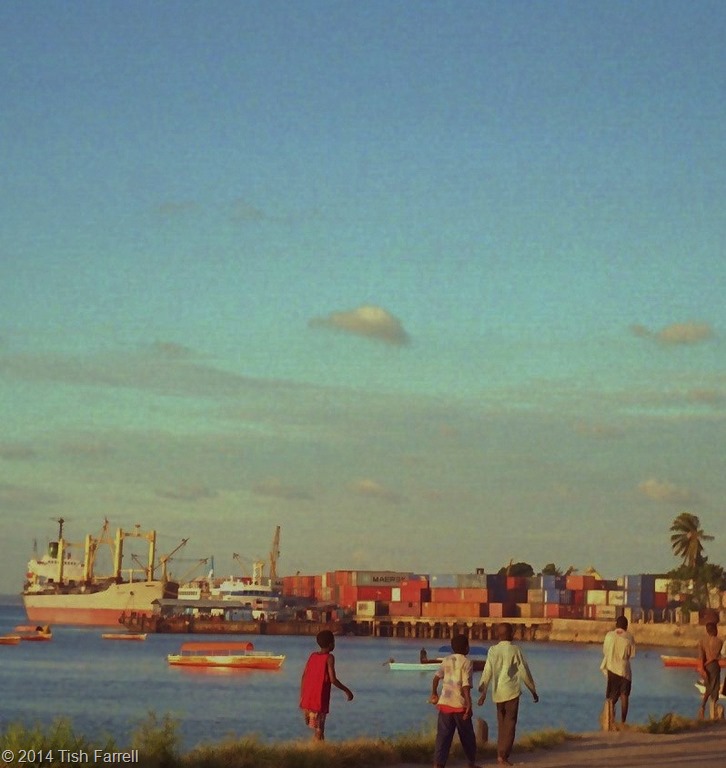
For more of the colonial story go to an earlier post Vulcanicity HERE. In the meantime below are some more soothing views in and around Stone Town, now a World Heritage site. Life is not so grand as it was in the days of the finely robed Omanis. Fishing, ferrying, farming (growing spices, coconuts and vegetables), curio trading, boat building, mangrove pole harvesting and tourism are the main sources of income. As in all African countries, people work hard to educate their children, and this is their number one priority.

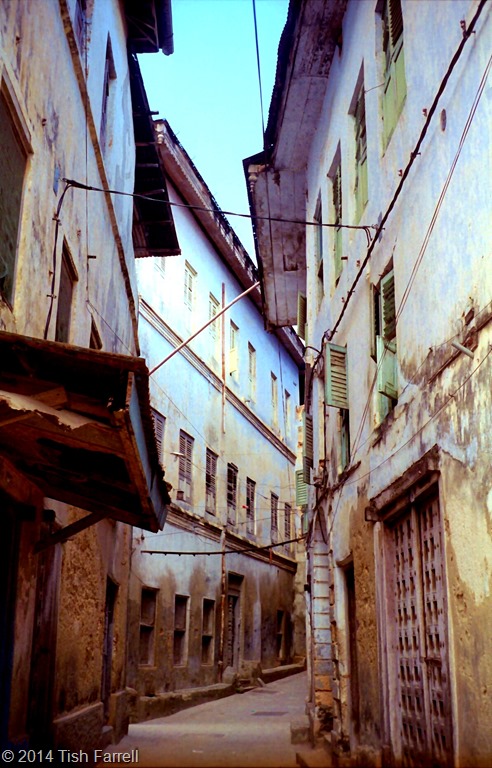
Stone Town is also a devoutly Muslim community, and sometimes this does not sit well with tourist inclinations to behave in ways not considered either respectful or respectable by Zanzibaris. There are over 50 mosques of several different Muslim persuasions, but most are unobtrusive buildings without minarets, and are scarcely noticeable among the domestic dwellings. There is also a Catholic cathedral as well as the Anglican church. The streets are maze-like and shadowy, but we met with nothing but gracious hospitality when we wandered along them.  The place may seem run down (although here and there restoration is in progress), but in the sudden whiffs of jasmine the Sinbad romance lingers on…

(For more about the Swahili see an earlier post HERE.)

Scan-130429-0110

Scan-130429-0129

Scan-130429-0149

Scan-130429-0131

Scan-130429-0046

Scan-130510-0002

Scan-130429-0123

Scan-130429-0081

Scan-130429-0122


AILSA’S TRAVEL CHALLENGE: TWIST

FLICKR COMMENTS TAGGED ‘Z’

copyright 2014 Tish Farrell


Yesterday’s Shining Star? The Restoring of Artist Mildred Elsi Eldridge (1909-1991)

www.glendwr.ac.uk (2)

Self Portrait Mildred Elsi Eldridge. Photo: Glyndwr University www.glyndwr.ac.uk

*

It has to be asked, this burning, niggling question, but why on earth do we forget women artists so readily? Why is it that their work is less exhibited, less revered or, if noticed at all, only grudgingly accorded a modicum of the status enjoyed by male artists?

I leave it to you to supply the answers to these questions. I only note that this same enquiry was the driving force behind Professor Amanda Vickery’s recent BBC2 series The Story of Women and Art. In this too brief historical exploration of  forgotten/hidden/suppressed  and otherwise invisible women artists, Professor Vickery introduced us to the breath-taking creativity of (among others) Sofonisba Anguissola, Berthe Morisot, Johanna Koerten, Properzia de Rossi and Artemisia Gentileschi.  I will be forever grateful for the introduction.

Now, though, I have a very particular question. It relates to the work you are about to see – details from a great mural that, until fairly recently, was hidden from view.


All photos: Glyndwr University www.glyndwr.ac.uk

DSC06549[1]

*

panel 6 glendwr


*

DSC06941[1]

*

DSC06556[1]


So my question is this. What was in the minds of the people when they took down and concealed from sight this work of lucent genius by Mildred Elsi Eldridge; how did they feel when they stowed away the Dance of Life?

Sorely deflated? Bereft? As if the light had gone out?

The work was originally commissioned in the early 1950s by the Hospital Management Committee of the Robert Jones Agnes Hunt Orthopaedic Hospital, Gobowen near Oswestry in Shropshire. A new nurse’s home had been built and the  mural was to hang in the dining hall. The hospital’s Doctors Menzies and Salt had recently been to Sweden and seen how art was being introduced to hospitals to enhance the healing process.

The fee for the commission was £500 and the work took M E Eldridge around five years to complete (Gwydion Thomas in Life and Times of M E Eldridge). In 1999, after being on display for forty years, the mural was put into storage. The hospital was undergoing development. But once consigned to custodial care, it was over a decade before moves were made to restore the panels and find them a new home. 

Elsi’s son, Gwydion Thomas, was a child when the panels were being painted  (see the boy with the monkey above). He says the work was created in their home, in the drawing room of Manafon Rectory, Montgomery. He says that, as there was not enough wall space to hang the work in progress, Elsi rolled up completed portions as she went along, hanging others over doors as she was painting. He says the work wound many times around the room. It is a sharp glimpse into this woman’s focus, vision and determination.

DSC06558[2]

The mural’s overarching theme explores how we industrialized human beings have become detached from the natural cycles of life and death. There are depictions of alienation and loss. Yet the work inspires hope, too, through the reclaiming of forgotten wisdom and traditional ways of living and healing. And so, despite the dark undercurrents, the work is hugely elevating. Joyous.  Transcendent. Full of verve. When fellow artist, Stanley Spencer, saw it in 1958 he wrote to Elsi: “Just one look at the heavenly sheep panel would remove all fear and gloom.”

Art Historian, Peter Lord, has described the work as “a masterpiece on so many levels”, while pointing  out not only the technical ambitiousness of so large a project, but also the fact that Elsi completed the work without a suitable studio.

It is good news, then, that Dance of Life has now been released from custody, restored and put on permanent view at Glyndŵr University’s Centre for the Creative Industries in Wrexham. It can be viewed by visiting the main University Reception (tel: 01978 293950). 

DSC06663[1]

Restoration by Vanessa Andrew in progress at Glyndwr University www.glyndwr.ac.uk

*

DSC06933[1]

Gwydion Thomas speaking at a private view of the restored panels

Photos: Glyndwr University www.glyndwr.ac.uk

DSC06936[1]*


*

So: you have seen some of her work, including that self-assured self-portrait at the start of this post, but what of the artist M E Eldridge? Why isn’t she better known?

Mildred Elsi Eldridge

She was born in Wimbledon in 1909, the daughter of a pawn- broker turned  jeweller. She studied at Wimbledon College of Art and then at the Royal College of Art, where her teachers included Eric Ravilious, Edward Bawden and William Rothenstein. She was one of the RCA’s star pupils. In her autobiography she says of this time:

A free studentship in 1931 took me to the RCA which in those days was attached to the Victoria and Albert Museum. There were huge doors from the V&A into the College which were kept securely locked but as there was always one of the museum keepers on duty on the other side of the doors, special signs and knocks could be made so that after signing on at the RCA entrance desk it was possible to escape into the V&A and make drawings of the splendid treasures in the museum, or experimental drawings of one’s own which would probably have received severe criticism from the RCA staff. From there, sallies could be made to the Science Museum across Exhibition Road or to the Natural History Museum to make studies of animals, plants and fungus.

In 1934 The Rome Scholarship competition was held – the subject Music. I submitted the 5′ x 5′ Telling the Bees which later became the central part of the first panel in the mural in the Dining Hall of theNurses’ Home at the Gobowen Orthopaedic Hospital. 

M. E. Eldridge Autobiography

meeautobees[1]

This was the piece that won her the prestigious Travelling Scholarship to Italy and opened the doors to the art world. When she returned to London she soon established herself, being the only artist to sell all her work at 1936 Royal Academy exhibition. The next year she had a one-woman show at the Beaux Arts Gallery, and with the proceeds of the sales, including several to major collectors and large metropolitan art galleries, she bought herself a Bentley car. And then –

She turned her back on the glitter, and headed off in her Bentley for  the Shropshire-Wales borderlands to teach at Oswestry High School and Moreton Hall School for Girls in Shropshire. She lodged just over the border in Wales, in Chirk near Wrexham, and it was in the house where she was staying that she met the fellow lodger, a young curate, who was to become known to the world as poet, R.S. Thomas. She made this portrait of him in 1940, the year of their marriage.

1940 yr of marriage

It would be easy to say that the growing fame of RS eclipsed or stunted Elsi’s talent. He apparently took no interest in her work or did anything to encourage her. There is a revealing interview in the New Welsh Review issue 64 in which Gwydion Thomas says that after Elsi’s death in 1991, his father wondered if Elsi would have “gone on painting properly” if, as they moved from rectory to rectory across Wales, he had ever bothered to arrange for a house with suitable work space for her. RS admitted, too, that he should never have expected her to live at Sarn y Plas in Rhiw (see the previous post) after he retired  from the priesthood, and the church authorities would not allow them to buy the Aberdaron rectory with its pleasant rooms and fine views.

cover_64[1]

Gwydion describes her room at the house in Rhiw: so dark with two tiny windows, and damp too. She had to keep her paintings in black plastic refuse bags to protect them from the water that  dripped through the walls. It was so cold, that as she painted, she kept her feet inside a cardboard box, along with a two-bar electric heater, and so was frequently burned. The room also had a low loft which she reached by means of a ladder. Here, with the company of mice, she both slept and worked. Tellingly, the new room that the Thomases built at Sarn y Plas served RS as bed-sitting room.

Elsewhere, Gwydion describes Elsi as

a remarkable and talented woman. She painted, and sold, some 2,000 finished pictures and produced innumerable studies…She was a weaver, a sculptor, a clothes maker – she made me clothes out of rabbit and mole skins – and a knitter, a teacher, a writer and illustrator of children’s books…She designed altar cloths, stained glass windows and wrought-iron chandeliers. She designed and planted four gardens, raised a child, cooked for my father: four meals a day, every day, for 50 years.

He did not know why she stopped painting landscapes, and took to churning out what he calls  ‘pretty’ paintings and illustrations. But he does say something that is perhaps illuminating. He says that when his parents first met, RS was writing “dreadful imitations of soppy Georgian poetry”, and full of dreams of Celtic romance. Then along comes this vibrant, shining, well read, well travelled and sophisticated young woman who can introduce him to other kinds of literature, and to the wider world besides.

When it comes to Elsi’s influence on the poet, R S Thomas scholar, Jason Walford Davies, calls her a catalyst, a promoter, the one who made things possible, and helped RS realize a career as poet. She certainly inspired him to write some of his most humane and moving poems.

Marriage

We met
under a shower
of bird-notes.
Fifty years passed,
love’s moment
in a world in
servitude to time.
She was young;
I kissed with my eyes
closed and opened
them on her wrinkles.
‘Come,’ said death,
choosing her as his
partner for
the last dance, And she,
who in life
had done everything
with a bird’s grace,
opened her bill now
for the shedding
of one sigh no
heavier than a feather.

R S Thomas

rst


And so perhaps, in a sense, R S Thomas was also one of Elsi’s creations, a co-creation certainly. She gave him the gift of possibility, and that is a great gift indeed. Her artist self may indeed have been diminished by the marriage, although she strikes me as a woman who knew her own mind and made her choices accordingly. Perhaps she had painted out all her best thoughts, and felt she had nothing more to add in terms of ‘great works’. She anyway never stopped creating, making paintings for Medici greetings cards for instance, and she was working still when she could barely see.

There seems to be no single explanation, then, as to why M E Eldridge, after such a glittering start, is not better known today. Clearly she had some hand in this when she decided  to drive away from her London career, and head for the Welsh Marches. But then to leave in a Bentley, that most self-aggrandizing of vehicles? It is all so playfully enigmatic.

And so instead of answers, I leave you, in like vein,  with this alluring abstract study called ‘Gwydion’s treasures 1952’. I love the shining light in the marbles: what a heart-felt evocation of childhood freedom, and not a shred of sentiment. Only wonder at the cycle of life and death to be observed upon the sea shore, and seen through the endlessly enquiring eyes of a child. Her child.

abstract 1952 httpwww.bbc.co.uknewsuk-wales-21714220

*

For further discussion of overlooked women artists:

Jeanne de Montbaston Women, Art and Authority: The Language of Exclusion

#artbywomen

Text © 2014 Tish Farrell