


In response to Paula’s Thursday’s Special challenge, here are my late roses opening in the warmth of my kitchen. One petal has already fallen, the rest are soon to follow. But how blissful they smell (sorry I can’t provide a sniff link), and what a joy to pick roses in November even if they do last so briefly – indoors or out.
The greenery is Lemon Balm, a soothing herb for all occasions, and the apples are Coxes Pippins from the allotment. To my mind Coxes are the best apples ever, and totally wonderful in Tarte Tatin, which is a Sheinton Street speciality when He Who Leads is not having a fit of waistline watching.
And if you’ve not had Tarte Tatin, then you have a delight in store. It comprises whole or halved, peeled and cored apples caramelized with vanilla, lemon juice, unsalted butter and sugar (enough apples to fill a pan in one layer). Then the pastry is laid on the top and tucked all round the fruit, and the lot baked in the oven. To serve, place a plate over the pan (carefully and using oven gloves) and turn out the Tarte. TA-RAAAH! Have a warm evening everyone.
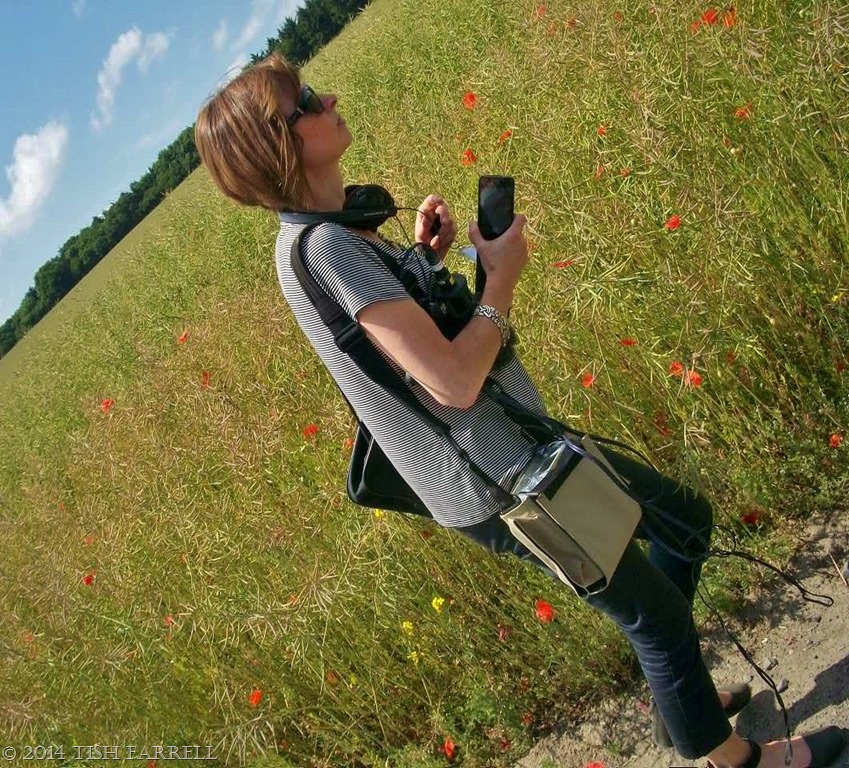
Out in the Shropshire fields below Wenlock Edge with Maggie Ayre, BBC Radio 4 Producer of Soul Music, and the Armistice Day 2014 edition A Shropshire Lad
*
So what is this all about? What has this writer to do with the making of a Radio 4 programme, broadcast today at 11.30 am? You may well ask. It is one of those situations where one thing leads to another, and this in itself is apt, given the topic of the blog post that prompted my connection with the programme.
Last November I wrote a piece called Songs from an Inland Sea: “On Wenlock Edge”. It looked at the way the work of one artist can inspire the works of other artists. It was also about the place where I live, Wenlock Edge, the twenty miles of upflung fossil sea that features in the poems of A E Housman’s A Shropshire Lad.
This cycle of 63 ballad type poems, first published in 1896, has indeed inspired other works, in particular the music of composers Vaughan Williams and George Butterworth. (You can hear excerpts of their works, and download a Guttenberg Press copy of A Shropshire Lad on the link above.)
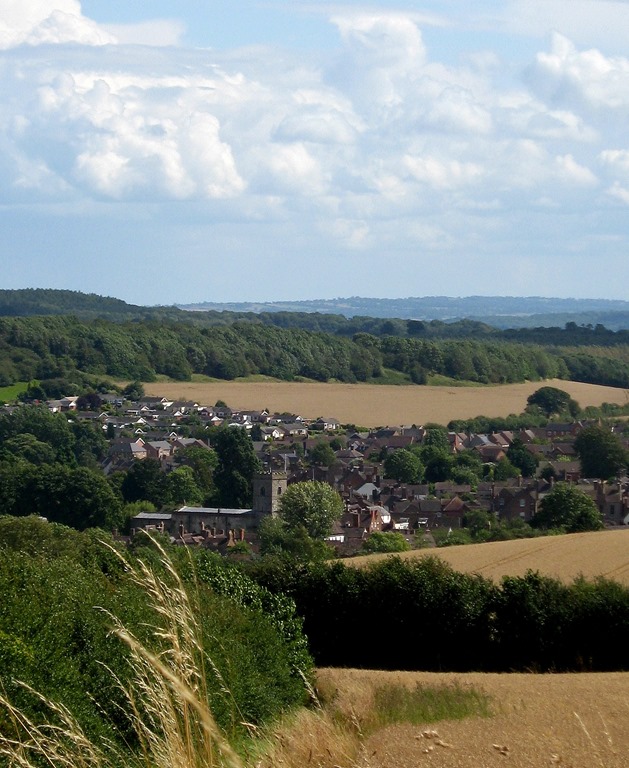
“Tis time, I think by Wenlock town/The golden broom should blow…” ASL XXXIX
*
Last spring Maggie Ayre contacted me, saying she had read my post and was struck by the connections I had made with the Shropshire landscape. She said she was researching a programme that would possibly feature George Butterworth’s Rhapsody, an orchestral work that expands his song version of the Housman poem Loveliest of Trees. She wondered if I would like to take part in the programme should it go ahead. Struck by a fit of ‘writer’s recluse’, I replied rather doubtfully that I might.
Soul Music is a long-standing Radio 4 series. Each programme usually features one piece of music, its performance intercut with the stories of several people for whom the work has special resonance. Today’s broadcast has further meaning, one that touches all of us: it commemorates Armistice Day.
I have written elsewhere about A E Housman and George Butterworth – Quoting Creatively: the “Out of Africa” Connection – but today, on 11th November, the connections are war-specific. Many of the Housman poems relate to the loss of young men going to war, of promising youth cut short. Indeed, sales of the work took off because of this, first during the Boer War, which in 1901 claimed the life of Housman’s younger brother, Herbert, and again during World War 1 when copies went to the front with many a recruit. Butterworth was one of those recruits. In 1911-1912 he had set eleven of the poems to music, and in 1913 seen the premier of the Rhapsody at the Leeds Festival. But by August 1916 the composer was dead, just another of the millions of casualties of World War 1. He was killed at Pozières, on the Somme, aged 31, his creative promise cut off in its prime.
![073_001[1]](https://tishfarrell.com/wp-content/uploads/2014/11/073_0011.jpg "073_001[1]")
But back to Soul Music. I did not hear again from Maggie Ayre until the summer. Then in June, on a hot summer’s day, she came to my house in Much Wenlock and, since the rumble of traffic on Sheinton Street is ever intrusive, she suggested we drive up on to Wenlock Edge, and find a quiet spot to talk about Butterworth’s Rhapsody while looking out across the Shropshire landscape. It seemed a lovely idea.
And so began our pursuit of silence across the countryside – silence, that is, from traffic, aircraft, chain saws and farm machinery. Who would have thought it would be so hard? It was not even harvest time. We drove over and behind the Edge and into the valley you can see in the next photo. We walked along farm tracks, and up and down fields of wheat. It was very hot. Always there was the grind of something mechanical resounding off the hillsides. Of course there would have been plenty of rural noise in Housman’s day – the rattle of carts, shouts of many farm labourers, the blasting of limestone at Wenlock Edge’s great quarries, but by now our pursuit of quietness was beginning to emulate A Shropshire Lad’s most poignant theme: the longing for the unobtainable, “the land of lost content.”
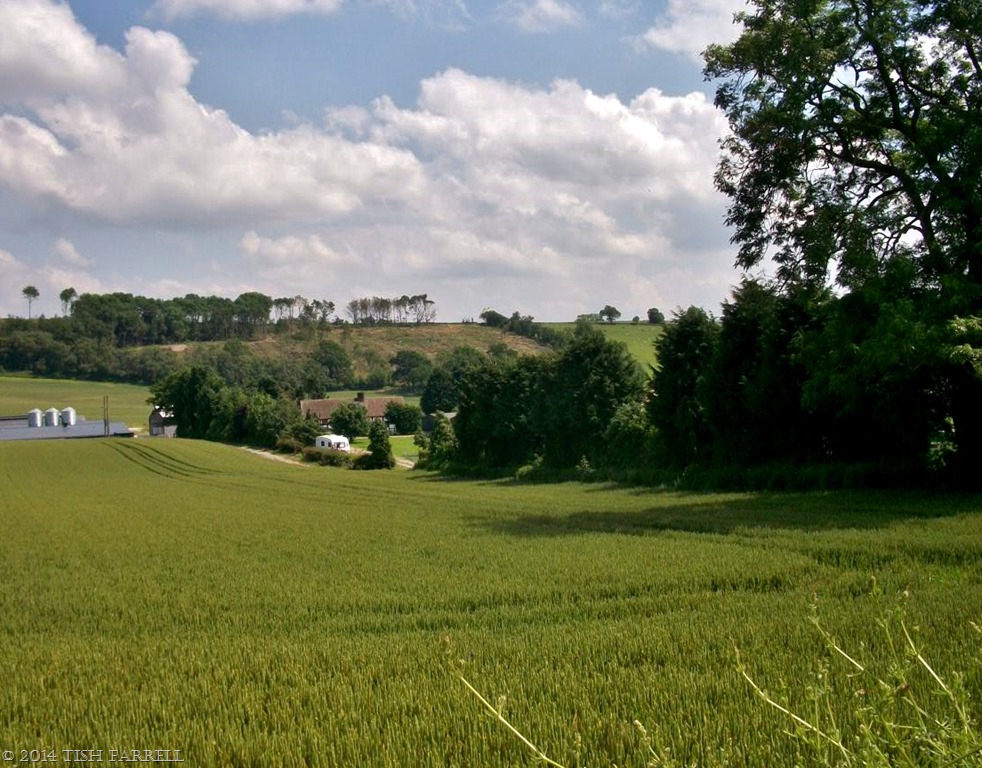
Finally there was silence, apart that is from a buzzard’s call and the humming of bees, and so we sat down on the sun-baked ruts of a wheat field path, and Maggie put that big microphone near my nose and we began. By which time of course, my mind was in a whirl, and everything I’d thought to say dispersed to the four quarters. But in the end, enough was apparently said for Maggie’s purposes. (I should add that I was only one of several participants who include students from Bromsgrove School, where Housman was a pupil; they had recently been performing the Butterworth-Housman songs for a school concert.)
As we tramped back along the farm lane to the car, the quietness was broken by a bird singing in an ash tree. I think is was a robin. It stopped us in our tracks. We listened as it sang and sang. It was a moment of true remembrance: the notion of peace when the bombardment ceases. It is something we need to hang on to, and hang on to for dear life. It is the best and only reason why all European countries, or all humanity for that matter, should stand together, and stop pursuing pointless, ruinous, life-wasting conflicts.
copyright 2014 Tish Farrell
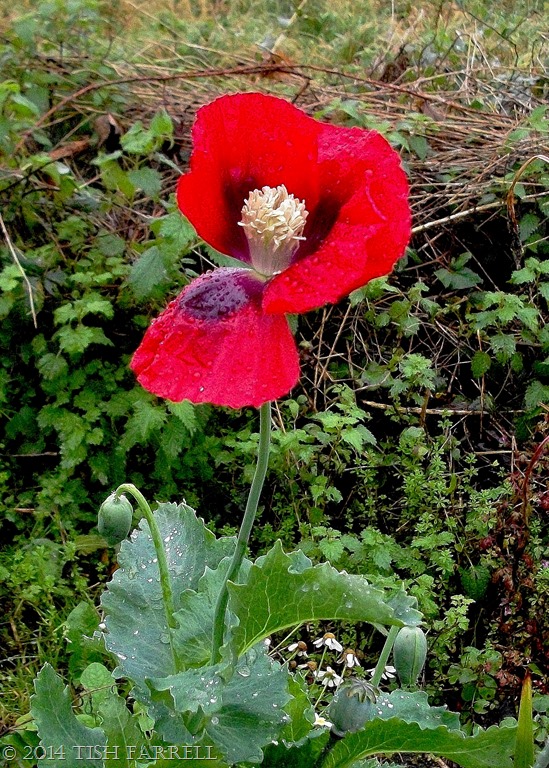
Not a Flanders poppy, but a wild poppy nonetheless, and quite extraordinarily it is flowering today, 11th November, in the field behind our house.
Remembering my own Great Uncle, Private Giles (Victor) Rowles, who died at Gallipoli, aged 19 years and was buried at sea off Mudros Harbour in August 1915.
https://tishfarrell.com/2013/09/15/looking-for-giles-aka-private-victor-rowles-1896-1915/
https://tishfarrell.com/2013/11/11/thinking-of-gallipoli/
*
Soul Music BBC Radio 4 A Shropshire Lad
#nogloryinwar

Dubai, United Arab Emirates
What makes the desert beautiful is that somewhere it hides a well.

Dawn over the reef on Tiwi Beach, South Kenya Coast
It’s a dog’s life on Tiwi Beach, the white strand where ocean roars on coral and trade winds waft the coconut palms; and where, best of all, as far as the local canines are concerned, there are quiet coves sparse in holidaymakers. It means they may do as they please. For after all, it is their own resort, and every morning they set off there from the beach villages along the headland, nose up, ears blown back in the breeze, ready for the day’s adventures.
But the dogs are not churlish. They can take or leave the odd pale human wrestling to right his windsurfer on the still lagoon; ignore the sentinel heron that marks the reef edge beyond; pay no heed to the etched black figures of the Digo fishermen who search the shallows for prawns, parrot fish, or perhaps a mottled lobster or two.
© 2013 Tish Farrell
From Going to the dogs on Mombasa’s Southern Shore
Continues HERE
Post prompted by Paula at Lost in Translation where you will find more blissful images.

For a small community a lot goes on in Much Wenlock. In fact you never do know what you will find even a stone’s throw from the doorstep. So it was that on a recent foray up Wenlock’s Windmill Hill, and for quite another purpose, G and I met up with this astonishing little horse. Given its newness on the planet, I was impressed by its air of stolid self-containment. It did not move an inch as I walked around it snapping photos. I asked it a few questions of course, but it seemed lost in thought. I even felt it might be having an identity crisis: I am a real little horse, aren’t I? Or am I?

Then at last it reached a happy horsey conclusion and went off to do a bit of grazing with the other little ponies. But please do not ask about the man in the next photo. He has the most irritating habit of walking into my shots. Does anyone else have a man who does this? Here, though, he is perhaps adding some sense of scale, a factor drilled into me as important during my student-archaeologist days. And archaeology, not little ponies, was the real reason for this outing to Windmill Hill.

In the background you can see the limestone tower that gives the hill its name. It is a famous local landmark, and only a short walk from our house. In its time, it has been both a watch tower and a windmill. Carved stones from its interior suggest construction dates of 1655-57, but none of the members of the Windmill Trust, the volunteers who look after the monument, has been able to discover quite what the mill would have looked like during its working life.
On the day of our visit a small archaeological dig was taking place beside it to investigate the possibilities of earlier human activity on the site. We went to see how the diggers were getting on, but disappointingly they said they had not found much that was particularly old. There were broken clay pipe stems of course– a feature wherever you turn a spadeful of earth around the town. Clay pipes were an important manufactured product here in the 17th century, and clearly used extensively by the locals as well as being exported.

On finding there had been no great discoveries, we wandered off across the hill. In early and late summer the pasture here is covered in wild flowers typical of a limestone meadow – orchids, cowslips, agrimony, wild thyme, St. John’s Wort, knapweed, drifts of yellow Lady’s Bedstraw, but now the grassland has a tired look, though clearly tasty enough for the ponies.
We scanned the fields all round. Recent lidar remote sensing surveys have revealed the existence of extensive mediaeval remains a few fields away from the windmill, and also the possible outline of a Roman villa. In any event, there would have been much human activity in the area from at least 680 AD when Milburga, the daughter of the Mercian king, Merewahl, became abbess of Much Wenlock Abbey. Her land possessions were extensive. She also later became a saint, renowned for all manner of odd miracles.
But great antiquity apart, the views from the hilltop reveal everyone’s idea of a typical English farming landscape, although it does not come without its adjacent ‘blot’. The ground immediately behind the hill falls away into a bleakly huge quarry with a deep pool of strangely turquoise water.

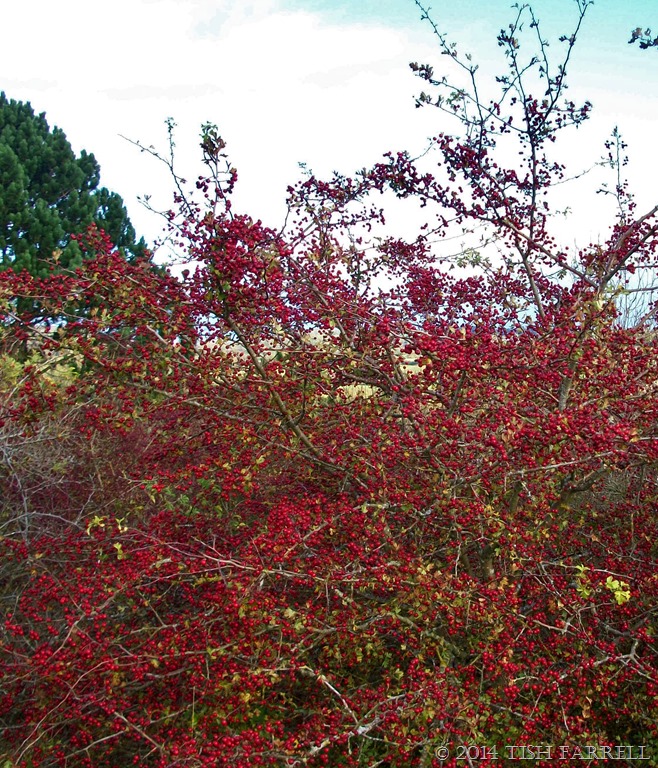
Now disused, the workings are screened by conifers, and also by this astonishing display of hawthorn berries. Plans to turn the site into a diving school with log cabins seem to have to been dropped.
At the foot of Windmill Hill is the Gaskell Recreation Ground, or Linden Field. Having long been used for village cricket and bowls, it was bequeathed to the people of Much Wenlock in the 1930s by a descendent of the Gaskell family who owned much of Milburga’s former domain. It was here too, from 1850 that the first modern Olympian Games took place every year, attracting athletes from across the country. The man responsible for reviving this prestigious sporting event was the town’s local doctor, William Penny Brookes.

Every year, thousands of visitors would come to watch the games, arriving on the Olympian Special train. The station was conveniently situated beside the field, the bringing of the railway being another of Penny Brookes’ successful projects for the benefit of Much Wenlock. The field was bare of trees in those days, so spectators could sit on Windmill Hill, amphitheatre-style, and have a fine view of track and field events.
Penny Brookes was also a campaigner of national standing. It was he who argued for the introduction of physical exercise into Victorian schools. He even did clinical trials to prove how young bodies grew well as a result of it. His fame spread, and in the 1890 Baron Pierre de Coubertin, charged by the French Government to improve the physique of the French army, came to Wenlock to see Dr. Brookes’ Olympian Games for himself. An elderly Penny Brookes apparently took this opportunity to share his ideas with the younger man, but sadly died four months before the launching of the first international Olympics in Athens in 1896. De Coubertin did, however, pay tribute to the Shropshire doctor’s vision:
” If the Olympic Games that Modern Greece has not yet been able to revive still survives today, it is due, not to a Greek, but to Dr W P Brookes.”
The Much Wenlock Olympian Games still take place on the Linden Field every July, and attract sportsmen and women from around the world. The Olympic Association also acknowledged Much Wenlock’s contribution to the modern movement with the naming of the Wenlock Mascot in the 2012 games.
*
But now here we are heading homewards, taking the path that runs down edge of the Linden Field, and beside the old railway line. Here William Penny Brookes left another legacy. He planted an avenue of lime trees – the Linden Walk. Many of the trees are around 150 years old and still going strong. The scent of the blossom in summer is transporting, but the walk is beautiful any time of the year. It is one of the town’s many treasures, and accessible to all.

As I stopped to take this photo, a young woman went powering past me, clearly in training for some event. But as you can see, that man is also there again. It is a puzzling phenomenon – how he is ever in my sights.
copyright 2014 Tish Farrell
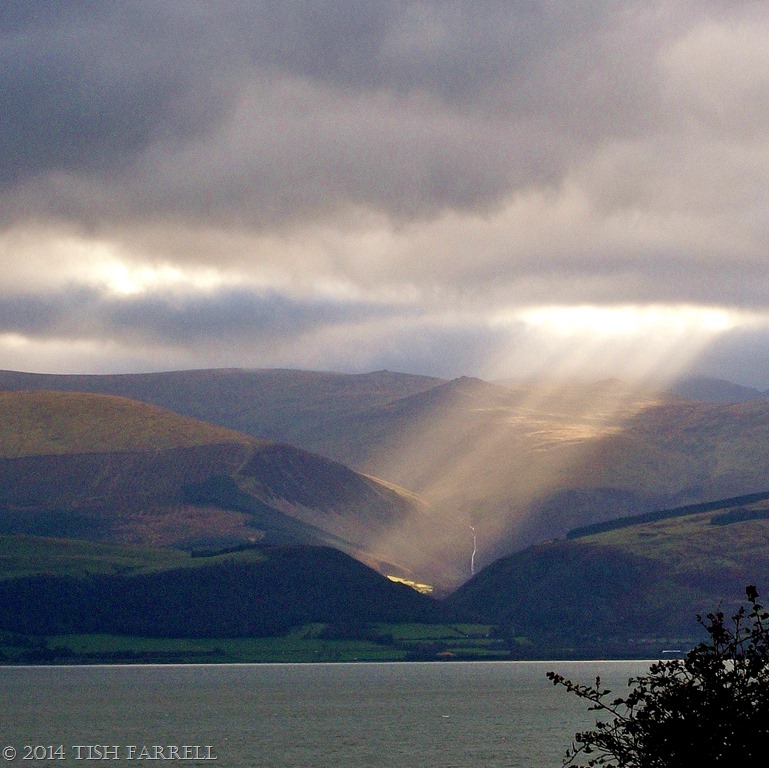
Christmas Day and it was almost dark at noon. And then, most eerily, the sun broke through a skylight in the cloud, lighting up a thread-like silver waterfall, and a single golden meadow.
Snowdonia, Wales across the Menai Strait from Anglesey (Ynys Môn )

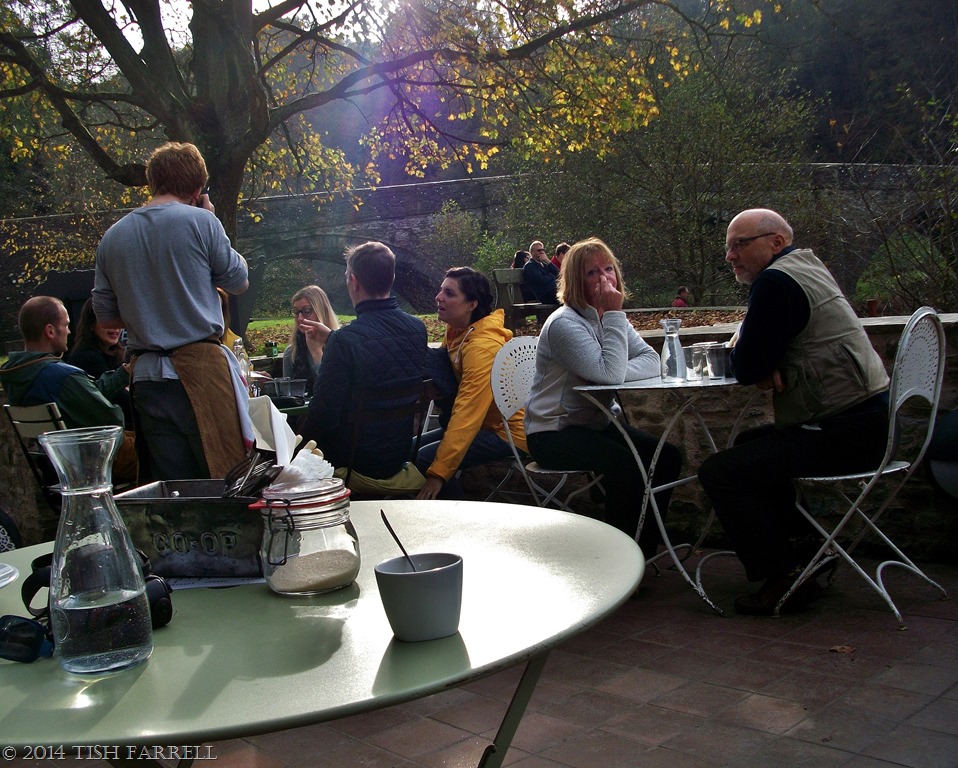
I was born on Halloween, so here I am today – not too scary I hope, wearing my autumn colours. The Team Leader snapped me by the bridge over the River Teme, in the ancient town of Ludlow, Shropshire. We went there for my birthday lunch.

It was warm enough to eat outside at The Green Cafe, a wonderful little restaurant that sits on the riverbank between the bridge and the weir. It serves divine food in rather cramped quarters, because it is simply so popular (voted third best in Ludlow, which is quite something in the foodie capital of Shropshire).
*
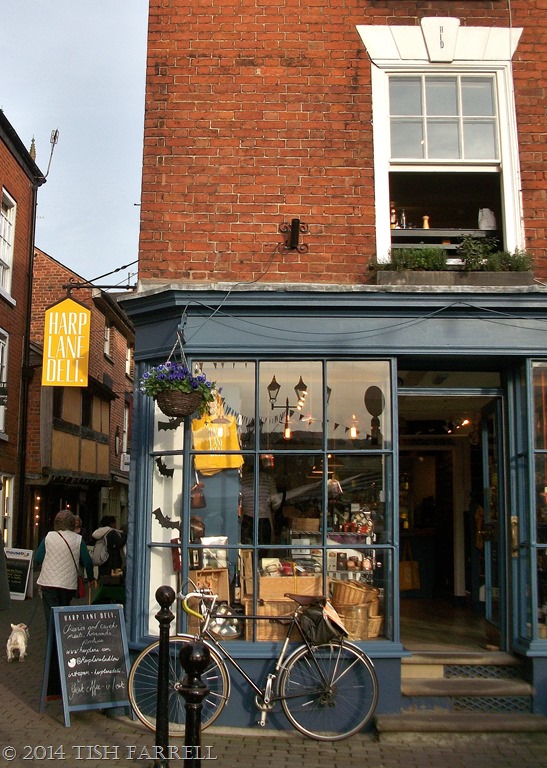
After lunch we wandered around ancient streets that were full of autumn sunshine.
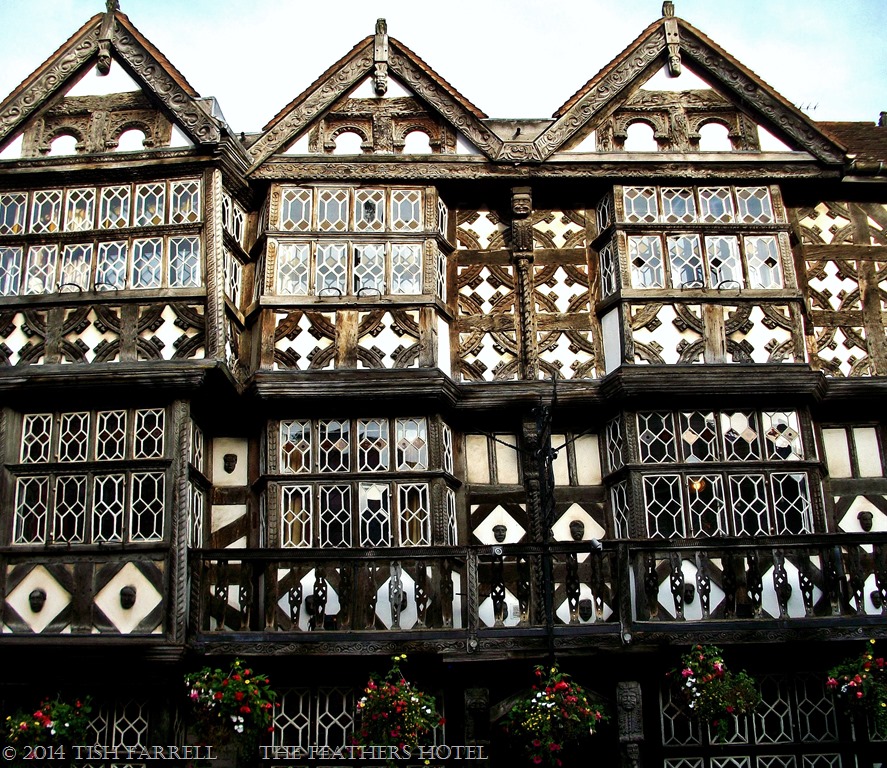

Happy All Hallows Everyone
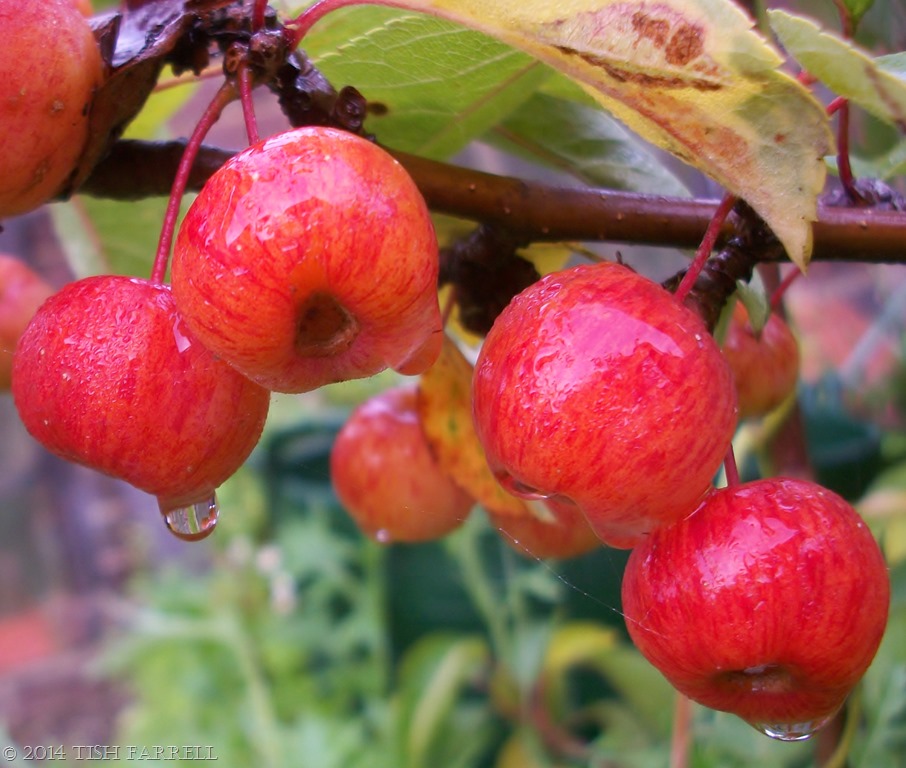
We planted the Japanese crab apple tree in the garden in 2006, not long after we moved into Sheinton Street. Now is its season of fiery scarlet glory. Each fruit glows like a miniature lantern, brightening the gloomiest autumn day. And today is just such a day in Much Wenlock, my usual sky-view over Wenlock Edge, a blanket of grey mist. Even so, the apples glisten. I know, too, as we head into winter, we will have the pleasure of watching the blackbirds come to feed on the fruit, grey days then enlivened by their darting silhouettes foraging among the branches. Few of these tiny apples will be wasted. And then before you know it, the tree will be bursting with purple-pink buds that open in showers of pale blossom. Spring. Splendid how one thing leads to another.
copyright 2014 Tish Farrell
For more studies in scarlet, visit Jennifer at One Word Photo Challenge: Scarlet

I may be wrong about this, but doesn’t John Barry’s Out of Africa film score owe just a little something to George Butterworth’s Shropshire Lad Rhapsody? Both works ride on a swell of yearning for a life, a love, a land that is lost or unobtainable. Both composers are English, and Barry probably knew Butterworth’s small body of very English song-cycles. (Butterworth died in 1916, a casualty of World War 1).
Of course, the influence of one composer upon another is common enough, and could well be subconscious. On the other hand, Barry might have chosen deliberately to nod to the earlier work. There are many reasons to do so, and it all begins with that other very English creation, the collection of poems called A Shropshire Lad, by A.E.Housman, the work that inspired Butterworth’s Rhapsody and the several Housman poems that he set to music.
I have written elsewhere how this collection of ballad-type poems inspired several composers in their works, and not only Butterworth, but also Vaughan Williams and Ivor Gurney. At the time when I wrote that post, I had not thought about the Out of Africa film connection. But now I have thought of it, my interest is rather personal.
Firstly, as a writer who has worked with several illustrators, I like the way one artist’s creativity can provide inspiration for other artists’ work. Indeed, when it comes to A Shropshire Lad, there is a veritable multiplier effect of allusion and quotation in other works throughout the twentieth century. This includes Dennis Potter’s disturbing play Blue Remembered Hills (A Shropshire Lad poem XL).
Secondly, Housman’s poems, and in particular the music they inspired, make reference to Wenlock Edge and the town of Much Wenlock where I live.
Thirdly, I have also lived in Kenya, the country that inspired Karen Blixen’s Out of Africa.
And fourthly, in the script of Sydney Pollack’s film of the same name, which derives more from the biographies by Judith Thurman (Isak Dinesen) and Errol Trzebinkski (Silence will Speak) than from Karen Blixen’s book, includes two very striking quotations from A Shropshire Lad.
Both arrive towards the end of the film, and both relate, directly and indirectly to Denys Finch Hatton, Karen Blixen’s lover who died in an unexplained plane crash at the age of 44. For more of their story go HERE.
The first and most heart-rending is at the burial of Finch Hatton up in the Ngong Hills. Meryl Streep as Karen Blixen reads, not from a prayer book, but from a book of poetry, and the poem she reads is poem XIX To An Athlete Dying Young. This is the final stanza:
And round that early-laurelled head
Will flock to gaze the strengthless dead,
And find unwithered on its curls
The garland briefer than a girls.
(You can read the whole poem HERE)
While I can find no biographical reference that supports the reading of the poem at the actual burial, I can only say that it could not have been more aptly chosen. In other words, if it is a Hollywood invention, then it is a good one. It adds to our understanding of both Blixen and Finch Hatton in real life.
Denys Finch Hatton had rare glamour. He was man who was adored and admired by men and women alike. He was a consummate sportsman, a soldier, hunter. He was an elusive adventurer and the son of an English Lord. As a great lover of poetry he would doubtless have known A Shropshire Lad very well. More importantly, he is said to have had a pathological fear of growing old, and was ever to be seen wearing a hat once his hair began to thin.
In her biography of him Too Close to the Sun, Sarah Wheeler makes the analogy with Icarus. This too is apt. With his shocking death, burned in his plane, the self-regarding sheen of aristocratic settler life was diminished. The film’s burial scene thus prepares us for Karen Blixen’s final exile from Africa. Loss piles on loss.
Before she leaves the country, the film shows her being treated to a drink in the ‘gentlemen only’ bar of Muthaiga Country Club, a restriction which she apparently infringed when first arriving in British East Africa. The toast she gives her hosts is one said to have been used by Denys: ‘rose-lipt maidens, lightfoot lads’. This comes from poem LIV:
With rue my heart is laden
For golden friends I had,
For many a rose-lipt maiden
And many a lightfoot lad.
*
By brooks too broad for leaping
The lightfoot boys are laid;
The rose-lipt girls are sleeping
In fields where roses fade.
So where are these quotations taking us? What exactly is being evoked by their appearance in the film script?
It all comes back to the unobtainable or unclaimable: of the lost life, love and land that I mentioned in the beginning. The settlement by British and European aristocrats of British East Africa (Kenya) in the early years of the last century was an epic romance, one filled with the notion of noble master and faithful ‘noble-savage’ servants. There was the pitting of human courage and wits against the African wilderness; a wilful dance of death wherein sporting valour was supremely admired. There was a notion of overbearing entitlement; that East Africa was their own country; that only they understood it. As a dream, it was bound to fail. It is a visceral longing for something that cannot be possessed.
For Housman the loss was for a love he could not have: another man. He was a respected academic who ultimately lived as a recluse. He wrote the entire collection of 63 poems while living in London, and without setting foot in the part of Shropshire that he evokes. Of this anomaly he makes the terse comment that, having grown up in the neighbouring county of Worcester, “Shropshire was on our western horizon which made me feel romantic about it.”
And here is where Out of Africa – book, film, and the true lives behind, find common ground with A Shropshire Lad; the ‘I had a farm in Africa, at the foot of the Ngong Hills’ moment; the sense of tragic romance, ‘The happy highways where I went and cannot come again.’ Those ‘blue remembered hills.’ The human condition of longing for something we think we had, or should have, but never can.

And finally then the music. Below are renditions of Butterworth and Barry. (The first begins with the song Loveliest of Trees, poem II, from which the orchestral piece derives). Compare and contrast, or simply ride the emotional tsunami – across Africa, or Shropshire, or wherever you think your lost Paradise resides.
Related:
Songs from an Inland Sea: “On Wenlock Edge”
Caught inside a Kikuyu Garden: A Memorial to Karen Blixen’s Lover, Denys Finch Hatton
A E Housman A Shropshire Lad A Gutenberg e-book
Copyright 2021 Tish Farrell
By Tish Farrell:

Things are going from bad to worse in Ingigi village. No one knows why five-year old Kui has gone missing. Nor does Sergeant Njau want to find out. He has his own problems, pressing matters that are far from legal. Then there is the endless rain. Will it never stop? Some Ingigi folk think it means the end of the world. Old man, Winston Kiarie, has other ideas. He senses some man-made disaster, and when it happens, it is worse than his worst imaginings. The fierce storms are causing landslides and throwing up British bombs, unexploded for forty years. Their discovery is giving the Assistant Chief ideas: how to make himself very rich. And then there’s young Joseph Maina and the primary school drop-outs thinking they have found treasure, and about to do something very, very foolish. Meanwhile, is anyone looking for Kui?
“Losing Kui” is a fast-paced novella of interwoven tales. There are secrets, conspiracies, tragedy and dark comedy. The setting is a fictional East African country in the late 1990s, a time when El Niño rains were causing havoc. The author lived in Kenya during most of the 1990s, and much of the story was inspired by real events.
5 star reviewed
