Giraffes And Other Animals ~ Graceful In Their Own Unique Way

200

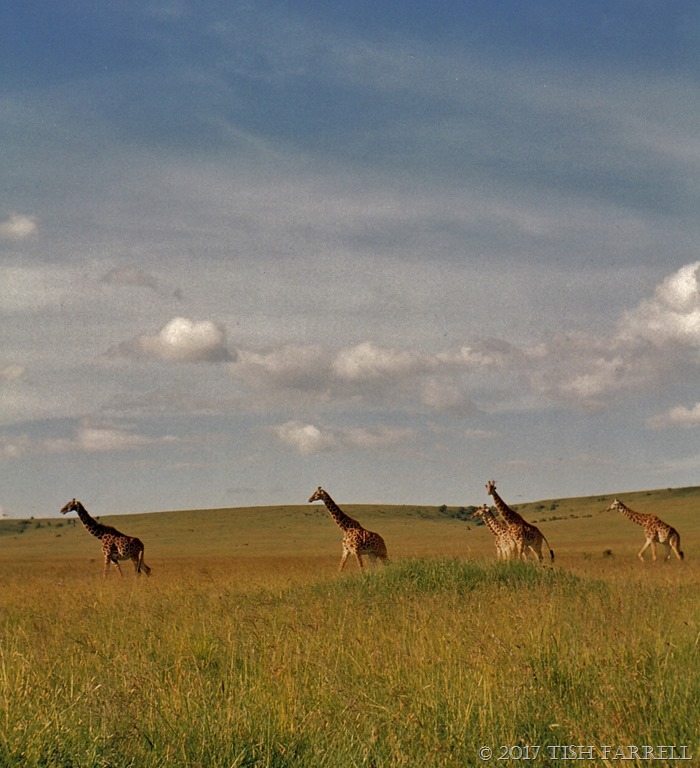
This week’s Daily Post photo prompt induced a ‘long ago when we lived in Africa’ moment, and thus a nostalgic trawl through the old photo files. It was giraffes I first thought of. They may seem an ungainly composite of various creatures, but to see them moving across the plains is a sight that cannot be forgotten. They lilt in time to some inner rhythm of their own. This is more apparent when you see several moving together. And you wonder what is this giraffe music, beyond your hearing, that they stride forth to with such synchronicity?
IMG_0027

Some of the plains’ song you can hear of course – the wheesh of dry grasses, the ceaseless koo-kroo-ing of collared doves, the crickets’ whine. And as you scan the bush country, looking for any signs of wildlife, these are the sounds that fill your head. The sun is hot on your scalp, the light too bright, and the spicy scent of thorn trees too rich for the over-sensitive. But just when you think all the game has gone and there’s nothing more to see, magic happens:
Scan-130429-0031

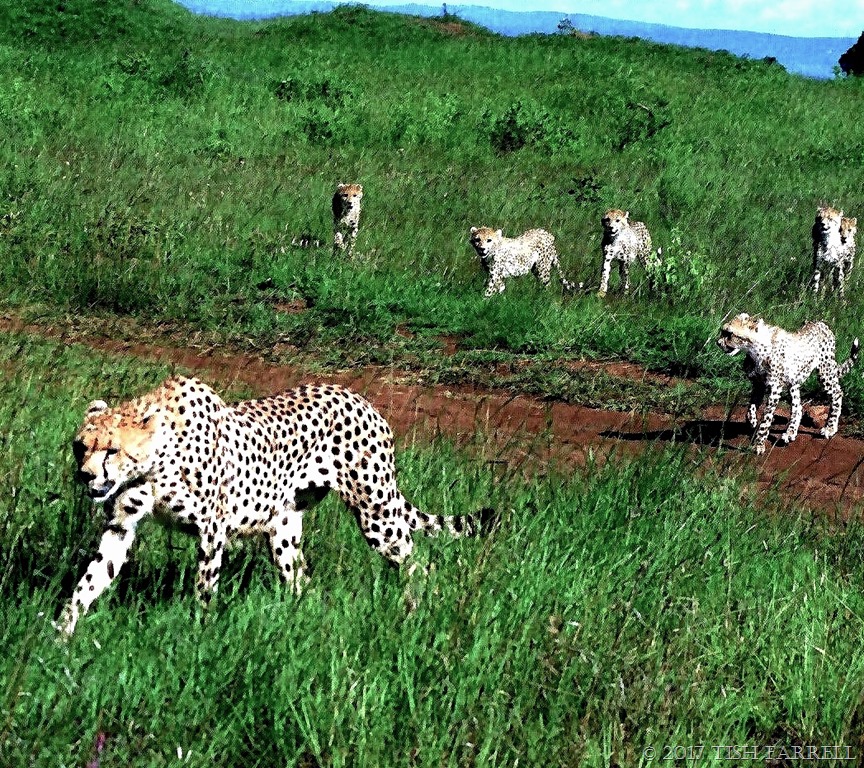
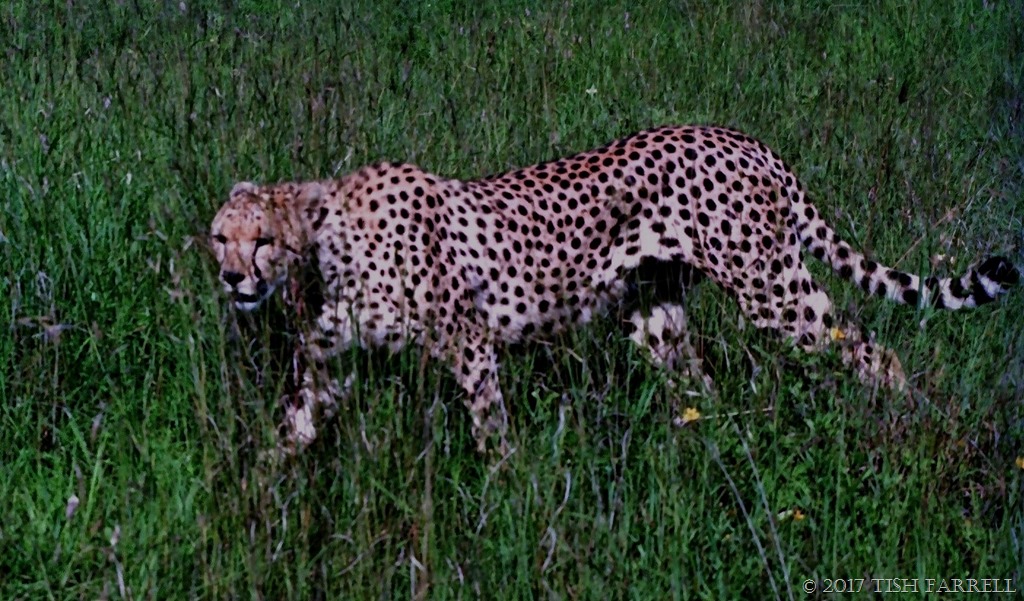
This cheetah mother with six half-grown cubs, walked out of the undergrowth beside the park track. When we stopped the car to watch she didn’t so much as blink at us. It seemed we were the least of her problems. She was trying to make the cubs stay in one place while she went off to hunt. But they were not having it.

IMG

No sooner had mama parked them and moved out sight, than one (there always has to be one) goaded the obedient ones out of the cover that had sheltered them until they all decided to follow.

IMG_0003

In the end, mama gave it up as a bad job, and gathered the offspring and disappeared into the bush. It is a mystery how she had ever managed to rear so many teenage cubs.

These photos, sadly ageing, were all taken in Nairobi National Park, a gem of a park that borders the city. It covers only 46 square miles, but when we lived In Nairobi during the 1990s the wildlife corridor to the south was still open, allowing for seasonal migration. Today there are all kinds of pressures from one of the fastest growing conurbations in Africa – the need for farm land and for better transport links. It’s a thorny issue however you look at it – wildlife versus humans: probably no happy solution; gracefulness seems not to be a natural human trait.
Scan-130429-0032

copyright 2017 Tish Farrell


Daily Post Photo Challenge Graceful
Meet T’owd Man ~ AKA The Old Man Of Wirksworth

IMG_3500

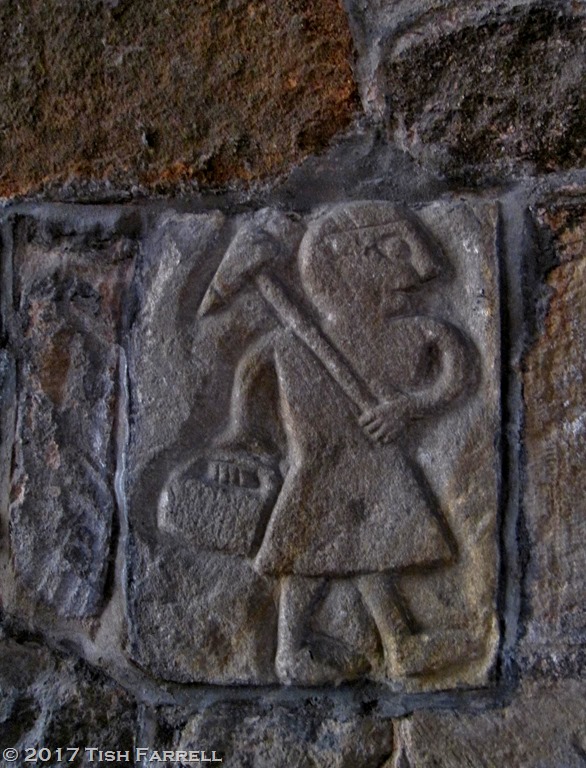
He is said to be 800 years old, or thereabouts, this mythic little figure of a lead miner with his pick and kibble (basket). He is presently to be found embedded in the wall inside St. Mary’s Church in the Derbyshire Peak District town of Wirksworth. But this was not his original home. He once lived in the nearby village of Bonsall, where he was found during the restoration of the 13th century  parish church of St. James. This was in 1863, and it was then that T’owd Man found his way (along with other pieces of interesting medieval stone work) into the garden of one Churchwarden Coates.

This highhanded commandeering of the local lead miners’ talisman did not please the general populace, who wanted him restored to sacred territory. Somehow in the argy bargy he ended up being firmly mortared into the wall of St. Mary’s Church in Wirksworth instead – where he has remained ever since for his own good and general safekeeping. He has also become the town’s ‘unofficial’ symbol, so you can pay him a visit, AND get the tee shirt.

But this story of general displacement is making me wonder. What  if T’owd Man is a good deal older than is currently thought.  I’m assuming his 13th century date was given him because he was found in a church of 13th century origins. But to my eye he could easily be a Saxon carving. What if the medieval builders of the Bonsall church had also recycled him?  (There are in fact many examples of Saxon carving within St. Mary’s, all re-deployed from an earlier church. See my post Expressions of Power  ~ Secular and Spiritual? for more of the background history).

Lead mining was a key industry in the area from at least Roman times. There is also documentary evidence of its importance in Saxon Wirksworth. In 835 the township was ruled by Abbess Cynewaru, and in a missive of that time she states that she was every year sending a gift of lead valued at 300 shillings to Christ Church, Canterbury. Much later in the Domesday Book of 1086 the entry for Wirksworth includes 3 lead works.

Wirksworth was in fact the centre for the trade. It was a hard and dangerous business. The miners were also a maverick lot. Many were yeoman farmers who combined hill farming with lead working, and some grew extremely rich on the trade, although many died from explosions in the mines, and the general toxicity of working with lead.

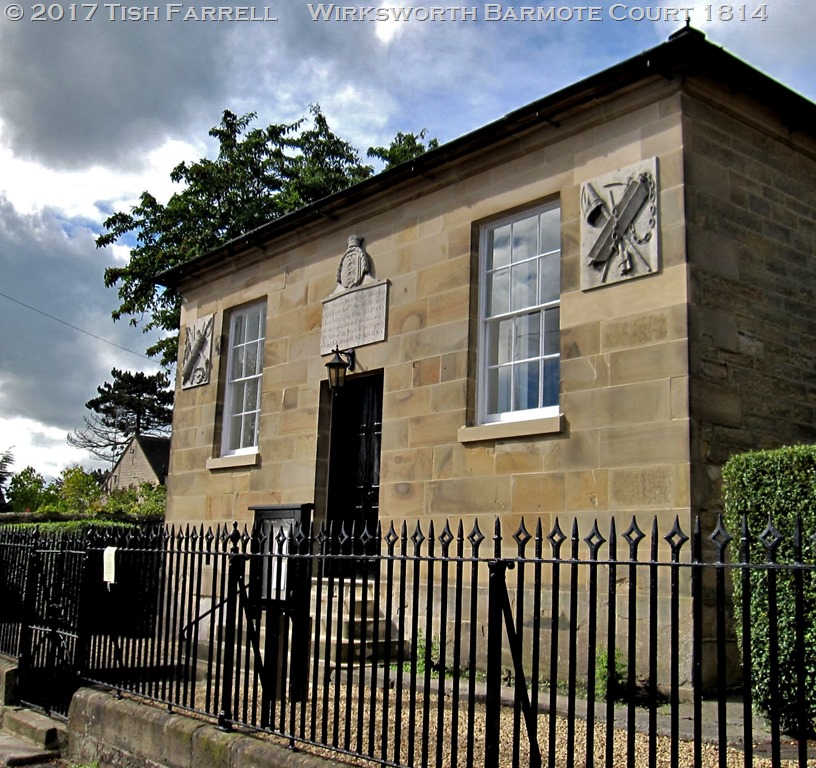
All the miners’ activities were subject to a system of rigorous rules and regulations overseen by the Barmaster of the Barmote Court. This court was held in Wirksworth for at least 7 centuries, and had its origins in Saxon Burg Moots (moot is Saxon for gathering or assembly). The last version of the court or Moot Hall still survives. It was built just out of the town centre in 1814 to replace a grander Moot Hall that stood in the Market Place. It seems the noisy behaviour of the miners, and the congestion they caused in the town centre, led to the earlier building being demolished.

IMG_3436

Wirksworth is a fine town for a visit. Its many surviving seventeenth and eighteenth century houses attest to the general prosperity of the place over many decades.  When the lead ran out in the 19th century, limestone quarrying replaced it. Rivers were harnessed to power cotton mills, and so the industrial age kicked in. And if this smacks too much of ‘dark satanic mills’, don’t you believe it. The town sits in glorious countryside, in the heart of England, in fact at ‘its very navel’ as one-time resident D.H. Lawrence put it. Here, then, are some more views from England’s very green and pleasant navel:

This slideshow requires JavaScript.


copyright 2017 Tish Farrell

Thursday’s Special ~ Traces of the Past Check in here to see what Paula and other bloggers have posted.

Ambience ~ Come Right In, Make Yourself At Home

P1030035 - Copy

P1030041

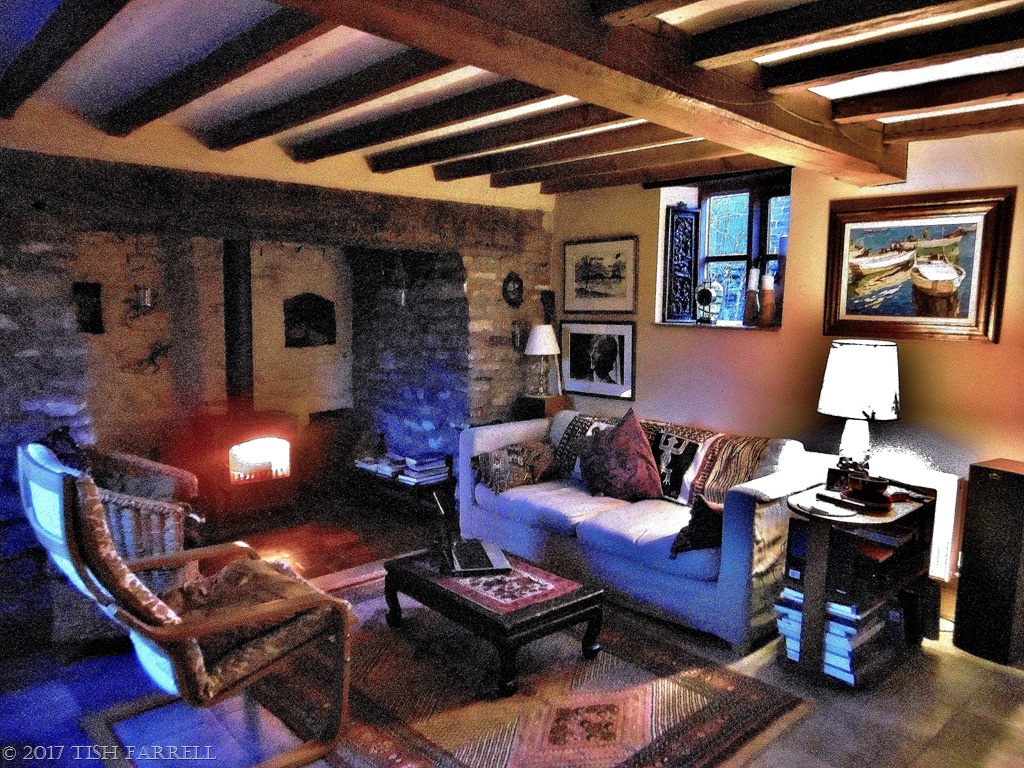
We don’t know a great deal about the history of our cottage. It seems it was built around the 1830s, and this room, with its large fireplace may have been some kind of workshop. The window was added in the 1980s after the place had been condemned, and then pretty much rebuilt. Originally, the back of the house was butted against the field bank – without footings or a proper floor. The privy was at the top of the bank beside the field, and to reach it you had go out of the front door, round the house and up the garden.

Back then, too, the house was basically a barn, the upstairs subdivided into two rooms with thin boards, and downstairs probably one open space. The owners who did the restoration work turned it into a two up, two down, and added a small upstairs bathroom. The next owners built on another room up and down, and installed the spiral staircase which featured in an earlier post. When we moved in ten years ago, we turned the new downstairs room, which hadn’t been used for any particular purpose, into the kitchen. The heart of the home of course. Which reminds me – I’d better scoot back there. I left some stock cooking on the stove about an hour ago.

P1030027

Ambience

On Top On Llanddwyn Island ~ Black & White Sunday

P1060365

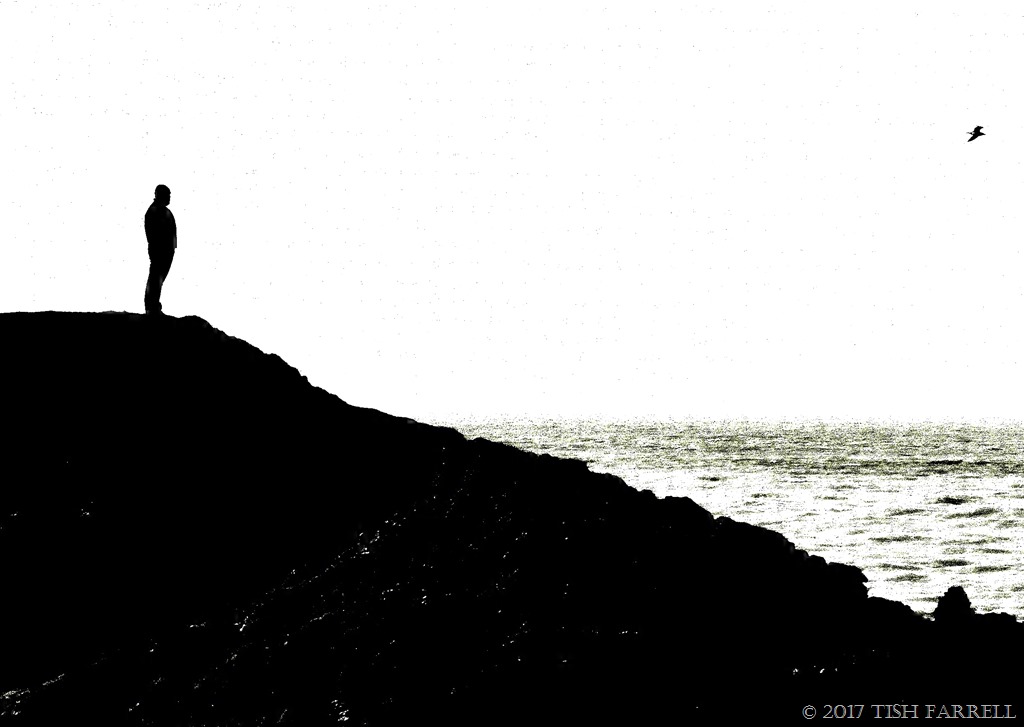
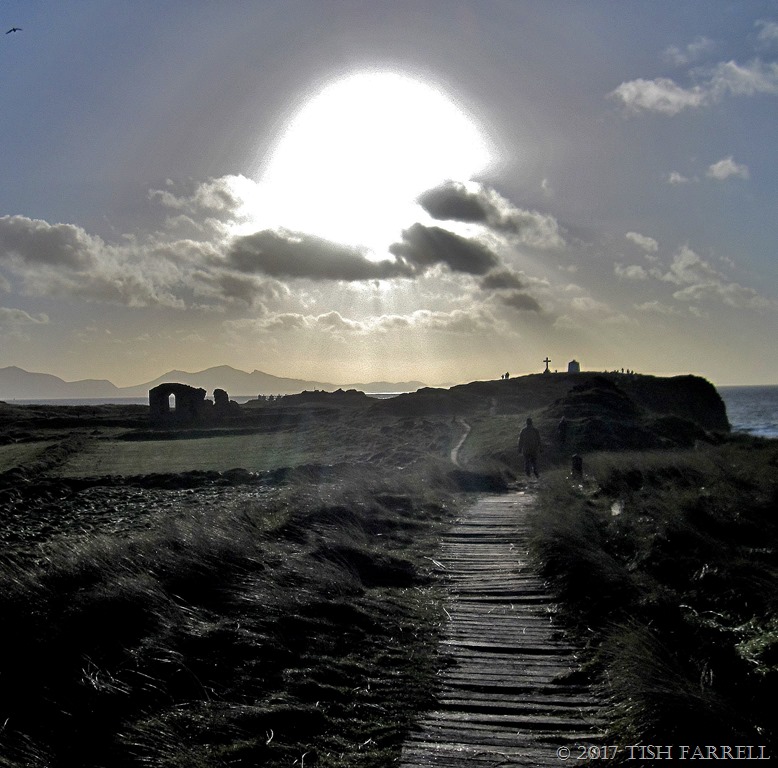
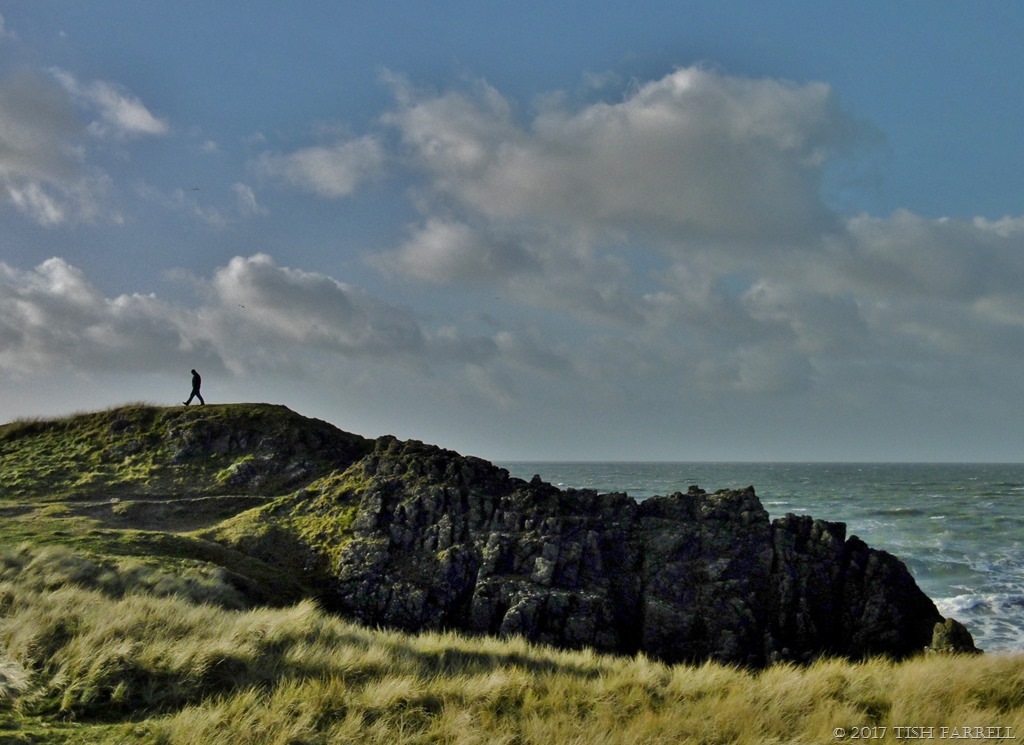
Here’s another view of, and from Llanddwyn Island, taken on our recent trip to Anglesey. It was snapped on high zoom in high wind and thus has pixilation tendencies, much like the snapper, some might say. So I edited it to exaggerate the silhouette effect. I anyway like the stance of this unknown man on the cliff top. He is so well rooted against the gale; so absorbed by the seascape.

I’ve written more about the island’s story at To the Isle of Dwynwen, Welsh Saint of Lovers.

Now please visit Paula at Lost in Translation. Her rendition of this week’s ‘on top’ theme is stunning.

Moving Pictures ~ Wales Through The Windscreen

P1060737 (2)

P1060737

P1060737 - Copy (2)

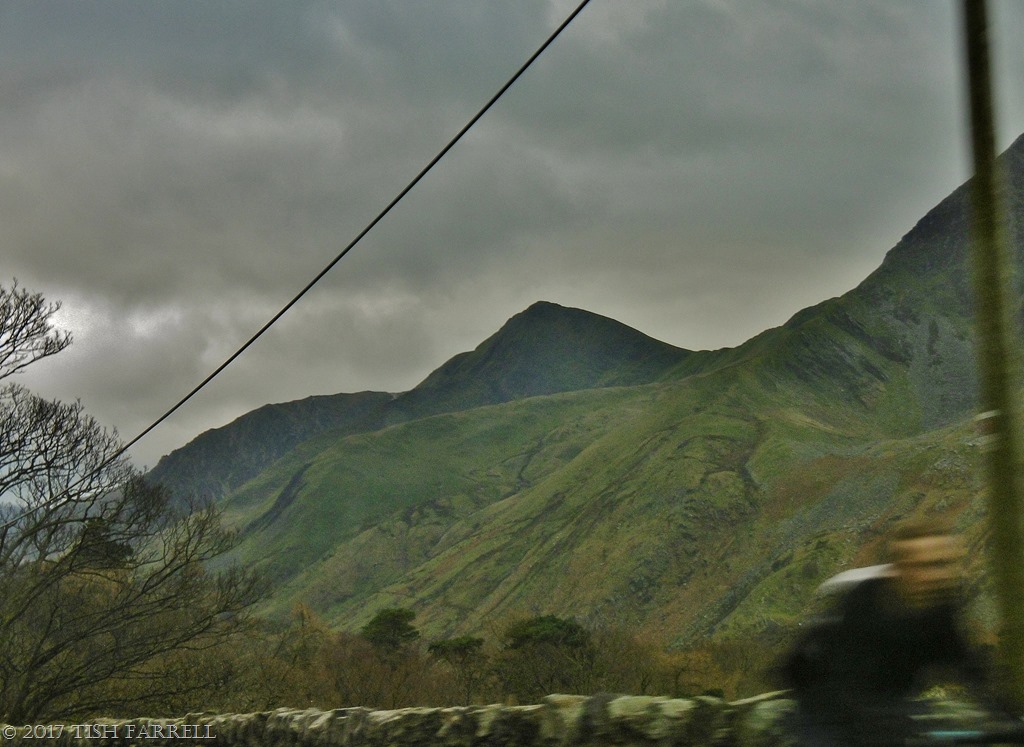
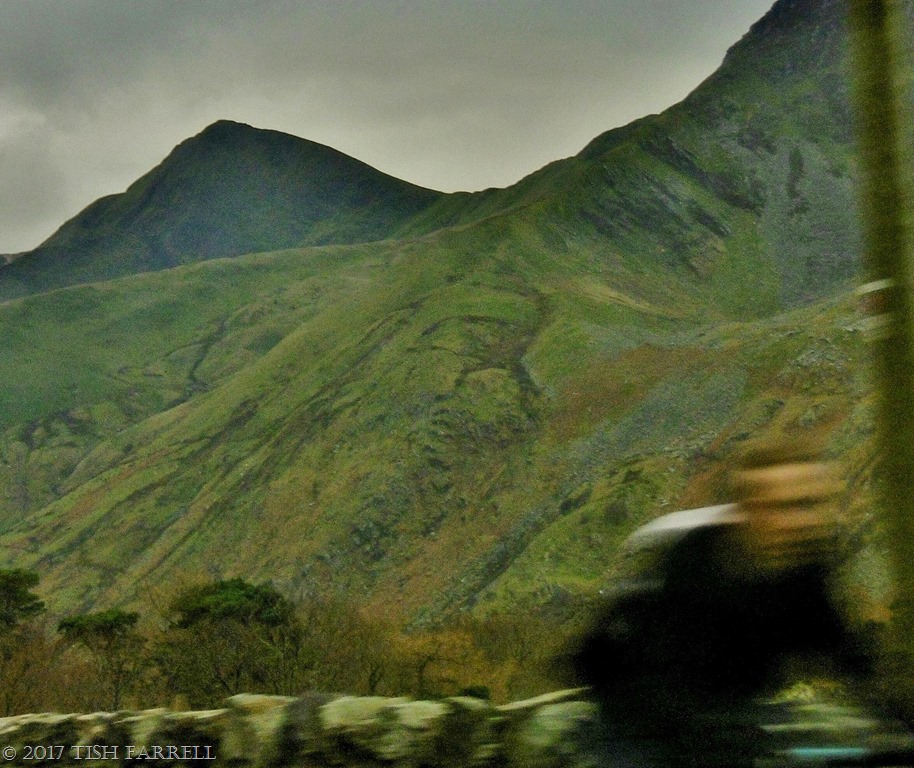
Nowhere does brooding gloom like Wales on a wet winter’s day. This happenstance shot was taken on New Year’s Eve as we were motoring home from Anglesey. I’d propped my camera briefly on the car dashboard as we’d headed through the mountain pass to Capel Curig. Then randomly pressed the shutter and so caught the cyclist.

This week at Lost in Translation Paula asks us to show her ‘unfocused’. She kindly says she doesn’t mind ‘happy accidents’, so here is mine.

Early Morning On Menai Strait

P1060515

I like the notion that everything is moving in this apparently static image: time, tide, clouds, shadows, light, the ash tree, me. And maybe even the mountains across the water.


Photo snapped in Dynamic Monochrome setting. For a very finely composed rendition of the theme ‘passage’ visit Paula at:

Black & White Sunday: Passage

A Sea Full Of Sky

P1060448

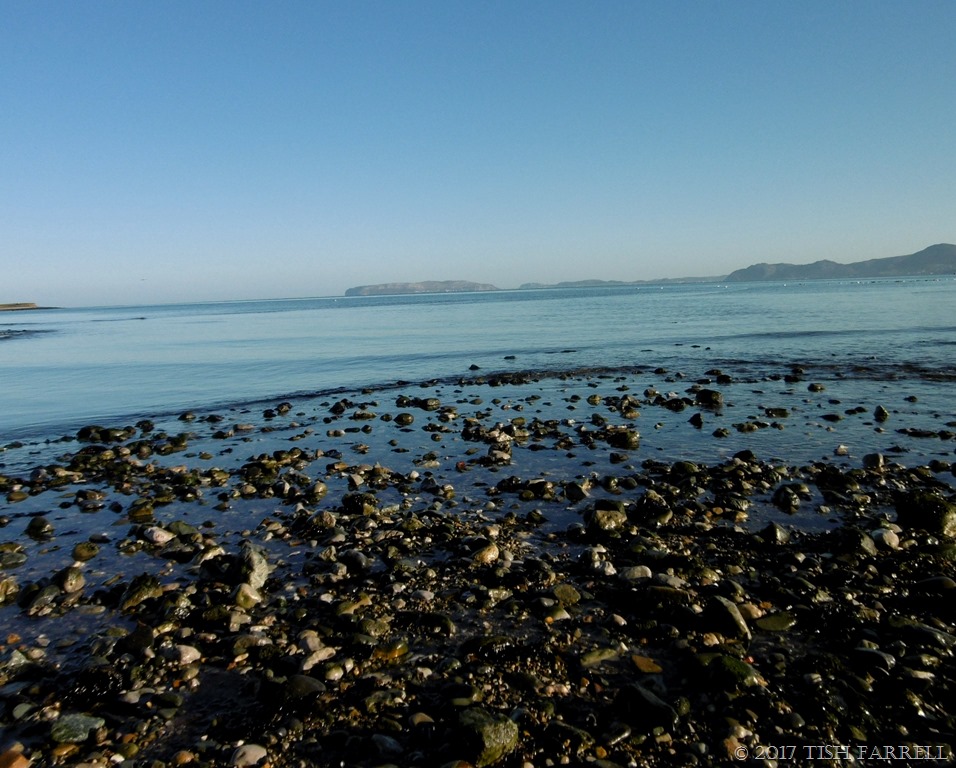
What a blessed scene. We could scarcely believe our eyes – a sea so still, so blue, and sky to match; the Great Orme slumbering on the horizon, and all this happening just last week on the Menai Strait, North Wales.

I love winter beaches whatever the weather, but this vista seemed to awaken a whole new plane of perception. I could see why the Celtic Druids made Ynys Mon their stronghold. You never do know what the light will do next. It is transporting.

The little boy and his dad seem caught up in the magic too. So it’s a good thing that the Great Orme is slumbering; for this Viking name for the limestone headland means sea serpent, and we don’t need him abroad disturbing the tranquillity.

It’s an odd thing, though, about that particular promontory. The weather along the Strait may be foul, but more often than not, there’s a beam of sunlight slanting down on the Great Orme. Perhaps it is all part of an enchantment that keeps the mighty serpent dormant. Sleep on, Great Worm. Dream and dream between sky and sea.

P1060459 - Copy (2)


Thursday’s Special  This week Paula has given us five words to fire up our New Year imaginations. I’m using two of them here – the sea permeated with sky colours, and the limpid waters of Menai Strait. Follow the link to find out more and to see Paula’s fine photos.

Llanddwyn Bound ~ Crossing To The Isle Of Lovers

P1060383

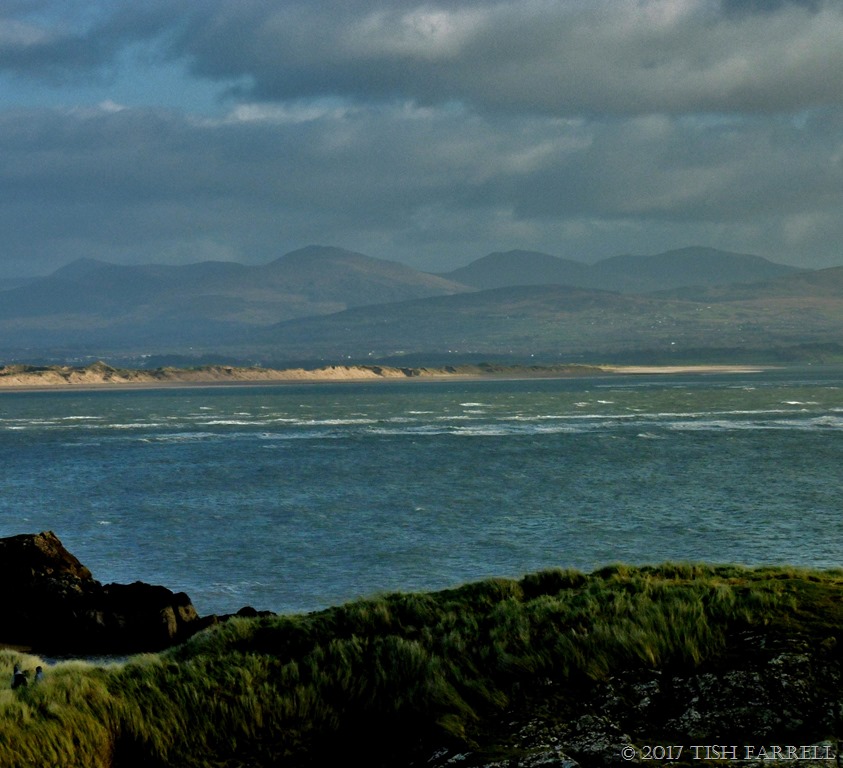
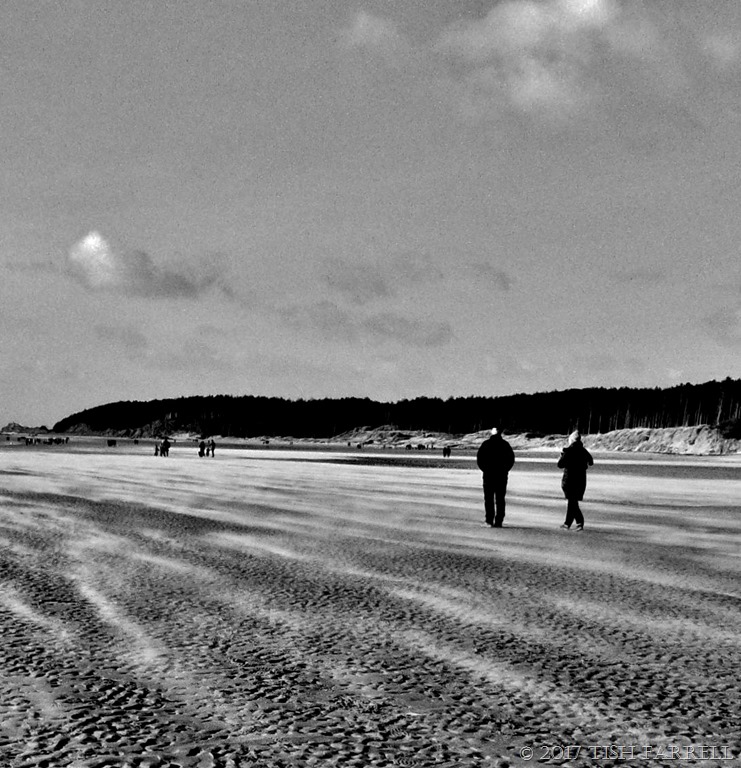
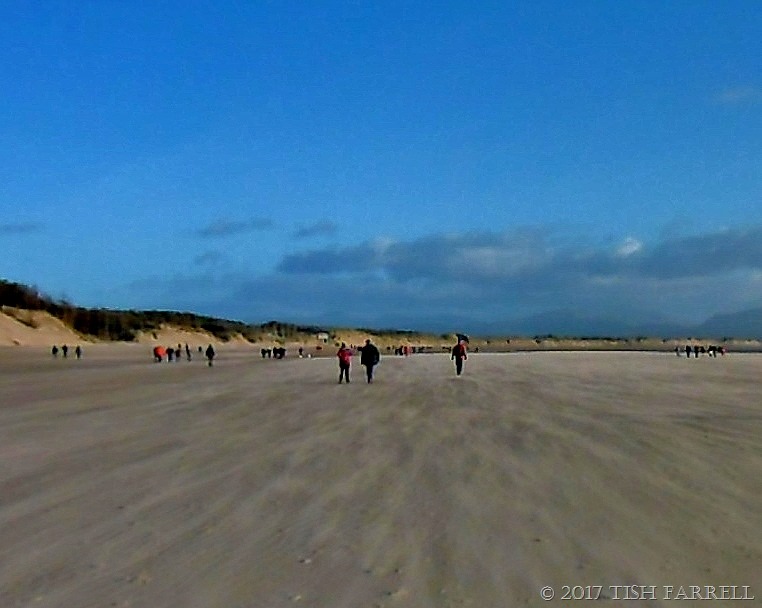
It was blowing a gale, wind like ice on our faces. But that did not stop us – nor a hundred like-minded souls, all intent on the secular pilgrimage of walking off Christmas Day excesses, giving the family dogs a much needed airing, and heading to Llanddwyn Island while the tide was on the ebb. Anyway the sun was out, the light crystal bright, and the mountains of mainland Wales across Menai Strait looking their dreamy best. So why wouldn’t you head for the sea shore.

Newborough Beach was positively crowded. Not only that, the sands were coming to meet us as we set off to the island. It was the strangest experience, which along with eyes full of wind-tears played havoc with one’s perceptions. It was rather like going backwards on a forward moving pavement.

P1060353

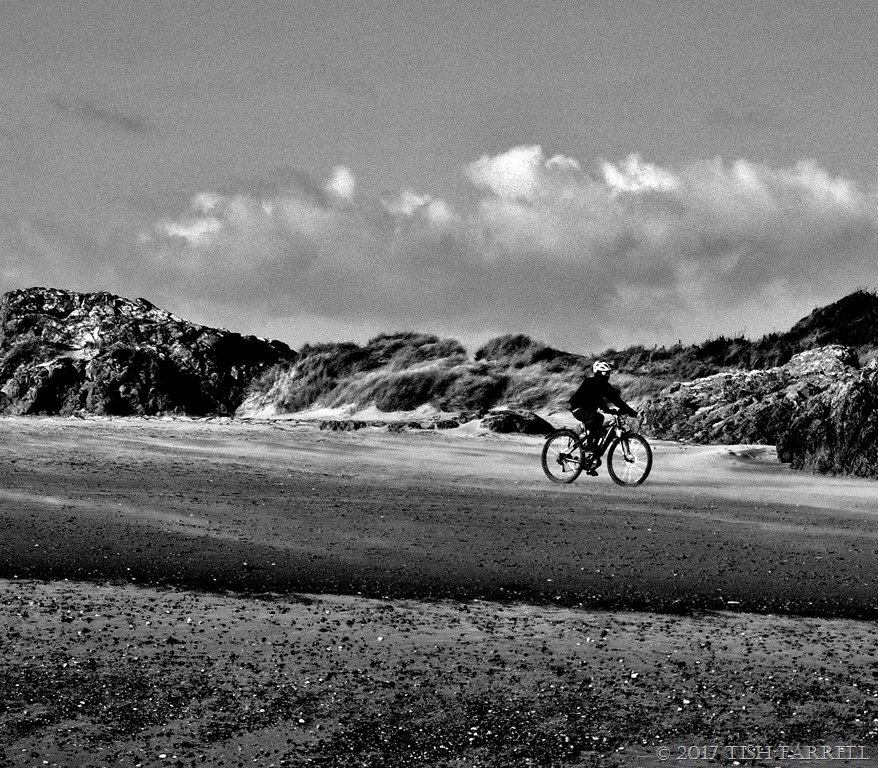
And so at this point, seeing a chap on a bicycle seemed most surreal. But then why not ride your bike on the beach? So much space. No grouchy motorists on your tail. All that sand for a soft (well soft-ish) landing.

P1060354

I’ve written about Llanddwyn (roughly pronounced ‘hlanthwin’) Island before. We were here two years ago, on Christmas Day, but then the tide was too high for us to reach the island.

In fact it is not an island at all, but a long, slender peninsula, poking out into the Irish Sea like some dragon’s  tongue. And it was here that St Dwynwen, daughter of a Welsh king, withdrew from the world to form a convent. This was in the fifth century, around the time that Roman rule in Britain was coming to an end. You can read her story at the link above, although there are many versions, and they mostly have to do with spurned or thwarted love, and so are used to explain how she came to be the Welsh patron saint of lovers. Her day is celebrated each year on 25th January.

During the Middle Ages, as poets and pilgrims were drawn to Llanddwyn Island, so the accounts of their visits helped grow  Dwynwen’s reputation for mystical powers of healing and divination. Even her well was said to be inhabited by sacred eels, and through the cunning reading of their movements, you might predict the future. On the other hand, if the waters boiled up during your visit you could be assured of love and good fortune.

We, however, were not enticed from the path to see this for ourselves. A very pungent odour wafting our way suggested something had died there. Perhaps the sacred eels? Instead we took the cliff path and enjoyed the thrill of stepping out above a stormy sea.

P1060364

P1060368

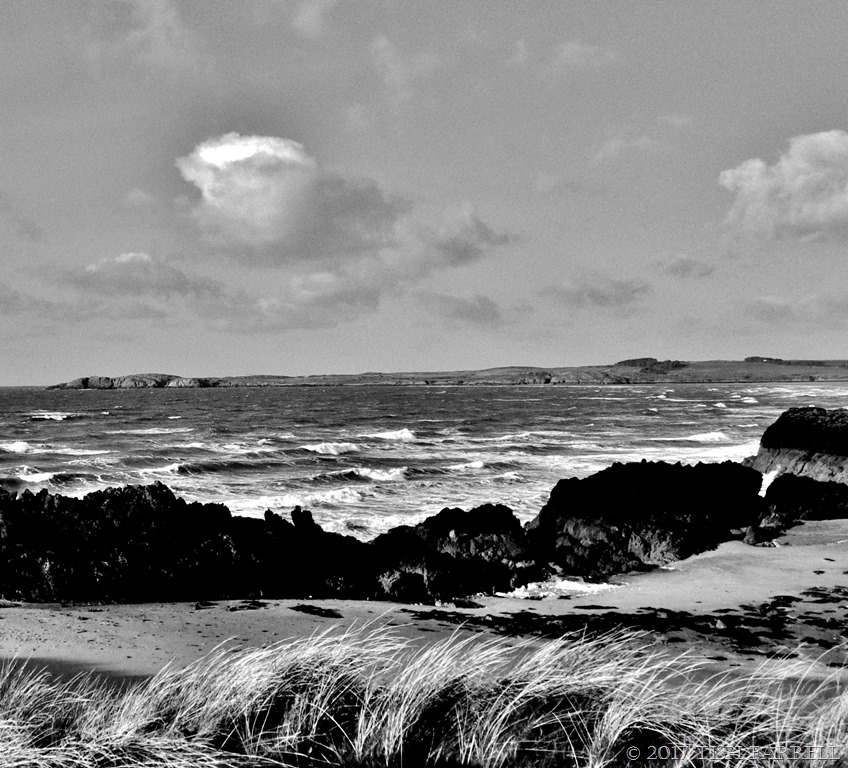
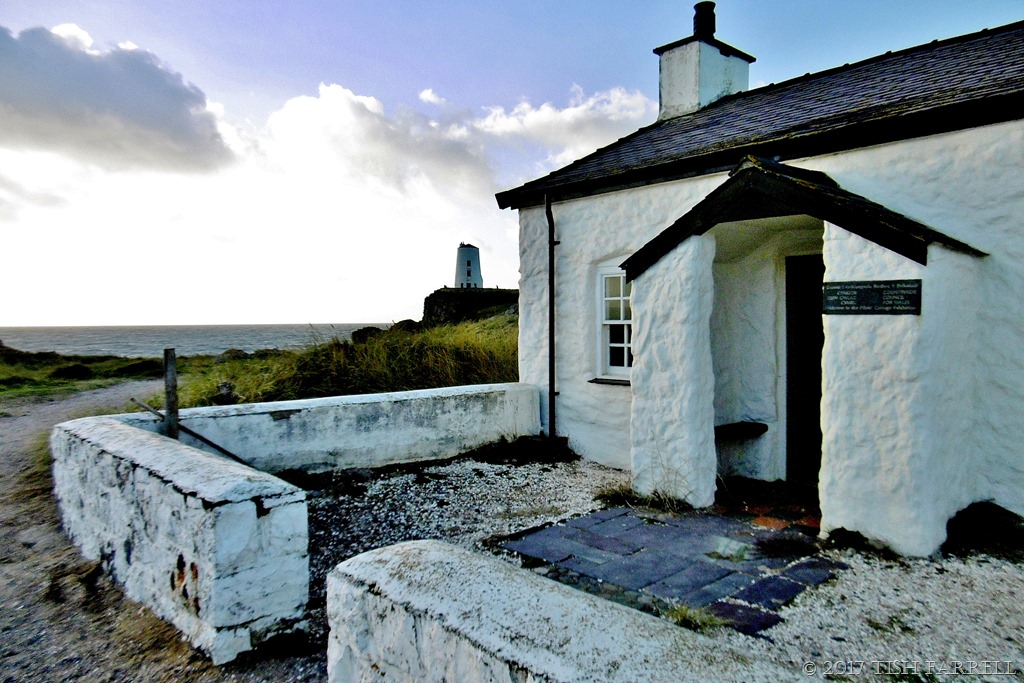
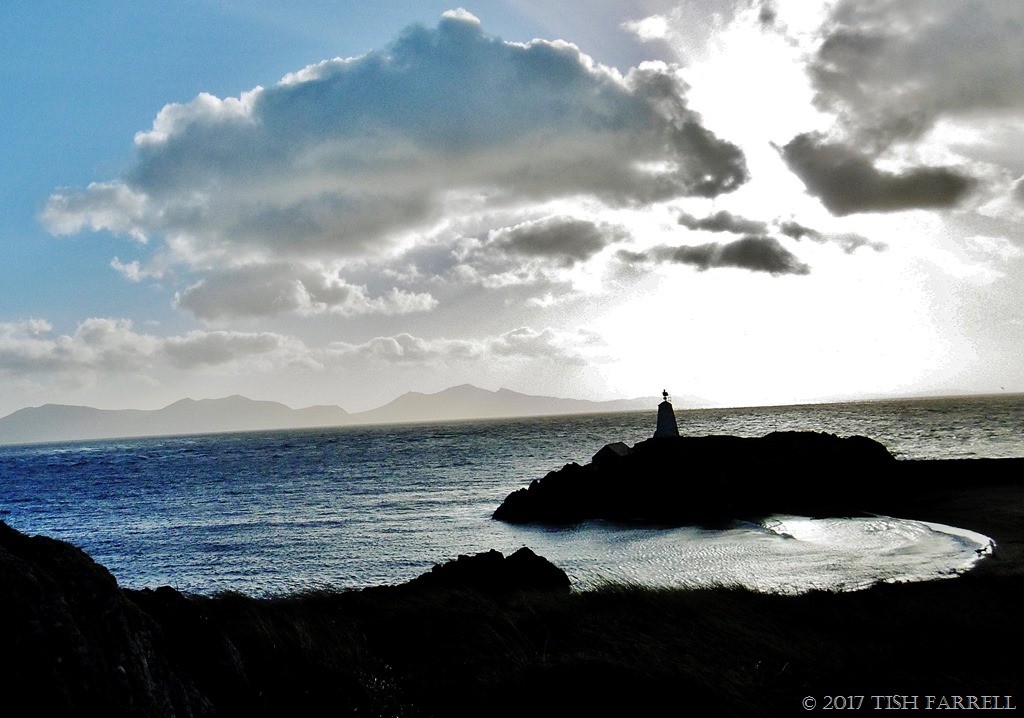
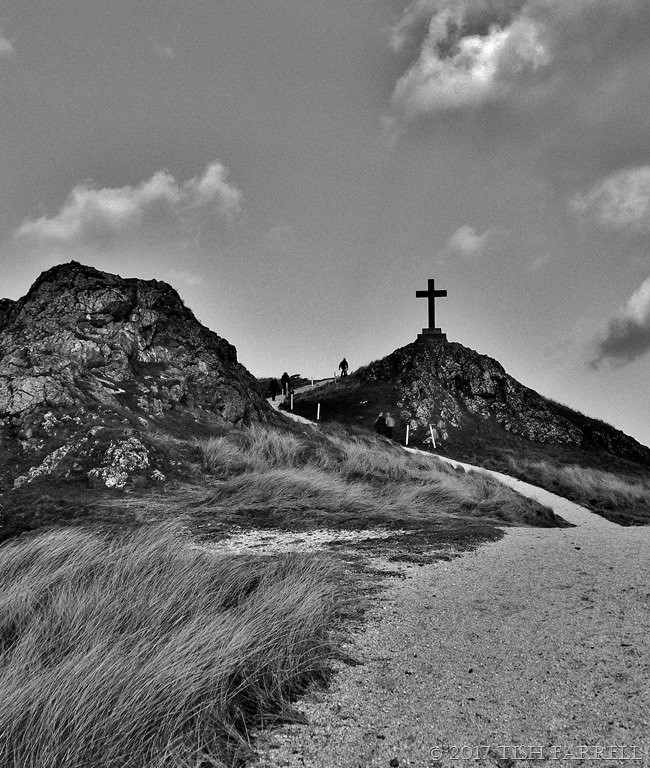
There is anyway much to explore on this small promontory. At every point, as the sea recedes, there are enticing coves – some rocky, some sandy. There are many man-made features too: a Celtic cross of nineteenth century vintage, another marking Dwynwen’s death in 465 C.E. There are the ruins of a Tudor church built on the site of Dwynwen’s own church which she apparently built herself from beach stones, and so doubtless did not stand the test of time and wild Welsh weather. There is also a beacon, a lighthouse and three cottages built for the lighthouse keepers and their families. In the nineteenth century the export of Welsh slate was a thriving industry, and the lighthouse served the slate ships in particular, keeping them off the dangerous Menai Strait sand bars.

P1060394

P1060396

P1060379

On the long walk back up the beach, the wind was behind us. Now we were walking with the moving sand. But it was still a very odd experience.

P1060409

Crossing

Last Year At The Allotment ~ Seasonal Highlights

Now is the time of year when gardeners head for their seed catalogues and start making plans for the growing season ahead. Seed potatoes must be ordered, and preparations made (i.e. brain put in gear so as not to miss appropriate time slots) for crops that must be sown early. It is also a good moment to review which of the last year’s crops grew best, and most importantly, which we most enjoyed eating.

Actually all the produce was delicious. We had loads of Early Onward peas, courgettes and salad greens. Beans thrived – French, borlotti, fava, runners, and Cherokee, as did the globe artichokes, raspberries and Swift sweet corn. In the polytunnel the Black Russian tomatoes, and yellow cherry variety were the most prolific. I also grew some very good pink onions in there, and thus saved them from alium beetle attack which did a lot of damage in the outdoor crop.

There’s still stuff to eat on the plot too – Brussels sprouts, Italian broccoli, Tuscan kale, parsnips, and early purple sprouting to come.

And now as I look at these photos, I sense the horticultural sap rising. Soon it will be time to go out and get growing – all over again. For the gardener’s work is never done. Yippeeeeee!

 copyright 2017 Tish Farrell

Thursday’s Special: 2016 Retrospective   Please visit Paula for her own fine retrospective, and be inspired.