Thinking of Gallipoli

IMG_0568

Giles (Victor) Rowles

1896-1915

Ninety nine years and one month ago, my great uncle, Giles Rowles enlisted with the 14th Battalion, Australian Imperial Force in Melbourne. He was an English sailor, born in the Old Red Lion Inn, Hollins Green, near Manchester. He was eighteen years old. By the time he enlisted, both his parents, Charles and Mary Rowles were dead, and for reasons unknown he had changed his name to Victor. When he enlisted he gave his next of kin as Aunt Louisa Rowles of 10, Despenser Gardens, Cardiff. She was his dead father’s widowed sister-in-law.

This photo from his mother’s locket is the only known photograph of Giles. He was the only child of my great grandmother’s second marriage to Manchester Ship Canal pilot, Charles Rowles. There were four older step siblings. He was thirteen when his widowed mother died, and it seems he then went to live with Aunt Louisa in Cardiff. The 1911 census return lists him as a trainee shipping clerk. His older cousin John, who was still living at home, was a shipping agent. The next record I have of him is when he enlists in Melbourne in October 1914.

The National Australian Archives have made all the war records available on line, and it was from these that we have been able to piece together a little of Victor Rowles’ last year on earth. It is noteworthy that he writes his signature on the enlistment form with a confident flourish. It is the clear hand of someone who has been a clerk. But the details are sparse, and all the more disturbing for that. The Medical Officer at Broadmeadows, where initial military training took place, lists the following: he was eighteen years and seven months, 5 feet 5 and a quarter inches , weighed 135 pounds. His complexion was ruddy, his eyes green and his hair brown. His only distinguishing marks are two vaccination marks on his left arm. I don’t know why I find it upsetting to know that his eyes were green.

On 22 December 1914 he embarked for Egypt on the HMAT ‘Berrima’, arriving there for further training in January 1915. On the 25th April  the Australian Imperial Force (AIF) landed at Gallipoli together with troops from New Zealand, Britain, and France. This began a campaign that ended with the evacuation of troops on 19 and 20 December 1915. 

File:Anzac Beach 4th Bn landing 8am April 25 1915.jpg

Anzac Cove, 4th Battalion landing 25 April 1915. Photo: copyright expired

*

The Australian and New Zealand forces held out for months on the narrow beachhead that became known as  Anzac Cove. Quite apart from the sniping and shelling from the hills above, conditions there were terrible. From the start, it was a quite pointless campaign with much digging in, and little or no ground gained. Then on 6th August, having survived one nightmare, the 14th battalion took part in the final British attempt to wrest control of the Gallipoli Peninsula from the defending Ottoman Turks. This involved the Anzacs moving up the coast to take Hill 971, a beetling, rugged ridge known to the troops as The Sphinx.  From an account in the official war diary,  the advance uphill and across impossible terrain that only gave great advantage to the enemy was courageous if chaotic; there were many casualties.

File:Anzac Cove.jpg

Anzac Cove. Great War Primary Document Archive: Photos of the Great War

*

On  8th August Victor Rowles was taken aboard the hospital ship Devanha where he died of gunshot wounds. He was buried at sea on the 10th August, two miles east of Mudros Harbour on the island of Lemnos. His few effects, including a handkerchief, manicure-set, letters and photos, were later sent to his Aunt Louisa, as were the memorial scroll and plaque. All these items are lost now, along with his three medals.  Nonetheless, now that I have found out these few fragments of his life, I will surely remember him, along with the many thousands of brave, but needlessly lost ones on both sides of the Gallipoli campaign.

© 2013 Tish Farrell

Related post: Looking for Giles AKA Private Victor Rowles

#nogloryinwar


Frizz’s weekly challenge: TTT

You can see the marvellous full-length film Gallipoli here. It movingly covers both sides in the conflict.

http://www.youtube.com/watch?v=KqqFMRcl_Q8

Songs from an Inland Sea: “On Wenlock Edge”

This week’s Word Press writing challenge, with its musical theme, has set off a whole host of notions. In fact this may just be the post where all the strands of my  ‘writer on the edge’ blog come together. This, though, is only a proposition and by no means a promise.  One thing I can promise:  there is some very fine music at the end. And for those of you who do not know the  English composers Ralph Vaughan Williams (1872-1958)  and George Butterworth (1885-1916), then please consider this an early solstice gift. And if by chance you do not care for it, or indeed anyway, by all means pass it on.

So to return to the notions.  Those of you who  have read my past posts will probably know that I live on the edge of  Wenlock Edge, a twenty-mile limestone scarp that bisects the county of Shropshire from the River Severn above the Ironbridge Gorge, to Craven Arms on the borderland with Wales. Aeons ago this now wooded, much quarried ridge was once a shallow tropical sea lying somewhere off East Africa. Today, and especially now through bare wintery trees, you can look out from its summit and scan a great panorama – the farm fields, villages and hills of Shropshire.

*

As I’ve said in other posts, there is a lot of history in this place – over 400 million years’ worth. Too much to embrace. But in the recent past (geologically speaking), you might have looked out from the easterly end of the Edge onto the smog-laden valley of Coalbrookdale as the Quaker ironmasters stoked their blast furnaces and helped fuel an industrial revolution. Travel back a further 1500 years and to the north you would have gazed on the impressive public buildings and sprawling settlement of the Roman city of Viroconium. Or in earlier times still you might have witnessed the building of the great Iron Age hill forts on the Wrekin and in Mogg Forest, or perhaps glimpsed some Bronze Age smiths plying the ancient ridge-top trackway en route for Wales.

*

The Edge, then, is full of spirits, and  it is not surprising that it has long inspired artists, writers and composers. And so we come to the music, or rather, we come first to the work that inspired the music – A E Housman’s A Shropshire Lad.  This collection of sixty three poems has been described as a gift for composers. The poems are written in the style of traditional ballads. And if at first they seem too obvious in their rhyme and rhythm, then look again. These are songs of loss and fleetingness – lost youth, lost love, the soldier’s death. That they are set against some scene of suggested rural perfection only heightens their poignancy. The work, too, somehow anticipated the bleak waste of the Great War, and so it was that, when the time came,  A Shropshire Lad went with many a soldier into the trenches.

Housman’s  sense of melancholy and loss stem from his own life: his mother died when he was twelve, his brother Herbert was killed serving in the Boer War, and his deep love for another man was unrequited. Nor did his work A Shropshire Lad have a very good start. Although it has remained in print since publication in 1896, in the beginning Housman could not find a publisher and had to pay to have the first five hundred copies printed. At first, too, there was a lukewarm reception. But within a few years, and much to the writer’s surprise,  its popularity suddenly grew. This in part was due to the fact that several composers seized on some of the poems and set them to music.

In 1909 came Vaughan Williams’ song cycle On Wenlock Edge. The work’s title is taken from the opening line of poem XXXI: On Wenlock Edge the wood’s in trouble. You can hear the storm-driven trees in the opening of the first video clip where English tenor, Ian Bostridge goes on to talk about his recording of the work with Bernard Haitink.  You also see him in rehearsal singing one of the most moving poems. It is written in the voice of a ghostly young ploughman returning home to see how his girl is faring. Here are the first two stanzas.

XXVII

“Is my team ploughing,

That I was used to drive

And hear the harness jingle

When I was man alive?”

*

Ay, the horses trample,

The harness jingles now;

No change though you lie under

The land you used to plough.

*

The entire Vaughan Williams song cycle sung by Anthony Rolfe Johnson is performed in the third video below. Other composers inspired by the poems include Samuel Barber and Ivor Gurney (The Western Playland and Ludlow and Teme). I could not find clips of these works but I did find George Butterworth, who was a friend of Vaughan Williams. He set eleven of the poems to music including Is my team ploughing. He also composed the orchestral rhapsody A Shropshire Lad. It is yearning, elegiac piece, performed in the second video and accompanied by Shropshire scenes. Butterworth himself was killed on the Somme in 1916, his composer’s career barely begun.

So,  you may ask, how does this all fit with ‘Tish Farrell – writer on the edge’? Well I suppose it comes down to this. As a fiction writer, or indeed a blogger, my focus is ever on the evocation of place (both through time and space) and how it resonates through the lives of the people and events I write about. And so I love the fact that the place where I live and have known most of my life has inspired so much creative work. And, indeed, continues to do so. In fact, I’m planning to feature more of it on this blog – the artists of the Edge. I am, anyway, fascinated by the process by which, in wonderful synergy, one person’s work inspires another’s creative response, thus building into a  body of cross-referencing works. See what good things we can make when we listen in good faith to each other.

Wenlock Edge of course has its own music. I hear it most when I’m working on my allotment – the windrush in the woods, the mewing buzzards, the calls of rooks and jackdaws, and through it the chiming of the church clock. I screen out the traffic sounds of course. So here we have it: the rural idyll that never was, the music of Vaughan Williams and George Butterworth evoking the peculiarly human need to long for something we cannot have, and finally Housman’s  own words from poem XL:

   Into my heart an air that kills
From yon far country blows:
What are those blue remembered hills,
What spires, what farms are those?

That is the land of lost content,
I see it shining plain,
The happy highways where I went
And cannot come again.

*

And now, courtesy of Gutenberg Press, here is your copy of  A E Housman’s A Shropshire Lad.

100_2138

Frizz’s S-Challenge

Weekly Writing Challenge: Moved by Music

© 2013 Tish Farrell


Two by Two in Maine: too many reasons not to go

IMG_0234

Two whooshes of spray Portland Head

*

IMG_0164

Two  yellow gables in Ocean Park

*

IMG_0075

Two windows on the Downeaster – Boston to Portland ME

*

IMG_0152

Two azure light streaks on Portland Library

*

IMG_0366

A bear and her bucket, Boothbay Botanical Gardens

*

The Farm 31a

Two ‘Ls’, a Bean and a Boot in Freeport

*

IMG_0317

Two spans over the Kennebec River, Richmond

*

IMG_0119

Pumpkins two by two with a few extra ones, Portland

*

IMG_0207

Two blurry men or is it the photographer?

*

IMG_0213

Two fences with dangling bits, keeping the beach tidy at Orchard Park

*

IMG_0315

Beach house supper: lots of things in twos

*

IMG_0294

Two watch the sea on Old Orchard Beach

*

111

Two embrace, Ogunquit Museum of American Art

*

110

Two zinnias and a monarch

*

Two chairs and another chair in Ocean Park

*

Portland Head

Two promontories on the way to Portland Head

*

The Farm 14

Two armchairs with art by Matt Hausmann, family collection, Richmond

*

Related:

Only One Ogunquit: the little gallery by the sea

Marvellous Multicoloured Maine

Posted in response to:

A Word A Week Challenge: Two

More twosomes here:

geriatrixfotogallery

Elizabeth Krall

Woolly Muses

Ese’s Voice

rajnishmishravns

Steve says…


Island of Old Ghosts

014

There are ancient, bloody-minded spirits here on Ynys Môn, the island where the Celtic druids made their last stand during the Roman conquest of Britain. This place, otherwise known by its Viking name of Anglesey, lies just off the coast of Wales, the narrow Menai Straits between. One Christmas morning we came here to Penmon on the island’s north-east tip. The light was very strange that day, darkness already gathering at noon. Then across the Straits, above the mainland, the sun bore down like a searchlight.

002.jpg

Penmon is the site of an early Christian monastery, founded in the 6th century by St Seiriol, but the roots  of Ynys Môn’s sacred, and now mysterious practices, are far older than this. Across the island there are Neolithic and Bronze Age chambered tombs, and then there is the spectacular Celtic Iron Age hoard from Llyn Cerrig Bach, a seemingly sacrificial lake offering of weapons, chariots, slave chains, and highly crafted regalia. The Romans claimed that in their groves the druid priests made human sacrifices, but little is known of these people beyond the gory account in the Annals of Tacitus. What is known is that the Romans conducted a ruthless campaign against the Celtic clans of Wales. Anglesey, with its powerful druid priests, was the last bastion of British resistance. Here is how Tacitus describes the Menai Straits battle of nearly 2,000 years ago. Suetonius Paulinus, Governor of Britain, was in command.

He therefore prepared to attack the island of Mona which had a powerful population and was a refuge for fugitives. He built flat-bottomed vessels to cope with the shallows, and uncertain depths of the sea. Thus the infantry crossed, while the cavalry followed by fording, or, where the water was deep, swam by the side of their horses.

“On the shore stood the opposing army with its dense array of armed warriors, while between the ranks dashed women, in black attire like the Furies, with hair dishevelled, waving brands. All around, the Druids, lifting up their hands to heaven, and pouring forth dreadful imprecations, scared our soldiers by the unfamiliar sight, so that, as if their limbs were paralysed, they stood motionless, and exposed to wounds. Then urged by their general’s appeals and mutual encouragements not to quail before a troop of frenzied women, they bore the standards onwards, smote down all resistance, and wrapped the foe in the flames of his own brands. A force was next set over the conquered, and their groves, devoted to inhuman superstitions, were destroyed. They deemed it indeed a duty to cover their altars with the blood of captives and to consult their deities through human entrails.

Annals of Tacitus translated by Alfred John Church and William Jackson Brodribb 1884.  XIV chapters 29-30. You can read the original work by following the link.

*

008

For more about Anglesey


Old Stones of Wenlock: repurposing the Silurian Sea

100_5030

I like the idea that I, like many in and around Much Wenlock, live inside blocks of repurposed, and well-travelled seafloor – the compressed and decomposing shells, sponges, bony fish, sea scorpions, trilobites and corals of  the Silurian Sea. It is also intriguing to know that some 400 million years ago, this shallow tropical ocean was part of a land mass that lay off East Africa, somewhere near the Comoros Islands. We even have our own geological epoch – The Wenlock that lasted from 428 to 423 million years ago. And yes, I know, it is hard to fathom – this mind-boggling vastness of geological time, the tectonic shunt and shift across the globe to create the continents we all now recognise.

100_5019

My own view of the world, I find, is firmly fixed, and distinctly two-dimensional, being the usual flat configuration found in an atlas. And of course, when I consult the world map I can surely see that Much Wenlock is definitely in the northern hemisphere, in England’s Midlands to be exact, nudging towards Wales. Yet the proof that this was not always so, is all around me – in the stones of church, priory, and the many barns and cottages, even in my chimney breast – this place, this ground beneath the wooded ridgeback of Wenlock Edge, where the stone was quarried, WAS ONCE IN THE TROPICS. And since I once lived in the tropics myself, I like to think that returning to Shropshire has brought me back to the place where I was in Africa, but in a different time zone – a bit like a Time Lord, a Doctor Who without a Tardis.

100_3478

The Farrell Silurian fireplace built c 1830

*

But back to the stones. The circular sections you can see in the first photo  are the remains of crinoids or sea lilies. These were animals, echinoderms, not plants, and looked something like this:

From McGraw-Hill Science and Technology Encyclopedia; Articulata

*

Bony fish also made their first appearance during the Silurian:

File:Silurianfishes ntm 1905 smit 1929.gif

Artist’s impression of Silurian Fish (creative commons copyright expired) from  Nebula to Man by Joseph Smit 1905

*

And the landscape may have looked like this, although was apparently entirely inhospitable above water, with roaring winds and hot flying dust, and no signs of life.

Silurian Sea reconstruction by Richard Bizley: http://www.bizleyart.com/

*

And here is bed of the Silurian Sea today, the upthrust levels that form the fifteen-mile wooded ridge of Wenlock Edge. Its geology is of international importance. (For more on Wenlock Edge, see its Facebook page here.)

The Edge has been quarried for centuries, but the quarries lie mostly empty now, waiting to be repurposed themselves. In the town our earliest surviving stone buildings date from monastic times. (In Much Wenlock An Inspector Calls.) But old buildings have always been recycled into new buildings, and you can see signs of this as you walk along the streets nearest the priory ruins.

100_5011

100_4998

100_5013.jpg

100_4965

100_4966

100_4993

100_4964

100_4992

And finally  (below) is the Farrell establishment – a blend of old and new construction. Hopefully the inhabitants are not yet as fossilized as their surrounding walls, although clearly it is only a matter of time.

100_4959

Travel theme: stone

© 2013 Tish Farrell

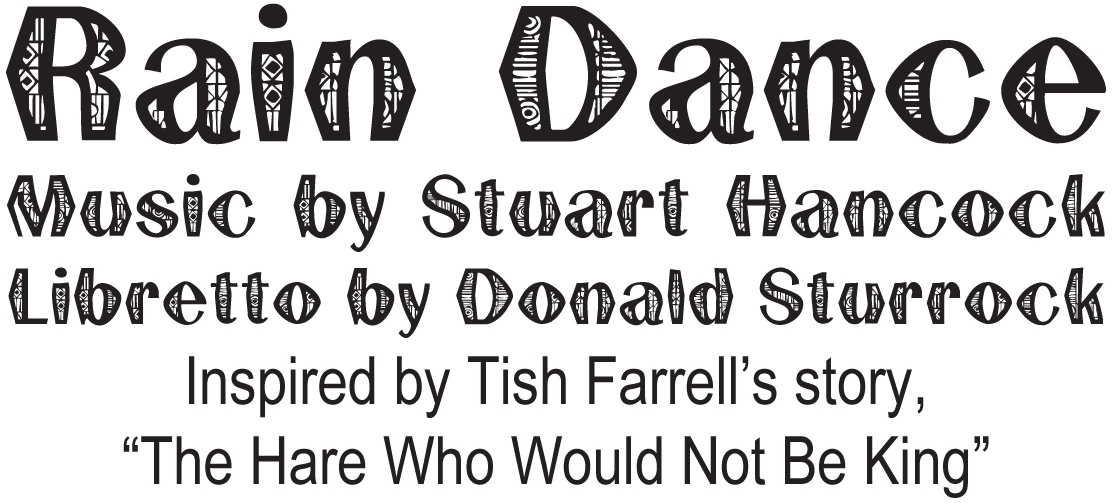
Rain Dance: all together now – let’s sing!

100_1434.jpg

There are some African wise words that say: if you can walk, you can dance; if you can talk you can sing. And this is what the children’s opera, Rain Dance is all about, giving young people the chance to perform and tell stories through song and dance (emphasis on the singing).

The opera was created by librettist Donald Sturrock and composer, Stuart Hancock, and my own small contribution is the fact that my retelling of an African story, The Hare Who Would Not Be King, was the starting point for the project.  Sometime back in 2007, Donald Sturrock  wrote to me asking if he and Stuart Hancock could adapt my story for a children’s opera. Their intention was submit the work to the London-based WW11 Opera in hopes of winning a commission for one of the Opera’s annual productions.

Time passed, and more time passed, but win they did, and Rain Dance was performed at the Riverside Studios, Hammersmith, London in December 2010 to a packed house. I was there with G of course, sitting amongst throngs of excited children. By the time we came to the finale with its rousing Rain Dance theme, I was pretty much as excited as my junior neighbours. I might even have been jumping up and down in my seat: to think that my story had been the very small spark for this wonderful new work, and its exuberant performance.

The finale of Rain Dance. Photo: WW11 Opera

*

Of course this splendid show with 85 young performers (9-18 years) was only made possible under the auspices of the  W11 Opera for Young People. This is a London-based charitable trust, founded in 1971, to give young people from all backgrounds the chance to sing and perform. Every year a  new opera is commissioned with the aim of creating a repertoire of song-based works that can be staged by schools and community groups. W11 Opera also showcases the work of new and established composers, and its productions have seen the launching of star performers such as Sophie Ellis-Bextor.

And so, as may be imagined, I am incredibly pleased to find that the opera, which began life with the W11 Opera, will be performed once  more. In March 2014 Rain Dance will have its North American premier at the North Cambridge Family Opera Company, Cambridge, Massachusetts. The NCFOC has a slightly different approach to the W11 Opera: the cast includes both young people and adults, and thus is a chance for family members to perform together. That there are people who put their time, enthusiasm and creativity into making such things happen makes me want to burst into song as I write this.

*

Home

Performances March 29 & 30, April 5 & 6, 2014

*

As to my story, that had its own sources. It tells how the plains animals vote for a bullying lion to be their king and of the dire consequences of their actions. Hare, the familiar trickster of many African tales, is the reluctant hero of the piece, and nearly ends up as lion food. The plot is based on a story once told by the Akamba people of  Kenya.  I was living in Kenya at the time of writing, when the country was struggling towards a western-style democracy after years of one-party rule. This situation very much influenced the retelling. My version of the story was first published in the United States in Spider Magazine February 1999, accompanied by some fine illustrations by US writer and illustrator, Brian Lies. You can read an extract and see some of the original illustrations HERE.

In the meantime it is good to know that, in the last week of October, eager performers (young and older) will have been showing up for the Rain Dance auditions at the North Cambridge Family Opera.  The story that Donald Sturrock has created is far more complex than mine. It draws on another African story besides, creating a updated version of the race between Tortoise and Hare. The animal election has all the razzmatazz of a human election with full media coverage. There is also the theme of climate change and its effect on the water-hole, to say nothing of hilarious interludes with Hare’s family and four shopaholic lionesses. Throughout, Stuart Hancock’s musical score is utterly original and captivating with no hint of ‘African’ pastiche in his lovely melodies.

The NCFOC performances are scheduled for March 29 & 30, April 5 & 6, 2014. Go, if you have the chance. You won’t regret it. You’ll come away singing and dancing too.

© 2013 Tish Farrell
Frizztext RRR Challenge

RELATED: The Hare Who Would Not Be King

Blue Lagoon

Weekly Photo Challenge: Horizon

DP Daily Prompt: The Golden Hour

sea-and-sky-on-the-reef-at-Tiwi.jpg

Beyond the shore, the reef, the sea, and then the sky: dawn one Christmas off Tiwi Beach, Mombasa

*

Other striking horizons:

Fractions of the World

Wind Against Current

Jolie Petite Maison

Hope*the happy hugger

Be Happy

Belgrade Streets

Artifacts and Fictions

vastlycurious

Northwest Frame of Mind

DARK CIRCLES, ETC

copyright 2013 Tish Farrell
In Much Wenlock An Inspector Calls

100_3606

Much Wenlock, the place where I live,  is a small town with a big history. You could say it owes its existence to the discovery of some holy bones. And no, this is not the reason for the inspector’s visit.  I’ll get to him in a moment. (In fact his arrival in town relates to the making of some new history). But about those bones…

First of all, they are very, very old. In life they belonged to a Saxon princess, whom we know locally as Milburga, though she comes in other spellings. She was daughter of the Mercian King, Merewalh, who held sway over much of the English Midlands during the 7th century.  These were turbulent times – the spread of Christianity going hand in hand with securing territory. To this end, Merewalh was a man with a plan. Instead of arranging dynastic marriages for his three daughters, he established them as rulers of new religious houses across his kingdom. Even his own queen, a Kentish princess, in later life returned to faraway Kent to become Abbess of Minster. In this way Merewalh consolidated spiritual and political prestige, commanding both bodies and souls.

In preparation for the religious life, Milburga was sent for her education to the double monastery of Chelles in Paris. According to the historian, and her contemporary Saint Bede, this was common practice for English girls. Sometime towards the end of the 7th century Milburga then took charge of an abbey in Much Wenlock. This was also a dual monastery i.e. for both men and women, and each sex had their own church. It was also the most important religious house in the region. There she presided for the next thirty years, ministering to the people of her extensive domain lands. Many legends grew up: that she had the power of healing the blind and of creating springs of water. After her death in 725 AD there were more and more stories about her miracles, and so in due course she became Saint Milburga.

Fast forward to the Norman Conquest of Britain (1066), and now we have brow-beating Norman earls establishing their power bases across the land. Their plan was to use ‘big architecture’ to dominate the natives: castles, fortified manors, churches and monasteries – the bigger the better. In Much Wenlock, Earl Roger de Montgomery built a Benedictine priory on the site of Milburga’s abbey. It was affiliated to the monastery of Cluny in France, and so French monks came over to live in it. The building was an impressive enterprise too. Today, the picturesque ruins in the heart of the town do little to indicate the vast scale of the original.

File:St Milburga's Priory, Much Wenlock - geograph.org.uk - 1652411.jpg

Wenlock Priory and the ruins of 12th century Benedictine monastery that was built on the site of Milburga’s Saxon abbey. In its day, this was one of the biggest and most prestigious religious houses in Europe. Photo: Creative Commons, Chris Gunns


But building big is not everything. The Normans faced a problem that every interloper faces: how to give their occupation legitimacy. Milburga was a much-loved saint and a Saxon saint to boot. It was essential to confirm possession, not only of her extensive lands (which was quickly achieved), but also of her remains.

The last proved less easy and, it may well be imagined, then, that when the French monks arrived in Wenlock and found the silver shrine of Milburga empty but for “some rags and ashes”, there was much consternation. Where were the saintly bones?

100_4921

Bishop Odo unfolds the mystery in an account written after he visited the Priory in 1190. It appears that the nuns’ church of Milburga’s abbey (now our town church, Holy Trinity, above) still survived in Norman times, but lay in ruins. The monks decided on some restoration, and it was during work on the altar that a monastic servant found an ancient Saxon document. The monks, being French, could not read it and  so a reliable translator had to be found forthwith. Thus was discovered the testimony of a priest called Alstan who said that Milburga had been buried near the altar in the nuns’church.

Of course by now  nearly four centuries had passed since her death, but news of the document reached Anselm, Bishop of Canterbury and he gave the monks permission to excavate. But before this could happen, two boys playing by the dilapidated altar, caused the floor in front to collapse, which in turn led to the more rapid discovery of Milburga’s remains. This was in 1101 AD, and we know they were her bones because they were “beautiful and luminous” and accompanied by the requisite saintly fragrance deemed to be given off by such relics.

The discovery gave Much Wenlock instant pilgrim-appeal, and the monastic publicity machinery rolled. The Prior commissioned the leading writer on saints of the day, Goscelin,  to write about the life of Saint Milburga and so firmly establish the cult of miracles that surrounded her. From that time pilgrims flocked to Wenlock, and the town grew to cater for them. Some of the surviving public houses have their beginnings in the Middle Ages. The Priory itself was wealthy in land and employed a large workforce who were engaged in agriculture and early industrial development including coal mining and iron working. Artisans and merchants were attracted to the area. Trades and services developed to cater for the pilgrims and the Priory. And over all this human business presided the Prior, delivering both spiritual and temporal edicts. It was not until 1468 that the town was handed over to a secular authority.

And so here we have the little market town of Much Wenlock, continuously occupied for a thousand years and presently home of 2,700 souls. It sits below the long limestone ridge of Wenlock Edge whose geology is of international renown. After the monastery was dissolved by Henry VIII in 1540, the town continued to thrive as entrepreneurs moved in to develop the industrial potential of former monastic holdings. The cloth trade and tanning became important. Agriculture and quarrying continued as mainstays since Much Wenlock’s limestone was not only useful for building, but was also burned in kilns to use as fertilizer. Most importantly, as time went on, it became an essential ingredient in the making of cast iron, acting as a flux to remove impurities from the iron.

Indeed, it was at furnaces on Milburga’s former domains at Coalbrookdale, Madeley, and in Broseley that many breakthroughs in the iron industry were made, thus setting off the World’s Industrial Revolution. And the reason these technological innovations took place here was because the locality had all the vital ingredients:  limestone, ironstone, fireclay and coal. The tributaries of the Severn could be harnessed for water power, and the river itself provided a trading route down to Bristol. Not only that, generations of monastic workers meant there was a skilled workforce to be utilised when post-Dissolution entrepreneurs moved in to take over monastic mines, iron works and water mills.

041

100_3609

100_4919

100_4926

043

We have other claims to fame too. The reason why one of the Olympic mascots was called Wenlock was because it was here in 1850 the town’s physician, Dr William Penny Brookes began the first modern Olympian games. For the next few decades people flocked to Wenlock in thousands to see them.  Brookes passed his ideas on to Baron de Coubertin who often visited the town, and so began the International Olympic Committee. The Wenlock Olympian Games are still held every year and provide a popular competition venue for sportsmen and women from all over the country. 

But back to the inspector who was left stranded at the top the page. Two years ago Much Wenlock was one of the seventeen front-runner communities in the country chosen by Government to create a Neighbourhood Plan. Since then, cohorts of Wenlock and other volunteers have worked with the community to produce a plan that sets out the kind of development we want in the parish over the next thirteen years. Last week the inspector, the man assessing the plan, came to the Priory Hall, the town’s community centre, to conduct a public hearing.
100_4923

For reasons that may become apparent by looking at the next photos, large scale development is not a popular proposition in the community. Most of us feel that we have had more than enough. The town sits in a basin. Wenlock Edge and surrounding hills drain through it down a culverted medieval watercourse once known as the Schittebrok. The Victorians did the culverting and there have been so-called remedial schemes since. Some argue these ‘improvements’ have made the problem worse. The town’s footprint has increased some 300% in the last decades with much unsympathetic development that has covered agricultural land with hard surfaces that speed up flooding. Our narrow medieval street system turns roads into rivers during heavy rain. The other serious problem then (apart from traffic congestion) is drains.

001 (4)

001 (3)

001 (2)

In 2007, after 91 homes were flooded due to a combination of flash flooding and poor drainage, the town held a referendum. The vote was 471 to 13 to have no more development until the town’s traffic and drainage problems were resolved. Nothing has been done to improve these matters, our sewage farm is under capacity. The bill for new drainage will cost millions and our private water company is unlikely to fork out. In the meantime the developers and major landowner informed the inspector that they are itching to build 85 houses in the near future, with a suggested total of 250 over all.

At the hearing the inspector gave them ample chance to make their case, and he himself gave no clue as to which side’s view would hold sway. The Neighbourhood Plan wants only small numbers of affordable homes for locals to rent, and a maximum of 25 market homes on a single low density development. But this is not how housing developers work. Much Wenlock’s property prices are high; it is a desirable place to live. They thus want to build up-scale houses with multiple bathrooms. Meanwhile our ageing community would like comfortable smaller places so they can downsize and release their homes to people with families. It is a divergence of objectives that appears to have no sensible resolution.

The British Government’s stance is that building houses is the only way to create ‘sustainable’ communities. So even if the Neighbourhood Plan is passed by the inspector, there is no knowing how far it will protect the town from inappropriate development.

As I said at the start, Much Wenlock is a small town with a big history. But perhaps our story has not yet been well enough told. Perhaps we are not shouting it loud enough. Events that occurred in and around Milburga’s former domain have helped change the world we all live in. A few miles away is the World Heritage Site of the Ironbridge Gorge (site of the world’s first cast iron bridge built in 1779). The iron, porcelain and decorative tile industries that grew up in this area traded their goods across the world. Monastic enterprise underpinned the development of  British industry.

Today if you visit Much Wenlock it may strike you as a Rip Van Winkle sort of place. It has a slumbering air, as if dozing under the weight of ancient timbers and stonework. But it can be lively too.There are some excellent shops including two excellent book shops and a gallery. There are small markets during the week, a museum, the church, the Priory, the Olympian trail, good pubs and hotels, many societies to join, a fully equipped leisure and arts centre. 

Above: glimpse of the Prior’s house, now a private home. Below: cottages on the Bull Ring

We have much  to protect and preserve here, and much to share with those who visit us. And we do want the town to grow and thrive, but on the community’s terms and according to their expressed needs. But looking over the last thousand years, this story does have a common theme. Whether we’re talking of Saxon kings, Norman earls or housing developers, those who have power and land do all the ruling, too frequently asserting their will over the wishes of the general populace. It remains to be seen whether the inspector will pass our plan. He said he would let us know in November. In the meantime, I, like others in the town, watch rainy skies with anxious eyes, if not for ourselves, then for vulnerable neighbours. Fingers crossed for Neighbourhood Planning and that it actually will serve our purpose.

© 2013 Tish Farrell

Related:

https://tishfarrell.wordpress.com/2011/06/27/of-silurian-shores/

https://tishfarrell.wordpress.com/2013/06/04/windows-in-wenlock/

https://tishfarrell.wordpress.com/2012/01/26/of-wolf-farts-windmills-and-the-wenlock-olympics/

twitter: @Wenlock_Plan

www.wenlockplan.org

https://www.facebook.com/pages/Wenlock-Edge/532033273535604?ref=profile

https://www.facebook.com/pages/Wenlock-Edge/119957538050970

BOOKS:

W F Mumford Wenlock in the Middle Ages 1977 re-published under ISBN 0950561606

Vivien Bellamy A History of Much Wenlock 2001 Shropshire Books ISBN 9780903802796

Kind of blue and other colours

Weekly Photo Challenge: the hue of you

100_1310

Stained glass by Marc Chagall, musée national Marc Chagall, Nice

Another of the world’s great little galleries, currently celebrating its 40th anniversary. I went there one October. It left its colours imprinted on my retina and in my heart. If ever you are in Nice, be sure to go there. Also posted with reference to Miles Davis and his ‘Kind of Blue’ album.

RELATED: https://tishfarrell.wordpress.com/2013/10/08/only-one-ogunquit-the-little-gallery-by-the-sea/

And some other good hues:

http://flickrcomments.wordpress.com/2013/10/18/weekly-photo-challenge-the-hue-of-you/

http://dewetswild.com/2013/10/18/the-hue-of-us/

http://windagainstcurrent.com/2013/10/18/weekly-photo-challenge-the-hue-of-you/

http://angelinem.wordpress.com/2013/10/18/weekly-photo-challenge-the-hue-of-you/

http://jampang.wordpress.com/2013/10/19/weekly-photo-challenge-the-hue-of-you/

http://retirenicaragua.wordpress.com/2013/10/18/weekly-photo-challenge-the-hue-of-you/

http://teepee12.com/2013/10/19/weekly-photo-challenge-color-me-orange-wrap-me-in-autumn/

Paul Kabochi, Path-finder, Pharmacist 1942-2003


Scan-130602-0001


It was dawn on the muddy shores of Lake Elmenteita in Kenya’s Rift Valley, and I was walking alone, listening to the endless grunting of flamingos as they grazed the algae-rich water. Suddenly a safari truck swung out onto the mud flats. A Japanese tourist jumped out and began taking photographs of the distant flamingos. His driver and guide Paul Kabochi, also got out, moving more softly as was his way. He  came over to me while his guest went on shooting. “Hello,” he said. “What are you doing here?”

It wasn’t a question that expected an answer; it was just Paul being Paul, the wry smile, and the glittering eyes that missed nothing. On several visits to Elmenteita’s Delamere Camp he had taken me out on dawn walks, and he had been our guide on night drives around the Soysambu estate.  And so, as I had my camera with me, I asked him to pose by the lake, which he was more than pleased to do.

Paul Githinji Kabochi was a man I am lucky to have met, and I mourn his tragic loss in what was, for him, the strangest of accidents. He was a true path-finder, and not only for the likes of me, a traveller, wanting to experience the African bush with someone who knew it intimately, but also for august naturalists such as David Attenborough.  Paul had been one of the expert guides during the making of The Life of Mammals, and his special knowledge was often called upon by the BBC’s outpost in Nairobi.

I first met him on the afternoon ethnobotany walk run by Delamere Camp to keep guests amused until the night drive around Lord Delamere’s private estate (now Soysambu Conservancy). That day, on the walk, we did not get beyond the camp grounds. There were too many plants that required our attention.

Paul knew about the medicinal properties of both indigenous and introduced plant species. I remember him telling me to pick some lavender from the bush outside the camp dining room when I told him I had a headache; this after ascertaining whether it was “a headache of the stomach, or of the weather.” He told me to make tea with it. On other occasions he also explained how he treated skin cancers with a mixture of, among other things, baked sodom apple (Solanum family) and avocado. Then there was the little blue flowered Wandering Jew (Commelina) that was especially good for clearing adolescent acne. He also once told me that he had successfully treated a typhoid outbreak in the locality with decoctions of (I think) fever tree bark.  He meant to write a book, imparting all he knew, but when I last met him he was struggling with finding ways to fund the venture.

When he was not acting as guide for Delamere Camps, he had his own clinic in Rumuruti, and was also called on from time to time to consult at the prestigious Nairobi Hospital.

001

Lake Elmenteita looking towards the exploded volcanic crater known as The Sleeping Warrior. Large numbers of flamingos come to feed here, but it is more important as a breeding ground for white pelicans. Like many of the Rift lakes, the water is exceedingly alkaline. This particular lake is also very shallow, being only around 1 metre deep. At times it has been known to disappear altogether, leaving a dusty basin. The name comes from the Maasai ol muteita meaning dust place.

005

There were around twenty ‘thatched-roof’ tents – all with bathrooms. On cool evenings we would return from the night drive to find hot water bottles in our beds.

001 (2)

Paul was responsible for many of  the features that made staying at the Elmenteita camp so special. One of them was the tree house he built in a fever tree, and on whose roof terrace he is standing in the photo above. Small numbers of guests could spend the night there in the hopes of spotting the leopard that came to drink at  a nearby water hole. We stayed there once, but saw no leopard. Instead we were kept awake by chattering tree squirrels who spent all night raiding the sugar bowl which we had carelessly left uncovered. The night drive out there, though, had been fun. We had seen both a zorilla and an aardvark. And in the morning the camp staff drove up with a full hot breakfast, so we could dine on the roof amongst the bird call.

Scan-130601-0007

Paul said he came from the Ndorobo community, or Ogiek, a small, but remnant population of hunter-gatherers, who traditionally lived by honey gathering and hunting. These slight-framed people were possibly among the indigenous inhabitants of East Africa before the arrival of the Bantu farmers and Maasai pastoralists. Many became assimilated with the newcomers, adopting their languages, but there are still groups living in the forests of the Mau Escarpment, where they struggle to have their rights acknowledged by the Kenyan Government. Top on their list of priorities is preserving their forest domain, now constantly under threat from agriculture.

Before he became a guide, Paul worked for many years as an animal trapper for the National Museums of Kenya, capturing animals for museum study and display. He told me that he and his party had once been set on by bandits while he was trapping up in remote and arid Turkana. The works Land Rover was stolen at gunpoint and they were left to die. He survived on that occasion, but blamed the loss of many teeth on the days of near starvation in the wilderness.

In the years before he died, Paul was working down at Taita Ranch near the border with Tanzania. There he liaised with film crews and scientific expeditions of all kinds, giving them the benefit of his wisdom and wit. It was on the 8th February 2003, while he was out alone, and on foot, tracking dwarf mongoose, that he was surprised by a lone elephant and killed. It was some years after the event that I heard what had happened, and oddly, too, from a friend of a friend in rural Shropshire, someone whose sister lived in Kenya and whom I met while she was briefly over in England on a visit. It was a strange way to discover this sad news. Even now, I find it hard to believe that someone as smart and wily as Paul Kabochi could have been caught unawares by an elephant. They have such a strong smell for one thing, and he was not a man to take anything for granted.

Many academic research papers have been dedicated to him, but I notice, as time passes, internet  references to Paul Kabochi grow fewer. This makes me wonder, too, about the loss of all his pharmacological knowledge. I know he had children, but did he pass it on? In 2000 German documentary film maker Ralf Breier made a short film about Paul. Its English title is ‘Animal Magician’. Now that’s a film I would like to see.

003 - Copy

The photo above was taken from the Sundowner Look-out, above Lake Elmenteita.This was another of Paul’s ideas: that in late afternoon guests would either walk or be driven up to the cliff top behind Delamere Camp. There they would be given a few roast ‘bitings’ of game meat and a beer or soft drink, and sit on tree-stump seats and watch the sun go down. We have sat up there and viewed this scene with some of our dearest friends. Now I  look at the photo and think of Paul Kabochi. It is hard to think that he is not still treading softly along Africa’s wilderness trails. 

© 2013 Tish Farrell
 

P.S. Delamere Camp is no more. Much of the former Delamere estate at Soysambu is now part of the Soysambu Conservancy. The soda lakes of Elmenteita and nearby Nakuru are now World Heritage Sites.


Nakuru is the next lake up the Rift from Elmenteita.