
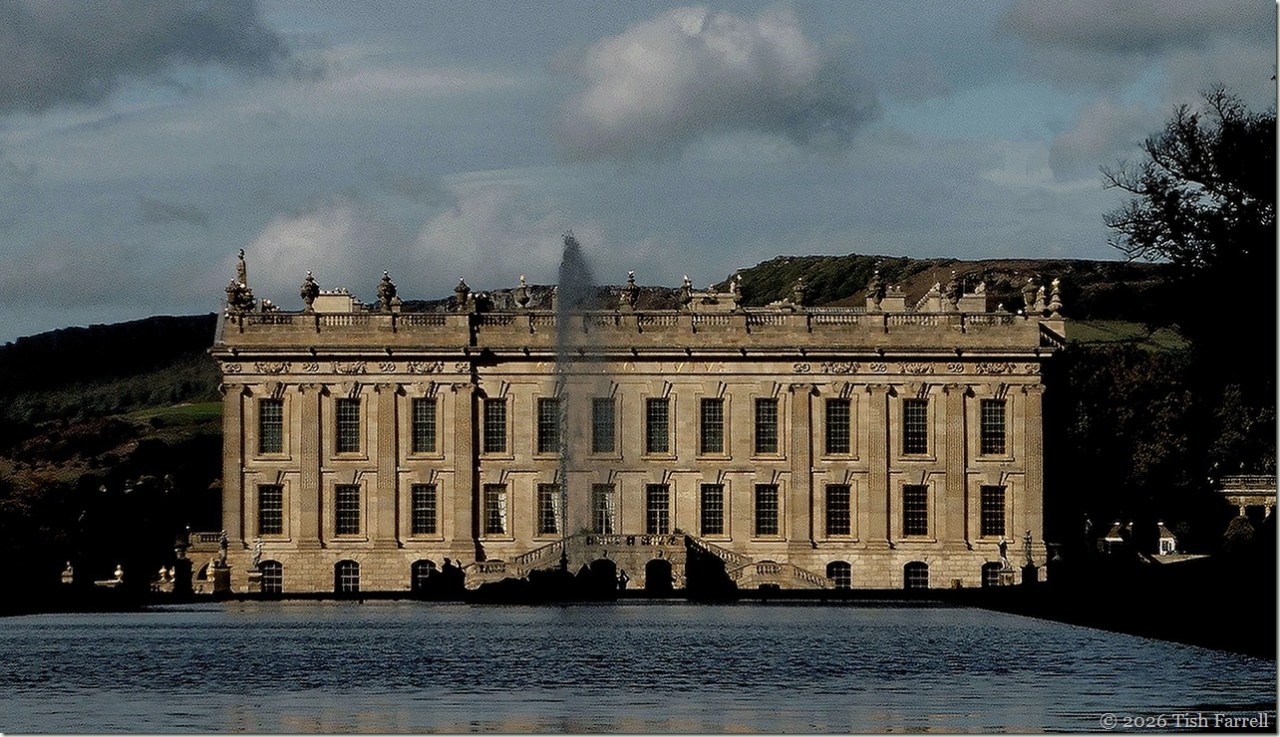
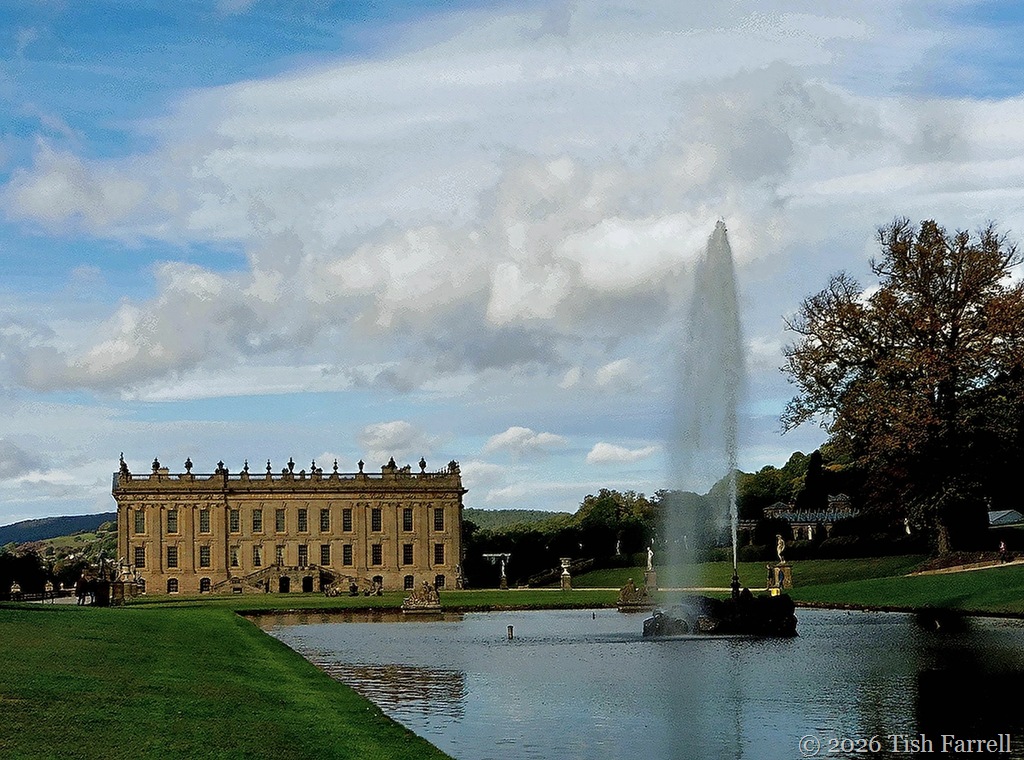
The grand mansion was ever built to impress and raise social standing, its setting in the landscape deploying all manner of visual knacks and contrivances to enhance imposing looks. See, it says, this is the domain of the rich and powerful, beings who inhabit a realm far removed from that of ordinary mortals.
And to prove this point, it was not unknown for mansion owners to dispatch from their purview, and place elsewhere, the unsightly villages of their peasant tenants. It was common, too, to incorporate tunnels and hidden thoroughfares in the surrounding grounds so as not to suffer the indignity of looking out from the drawing room windows and seeing a passing labourer.
Sometimes one does wonder why we British never had a revolution.
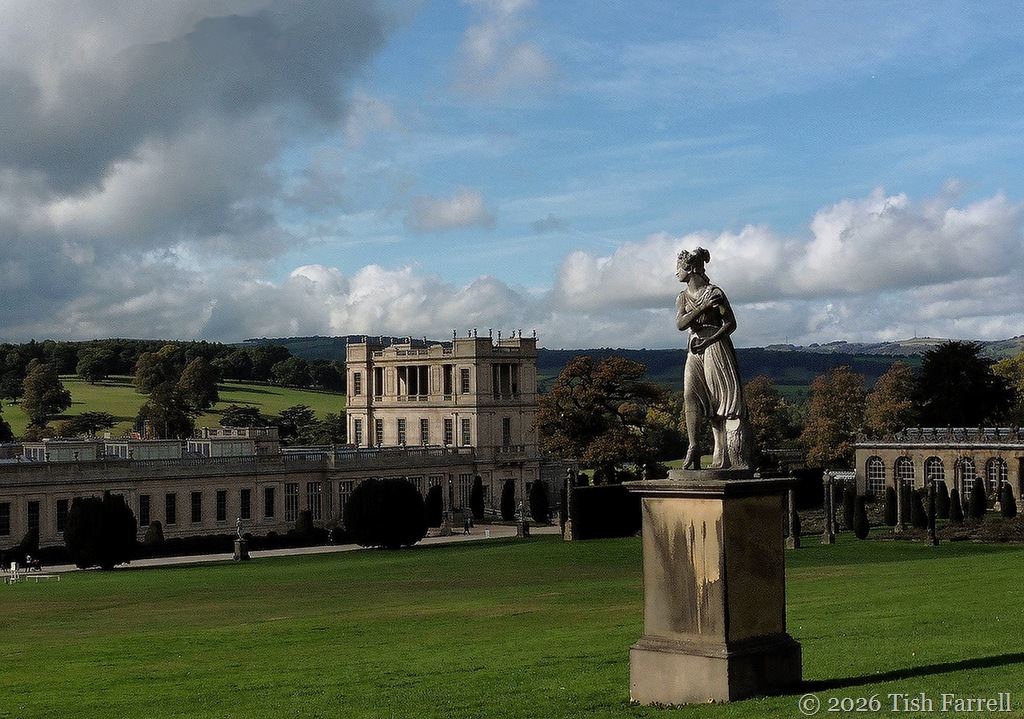
Here at Chatsworth in Derbyshire, seat of the Dukes of Devonshire, generations of the Cavendish family have spared no expense when it comes to home and garden improvements. (It is still the family’s home, albeit now the Chatsworth House Trust).
The first house here was built in the 1550s by Elizabeth Talbot (widow of Sir William Cavendish who amassed great wealth during the Dissolution of the monasteries), otherwise known as Bess of Hardwick, Countess of Shrewsbury. She built a large Tudor mansion on the banks of the River Derwent, which in later times acquired the Classical finish we see today, complete with elaborate gold leaf embellishments (recently restored across the entire exterior by the Chatsworth House Trust).
Yes, all those windows in the header photo, and more besides, have gilded frames since real gold is said to provide the best weather protection.
On the stately homes tourist trail, Chatsworth is among Britain’s most popular visitor attractions, this despite the £33 adult entry ticket. The gardens and park are perhaps what return visitors love most, the Emperor Fountain (header) and the Cascade (coming next) being among the more spectacular favourites. (Note too the ride cut through the trees on the far hill, to mirror the Cascade and add to the expansiveness of the parkland setting).
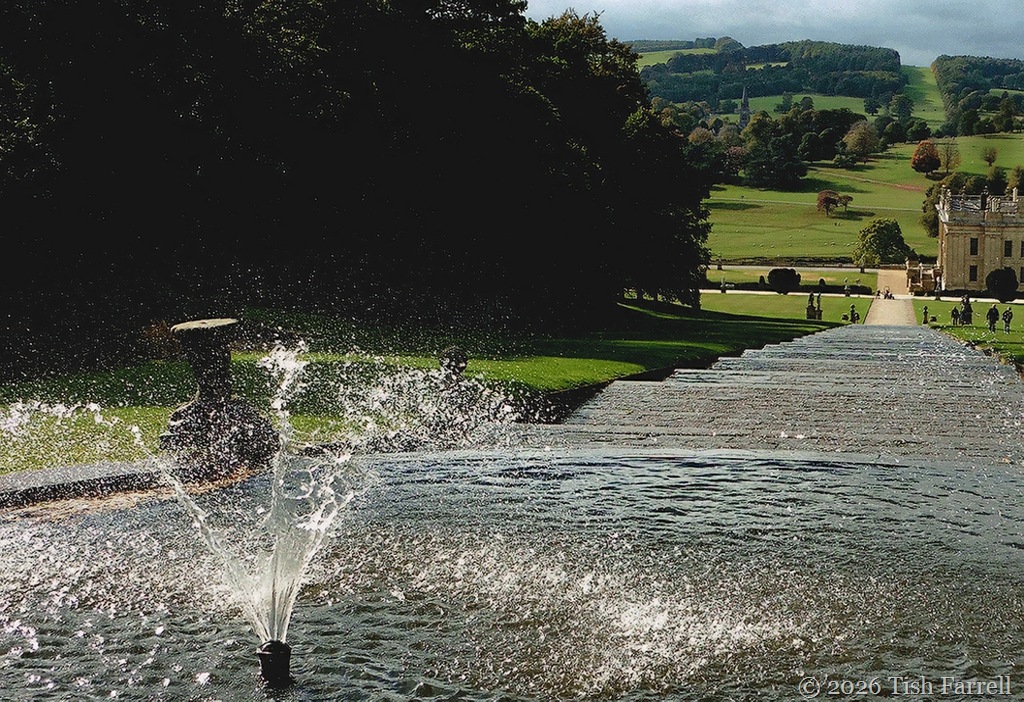
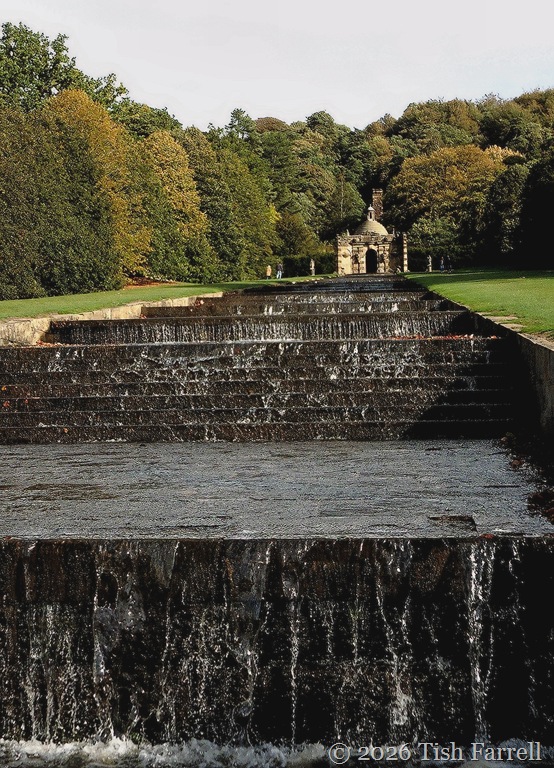
The first version of the Cascade was built in the 1690s by French hydraulics engineer, one Monsieur Grillet, who had worked for Louis XIV. In succeeding years it was doubled in length, widened, made steeper and repositioned to align with the southern frontage of the house. The contrived waterfall is fed from water draining from the high moors into a series of lakes above Chatsworth, and then descends through some 60 metres, just under 200 feet.
These days it is out of commission, waiting for 7-million-pounds’ worth of repairs. Over half of this sum has already been awarded by the National Heritage Lottery Fund, but members of the public are also being urged to sponsor one of the hundred stones that make up the 23 steps, the suggested donations ranging from £100-£500.
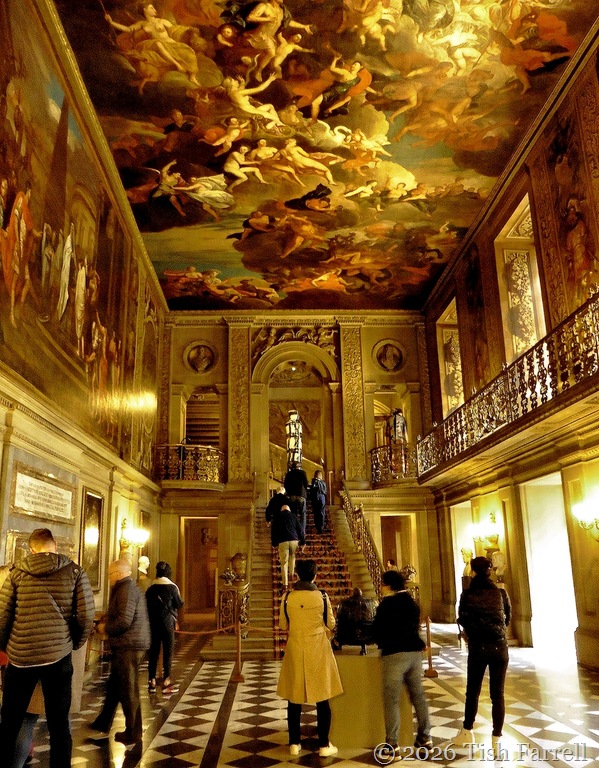
Meanwhile, the grandeur of the interior might also render one speechless. This is the Painted Hall, created in 1694 by Louis Laguerre. Actually, when we visited a few years ago, it simply made me very cross. Much of the wealth of the Dukes of Devonshire (and before them the Earls of Shrewsbury) derived from tithes and rents from their farm and lead miner tenants who inhabited communities on their land holdings across Derbyshire’s High Peak District. Among them were generations of my maternal Fox and Bennett ancestors. So it makes me think, looking at such unbridled opulence; family tales have it that, as a girl, my great grandmother, Mary Ann Fox, used to ride over to Chatsworth from Callow Farm, at Highlow, to deliver the family’s tithe in eggs.**
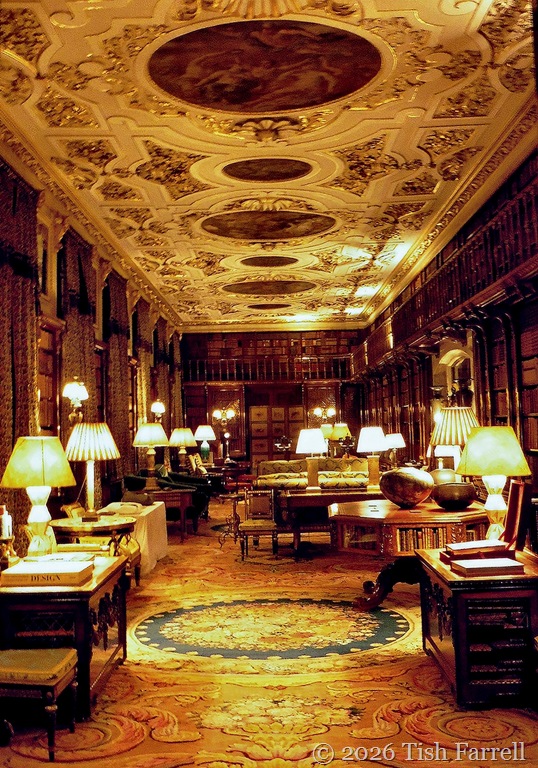
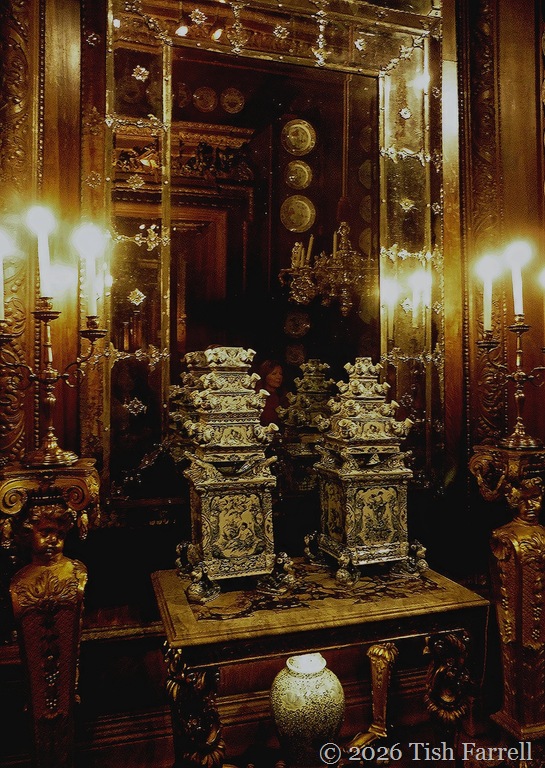
The photo above shows the library. We were only allowed to look through the open doors. And this is but one of very many extravagantly furnished rooms and apartments . (See the State Apartments HERE) So how does one gain perspective on the scale of wealth disposed for the single purpose of showing off? What did successive dukes and duchesses see if they caught sight of themselves in one of their many grand mirrors?
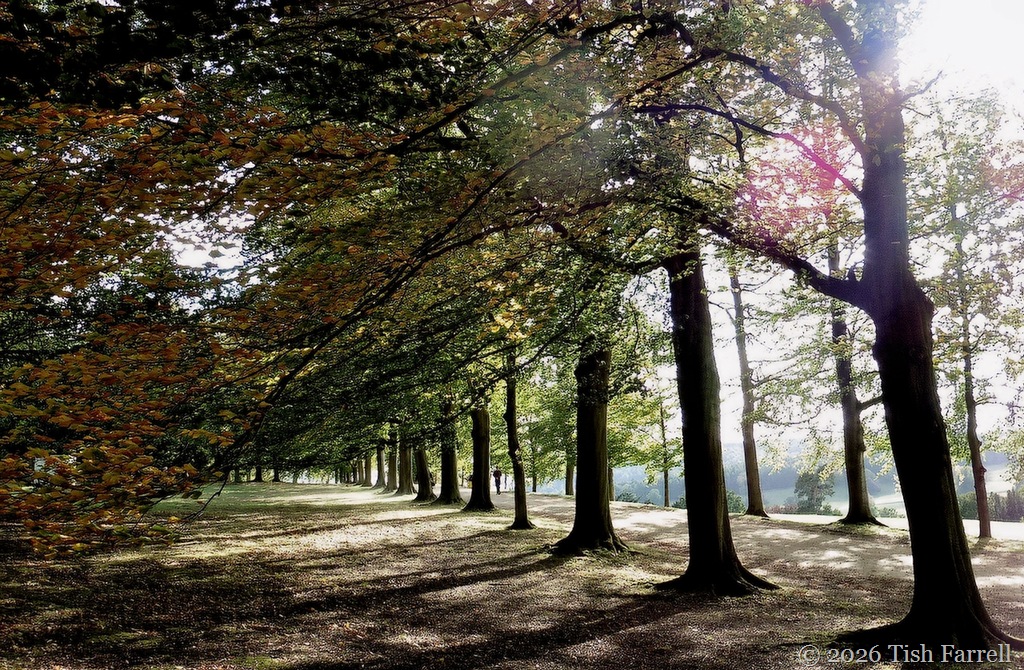
Enough. I’ll finish with a much more pleasing view out in the garden. A soothing avenue of young beech trees, moderately uncontrived, in late summer light:
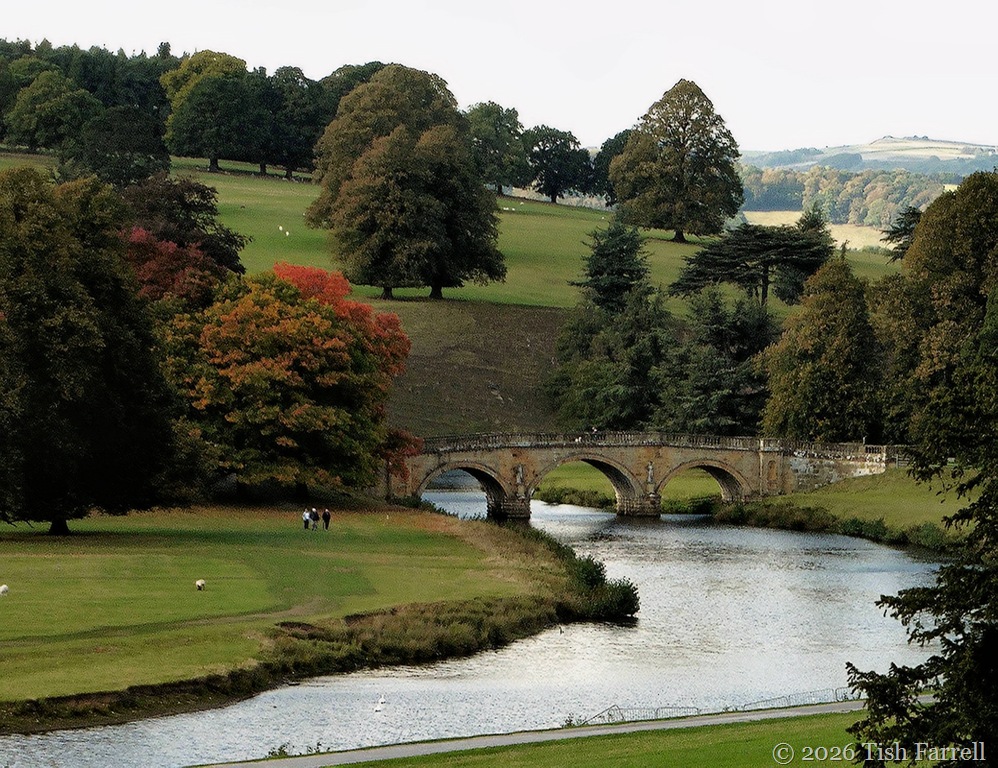
And a view of the River Derwent that flows below Chatsworth. Upstream it passes through fields once farmed by the Fox family at Callow Farm. They had to sell up in 1892. The rents were by then too high to make a living.
**To Chatsworth and how Mary Ann went to the ball
Copyright 2026 Tish Farrell
Lens-Artists: Perspective, Depth, Scale This week John shows us different tools in photo composition. Go see!

On one side one can appreciate the grandeur, while the other perspective is, as you allude, crass and vulgar. A poignant reminder of the deeply ingrained class system that is still there, and a not so subtle reminder of whose neck is under the oh so well-heeled boot, dontcha know?
Or, as the band 10cc sang…
Art for art’s sake… Money for God’s sake.
Cheers, Ark. All sorts of weird goings on these days re the elite and the citizens. As you say; things aren’t looking too rosy.
Decidedly odd, that is no maybe. And now Starmer is apparently on the way out.
Looks like the UK is in for an interesting few months all said and done.
As my mum once told me: Doug, you wouldn’t recognise the place.
That might be a bit of a stretch… After all it was still raining when we visited in 2024 just as it was when I left way back in the Dark Ages. 😉
Well, there’s much I don’t recognise and I’ve been back living here for 26 yrs. Something nasty in the woodshed as Stella Gibbons would have it in Cold Comfort Farm.
Funny how at a certain
Ooop… Pressed send accidentally.
… certain point in our lives when some things around seem to be going off the rails a bit we might retreat a little rather than bother confront ‘them’ .
I find that, these days there is a lot to be said for a nice cup of tea, a pleasent view and a bit of genuine peace and quiet.
My grandad (Mum’s father) was a man of very few words and seemed to like nothing more than to share his tea with his Corgi, Jumbo, (poured into the saucer!) and to go dig a few spuds from the back garden.
Much to be said for the retreat of one’s choice, Ark. I haven’t the faintest idea how I would begin to confront the compounded nonsense that has been dropped on us over the past few years.
Maybe it’s simply a generational thing?
Our folks and grandparents had to contend with World Wars and that came with its own nonsense.
And on that note at least the governments haven’t issued ration books yet.
And we still have football. Hah! Damn Jerries are playing tonight. Where’s a Lancaster bomber or Spitfire when you need ’em, eh?
Come on Ecuador!
😉
Cup of tea, my dear?
More like a glass of Cleric’s Cure beer from our local Three Tuns pub/brewery
There you go! If we get back to blighty before the world goes to pot, I’ll make sure we pop by. And I’ll happily stand the first round.
You’re on! Here’s the spot:
https://thethreetunsinnpub.co.uk/
Recently re-opened after much public pressure. Been brewing since 1642.
What a delightful looking pub. Definitely worth a visit to while away an hour or three!
I’m not sure what to say Tish. The building is beautiful and so are the grounds. The inside is a treasure trove of art–the ceilings. Wealth equals power, even today. No matter where you live, it’s the same. We have many former homes of wealth that are now historic sites. Quite frankly, I can’t imagine living in one of them.
No, I can’t imagine living in them either, but then Chatsworth, like most big houses, doubtless had its more modestly domestic living spaces somewhere. The grand rooms were basically public performance spaces, designed for royal visits. You can almost forgive the overdone houses of past industrialists. At least they went to work/invented something/created wealth one way or another.
Almost is the important word! I wonder with all the hunger in the world, would billionaires miss, maybe, one million to feed many in need. Imagine how many they could feed if they all chipped in! Would they miss that money?
That is a very good question, Anne. It seems they can’t have too much.
Tish, I was completely absorbed by the beauty in your photos. What a series! Also, the family connection made this post even more interesting to read.
So pleased you enjoyed this, Egídio. Thank you.
My goodness, this was a wonderful virtual tour. I love the library!
It’s pretty extraordinary, isn’t it.
Yes, indeed!
Beautiful old house but I think you won’t be contributing to one of the stairs! How the other half live
Ha! Spot on Alison re the Cascade. Many thanks 🙂
A very interesting perspective (word chosen intentionally!) on the challenge John set, and also on England’s stately homes and the wealth they represent. There’s no denying they are architecturally stunning and many have fascinating stories to tell, but the main narrative is one of ‘us and them’ as you point out. On the rare occasions we visit such a house I’m often drawn to the kitchen and below stairs areas – I guess I know my place!
Yes, the kitchens are often the most amenable spots. We don’t do such visits now either, though am often tempted by the gardens.
It’s the kind of place I love to visit, Tish, but your words were more in line to my reasoning. I do wonder how there was never a revolution here, even now…
Yes, ‘even now’ – I wonder that too. Many thanks, Sofia, and I can well see you would be in your element at Chatsworth, especially in the grounds. Lots of interesting planting. Many extraordinary artworks. Some wonderful vistas. I hardly scratched the surface 🙂
A lovely post. We were in the Peak District in May but staying near Stoke on Trent. I had Chatsworth House on a list to visit but we never made it. We went for a reservoir walk instead although we made it to Bakewell. Your post has ensured we’ll be coming back 🙂
There’s so much to see in and around Bakewell. Also lots of lovely walks at Longshaw etc https://www.nationaltrust.org.uk/visit/peak-district-derbyshire/longshaw-burbage-and-the-eastern-moors
And then Eyam’s well worth seeing too 🙂
Now this garden I’d love to see, Tish. We don’t have anything this grand. Gorgeous to see and read of the mansion’s regal history.
It is an amazing garden, and with its own several hundred year history. The original 16th century version was extremely ornate and laid out in squares. Later Joseph Paxton was employed to give it more ‘natural’ looks.