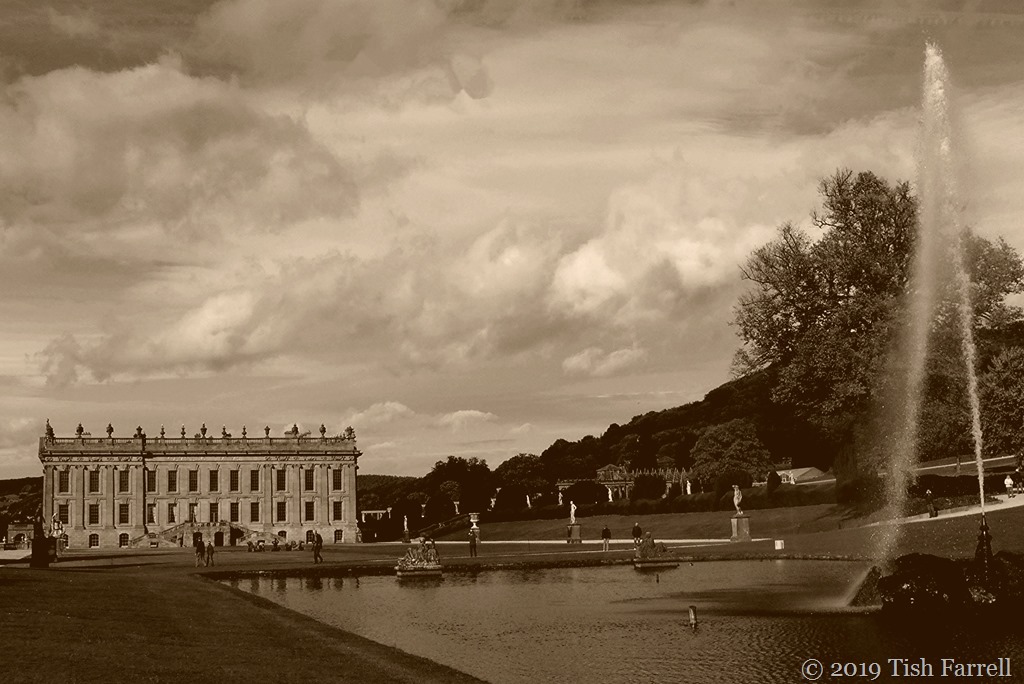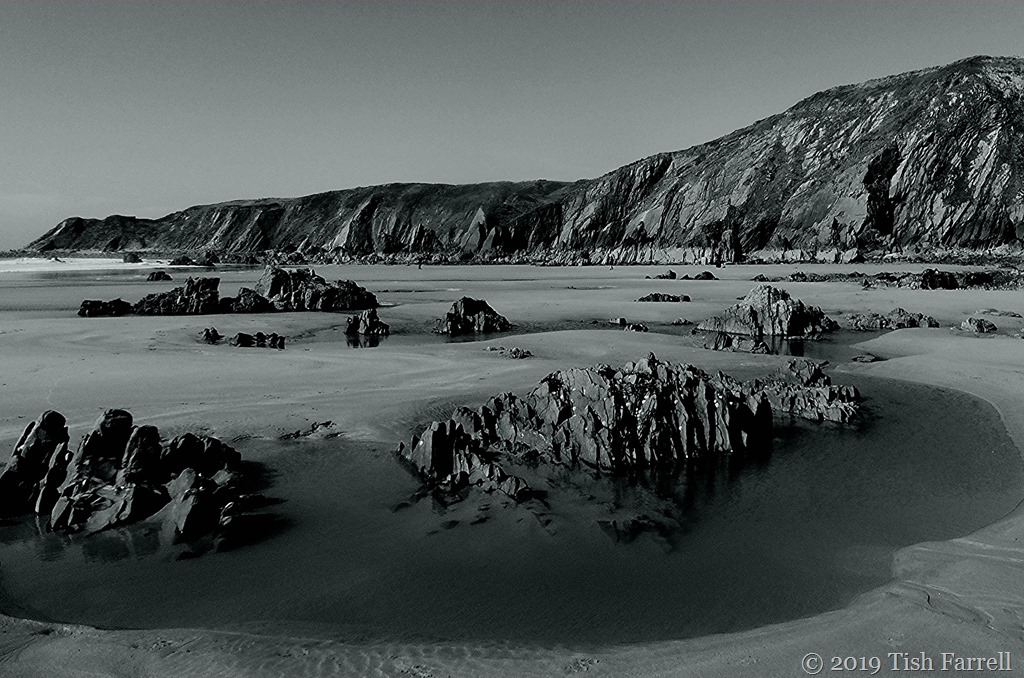
Llanddwyn Island, Anglesey, North Wales shot in monochrome
Tish Farrell Writer
Remembrance For Days Like These
No man is an island,
entire of itself;
every man is a piece of the continent,
a part of the main.
If a clod be washed away by the sea,
Europe is the less,
as well as if a promontory were,
as well as if a manor of thy friend’s
or of thine own were.
Any man’s death diminishes me,
because I am involved in mankind;
and therefore never send to know for whom the bell tolls;
it tolls for thee.
John Donne 1572 – 1631
Thursday’s Special: Desert Dawn
We’ve been suffering serious gales and wetness in the UK, and it’s set to persist, bluster and precipitate for several more days yet. Which has me thinking of dryness and deserts and heat and stillness and no wind. This photo was taken early one morning in the desert outside Dubai. It was around 5 a.m. and I had just given up the battle of trying to sleep in an igloo tent while close by our guide snored loudly in the open back of his 4×4. And when I walked out alone and saw all this, what could I say. Who cares about mangled limbs and a sleepless night? Why would I?
Thursday’s Special This month Paula challenges us to show her any or all of the following: inversion . circuitous . corniculate . sabulous . interstice . I’m definitely claiming the last two in this shot, and also some circuitous tyre tracks. And then there’s inversion – the up and down-ness of the dunes and sand ruts, the light versus shade, the cool of sunless valleys versus sun-warmed peaks. I suppose at a push too, you might say the distant small lumps and bumps are reminiscent of newly erupting horns?
copyright 2019 Tish Farrell
And It’s Not Only A Pelican…
Not the best photo, I know. I cropped it so you can just about see what is going on in the papyrus to the right of the pelican. i.e. the rear end of one of Lake Naivasha’s hippos going ashore and the roaring, open mouth of another hippo who is objecting to the intrusion. Hippos have whopping teeth and tusks, and quite apart from being grouchy with each other, they also kill quite a few humans, especially fishermen. They are at their best when mostly immersed in water, and their surprisingly tender hides well protected from the heat of the sun. But even so, it always pays to be wary.
A glimpse of some of Lake Naivasha’s rich bird life (apologies for grainy old ‘out-of-Africa’ shot).
The lake is fed by underground rivers and is Kenya’s only freshwater lake among its Great Rift string of soda lakes. Many of the fresh flowers bought in Europe – roses as well as carnations – are grown in corporate-owned flower factories around the lake shore. Their presence has created jobs and some social services (e.g. company funded primary schools and clinics) for local people, but there are big costs too: too much water abstraction that has shrunk the lake and pesticide and fertilizer run off that have threatened fish stocks. There’s a good little video (7 mins) focusing on these problems and showing more of life around the lake HERE.
Accidental But Interesting
Not sure what was going on here. I think this is one of my camera’s own recent compositions. I recognise the power lines behind the allotment, but who knows where the wafty branches came from. The whole thing looks like a charcoal sketch, with just enough spikiness to qualify for Becky’s March Squares.
Today The Weather Feels Like This
Country lore has it that if March comes in like a lion it will leave like a lamb. Well roll on flocks of little ovine entities. As I write this, the wind is roaring up over the Edge, and blowing right through the house even though all the windows are shut. And IT IS ICY. And outside, it is blow-you-over gale force across the field with intermittent fierce rain squalls. Yet the BBC weather people claim that here in our corner of Shropshire we are currently having ‘sunny intervals with a fresh breeze’. In support of this contention, they have staked out their hourly weather map with a row of sunny-cloud icons. It’s a sign of the times of course. You can no longer trust a single mediated report, not matter how supposedly trustworthy the source. Wear more vests, that’s my advice. And balaclavas.
Photo: Bin bag and barbed wire, St Bride’s Bay, Pembroke, March 2018
Shopping In The Papyrus At Lake Naivasha
Even locals said that anything could happen in Kenya. And so one Lake Naivasha morning, when I thought I was alone in the wilderness outreaches of an old safari lodge, I was both surprised and unsurprised when a young man stepped out from the papyrus swamp clutching two bunches of carnations. Fifty bob, madame, he said after the customary greeting. He seemed nonplussed when I started to laugh.
“Do you always keep your carnations in the papyrus,” I asked.
“Yes,” he said.
“What, waiting for people like me?”
“Yes,” he said.
This exchange seemed to seal the deal. I didn’t even bother to haggle. And although I have no idea why I would have 50 bob on me in such a place, I bought a bunch. Given the general lack of wazungu humanity in that particular location, I also wondered how long he had been waiting for the likes of me to come along; or how long he would have been prepared to wait for a customer. Or if I was just the unexpected thing that happened to him, rather than he to me. (You could tie yourself in knots second guessing). The rest of the lodge guests, I knew, were male entomologists, engaged all day in seminars and workshops; only I was free to wander about the hotel grounds buying flowers for which I had no particular need.
For the rest of this story see: Carnations, Crooks and Colobus at Lake Naivasha
Lions Among Thorns
This photo documents my first real-life encounter with lions. We were on a Saturday afternoon drive in Southern Kenya when some game rangers flagged us down and asked us if we’d seen the lions. They then headed off into the bush in their truck and we followed – in a Peugeot 304 saloon.
I’d only been in Africa a few days, a camp follower in the Team Leader’s Team (aka Graham’s Outfit). He was there working, as in serious crop protection entomologist, hot on the trail of larger grain borers (LGB), an alien species of wood-boring beetles imported into Africa on American food aid in the 1980s. The pest’s original home is in Mexico where it had grown a taste for maize, a proclivity it brought with it to Africa where it causes havoc in grain stores up and down the continent. The greatest incidence seems to be along the line of rail, doubtless due to beetle escapes from goods wagons hauling grain upcountry from East African ports.
Anyway, the Team Leader had business up in the Taita Hills, interviewing smallholder farmers to gauge how far these nasty dudus had spread. It is beautiful country on the way to Taveta in Tanzania – and the setting for much of William Boyd’s An Ice-Cream War and thus once the front line in the First World War guerrilla conflict between the forces of British East Africa (later Kenya Colony) and German East Africa (Tanganyika). And being rather remote, there was nowhere handy to stay apart from the 5 star Taita Hills Hilton. Oh dear, the trials and tribulations of exotic travel. The lovely Kenyan manager even forced a suite upon us (well stocked fridge, Air Con, swish bathroom and all).
The hotel also has its own game reserve, formerly a colonial sisal plantation run back to bush. To the south lie the plains of the Serengeti grasslands, to the north the vast expanse of the Tsavo game reserves. It is thus a wildlife gem, and you can stay there too, in an extraordinary stilted creation inspired by the traditional homesteads of the local Taita people, though rather oddly constructed using congealed cement sacks which instead reminded us of sand-bagged gun emplacements and so presumably with an intentional nod to the ‘Ice-Cream War’.
Not a thing of beauty then, but providing magnificent viewing of the wildlife, especially elephants which, in our time, would come in the night to drink at the ornamental pool within the lodge’s basement bar – a whole herd only a few feet away. At dawn you can walk along the raised walkways between the rooms and watch Kilimanjaro make its brief morning appearance, floating high above the horizon like a magic carpet mountain. The next time you’d look it would be gone – poof! Only a clear blue sky.
Reality T.V. And The Roman Town House And Disquieting Views Of The Past
This 4th century Roman house is quite a landmark. It sits beside a rural crossroad below Wenlock Edge, and even though we know it is there, it always takes me by surprise whenever we drive that way to Shrewsbury – its time-slipped Mediterranean demeanour striking false notes in the midst of 21st century Shropshire farmland. But then this was once the style de nos jours across most of England – the way we were, almost fully Romanized, twenty to sixteen centuries ago.
And of course it is a re-creation, but then that is surprising in other ways. For a start it is built on the site of an actual Roman city, otherwise known as Wroxeter or Viroconium, and it is not usual for the heritage-powers-that-be to allow building work on their sites of international archaeological importance. For another, it is a product of a Channel 4 ‘Reality TV’ show broadcast in six episodes back in 2011. ‘Rome Wasn’t Built in a Day ‘ was a piece of experimental archaeology turned mainstream viewing, in which a team of UK builders was set the task of building the town house using ONLY traditional Roman methods.
They had 6 months to master new skills, guided by a 2000 year old manual written by engineer Vitruvius, and under the watchful eye of project planner Professor Dai Morgan Evans, who had based the design on an actual building excavated at the site. By all accounts it was a bit of a bumpy ride.
These days Wroxeter is in the care of English Heritage and if you follow the link you can find out more about the once fourth largest Roman city in Britain. The site’s immense historical importance meant the town house project could only proceed by first creating a foundation raft that would protect the remains in the ground. Originally, too, it was intended that the house would have a limited time span. However, it is still with us, and we finally decided to make an actual visit in November last year – on Remembrance Sunday in fact, when many of us were pondering on quite another momentous historical event, the centenary of the end of World War One.
A strange case of mixed millennia then. The day was bright and blustery day with an icy wind blowing up the Craven Arms gap between the Shropshire Hills. As we peered into the re-created domestic quarters (in much need of some serious house-keeping) we could hear the peeling bells of Shrewsbury’s churches several miles away. It sounded joyous too, this commemorative toll on so many million wasted lives.
And so it was one of those moments of complete chronological, if not ontological disorientation when you wonder what life, the universe and everything means. A ‘Who am I? Why am I?’ reaction. I took a few photos and fled back to the warmth of the visitor centre where there were two lovely young English Heritage women to chat to, and where one could also submit to the soothingly anodyne effect of graphics panels on topics Roman.
I came away thinking there are many versions of ‘reality’ that we buy into, man-made, manipulative and specious. Nonetheless, there are still some actual Roman remains at Wroxeter, the rising facade of the great Baths Basilica. And of course I remember a couple of weeks I spent here in the 1970s, a Prehistory and Archaeology undergrad, apparently gaining some required excavation skills in order to obtain my degree.
In fact I probably learned more from the gang of prisoners let out each day from their penal establishment. They worked close behind the line of us middle class student excavators, emptying our spoil buckets, barrowing the dirt into skips, all the while intent on shocking us with talk of lurid prison doings. One among them, though, grew so fascinated with the excavation process that he was promoted to the digging line and even worked through his lunch break. ‘I’m going to do this when I get out,’ he said, head down, trowel in hand, scrape-scraping away. Yes. That was a real reality glimpse. I learned a lot from that.
copyright 2019 Tish Farrell
A Really, Really Bad Hair Day And Do I Care?
For the month of March Becky asks us to show her spiky, however we find it. The only rule: the photo must be square. To join in, follow the link: