Kui’s 5-star review on Amazon Kindle

Losing Kui -Final

Cover: Kathleen Collins Howell

There’s nothing like a good review for recharging flagging  creative spirits, and believe me, they do flag. So I was more than delighted to receive this one for my novella Losing Kui. Many thanks bjg.

You can read the opening chapters on an earlier post HERE

Available on Amazon and also on ePub Bud for Nook, iPod/iPhone

Flickr Comments ‘K’ words


Far away in black and white in the Shropshire Hills

IMG_1309 - Copy (2)

mitchells fold monolith 2 - Copy (2)

These photos were taken at the Bronze Age stone circle of Mitchell’s Fold, up in the South Shropshire hills. It seems isolated now, but four thousand years ago there was much human activity in these uplands. There are the remains of field systems from this era as well as burial cairns and other stone monuments. In more recent times this stone circle has been associated with the legend of a wicked witch called Mitchell. She is reputed to be entrapped within the stones. You can read more of this story at Witch-catching in the Shropshire Wilds.

copyright 2014 Tish Farrell


With thanks to Cee for her brilliant challenges, and to Graham for the use of his photos.

Cee’s Black & White and Far Away Challenge

How much for humanity on the Congo ferry?

Scan-140829-0086jpeg

Scan-140829-0087jpeg

ferry16 Congo

Scan-130703-0006 (2)

Scan-140829-0072jpeg

Scan-140829-0071jpeg

I have written elsewhere that the Team Leader’s long ago trip on the Congo Ferry is a source of great envy to me. I’ve said, too, that the Congo River is Central Africa’s super-highway. In a land with few roads and vast forests, the river is not only an essential means of transport, but a place to do business for communities along the river. This ferry plies some thousand miles of treacherous waterway between Kinshasa, the capital of the Democratic Republic of Congo, and Kisangani in the east. The ferry takes not only passengers, but also has several great barges hitched alongside, and to them are tied fleets of traders’ pirogues. Since progress can be slow with days of delay – running aground on one of the shifting sandbars being a common hazard – the ferry becomes a floating shanty town – all of life and death takes place here.

Henry Morton Stanley was probably the first European to explore the river’s length. It was down to his urging of the riches to be had there that King Leopold II of Belgium established one of the cruellest, most murderous regimes ever perpetrated on hapless humanity. Under the guise of humanitarian aid, Leopold secured this vast Central African territory as his personal fiefdom and named it Congo Free State. From 1885-1908 (until the Belgian Government forced him to relinquish control) Leopold was thought to be responsible for up to 10 million deaths*of African villagers who were terrorized, raped, mutilated and killed in order to provide their quotas of wild rubber and ivory to European Station managers. And believe me, you see only the merest glimpse of these European officers’ activities in Joseph Conrad’s Heart of Darkness, a tale that was rooted in his own brief experience as a steamboat captain on the Congo. Campaigners who helped to expose Leopold’s activities include British journalist E. D. Morel, Irish-born British diplomat, Roger Casement in the Casement Report, and Sherlock Holmes creator, Arthur Conan Doyle.

Nor has the resource grabbing by foreign powers ever stopped. One way and another, the world’s greatest nations have long defended their vast interests in the Congo.  Western multi-nationals control millions of dollars of mining concessions. This was the reason why America installed, kept in power and armed the plundering Mobutu regime for 30 years. In 1998, after the repercussions of the Rwandan Genocide escalated into a civil war across the Congo,  the US armed 3 of the African nations (Chad, Namibia and Zimbabwe) involved in supporting Laurent Kabila’s bid to take control**. In 2012 The Guardian newspaper reported that British MPs were investigating the ‘opaque dealings’ of London-listed mining companies in DRC***:


“News of the potential inquiry, which could involve top FTSE 100 mining executives being called to give evidence, comes as campaigners argue that natural resources deals are benefiting multinationals rather than the DRC’s population. Commodity trader Glencore will also face calls to explain its involvement in the resource-rich central African country.”

And so the question that nags is when, in the name of humanity, is the plunder and rapine ever to stop? Do not be fobbed off with the notion that the bloody conflicts that have been raging along DRC’s eastern border with Rwanda for over a decade are ONLY to do with local warlords, or Rwanda’s predation. They are to do with coltan that is an essential resource for making cell phones. They are to do with diamonds that adorn the elite and pampered, and are essential to industrial processes and make foreign dealers very rich. They are to do with gold, and copper, and cobalt, and hardwoods, and oil prospecting. They are to do with super-power arms dealing. For this piece of Africa is the most resource-rich territory on the planet, far beyond H M Stanley’s wildest dreams, or even Leopold’s rapacious imaginings. 

Yet its people remain the poorest on earth.  Corporate wealth based on unfair trading  comes at human cost, and that cost is the same kind of barbarity that Leopold’s men doled out. As the angry Karim in Monica Ali’s novel Brick Lane is wont to say, the question to ask is: “Who benefits?” In these conflict-ridden days, it is a question always worth asking. Sometimes it offers a glimpse of clarity between all the establishment smoke and mirrors.

Scan-140829-0046jpeg

copyright 2014 Tish Farrell

References:

* Andrew Osborn Belgium Confronts its Colonial Demons


**World Policy Institute report: US Arms to Africa and the Congo War


*** Mining firms face scrutiny over Congo deals

Corporate Watch Death on the lake: British oil company’s role in Congo killings exposed


Related: Up the Congo for more of the history

DP photo challenge: humanity

wild shopping in Kenya

Scan-130602-0001

In Africa shopping is often an adventure. Well, who needs the thrill of the mall when you can strike a deal in a hippo-infested papyrus swamp? And for carnations too. I was most impressed by this young man’s opportunism, though puzzled too. Flower-buying customers seemed in short supply in this particular location. I was in the wilderness grounds attached to the Safariland Hotel on the shores of Lake Naivasha when he popped out of the papyrus. I had been wandering alone there (as I did over several days), not on the look out for retail therapy, but for Cape Buffalo (as indeed the sign warned me), and also for hippo whose very loud grunting was resounding off the lake. Both creatures can be deadly if you catch them, or they you, in circumstances not to their liking. 

In short then, I was engaged in my own form of adventure bird-watching, while the Team Leader, aka Graham, was back at the hotel, involved in workshop brain-storming with fellow scientists from across Africa. The other surprising factor is that I had some money on me so was able to buy a bunch. The flower seller kept his stock hidden from view in a swamp puddle. It seemed he was recycling the discarded side-shoots from one of the local flower factories. There are several of these huge horticulture enterprises along Lake Naivasha’s shore, all abstracting and polluting the only freshwater lake within Kenya’s Rift in order to export perfect metre-long stems of roses and carnations to Europe. The seller was thus making an opportunity out of stock control squeamishness over European “standards”. But as you can see, his little posy is very pretty. The flowers lasted ages, even surviving a hot drive back to Nairobi. A good buy all round.

You can read more of this story at CARNATIONS, CROOKS AND COLOBUS AT LAKE NAIVASHA  For now, here are more views of this unique wildlife outlet store:

Scan-130602-0003

Scan-130716-0012

Scan-130602-0006Scan-130716-0010Scan-130716-0013


DP weekly photo challenge: adventure

Ailsa’s Travel Challenge: merchandise

on a knife edge at victoria falls

Zambia's Victoria Falls looking along knife-edge to Zimbabwe's falls

Hang-gliding over the hundred metre precipice at Victoria Falls is not to be recommended. Nor had I intended to take the plunge, my ‘sail’ being nothing more than a wet kanga-wrap, held up to fend off a tropical deluge. Somehow, though, circumstances (and a lack of sensible forward planning) had led us to the Falls’ knife-edge just as Zambia’s 18-month drought was ending, and the rains beginning. Even without  the hang-gliding it was a heart-stopping moment.

The prolonged drought across Southern Africa was of course the reason for Team Farrell’s presence in Zambia in late 1992. The Team Leader, Graham, had been seconded to the European Union Delegation to manage maize flour and cooking oil distribution to foodless villages across the nation. We had only been in the country a couple of weeks when G was directed to go down to Livingstone on the southern border to inspect a newly arrived consignment of maize. His boss suggested he should drive down on a Saturday and take me too. Naturally Nosy Writer (that’s me) was only too pleased to head off on a several hundred mile safari.

Looking back, the diplomat’s suggestion that I should go was possibly a kindness in disguise. Nothing was spelled out, since we were newly arrived, and Bernard (aka the boss) did not wish to scare us before we had found our bearings. But security in the capital Lusaka was not good. President Chiluba, the newly democratically elected leader, had been in office for barely a year, this after ousting the incumbent of decades, Kenneth Kaunda.

Later it transpired that Kaunda’s army officer son, Rezi, had been intent on destabilizing the country, and was apparently behind the city’s upsurge in violent crime. On top of that, in neighbouring Zaire (now DR Congo) President Mobutu had not been paying the army, and so gangs of gun-toting soldiers would drive down to Lusaka for a spot of night-time car-jacking and house-breaking. In a nation of impoverished people, the diplomatic quarter was the obvious target. Better, then,  that I should not be left alone. Not that I knew this then. Nor had G’s company thought to mention any of this before offering his services to the EU. As they say, ignorance is bliss.

Zambia's Victoria Falls in the dry season

And so one Saturday morning under a wide blue, and seemingly ever rainless sky we set off south. The road, once clear of the city, ran on mile after mile after mile with hardly another vehicle in sight. We passed through landscapes of rolling woodland, the tall-tree miombo which, at first glance seemed more like Europe than Africa. After nine months in Kenya the vistas, too, seemed curiously lacking in drama –until, that is, we reached Livingstone.

Our hotel stood beside the Zambezi, and after tea on the lawn in the English manner it was off to the nearby Falls. The photo above was my first view of them. I wasn’t sure whether to laugh, cry or simply stare open-mouthed. Where was the water?

The drought had much to do with it of course. But the other reason was that Zambia abstracts large volumes of water to run its hydroelectric plant.

004 (2)

The Falls as seen (and ‘discovered’) by  David Livingstone.

Engraving from Missionary Travels and Researches in South Africa 1857

*

G told me the best view of the falls was across the border in Zimbabwe, and that if we had remembered to bring my passport we could have walked across. Most frustrating.

Instead, we walked along the path beside Zambia’s waterless gorge.  But trailing through dead vegetation while staring at the stark basalt cliff face felt more and more oppressive. It made me think of Tolkein’s Mordor. We gave it up and went back to the hotel.

Our room theoretically had a river view. In reality all we could see was its empty bed, with huge boulders and clumps of palms here and there. But on Sunday afternoon I noticed that people walking across it. “Let’s go,” I said.

The sun was shining when we set off, and soon we were joined by a boy who appeared from nowhere and offered to guide us to the best Falls’ viewpoint. We duly followed, picking our way round oily looking rock-pools, mammoth sized boulders, and piles of fresh elephant dung.

We must have scrambled on for nearly a kilometre when the sky started to turn grey. I began to feel nervous, glancing upstream and expecting a wall of water to come rolling down. Or to walk round a boulder and into an elephant.

And then the rain came down. Fat freezing drops. We made a dash for cover, which happened to be some trees on Livingstone Island, the very spot from where the explorer had first viewed the Falls in 1855. We crouched for ages under dripping trees until at last, thoroughly soaked, G asked the boy if the ‘good view’ was much further. On discovering that it wasn’t we made a final dash. And here it is. The view:

Victoria Falls, looking over the knife edge in a rainstorm

Not much to be seen for the spray coming up, and rain coming down. I took this quick snap, and then held up the sodden cotton wrap that I had been wearing earlier to fend off the sun. As I stood on the knife-edge the sudden gust of wind that filled the wrap was enough to lift me towards the abyss. I stepped back in shock. I’d had more than enough of Mosi-oa-Tunya (the smoke that thunders). So had the boy.  Soon he was sprinting away without even waiting for a tip, and that really had me worried. What did he know that we didn’t? We slipped and slid, back the way we had come. More phantom elephants. More imaginary flash floods. More getting lost in outcrops of giant boulders. It seemed a long, long way back to the hotel.

It was not until several months later that we finally got to see the Falls, this time from the Zimbabwe side. On this occasion we only got drenched from the spray, while I took yet another wet and misty photograph, but thankfully avoided all inclination to hang-glide.

Victoria Falls and Zambezi

copyright 2014 Tish Farrell


Related:

The Smoke that Thunders

Letters from Lusaka I

Letters from Lusaka II

Once in Zambia – in memoriam


Daily Post Photo Challenge: adventure for more bloggers’ photo-adventures

ILLUMINATING INGENUITY AFRICA-STYLE

“production from local resources for local needs is the most rational way of economic life.”    E F Schumacher


100_6355

You could call this the mother of all light bulb moments: a piece of African technology transfer that would have been right up E.F. Schumacher’s street (Small is beautiful: a study of economics as if people mattered). Of course light bulbs aren’t much use to people whose politicians have failed to connect their villages to the national grid.  One might also assume that a blown light bulb isn’t of use to anyone anywhere. But well,  think again. Here we have the proof of it: some very natty Tanzanian recycling. And in case it is not entirely obvious from this photo, here we have a used light bulb, and a remodelled tin can made into a very handy carrying lamp. The cap that holds the wick in place, can be removed to refill the bulb with oil as needed.

200px-SmallIsBeautiful1973[1]

And talking of E F Schumacher, his book Small is beautiful  has been rated one of the 100 most influential books written since World War 2. It has inspired highly inventive  Intermediate Technology Development projects around the world, low tech solutions that use the kinds of materials and spare parts that can be maintained, replaced  and replicated locally. Adeyemi’s floating school in Lagos (see earlier post Floating not flooding) is a good example of such principles in action.

This particular light bulb lamp was bought in the market in Tabora in central Tanzania. Graham lived there two years in a house beside the old Arab slave route, while working as an agricultural extension officer for V.S.O  (Voluntary Service Overseas). These were in the days TBT – Time Before Tish. 

But then much later there was another light bulb moment. When we were in Kenya doing fieldwork on the Central Province farms ( Looking for smut: work on Kenya’s highland farms ) I came across quite another use for a cast off bulbs. We had been invited into a Kikuyu farmer’s home for tea and cake, and there it was hanging on the sitting room wall. Our hosts had already told us the sad tale of how they and their neighbours had made financial contributions to  a political candidate who promised to bring electricity to their community, but then conveniently ‘forgot’ once he had been elected. I wrote a poem about it.


Power-play

Joe Maina, small-time farmer, says

before the polls he paid

some local boss three thousand bob

to bring the power lines down the Rift.

The big man won the vote,

but now, as ever,

Faith Waithera Maina cooks githeri,

bending at her hearth,

three rocks to hold the pot,

sleek skin cured hide in smoke-house fug.

Next, slogs like an ox on cow-track paths

to fetch more wood  to feed the fire.

“Our days’ career,” she shrugs.

Till dusk she lights her

sofa room with fumy lamps,

where, hanging on the wall with

keep-safe snaps and family memorabilia,

a cast-off city sixty-watt has second lease;

recharged of course,

a perfect vase

for garden sprays of purple

Tradescantia.


Flickr Comments ‘I’ words

A Word A Week: technology

strait edge

IMG_0834

This awe-striking effect of cloud and sunlight seems to be a feature of Menai Strait, the narrow stretch of tidal water between the island of Anglesey (Ynys Môn) and the North Wales mainland. This photo (looking towards the mainland) was taken around midday in December last year. The cloud had banked so thickly it seemed we were heading into night. Over the previous days there had been horrendous winds that had torn across the island, ripping up trees and closing roads. And then quite suddenly the sun broke through – a moment of luminous tranquillity after all the storms.

Anglesey has a long and dramatic history extending back to at least the Neolithic. At the start of the Common Era it was also the stronghold of the Celtic peoples’ priestly caste, the Druids. These warrior mystics were slaughtered in a terrible battle by the army of the Roman Governor of Britain, Suetonius, which in 61/62 AD bore down on them across this Strait. You can read more about it in Island of Old Ghosts.

copyright 2014 Tish Farrell

Ailsa’s Travel Challenge: Edge for more edgy photo stories

Hyena Heist in the Mara

Scan-140826-0021jpeg

First light on the Mara plains, and the Marsh Pride lionesses have eaten well. In the night they have killed a giraffe and are resting up near the remains of the carcase.  The peace doesn’t last though. And it isn’t us who are bothering them.

Scan-140826-0029jpeg

Other predators are moving in on the leftovers.  First a black-backed jackal comes trotting by, watches hopefully from the side-lines. Her chances are looking slim…

Scan-140826-0024jpeg

…already the heavy mob are moving in – a pack of spotted hyenas.

Scan-140826-0027jpeg

As I said in an earlier post, hyenas do  not only scavenge, they are powerful hunters with jaws like demolition-crushers. And despite their lop-sided gait, their feet with blunt, non-retractable claws, are well adapted for the long-distance chase. They can take down a wildebeest and eat and digest the lot (apart from horns and rumen) within 24 hours. They will also eat anything, including the faces of sleeping humans caught out without sufficient night-time protection. This was a commonly reported horror while we lived in Kenya.  In consequence they are East Africa’s most successful large predator, apart from politicians, that is.

Scan-140826-0026jpeg

Here, one of the pack has made a rush on the kill and escaped with some leg bones, but it doesn’t look as if sharing is on the hyenas’ menu.

Scan-140826-0006jpeg

Scan-140826-0008jpeg

The lionesses go on watching, alert in that laid-back kind of way that cats do so well. The remnants are not worth fighting over. When the time comes, and bellies are empty, they will make another kill.

FLICKR COMMENTS ‘H’ WORDS for more bloggers’ stories

copyright 2014 Tish Farrell

sunday stills: Get your pumpkinhead now


IMG_0394

We had left Maine in late September sunshine, heading for Boston on the last leg of our journey before returning to the UK. We arrived mid-afternoon after mooching around Portsmouth. The sun lasted long enough for a fine view of Jamaica Pond, and then the rain moved in. By supper time it was cold and dreary and we did not feel like walking far from our B & B. We wandered a couple of blocks up and down Centre Street, looking for somewhere to eat. Nowhere beckoned, but at least the red glow of Costello’s sports bar looked welcoming. And it was welcoming. A query about the best brew on offer very quickly led to this:

IMG_0396

DA-DAAH! A round of applause for Shipyard Pumpkinhead Ale.

I have to tell you that this was a whole-body experience. The rim of the glass came coated in caramel, sugar and cinnamon, which then proceeded to dribble down the sides. And all over our hands, which then required clean-up trips to the rest-room. But never mind. The ale was delicious, and required further sampling, and more de-sticking, and finger-licking. To hell with it. Who needs supper.

I now discover that this ale was created first in 2002, and that the Shipyard Brewing Company had its beginnings in Kennebunkport Harbor ME. In 1992 entrepreneur Fred Forsley joined forces with English master brewer, Alan Pugsley and started Federal Jack’s Restaurant & Brew Pub. This was the birthplace of Shipyard ales, but so popular were their English and seasonal ales, they soon had to move production to bigger premises in Portland ME.

IMG_0328

The other thing you need to know is that Pumpkinhead Ale is strictly seasonal, and only available between August and November. So get yours now. It is described as “a crisp and refreshing wheat ale with delightful aromatics and subtle spiced flavor”. 

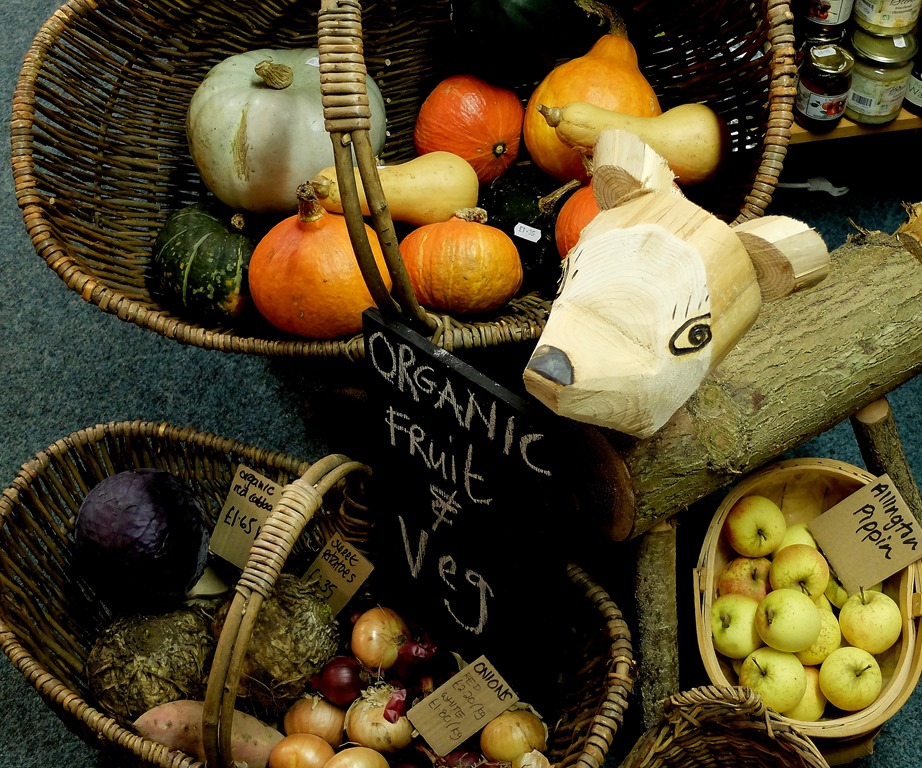
I’ll second that, or even third it. But just to finish off, and continue in the seasonal vein  (since autumn has definitely come to England a month early), this last photo was taken at a farm shop just outside Kennebunkport. It’s the sort of quite understandable confusion that might arise after a beer or two. Chin-chin!

073b


copyright 2014 Tish Farrell


Sunday Stills