
One thing I have learned: we need to be very, very careful when we assess the quality of our leaders. Otherwise who knows where they might take us, and for what foolish or malign reasons all their own.

One thing I have learned: we need to be very, very careful when we assess the quality of our leaders. Otherwise who knows where they might take us, and for what foolish or malign reasons all their own.
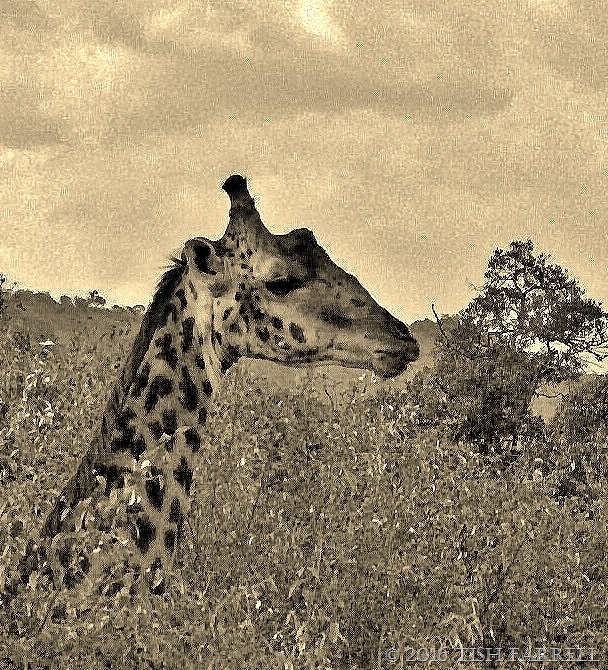
I had no idea until this week when the BBC aired Giraffes: Africa’s Gentle Giants in their Natural World series. But in the twenty years since this photograph was taken in the Maasai Mara the continent’s giraffe population has fallen by 40 %. That’s roughly 36,000 fewer wild giraffes on the planet, out of a total remaining population of 90,000.
I’ll say that again: there are only 90,000 giraffes left in all Africa. Some populations comprise less than 400 individuals. Seven countries have lost their populations altogether.
In his voice-over, David Attenborough calls it a ‘silent extinction’; it has happened without anyone much noticing. We have been too busy worrying, and quite rightly so, about elephant numbers. But then Africa still has half a million elephants, albeit a fraction of those slaughtered for piano keys, billiard balls, and objets d’art.
One man who has been noticing the giraffe depletion is Australian scientist Dr. Julian Fennessy. From their home in Namibia, he and his wife have been studying the resident Angolan giraffes for twenty years, learning things about giraffes that no one else has bothered so far to discover. It seems that we all have thought that giraffes will always be there. If Fennessy has his way, they will be. But it’s a big call.
In many regions of Africa they have been poached for meat, or their habitats destroyed. There appears to be a further problem. It has long been known that there are several ‘races’ of giraffe across Africa – Maasai, Rothschild, Reticulated amongst others. Now Fennessy is coming to the conclusion that some of these regional variants are actually separate species. He is carrying out genetic sampling across the continent in order to find out. If his theory proves correct, then this knowledge will be crucial when it comes to maintaining viable breeding populations.
To fund operations, he and his wife run the Giraffe Conservation Foundation, the only conservation charity devoted exclusively to giraffes. The BBC film also documents the Fennessy family’s part in the extraordinary effort by the Uganda wildlife authority to translocate 20 giraffe across the Nile in order to establish a new population outside an area earmarked for oil exploration, and one already predated on by poachers. For anyone in the UK, the programme is still on BBC iPlayer.
And why should we worry about loss of giraffes. Well, like elephants, they are the natural world’s gardeners. They help to pollinate trees, so ensuring fruits and seeds for a range of other wildlife. They also spread ready-to-grow seeds in their dung, so propagating tree cover which benefits the planet. And utility aside, just the thought of them makes people happy. Perhaps happy enough to help to support the Giraffe Conservation Foundation? Follow the link to see the kind of work they do.
*
Post inspired by Paula’s theme at Black & White Sunday: Always there
copyright 2016 Tish Farrell
#GiraffeConservationFoundation
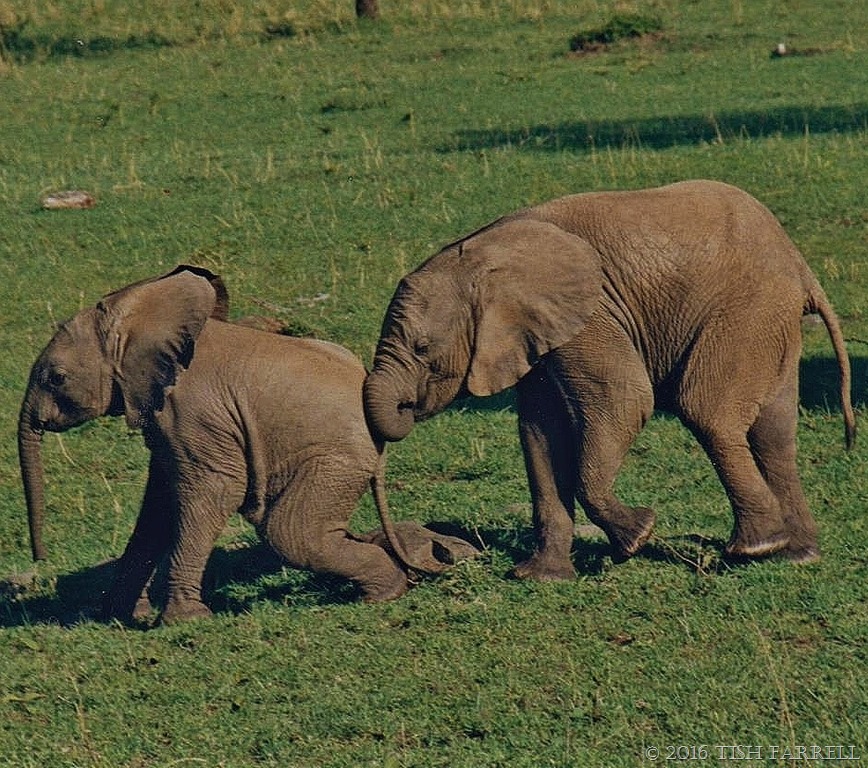
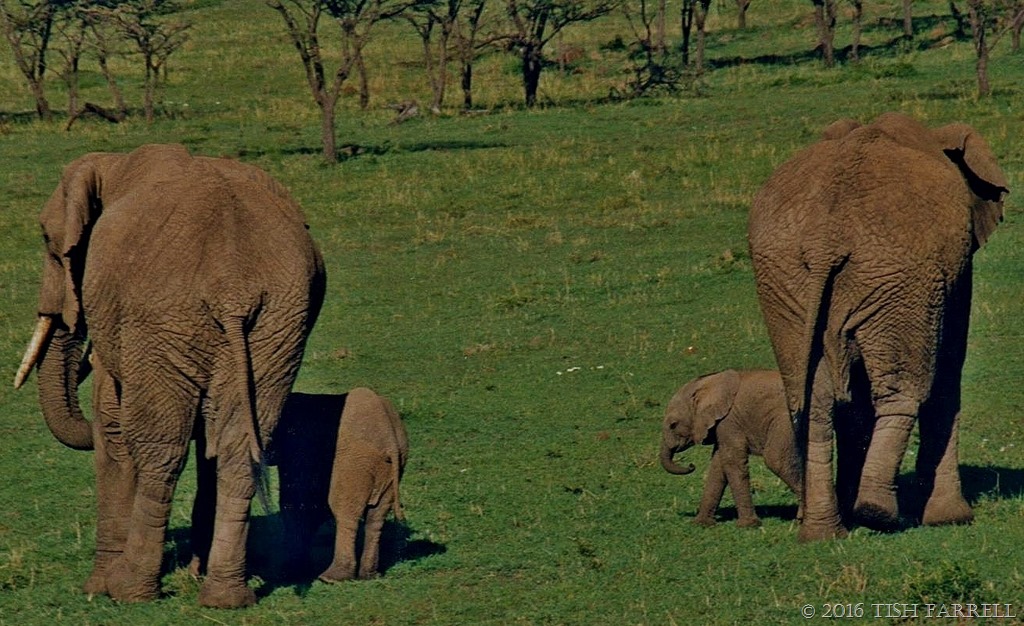
Elephant females and young spend most of their time in small family groups of ten to fifteen related individuals, ruled and guided by a matriarch. She is the equivalent of the institutional memory, and her role is to keep the family safe. These small groups gather into larger herds during the rainy season as they search for fresh vegetation. Adult elephants consume up to 400 pounds/180 kilos of vegetation a day. The two youngsters in the picture, however, will still be suckling – when they’re not busy playing that is.

I spotted the blood red field across the town from Windmill Hill on Midsummer’s Eve. Yesterday at sunset, I gave up picking field beans and strawberries at the allotment, and went to seek it out. After a dull afternoon and early evening, the sun suddenly put in an appearance and I surmised it would be shining right on the poppies, and it was.
What a glorious sight. I have never seen such a profusion of scarlet heads, pushing their way up through the ripening stems of oil seed rape.
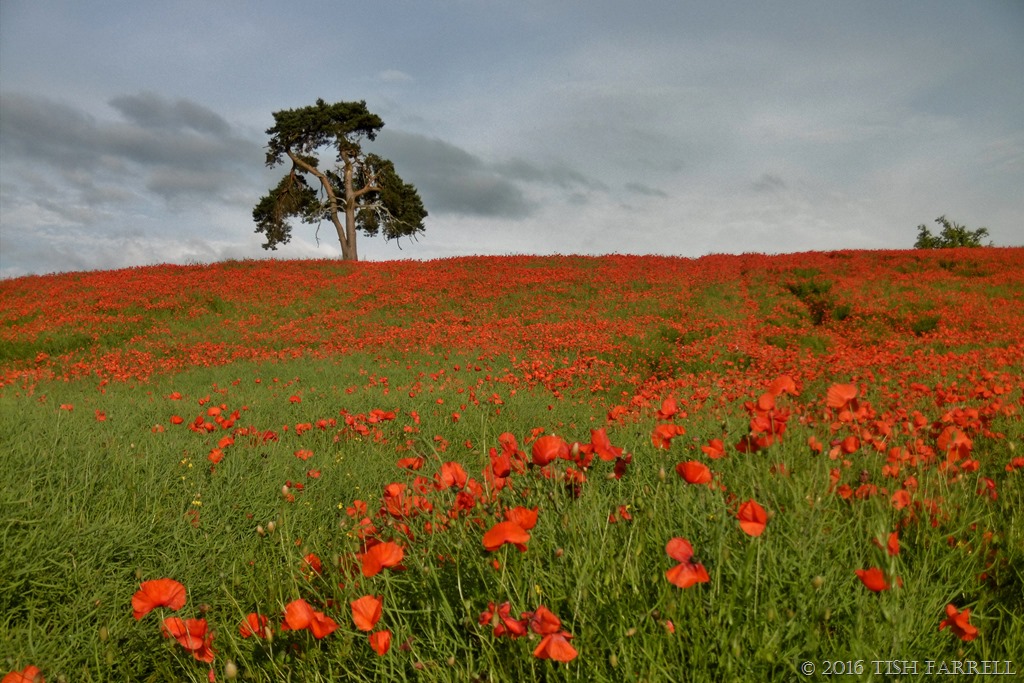
Of course the question I ask myself – is this happenstance or has someone gone in for some guerrilla gardening on an epic scale? Either way, it cannot be rivalled as a piece of earth art. And of course with the hundred year anniversary of the Battle of the Somme upon us, it strikes other chords – the pointless waste of so much promise; of so many brave young men. Today, too, just over half of the British voting public opted to leave the Europe Union, one of whose founding objectives was the avoidance of another European conflict. I feel very sad about this outcome. I think change can be best effected by participation and engagement from within. In fact we Farrells were so fed up this afternoon we had to visit the poppy field once more to cheer ourselves up.
So here’s to poppy power and creative cultivation. A potent beautiful force.
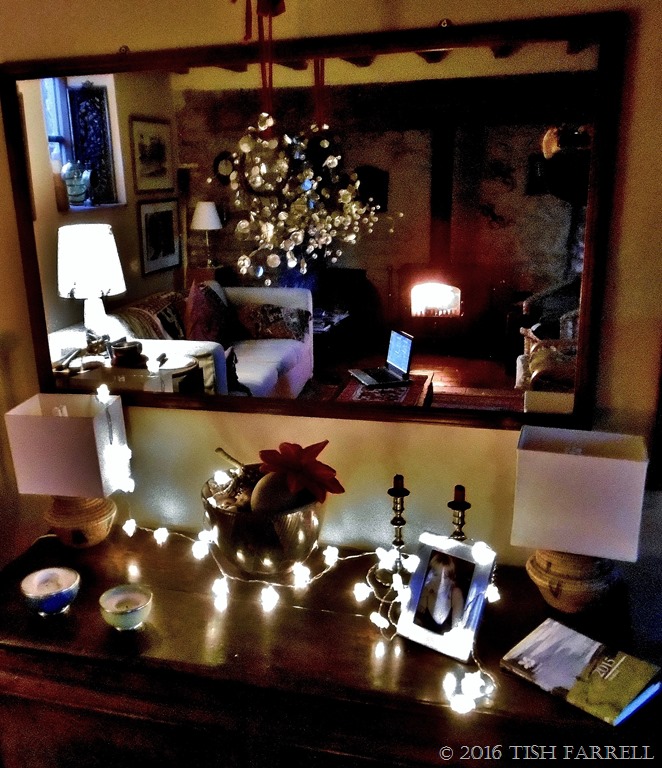
Reflected worlds are endlessly fascinating. I often wonder what kind of people live on the other side of our sitting room mirror.
Thursday’s Special: Mirroring Please visit Paula for further reflections on this theme.
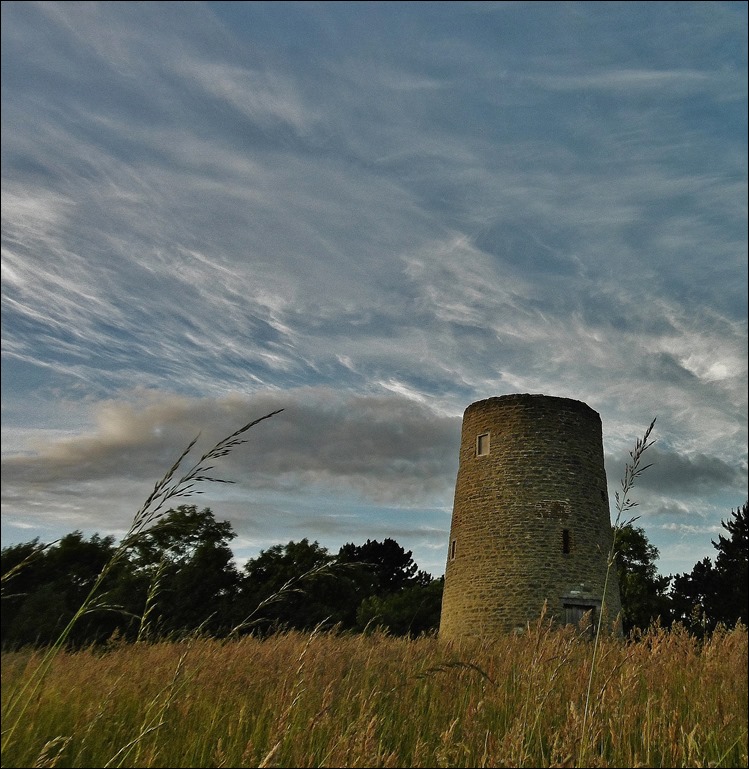
With this shot I’m back to what Meg at 12monthsinWarsaw calls my Monet’s Haystack mode – i.e. there just cannot be too many shots of the old windmill near my house. I succumb every single time I’m there with a camera to hand. I snapped it yesterday in celebration of the summer solstice, caught in a quick walk between supper’s first course of dhal and Staffordshire oat cakes, and the strawberry crumble that was to follow.
I was also taken by the midsummer meadow in all its lushness – so many different kinds of grasses that I cannot name, and masses of pyramidal orchids – far more than last year. There were also spotted orchids, meadow sweet, vetch, red and white clovers, ladies bedstraw, and white bladder campion which is most usually seen growing on seaside cliffs. And also the sky above was filled with clouds that looked like dragons.


Please visit Cardinal Guzman’s Changing Seasons for more on this challenge.
copyright 2016 Tish Farrell
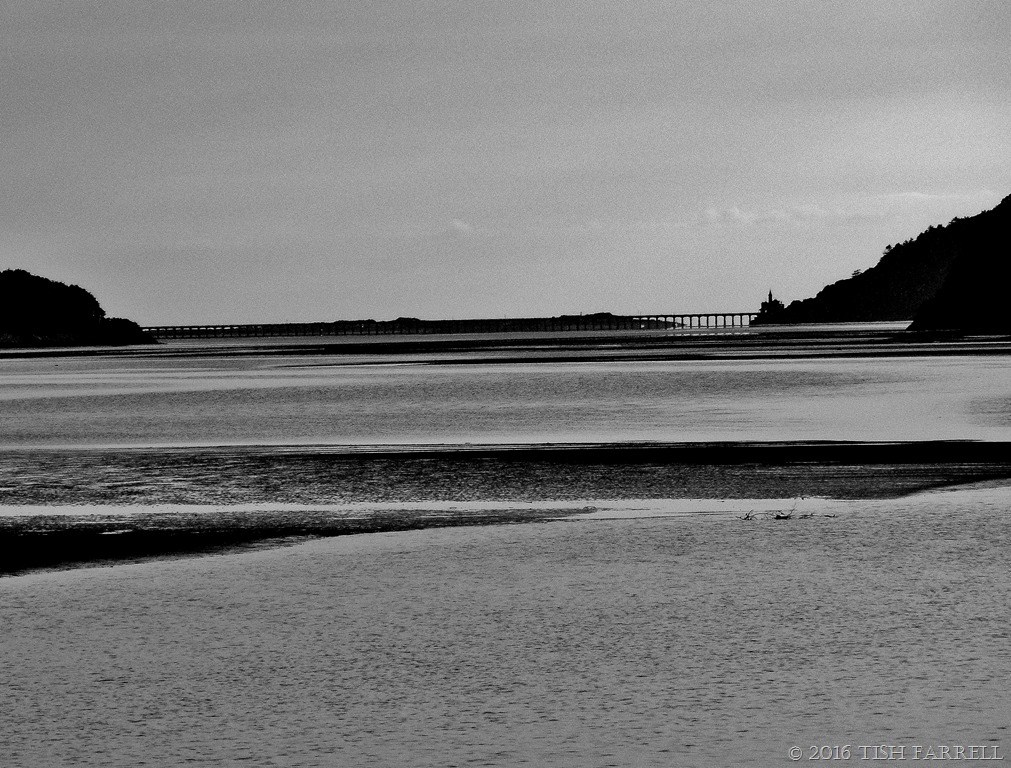
The most unexpected thing about this shot is that it came out at all in such low light conditions. I do love the Dynamic Monochrome setting on my Lumix. It creates all kinds of unforeseen magic, even with much added zoom.
I suppose the other piece of unexpectedness here is the perversity of shooting a limpidly pastel sunset in monochrome. But I like the way it silhouettes the old railway viaduct across the estuary mouth. In Welsh it is called Pont Abermaw, and in English, Barmouth Bridge. It was constructed mostly from wood during the 1860s, and included a drawbridge section that would open allow tall masted ships to pass through, sadly not a facility much needed these days. It would be fine sight though, so please add your own sailing ship to this vista.
*
Black & White Sunday This week Paula requests we show her the unexpected. Please drop in there for more creative renditions of the theme.
#MagesticMagicalMawddach
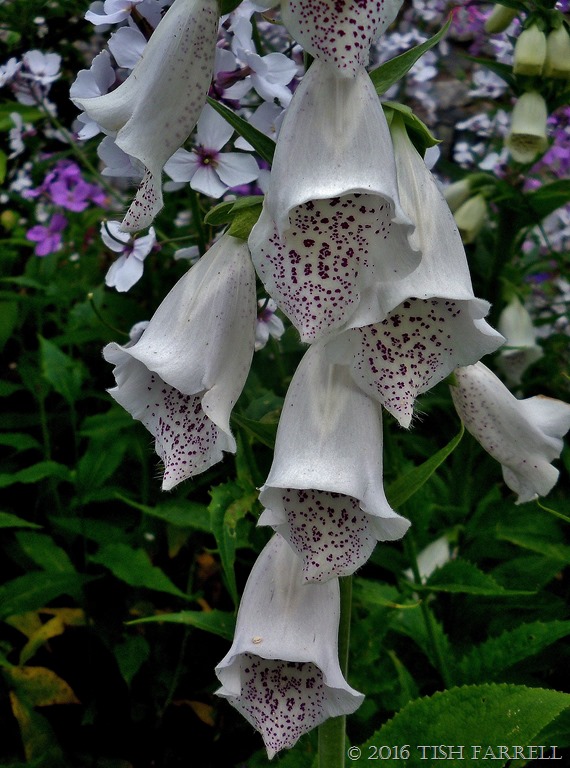
For her June Sunday Garden Challenge, Jude asks us to show her what summer means to us. So here are a few views of our garden on Sheinton Street. I should say straight away that I don’t give it the attention it deserves, and that daily I abandon it as I walk through and out the back gate and across the field to the allotment.
The plot is long and thin, following the width of the cottage, and on three different levels, which I don’t make enough of. For one thing, I know it must be possible to have beautiful plants growing somewhere within it all the year round if only I would sit down and do some proper planning and research.
Instead I tinker here and there, and let the garden do a lot of its own gardening. This includes encouraging the self-sown foxgloves, and the wonderfully scented purple, mauve and white Dame’s-violet (Hesperis matronalis) seen in the photo behind the foxglove, both of which follow on from the clouds of self-sown columbines. My garden, then, comes into its own only in summer, and otherwise can look rather dreary. But while it’s here, it’s wonderful – total cottage garden exuberance and chaos.
Welcome to my garden.
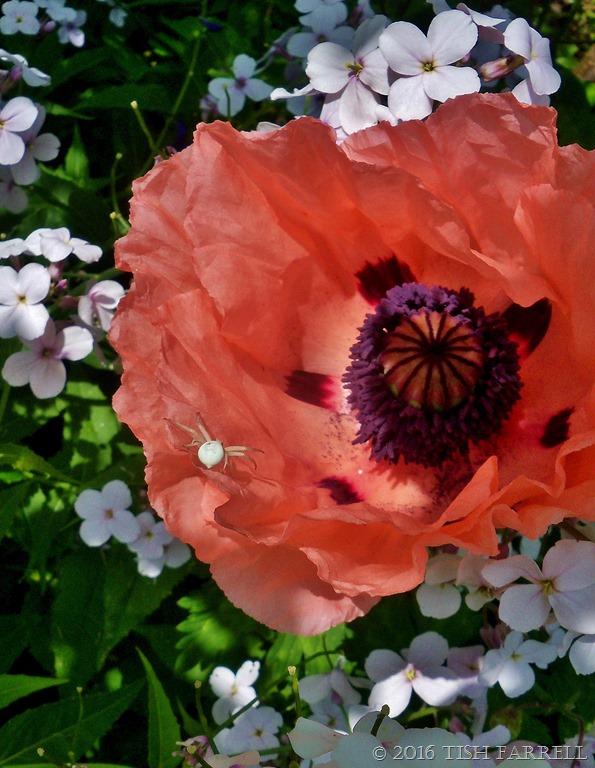
Oriental Poppy, crab spider and Dame’s-violets
*
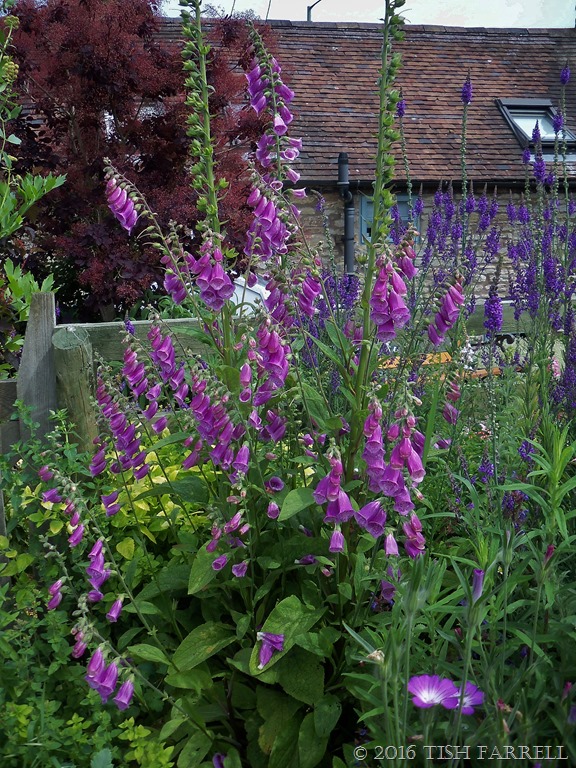
Wild corn cockle (bottom right), foxgloves, purple toadflax; variegated lemon balm, oregano and golden marjoram in between, and the coppery foliage of Smoke Bush (Cotinus) in the background.
*
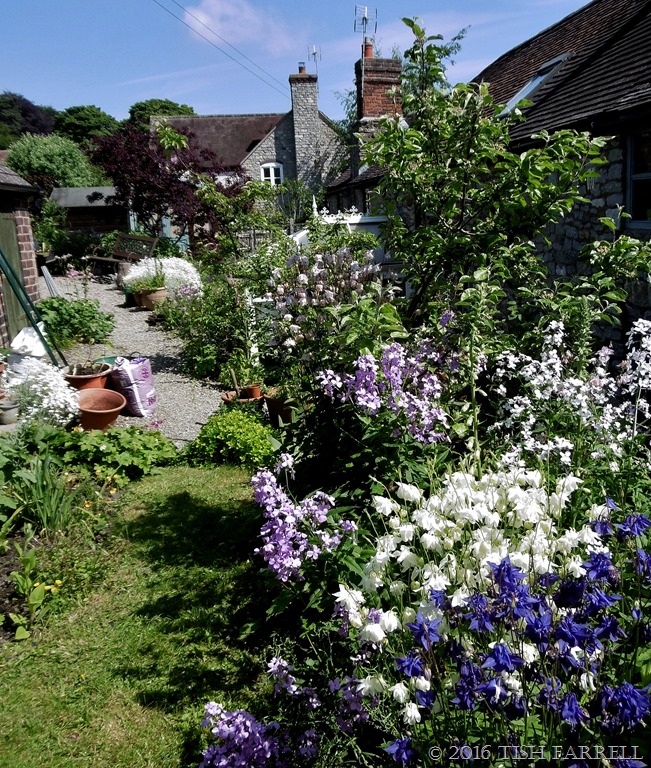
Columbine break-out

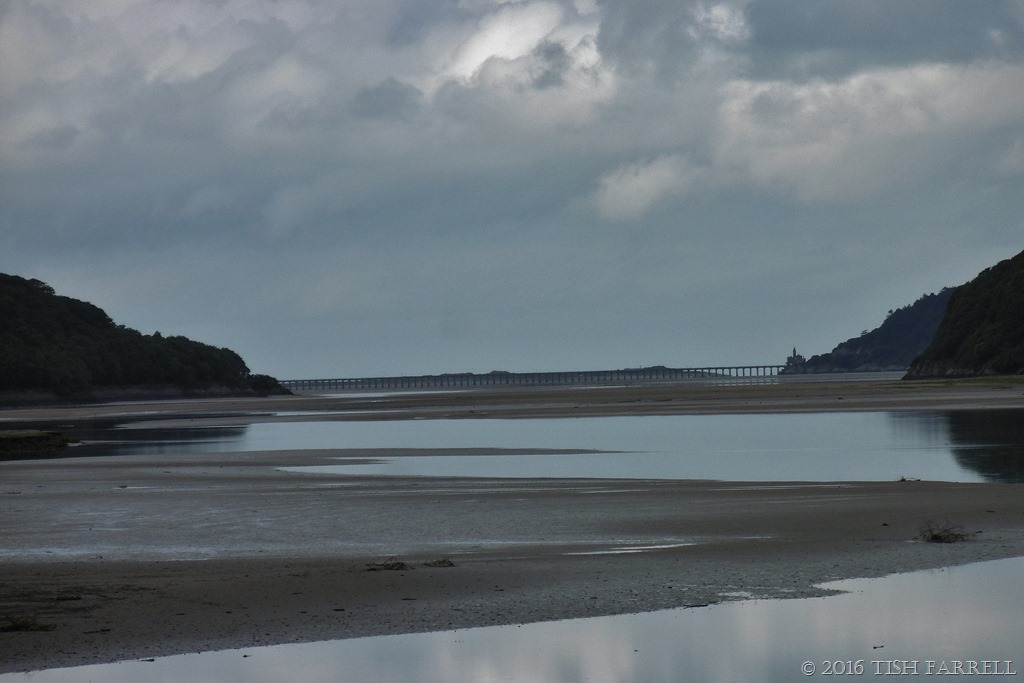
We drove through one hundred miles of rain to reach it. From South Shropshire to the Welsh coast clouds piled on clouds and the rain dashed down the windscreen with only brief interludes of drizzle. Climbing and climbing the precipitous road through Dinas Mawddy, sky and mountains closed in, reminding us that we humans are rather puny ineffectual things, and that the motorized carapace that transports and shelters us may just not be enough in a land like this. Even the sheep, inured to the place, stand hunched and motionless on the hillsides, backs to the downpour.
And then at last we’re here, on the banks of the Mawddach Estuary, just downstream of Penmaenpool, and the rain recedes, leaving stillness and shadow, the slow curves of the river, Welsh Black cattle grazing the salt marsh, a buzzard calling, canoeists returning to base, and on the far horizon the knowledge of the sea, though unseen, marked by a sudden flush of brightness out in the bay.
copyright 2016 Tish Farrell
#SnowdoniaNationalPark
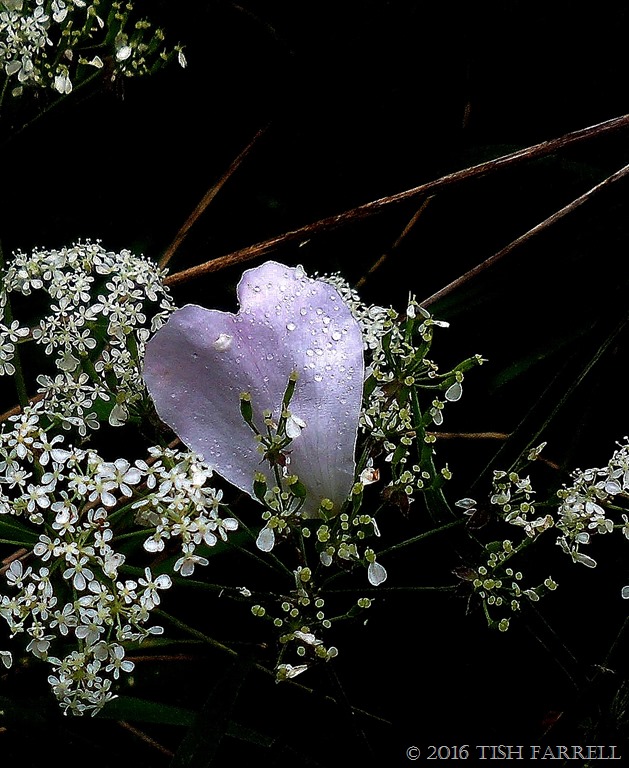
It is tear-stained too. Fallen on the field path among the pignut flowers, a plant also known as Earth Chestnut, because its tubers were once grubbed up and relished by country children. And as for the heart? Eglantine. Sweet Briar. Dog Rose. Rosa canina.
If this image inspires anyone to a bit of storytelling in whatever form, and short as you like; then leave a link here so I can read it. I won’t be back in blog world until Saturday, so no rush.
