Mara Dawn, Lewa Sundown: Monochromatic Africa

Scan-140826-0029jpeg

In winter at the Equator, Africa comes in many kinds of monochrome. At first light all is sepia. This lioness was captured at dawn in the Maasai Mara. She is watching out for hyena that are moving in on the Marsh Pride’s kill.

At sundown  in Lewa, in Northern Kenya, all is old gold as these kudu stop for a moment before melting away into the thorn scrub. Did we really see them?

004

003

Monochromatic

Connected, on and off the rails: a passion for steam

IMG_1835 - Copy

This year Shropshire’s Severn Valley Railway celebrates 50 years as a tourist attraction. That this 16-mile remnant of an 1862 main line railway is still up and running is due to the efforts of several generations of steam engine enthusiasts who lobbied, fund-raised, rescued and restored old rolling stock, and then threw the lot open to a willing public that now loves to spend its spare time watching and riding on steam trains. I mean who wouldn’t want to catch the Santa Special? If you’re up for it, I should tell you that advance booking opens on September 14th.

These photos were all taken back in the winter at Bridgnorth Station, our nearest market town, and the railway’s terminus. Graham was there on a mission – to look at rivets. I was just there to savour the steam. Aaaaah. Oh yes, and to take snaps. But perhaps I’d better explain about the rivets.

100_6762

First a little back story. Rewind 153 years…

In 1862 a branch from the original Severn Valley line was built through Much Wenlock. Mainly it served the limestone quarries, but at Whitsuntide, the Great Western Railway put on special trains to bring thousands of spectators to see William Penny Brookes Wenlock Olympian Games. Conveniently, the station was right beside the Linden Field where the games were, and are still held every year.

And because it was Wenlock’s William Penny Brookes who inspired the notion of the modern Olympic Games, and because we are proud Wenlock residents, some time in 2011 Graham had the idea, as a de-stressing pursuit, and as his own celebration of our town’s connection to the 2012 Olympics, to make a gauge 1 model of the  ‘Olympic Special’.

This resulted in the creation of very pleasing passenger carriage, and a goods waggon that was the original practice piece for the enterprise. The superstructures of both were  made from scratch, following some 1860s plans that Graham had unearthed. I don’t remember where he found them. But then came the stumbling block – the locomotive itself.

For this, he would need equipment he did not own, and skills he did not think he possessed. Ever since he has been pondering on how to set about it, egged on by our good neighbour, Roger, who does have handy engineering skills. Part of the on-going pondering included first-hand experience of GWR engine rivets so that Graham could judge the scale of them. And who am I to throw cold water on a chap’s enthusiasm.

Besides, as a child, I spent a lot of time on steam trains, and more specifically waiting to catch one on Crewe Station. And anyone who knows their railway history will know that Crewe Station, built in 1837, is one of the world’s oldest stations, and that its junction was once a thing of railway wonder. So, all in all, I was glad to tag along on the boiler rivet hunt, and thereby have the chance sniff hot coal and engine oil, and look at rust on old locomotive hulks. Graham always claims I was born on the foot plate. And no. My father was not an engine driver.100_6822

100_6813

*

Also it was good to watch the happy voyagers waiting to embark on The Royal Scot…

100_6779

IMG_1846

100_6791

*

And finally that brings me to the work in progress. It’s sitting over the DVD/CD shelves in the kitchen, waiting for an 1860s vintage locomotive to take it away.  Passengers please take note. This train may not be leaving until the advent of the next Olympic Games. Graham says it’s good to have a deadline…

100_6961

copyright 2015 Tish Farrell
Severn Valley Railway Go here to find out more about the SVR

#SVR #SevernValleyRailway #steamrailways


Connected

One thing leading to another on Windmill Hill: everything is connected

P1010943

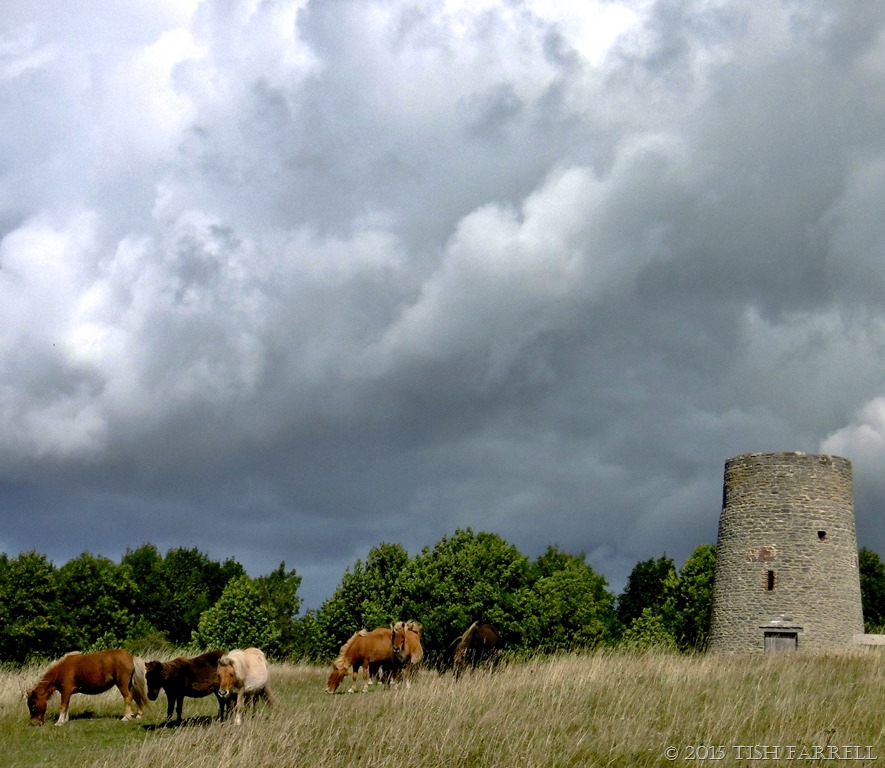
We’re barely into September and already autumn is here in Shropshire. It must be so, because the little horses are back on Windmill Hill. They will spend the next few months grazing off the dying summer grasses and wild flowers. They look very windswept, but the punk-mane-effect is mainly down to thickets of cleavers (goose grass) seeds in their top knots.

P1010945

P1010942

Looking across the hill there’s hardly a sign of the June-July flowering – all those buttery clouds of Lady’s Bedstraw quite gone. Not a trace of the orchids either. Only the dark and brittle seed heads of knapweed that always strike a note of dreariness. The weather doesn’t help either. For weeks it has been rain between showers.

Nor was I encouraged by the BBC radio science programme I heard yesterday. I caught it in the midst of recompiling a glut of runner beans into chutney (beans at least like rain). The guest climate experts were soon informing us that the El Nino effect they promised us all in 2014 did not come to much. In fact, they opined, (and they sounded quite definite about it too) we still have it very much to look forward to – the worst El Nino effect hitherto experienced, they said. For some reason the Pacific Ocean keeps heating up. And this means disrupted weather patterns worldwide, and for Europe, an even wetter winter than usual.

MORE RAIN? I wish we in Shropshire could email some of it to those lands whose dramatically changing climates mean that they now receive little or none. Mongolia is one place suffering massive desertification. Likewise, the countries of Africa’s Sahel that border the Sahara. In both regions, and many others besides, human actions, poverty and climate shift combine in a vicious downward spiral that results in increasing degradation of land and water sources. This, apart from war, is one of the main drivers of human migration. It’s all connected, despite what the climate change naysayers may wish to believe.

All of which is to tell myself to count my blessings.  I am free to wander where I like without fear of being terrorized by extremists. I have all the food I need and more. I enjoy every comfort. I have the luxury to meander along Shropshire byways, talking to little horses, musing on the meaning life, the universe and everything, while across the globe desperate others risk all to find somewhere they can live a decent life with their families. Some people, we hear, do not want to share their land with refugees. It is assumed that they will be nothing but a drain on resources. Yet who knows what gifts in talent and skills these homeless souls might be bringing us? Also, not sharing may cost us more than we could ever imagine. In some societies the truest measure of civilisation is the gift of hospitality. Perhaps we need to think about this with a little more application. At least, I know I do.

P1010956

copyright 2015 Tish Farrell
Connected

Help, Mr. King! My polytunnel needs editing

100_6203

I have written elsewhere how gardening and writing become mixed up in my life. But just see what happens when you don’t rein in your gardening writing, when you let your setting run riot. Words, like plants, need a certain space to perform well; to be the stars of the show; to say their piece effectively.

I never intend to over-create. In fact my internal critic warns against it, whether gardening or writing. The polytunnel mayhem is of course easily explained: I simply had to  plant out every last tomato seedling. How could I not, when I had nurtured each one through the cold spring months that seemed never ending?

All I can say if you write like this, and then don’t engage in some ruthless excision tactics, you will not be able to find the tomatoes for the overgrowth.

On the fiction writing front, Stephen King (On Writing: A Memoir) would call this kind of chaos “a thicket of description”. It’s what happens when writers become too attached to the minutely researched details of their setting, and then feel they can’t sacrifice a single beloved element.

It can also happen when you start a story in the wrong place, and then flounder about trying to write yourself to the right place. It’s like planting all your tall-growing tomato plants at the front of the bed, and then wondering why you, or anyone else can’t see what’s going on behind with short varieties. This, then, is also a setting problem: you have not planned the planting scheme and stuck to it (more or less).

All of which is to say, there comes a point when you have to take out a whole batch of words and shoot them – this so the survivors have room to expand and thrive (the excess tomato plants you could of course give to someone else.)

Stephen King explains the situation further (pp 138-9). He gives an example of using a real location as his setting for a piece of narrative, in this case the Palm Too restaurant in New York. It is somewhere he knows. As he starts to visualize the place, he summons the first four things that strike him. These, he says, are likely to be ‘the truest and the best’ details. He also says he can  make up a few other things too, but there is really no need for more:

“This isn’t the Taj Mahal we’re visiting…and I don’t want to sell you the place…it’s not about setting, anyway – it’s about the story, and it’s always about the story.”

Put another way, you could say that fiction writing is never about the writer. To create, you need to GET OUT OF THE WAY. And the better you succeed in this, the better the story. This is not to say that the writer’s experiences and cast of mind do not inform/infuse the narrative, but think conduit and transit time, rather than compendium drag.

Words are fiction’s conveyance to transport readers out of themselves and into the lives of others in new/penetrating/exciting /inspiring ways. The words need lift, energy, vivacity. Anything that snags transition must be cut.

This is probably the hardest lesson for the starting-out writer to believe, let alone put into practice. But it is a truism: less is almost invariably more. Not believing this is one of the reasons we have slush-piles, and why publishers now mostly shut their doors to unsolicited submissions. It’s the reason why I have too many tomato plants in my polytunnel, when I could have made the best of, say, half a dozen of the strongest plants.

But then as Stephen King advocates, practice (lots of practice) will yield improvement. So I vow to improve in my prose and in my planting. For now I leave you with Mr. King’s brief words on the means to create viable settings:

“The key to good description begins with clear seeing and ends with clear writing, the kind of writing that employs fresh imagery and simple vocabulary.”

100_6937 N.B.: use only the brightest and the best tomatoes, and not too many.

Happy writing!


Related: Errant muse? But there’s still life at the allotment

copyright 2015 Tish Farrell

Secrets, conspiracies, tragedy, dark comedy

– a fast-paced novella of interwoven tales

set somewhere in East Africa

Inside Much Wenlock’s Council Chamber: can the past cost too much?

100_6652

This is not the sort of chap you expect to find at a town council meeting (lion or devil, I’m not sure which) but then Much Wenlock’s council chamber is no ordinary place. It was built in 1577 as an extension on the 1540 civil courtroom. The two chambers on the upper floor of the Guildhall thus became the judicial and administrative centre for the 70 square miles that had once been ruled by the Prior of Wenlock. Underneath was the town lock-up, and an open space for a corn market.  Behind is the churchyard, and next door, Holy Trinity parish church. The hub of the town then.

100_5540 - Copy

But perhaps the most surprising thing about the council chamber is that it is still in use today, although anyone sitting through a council meeting may well be left with distinctly unfavourable impressions of the past, and physically too: the seating is a torture on both knees and nether regions. I guess it was designed to keep everyone awake.

I’m afraid these upcoming interior shots look a bit woolly because of the spotlighting. On the other hand, they perhaps convey some sense of the antique residue that pervades the place.

100_6640

The panelling around the walls is 17th century, and was bought from elsewhere and installed in Victorian times by the town’s doctor and benefactor, William Penny Brookes, he who invented the modern Olympic Games (a fact I may have mentioned a few times.). The mayoral and officers’ chairs are especially awe-striking, and the said august personages truly do need to have on all their robes , wigs and paraphernalia if not to get lost inside them. These days this usually only happens on Mayor Making Day, once every four years.

100_6646


100_6645

Here’s a closer view of the panelling behind the officers’ chairs. (There’s another scary entity up in the top right hand corner). Then coming up is the panel above the fireplace. Something to do with the Garden of Eden perhaps:

100_6650

And now for a glimpse of the Church Green, along with the grave of William Penny Brookes. The blue painted surround is comprised of Olympian victors’ garlands. The Green is the venue for all the town’s fairs.

100_6649

This next shot is taken from the Green. It’s hard to capture both the Guildhall and the church at one go:

P1000406

Of course the question that has doubtless surfaced in many of your minds is does the antiquated setting of the council chamber affect the quality of the thinking that goes on in there, and likewise the kind of decisions arrived at?

A few years ago I would have said that it certainly did. Some of the councillors back then had served for fifty years. These days, though, we have some very hardworking representatives. They are not paid either, since the once impressive Borough of Wenlock with its two members of parliament is no more, and the current town council has no more status than a parish council. But paid or not, our councillors still have some pretty big headaches to wrestle with, one of them being the continued upkeep of the Guildhall, including the roof over their own chamber.

It is perhaps a good example of the past becoming a public burden. Doubtless it is an amazing relic, and full of history, but it is no longer functional in modern terms. For one thing, there is no access for anyone with disabilities, or for the elderly who simply might have difficulty mounting the handrail-less stairs. As a listed building, the cost of installing some kind of lift would be astronomical, even if it were actually feasible. This situation immediately excludes quite a segment of the town from the democratic process. The uncomfortable seats probably do for the rest.

As to who foots the bill for running costs, then it is ultimately us, the council tax payers of Much Wenlock. If we did not pay to keep it going,  it’s hard to know what anyone else would do with such a building. So here we have it – listed, listing, leaking energy, and generally not fit for purpose.

Attempts to raise some revenue by charging a  modest fee to visit the old court room and council  chamber did not work. Few people wanted to pay to go in. Now the court room is a small museum and art gallery, and entrance is free.

All of which leaves us with an impossible, but fascinating building, and one that probably no one in Wenlock would wish to be without. It gives the town its identity, and so maybe, at the end of the day, it’s only right that its citizens continue to support it, whatever way they can. At least the old corn market is still well used, and much for the purpose it was originally intended.

100_6020 (2)

copyright 2015 Tish Farrell
 

This week at Thursday’s Special, Paula is inviting us to post traces of the past. Please visit her blog to find out what she and others have come up with.

In my garden after the rain

100_6854

Ladybirds seem to have been in short supply this year, so I was pleased to find this one nestling in my sage bush. Like bees, we absolutely need ladybirds. They are our natural pest controllers, preying on aphids and scale insects that can otherwise cause massive damage to food crops. As I was taking this photo, I was also delighted to scare off the harvestman spider that was creeping up on the ladybird. If you look in the bottom right corner above the copyright notice, you can just see the spider’s legs. Yikes!

*

100_6836

And here’s more evidence of spider activity: ambush exposed by raindrops in a garden pot.

*

100_6857

Now for one of my favourite plants in the garden. The flowers of this later flowering phlox remind me of jasmine and are half the size of the usual cottage garden varieties. It has just the faintest subtle scent, and doesn’t mind shade.

*

100_6863

Heuchera is another wonderful plant, and especially for ground cover. It comes in several hundred variations, and although understated on the floral front, it more than makes up for this with colour-bursting leaves that last all spring and summer. Also I see there’s spider lurking top left. I think it’s another harvestman. The bright green leaves amongst the heuchera are self-sown aquilegia seedlings. More granny’s bonnets to look forward to next year then. You never know what colour the flowers are going to be either – mauve, purple, pink, red, white. It’s one of the best things about plants that do their own gardening.

*

100_6832

The tiny fruit on our Japanese crab apple are just beginning to take on their autumn colour. Soon they will be a deep russet red. I don’t think snails eat apples. At least I’m giving this one the benefit of the doubt; it’s probably just been sheltering from the rain.

*

100_5373

And now for a flashback-fastforward: the crab apple tree in April – spring past, spring to come…

Today Was a Good Day

This was a good day: Great Zimbabwe

Scan-130429-0011

I’ve posted this photo before, but then it was a very good day all those years ago in Africa. And it’s also good to remember days when I looked a lot younger. (Or maybe not).

As you can see, all was bathed in old-gold light at Great Zimbabwe. The air was dreamily soft – much like a September Indian Summer day in England when all is drowsing except for the buzzing of wasps and bees.

Surprisingly, we had the place to ourselves. There we were, utterly free to wander about, seeking out the spirits of this once thriving African city of cattle herders and gold traders.

I remember pressing my palms on the granite blocks of the Great Enclosure and feeling their warmth, and wondering, too, at the sheer height of the walls that had no mortar to hold them  fast for 700 years. Just imagine the skills needed to build walls like this, and think, too, how the white elite that once ruled Southern Rhodesia attributed this astonishing structure to Phoenicians, Ancient Egyptians, the Queen of Sheba, in fact to pretty much anyone who was not a member of the local Shona people who did construct it.

It was at times like these that I discovered that archaeology was not the benign, gently antiquarian discipline that I had spent three years of my life studying. No indeed. In certain quarters archaeological ‘evidence’ can be grossly perverted to sell false credentials to justify the rule of unjust rulers. I find it both sad and shameful that amongst such self-appointed elites even old stones can become the object of racist bigotry.

But wait. Such thoughts are spoiling the day, and there is still so much to see. There are  mysteries too. Why were these city walls raised up so high when there is no evidence that the entrance gateways were ever closed, or even defendable? What was the purpose of the extraordinary stone tower? Why was this place abandoned, left amid the granite hills as the people simply gathered their cattle and belongings and walked away?

For more of Great Zimbabwe’s history see my earlier post:

Abandoned: Great Zimbabwe

Great Zimbabwe general view

100_6880

Scan-130429-0004

copyright 2015 Tish Farrell

Today Was a Good Day

Strawberry Vodka Revisited

100_6756

Some of you will remember that back in early July I posted Jane Grigson’s recipe for Strawberry Vodka. A good six weeks on, it has been duly shaken not stirred, kept in a dark, cool place, drained and strained, and here is the result – back in the vodka bottle (not the vase, although the liquid contents do look similar). Obviously during the decanting process we had to have a little sip or three. All I can say is this stuff is sure to add gleam, both inside and out. Also the only travel involved in procuring this shot  was the trek between allotment and kitchen (me), and off licence and kitchen (Graham), and then to the sofa for a lie down (me again).

Strawberry Vodka Recipe


P.S. And if you are groaning because you missed the strawberry season, then this recipe will surely work with late summer fruits: plums, damsons, black currants, autumn raspberries, although you might need to add a little more sugar.


For more shimmer and shine please visit Ailsa at Where’s My Backpack where this week her theme is ‘gleaming’.