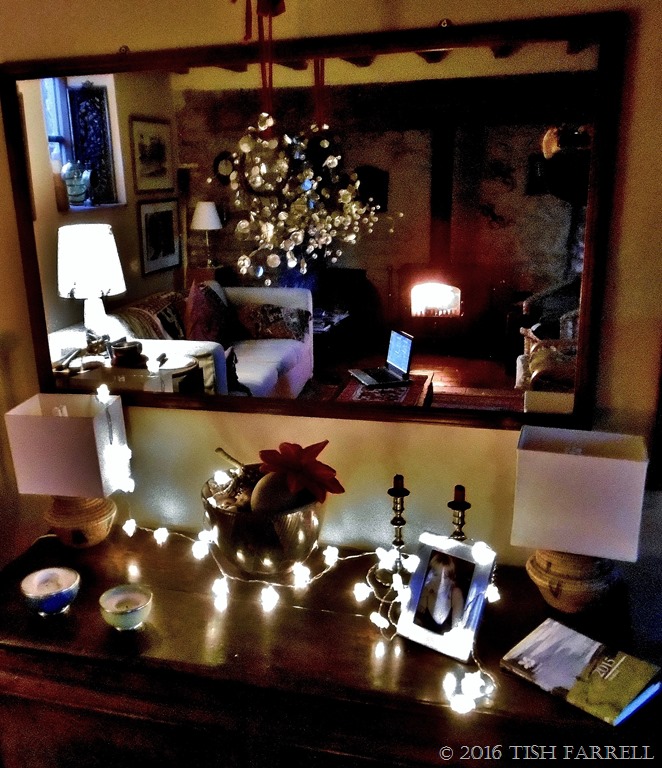
Reflected worlds are endlessly fascinating. I often wonder what kind of people live on the other side of our sitting room mirror.
Thursday’s Special: Mirroring Please visit Paula for further reflections on this theme.

Reflected worlds are endlessly fascinating. I often wonder what kind of people live on the other side of our sitting room mirror.
Thursday’s Special: Mirroring Please visit Paula for further reflections on this theme.
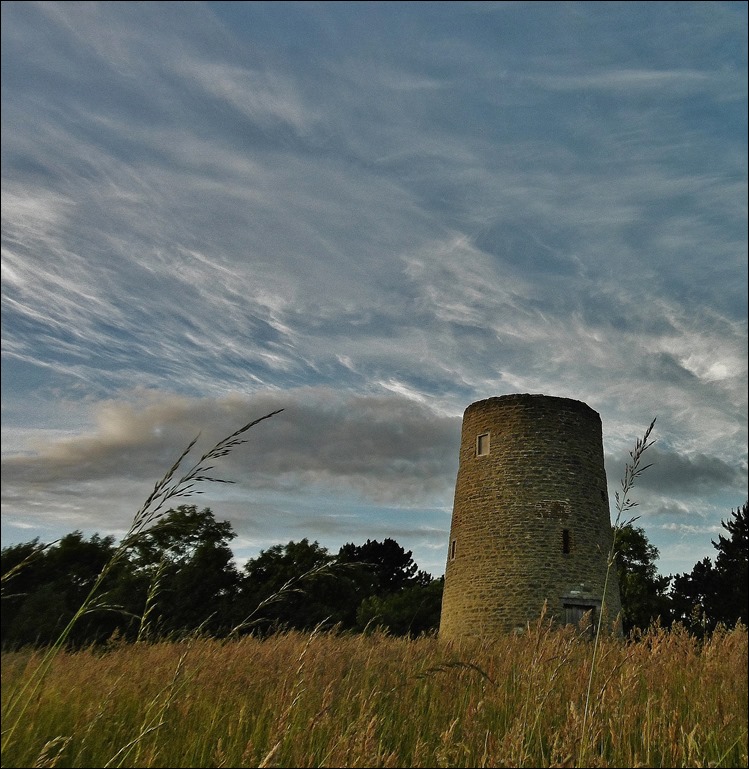
With this shot I’m back to what Meg at 12monthsinWarsaw calls my Monet’s Haystack mode – i.e. there just cannot be too many shots of the old windmill near my house. I succumb every single time I’m there with a camera to hand. I snapped it yesterday in celebration of the summer solstice, caught in a quick walk between supper’s first course of dhal and Staffordshire oat cakes, and the strawberry crumble that was to follow.
I was also taken by the midsummer meadow in all its lushness – so many different kinds of grasses that I cannot name, and masses of pyramidal orchids – far more than last year. There were also spotted orchids, meadow sweet, vetch, red and white clovers, ladies bedstraw, and white bladder campion which is most usually seen growing on seaside cliffs. And also the sky above was filled with clouds that looked like dragons.


Please visit Cardinal Guzman’s Changing Seasons for more on this challenge.
copyright 2016 Tish Farrell
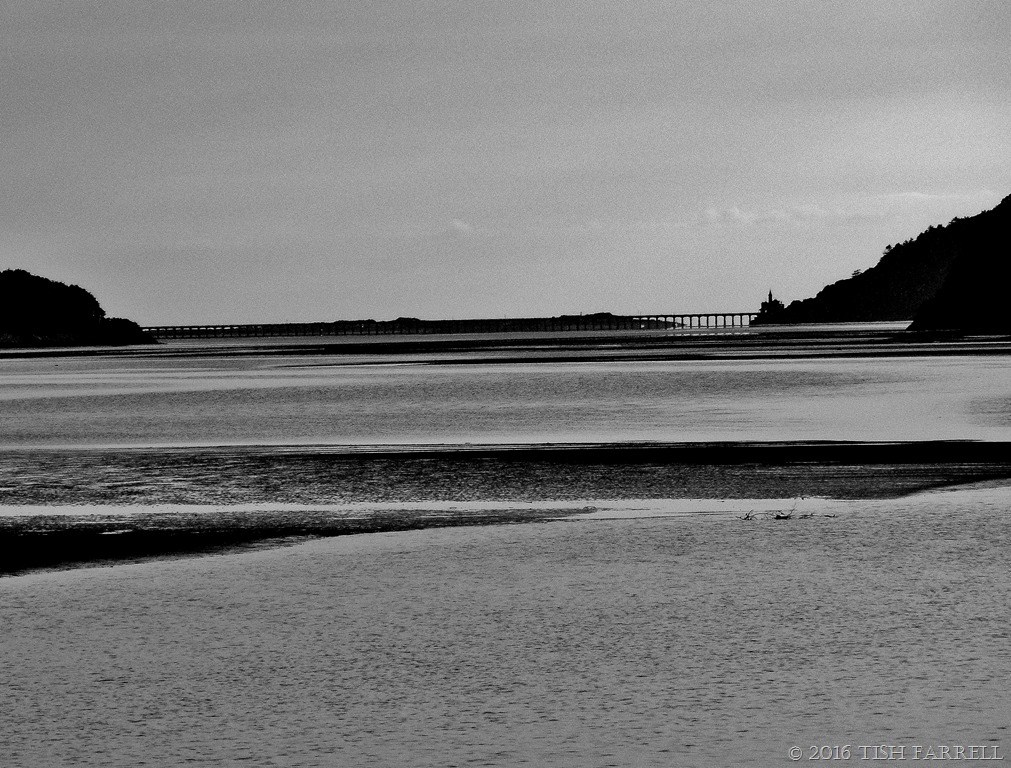
The most unexpected thing about this shot is that it came out at all in such low light conditions. I do love the Dynamic Monochrome setting on my Lumix. It creates all kinds of unforeseen magic, even with much added zoom.
I suppose the other piece of unexpectedness here is the perversity of shooting a limpidly pastel sunset in monochrome. But I like the way it silhouettes the old railway viaduct across the estuary mouth. In Welsh it is called Pont Abermaw, and in English, Barmouth Bridge. It was constructed mostly from wood during the 1860s, and included a drawbridge section that would open allow tall masted ships to pass through, sadly not a facility much needed these days. It would be fine sight though, so please add your own sailing ship to this vista.
*
Black & White Sunday This week Paula requests we show her the unexpected. Please drop in there for more creative renditions of the theme.
#MagesticMagicalMawddach
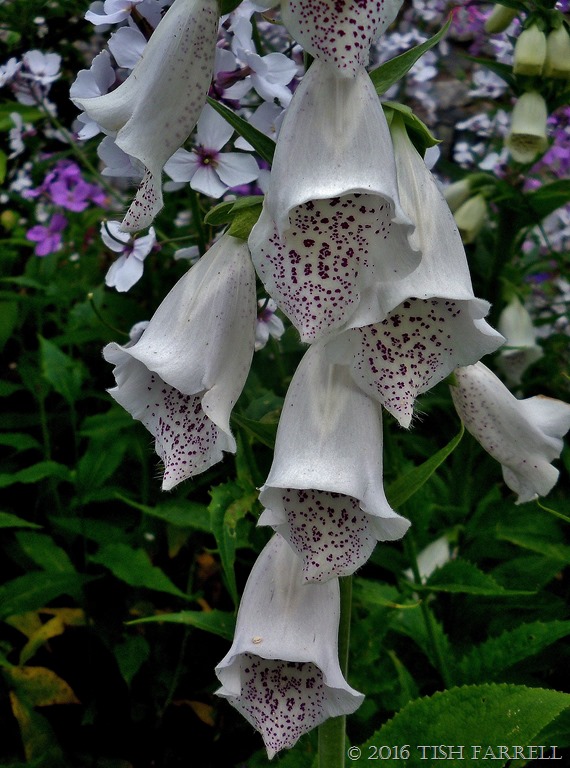
For her June Sunday Garden Challenge, Jude asks us to show her what summer means to us. So here are a few views of our garden on Sheinton Street. I should say straight away that I don’t give it the attention it deserves, and that daily I abandon it as I walk through and out the back gate and across the field to the allotment.
The plot is long and thin, following the width of the cottage, and on three different levels, which I don’t make enough of. For one thing, I know it must be possible to have beautiful plants growing somewhere within it all the year round if only I would sit down and do some proper planning and research.
Instead I tinker here and there, and let the garden do a lot of its own gardening. This includes encouraging the self-sown foxgloves, and the wonderfully scented purple, mauve and white Dame’s-violet (Hesperis matronalis) seen in the photo behind the foxglove, both of which follow on from the clouds of self-sown columbines. My garden, then, comes into its own only in summer, and otherwise can look rather dreary. But while it’s here, it’s wonderful – total cottage garden exuberance and chaos.
Welcome to my garden.
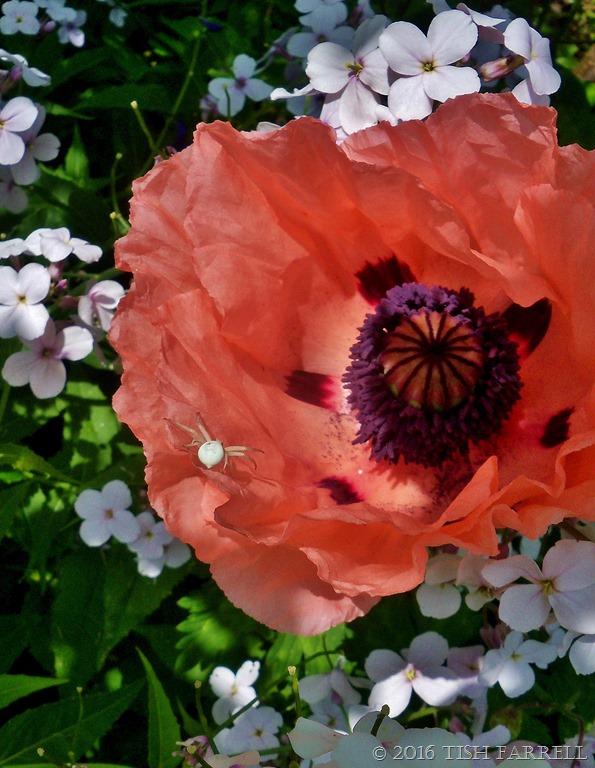
Oriental Poppy, crab spider and Dame’s-violets
*
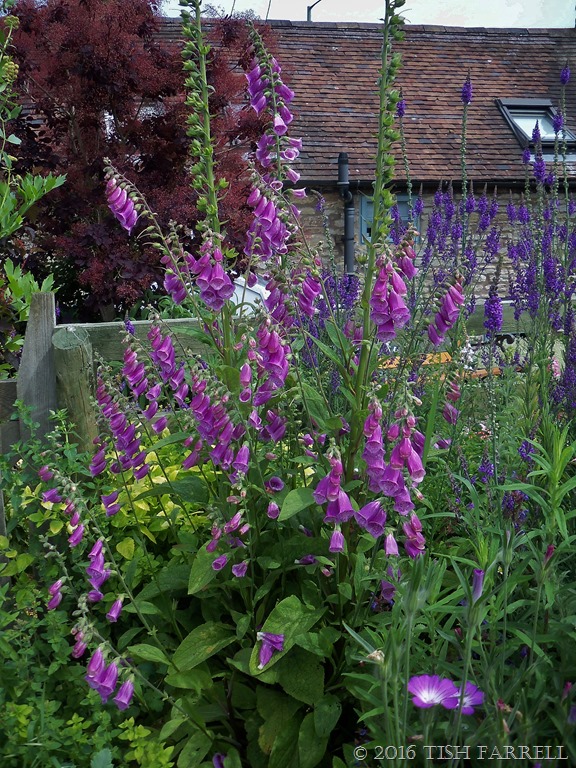
Wild corn cockle (bottom right), foxgloves, purple toadflax; variegated lemon balm, oregano and golden marjoram in between, and the coppery foliage of Smoke Bush (Cotinus) in the background.
*
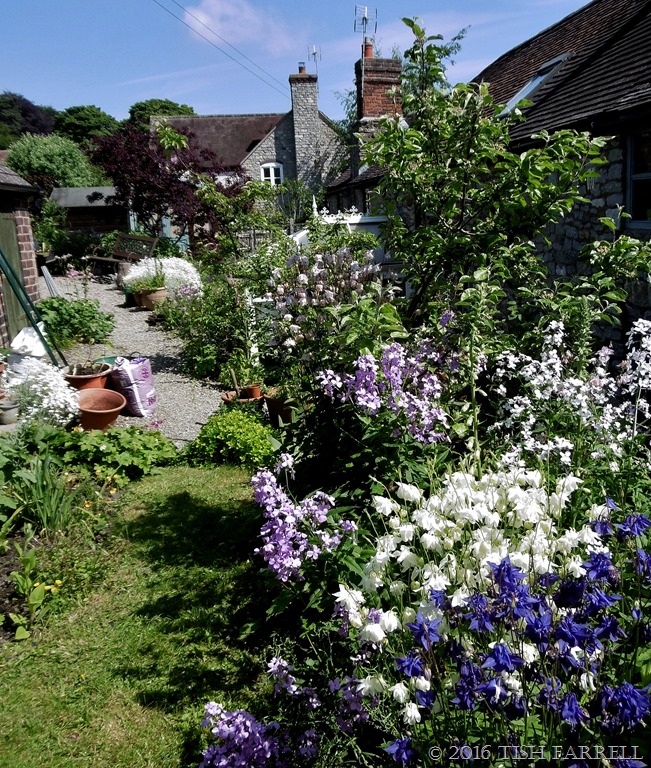
Columbine break-out

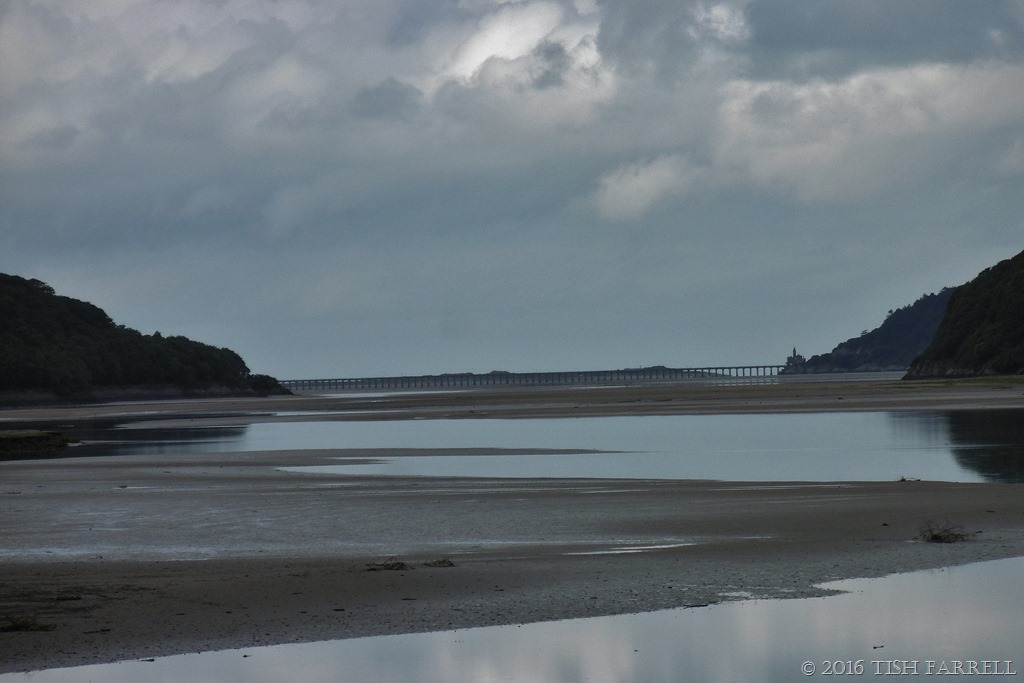
We drove through one hundred miles of rain to reach it. From South Shropshire to the Welsh coast clouds piled on clouds and the rain dashed down the windscreen with only brief interludes of drizzle. Climbing and climbing the precipitous road through Dinas Mawddy, sky and mountains closed in, reminding us that we humans are rather puny ineffectual things, and that the motorized carapace that transports and shelters us may just not be enough in a land like this. Even the sheep, inured to the place, stand hunched and motionless on the hillsides, backs to the downpour.
And then at last we’re here, on the banks of the Mawddach Estuary, just downstream of Penmaenpool, and the rain recedes, leaving stillness and shadow, the slow curves of the river, Welsh Black cattle grazing the salt marsh, a buzzard calling, canoeists returning to base, and on the far horizon the knowledge of the sea, though unseen, marked by a sudden flush of brightness out in the bay.
copyright 2016 Tish Farrell
#SnowdoniaNationalPark
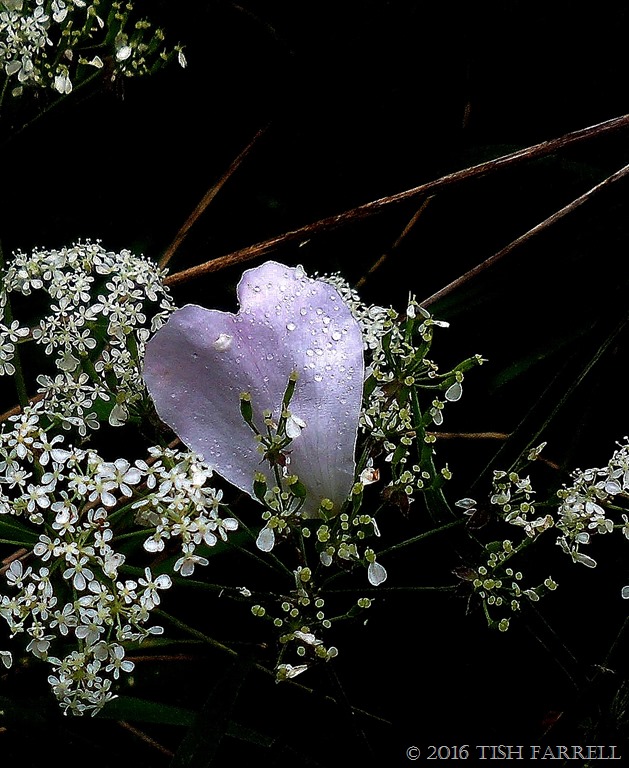
It is tear-stained too. Fallen on the field path among the pignut flowers, a plant also known as Earth Chestnut, because its tubers were once grubbed up and relished by country children. And as for the heart? Eglantine. Sweet Briar. Dog Rose. Rosa canina.
If this image inspires anyone to a bit of storytelling in whatever form, and short as you like; then leave a link here so I can read it. I won’t be back in blog world until Saturday, so no rush.
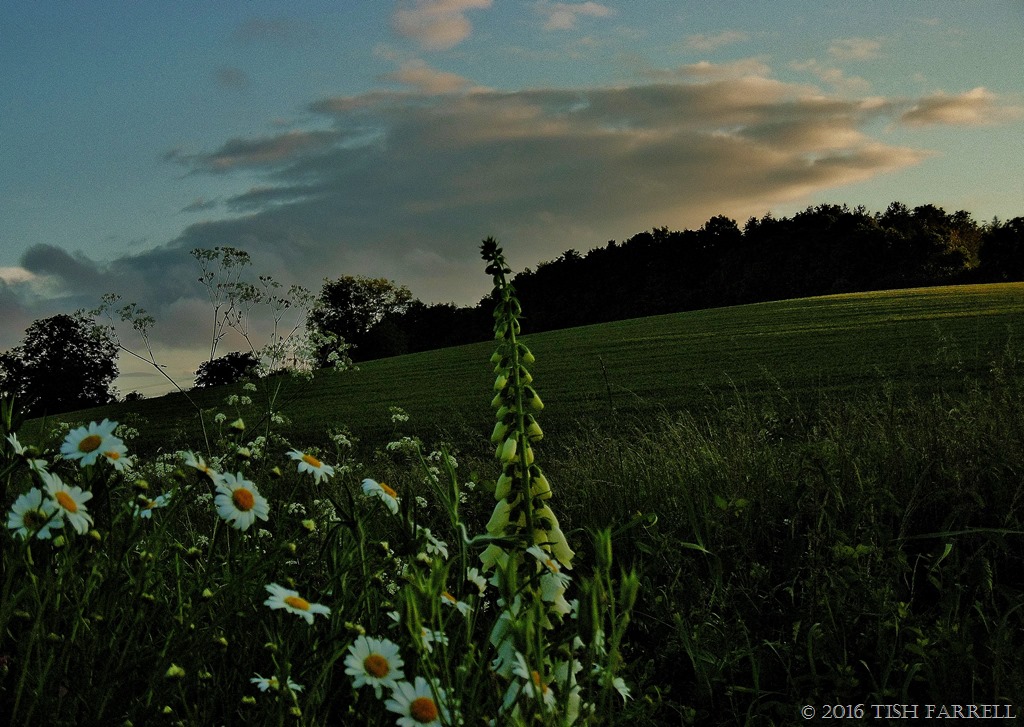
After tropical days in Wenlock we now have rain and more rain. There were showers between downpours for most of yesterday, and only at the last lap, as it was about to set, did the sun coming bursting hotly through the clouds. I caught its last beams here before it disappeared behind Wenlock Edge.
With all the sudden rain the wheat in the field behind our house is growing before our very eyes. So is our wildflower garden along the fence below it. Seen here are Moon Daisies (also known as Oxeye Daisy, Dog Daisy and Moonpenny). I love that last name. And keeping company with the daisies is one stately white foxglove, with a spray of cow parsley or Queen Anne’s Lace in the background.
According to Richard Mabey’s Flora Britannica cow parsley (a member of the carrot family) has a whole lexicon of country names – some obvious, others not so. So here we go with a few more: Fairy Lace, Spanish Lace, Mother die, Step-mother, Badman’s oatmeal, Blackman’s tobacco, Kecksie, and Rabbit meat.
And as for the foxglove, it was also known as Fairy Gloves and Fairy Bells. It has long been used as a herbal remedy that at times proved more killing than curing. And of course until recent times a compound version of the toxin found in foxglove leaves was the drug of choice for various heart conditions.
It is anyway one of my favourite plants. I like the way it grows itself around the garden and crops up in a variety of subtle shades from white to purple, although it perhaps looks a little sinister, looming here in the failing light across Townsend Meadow.
*
Posted for:
Mundane Monday #63 at Jithin’s PhoTraBlogger
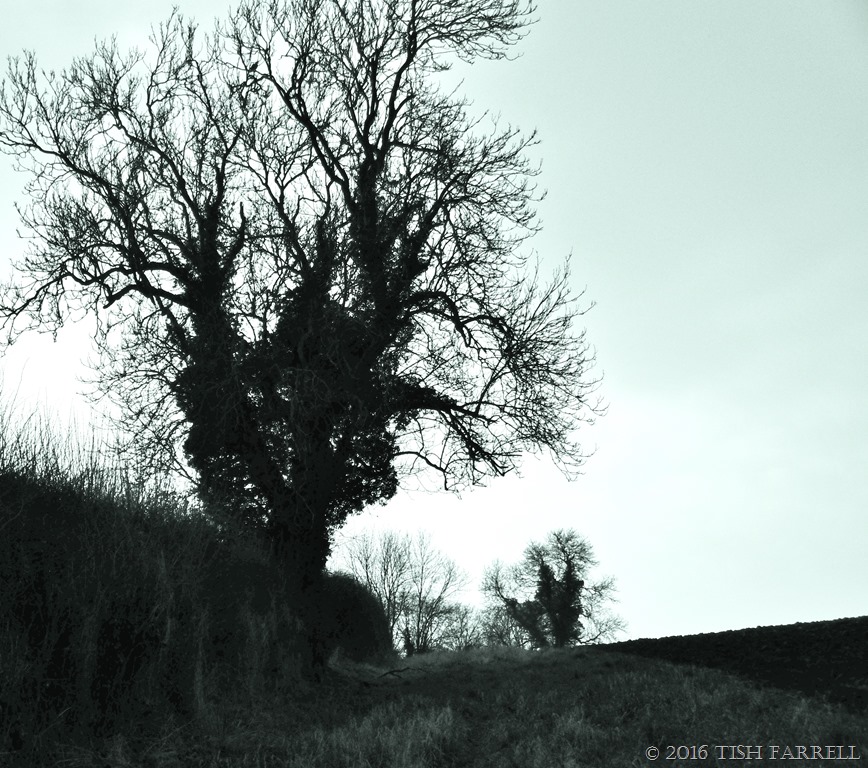
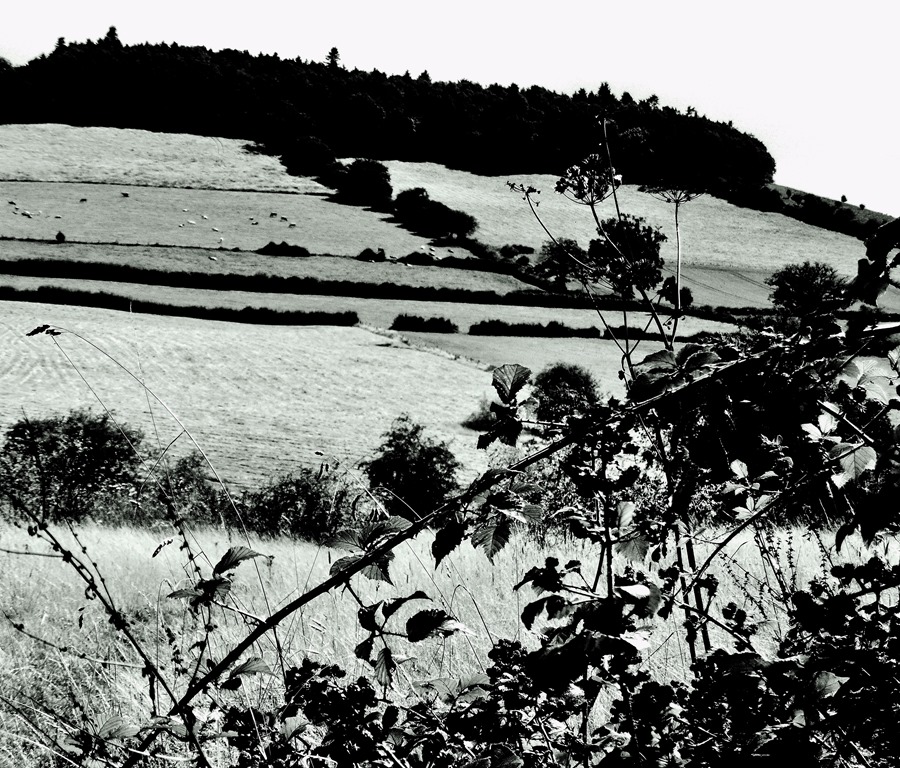

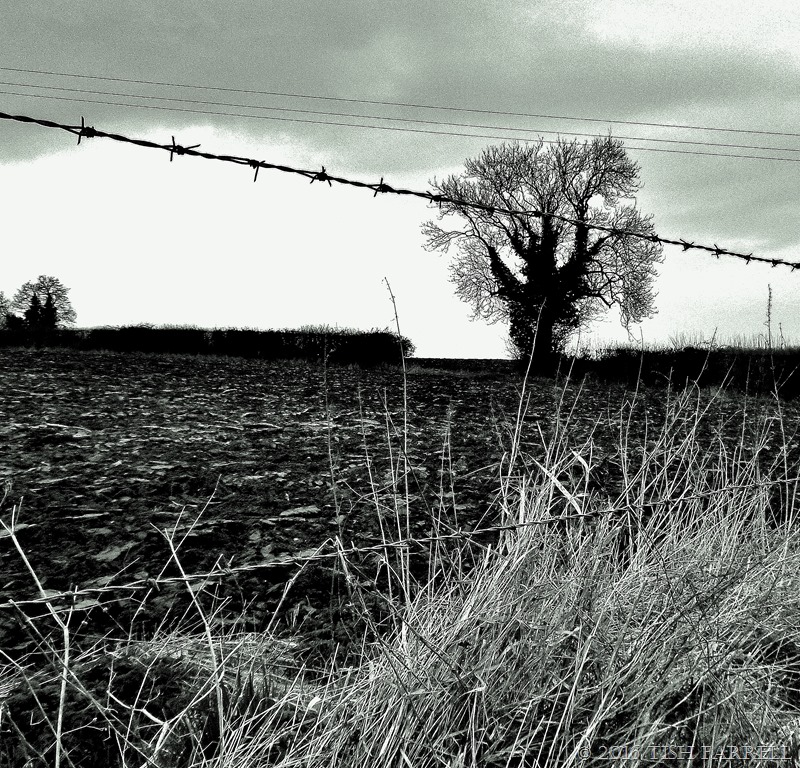
This week’s diagonals theme at Black & White Sunday is right up my street, or at least in my neighbourhood. Looking through my file of Lumix monochrome images, it seems that the diagonal often features. I think it’s because it appeals to both my visual and my writing mind. Things on the slant; one thing leading to another that’s not quite in view; unexpected angles; the monochrome subliminally suggestive of the written word and printed pages: storytelling then.
The first photo was taken on my well-worn path to the allotment. It’s a scene I photograph in all seasons, but I especially like the ash tree silhouettes in winter, their boughs cloaked in ivy which always reminds me of Tolkein’s Ents. I think this is where the lost Ent Women ended up, guarding our Wenlock Edge field boundaries.
Photo 2 was taken from the old railway line, leaning over the fence and shooting from deep shade into bright sunlight and with some zoom – not quite the best thing to do, though it gives the hilltop wood a touch of dark mystery.
Photo 3 is the field path from Wenlock to Bradley Farm, once the site of a medieval settlement.
Photo 4 – we are back at the allotment, the field behind our plots looking at the ash trees from another angle. I like the way the barbed wire adds a bleak and faintly sinister air.
Now please visit Paula at the link above for more photo essays on the slant.
copyright 2016 Tish Farrell
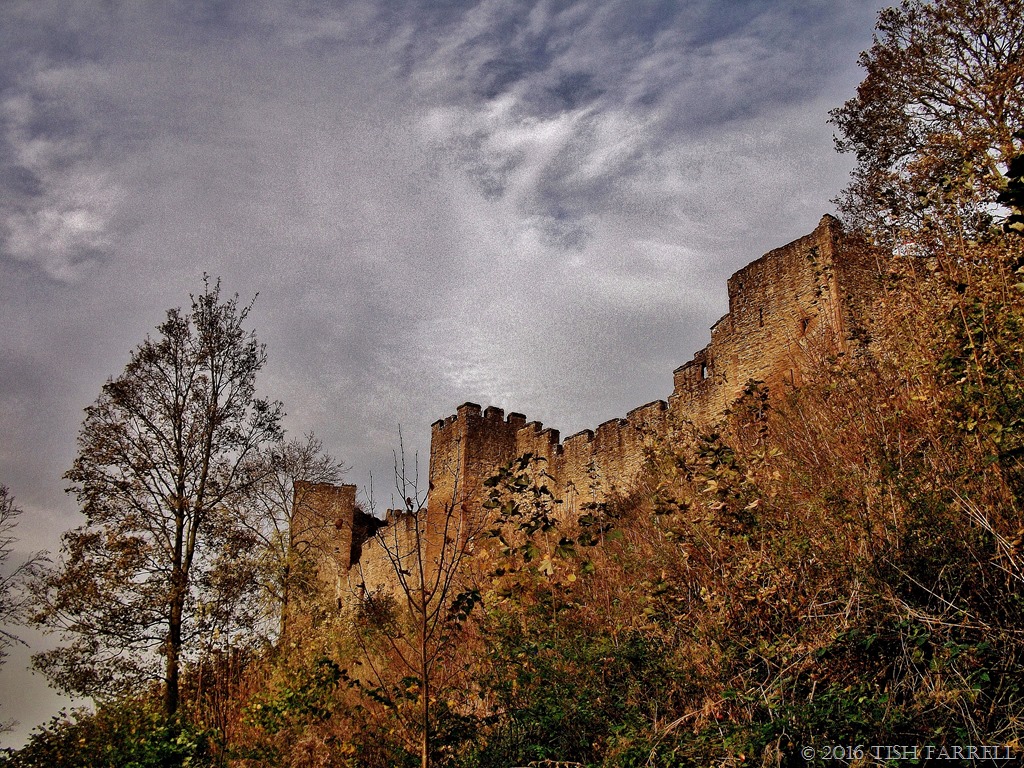
I recently posted a dramatic black & white photo of this thousand-year old castle – one of Shropshire’s finest. Here are the perimeter walls from a different angle, on their clifftop eyrie above the River Teme. It must have been a daunting sight for any peasant foot soldier commanded by his lord to get on and besiege the place. It might explain why so much of the castle is still standing.
Traces of the past is the theme over at Paula’s Thursday’s Special.

On Saturday I had a very nice surprise. The usual post delivery person had been and gone at least an hour when along comes a courier with a neat, and quite unexpected package. Inside are my 6 author copies of the new edition of Mau Mau Brother. Yippee! Much jumping up and down in the kitchen. It’s always a thrill to have the freshly printed book clasped to one’s chest.
Some of you may remember that just over a year ago I was turning my brain inside out, cutting an already tightly written teen reader in half to make a new edition. The first version, bottom left, is a 6000-word, 64-page novelised short story aimed at struggling young adult readers with a reading age of 9-10 years. It is one of Ransom Publishing’s Shades series of fast-paced, high interest teen fiction.
The new Sharp Shades 2.0 edition has the same number of pages, 3,000 words, larger font and the addition of several moody full-page, grey-scale images. Its target audience are less able teen readers.
When it comes to reading age markers, it is worth pointing out that the average UK reading age (that includes everyone, adults and all) is 9 years. The reading age for our best newspapers like The Guardian is 14 years, and the reading age for tabloids like The Sun is 8 years. But of course the ability to read, and the application of that ability, and using it to acquire information, learn or to nourish the mind, are not necessarily the same thing.
It’s quite simple too. Teens can struggle with the notion of actually picking up a book; are daunted by the size and word density of a 40,000 word novel. It can be tied in to a lack of self worth; some deep belief that if they attempt so big a book they will fail; that it will be yet another manifestation of their feeling of uselessness and inferiority; that so much dense text with no pictures is of itself BORING.
There are, after all, so many other more instantly engaging, loud and in-your-face-ears-eyes experiences to be had at the lightest press of a button, and every minute of the day. You can while away every spare moment on your smart phone with whatever teen version of TwitFace is currently cool. It’s like a continuous intravenous feeding – films, music, chat endlessly streaming into us. I think it was Margaret Atwood who, speaking of the addictive quality of the internet in the Observer, said that the problem is, every time you log on you expect WWW to deliver you an Easter Egg.
That’s it exactly. It’s how I feel. It must be how Margaret Atwood feels too!
All of which is to repeat that there is for many – adults and children alike – a big resistance to picking up a book in the first place, let alone losing themselves in it. Reading requires effort and application and being still. Which brings me back to my book. The aim of the Shades series is to engage teens with the process of reading; to help build a reading habit; to show that reading a story can deliver more than a tray load of Easter Eggs, something more meaningful that helps you grow within and without; to discover where your place is in the world. The stories, then, must be arresting, but their conveyance swift and affecting. Remember: we are up against competing intravenous streaming here.
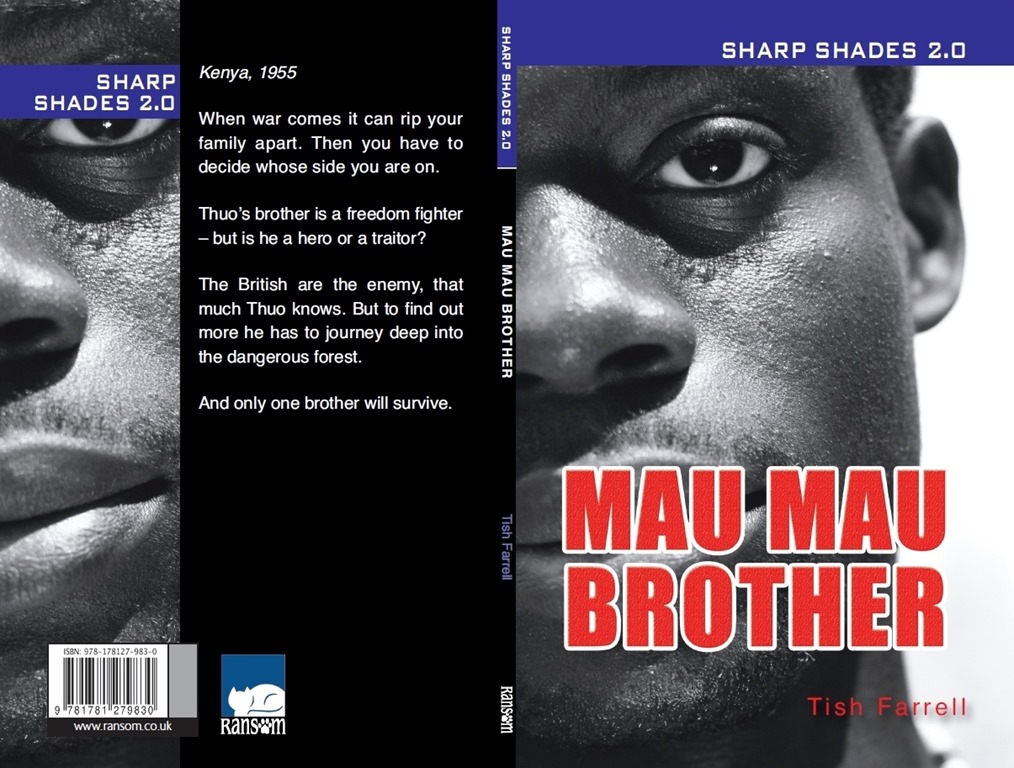
As you can see, I’ve taken some editing liberties with the covers in the intro photo. This is what the new Sharp Shades edition actually looks like.
The story is told in the first person, present tense by fifteen year old Thuo. And since the cover blurb already sets scene, I won’t say more. But to demonstrate something of the editing process involved in reducing one accessible text to an even more accessible text, here are excerpts from the two versions of Chapter 2. I think it’s anyway interesting to see what can be excised from a piece of prose and and have what’s left still carry the narrative. Of course in the process the whole tone may change. I actually found myself more engaged with the sparer version. But see what you think: the hard pruned Sharp Shades first:
Bombers
The day we lose our home Mugo and I are taking our goats to graze. My little brother runs ahead, slapping the dewdrops from the grass. I stew on my anger.
Before the war, I was a schoolboy. I wore a smart white shirt and khaki shorts. I was studying hard to be someone. Then the British closed my school, and now I am a goat herder.
It’s another reason to hate Kungu.
I’m so busy fuming I don’t hear the Lincoln bombers. They come like giant birds.
Boom-boom-ker-boom.
Bombs fall. Trees fly apart. Hills sprout volcanoes. They are bombing God’s Mountain, bombing Mau Mau.
When the planes drone away and the smoke clears, Mugo grabs my arm.
‘Kungu?’ he chokes. ‘They’ve killed him.’
*
And now the here’s the original Shades version:
Bombers
On the day we lose our home, my little brother Mugo and I are taking our goats to pasture.
It is January, high summer. All around doves coo and cornstalks rustle, and I think: how can there be war on so fine a day?
The sun is just rising and Mugo runs ahead, slapping dew from the grasses, so the drops fly like jewels through the sky. I remember doing that too when I was younger.
But I was not minding goats. I was hurrying to school, wearing the white shirt bought four sizes too big from the Indian trader so it will last for years. And I am wearing khaki shorts instead of my kidskin wrap. It is my first day at the Kikuyu Independent School.
Father has taken me away from the Scottish Mission, saying the teachers there teach Africans to be nothing better than clerks and house servants. He says I will have a better future at KIS.
I don’t. With the uprising, the British close my school. I have been minding goats ever since. It is another reason to hate Kungu.
Mugo goes on swishing grasses, but I am so busy fuming I do not hear the planes. Then the world shakes to bits.
Boom-boom-ker-boom.
Mugo jumps like a spooked deer. And we run. At the top of the ridge we see the Lincoln bombers like giant birds above the forest.
Down come the bombs. One, two…five, more…till I want to vomit. The hills sprout volcanoes. Trees fly apart. Our goats shriek.
We stand and stare as if turned to stone. The bombers do not target our farms, only the forests outside the Reserve.
When planes drone away the smoke clears, we stare at God’s Mountain. The jagged snow peaks, the dark forest slopes, are still there. It is hard to believe.
‘Kungu?’ Mugo’s eyes dart round in case there’s anyone to hear. ‘They have killed him?’
*
As you can see, nearly two thirds of the descriptive context has gone from the shortened version. It is easy to be sorry to lose these kinds of detail, but ruthless cutting of such passages was better than losing the story.
All fascinating stuff. I quite like seeing how many versions of a work I can come up with. And I really enjoy the challenge of a limited word count. After all, it’s not so much about how much you can hang on to, as how little you actually need to tell a well rounded and affecting story.
But there is a problem here for me as creator of fiction. If you produce work that is labelled for a specific purpose, then it is unlikely to be read by anyone else, i.e. those who consider themselves outside the target audience. As a writer, I write for anyone who will read me, and tend to balk at categorisation of any kind. I especially dislike the category ‘educational writing’.
All the same, if the stories I write, and the different ways I can write them, will encourage unkeen readers to read and develop a love of reading, then I’m wholeheartedly for it. Not to read well is to be disenfranchised. Your options are shut down. You leave oneself vulnerable to those who would misrepresent, manouevre and manipulate the information-world we inhabit. Good reading promotes understanding, powers of discretion, a sense of autonomy; it strengthens mind and imagination, those attributes that make us keenly human; the very attributes we will increasingly need if we are to make something worthwhile of our lives on this planet.
In England we especially need to look to our laurels. In fact those laurels are down round our ankles like pants that have lost their elastic. We apparently have the lowest teen literacy rates, and second lowest numeracy rates of the world’s 23 most developed countries. Korea, Japan, Netherlands are respectively the first, second and third most literate and numerate nations. See The Spectator article HERE for more on this shaming state of affairs.)
In the meantime, more power to small publishing houses like Ransom who specialise in making books for struggling readers of all ages. Their extensive catalogue provides all the tools to tackle literacy. This particular writer is anyway proud to be a Ransom author: when it comes to better reading only the best writing will do.
*
Ransom blog on WordPress HERE
Numbers – go here for the Daily Post Weekly Challenge
#RansomBooks #literacy #NickyMorganSecretaryOfStateForEducation #NationalLiteracyTrust #Proud2BeARansomAuthor #BestWritingForBetterReading
