
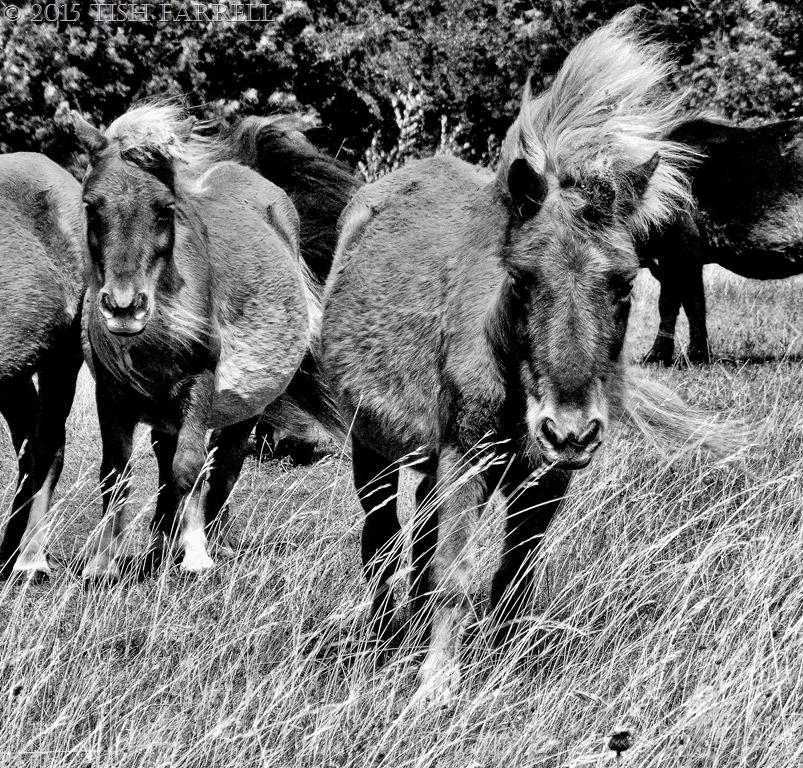
We’re barely into September and already autumn is here in Shropshire. It must be so, because the little horses are back on Windmill Hill. They will spend the next few months grazing off the dying summer grasses and wild flowers. They look very windswept, but the punk-mane-effect is mainly down to thickets of cleavers (goose grass) seeds in their top knots.
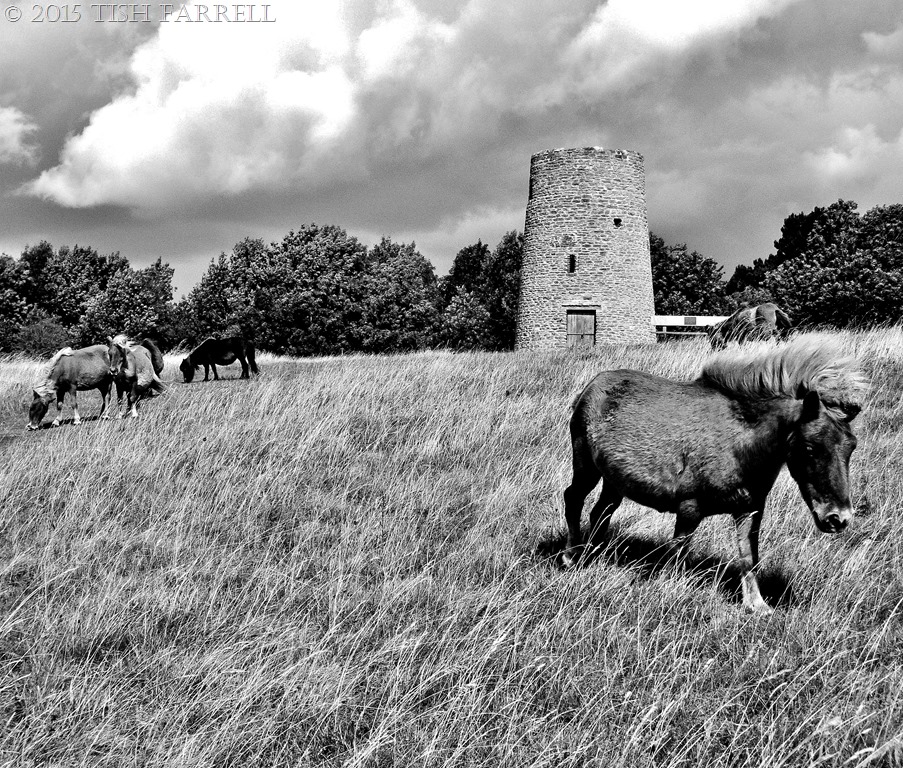
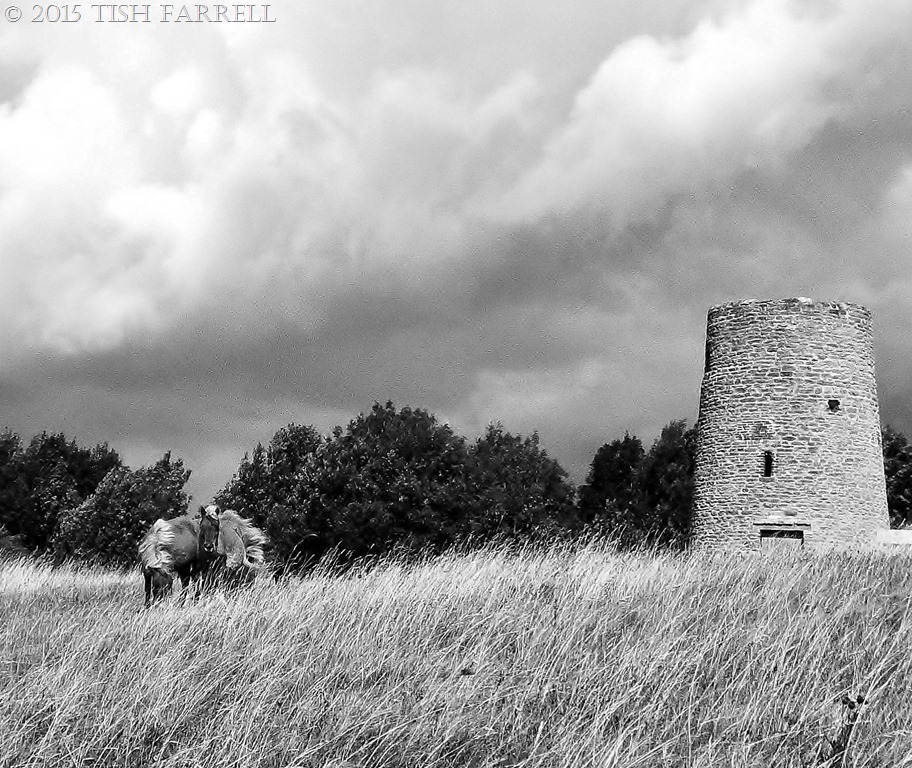
Looking across the hill there’s hardly a sign of the June-July flowering – all those buttery clouds of Lady’s Bedstraw quite gone. Not a trace of the orchids either. Only the dark and brittle seed heads of knapweed that always strike a note of dreariness. The weather doesn’t help either. For weeks it has been rain between showers.
Nor was I encouraged by the BBC radio science programme I heard yesterday. I caught it in the midst of recompiling a glut of runner beans into chutney (beans at least like rain). The guest climate experts were soon informing us that the El Nino effect they promised us all in 2014 did not come to much. In fact, they opined, (and they sounded quite definite about it too) we still have it very much to look forward to – the worst El Nino effect hitherto experienced, they said. For some reason the Pacific Ocean keeps heating up. And this means disrupted weather patterns worldwide, and for Europe, an even wetter winter than usual.
MORE RAIN? I wish we in Shropshire could email some of it to those lands whose dramatically changing climates mean that they now receive little or none. Mongolia is one place suffering massive desertification. Likewise, the countries of Africa’s Sahel that border the Sahara. In both regions, and many others besides, human actions, poverty and climate shift combine in a vicious downward spiral that results in increasing degradation of land and water sources. This, apart from war, is one of the main drivers of human migration. It’s all connected, despite what the climate change naysayers may wish to believe.
All of which is to tell myself to count my blessings. I am free to wander where I like without fear of being terrorized by extremists. I have all the food I need and more. I enjoy every comfort. I have the luxury to meander along Shropshire byways, talking to little horses, musing on the meaning life, the universe and everything, while across the globe desperate others risk all to find somewhere they can live a decent life with their families. Some people, we hear, do not want to share their land with refugees. It is assumed that they will be nothing but a drain on resources. Yet who knows what gifts in talent and skills these homeless souls might be bringing us? Also, not sharing may cost us more than we could ever imagine. In some societies the truest measure of civilisation is the gift of hospitality. Perhaps we need to think about this with a little more application. At least, I know I do.

copyright 2015 Tish Farrell
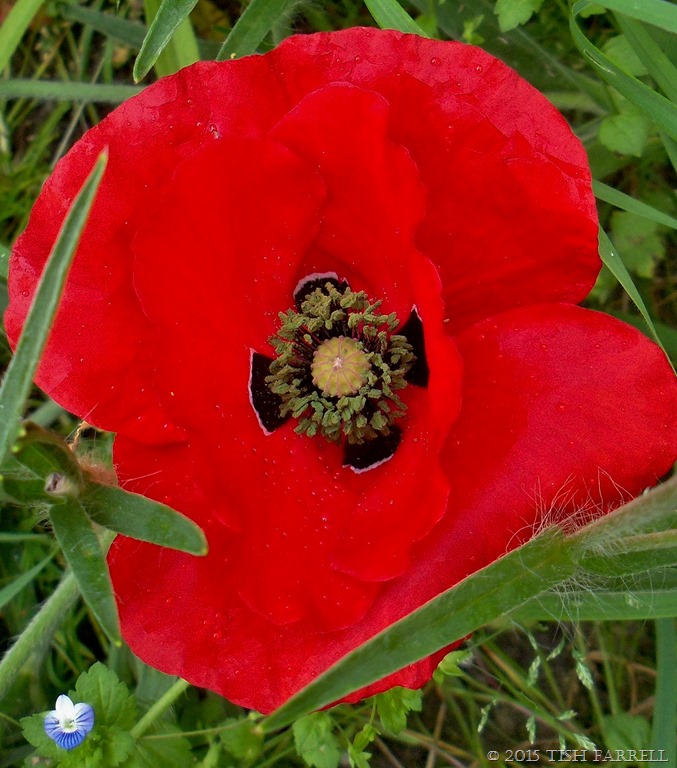
Field Poppy also known as the Flanders Poppy. I found it growing beside the field path on my way to the allotment. Its tiny blue neighbour is speedwell.
Nancy Merrill’s A Photo A Week Challenge: Fill the Frame
#NoGloryInWar
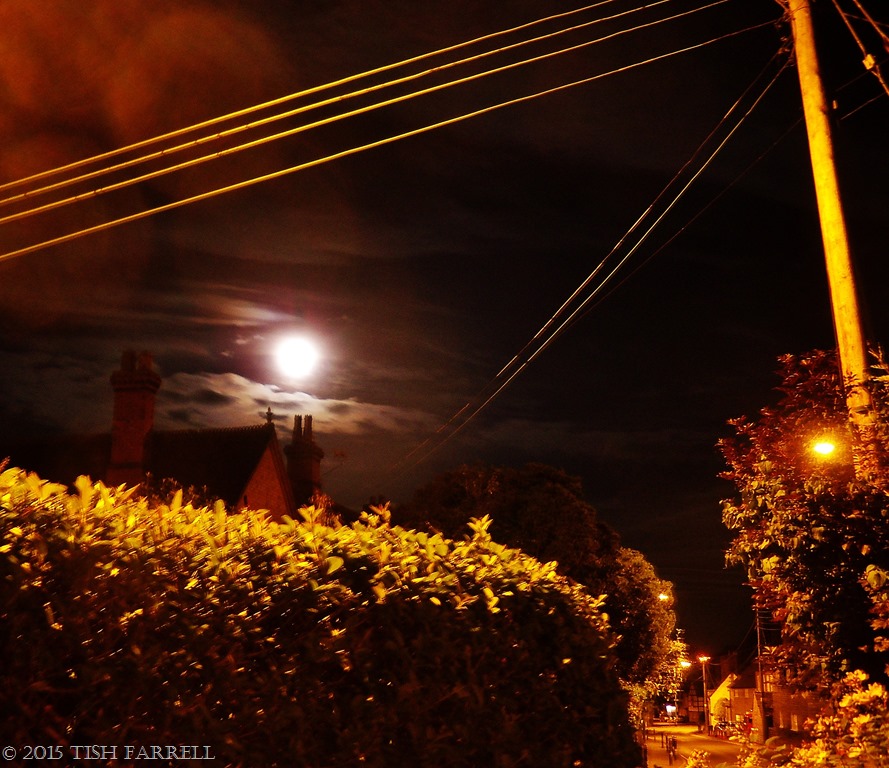
There’s all sorts of flare going on in this photo, not least around the moon. The pink smoke, and golden hedge effects are courtesy of a tall street light out of shot top left. I was trying to capture a blue moon. I even used a tripod. I’m not sure where the light on the right came from as there isn’t an actual street lamp on that side of the road. Anyway, if you peer hard you can look down the curve of Sheinton Street towards the town centre. It looks a bit like a film set. In fact isn’t that Mary Poppins coming along the road? Chim-chiminee, chim-chi…
Please visit Paula at Lost in Translation for more flare
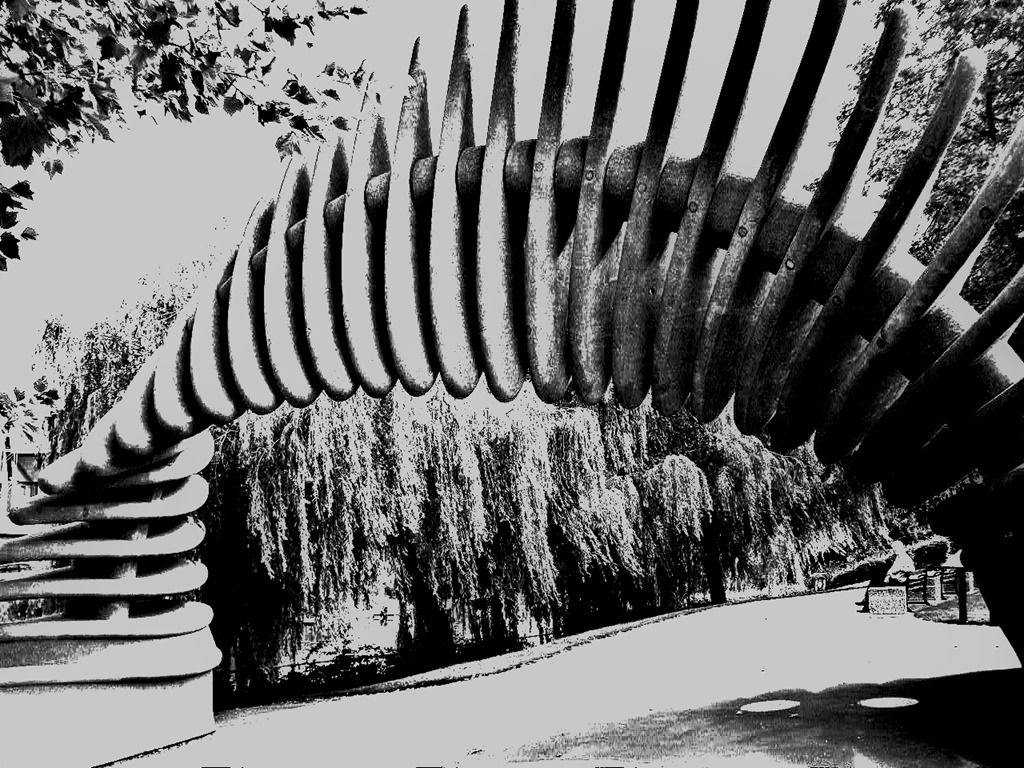
Earlier in the week I wondered what readers might make of this piece of public art, aka the ‘Shrewsbury Slinky’. Many of you picked up on the dinosaur bones, and the allusion to the double helix of DNA, both of which, we are told on the accompanying notice board, did indeed inform the thinking of the architectural designers, Pearce & Lal who conceived the structure. Some of you also guessed, or knew about the Charles Darwin connection.
Anyway, the work is called Quantum Leap, and as the explanatory board also states : “this geo-tectonic piece of sculpture has been designed through the influence of objects and materials central to the development of Darwin’s thought: rock, fossils, zoology…”
It was commissioned originally by Shrewsbury & Atcham Borough Council to commemorate the bicentenary of Darwin’s birth in 1809, and to mark the 150th anniversary of the publication of On the Origin of Species , both events well worth celebrating. The original cost to the public was expected to be around £200,000. But somehow, between the concept and its physical manifestation, things went awry on the costing front. More of which in a moment.
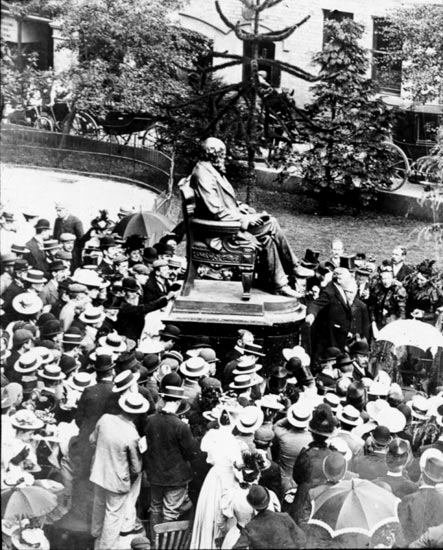
First, though, here is the man himself, sitting in his armchair outside the old Shrewsbury School, where as a youth he was student boarder. This more traditional tribute in bronze was unveiled in 1897:

Here you can see the 1897 unveiling. By then the prestigious Shrewsbury School had moved to larger premises across the River Severn, and Darwin’s old school become the town museum and reference library. This photograph is from the Shropshire Museums collection.
I don’t suppose many know that Charles Darwin was a Shropshire lad, born and brought up in Shrewsbury. If we picture him anywhere at all it is probably voyaging around the world on HMS Beagle (1831-1836), surrounded by a myriad of fascinating specimens, or else lost in deepest thought, unpicking thorny issues on his Thinking Path at Down House, Kent where he lived with his family for the last forty years of his life.
The Darwin family lived on The Mount in Shrewsbury. Darwin’s father was a doctor and financier, and also a free thinker. Charles’ paternal grandfather was Erasmus Darwin, physician, natural philosopher, inventor and leading light of the Midlands Enlightenment. His maternal grandfather was Josiah Wedgwood, potter industrialist extraordinaire, and inventor. Both grandfathers were staunch slave trade abolitionists. Darwin thus grew up within the orbit of men for whom it was the norm to challenge and think outside the bounds of convention.
While his mother still lived, Charles and his siblings worshipped at Shrewsbury’s Unitarian Chapel. Charles also went to the preacher’s day school, and by an early age was already absorbed with his own natural history collections. But after Susannah Darwin’s death, Charles and his brother, Erasmus were sent off to board at Shrewsbury School. Later both would go to Edinburgh to study medicine, and Charles apparently spent the year of 1825 acting as apprentice to his father, and treating the poor people of Shropshire.
However, he found medicine dull, and seems to have spent his time in Edinburgh studying marine invertebrates and learning taxidermy from a freed slave called John Edmonstone, a man whose company he much enjoyed. An annoyed parent wisely chose not to press his son into the family profession, but sent him to Christ’s College Cambridge; he would get his degree and become an Anglican minister instead.
But once more Doctor Darwin’s plans for his son foundered. While at Cambridge, Charles continued to pursue his interest in natural history. When he graduated in 1831 he took the chance to embark on a ‘gap year’ to end all gap years, and set sail on HMS Beagle, travelling as the ship’s gentleman naturalist. The planned two year voyage turned into five. The rest, as they say, is history.
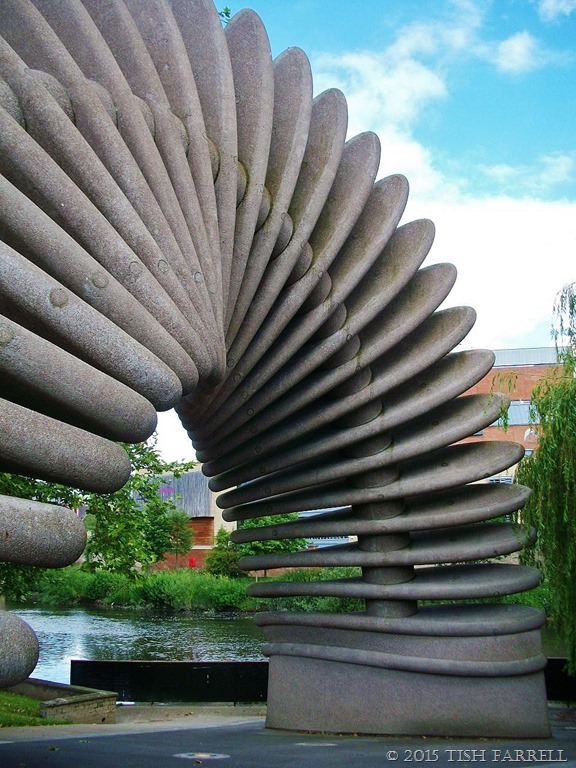
And so back to Quantum Leap, a project that was indubitably inspired by the very best of intentions – to honour the life’s work of a native son. I’ve already mentioned the unsuitable setting, in a cramped little garden between the River Severn and the town’s busy inner ring road. It is not a part of the town where many visitors are likely to find themselves, or even wish to be. But perhaps my main objection is the material. Concrete seems such a rigidly dull substance with which to evoke structures from the natural world. I can also foresee it acquiring a slimy algal coat, which though admittedly a life form, is unlikely to add a life-enhancing effect from the viewer’s point of view. And given all the cuts in Local Authority funding, it seems unlikely that someone will be paid to come along and scrub the thing. Where would you begin?
I’m trying to think, too, what that magician of installation, Anish Kapoor, could do for it, if called on to do some remedial work. I’m imagining something in cast iron here, or in wrought iron, or polished steel. Or even wood. Or perhaps, as Marilyn Armstrong suggests in the comments on So what’s this all about?, people will just hate it so much it will be taken down. My own feeling is that it will simply be forgotten, and that is the worst outcome of all. So much for commemoration.
This brings me to the most shocking aspect of the project. As we headed into the unveiling year of 2009, Shropshire was becoming a Unitary Authority, and the Borough Council passing into obscurity. There followed various problems with the contractors assigned to construct the monument. Costs rocketed. There was a court case. According to press reports there was a chance for the Council to settle the bill when it hit £600,000. They declined. In the end the 2012 accounts revealed that the final cost had amounted to over £1,000,000. As one Labour councillor acidly pointed out, this was considerably more than the cost of Antony Gormley’s epic, acclaimed and truly colossal Gateshead landmark, Angel of the North.
However you look at it, the final bill is staggering. In the face of austerity measures that have reduced some Shropshire residents to relying on Food Banks, and threatened so many social services, it is appalling to think of so much wasted money. But money aside, the whole enterprise now seems rather sad and silly. The original design concept for Quantum Leap has much to be said for it, but when it comes down to it, public art should serve the public who paid for it. It should be placed where everyone can enjoy it. It should be life-enhancing, spirit-raising, thought-provoking, a piece of wit or wisdom that becomes a point of attraction for locals and visitors alike. In other words, there should be returns on the investment, material and immaterial. It doesn’t of course mean that everyone has to like it. That would be too much to ask.
My other thought is that the town already has its monument to Charles Darwin. They got it right back in 1897. And although the statue might these days seem unadventurous, not to say a bit stuffy, it does at least show us the man – his intelligence, modesty and humanity – qualities that cannot be too highly valued. Not even the town’s incontinent pigeons detract from them. And so christened with bird lime he may be, but Charles Darwin looks a pretty decent old gent. His thinking changed the way we think. It took on superstition, and narrow-mindedness, and continues to challenge the scientific world to explore ever new ways to understand life on the planet. We Salopians can feel justly proud that he is one of ours.
copyright 2015 Tish Farrell
This is a follow up on my post for Paula’s Black & White Sunday theme of sculpture: So What’s This All About?
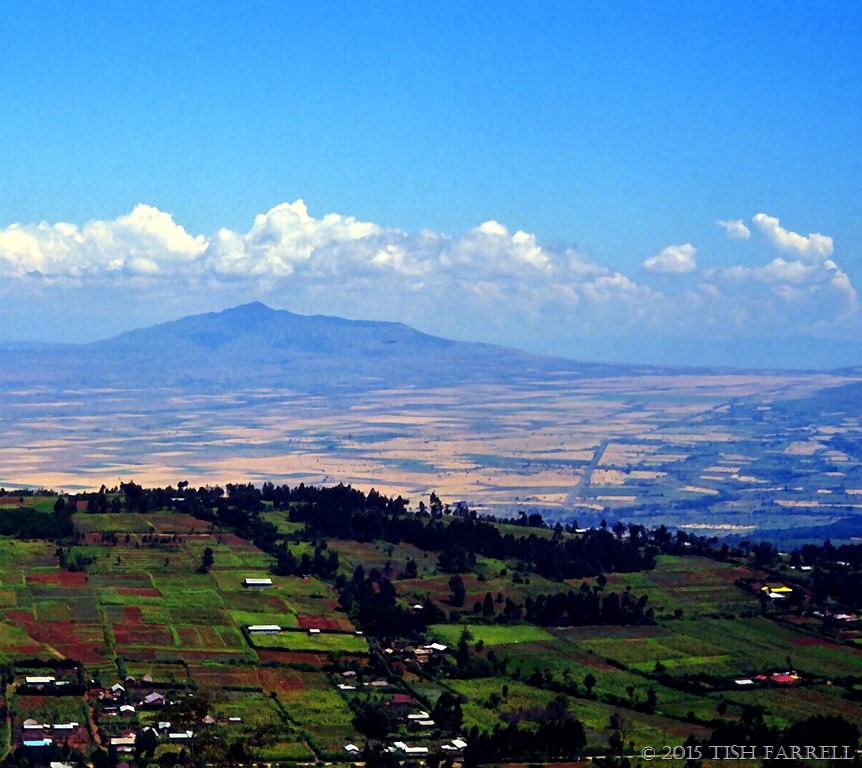
RIFT
Not homeland,
but sourceland;
scored in genetic code;
branded in bone:
thorn trees’ jasmine scent,
red pepper dust on the tongue,
sifted on skin,
while beneath our feet
obsidian’s glint,
shards of the earth’s dark heart;
the Rift,
riven,
wide
open
copyright 2015 Tish Farrell
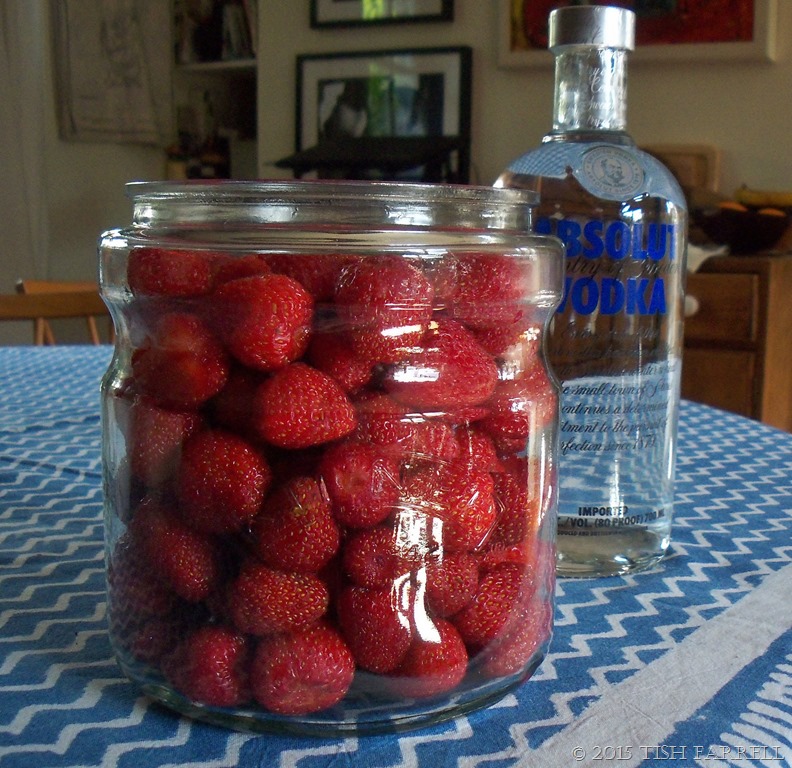
This story doesn’t begin here, although this is my first ever photograph shot using a tripod (plus a Kodak EasyShare M380 on macro setting). You do not, however, need the tripod for the recipe coming up below, although it could come in handy for balance if you’ve sampled too much of the end product some months hence.
So: the story actually begins at the allotment, and a case of TOO MANY strawberries. Gilly at Lucid Gypsy has also been suffering from the same dilemma. In fact as I was picking all these juicy fruits under a very hot sun, I was wondering if this was indeed a subject for some serious philosophical debate. I mean, can you have too many strawberries?
(N.B. These next two photos did not involve a tripod, only a hot and bothered biped in ‘pick ‘n shoot’ mode.)
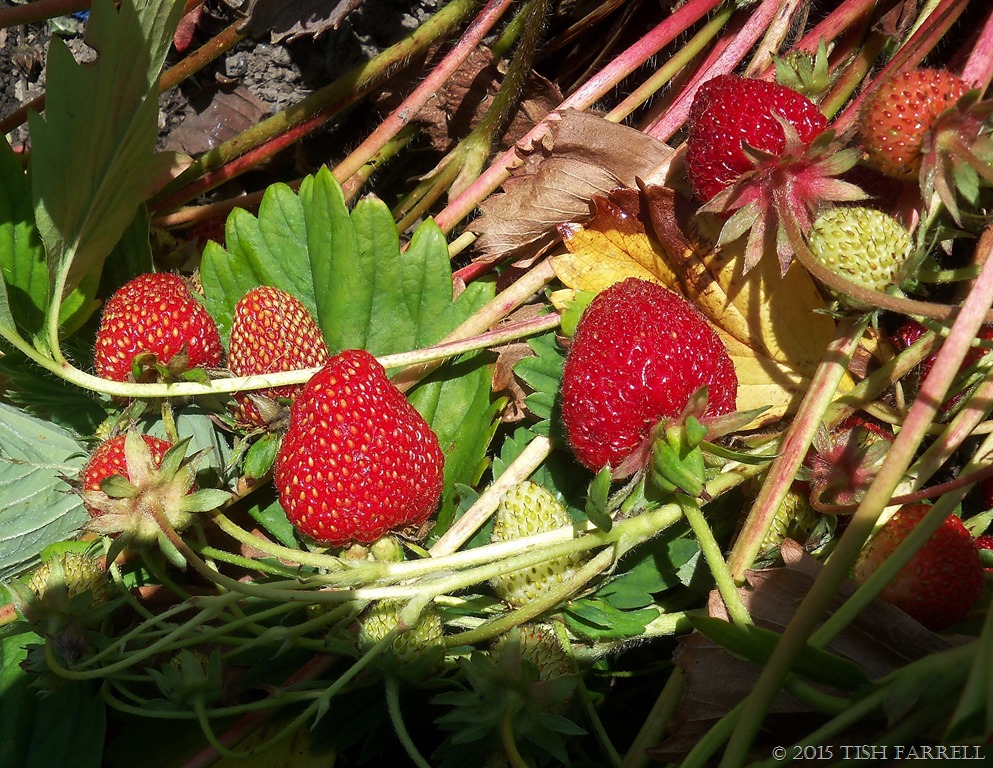

So can you have too many strawberries?
It is the sort of question that inevitably leads me to Jane Grigson’s Fruit Book (the companion to her Vegetable Book). She is just the cookery writer you need when you have any excess produce. And it is thanks to her that I will pass on this morning’s activity at the kitchen table in Sheinton Street.
Strawberry Vodka
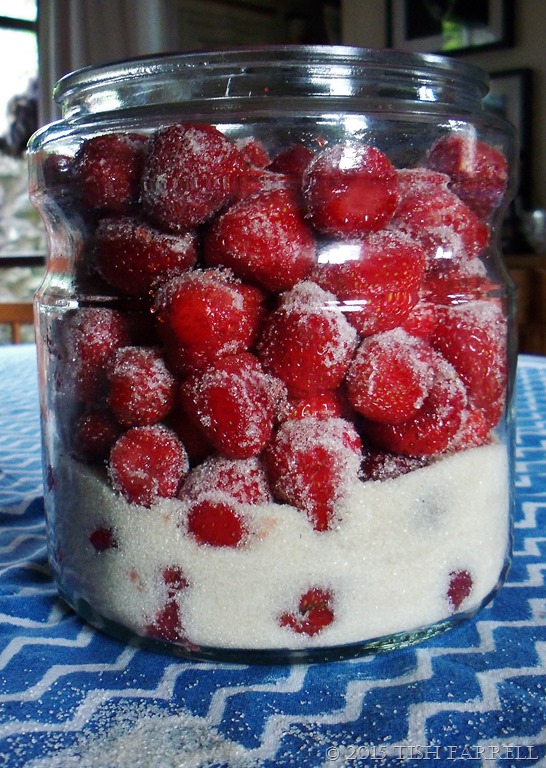
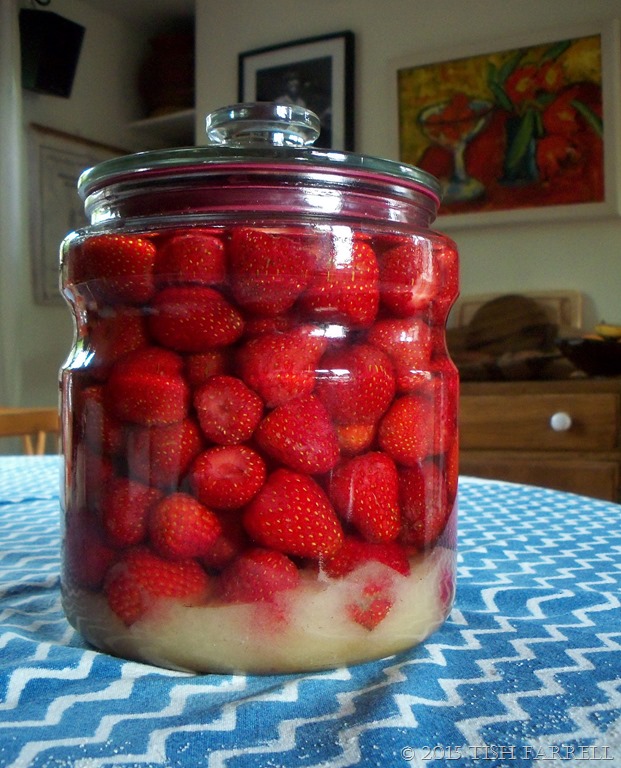
Jane Grigson’s instructions then are that you place the jar in a cool, dark place, and turn it over from time to time. After a month the strawberries will look wan and floppy, and you can then strain the lot into a new jar, using a double layer of muslin. Or you can leave the fruit as it is for several months more.
The resulting cordial can then be drunk as a liqueur, and used to pep up sorbets, fools and mousses. My mind is tending (albeit perversely so on this steamy July day) towards thoughts of Christmas trifle.
I should add that I have never tried this before, but so far it is looking good, and that’s where the tripod came in. I shall definitely be using it again. As to the strawberry vodka, only time will tell.
copyright 2015 Tish Farrell
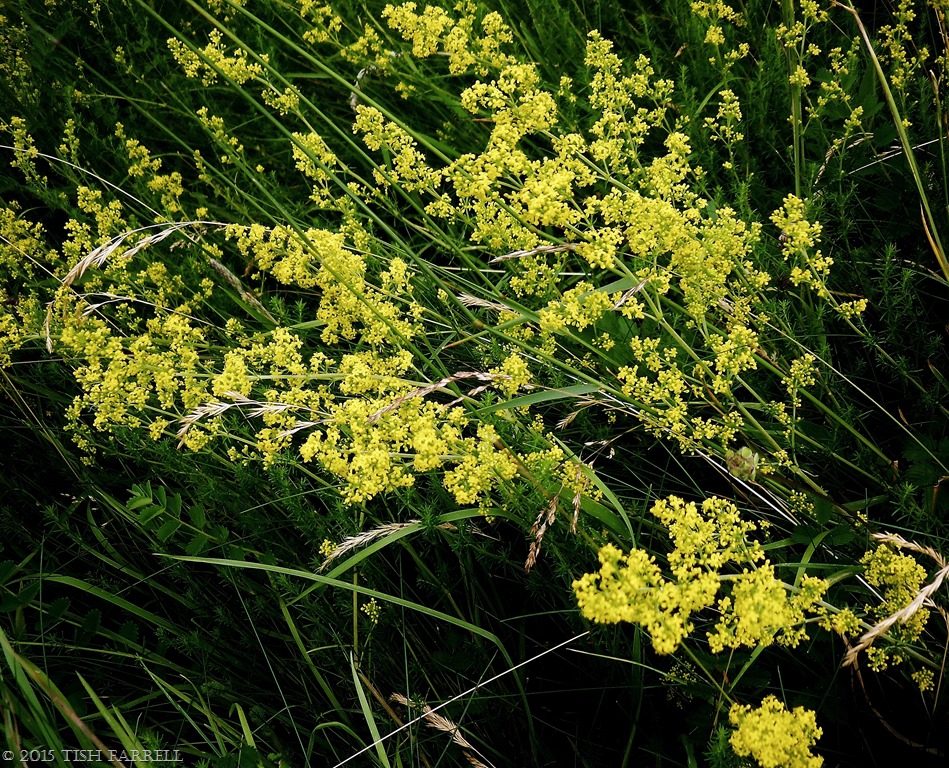
Photography-wise, you could say this is a case of learning from one’s subject.
Anyone who joined me on last week’s walk around Windmill Hill, will probably know that this drift of yellow is commonly known as Lady’s bedstraw or Lady’s tresses (Galium verum). When dried it smells of freshly mown hay, and so was once added to mattresses. Given these supine associations it seemed fitting that the only way to capture its essence was to lie down with it in the grass.
And lying down certainly reduces operator wobble, although there wasn’t much I could do about the summer breeze. So I caught that too. And since I have yet to devise a ‘scratch and sniff’ widget, you must now use your imagination to summon a fragrance with subtle notes of gardenia plus a dash of fresh acacia honey. Mmmm. I don’t know about you, but I’m feeling a snooze coming on, borne away on a tsunami of sweet, golden, flowers. Happy dreams.
copyright 2015 Tish Farrell
Inspired by Jennifer Nichole Wells One Word Photo Challenge: tsunami Go here to see Jennifer’s fascinating miniature world, and other bloggers’ interpretations for OWPC.
I’m also linking this to Lucile de Godoy’s Photo Rehab at Bridging Lacunas. Please visit her and her community of photo bloggers for a great boost to your creativity.
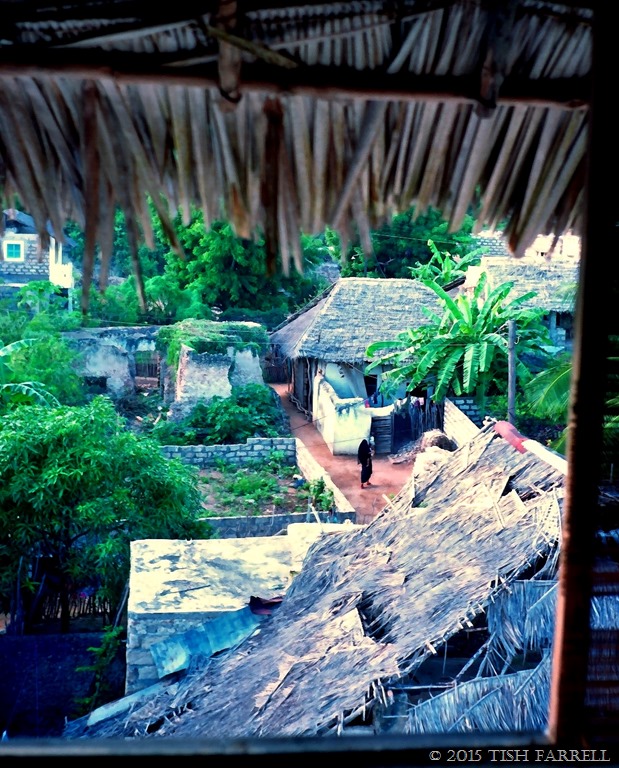
This week at Thursday’s Special, Paula has asked us to interpret ‘a bird’s eye view’. I’m not sure that four storeys up in Shela’s Island Hotel quite constitutes a bird’s eye view, but it’s as high as I’m going. I’ve written about our stay on Lamu in other posts. One thing I will say here is that we had a room that was ideal for someone as nosy as I am. Three sides were entirely available for nosiness, overlooking the centre of the village. I didn’t know which way to look first.
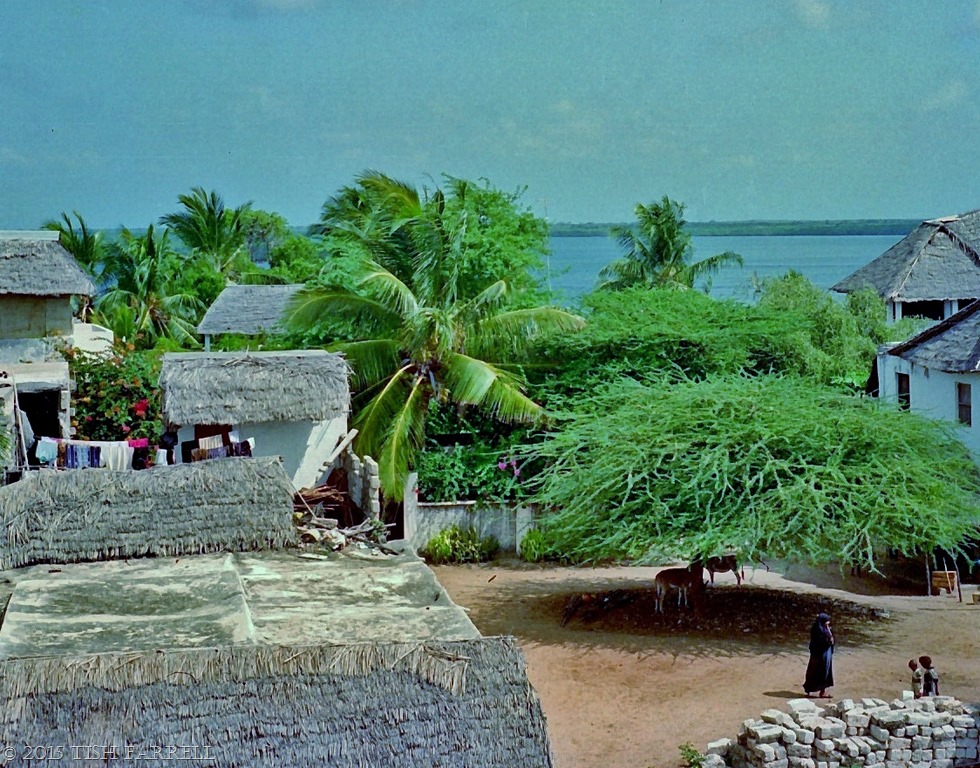
In the next photo you can see the village square with its donkey park under the thorn tree. There was only one vehicle on Lamu at the time of our visit – an aged Land Rover, and donkeys were used for all forms of land transportation. They were left under the tree until someone needed one to move something. In the bottom corner you can see blocks of quarried coral rag used for house building.
Please visit Paula at Thursday’s Special for more views.

There’s clearly something in the air over Wenlock Edge. Last night as we were sitting on the garden bench watching the sun go down – with our glass of wine and pot of olives – there it was. A rainbow. And it had absolutely nothing to do with rain. Most of the day had been hot and fine.
Fire rainbows are rare and technically called circumhorizontal arcs, and thus they are HORIZONTAL. i.e. More like this one, faintly seen, a little later and slightly north of the first iridescent cloud.
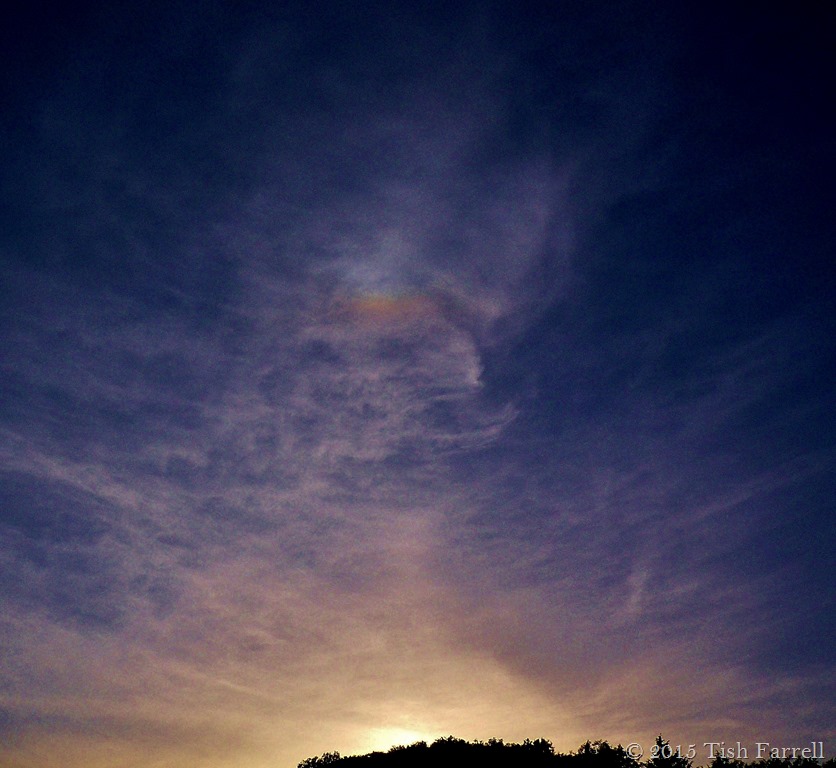
But if this isn’t a ‘fire rainbow’, but part of an ordinary rainbow, then the colours are the back to front, more as if this is part of a double rainbow, but with only the reflection visible. Curiouser and curiouser, but a wonder to see over one’s garden fence. Perhaps it is a Wenlock Edge phenomenon, the angle of the setting sun in relation to the cloud above it. Anyway, this is what was going on in the rest of the sky over the bean field. Someone has clearly been sky painting.
Happy Monday everyone.

