Garden Treasures: The Salvaged And The Self-Seeded

IMG_7726 variegated yellow flag

Well, this was a big surprise last week, and a very lovely one too. It is the unexpected outcome of a little rescue job performed over a year ago, not long after we’d moved into The Gables. Back then, in the August of 2023, I was making a start on de-jungling various flower beds and found some rhizome fragments swamped by phygelius and euonymus and assorted weedy thugs. They had small spikes of green and white leaves and I thought they might be Japanese iris so I replanted them in a cleared corner and pretty much forgot about them. They certainly didn’t do anything last summer, and when I looked at them early this spring I decided that they weren’t likely to either.

So it just goes to show what can happen when you’re not paying attention.

IMG_7720 variegated iris 2

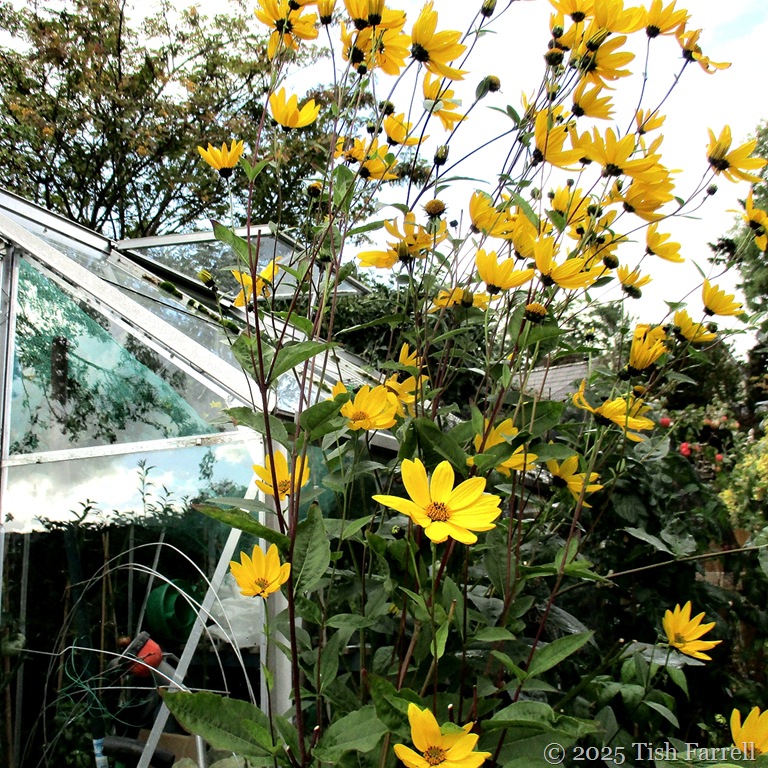
The spot where they’re growing is fairly sheltered, between Graham’s shed, a blackcurrant bush, the path and the hot composting bin. They are also being encroached on by some super-charged perennial helianthus ‘Lemon Queen’ (more of which in a moment). And here’s the puzzle.

When I first spotted the opening iris I couldn’t quite believe my eyes. It looked exactly like the wild yellow flag that grows in and near ponds and marshes. The only difference appeared to be the green stripy leaves. Some internet sleuthing was thus required, and this soon revealed that the iris was indeed a variegated cultivar of the wild form. But how come? There is no standing water in its vicinity. Until last week we’ve been many weeks without rain, and on sunny days, out of the wind, it’s been quite hot, leaving other herbaceous plants in parched beds.

Then I considered the size of the neighbouring helianthus clump. The first shoots are waist high already and the leaves huge. I then began to wonder if the hot compost bin has been having a hand in things. It does make a quantity of liquid gloop which, if I haven’t drained it, dribbles onto the path and onto the flower bed (?). Also the soil there is largely unimproved and thus dark and heavy; slow to dry out where the shed shades it.

Hm. Who knows? I’m just hoping that the iris will decide to stay. There are signs that the plant with the flowering stem is beginning to clump up. The smaller cuttings, in amongst a spreading geranium and rudbeckia,  are also beginning to look promising. And now we’ve installed a nearby water butt, I’ve no excuse not monitor watering requirements.

All the same, all the gardening sites do call the variegated yellow flag a wetland plant, and also warn that it, too, can develop thuggish tendencies. A watching brief then.

*

IMG_7776 geranium phaeum alba

I rescued this geranium phaeum album early last summer. I discovered it behind the compost bin, lurking mostly under the fence with next door’s garden. It’s now growing under the apple tree at the bottom of the garden, though it’s a spot prone to drying out. It’s doing better in an open sunny border along with geranium Anne Thomson. Damp shadiness is supposed to suit it best.

*

The recent downpours have bruised many of the geranium faces, but the rescued clumps of Johnson’s Blue (I think that’s what they are) have been putting on a good show and pleasing the bees.

IMG_7765 blue geranium and bee

Here they are with this year’s number one self-seeders: white foxgloves. They are everywhere about the garden, although there was no sign of white ones over the last two summers. I love their cool and stately demeanour.

IMG_7764 white foxgloves

*

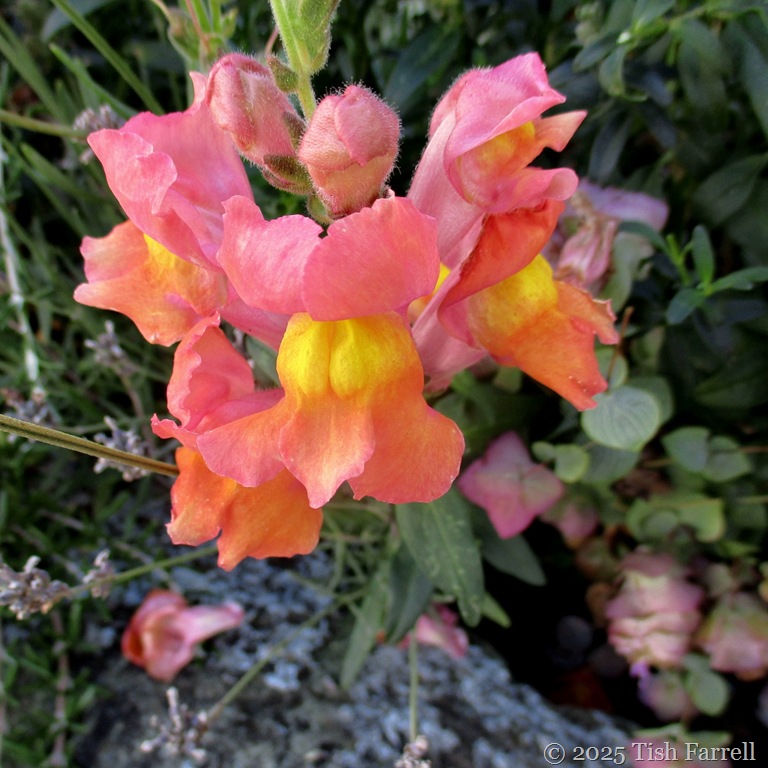
And at the hotter end of the colour palette, in the front garden we have a row of snapdragons, self-seeded along the wall in a remarkably orderly fashion. Anyone would think I’d put them there.
IMG_7758 snapdragon 3

IMG_7756 snapdragon and bee

They glow in late afternoon sunshine.

*

Throughout May we had profusions of columbines, mostly pink and dark mauve. They are actually too much of good thing on the self-seeding front, and I spend much time rooting seedlings out of the vegetable beds. But then amongst them were two plants of delicate lavender, each with a different ‘frock’, one by the green house, and another in the far corner behind an apple tree.  They are over now. But I know where they are.

IMG_7562 columbine lavender

IMG_7554 columbine lavender 2

*

Six On Saturday  Please visit host Jim’s lovely garden – so many treats to be found there.
It’s All Birds And Bees In Our ‘Castle’ Garden
IMG_7447ed

Well, they do say an Englishman’s home is his castle. And for this English woman, this stronghold must obviously include the garden. At least I like to think the garden is my domain; my own small fiefdom.
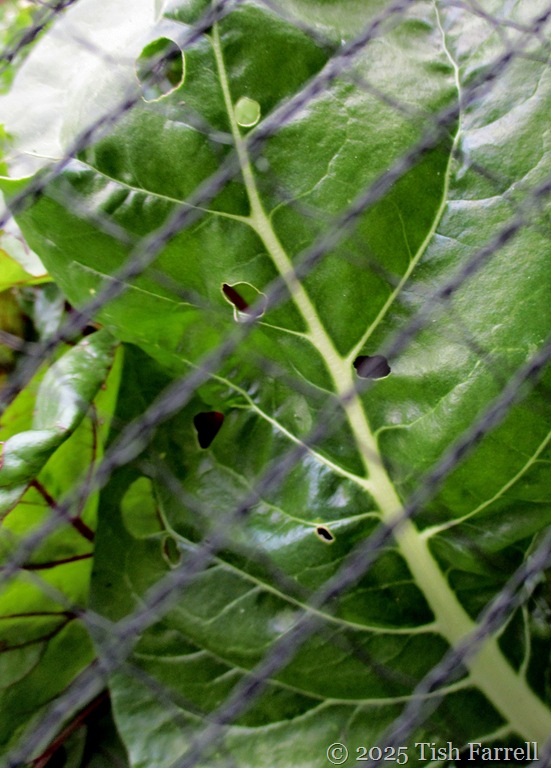
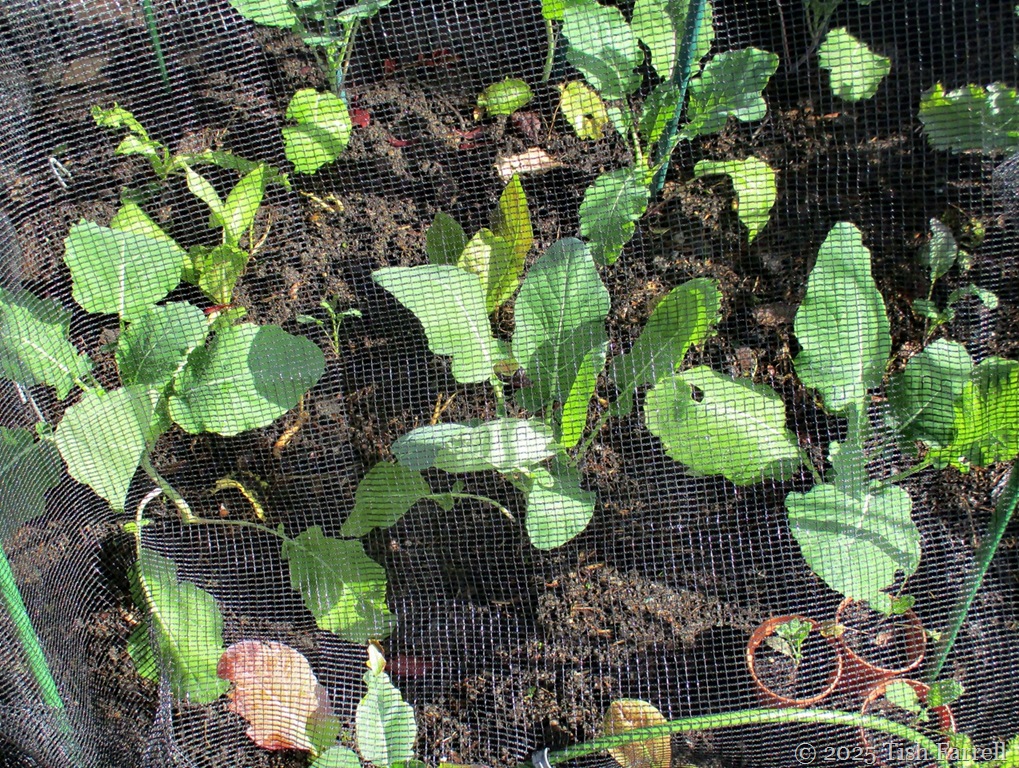
The wildlife, of course, has other notions. This mama blackbird, for instance, is quite sure my purpose in life is to provide her with fresh feeding stations. As soon as I begin work in the garden she’s there, poised to snatch a worm or grub. If I do not provide quickly enough, she fixes me with that beady eye, and starts her own digging.  This has led to us falling out somewhat. I’ve had to net all my vegetable beds to stop her rooting out my seedlings.
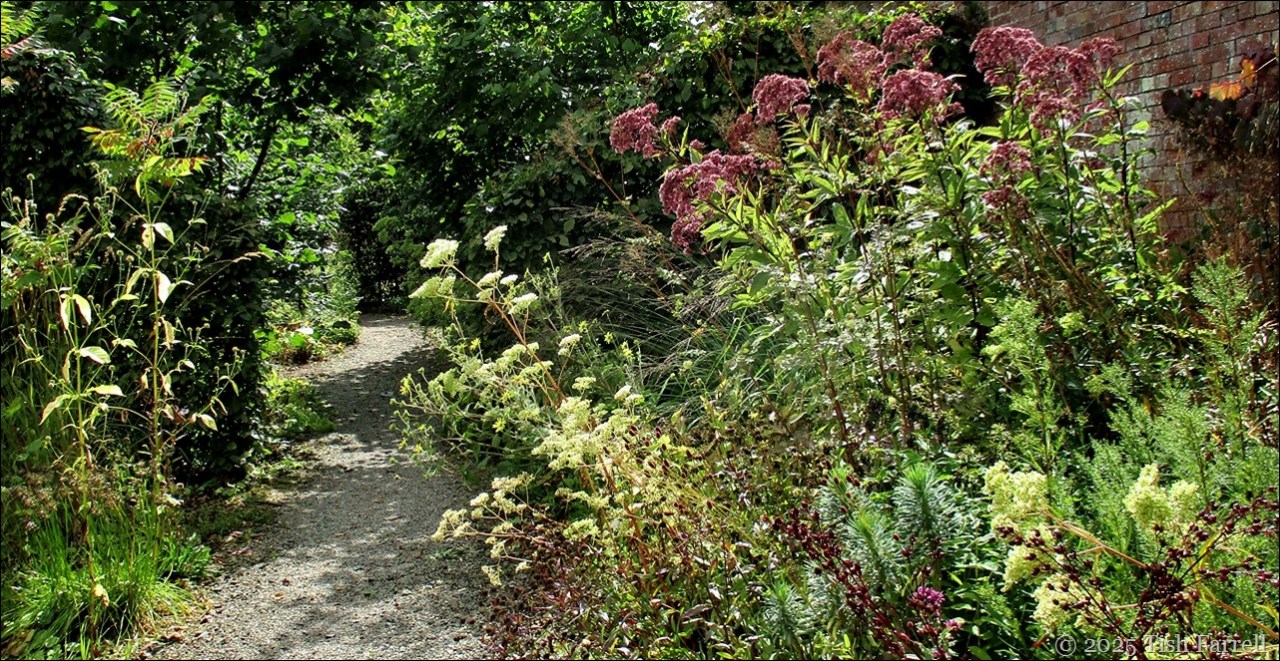
But she did keep me company while I cleared the boundary wall with our neighbour’s garage. It was a horrendous job, hacking out ingrowing and overgrowing hypericum (Rose of Sharon) that years ago had been planted along the top of the wall, and since turned itself into a stretch of brutal anti-tank wire, while inviting Spanish bluebells, ash trees and willow herb to join in the fray.
IMG_7328 ed

I’d been tackling the job on and off since last summer. But now it’s done.

IMG_7332 ed

I’ve planted the road end with a couple of trailing blackberries designed for hanging baskets and also some foxgloves which had grown themselves in the back garden. As for the rest, for this year I’m thinking of putting in various kales and perhaps courgettes; nothing permanent in other words. I’ve discovered that hypericum shoots and roots from the tiniest scrap of itself, so it will probably take a few seasons to clear the bed.

Meanwhile mama blackbird has been well fed, and the feeding clearly paying off. Two days ago, while planting a hornbeam sapling to fill a gap in our rear hedge of horrors, I had the sense of being watched. When I peered into the tangle of privet, holly and sycamore, there she was, sitting still as stone, on a very neat nest, looking straight back at me. I left her in peace.

As blackbirds go, I suspect she is rather elderly. Her tail feathers look more than a touch bedraggled. But she has us weighed up as non-threatening entities, choosing to nest right by the path that we use all the time. She is not afraid to leave it either, when she sees me with a spade. Yesterday,  when I was unearthing some ash tree saplings further down the hedge, she was right there, just in time to gobble up a big juicy worm.

IMG_7417

Male blackbirds don’t do nest duty, but I’m assuming this is papa. He’s taken to singing sweetly in the hawthorn tree just over the hedge. He shows up when I’m digging too, but not if mama is around. (She sees him off). He actually comes very close and tweets at me, if I’m not providing worms.

Earlier in the year it was the robin who would come nagging as soon as I set foot in the garden. He/she was especially pleased with operation dig-out-compost-bin, but now is perhaps too busy with egg minding to be around so much.

IMG_6911ed

IMG_6843

*

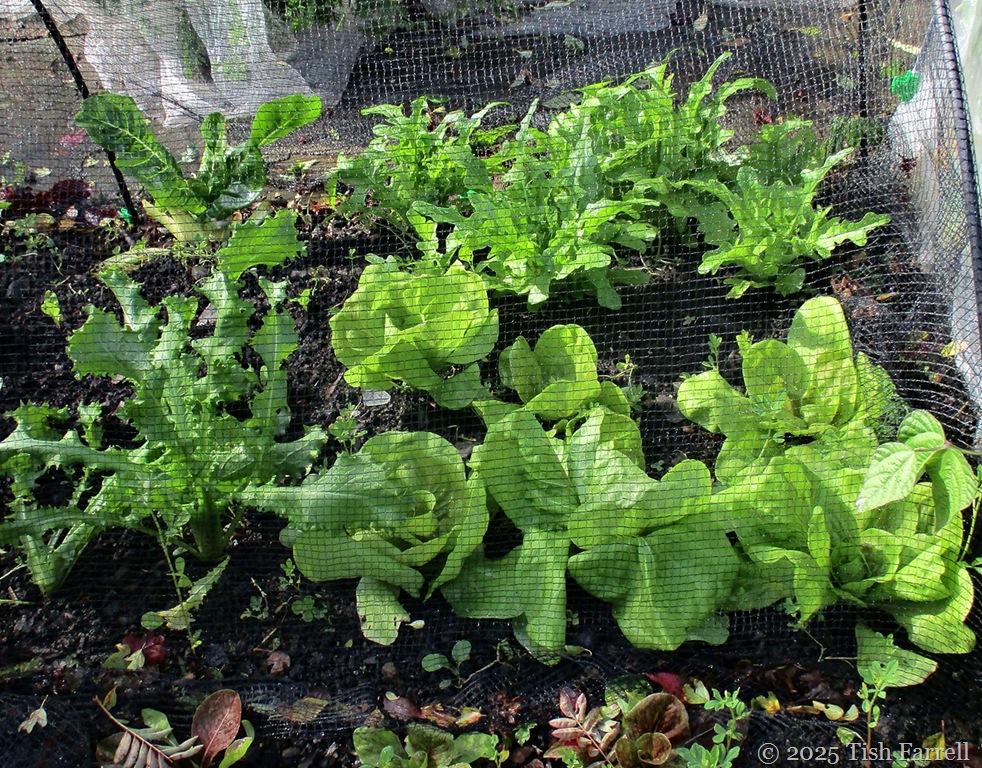
Other birdlife, as in pigeons, I’m not so pleased to see. They’re another reason for having netting all over the vegetable plots, though it doesn’t stop them from nibbling through the fine mesh if the plants grow too close to the edge. They like spinach, brassicas, chard, chicory, beetroot leaves, lettuce, young field bean leaves and lemon sorrel.

IMG_7437

IMG_7434

IMG_7508

The garden is very much ‘a first draft’; there’s much to sort out (tidy) and much trial and error (given the lack of an actual plan). Next week a paling fence will start going up around the perimeter (from behind the greenhouse and round). It won’t be too tall but will create a boundary for fresh planting which might help focus this gardener’s mind.
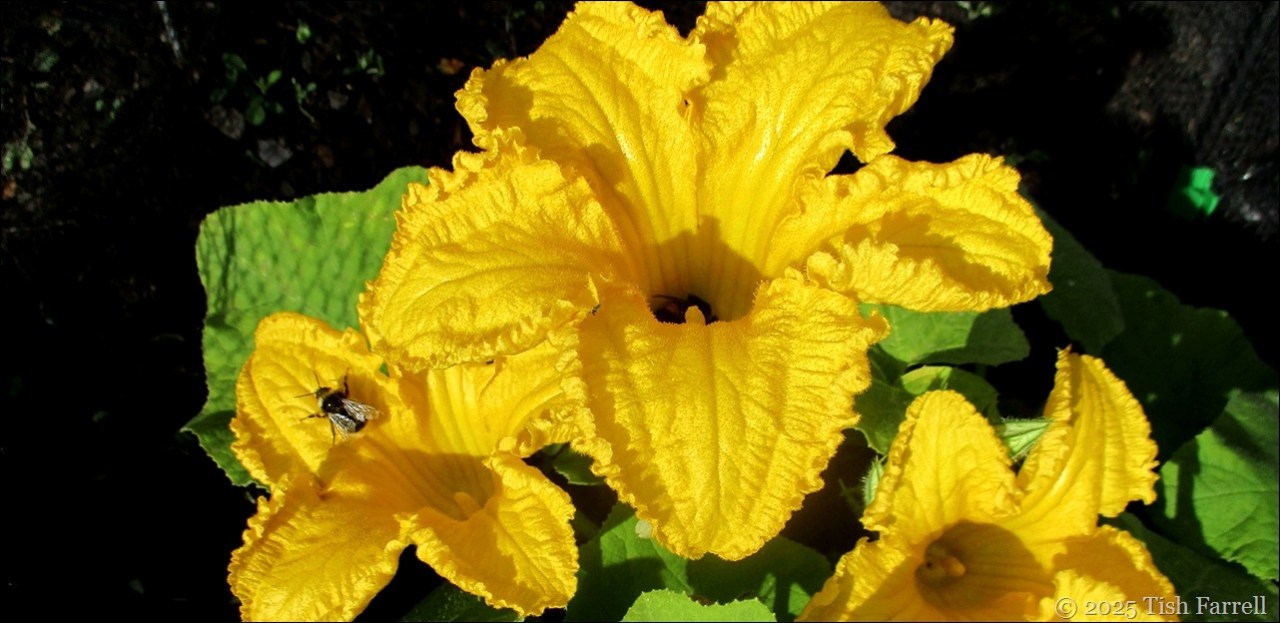
For now we are enjoying the apple blossom, and especially the little tree which is flourishing between the compost bins, one open, one hot. I think it’s a Crispin. The black hot bin is not a pretty sight, but the mass of flowers is lovely and, in a spot of warmish afternoon sun, is alive with bee hum. Just look at the pollen sacs on the bees’ legs.

IMG_7478

IMG_7474sq

IMG_7427

*

And there’s not only apple blossom. On the terrace wall we have tulips. They are presently looking rather glamorous:

IMG_7426ed

IMG_7425

So: spring is here in the Farrell domain aka Castle (also the locals’ name for the town), and in moments when the wind drops and you stand in the sun where the air is less frigid, it feels like it too. Cheers, fellow gardeners! Happy planting!

Six on Saturday: blackbirds, robins, bird defences, apple blossom, bees and tulips

copyrithg 2025 Tish Farrell

Catching The Light And Finding Home

IMG_6923 cherry plum sunset

I took the header photo on March 11th, the last rays of sun over Shropshire-out-of-Wales, lighting up the first sprigs of cherry plum blossom. I have only recently identified this tree: Prunus cerasifera nigra – a native species that lives just over the hedge outside our kitchen window. Every day now, and especially when we sit down to eat, we are watching it with special attention. For it seems this tree, which I had started off disliking (for reasons explained below) has become a household treasure, albeit one ‘borrowed’ from the roadside verge next door.

When we planned the kitchen extension (to replace an ageing conservatory attached to our newly bought old house) we did not think too much about the view. The site was tight, constrained by planning regulations, conservation area considerations and an overgrown hedge (although it has been cut back), and so we assumed our new big window would mostly look out on sprawling holly and hawthorn.

But now we find we also have a tree-view. And though I’m not so keen on pink, I cannot deny its loveliness, and especially at sunset. For this was another unplanned aspect: the only possible position for the window meant it faces due west.

IMG_6907ed

Two weeks ago the branches were still black and bare, a skeleton mesh against wintery skies. One week ago, with the sudden sunny spell, if we looked hard, we could spot tiny slivers of pink on breaking buds. This week we have the first blossom, a good two weeks later than last year, when our February 24th view through the landing window looked like this:

IMG_4676

So much for all the talk of this spring being sooner and warmer etc etc than other springs. Not so in Bishop’s Castle. After the week of warmish weather, the polar vortex is now rolling out cold, cold air day after day, and the cherry plum’s impulse to flower feels arrested somehow. But then that’s alright. A slow flowering will be just fine.

*

Last spring, as the building work progressed we watched the blossom cloud give way to foliage production. Next we had a dense, dark, rustling canopy, the leaves almost black at first sight, and not very pleasing. When viewed from outside, the tree cast a pool of deep gloom over the garden steps which  I found depressing. But then come August and the kitchen all but done, we found ourselves sitting down to supper with an unexpected light show.
IMG_6006

kitchen window

*

Two months on – and another unexpected view – a November snowfall and an abstract work that made me think of Jackson Pollock’s  Autumn Rhythm, which I think we once encountered in the New York Met, where we’d gone to escape an unanticipated May heatwave.

IMG_6474ed

And so in our new home, with passing moments, hours, days, and months, (two years in August), we are coming to know our closest neighbour, the cherry plum. Its fruits are said to be edible and good for jam. I managed to discover a single one last year. It was deep red and round, bigger than a cherry, with a firm skin that seemed to scrunch when I bit into it. It had a sweet-and-sour taste that made me think of Chinese plum sauce. Back then I did not know about its eating potential, and anyway I think the tree has grown too tall for elder scrumping  forays.

But never mind. It has anyway inspired me to think more kindly about our horrid hedge, and how to deal with some ugly gaps just beyond the window. I’ve discovered cherry plums are good for hedging so I’ve recently planted three white flowered saplings, hoping that (in the not too distant future?) the blossom will cheer both us and passing neighbours. And maybe there’ll be fruit too – for us and the birds.

There are other bonuses of course. When I was out on the far side of the hedge preparing the ground for planting, there was much chatting with locals who wanted to know what I was up to. And indeed, why I’d come to live in Bishop’s Castle, and where was I before. All good questions and a good start too to feeling, after a few unsettled years, that we’ve at last come home.

IMG_6902ed

Lens-Artists: Life’s Changes This week Anne sets us a theme rich in possibility. Interpret it as you may, but first see her post for an inspiring tale of personal development.

Spring!

IMG_6806ed

Or is it?

February in Britain often teases, bringing us a sudden mild and sunny day, as it did last Saturday, followed by bone biting winds (today). Countryman poet, John Clare 1793-1864, wrote a poem about February fickleness. I probably mentioned this time last year. It’s worth a read.

So: we have crocus and snowdrops, and the odd daffodil. Also hellebores, both waning and waxing. On the garden steps the winter pansies still thrive, although all but blustered out of their pot.
IMG_6787ed

IMG_6795

We have only a small scatter of snowdrops in the Farrell domain, but everywhere else about the town, in gardens, under lane-side walls and hedges there are drifts and drifts. Reinforcements, then, needed at The Gables for next year.

IMG_6822ed

At the top of the garden steps the dark hellebore has just begun to flower. Very striking when the sun catches it. Meanwhile, in the pot below, Hellebore Christmas Carol is winding down after a three month performance. Although having said that, this morning I noticed there are new buds forming beneath the gone-to-seed blooms.
IMG_6832

*

The clump of tiny crocus at the top of this post popped up this week by the front gate. Most welcoming of them. This particular variety also seems to be growing in every Bishop’s Castle garden. And of course there are the chunkier sorts too, a whole host in fact spotted in the grounds of the Wintles eco-houses:

IMG_6796

IMG_6801ed

*

Outside the kitchen window (on the far side of our horrid hedge) the ornamental cherry tree is now displaying the faintest haze of plum coloured buds. They will be candy floss pink when they open. Not a favourite colour, but still a sight to look forward to against a blue spring sky.

IMG_6808

And talking of the horrid hedge, those of you who follow my gardening pursuits will know that last year I was doing battle with it: untangling swathes of ivy, pulling out decayed hawthorn branches, unpicking very prickly vegetation that had knitted itself into a chicken wire fence running the length of the back garden, whingeing about the forest of saplings – ash, sycamore and elder that had grown amongst the holly, privet, weigela and hawthorn, all of which meaning you pretty much need a chainsaw to keep it in check.

In an ideal world I would have it dug out and replanted with wildlife-human friendly species. In fact, looking at 1990s photos of it, I don’t think it was ever deliberately planted as a hedge: more a case of boundary holly trees and shrubs suckering up together with arboreal interlopers and encasing a very rotten field fence.

But then a few weeks ago I had a notion. I discovered I could buy individual wild hedging plants and so fill in gaps between existing thickets. We have now popped in bird cherry, field maple and briar rose whips. We also have a more substantial hornbeam still to plant on the sunny side of the biggest gap created by our recent building work.

My hope is that, as the new plants become established (well trained of course), we can then cut back the main stems of the ash, sycamore and overgrown weigela, encouraging them to sprout more usefully (and manageably) from the base. That’s the plan anyway. One for the long term, methinks.

And apart from this, and in rare dry spells, my other betwixt-winter-spring gardening pursuit has involved digging out the compost bin. Last year I’d filled it with dug up lawn. And oh, what lovely stuff it’s become. I can’t tell you how happy it makes me – a lovely big pile of crumbly dirt. Perhaps enough for two raised beds.

Time to start some seed sowing then…

IMG_6809

copyright 2025 Tish Farrell

*

IMG_6807header

The Tenacity Of Small Things

IMG_6788

*

A persistency of pansies

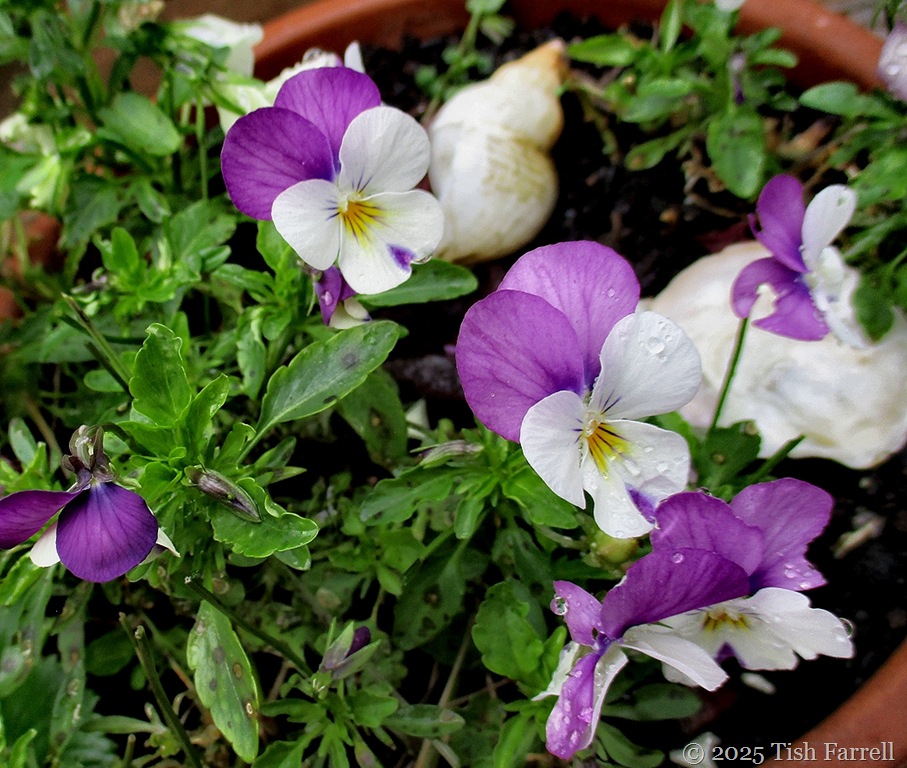
I am truly astonished by the hardiness of pansies. They must have been bred with anti-freeze in their roots and shoots. Their structure is anyway so puny and fleshy; easily crushed by clumsy humans. So how can they still be flowering?

The pansy in the photo is much tinier in real life, less than one inch across, and so tending more towards the wild heartsease, Viola tricolor ,  which grows in upland summer meadows.

Sister Jo gave me three little pots around the end of September. I planted them out in a larger pot and they have been sitting on the garden steps ever since, already into their fifth month of flowering. And not once have they failed. Not when they were buried in snow for several days. Or subjected to hard January frosts night after night. Or buffeted by gale force winds. Or beaten by downpours.

It’s true they look mangled after a frost, but as the day warms, they perk themselves up as if it had never happened. Bless their little pansy faces.

IMG_6597 ed

After the December snow and frost

*

A hurrah of hellebores

And cheering on the pansies comes the hellebore – a Christmas Carol gift from best chum Les. Since mid December it too has flowered its socks off in a pot by the back door where we can see it. So heartening on dull winter days when it’s too icy to venture outside: there it’s been, day after day. And according to the horticultural sites on the internet, it may well carry on till spring, which at the moment it looks like doing.

IMG_6596

*

And now in the front garden, pushing up through frosty soil come miniature crocus, their stems no thicker than a darning needle. They are scattered everywhere and seem to be tiny seedlings rather than the offspring of corms; not a garden phenomenon I’d come across before we moved into The Gables. On gloomy days when they are closed up tight, you can hardly see them. But when the sun shines, the little flowers open wide. Spring is on the way, they say.

They’re nothing if not optimistic little specimens.

 IMG_6777

A cheerfulness of crocuses. Or maybe croculetti.


Fruitily Geometrical: The Pink Pineapple Pavilion

IMG_1328ed pineapple 2

Some of you will have seen this before, but I thought it deserved another outing; ideal for Becky’s #GeometricJanuary.

We came upon it a few years ago when visiting National Trust stately home, Berrington Hall, in Herefordshire. It is the work of installation artists Heather and Ivan Morison; their interpretation of the Georgian garden pleasure principle, which included all manner of temporary structures for dining, conducting assignations, or communing with the great outdoors. It’s called Look, Look, Look!

P1030075 sq pineapple 4

In the 18th century, Britain’s landed rich expended their often questionably-gotten gains in the creation of pleasure parks around their grand houses. These were places for promenading, a little sporting activity (fishing, sailing, archery), for re-enactments of famous naval battles (if you had your own lake); there were ‘eye-catcher’ summer houses, grottos, fake ruins, and classical temples. It was also the era of wholesale removal of villages from the sight-lines of the gentry in the ‘big house’. Garden tunnels were also dug so the horticultural workforce could go about their labours largely unseen. Above all, these gardens were ‘show off’ places, and if you wanted the best, you employed the likes of Lancelot ‘Capability’ Brown to design it.

IMG_1312 pineapple 3

Another show-off item was exotic fruit, especially the pineapple whose possession, in the flesh, produced in your own very expensive-to-run hot house, or as architectural motifs about the house, demonstrated your wealth and prestige. At Berrington Hall there are both pineapple allusions, and  the surviving landscape contrivances of Capability Brown. The park is magnificent, and Brown’s last endeavour as a garden designer. There is currently an extensive garden restoration project which aims to recover his original groundworks.

pineapple quite

Inspired by the pineapple, detail from a Berrington Hall bed quilt

*

N.B. You can find full details of the Pink Pineapple’s construction, with architectural plans HERE.

#GeometricJanuary Day 5

Of Right Royal Geometry

IMG_2129ed

*

So begins Becky’s month of square format photos – of things geometrical. So here goes.

There’s almost too much geometry in this shot: triangles, rectangles, circles, semi-circles, octagons. It is was taken at Kenilworth Castle in Warwickshire, a medieval fortress transformed in the 1570s into a grand Tudor palace, wrought at huge expense by Robert Dudley, Earl of Leicester, and with the sole purpose of entertaining his queen (and rumoured lover)  Elizabeth I.

More of that story here: Greater love had no man…

The photo shows a slice of the pleasure garden and ornamental aviary constructed in 1575, specifically for Elizabeth’s visit. This is how she would have first glimpsed it, descending from the royal apartments to a loggia terrace, whence she could view the whole extravagant horticultural confection. For this particular visit, it is said Elizabeth arrived with thirty-one barons and four hundred staff.

And they  stayed nineteen days. (Just imagine!)

Robert Dudley pretty much bankrupted himself to keep them all amused, not only with lavish banquets, but also with hunting, pageants, plays, bear baiting and fireworks.

And after all this, Elizabeth still could not be persuaded to marry him.

As to the garden, it was lost for nearly 400 years. English Heritage have reconstructed it using an eye-witness account of the visit by one Robert Langham plus archaeological and historical investigation.

You can read Langham’s account HERE. He speaks of ‘fair alleys…green by grass…and some (for a change) with sand…pleasant to walk on, as a sea-shore when the water is availed.’ He mentions too (and not an inconsequential attribute in those times) ‘the sweetness of savour on all sides, made so respirant from the redolent plants and fragrant herbs and flowers, in form, colour, and quantity so deliciously variant’.

*

IMG_2086

IMG_2084ed

*

And the ruins of the erstwhile royal apartments:

IMG_2065sq

*

Wishing everyone an all round happy New Year

*

#GeometricJanuary  You can join Becky’s square posting every day this month. The only rule is the photo must be in square format. How you interpret ‘geometry’ is up to you.

The Grateful Gardener

IMG_6486ed

We have snow here in the Castle. We woke up to it early yesterday. What a shock. Snow in November. It’s much too soon. I’d seen the weather forecast of course, but was expecting only a spot of sleet that would soon melt away with the global boiling, not several inches of real snow, the sort perfect for snowballs.

Anyway, it’s not the snow I’m grateful for, but I do love the brilliant blue sky it’s brought with it. And also this golden Rowan tree in its white cocoon. It stands just outside our garden, and provides us with some borrowed treescape. And it, in turn, has recently been much loved by the birds, especially the blackbirds. Before the snow came they were busily stripping the stems.

IMG_6457

*

I’ll miss the berries when they’ve gone. On bright autumn days they light up like jewels. This is how they looked in early October. A tree full of joy. Thank you, Rowan.

IMG_6424ed

*

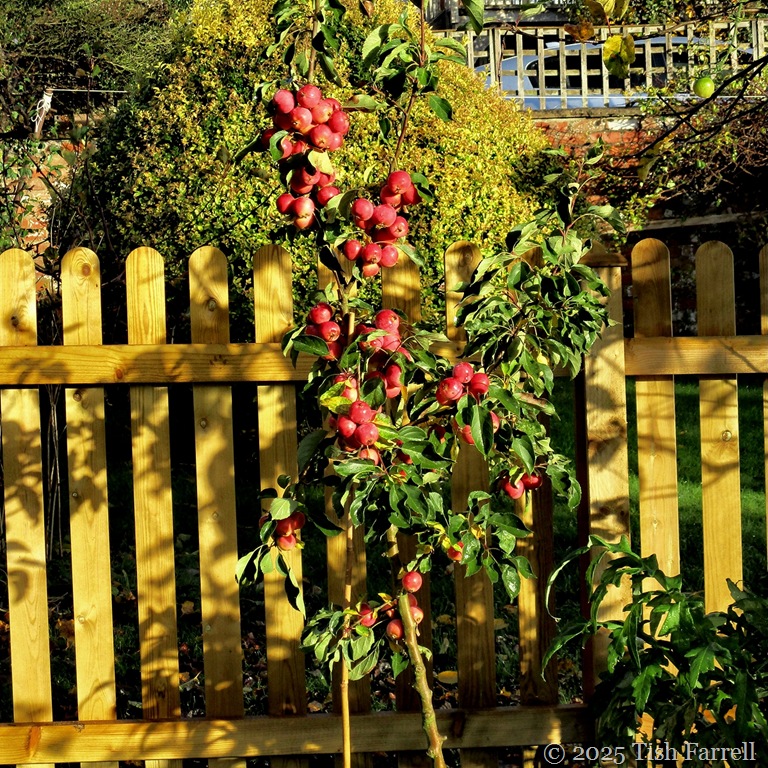
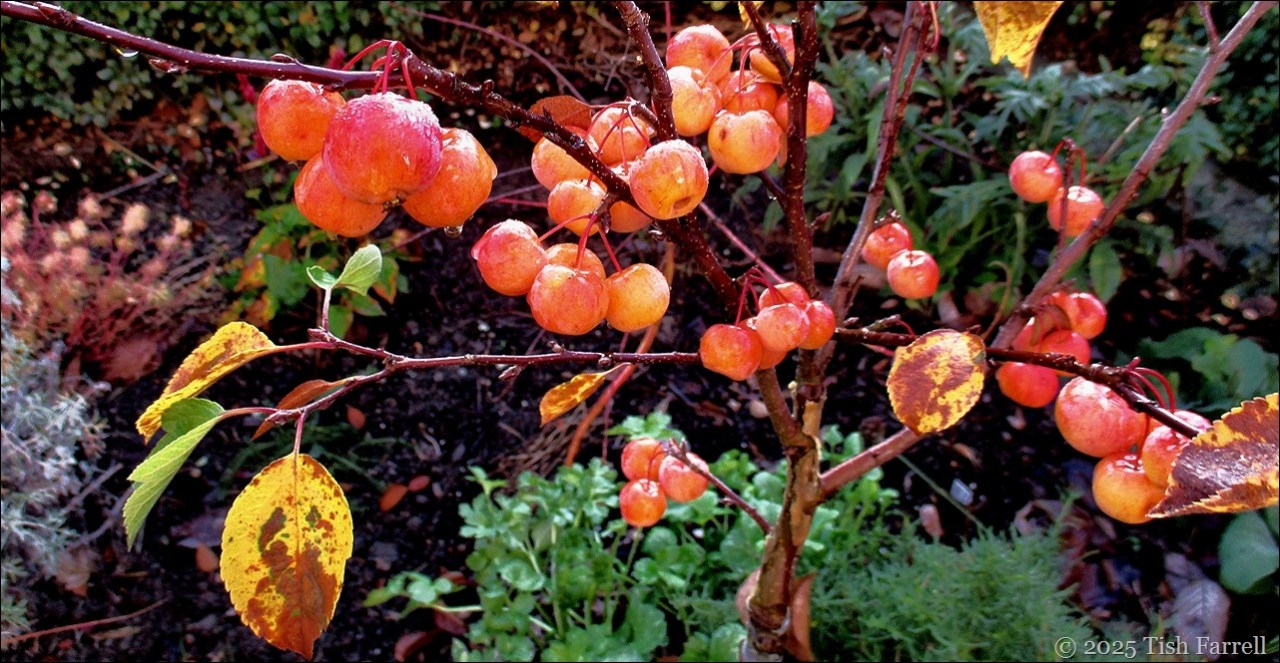
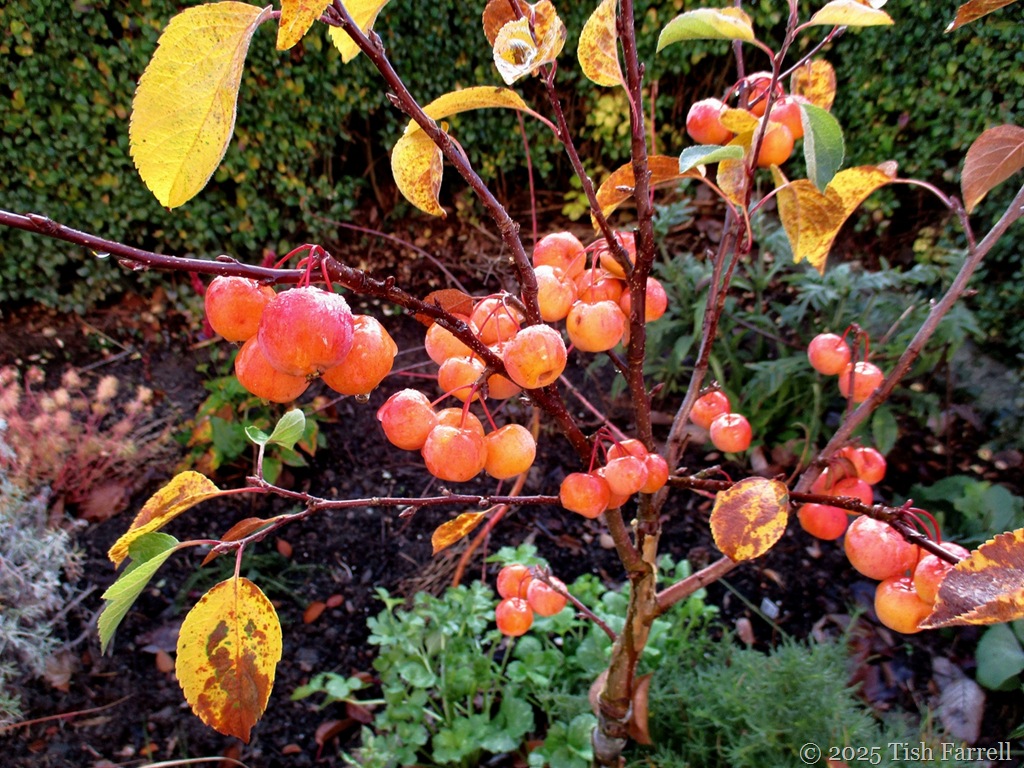
The snow fall also focused my eye on the latest garden addition: a Jelly King crab apple tree. Yesterday morning while sitting at the kitchen table eating my porridge, I could see its clutch of red apples glowing like little beacons at the bottom of the garden. Time for a photo then, and to say how very pleased I am with this Halloween birthday gift from my other half. Thank you, Graham.

IMG_6489ed

It came a few days before my birthday, delivered in a tall box to the front doorstep, whither I was directed to investigate the new arrival. Once I’d broken through the cardboard, I was surprised to find the little tree had come with eight tiny apples still firmly attached. There were also a dozen loose ones in the bottom of the box, sadly not quite enough to make crab apple jelly, but filling me with high hopes. I decided to keep them as a spur to locating a wild tree. I thought I knew where there was one. And so it proved. Last week I found a fine crop of fallen apples in a patch of woodland on the way to the builders’ merchants. We now have crab apple jelly. No need to wait for the little tree to do its stuff then.

*

And speaking of stuff – we still have some of the salad variety growing outdoors and in the greenhouse.

IMG_6466

This year I’ve grown Red Radicchio endive. For the past few weeks it’s been growing fatter by the day, and as temperatures lower, the more red it becomes. I’ve been plucking the outer leaves with hopefully plenty more to come. In the greenhouse I have tubs of red Chinese mustard, Moroccan Cress which grows like a cut and come again lettuce and a few oakleaf lettuces. Also some lettuces out in the garden, though they may have succumbed to the snow. Likewise the marigolds. But it makes me very happy to find a bowl full of fresh salad leaves in late November. Thank you, garden.

And one little plant that is standing up to the snow, once I’d dug it out it earlier today:

IMG_6508

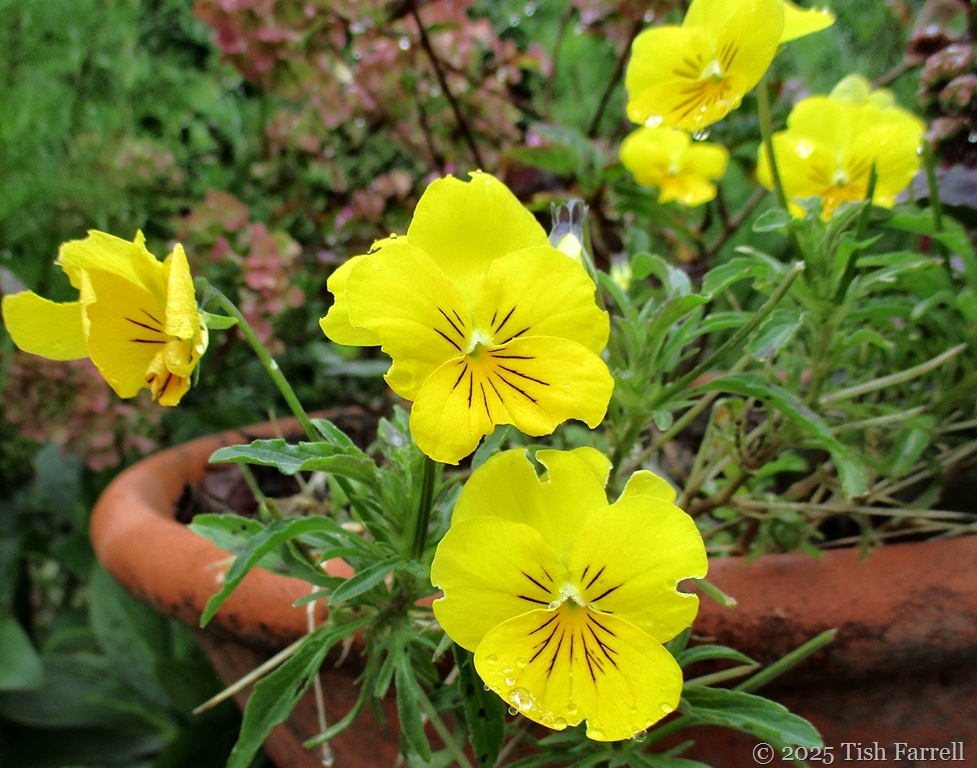
These sweet little hearts ease type pansies have been flowering for weeks and weeks in a pot on the garden steps. And they’re still going strong. They were a gift from my sister. Thank you, Jo.

Lens-Artists: Gratitude  This week Tina sets the theme, both timely and thoughtful. Please visit her ever lovely blog.

Six On Saturday: Of Flying Saucers, Scorpionweed And An End To The Great Gobbling

IMG_6143

And no, we have no extra-terrestrial sightings here in Bishop’s Castle, at least not over The Gables, but I do have a few Flying Saucer Morning Glories. They are late on parade, growing up my obelisk of butter beans in the front garden.  I wasn’t really expecting them: the seed was several years old. Yet here they are, busy luring insectkind.

IMG_6145

*

Also in the front garden, in the opposite bed, the phacelia has been flourishing for the past few weeks, every day alive with bee hum.

IMG_6172ed

IMG_6166ed

This borage family member hails from North and Central America where it also goes by the name of Scorpionweed, which sounds hair-raising. So far there has been no sign of cohabiting scorpions (no doubt a huge comfort to other half who was bitten on the foot by one while overlanding in the Sahara.)

I sowed the seeds quite late, probably around the beginning of July. As with the Flying Saucers, I was prepared for them not to germinate. The packet was left over from Wenlock allotment days. I grew it back then either as green manure or a cover crop. But then on a trip out in late June I’d spotted fields of it around Ludlow. I’d never seen it growing on an agricultural scale before. It was in full bloom and the fields seem to float in a mauve haze. More than a good enough reason to try it.

These days there is much farmer emphasis on improving soils and attracting insects on land taken out of food production (food security no longer seems to be a priority in government policy for British agriculture). Hairy crops like phacelia, vetch, linseed have been found to improve worm populations, this even in light and sandy soils.

I decided to try it on the ground where we had lifted paving slabs and left behind a layer of old mortar which had mostly been broken up into the soil. It looked very unpromising territory, and I wanted to see if anything would grow there. And it did. The seeds sprouted in a few days.

Usually if you’re growing phacelia to provide green manure, it should be dug in before it flowers to stop self seeding. But I thought never mind about that. The flowers are so pretty, their scent so subtle and, while they last, their kindness to insects immeasurable. The first frost will doubtless fell the plants, and I’ll probably leave them to dig in before spring.

*

IMG_6271ed

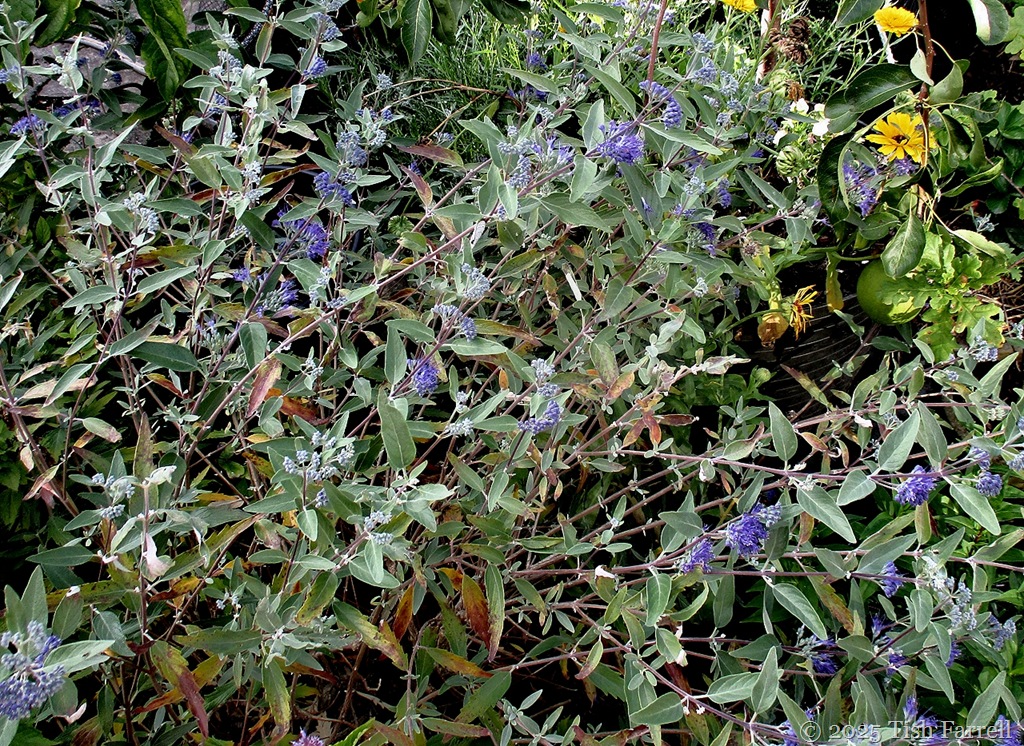
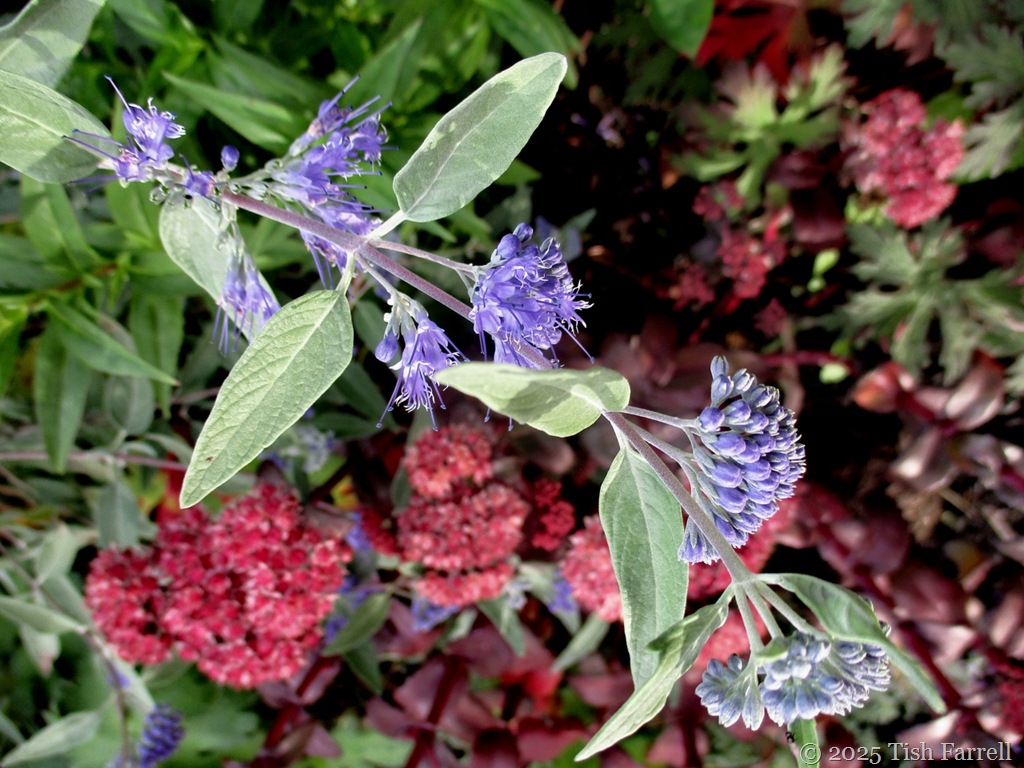
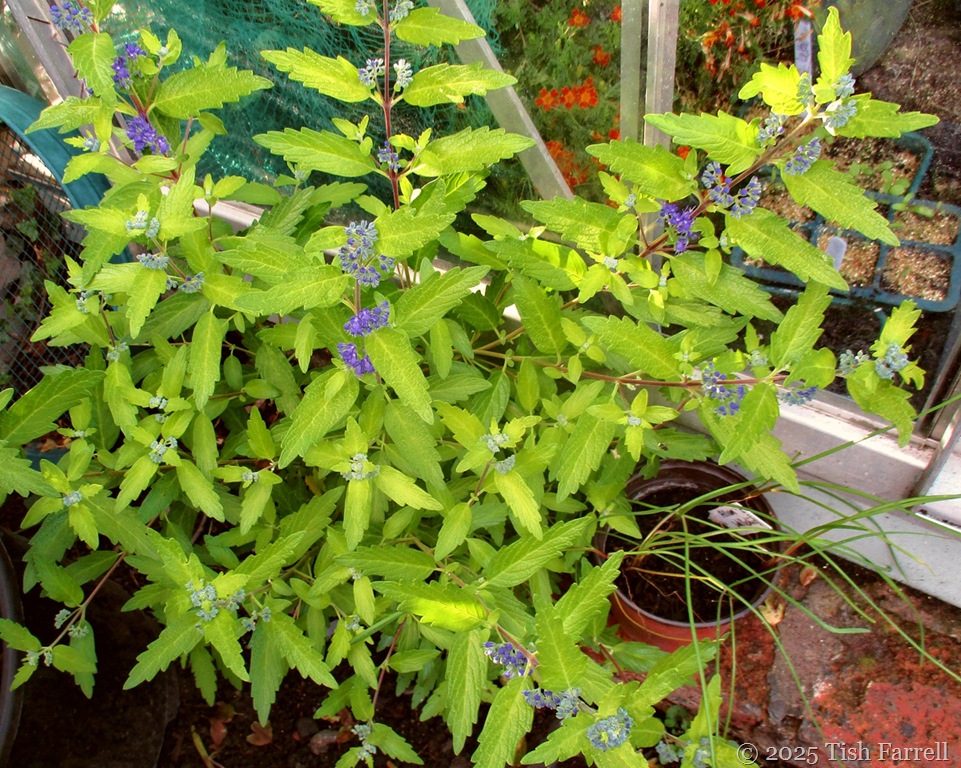
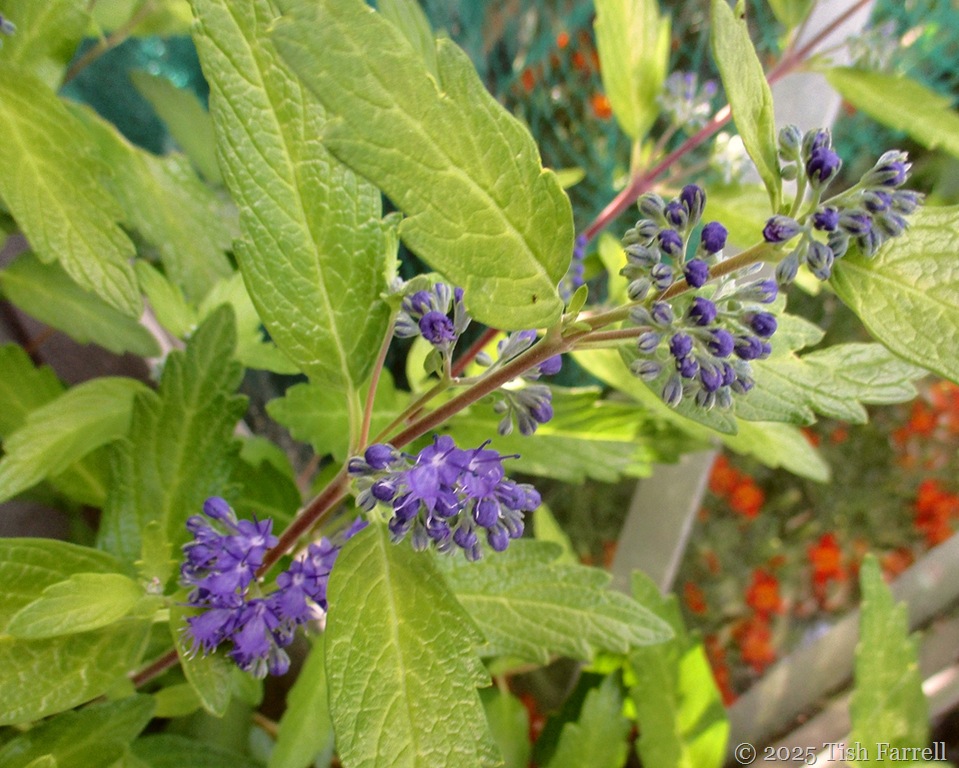
And here’s another insect friendly plant, doing its end of season feeding duty while looking lovely too: Caryopteris ‘Heavenly Blue’, a fairly compact hardy shrub bought back in the spring. It clearly loves our garden and has opened its branches so generously. The flowers are scented too, and it’s taken over catering duties from the neighbouring purple agastache, which is now a mass of dusky seed heads and no longer of interest to the bees.

Much of the rest of garden has a look of late-summer weariness. We had a couple of real summer days earlier this week, but there’s a real sense of autumn in the offing. My runner beans simply stopped producing at the end of August, for no reason that I can fathom. Although I did notice yesterday that a single plant has decided to grow a couple of strands worth. Perhaps one last small meal then.

Meanwhile, the Flying Saucers’ hosts, the butter beans are still flowering like mad up the front garden obelisk. There are many pods but they are being very slow to fatten, doubtless down to the lacklustre summer and cold-spring start. I’m now hoping for an amiable October that might give the beans the chance to finish off. And for now, the blossom is still performing essential services.

IMG_5976

*

The good news, though, is that the horrendous brassica gobbling has ceased, this after the cabbage white caterpillars ate every kale plant down to the stalks. It did not matter that I’d covered crops with so-called butterfly netting and fine grade enviromesh. Somehow the butterflies sneaked in to lay their eggs. Patrolling the plants even twice a day proved a losing battle. They made inroads in the pointy cabbages too, but I’ve managed to save some of those.

Ever hopeful, I’ve replanted Russian and Tuscan kale plantlets under extra-fine mesh. The butterflies are still about, but not in the flocks we experienced earlier in the summer. Fingers crossed.

IMG_6282

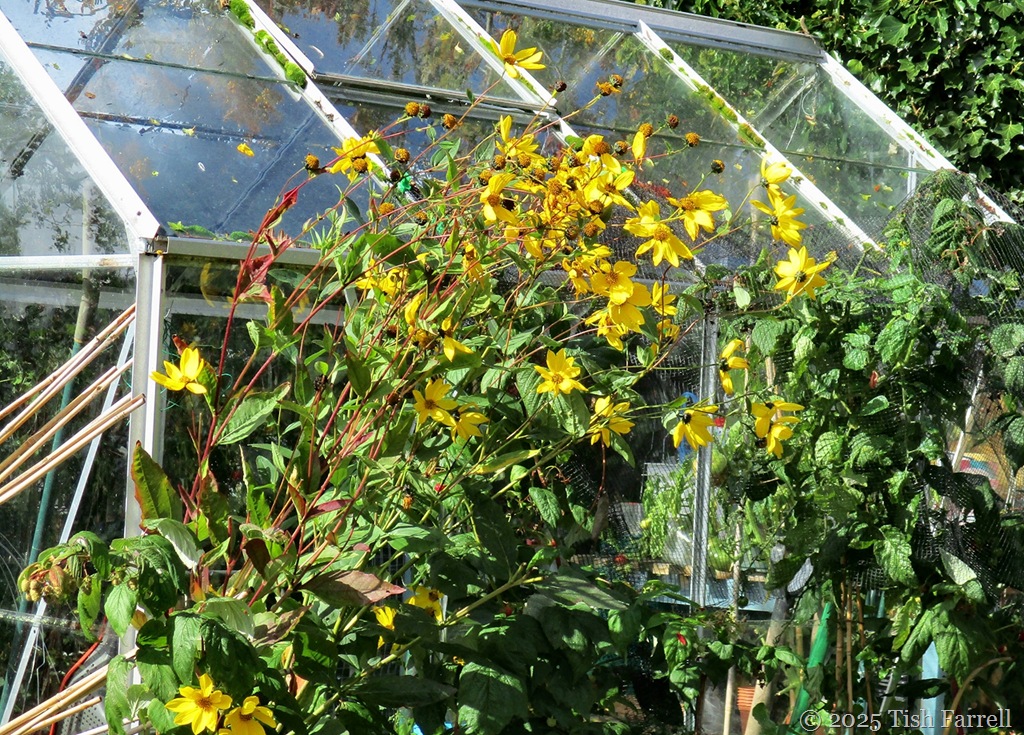
There are other bright corners in the garden, and especially this towering clump of helianthus, a perennial sunflower. Back in the spring when I planted it out, it was three single small stems with only a few roots between them. The cuttings came from my sister’s Little Stretton garden, descendants from plants that grew in our Aunt Miriam’s Devon garden. I’m so pleased to have it. I did not have a chance to grab a segment or two of my Wenlock helianthus before we moved. It used to be the star of the late summer guerrilla garden there. It’s growing even more vigorously in Bishop’s Castle.

And last but not least, but definitely with an eye to autumn in its new russet foliage, this is a newcomer to the Farrell garden, Japanese cherry kojo-no-mai. (Posing here with some very sweet violas).

IMG_6254

It will eventually grow into a small tree, but for now seems happy in this pot.

*

Six on Saturday  Please visit Jim at Garden Ruminations. He needs some get-well wishes.

What’s In A Garden ~ Or Tales Of The Not Quite Planned

butter bean blossom and morning glory

The thing about making a garden is you never really know what will happen there. Not really really. You do of course ‘set the stage’ for growing to happen – from planting up a few doorstep pots to toiling over ground work and designing and filling borders.

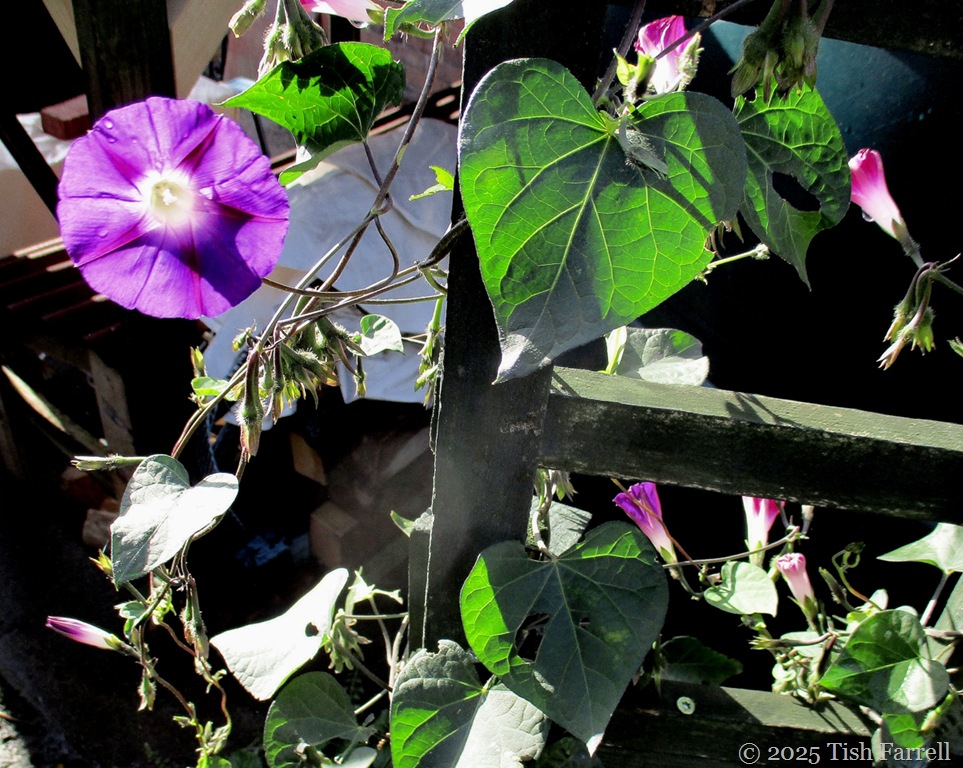
And then when you sow seeds, as I did here for Gigantes butter beans, and Black Knight morning glory – you could well envision how they might be if they were planted out together and set to grow up the front garden obelisk. (Header photo)

But you can’t necessarily predict the actual ‘show’, which of course is what’s wonderful about gardening. In many ways it’s ever an experiment. The pleasure comes when you walk outside and notice something  special, the something whose actual disposition you had no control over.

IMG_6023

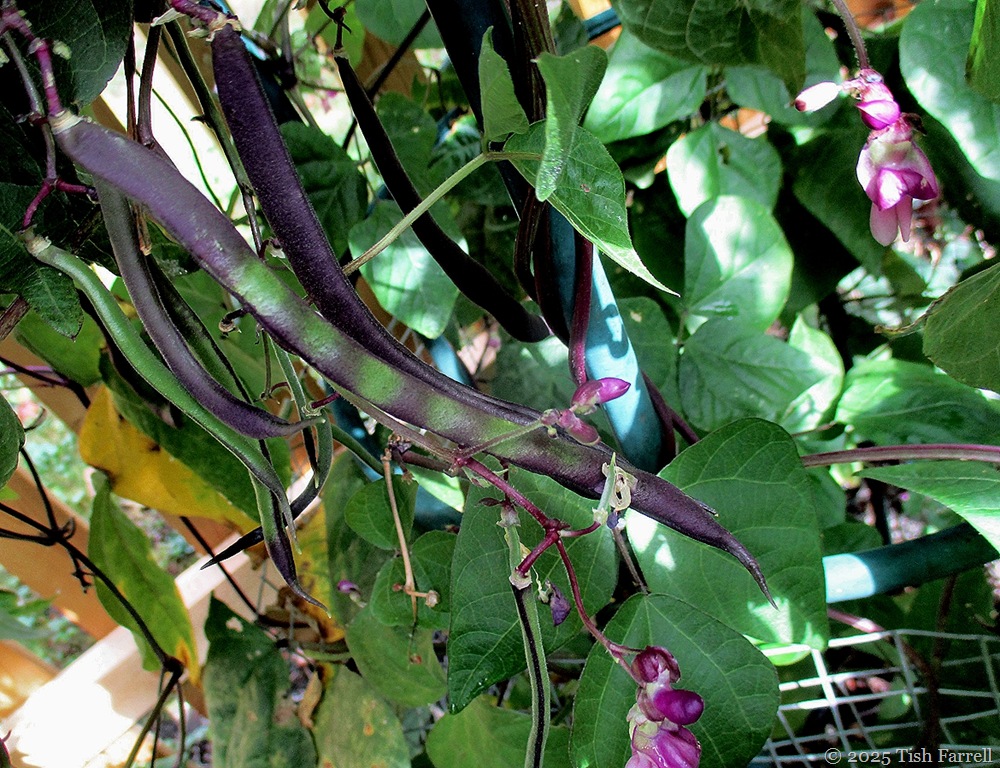
In the back garden I planted out some more Black Knights with purple climbing French beans Violette. But at the moment they seem more keen to keep company with the courgettes. The flowers have an unearthly look about them. I could swear they radiate light from their recesses.

IMG_6035

*

Then there are the wild and feral plants that invite themselves into the garden. Sometimes they are not too welcome. But sometimes they make one’s heart leap with delight. Here, entwined in our otherwise horrid hedge we have this glorious pink convolvulus (bindweed). The flowers are much bigger than the wild white version of themselves and they out-trumpet their morning glory cousins too.

IMG_6010

*

And then there are the garden invaders that invite more curiosity than delight. These delicate crimson-grey poppies are presently flowering above the terrace wall and, as far as I can tell, is a single plant with many branching stems. As the flowers fade, the more ashy they become.I’m not sure what to feel about them.

IMG_5878

IMG_6036

*

But I know I love this white marsh mallow, a shrub I bought recently to grow on and fill a gap along the back garden fence. A perfect moment – catching the early morning sun on its face:mallow

*

And then there are things that add to a garden that aren’t quite in the garden. Just over the hedge, on the roadside verge, is an ornamental cherry tree with deep burgundy foliage. At sunset, as we eat supper, we have a glimmering light show at our new kitchen window; not at all what we were expecting.

kitchen window

IMG_6006

P.S. For followers of the house renovations: the kitchen’s not finished yet. Last lap stuff still to do.

Lens-Artists: What’s In A Garden  Ann-Christine at Leya shows us some stunning gardens