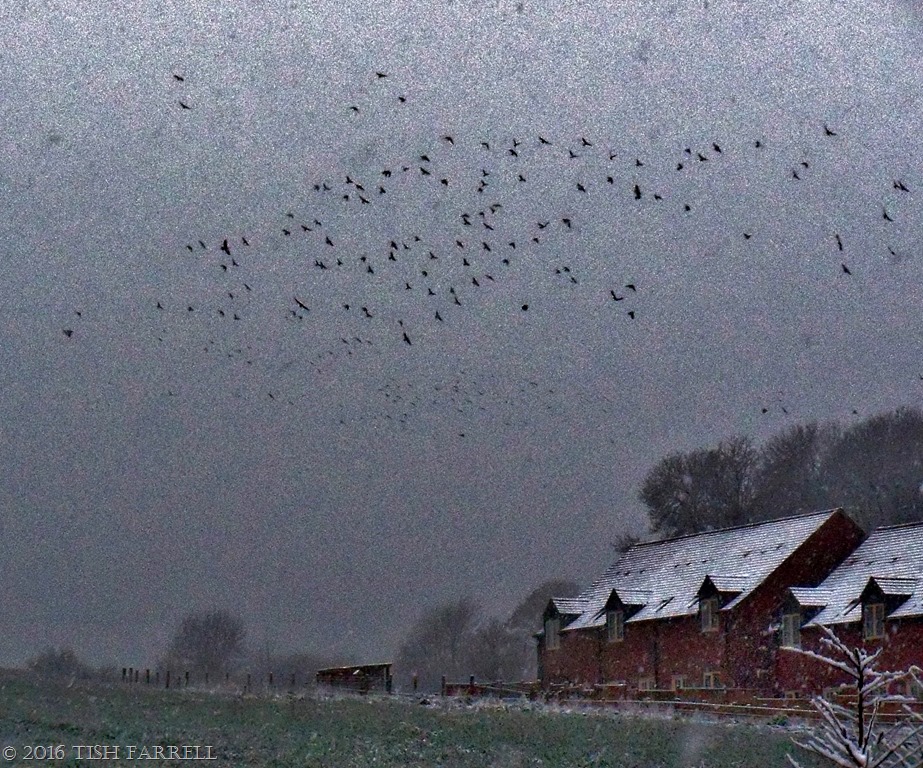
This was the view from my office window at 6 a.m. this morning. Flurries of snow and rooks. Snow-capped old privies. And cold. Brrrrrr. Not April showers as we usually know them. May your Saturday be warmer.
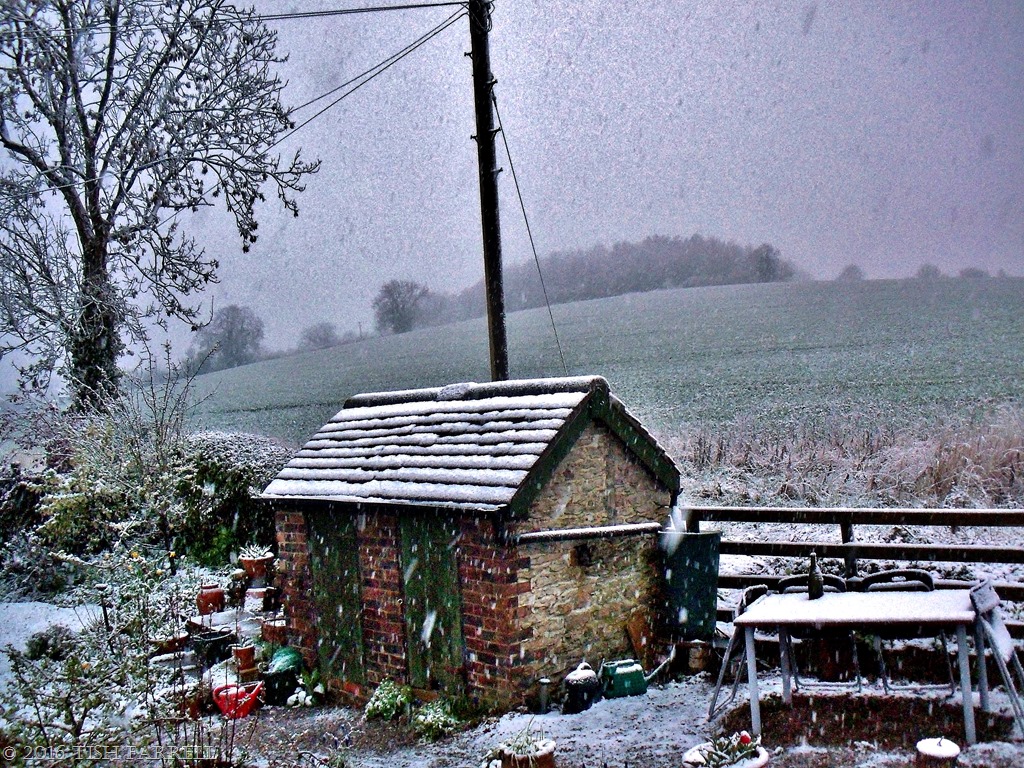

This was the view from my office window at 6 a.m. this morning. Flurries of snow and rooks. Snow-capped old privies. And cold. Brrrrrr. Not April showers as we usually know them. May your Saturday be warmer.
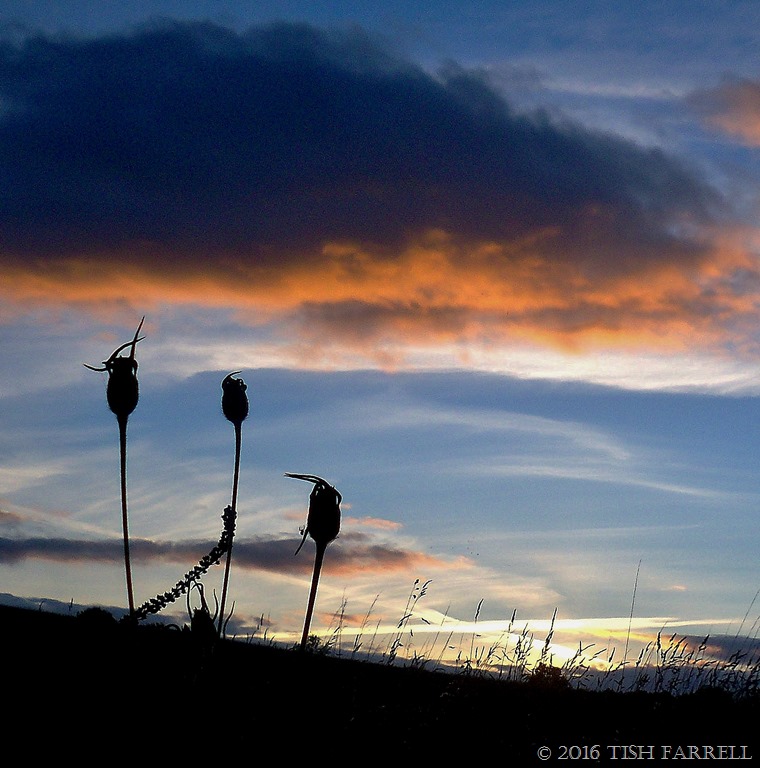
These are the seed heads of a lovely plant that was once to be seen in English corn- fields, but is now almost extinct in the wild. And here it is in its full flowering glory…

…the Corncockle aka Agrostemma githago aka Kiss-me-quick.
This stately annual plant was also the target of shock-horror media hysteria a couple of years ago.
And why? You may well wonder.
It apparently all began with a well-meaning gesture by the BBC’s Countryfile programme. Courtesy of the Royal Botanic Gardens at Kew, they were giving away packets of wild-flower seeds that contained corncockle. There was huge demand. Suddenly everyone was sowing wild flower gardens.
Next some individual in Royal Wootton Bassett, a small market town in Wiltshire, noticed that the plant had appeared in a garden created by the Brownies in the local park. He, having ‘googled’ it, raised the alarm, pronouncing the plant deadly. The Town Council then had the plant fenced off and eliminated, and it all became a matter for the national press as more and more sightings of the plant were made across the land.
The Telegraph’s headline positively screamed with indignation:
BBC spreads poisonous wild flowers across Britain
And from the Daily Mail we have:
The plant that can kill
In an eminently sensible press account Patrick Barkham of the Guardian tried to bring perspective and rationality to the panic:
This kerfuffle is a huge overreaction, given that many of our most popular garden plants are poisonous, including daffodils, laurel, ivy, yew, hellebores, lupins and particularly foxgloves. In fact, we have lived alongside poisonous plants for centuries, and many toxic species are particularly useful to medicine and are used in life-saving drugs. Even parts of plants we eat, such as potatoes, are toxic.
And the real story?
Corncockle, it seems, arrived in Britain back in the Iron Age over two thousand years ago. Its seeds were present in imports of rye grain from Europe, and it soon became established on the lighter soils of southern England. Thereafter, and into the 20th century the plant could be found among the nation’s arable and cereal crops. Then improved methods of seed cleaning were introduced, and together with extensive herbicide use, this led to the plant’s virtual extinction in the wild.
The plant does have toxic properties. This is what Monique Simmonds, Head of Royal Botanic Gardens Kew’s Sustainable Uses of Plants Group has to say:
This plant, like many we have in our gardens, does contain compounds that can be toxic if eaten in large amounts or eaten frequently over a period of time. The toxic compounds are in higher concentrations in the seeds, which are hard and very bitter. If eaten by a child, the child would most likely be sick or complain of a stomach ache. There is no evidence that eating a few seeds would cause acute toxicity.
In the past, problems associated with toxicity occurred in Europe when flour contaminated by corn cockle seeds was consumed in bread, and this contaminated bread was eaten over a period of time. The fact that there are very few reports about any form of toxicity to humans in other parts of Europe, where the plants are more common, indicates that although toxic, the plant is not considered a high risk.
Plants for the Future website explains further:
The seed and leaves are poisonous, containing saponin-like substances. Although poisonous, saponins are poorly absorbed by the human body and so most pass through without harm. Saponins are quite bitter and can be found in many common foods such as some beans.
What concerns me about this story is how easily people can be stirred into panic and demonizing tactics by manipulative and exaggerated press coverage. And over a flower that has absolutely no appetizing qualities whatsoever. Of course that doesn’t mean we should not be aware of the toxic qualities of plants. We definitely should be. People sadly do die from eating poisonous plants. But we don’t need to feel afraid of their very existence. The problem is when we lose connection with our natural environment, it leaves room for the kind of scare-mongering that seeks to make us feel like victims – and all, and only to sell newspapers. Obviously this goes for many more serious issues and situations too.
But then you never do know. Maybe the denizens of the plant kingdom have it in for us. Maybe they are just biding their time, thinking up cunning ways to lure us into eating their poisonous parts.
Quick! Surround the lupins and hellebores! Cut them off at the roots before we’re driven to eat them and DIE!
copyright 2016 Tish Farrell
NB. For well-informed details about poisonous plants see The Poison Garden website.
#7-daynaturephotochallenge Day 6
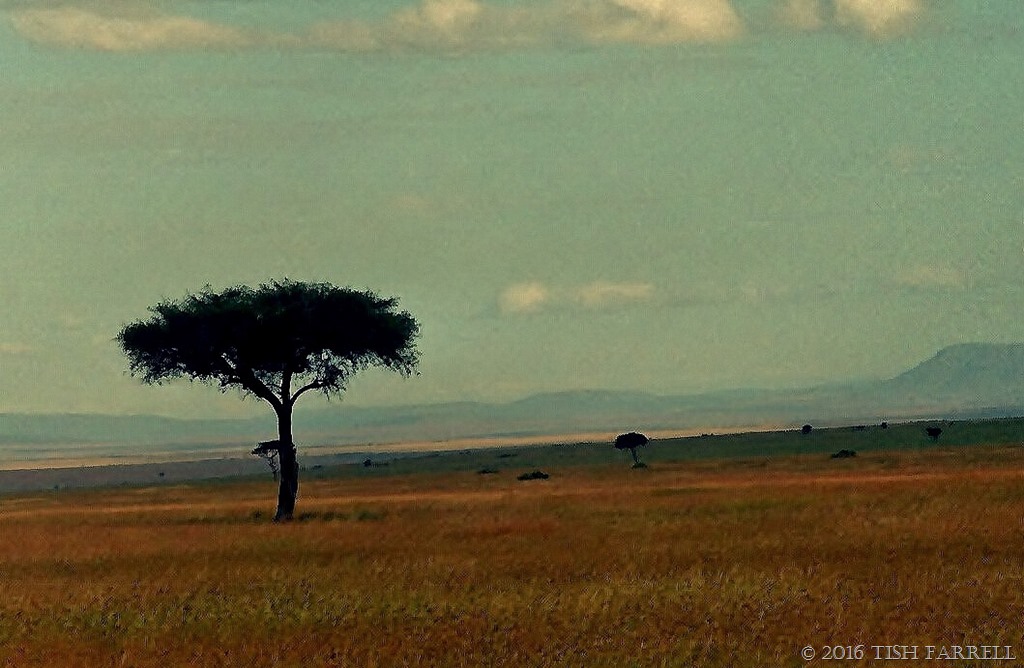
I had been wondering to myself whether I would post some of my Africa pix for the nature photo challenge, and thought I probably wouldn’t. Then the ‘Landscape’ challenge cropped up, and so here I am, killing two birds with one shot. Or it might be two. Also, for whatever reason that has nothing much to do with me, post editing or anything, this view of the Maasai Mara (edge of the Ololo Escarpment to the right, desert date tree to the left) has acquired the look of a painted landscape. I think it was probably taken at dawn, out on game drive from the Mara River Camp, one of the last places we stayed before ending our eight-year life in Kenya and Zambia.
The desert date (Balanites aegyptica), much like the baobab, is one of Africa’s treasure trees, and has multiple uses. It grows in the driest places across the Sahel and savannah regions of the continent, and fruits in the driest of years. It is thus highly valued by nomadic herders since both fruit and foliage provide useful forage for camels and goats during times of drought.
Also a nourishing and restoring skin oil can be made by milling the fruit, its cosmetic and therapeutic qualities long known of by the Ancient Egyptians. (Samples have apparently been discovered amongst pyramid grave goods). And you can buy it now. Fair trade producers in Senegal, West Africa are producing the oil commercially.
Other traditional uses include making fish poison from the bark, and using the termite resistant wood to fashion farm tools. Better still, an emulsion can be produced from the fruit – harmless to humans and warm-blooded mammals (Trees of Kenya Tim Noad & Ann Birnie: 27) and used to clean up drinking water supplies. It kills the freshwater snails that carry bilharzia, and the water fleas that carry guinea worm, both causes of distressing and debilitating diseases in many parts of Africa.
The continued existence of this tree is also related to the continued existence of elephants. In the wild they are the main conduits by which seed is processed and made ready to plant. Having passed through the elephant’s digestive tract, it is then conveniently deposited in its own dollop of manure. Another example of how all in the natural world is intimately connected, and we kill off bits of it (stupidly thinking they don’t matter) at our peril.

Elephants at high noon beside the Mara airstrip. You can see the green tops of desert date trees above a gully in the distant heat haze.
*
Anna at Una Vista di San Fermo invited me to join the 7-day Nature Photo Challenge. This is my Day 4. Please also go and see Laura’s magnificent dragonfly at Eljaygee, and Sue Judd’s elegant study of daffodil decay at WordsVisual, and Gilly’s absolutely mega termite mound at Lucid Gypsy.

The Wood Anemone (Anemone nemorosa) is one of the loveliest of Britain’s wild flowers. The delicate white blooms have bell-like heads that open to the sun as this one is doing. It’s about 3 cm across. They are also among the earliest spring flowers, carpeting ancient woodlands before the trees come into leaf and make too much shade. The flowers nod in the April breeze, which distinctive habit doubtless inspired their country names of Wind-flower and Grandmother’s Nightcap.
As ever, I am indebted to Richard Mabey and his magnificent (and very large) book Flora Britannica for further intriguing details about this plant.
I found this particular anemone yesterday. It was growing below Windmill Hill, on the edge of the Linden Field. I’d not noticed anemones there before, and the sparse little colony hardly made a carpet. They were also growing under trees that I know have been planted in the last hundred years to commemorate various events associated with the Much Wenlock Olympian Games. Before that, in Victorian times anyway, the field was, well, a field. This, then, presents a bit of mystery.
Mabey says that in Britain the Wood Anemone only very rarely produces viable seed. Instead it spreads by means of its root system, six feet for every hundred years, which is pretty slow going. When you find them, they are thus a pretty good indicator of ancient woodland since they rarely extend beyond these age-old sites. All of which makes me wonder how the little group of Wind-Flowers found its way to the Linden Field. Perhaps they are relic rootstock from times when the ground in question did host ancient tree cover. Mabey suggests that this could be a explanation for the more open-growing colonies now to be found on the limestone pavements of the Yorkshire Dales.
Anyway, however they got there, I was very pleased to see them. More power to their root systems is all I can say. Faster. Faster. We can’t have too many Wind-Flowers.
*
Anna nominated me for this challenge, so please take a look at her cloud scenes at Una Vista di San Fermo. Also Meg has posted some magnificent Warsaw tree-scapes; Ark at A Tale Unfolds gives us stunning bee and other flying insect shots; while Sylvia at Another Day In Paradise takes the absolute biscuit with parting shots of her erstwhile (too close for comfort) neighbour, alligator Mr. A.
#7daynaturephotochallenge

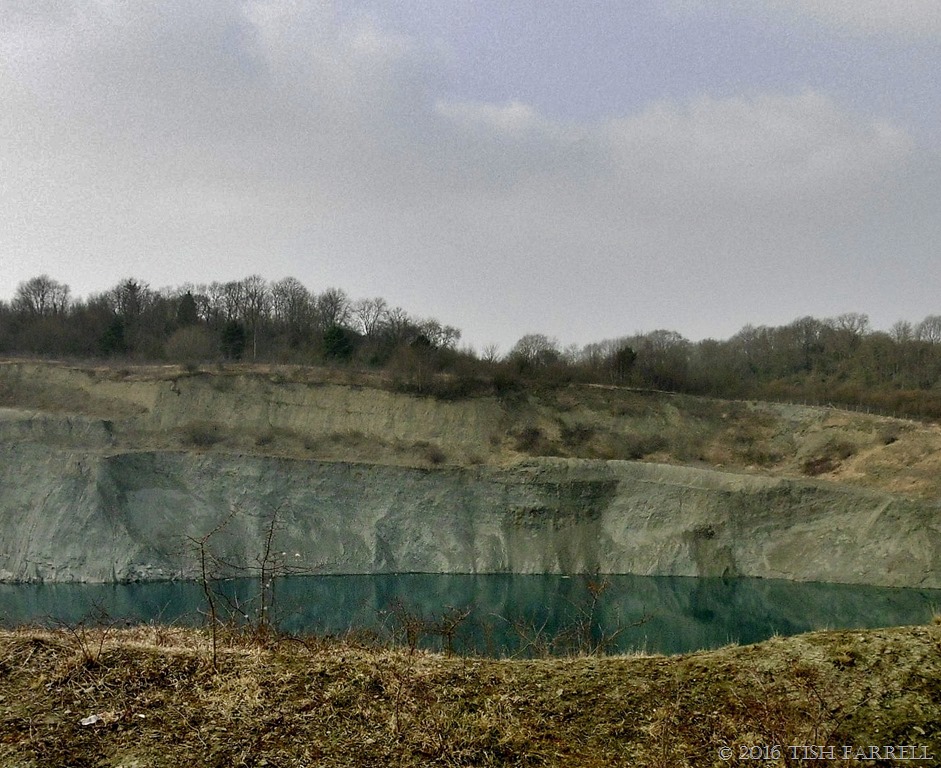
I’ve always found quarries disturbing places – the wholesale delving into the earth, the ravaged landscapes left behind. And yes, I know we need the resources. (Our own house is built of this fossilized Silurian Sea, although actually I’d be just as happy with brick or timber).
Shadwell Quarry behind Much Wenlock’s Windmill Hill is only one of the many old limestone quarries along Wenlock Edge. These days they are no longer worked but host various business enterprises that simply need a large amount of storage space. Quarry owners are supposed to do some restoration after the blasting has stopped, but I’ve not noticed much of this actually happening.
These photos show how slowly recolonization of quarried land takes place. (For an aerial view go HERE.) It has been twenty years since Shadwell was decommissioned.
The water in the quarry bottom is also a strange blue, almost turquoise at times, coloured by the limestone deposits. At over seventy feet deep, it lures tipsy young men to prove their manliness by diving in from one of the man-made cliffs while their mates film the act and post the videos on You Tube. Last summer I spotted gangs of school leavers heading off behind Windmill Hill. They were armed with ghetto blasters and towels and I overheard them saying they were ‘going to the beach’.
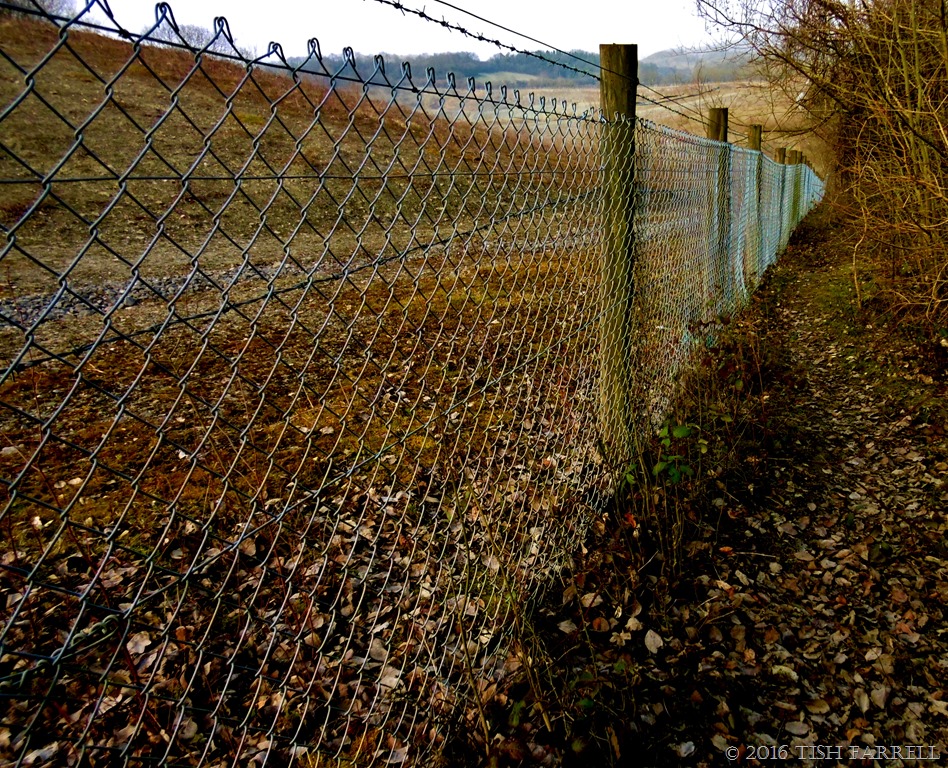
It’s interesting how people’s perceptions of places differ. One sees ‘exciting resort’; another oppressive dereliction – albeit with strains of desolate grandeur.
*
I’ve written more about the history of Wenlock’s limestone quarrying at Hidden Wenlock #4
This week at Lost in Translation Paula’s theme is ‘forbidding’. Please call in there if you want to take part in the challenge. She suggests many possibilities for interpretation.
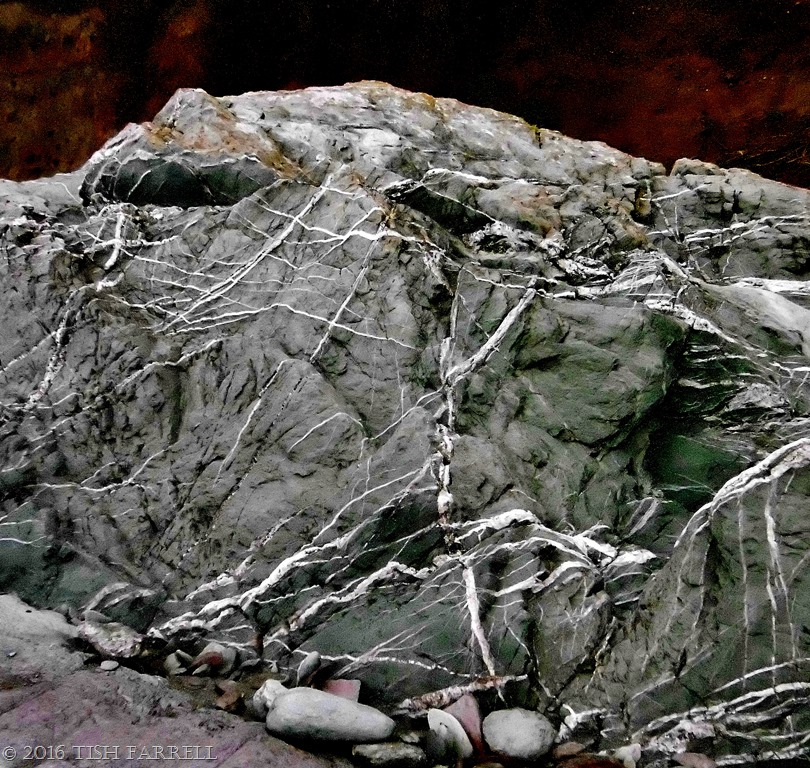

I discovered these rocks on Seaton Beach when were down in Cornwall at Christmas. My attempts to find some sensible information about the geology have so far proved fruitless. So I’m just going with my initial interpretation – that here we have a mythic precursor to runic script left by some race of Northern Giants.
But what are they telling us? Have they left us instructions on how to find a parallel universe? Or could these be warnings to mankind to take better care of the earth? Or maybe they are the crossings-out of an infant Northern Giant learning to write. Can anyone out there crack the code before the rising sea levels claim them?
*
This my response to Meg’s ‘calligraphy’ challenge. She is Paula’s guest at this week’s Thursday’s Special.



This week over at Paula’s Black & White Sunday, her guest Sue Judd gives us a fascinating insight into the use of negative space in our compositions. Please go and see what she has to say at: Black & White Sunday: Negative Space
Meanwhile, here are some more of my shopping mall photos. As I mentioned a few posts ago when I showed another version of the second shot, to me the mall is usually a very negative space. I’m also thinking that my metaphorical interpretation of the theme might be rather stronger than my photographic rendering of Sue’s guidelines, but I thought I’d share these rather weird compositions anyway: my study of consumer alienation.
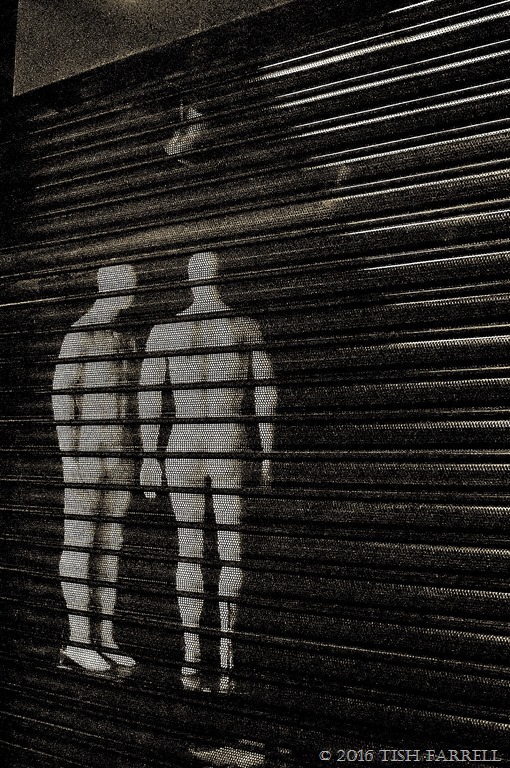
This image sums up how I feel whenever I go into a big shopping mall – soul sucked out, life signs shutting down, a sense of being processed, objectified in the drive to SHOP and SHOP and SHOP. On the other hand, when I came upon this scene through the strangely translucent shutters of a closed-down men’s clothing store I couldn’t have been more delighted. I didn’t have to arrange anything. It was all set out for me. I simply had to pull out my camera. Still life in the mall indeed, although sometimes you have to look hard for it.
Paula’s Black & White Sunday Challenge at Lost in Translation is Still Life. She has come up with a very intriguing take on the theme. Go see.

Humans have been cutting down trees since the end of the last Ice Age. Even by the Neolithic period, i.e from around 6-8,000 years ago, whole scale clearance of forests was taking place across Europe. Some of this was a bi-product of domesticated stock grazing; some was direct harvesting for building materials and fuel; most was probably due to felling and burning to make farm fields. For thousands of years, then, we have been destroying the planet’s life-nurturing tree cover.
But now look what nightmare plans are afoot for our surviving trees – genetically engineered fuel- and paper-making-friendly trees that grow in sterile, silent forests. In the video geneticist David Suzuki gives clear explanations of what is involved in genetic engineering and flags up the potential consequences of the bio-tech industry’s objectives for tree-life on the planet. It is all very disturbing, but I think we need to know what’s going on in our world, and with official sanction. See what you think. This is followed by a documentary film, in which Dr. Suzuki is also the narrator.

This is one my favourite photos. If you look hard you can even see the bees’ wings vibrating. And yes, for those who come here often, I know I’ve posted it a few times before. But isn’t it joyous – hot red, buzzing bees, sunshine.
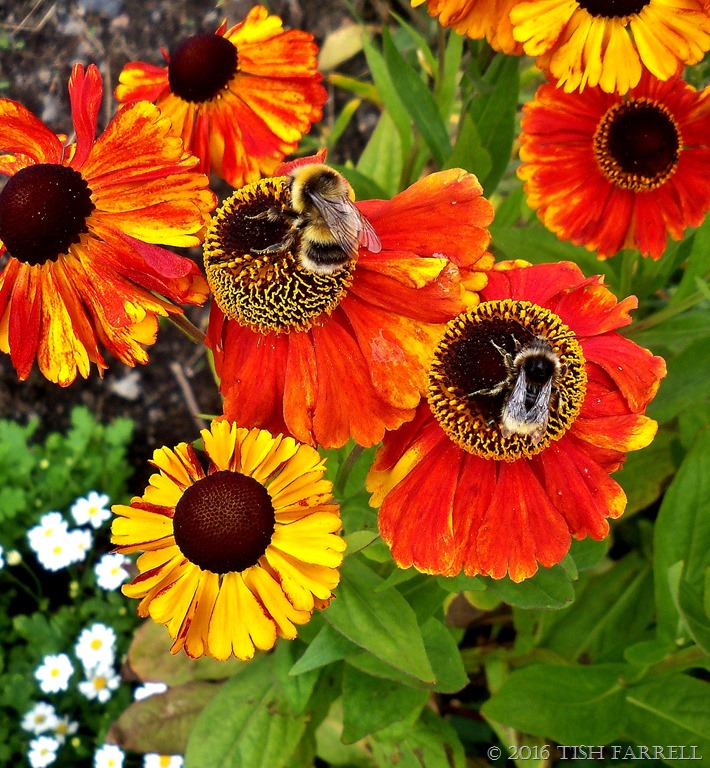
And how about bees in the sneeze weeds (aka Heleniums)
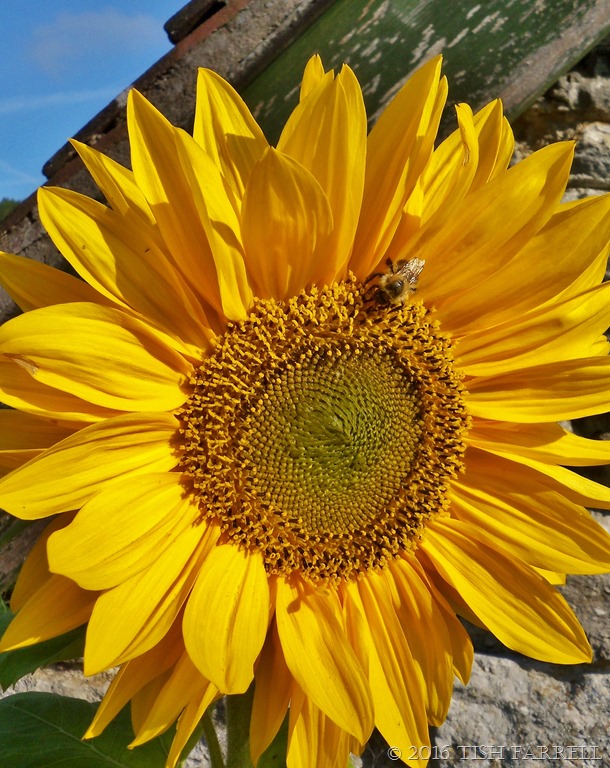
Or the bee on this sunflower that was growing last summer in a pot by the shed:
All of which is to say we need to keep thinking about bees. We cannot do without them. They pollinate many of the plants that provide us with essential foods. In the northern hemisphere new seeds are coming into the shops, so we can all think about sowing some bee-friendly flowers. You don’t need a garden. A pot of oregano will please them, and make you happy too when you’re making spaghetti sauce.

And then sedums will provide a valuable late summer nectar boost for honey bees. There are many varieties of this plant – large and small. They don’t need much attention and will grow in containers too:

If you want to find out which plants are bee friendly, there are many bee sites on the web. But for local first-hand information ask your local beekeepers society. There will be one. Meanwhile the Royal Horticultural Society provides some useful guidance if you want to give your life and bee-life lots more buzz.
IN 2016 THINK BEES
Happy Wednesday Wherever You Are
