Yellow Peril? Some Cut and Thrust Tactics on Kenya’s Matatus

002 (2)

Going down the Great Rift

*

Meet the matatu, one of Kenya’s 24,000 privately owned and operated mini-buses. They are the country’s main form of public transport, taking 12 million Kenyan commuters to and from work each day. It can often be a grit-your-teeth-and-hope-to-live-to-tell-the-tale form of transport. The decrepit state of some of the vehicles, reckless driving and overloading are  frequent causes of the country’s large numbers of road deaths.

Government attempts to regulate the industry regularly stall. But whatever their shortcomings, there is always a matatu to be had, and their fares are relatively affordable. They provide the only means for many traders to transport their goods to market.

In fact you could say that matatus are an example of free market enterprise at its most vibrant/rampant – depending on your stance. This is especially true in the country’s capital Nairobi, now home to 3 million souls and counting. The competition to secure key commuter routes across the unregulated urban sprawl can be cut throat. Matatu owners hire young men as drivers and touts, and since they earn a cut of the takings, the inclination to make the maximum return from every journey, and to beat competitors  to the queue of waiting passengers, can lead to hair-raising practices. ‘Undertaking’ or cutting up on inside lanes and pavements is a particular Kenyan driving style. When we lived in Nairobi there were also anguished  letters to the local press from matatu users, saying how they had been physically ‘kidnapped’ by touts, forcing them to ride a particular bus when the did not want to.

And not only that, when it rains, the fares go up.

Scan-130603-0058

Matatu stop in Westlands, Nairobi

*

These two photos of yellow matatus were taken in the late ‘90s and are bit old hat when it comes  to the exterior paintwork. But even back then many buses were mobile art galleries. In recent times a vehicle’s ‘look’  has become part and parcel of the competition war. Owners commission the hottest young graffiti artists to paint their matatus’ livery.  The expectation is that a well ‘pimped’ vehicle will up the takings. And this is the vibrant side of the matatu business. It is creating employment opportunities for educated and creative young Kenyans who finish school but cannot find work. They have a lot to say for themselves and considerable flair. Their style is increasingly sophisticated and western influenced. Go matatu spotting and you will soon grasp what is trending in popular culture and political opinion.

Photo: Cheki.co.ke

*

Then there is the loud music, especially hip hop. This is another ‘on board’ feature designed to attract and secure clientele. The touts say it brings in the beautiful girls and stylish guys, and is all about creating a cool atmosphere.  Needless to say, the Kenyan Government has also attempted to ban the music, but enforcement is another matter.

The intense competition for business has been taking the matatu in other directions. Over 1,000  Nairobi matatus have recently gone high-tech. Commuter journeys from the city suburbs can take up to 2 hours, so providing free wi-fi has been proving a significant draw. Vuma Online was launched last April by Kenya’s biggest telecom company, Safaricom. Now passengers can pass the time stuck in the capital’s notorious traffic jams on their smart phones – checking emails and watching the news. People with particular views of what goes on in African countries may be surprised at the particular sophistication of this commuter facility. They shouldn’t be. Kenya is the East African hub of telecoms interconnectivity. This is the country that has pioneered the M-Pesa mobile phone money transfer and micro-financing system that is now facilitating so many small businesses.

But enough from me. If you want a flavour of what city life is like for ordinary Kenyans, take a look at these two short films.

Ailsa’s Travel Theme for more yellow entries besides these that caught my eye:

Melissa Shaw-Smith

Travel Words

Figments of DuTchess

PDJPIX

The Changing Palette

Photos by Emilio

In Looking Glass Land in Kensington Gardens: Anish Kapoor Revisited

100_1453

100_1453 - Copy

Yes, this is me in the hat, snapping myself inside Anish Kapoor’s wonderful C-Curve installation. To see more of the C-Curve go HERE and join me in Looking Glass Land.  And yes, this was just an excuse to show again this brilliant piece of public art – the kind that invites you in makes you part of the picture.

Related: Object, subject, object: who cares when it’s this much fun

Weekly Photo Challenge: Selfie go here  for more self portraits.

Errant Muse? But there’s still life at the allotment

100_4927

I’ve posted this photo of my last summer’s allotment produce to prove something. I thought it might be a good antidote to my dreary state of writing stuckness. (And may be yours too). For one thing it shows conclusively that if I can’t get to grips with the several novels now backed up in brain and filing cabinets, then I can at least produce beautiful vegetation. (In season of course). Most of it is edible too, although I would not recommend the zinnias. Marigolds are fine however – in salads and as herbal tea. Excellent for the immune system, or so a herbalist friend tells me.

100_4943

I sometimes think my allotment life is a metaphor for my writer’s life. Sometimes I think  it’s the other way around. This reminds me of the great Welsh poet, R S Thomas. In my post about him the film link shows him, in his elder years, out bird watching on the Welsh coast. Speaking to camera, and with a wry smile, the Nobel nominee says he is supposed to be a poet, but that when the poem is going badly, then he is a birdwatcher. Likewise for me, when the writing stalls, then I am a gardener. I am mostly a gardener.

100_4941

The common ground between growing and creating is obvious: seasons of  productivity followed by dead times when the creative flow seems to be, well, DEAD. This is the natural order of things. I know it. And so I am forgiving when it comes to the garden. I do not expect it to grow things in December and February (or at least not much). But when it comes to writing, I fret, fume and grow ever more despondent with myself because the ideas in my head cannot be rendered, as I would like them, to word, to screen, to finished work.  And I do not forgive this. I consider it a grave fault.

100_4945

Yet I know, too, that good growing and writing, require a fertile medium, one that is well turned and appropriately nourished. You need plans and timetables, while remaining open to alternative courses of action. You also need the right medium for the job in hand. All this takes time: years of learning, of preparation, and the application of improving strategies. You have to understand your ground from the inside out. And that brings me to another essential condition – good drainage. And  in my home town poor drainage is a problem; both brain and allotment, then, are equally afflicted. They are not free-draining. But at least I know how to improve the soil. Grit is good.

100_4954

In the absence of creative flow, ungoverned gathering of new material can start filling the gap. This in hopes of finding a  spark, some fresh inspiration to jump start the writing. The activity can of course have its good points. You may indeed find the very thing you need. Besides which, well rotted down and aerated compost improves content and structure for any future cultivation. On the other hand, ever growing stagnant piles of poorly decomposing matter simply overwhelm and add to the stalled flow problem. In other words, there comes a time when you simply have to give your brain a rest, leave the compost heap to rot down, and allow the period of dormancy to run its course. The hard thing is to keep faith during this process of seeming inactivity; to believe that you WILL recover and complete the works you began.

That wonderful woman, poet and Jungian psychoanalyst, Clarissa Pinkola Estés has some very heartening things to say about this. In her autobiographical exploration of the nature of story, The Faithful Gardener, she says that new seed is faithful, and that it roots most deeply where the ground is the most empty. In The Creative Fire she also says that everyone is an artist even if they have not lifted a brush to the canvass or opened a new Word file (I paraphrase). Finally she tells us that the only thing you need to create is to get out of the way.

And so in a bid to get out of the way, I leave you with some summer marigolds. Before your eyes they are passing through their natural cycle from bud, to falling flower to newly forming seed head. Perhaps if we stare at them long enough, absorbing all that very creative orangeness, we stalled creators will ‘hear’ what they are telling us.

100_4935

© 2014 Tish Farrell

*

Frizz’s Tagged E  Go here for more ‘E’ stories

*

Related:

Bright Fields on Llyn: windows in time, mind and space and other stories from Cymru

Onwards and upwards…the big New Year ‘do-over’

Object, subject, object? Who cares when it’s this much fun…


100_1454


It was a brilliantly cold December day and we heading for the Serpentine Gallery in London’s Kensington Gardens when when we happened on this marvellous magic mirror. We were already in fantasy-mode too. We had just been questing in Kensington’s Enchanted Palace exhibition, wherein the State Apartments had been filled with mysterious installations that told serial tales of seven princesses who had once lived in Kensington Palace. Many of the stories were hauntingly sad, and the last of these, Princess Diana’s, very much skated over. And so, despite the grandeur of the place, and the wonder of the installations, we were left with disturbing cobwebby feelings that made me think of finding wicked fairies in the attic. It was good to step out into the icy air and  regain some sense of reality.

But then look what happened…?

100_1451

Wandering through the wintery park, we collided with this piece of optical wizardry – sculptor Anish Kapoor’s C-Curve – a highly polished steel convex-concave mirror. It turned out to be one of four magnificent pieces making up the six-month 2010-11 exhibition put on by the Serpentine Gallery in conjunction with the Royal Parks. Sadly, the exhibition is over, but you can have a retrospective view and see a short video at this link:

Anish Kapoor: Turning the World Upside Down


100_1452

But the great thing about the C-Curve was the huge enjoyment it was giving to all the passers-by. Public art at its very best. You could walk right up to it. You could watch yourself do silly walks and upside-down too. You could hug your partner and grin inanely at your reflections. It made you, the viewer, the subject of the work. It inspired you to explore the landscape with fresh eyes as reality became a multi-layered spectacle and wonder. It was thus a resplendent antidote to palace fantasies and wicked fairies in the attic. What an artist is Anish Kapoor.


And finally for a different interpretation of OBJECT. Here is Anish Kapoor and friends in the official Amnesty International’s video objecting to human rights abuses. Gangnam for Freedom. Go for it…


Weekly Photo Challenge: Object

The Tsavo Big Game Show: it’s a dangerous pursuit

lone elephant at twilight

Night comes swiftly in the African bush but never quietly. As the sun drops behind the Chyulu Hills, so the pipe and whirr of frog and bug ratchet up a few decibels. It is like a million high tension wires being pinged and twanged. If you listen with both ears it can drive you mad. Likewise, if you allow yourself to succumb to the night’s sticky heat and the hypnotic scents of thorn flowers, then do not be surprised when the sudden scream of a tree hyrax stops your heart.

But we are not going mad. And our hearts are just fine. We think we have cracked this Africa lark. Well sprayed with insect-repellent, all accessible parts covered as can be, anti-malarials ingested, it seems safe to sit out on our veranda at Kilaguni Lodge  and do some night-time big game watching. 

Below our room is a barren stretch of red volcanic earth, and a water-hole lit up by two search lights. The illuminated circle that the lights create is like a stage set. It seems we are seated in a mysterious wildlife theatre waiting for the cast to appear.

The contrast is disturbing. By day, this self-same set is furnace red, littered with volcanic spoil; it is the haunt of the cadaverous-looking marabou storks and the occasional zebra. By night, all is softer, surreal. You feel you might dissolve through the light into perpetual darkness; for out there the night goes on forever, doesn’t it?

And so we go on gazing at the scene. It takes some time to realize that small groups of impala are emerging from the gloom. Their stillness is mesmerizing. Perhaps they are not there at all.

And then…

And then…

The impala are wary. You can almost see the charge of anxiety ripple through the herd. We hold our breath and stare into the dark behind the lights.

And then we see them – black hulks gliding through the thorn trees. Elephants. They have come so silently, walking always on tiptoes, their heels cushions of fat to muffle their footfalls. Slowly they move in from the bush. Even in the dimness beyond the pool, their hides glow red, irradiated by the igneous dirt they have blown over themselves.

In the wings the elephants pause. It is hard to say how many are there. After a few moments two peel away and the rest of the group retreats again into darkness. Two large matriarchs now head for the pool. At the water’s edge they part, and in matched strides stake out the water-hole from opposite directions. There’s an angry trumpeting when an impala fails to withdraw fast enough, and only when the entire bank is clear do the elephants go down and drink. But they have hardly taken a couple of gulps when they move back and take up guard duty, one at each end of the mud bank.

We are transfixed. We cannot fathom the plot, but note that, despite the elephants’ aggressive stance, there has been a concerted gracefulness to their routine. It crosses my mind that the great choreographer, Balanchine, once made a ballet for elephants. Now we see they have dances of their own.

And so we wait.

Slowly the rest of the group reappears, moving as one in the tightest huddle. As they enter the spotlight we understand. Tucked safely between the legs of four large cows are three infants. Like precious celebrities surrounded by an escort of heavies, the youngsters are guided to the water. There, with tiny trunks they cannot quite control, they drink their fill. The whole thing takes only a few minutes. Then, with this life-and-death task accomplished, the sentinels re-join the group, and the small herd leaves as silently as it came, melting into the backdrop.

So: this drama is over; the stage empty. After the thrill there is anti-climax, a strange sense of banishment; depression even. We go to bed, suddenly overcome by the heat and with too many insects on the brain.

Inside, though, the room is hotter still; windows shut fast against malarial mosquitoes. Even so, and despite the rock-like pillows, we sleep for a time. At midnight it is the menacing whine of a mosquito that rouses us to a bleary-eyed seek and destroy mission. At 2 a.m. we are awake again as two waterbuck lock in high-snorting combat below our veranda.

G. huddles back in bed. I press my nose to the window. It’s at times like this that Africa looms largest, that you know you are out of your element. Night stretches ahead like a herculean trial. I stare once more at pale stage in the bush. The impala have drifted back to the pool again, but they barely move. It is like watching a Samuel Becket play where nothing much happens.

And yet…

Suddenly the antelope are on full alert – rigid stance, ears pricked, noses twitching. I stare and stare. At last I spot movement, a sinuous shape pressing through the low scrub. The impala rise on hoof-tips, torn between staying and fleeing, and then the lioness steps out from the grass and pads down to the water.

The impala draw back, still unsure of the big cat’s agenda. The lioness parades around the waterhole, but does not drink. Instead she finds a clump of grass and lies down, head up, still as stone, commanding the pool  – a heraldic lion couchant. Now it is clear. None of the animals can drink. The tension is visible. This is a new kind of drama: feline power play.

But I cannot wait for the denouement. Worn out, I return to my hard pillow and tangled sheet.

The next time I wake it is light enough to know that I can abandon all efforts to sleep. It’s a huge relief. While G. slumbers on, I step out into cool of the veranda. In the dawn light I see that last night’s set has mystically expanded into a vast new backdrop. Now the Chyulu Hills rise above the dry plains, a vision of impossible greenness that belies the violence of their birth. For these hills are new, erupting around the time Sir Francis Drake was bowling off Plymouth Hoe and ignoring news of the advancing Armada. It’s hard to believe.

But this is not all. To the west, the snow-capped crown of Kilimanjaro breaks free of the earth and floats high on a wreath of pink clouds. It makes me want to hoot with laughter. Who does this Africa think she is? Does she really expect me to be taken in by  all her absurd illusions? Poof! The mountain snuffs out and leaves only sky. (Is this possible?) And I, like the victim of some worming parasite, know I am becoming infected. All our defences are useless. This land is creeping under my skin and invading all my senses. More likely than not I will never be the same again.

© 2014 Tish Farrell

Kenya; Chyulu Hills; Campi ya Kanzi - Giraffe in the Chyulu Hills

Chyulu Hills. Photo: Abercrombie & Kent

Daily Post Prompt: write here, write now


Double take, double bass and all that jazz down at the Eagle Tavern

002

Sunday jazz at The Eagle Tavern was a regular haunt for us in the early 2000s when we lived in Rochester in Kent. The local jazz club worked its socks off to secure a programme of first class trios and quartets. We were never members. No one even asked us to join, but for the price of a few raffle tickets we could sit with a glass or two of good Kentish ale and the Observer crossword and enjoy some of the best jazz musicians around.

006

Gilad Atzmon at the Eagle Tavern

Bands would drive down from London to perform at The Eagle. Gildad Atzmon, Renato D’Aiello, Derek Nash, Alan Barnes – all top names in British jazz – were among the musicians who often came to play for a couple of hours over a Sunday lunch-time. In return they received nothing more than a pub meal and  the raffle takings, but they came because they knew that every note they played would be listened to, appraised and appreciated by the dedicated members of the Medway jazz club. Besides which, it was a good place to warm-up for their paid Sunday night gigs back in the capital.

Unfortunately the Farrell filing system – both mental and physical, failed dismally when trying to access the name of the double bass player rendered severally above. For which apologies all round, and most especially to the musician himself. To make up for this omission here is Gilad Atzmon, first  in whimsical mode, then a more serious piece.

© 2014 Tish Farrell

*

TAGGED ‘D’  JOIN THE CHALLENGE: GO TO FRIZZ’S BLOG FOR MORE GREAT ‘D’ STORIES

#jazz #GiladAtzmon

*

Mao at the Met: a disturbing juxta-position?


“My idea of a good picture is one that’s in focus and of a famous person.”

Andy Warhol


New York 129

Mao Zedong by Andy Warhol (1928‑1987)

Metropolitan Museum of Art, Manhattan

*

Andy Warhol became interested in China in 1971. “I have been reading so much about China. They’re so nutty. They don’t believe in creativity. The only picture they ever have is of Mao Zedong. It’s great. It looks like a silkscreen”.

The following year he began work on the portrait, which grew into ten variations, all based on the portrait that appears in Little Red Book: the thoughts of Chairman Mao.

In 2012 the portraits were part of the touring art show ‘Andy Warhol: 15 Minutes Eternal’.  The exhibition, organised by the Andy Warhol Museum, Pittsburgh, marked the 25th anniversary of Warhol’s death. The Mao portraits, however, did not make an appearance in either Beijing or Shanghai when the show went to Asia in 2013.  The official Chinese view was that the portraits were disrespectful in suggesting that the former leader wore make-up. All the same, Mao Zedong’s legacy is currently undergoing some re-evaluation in China. There are even admissions that mistakes were made. It is a start…


For more juxtapositions go to Weekly Photo Challenge

Nice Family? En famille at the Massena Palace

The family who lived in the Palais de Masena

100_1225.jpg
Believe me, the family gathering depicted in these two murals has more tales to tell than most. They could be the very depiction of Tolstoy’s famous opening to the tragic novel Anna Karenina: (and I paraphrase) all happy families look alike, but the unhappy ones are unhappy in their own inimitable way. I leave you to decide which sort we have here.

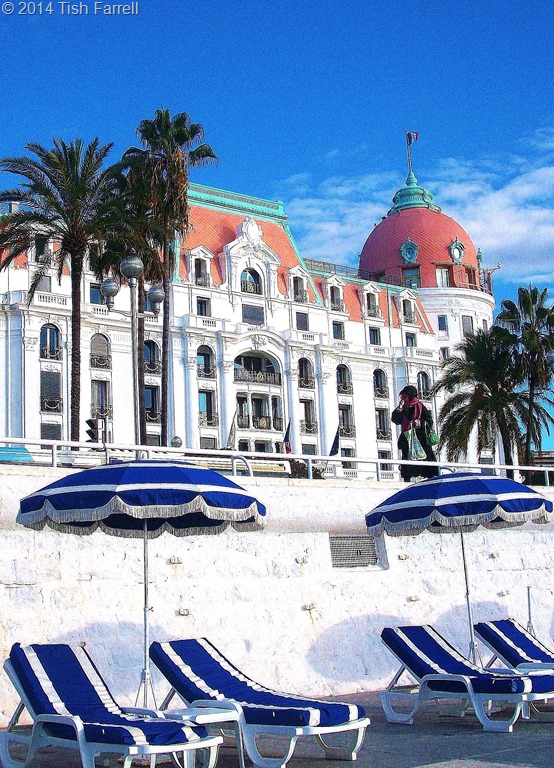
But before the stories, first a little about the murals’ setting. They face one another across the top of the grand staircase in the Palais Masséna in Nice. This imposing house was one of the last of its kind to be built on the Promenade des Anglais, looking

Palais de Masena

out on the sparkling blue Mediterranean.  It was designed by Danish architect Hans-Georg Tersling (1857-1920),  and  finished in 1901. By then Nice had long been a thriving upper class resort, a trend begun in the 1730s when British aristocrats such as Lord and Lady Cavendish first began to gather at Nice and along Côte d’Azur for the winter season. Back then Nice was an ancient fishing town. The Scottish poet, Tobias Smollett describes it in 1764. He went there in hopes that the benign winter climate would help improve his consumption:

“This little town, hardly a mile in circumference, is said to contain twelve thousand inhabitants. The streets are narrow; the houses are built of stone, and the windows in general are fitted with paper instead of glass. This expedient would not answer in a country subject to rain and storms; but here, where there is very little of either, the paper lozenges answer tolerably well. The bourgeois, however, begin to have their houses sashed with glass. Between the town-wall and the sea, the fishermen haul up their boats upon the open beach.”

As time went on the Tsars of Russia and the Romanov family made the South of France their second home, which circumstance, in 1912, prompted Tsar Nicholas II to build the Russian Orthodox Cathedral in Nice to serve the Russian nobility. Even Queen Victoria came on holiday to Nice, staying in the magnificent  Excelsior Régina Palace which looks down on the city and the sea from the hill of Cimiez. It was apparently built in response to her requirements for a place to stay that matched her status. And so the hotels and palaces grew up around the old town of Nice to provide for the royal, rich and famous.

Le_Regina_à_Cimiez_6_Fi_09_0041[1]

Excelsior Regina Palace built 1895-7; Photo: Nice Archives copyright expired

*

Angelo Garino Promenade des Anglais 1922[1]Detail from Promenade des Anglais 1922 by Angelo Garino  (1860-1945)

*

Some of these elite visitors and palace owners acquired their riches and nobility by rather questionable means, and this includes the erstwhile owners of the Palais Masséna. It was built for Victor Masséna, 3rd Prince d’Essling, 3rd Duc de Rivoli and the grandson of  André Masséna, son of a Nice shopkeeper who acquired wealth and royalty while serving and plundering in Bonaparte’s army.  More of him later.

The two family murals are dated 1902-3 and include members of the intermarried Masséna, Murat and Ney families. The reason for the elevated positions and princely titles is entirely due to Napoleon Bonaparte and his ambitions of military conquest.  The founders of their ennobled dynasties were three ordinary men from ordinary backgrounds who joined the French army. All three proved to be brilliant and courageous soldiers who ascended rapidly through the ranks to become Marshals of Empire.

Joachim Murat, an innkeeper’s son, married Bonaparte’s youngest sister, Caroline, and for services rendered was made the King of Naples. He ruled between 1808 and 1815. File:Murat2.jpg

*

Michel Ney, a public notary and surveyor of mines, gave up being a civil servant and enlisted in the hussars. After great battle victories he became 1st Prince de la Moskowa, 1st Duc d’Elchingen.
File:Marechal Ney.jpg

*

As mentioned above, André Masséna earned the titles 1st Duc de Rivoli and 1st Prince d’Essling.

File:Renault - André Masséna, duc de Rivoli, prince d'Essling, maréchal de France (1756-1817).jpg

*

But status and wealth are not everything. Nor were they enjoyed for long. Masséna, long suffering from ill-health, died in retirement after being serially dismissed by Napoleon, first for excessive war looting, and then (after reinstatement) for military failures against the British in the Peninsular War. In his last days before his death in 1817, he supported the restoration of King Louis XVIII to the French throne. Doubtless a wise move for his descendants.

In 1815, after the capture and  exile of Napoleon Bonaparte, both Murat and Ney were executed by firing squad for treason. Murat’s two sons went to North America in the 1820s; the elder stayed and became a citizen, but the younger, Napoléon-Lucien-Charles returned to France in 1848 when his title as Prince Murat was recognised by Napoleon III under the Second Empire.

*

And so we come back to the descendants of the three brave Marshals on the walls of the Palais Masséna. The more you look at these murals, the more curious they seem. They were painted by the then successful French artist François Flameng (1856–1923). He later went on to paint Great War battle scenes, and document new kinds of families, the close-knit comradeship of companies of men under siege.

300px-A_Machine-Gun_Company_of_Chasseurs_Alpins_in_the_Barren_Winter_Landscape_of_the_Vosges._painting_by_Francois_Flamenge[1]

A Machine Gun Company of Chasseurs Alpins in the Barren Winter Landscape of the Vosges, François Flameng, photo Wikimedia Commons.

*

DSCN4945[1]

I suppose my first question is why would the mural people wish to have themselves depicted in this way? Certainly there is a sense of entitlement and much self-regarding, but at the same time it is also as if they are not quite self-aware. Flameng verges on caricature for most of his subjects.  For surely there are suggestions of secrets, collusion, factions, conspiracy, loss of status within the gilded circle.  There are shared misfortunes and private sorrows; anxiety and repression; no one smiles; the children look utterly constrained. And then there are simply too many people peering round pillars, or only half seen despite their prestigious titles.

The two men on the far left of the second painting look distinctly rascally, their almost-smiles, sardonic, malicious.  They are related, brothers I think; the nearest to the viewer is Napoleon Ney, Prince de la Moskowa; behind him Claude Ney, Duc d’Elchingen. In 1903, the year the murals were completed, the Prince and Princesse de la Moskowa were divorced. La Princesse is the sad woman in the blue gown at the other end of the mural, only partially seen behind the column. Is Flameng intimating her loss of status in relation to the others? She is Eugénie, youngest daughter of Napoleon Bonaparte. She married the Prince in Rome at the Villa Bonaparte in 1898, and with all the Ney family in attendance. The couple had no children.

100_1225 (2)

100_1225 - Copy

Here is Eugenie on her wedding day. The photograph is attributed to Count Guiseppe Primoli.

Eugenie Bonaparte 1898

*

Further along the mural from the Ney brothers is Victor Masséna, Prince d’Essling, the builder of the palace. His eldest daughter, Anne, has a proprietorial hold on his shoulder. He will die in 1810 in a Paris nursing home after an operation, and she will marry the Duc d’Albufera. The two faded souls at Victor’s elbow are his long-dead parents, also named Anne and Victor.

100_1225

The only calm and truly sympathetic face among the whole gathering is that of Rose Ney d’Elchingen. She leans over the balustrade accompanied by two macaws and an expensive tapestry. Beside her (with the pince nez) is the Princesse Joachim Murat, born Cecile Ney d’Elchingen, probably Rose’s sister. Her husband, Prince Joachim Murat, is across the stairs, lurking between a pillar and a large urn.  Rose, herself, will marry the distinguished Italian politician Duca Guiseppe Lanza di Camastra, and he will die prematurely in 1927 at the age of 31. Before that though, a 1916 newspaper photo will show Rose La Duchesse in full nurse’s gear, apparently assisting the surgeon with the war wounded at Val-de-Grâce military hospital in Paris. She is well-known for her beauty and philanthropy.

100_1225

Also in this mural detail is Prince Eugene Murat and the boy Charles Murat. The prince will die, aged 30, in 1906 when he overturns his car  while driving to Karlsbad. The report says he lived in Paris and left three children. It does not mention that he was married to the notorious Violette Ney d’Elchingen, Princesse Eugene Murat, and Rose’s sister. We are about to meet her across the staircase. They could not be less alike, at least in their demeanour.

The family who lived in the Palais de Masena

In fact you can hardly miss her, can you, Madame in the royal blue blouse. She seems to dominate the gathering on both sides of le grand escalier. The hand on hip gesture looks coarse, suggestive more of a nicoise fishwife than a princess. She is also the only one taking an active, indeed aggressive stance. She looks out at us visitors as if we were something unpleasant she has stepped in.

But what did the artist Flameng mean us to understand from this image? And what is going on with sad, submissive girl who leans against the redoubtable Violette? After all, this is not mother and daughter. The girl is Victoire  Masséna, younger daughter of Victor. She is around 14 years old here. In 4 years she will be married to the Marquis de Montesquiou. She will have two sons and at 30 she will be dead. Perhaps she foresees her future. Perhaps when you know that Violette, besides being a mother of three, is also a predatory bisexual, you might think there is something more sinister here. But then maybe one should not jump to conclusions.

tumblr_m74mcdKjfO1qjm0dlo1_500[1]

Princess Eugene Murat c.1929; photo Berenice Abbott

*

In the decades of her widowhood, after the car-crash death of Eugene, Violette led a very gay life, and in all senses of the word. She was part of the Paris and Harlem Jazz Age scene. She entertained the likes of Stravinsky and Cocteau in her Paris home. She was a friend of the artist Augustus John who sketched her quite pleasingly while she introduced him to novel ways of taking hashish. In his autobiography he says:

“I had already tried smoking this celebrated drug without the slightest result. It was Princess Murat who converted me. She contributed several pots of the substance in the form of a compôte or jam. A teaspoonful was taken at intervals.”

She famously stormed out of a very famous Paris dinner party, held in 1922 for Europe’s artistic elite. The guests of honour included Diaghilev, Stravinsky, James Joyce, and Picasso. But it was the appearance of the reclusive Marcel Proust that evinced Princess Murat’s all too visible disfavour. At the time everyone who was anyone was trying to identify themselves and others in the characters of Proust’s À la Recherche du temps perdu. Violette, who was renowned for meanness had seemingly provided the model for an extremely miserly individual.

She was, in fact, exceedingly generous with the cocaine, or so we discover in Sebastian Faulks’ book The Fatal Englishman, which includes the biography of the English artist, Christopher Wood (1901-30). In it he describes Violette as “an enormous drug-addicted lesbian with a hunger for company.” She goes around with a bag of cocaine and lays out lines for Wood when he is struggling to complete a piece of work. Faulks tells, too, of Wood’s claim that she lost £5 or 6 million in the 1929 Stock Market crash. She ended her days, living in squalor, having overcome an earlier obsession with maintaining cleanliness, and died of barbiturate poisoning at the age of 58. A sad end to a damaged life.

And what was at the heart of this – sibling jealousy perhaps? Does that explain Flameng’s placing of the players in the murals – the beautiful Rose on one side of the stairs, blissfully unaware of her allure, and beloved even by the two family macaws? While opposite, the portly, coarse featured sister tries to outface her, and indeed the whole world that pays court to her much prettier sister. It’s a theory.
Finally, there is a more pleasing story, at least as far as the palace is concerned. Below on the left we see Victor Masséna’s heir, André, the future Prince d’Essling beside his mother, Princesse d’Essling. In 1919, with his father dead nearly ten years, he hands the Palais Masséna to the city of Nice on the understanding that it will be open to the public. Today it is the city’s local history and art museum.

The family who lived in the Palais de Masena

And so what is there left to say about this self-aggrandizing family. With hindsight one could say that in real life, when these murals were painted, the Belle Époque was drawing to its close. Did Flameng already sense this? The world was changing. Soon there would no longer be the annual winter retreat to the Palais Masséna.  Somehow, then, the murals do have a Proustian feel, perhaps a missing story thread from À la Recherche du temps perdu; the last moment of a perfect, and rarified age caught in two wall paintings, and now gawped at by the passing public.

And as for the three Marshals of France whose derring-do started all this social climbing, you  may find them lying quite close to one another in the Père Lachaise Cemetery, Paris. There they have long since made their residence – among the great and growing family of the dead.

File:Père-Lachaise - chemin 01.jpg

Père Lachaise Cemetery, in Paris.Photo: Pierre-Yves Beaudouin / Wikimedia Commons / CC-BY-SA-3.0
*

Last but not least, I leave you with glimpses of former winter season glory chez Masséna.

Nice is filled with chandeliers

Palais de Masena, now a museum

© 2014 Tish Farrell


Chrissie Hynde Queen of the Castle

Scan-140112-0009

It’s not often that a rock legend comes to perform practically on your doorstep, but in the summer of 2002 Chrissie Hynde and The Pretenders did just that. They were booked to show in the outer bailey of Rochester Castle. At that time we’d not long moved back to the UK from Kenya and were living along the Esplanade in Rochester, Kent, a short walk from the castle. We could not believe our luck. The tickets cost £15 and we had to bring our own chairs and refreshments. Midge Ure did the opening set and it was all rather low key, with people milling around and having sunset picnics. And then the Pretenders were on and the night turned electric…

Scan-140112-0022

001 (2)

The 12th century keep of Rochester Castle, Kent _ The Pretenders’ venue July 2002.

*

And now for a classic favourite performed live:

*
*
#chrissiehynde #thepretenders #tishfarrellwriter #rochestercastle
Gallery

Windows Into The Inner Sanctum

Such a stunning insight into inner turmoil and trauma – from The Beauty Along the Road

Beauty Along the Road's avatarThe Beauty Along the Road

So often we think of windows as enabling us to look OUTSIDE. However, I’d like to introduce a window that allows us to look INSIDE, specifically, into the inner workings of the psyche.  As a former psychologist with a specialty in playtherapy, I used sandplay therapy with both children and adults to gain a better understanding of what my clients were struggling with. Sandplay was truly a window of privilege – no other technique revealed as much about what was really going on INSIDE.

“At the beginning in sandplay, we observe images of the daily world, its difficulties. When we continue this work, we get into deeper realms of ourselves. We discover contents which have remained unknown. They have become dark and negative. All of our potentials would like to be developed. If they are not taken care of, they get furious and work against us.
Beyond this darkness is the…

View original post 559 more words