When 11th Great Grandfather was about to die…

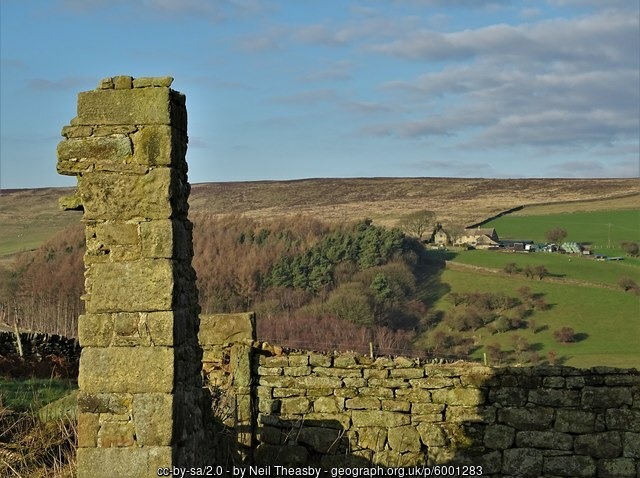
Gotherage ruin possibly with view across to Oaks which is due north geograph-6001283-by-Neil-Theasby

These last few months I’ve been tracking down great grandparents and have gathered rather more than are manageable. But one family line, the (Derbyshire) Bennetts of Eyam, Grindlow and Bradwell has yielded treasure. I’ve recently found two seventeenth century wills, of father and daughter, written 45 years apart. First was the discovery (on a well-known genealogy website) of the will of 11th great grandfather William Bennett, farmer of Gotherage (also Gotheridge and Godriche), a remote tenant farm between Eyam and Abney. It was written in 1620 – four hundred and one years ago – and on the 20th May, as in yesterday when I began writing this post.

William says he is ‘sick in body but of good and perfect remembrance’; it is time, then, to share out his worldly goods. As in all wills of this era, the most pressing provision concerns the afterlife and so he begins by bequeathing his soul to ‘Almighty God my maker and redeemer,’ and requesting that his mortal remains be buried in Eyam parish churchyard. There is nothing here to indicate his age, but the bequests show that one son and two daughters are married and have children of their own. Other sons, George and Francis, are apparently still at Gotherage, as is their sister Joan. All of William’s offspring appear to be adults since there are no coming-of-age conditions attached to bequests. And so, given that the usual marrying age was 21 (often older for men), it is likely that William was between 50 and 60 years old.

*
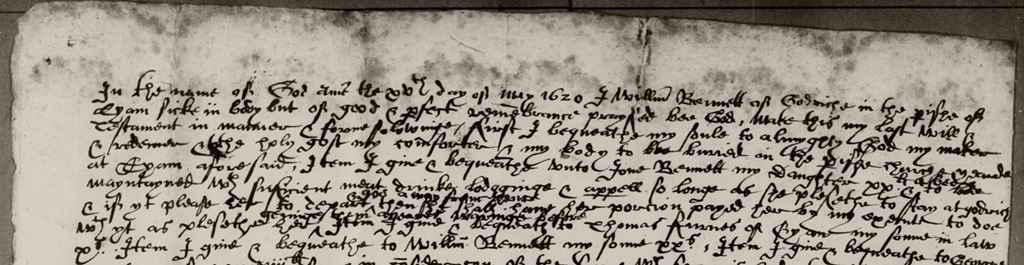
William Bennett - 1620 Will Eyam top page 1 extract

The opening lines of William Bennett’s will 20th May 1620

*

Having settled spiritual matters, William’s next thought is of his daughter Joan. There is every suggestion that she has refused to be married, and he seems anxious to ensure her well being. I could of course be reading this wrongly, but it strikes me as enlightened: for the next few centuries spinsters tended to be considered family burdens and therefore status-less. Here, it seems, is a father bequeathing freedom to a daughter to do as she likes.

And so he writes:

I give and bequeath unto Jone Bennet my daughter £20 * and a bed, to be maintained with sufficient meat drink lodging and apparel so long as she pleaseth to stay at Goderiche and if it please her to depart and go away from there then she shall have her portion paid her by my executors to do with it as pleaseth her going been against marriage before.

[* around £3,000 in modern monetary values]

The rest of the will comprises bequests to sons and sons-in-law, and a lamb to each of his grandchildren. Eldest son William receives 20 shillings (a month’s wages), son-in-law Thomas Furness 10 shillings. George however is to have £33 in lieu of the fact that his brother Francis has been managing the farm for his own use.

Finally, all William’s goods, catells and chattels are to be shared equally between his wife Ann (we hear nothing else about her) and sons Francis and George.

The will then concludes with monies owed to him by local householders in Eyam, Grindlow and Abney. It amounts to over £63, which is a tidy sum in 1620. In fact the National Archives currency converter says this was equivalent to more than £8,000, or a skilled tradesman’s wages for 1260 days.
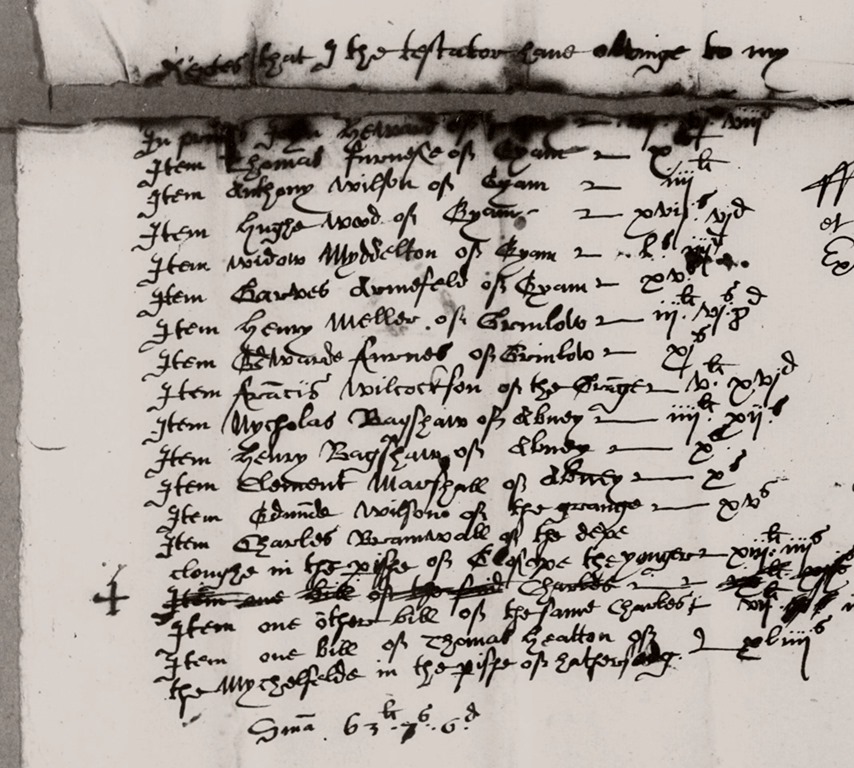
William Bennett - 1620 Will Eyam top page 1 debts owed

Sums owed to William Bennett

*

There is no clue as to what services William was rendering. It seems unlikely that these were all unpaid bills for farm produce since most of the people here were likely to be fellow farmers, at least in some capacity. And while the probate inventory sets William’s worth in goods and livestock at £133  19 shillings (£17,500), the contents suggest a fairly modest farming enterprise. My one notion is that he had a side-line in transporting lead ore to local smelting points in the area, one likely spot being due east of his farm, at Bole Hill, a name that historically signifies lead smelting.

High Peak farmers, of necessity, had many strings to their livelihood bow. Many combined farming and lead prospecting. The latter was a dangerous enterprise, but the lead miner’s freedoms associated with the King’s Field of lead deposits were well worth having. They included free timber from landowners’ woodland, free access to and over other people’s land while extracting ore, and the right to freely graze their animals on common land. In return, they paid ‘lot’ to the monarch, a 13th portion of their gains, and a tenth part tithe to the church, all overseen by the Barmaster and jurors of the Barmote Courts who were themselves lead miners.
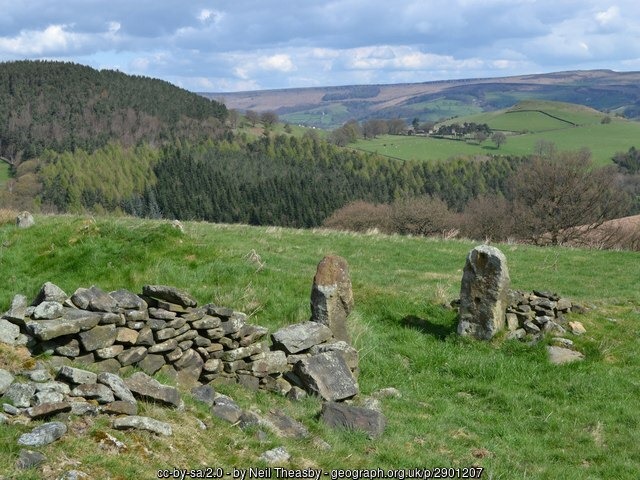
Gotherage likely ruins looking towards Highlow SK2179 nr Stoke Ford geograph-2901207-by-Neil-Theasby

Here’s another view of the barn ruins, this time looking north towards Highlow and Hathersage

*

And more general views, the first taken by Jonathan Clitheroe higher up the hillside above Gotherage Plantation and well above the barn ruins:
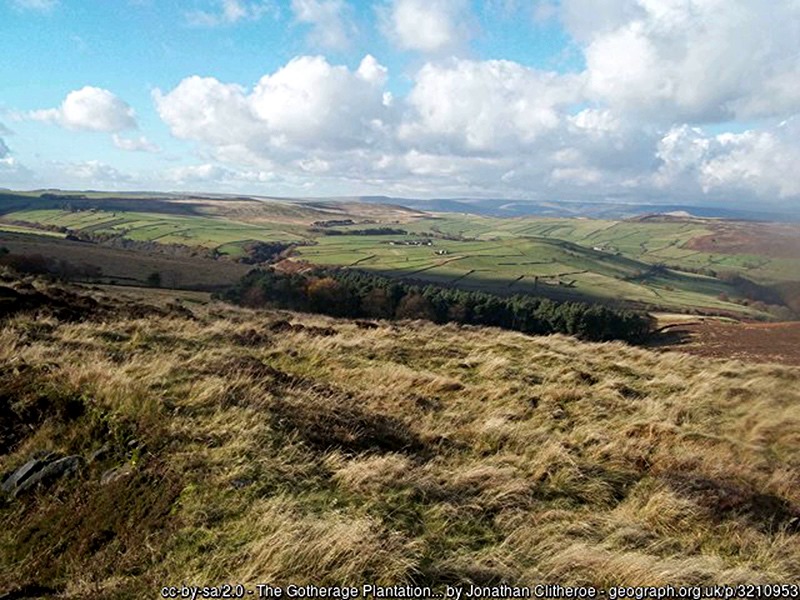
Gotherage geograph-3210953-by-Jonathan-Clitheroe (1)

*

And this next Neil Theasby view which is taken beside Gotherage Plantation and looking  across Bretton Clough to Abney Barn. On the horizon, left of centre, you can just make out the scarred ‘face’ of Mam Tor below which were extensive lead mining operations in the 17th and 18th centuries (Odin Mine):
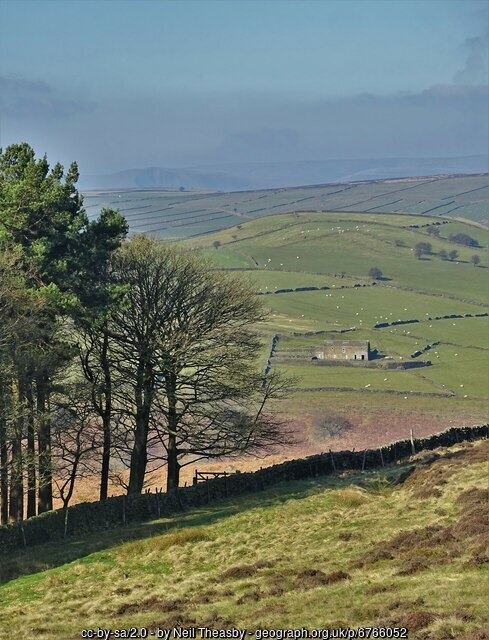
Edge of Gotherage Plantation Abney Low barn ahead geograph-6766052-by-Neil-Theasby

A challenging landscape, however you look at it.

*
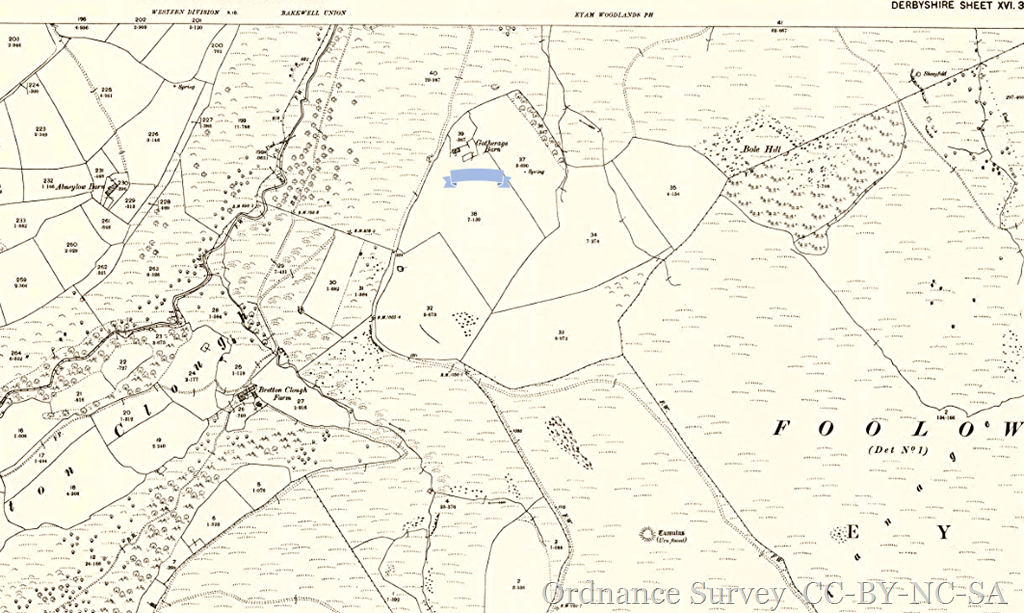
Gotherage Barn and fields 1898 OS CC-BY-NC-SA with banner

I have found the location of Gotherage Barn on an 1879 Ordnance Survey map. You can see farm fields much as they would have been delineated on the original estate tithe and rent book maps. The blue ribbon marks the barn remains, but there is no sign of the house where the Bennetts lived, though the presence of a natural spring below the barn might suggest it would not have been far away. You can see Bole Hill due east of the barn.  A trip to Derbyshire Record Office and a sight of the Highlow estate rent books would doubtless reveal more, but that will have to wait. I’m also relying here on landscape photos taken by the lovely people who post their work on www.geograph.org.uk and allow reuse under Creative Commons licencing. They also add map references and all manner of locational assistance. What stars.

The header photo by Neil Theasby, I’m pretty sure, shows a corner of Gotherage Barn, a building that is probably c1800s in date, and beyond it, across Bretton Clough, the Oaks Farm where there are other ancestral links, having been occupied by members of three separate family lines: Foxes in 1660, Bennets in the early 1700s, and 4th great grandfather, Robert Jackson the hatter in the 1850s. Oaks is another of the many Highlow farms, originally owned by the Eyre family, but now part of Duke of Devonshire’s estate.

I’ve been trying to reconstruct some image of life at Gotherage in William’s time. The probate inventory is very sketchy compared with others I’ve recently transcribed. For instance it doesn’t record items by room, and similar items are lumped together: ‘pewter and brass’ £6 13 shillings 4 pence , ‘bedding and nappery ware’ (cloth items) £10. And then there are bits I can’t decipher.

But basically the domestic furniture comprised bed frames and many kinds of boards: cupboards, dishboards, bread boards and boards that would have rested on trestles to make tables. There were also stools and chairs and arks (storage chests).

We do know that William’s purse and apparel were valued at £10 (£1,300). He had two mares and one saddle, so was well equipped on the very essential personal transport front. He had four oxen for working the fields, with ploughs, harrows and yokes in the barn. There was corn growing in the field, ten pounds worth in sheep and lambs, 2 swine, 4 steers, 4 cows, 3 calves one of which was being weaned. There were hams hanging in the roof space and stores of meal, malt, butter and cheese. I also think there were bees.

There are more clues about the house from Joan’s probate inventory of 1665. Besides the barn with its’ ploughs, harrows and carts’ there were three main rooms, ‘the house’ which seems to be the living-cooking quarters, ‘the parlour’ where the beds were, and ‘the chamber’ which appears to have been used to store things. The house might have been wholly stone built, but I’m also imagining a part-stone, part timber-framed house, one main large living space, perhaps with an upper storey attic ‘the chamber’ (?) above. It’s the sort of place that would leave little trace of itself once left to decay, and doubtless any stonework would have been re-purposed. Most of the Derbyshire farmhouses we see now are stone-built, but many were late 18th century re-builds, doubtless replacing aged and dilapidated predecessors.

But, I hear you asking, never mind about the house. What about Joan? What became of the young woman whose father appears to give credit where credit is due and is prepared to enable some (surprising) degree of free choice?

It will have to wait for the next instalment of the ‘Bennetts of Gotherage’.  For now here’s another striking Neal Theasby photo of the  barn ruins.
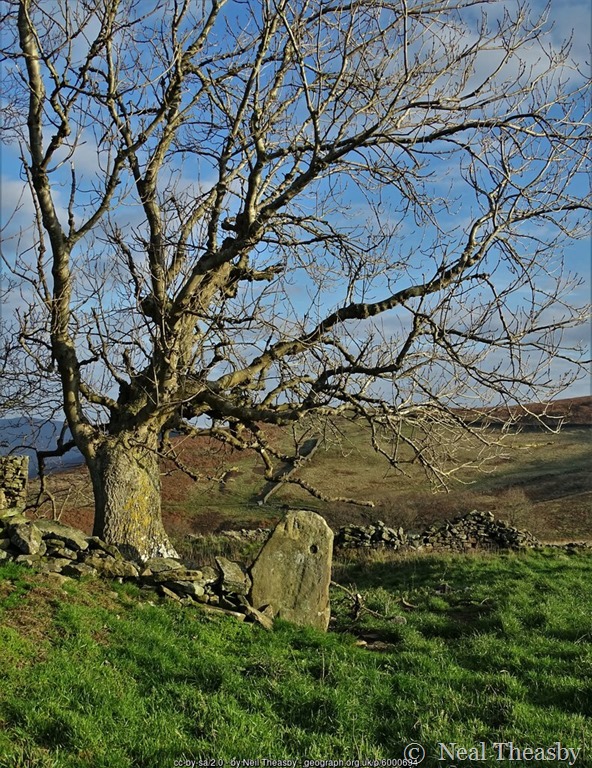
Gotherage possibiity geograph-6000694-by-Neil-Theasby

copyright 2021 Tish Farrell
Sky-Rise

100_8787Telford

Telford is Much Wenlock’s closest town, just a few miles away across the River Severn. It’s a new town in fact, begun in the 1960s when its developers laid claim to the brownfield land between the traditional coalfield communities of Wellington, Madeley, Ironbridge, Dawley and Oakengates, places whose inhabitants had played their part in Britain’s industrial revolution from at least the 17th century.

One new-town aim was to provide fresh work opportunities and decent housing for families of the ever-expanding West Midlands (Birmingham-Wolverhampton) conurbations. Another was to revive the old Shropshire coalfield towns and villages, including Ironbridge, which by the 1960s, with their declining local industries, appeared to have lost the will to live. Back then I recall visiting Ironbridge on a school history trip. We peered at the decaying bottle kilns of the Coalport China Works through a jungle of waste-ground weeds and wondered why on earth Miss Price had brought us to such a dreary place.

From the start, then, Telford Development Corporation (TDC) panjandrums had a mission: their new town had heritage. They chose to name it after a man of vision: Thomas Telford 1757-1843, father of modern civil engineering and a man with strong local connections. At the start of his career, after leaving his Scottish homeland, he had been Surveyor and Engineer for Shropshire. He left us many striking landmarks too, including the breath-taking Pontcysyllte Aqueduct.

The ‘new town with a past’ message was not simply a piece of window-dressing. TDC committed huge resources to saving the historic industrial fabric of the coalfield settlements, deploying teams of conservation architects and builders across the district, restoring everything from workers’ cottages and toll houses, to ironworks warehouses and riverside tile factories. It is probably fair to say that without all the new-town investment in conservation, the internationally famous Ironbridge Gorge Museums might never have made it off the starting blocks.

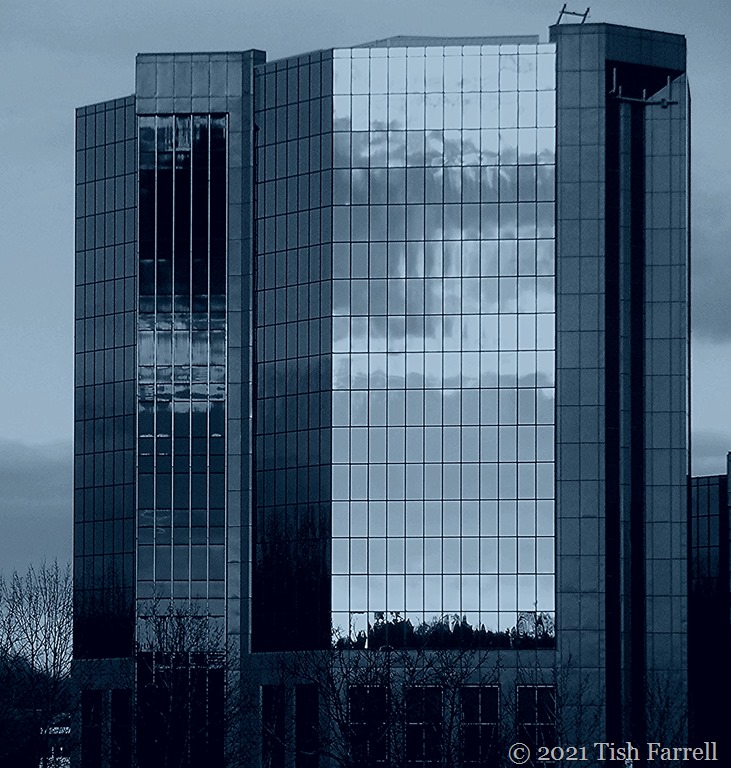
100_8788Telford

This particular high-rise, Darby House, is also a nod to the past. HQ for the Telford and Wrekin Council, it rises above one of town centre’s notoriously numerous traffic islands, and salutes the ingenuity of the Darby ironmasters of Coalbrookdale. (Abraham Darby I invented the means to smelt iron using coke instead of charcoal, and  Abraham Darby III built the world’s first cast iron bridge over the River Severn).

One can’t help but wonder though what Thomas Telford and the Darbys would think of these tributes – the new-fangled new-town architecture, the dizzying, multiplying networks of roads, shops, business parks and housing. But then you could say these were men who started it all; played their part in the pioneering of cast-iron construction which gave rise to the high-rise and more besides.

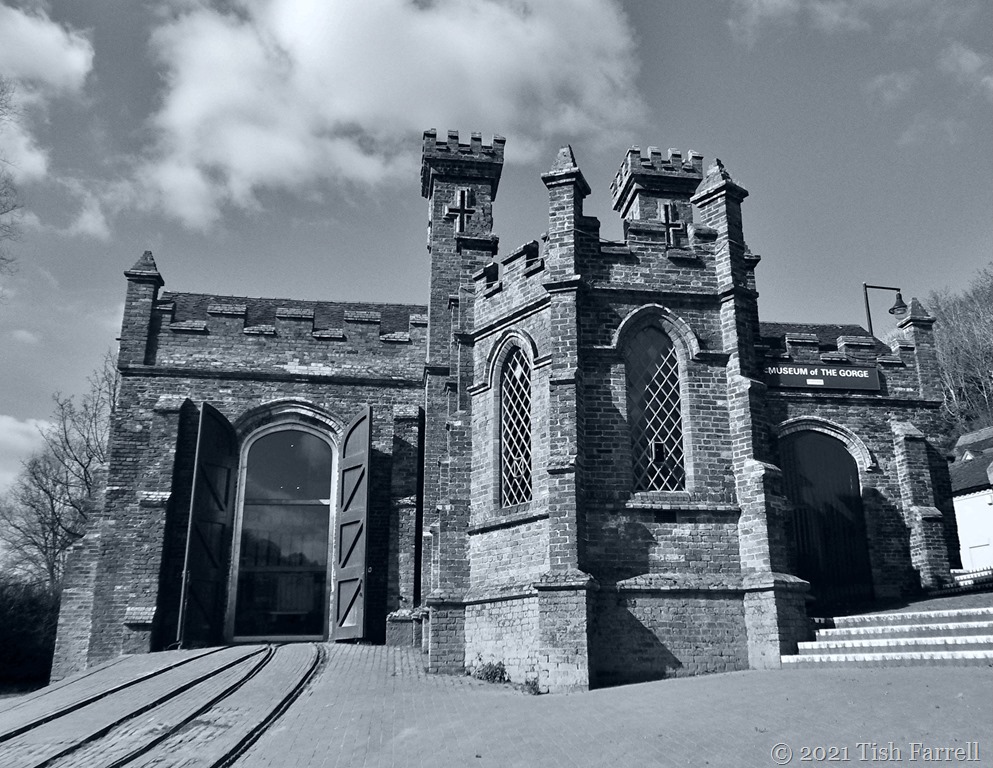
P1000856

Anyway, here, by contrast, is a building that the Coalbrookdale ironmasters considered  ‘just the thing’ in its day. Designed in the Gothic style around 1840, it was the riverside warehouse for the despatch cast iron goods down the River Severn to Bristol. It is also one of the many buildings saved from decay by Telford Development Corporation and now part of the Ironbridge Gorge Museum complex.

*

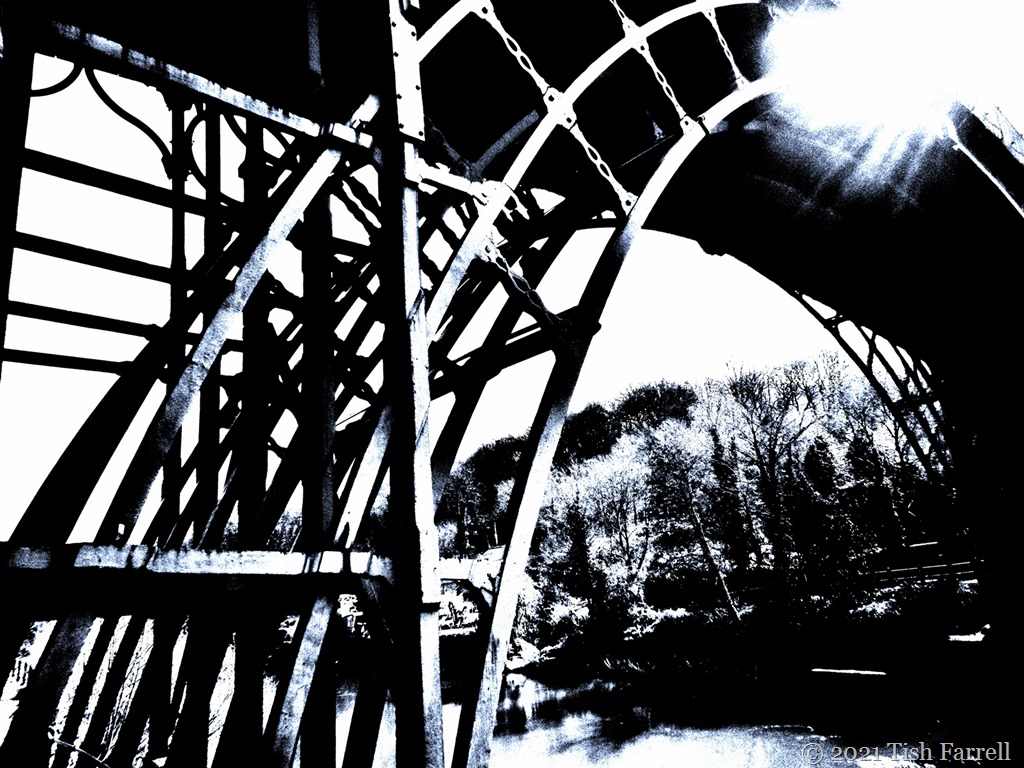
And finally the Iron Bridge (1779) (restored and owned by English Heritage).

P1000846

For those of us who tend to think the modern more ugly than picturesque and prefer to take comfort in the ‘antique’, it is worth remembering that in its day, this bridge, the manner of its construction, was unthinkable for most people. There it was, replacing the stalwart, heavily buttressed stone bridges that everyone had used for hundreds of years. It literally was ‘the shock of the new’, a daring piece of pioneering technology designed to show off and sell a concept. In this respect then, you could say it has very much in common with the enterprise and entrepreneurial zeal that gave rise to Telford ‘new town’. Surprising or no, the connections are real ones.

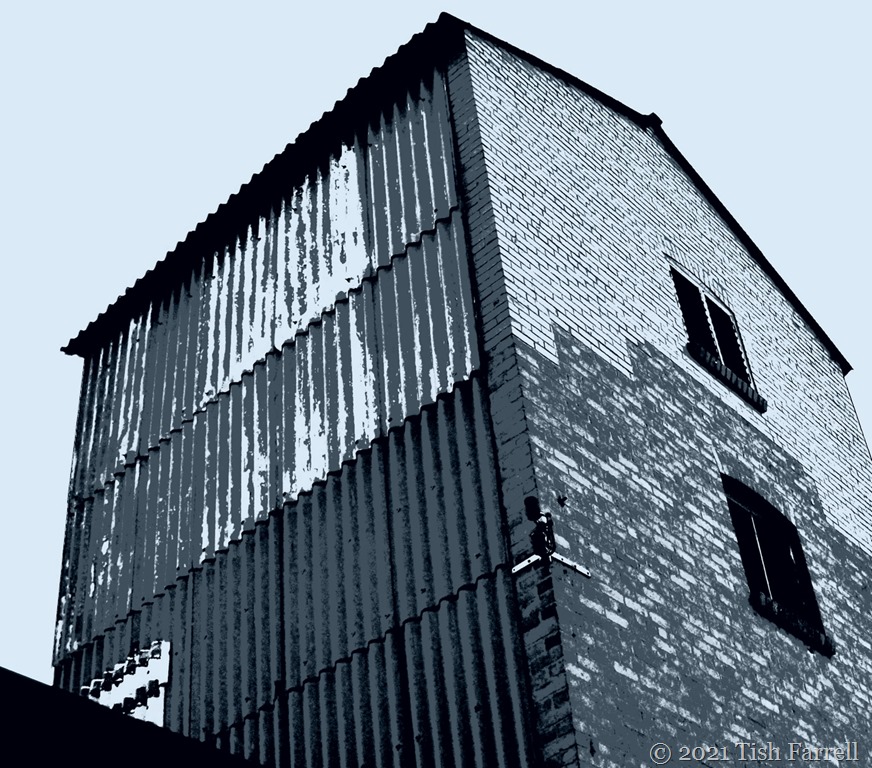
Cee’s Black & White Photo Challenge: Buildings

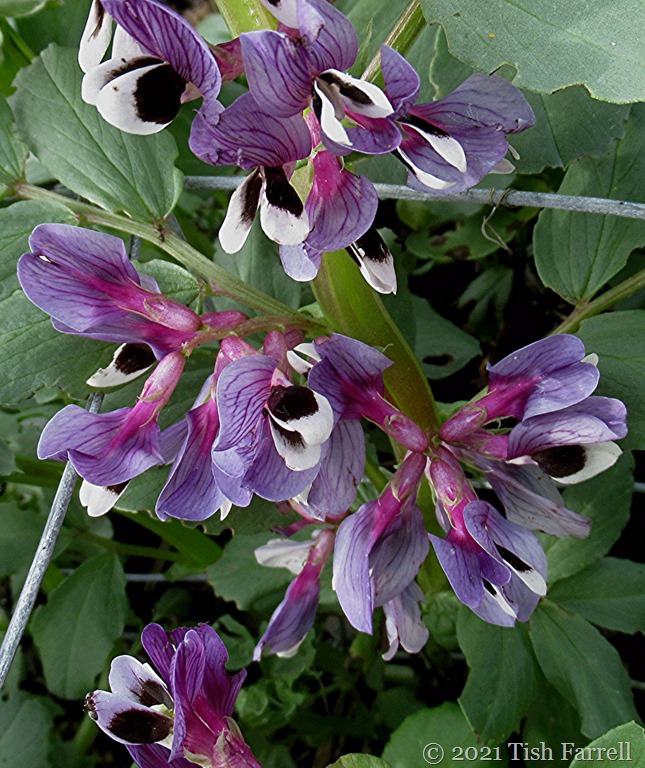
Purple on the plot: bean flowers

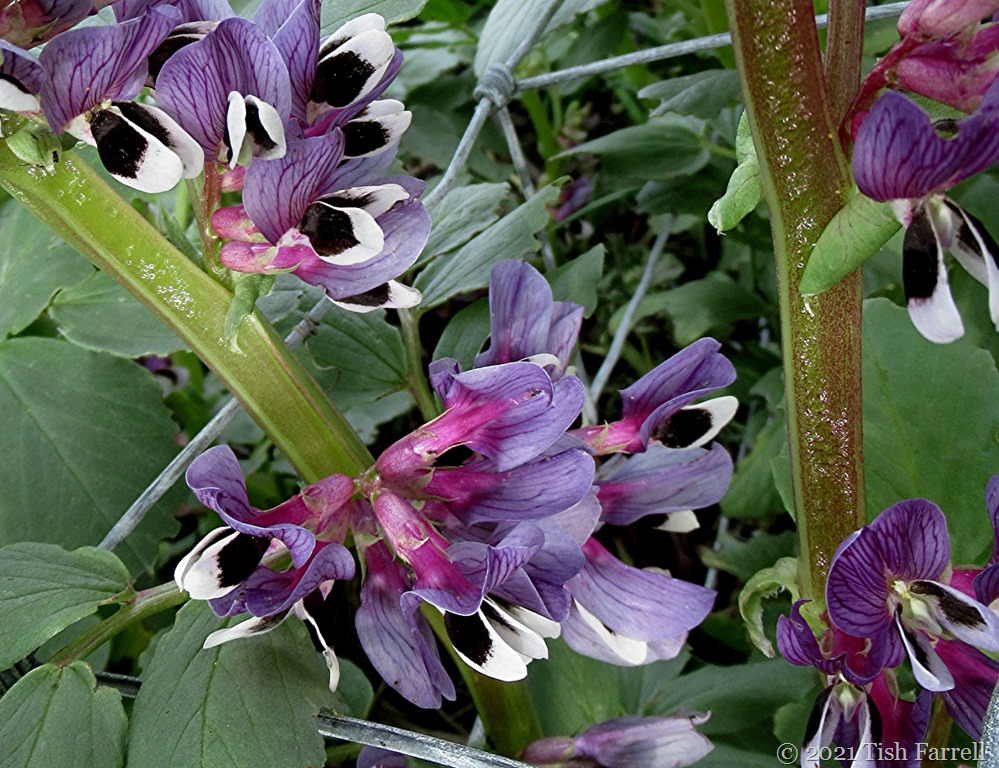
IMG_3462

Aren’t they amazing! I was astonished this week when I saw the colour of this year’s field bean blossom. They’ve never turned out like this before.

The beans were sown back in October and the plants were around six inches (15cm) tall when winter struck. I was surprised how well they survived the recurring frosts.
Once they start flowering, they often put on a growth spur which means staking may soon be required. One year they grew nearly as tall as me. But in any event, by early summer each plant will produce a mass of small pods with miniature broad (fava) beans inside.

They are usually grown by farmers for animal feed. They also make good winter cover to protect the soil, dug in the following season as green manure. This is done before flowering. Which means NO BEANS. Which would be a shame. They are delicious (if you like broad beans) and make a very tasty version of humus. Also good for the Tex-Mex refried beans approach. But for now we can just admire the extraordinary flowers. I’m only sorry I can’t pass on their wonderful scent.

IMG_3465

Life in Colour: Purple

Six Word Saturday

“Apple of my eye”

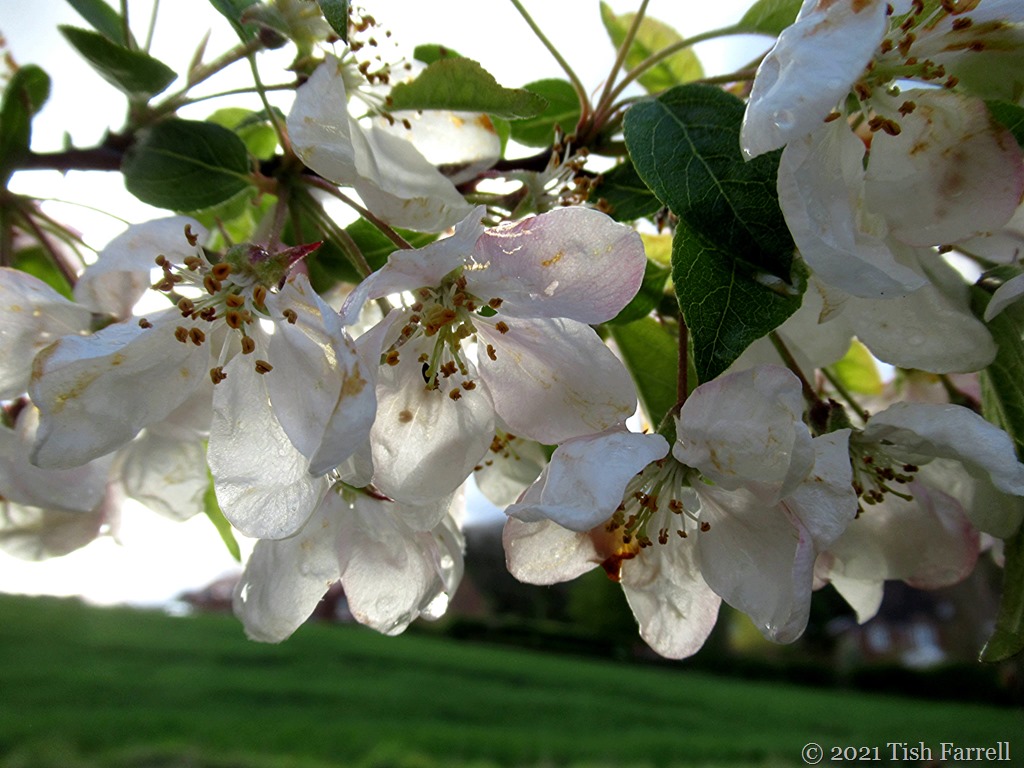
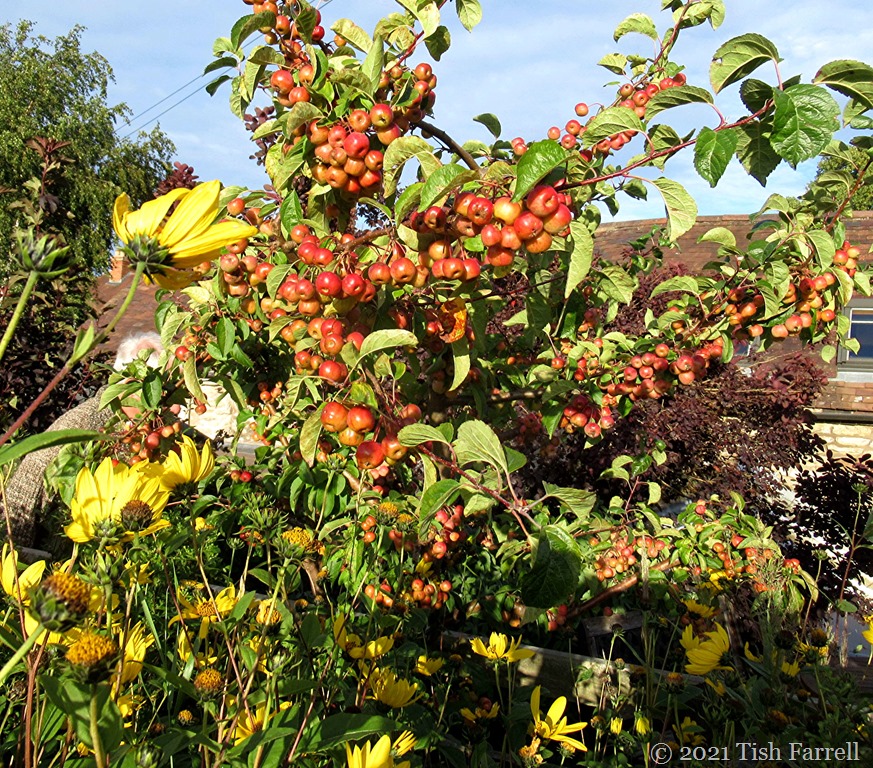
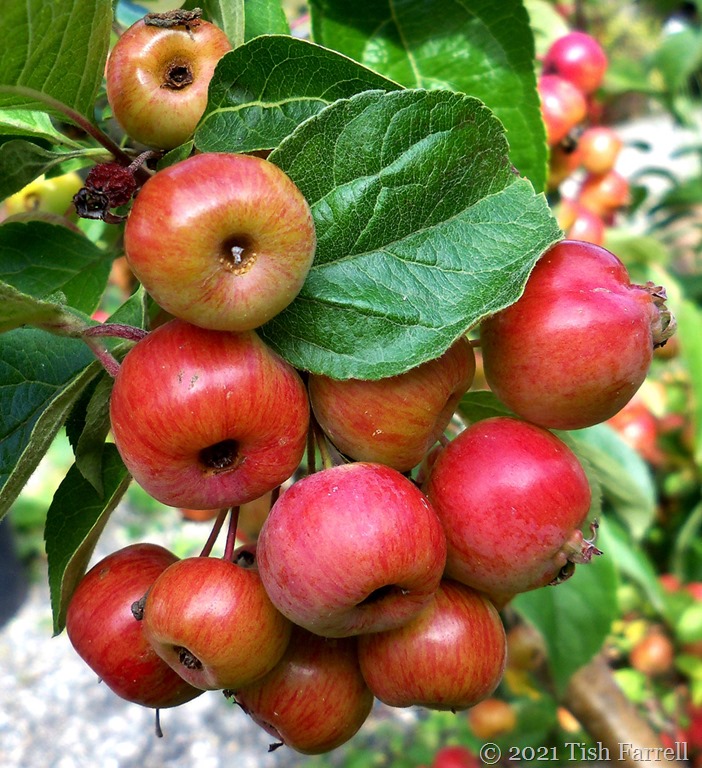
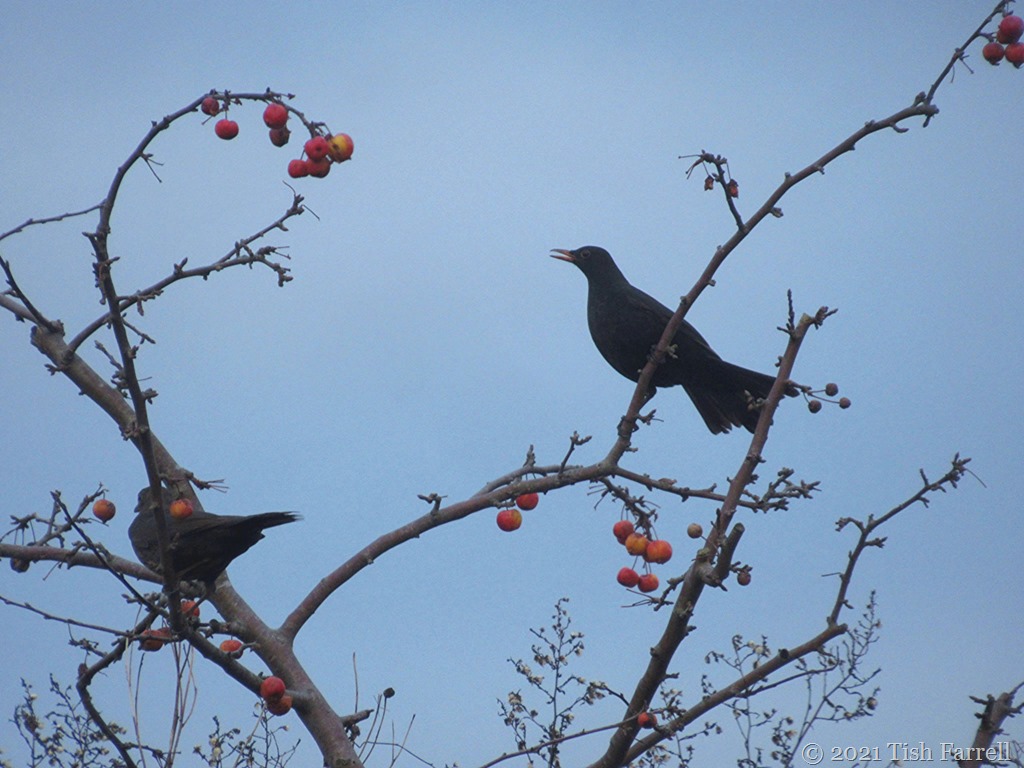
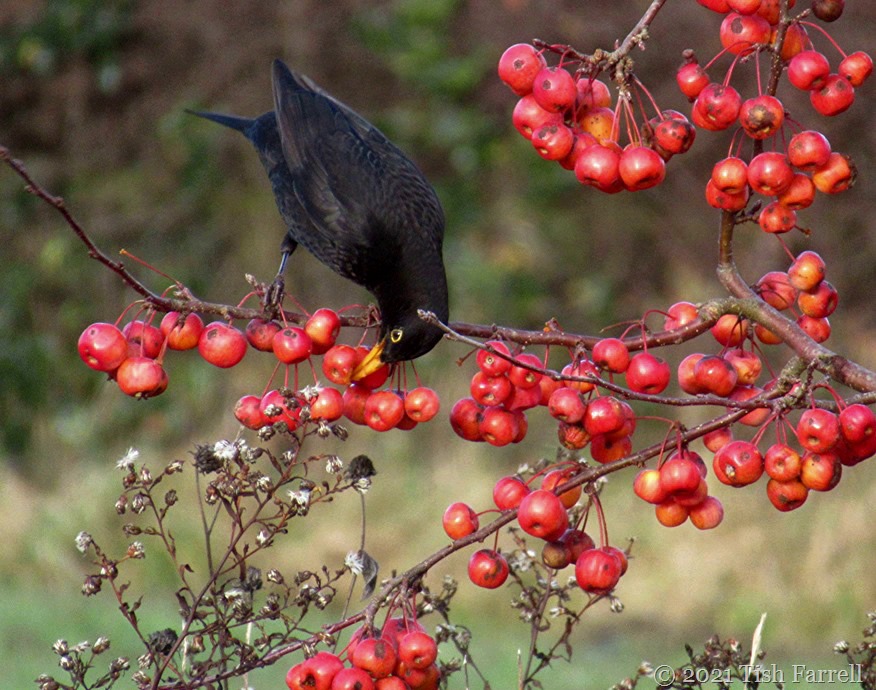
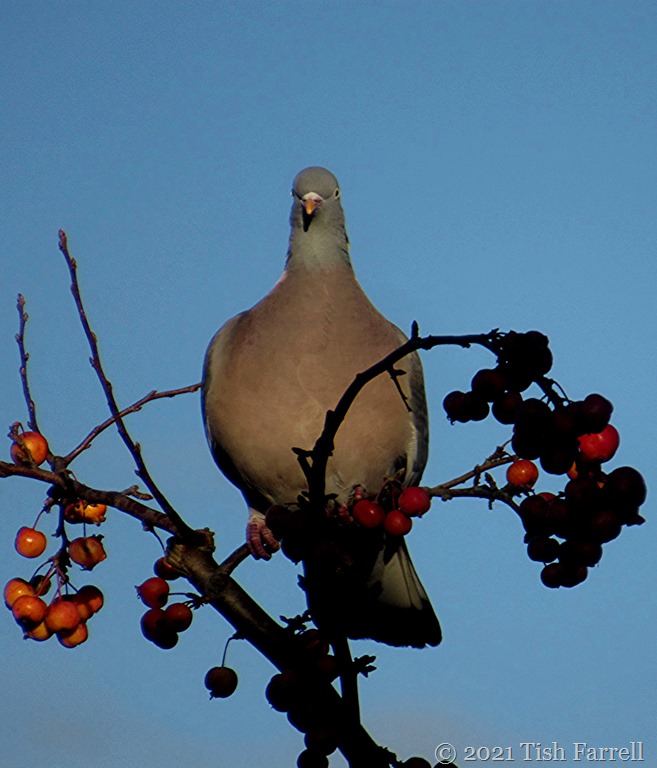
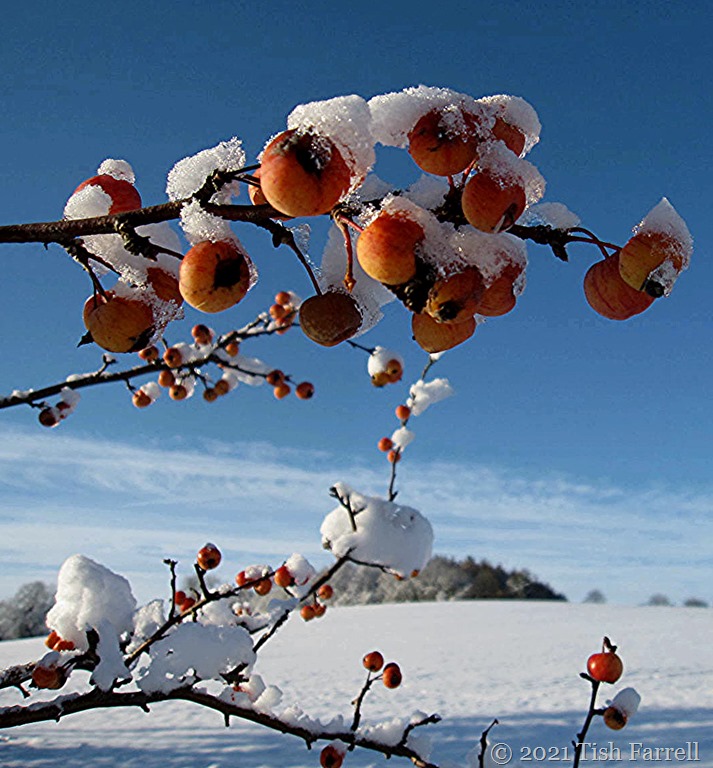
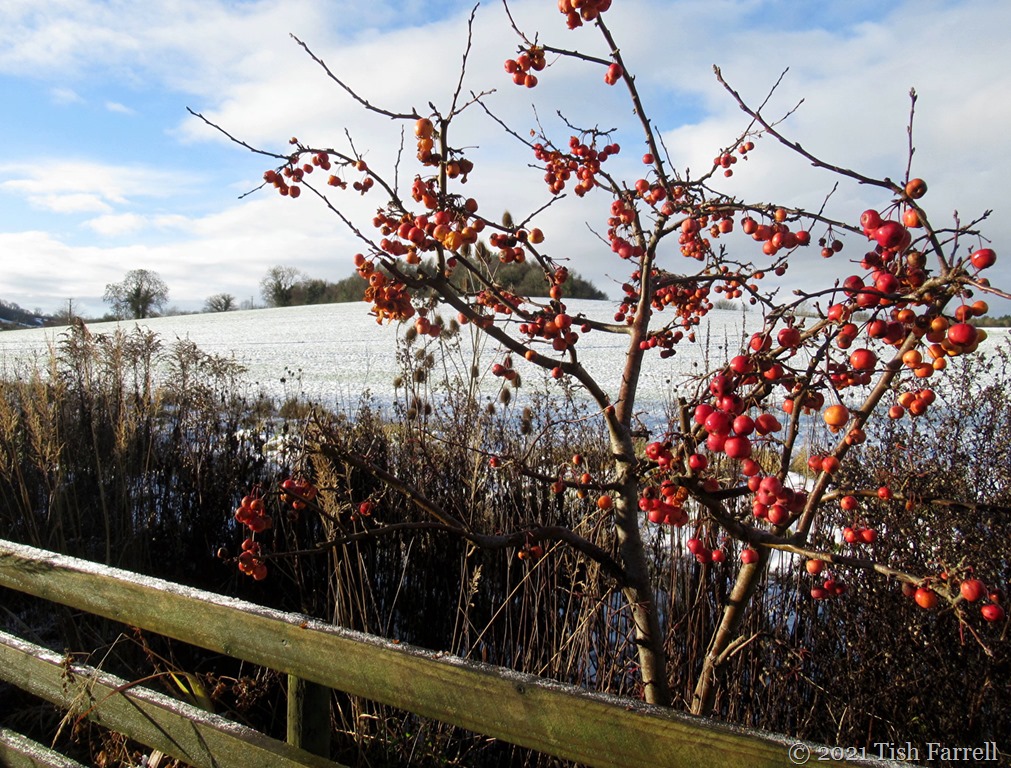
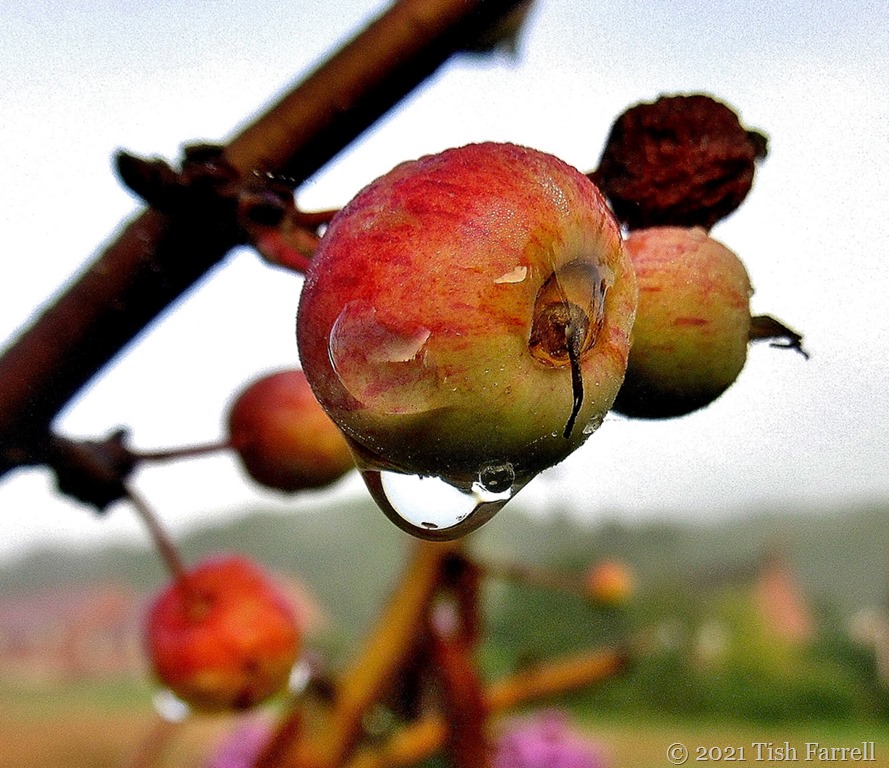
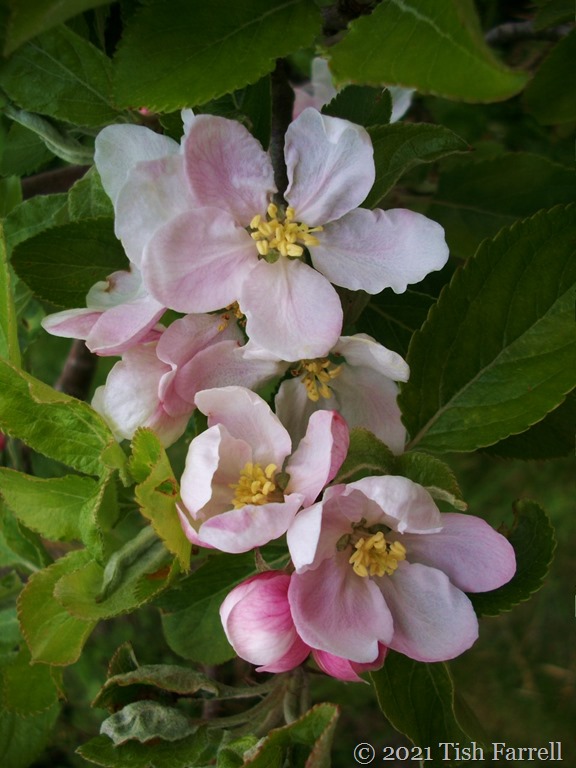
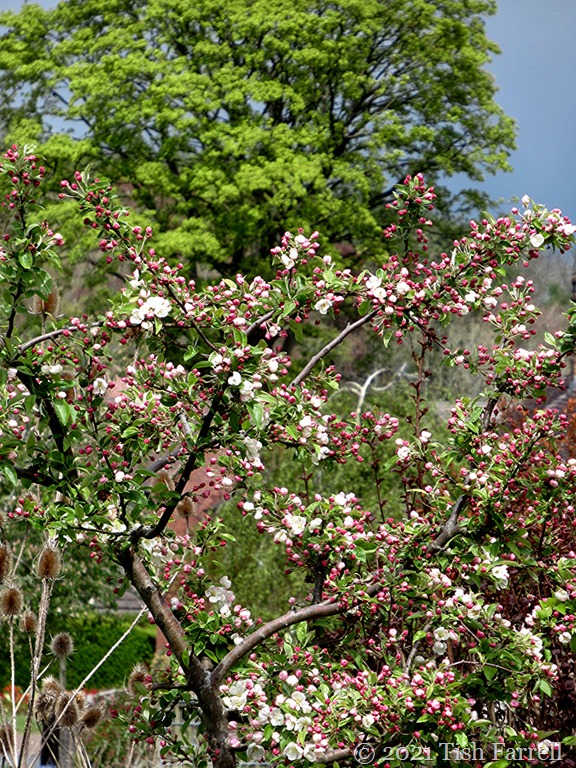
IMG_3426Every gardener has their treasures season to season. The Evereste crab apple tree probably tops my favourites list because she covers all of them. Here she is, caught this week in the evening sun after a day of buffet and bluster, hail, wind and downpour. Already much of the blossom is ‘blown’, and whether any fruit has set, we’ll have to wait and see. The apples that come in the autumn are small and russet-blushed, an inch or two centimetres at most, but each one image perfect; doll’s house apples in other words. And after we have admired them for many weeks, the winter weather then softens them enough to make them a valuable food store for the blackbirds and pigeons. We watch them from the kitchen door.

A tree of many pleasures then. Here she is a couple of weeks ago, the blossom just opening:

IMG_3231ch

*

And this was last September (in the midst of an early autumn gale), the apples freshly formed:

IMG_9855

100_7068

*

Evereste is also queen of that unruly quarter, the-garden-over-the-fence aka the guerrilla garden, caught here early one summer’s morning. Its content changes every year:

IMG_2867gg

*

And in winter there are many new scenes:

IMG_6553

img_1083

IMG_6106

IMG_6565

IMG_1586

*

And so yes, the apple of my eye:

P1050485

Lens-Artists: Gardens  Please visit Amy’s very lovely gardens. She is hosting this week’s theme.

There’s A Storm Coming…

IMG_3418

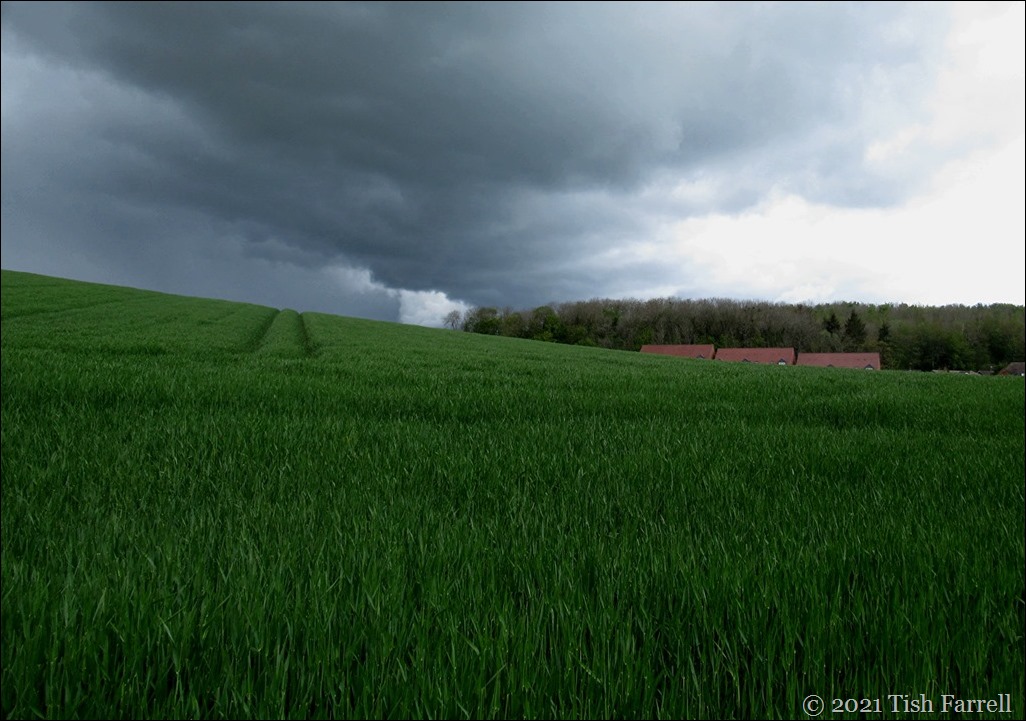
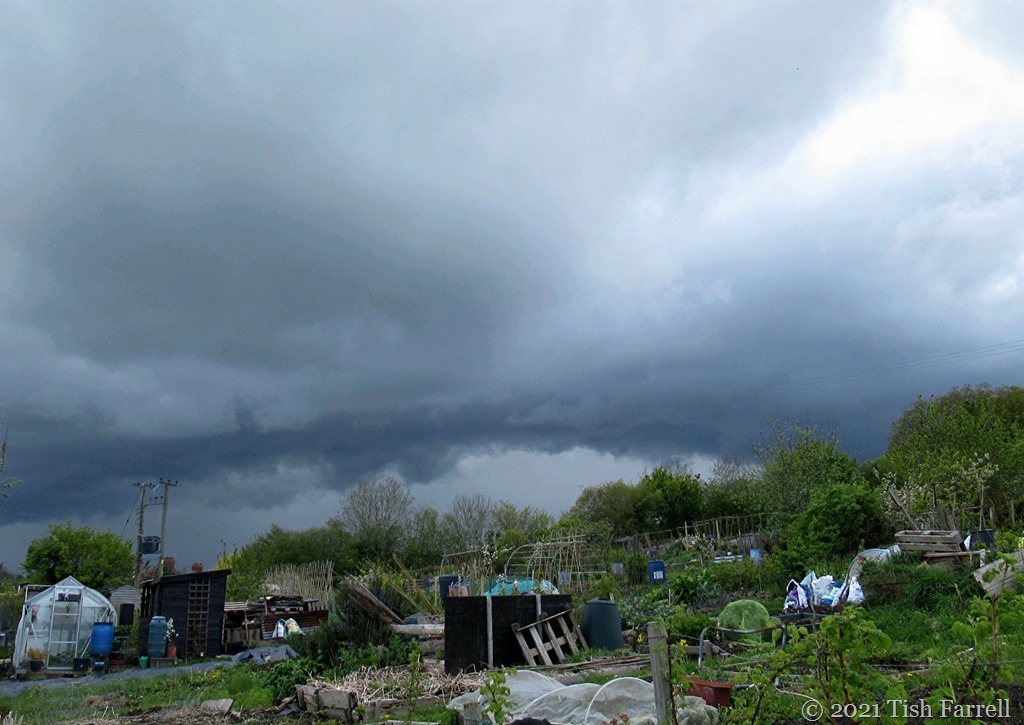
This week the icy currents have retreated. Instead we have storms. I was at the allotment yesterday when this one crept up on me. I was planting out some pea seedlings, the skies ahead sunshiny blue, and all well with the world, but when I turned round:

IMG_3398

Heavens! A swift retreat looked called for. Lately the rain has come in sudden deluges of tropical ferocity, the sort of downpours that leave you soaked no matter how water-proofed you think you are. I’ve been caught out before between allotment and home. For sure it’s only a five minute hike across Townsend Meadow, but it’s amazing how much wetter than wet you can get in that short space.

So home it was, the storm on my heels.

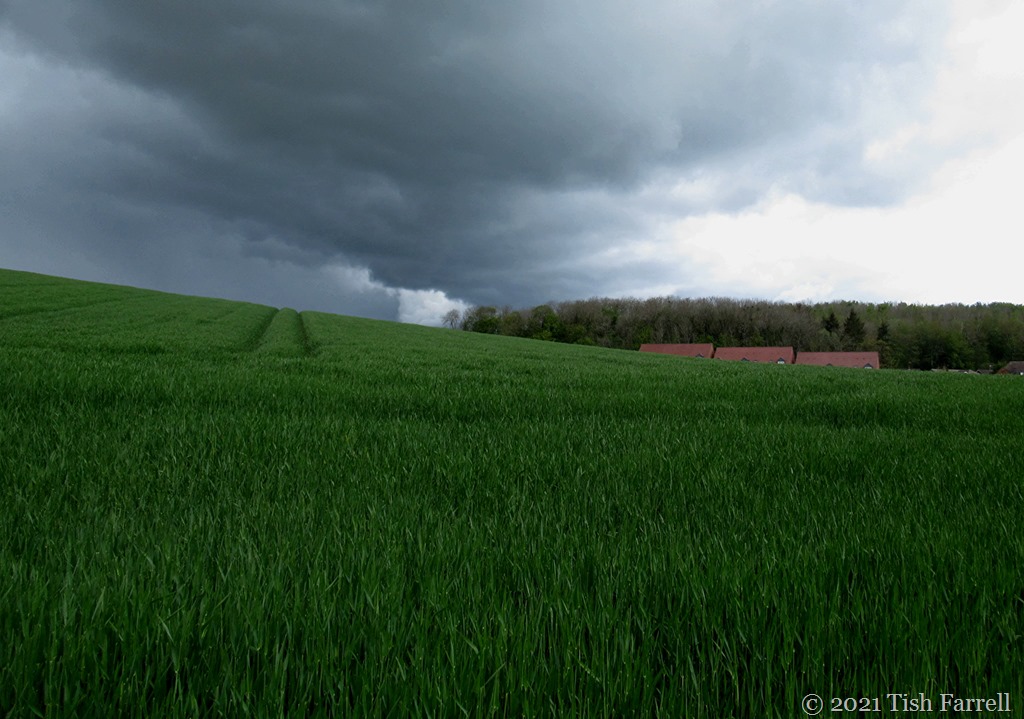
But it was only a tease. Almost home and scarcely a drop, I stopped to take the header photo and watched the storm slip over the Edge.

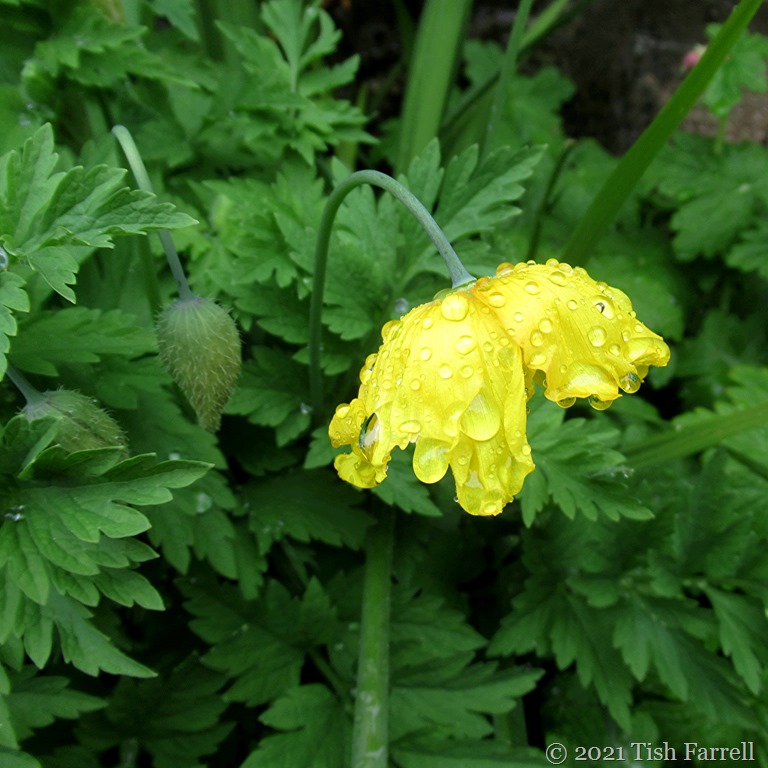
It came back later though: hail, thunder, downpour. During an early evening lull I went out into the garden. The birds were singing. It was almost warm; the sky looked amazing: so many shades of grey. And then it started to rain again.

IMG_3441

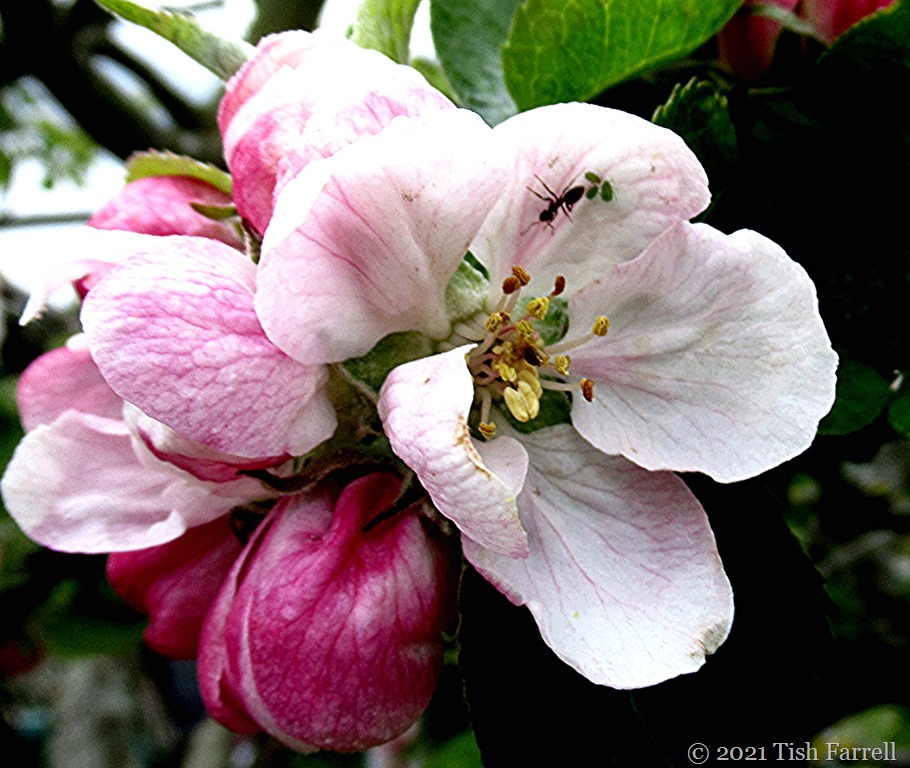
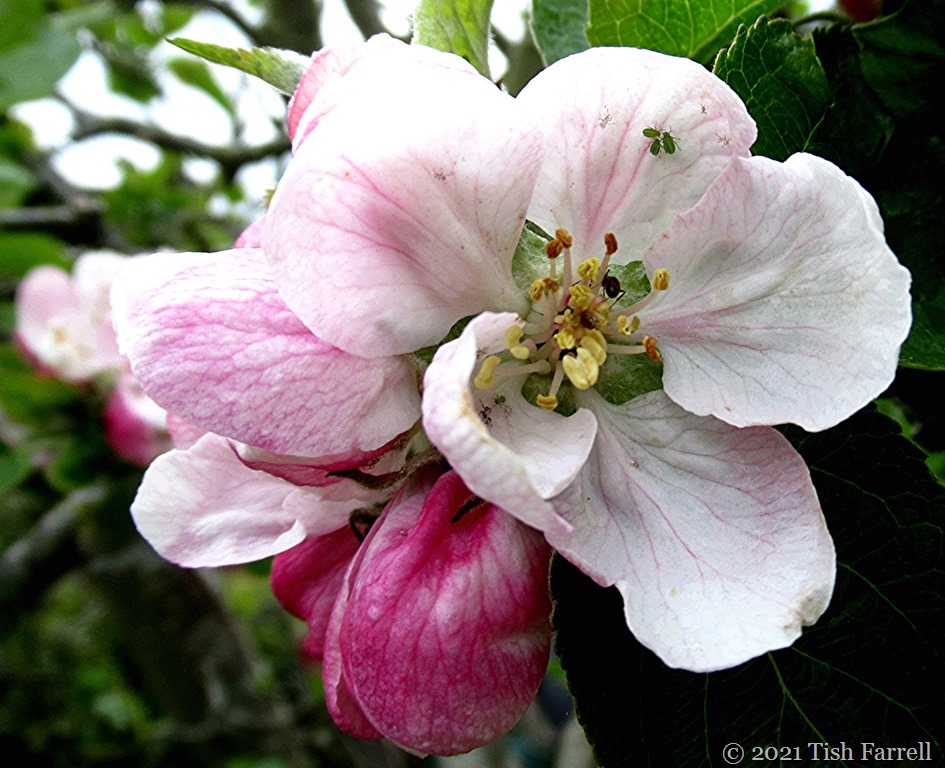
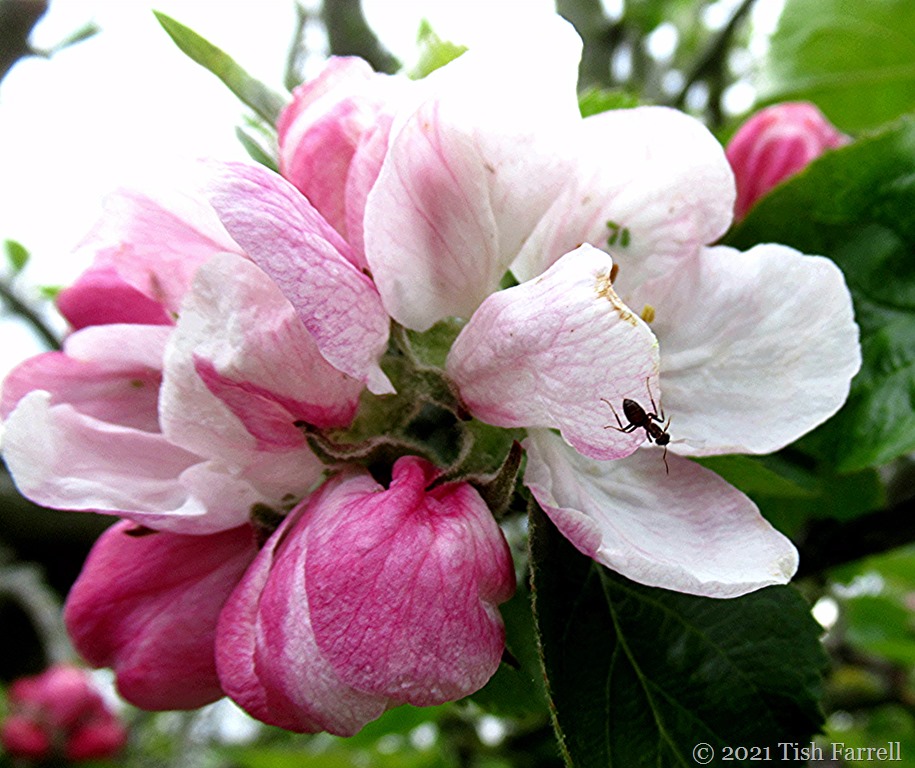
Ant takes up aphid herding inside a Bramley apple flower

IMG_3330ant and aphids

Ants and aphids have a good deal, otherwise known as a symbiotic relationship. Ants protect the aphids in return for giving them a squeeze, or at least stroking them with their antennae, in this way encouraging the voracious plant-consuming pests to excrete their honeydew waste. And ants can’t get enough of it. So they herd and manage and protect their aphid herds, moving them from harm’s way, seeing off predators, in  particular ladybirds, whose eggs they will destroy.

In the next photos you can see the aphids have been ‘parked’ while the ant goes off to forage in the blossom and then patrol the ‘perimeter’.

IMG_3334

IMG_3336

Fascinating what one finds on the way home from the allotment. The photos were taken one evening last week so not the best light conditions.

Lens-Artists: Focusing on the details  Patti asks us to look at the finer points.

I wasn’t whingeing…It really was the coldest April in 99 years

IMG_8341p

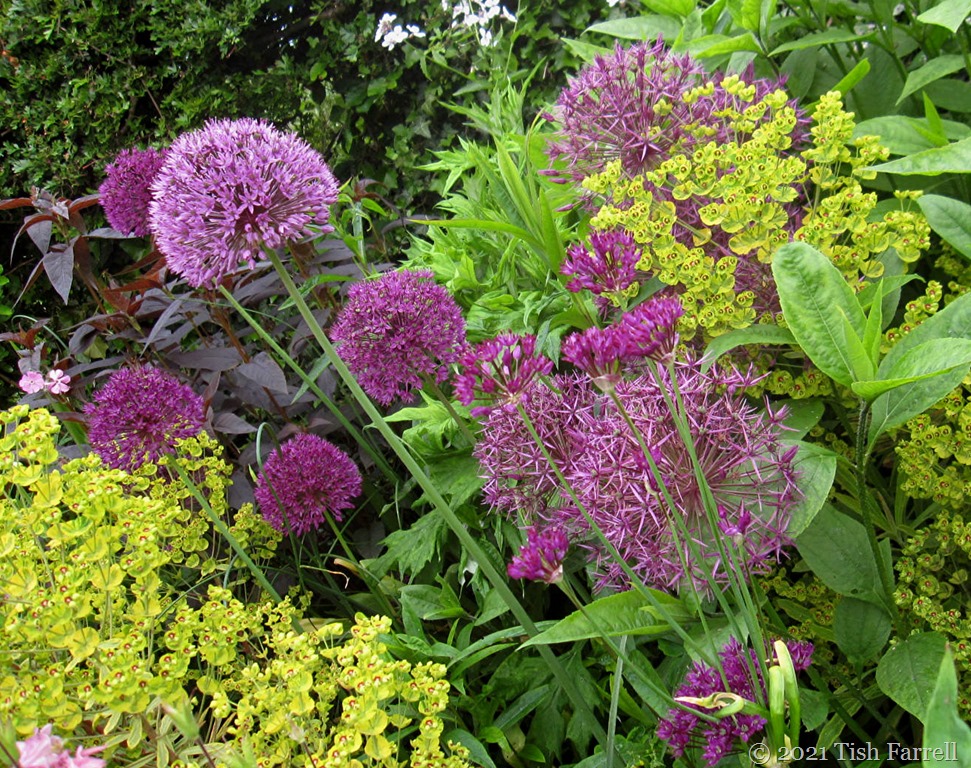
No alliums out in our part of Shropshire yet, though there are frosted leaf tips and a few tightly closed buds just showing. Still, when they do come, they really can’t be beaten for early season purple, and purple is this month’s Life in Colour choice at Jude’s Travel Words blog (link below).

Jude and I have also been muttering about the weather in April. At one point we both wondered whether it was growing older than made us think it was colder. But no! Now we have the evidence. The UK Met Office report:

April 2021 had the lowest average minimum temperatures for April in the UK since 1922, as air frost and clear conditions combined for a frost-laden, chilly month, despite long hours of sunshine.

Early provisional figures from the Met Office’s National Climate Information Centre indicate that April had the third lowest average UK minimum temperature for the month since records began in 1884, while Wales, Scotland and England all reported their figures in their top five lowest ever recorded. Average daily maximum temperatures were also below normal, but not by as much as the minimum temperatures.

It had already been reported that April had seen its highest level of air frost in 60 years, with an average of 13 days of air frost topping the previous record figure of 11 days in 1970 (records for air frost go back to 1960). This number of air frosts is more typical for December, January or February, whereas the average number of air frosts in April is five days. For gardeners and growers there were also a record high number of ground frosts with 22 days this month compared to an average of 12 days.

And so while we’re waiting for warmer days and nights and for the alliums to happen, here are some archive allium shots to be going on with:

IMG_4718

p1070248p

Life in Colour: Purple