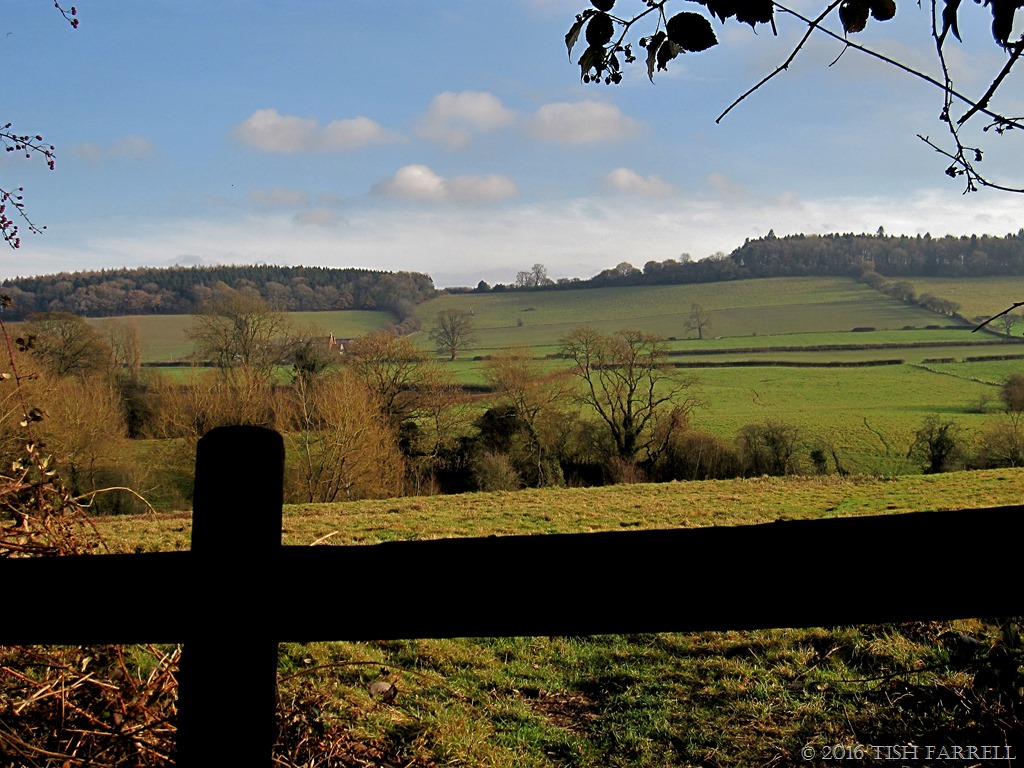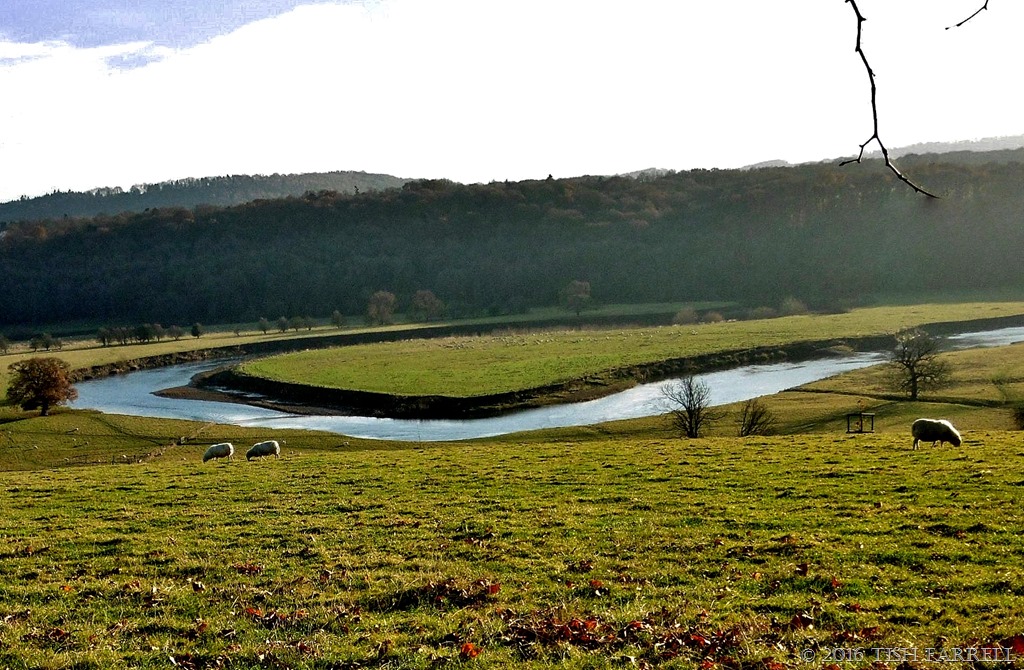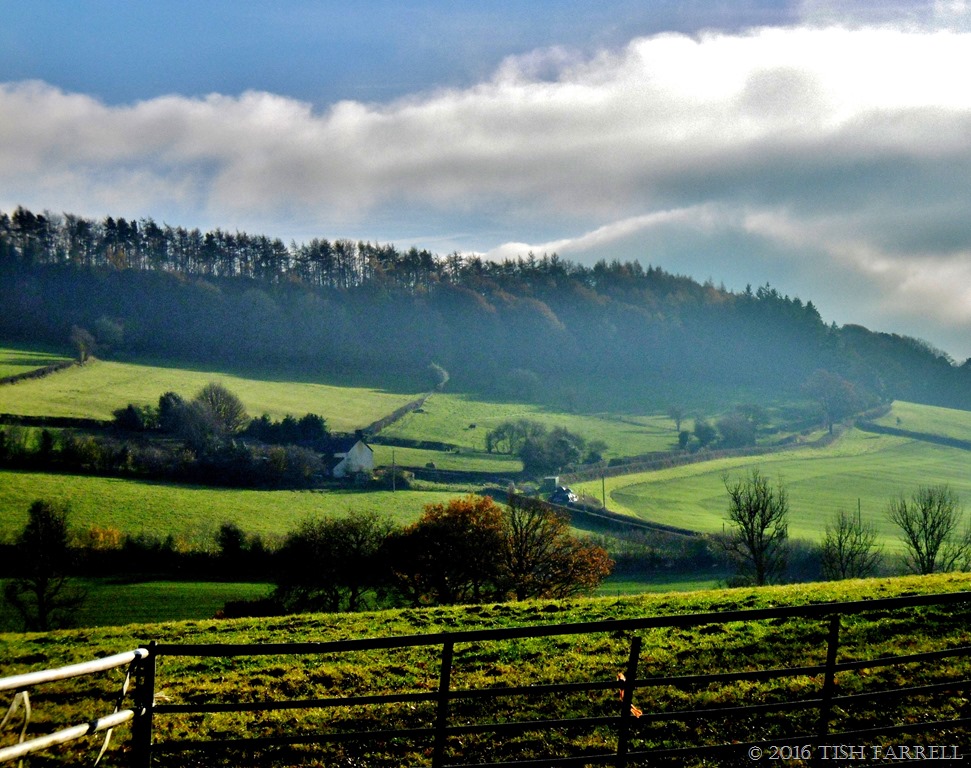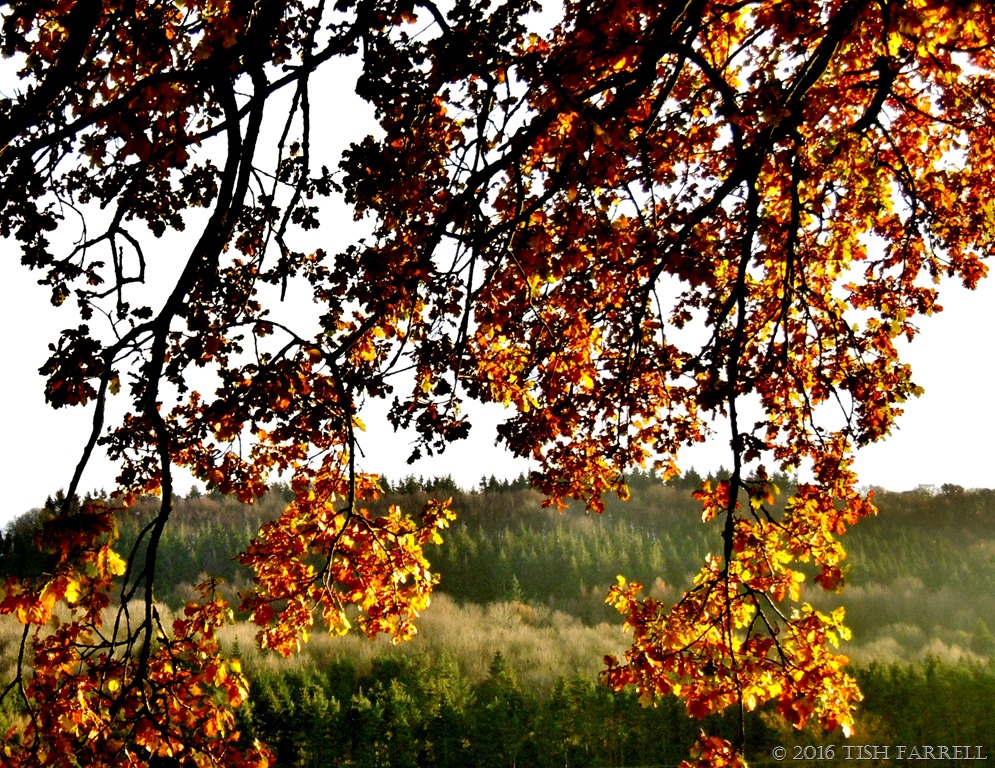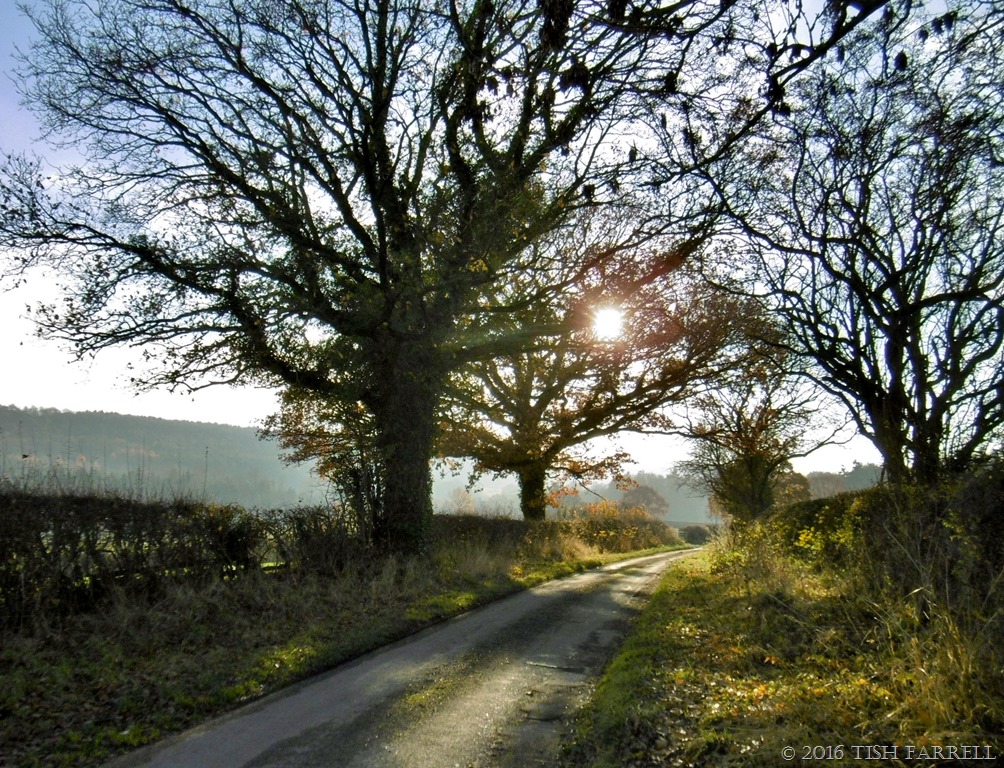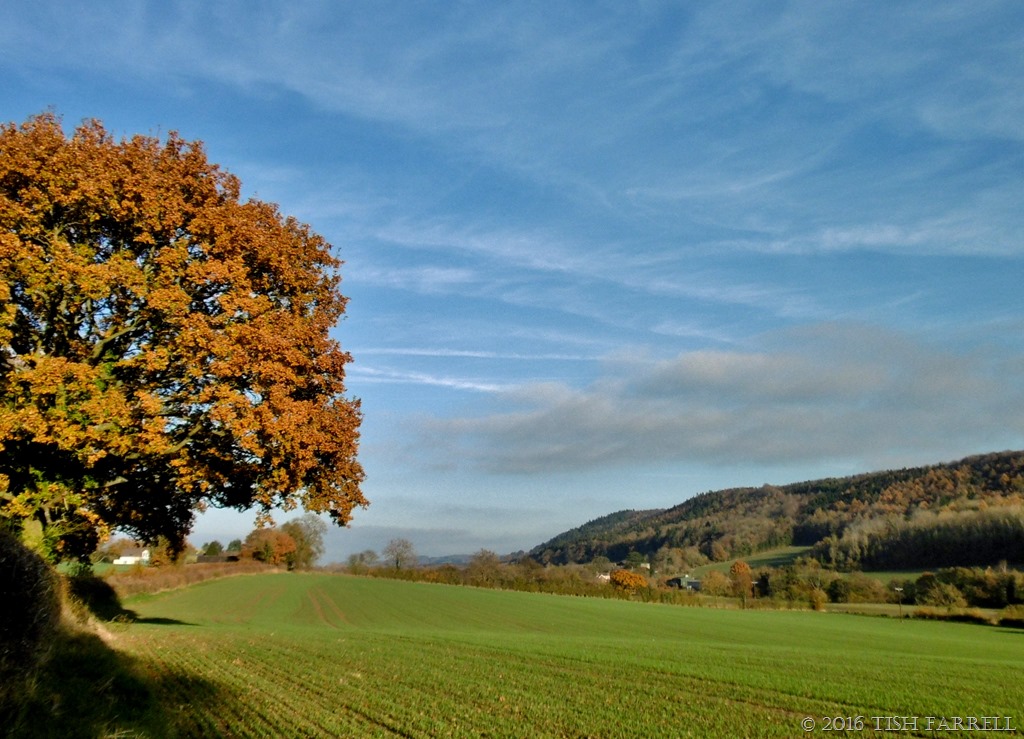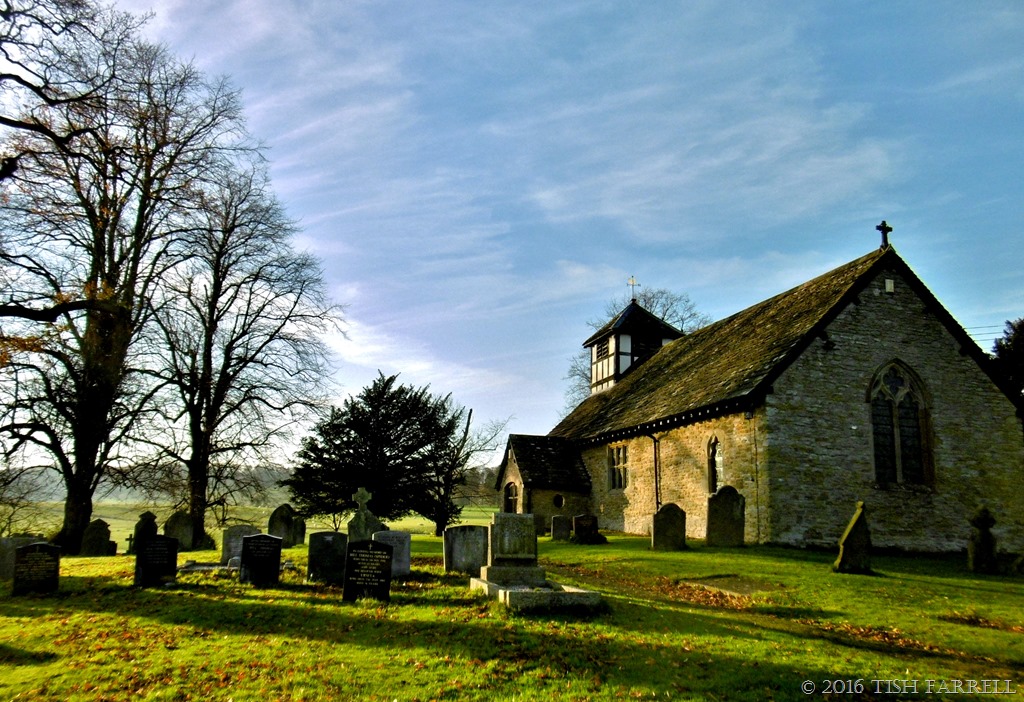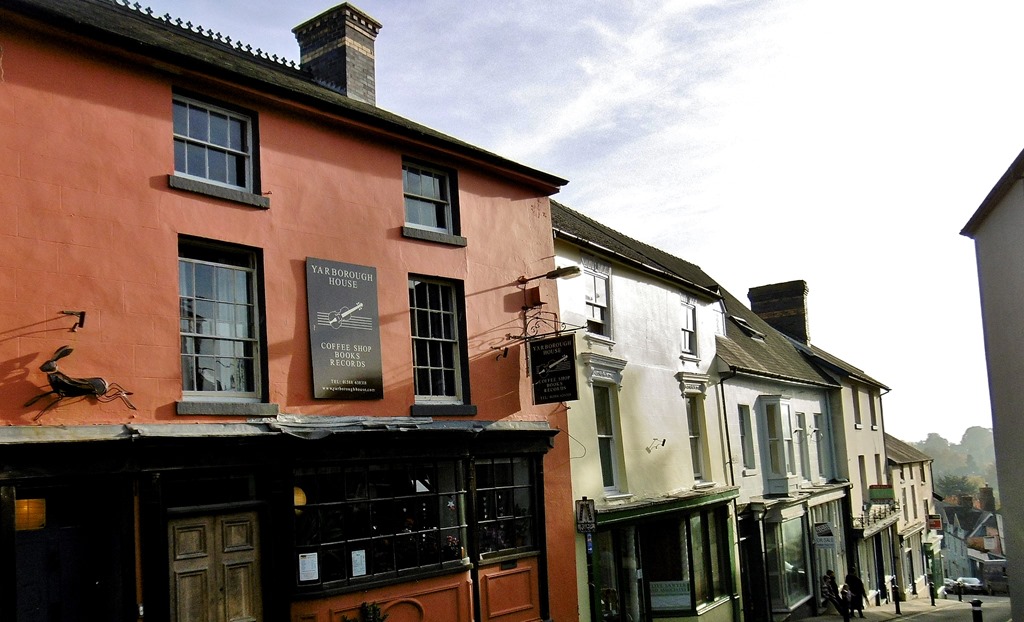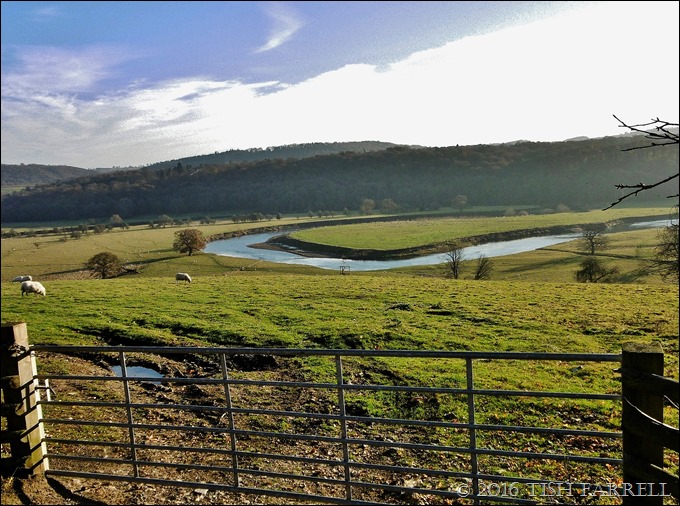
December 7 and at noon we had sun and 12 degree warmth: a spring day in winter. Graham and I headed out over the fields and came back down the old railway line. He strode off ahead while I stopped here to take this photo. It is for my U.S. Buffalo chum, Kathy. She and Jack come each year like swallows to spend the summer in Wenlock, away from Buffalo’s heavy heat. This is the walk she often walks with me, and we always stop at this fence, lean awhile, churn over world events, sometimes rant a little. And then at last simply look, taking in the view – the ever-changing unchanging landscape. (At least for now).
Shropshire
Of Rivers Running Backwards And Looping The Loop
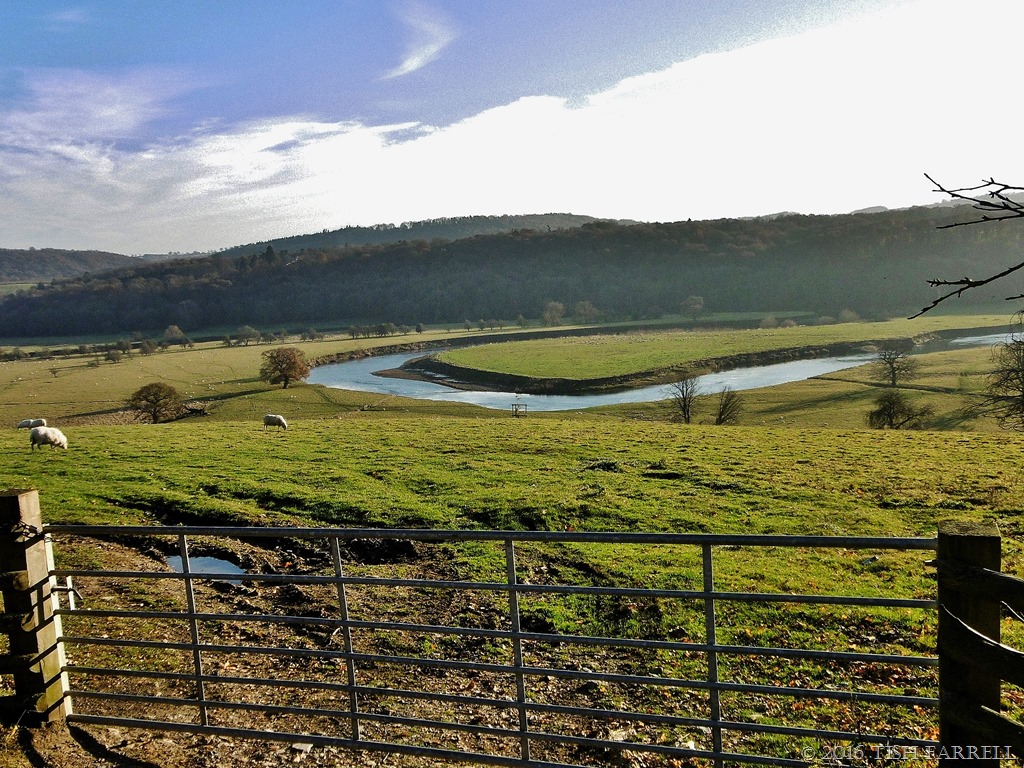
Last week I took you on a walk along Wenlock Edge behind our house, and talked about the melting ice fields of the last Ice Age (around 15,000 years ago), and how the River Severn that once flowed north, started to back up against the limestone ridge of Wenlock Edge and so formed Lake Lapworth. And then I said how the expanding melt waters worked their way through the rock wall, and so formed the Severn Gorge, and at the same time created a whole new southerly course for Britain’s longest river. Well, this is where it all happened – at the northerly end of Wenlock Edge.
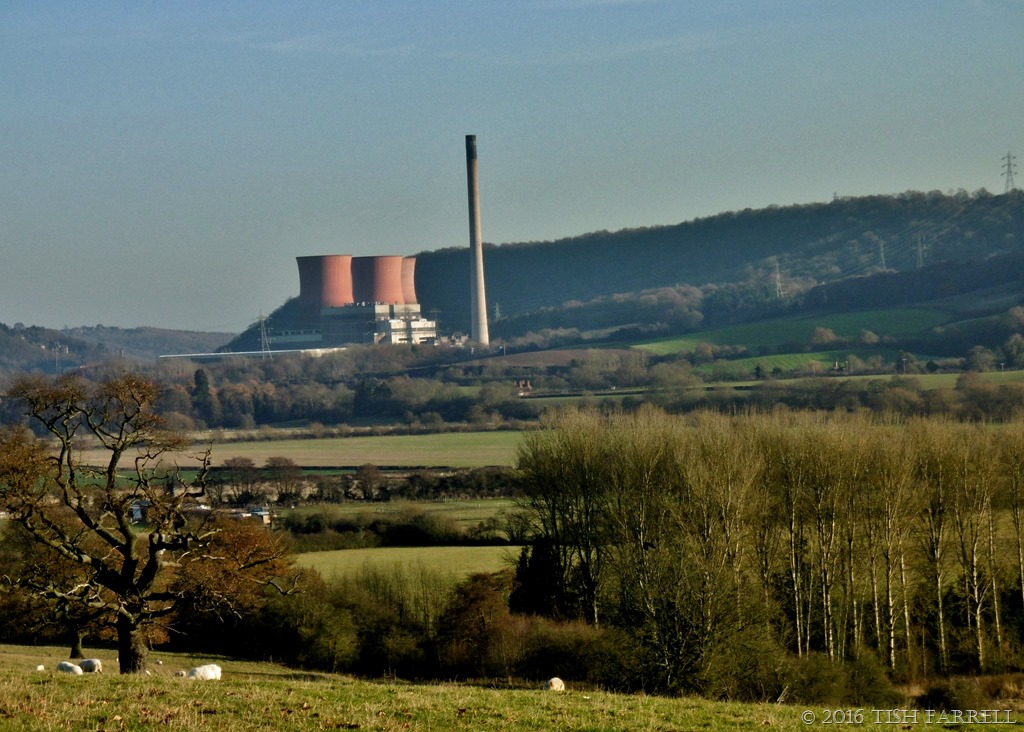
Off to the left of the photo, and out of shot, is the old Ironbridge Power Station. It’s coming up next in a ‘zoomed in’ shot.
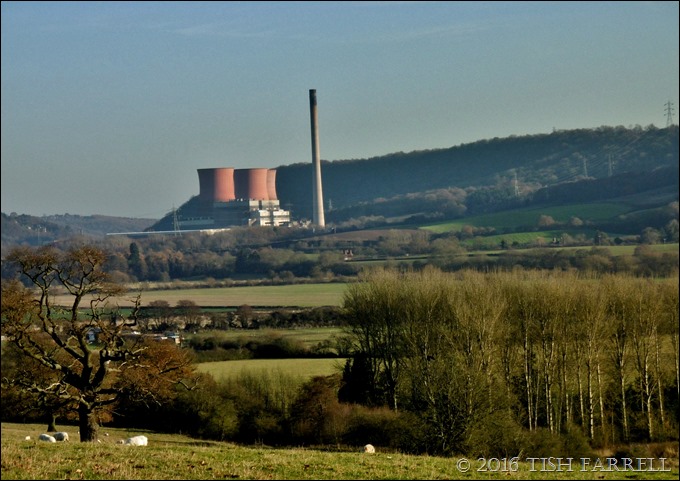
The power station stands on the riverbank at the entrance of the Gorge, and below Benthall Edge, and thus marks the spot where the Severn first headed south. And just to orientate you further, dead ahead to the left of the power station is Ironbridge and Coalbrookdale, and to the right, and below the power station is the road to Much Wenlock. You can just see the house roofs along it. Benthall Edge is thus a southerly spur striking off from Wenlock Edge.
Like Wenlock Edge, Benthall Edge is also composed of limestone strata formed around 400 million years ago when both Edges were part of the Silurian Sea. From the early 1200s the monks of nearby Buildwas Abbey had the rights from Lord Benthall to quarry the limestone, which they burned in kilns to make fertilizer for their farm fields, and lime mortar for building. They also cropped the woodland along Benthall Edge to make charcoal.
In later centuries the Benthall limestone was used in local blast furnaces, tipped in with ironstone, and when fired, acted as a flux which drew impurities from the metal. This was tapped off as slag, and the resulting molten iron cast into ‘pigs’ on the furnace floor. The pig iron was then shipped on to the forge to be worked further into wrought iron, a more durable product than cast iron, which has a tendency to fracture. So now, if you can picture it, see that little stretch of the Gorge by the power station thick with sulphurous smoke, and hear the whole place banging and clanging with forge hammers.
These days Benthall Edge is a tranquil place of hanging woodland and winding paths, although you can still spot the remains of old quarries among the trees. The ‘Lime Trail’ information leaflet of the Severn Gorge Countryside Trust provides an extraordinary statistic about the quarrying. It says that over a period of 750 years an estimated 1.2 million cubic metres of limestone was removed from the Edge. So there we have it: landscape formed both by human and natural agencies – though I’m wondering how that piece of man-made intervention was calculated.
But now to get back to the other feature of note at this spot – the River Severn’s meanders between the villages of Buildwas and Leighton.
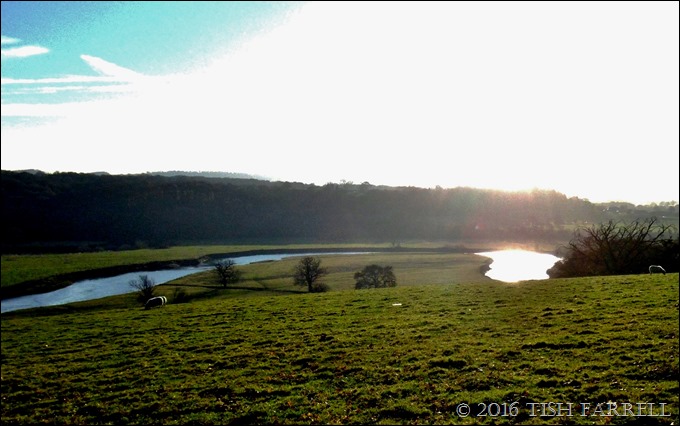
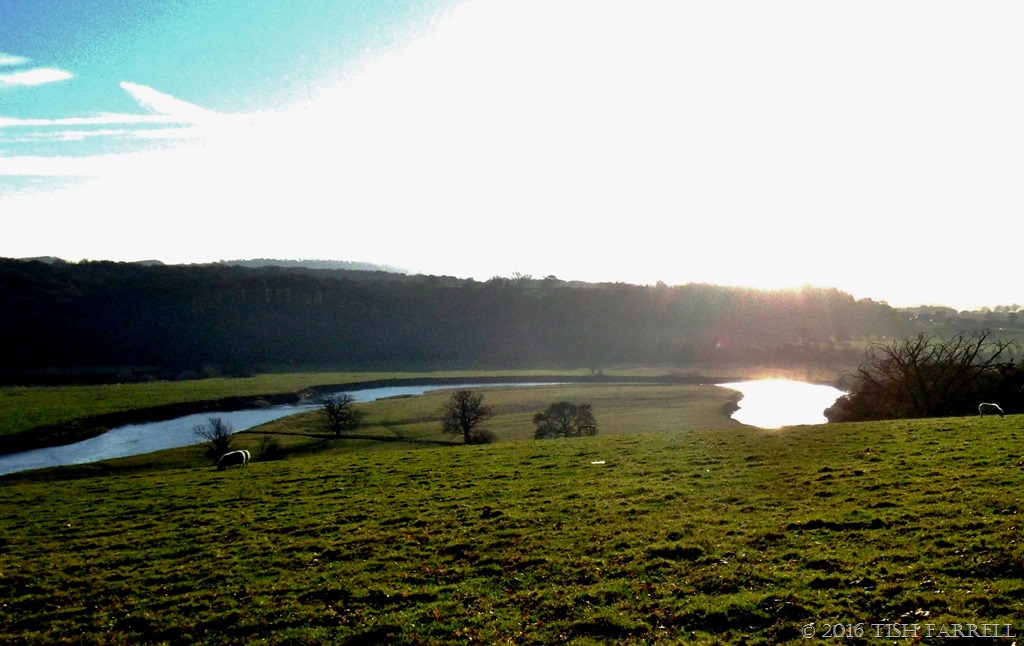
I’ve not really done it justice, this looping riverscape formed by silting on the one hand, and erosion on the other; an oxbow lake in the making. I think I probably needed to climb a tree to achieve a better panorama:
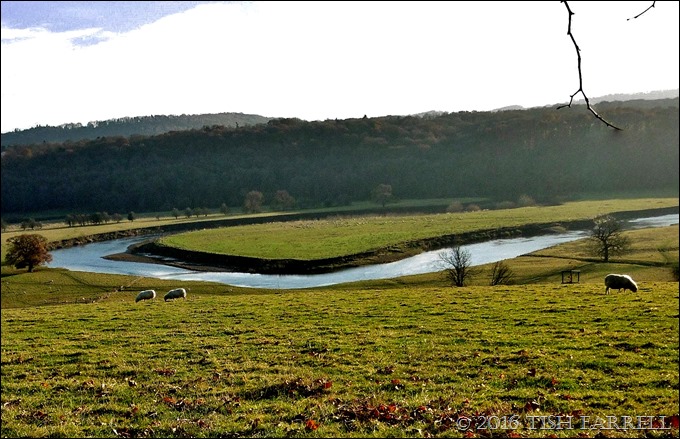
It is of course a favourite viewpoint for geography fieldtrippers, and a very fine place to linger, although not for too long on a winter’s afternoon, however bright and beautiful.
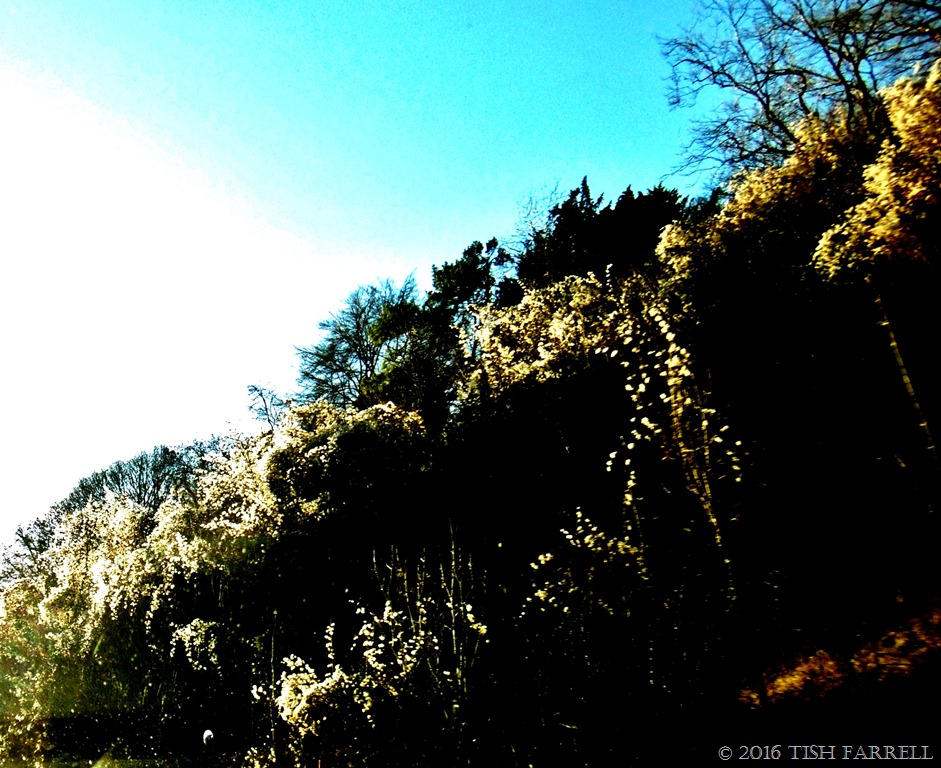
As we headed home, the December sun was lighting up cascades of Old Man’s Beard along the roadside; the trailing seed heads of wild clematis making their own festive streamers. Caught here through the car windscreen. (I wasn’t driving).
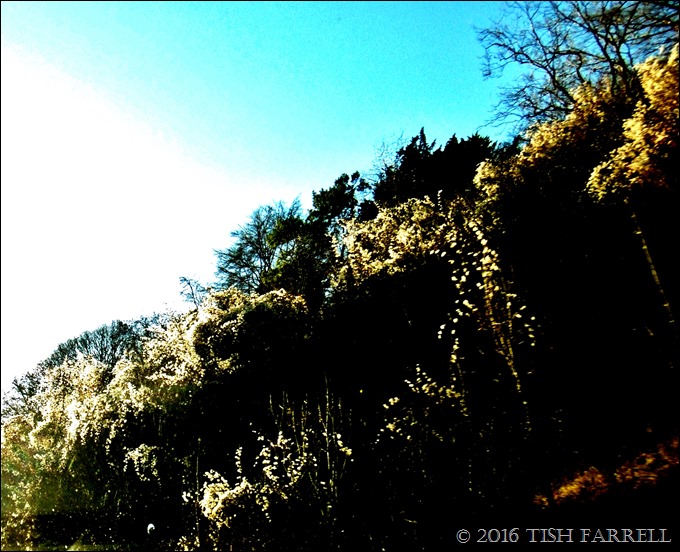
Today The Sky Over Wenlock Was…
The Changing Seasons ~ Today Below Wenlock Edge, Rambling Through Westhope And Easthope
Today was a golden day – not a breath of air and the landscape lit up by the oak trees that still have their leaves. Here are some glimpses, then, of my corner of Shropshire on a late November afternoon.
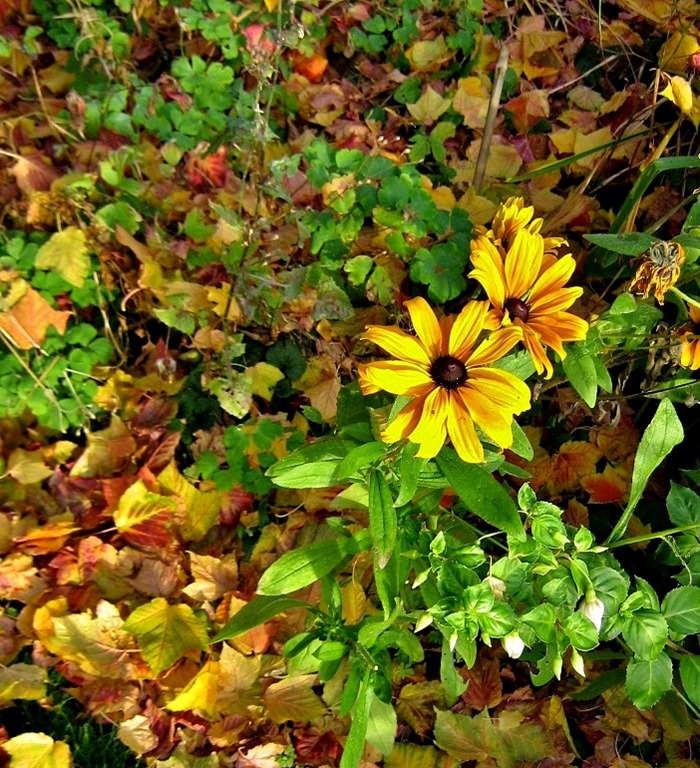
All Gold On All Hallows’ Eve In Bishop’s Castle
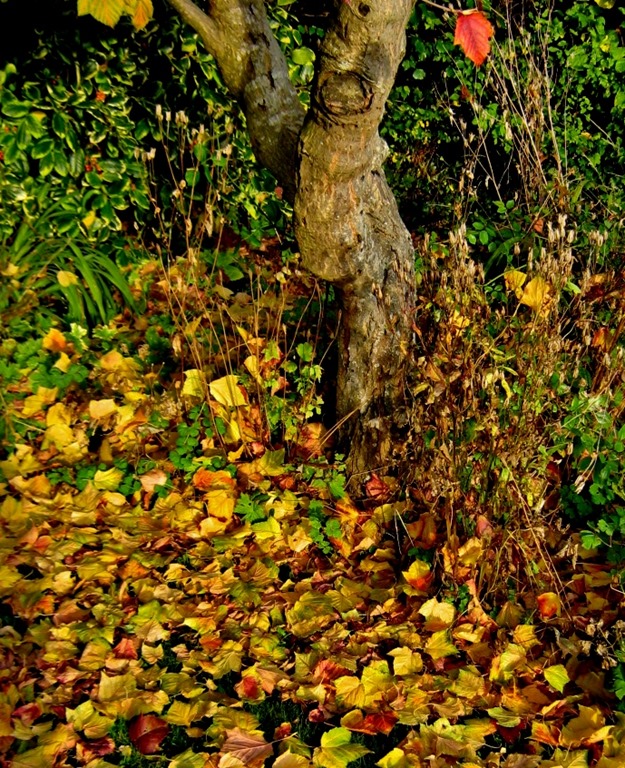
The Shropshire Hills lay in a golden haze on the last day of October. Not only that, it was warm and still, and in Bishops Castle, where we went for my birthday outing, all was drowsing. We were drowsing. Lunch at the Castle Hotel was long and leisurely, and the food unassumingly delicious, and we spent the afternoon drifting around the streets, looking in the windows of shops that were mostly shut. It did not matter. It was Monday, and clearly the proprietors of most of the town’s establishments had better things to do on Mondays. We simply made a mental note to return when we were more alert, and they were more alert, and on the kind of day when it didn’t seem too bothersome to open one’s purse and shop.
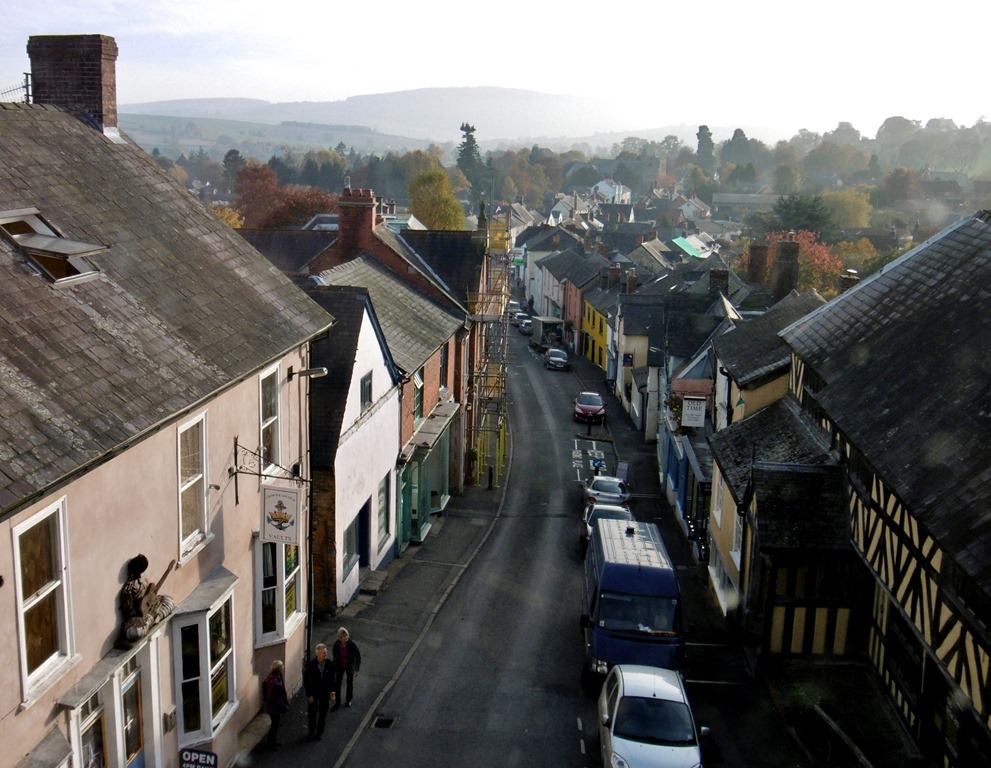
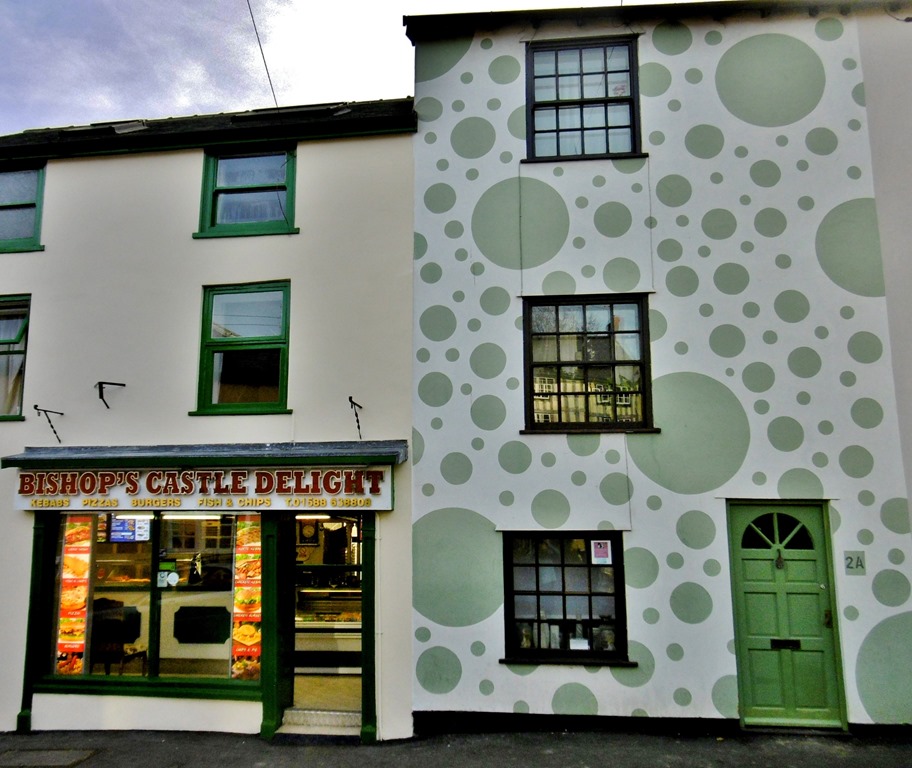
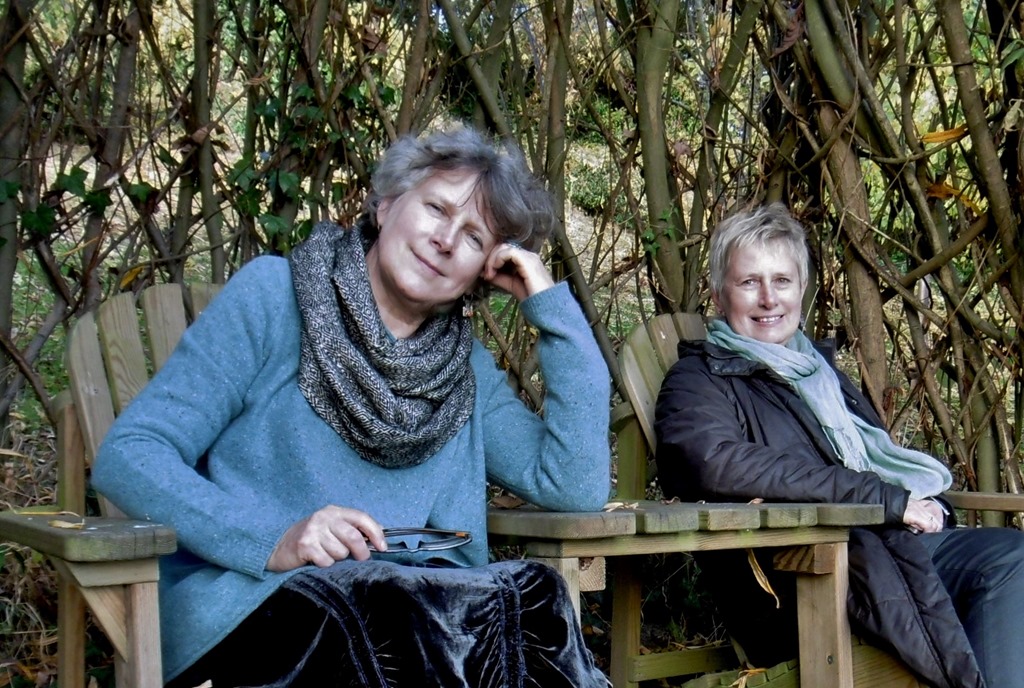
Here then are scenes of Bishop’s Castle. It is a town with a very long and steep high street – a handsome church at the bottom, a fine town hall at the top, and ancient hostelries brewing their own ale at either end. And from every quarter, whenever you look down a main street you can see out to the countryside beyond. The best of all worlds then. I’m leaving the photos to speak for themselves, apart from saying, look out for the crocheted fairy cakes: they almost look good enough to eat. Oh yes, and there’s a shot of me with my best and only sister, Jo, in the garden of the Castle Hotel.
copyright 2016 Tish Farrell
*
I’m linking this to Jo’s Monday Walk. So if you want more than the amble I’ve given you here, pop over there for a proper walk. It’s in Portugal too.
Wall to Wall Poppies In Wenlock
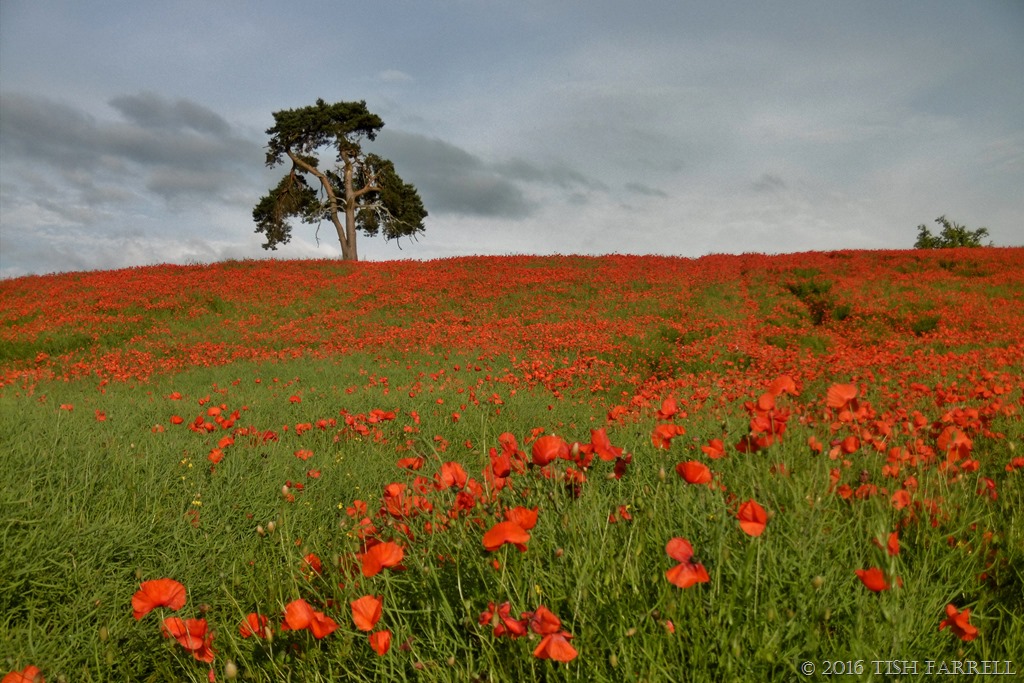
I spotted the blood red field across the town from Windmill Hill on Midsummer’s Eve. Yesterday at sunset, I gave up picking field beans and strawberries at the allotment, and went to seek it out. After a dull afternoon and early evening, the sun suddenly put in an appearance and I surmised it would be shining right on the poppies, and it was.
What a glorious sight. I have never seen such a profusion of scarlet heads, pushing their way up through the ripening stems of oil seed rape.
Of course the question I ask myself – is this happenstance or has someone gone in for some guerrilla gardening on an epic scale? Either way, it cannot be rivalled as a piece of earth art. And of course with the hundred year anniversary of the Battle of the Somme upon us, it strikes other chords – the pointless waste of so much promise; of so many brave young men. Today, too, just over half of the British voting public opted to leave the Europe Union, one of whose founding objectives was the avoidance of another European conflict. I feel very sad about this outcome. I think change can be best effected by participation and engagement from within. In fact we Farrells were so fed up this afternoon we had to visit the poppy field once more to cheer ourselves up.
So here’s to poppy power and creative cultivation. A potent beautiful force.
My Wenlock Summer Garden
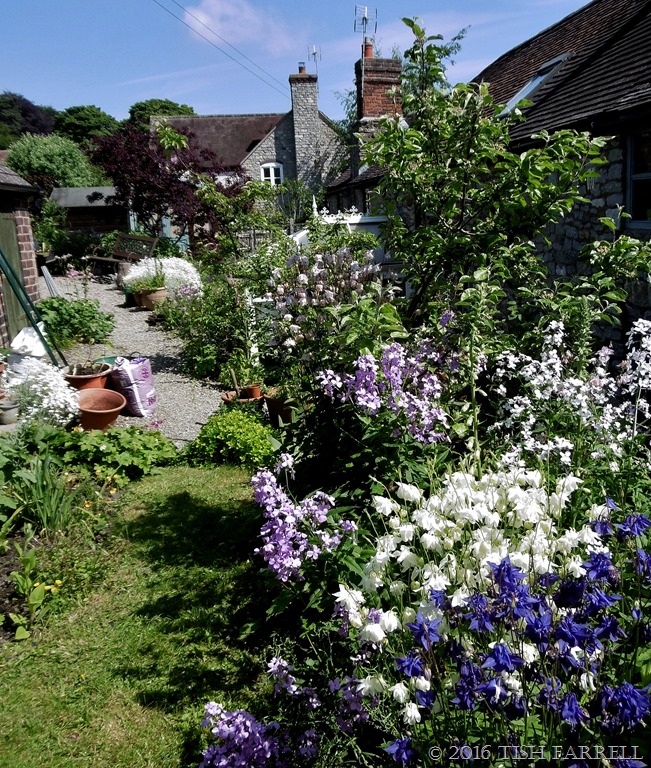
For her June Sunday Garden Challenge, Jude asks us to show her what summer means to us. So here are a few views of our garden on Sheinton Street. I should say straight away that I don’t give it the attention it deserves, and that daily I abandon it as I walk through and out the back gate and across the field to the allotment.
The plot is long and thin, following the width of the cottage, and on three different levels, which I don’t make enough of. For one thing, I know it must be possible to have beautiful plants growing somewhere within it all the year round if only I would sit down and do some proper planning and research.
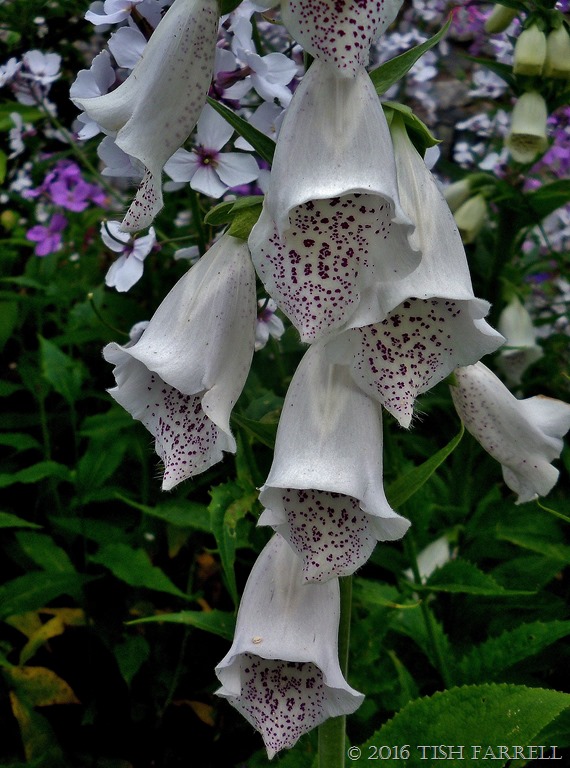
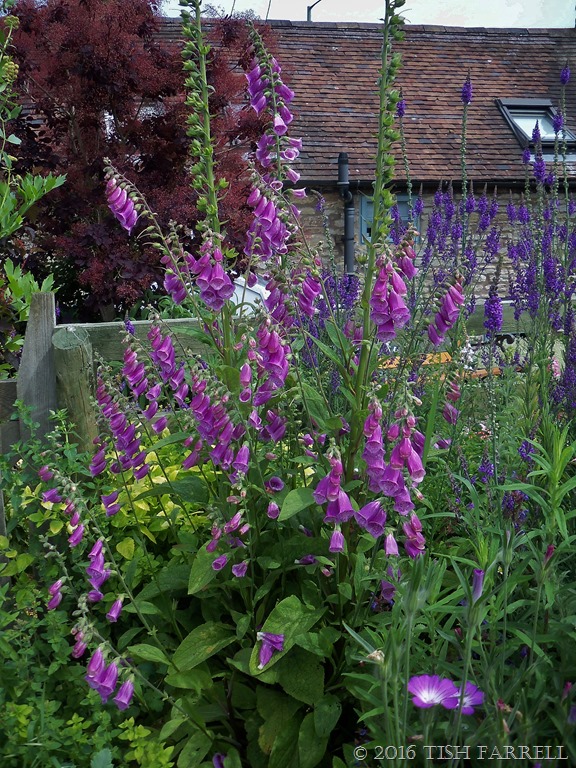
Instead I tinker here and there, and let the garden do a lot of its own gardening. This includes encouraging the self-sown foxgloves, and the wonderfully scented purple, mauve and white Dame’s-violet (Hesperis matronalis) seen in the photo behind the foxglove, both of which follow on from the clouds of self-sown columbines. My garden, then, comes into its own only in summer, and otherwise can look rather dreary. But while it’s here, it’s wonderful – total cottage garden exuberance and chaos.
Welcome to my garden.
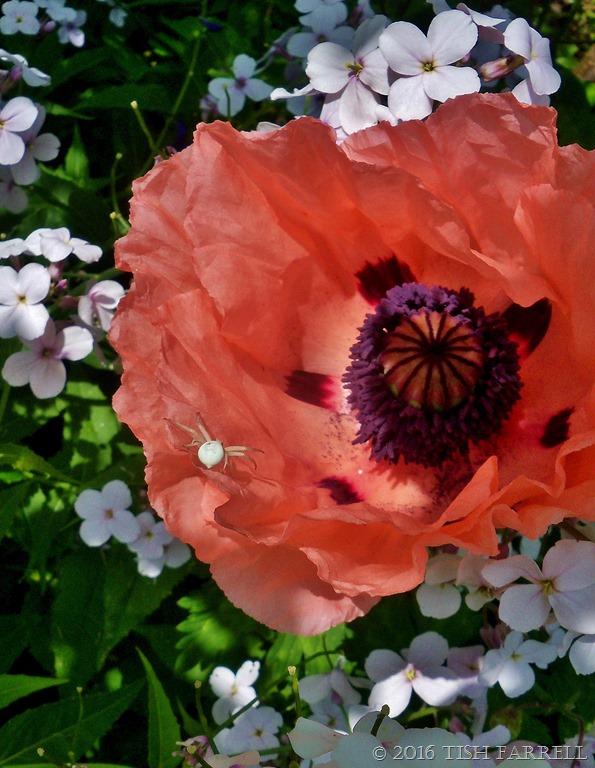
Oriental Poppy, crab spider and Dame’s-violets
*
Wild corn cockle (bottom right), foxgloves, purple toadflax; variegated lemon balm, oregano and golden marjoram in between, and the coppery foliage of Smoke Bush (Cotinus) in the background.
*
Columbine break-out
On The Diagonal ~ Around Wenlock In Winter And Summer
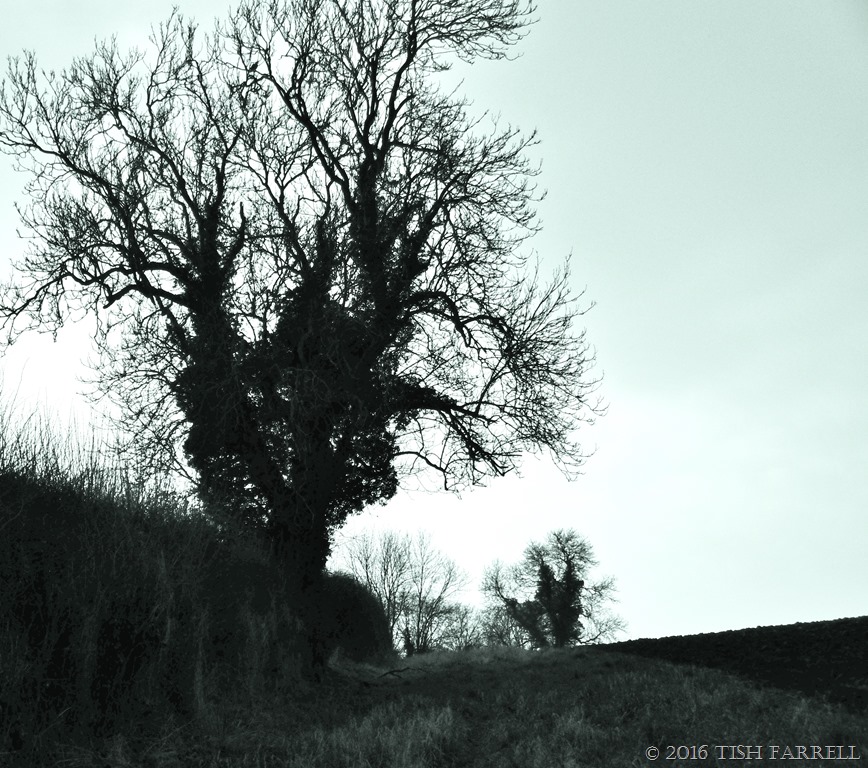
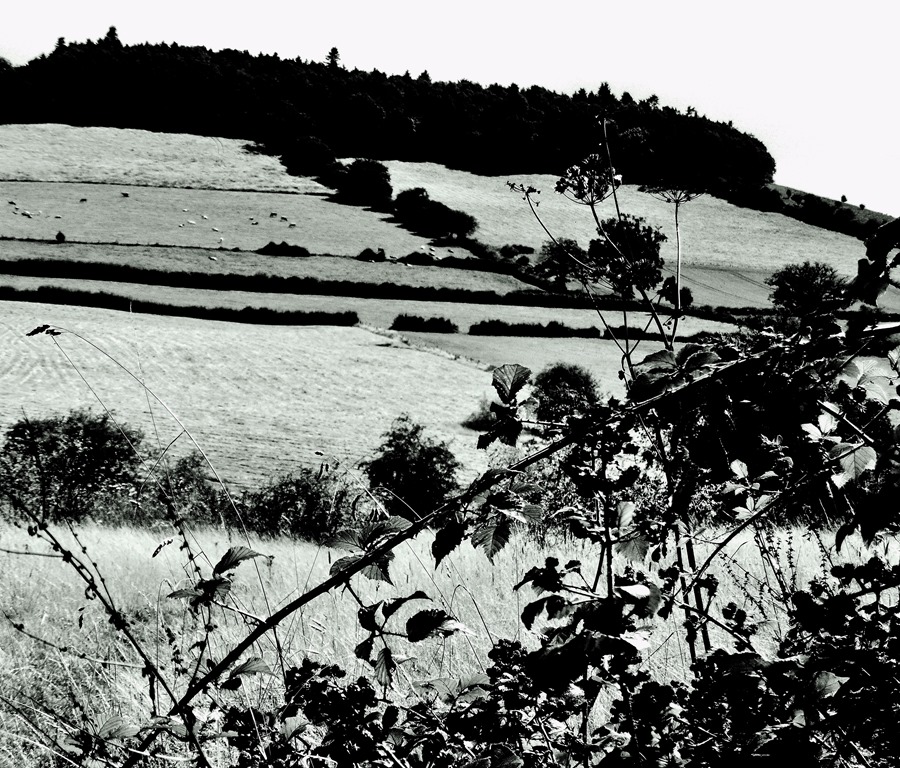
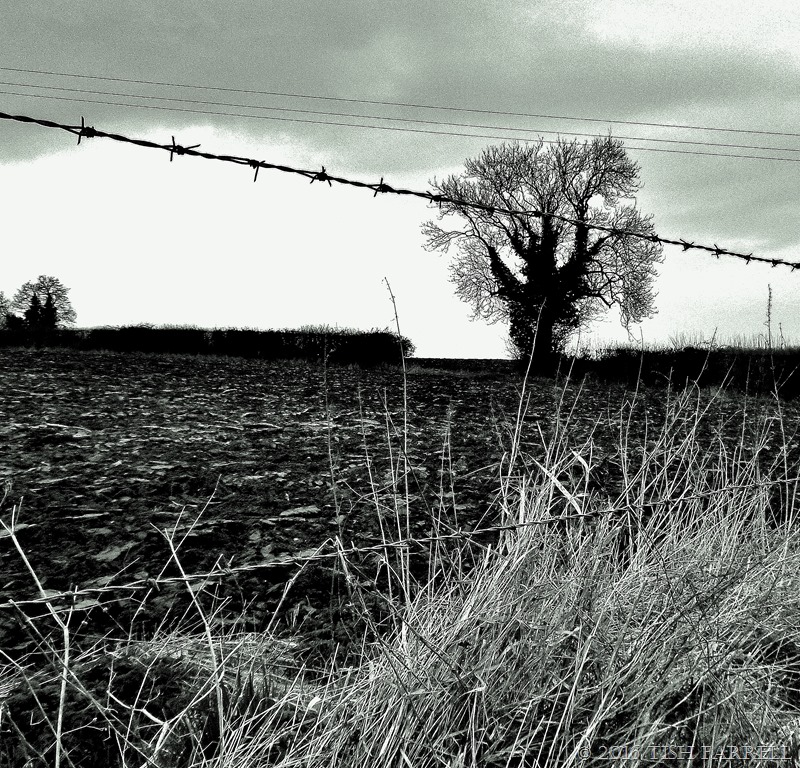
This week’s diagonals theme at Black & White Sunday is right up my street, or at least in my neighbourhood. Looking through my file of Lumix monochrome images, it seems that the diagonal often features. I think it’s because it appeals to both my visual and my writing mind. Things on the slant; one thing leading to another that’s not quite in view; unexpected angles; the monochrome subliminally suggestive of the written word and printed pages: storytelling then.
The first photo was taken on my well-worn path to the allotment. It’s a scene I photograph in all seasons, but I especially like the ash tree silhouettes in winter, their boughs cloaked in ivy which always reminds me of Tolkein’s Ents. I think this is where the lost Ent Women ended up, guarding our Wenlock Edge field boundaries.
Photo 2 was taken from the old railway line, leaning over the fence and shooting from deep shade into bright sunlight and with some zoom – not quite the best thing to do, though it gives the hilltop wood a touch of dark mystery.
Photo 3 is the field path from Wenlock to Bradley Farm, once the site of a medieval settlement.
Photo 4 – we are back at the allotment, the field behind our plots looking at the ash trees from another angle. I like the way the barbed wire adds a bleak and faintly sinister air.
Now please visit Paula at the link above for more photo essays on the slant.
copyright 2016 Tish Farrell
Ludlow Castle In Its Autumn Glory
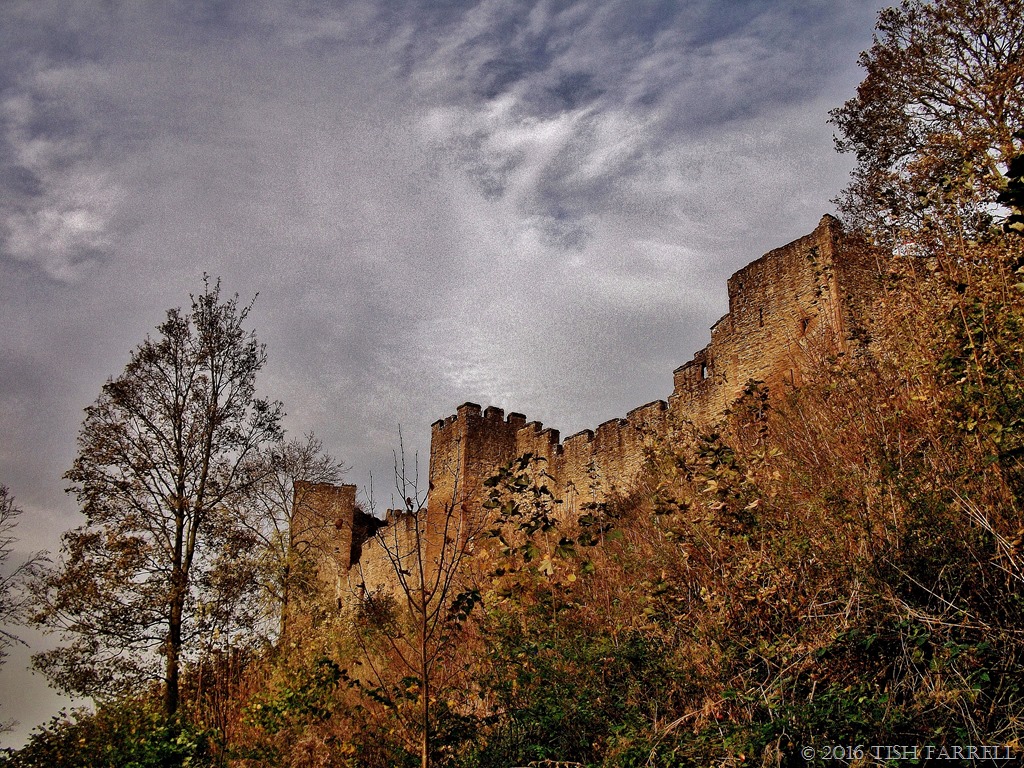
I recently posted a dramatic black & white photo of this thousand-year old castle – one of Shropshire’s finest. Here are the perimeter walls from a different angle, on their clifftop eyrie above the River Teme. It must have been a daunting sight for any peasant foot soldier commanded by his lord to get on and besiege the place. It might explain why so much of the castle is still standing.
Traces of the past is the theme over at Paula’s Thursday’s Special.
Trying Not To Dig The Plot And 30 Minutes Of Weird Weather
On a very dull Tuesday afternoon I thought I’d brave the cold wind and walk across the field to the allotment. On went the woolly hat, quilted coat (over three layers) and the wellies.
Unsurprisingly I had the allotment to myself – not another mad gardener in sight. I set about emptying one of the compost bins, and spreading the contents (a hand’s width deep) over a metre wide stretch of ground that had been cleared of over-wintering sprouts and broccoli. It seemed a good day to do it, and I was glad I had prised myself from the house.
This year I’m experimenting with the ‘no dig’ system of cultivation, so apart from tweaking out one or two noxious weeds, I resisted the temptation to get out my favourite spade. The objective is to cover the soil with enough interesting organic matter to excite the worms in the soil below. They then do the digging, and other soil-friendly organisms get going too so that, hopefully, the later seasons’ crops – cabbages and sweet corn – can be planted out on the much improved, and better nourished ground.
I was thus in the middle of this very absorbing activity when someone upstairs switched off the lights and I turned to find a tempest sneaking up on me.
Yikes! By the time I had scooted across the plot to the shelter of my polytunnel, we were having a small, but very concentrated snow and hail blizzard. It was far too stormy to think of making for home. Instead, I pottered about in my tunnel sowing some purple Brussels sprouts seeds in modules, while trying to remain hopeful that this truly was a passing squall and not the heavens falling in as the heavyweight clouds suggested.
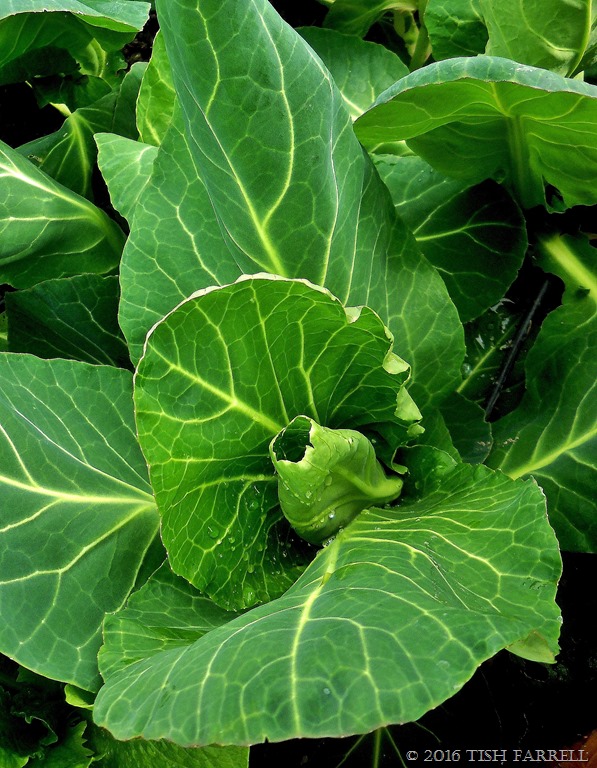
I forgot to record the actual blizzard that followed, so here are some Précoce de Louviers pointy spring cabbages that are growing most happily in the tunnel.
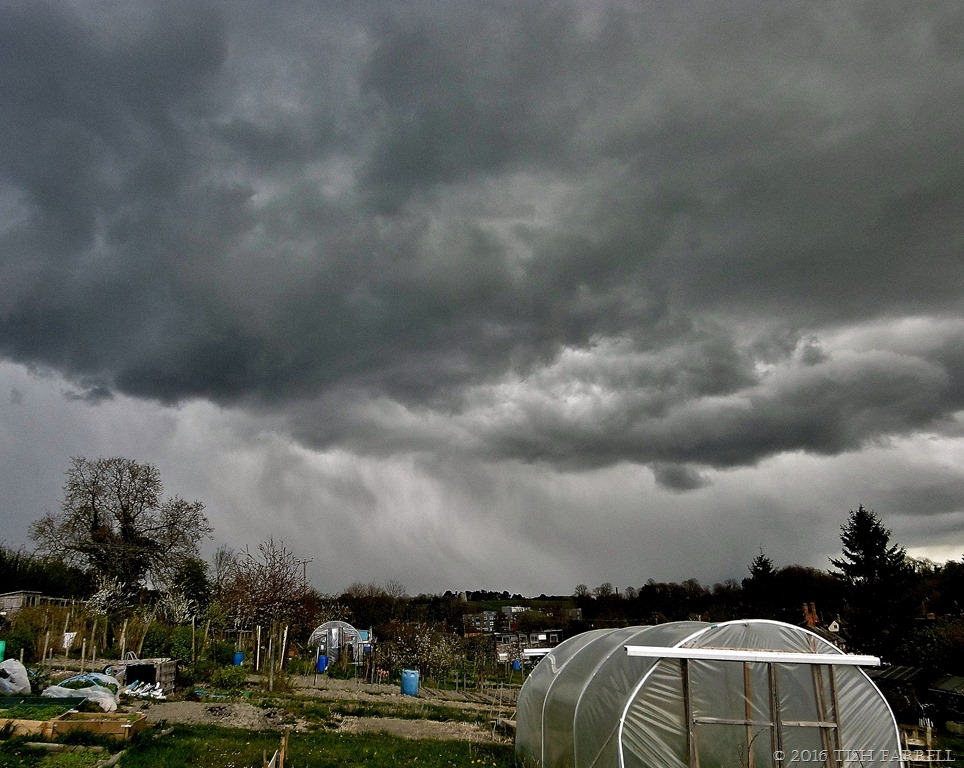
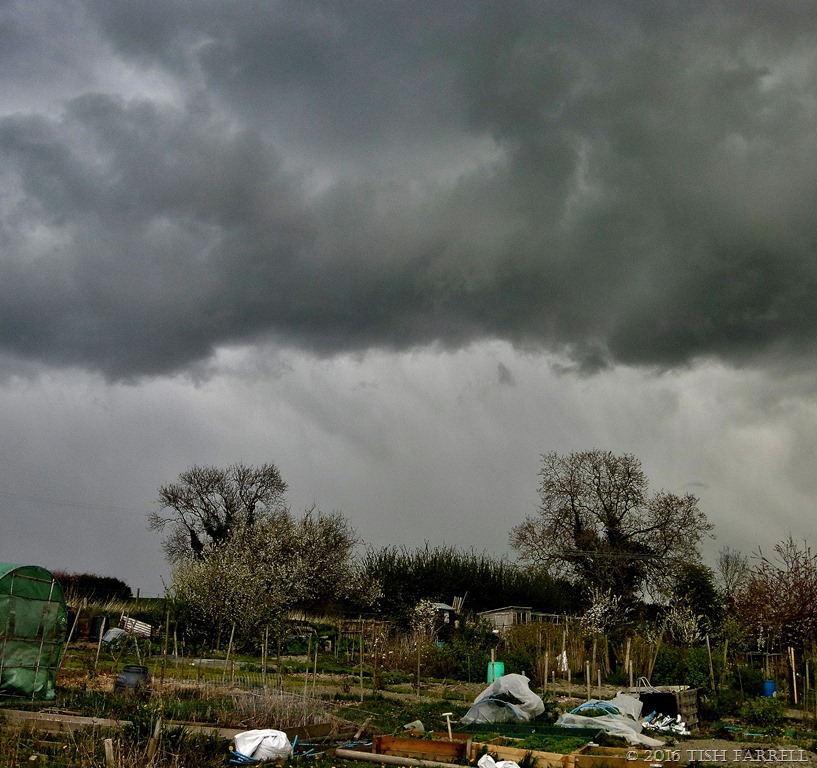
When I stuck my nose out of the tunnel some twenty minutes later, this was the view over Much Wenlock:
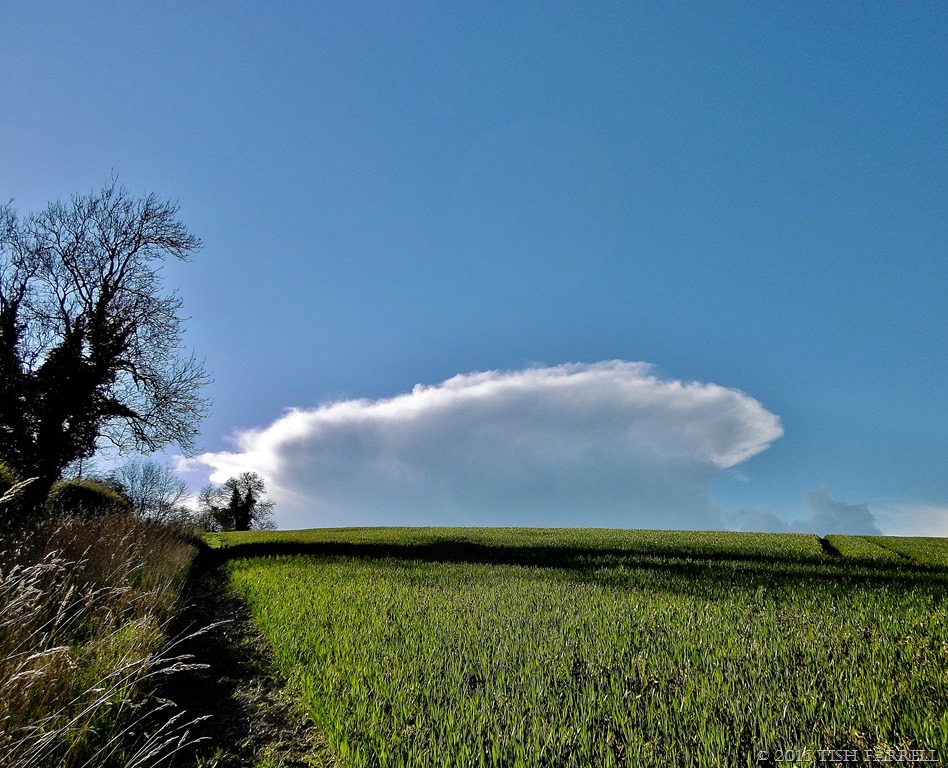
By which time it was too late, and the ground too wet to go back to compost spreading. As I walked home across the allotment, I watched strange, but less threatening clouds gather over the hills:
And when I stepped through the hedge into the wheat field behind our house, the sky looked as if butter wouldn’t melt in its mouth: snowstorm, what snowstorm?
Clearly the figment of a delusional, non-digging gardener then:
copyright Tish Farrell 2016