The People of the Birch Bark House

101_0161

101_0162

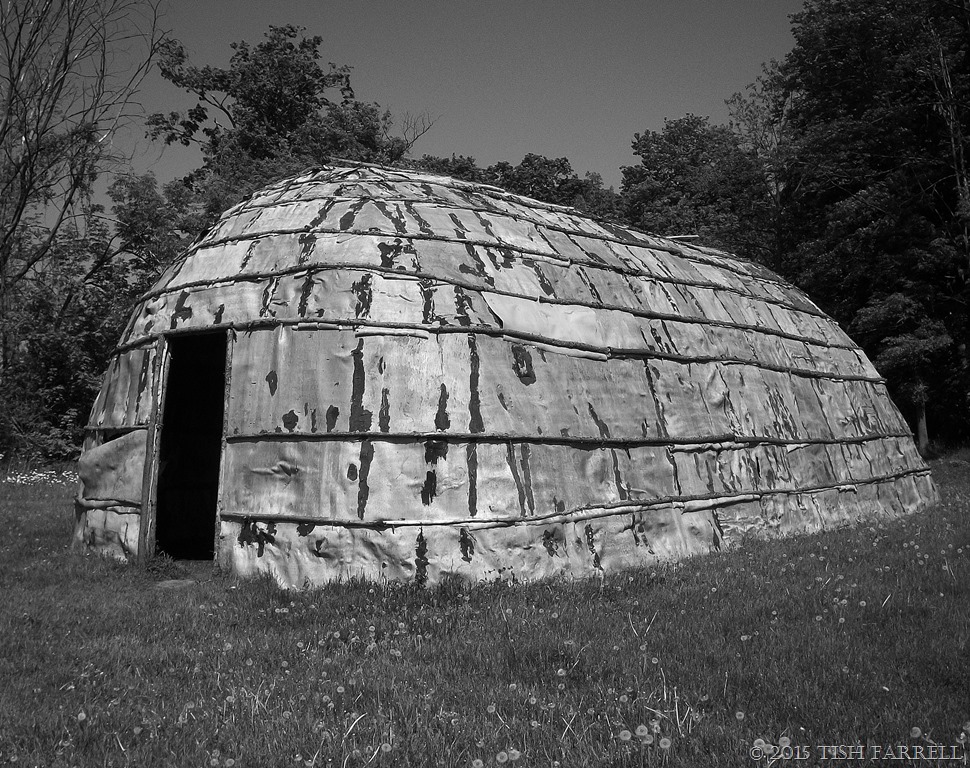
We came upon this reconstructed Iroquois longhouse when visiting the Museum of Ontario Archaeology in London, Ontario. It stands next door to the museum, on the Lawson site, where the remains of a 500-year-old fortified Neutral Iroquois village were discovered in the 1920s. Since then over 30,000 artefacts have been recovered, along with traces of 19 long houses and a long section of palisade. It is thought that around 2,000 people once inhabited the five acre site.

The village sits up on a flat plateau above Medway River and Snake Creek in northwest London, a good defensible position with access to fresh water and fishing. From the late 1400s there seems to have been an increase in inter-tribal conflict, made worse later by the arrival of Europeans, who among other things, sought to control the fur trade. Around the 1650s the Neutral Iroquois were defeated and dispersed by the New York State Iroquois, leaving south western Ontario empty until the early 1700s when the Ojibway moved into the area.

The Iroquois called and call themselves Haudensaunee. (See the Haudensaunee Confederacy website for more about their culture). I read that this name translates as: ‘People of the longhouse’. It is a fitting name for a culture whose architecture so clearly defines their communal ethos.  Traditionally, longhouses were as long as there were extended family groups to occupy them – between 60 and 300 feet. The frame was made of bent saplings with a span around twenty feet wide and high. On either side the door, platforms ran the length of the house, with one family to every section. Every two families facing one another across the corridor shared one of many central hearths. The Lawson example, though, is apparently more typical of longhouses found in northern Ontario since it uses a covering of birch bark rather than elm that was used in the south west.

It was strange, but the Lawson longhouse felt very lonely. Perhaps it was because there was only one house on a site where there should have been several. Inside, too, there was a curious sense of abandonment, and this seemed odd for a reconstructed exhibit. There was no one else around on the day we visited, just the spring breezes in the surrounding scrubby woods. Even now, several years on, I can still feel the great sense of sadness that I experienced as I walked around the site. I had earlier been told at London’s Fanshawe Pioneer Village that before the European settlers arrived, south west Ontario was a land of monumental trees, and as soon as I heard this I began to regret their loss. It was also a land of peoples whose values and customs were often greatly misrepresented and wilfully eradicated by the newcomers. I felt the loss of them too, and also the sense that we had missed something very important by not understanding better how the ‘first people’ lived in the once majestic landscape, that is now so very cleared and broken in, and in many places, downright ugly with viral shopping malls, diners and freeways.

© 2015 Tish Farrell

Cee’s Black & White Photo Challenge: Wood

Thursday’s Special: Multicoloured

IMG_0391

This batch of colanders made smile. They were spotted in a cook shop window in Portsmouth, Massachusetts, where we had stopped en route for Boston.  I was entranced. Like a child eyeing shiny new building blocks, I wanted them all. What was the point of buying only one colander when they looked so good in a crowd? And which would I choose – the red, or the mauve, or the sky blue, or…? My companions walked off without me. Lunch was calling. So in the end I simply snapped them, and now they seem just right for Paula’s Multicoloured prompt at Thursday’s Special.

Thursday’s Special ~ Take Two Elephants

225

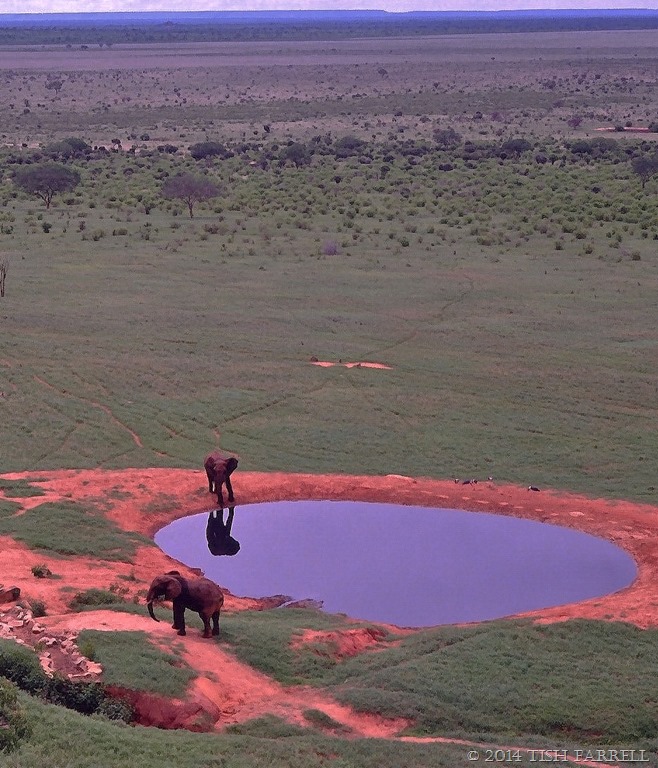
This week at Paula’s Thursday’s Special/Photo 101 the theme is ‘double’. I could have chosen several more striking close-ups of elephants and lions, but this shot is a double-take on double. I like that silhouette in the still pool. Also it is perhaps a more realistic view of how one most often sees wildlife on an East African safari: i.e. it’s usually too far away for a good photo, or else there’s a bush in the way. You can also drive round game parks for many hours and spot absolutely nothing – not even a bird.

This shot was taken from the terrace at the safari lodge in Kenya’s Tsavo East National Park, and such places can offer the best sightings, especially at dawn and sundown. Here you also get a good eyeful of Tsavo’s famously red earth. You can see, too, the web of game trails leading to the pool, and at the very top of the photo, part of the Yatta Plateau. This is a 180 mile long, single finger of lava that runs south east across Kenya from Thika near Nairobi.

Tsavo East  is a vast game reserve (4,500 square miles), mostly thorn scrub and much of it closed to visitors due to incursions by Somali bandits and poachers. Its elephant herds, however, are famous, though frequently under threat. For some truly fantastic images of them, accompanied by expert commentary please fly over to wildlife filmmaker, Mark Deeble’s blog. You will not be disappointed.

Let’s Hear It For The Bees ~ Three Big Cheers

100_3915

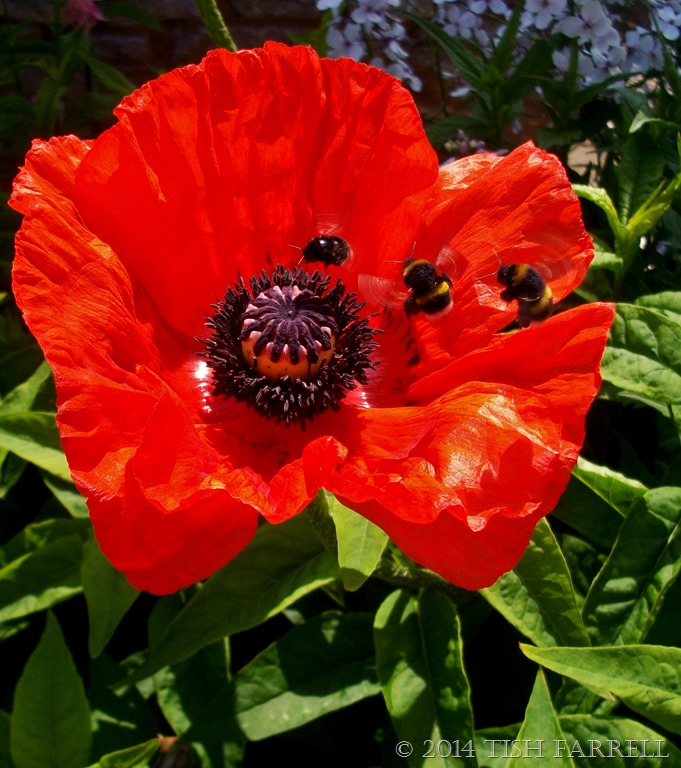
There are different kinds of achievement in this shot. The first is that I managed to capture it at all, teetering in a flower bed with my Kodak Easyshare. The sun was full on too so I could not see the camera screen. But by far the biggest achievement is the presence of three bumble bees all at once.

All over the world bee numbers have been declining. Swarms in the US have been especially hit. Over the last few decades many factors have played a part, including habitat erosion, lack of quality forage and disease. But in 2006 honey bee keepers began to report dramatic losses. It involved the deaths of whole hives and has been dubbed colony collapse disorder.

Environmentalists believe the cause to be the neonicotinoids in the new generation of pesticides. They want them banned until unbiased research proves otherwise. It is a sobering thought that without bees to pollinate fruit and vegetables, the US would be left with only three staples that do not require insect pollination: wheat, rice and corn.

To find out more, please visit Dear Kitty. Some Blog.  She has posted a good video that covers this topic. In the meantime, everyone needs to think about what they can do to encourage bees, including growing some bee-friendly plants. We also need to be prepared to pay a little more for organic produce, or to do what we can to grow our own food, WITHOUT chemicals.

This would be a real achievement – not only good for bees, but for us, the soil, and other wildlife besides.

copyright 2014 Tish Farrell


Thursday’s Special: November Roses On My Kitchen Table

100_6875

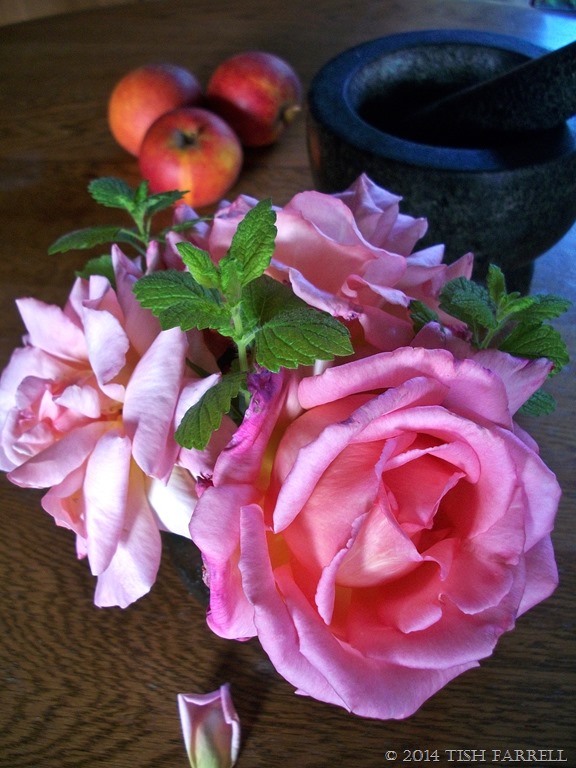
In response to Paula’s Thursday’s Special challenge, here are my late roses opening in the warmth of my kitchen. One petal has already fallen, the rest are soon to follow. But how blissful they smell (sorry I can’t provide a sniff link), and what a joy to pick roses in November even if they do last so briefly – indoors or out.

The greenery is Lemon Balm, a soothing herb for all occasions, and the apples are Coxes Pippins from the allotment. To my mind Coxes are the best apples ever, and totally wonderful in Tarte Tatin, which is a Sheinton Street speciality when He Who Leads is not having a fit of waistline watching.

And if you’ve not had Tarte Tatin, then you have a delight in store. It comprises whole or  halved, peeled and cored apples caramelized with vanilla, lemon juice, unsalted butter and sugar (enough apples to fill a pan in one layer). Then the pastry is laid on the top and tucked all round the fruit, and the lot baked in the oven. To serve, place a plate over the pan (carefully and using oven gloves) and turn out the Tarte. TA-RAAAH!  Have a warm evening everyone.

Rhinos: strong but oh so vulnerable

Scan-140827-0009jpeg

The poaching of rhinos for their horn is a truly abhorrent trade, and shows humans at their worst, not only in terms of wanton cruelty, but also for their gross stupidity in believing that the horn a) makes a nice macho handle for their dagger, or b) does a single thing for their sexual performance. I do not wish to be sexist, but we are talking of the male of the species here.

However, while we are blaming recent decades of poaching for big game loss, it is worth remembering that some truly monumental decimation took place in countries like Kenya under colonial rule, and by the kind of aristocratic settler who considered East Africa their own personal hunting ground; this to the exclusion of the people whose land it had been for generations, and who then became labelled poachers if they were caught hunting for the pot.

John Hunter, was but one of many white hunters who worked both on his own account as a safari leader, and as a game clearance officer for the government. He began his hunting career around 1910 after quitting his job as a guard on the Mombasa railway. In an article in LIFE magazine 12 July 1952 he begins by saying:

When I first came to Kenya the game covered the plains as far as man could see. I hunted lions where towns now stand, and shot elephants from the engine of the first railroad to cross the country. In the span of my 65 years the jungles have turned to farmland and savage tribes have become factory workers. I have had a little to do with this change myself; for the government employed me to clear dangerous beasts out of areas that were opened to cultivation.This was in a day’s work for me; yet I have always been a sportsman.

John A Hunter(1887 – 1963)

*

His career tally for elephants killed is 1,400, but when it comes to rhinos, he holds the world record. Over a two-day period he was responsible for 1,000 rhino deaths, the slaughter taking place in the Makindu area of Ukambani, about a hundred miles south of Nairobi. The land, and rather poor land at that, was wanted by the authorities for the resettlement of the Akamba people. But the scale of the killing goes to show how plentiful these animals once were.

When John Hunter came to retire in 1958, it was to the small hotel he had built at Hunter’s Lodge, Makindu. I have written about the place in other posts; we practically lived there in ‘92. The story goes that successive owners had long given up trying to keep the roadside hotel sign upright. Always, the locals said, some avenging rhino would come and flatten it. Whether this was a real or a spirit rhino, no one said, but there were certainly no rhinos in sight when we were there.

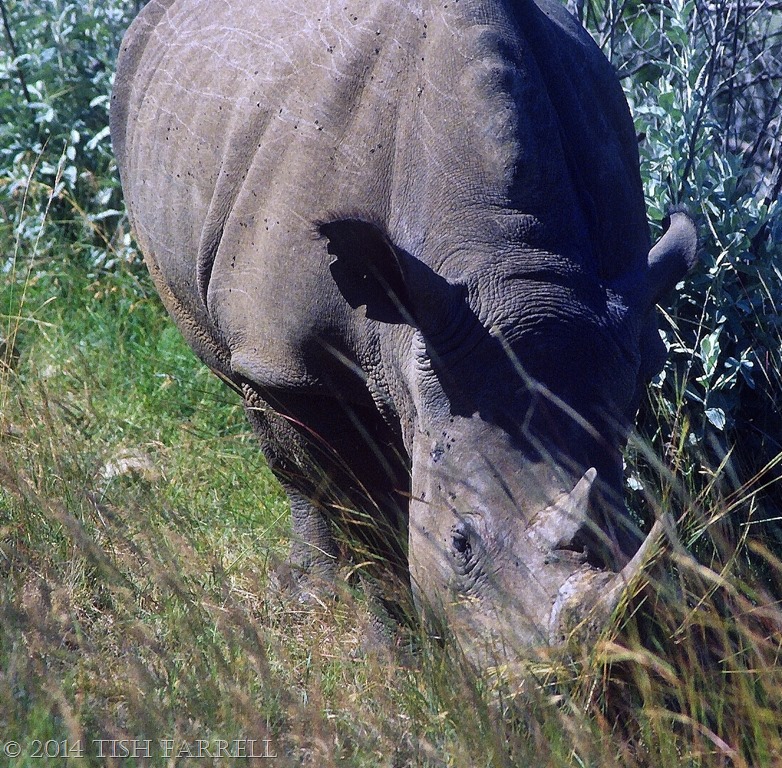
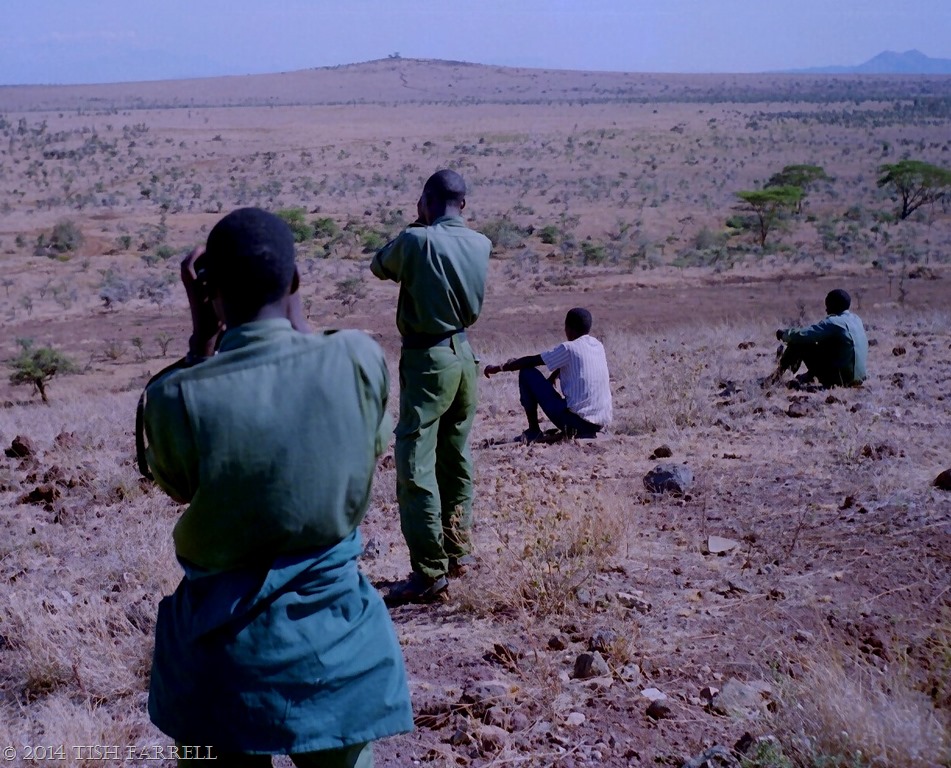
Today in Kenya there are several private reserves where small numbers of black and white rhinos live out their lives with round-the-clock ranger-guards. At the time when the top photo was taken, the white rhino concerned inhabited, with several others, a secluded part of a Maasai-owned group ranch. It is hoped that initiatives such as these will keep the species viable, but it is by no means certain. It is anyway a dangerous job for the men in the photo below. These days poachers come well armed with automatic weapons. It takes great bravery and strength of character to protect the world’s wildlife out in the bush. So three cheers for the rangers wherever they are working on this, WORLD RHINO DAY. These men and women deserve all our  praise and support. It is only a shame that their diligent protection continues to be needed.

Scan-140809-0037

Anti-poaching team in a private reserve in Northern Kenya

*

copyright 2014 Tish Farrell

For a South African perspective on the state of rhinodom see De Wets Wild, always a blog worth visiting for its wonderful wildlife photos.

And for an Indian view, Sriram Janak’s wonderful blog.

Ailsa’s travel theme: strong for more strong stories


on a knife edge at victoria falls

Zambia's Victoria Falls looking along knife-edge to Zimbabwe's falls

Hang-gliding over the hundred metre precipice at Victoria Falls is not to be recommended. Nor had I intended to take the plunge, my ‘sail’ being nothing more than a wet kanga-wrap, held up to fend off a tropical deluge. Somehow, though, circumstances (and a lack of sensible forward planning) had led us to the Falls’ knife-edge just as Zambia’s 18-month drought was ending, and the rains beginning. Even without  the hang-gliding it was a heart-stopping moment.

The prolonged drought across Southern Africa was of course the reason for Team Farrell’s presence in Zambia in late 1992. The Team Leader, Graham, had been seconded to the European Union Delegation to manage maize flour and cooking oil distribution to foodless villages across the nation. We had only been in the country a couple of weeks when G was directed to go down to Livingstone on the southern border to inspect a newly arrived consignment of maize. His boss suggested he should drive down on a Saturday and take me too. Naturally Nosy Writer (that’s me) was only too pleased to head off on a several hundred mile safari.

Looking back, the diplomat’s suggestion that I should go was possibly a kindness in disguise. Nothing was spelled out, since we were newly arrived, and Bernard (aka the boss) did not wish to scare us before we had found our bearings. But security in the capital Lusaka was not good. President Chiluba, the newly democratically elected leader, had been in office for barely a year, this after ousting the incumbent of decades, Kenneth Kaunda.

Later it transpired that Kaunda’s army officer son, Rezi, had been intent on destabilizing the country, and was apparently behind the city’s upsurge in violent crime. On top of that, in neighbouring Zaire (now DR Congo) President Mobutu had not been paying the army, and so gangs of gun-toting soldiers would drive down to Lusaka for a spot of night-time car-jacking and house-breaking. In a nation of impoverished people, the diplomatic quarter was the obvious target. Better, then,  that I should not be left alone. Not that I knew this then. Nor had G’s company thought to mention any of this before offering his services to the EU. As they say, ignorance is bliss.

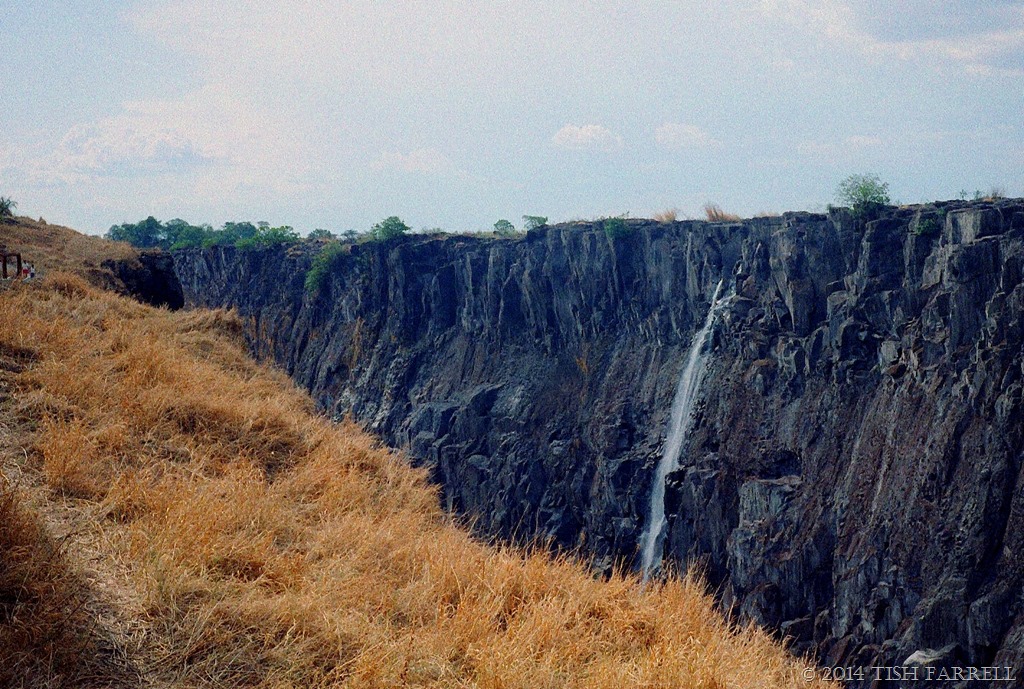
Zambia's Victoria Falls in the dry season

And so one Saturday morning under a wide blue, and seemingly ever rainless sky we set off south. The road, once clear of the city, ran on mile after mile after mile with hardly another vehicle in sight. We passed through landscapes of rolling woodland, the tall-tree miombo which, at first glance seemed more like Europe than Africa. After nine months in Kenya the vistas, too, seemed curiously lacking in drama –until, that is, we reached Livingstone.

Our hotel stood beside the Zambezi, and after tea on the lawn in the English manner it was off to the nearby Falls. The photo above was my first view of them. I wasn’t sure whether to laugh, cry or simply stare open-mouthed. Where was the water?

The drought had much to do with it of course. But the other reason was that Zambia abstracts large volumes of water to run its hydroelectric plant.

004 (2)

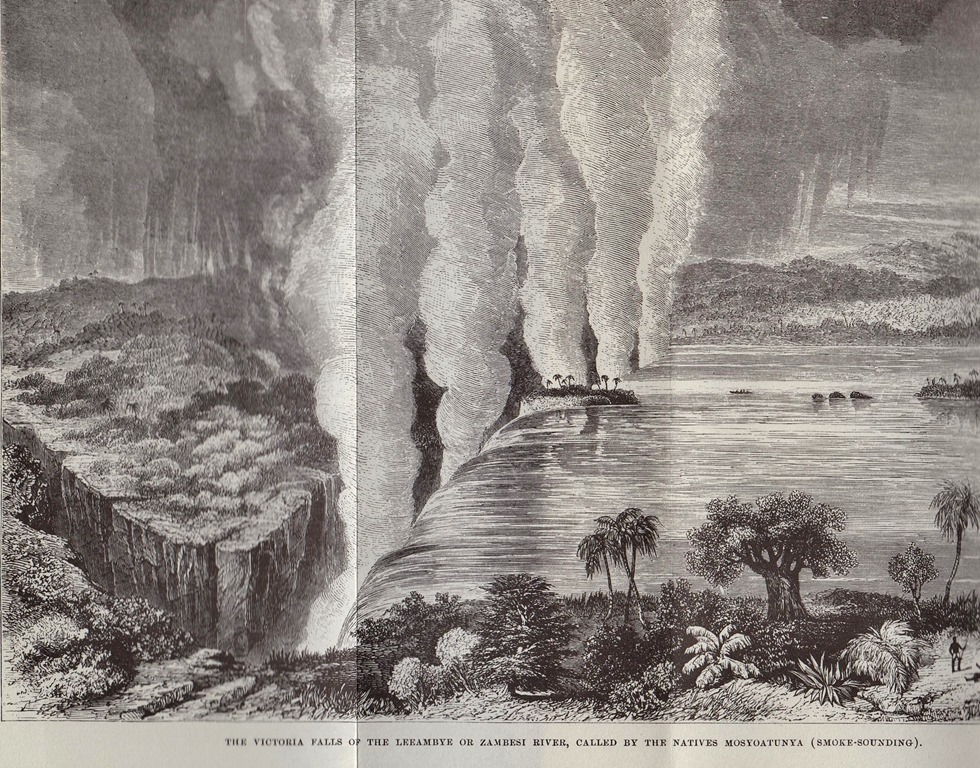
The Falls as seen (and ‘discovered’) by  David Livingstone.

Engraving from Missionary Travels and Researches in South Africa 1857

*

G told me the best view of the falls was across the border in Zimbabwe, and that if we had remembered to bring my passport we could have walked across. Most frustrating.

Instead, we walked along the path beside Zambia’s waterless gorge.  But trailing through dead vegetation while staring at the stark basalt cliff face felt more and more oppressive. It made me think of Tolkein’s Mordor. We gave it up and went back to the hotel.

Our room theoretically had a river view. In reality all we could see was its empty bed, with huge boulders and clumps of palms here and there. But on Sunday afternoon I noticed that people walking across it. “Let’s go,” I said.

The sun was shining when we set off, and soon we were joined by a boy who appeared from nowhere and offered to guide us to the best Falls’ viewpoint. We duly followed, picking our way round oily looking rock-pools, mammoth sized boulders, and piles of fresh elephant dung.

We must have scrambled on for nearly a kilometre when the sky started to turn grey. I began to feel nervous, glancing upstream and expecting a wall of water to come rolling down. Or to walk round a boulder and into an elephant.

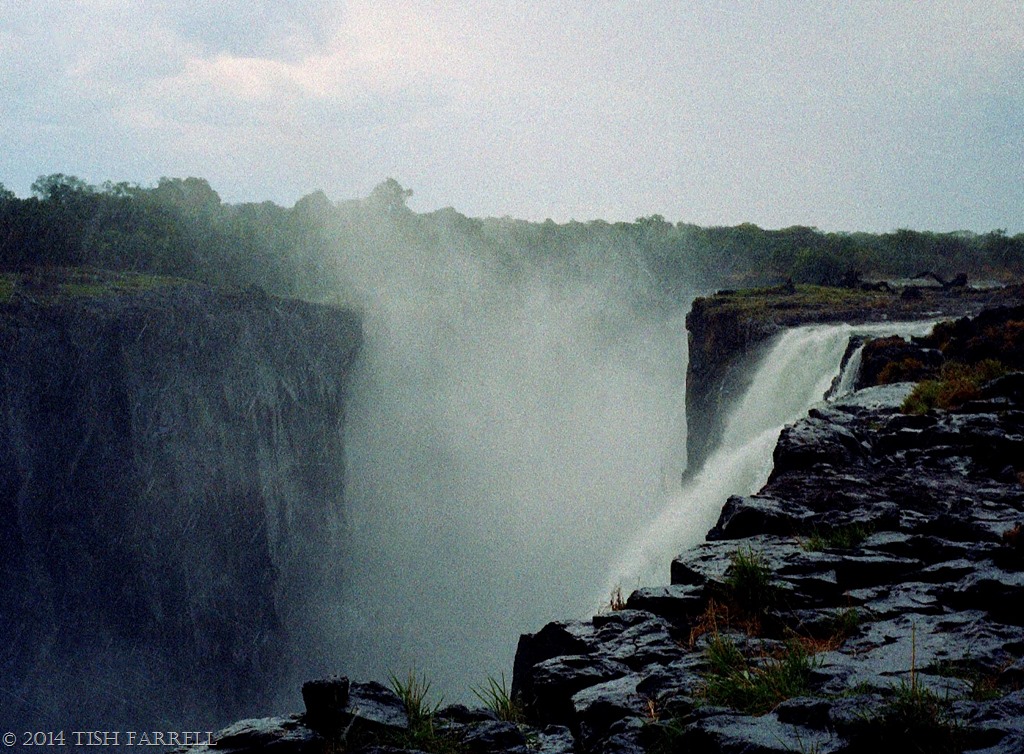
And then the rain came down. Fat freezing drops. We made a dash for cover, which happened to be some trees on Livingstone Island, the very spot from where the explorer had first viewed the Falls in 1855. We crouched for ages under dripping trees until at last, thoroughly soaked, G asked the boy if the ‘good view’ was much further. On discovering that it wasn’t we made a final dash. And here it is. The view:

Victoria Falls, looking over the knife edge in a rainstorm

Not much to be seen for the spray coming up, and rain coming down. I took this quick snap, and then held up the sodden cotton wrap that I had been wearing earlier to fend off the sun. As I stood on the knife-edge the sudden gust of wind that filled the wrap was enough to lift me towards the abyss. I stepped back in shock. I’d had more than enough of Mosi-oa-Tunya (the smoke that thunders). So had the boy.  Soon he was sprinting away without even waiting for a tip, and that really had me worried. What did he know that we didn’t? We slipped and slid, back the way we had come. More phantom elephants. More imaginary flash floods. More getting lost in outcrops of giant boulders. It seemed a long, long way back to the hotel.

It was not until several months later that we finally got to see the Falls, this time from the Zimbabwe side. On this occasion we only got drenched from the spray, while I took yet another wet and misty photograph, but thankfully avoided all inclination to hang-glide.

Victoria Falls and Zambezi

copyright 2014 Tish Farrell


Related:

The Smoke that Thunders

Letters from Lusaka I

Letters from Lusaka II

Once in Zambia – in memoriam


Daily Post Photo Challenge: adventure for more bloggers’ photo-adventures

strait edge

IMG_0834

This awe-striking effect of cloud and sunlight seems to be a feature of Menai Strait, the narrow stretch of tidal water between the island of Anglesey (Ynys Môn) and the North Wales mainland. This photo (looking towards the mainland) was taken around midday in December last year. The cloud had banked so thickly it seemed we were heading into night. Over the previous days there had been horrendous winds that had torn across the island, ripping up trees and closing roads. And then quite suddenly the sun broke through – a moment of luminous tranquillity after all the storms.

Anglesey has a long and dramatic history extending back to at least the Neolithic. At the start of the Common Era it was also the stronghold of the Celtic peoples’ priestly caste, the Druids. These warrior mystics were slaughtered in a terrible battle by the army of the Roman Governor of Britain, Suetonius, which in 61/62 AD bore down on them across this Strait. You can read more about it in Island of Old Ghosts.

copyright 2014 Tish Farrell

Ailsa’s Travel Challenge: Edge for more edgy photo stories

Hyena Heist in the Mara

Scan-140826-0021jpeg

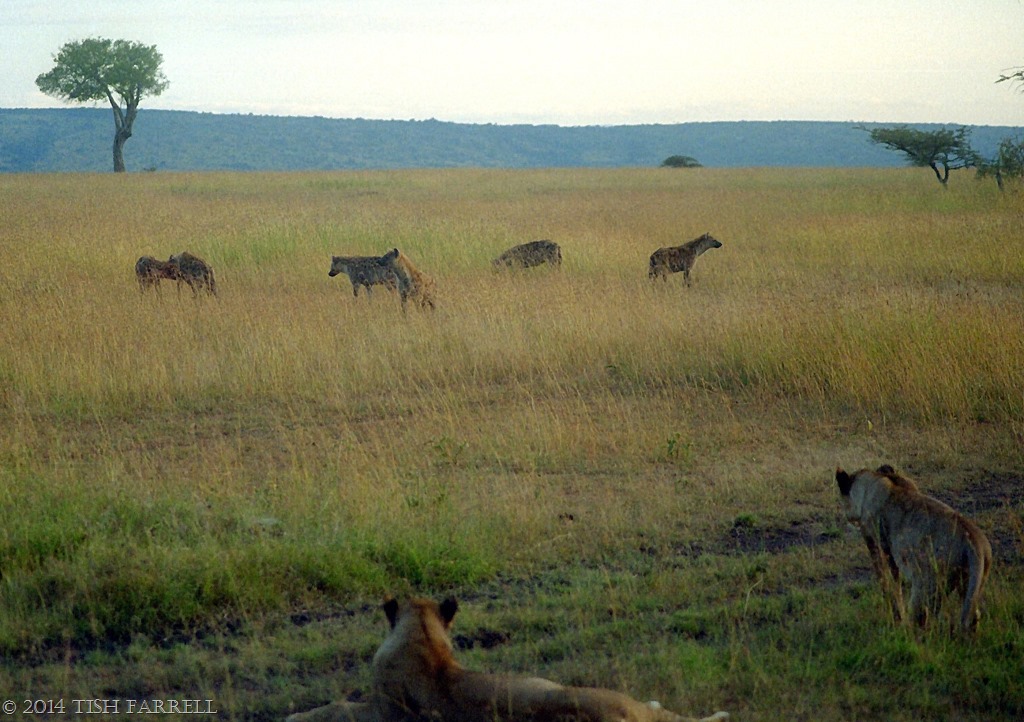
First light on the Mara plains, and the Marsh Pride lionesses have eaten well. In the night they have killed a giraffe and are resting up near the remains of the carcase.  The peace doesn’t last though. And it isn’t us who are bothering them.

Scan-140826-0029jpeg

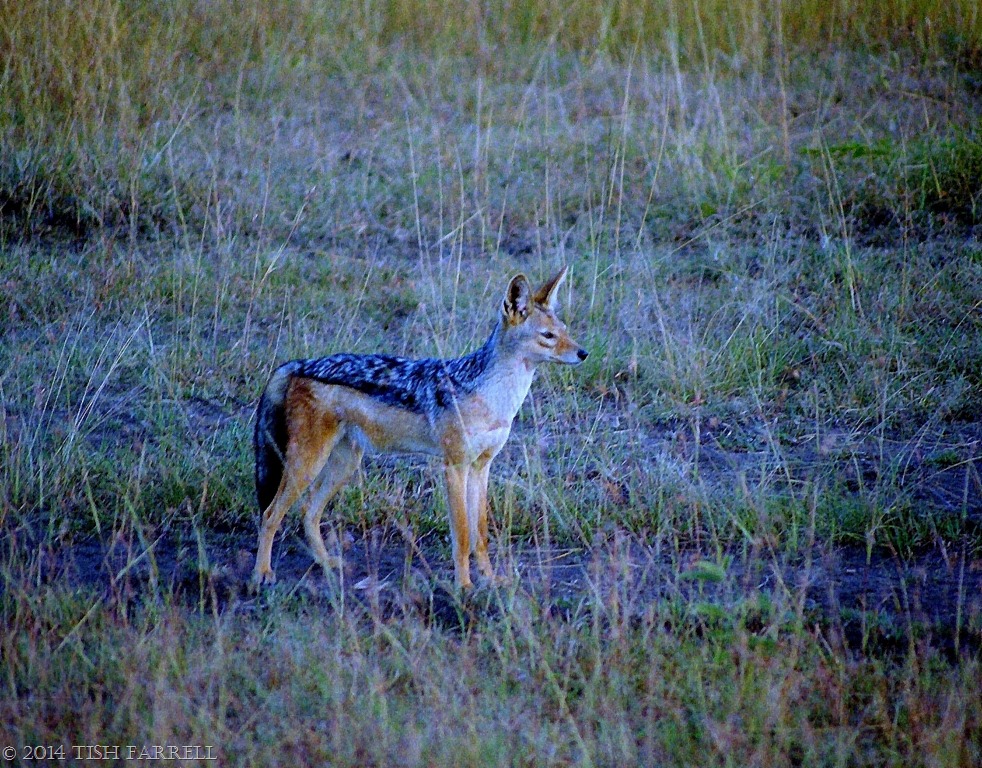
Other predators are moving in on the leftovers.  First a black-backed jackal comes trotting by, watches hopefully from the side-lines. Her chances are looking slim…

Scan-140826-0024jpeg

…already the heavy mob are moving in – a pack of spotted hyenas.

Scan-140826-0027jpeg

As I said in an earlier post, hyenas do  not only scavenge, they are powerful hunters with jaws like demolition-crushers. And despite their lop-sided gait, their feet with blunt, non-retractable claws, are well adapted for the long-distance chase. They can take down a wildebeest and eat and digest the lot (apart from horns and rumen) within 24 hours. They will also eat anything, including the faces of sleeping humans caught out without sufficient night-time protection. This was a commonly reported horror while we lived in Kenya.  In consequence they are East Africa’s most successful large predator, apart from politicians, that is.

Scan-140826-0026jpeg

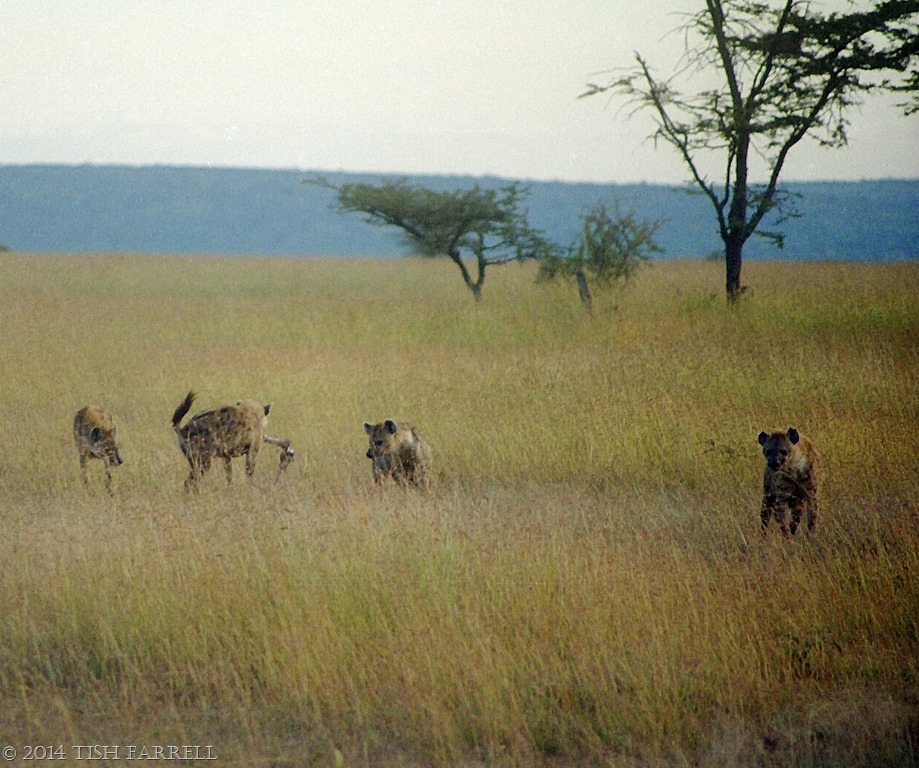
Here, one of the pack has made a rush on the kill and escaped with some leg bones, but it doesn’t look as if sharing is on the hyenas’ menu.

Scan-140826-0006jpeg

Scan-140826-0008jpeg

The lionesses go on watching, alert in that laid-back kind of way that cats do so well. The remnants are not worth fighting over. When the time comes, and bellies are empty, they will make another kill.

FLICKR COMMENTS ‘H’ WORDS for more bloggers’ stories

copyright 2014 Tish Farrell