
Enjoy!
Much Wenlock
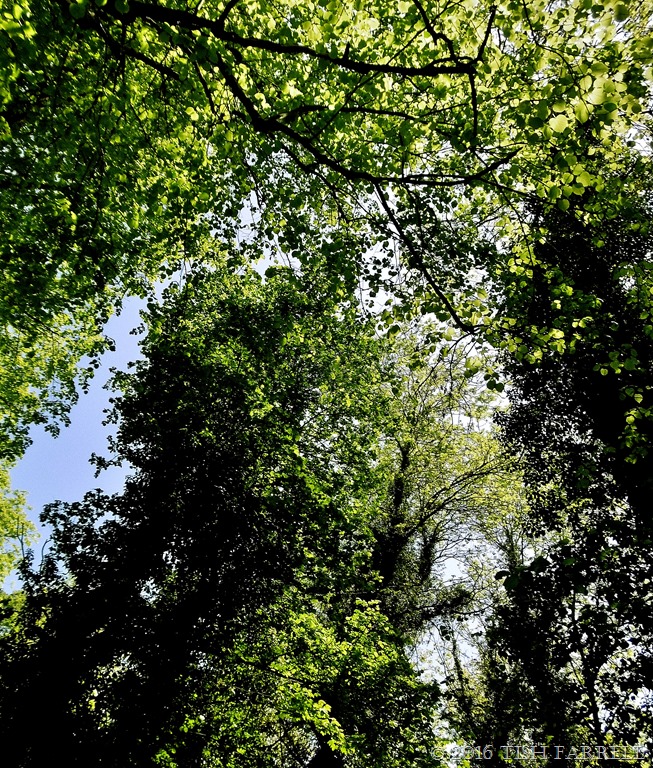
The Power Of Green And Dappled Sunlight This Morning On The Linden Walk


You can almost see the sap rising – gushing forth in fact to catch up after a slow-start spring. Anyway, walking amongst it this morning made the pursuit of allotment chores a complete and utter pleasure.
The chore in question is part of my on-going experiments with no-dig cultivation. So armed with my big green polypropylene bag I was out gathering up some of the piles of tree shreddings left around the Linden Field by the chap who comes to trim the lime trees’ overgrowth. I then haul them up to the allotment where I am covering a 6 feet wide x 20 feet section of uncleared plot with cardboard plus several inches of chippings on top. It’s rather a slow process, but I’m over half way there.
I’m hoping that by the time I get round to cultivating this section next year, most of the worst weeds will have turned up their roots, and the mulch rotted down enough to produce a reasonable planting medium. Oh yes, and that in order to achieve all this both the cardboard and the mulch will have attracted a lot of very happy worms.
The thing is, though, once I’m out on the Linden Walk it is so easy to forget about heavy labouring, and slip into a complete green daze. And as you can see, I also had my camera with me. I was particularly taken by this fence post:

And then at the end of the avenue near one of my target chippings piles, I noticed a nice flat area between the limes and the old railway line. I had not spotted it before, but it looked just the place for some qi gong. Secluded enough, I thought, not to frighten any of the Wenlock dog walkers who might otherwise come upon me in the midst of repulsing the monkey or being a wild goose flying. So this is where I stood – beneath a canopy of limes and sycamores, accompanied by bird call and the soft flutter of pigeon wings. Aaaaah. Wishing you a similarly blissful, green-filled, sap-rising, sun-dappled day.
*
Now please pop over to Jo’s Monday Walk for a truly inspiring excursion in beautiful rural Poland. And to add your own walks to Jo’s go HERE.
The Changing Seasons ~ May With Zest Of Lime And Cricket
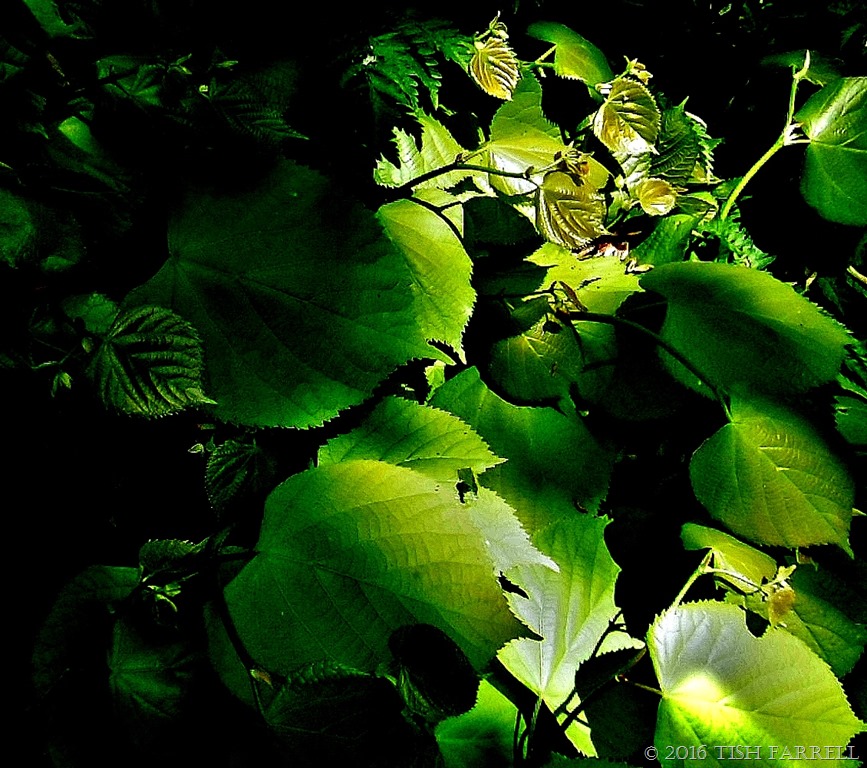
Only last week did the lime trees on Wenlock’s Linden Walk show any real signs of coming into leaf. The avenue itself was a faint haze of juicy green. The leaves may be late, but they sum up the sap-filled exuberance of spring.
Another sign of spring around English villages and towns, is the weekend sight of chaps in their whites lingeringly engaged in the friendly cricket match. It’s one of those things, cricket. I scarcely understand the game, but I’m glad someone does. Or to quote the chorus from 10CC’s Dreadlock Holiday “I don’t like cricket, oh no, I love it”. At least I love the idea of it: a quintessential cultural marker layered with notions of perfect summers that never were.
It conjures ghosts too. The thwack of ball on willow. Resounding cheers at a good catch. An inexplicable sense of something lost. This doubtless explains why many cricketing poems are interwoven with strands of war. Here’s one such from A E Houseman’s A Shropshire Lad cycle, poem XVII. It alludes to young men lost in the Boer War:
- Twice a week the winter thorough
- Here stood I to keep the goal:
- Football then was fighting sorrow
- For the young man’s soul.
- Now in Maytime to the wicket
- Out I march with bat and pad:
- See the son of grief at cricket
- Trying to be glad.
- Try I will; no harm in trying:
- Wonder ’tis how little mirth
- Keeps the bones of man from lying
- On the bed of earth.
*
And now to relieve that sombre note, my May gallery in and around the Linden Field:


Related: Heading for the Light ~ Wenlock’s Linden Walk in Winter
To join in Cardinal Guzman’s The Changing Seasons challenges go HERE
Trying Not To Dig The Plot And 30 Minutes Of Weird Weather
On a very dull Tuesday afternoon I thought I’d brave the cold wind and walk across the field to the allotment. On went the woolly hat, quilted coat (over three layers) and the wellies.
Unsurprisingly I had the allotment to myself – not another mad gardener in sight. I set about emptying one of the compost bins, and spreading the contents (a hand’s width deep) over a metre wide stretch of ground that had been cleared of over-wintering sprouts and broccoli. It seemed a good day to do it, and I was glad I had prised myself from the house.
This year I’m experimenting with the ‘no dig’ system of cultivation, so apart from tweaking out one or two noxious weeds, I resisted the temptation to get out my favourite spade. The objective is to cover the soil with enough interesting organic matter to excite the worms in the soil below. They then do the digging, and other soil-friendly organisms get going too so that, hopefully, the later seasons’ crops – cabbages and sweet corn – can be planted out on the much improved, and better nourished ground.
I was thus in the middle of this very absorbing activity when someone upstairs switched off the lights and I turned to find a tempest sneaking up on me.
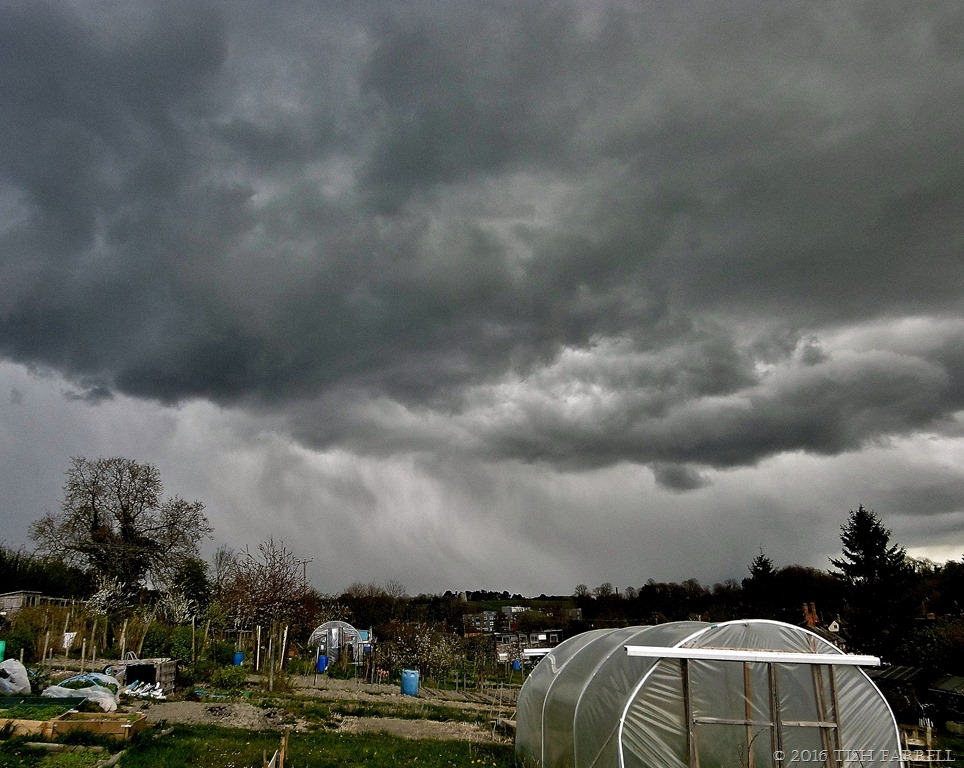
Yikes! By the time I had scooted across the plot to the shelter of my polytunnel, we were having a small, but very concentrated snow and hail blizzard. It was far too stormy to think of making for home. Instead, I pottered about in my tunnel sowing some purple Brussels sprouts seeds in modules, while trying to remain hopeful that this truly was a passing squall and not the heavens falling in as the heavyweight clouds suggested.
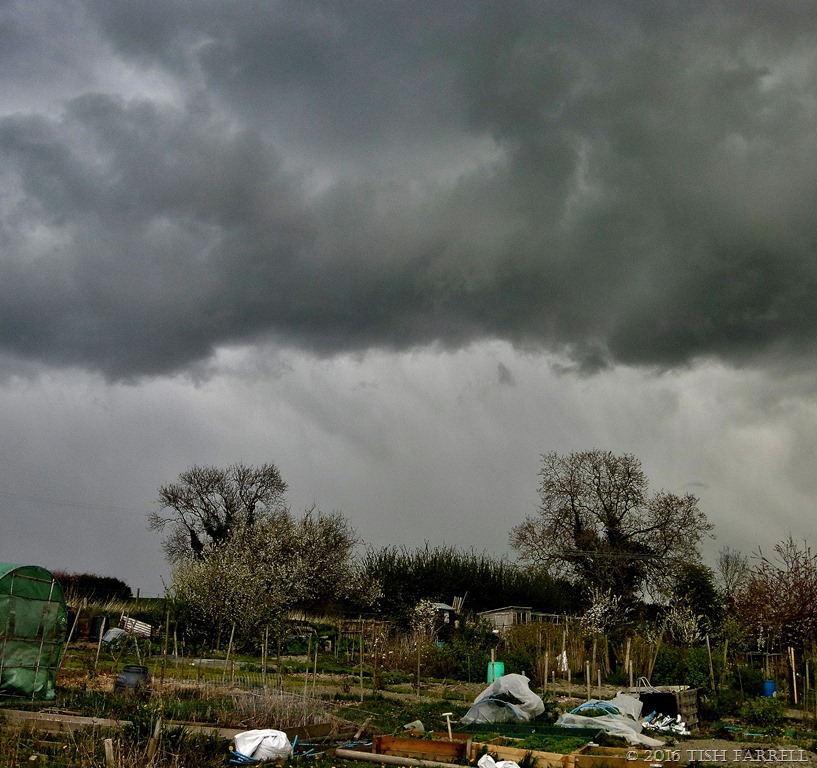
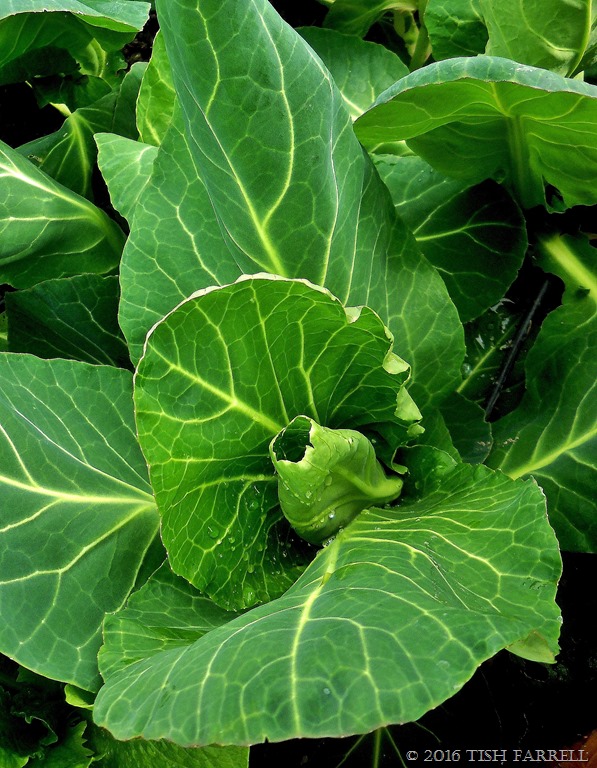
I forgot to record the actual blizzard that followed, so here are some Précoce de Louviers pointy spring cabbages that are growing most happily in the tunnel.
When I stuck my nose out of the tunnel some twenty minutes later, this was the view over Much Wenlock:

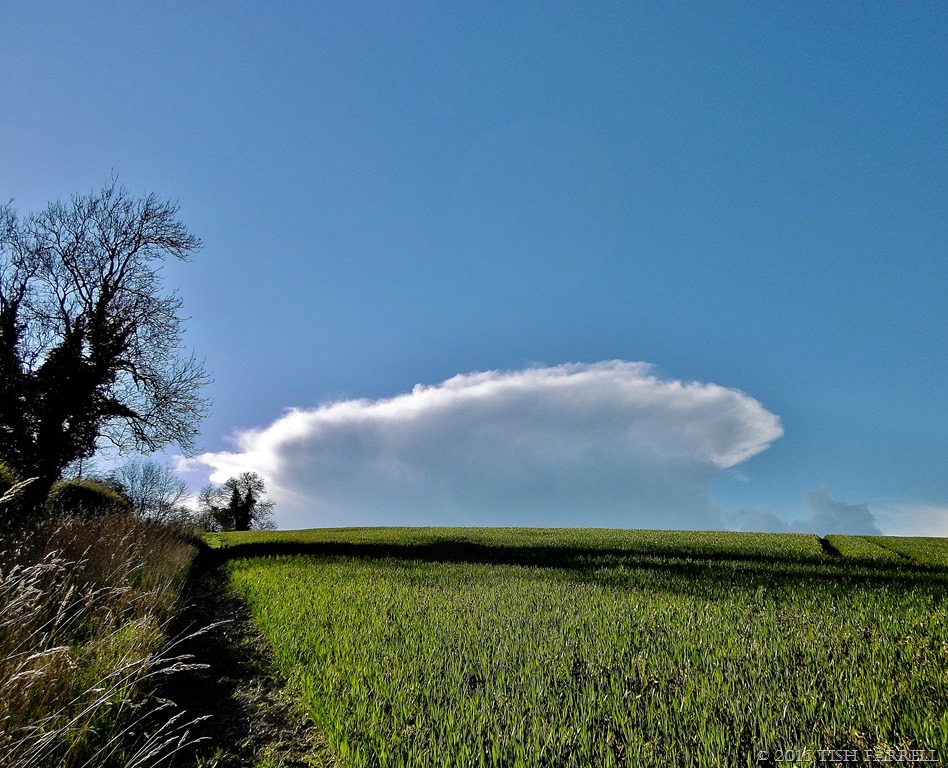
By which time it was too late, and the ground too wet to go back to compost spreading. As I walked home across the allotment, I watched strange, but less threatening clouds gather over the hills:

And when I stepped through the hedge into the wheat field behind our house, the sky looked as if butter wouldn’t melt in its mouth: snowstorm, what snowstorm?
Clearly the figment of a delusional, non-digging gardener then:
copyright Tish Farrell 2016
April’s Changing Seasons: Fifty Shades Of Grey And A Little Bit Of Blue

We Brits are renowned for an unbridled capacity to talk about the weather, and this month there has been so much of it, and sometimes all at once. In the Farrell household the question has been hourly batting back and forth between he and she who live in our house: have you seen the weather forecast?
He has a major earth-moving project in the back garden – dismantling a raised bed, and sawing up next winter’s firewood supply since we keep using the logs that have already been chopped. She has a major earth-moving project up at the allotment – filling raised beds with a recycled compost mountain. There is also seed sowing, hardening off and planting out of vegetables to consider, all of which are dependent on weather conditions in general, and knowing how long arctic winds and icy rain will last in particular.
But what can one say about British weather that our greatest poet, William Shakespeare has not already said, since even he, with all he had to write about, was somewhat climate-fixated:
With hey, ho, the wind and the rain…
For the rain it raineth every day.
He’s not too heartening for next month either:
Rough winds do shake the darling buds of May.
Oh well. Better hang on to the woolly hats and vests, wellies and waterproofs.
*
Cardinal Guzman The Changing Seasons April 2016 Go here to see the Cardinal’s take on April, plus his rules for the challenge. Then join in!
Snow in April?
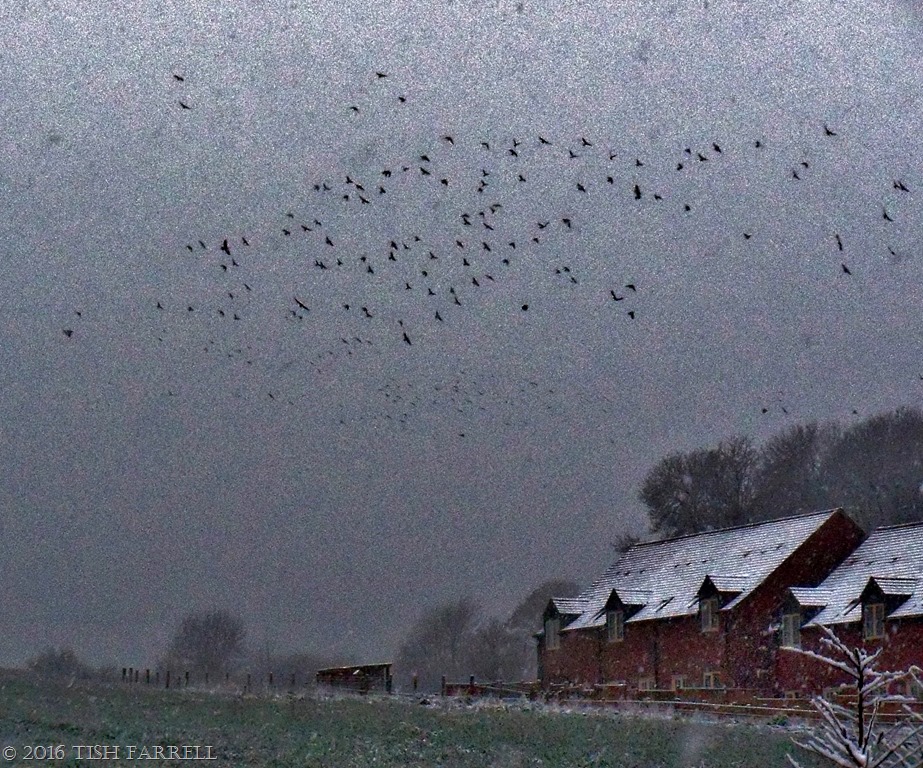
This was the view from my office window at 6 a.m. this morning. Flurries of snow and rooks. Snow-capped old privies. And cold. Brrrrrr. Not April showers as we usually know them. May your Saturday be warmer.
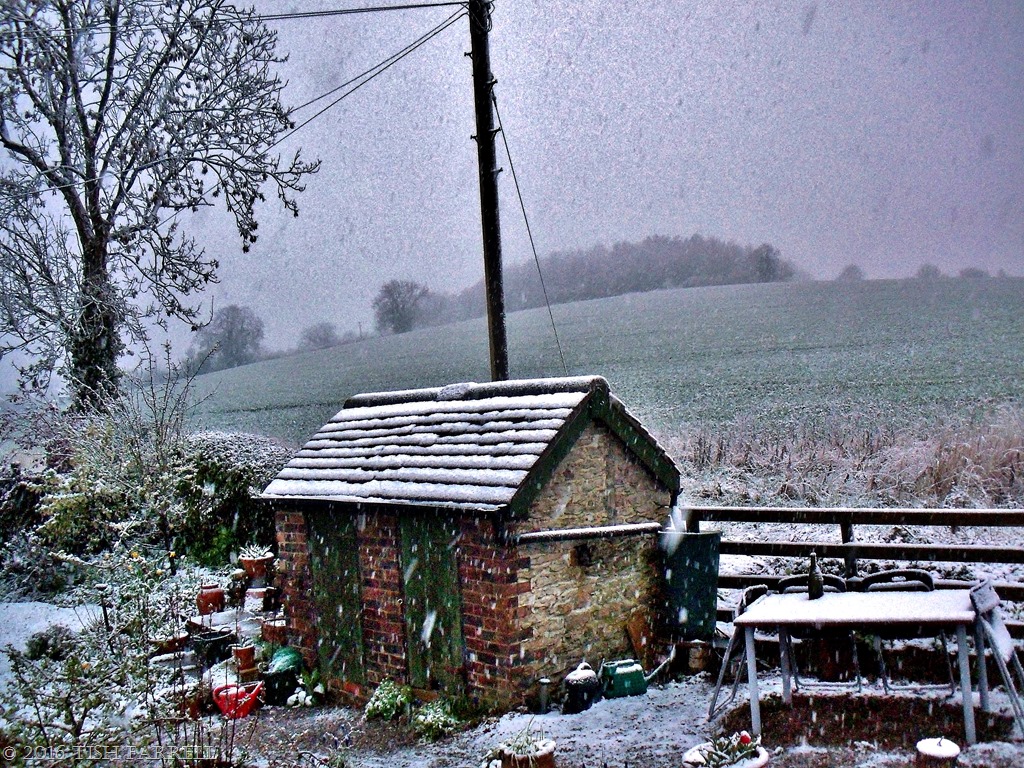
Heading For The Light ~ Wenlock’s Linden Walk In Winter

I consider myself well blessed to have this avenue of venerable lime trees within a stone’s throw of my house. The Linden Walk is one of Much Wenlock’s treasures. The limes on the right were planted in October 1869 by the town’s physician and philanthropist, Dr. William Penny Brookes. He apparently had help from his friends to do the job. Forty two trees were planted and forty two trees still thrive. Thank you Dr. Brookes.
The limes on the left are possibly older, and our local tree expert surmises that they may have been planted by the railway company in 1860-ish to demarcate the railway line when it first arrived in Wenlock. Dr. Brooks was a prime mover in bringing the railway to town. It’s only a pity he can’t bring it back to us.
The avenue forms the southerly boundary of the Gaskell aka Linden Field, where from the 1850s Dr. Brooks held the Annual Wenlock Olympian Games, an event of his devising for improving the health and wellbeing of the general populace of Wenlock and beyond. He even designed the ornate medals and paid for them himself. And it was these games that went on to inspire and inform the modern Olympic Movement. A crown of laurels to you, Dr. Brookes.
The good news is that, according to an international lime tree specialist, who was brought in to inspect them, this avenue has another good century and a half of life left in it – as long as we continue to care for it. I’m sure we will.
In this winter view, taken in Lumix monochrome mode, the walk looks very mysterious. In summer, though, it is so flush with leaf vigour and the soothing notes of linden blossom that you can walk beneath the trees and get high as kite: so much juice and joy – to misquote Gerald Manley Hopkins.
*
Over at Paula’s Black & White Sunday the theme is ‘convergence’. Please go and see her work, and others’ converging interpretations.
The Old Quarry ~ Thursday’s Special

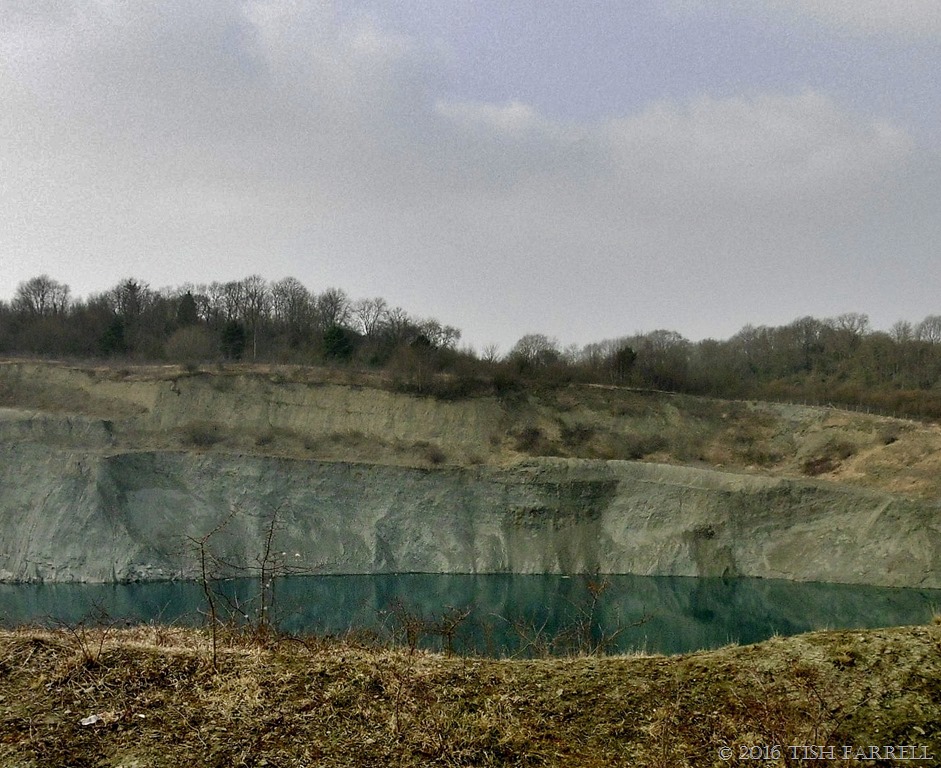
I’ve always found quarries disturbing places – the wholesale delving into the earth, the ravaged landscapes left behind. And yes, I know we need the resources. (Our own house is built of this fossilized Silurian Sea, although actually I’d be just as happy with brick or timber).
Shadwell Quarry behind Much Wenlock’s Windmill Hill is only one of the many old limestone quarries along Wenlock Edge. These days they are no longer worked but host various business enterprises that simply need a large amount of storage space. Quarry owners are supposed to do some restoration after the blasting has stopped, but I’ve not noticed much of this actually happening.
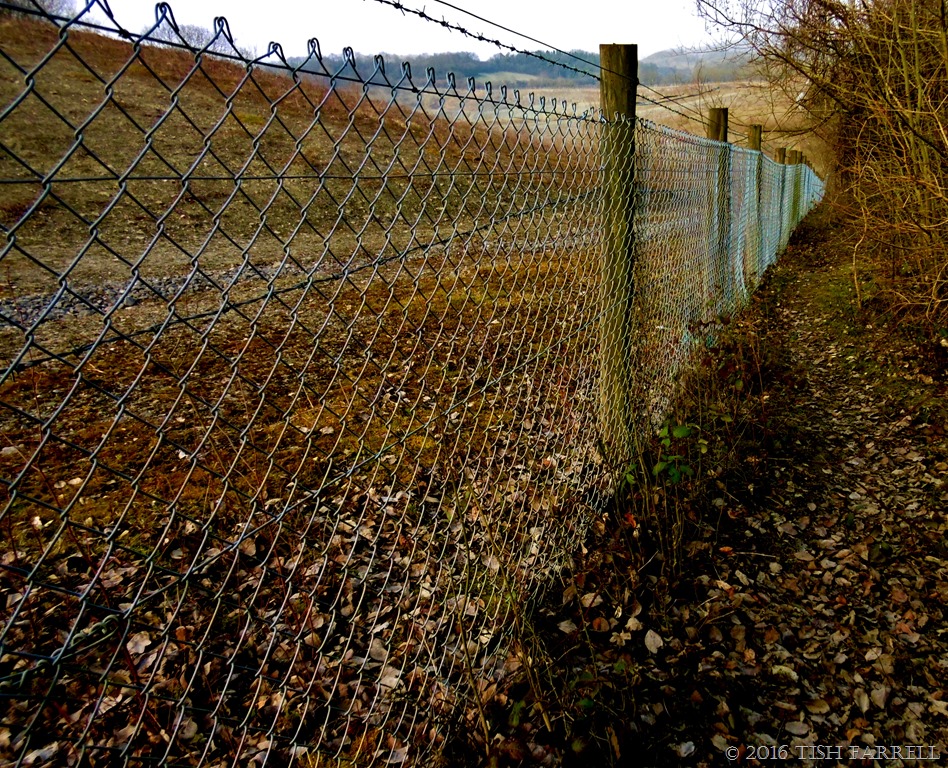
These photos show how slowly recolonization of quarried land takes place. (For an aerial view go HERE.) It has been twenty years since Shadwell was decommissioned.
The water in the quarry bottom is also a strange blue, almost turquoise at times, coloured by the limestone deposits. At over seventy feet deep, it lures tipsy young men to prove their manliness by diving in from one of the man-made cliffs while their mates film the act and post the videos on You Tube. Last summer I spotted gangs of school leavers heading off behind Windmill Hill. They were armed with ghetto blasters and towels and I overheard them saying they were ‘going to the beach’.
It’s interesting how people’s perceptions of places differ. One sees ‘exciting resort’; another oppressive dereliction – albeit with strains of desolate grandeur.
*
I’ve written more about the history of Wenlock’s limestone quarrying at Hidden Wenlock #4
This week at Lost in Translation Paula’s theme is ‘forbidding’. Please call in there if you want to take part in the challenge. She suggests many possibilities for interpretation.
March: Windswept
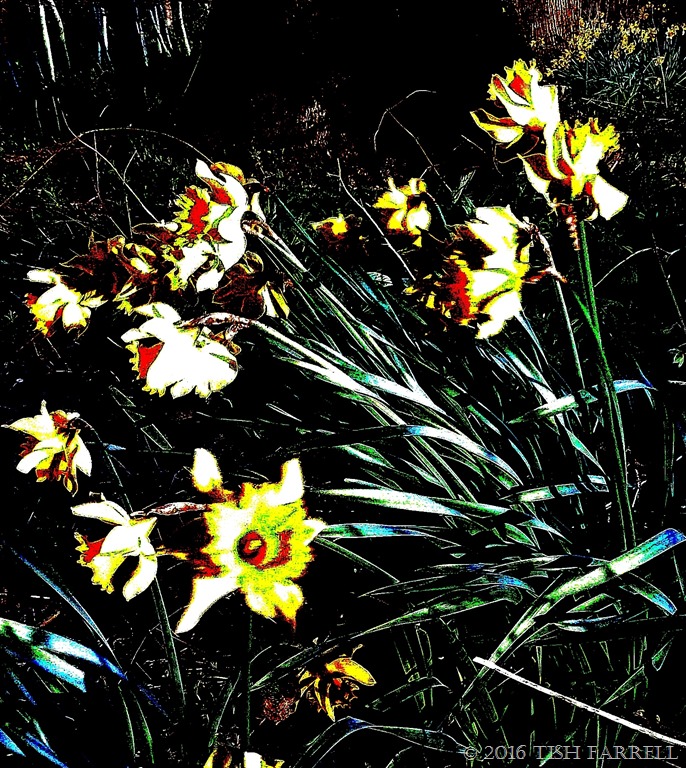
It was blowing a gale when I took the February #ChangingSeasons photo on Windmill Hill. So too for this March photo. On Sunday the wind was so fierce I could hardly hold the camera steady, and these poor daffodils at the foot of the hill were being whooshed off their roots. You can almost hear their trumpeting distress calls.
So if, as the saying goes, March means to go out as a lamb, and not persist in roaring at us, then it needs to go in a corner and think some calming, and softly woolly thoughts. It does not need to cover us in snow as it did in the early hours of Monday morning. Not that I saw it for myself. I was up far too late, by which time it had melted. Even so, we are left with icy draughts that zoom inside any gap in one’s under-layers, or sting the ears that are silly enough to go outside without a hat.
So what is going on with all this gust and bluster? Is this more El Nino effect? In between the rain and wind storms, spring seems to have been teasing us here in the UK since December. That was when I photographed the first daffodils, albeit in the slightly milder climes of south-coast Cornwall. Meanwhile at home on Sheinton Street, the tulips have been pushing out of the garden pots since January, accompanied by flurries of white flowering currant blossom – all far too early. So spring, if you truly do mean to come this year, please get on with it, and cut out the frigid blasts. Now please visit Changing Season’s host, Cardinal Guzman. This month not only does he give us fine photos, but also a master class in sofa assembly.
Cardinal Guzman: Changing Seasons
There are two monthly Changing Seasons 2016 challenges, and you can join in at any time. Here are the Cardinal’s rules:
The Changing Seasons 2016 is a blogging challenge with two versions: the original (V1) which is purely photographic and the new version (V2) where you can allow yourself to be more artistic and post a painting, a recipe, a digital manipulation, or simply just one photo that you think represents the month. Anyone with a blog can join this challenge and it’ll run throughout 2016. It doesn’t matter if you couldn’t join the first month(s), late-comers are welcomed. These are the rules, but they’re not written in stone – you can always improvise, mix & match to suit your own liking:
Rules for Version 1 (The Changing Seasons V1)
- Tag your posts with #MonthlyPhotoChallenge and #TheChangingSeasons
- Each month, post 5-20 photos in a gallery.
- Don’t use photos from your archive. Only new shots.
- Rules for Version 2 (The Changing Seasons V2):
- Tag your posts with #MonthlyPhotoChallenge and #TheChangingSeasons
- Each month, post one photo (recipe, painting, drawing, whatever) that represents your interpretation of the month.
-
Don’t use archive stuff. Only new material!
Related: My chosen location for tracking the changing seasons is Windmill Hill and its associated Linden Field – a few minutes walk from my house in Much Wenlock, Shropshire. Here are the January and February posts.
Farm hedge, winter sunset

I like winter hedgerows in silhouette. In this one I can spot ash, ivy, holly and briar rose, and possibly some hazel twigs.
*
Black & White Sunday: Rural Photography
Please visit Paula for more B & W inspiration.
