And here’s the answer, plus a bit of a scandal

100_5777

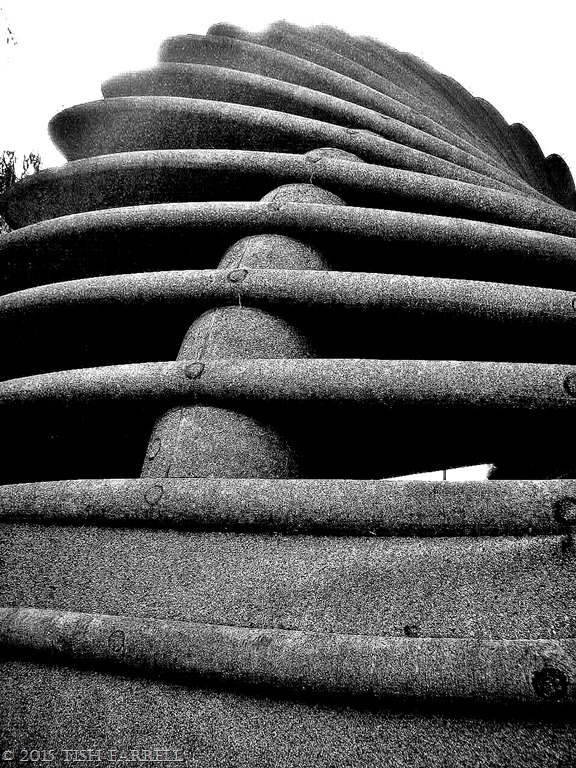
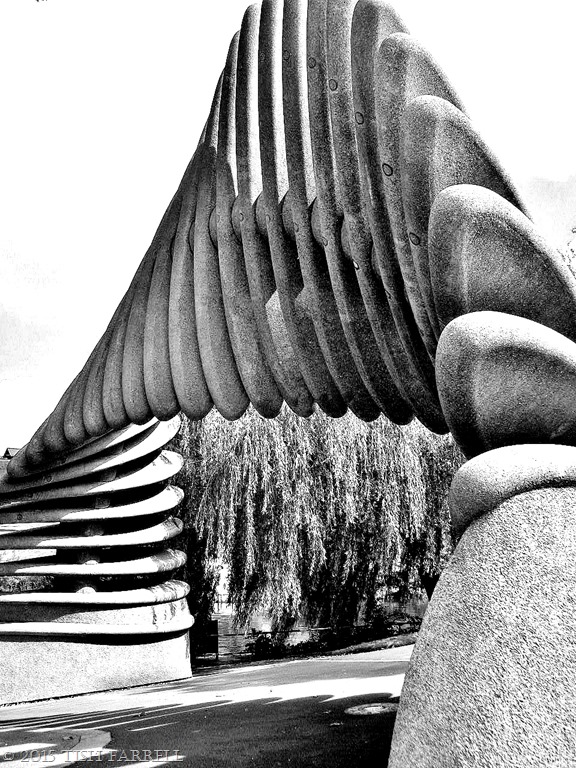
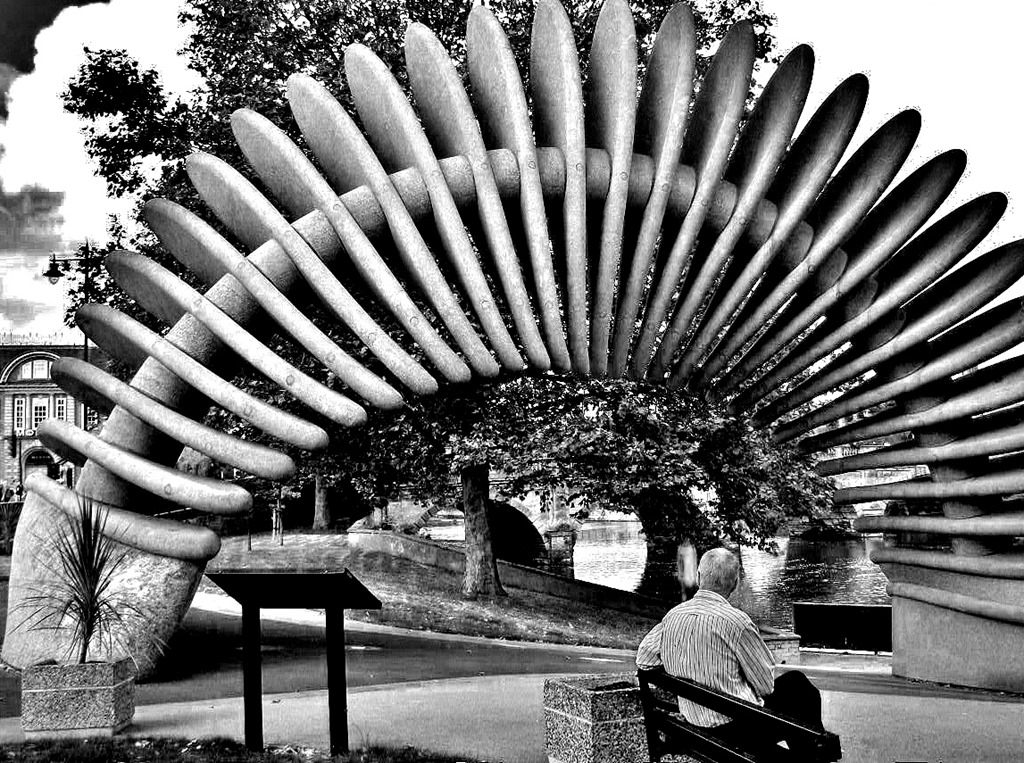
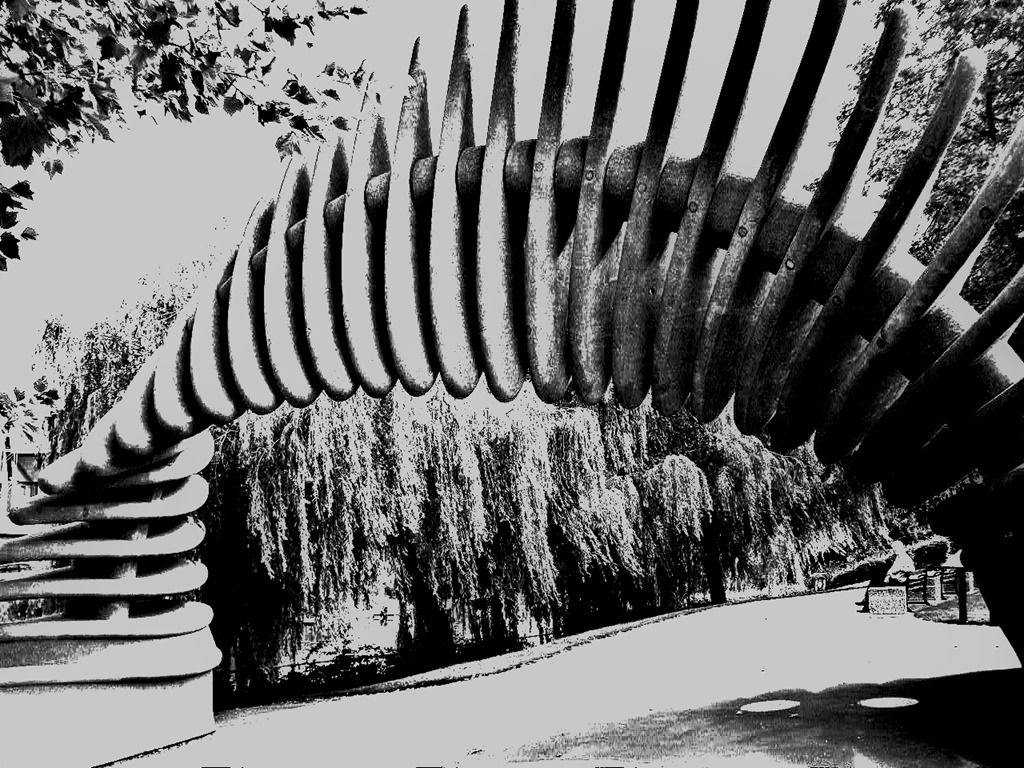
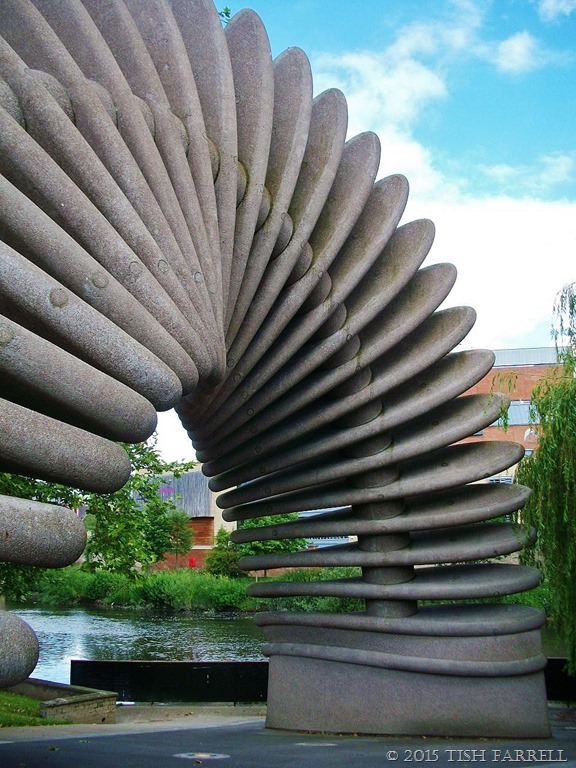
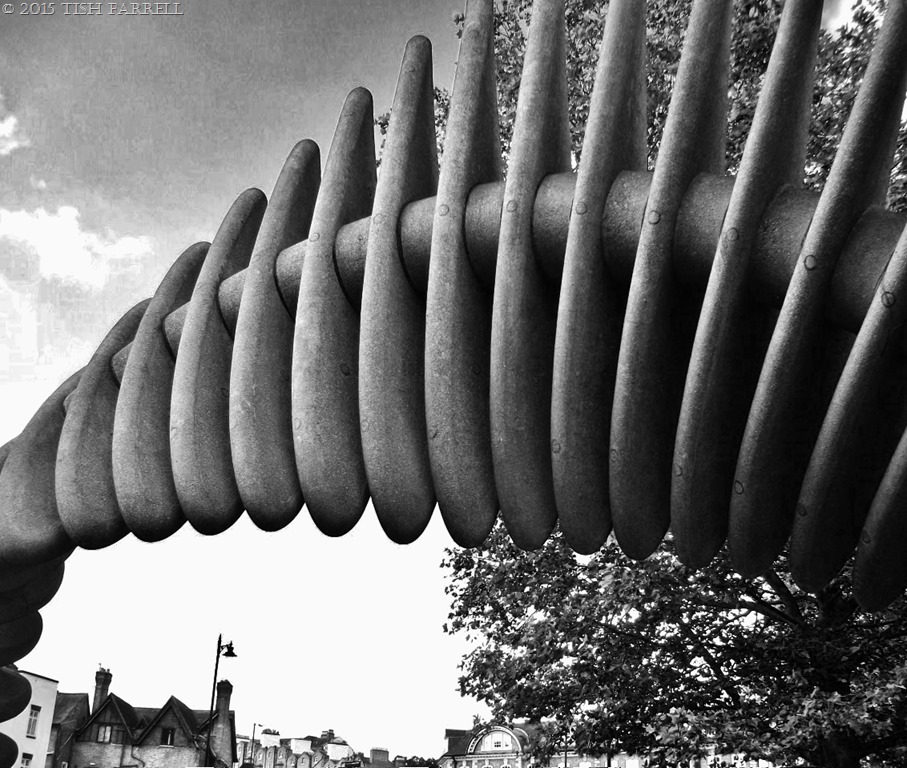
Earlier in the week I wondered what readers might make of this piece of public art, aka the ‘Shrewsbury Slinky’. Many of you picked up on the dinosaur bones, and the allusion to the double helix of DNA, both of which, we are told on the accompanying notice board, did indeed inform the thinking of the architectural designers, Pearce & Lal who conceived the structure. Some of you also guessed, or knew about the Charles Darwin connection.

Anyway, the work is called Quantum Leap, and as the explanatory board also states : “this geo-tectonic piece of sculpture has been designed through the influence of objects and materials central to the development of Darwin’s thought: rock, fossils, zoology…”

It was commissioned originally by Shrewsbury & Atcham Borough Council to commemorate the bicentenary of Darwin’s birth in 1809, and to mark the 150th anniversary of the publication of On the Origin of Species , both events well worth celebrating. The original cost to the public was expected to be around £200,000. But somehow, between the concept and its physical manifestation, things went awry on the costing front. More of which in a moment.

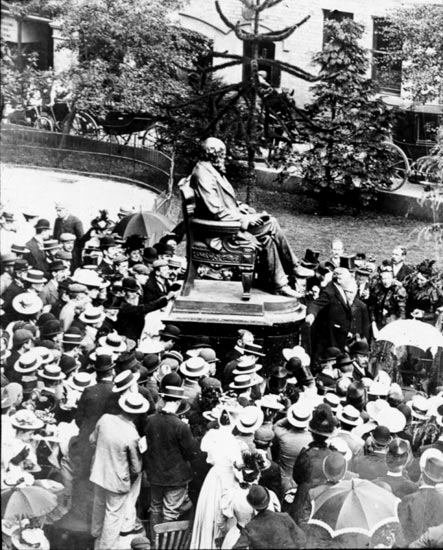
First, though, here is the man himself, sitting in his armchair outside the old Shrewsbury School, where as a youth he was student boarder. This more traditional tribute in bronze was unveiled in 1897:

100_5383

Here you can see the 1897 unveiling. By then the prestigious Shrewsbury School had moved to larger premises across the River Severn, and Darwin’s old school become the town museum and reference library. This photograph is from the Shropshire Museums collection.
image

I don’t suppose many know that Charles Darwin was a Shropshire lad, born and brought up in Shrewsbury. If we picture him anywhere at all it is probably voyaging around the world on HMS Beagle (1831-1836), surrounded by a myriad of fascinating specimens, or else lost in deepest thought, unpicking thorny issues on his Thinking Path at Down House, Kent where he lived with his family for the last forty years of his life.

The Darwin family lived on The Mount in Shrewsbury. Darwin’s father was a doctor and financier, and also a free thinker. Charles’ paternal grandfather was Erasmus Darwin, physician, natural philosopher, inventor and leading light of the Midlands Enlightenment. His maternal grandfather was Josiah Wedgwood, potter industrialist extraordinaire, and inventor. Both grandfathers were staunch slave trade abolitionists. Darwin thus grew up within the orbit of men for whom it was the norm to challenge and think outside the bounds of convention.

While his mother still lived, Charles and his siblings worshipped at Shrewsbury’s Unitarian Chapel. Charles also went to the preacher’s day school, and by an early age was already absorbed with his own natural history collections. But after Susannah Darwin’s death, Charles and his brother, Erasmus were sent off to board at Shrewsbury School. Later both would go to Edinburgh to study medicine, and Charles apparently spent the year of 1825 acting as apprentice to his father, and treating the poor people of Shropshire.

However, he found medicine dull, and seems to have spent his time in Edinburgh studying marine invertebrates and learning taxidermy from a freed slave called John Edmonstone, a man whose company he much enjoyed. An annoyed parent wisely chose not to press his son into the family profession, but sent him to Christ’s College Cambridge; he would get his degree and become an Anglican minister instead.

But once more Doctor Darwin’s plans for his son foundered. While at Cambridge, Charles continued to pursue his interest in natural history. When he graduated in 1831 he took the chance to embark on a ‘gap year’ to end all gap years, and set sail on HMS Beagle, travelling as the ship’s gentleman naturalist. The planned two year voyage turned into five. The rest, as they say, is history.
100_5792

And so back to Quantum Leap, a project that was indubitably inspired by the very best of intentions – to honour the life’s work of a native son. I’ve already mentioned the unsuitable setting, in a cramped little garden between the River Severn and the town’s busy inner ring road. It is not a part of the town where many visitors are likely to find themselves, or even wish to be. But perhaps my main objection is the material. Concrete seems such a rigidly dull substance with which to evoke structures from the natural world. I can also foresee it acquiring a slimy algal coat, which though admittedly a life form, is unlikely to add a life-enhancing effect from the viewer’s point of view. And given all the cuts in Local Authority funding, it seems unlikely that someone will be paid to come along and scrub the thing. Where would you begin?

I’m trying to think, too, what that magician of installation, Anish Kapoor, could do for it, if called on to do some remedial work. I’m imagining something in cast iron here, or in wrought iron, or polished steel. Or even wood. Or perhaps, as Marilyn Armstrong suggests in the comments on So what’s this all about?, people will just hate it so much it will be taken down. My own feeling is that it will simply be forgotten, and that is the worst outcome of all. So much for commemoration.

This brings me to the most shocking aspect of the project. As we headed into the unveiling year of 2009, Shropshire was becoming a Unitary Authority, and the Borough Council passing into obscurity. There followed various problems with the contractors assigned to construct the monument. Costs rocketed. There was a court case. According to press reports there was a chance for the Council to settle the bill when it hit £600,000. They declined. In the end the 2012 accounts revealed that the final cost had amounted to over £1,000,000. As one Labour councillor acidly pointed out, this was considerably more than the cost of Antony Gormley’s epic, acclaimed and truly colossal Gateshead landmark,  Angel of the North.

However you look at it, the final bill is staggering. In the face of austerity measures that have reduced some Shropshire residents to relying on Food Banks, and threatened so many social services, it is appalling to think of so much wasted money. But money aside, the whole enterprise now seems rather sad and silly. The original design concept for Quantum Leap has much to be said for it, but when it comes down to it, public art should serve the public who paid for it. It should be placed where everyone can enjoy it. It should be life-enhancing, spirit-raising, thought-provoking, a piece of wit or wisdom that becomes a point of attraction for locals and visitors alike. In other words, there should be returns on the investment, material and immaterial. It doesn’t of course mean that everyone has to like it. That would be too much to ask.

My other thought is that the town already has its monument to Charles Darwin. They got it right back in 1897. And although the statue might these days seem unadventurous, not to say a bit stuffy, it does at least show us the man – his intelligence, modesty and humanity – qualities that cannot be too highly valued. Not even the town’s incontinent pigeons detract from them. And so christened with bird lime he may be, but Charles Darwin looks a pretty decent old gent. His thinking changed the way we think. It took on superstition, and narrow-mindedness, and continues to challenge the scientific world to explore ever new ways to understand life on the planet. We Salopians can feel justly proud that he is one of ours.

copyright 2015 Tish Farrell


This is a follow up on my post for Paula’s Black & White Sunday theme of sculpture:  So What’s This All About?
So what’s this all about?

100_5788

I truly would like to feel more enthusiastic about this monumental piece of public art. I mean I can see it is interesting – in its way – and the more so with the application of some photo editing. This has at least relieved us of the sickly mud-brown colour. Also the cast concrete takes on a little more texture than seems apparent in the original. But perhaps the most serious problem with this sculpture is its setting – squeezed into a little triangle of municipal garden between Shrewsbury town’s inner ring road and the River Severn.

And so given that its siting was down to town councillors, and not to the artist whom they commissioned to do the work at great public expense, I tried approaching the work from different angles. As you can see, it is incredibly well made:

100_5786

100_5779 (2)

100_5775

*

I even tried including some human interest, but this next shot only added to the sense of crammed in-ness, with too many planters, and a poorly situated  explanatory panel:

100_5790

And so what do you think this work is commemorating? (I know that at least one person who reads this blog knows it person). Otherwise, all answers on a postcard to the secret WordPress post box.

Before I go, I will at least tell you that it is something very important, and relates to all of life on this planet, and that all may well be revealed in an upcoming post.

 copyright 2015 Tish Farrell

Please also drop in on Black & White Sunday, where this week Paula’s theme is sculpture.

B & W Sunday ~ Stronghold ~ The Telling Of Family Tales

P1000972

Most families tell tales about their origins: legends of high-born connections, of inheritances lost or missed-out on, of forebears famous or notorious somewhere in the family tree. These stories, the ideas of who we are become strongholds of sorts; a defence against times when others make us feel ‘not good enough’, or just plain dull.

I seem to remember when I was eight or nine telling one very competitive school friend, and as a piece of deliberate one-upmanship on my part, that one of my ancestors was a well known poet and buried in Poets’ Corner in Westminster Abbey. Mother had told me so.

Indeed, Mother told me lots of family stories about her Derbyshire Fox and Bennett antecedents, and because a) she still had her own childhood interpretation of what her own mother had said, and b) was framing them in a way she thought I would also understand, the ensuing narrative, much like Chinese Whispers, came out more than a little garbled. In other words, our family connection to the poet ancestor is probably so much tosh.

From time to time I have little delving sessions on the internet in a bid to clear up the maternal myths, and last year came across two fellow searchers into the Fox family of Derbyshire’s High Peak. It turned out we were each descended from three siblings William, Robert and Deborah Fox, all born at Callow Farm in the manor of Highlow, in the 1770s. And it’s odd, but I find I treasure this present-day, albeit tenuous blood connection, almost more than anything I might find out about our mutual family past. I mean, well, who would have thought it; without the internet, we never would have found each other.

The Fox siblings’ father, George Fox, came from many generations of farmers. Over the years the family appears to have owned several pieces of land in the parishes of Hathersage, Longshaw, Eyam and Abney (one was a sheep run, others were possibly both farms and lead mine workings), but the Foxes, certainly in recent centuries, were mostly the tenants, first of the Eyres at Highlow Hall (pictured above), and later of the Dukes of Devonshire who came to rule much of Derbyshire from their own dynastic stronghold of Chatsworth.

If the Eyre name rings bells, well it is true (just to add another story thread) that Charlotte Bronte was staying with her friend Ellen Nussey in Hathersage in 1845, around the time she was writing Jane Eyre. Mr. Rochester’s Thornfield Hall is said to be drawn from another Eyre family stronghold, North Lees Hall. She and Ellen went visiting there. Other local features are also present in the book, including Hathersage itself, which was apparently the model for Morton, the village where Jane Eyre ends up after running away from Edward Rochester.

My Fox ancestors, it seems, were also good storytellers – fact mixed seamlessly with fiction. When Robert Fox’s son, my great, great grandfather George Brayley Fox was forced to sell up his possessions at Callow Farm in 1892, this piece appeared in the Derbyshire Courier:

Derbyshire Courier 25 March 1893

My own feeling about this ancestral yarn is that it was a bit of a face-saving exercise for a family that had indeed been part of the local scene for generations. Some of the details may well be based on some misremembered version of reality. Early medieval charters of the 12th and 13th centuries certainly have Foxes farming in pretty much the same location. Now, I and my two fellow Fox hunters are trying to tease the facts from the myths.

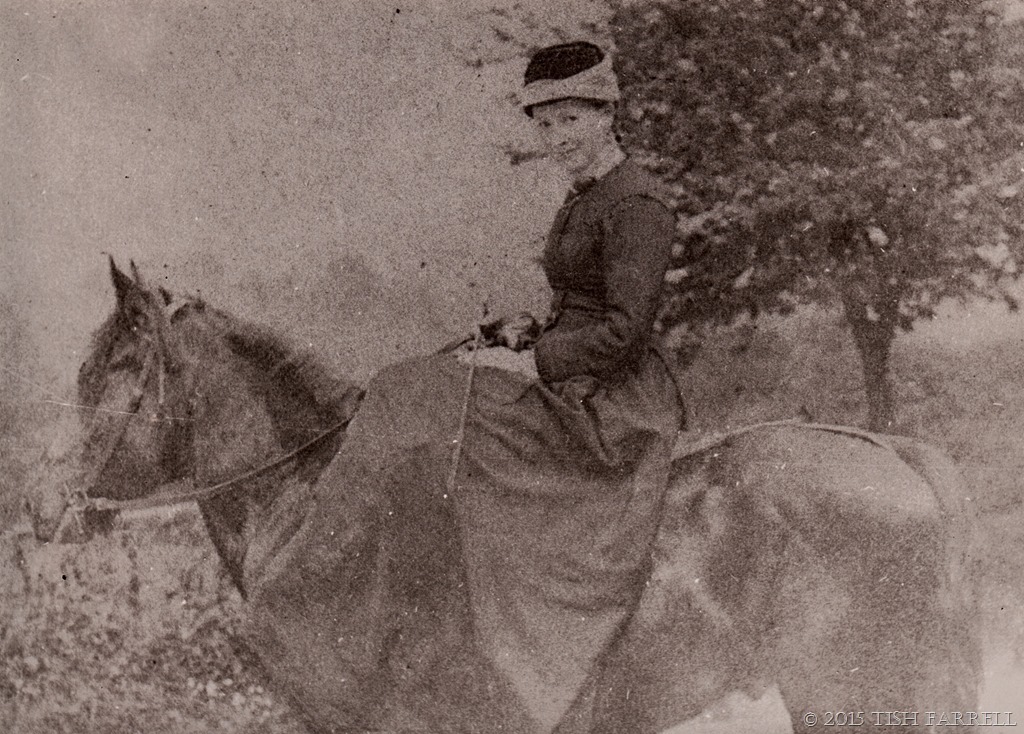
But one thing I do know (because I have the photo), my great grandmother, Mary Ann Fox, rode her pony along the winding lane from Callow Farm. She would have ridden past Highlow Hall on one of her regular missions. Grandmother said she went to Chatsworth Hall to deliver the farm tithe in eggs to the Duke of Devonshire. Here she is c1880s in her late teens, before she was silly enough to run off with a Manchester spindle manufacturer and, at thirty, end up the widow of a bankrupt with three young children and a stepson to support:

IMG

And here is Callow farmhouse, the photo taken by a family researcher in the 1970s. It sits on a hillside below Highlow Hall, and looks down on the River Derwent and the small town of Hathersage. If there is a house of 1391 here, as the newspaper article suggests, then it is very well hidden inside a very much later exterior:

Callow Farm, Hathersage c 1970s

But if I said that these images and family tales have not affected how I see myself, then this would not be true, although it is only recently that I have seen this. For some reason, too, in my later years, these particular maternal ancestors seem to mean more to me.

The thing that speaks most loudly is not so much the gentry connections – real or imagined – but the sense of landscape, of the bleak uplands, the rugged scarps of millstone grit, the arcane, but tough world of lead-mining in which all classes toiled from the Eyres downwards; the fact that men and women worked so hard in this land, lived on oat cakes and homemade butter, cheese and ale, reared often very large families, and (in a surprising number of cases) lived into their eighties and nineties.

Somehow the more I uncover of my ancestors’ world, the more it becomes my stronghold, the mental hinterland wherein I am truly rooted.  I stand up more strongly, look out across those moors with their prehistoric stone circles, and ancient burial cairns, the stone walls, and the sheep fields. The wind is in my face. My gaze broadens and lengthens. It is like standing on top of the world, looking down the endless spiral of time of which I am a part, and forever will be.

copyright 2015 Tish Farrell

Reference: For more about the Peak District

Black & White Sunday: Stronghold  Go here to Paula’s to her and others’ strongholds

Present and Past in the Ironbridge Gorge

P1010073

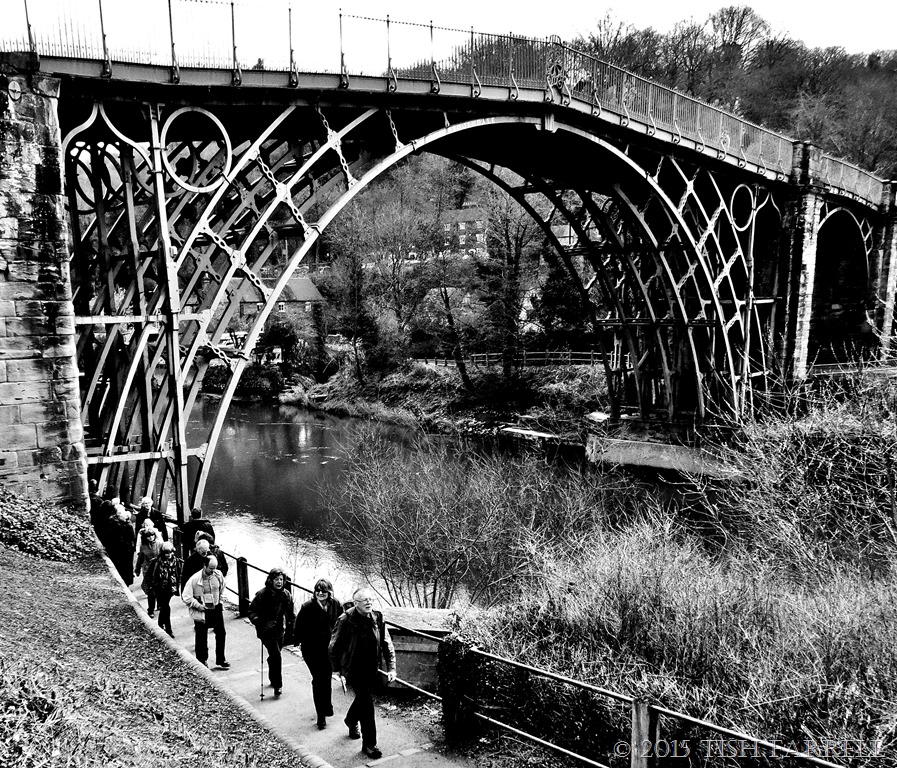
This coal-fired power station sits at the entrance to the scenic Ironbridge Gorge on the River Severn in Shropshire. Even when you know it’s there, to come upon the four great cooling towers through the trees, is always a surprise. Its days, however, are numbered, and many of us are wondering how the power station powers-that-be will go about recycling the place, and especially on the edge of a World Heritage Site. Just downstream is Ironbridge town, named after the world’s first cast iron bridge, built between 1779-1781 by Coalbrookdale ironmaster, Abraham Darby III. (See my earlier post Bridge, What Bridge)

P1000828

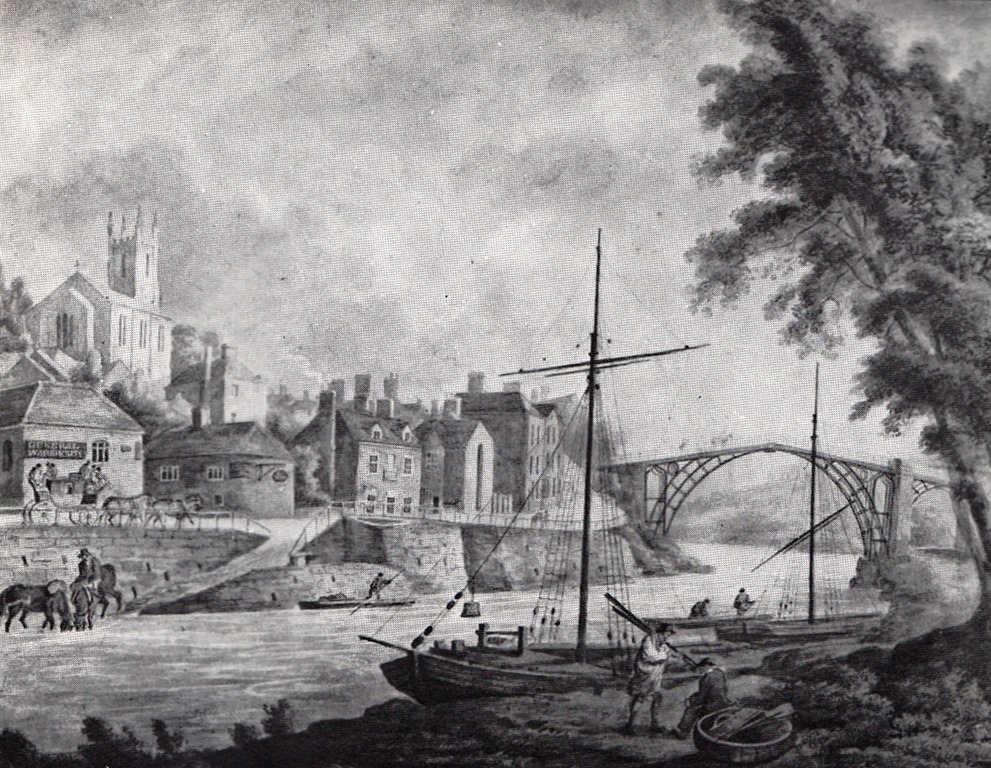
Before this bridge arrived on the scene as an 18th century world wonder, earlier bridges were mostly built of stone, usually with several low arches. The particularly novel aspect of the Iron Bridge’s design, then, was the high single arch, devised to allow the large sailing barges, known as Severn trows to pass beneath without lowering their masts. This was a clear piece of Coalbrookdale Company bravado, since the trows would have had to lower their masts for all the numerous other Severn bridges, both up and downstream of the Iron Bridge.

Looking at the sleepy river today, it is hard to imagine that in 1712, Coalbrookdale’s iron works were exporting  1,400 tons of iron wares downriver. It’s hard to imagine too, that although a hundred miles from Bristol, that the towns of Ironbridge and Broseley (on either side the bridge) were busy inland ports, with boat builders’ yards, and locally owned trows. The trade also went upriver to Shrewsbury which in turn exported cloth from the Welsh hinterland and local agricultural produce.

IMG

Ironbridge town and bridge, trows in the foreground; attributed to J. Fidlor some time after 1837, Shrewsbury Museum

*

Fascinating details of the trade are preserved in the Gloucester Port Books. For instance, they record one of the  Bristol-bound cargoes of the Broseley barge Thomas & Mary  in 1722. It included:

10 tons of ironware; 8 tons of cheese; 8 packs of Manchester ware; 2 packs of sadlery ware; 2 hogsheads of oats; 2 barrels of oats; 8 hogsheads of hair; 80 crates of earthenware; 1 barrel of brass; 2 trunks of wearing apparel; 2 boxes of wearing apparel.

An upriver cargo that same year comprised:

40 bags of cotton wool; 40 packs and a truss of cloth; 4 hogsheads of train oil; 1 ton of saltery; 2 barrels of herrings; 5 cwt. of salt fish; 4 cwt. of red lead.

The prestigious nature of the trade is perhaps embodied in the Severn Warehouse, now part of the Ironbridge Gorge Museum Trust. It stands on the river mid way between the Ironbridge Power Station and the Iron Bridge, and was built by the Coalbrookdale Company in 1834 in flamboyant Gothic Revival style. Down its iron rails to waiting barges would have trundled carts loaded with iron castings of every sort, both functional and decorative, heading for markets throughout Britain and across the Empire. It did a particularly thriving trade in iron bellied, so-called Missionary Pots – some holding up to 400 gallons, and thus big enough to hold a  missionary or two.  They were actually used for processes like soap making and rendering down whale blubber.

P1000856

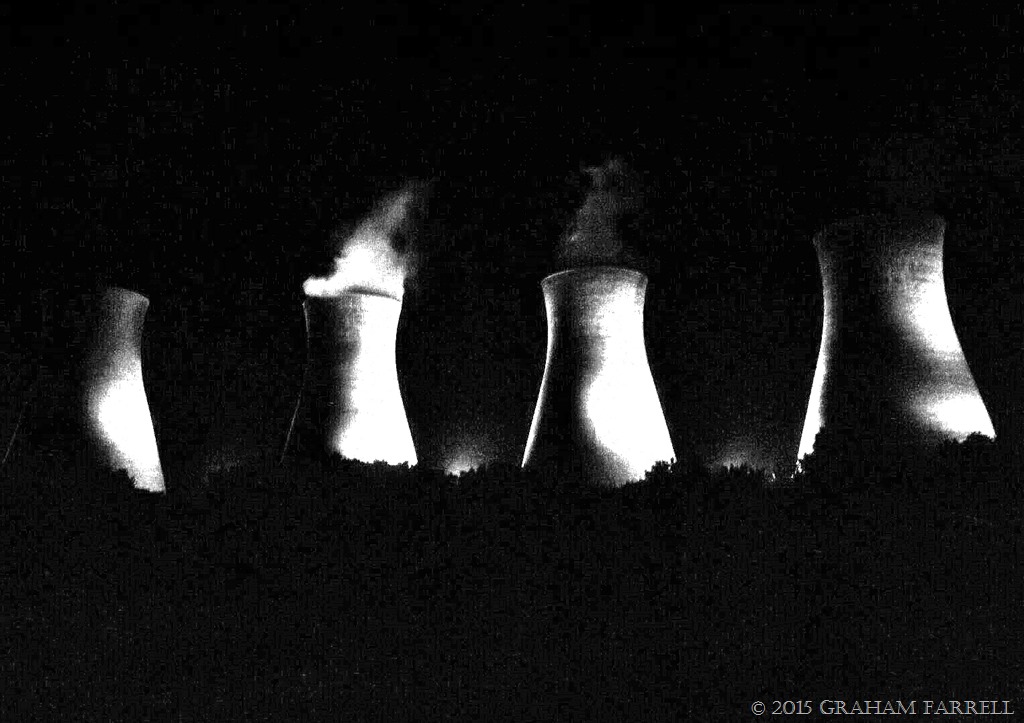
But back to those cooling towers. I am rather fascinated by them; as indeed was TV historian Dr. David Starkey, when I was showing him around the Severn Warehouse many moons ago. He was doing some consultancy for me at the time, and when I told him that in 1979, the Iron Bridge bicentenary year, the cooling towers had been lit up at night, he grew very animated, and said it was a pity that this was not a permanent feature. He felt that the power station provided a dramatic analogy of industrial prowess that would help visitors to the Gorge to grasp a sense of the importance of past technological innovation. Some people will of course hate them as ‘blots on the landscape’. But anyway, see what you think. Here’s a shot that Graham took during their nightly illumination in 1979:

Scan-130804-0002

copyright 2015 Tish Farrell


Black & White Sunday Go here for more ‘unusual’ shots in B & W

Elephant tribe versus Man tribe: and how the bees are helping

We’ve been watching a very heartening series on BBC i-Player The Secret Life of Elephants. It followed the magnificent conservation work being carried out by Save The Elephants, a charity that operates in Samburu, Northern Kenya, and relies on the cooperation between  the nomadic Samburu people, local smallholder farmers and scientists from Kenya and beyond.  One of the key initiatives is to put tracking collars on the matriarch leaders of particular elephant clans, and also on the large bulls who, outside the breeding season, lead more solitary lives.

Elephants may cover vast distances in the course of their annual migrations. But once they leave the national parks they are more vulnerable to poachers, and also to irate farmers who are tired of having their year’s livelihood consumed in a single night. By tracking and mapping the herds’ movements on computers, and  maintaining channels of communication with the pastoralists and farmers, Save The Elephants researchers  are working out ways to lessen conflicts, and present solutions, and above all, to secure the future for wild elephants.

The Samburu pastoralists have always been wise enough to respect elephants, and are now anxious to do what they can to protect them. This is their view on the matter:


The first man said the elephant is like us, like our brother, and we have to live together, not hunt elephant. That’s what we say we were told at the beginning. That’s what we still believe. The elephant has always been, and will always be, special to us. This is why we protect it now.

Samburu people on the importance of elephants


Scan-130608-0001


For farmers it is a very different matter. People are often killed trying to drive elephants out of their crops.  And so one of STE’s objectives is to work out the best place to erect elephant fencing so that elephants can be channelled away from farming communities as they pass by on their seasonal trek between the river where they congregate to breed,  and the mountain forests where they go to browse.

Fencing, though, is not always the total solution it seems. Elephants are not daft. The old bulls have learned  how to open gates onto the vast European wheat farms that lie to the west of Mount Kenya. But while the large-scale producers can tolerate some elephant grazing, smallholders cannot. For them it is a matter of living or starving.

One of the STE researchers, Dr. Lucy King has come up with a very simple, low-tech and productive approach to keeping elephants out of Kenyan farmers’ cabbage fields.  It began with the discovery that elephants will move off if they hear the sound of bees buzzing. African bees are especially aggressive, and on a very short fuse temper-wise. She thus came up with the notion of placing beehives around farm fields.

Traditional African beehives are made of lengths of hollowed-out tree trunks that are then suspended in trees. These were hung at intervals on the field perimeters, and connected up by tripwires. When the elephants tripped the wires, the hives were duly shaken and out would swarm the angry bees. Elephants would then beat a retreat, leaving farmers with both their crops and a new source of income from the honey.

As Colonel John ‘Hannibal’ Smith was so often wont to say in The A-Team: “I love it when a plan comes together.” In this case, though, it is clearly the work of the B-Team.

Copyright 2015 Tish Farrell


Related:

I’ve written more about elephants in Elecommunication: So Many Connections

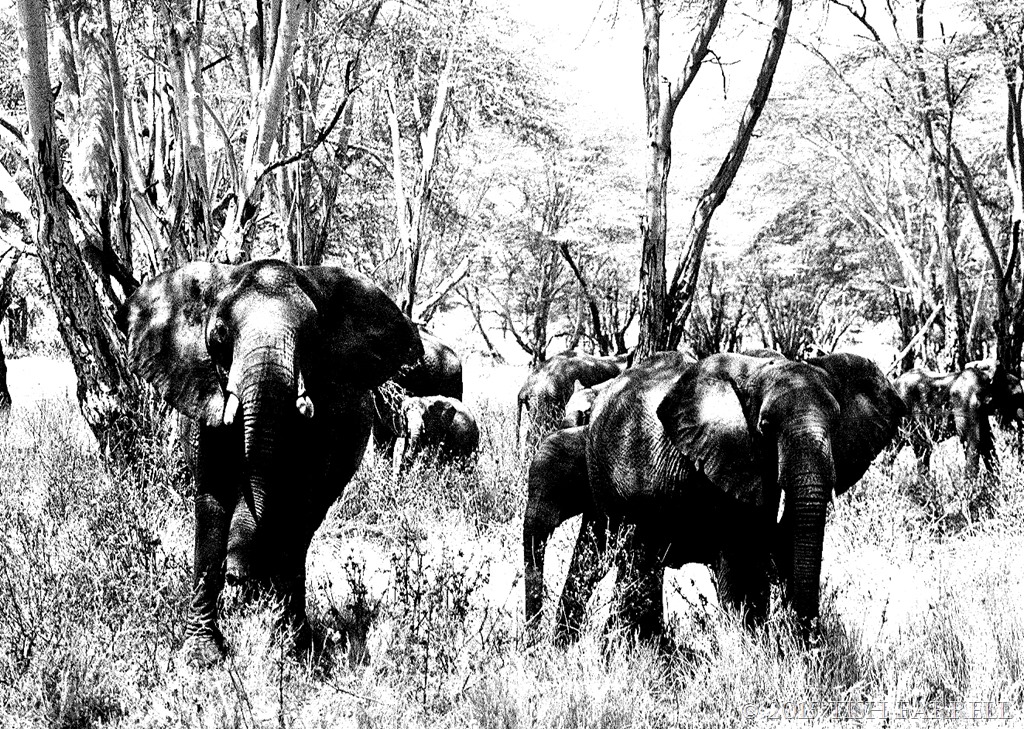
And last but never least, thanks to Paula at Lost in Translation and her guest challenger, photographer Guilhem Ribart. TRIBE is the prompt. For more interpretations, please also follow this link.  I should add that my photos here were taken in Lewa Downs which is part of Save The Elephants’ sphere of operations. The original negatives are very degraded, but seem to have a new lease of life translated into B & W. In fact they also seem to capture the elephantness of elephants rather better than the colour originals, which is interesting when you think about it.

Black & White Sunday: Lining up in NYC

Grand central

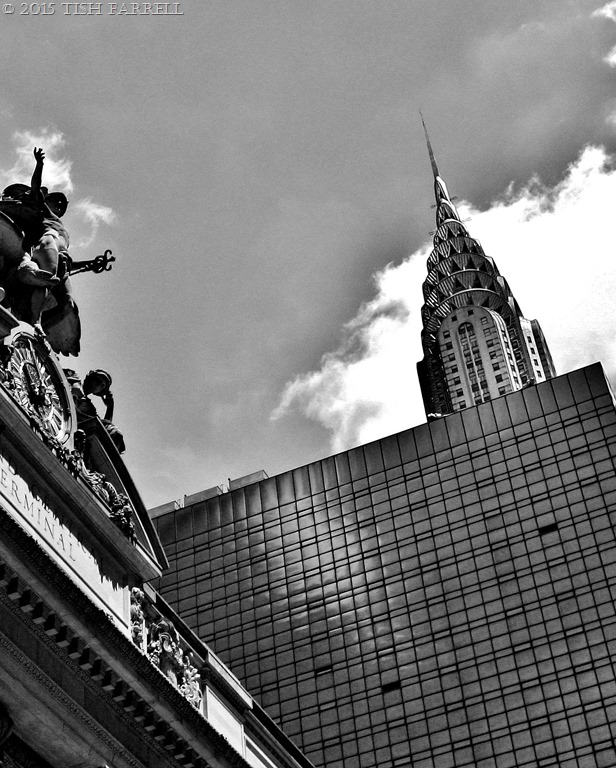
It was just pure chance that made me look up as we were heading into Grand Central Terminal en route for the subterranean Oyster Bar. I was thus able to snap two landmarks in one – both the Terminal’s pediment and the top of the Chrysler Building. Between the two is the glassy face of the Grand Hyatt Hotel. We were not staying there I hasten to add,  but at the upcycled Beaux Arts Hotel Belleclaire on Broadway in Upper Westwide. I can recommend it. I can recommend the Oyster Bar too. On the day I took the photo it proved a haven in more ways that one. The sea food and Brooklyn beer were not only delicious, but the place was so COOL. Out on the streets there was May heat-wave going on with temperatures of  over 100 degrees. We had already spent most of our few days in the city sticking to the  shade in Central Park, and drinking copious glasses of iced coffee at the Loeb Boathouse cafe. Very good it was too, but there’s only so much of this you can do when you have come thousands of miles to see Manhattan. Finally we forced ourselves out into the baking streets …

By the way, this reflected framing of the shot is a feature of Windows Photo Gallery which I use for writing my blog posts. I thought I would try it out for Paula’s challenge.

copyright 2015 Tish Farrell

Paula’s Black & White Sunday: Lines

Black & White Sunday

Scan-140801-0010

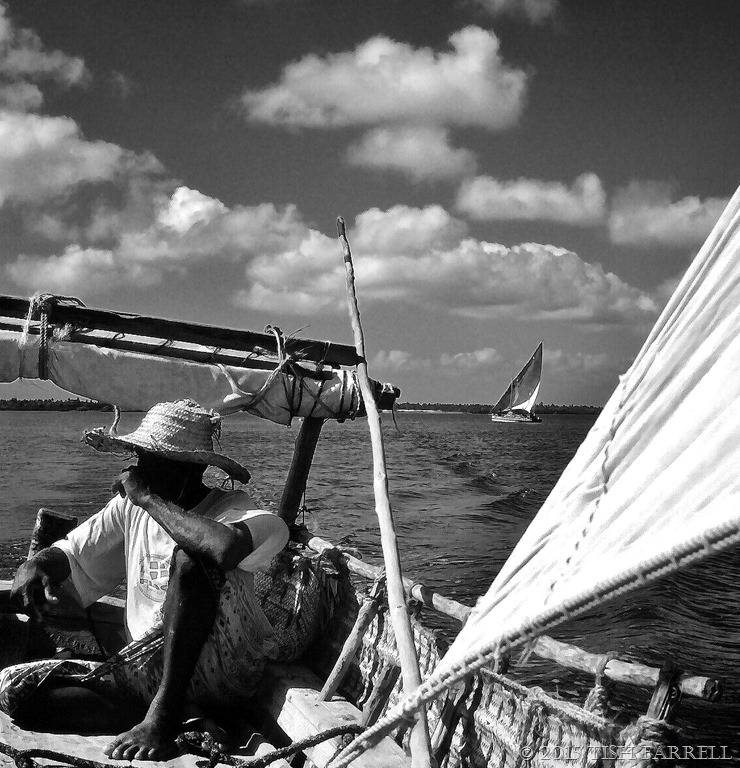
Today Paula’s guest blogger over at Lost in Translation is Debbie Smyth who many will know from her own blog Travel with Intent. Today she is setting us the challenge to ‘let the shapes shine through’. This is what she says:


For me the most important point about monochrome is that by removing the distraction of colour, the photographer is able to direct the viewer to the key elements of the image.  Going monochrome is one of several tools we have as a photographer that allows us to provide focus.

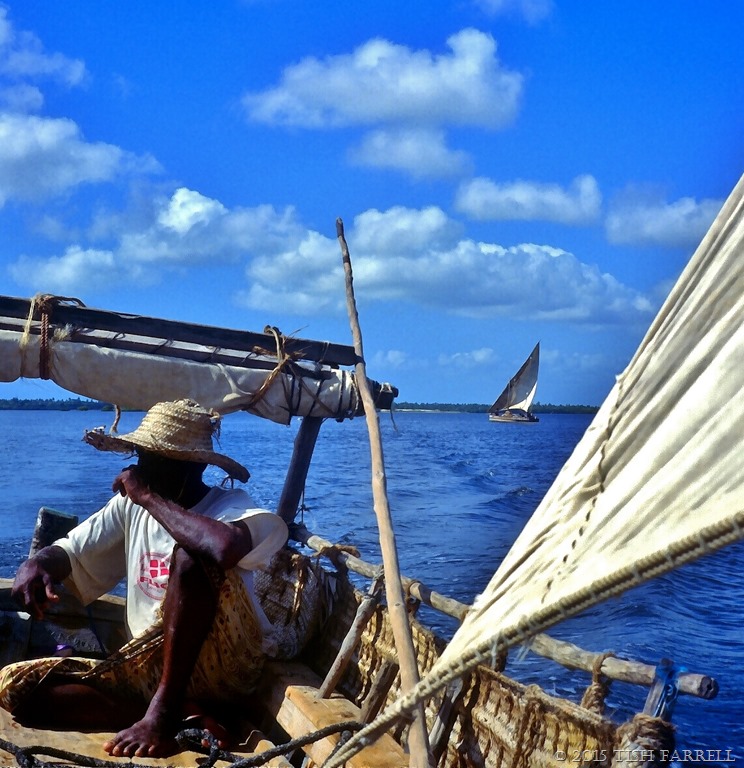
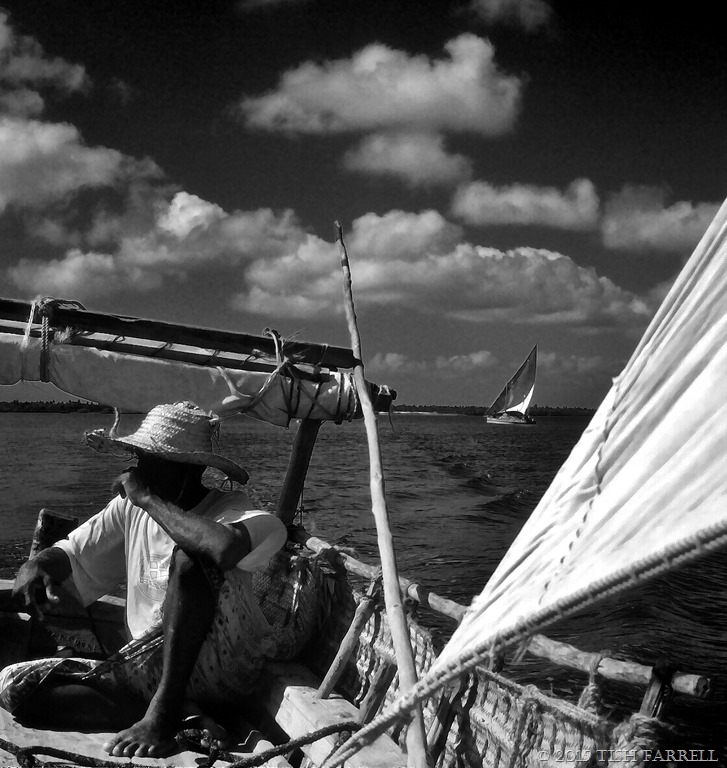
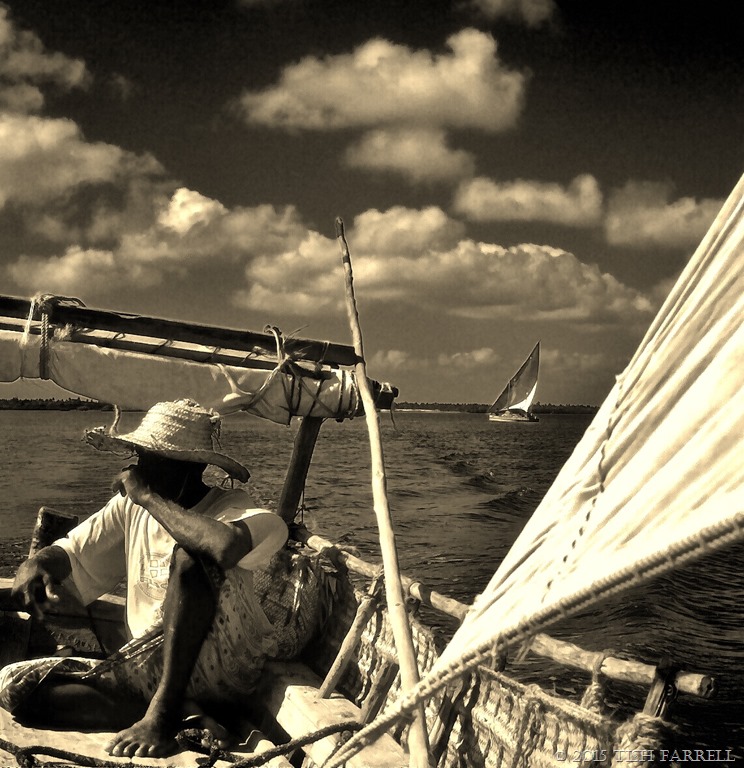
The composition of my own photo is perhaps a little ‘busy’ in this B & W version (it could have done without the pole), but I like the play of light on the dhow sails, the clouds, and Lali’s straw hat. It was taken in Manda Strait, in Kenya’s Lamu archipelago.

For the story behind the photo, please go HERE. But now here are more versions. The second one down is a ‘red filter’ edit, followed by sepia. Let me know what you think.

Scan-140801-0010 - Copy (2)

Scan-140801-0010 - Copy (2)

Scan-140801-0010 - Copy (2)