Of Monumental Mysteries

“The past is a foreign country: they do things differently there.”   L P Hartley The Go-Between      

Scan-130804-0007


Scan-130804-0012

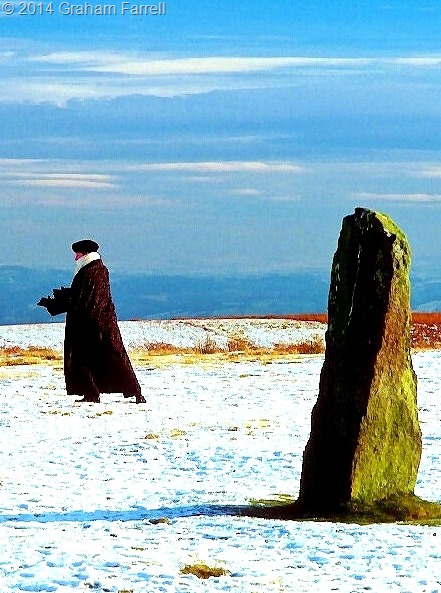
So what’s the mystery here? No, not that strange woman in a Welsh felted hat doing tai chi. (Actually,  I think I may be in the process of ‘grasping the sparrow’s tail’ Yang-style long form. I’ve rather forgotten).  I remember, though, the icy winter’s day, and the absolute stillness, and the hazy blue views of Wales over the border from my Shropshire homeland, and the feeling that this circle of ancient stones was a special place; that it stirred in me the sense that doing tai chi here would be a good thing.

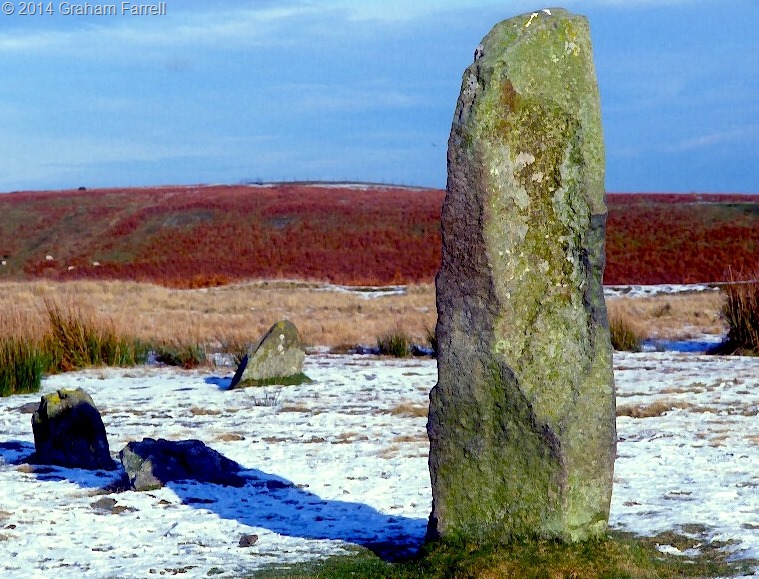
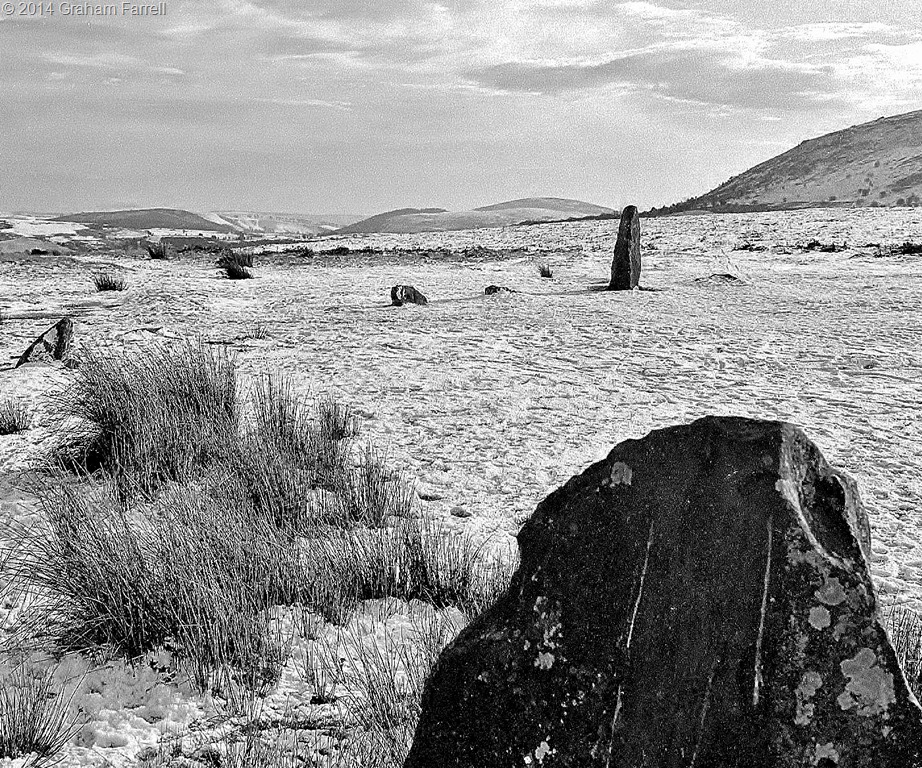
I have written before about Mitchell’s Fold Bronze Age stone circle,  and you can find the witchy legend associated with it  HERE.  Historically speaking, little is known about the stones  beyond the fact that they were raised some 4,000 years ago. The surviving fifteen stones form a rough circle, although there may have once been as many as thirty. The tallest survivor is said to have originally been one of a pair, and so formed some kind of gateway or threshold at the circle’s edge.

These henges are, on the whole, unfathomable. There is no knowing how the people, who toiled to build them, made use of them, or what their precise significance was in their daily lives. The elevated location of Mitchell’s Fold, with its sweeping vistas, suggests to us a sacred function. There are also possibilities that the stones’ particular alignment served as some kind of calendar, marking solar and lunar events. And, for more prosaic purposes, in a world without maps and SatNav, prominently sited megaliths may also have provided travellers with landmarks to keep them on course through the upland wilds. The Bronze Age was, after all, a time of intinerant smiths and artisans who covered great distances to trade their goods and services.

Scan-130804-0041

This is borne out by the fact that not far from Mitchell’s Fold, just over the Welsh border in Powys,  is the Cwm Mawr Bronze Age axe factory. The distinctive looking axe-hammers that were made here have been found across Wales and England, their discovery demonstrating an extensive trading network. Nor is this henge an isolated monument in the immediate landscape. There are numerous cairns and two further stone circles nearby. This seemingly remote place, then, was very busy some four millennia ago.

As a Prehistory undergraduate, also in times long past, I spent three years in Sheffield University lecture theatres looking at images of barrows, chambered tombs, henges, hillforts, cist burials, urn cremations and other ancestral relics. This being the era of slide projection, the photographs were often shown upside down and back to front; it became a standing (or otherwise) joke, looking at remains from an inverted position. The fact is though, however you looked at them, their intrinsic meaning  could  not be divined. All that might be said is that these mysterious constructions were of immense importance to our forebears. We know this because of the great effort involved in their making; these were people who, by our standards, had very limited technology.

033

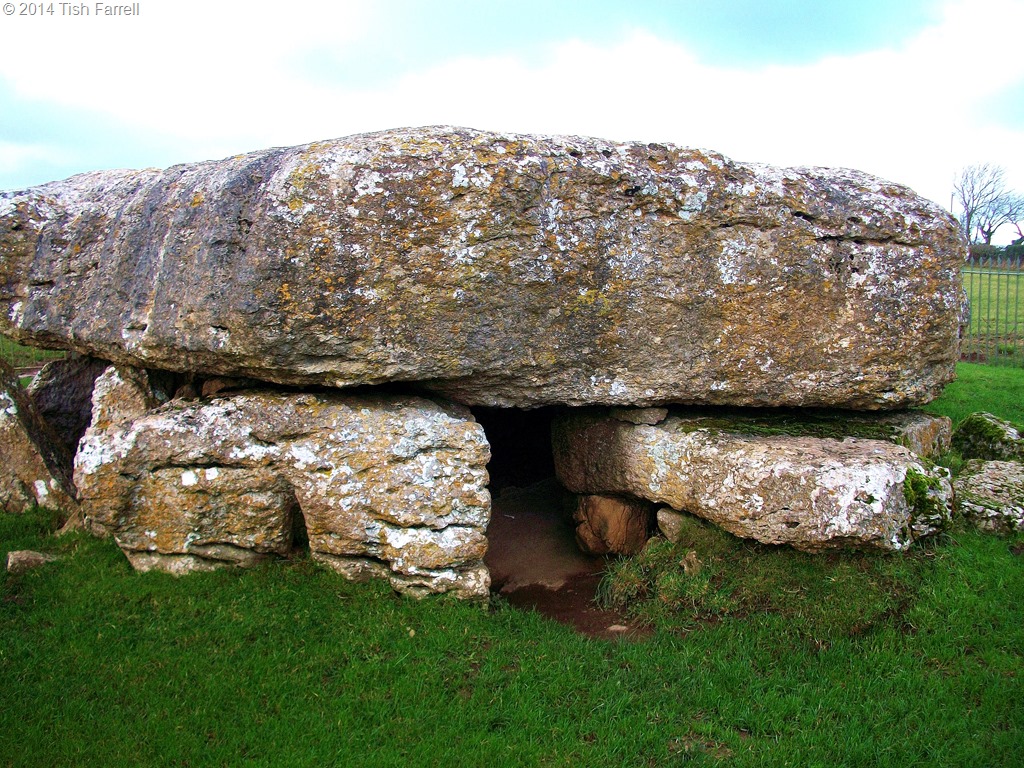
And so here is another example of megalithic mystery. This is the late Stone Age (Neolithic) Lligwy burial chamber on Anglesey in Wales. Excavation in 1908-9 uncovered the remains of 15-30 people, along with pottery that provided the dating evidence. It is estimated that the capstone weights 25 tonnes. This is truly mind-boggling. How did people without cranes lift this monstrosity onto the supporting stones? How  many people did it take? Wasn’t the population in prehistory supposed to be small?

Of course experimental archaeology has demonstrated that much may be achieved with the cunning use of tree trunk rollers and various simple pulley devices combined with muscle power. But even so,  the Lligwy burial chamber is surely  a triumph of human will  over an absence of hydraulic lifting gear. In this era people had only stone tools.

So yes, the past is a foreign country, and people did do things differently there, and in ways we cannot possibly know. And if I learned anything from three years of studying Prehistory and Archaeology it was not to judge people by their limited toolkit. These people were as intelligent as we are, maybe more so, since there was a greater need to apply it at all times.

Our current understanding of these  monuments may be fragmentary, wrong-headed even, but shouldn’t this be all the more reason to keep these ancient places safe? At this present time in England our heritage is daily under threat from a government that wishes to build its way out of  recession.  Worse still, current laws allow developers to take local authorities to judicial review  if their  planning applications are refused.

To avoid  incurring huge costs to the public in legal representation, local authorities are now being pushed to grant planning permission in close proximity to unique monuments.  At present, in Shropshire, the setting of  2 major sites  is under threat: Old Oswestry Iron Age hillfort, and the post-Roman Offa’s Dyke. Why this is happening is of course absolutely no mystery at all.  The past has cachet. It is a highly sellable ‘commodity’. Let’s sell it off, why don’t we?

© 2014 Tish Farrell

Related:

Valuing the Past: How  much for Old Oswestry Hillfort?

Open to Offa’s: yet another piece of Shropshire’s heritage at risk  in The Heritage Journal  along with many other excellent articles


Weekly Photo Challenge: Monument

Colourbridge

Life is great

Leya

Travel Garden Eat

PonderTheIrrelevant

The Human Rights Warrior

FRIZZ’S TAGGED ‘O’  GO HERE FOR MORE ‘O’ STORIES

Misty Mountains of East Africa


002 (2)

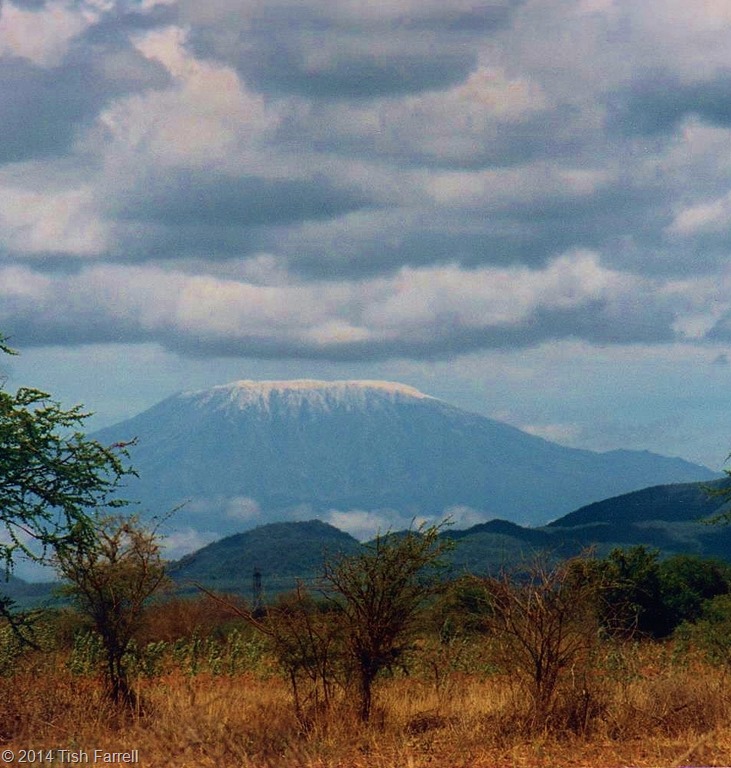
Kilimanjaro rising behind the Chyulu Hills, Ukambani, Kenya. Photo taken from the Mombasa Highway during the December short rains.

*

001

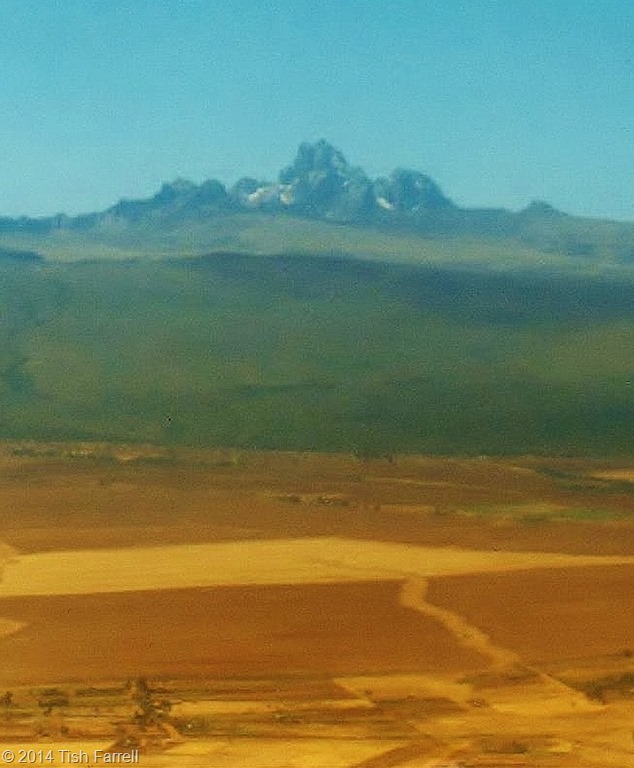
Mount Kenya from the plane window, looking over the European-owned wheat farms of Laikipia

*

It is one of history’s bizarre anecdotes, that one of these two old volcanoes was once given away as a birthday present. But before I reveal how this happened, please take a look at the map. Head for the centre.

4e1bbcd8-9af9-95ca[1]

Here you will see that Tanzania’s Kilimanjaro and Kenya’s Mount Kenya lie pretty much on the same north-south axis, albeit a couple of hundred miles apart. In an earlier post about Denys Finch Hatton’s burial place in the Ngong Hills (to the left of Nairobi on the map) I quoted Karen Blixen’s description of how  one sunset, she and Denys had witnessed a simultaneous sighting of Kilimanjaro and Mount Kenya. This must have been something to see, for these mountains can be frustratingly elusive when it comes to showing themselves. One moment you can be looking them full in the face; the next they have dissolved into a clear blue sky as if they were never there. You blink and wonder how this could have possibly happen. It is doubtless a quantum physics thing, but in the absence of more scientific explanations, the phenomenon anyway seems quite mystical. It is not surprising, then, that local people have long regarded these mountains as sacred places that may, from time to time, be visited by the Creator.

But to return to the mountainous birthday gift.

If you look again at the map you will see how the border between Kenya and Tanzania makes a sudden kink to encompass Kilimanjaro.  This daft piece of map-making is testimony of a tussle in colonial expansionism (Britain versus Germany) and the kind of queenly megalomania  that thought it perfectly reasonable to take possession of someone else’s mountain and then make a gift of it to a fellow monarch, a personage whom she rather despised even though he was a close relative.

I’m sure you will have guessed by now that we are talking of Queen Victoria  and Kaiser Wilhelm. One can only presume that someone who also called herself  the Empress of India would think nothing of the sharing out of stolen mountains. I dare say she thought it made up for the fact that she had bagged the territories now known as Kenya and Uganda when Wilhelm had wanted them too. Perhaps she also thought that giving Wilhelm the taller of the two would also help to placate him.  If she had stopped to consider the fact that Kilimanjaro was only a dormant volcano, she might have had second thoughts.  It was altogether too ominous a gift.

In the end the whole land-grabbing deal was  ratified in the Heligoland  Treaty of 1890, and the map-makers  then duly drew a line straight through the middle of Maasai territory coupled with the requisite detour round Kilimanjaro. They called one side British East Africa, and the other German East Africa. Meanwhile the locals, who comprised very many different ethnic communities, were largely unaware how far they had been scrambled, or indeed scrobbled, to borrow a term of dastardly rapine from John Masefield and The Box of Delights. They were soon to find out. On the British side it began with the setting up of forts along the proposed line of rail for the Uganda Railway. This 600-mile line from Mombasa to Lake Victoria would be the means by which the Empress of India would get her troops (mainly Indian ones) swiftly to the source of the Nile. Why she would ever need to do this will have to wait for another post. Suffice it to say that this project was substantially dafter  than the giving of mountains as birthday presents. Even at the time people thought so. In Britain they called it  the Lunatic Line. In East Africa the invaded called it the Iron Snake.

Scan-130510-0006

Glimpse of Kilimanjaro on the flight from Zanzibar to Mombasa

© 2016 Tish Farrell

*


This fiction writer’s path: five things learned along the way


068

1) Swimming not drowning: there will be (many) false starts

I associate intending to be a writer with learning to swim. I was ten, in my last year of primary school, when I told Mr. Williams, my very Welsh head teacher, that I meant to be a writer. I said it with great certainty, and he listened in all seriousness. He was someone I trusted implicitly. He was also the person who taught me to swim, and to me, decades later, the way he did it still seems a little miracle.

There were several non-swimmers in the senior class and one day Mr. Williams decided to remedy this life-threatening deficiency. Once a week for several weeks he drove us to the swimming pool in the school minibus. He made no concession to the occasion and still wore his smart grey headmasterly suit. Looking back, he probably did this on purpose. It showed he meant business and we were not there to play. The suit’s material had a soft metallic sheen and probably went by the name of Tricel. It somehow had a part to play.

After a couple of trips to the pool I had fully grasped the mechanics of swimming, but was unwilling to give up my rubber ring. Mr. Williams, however, was determined. He told me to walk twenty paces into the pool’s shallow end. He told me to take off the rubber ring. Then standing at the pool’s edge, he squatted down so low that his trousers strained across his knees and shone like silver. His eyes levelled with mine as I stood there – in the water – shivering – without my protecting ring. He told me to swim but I kept standing and staring at his knees, feeling silly and helpless. Then suddenly out flew his arms in a welcoming embrace. ‘Come on,’ he cried. ‘Swim to me. YOU.CAN.DO.IT.’ And such was his look of unconditional expectation that I took to the water and swam.

And the point of this story? Becoming a writer/maker/artist means learning to  grow and nurture your inner Mr. Williams. Along the creative path there may be few external expressions of encouragement. But without the deep-down core of self-belief you will not have the resilience to stay the course, bear the disappointments, handle the rejection slips, or to toil and toil alone for the days, months and years it will take to learn your craft. All of which is not to discourage, but to say that you really have to want to do this.

2) Having formed your intention, do NOT wait for inspiration to strike: you can wait till the crack of doom

Of course learning to swim is not the same as being a good swimmer who can swim fifty lengths with ease and feel quite at home in the water. To become a skilled artisan of any kind, there is the long haul of apprenticeship, probably one that will never end. I, though, and like many would-be writers, went for years, carrying in my head the apparently foregone conclusion that one day inspiration would strike and I would begin to write my own stories instead of reading other people’s.

It rarely, if ever happens this way. Besides which, inspiration is only the starting point, the ‘ah-ha’ moment when your attention fixes on an overheard conversation, or collides with a character on a bus, or gets hooked on some bizarre news event that starts you asking the kind of questions that kick off the story-making process. Mostly, though, you need to seek it out. Because the fact is, even if you are not actually writing, you must be doing the internal work, mentally exploring the stories that you might one day tell, gathering material, keeping watch, feeding that tiny flame of an inkling that says ‘I do have a story to tell’. ‘I do have something important to say.’

Inspiration, then, does not arrive ‘out of blue’ or occur in a vacuum; it needs one, two or several things to rub together. You could say it’s a bit like the slow-going process of rubbing dry sticks together, and trialling likely bits of kindling to get a fire started. In that initial whoosh of a blaze taking hold all is very exciting, but it is only the start. Now the hard work really begins – keeping the fire going, finding suitable material that will burn well – fast or slowly or long enough to cook your dinner. In other words, flash-in-the-pan, quick-fire notions (inspiration) are the easy part. Thereafter comes the sourcing of materials, planning, construction and general project management. You can only truly learn how to do this by doing it. So how to begin?

3) Do not fall into the trap of thinking that reading other writers will drown out your own small voice before you even start: read, read, read…

As an adult, my writing work was largely academic: dissertations, reports, preparing educational materials in various museums. Somewhere along the line I stopped reading fiction; I feared that to do so would distract me from finding my own inspiration, my own voice, my own stories. I have met other beginner writers who said they did the same thing, and especially when it came to books that they thought might ‘compete’ with their own ideas. Yet not to read widely is another form of writer’s self-sabotage. Writers need to read anything and everything they can, and across all genres, and they need to read with attention and discernment. For instance, you can learn a huge amount about story construction by studying an infant’s picture book that contains only around 30 words (Pat Hutchins Rosie’s Walk).

In fact some of the best-crafted storytelling on the planet is for young people – and here I’m thinking of writers such as Richard Peck, Sharon Creech, Robert Cormier, Kate di Camillo, Geraldine McCaughrean, Philip Pullman, Jennifer Donnelly, David Almond. Reading good books with all senses attuned is akin to having mental conversations with other writers; far from swamping your own style/voice/subject matter, listening carefully to what they say and how they say it can help release your very own form of creative expression. This is not about copying ; it is about finding your own truthful response to other writers’ work. Writing a book or a story or a poem is not a contest with anyone else. It is your book, story, poem. Only you can write it. And if in doubt, think ‘Mr. Williams’. At some point you have to get in there and swim.

But of course, having joined the fray, then comes the endurance testing and training, the honing of skills, and goal setting.

4) Being a good writer is not the same as being a good storyteller

Some people are natural storytellers, and especially so when they come from families or cultures where oral storytelling is still practised. Even so, and no matter how you treat them later, it helps to learn the storytelling basics: the beginnings, middles and ends of a story, their possibilities, the ways to build tension and interest, how to manage revelation, crisis and resolution, what it takes to create believable worlds (real-life or science fiction), to breathe life into characters who will then ‘speak’ to readers, to make effective and affective use of language.

All these skills can be learned to some extent by much well-directed reading, including studying a few how-to-write books on the way. But taking out a subscription to a good creative writing magazine or attending a class are the more interactive and less lonely options. The disciplines of entering magazine contests or doing class exercises – reading others’ work with interest rather than envy, writing to deadlines, word counts and prescribed themes are all worth cultivating. They all build the kind of writing muscles you need to best deliver ‘the what’ of the creative process – the  story.

5) Writing fiction does not mean ‘making things up’; it is all about building convincing worlds.

This is something that is easily misunderstood, and it took me some time to grasp explicitly. Fiction reveals imagined worlds and their inhabitants in ways that are truthful in. Integrity and authenticity are key objectives. The setting may be a medieval Russian monastery, a London secondary school, or a planet with two suns, but it must ring true for the reader. Its special characteristics will add depth and texture to the narrative, but above all, they will be dynamic – informing, shaping, adding drama to the characters’ behaviour/situation/dilemmas. This requires considerable research and construction work by the writer, but with the caveat that, at the end of the process, only the writer ever needs to know all this stuff. The reader wants only the most telling details, the ones that, like literary hyperlinks, will take them straight into that special place and engage them wholeheartedly with the characters’ lives. (A fine example of this is Hilary Mantel’s Wolf Hall where she uses historical, social and political contexts to reveal the life and times of Thomas Cromwell.)

To achieve this level of ‘reality’ requires the writer to have strong reasons for telling a particular story. As I’ve said, creating a story from start to finish requires drive and stamina. Passion, pain, compassion and anger are great spurs, but their energy needs to be channelled judiciously. (No ranting or heavy-handed moralizing required and the writer’s self should keep well out of the way). The research part of the project may also demand a whole new reading schedule (encyclopaedias, atlases, internet content, telephone directories, newspapers etc) and, where possible, physically immersing yourself in the places where the story is set.

This is all about knowing your territory as an expert guide would know it. Only then can the alchemy begin. Or perhaps shape-shifting is a better analogy. Because this is one of the most important of all the things I have come to learn from the practise of being a writer: the writing must come from the inside out; writers must inhabit their character’s minds, shoes and underpants; whatever it takes to get inside their skin. For me, this usually means starting with the feet rather than the knickers department. When I wrote about a street girl called Jessicah, she was conjured by a ‘feeling’ in the balls of my feet as she tramped in thin-soled shoes through the African highlands. Years later I can still summon that particular sensation and know it is Jessicah, and start seeing the world again through her eyes. All of which is very strange when you think about it, and probably the reasons why most writers keep writing. For the final truth is that even well-published writers struggle to make a living from book sales alone. Writing then, first and foremost and anyway, has to be done for the love of the thing.

© 2014 Tish Farrell


Tish Farrell writes short fiction to entice unkeen teen readers to read in the Shades series at Ransom Publishing. She also writes for Heinemann Junior African Writers, Zimbabwe Publishing House and Phoenix Publishers East Africa. Her short story Flight came third in last year’s International Bath Short Story Award.


Writerly Reflections

Looking inside ‘The House of Belonging’: remembering artist Sheilagh Jevons

House of Belonging detail i

The following is the account of a conversation I had with Sheilagh in 2014, a year before her death. She is sadly missed.

*

I thought it was time I welcomed good friend and artist, Sheilagh Jevons, to this blog. She lives a few miles from me along Wenlock Edge, in the little village of Easthope. There, and in her studio not far away, she creates arresting work that explores the sense of belonging that people have with landscape. From time to time she and I have involving conversations about the creative process – the stumbling blocks, the sources of inspiration, the way we work (or in my case, don’t work).

A few weeks ago she came round for coffee. I wanted to ask her about a painting I had seen in her studio. I had thought it striking and mysterious, and wanted to know what she meant by it. Besides which, it is hard to resist the opportunity to grill an artist when you have one captured inside your house.

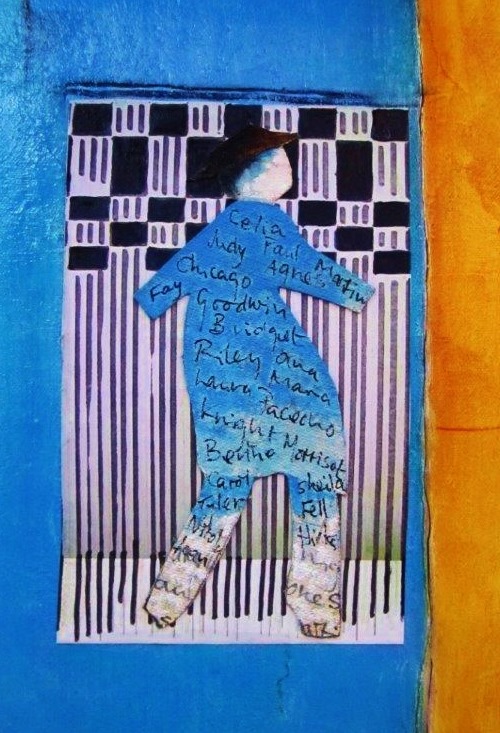
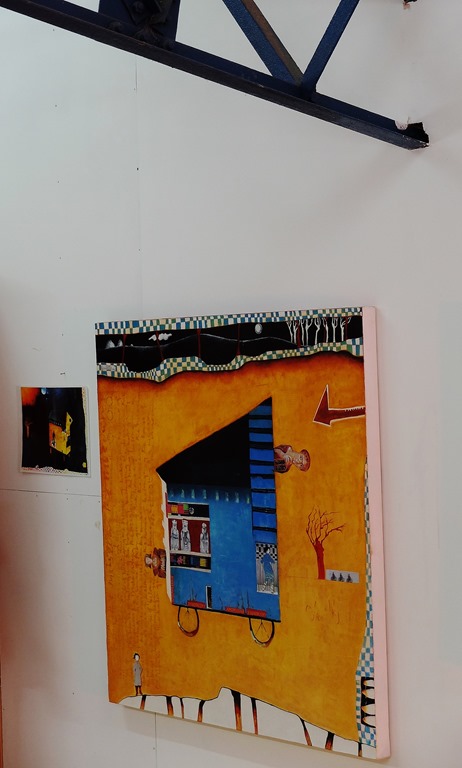
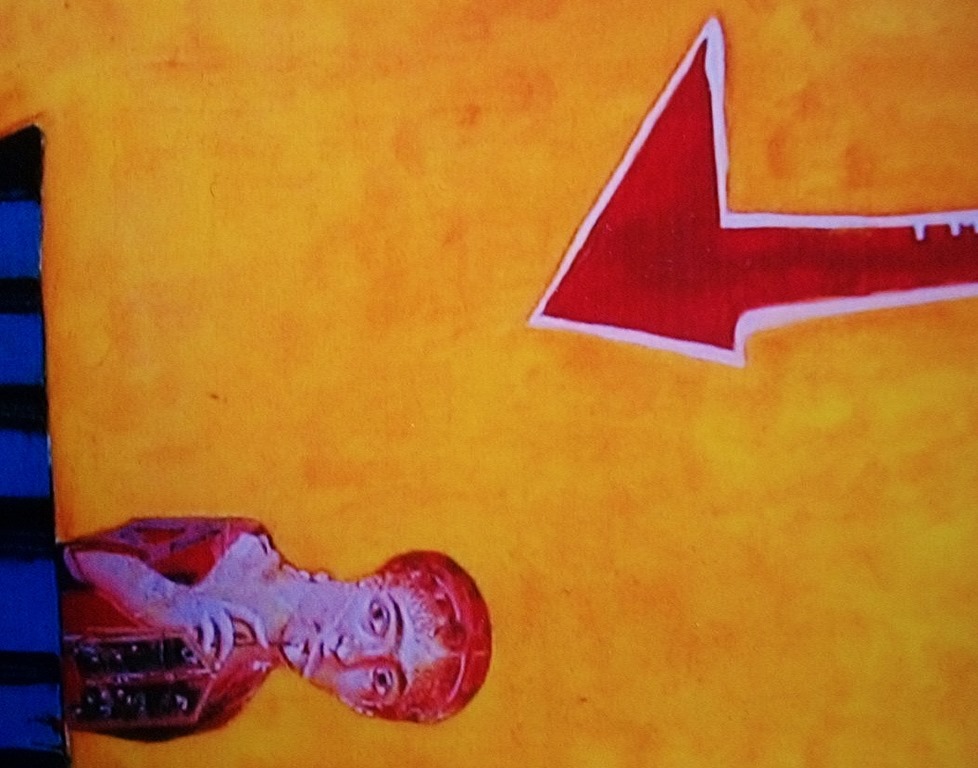
The header image is a small detail from a work called The House of Belonging. This figure has appeared in Sheilagh’s other works and represents women artists. Some of their names are written on the smock, artists perhaps not well known to the general public. Here she pays homage to their work, but also alludes to the fact that, overall, very little work by women artists is to be found in museums. The writing of names and of repeated key-words and equations is characteristic of many of Sheilagh’s pieces. It was one of the things I was going to ask her about. But first, the painting.

House of Belonging ii

It is a large canvas, some 4 feet (120cm) square. The next photo gives a better sense of scale. Here it is hanging in Sheilagh’s studio:

Shelagh 003

I asked Sheilagh how the work began. She told me that some years ago the idea of belonging had become very important to her. As she says on her website:

Our ‘sense of belonging’ ripples out from our homes to our village, street, town, county, region and country and help to shape our identity…

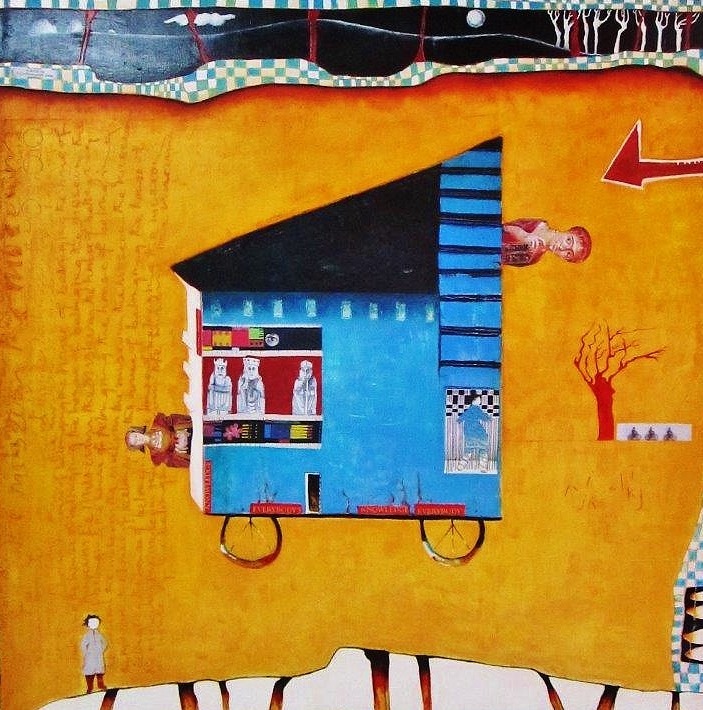
Key, then, to her work is a sense of connection to land and how that relationship defines us. This in turn has physical expression in community repositories, the places where we keep artefacts, our history, the knowledge of ancestors – all the familiar things we recognise and which tell us something of who we are. In other words, the museum, or as Sheilagh describes it: the house of belonging. The script running down the left-hand margin of the painting in fact repeats over and over the words ‘the museum’, the house of belonging’. The repetition reflects the strong political stance of Sheilagh’s work.

To me this is ‘the writing on the wall’, a statement of collective ownership; The House of Belonging staking a claim. Its contents are manifestations of how humans have interacted with their landscape and the place they call home. Sheilagh also says that adding text creates a certain texture; that the sense of a hand moving across the work creates a connection with her, its maker. The wheeled blue structure, then, is the House of Belonging. The words written inside say ‘everybody’s knowledge’. This is written twice so there can be no mistake. It feels like something to stand up for, a rallying call.

It is also important, Sheilagh says, that the House can move across the landscape to where the people are, rather than the other way round; this makes it more egalitarian. Inside the House are images and artefacts, symbols of creativity. Some of them are stereotypical of ‘heritage’ and therefore instantly recognisable. For instance, the chess pieces (centre left in the painting) are derived from the Scottish Isle of Lewis Chess Set in the British Museum. The set dates from AD 1150-1200 and suggests Norse influence or origins.

House of Belonging Detail ii

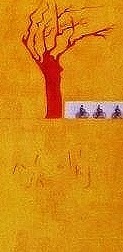
Sheilagh copied and simplified the images from a sales catalogue that specialises in heritage reproductions. The placing of the queen in the central position is also significant. She says she feels bound to redress an imbalance: the fact that in most of our media women only occupy centre stage when they are being commodified in some way. And then there is the mathematical equation painted in red beneath the red tree, centre right of the painting. 100_5291 The presence of equations in Sheilagh’s works adds a further layer meaning for her, and although she doesn’t think it necessary to explain them, she is always very pleased when people recognise them. This particular one refers to mathematical research by American academics in the 1920s called The Geometry of Paths. The appearance of equations in Sheilagh’s paintings also has more personal origins. She tells me she started to include them some years ago – after she had been helping her daughter revise for her Maths and Physics A’ level exams. It is another connection. There are many more signifiers in the work: motifs that have links and resonance with Sheilagh’s other works. The red tree above the equation is a symbol of timelessness, indicating ‘forever’ in human terms.  House of Belonging ii - Copy The red arrow in the top right creates a sense of energy and direction; a ‘look what’s here’ sign. There is the sense of a force field, drawing people to the House of Belonging. 100_5294

Finally, we talked about the overall composition. Sheilagh says that she began the work some years ago after she noticed that a small building denoting ‘museum’ often appeared in her landscapes. This time she wanted it to have it as the main subject, and to make it both an enticing and a mysterious place. At this point she also created the friezes at the top and bottom of the picture, these in order to suggest other layers of reality behind the surface painting. The top frieze is the wider, timeless landscape of which the museum is also symbol. The bottom frieze is deliberately ambiguous and suggestive; it invites the viewer to consider what might lie behind.

House of Belonging ii And having created the work’s essential structure, the painting was then abandoned. It was only some fifteen months later, when Sheilagh, looking for a large canvas to start another work, returned to it. She was fully intending to paint over it, but when she looked at it again she suddenly knew how to proceed and completed the work very swiftly. She says it probably is not quite finished, and suspects that something may still need to be added. In the meantime she has been occupied with a large body of work relating to Scotland.

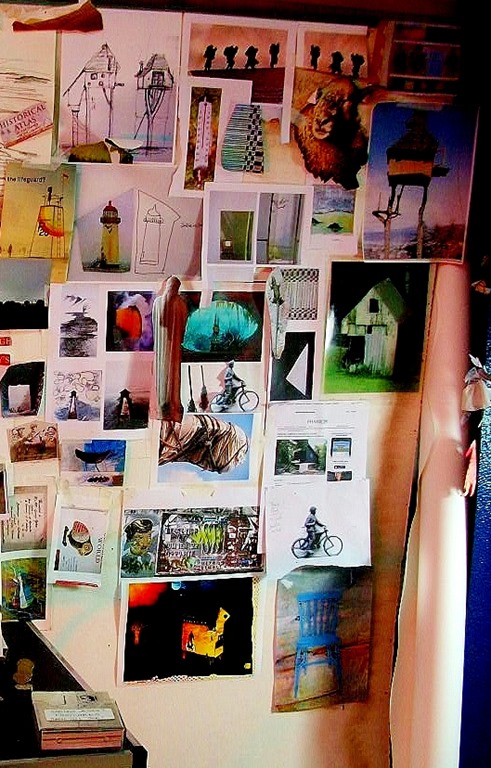
*100_5111 100_5110

Notes and reference materials from Sheilagh Jevon’s studio

© 2014 Tish Farrell

Kudos to North Cambridge Family Opera and their upcoming show Rain Dance


image

Art by Brian Lies  (Copyright Brian Lies)

*

The North Cambridge Family Opera Company based in Cambridge, Massachusetts, has been working long and hard for their upcoming production of Rain Dance. This will be the US premier of the young people’s opera created by librettist, Donald Sturrock (official Roald Dahl biographer) and award-winning composer, Stuart Hancock. I am honoured to say that this wonderfully witty creation was inspired by one of my short stories, The Hare Who Would Not Be King, originally published in Spider, part of the Cricket Magazine Group in the US. Above is some of the artwork by children’s writer and illustrator, Brian Lies. I especially love Brian’s hats.

Rain Dance was originally commissioned for performance in 2010 by W11 Children’s Opera in London. As such, the cast comprised entirely young people from London schools. North Cambridge has a different approach, putting on shows that involve all family members – kids and adults together. And the reason I know they have all been working so very hard is because there is a PREVIEW of the performance on their website. If you click HERE you can not only download the score and read the synopsis, but hear an entire performance scene by scene. Please listen. You truly will not be disappointed. Stuart Hancock’s score is captivating, and Donald Sturrock’s libretto is very funny.  And it is all about failing rains and lion-style political corruption down at the waterhole  (based on an original Akamba traditional story). But if you live in MA and can make an actual performance, here are the details:

Home

Directed by David Bass and Kathy Lindsay
Choreography by Rachel Zimmerman

Performances:
Saturdays March 29 and April 5, at 3:00pm and 7:00pm
Sundays March 30 and April 6, at 1:00pm and 5:00pm
AT:
The Peabody School  (Directions, map, parking)
70 Rindge Avenue, Cambridge, MA 02140


Frizz’s challenge ‘tagged K’

International Women’s Day 8 March


I posted a version of this last year, but here it is again…

image

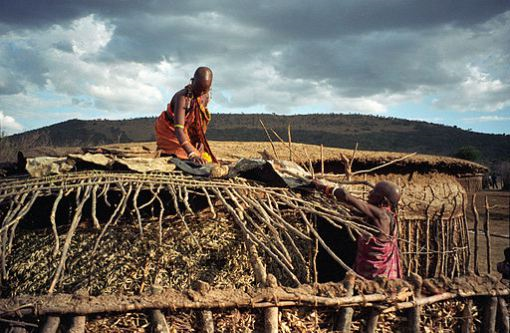
Maasai women house builders. Photo: Creative Commons – Jerzy Strzelecki


*

I’m thinking of women whose life is immeasurably harder than mine. Could I, for instance, walk the Maasai woman’s barefoot daily trek across wild bush country, searching for firewood, fetching water, taking produce to market? Could I have reared children in the dung and wattle hut that I had built myself? Could I live obeying a husband’s commands even when I thought them wrong? What kind of bravery, tenacity and inner strength would I need to live this way, and to still live well? These days, things are slowly changing for Maasai women, not least because campaigners from their own communities are pressing for girls’ education, the end of genital mutilation and forced teen marriages. But for outsiders visiting the Mara it is all too easy to see only the grinding poverty and the reconstituted, fit-for-tourist shreds of former warrior glamour. But before jumping to too many conclusions about what is really going on, here is my version of a Maasai traditional story that sheds some light (literally) on their own views of the man-woman relationship.


And the moon still shines

Long ago Sun wanted a wife
so he married Moon and they made a pact,
to ply the sky in endless round,
Sun ahead, Moon behind.
And each month, tiring of the trek,
Sun carried Moon-Wife on his back.

But then one day they came to blows.
Moon crossed Sun and Sun lashed out,
beating his Moon-Wife black and blue.
Moon struck back. She slashed Sun’s brow.
He gouged her cheek, plucked out an eye.

Later Sun fumed: I’ll shine so hard
that none will ever see my scars.
While Moon tossed her head:
Why hide my wounds?
I still light up the night sky.

*  

text© 2014 Tish Farrell

*

image

Photo: Creative Commons www.flickr.com/photos/javic


Frizztext’s tagged ‘i’

Go here for more ‘i’ inspired stories

Abandoned: Great Zimbabwe

Scan-130429-0005

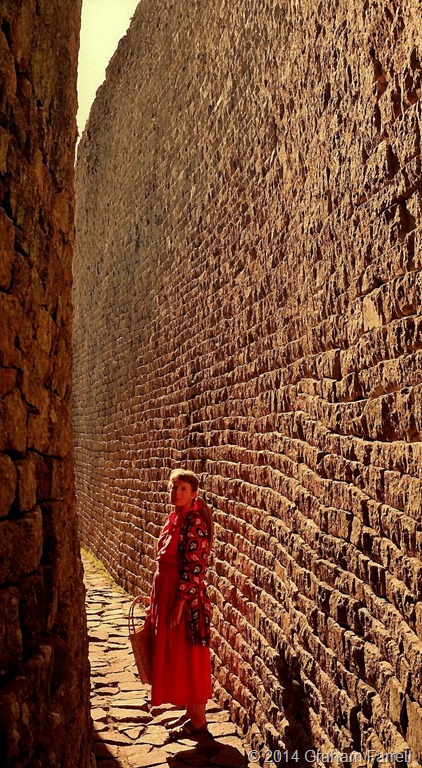
Inside the Great Enclosure of Great Zimbabwe. These magnificent walls have survived for nearly seven centuries, and not a lick of mortar to keep them standing.

Scan-130429-0010

No one knows exactly why this great African city  was abandoned. For some 350 years, until  around 1450 AD,  Great Zimbabwe had been a flourishing merchant centre that drew in from the surrounding country supplies of gold, copper, ivory, animal skins and cotton. The city’s entrepreneurs  then traded these goods on to the Swahili city states of Sofala and Kilwa on the East African coast. (You can read more about the Swahili HERE). In return, the traders brought back luxury goods –  jewellery, decorative pieces such as 13th and 14th century Chinese celadon dishes and Persian ceramics.

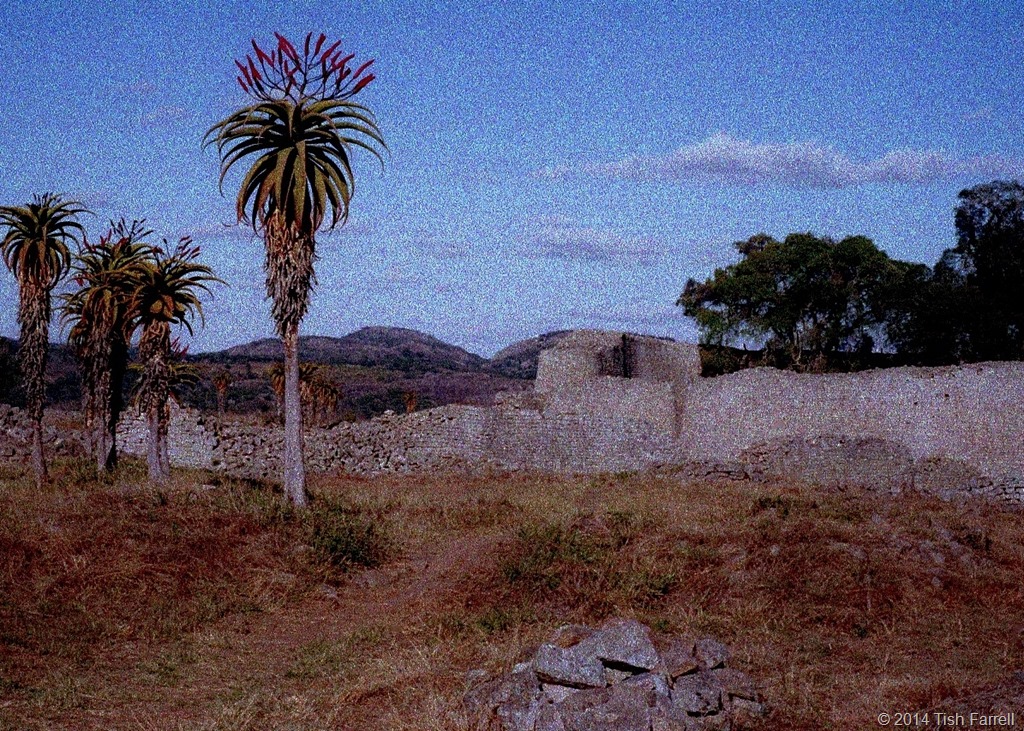
aloes and Great Zimbabwe

The city’s ruins cover 80 hectares, its many stone enclosures commanding the southern slopes of Zimbabwe’s High Plateau watershed between the Zambezi and Limpopo Rivers. The site is well watered with good grazing throughout the year. It is above the zone of the deadly tsetse fly that can infect both cattle and humans with sleeping sickness; and the plateau’s granite scarps provide plentiful building stone and other raw materials. Even so, these favourable circumstances do not explain why this particular settlement rose to such prominence.

For Great Zimbabwe was not a singular phenomenon. Contemporary with it,  and across the High Plateau region, are the remains of at least a hundred other mazimbabwe (houses of stone). Several were large enough to have been the capitals of rival states. Others may have been satellite communities occupied by members of Great Zimbabwe’s ruling lineage.

So who were the city’s builders?

During Zimbabwe’s colonial times, and until independence, the  Rhodesian government actively supressed  evidence that Great Zimbabwe was built by Africans.  Many of the other stone ruins were destroyed or re-purposed by European settler farmers. The official view claimed that the city was Phoenician, and that the Queen of Sheba’s fabled kingdom of Ophir had been discovered. Archaeologists, however, have long demonstrated  that it was the cattle-owning Karanga Shona who built Great Zimbabwe. The first phase of stone building began around 1100 AD. Thereafter, the city’s rising fortunes and successive building phases suggest its increasing control of the ancient High Plateau trade routes to the Swahili cities of Sofala and Kilwa.

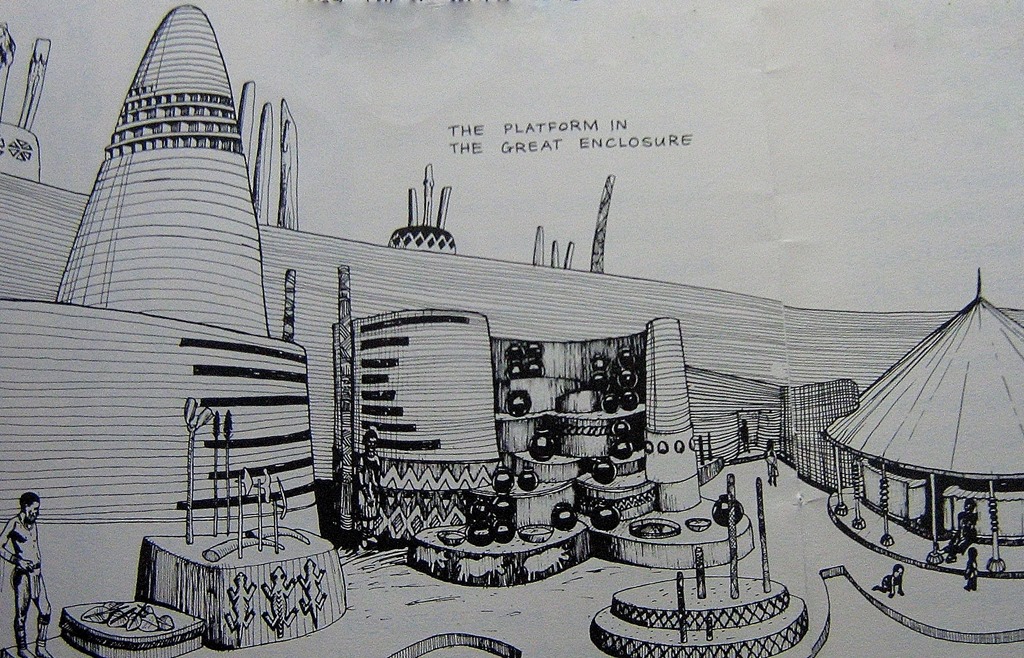
Gold was the key commodity, and it is likely that it was Great Zimbabwe’s successful cattle production that provided it with the trading power to secure gold supplies from mines some 40 kilometres away. The more prosperous the city became, the more sophisticated its demonstrations of prestige. In around 1350 AD  the Great Enclosure of finely dressed stone was built. This huge elliptical structure with its mysterious platform and conical tower is thought to be the royal court. There is no indication that the walls were defensive. This was  a regime confident in its power and authority.

IMG_0889

Peter Garlake’s reconstruction of the Great Enclosure Platform from Life at Great Zimbabwe,  Mambo Press 1982

*

Then why did the city decline?

There are various explanations: the people had let their herds overgraze the land; they had cut down all the trees; there was a prolonged period of drought as may happen in southern Africa. But somehow none of these theories quite explain why, after 350  flourishing years, a community of perhaps 20,000-plus people should simply pack up and leave. Did all these farmers, herders, miners, craftspeople, soldiers, traders, accountants, court personnel and the city’s rulers  leave on a single day, or did the city die slowly?  The archaeological evidence does not say.

But we do know there were disruptive external forces at work. In the 15th century the Portuguese invaded the Swahili coastal city of Sofala. They were on the hunt for gold and so pressed inland with Swahili guides. Their interfering presence drove the trading routes north, giving rise to the Mutapa state. This new state may well have been founded by people from Great Zimbabwe. Certainly by this time the Swahili traders were coming up the Zambezi to trade with the Shona directly, the old trade route through Great Zimbabwe no longer used. At this time, too, we see the beginning of another Shona city state  with the building of the stone city at Khami near Bulawayo in southwest Zimbabwe. In the following centuries this became the centre of the Torwa-Rozvi state whose other major cities during the 16th and 17th centuries included Naletale and Danangombe.

Great Zimbabwe entrance

The Great Enclosure entrance at Great Zimbabwe built c.1350 AD

*

And so into history…

Of course with the Portuguese incursions comes the first documentary evidence. From the early 1500s Zimbabwe’s royal courts enter the historic record in the accounts of the Portuguese conquistadores. In 1506 Diogo de Alcacova writes to his king, describing a city  of the Mutapa state

“called Zimbany…which is big and where the king always lives.”  His houses are “of stone and clay and very large and on one level.” Within the kingdom there are “many very large towns and many other villages.” 

The Portuguese historian Faria y Sousa also describes the King of Mutapa’s great retinue which included the governor of the client kingdoms, the commander-general of the army, the court steward, the magician and the apothecary, the head musician “who had many under him and who was a great lord”. Also noted were the vast territories over which the king ruled, the revenues and subject kingdoms of the king’s several queens.

And suddenly we have a true glimpse of what this land called Zimbabwe might have looked like in the past, a bustling, mercantile, metropolitan culture, supported by gold miners, farmers, cattle herders and craftspeople. And so it remained until well into the 18th century, albeit with a shift of Shona power to the southwest and the Torwa-Ruzvi state as the Portuguese presence caused increasing instability. Then in the 19th century came new invaders – the Nguni, the Ndebele and the British.

This centuries old heritage of royal courts is not a picture that the likes of Cecil Rhodes or, the later Rhodesian government of Ian Smith ever wanted anyone to see. And so in the end this is not so much a story of a city abandoned by its people, but of a people wilfully excluded from their past.  In 1980 when Zimbabwe became an independent state, some of this past was reclaimed: the new state took its name from the first great Shona city, and  adopted for its flag and coat of arms, an image of one of the city’s ceremonial soapstone birds. These are small steps forward, but there is still a long way to go before the world sees the indigenous histories of the Africa continent in their true perspective, and acknowledges their intrinsic cultural worth.

There is more about Great Zimbabwe in an earlier post HERE.

References: The classic work on the excavations of the city is Peter Garlake’s Great Zimbabwe 1973. For an overview of the mazimbabwe culture see Innocent Pikirayi’s The Zimbabwe Culture AltaMira Press 2001. For a wider historical perspective Randall L. Pouwels The African and Middle Eastern World, 600-1500 Oxford University Press.

© 2014 Tish Farrell

Looking for Smut on Kenya’s Highland Farms

For those of you who read my recent post Valentine’s Day Runaway this is one of the things Team Farrell got up to next; it had a lot to do with smut. And no: it’s not what you think.

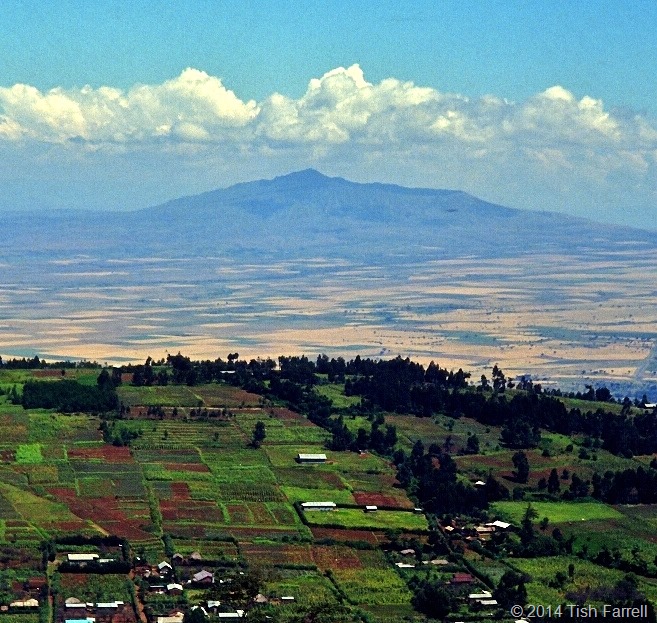
Rift Valley from Escarpment

Smallholder farms on the Great Rift Escarpment, Kenya

*

For most of the 1990s we were based out in Kenya, where Team Leader Graham, food storage expert and all-round fix-it man, was one of several  British scientists running a crop protection project alongside Kenyan scientists at the National Agricultural Research Laboratories (NARL). This work was funded by DFID, Britain’s Department for International Development, which in turn is of course funded by British taxpayers.

image

Most of Kenya’s farmers are women. Their efforts feed their families and feed the nation.

*

Many of the project’s programmes of work were done on farms, and involved helping farmers to devise their own research methods for controlling the numerous pests that attack their crops both before and after harvest. Since just about every Kenyan, from the President down, is some kind of farmer, or has a farm in the family, this was an important project, and just about everyone was interested in the outcomes. (Next time you are buying French beans or mange tout peas in the supermarket, look where they have come from. Much of this kind of produce is grown under contract on small farms like the ones below.)

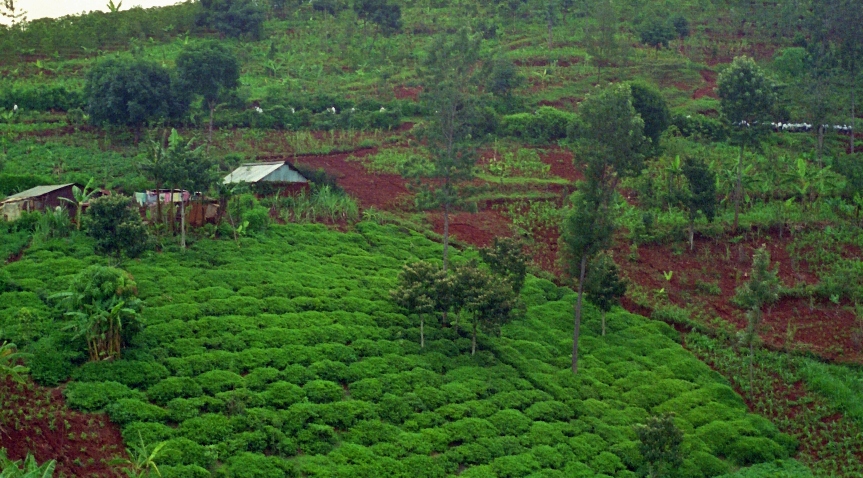
clip_image002

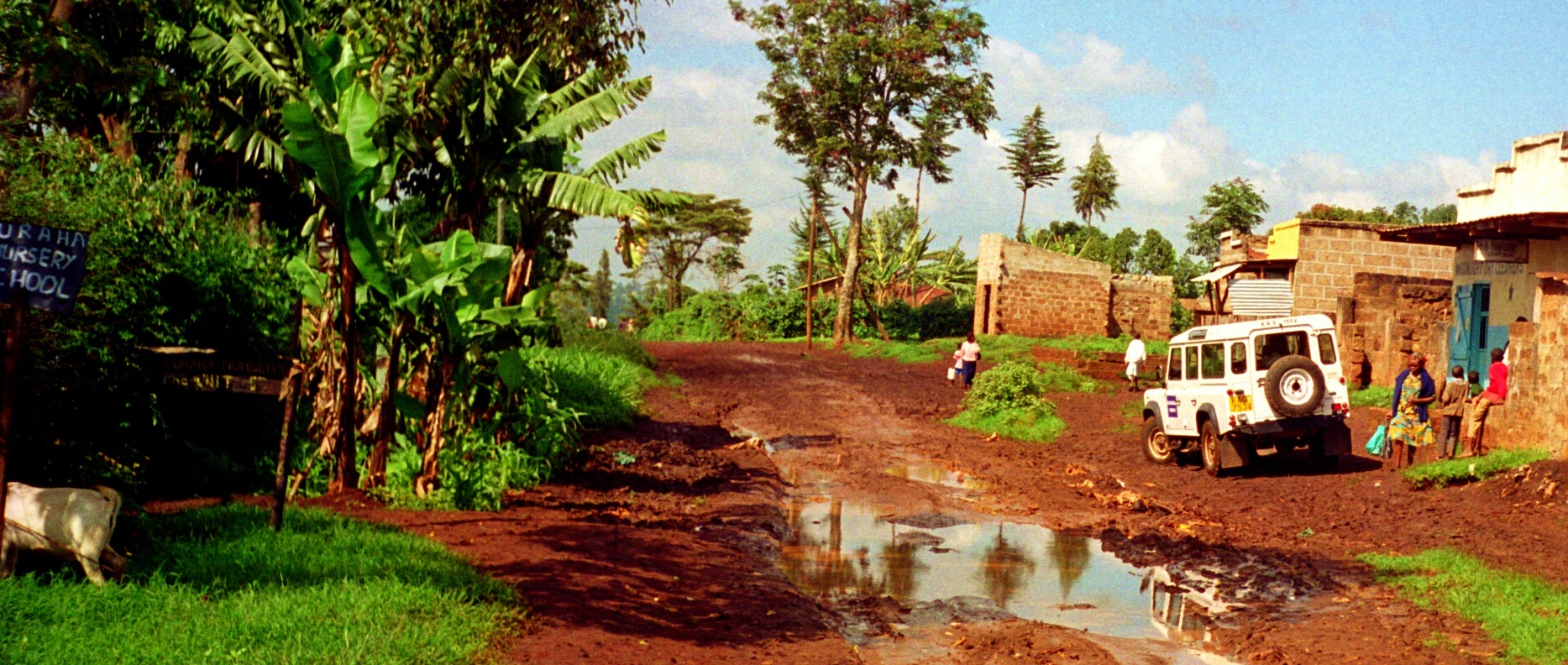
A typical farmstead in the Kenya Highlands north of Nairobi. The volcanic soil is very fertile, but also susceptible to erosion.

*

Today Kenya is undergoing a massive hi-tech revolution through the proliferation of cell phone and computer technology, but it still relies on agriculture for survival. When you discover that only 15% of Kenya’s landmass has enough rain or is fertile enough for arable production you may begin to see the scale of the problem for a nation that is only now beginning to industrialize. There are of course the big multinational outfits that grow wheat, coffee, tea, flowers and pineapples, but most of the food that Kenyans eat is grown on thousands of tiny farms, many less than an acre in area.

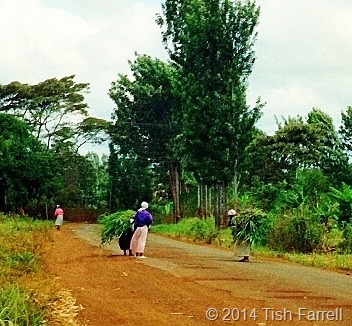
Escarpment lane

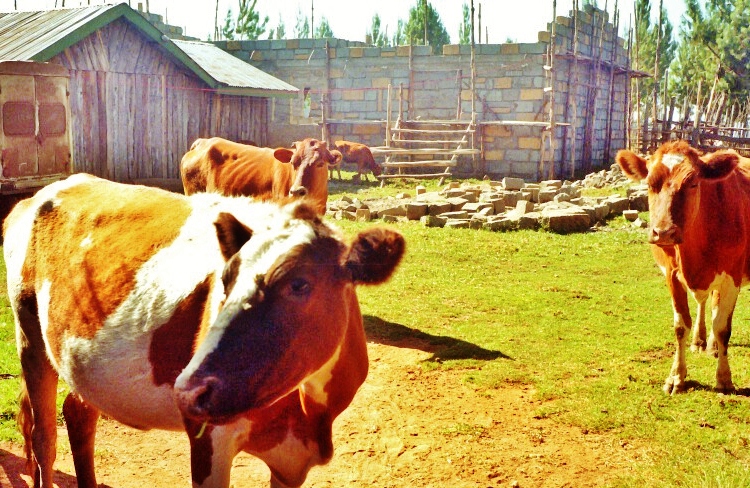
Gathering Napier Grass from roadside plots to feed ‘zero-grazed’ dairy cows. Most farms are so small that cattle are kept in small paddocks and their food is brought to them: yet another daily chore, along with gathering cooking fuel and attending to children and fields.

Kikuyu lane with woman carrying napier grass

Furthermore, most of Kenya’s farmers are women. Providing most of the the country’s food, they are in every sense the backbone of the nation. They stay in their rural homes, tending the crops and bringing up the children while husbands work away to earn extra cash to repair homes, buy fertilizer, educate their children and fund small business enterprises.

These men usually head to the cities where they work as security guards, clerks, hotel staff, house servants and drivers. Most take their annual leave at harvest and planting times so as to be back on their farms to help with the year’s most arduous tasks. So however you look at it, everyone in Kenya works very hard. Certainly in the nineties even most professional Kenyans believed that owning a plot of land to work at weekends was an essential insurance policy in a nation with no social services.

clip_image005

Most of the milk from smallholder’s cows is sold to provide cash to pay for children’s education and medical bills. While primary education has been free over the last few years, there are still expensive books and uniforms to buy, and secondary education is not free. On this farm the owner is also using any disposable income to bit-by-bit replace his timber farm house with a good stone house.

Kikuyu farmstead 24

*

So back in 1998, as part and parcel of protecting Kenya’s agricultural production, Team Leader Graham invited Nosy Writer (me) to accompany him on a fact finding mission around the farms north of Nairobi. We were on a quest to plot the incidence of SMUT, a fungal disease that was affecting Napier Grass, an important fodder crop. Most smallholders kept a small number of dairy cows because the selling of milk provided a valuable supplement to their income, helping to pay for school fees and medical expenses.

Most farms are too small to include pasture and so the cows are ‘zero-grazed’, that is, kept in small paddocks and their fodder (mostly Napier Grass) brought to them. This grass, if well-tended, grows into huge perennial clumps that can be cut at intervals. It can also be usefully grown on vertical banks to consolidate field terraces, or wherever the farmer can find a space, often on roadside verges. However, once smut gets a hold, the plant will gradually weaken and its food value decrease. Not only that, smut spores blow on the wind, and infect other plants. The only remedy is to root up the infected plants and burn them.

Graham and Kungu delighted to find smut on Waiyaki Way

Nothing pleases plant pathologists more than to find a nicely diseased plant. After a morning spent searching for smutted plants out on the farms, Doctors Graham Farrell and Jackson Kung’u are amused to spot a case back in the city. Here it is on a highway verge near the National Agricultural Research Laboratory in Nairobi. Smut lives up to its name and turns the flowering stems a sooty black. The fungus gradually weakens the plant and reduces it in mass and nutritional value.

*

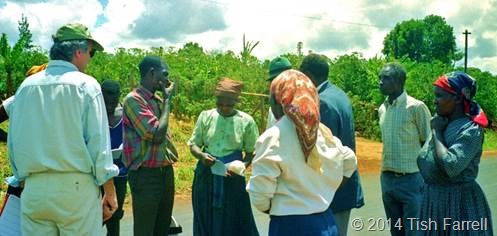
My job on the smut quest was to hold the clip-board and the other end of the measuring tape while we sampled farm plots. Our third, and  most essential team member, (in fact he was the real team leader) was Njonjo. He was the one who heroically drove us up and down the hilly Kikuyu lanes that had recently been ravaged by torrential El Nino rains.

clip_image009

Rift lane after July downpour

As well as being one of NARL’s top drivers, Njonjo was himself a farmer, and so had a vested interest in getting to the bottom of the smut infestation. Since Graham’s Kiswahili was a bit rusty, and many of the older farmers preferred to speak Kikuyu, Njonjo provided them with on-the-spot lectures on what they should do with their smut-infected plants. He also talked our way onto every farm, where we welcomed in with huge courtesy, despite arriving uninvited.

clip_image011

Njonjo and Margaret the farmer. She was busy making compost when we arrived on her farm.

Kikuyu farmer and sugar cane

This farmer was so grateful to be told about his smutted Napier Grass he presented us with some sugar cane. We also came home with chickens, maize cobs and bags of pears

*

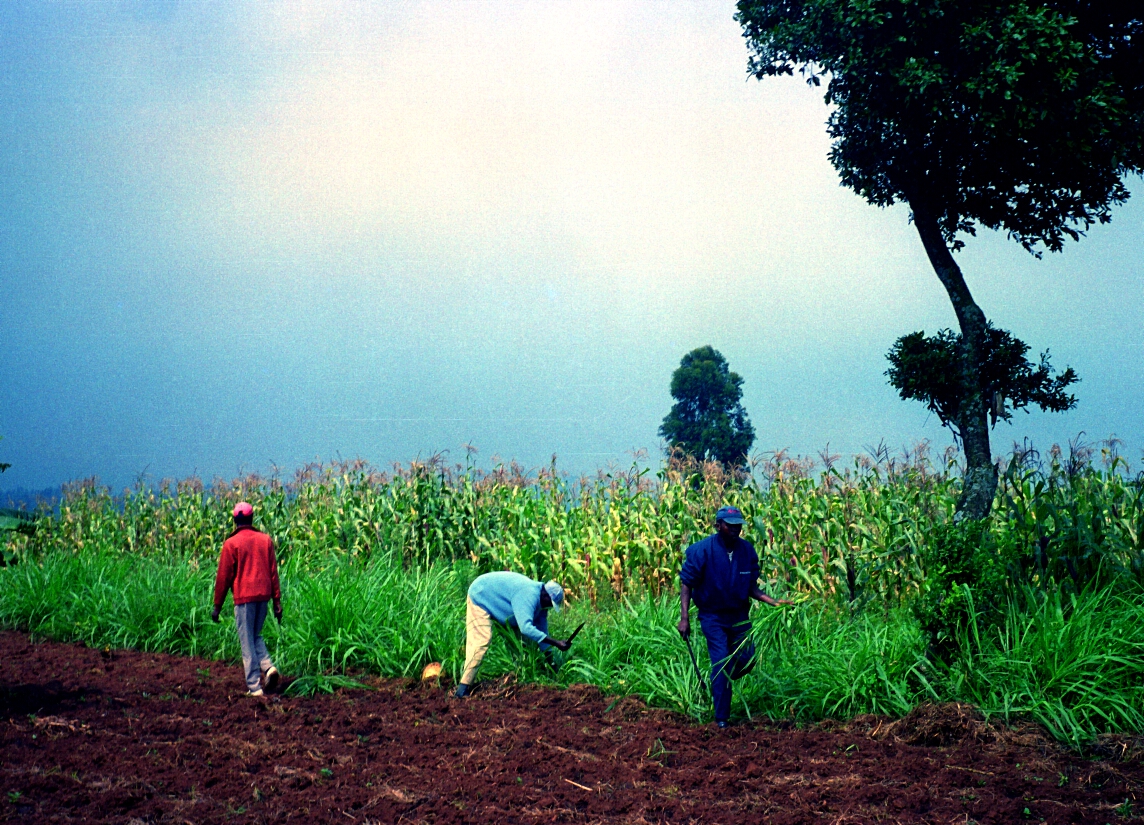
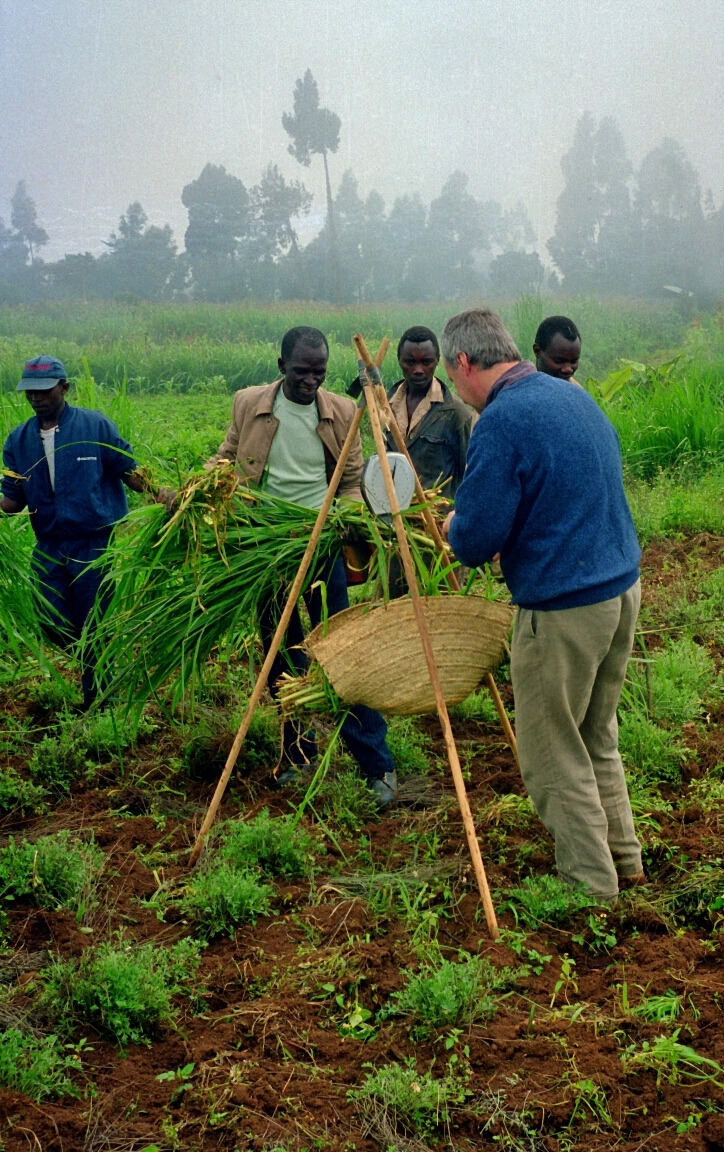
One of our tasks on the farm was to sample farmers’ Napier Grass plots to see how far they were infected, and to what extent the affected plants had lost mass. Njonjo organised a team of unemployed lads to help with the sampling.

clip_image015

clip_image017

clip_image019

Before the cell-phone revolution of recent years, farming information was hard to come by. Here Njonjo delivers his Smut Lecture to an impromptu gathering of smallholders who have spotted our arrival in their district and want to know what we are up to.

*

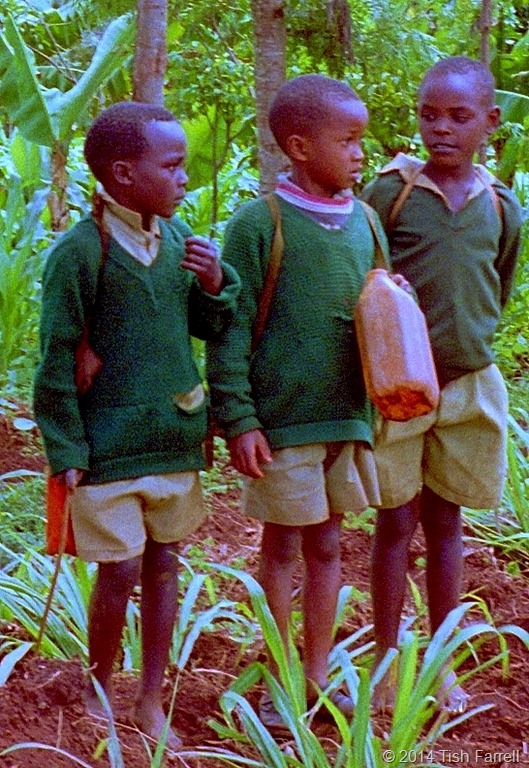
And here are three good reasons why Kenyans work so hard…

Kikuyu schoolboys

…education, education, education.

© 2014 Tish Farrell


Warrior Wind-Singer of Llyn


holiday 027


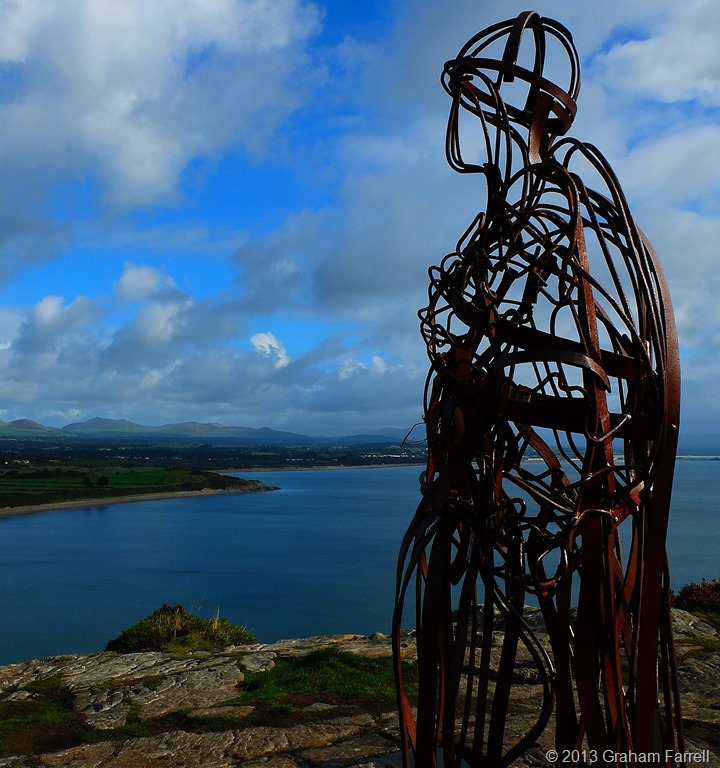
It is said that the Iron Man of Mynydd Tir y Cwmwd sings in the wind. I can believe it too: bold laments of long ago battles, a proud Celtic warrior fending off invading Roman governors and power-hungry English kings. Sadly, the cause was lost on both fronts, although at least these days Cymru,* Wales, has its own Welsh Parliament, and Cymraeg, the Welsh language, is nurtured, learned in schools and spoken widely with great pride. And so it should be. It is one of the world’s wonderful languages, the words formed from the rush of sea on rocks, the wind whistling down from the heights of Yr Wyddfa** (Snowdon, Wales’ highest mountain). Under past times of English domination much was done to stamp out the Welsh culture altogether. It is what invaders do – belittle, ban, override  heartfelt expressions of a conquered people’s culture.

{*roughly pronounced Kumree and Ur Oithva}

100_4536

Llyn Coast Path, Mynydd Tir y Cwmwd

*

Recently I have been writing much about preserving and respecting heritage (Valuing the Past…and also Is the Past past saving in The Heritage Journal) but I recognise, too, that nothing stays the same – at least not in the physical world. The Iron Man is a case in point.


The first man standing was a carved ship’s figurehead placed there in 1911 by Cardiff entrepreneur, Solomon Andrews.  Andrews had bought the nearby grand house of Plas Glyn-y-Weddw some twenty years earlier and turned it into a public art gallery, the first of its kind in Wales. Today the house is the home of the wonderful Oriel Gallery, run by a trust, and the place where Welsh creativity is celebrated.

holiday 026

Oriel Plas Glyn-y-Weddw from Llyn Coastal Path

*

The ship’s figurehead did not fare so well. In 1980, after it had been set on fire by vandals, local artist, Simon Van de Put replaced it with a figure of an ancient warrior made from recycled sheet steel. As had been envisaged, the warrior , exposed to the sea winds, weathered away until only his boots remained. But in 2002 reinforcements arrived, delivered to the headland by a helicopter and winch.

Today this new Iron Man surveys Cardigan Bay with the kind of stance that says  he means to stay. In fact I’m not altogether certain that he might not also be a woman. This warrior, then, is the work of local craftsmen Berwyn Jones and Huw Jones.

To me the rope-like ironwork  suggests sinew and muscle. It is thus simultaneously  symbolic of both decay and regeneration; a rare act to pull off.  The tilt of the head is dignified, but wistful too. I would like to feel I have the courage to stand up behind this guardian.

I am not Welsh of course. As far as I can tell my ancestors were Anglo Saxons and Normans. But if we do not celebrate the best of our culture, our own and other peoples’, then think how much is lost – all those things that make us  truly well nourished humans – the poem, the saga, the dance, the metaphor, the hymn, the riddle, the rune, the touching words, the art – all that makes us recollect and care, confers insight and wisdom, gives us heart and good heartedness. For now though I take joy in the knowledge that when the wind blows across Mynydd Tir y Cwmwd (The Headland), even though I am not there to hear it, the iron warrior sings.

100_4534

The cliff top path to the Iron Warrior


© 2013 Tish Farrell

Related:

For more on Oriel Plas Gwyn-y-Weddw

http://www.oriel.org.uk/

http://www.oriel.org.uk/en/home/lost-woodland/69-winllan-history


Frizztext’s WWW Challenge

And also: Ailsa’s Travel Theme: Sky

Elecommunication: so many connections

Scan-131109-0009.jpg

Elephants: “The animal which surpasses all others in wit and mind.” Aristotle

*

Do you remember when you first discovered there were such things as elephants? And didn’t childish intuition tell you at once that these animals were among the world’s most wonderful creatures?

Over the last few decades scientists have proved that they are in fact wonderful – and in all sorts of ways, not least their ability to communicate over large distances. Then there is their highly developed matriarchal society. They are also one of the most intelligent species on earth. They are good at problem solving. There are many cases of their altruistic acts. For instance they have been known to help wounded humans in the bush, even going so far as placing exposed individuals in the shade, and then keeping guard over them against predators.

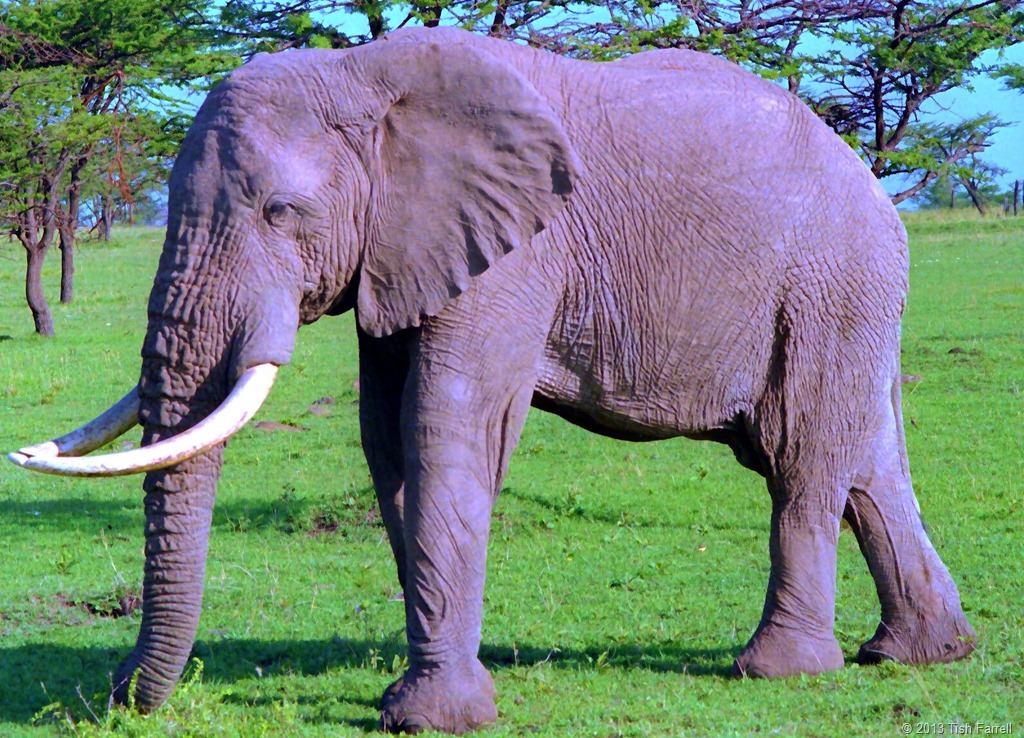
But proof apart, it is probably anyway beyond most people’s comprehension that some forms of humanity see elephants purely as a resource – killing them for ivory, or a trophy head to brag about to their shooting chums.
Scan-131109-0004.jpg

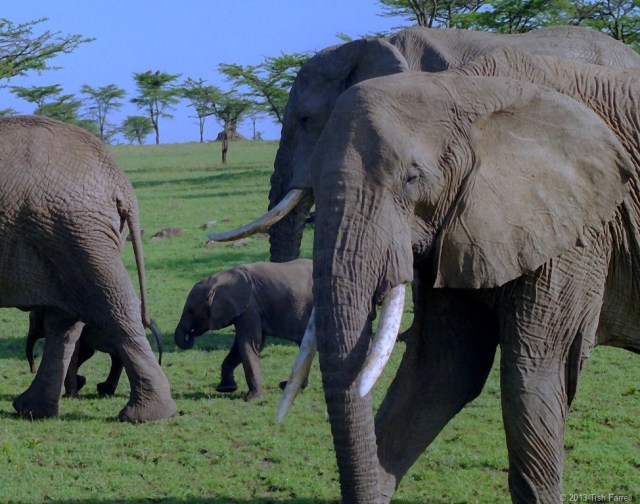
The word elephant, I’ve just read somewhere on Google, comes from the Greek word elephas meaning ivory, so already we have a clue as to the literate world’s  (one hesitates to use the word ‘civilized’ here)  once primary relationship with elephants. But then this is not the only kind of man-elephant relationship. The killing of elephants is not always about the pursuit of luxury goods. Indigenous African peoples, such as the small-statured Mbuti hunters of the the Congo forests, have long hunted elephant for food, and also possibly scavenged dead ones. One beast, killed once in a while would keep a hunting band going for many days as well as providing large amounts of meat to trade with farming neighbours for other goods.

The fact that there have always been hunters like the Mbuti who will tackle an elephant, makes them in turn desirable allies and trading partners to less brave outsiders who crave only the ivory. In East Africa, from at least the start of the first millennium AD, Arab dhow merchants relied on locals like the Akamba people to bring ivory to the coast to trade. In the nineteenth century the Swahili slavers set off into the interior to grab for themselves a combination haul of humans and ivory, the poor human captives being forced, while they still lived, to carry the elephant tusks hundreds of miles back to the coast.

There are far older stories too.  The tomb biography of Prince Harkhuf of Elephantine records that four thousand years ago this Ancient Egyptian general headed at least four major expeditions into the African interior. One objective was to test the waters for a take-over of the neighbouring Kingdom of Nubia. But there were also valuable resources to garner: ivory, leopard skins, ebony, precious stones. One expedition went beyond the Mountains of the Moon, the Rwenzori Mountains on the borders of Uganda and Eastern Congo, and so into the territory of Mbuti hunters.

The tomb account includes a letter from Harkhuf’s Pharaoh, Pepi II Neferkare  who, on becoming Egypt’s ruler at the age of six, longed for nothing more than his own pygmy,  he “who danceth like the god”. The letter contains strict instructions as to the pygmy’s care, and especially on the voyage back down the Nile so that he does not fall in the river. Anyone who has read Colin Turnbull’s The Forest People, will know that the Mbuti are renowned for their performances of complex polyphonic singing and energetic dancing conducted in praise of their Forest Creator. Neferkare’s letter would suggest that the Mbuti were already well known to the Egyptians thousands of miles away, and the primary source of this relationship was mostly likely to have been the Mbuti’s provision of forest produce including ivory.
Scan-131109-0022.jpg

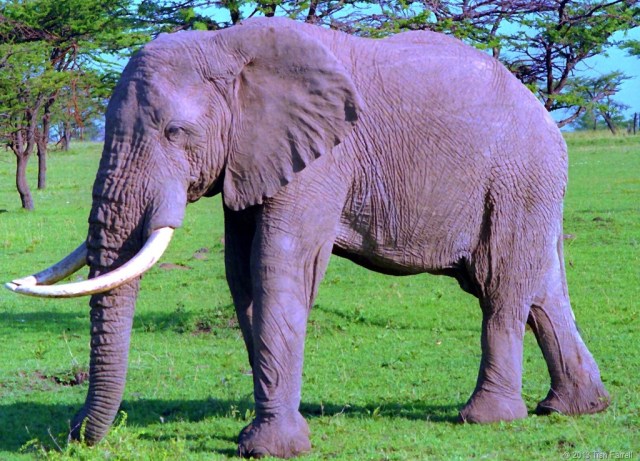
But the biggest assault on elephant-kind has all to do with the arrival of the gun. A major killing spree began in the late 1800s in the Congo – then a private fiefdom of Leopold II of Belgium (think Joseph Conrad’s Heart of Darkness and the Congo River stations set up especially to export ivory and wild rubber from the forest hinterland). In East Africa the slaughter began at a similar time under British colonial rule – first British and European aristocrats out to make their fortunes, then by hunters,like John Hunter,  employed by the colonial administration to protect settler plantations from elephant damage. The ivory hunters of course always sought out the animals with the biggest tusks. So much so, that when the likes of Denys Finch Hatton and aviator, Beryl Markham began scouting for ivory from the air, the big bulls of Tsavo were reputed to hide their tusks in the undergrowth whenever they heard a plane.

What was taking place, then, was a most unnatural selection. The biggest and best elephants had the biggest and best ivory. The gene pool of present day elephants has thus been ravaged by a century of mass killing. After the colonial era, the armies of civil war conflicts across the continent, continued the job started by colonial sportsmen and administrators. After the Idi Amin regime in Uganda when much wildlife was decimated, the tusks of the elephant population that gradually re-established itself were either puny or did not develop at all. And an elephant needs his tusks – not least for rearranging the landscape (clearing trees to favour grass growth) and mining for water sources and essential mineral salts.

And why did this killing begin? Because humans thought that ivory re-fashioned into billiard balls, piano keys, and objets d’art was more valuable than embedded in living, breathing elephants. Some people still think this.

001 (3)

But back to the elephants and those extraordinary things that scientists have been discovering about them. For one thing, the infra-sound throat rumbles that vibrate through the earth can convey information to other elephants at least six miles away. It would appear, too, that they can pick up seismic movements over far greater distances than this. Researchers have observed that when it started thundering in Angola, thus signalling the start of the rains and fresh browse in that quarter, elephants one hundred miles away in Etosha National Park, Namibia, set off there. Apparently the tips of trunks, toes and heels are especially sensitive to vibration. Working Asiatic elephants have also been known to detect tsunamis and make for higher ground, thus saving any humans who happened to be riding on them at the time.

When it comes to communicating amongst the immediate herd or with potential predators, elephants have a whole range of calls and gestures, depending on the circumstances. These include ear-splitting screams and trumpeting, rumbles and grunts, crying and barking, head shaking and ear-flapping, trunk slapping, dust-kicking, throwing missiles, ear spreading, standing tall, and making mock and real charges.

Scan-131109-0021

While their eyesight is not acute, and especially in bright light conditions, they have a keen sense of smell. An elephant will  thus continuously read its environment and, using the tip of its trunk like an antenna, decode all manner of messages by scanning urine, faeces, saliva, and the secretions from their fellows’ temporal glands (found on the side of the head mid way between the  eye and ear). Also, when it comes to acts of aggression from humans, elephants will remember these and continue to identify such aggressors by their smell.

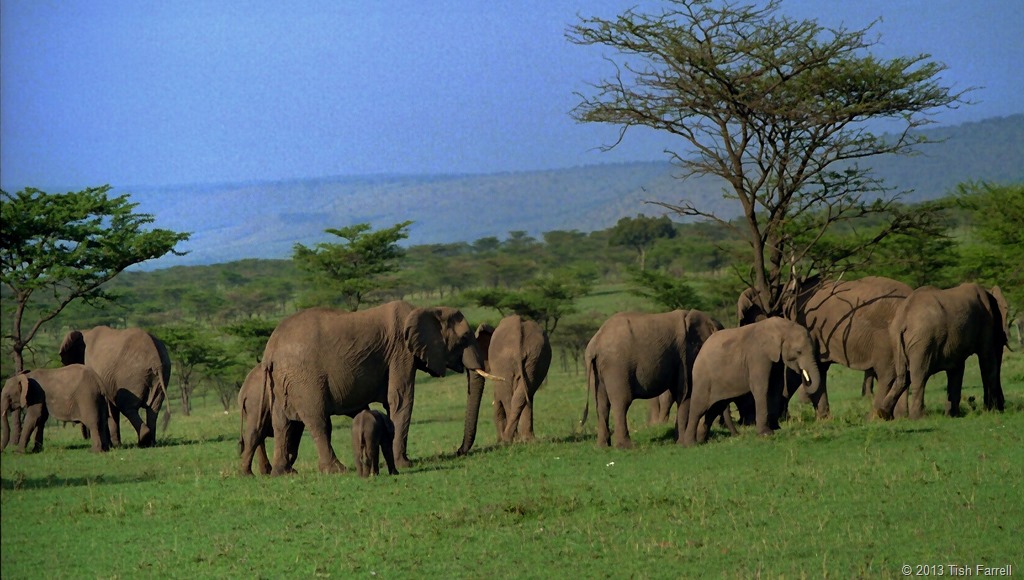
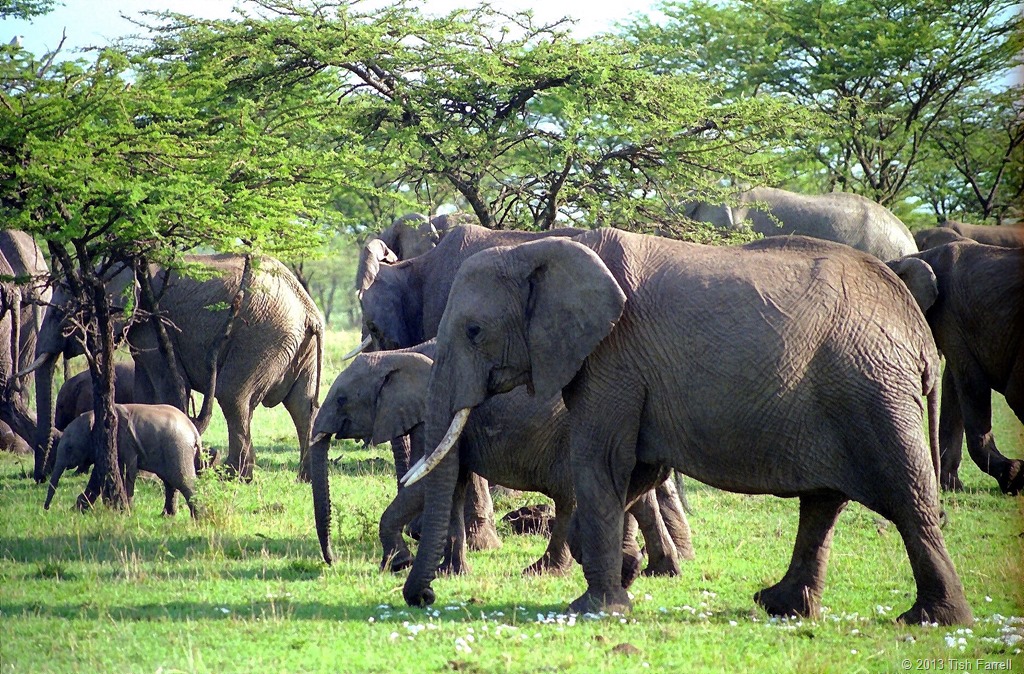
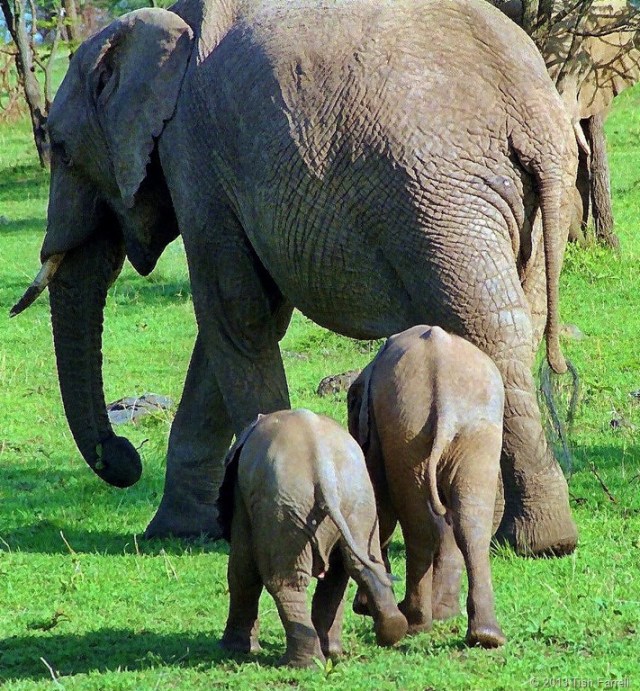
And that’s the other marvellous thing. Elephants do remember. For much of the year the males and females live separately usually only congregating for mating purposes. The females roam in small family groups led by an old matriarch. Within that matriarch’s head is a lifetime’s accumulated wisdom that she uses to manage her daughters, granddaughters and their offspring, and so keep them healthy and safe. Elephants left bereft of their elders through culling or poaching, are known to flounder and panic without the old ones’ guidance. 

Scan-131109-0032

010 (2)

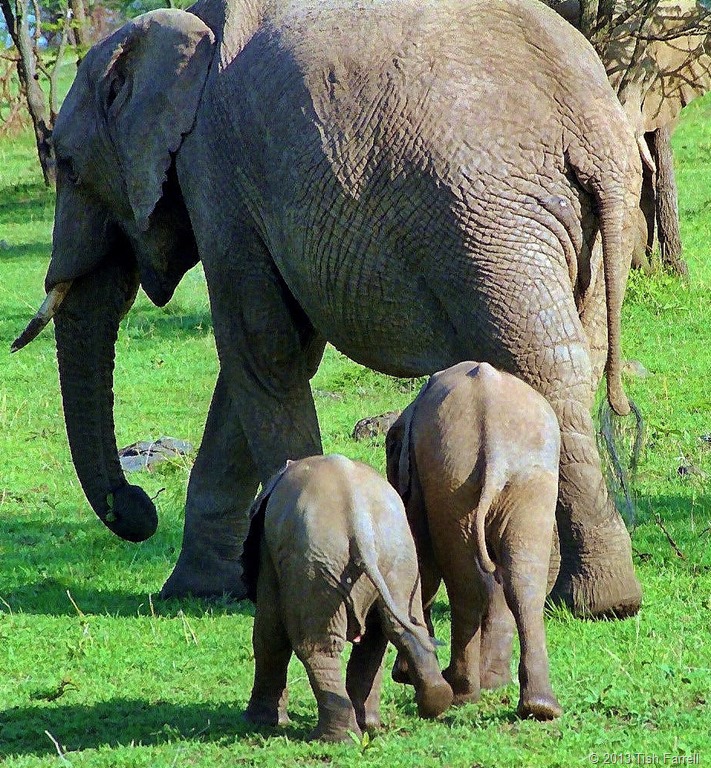
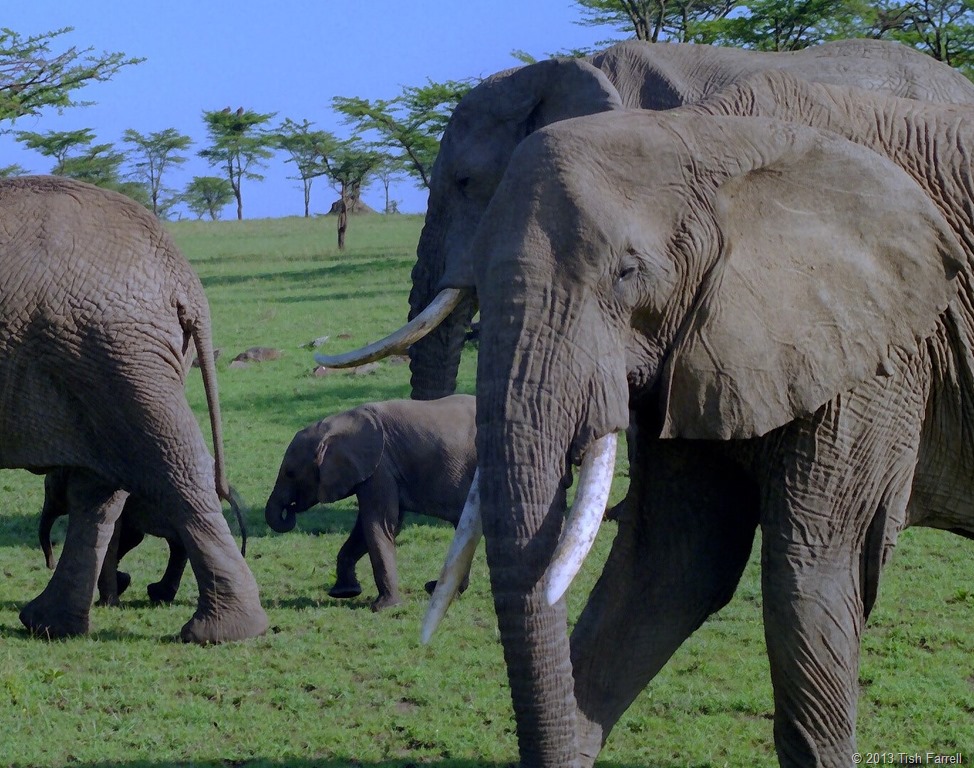
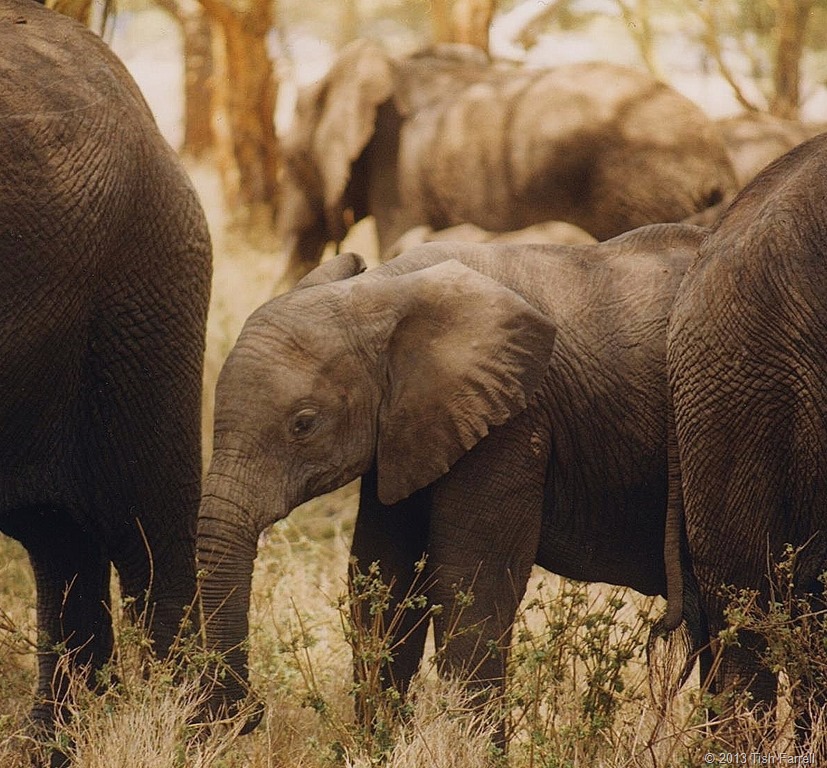
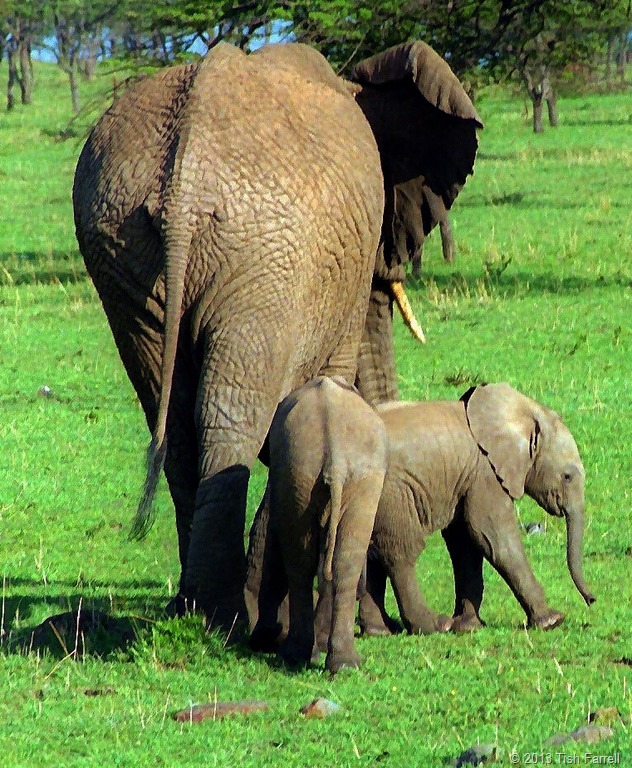
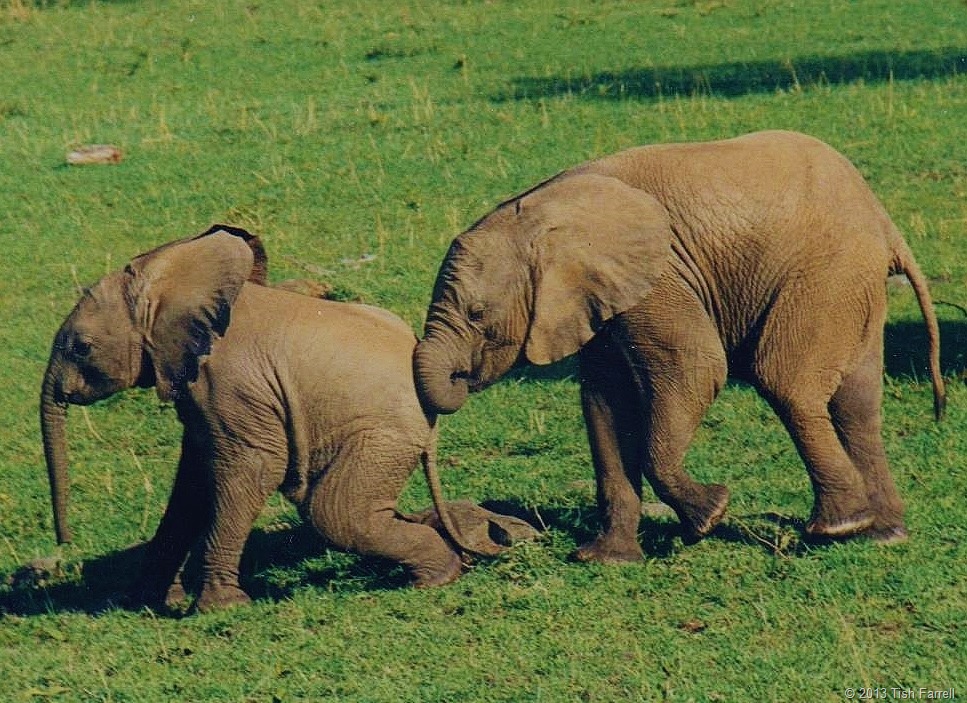
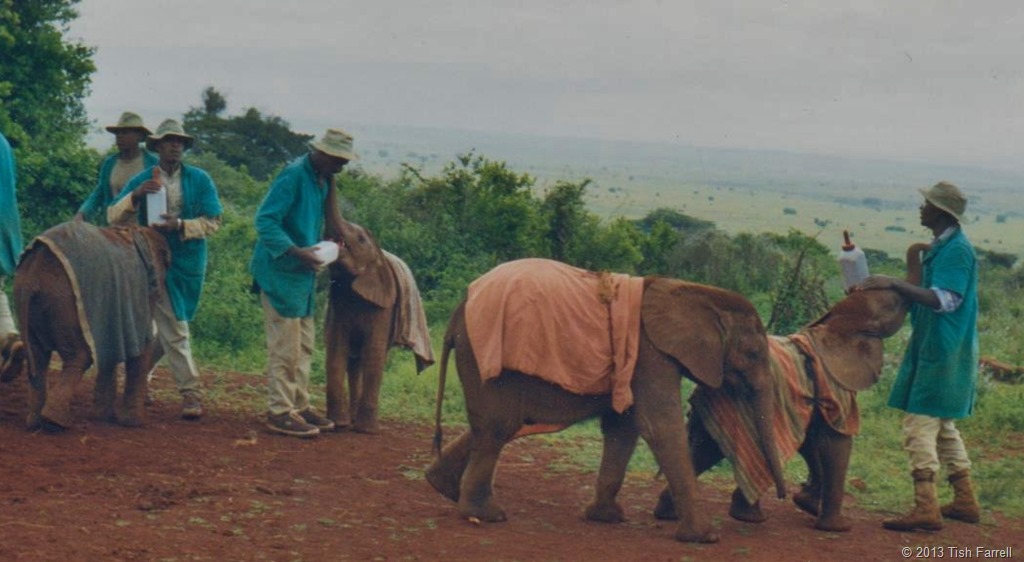
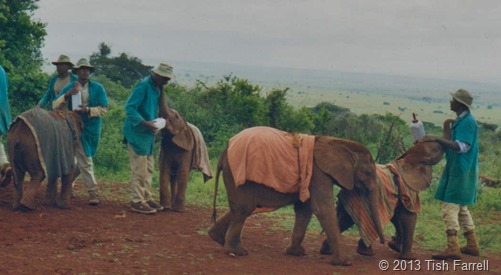
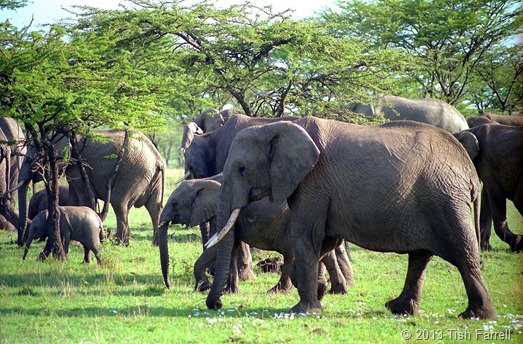
As you can see from some of these photos, mostly taken outside the national park  in Kenya’s Maasai Mara, elephants are not only highly sociable, but also very tactile. They spend much time wiggling against each other and touching each other with their trunks. Even older elephants like to play, and there are a whole range of gestures that they use to invite general romping. As the work of Daphne Sheldrick has shown at her Nairobi elephant orphanage, an orphaned elephant will die, not so much because it is short of food, although the right infant milk formula is very important, but because it does not have a continuous show of affection and reassurance from family members.

Sheldrick has learned how to provide for this vital need by assigning a human keeper-parent to every baby; duties, apart from feeding and playing, include spending the night with their charges. When the time comes to repatriate adolescent elephants to the wild, the lack of matriarchal knowledge creates a considerable challenge to making a viable transition. This was well shown in the BBC series The Elephant Diaries.
018

The Elephant Orphanage, Nairobi

*

More sobering to learn is the fact that elephants, not only have a similar life-span to us, but they also do understand death. In the past, conservationists have found to their cost that elephants are utterly traumatized by witnessing culling events. Where elephants have been wounded by poachers, their comrades will stay beside them and try to lift them or feed them grass. Once an elephant has died, the herd may remain with the corpse of several days. The young ones have been seen to cry. The survivors will then cover the dead one with branches, leaves and grass. During colonial times, a Kenyan district officer once confiscated a poachers’ stash of ivory, only to find that in the night, the local elephants broke into the store and carried off the tusks.

There is, though, another side of the elephant-man story, and especially where they compete for the same territory. In a single night’s  foraging, elephants can wipe out a whole season’s crops in a farmer’s smallholding, and that means starvation for the family concerned. They will also kill humans if they consider themselves provoked. Bulls in must are quickly irritated and are especially dangerous at such times, as are mothers with small calves.  In poor communities poaching ivory can become an attractive proposition where local bigwigs and foreign buyers seem to be offering them a small fortune to do so. The only way to protect both elephants and would-be local poachers is to give communities reasons to protect elephants. That means a fair cut of tourist dollars to provide for schools and clinics and a a better standard of living all round.

There are many thousands of elephants still roaming African, but they are always under threat. Most nations’ wildlife parks are under-resourced when it comes to vehicles, equipment and manpower. Much protection of wildlife is in fact done by owners of private game reserves in conjunction with local communities.  In the meantime, we need to thank those African rangers, men and women, who daily risk their lives for often little pay, to protect their countries’ wildlife from human rapine. They are indeed true heroes.  We might also stop to ponder on whether some of the resource grabbers funding the poachers  might not have closer connections to our own lives than we care to admit.

Ailsa’s Travel Theme: connections

© 2013 Tish Farrell

For more about ivory poaching:

Dear Kitty. Some blog Ivory trade legal in the USA
Scan-131114-0004

For more about elephants in general: Elephant Voices

Related posts:

Elephants, E-books and Enticing Reluctant Readers  #amwriting