Seven-spot Ladybird on Rudbeckia
[1] Earlier in the summer I grew some uchiki kuri squashes from seed and planted a couple on the boundary wall. This is is the wall that had a ‘flower’ bed in the middle of it and was originally choked with Rose of Sharon shrubs, Spanish bluebells and ash trees. I wasn’t expecting too much of it once I’d cleared it, but it seemed like a useful space that could not be wasted. Much to my surprise the squashes have taken off like magic beanstalks. Even had to stop them heading off for the top of the town.
The leaves are huge and the flowers are wonderful. Bumbles, honey bees, beetles and hoverflies think so too. They are currently getting drunk, shoving their way into the male flowers, and drilling down into the nectar below the stamens. In the process they are bathed in pollen. They can’t seem to get enough nectar and don’t care how many of them squash in there, or if they are different species.
And this is what they have made.
So far it’s about a hand’s width across. There’s a slightly larger one behind the oil tank, and a couple of smaller ones besides. Thank you bugs and bees. Some of you seem to be sitting around the garden with hangovers.
*
[2] The runner bean plants are still looking good and there is a mass of blossom, but so far they have been slow to set and the cropping sporadic. Too hot for them it seems. We’ve still had very little rain, apart from a good cloudburst on Thursday which added a few watering cans full to the water butt. And it certainly refreshed the garden, but did not last long enough to really penetrate the soil. The days have been much cooler though, and today there are signs of more beans coming. The bees have certainly been doing their best here too.
*
[3] When I had my allotment I used to grow big rows or wigwams of climbing borlotti beans. Here at The Gables I haven’t the space. Instead, I have half a dozen plants growing up an obelisk in the front garden, and also a few more plants growing up some trellis beside the neighbour’s garage wall in the aforementioned border bed i.e. between the squashes. The beans are just beginning to set, but have a long way to go yet.
Meanwhile, in the bed in front of the runners, I have a short row of dwarf borlotti beans grown from seed. This was the first time I’ve grown them, and goodness, much like the squashes they zoomed off almost as soon as I’d planted them out. Already there are clusters of fattening pods. I love them for their colours as well as for cooking. So fingers crossed for a reasonable crop and no bean-boring bugs.
These are the climbing borlotti beans growing up some recycled trellis, and propped against next door’s garage, glimpse of squash plant to the rear. Some peas under the mesh in front are presently being nibbled. Graham, wearing his plant pathologist’s hat, tells me it is pea weevil. We entertain all bugs here – the good, the bad and the weevils.
*
[4] It’s been a struggle stopping the herbaceous borders from flagging. In the front garden we left all the privet hedge cuttings on the flower beds to provide a bit of protection. I had mulched a number of plants earlier in the summer, but the blackbirds have kept moving it everywhere but under the plants.Most annoying.
Still, things have survived, and now the late summer flowers are coming to the fore, and especially the Agastache, which I grew from seed last year. It’s another plant frequented by insects, including the cabbage white butterflies. I love its mauvy purple spikes, and the aniseed scent of its leaves.
*
[5] When I was thinking how to plant the front garden, I was much beguiled by Alcathaea ‘Parkallee’. I’d spotted it in a garden catalogue and was attracted by the fact that, as a crossbred hollyhock and mallow, it was immune from rust that frequently attacks hollyhocks. It also looked very pretty and so was among the first plants I bought for new garden.
It’s been flowering beautifully, despite the drought, but it does grow very tall, and thus has a tendency to flop over. I’ve found that cutting off the top few feet to put in a vase doesn’t seem to detract from the overall display. They anyway last very well as cut flowers too. Probably because they’re actually getting some water!
*
[6] And now it’s also time for sunflowers. I’ve grown all sorts, including the short Sunspot and some giant ones. Early summer plantings were zapped by some nasty bug and I had to cut off the main stems. Most annoying. Except now we have whole bushes of small-headed but long stemmed sun flowers which is actually very pleasing. You can see some orangey ones in the pot in the first Alcathaea photo.
The long…
…the tall
…and the short Sunspot:
*
It’s hard not to smile back at a sunflower ![]()
Six on Saturday Join host Jim at Garden Ruminations: lots of lovely plants and planting schemes.
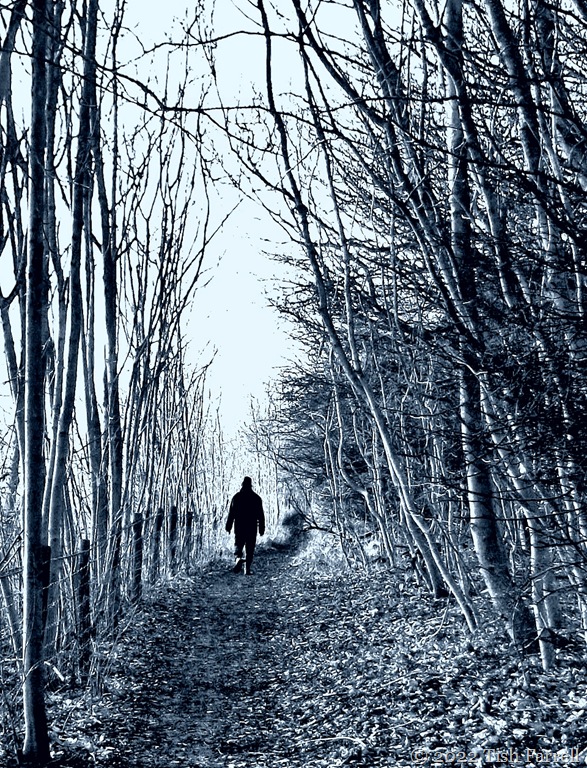
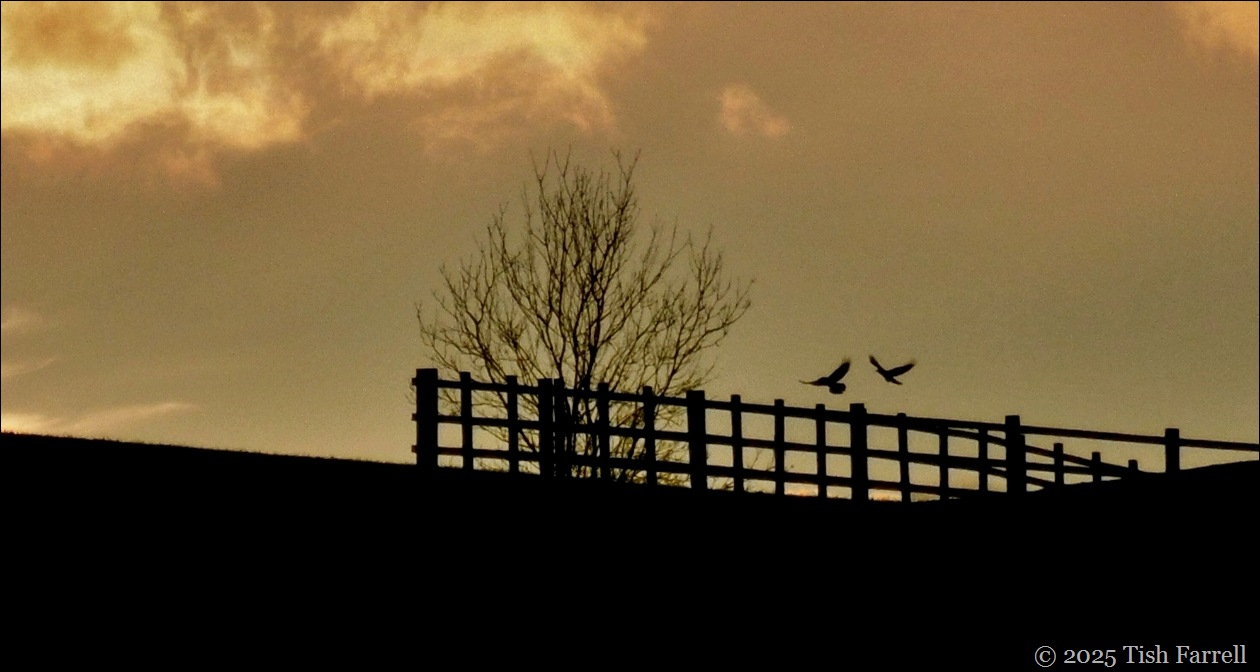
I was walking in the deep shadows of Much Wenlock’s old railway line when a break in the tree cover provided this moment for a backlit photo: the spread ‘palms’ of Horse Chestnut leaves holding up the sun.
*
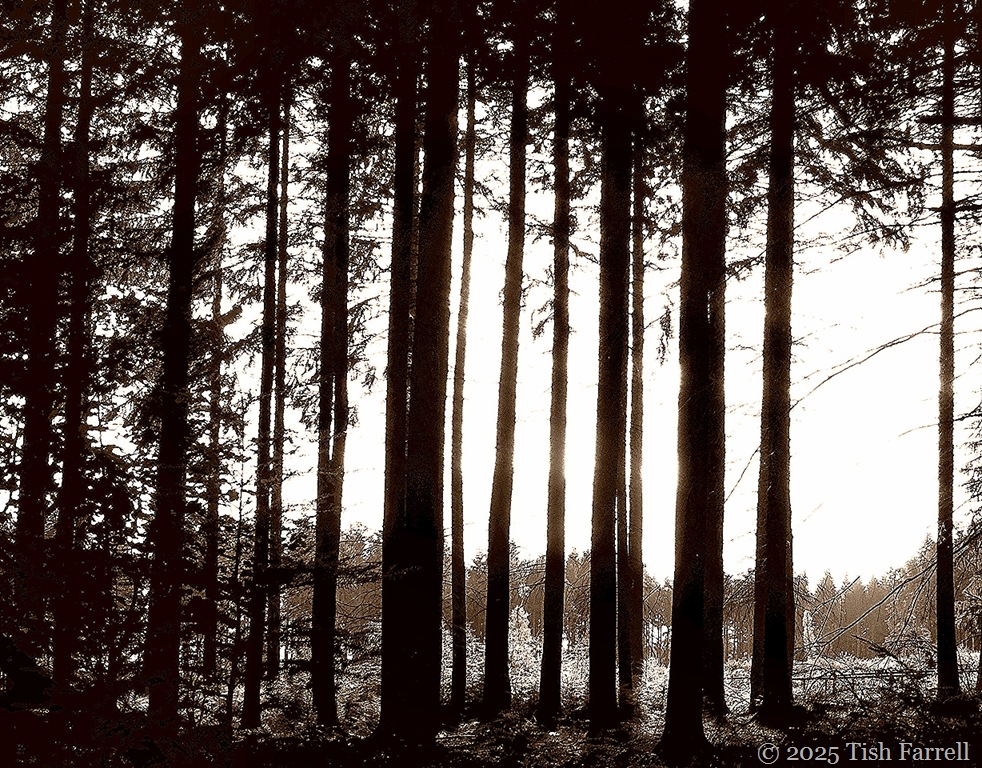
This section of clear-felled woodland viewed through a row of standing conifers caught my eye on a walk up to Iron Age hillfort, Croft Ambrey, just over the Shropshire border in Herefordshire. It was a bright autumn day, the last day of October in fact.
Here’s the non-sepia version:
*
I’m often inclined to take photos in very unpromising light conditions. This next shot, edited in sepia tones, is of the ruined nave of Much Wenlock Priory taken after the sun has just set. I like the slices of remnant light inside the windows and on the corner stonework.
*
No people in glasshouses in the next shot, only weeds and general abandonment. It was a chance shot one winter’s afternoon as I was leaving my allotment plot. The glow inside the old greenhouses struck me as unearthly, a bit E.T.-ish. What alien life forms might be sprouting in there as the sunlight strikes them?
*
This next structure was caught in full-on spring sunshine.
*
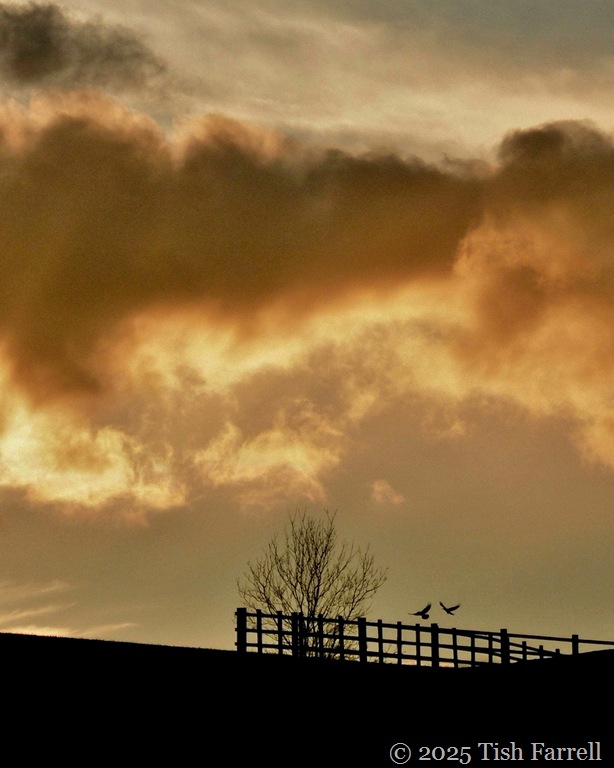
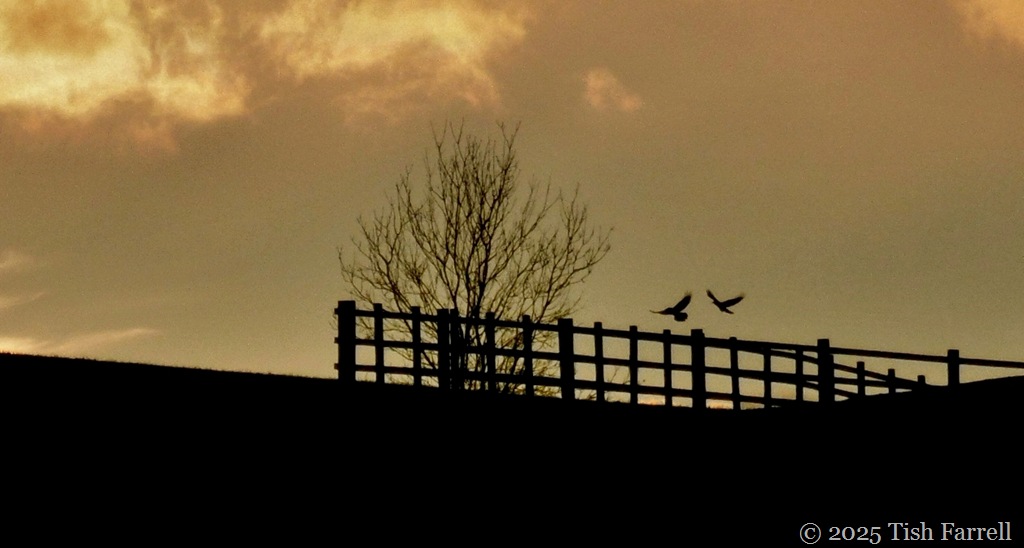
Whereas these Pembrokeshire rooks, were snapped as they came home to roost in winter twilight:![]()
*
Finally, a sunsetting shot, taken looking out on the Mawddach Estuary. It’s a favourite Farrell spot in the garden of Borthwnog Hall, near Dolgellau, mid Wales
*
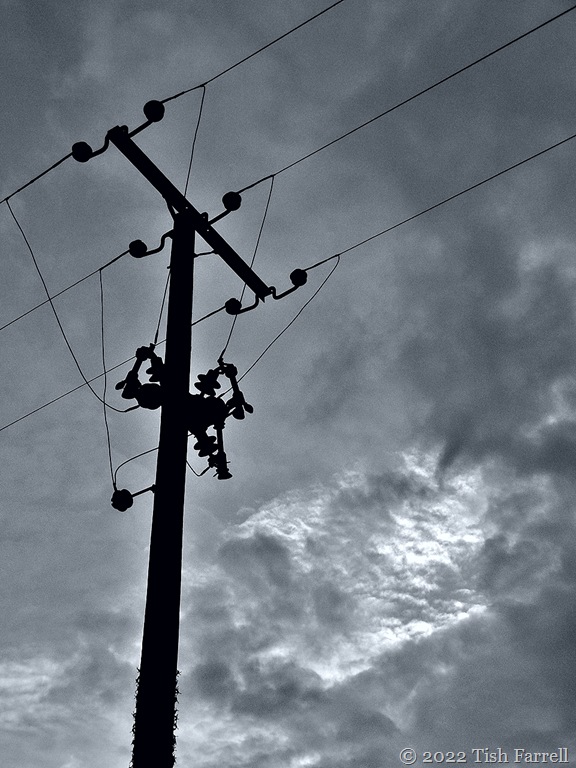
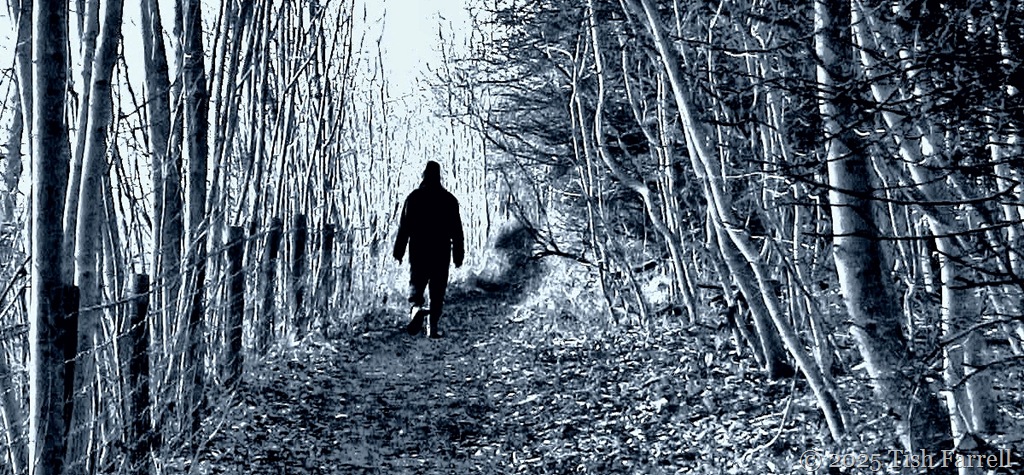
Monochrome Madness: Backlighting This week at Leanne’s Monochrome Madness, Brian aka Bushboy sets the theme. He wants to see our backlit photos, but for more inspiration, please take a look at his post.
Come August and this year’s harvest has already been and gone. A good month earlier than usual. And somehow we missed it, we who live in the midst of rural Shropshire. In fact, when we drove out of Bishop’s Castle last Saturday, it was quite a shock: wherever you looked the wheat and barley fields lay shorn, the straw baled, or rolled in roundels, the remnant stubble pale and parched. Fields stripped.
How could we have missed so much activity and industry. Did we not hear the combines’ drone?
Along the lanes, too, the hedgerows had that dull and dusty out-grown look of late September. Dock and hogweed gone to seed: russet and deep umber shades of autumn. And again: how could this be? Had we been asleep, Rip-Van-Winkel-like, and lost a chunk of summer? Or had time skipped a month or two?
No. Simply distraction on the home front, gardening and household pursuits. Letting the world pass us by through weeks of day-on-day sun and rainlessness, which of course is the reason why the harvest was so early.
But now it has me reflecting on the beguiling looks of stubble fields, and thus a posting of photos of harvests past, of pared down textures, bare lines and simple colour palette of monocrop farming. I find myself attracted to the spareness of these humanscapes, although wary, too, of the high high-techery that produces such results. This is not the kind of farming I grew up with, the cut wheat stacked in stooks to dry, the arrival of the threshing machine, a monstrous sight over our garden wall, the contraption that, hung in sacking shrouds, throbbed and shuddered, spewing out clouds of chaff as it garnered precious grains from stalks and husks.
Hey-ho. More time slippage.
[The header and final photos were taken mid-September last year above Bishop’s Castle. The in-between shots are from Townsend Meadow, below Wenlock Edge]
Lens-Artists: Lines, colours, patterns Johnbo asks us to explore these tools of photo composition.
Actually, it’s probably the eyespots that see off birds that might prey on the peacock butterfly (Aglais io). But then the deep rusty red does show them off so well.
The peacock is said to be one of our commonest UK butterflies, although I’ve only seen one so far this year, and that was in our bedroom. I was more concerned with helping it escape than snapping it. These photos, then, are from our previous garden where they would often come in high summer to feed on Doronicum, aka Leopard’s Bane.
*
But how beautifully it has composed itself. And so it seems a fitting tribute to Becky who, for a whole month, has kept us so well amused with our respective photo archives.
THANK YOU, BECKY, QUEEN OF SQUARES
Yesterday surely was a red letter day – at least on the gardening front.
We had rain.
We did.
Enough to soak the top inch of soil. This I discovered in late afternoon when I went to dig up some Rooster potatoes whose leafy tops had been cut off some weeks ago. I was surprised the rain hadn’t penetrated more deeply. We’d had a few heavy downpours during the day, along with gentle summer showers in between. It just goes to show how much rain is needed to nurture crops and all growing things. In fact, the soil under the potatoes had baked into an ashy crust, reminiscent of Bishop’s Castle’s very particular brand of lime mortar that holds our house together, the crust only penetrable with a hefty thrust of the garden fork.
But for all that quibbling, the garden does look relieved, some plants almost perky. This includes the runner beans which had been too overheated to make any beans. Now, with the cooler temperatures, they are abuzz with bees and (hopefully) making up for lost time.
And in the bottom of the garden, our little crab apple is looking especially grateful. It was planted last October and, as a new young tree, has been struggling during the long dry spell. Buckets of tap water really don’t quite do the job, although obviously better than nothing. But the tree has survived and has a mass of little apples which are growing in redness by the day. I’m trying to recall the variety. I especially wanted a tree that was good for jelly, so it may well be Jelly King. Or if not that, Red Sentinel. It will become more obvious in a few weeks time when the apples gain their full colours. Happy thoughts of jelly making, though not of rushing too fast into autumn.
A week or so ago we were on one of our periodic walks to the Builders’ Merchants. It sits on the edge of town, part of a small industrial enclave whose buildings are screened from adjacent roads by a section of dense mixed woodland.
And this is what we found along the fence-line – a close-set row of cherry plum trees, laden with fruit.
The Cherry plum (Prunus cerasifera) is native to Europe and Asia and grown in the UK as an ornamental due to its early flowering. It is also used in hedging. (Which makes me wonder if this row is a hedge gone feral. There are a few of those in Bishop’s Castle and we should know.) Better still, the fruit, ripening between mid-July and September, is edible. I tried a couple of windfalls, fallen on the verge. Sun-warmed and juicy. Delicious.
Now, I can’t think why I haven’t been back to gather some more – before the wasps beat me to it.
I’m back in the garden today. The old Africa album is taking a break. Although actually, thinking about days long past in Kenya has been a happy diversion from fidgeting about the lack of rain. Yet another month now with hardly enough to fill a watering can. But at least the days are much cooler and today quite overcast. In the meantime, the weather forecasting bods keep teasing and teasing, saying there will be rain two days hence, and then when we get there, ne’er a drop. Even my computer’s been joining in the game – a little message popping up saying ‘rainy days’ ahead. I now understand that ‘ahead’ is the operative word. And, of course, this being England, we can be fairly sure that one day we will receive a proper soaking.
Anyway, it’s not all bad news on the gardening front, so long as I keep up the regular watering. In fact the bergamot has scarcely needed any attention. For weeks now it has been a riot of bright purple heads. The leaves smell wonderful too, crushed between soily fingers. And as for the white tailed bumbles which, on closer inspection, are probably garden bumbles – talk about bee-lines. These days whole tribes of them are foraging among the curiously structured flowers.
*
I’m also very pleased to see a number of ladybirds in the garden, most numerously in the perennial cornflower (Centaurea). I’m puzzled as to why they are there, since I can’t see any aphid infestation, only ants. Unless they both ladybirds and ants preying on something too small for me to see.
Also spotted in the Centaurea are Common Carder bees, seen here with an incoming hoverfly:
*
And in the neighbouring Sunspot sunflower a Red-tailed bumble bee:
*
However, I am not so pleased this morning, to discover flea beetles on my Kabuki broccoli seedlings, planted out only two days ago. These tiny brassica-infesting bugs create a ‘scatter-shot’ appearance to all the leaves. Time to round up a few ladybirds and put them to work then. I’ve just read that they like flea beetles…
We were up in the Taita Hills. It was the final phase of the Larger Grain Borer (LGB)project (see previous post). Graham was checking on the on-farm release of predator beetles, Teretriosoma nigrescens (TN). There were high hopes that TN would be a viable control for LGB, a voracious (and imported) pest in grain stores. (In the project’s trial stores you could actually hear the gathered tiny entities grinding through maize cobs, one of Kenya’s essential food crops being turned to dust).
I was along for the ride. And what a ride it was up from the hot plains: hairpin bends and a rapid climb through 1500 metres, verges bursting with wild flowers – black-eyed Susan, wild hibiscus, morning glory, goats grazing, hillside farms steeply terraced, the scattered plots of maize and banana, the cooling presence of cypress forest. Everywhere along the road people walking, transporting something; jerrycans of cooking oil, sacks of maize flour, women hauling firewood, bundles of sugar cane, mamas with infants.
The Taita Hills comprise three massifs formed during the Precambrian era – i.e. between 650 and 500 million years ago. The peaks range from 700 m to 2,208 meters above sea level, and are covered with remnant cloud forest, which also has very ancient origins. The land is mineral rich and highly fertile. The flora and fauna include species endemic only to these hills, butterflies and orchids among them.
It is a landscape that scarcely fits the usual visions people may have of Kenya. And on top of that, if you choose your spot, there can be moments there when Kilimanjaro (just over the border in Tanzania) deigns to show itself. It is a capricious mountain, coming and going in a matter of seconds, dissolving impossibly into a blue and cloudless sky. It changes size too. Some days it can appear huge, shimmering in the sky with all the substance of a giant soap bubble; other times, as in the photo, it is more discreet. But however one sees it, it changes the day. The nervous system fizzes from head to toe: we’ve seen the mountain! We have!
Well, it had to be done, didn’t it – that particular ‘red’ title for Becky’s month of #SimplyRed squares, and this despite the apparent lack of ‘red’ in the photo. But then, if you look very carefully, the dozing lion does appear to have a bloody nose.
Of course I’ve posted this photo a few times before. It’s probably one of my best ‘caught moments’ from the old Africa album. We were staying at the Taita Hilton in May 1992. Our other bolt-hole, when Graham was working in the Taita Hills, was the very basic Danish Guesthouse in upland Wundanyi, but on this occasion a room wasn’t available. Oh dear. That meant five days of wall to wall luxury down in the bush country, although that said, I loved the simplicity of the guesthouse too. The Taita hill country is anyway very beautiful.
And the reason we were there at all, Graham was supervising the release of predator beetle Teretriosoma nigrescens (TN for short) at sixteen highland farms. There were high hopes that it would begin to control the spread of larger grain borer (LGB), locally known as dumuzi, which had been introduced to the continent around the 1980s in cargoes of food aid maize sourced in LGB’s native South America. (For those who want the scientific details there’s a short abstract here of a related project in West Africa. It gives the gist of the experiment.)
Our stay coincided with a weekend, so on Sunday afternoon we thought we’d take a drive around the hotel’s small game reserve. It was the start of the dry season and a time in Kenya when skies are often overcast, the light lacklustre. We bounced along the dirt tracks scanning every tussock of brown grass for big cats. That day at the hotel there had been talk of lion sightings. We felt hopeful, but instead, we spotted zebra, hartebeest and waterbuck, all grazing peacefully.
We were giving up on the quest when a park truck pulled up in front of our land rover. I thought the ranger wanted to check our tickets, but he only wanted a chat. When he discovered that we hadn’t seen the lions, he told us to follow him, and zoomed off track and into the bush. We trundled behind. Soon he had us lined up by a thorn bush. There, beside my car door was a slumbering lioness. She opened her eyes to check me out and then went back to sleep. (Lions sleep around 23 hours a day). The ranger then pressed on to the next bush, and there were the two males. I leaned out of the car window and simply took the photograph – just like that. It’s still hard to believe. I think I was there.
copyright 2025 Tish Farrell