In 1992-1993, during the first years of Zambia’s multi-party democracy, we were posted to Lusaka, Zambia’s capital. Graham was charged with organising the distribution of European Union food aid to drought-stricken Zambians. (Part 1 is HERE)
*
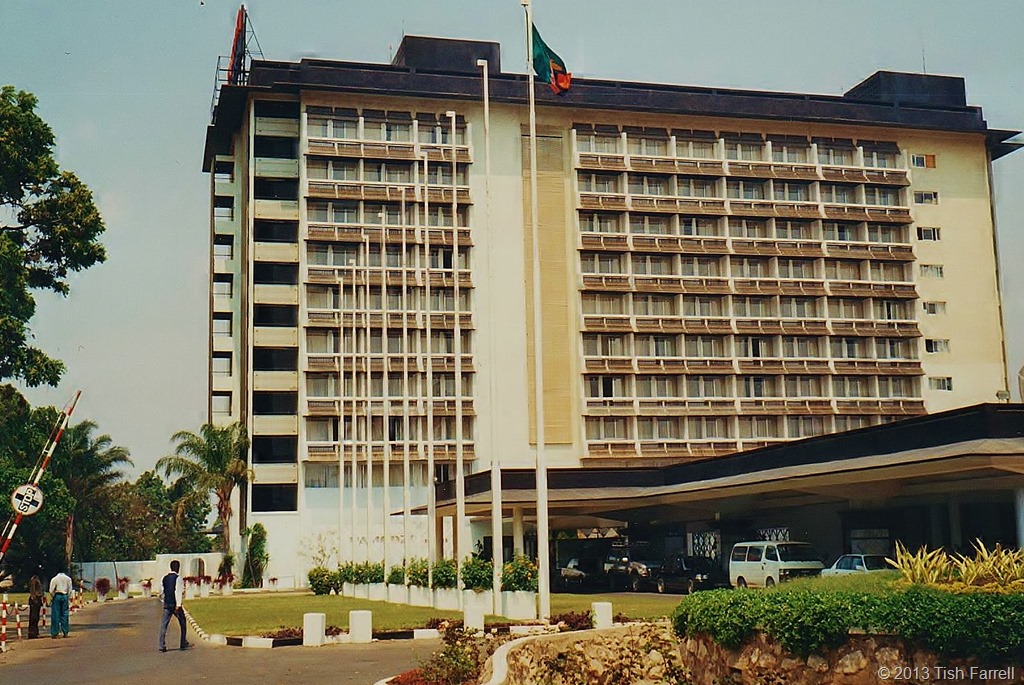
While we are still ‘living’ at the Pomodzi Hotel, and Graham is away at the European Union Delegation, getting to grips with his mission while walking a tightrope of diplomatic protocol, I do the unthinkable as far as white locals are concerned. I walk out of the hotel grounds and down a couple of avenues to the Ridgeway Hotel. One of Graham’s Natural Resources Institute colleagues, a regular visitor to Lusaka, has told me the place has a good gift shop, and that there may be a chance of finding some local books.
I set off on the basis that as I am not travelling by car, I will not be car-jacked. I am not. The gift shop is wonderful, brimming with Zambian craftwork. I buy a beautiful Tonga basket and a small olive-wood elephant for luck. I have it still on my Bishop’s Castle mantelpiece.

*
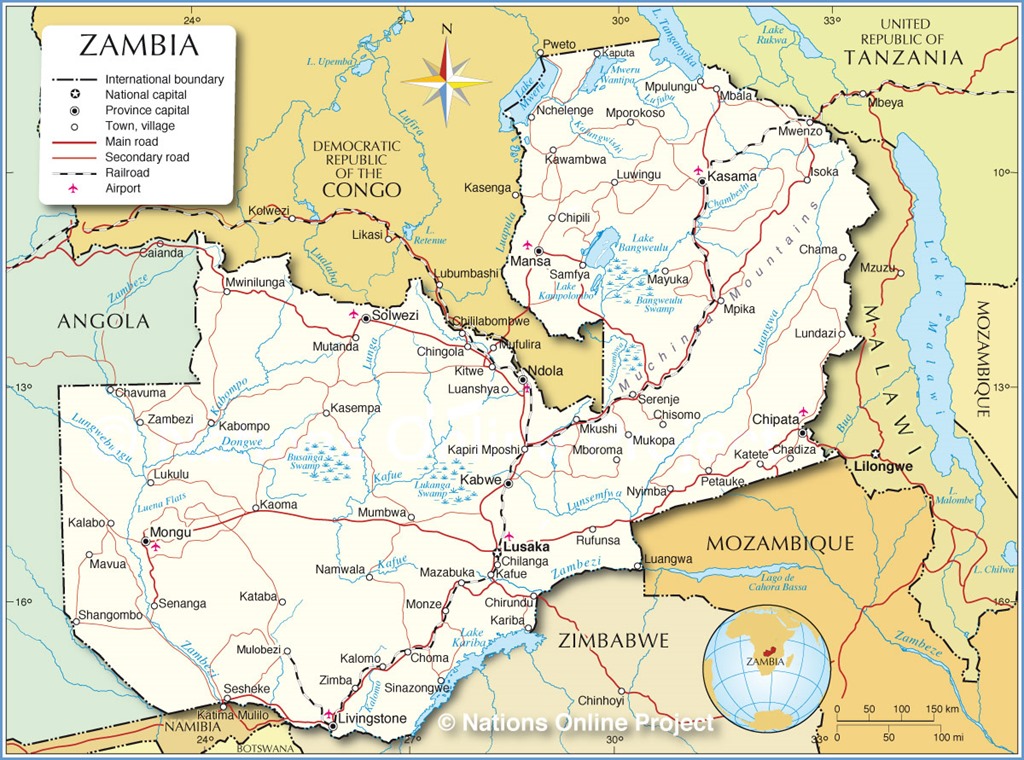
I’m disappointed to find no books at The Ridgeway, but I do find a map: a Lusaka street map one side, Zambia on the other. At last we can properly see where we have landed. I study the country’s boundaries, trying to make sense of the colonial cobbling that created a nation whose North Province lies to the east of its Central Province. (The British were here in erstwhile Northern Rhodesia for the copper).
*
The country nestles in the heart of southern Africa between eight countries. In outline it resembles a foetal chick curled on its back within a protecting shell. In reality, though, I soon learn that Zambia has no such protection. It simply has too many borders and not enough military personnel. In 1993 there are only some 300, 000 taxpayers in a population of eight million, which is not enough to pay for more soldiers. The north-west border with Democratic Republic of Congo is lethally porous. Members of then President Mobutu’s own unpaid armed forces regularly drive into Zambia’s Copper Belt and conduct armed pillaging campaigns against innocent drivers and householders. Sometimes they come as far south as Lusaka.
*
We are told that when driving at night, we must never stop at red traffic lights (locally called robots), since this is the moment that car-jackers will choose to pounce. Over in Eastern Province the threat comes from the conflict in Mozambique as RENAMO guerrillas cross the border to shoot up Zambian buses and steal food. In Western Province UNITA fighters from Angola’s war terrorize Zambian villagers. Famine, then, is only one cause of death; there are many others, and the mineral resources that Cecil Rhodes sought so hard to control through his dark-hearted dealings with local chiefs are high on the list.
Then there is malaria and tuberculosis, and as the rains bucket down through December, the cholera season begins. Overflowing septic tanks and pit latrines are polluting the city’s boreholes. At first, oblivious of such dangers, we eat out at downtown restaurants. We are down in Livingstone, near the Zimbabwe border, Graham checking out the contents of grain stores, when I am stricken with amoebic dysentery. Again it is the Delegation secretary who comes to the rescue and directs us to the mining companies’ private clinic, downtown on Cairo Road. The diagnostic facilities there are impressive, the British-born doctor patronizing. But after a three-day course of very large pills, I recover. I am lucky. Of course I am.
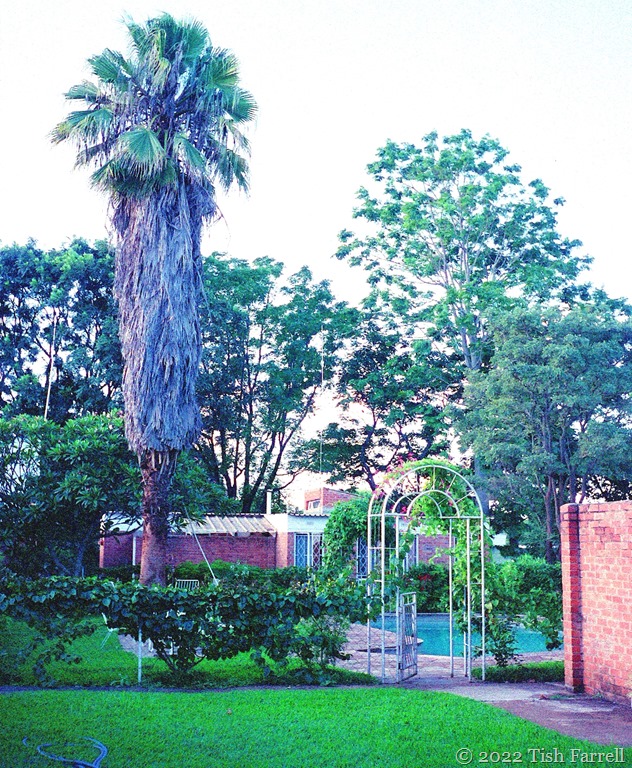
Six or so houses share the gardens, including a very small pool.
*
After a fortnight’s dispiriting search for a bolt-hole away from the Pomodzi, viewing sprawling premises we can’t afford, the Delegation Secretary suggests a vacant house on a small compound in Kabulonga. It is small, red brick, single storey with a sheet iron roof that, during the rains, resounds as if someone is firing bullets into a host of upturned buckets. The kitchen and bathroom are 1950s basic, but the spacious living room has French doors opening onto a tiny high-walled garden. There is a big avocado tree in the corner where African sparrows come twittering in to roost in late afternoon. Above the perimeter wall, when it is not raining, arcs the blue Zambian sky. To the rear, the kitchen gives onto a walled back yard and a patch of grass. There are two bedrooms, and a tiny study. Outside the front door is a communal garden and terrace – garden seats set by a small swimming pool, a tall palm that rustles endlessly in the high plateau breezes, a sweet scented frangipani tree. No house overlooks any other and there are shady walk ways in between each property.
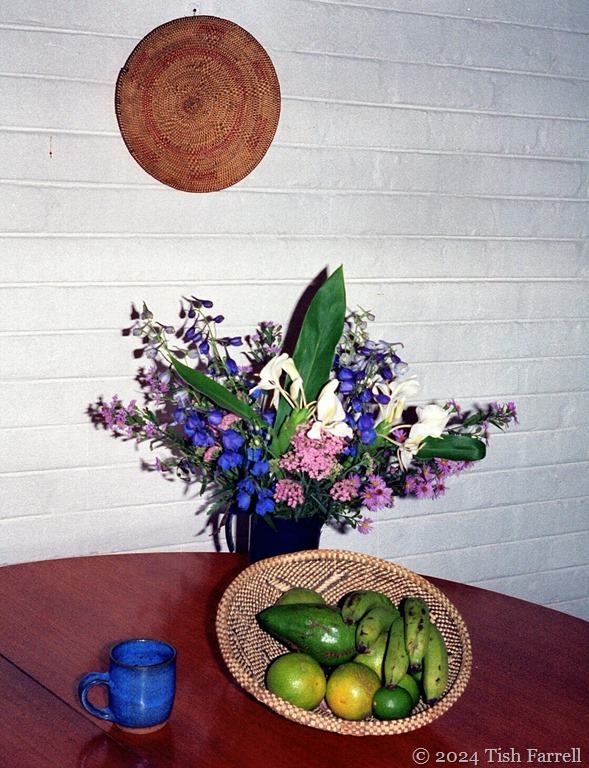
Produce including delphiniums and ginger lilies from the local co-operative on Sable Road
*
The gardens are tended by a gentle young man called Stephen Nyangu. His name suggests erstwhile connections with the Nyanja royal clan. But Stephen’s situation is a far cry from tribal pre-eminence. He sweeps, mows, weeds, plants, prunes and waters six days a week, from seven in the morning to five in the afternoon. Then he cycles the couple of miles to his compound home in Leopard’s Hill Road where he lives with his wife and four children. The gardens he cares for bloom strangely under sub-tropical skies with tea roses, violets, pansies, Sweet William and Madonna lilies. He also washes all the cars and hefts all the dustbins to the big compound gate to be emptied once a week. For this he earns twelve thousand kwacha a month, about eighteen pounds. He has no leave beyond national holidays, and after work he runs a cigarette stall.
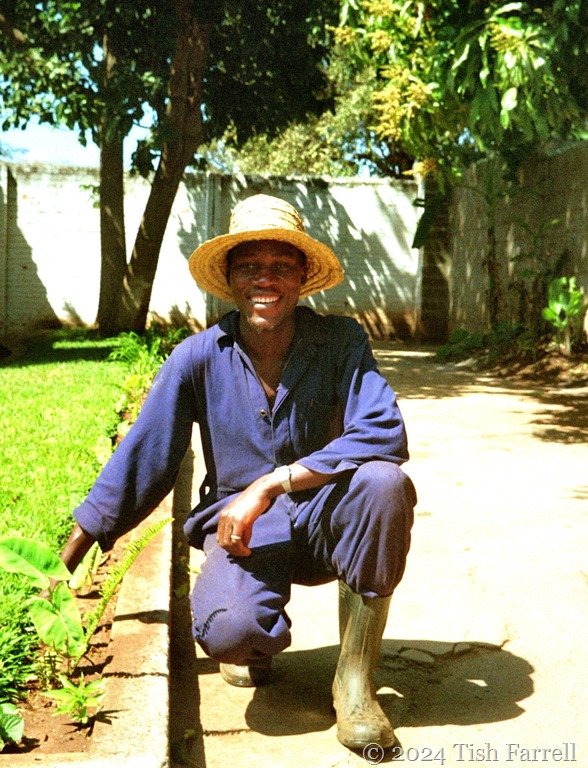
Stephen Nyangu works day and night to keep his family.
*
On my first day in our new home, it is Stephen who knocks on my door.
“Good morning, madam. My name is Stephen. If there is anything you want me to do, I am just out there.” He gestures in the general vicinity of the pool. “Call me.”
He is the only person on the compound who bothers to introduce himself. In ten months we scarcely see any of the other tenants beyond the Sikh couple who live next door. They nod to us. They have two much pampered, miniature Pomeranians and a maid called Isa. Isa looks a good-hearted soul and she works in several of the other households on the compound once she has done her daily tasks for the Sikhs. These include much furious chopping at seven a.m. Perhaps she is chopping for the Pomeranians. When she is left in charge of them for three months while their owners go on leave, she grows so fed up with their insistent yapping that one day she yells SHUT UP. And so shocked are the indulged little canines, that they do just that. I want to hug Isa.
I further decide that my house is scarcely big enough to justify even a once-a-week cleaner, this despite the constant slick of red dust that blows in every day. I thus do my own housework.
Our compound is in Kabulonga, the heart of the diplomatic quarter. Our next door neighbour is the Egyptian Embassy. At night the guards fire off rifles. We never do know what is going on there, and sometimes it sounds like a siege. Our compound is one of the least fortified on the road. The iron gate has open railings instead of sheet metal armour plating, and our day guard, Sammy, always leaves it unlocked anyway during the day, while he plays draughts with a neighbouring house-guard. He’s a bit nonplussed by my habit of going out on foot, and at first dashes from his game to open the gate as if I were a passing vehicle. We soon come to a silent arrangement whereby we greet each other, I open the gate for myself and he keeps on with his game.
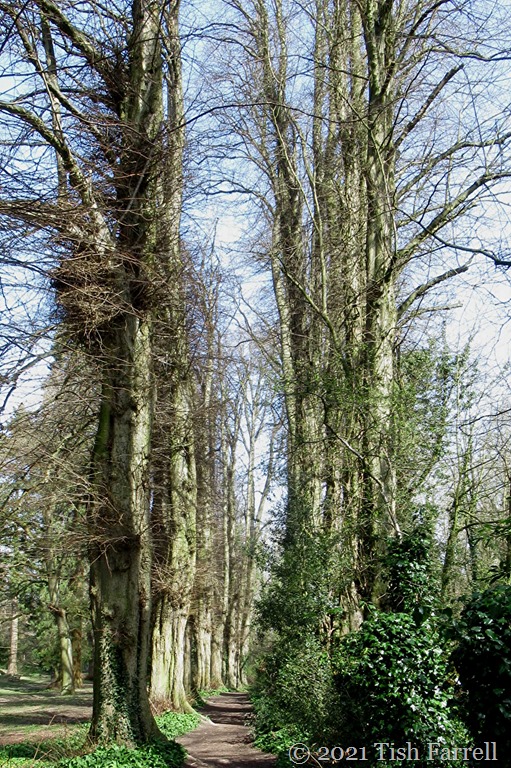
There is a sense of excited liberation as I step out onto Sable Road. I never meet another European walking here on this lovely tree-shaded avenue.
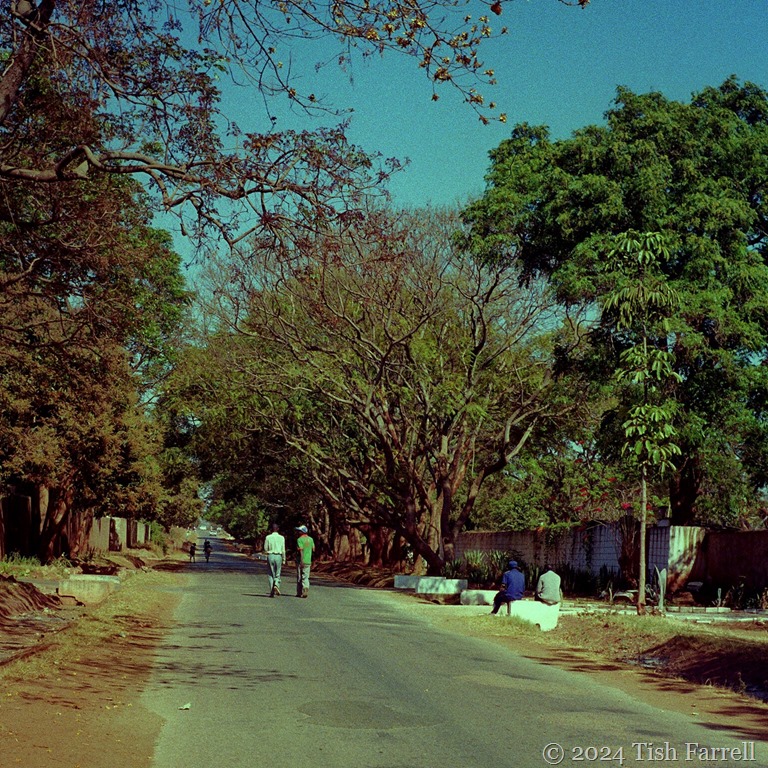
Sable Road in the dry season.
To be continued
copyright 2024 Tish Farrell