
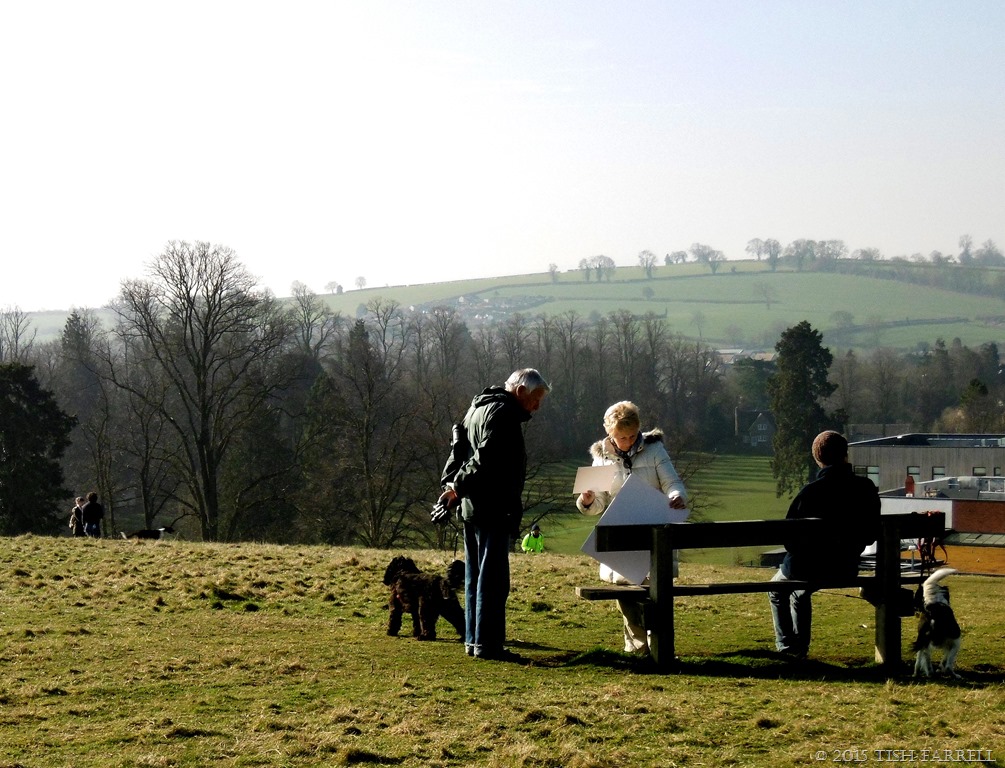
 Here I am on top of Windmill Hill, Much Wenlock’s landscape landmark, and this is the only way I could see the partial eclipse – with my back to it, and camera at the ready. We had such clear skies, and the sun was so bright that we remained bathed in sunshine throughout this cosmic event, although it did seem very cold. Lots of people who were out walking their dogs had gathered at the windmill too, one lady monitoring the process through a pin-hole viewer. This is the scene before me as I take the photo over my shoulder: windmill and pointer. Had the eclipse actually happened?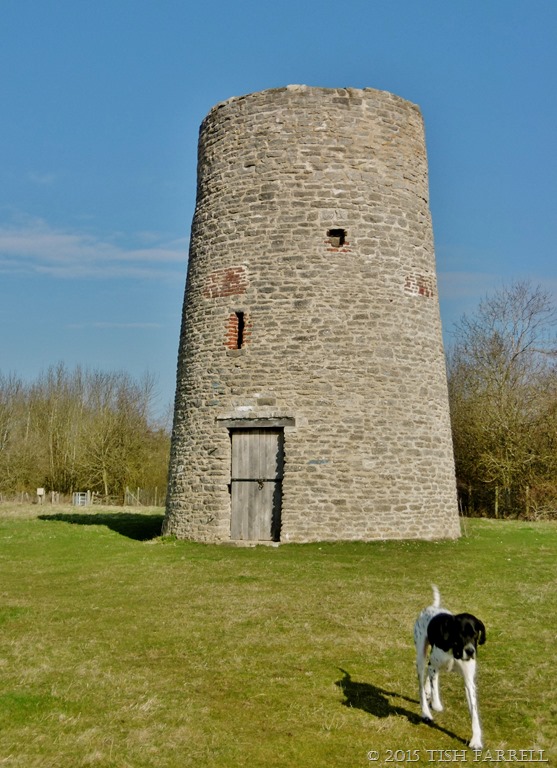
 Aftermath. I caught the sun in the trees as I walked home across the Linden Field. This, incidentally, was the place where the Much Wenlock Olympian games were, and are still held every year. They were devised in 1850 by the town’s physician and herbalist, Doctor William Penny Brookes, and went on to inspire the founding of the modern Olympic Movement. Windmill Hill provided the natural viewing platform where spectators sat to watch the events. See how this little town of ours spread its good hearted influence around the world. Wishing everyone joy on this, International Day of Happiness #eclipse #International Day of Happiness
photography

Elephant tribe versus Man tribe: and how the bees are helping
We’ve been watching a very heartening series on BBC i-Player The Secret Life of Elephants. It followed the magnificent conservation work being carried out by Save The Elephants, a charity that operates in Samburu, Northern Kenya, and relies on the cooperation between the nomadic Samburu people, local smallholder farmers and scientists from Kenya and beyond. One of the key initiatives is to put tracking collars on the matriarch leaders of particular elephant clans, and also on the large bulls who, outside the breeding season, lead more solitary lives.
Elephants may cover vast distances in the course of their annual migrations. But once they leave the national parks they are more vulnerable to poachers, and also to irate farmers who are tired of having their year’s livelihood consumed in a single night. By tracking and mapping the herds’ movements on computers, and maintaining channels of communication with the pastoralists and farmers, Save The Elephants researchers are working out ways to lessen conflicts, and present solutions, and above all, to secure the future for wild elephants.
The Samburu pastoralists have always been wise enough to respect elephants, and are now anxious to do what they can to protect them. This is their view on the matter:
The first man said the elephant is like us, like our brother, and we have to live together, not hunt elephant. That’s what we say we were told at the beginning. That’s what we still believe. The elephant has always been, and will always be, special to us. This is why we protect it now.
Samburu people on the importance of elephants
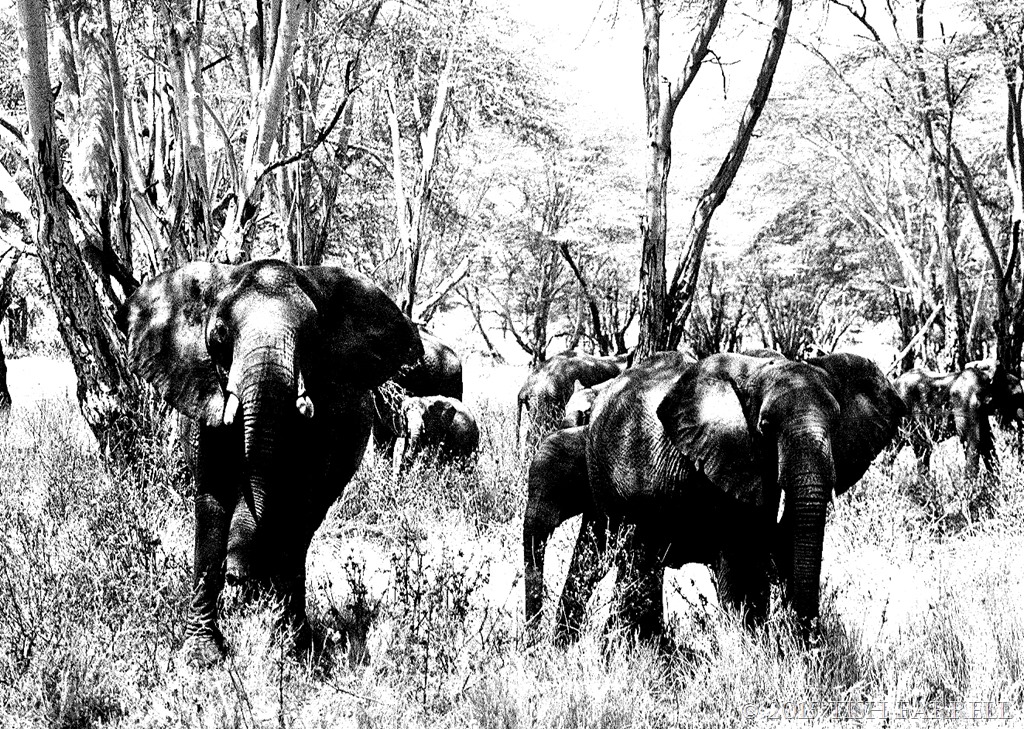
For farmers it is a very different matter. People are often killed trying to drive elephants out of their crops. And so one of STE’s objectives is to work out the best place to erect elephant fencing so that elephants can be channelled away from farming communities as they pass by on their seasonal trek between the river where they congregate to breed, and the mountain forests where they go to browse.
Fencing, though, is not always the total solution it seems. Elephants are not daft. The old bulls have learned how to open gates onto the vast European wheat farms that lie to the west of Mount Kenya. But while the large-scale producers can tolerate some elephant grazing, smallholders cannot. For them it is a matter of living or starving.
One of the STE researchers, Dr. Lucy King has come up with a very simple, low-tech and productive approach to keeping elephants out of Kenyan farmers’ cabbage fields. It began with the discovery that elephants will move off if they hear the sound of bees buzzing. African bees are especially aggressive, and on a very short fuse temper-wise. She thus came up with the notion of placing beehives around farm fields.
Traditional African beehives are made of lengths of hollowed-out tree trunks that are then suspended in trees. These were hung at intervals on the field perimeters, and connected up by tripwires. When the elephants tripped the wires, the hives were duly shaken and out would swarm the angry bees. Elephants would then beat a retreat, leaving farmers with both their crops and a new source of income from the honey.
As Colonel John ‘Hannibal’ Smith was so often wont to say in The A-Team: “I love it when a plan comes together.” In this case, though, it is clearly the work of the B-Team.
Copyright 2015 Tish Farrell
Related:
I’ve written more about elephants in Elecommunication: So Many Connections
And last but never least, thanks to Paula at Lost in Translation and her guest challenger, photographer Guilhem Ribart. TRIBE is the prompt. For more interpretations, please also follow this link. I should add that my photos here were taken in Lewa Downs which is part of Save The Elephants’ sphere of operations. The original negatives are very degraded, but seem to have a new lease of life translated into B & W. In fact they also seem to capture the elephantness of elephants rather better than the colour originals, which is interesting when you think about it.
Thinking of Sheilagh
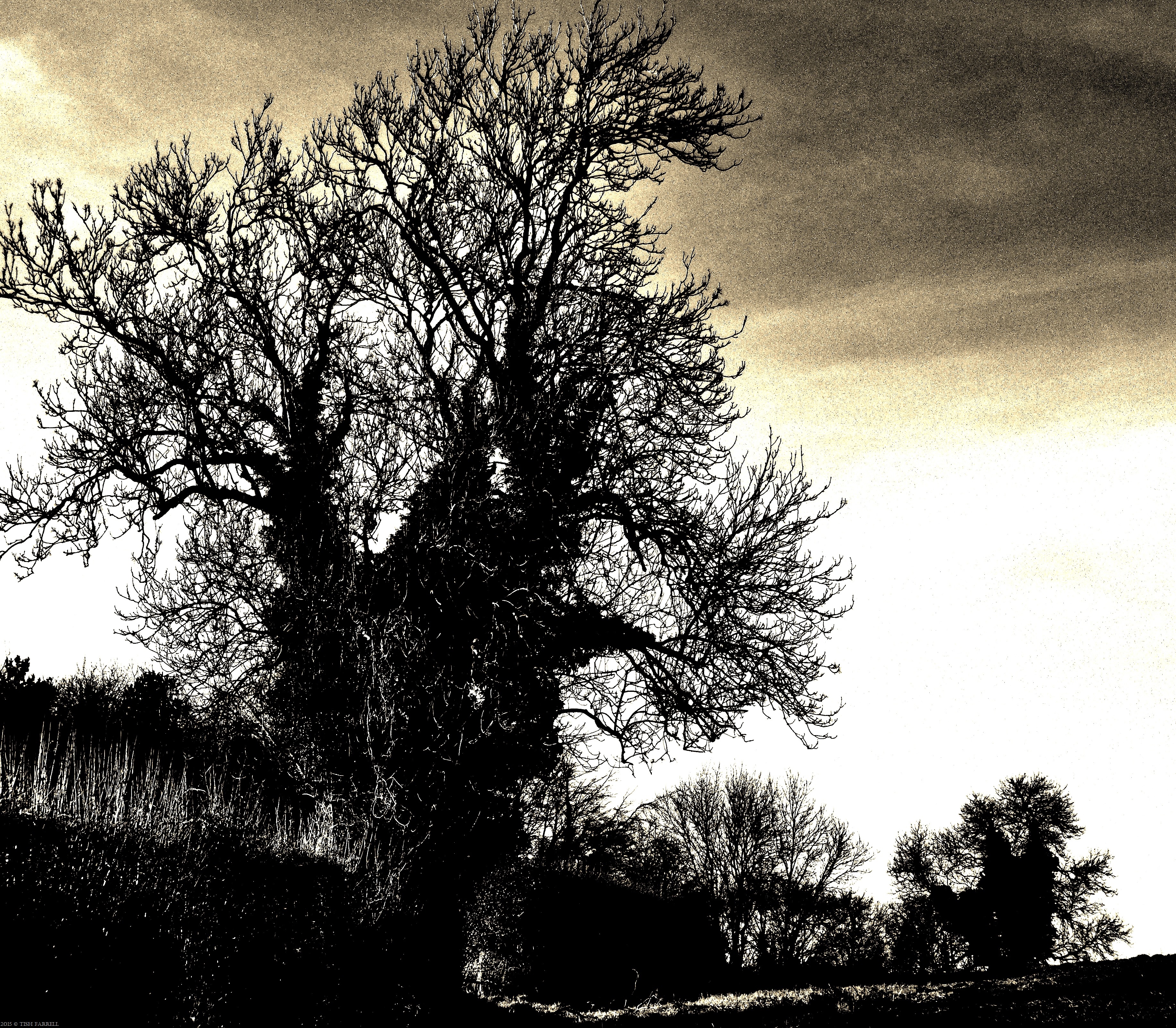
Our sense of belonging ripples out from our homes to our village, street, town, county, region and country and helps to shape our identity.
Sheilagh Jevons, Artist
Related: Looking inside the House of Belonging with Artist Sheilagh Jevons
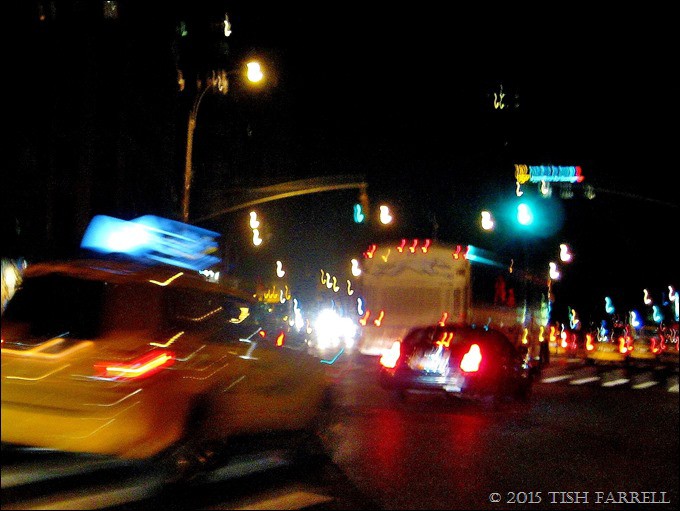
Night-time on Broadway ~ look out, the music’s escaped…

This week artist, Suzanne Miller, is Paula’s guest at Thursday’s Special, and she has challenged us to think and look at our photographs in a more abstract way. This photo was taken after a trip to the New York Ballet at the Lincoln Centre. I’m rather fond of ballet, and had been very much looking forward to the show, but after the first forty minutes, I was so bored I succumbed to rather more than forty winks. It was far more exciting out on Broadway.
To see Paula’s and others’ response to ‘abstract’ go to her post at Thursday’s Special
Pondering on what makes us human: that would be shopping, then?
![96_thumb[19]](https://tishfarrell.com/wp-content/uploads/2015/03/96_thumb19.jpg "96_thumb[19]")
So what does make us human? What differentiates us from our closest relatives the great apes? These were some of the questions posed to us as students of Prehistory & Archaeology way back in the 1970s. Naturally, the philosophical framework of a course with such a title is going to be artefact-driven. Archaeologists deal in physical remains. Prehistory means there is no written record. Mostly all we are left with are bones, stones, post-holes, hearths, bits of wood (if we’re lucky), stains in the soil, and that prehistorian’s joy of joys – the rubbish pit and/or midden.
(After all, there is nothing so fascinating as poking through other people’s garbage – as long as it doesn’t smell too much. Just think what future archaeologists will make of our landfill sites, and what their contents will say about us. See WALL.E the movie for starters.)
But back to that ‘what makes us human’ question.
In the early 1970s it was widely thought that the appearance of tools was a key criterion. Their construction suggested evolving cognition and the ability to forward plan. Tool-making further presupposed the facility to walk upright, thus leaving hands free to access materials, and to fashion them for preconceived purposes.
For a time this seemed a useful marker, but then as palaeontologists delved ever further back through the remains of our pre-human ancestors (mostly in Africa’s Rift Valley) it became clear that even by 2.5 million years ago, pre-humans were making tools. The picture was further confused by the realisation that chimpanzees also make tools, albeit crudely fashioned ones – e.g. hammers to crack open nuts, or break into bee hives.
Large brain size was another criterion (judged back then on the basis of the cranial capacity of skull remains), this supposedly indicating a well developed intelligence. I’ve never liked this much, feeling it had a whiff of eugenics about it. I also remember finding it perplexing to discover that Neanderthal brains were apparently larger than those of modern humans even though Neanderthals were supposed to be ‘inferior’.
None of this seemed to advance my understanding at that time, and besides, now we find that back in the Paleolithic, and in two distinct phases hundreds of generations apart, humans of the northern hemisphere interbred with Neanderthals. The evidence is there in our genomes.
![88_thumb[7]](https://tishfarrell.com/wp-content/uploads/2015/03/88_thumb7.jpg "88_thumb[7]")
I left Prehistory behind long ago. As a discipline, I felt it never would be capable of revealing the aspects of humanity that are truly important. And while inferences might be drawn (read: guesses made) about social, religious, political and economic systems from the fragmentary remains of ancient humans, archaeology alone cannot retrieve the all important drivers of human development, the intersecting sets of shared beliefs that create human culture.
After all, we do not know why Stonehenge was built, or what people actually did there, or who organised its building and the activities that took place within the great stone arcades. We never will know. But we can date associated remains, source materials, conjecture on construction techniques, work out how long the place was used, and then we can admire it as an astonishing edifice built by people with an apparently limited technology.
The physical remains,then, are indeed important, but what I really want to know is what was the intention of its builders; what beliefs led to Stonehenge’s conception and realisation.
By now you may be wondering why this post includes scenes from Dubai, including the 9th century pot above. Here’s a clue from the bazaar:
![128_thumb[7]](https://tishfarrell.com/wp-content/uploads/2015/03/128_thumb7.jpg "128_thumb[7]")
And another from the Gold Souk:
![127_thumb[5]](https://tishfarrell.com/wp-content/uploads/2015/03/127_thumb5.jpg "127_thumb[5]")
And at the Dhow Harbour:
![118_thumb[8]](https://tishfarrell.com/wp-content/uploads/2015/03/118_thumb8.jpg "118_thumb[8]")
And in the mall:
![72_thumb[11]](https://tishfarrell.com/wp-content/uploads/2015/03/72_thumb11.jpg "72_thumb[11]")
Yes, you have guessed it. Trade is the clue. And so, having ruminated on archaeology’s limitations, I can say that one of the things it does do well is reveal ancient trading patterns across the globe. In fact only last week it was announced that a study of sediments from a waterlogged 8,000 year-old Mesolithic (ostensibly hunter-gatherer) settlement in the English Channel contained introduced wheat grains that suggest trade with European farmers.
In this regard then, the movement of goods, the origins and spread of food species can be tracked across the millennia. We can thus surmise that even 8,000 years ago humanity was already out shopping, and that, down the ages, this would seem to be one shared behaviour pattern that is exclusively human. We all do it, and probably always have, because whatever territory was commanded on a day to day basis, it probably did not provide for all its inhabitants’ wants and needs.
There may have been the need to share with other groups a particularly good source of flint for tool making. Inland and maritime communities would have met to exchange materials and foodstuffs. There would also have been the pressing need to find mates well outside the group of related family members. And there might have been a yearning for salt or, in season, for honey or for a particular fruit, all of which might have involved negotiation with outsiders. Fresh water sources might also have been at issue, or the need for extra hands for some seasonal hunting or farming pursuit. And so, for these reasons and more, we would have traded, bartered, exchanged, made treaties and contracts, formed alliances, given and received gifts. This was also probably how some us of ended up with Neanderthal DNA in our genomes.
From the historical record we also know that when it comes to dealing in resources and commodities, hostilities may be instigated, or suspended depending on those whose interests rule. Safe havens, forums, fairs, markets, shopping centres, bazaars, souks, malls are places we all recognise. In the past such gathering points would have also provided venues for song and dance, spiritual and ritual observance, political rallies, exchanges of information and specialised services, the telling of tales.
Dubai, these days, is one of the world’s shopping capitals, reinvesting its wealth from oil refining and trade in the ’shop till your drop’ model. It brings together the concepts of the marketplace and the caravanserai, but on a mega, upmarket 5* scale. Yet it also draws on ancient roots, and on actual trade routes that go back to at least 3,000 BCE. Back then copper and the pearls dived for off Dubai Creek were the stock in trade. Later, as commerce between the Mediterranean and the East began to thrive, dhow merchants made the most of Dubai Creek’s favourable geographical position. The trade continues, only now it is western cars, refrigerators and Coca Cola going east, while the spices, as they have for centuries, come west.
![100_thumb[11]](https://tishfarrell.com/wp-content/uploads/2015/03/100_thumb11.jpg "100_thumb[11]")
Shopping then, provision and consumption, is, I suggest, what makes us uniquely human. And while I admit that this does not seem a particularly elevating pursuit for our time on this wonderful planet, it nonetheless engages pretty much all of us, from Manhattan bankers to Congo hunter-gatherers. Multifarious mechanisms of exchange bind us in relationships of largely peaceable cooperation. The squabbling over resources, and corporations’ drive to make profits at others’ expense threatens us and our planet. But either way, it is hard to see where this never-ending shopping spree will take us. Maybe we need to take a hard look at those landfill sites of ours, and consider what future archaeologists will have to say of us. I’m not sure we will want to hear it.
copyright 2015 Tish Farrell
Inspired by Jennifer Nichole Wells and her One Word Photo Challenge: teal
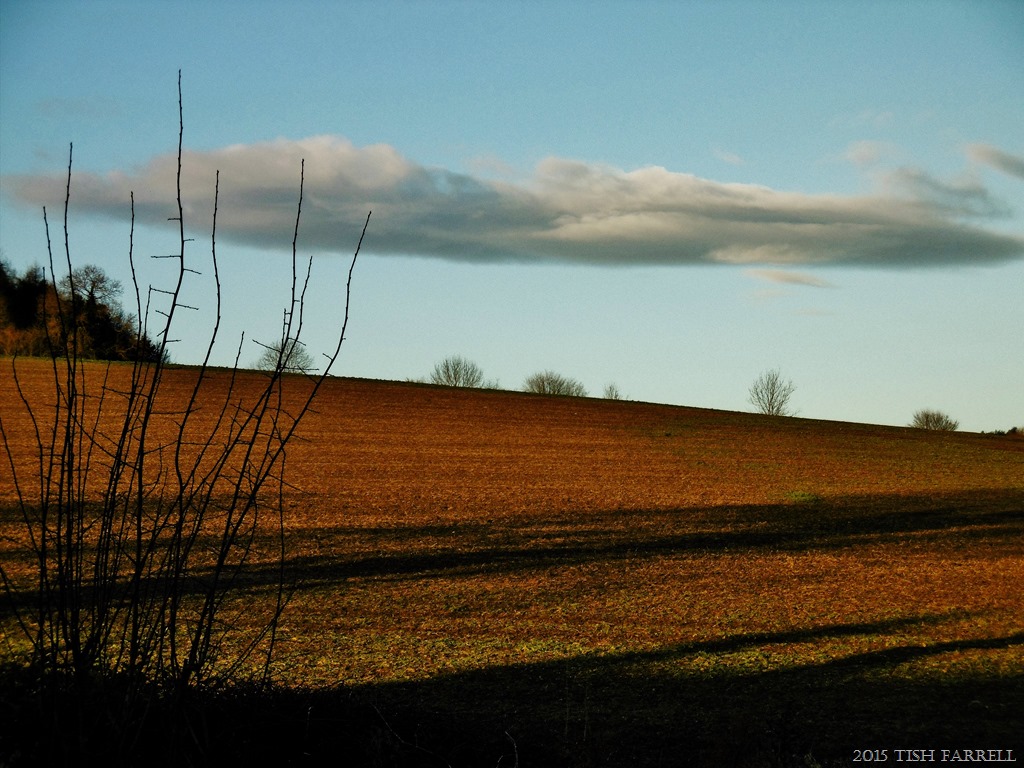
Life Imitating Art Imitating Life…?

I snapped this the other morning with my little Lumix ‘point and shoot’. It’s the view from our bedroom window. The light was extraordinary, and when I looked at the image again it reminded me of René Magritte’s The Golden Legend – also a view from a window, although with the interesting addition of flying baguettes. What do you think?

You can find out more about Magritte HERE. I like the way he challenges our ingrained perceptions.
DES RES ~ Nouveau Roman Anyone?
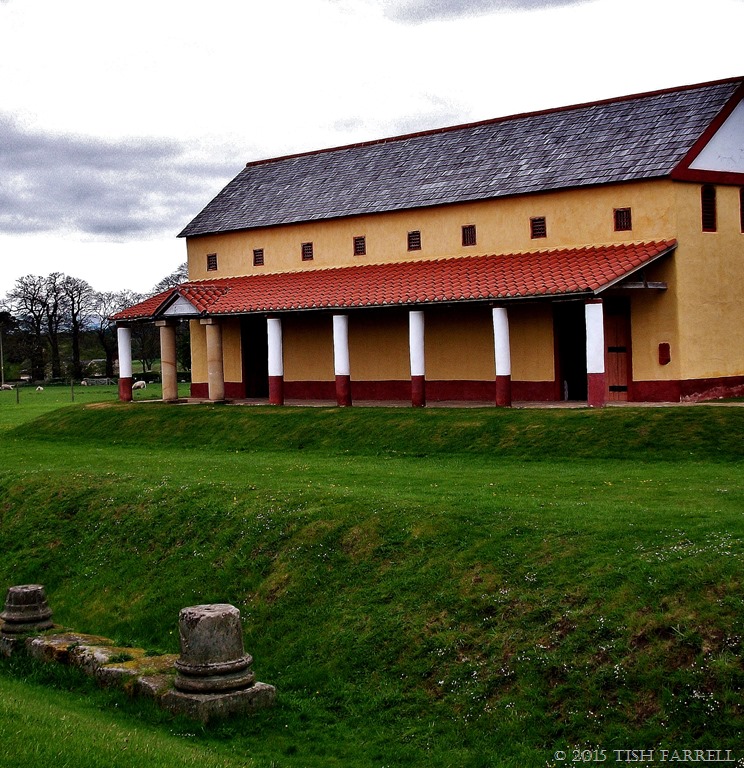
I think I may have mentioned somewhere on this blog that, a few miles up the road from Wenlock, we have the remains of Wroxeter Roman City aka Viroconium aka Uriconium. In its day it was one of the largest urban settlements in Europe (AD 47 – AD 650). Most of it still lies under farm fields within the broad sweep of the River Severn, although the outlines of houses and roads have been eerily revealed in aerial photos and LADAR surveys.
For centuries, too, farmers at their ploughs have turned up marvellous Roman artefacts. Even now, if you walk the fields after harvest you can easily spot the polished terracotta shards of fine Samian pottery among the wheat stubble. Archaeological excavations have been on-going for decades. I dug there myself aeons ago, as an undergraduate archaeology student who needed to rack up some fieldwork experience. The exposed remains are now in the care of English Heritage, and many of the finds are on display in the site’s small museum. More of the collection has been recently re-displayed at the county’s new Shrewsbury Museum.
But now we come to the Roman Villa in the photo – this ‘desirable town residence’. Its appearance here was prompted by Jo’s ‘restoration’ challenge. Strictly speaking, this is not so much a restoration as a reconstruction. Although on the other hand, you could say that its builders did attempt to use only Roman construction methods – thus ensuring the restoration of long-lost skills. They did, however, have to apply for present day planning permission before they could start work.
And the whole project came about as part of a TV series on UK’s Channel 4 – Rome wasn’t built in a day. You can have virtual tour of the villa HERE
*
Of the original city, there is not a great deal to see, although the remaining high-standing basilica wall is pretty impressive, and did feature rather splendidly in Simon Schama’s epic A History of Britain TV series. You can see the first episode in which it and the surrounding remains feature at 40 minutes in:
Simon Schama’s A History of Britain
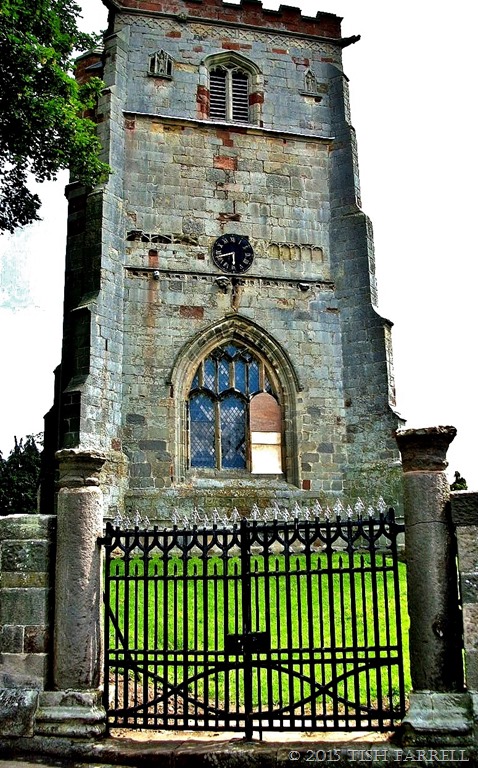
One of the reasons why the physical remains of this large and long-lived city are so few is because the building stone was recycled through the ages. If you walk down the lane to Wroxeter Church you will find that Roman pillars have been used to make the gateposts. Doubtless much more of the Roman stonework found its way into the body of the original Anglo-Saxon, later Gothic church. The church is redundant now, and looking rather sad.
And finally, I can’t leave you without showing off some more Roman treasures that may be found in Shrewsbury Museum’s Roman gallery. The finest object of all is a polished silver mirror, made in the Rhineland but found in Wroxeter forum’s courtyard. It dates from the AD 2oos. Its convex design, and the weight of the silver suggests it would have been held by a slave or servant so ‘my lady’ could admire her latest hair-do. Enjoy!
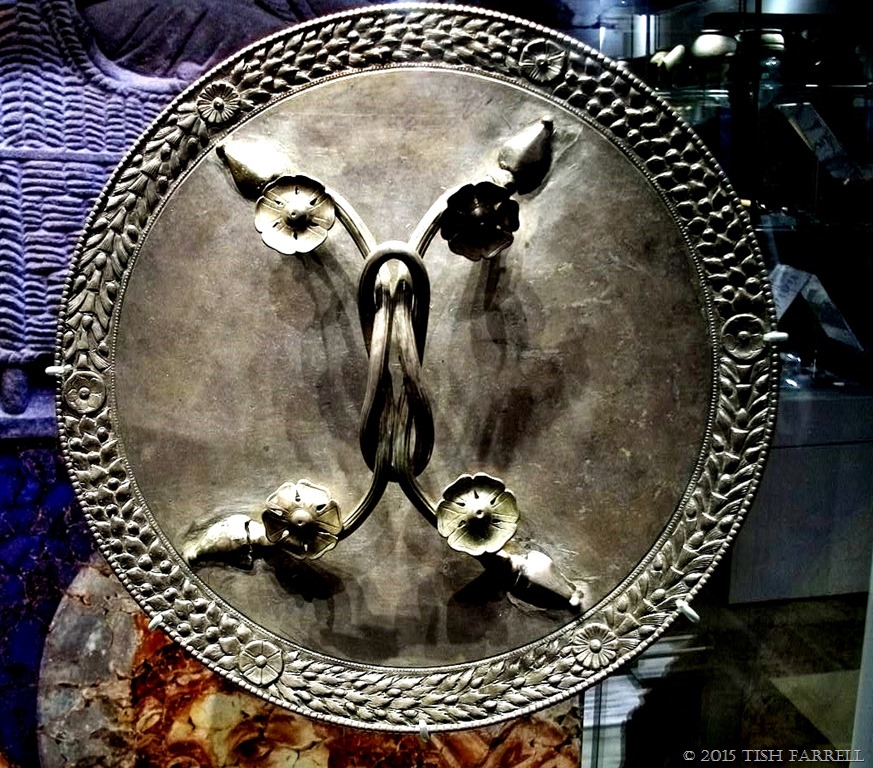
Back of a convex silver mirror, circa 3rd century AD, Shrewsbury Museum.
*
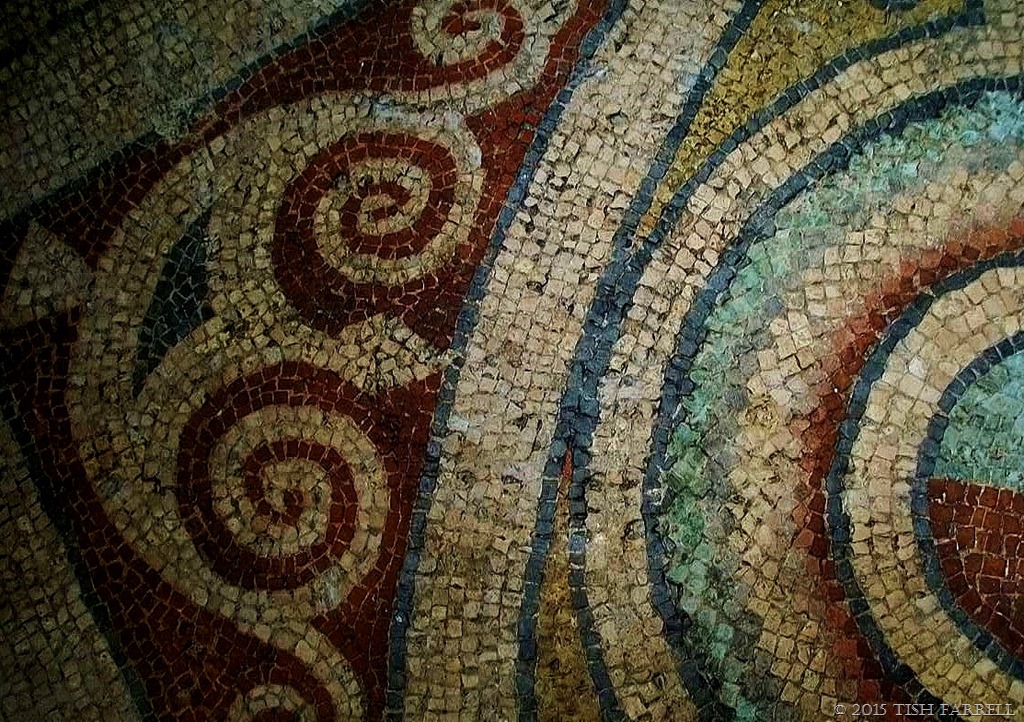
Restored section of Roman mosaic floor from Whitley Grange Roman Villa, near Shrewsbury.
*
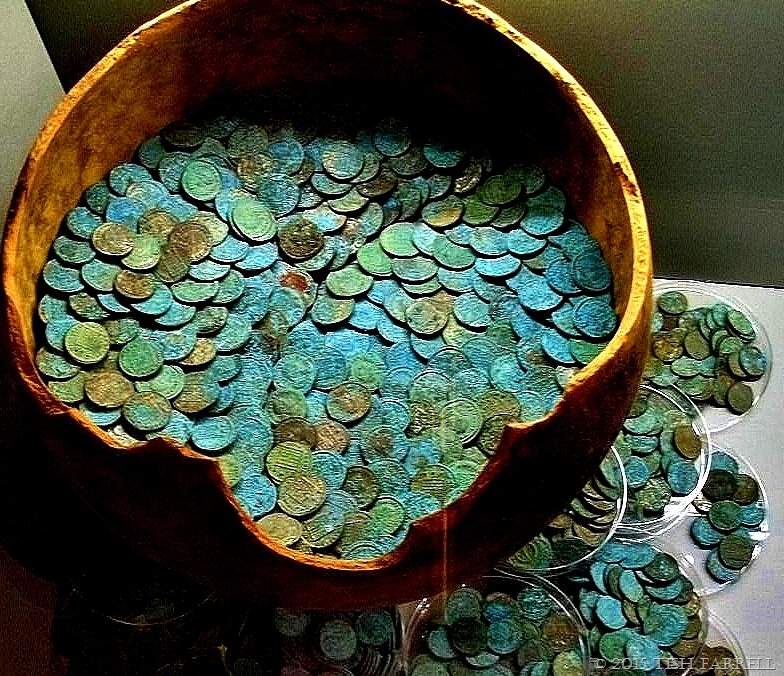
The Shrewsbury Hoard: over 9,000 coins dating from 280 AD to the following century. The coins were wrapped in cloth bags and buried in a big storage jar.
*
copyright 2015 Tish Farrell
For more restored pieces go to: Jo’s guest challenge ‘restoration’. Also check in at Paula’s response at Lost in Translation Thursday’s Special
Day’s End at the Rookery
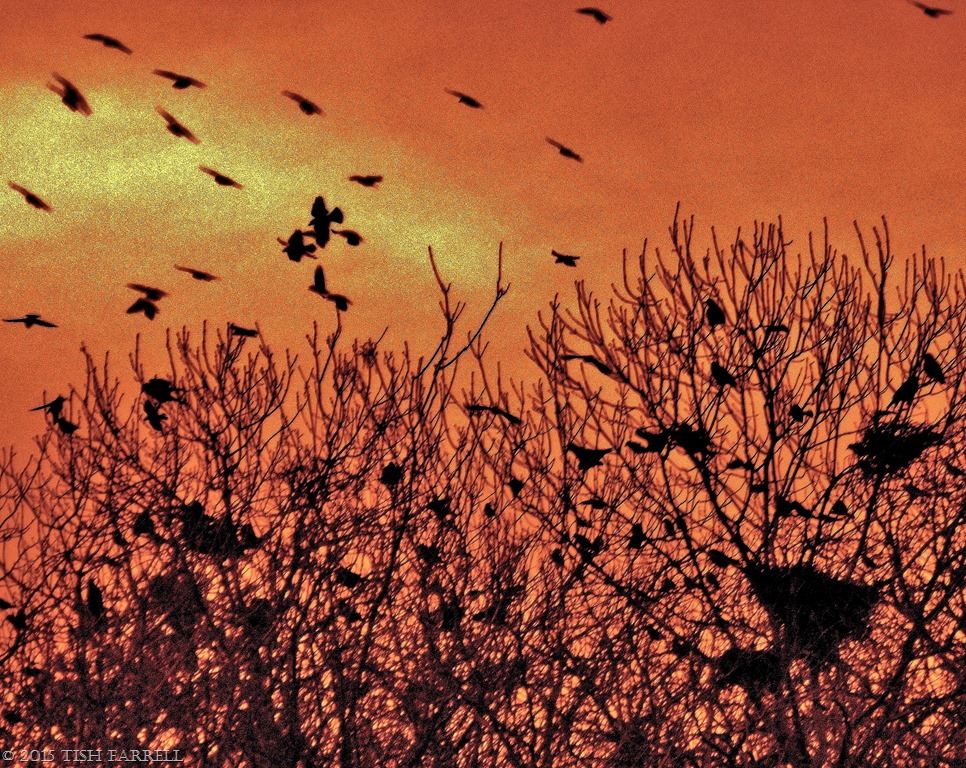
With sunset there is a general homecoming behind our house: hundreds of rooks and accompanying jackdaws return to the rookery in Limekiln Wood. The corvid air fleets head in from all points, returning from the day’s foraging grounds around the town. There are the strident greeting calls – a caw-cophony if you like – of passwords given and passwords received, as the early-bird returnees acknowledge the arrival of others. Sometimes, it seems, an incoming squadron ends up in the wrong tree, and then there is an avian explosion, black silhouettes shot into the sky. Much rook-shouting and abuse ensues.
They sort themselves out, and the wood soon echoes to sounds of companionable muttering.
As the year progresses we will be treated to elaborate twilight fly-pasts and synchronised acrobatics that resemble the murmuration of starlings. And, as the weather warms and we sleep with open windows, so the night will be sound-tracked by the chuntering of rooks. I know from the sleepless small hours that they talk all night. ALL NIGHT. Sometimes I want to tell them to settle down in their nests, and SHUT UP.
The collective term for rooks, of course, is ‘a parliament’, and anyone who has listened to the proceedings of Britain’s House of Lords or Commons on the BBC will have a rough idea of how a rookery sounds. Some might say the corvids are the more intelligent. I could not possibly say.
The rookery wood thus gives us much pleasure, but there are strains of melancholy too in the resonant kaah-kaahing, and the tchaka-tchak counterpoint of jackdaws. It evokes the kind of nostalgia that is so very English, the longing for a lost and perfect England that never existed; a feeling that A E Housman conjures so well in stanza XL of A Shropshire Lad:
Into my heart an air that kills
From yon far country blows:
What are those blue remembered hills,
What spires, what farms are those?
That is the land of lost content,
I see it shining plain,
The happy highways where I went
And cannot come again.
*
Post inspired by Jennifer Nichole Wells’ One Word Photo Challenge: Bittersweet, a colour that is roughly the colour of the sky in the photo.
copyright 2015 Tish Farrell
A Shropshire Lad by A E Housman – you can read the full work HERE courtesy of Gutenberg Press
To see/hear rook acrobatics click on the link below to my brief video …OF ROOK DANCING
Wordless Wednesday from Wales


Sky Energy up at the Allotment
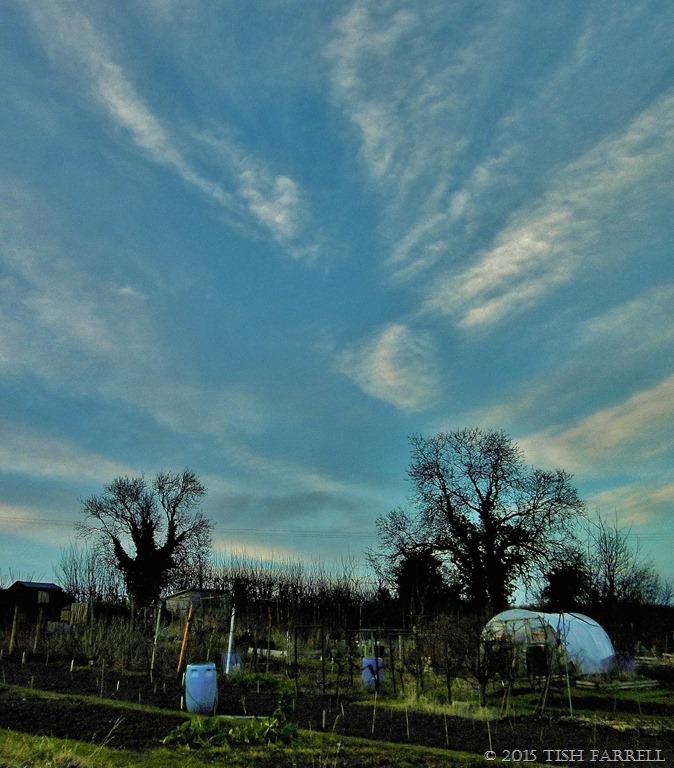
This climate change business is most perplexing. There was a time when winter was a time to get the digging done. Not so the last few years. With the autumn comes rain and more rain. By November the ground is sodden, the soil claggy. My wellies become giant boots in seconds if I am unkind enough to the soil to walk upon it. This year the situation looks set to last until March.
Certainly we have intervals of splendid skies like this, but these periods of unrain never last long enough for the soil to dry out. All I can do on my plot is pick a few overwintered vegetables (leeks and greens), add fresh supplies of pony manure to my compost bins (a nice man who keeps horses dumps regular supplies out in the lane), and well, take photographs.
The light was just going when I took this first photo, but the burst of clouds above the bare ash trees made me think of Ailsa’s energy challenge over at Where’s My Backpack. Simply to see them filled me with energy, and made me think that the generally dreary look of allotment gardens in February had its scenic qualities too. And of course there are signs of spring. Lurking inside this nest of purple and green is an emergent winter cauliflower, in real life, little more than an inch across.

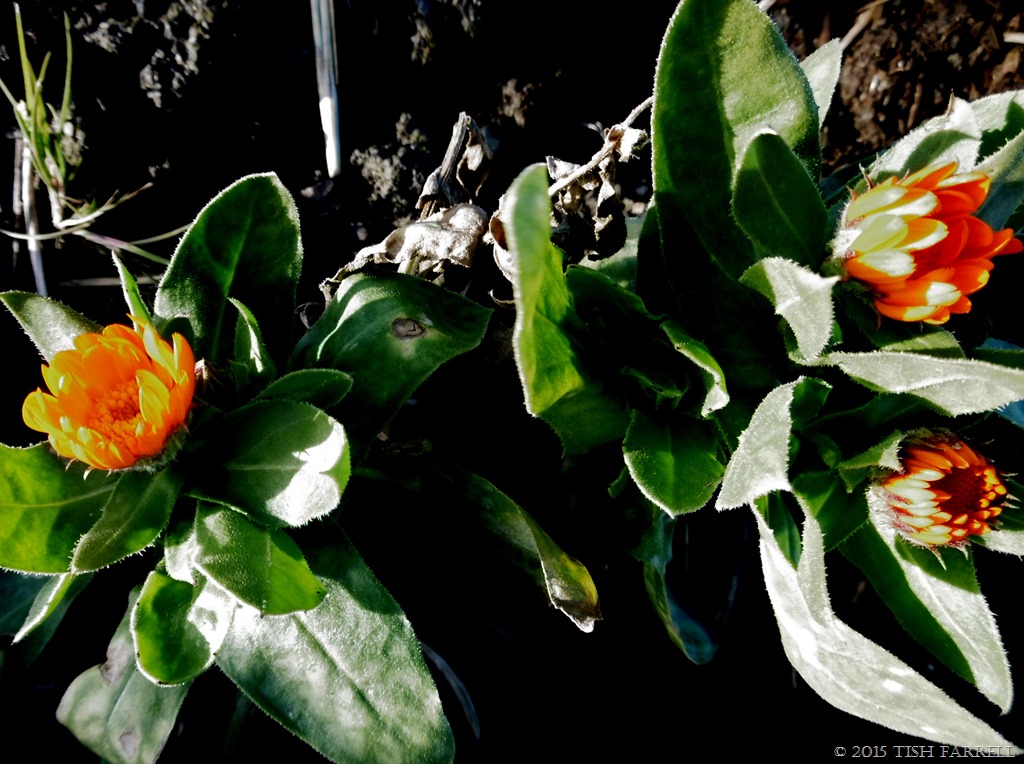
And the marigolds that grow themselves all over my plot, are coming into flower, although they proved a little hard to capture in the biting wind. Perhaps these hopeful signs mean that I will soon be out digging.
Where’s My Backpack – go here for more responses to Ailsa’s ‘energy’ photo challenge
