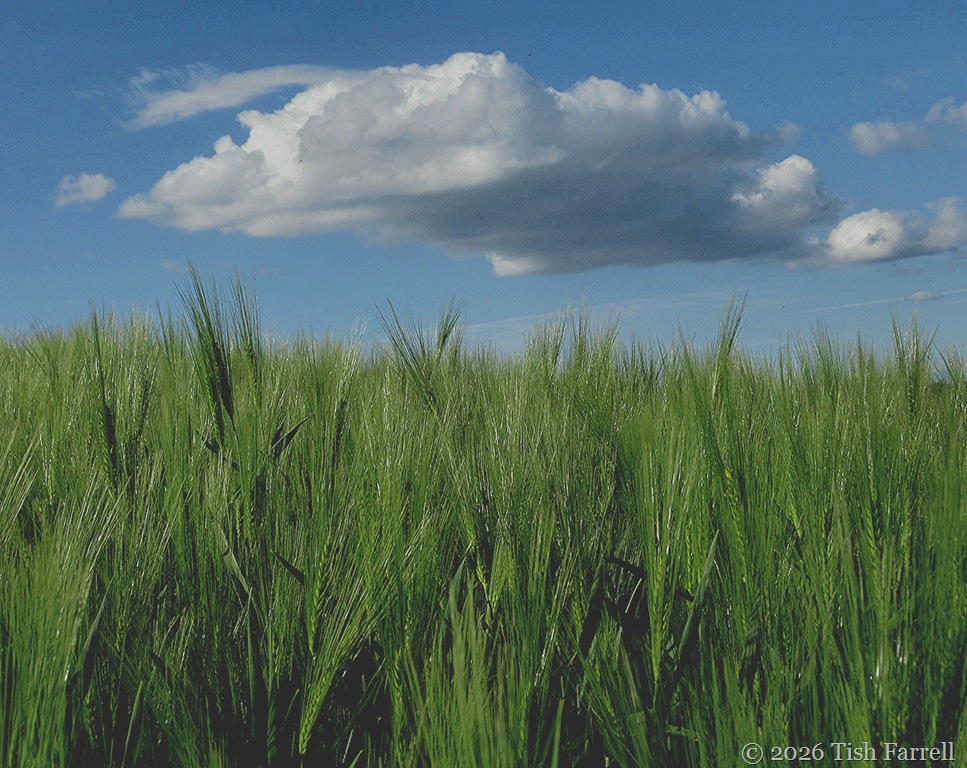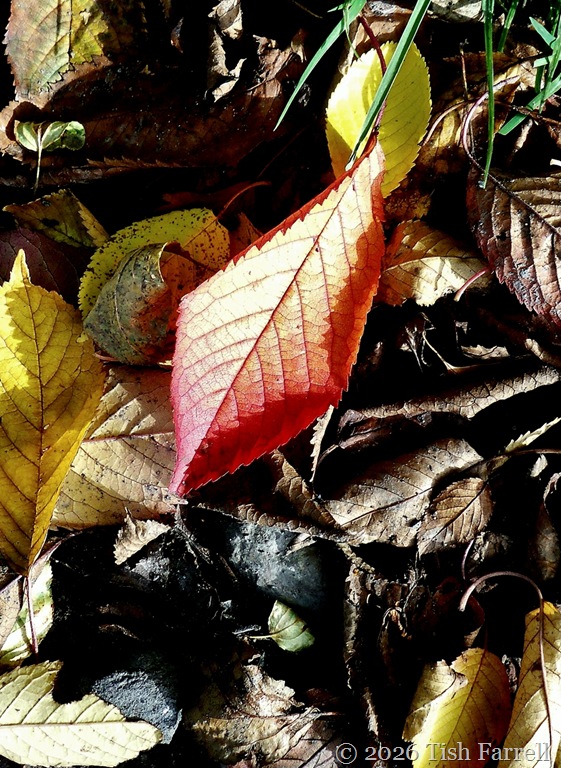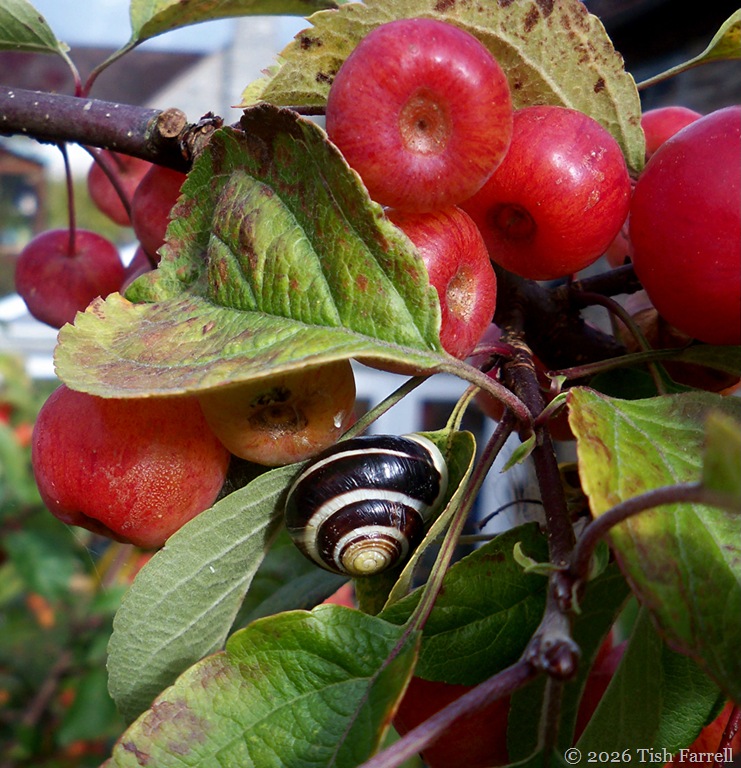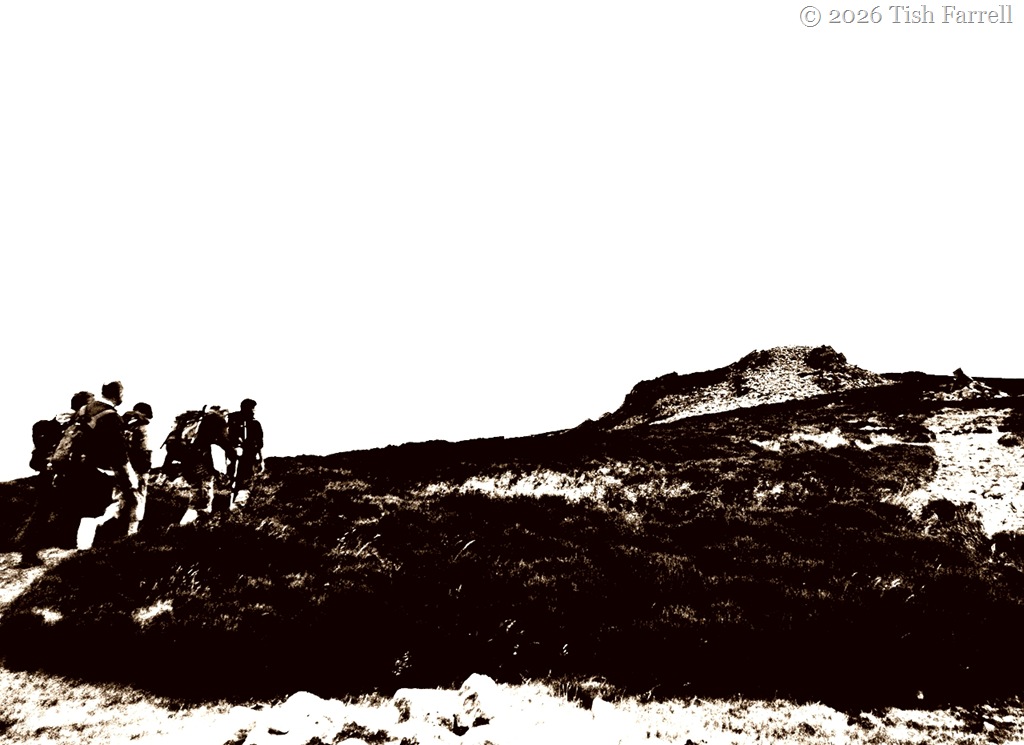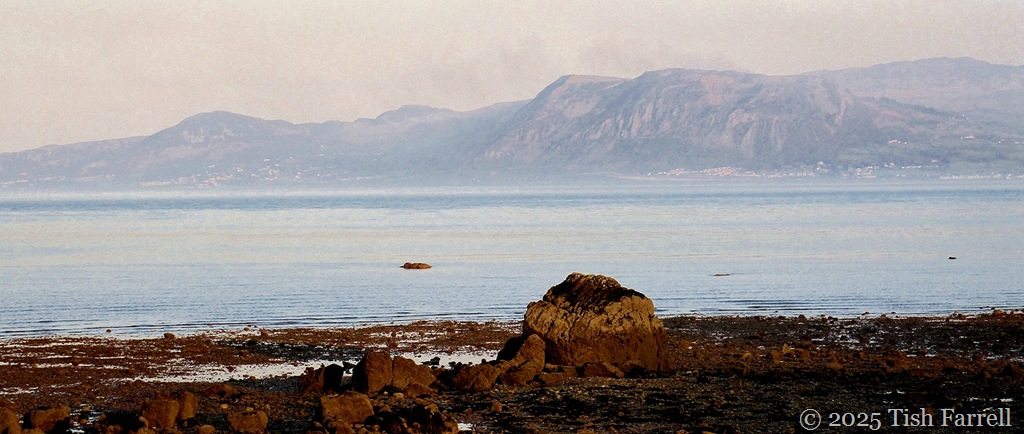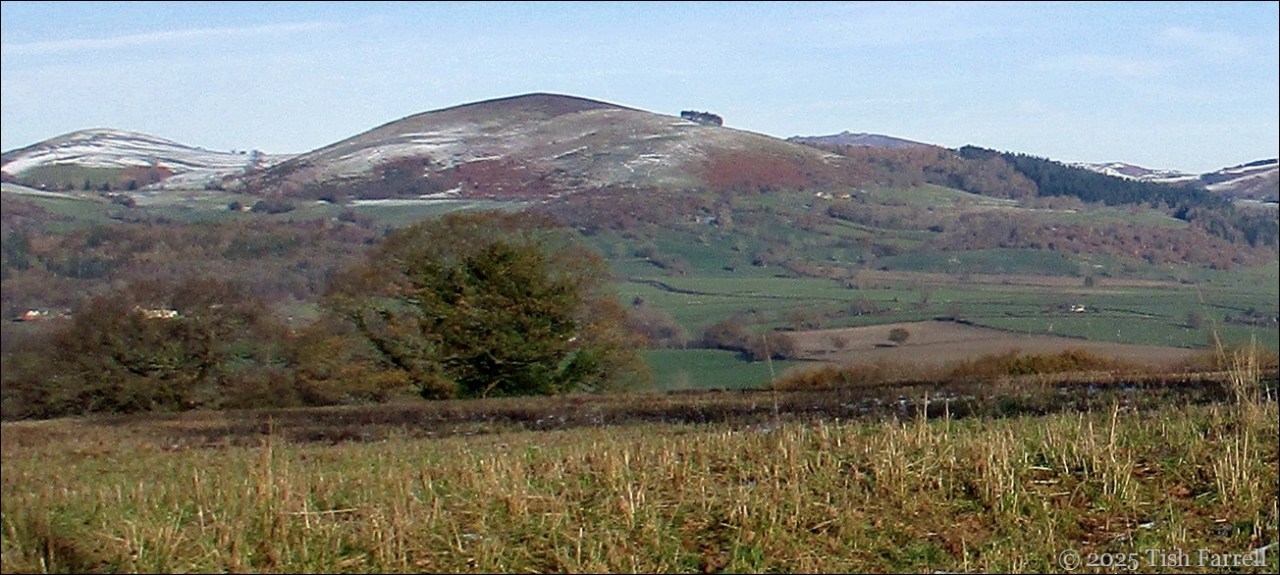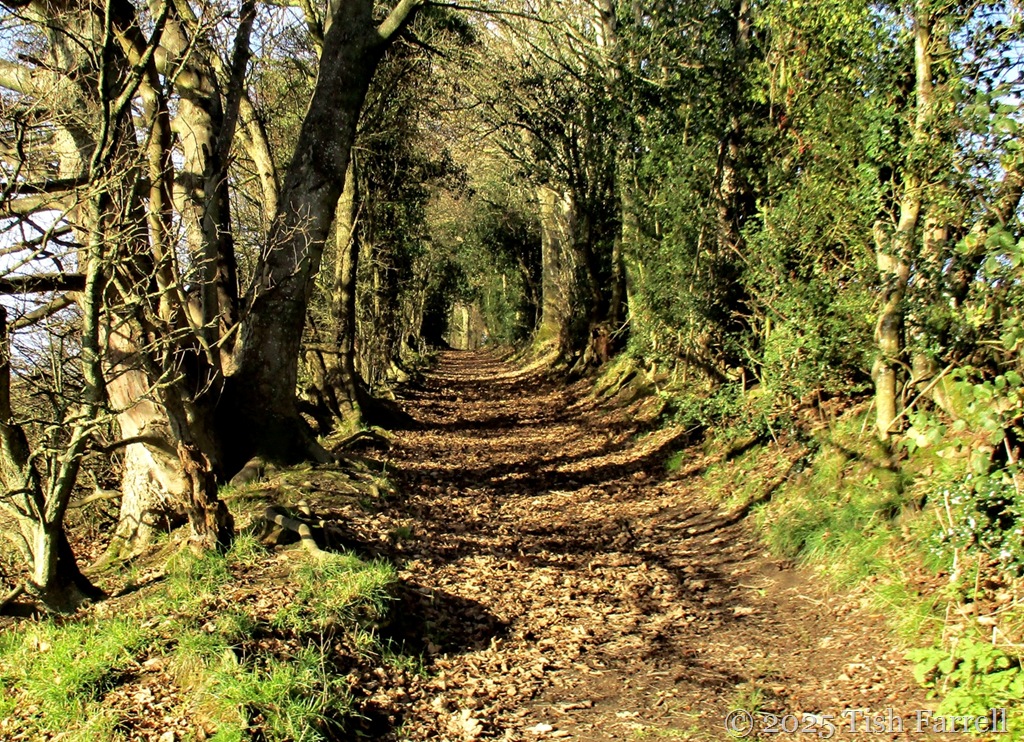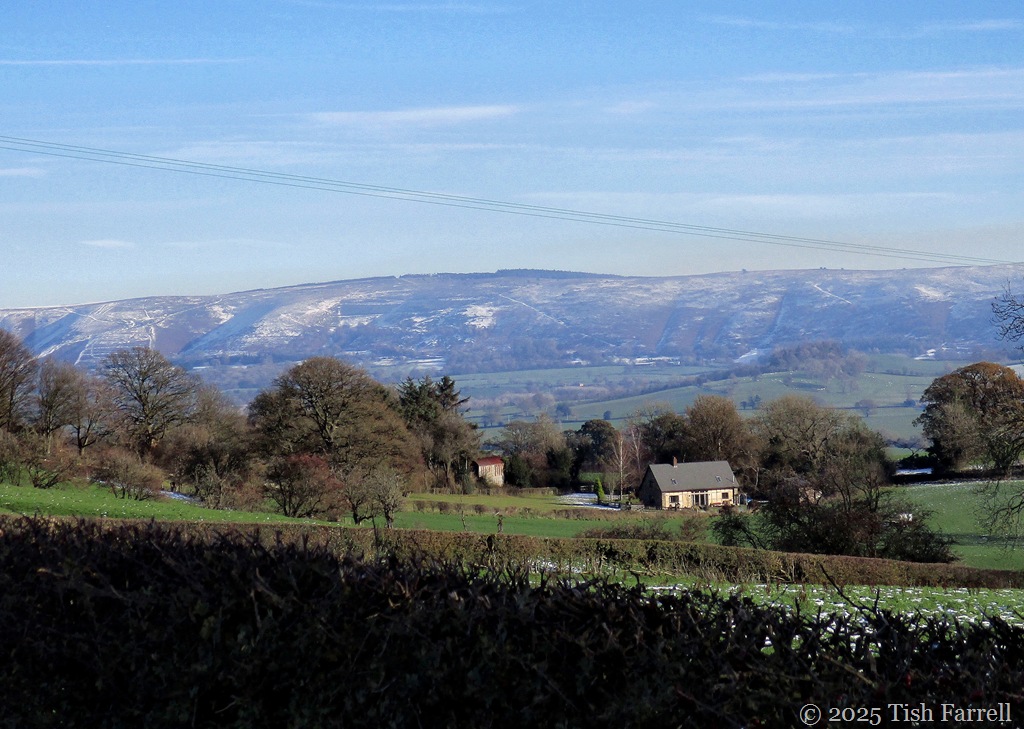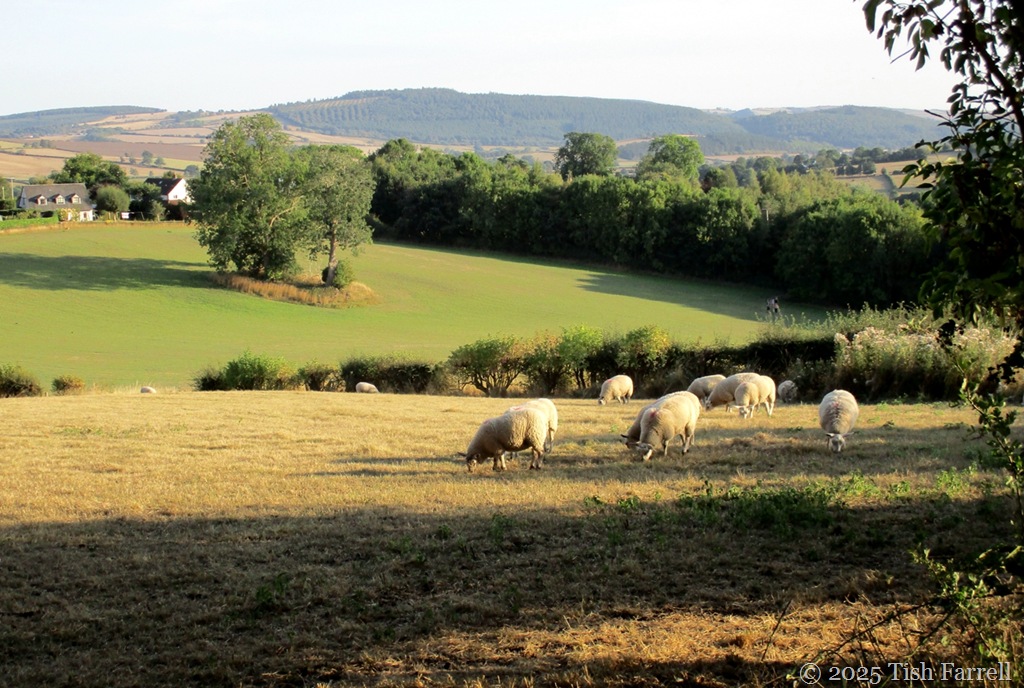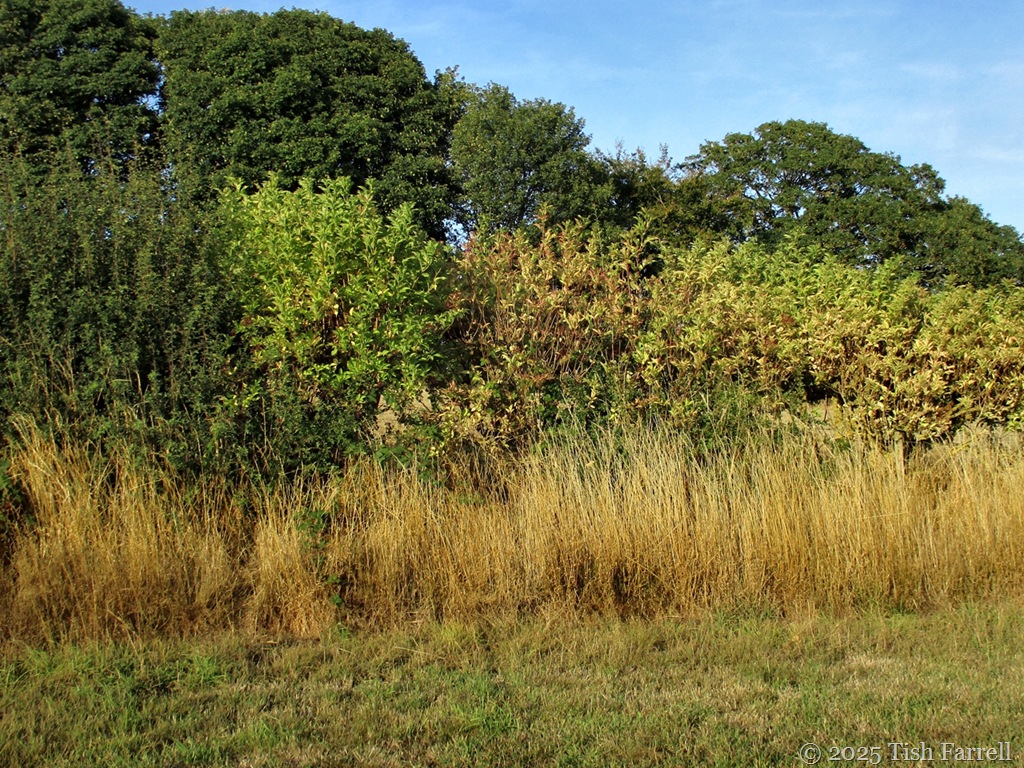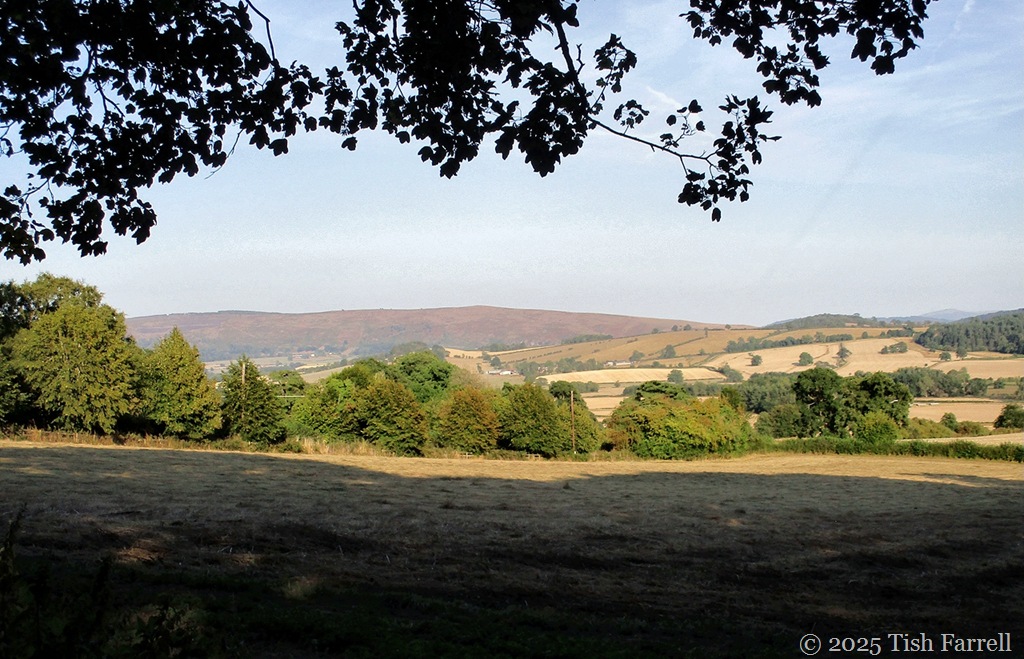
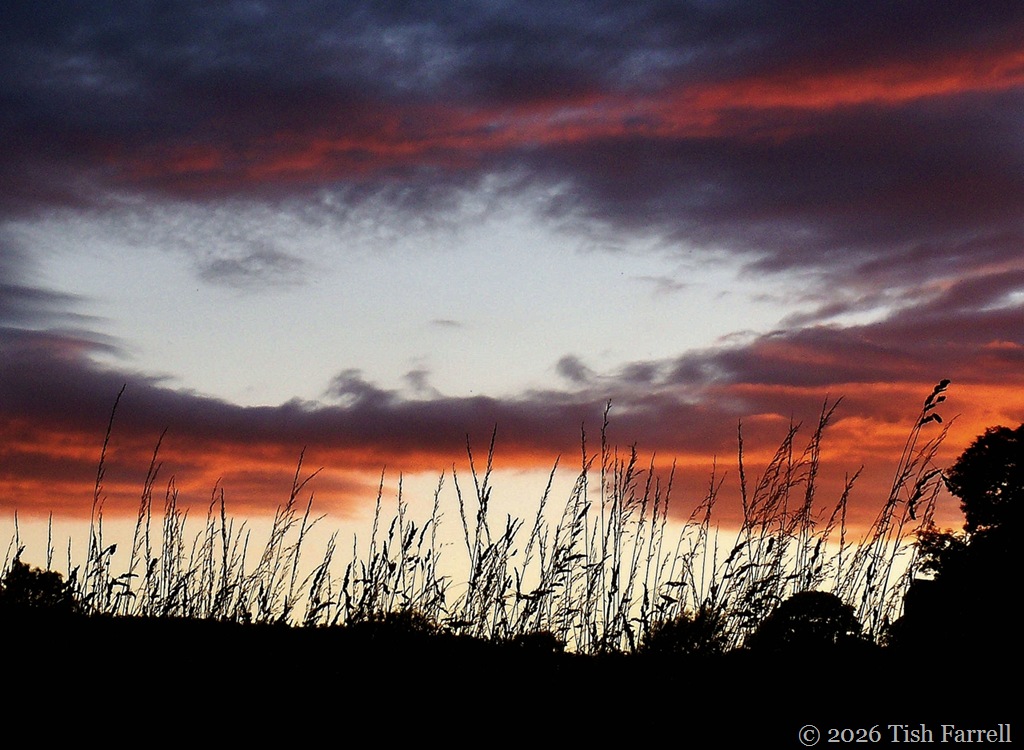
Last Posting For Lens Artists: The Dew Pond Walk

Hollow Way 4

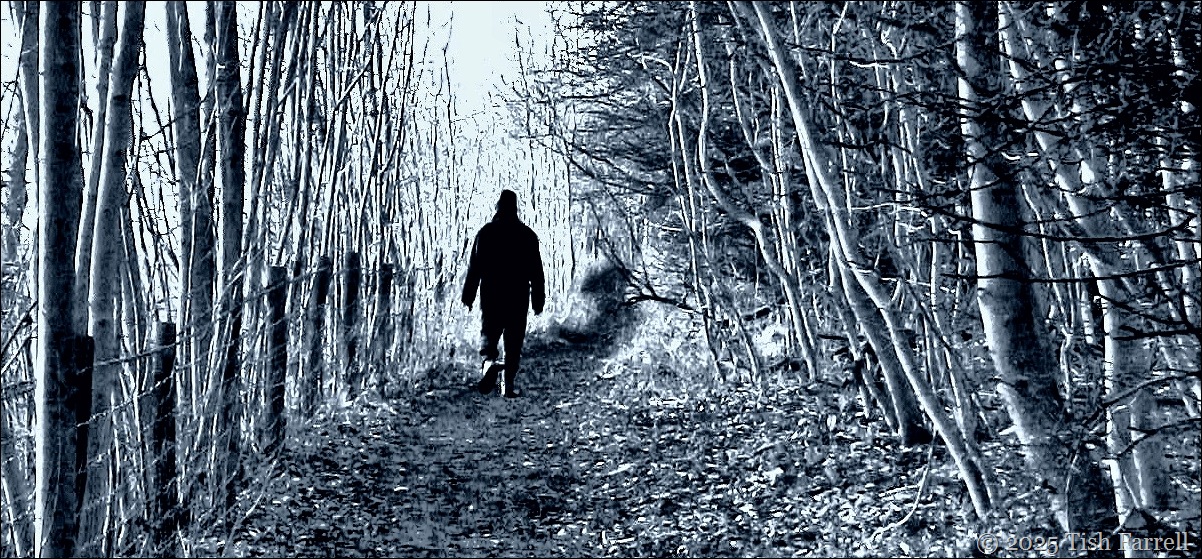
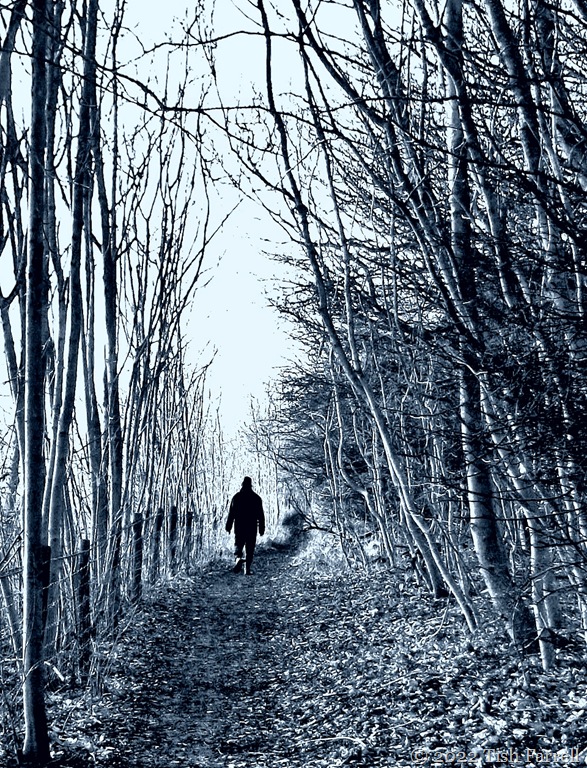
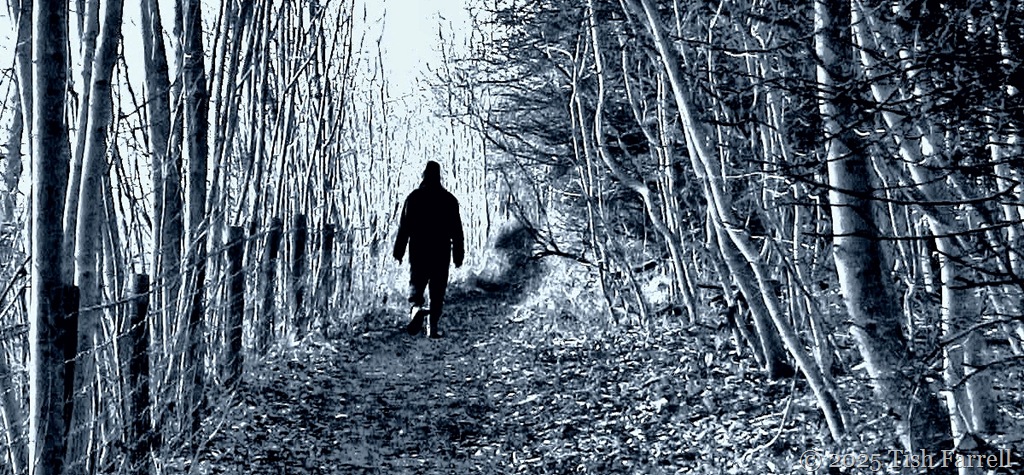
Green lane, hollow way, sunken road: there’s a hint of mystery in these byways, not only in the names, but in the sense of times past, centuries of footfall embedded in the earth between ancient hedges; the passing of cottage folk, farmers, drovers with their herds and flocks; times when most people only had their feet to rely on if they needed to go anywhere.

This particular green lane is one of my favourite spots in Bishop’s Castle. The following photos are ones I forgot to post, taken on a late November walk. It was a brilliant day too, following a brief snow fall and several days of hard frost.

The frozen grass and leaves were crunchy under foot, gripping boots and making the walking easy as we climbed up Wintles Hill. We were heading to the dew ponds.

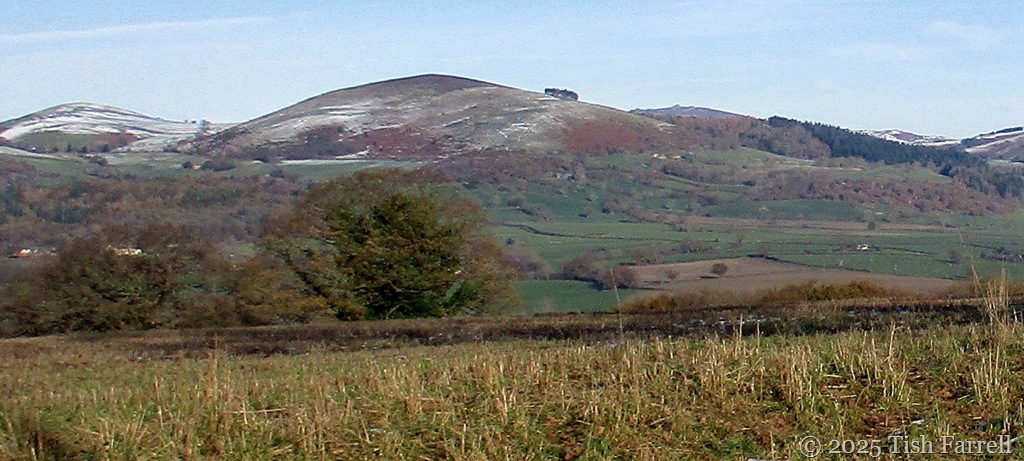
There are essential landmarks en route of course: a hoar-frosty Long Mynd…

Longmynd

*

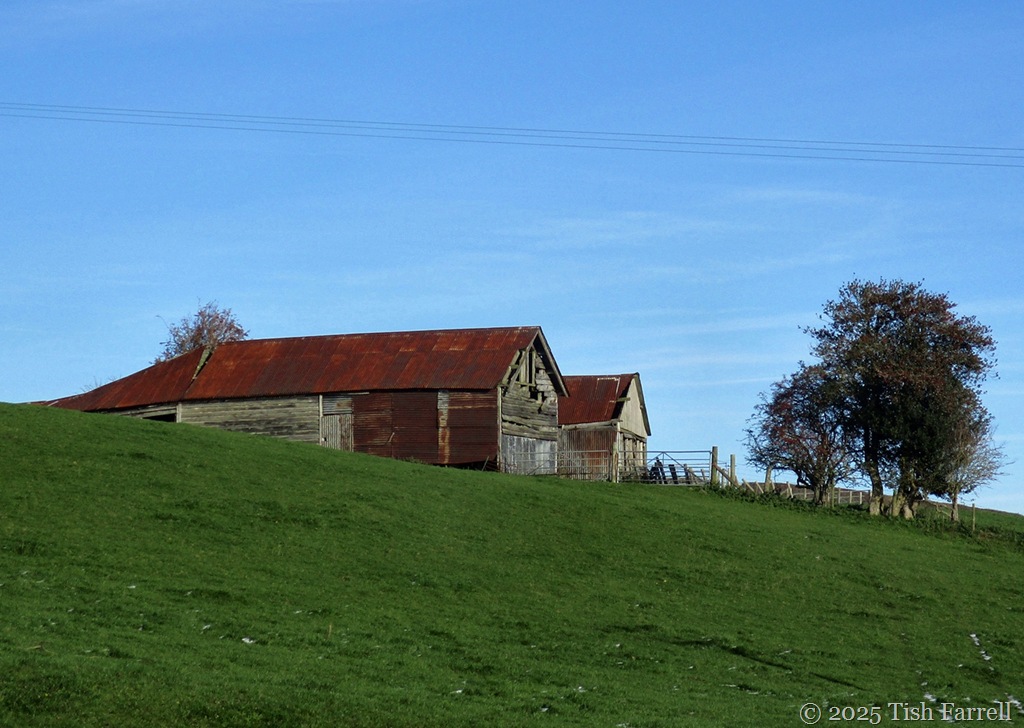
The barns with their rusty roofs that always insist on having their photo taken…

barns

*

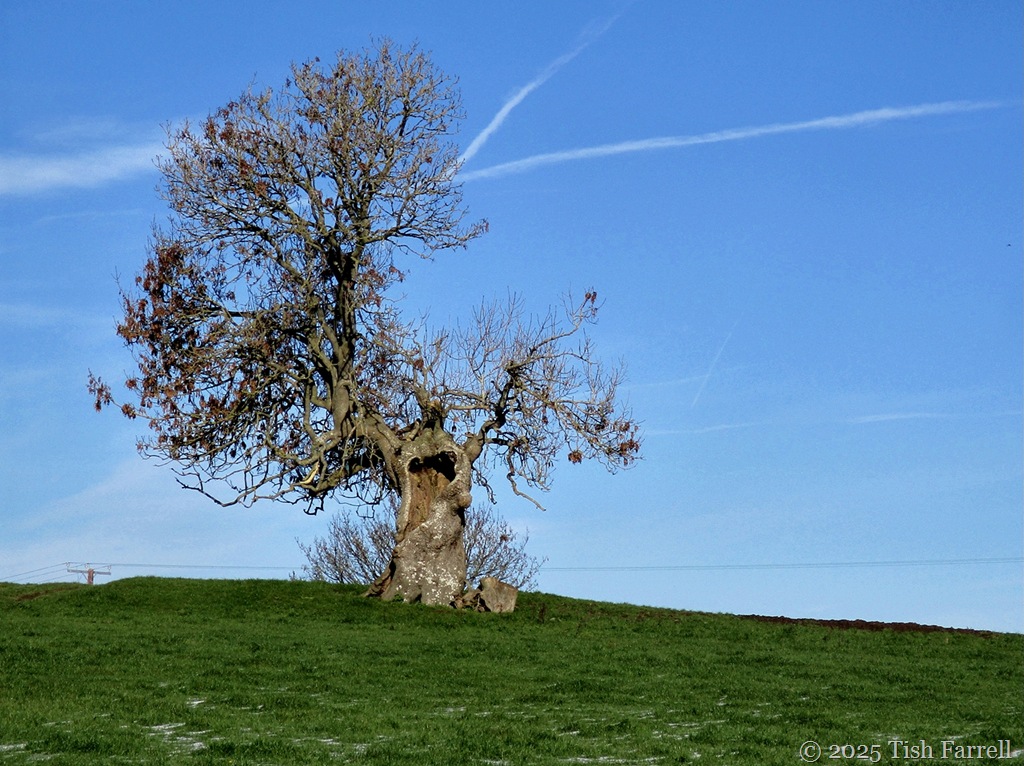
The skyline ash tree that looks like an arboreal version of Munch’s ‘The Scream’…

Wintles hill ash

*

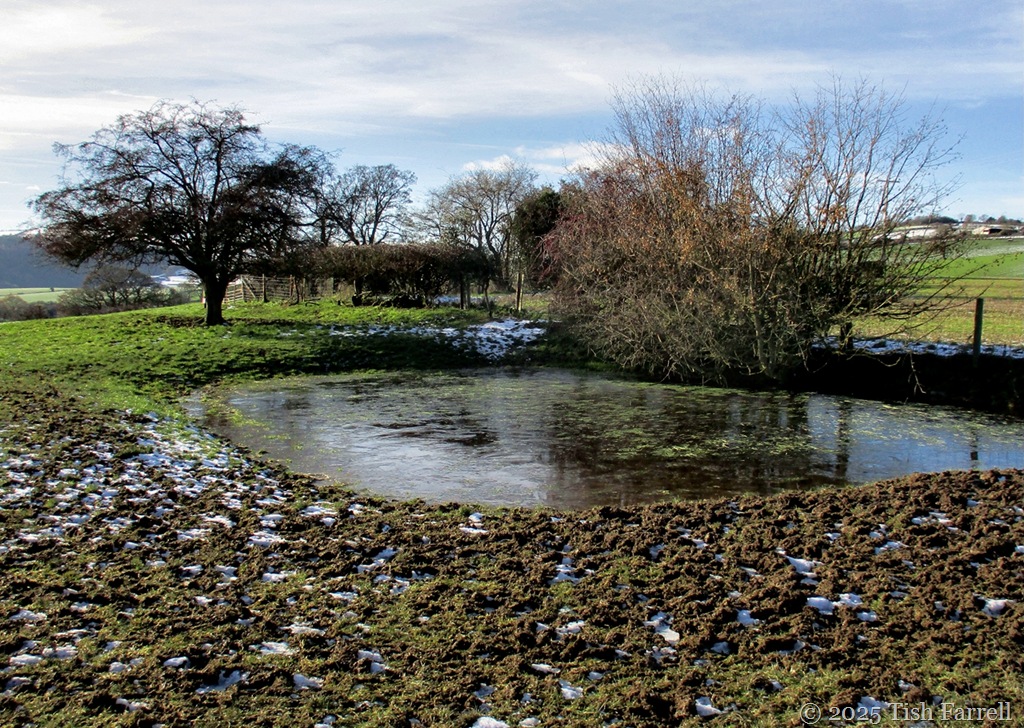
As for the dew ponds, there are three on the hilltop, one very much in use, as you can see from the well-pocked mud around it…

dewpond3

*

One dwindling in the next door arable field and so only used by wildlife…

dew pond 3

*

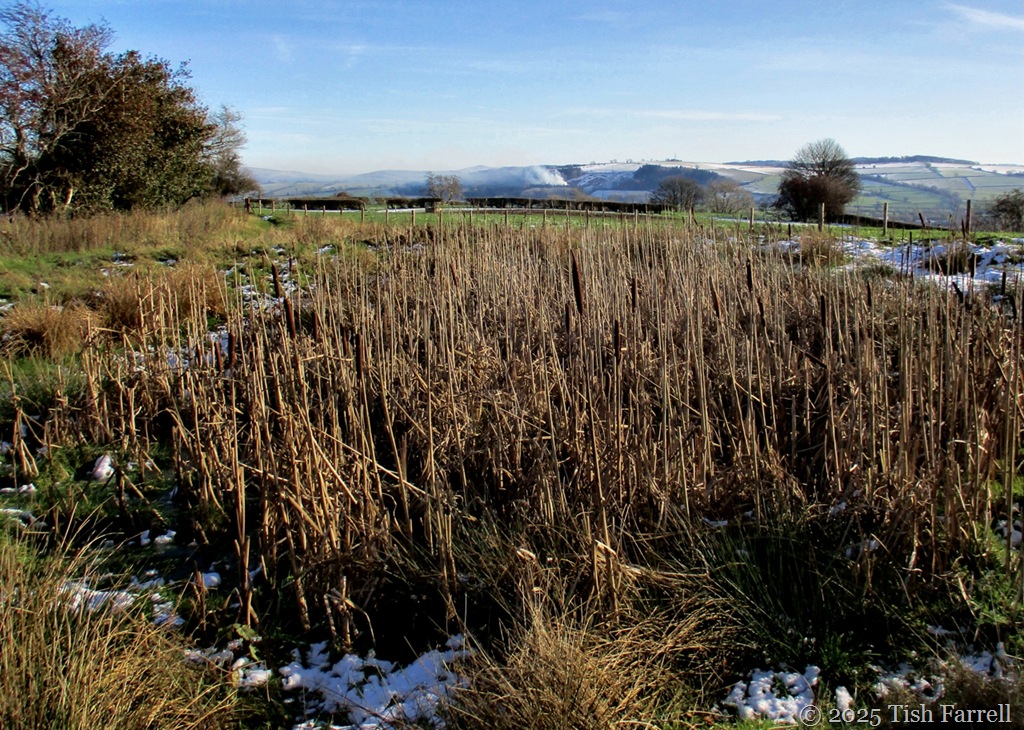
And the largest in a now enclosed enclave where it is producing a fine crop of bullrushes…

dewpond 4

I don’t know why this corner of the field has been hived off, access provided by two stout kissing gates either side of it, but the Shropshire Way footpath passes through it.

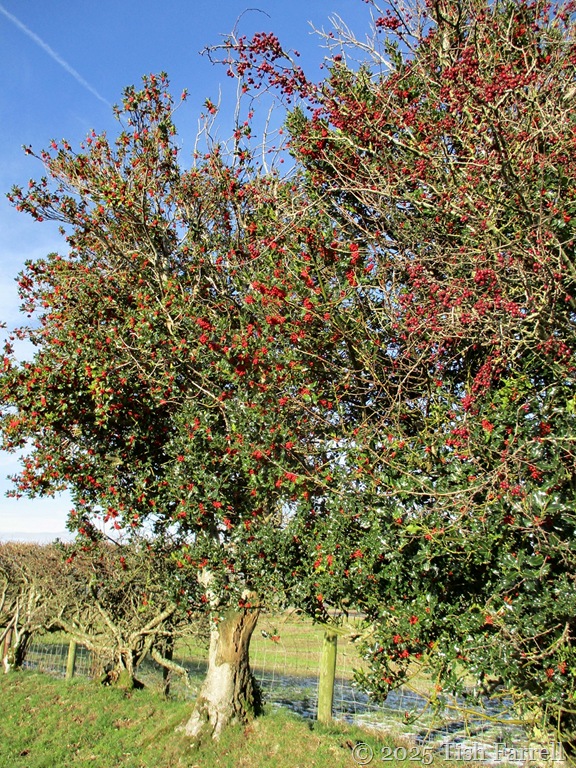
It’s a good spot for holly trees, which reminds me. Holly was once grown in farm hedges both to shelter stock and as a valuable winter fodder for sheep (and sometimes cattle) when hay was in short supply. And yes, it does seem an unlikely foodstuff with all those prickles, but apparently the leaves become less barbed as the tree grows taller. And so it was the upper branches that were lopped off for the animals to feed on, the holly trees doubtless thriving on the pollarding (if our brute of a garden holly hedge is anything to go by).

holly trees

*

Water was the other essential in hill country where streams were lacking. Dew ponds have been used at least since Neolithic times. They were also much used in mediaeval times and in the 18th-19th centuries, both periods reflecting a vibrant market for sheep wool.

Pond construction required skill and heavy labour. First a saucer shaped depression was excavated, about 3 feet (1 metre) deep. The diameter varied between 10 feet (3 metres) to 45 feet (15 metres). The whole surface was then covered with straw followed by a layer of mud which had to be puddled to seal the surface. (Canal beds were sealed in the same way, the puddling usually done by labourers in bare feet). Once sealed, rain and field run-off duly collected in the ponds.

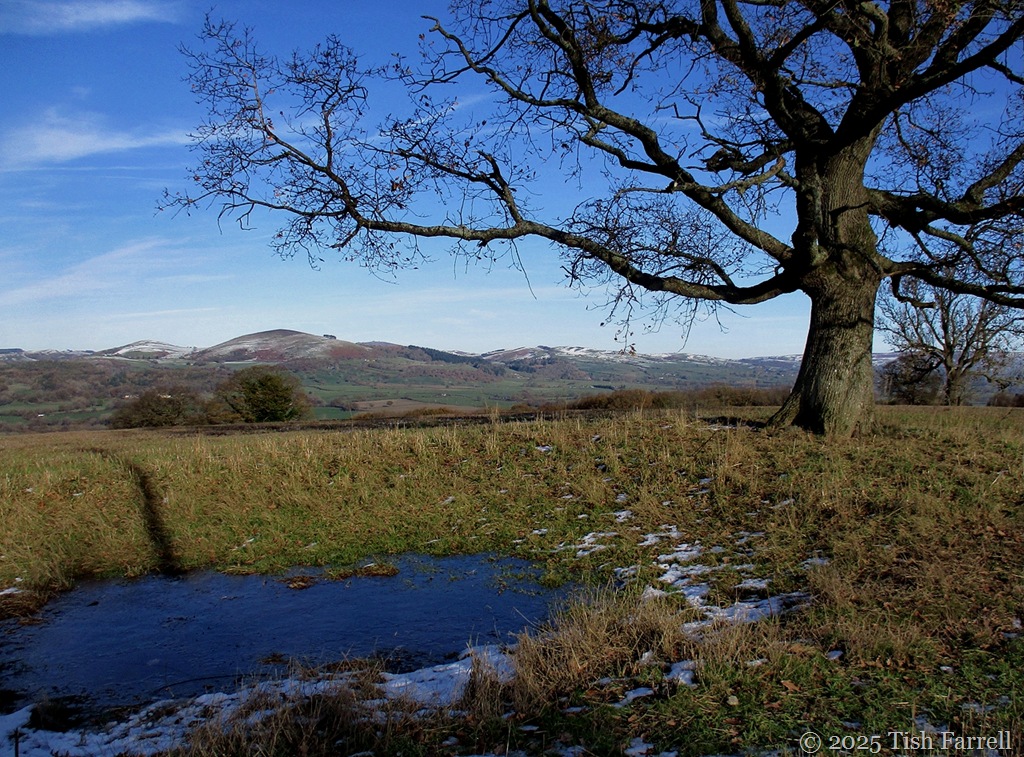
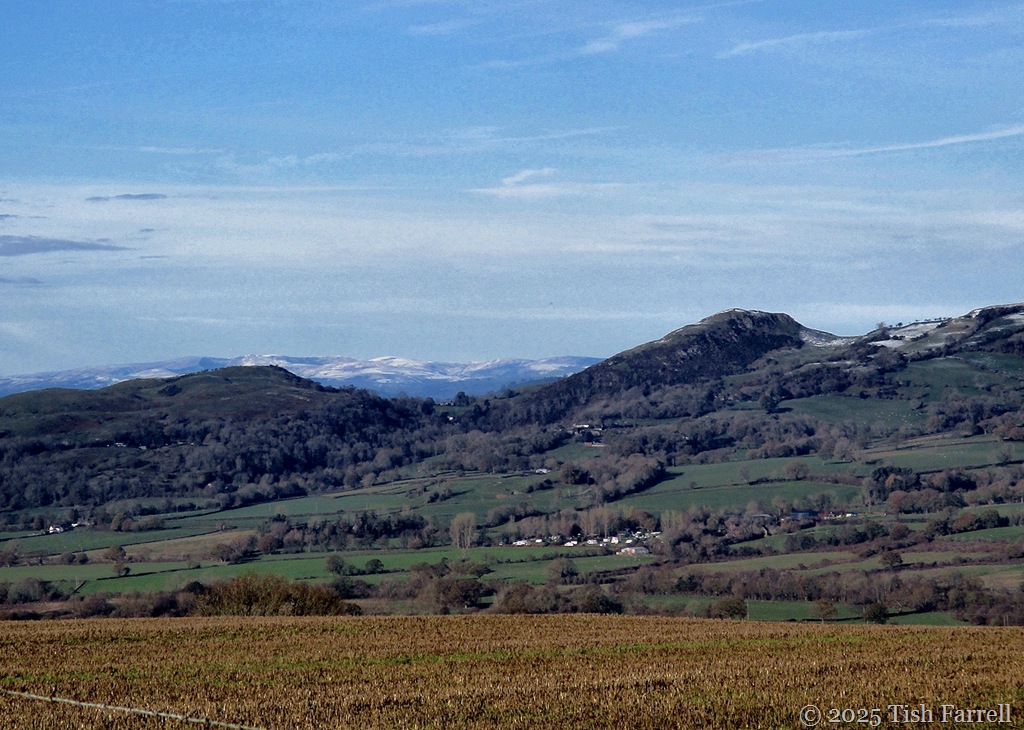
In the past, Welsh drovers would have driven their stock through Bishop’s Castle, and on to the town and city markets of the Midlands. This next photo shows the country they would have trekked through – not so tamed and tidy in the eighteenth century. (Wales ahead, dewponds behind me). Perhaps the flocks and herds were gathered and watered at points like these before the drovers broached the town.

hillview 6

*

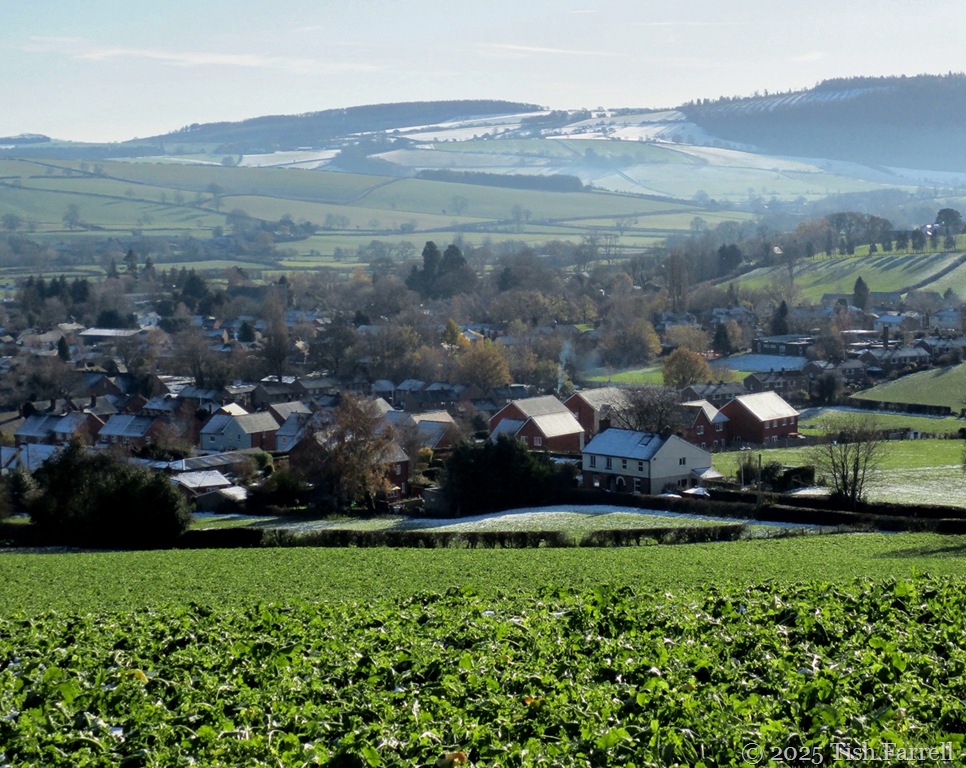
And it was at this moment that thoughts of watering holes had us turning on our heels and  heading downhill to town. Toasted sandwiches at The Castle Hotel suddenly beckoned, plus a glass of delicious Clun pale ale.

Cheers and happy festive season to all the Lens-Artists (and their followers).

Many thanks for setting us so many diverting challenges through 2025.

IMG_9497ed

*

Lens-Artists: Last chance for 2025   This week Patti sets the theme: last chance to post photos that missed previous posting opportunities.

dew pond 3 header

In Light And Shadow ~ Lakeside Reflections

Mellington Hall 9

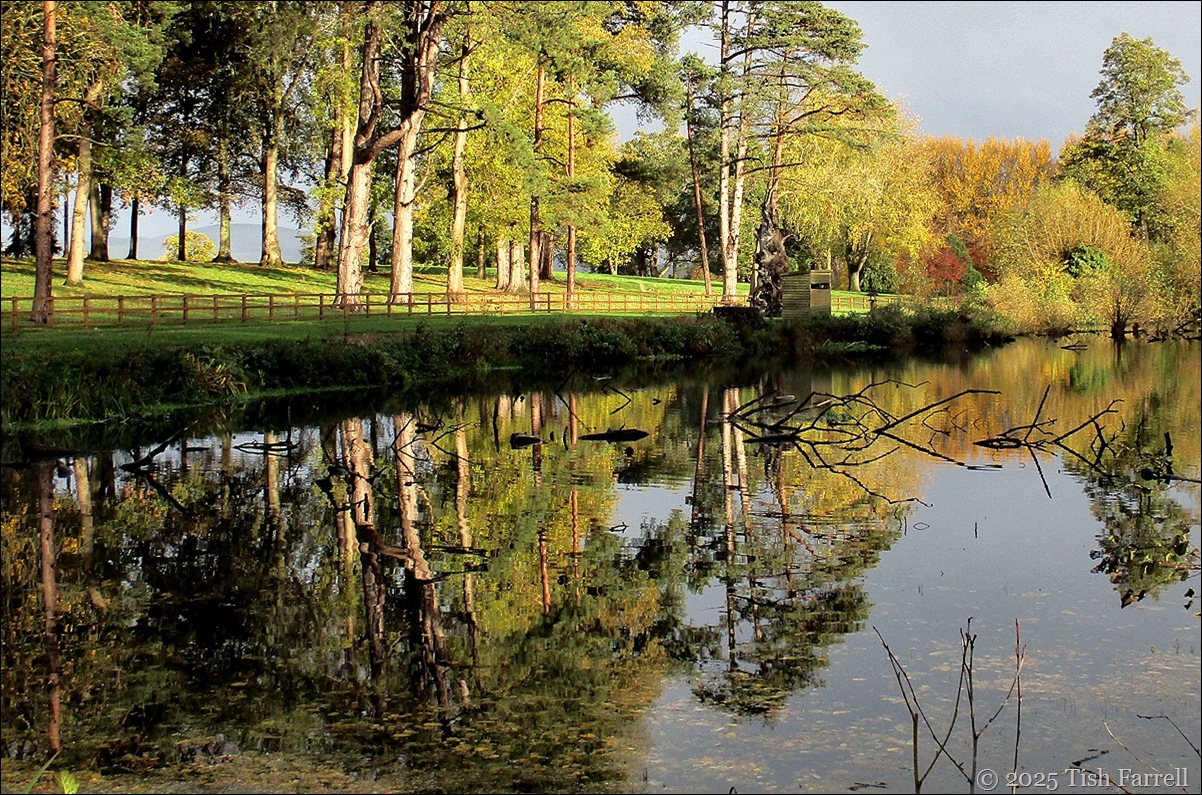
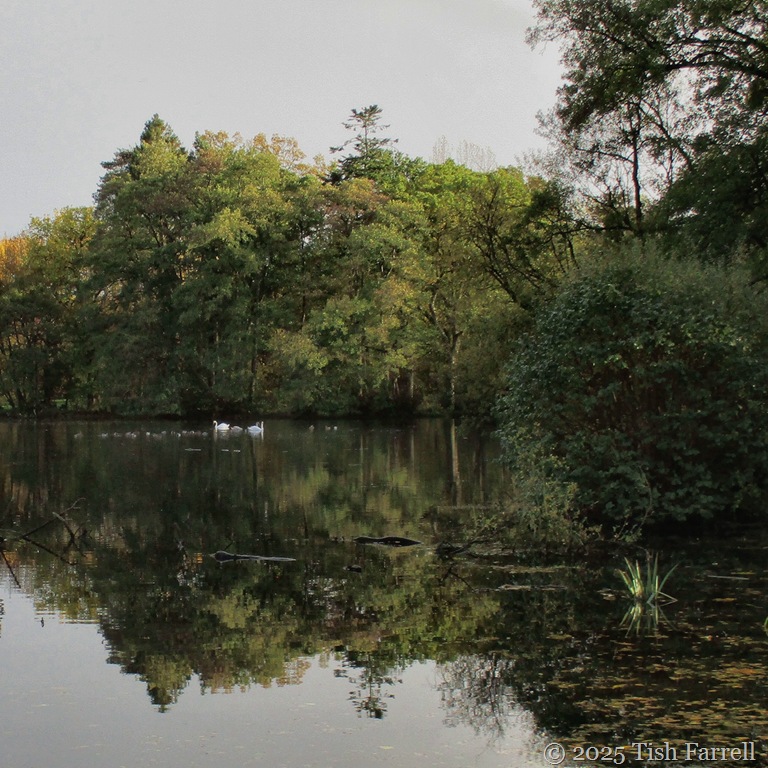
These are the last photos from our Friday day out to Mellington Hall, caught in a brief burst of sunshine. The far glimpse of two swans across the lake had magic in it – a gentle scene for All Hallows’ Eve.

Mellington Lake 11


November Shadows Day 4 Becky has the most fabulous shadows on show today. She’s flying high in a mass aerial display.


All Hallows’ Eve ~ Light And Shadow At Mellington Hall

Mellington Lake 3

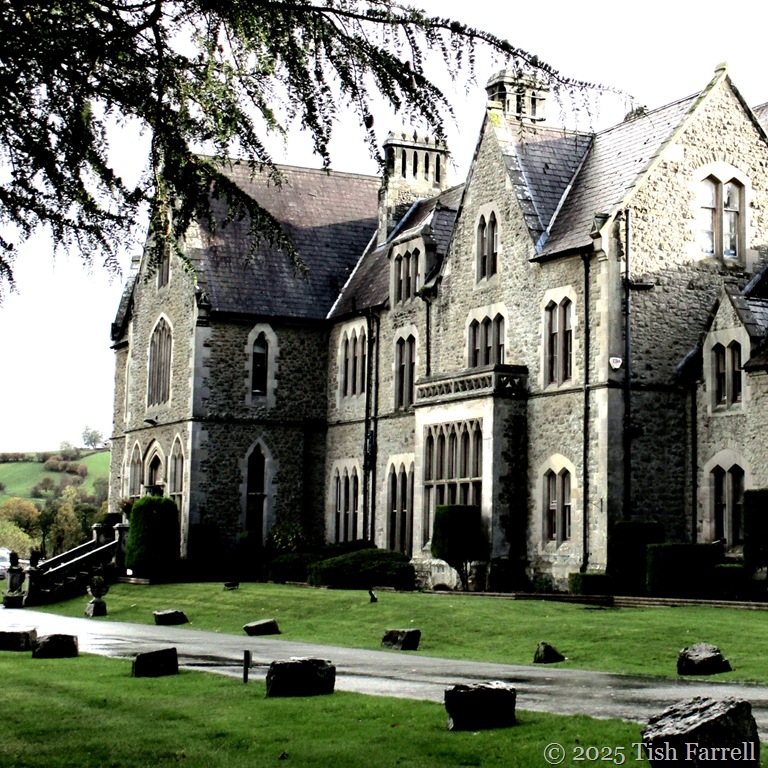
On Friday we were out for a family lunch just over the border in Wales: destination Mellington Hall. It is only a few miles from Bishop’s Castle, an impressive Gothic pile built in the 1870s by Derbyshire ironmaster, Philip Wright, and now run as a country house hotel and holiday park.

Mellington Hall 5

“Built by iron, saved by eggs and rabbits.”

This is how the current owners describe the hall’s more recent history.

They then explain how the present enterprise derives from some creative family entrepreneurship over sixty years ago:

The establishment of the Holiday Park in the 1960s and the survival of the Hall are inextricably linked: the Hall was in a terrible state when Mr Jack Evans, the grandfather of the present owner, bought the Hall and parkland in 1959.

Jack built his business on collecting rabbits, other game and eggs from the nearby farms and selling the produce to shops and markets in the Midlands. Coincidentally, Jack’s wife Margaret had been in service at the Hall as a young girl but by the 1950s the Hall was almost certainly going to be demolished.

Prompted by business contacts in the Midlands looking for a rural bolt-hole, Jack created the Holiday Park in the 1960s to generate revenue which would pay for the restoration and upkeep of the hall and thus save it from demolition.

What a project.  And the restoration work is still ongoing.

You can see some photos of the Hall in its Victorian heyday HERE.

Mellington Hall 4

The grounds were originally landscaped by Joseph Paxton, but there has been further planting of specimen trees by Jack Evans. Work also still continues in the park, including the upkeep and creation of woodland paths, one of which links to the 177 mile Offa’s Dyke path, constructed along the England-Wales border in the late 700s CE by the Saxon king of Mercia.

Mellinton 7

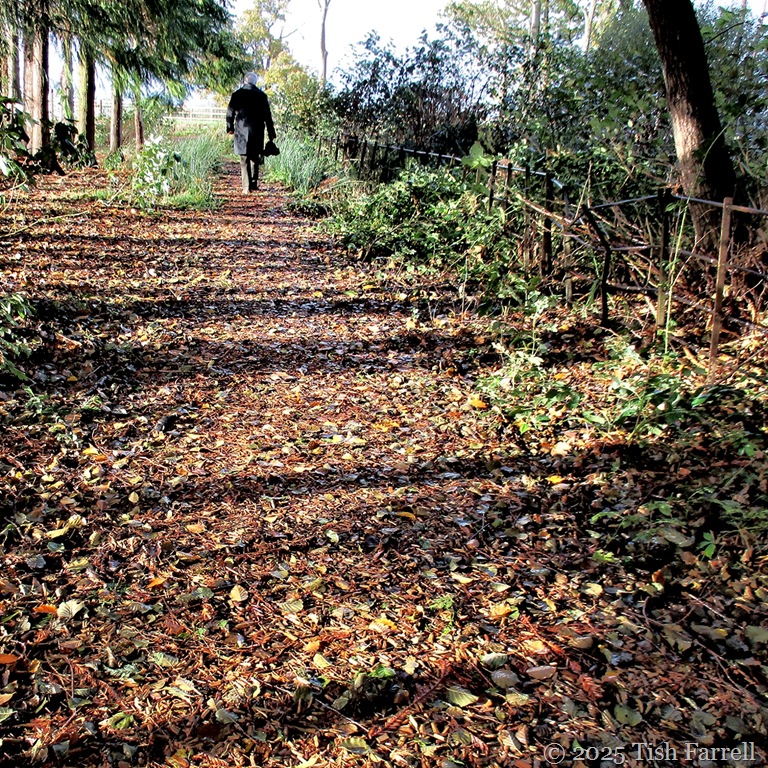
Friday, though, was not a day for big walks, or even short ones. Too many fierce squalls to contend with. But between two showers, and armed with brollies, we did manage a brief stroll to lake where a sudden burst of sunlight yielded the header photo.

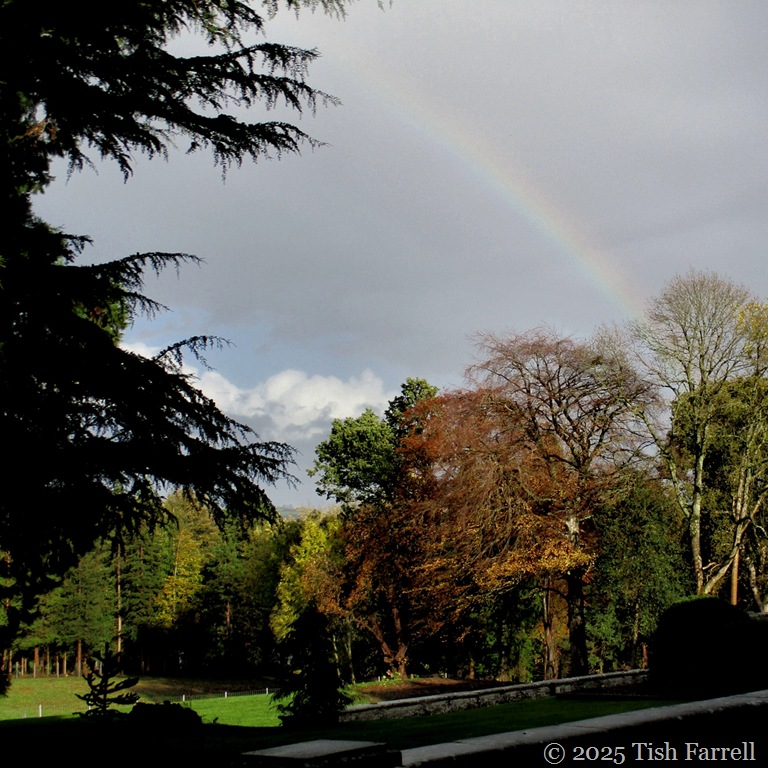
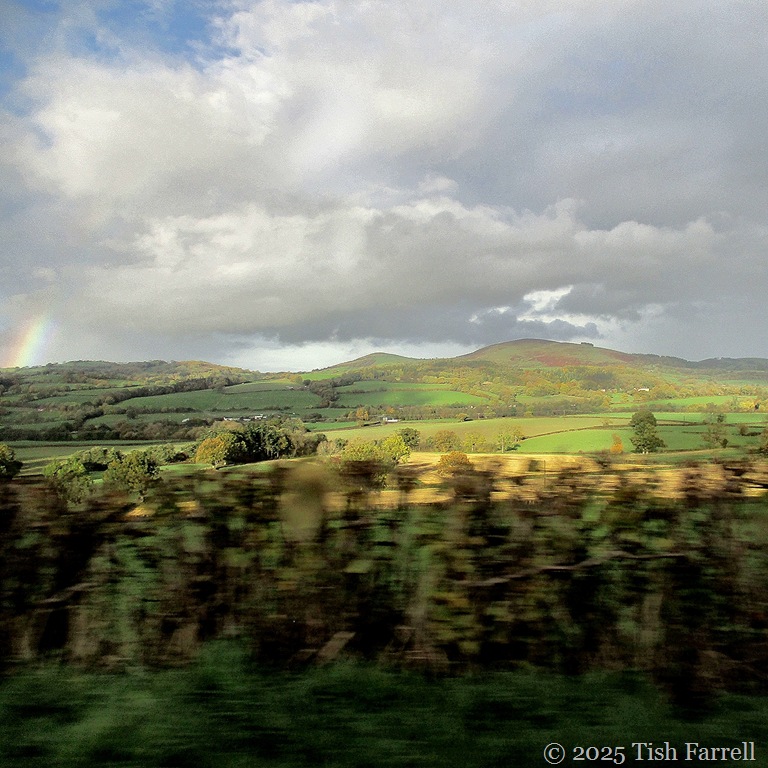
On the drive home, sun and rain together created a huge double rainbow over the Camlad Valley, casting brilliant prisms across the foothills of Todleth, Roundton and Corndon Hills, but not quite caught here as we sped along.

Mellington Hall 6

*

November Shadows  This month Becky invites us to post square-format photos on a shadowy theme, however we care to interpret it. You can join in as and when.


As We Walked Out One August Evening

IMG_8622ed

So why don’t we have supper with the elephant? says I. We can take a picnic.

It was Sunday evening, and he-who-builds-sheds had been toiling all day on a new construction. (We call it ‘the car port’, but it’s not for the car.) The response was not altogether encouraging. I knew he was thinking of the hill climb in the heat. I thought of it too, but the notional destination outweighed resistance. I packed a couple of small cool bags with spicy cooked chicken, bulgar wheat salad, apples and some elderflower kombucha.
We set off a little after six. The sun beamed hotly. (What a summer we’ve had).

The walk I had in mind is a climb of two parts, the first being the short sharp yomp up our street to the top of the town. This haul can be alleviated half way up from our house by deviating into Laburnum Alley, a shady ginnel of ancient walls and overhanging greenery, that wends more gently around garden perimeters, and brings you, breathing easily, into Welsh Street.

Next there’s an even stretch along the road around the Wintles mini eco-village before we head into the shade of this settlement’s privately owned (but freely accessible) woodland enclave of vineyard, allotments, and bosky meanderings. The Shropshire Way also bisects it. We pass through the gate into the field behind the gardens, and start the main climb. We’re headed towards Wales now, the Long Mynd our right.

The field behind the Wintles woodland still looks remarkably green, this despite the months of drought. But above us, the fields are pale ochre, shorn of pasture or wheat, the hedgerows tousled, fringed with dead grasses and thistles bursting with down.

IMG_8613 ed

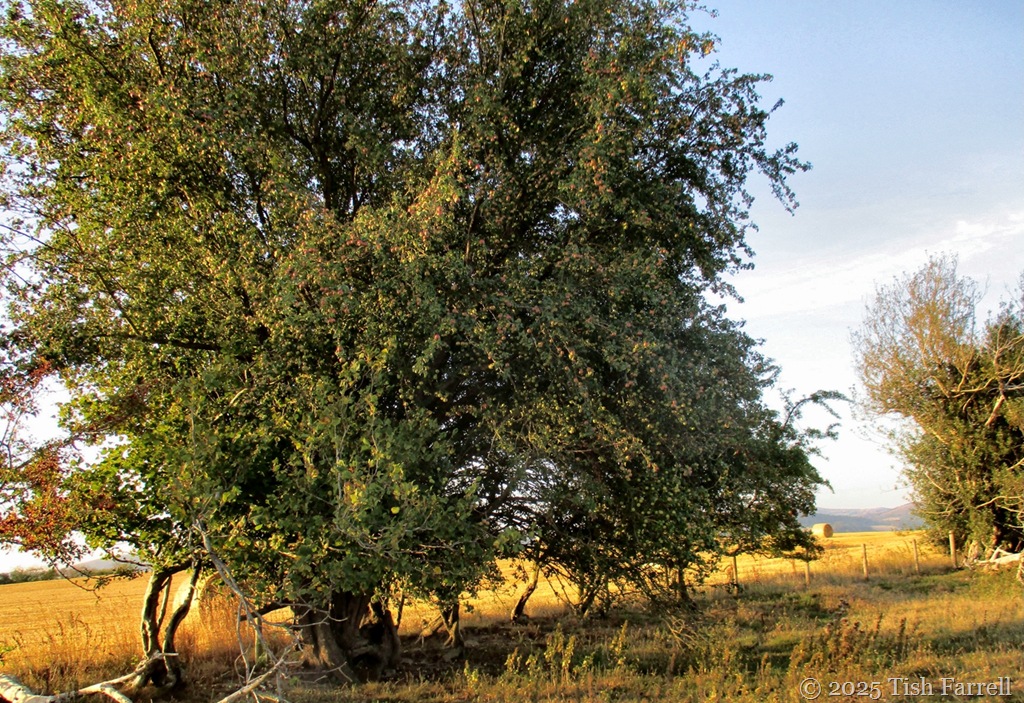
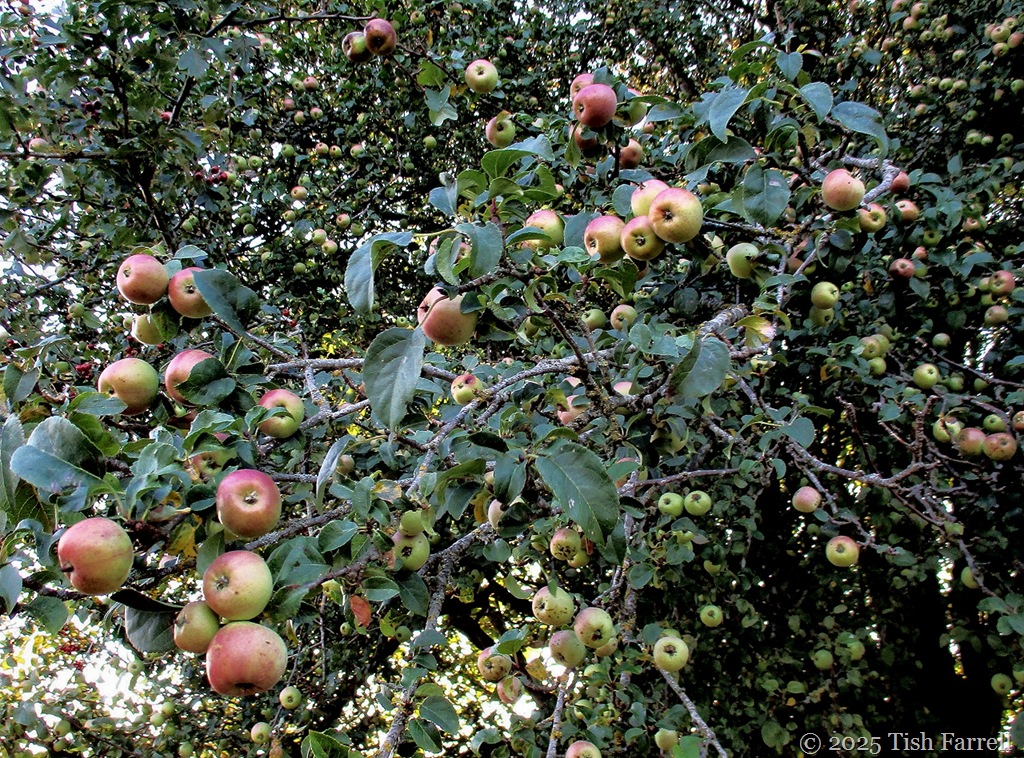
The few sheep we pass seem happy enough, and we begin to see that not everything has suffered from the lack of rain. The red clouds of the berry-laden hawthorns are astonishing, so copious is this year’s crop. The elders, too, are weighed down with ripe black berries, and later we see bushes of fat blue sloes (think passingly of making sloe gin), and then come upon a crab apple tree so crammed with fruit it is almost too good to be true. Excitement mounts. Crab apple jelly will definitely happen – if not yet, then very soon, and feasibly in quantities for all of Bishop’s Castle.

But first the picnic. We follow the footpath markers through two gates and into the trees below Foxholes Campsite. There’s a good view of the Longmynd now…

Longmynd

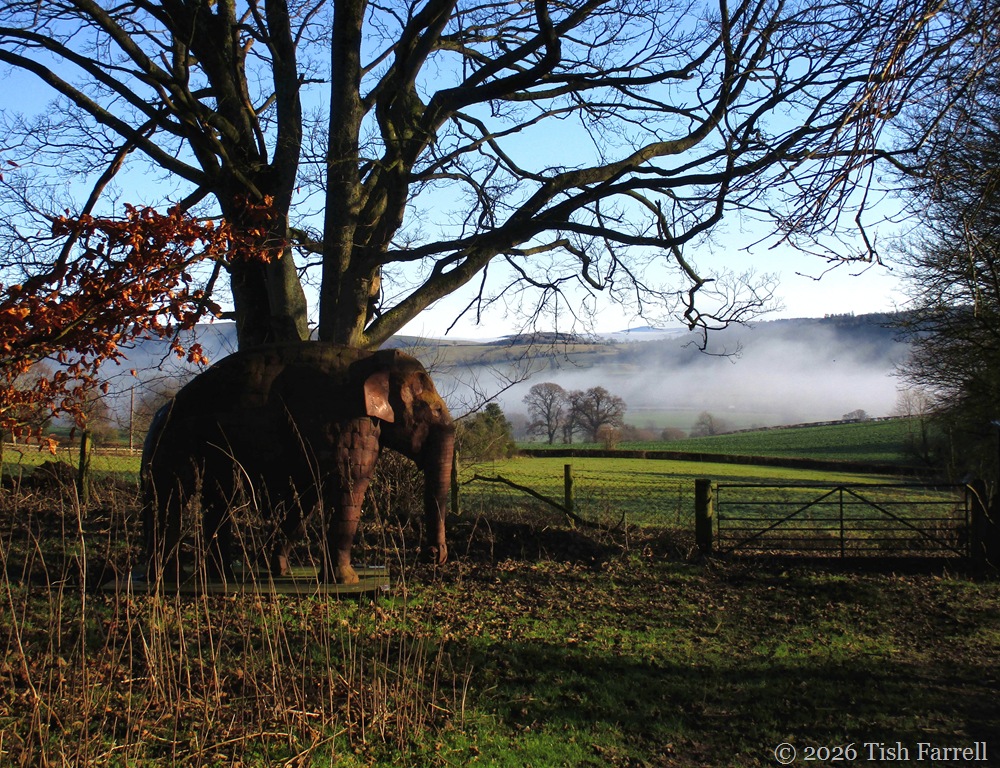
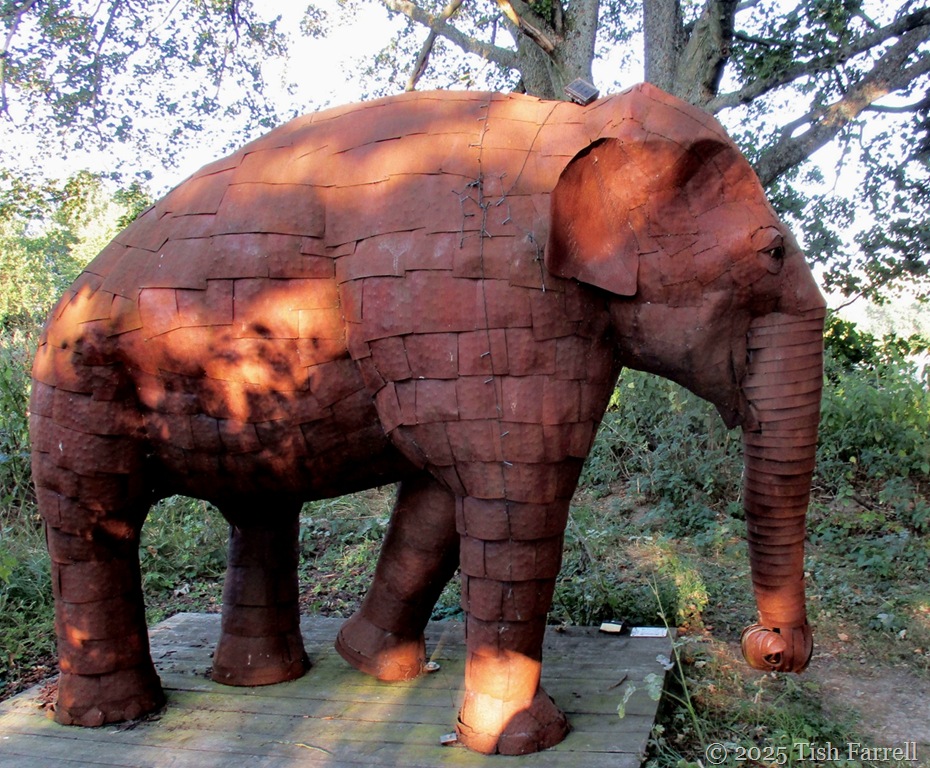
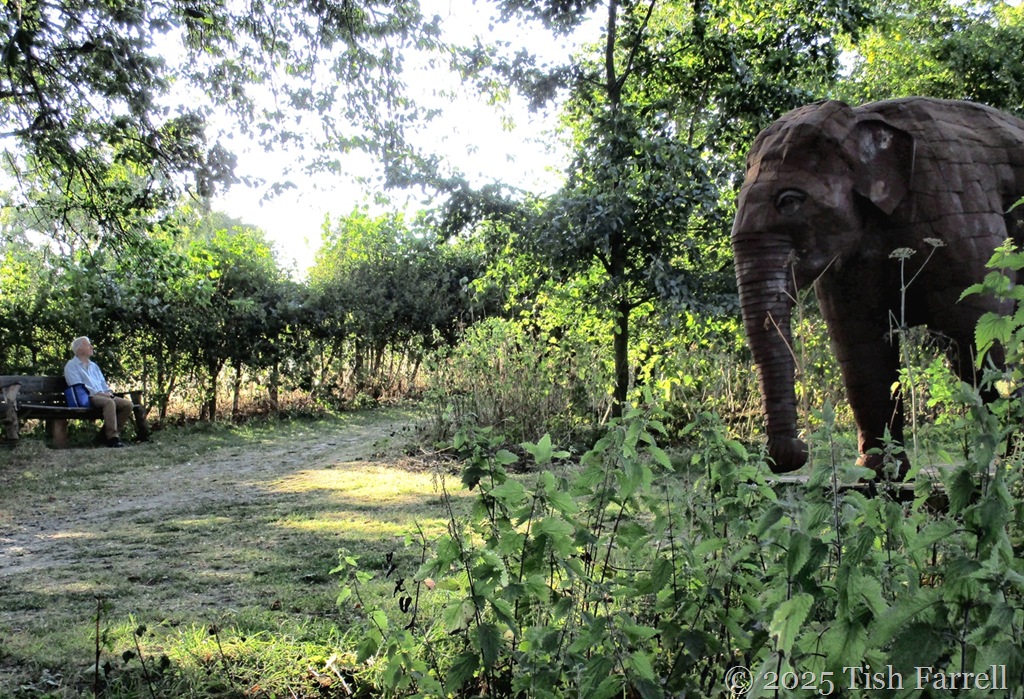
…and there is also an elephant…an Asian elephant…

elephant 2

*

Some of you will have seen this before, and I’m sorry to say that I’ve still not tracked down who made her or why she is here in this particular spot.

*

IMG_8627ed

But here, then, was the envisioned picnic spot.

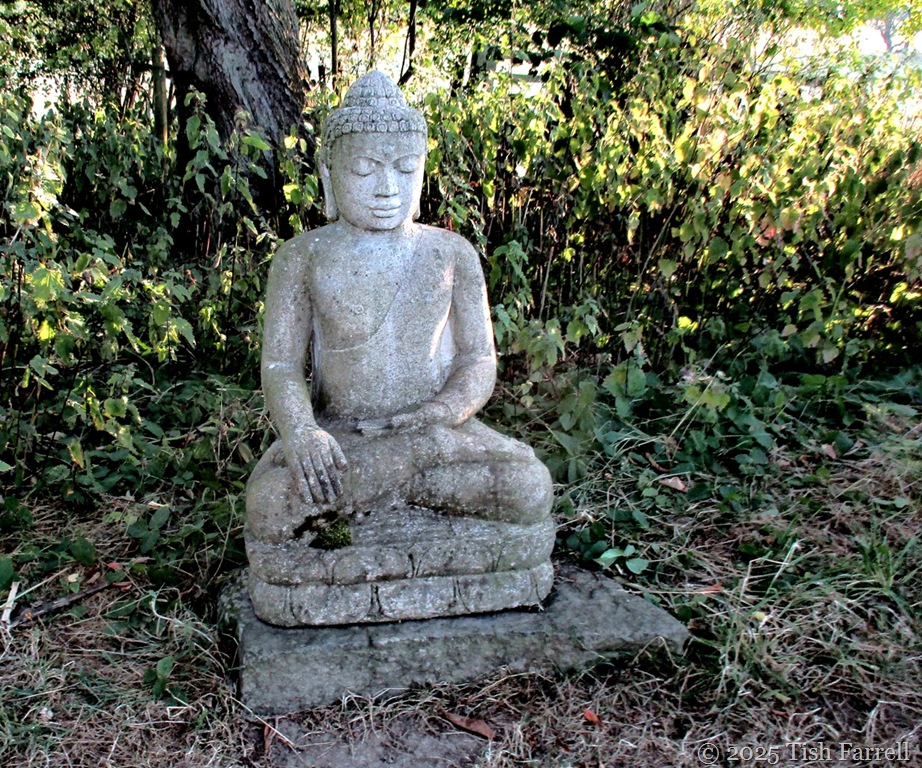
We ate our supper, sitting on a fine seat commemorating a lost love, greeting camping folk as they passed by, listening to the breeze in the trees. The elephant did not have much to say. Nor did Buddha who was sitting near us:

Buddha

Just some quiet communing.

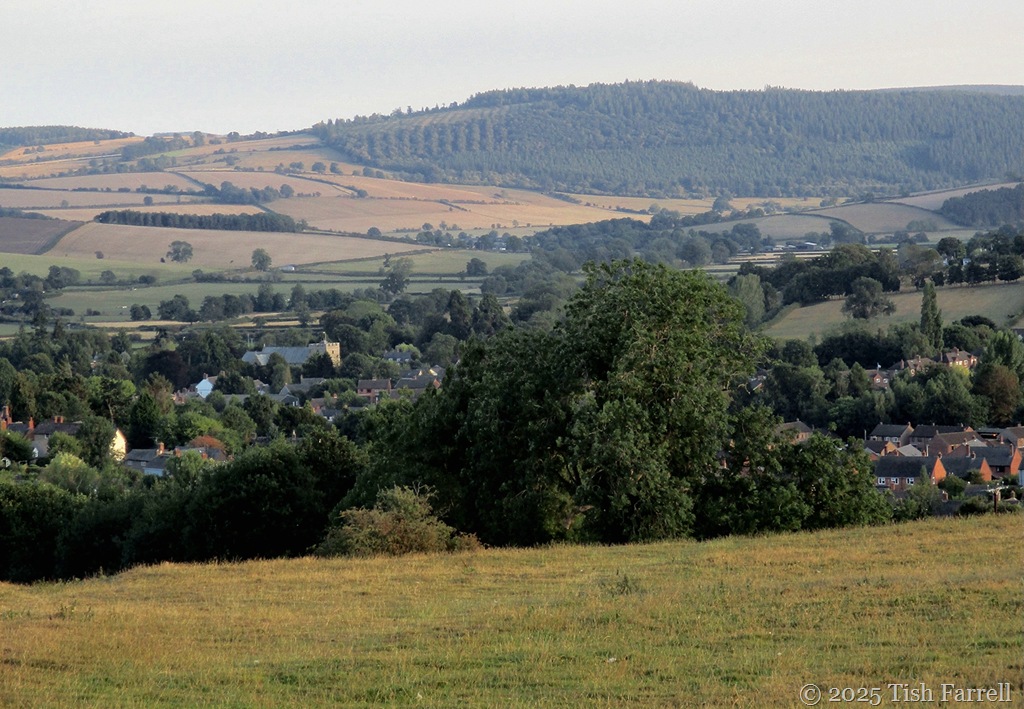
Once we’d eaten, I thought I could risk suggesting a little more climbing. This time to the top of the hill to see the views towards Montgomery.

It was here we found the crab apple tree.

crab apple and haw accessories

crab apple tree

*

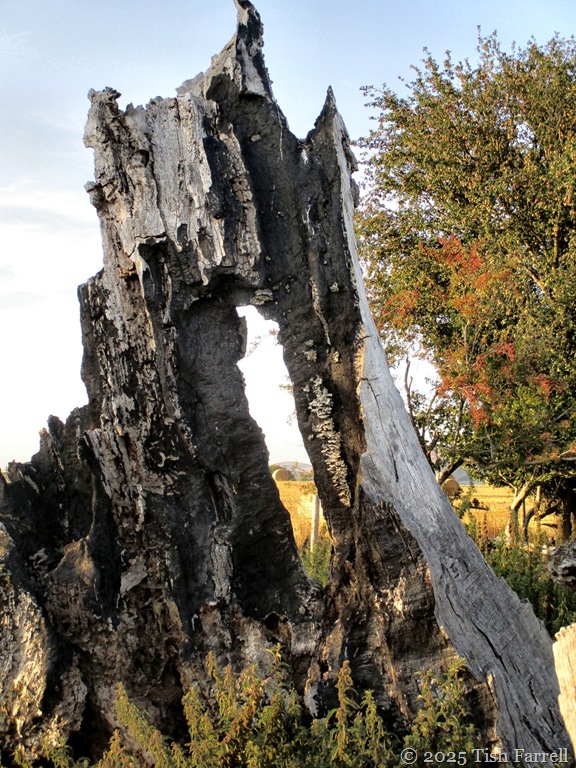
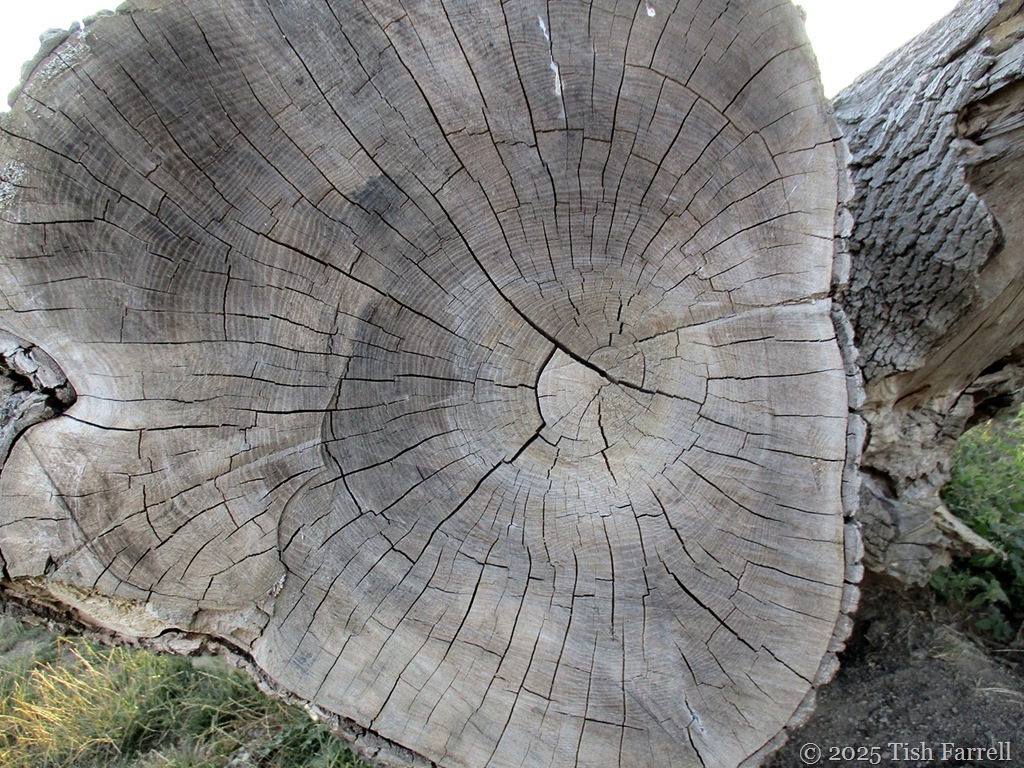
And next to it a fallen giant with its own elephantine qualities. It looks to have been struck by lightning many moons ago:

tree window

tree rings

*

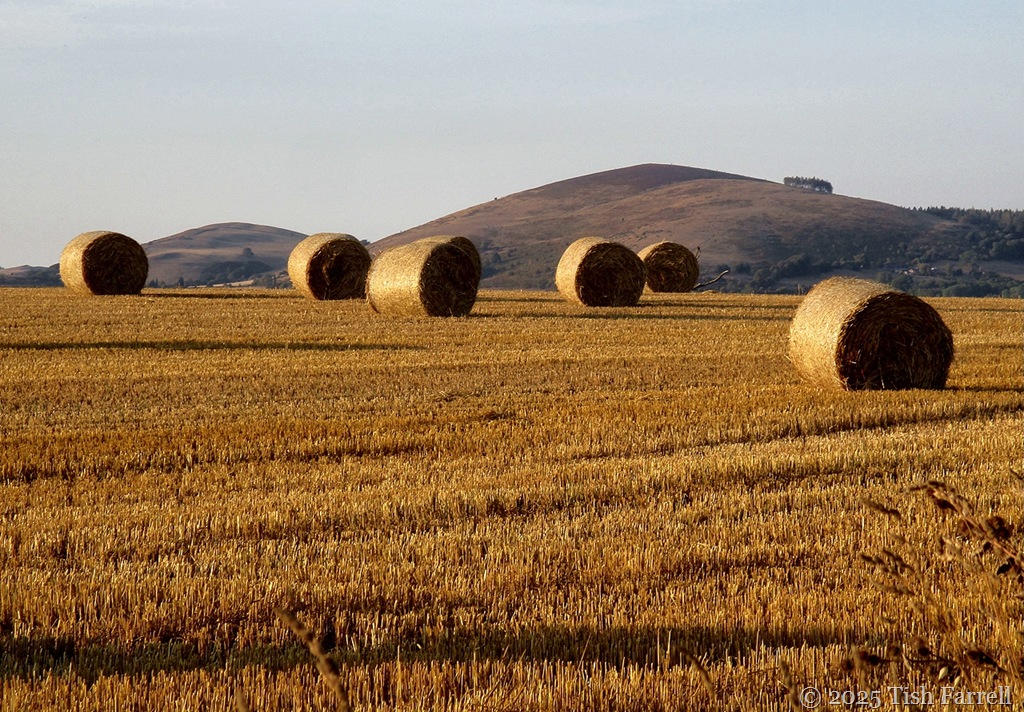
And beyond it the wheat field, the crop harvested and the straw bound in roundels, which for some reason are always appealing:

stubble

*

Then it was time to turn for home, slithering down the hill on sun baked ground…IMG_8666ed

*

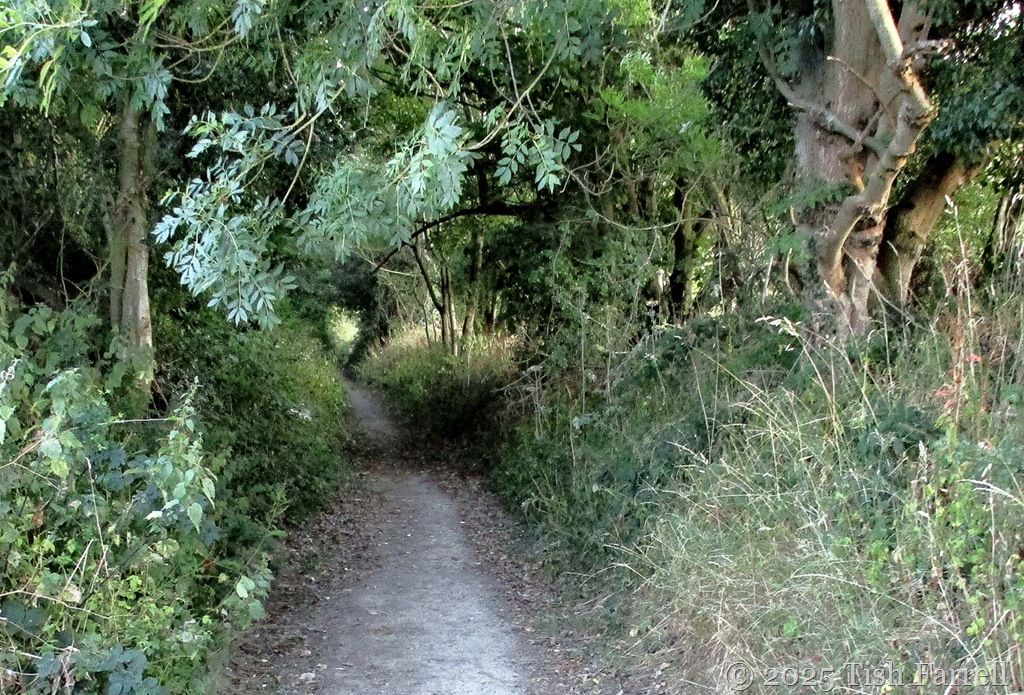
…and on down the hollow way, back to the Wintles.

hollow way

*

We should do this more often, we said when we arrived back at the Gables.

copyright 2025 Tish Farrell

After The Harvest: Of Stubble And Straw

BC lines

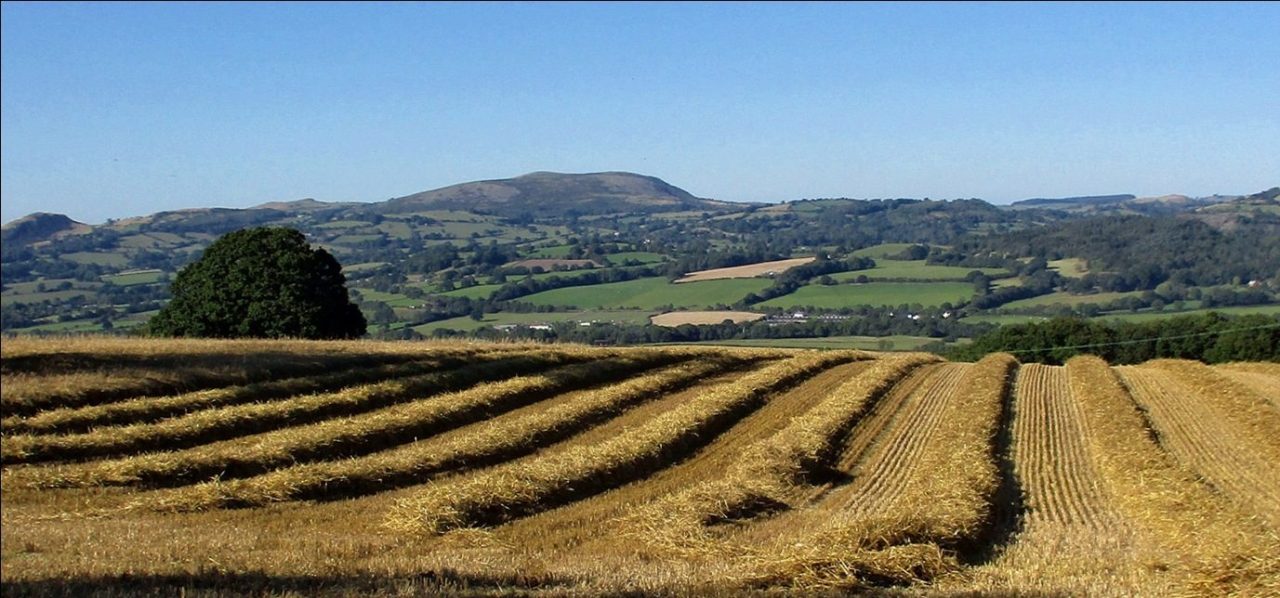
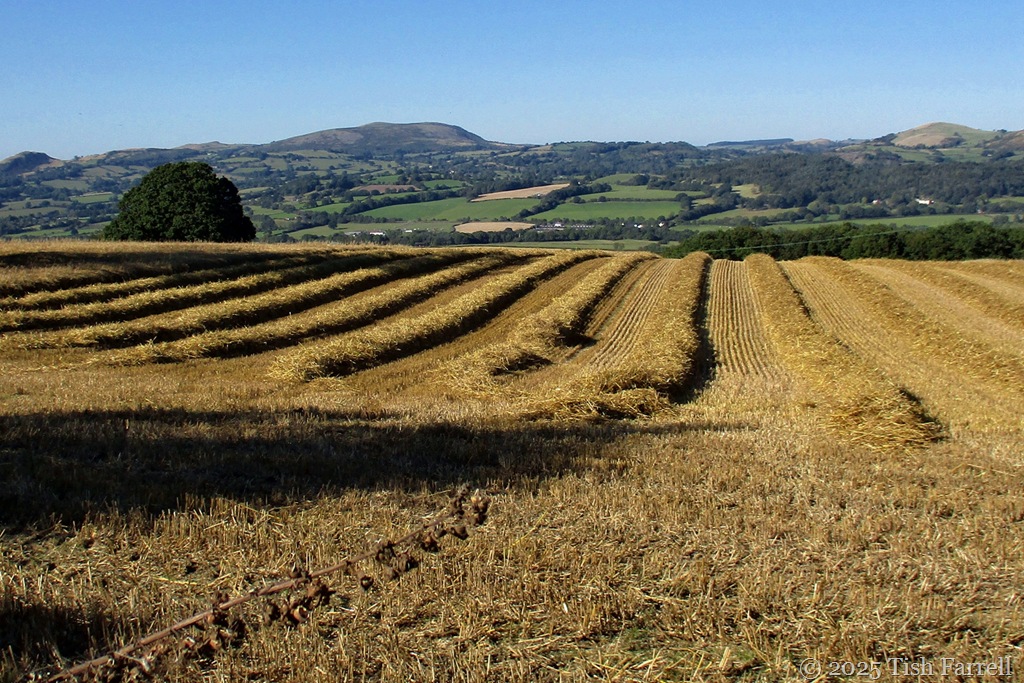
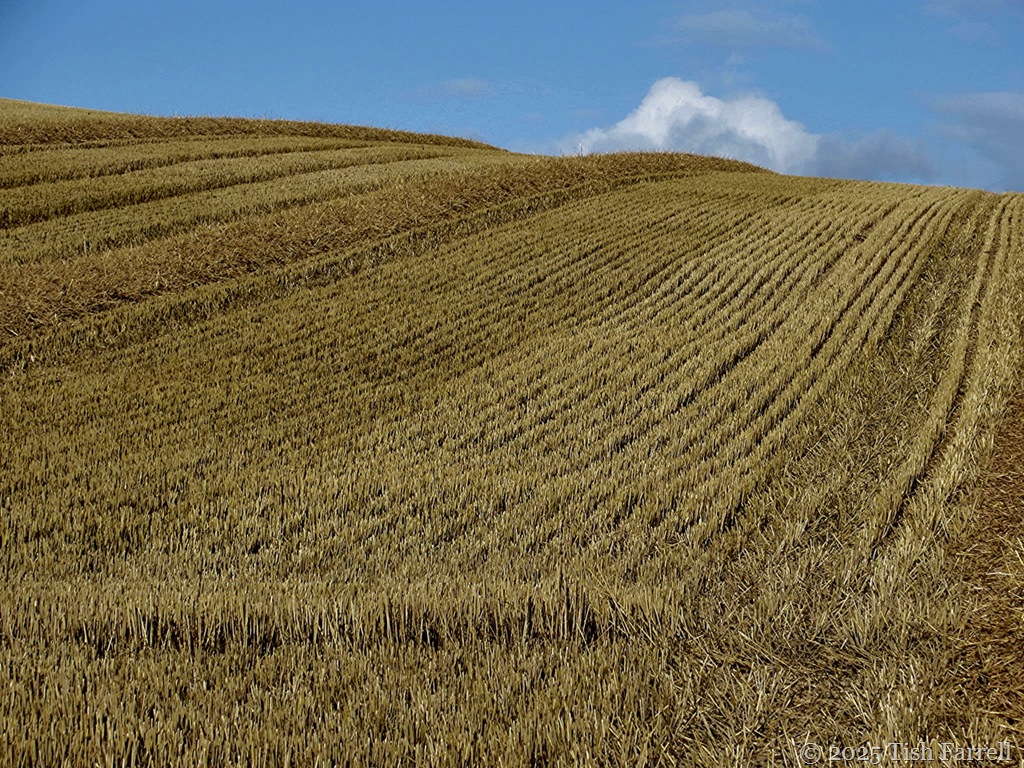
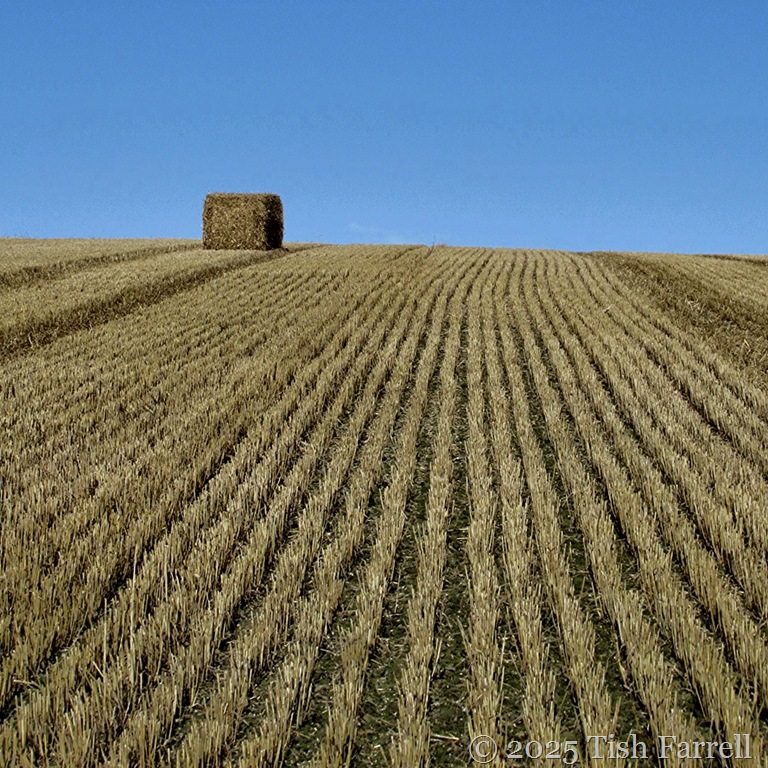
Come August and this year’s harvest has already been and gone. A good month earlier than usual. And somehow we missed it, we who live in the midst of rural Shropshire. In fact, when we drove out of Bishop’s Castle last Saturday, it was quite a shock: wherever you looked the wheat and barley fields lay shorn, the straw baled, or rolled in roundels, the remnant stubble pale and parched. Fields stripped.

How could we have missed so much activity and industry. Did we not hear the combines’ drone?

Along the lanes, too, the hedgerows had that dull and dusty out-grown look of late September. Dock and hogweed gone to seed: russet and deep umber shades of autumn. And again: how could this be? Had we been asleep, Rip-Van-Winkel-like, and lost a chunk of summer? Or had time skipped a month or two?

No. Simply distraction on the home front, gardening and household pursuits. Letting the world pass us by through weeks of day-on-day sun and rainlessness, which of course is the reason why the harvest was so early.

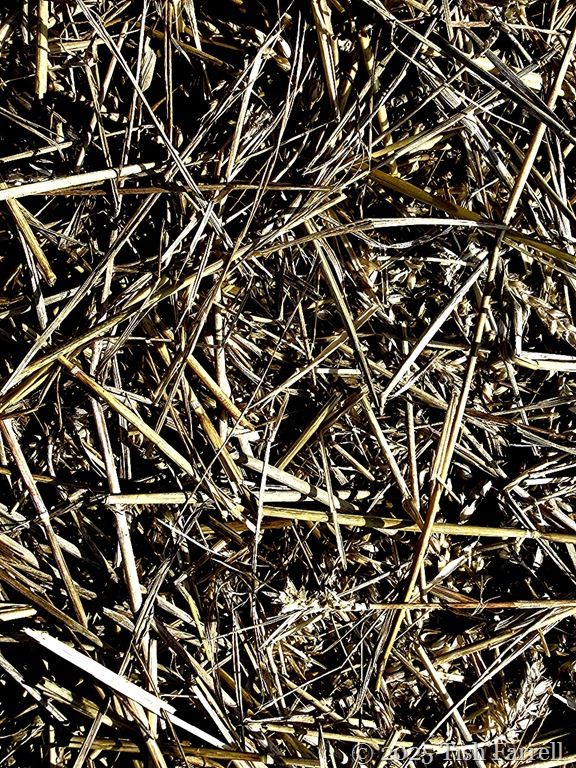
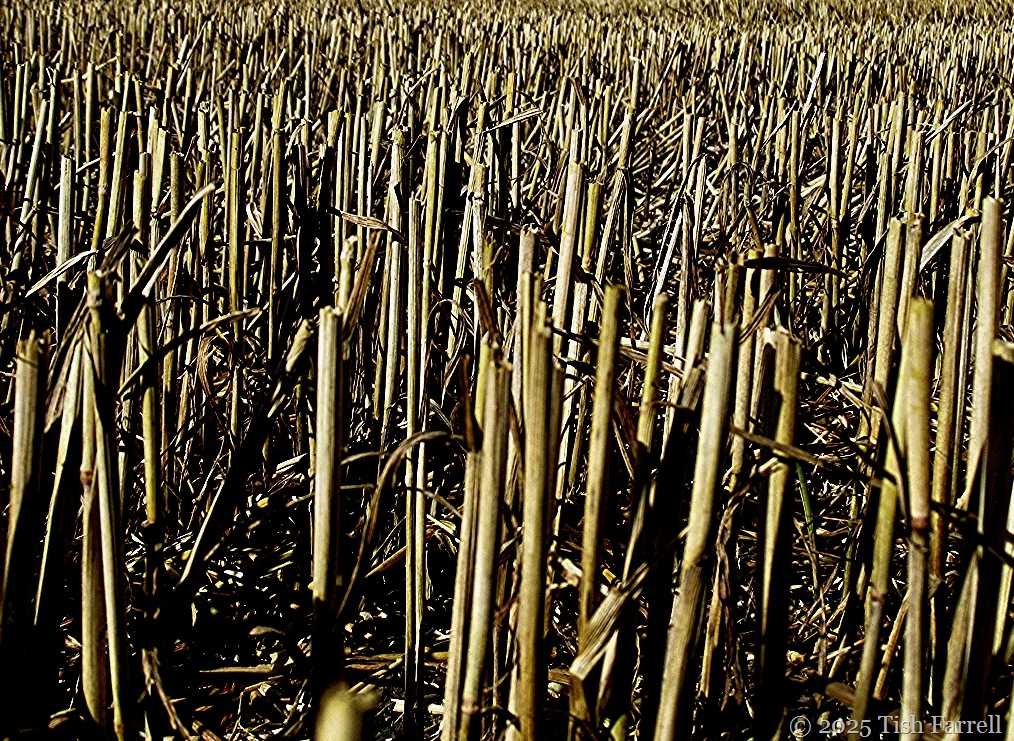
But now it has me reflecting on the beguiling looks of stubble fields, and thus a posting of photos of harvests past, of pared down textures, bare lines and simple colour palette of monocrop farming. I find myself attracted to the spareness of these humanscapes, although wary, too, of the high high-techery that produces such results. This is not the kind of farming I grew up with, the cut wheat stacked in stooks to dry, the arrival of the threshing machine, a monstrous sight over our garden wall, the contraption that, hung in sacking shrouds, throbbed and shuddered, spewing out clouds of chaff as it garnered precious grains from stalks and husks.

Hey-ho. More time slippage.

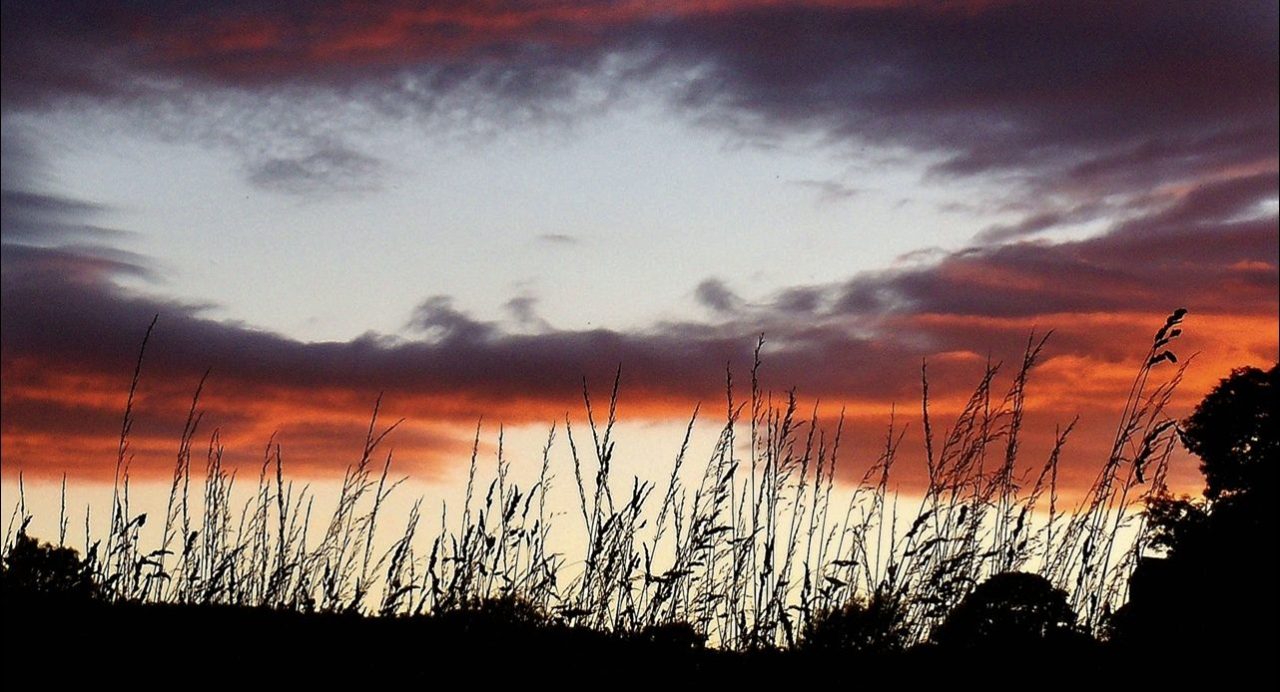
[The header and final photos were taken mid-September last year above Bishop’s Castle. The in-between shots are from Townsend Meadow, below Wenlock Edge]

lines 3

IMG_3993ed

lines stubble

lines 2

IMG_6231ed

Lens-Artists: Lines, colours, patterns  Johnbo asks us to explore these tools of photo composition.

Serenity ~ Inside And Out

P1060459 - serenity

There are vistas that manifest serenity – at least as seen through human eyes. (I mean who knows what fervid biological imperatives are playing out beneath the calm surfaces of things).

This distant view of the Great Orme from Anglesey was shot on a late December day, the air so still there is barely the hint of a tide. No clouds either, and the sun warm enough to go coatless and believe the seasons have fast-forwarded to June.

*

Another ‘still waters’ scene. An end-of-summer sunset in Kalamata. I watch a naked man wade into the rose-tinted shallows of the Messenian Gulf, talking on his cell phone.

serenity

*

And a third sea-serenity scene: another December, this time long ago, a tropic summer afternoon on the Manda Strait; Lamu, dhow captain Mzee Lali dreams.

Scan-140801-0001serenity

*

Then there are things that induce a sense of serenity in me. This unruffled cloud for instance…

IMG_6932

*

The close-up view of hawthorn blossom and the scent of lilac…

IMG_7582

*

The gentle fragrance of bean flowers and pleasing thoughts of beans to come…

IMG_7640

*

And the all embracing company of trees…

100_5864ed

*

…whatever the season…

P1050998ed

P1030637

Lens-Artists: Serenity  This week Egidio at Through Brazilian Eyes sets the theme. Please pay him a visit.

Cinematically Cornish

P1080012cheesewring Bodmin

This week at Lens-Artists Sofia calls for a cinematic approach to our photography.

This is what she says:

“There are a few things that give a photo that cinematic feel: camera angles, bold and high-contrast colours, light, locations, just to name a few. The main objective is to take a shot that is part of a story, there’s mood and a sense of location; our image is but a snapshot of a much wider situation.”

The first four photos here were taken one bleak spring day on the edge of Bodmin Moor near Minions in Cornwall. This, Great Britain’s most south-westerly county is a land of dramatic vistas: of high moors and rugged shore-lines. There are stories everywhere, layered through time like the ‘pillows’ of this granite tor, known locally as the Cheesewring.

The tor has its own stories of course. The first is one of weathering over millions of years, wind and rain driving into its crevices. Then there is the Dark Ages tale, from the post-Roman times when Christian missionaries  were beginning to make their presence felt. The proponents of new faith were not always welcomed, and so the formation of the Cheesewring is explained as the result a quoit-throwing contest between Uther the giant and a saintly missionary named Tue. If Uther won, then the Christian must go. Th giant lost of course.

The Cheesewring name itself has different derivations – either a straining device for making cheese, or else relating to cider brewing wherein the press of apples to a pulp is referred to as cheese.

There also some mystical notions, for it’s said that if you come to the Cheesewring as day dawns you will see the top ring turn three times. Which makes me wonder if that crow might have something to say on the matter.

*

Below the Cheesewring we step back into the remnants of a prehistoric landscape: three Neolithic stone circles called the Hurlers. But as to that figure apparently hovering on the horizon – who knows what time stratum he belongs to.

P1070982ed

P1080022ed

Looking through the Neolithic circle we come to another narrative: one belonging to the 1850s – 1890s when the South Phoenix Mine was churning out train loads of copper, a time when over 3,000 people were employed here – women and children included.

P1070983ed

There is more about these stories at an earlier post: ‘Hurlers and Miners: 6,000 years of heritage on Bodmin Moor’ HERE.

*

Cornwall does have its own cinematic history. Several Cornish based novels by Daphne du Maurier have made it to the big screen, some in duplicate versions – Rebecca, Frenchman’s Creek, Jamaica Inn, My Cousin Rachel. Her deeply disturbing short story,The Birds, is also set in Cornwall, although Hitchcock chose to transpose it to San Francisco. Du Maurier’s works are usually classed as romances, but they also have dark undercurrents, sometimes touching on the paranormal, their settings the wilds of Bodmin Moor, brooding mansions, sheer-drop sea cliffs, rocky coves and crashing surf.

So here are some more Cornish photos, taken one gloomy December, and with a little nod to Daphne du Maurier’s sensibilities.

P1020701ed

*

P1020927 ed

*

P1020611ed

Lens-Artists: Cinematic This week Sofia at Photographias sets the theme.

Weather’s Untamed Ways…

IMG_6969 ed

…from heavenly ethereal to eerily supernatural:

IMG_7161ed

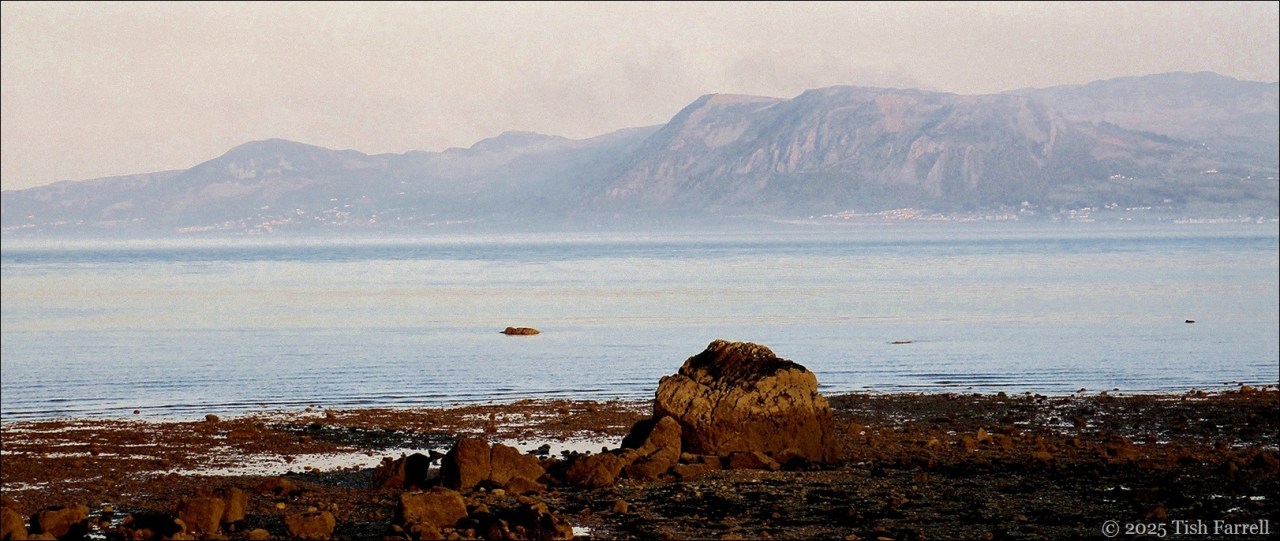
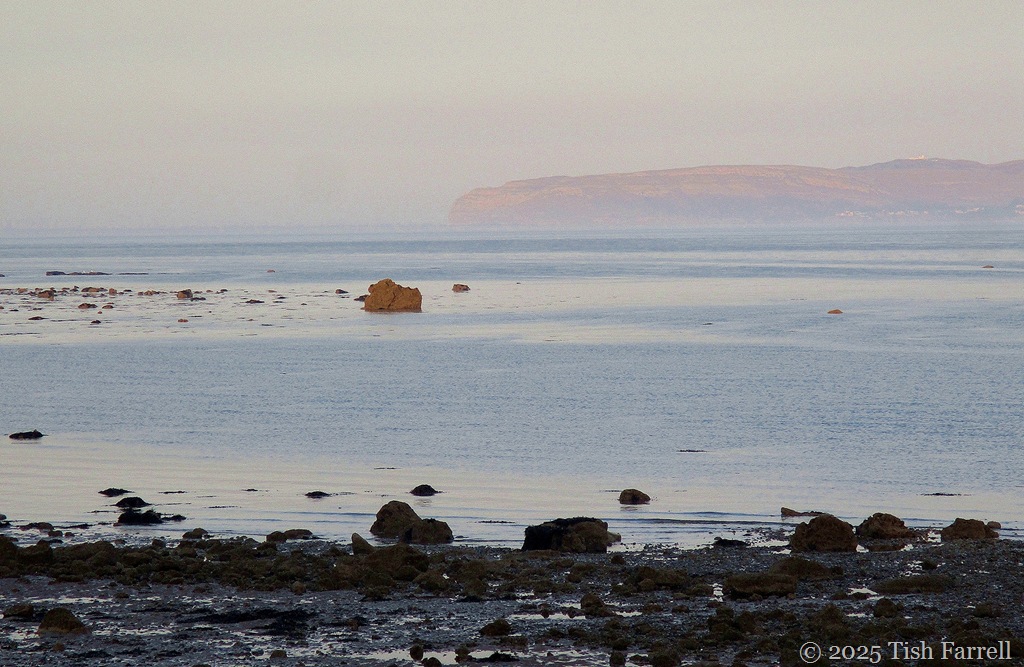
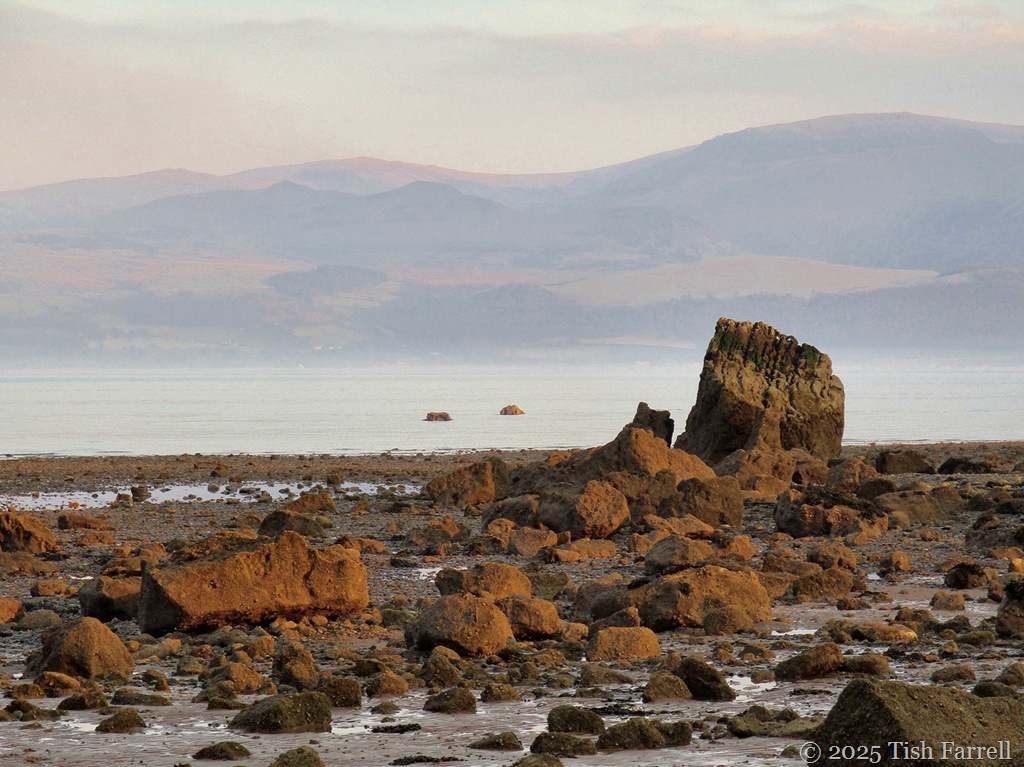
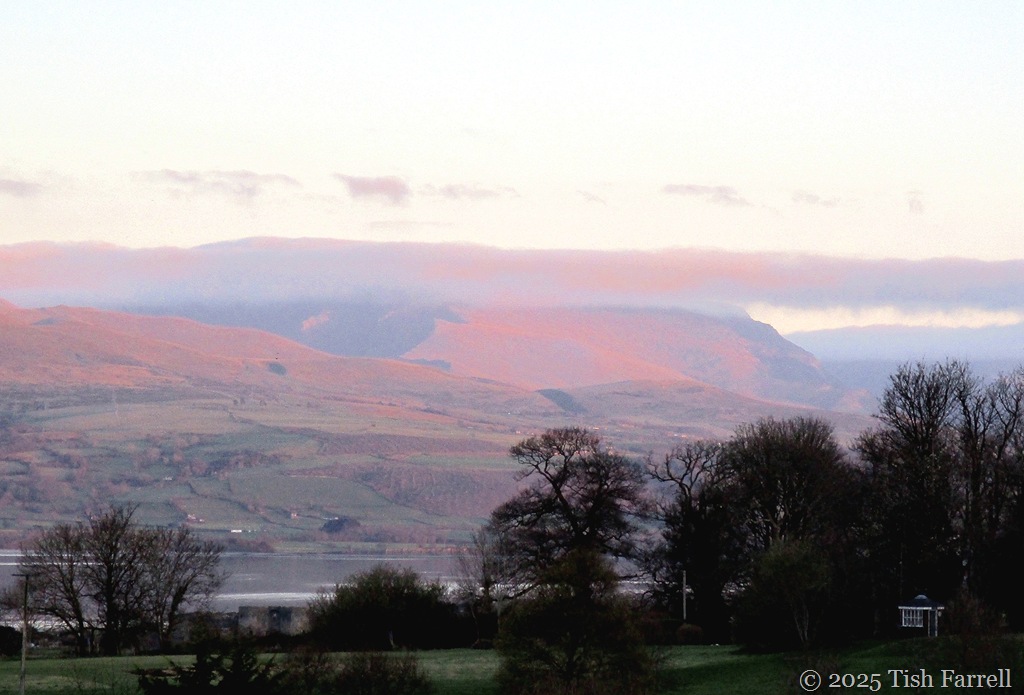
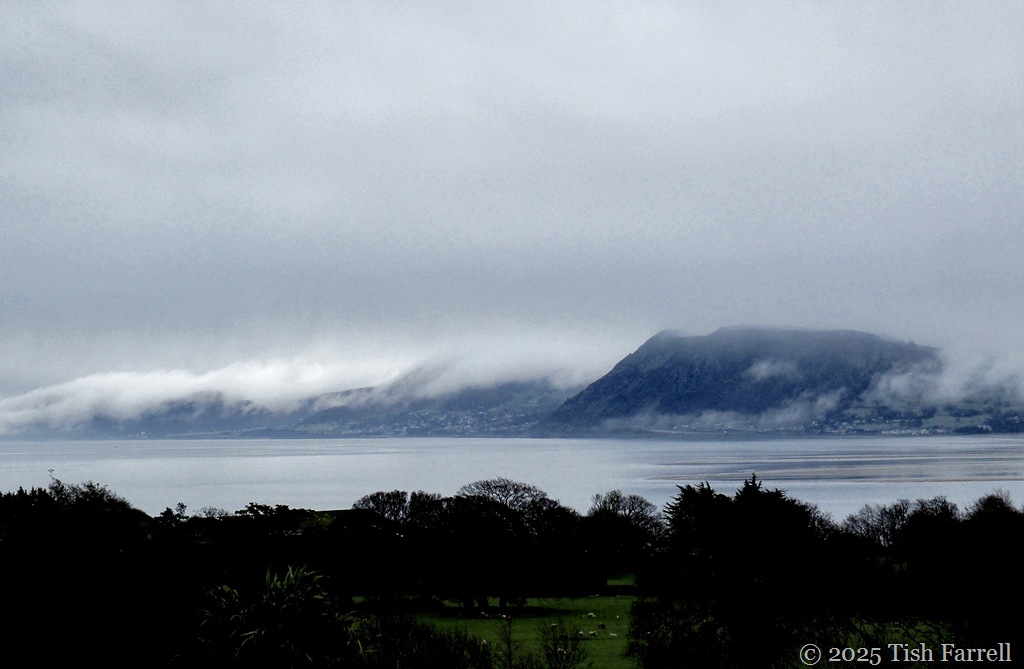
Herewith some recent views across the Menai Strait – from the island of Anglesey above Beaumaris to the Welsh mainland.

We’ve just returned from a week’s stay on Ynys Mon. It was our first March visit to the island, our usual time-slot being late December, and our arrival coincided with both the spring equinox and a spring tide. In fact we had never seen the low tides so low. When the sea went out, sand banks never glimpsed before, became exposed.
You can just make them out in the first photo.  This reminded me of the tales of the Roman invasion of Anglesey around 60 CE and how Governor Suetonius Paulinus equipped his army with flat bottomed boats to deal with the uncertain depths across the strait. But it is possible, too, that there are/were low-tide paths, known only to locals. Perhaps Suetonius Paulinus found himself an informer. The conquest anyway was bloody: the object to smash the power of the Celtic tribes’ druid priests who made their last stand on the island.

There’s more about this at an earlier post: Island of Old Ghosts.

For the mystically or meditatively inclined, you can see how weather watching can enthral; you never know what may happen next; all the elemental forces conspiring: the ever changing light, coastal winds, cycles of convection and condensation, the lunar-solar ebb and flow of tidal waters.

So much weather in a week on this tiny corner of the planet. We had hot sun, biting winds, cloudless blue skies, deep gloom, rain (though not so much for Wales), drizzle, mist, stormy and glass glittering seas.

IMG_7159ed

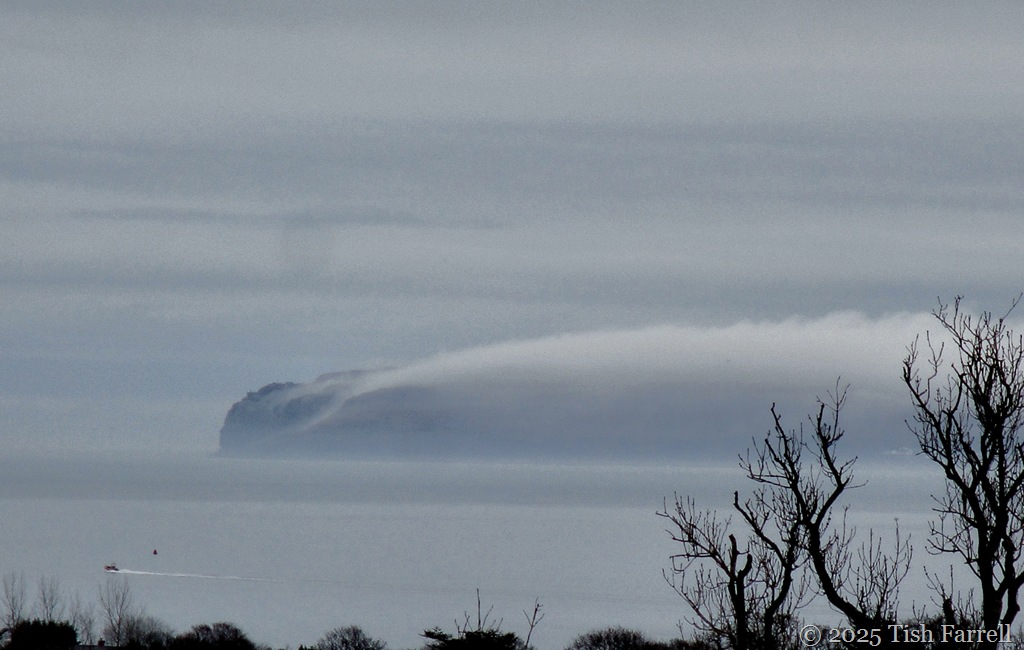
Late one afternoon we watched, with some sense of awe, as this white cloud moved low along the mainland shore, spilling out like dry ice till it reached the Great Orme headland.

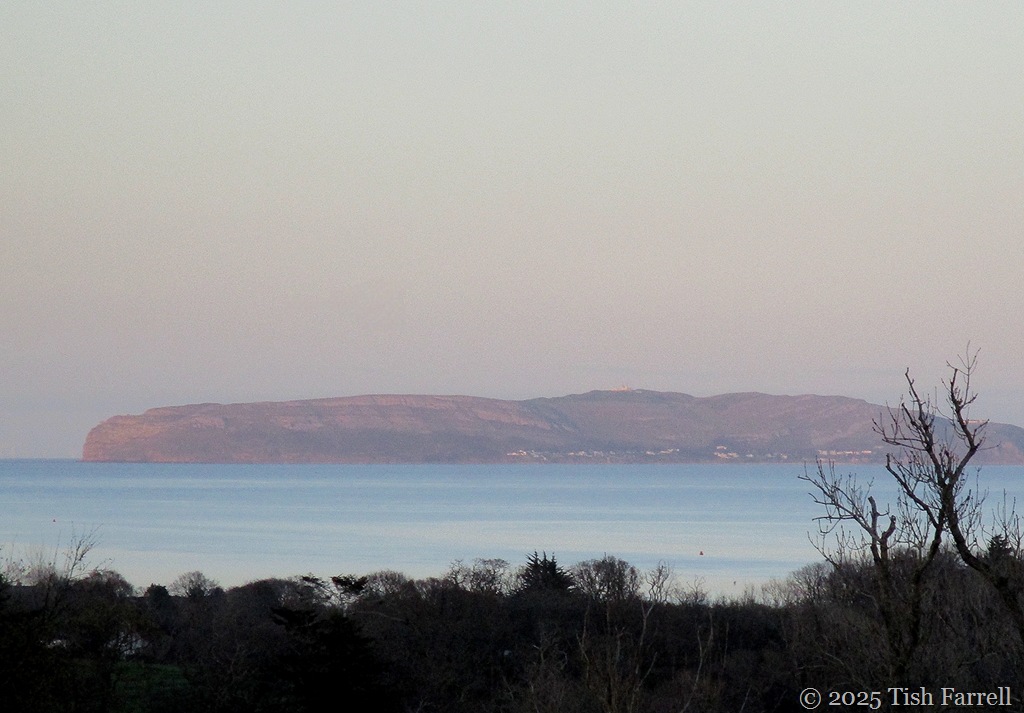
And then one evening…

IMG_6971ed2

*

At other times the mainland looked gauzy. It could be a mirage. Or there again it reminded me of the magic painting books we had as children – the wash of colours emerging from the empty page.

IMG_6967ed

IMG_7184ed

Copyright 2025 Tish Farrell


Lens-Artists: Wild  This week Egidio at Through Brazilian Eyes wants to know what wild means to us. Go see what wild means to him.