
Somehow I feel this image says much about our relationship with planet earth. I’m wondering what you think?
Location: Little Haven, Pembrokeshire
Baleful is Debbie’s word for today

Somehow I feel this image says much about our relationship with planet earth. I’m wondering what you think?
Location: Little Haven, Pembrokeshire
Baleful is Debbie’s word for today
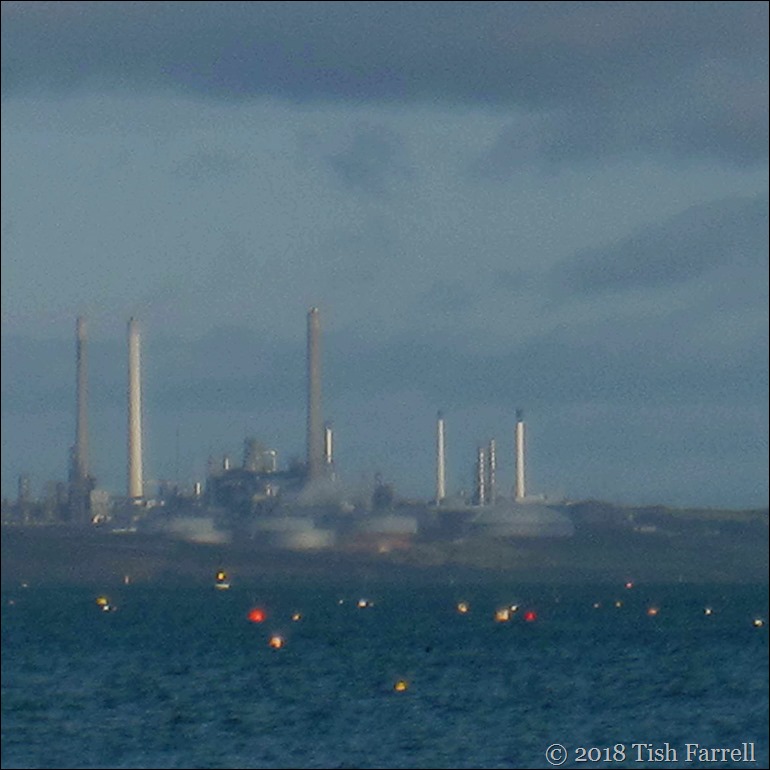
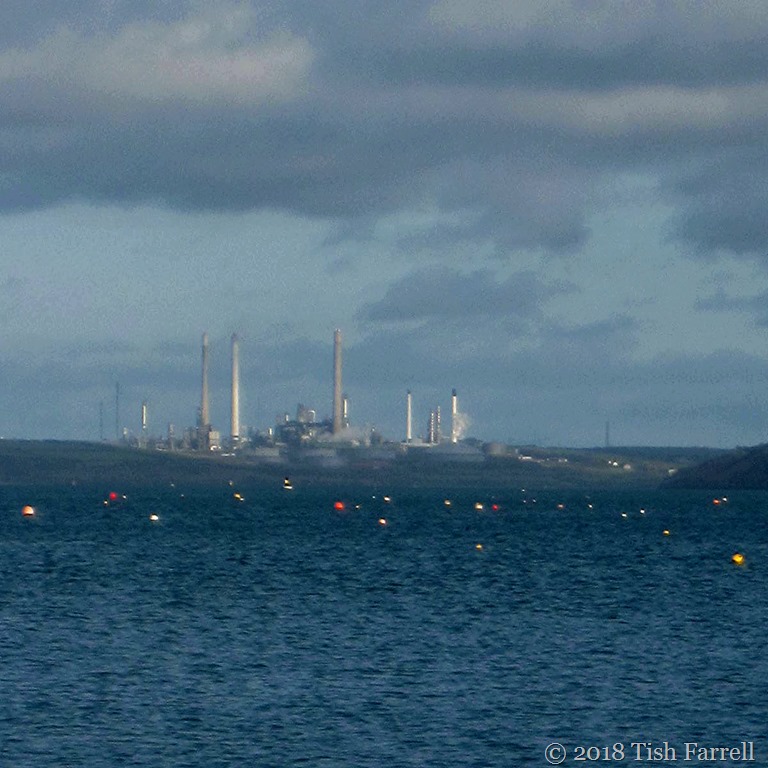
This view was taken from the little village of Dale on the estuary of the Black and White Rivers Cleddau, looking towards the port town of Milford Haven. Twelve hundred years ago, and until the Norman Invasion of 1066, the sheltered inlets of the Haven were the haunt of Viking raiders. In fact if you had been looking out across this stretch of water in 854 CE you might have spotted the 23 ships of a Viking raiding fleet. They were gathered off Milford Haven, under the command of Ubba/Hubba (who incidentally gave his name to the present-day settlement of nearby Hubberston). He was one of several commanders of the Great Army whose various factions invaded the Saxon kingdoms of Wessex, Mercia, Northumbria and East Anglia.
If you had looked again in 1171 CE you would surely have seen at least some of the 400 warships that had converged in the Haven as a prelude to Henry II’s invasion of Ireland. The ships were carrying 500 knights and 4,000 men-at-arms.
Look again in 1597, and there would have been storm ravaged ships of the Spanish Armada. A number made landfall on the Cleddau only to be sent packing back to sea by the Welsh militia. This seeing off also apparently involved some pillaging. One of the damaged caravels was captured by six Welsh boats, and relieved of its gold and silver.
Today, though, instead of long boats and warships, you are more likely to see oil tankers heading for the oil refineries of Pembroke Dock. And sometimes even a cruise ship. The misty installation is a recycled oil refinery, now used for the storage of Liquefied Natural Gas.
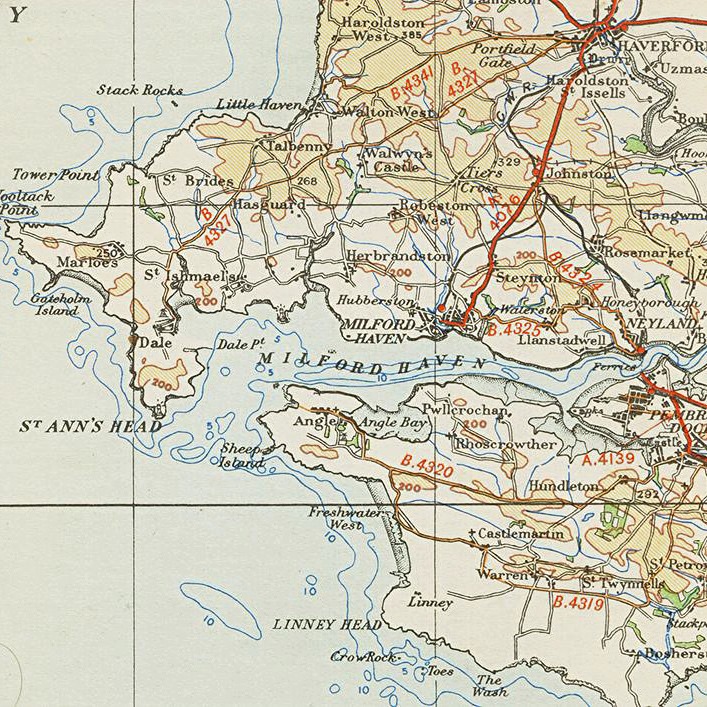
Milford Haven, Pembrokeshire Ordnance Survey 1946 (out of copyright)
*

Dale Beach – never too old to hunt for seashells.
*
March Square Ordnance Survey map apart, this post’s circles and squares in squares may take a bit of finding: round buoys and storage tanks anyone? Square window panes and spotty backpack? Please pop over to BeckyB’s for more March geometrics.
In which Six Go Potty In Pembroke With Cockapoo Puppy – holiday snaps #7
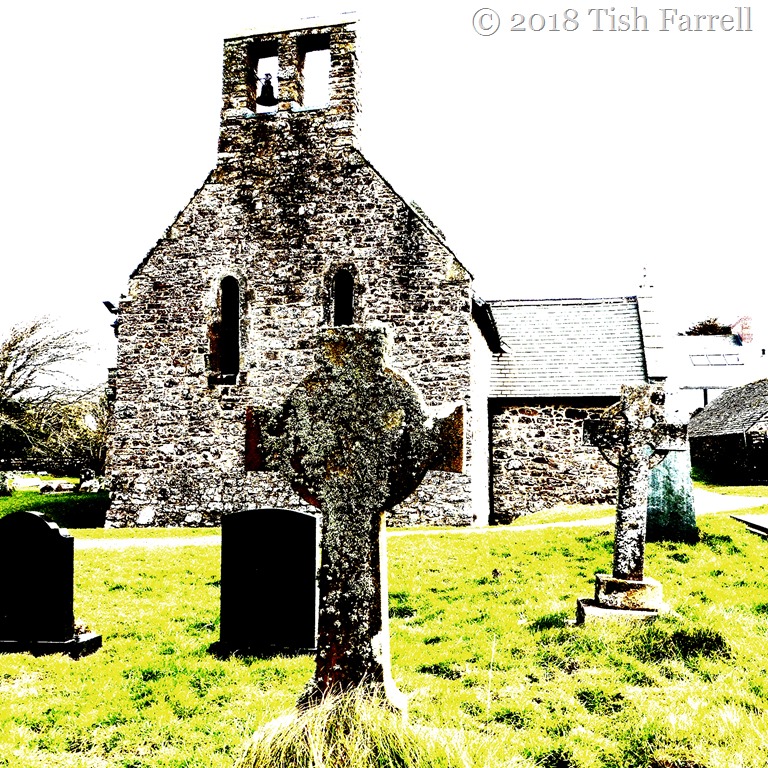
I know many people do not care for them, but I like graveyards. In my teenage years many moons ago we lived next to one – an unassuming village sort with a few brooding yews and a small plain church presiding. It had one tunelessly doleful bell which was very trying to the nerves of us Ashfords come Sunday morning. My father, who was a godless soul as far as I know, took to mowing the grass around the nextdoor graves. This was after he had deeply offended the vicar by mowing our own lawn during evensong.
Pa was deaf and had switched off his hearing aid and so presumably had missed the Sunday evening bell tolling, although this is hard to believe. Anyway, around seven on a summer’s evening he was happily whizzing over the grass with a very noisy flymo only to be fruitlessly hallooed over the church wall by the vicar who had worked himself up into a whirlwind of white cassock.
I think it was me who spotted the poor man waving his arms, trying to catch Pa’s attention. It was a bit embarrassing. Ma tut-tutted. We all knew that Pa was a bit obsessive-compulsive when it came to grass-mowing. But all was smoothed over in the end.
Anyway, to get back to graveyards. Here I am posting some photo details of St. Bride’s churchyard memorials (See earlier post The Little Church By The Sea.) I’m including them for a very important reason. While we were away at St. Bride’s I happened to read an article by Harriet Carty in April’s The World of Interiors magazine. Harriet Carty is an environmental scientist who lives in Shropshire and she is also director of a non-religious charity called Caring For God’s Acre. My interest was thus piqued on several fronts. This is what the organisation says about itself and what it does:
There are about 20,000 burial grounds in the UK and they contain a fantastic wealth of biodiversity and history. They are refuges for wildlife and stepping stones of habitat within our increasingly nature deprived landscape.
And…
Burial grounds are unrivalled for the wealth of built heritage and social history they contain. We encourage appropriate management of heritage and the appreciation and surveying of monuments. Good management of a site creates a haven for wildlife without losing accessibility to the built heritage.
In the article Harriet also mentions lichens in particular, saying how churchyards provide sanctuaries for one third of the 2,000 species found in Britain – the stone walls and memorials being ‘ideal hosts for these slow-growing colonies.’

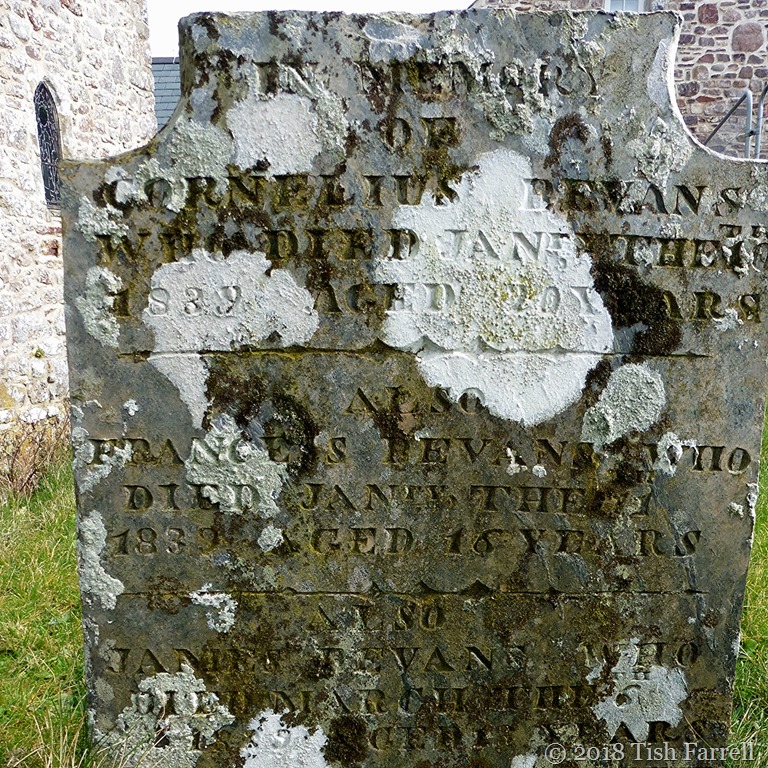
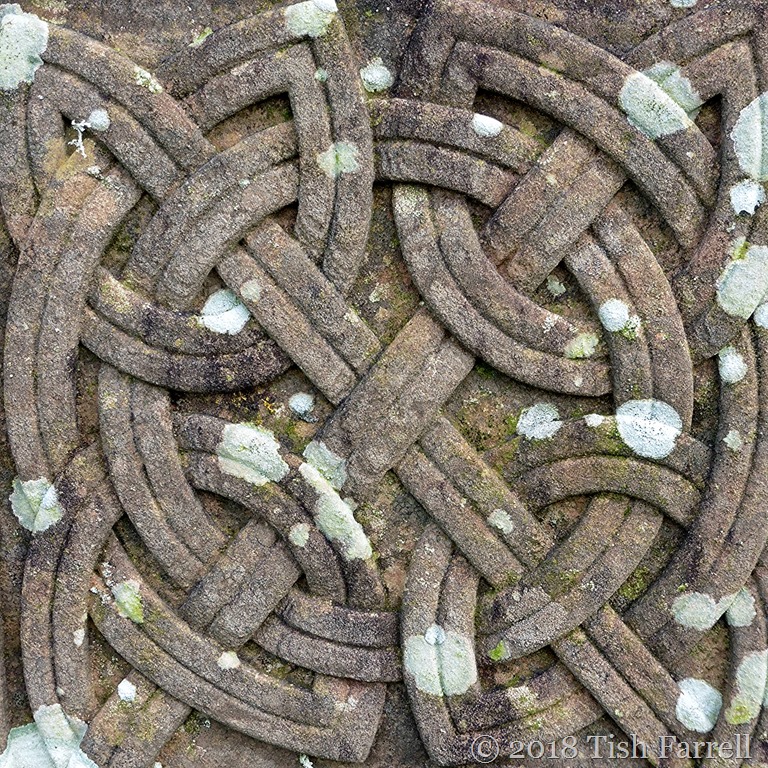
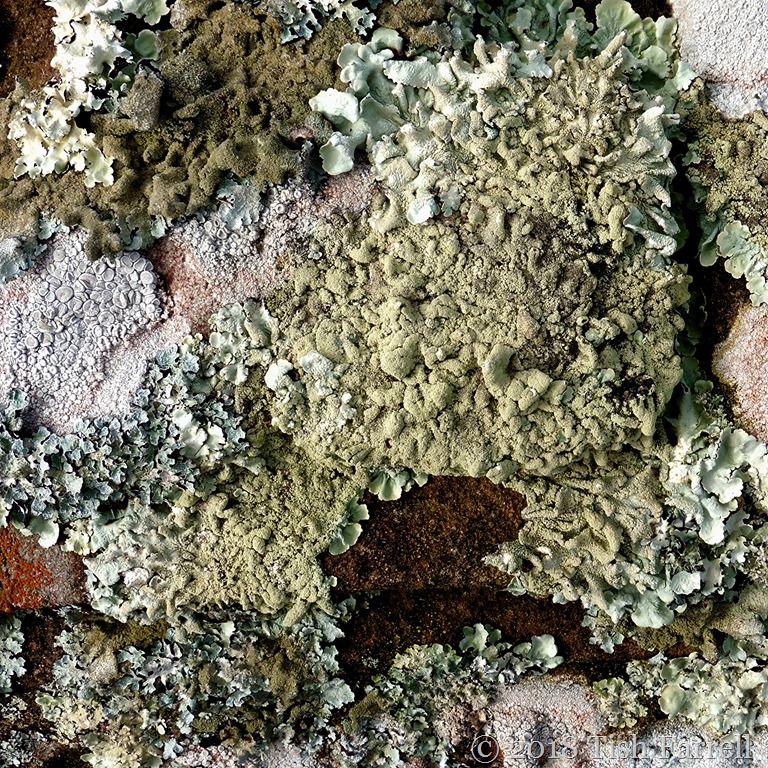
I don’t know much about lichens, apart from their presence indicating unpolluted air, but I would say there are a good few species on these stones. Of course lichens are not the only life forms to have found protecting spaces in graveyards. There may be slow worms, voles, nesting birds, toads, bees and butterflies. There’s also the social history too. So much may be gleaned about past communities from their memorials. Over the next four years Caring for God’s Acre will establish a national data base, listing all the natural and man-made treasures in the nation’s burial grounds. A fascinating project. But most of all I find it very heartening that new life thrives on and around the monuments to those humans who have left the living world. I like it that even on ground dedicated to the dead, the circle of life turns ever on.
Squaring the Circle #March22 Circles in squares and squares in squares are happening all month over at Becky’s
In which #SixGoPottyInPembrokeWithCockapooPuppy – holiday snaps #4
copyright 2018 Tish Farrell

The continuing freezing temperatures in the Britain made me think of this photo, taken back in December. Now I have cropped and enlarged it, it looks like a Christmas Tree bauble, a piece of intricate glass. I also imagine I see a cloaked figure, a woman I think, fleeing for her life on a galloping horse. Or else it looks like a Victorian woman’s reticule, soft velvet with a drawstring closure. Or perhaps one of Scrooge’s stash of money bags.
How it formed like this, suspended from a coat thread caught on a barbed wire fence up at the allotment, I have no idea. It just goes to show that we do not need to know the hows and whyfors and whats of something to see its wonder. When I found it, I thought the elements had left me a gift.
Copyright 2018 Tish Farrell
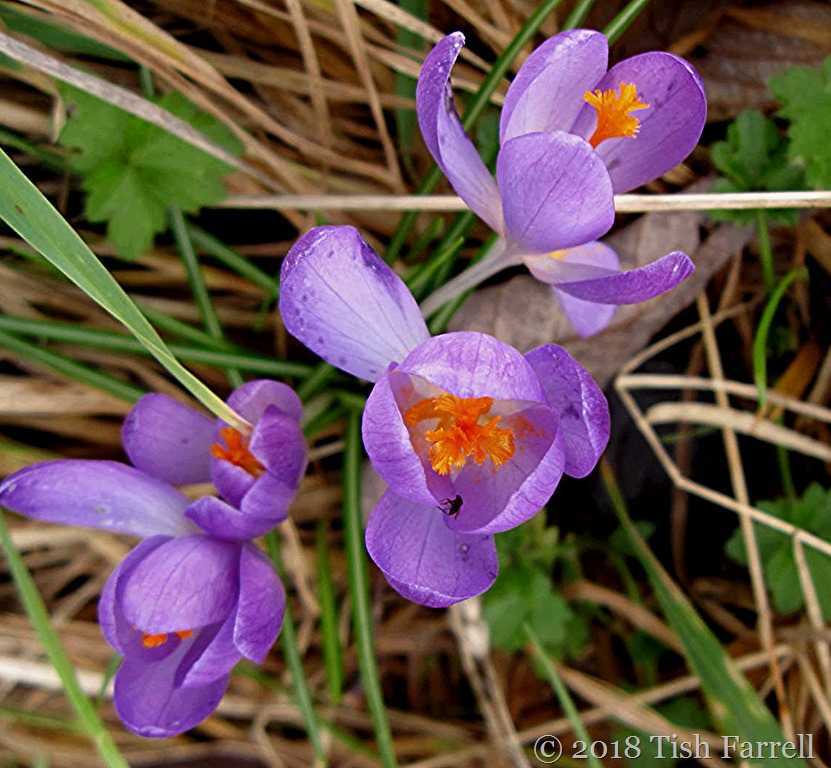

Several things spurred me to the allotment on Saturday – sun, dryness under foot, onion sets in the post, and the need to get a 2” covering of compost onto the raised beds as per the ‘no dig’ methodology, a job I had forgotten to do in the autumn.
For once the field path was not all of a slither, and along the way I found these crocus (tiny in real life). Clearly they had grown bored with the confining domesticity of suburban flower beds, and so taken off over the garden hedges to try things on the wild side.
Breaking bounds with a flourish – one could learn a few things here…
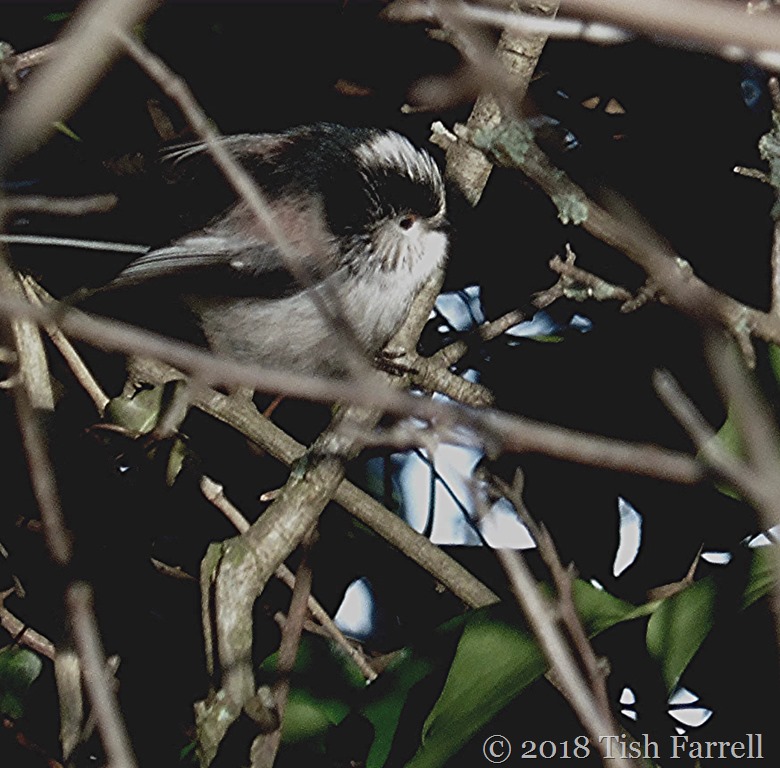
It is one of those sudden joys. You can be staring out at a bleak winter garden, all dormant stems and leafless, when whoosh – like darts of light – the gloom is fragmented by a little host of twittering, darting long-tailed tits. Their dashing habit of course makes them hard to photograph, and their livery – all the colours of a winter landscape – adds to the general elusiveness. They are tiny too. And they rarely stay for more than a few moments before taking off again on the great insect hunt. When they have gone, the garden is bereft, but you are left with the feeling that someone just gave you a perfect small gift. You can conjure it again at any time, in your mind’s eye, that moment when a flock of tiny beings flew in and lit up the day.
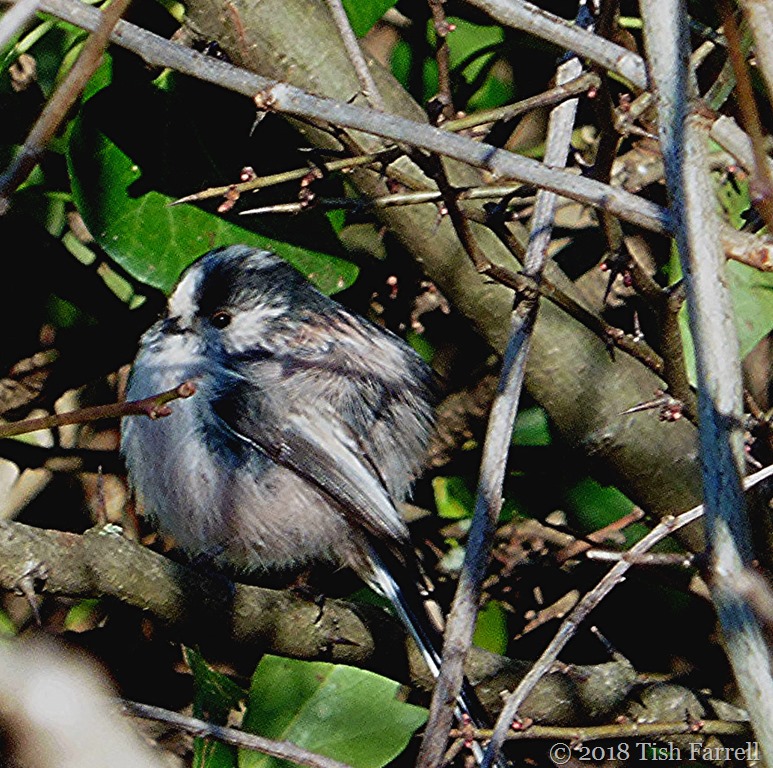
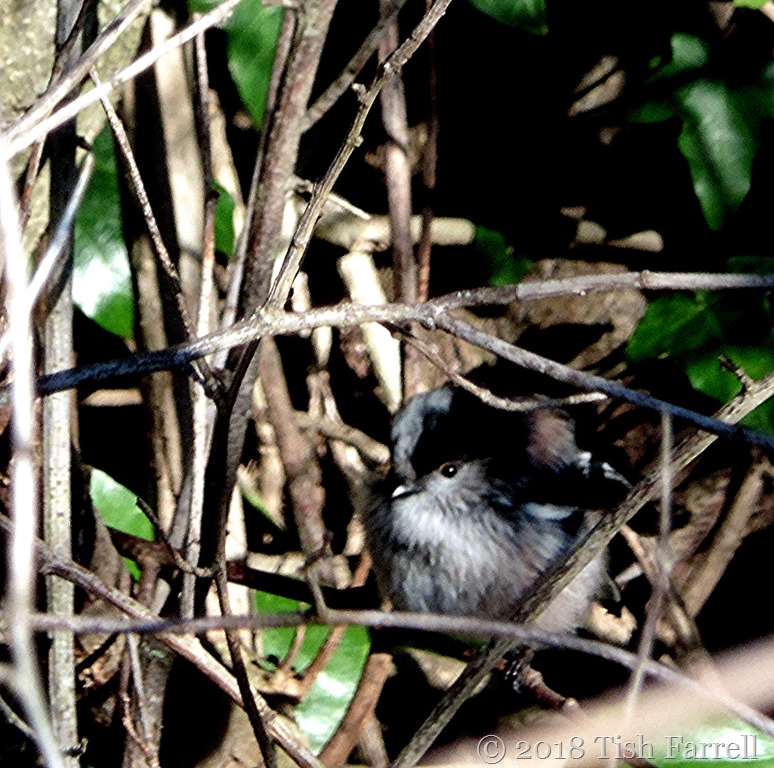
Long-tailed tit Go here to find out more about them and for far better images than I managed here.
copyright 2018 Tish Farrell

These dandelion ‘clocks’ are putting on their own firework display. If I had my gardener’s head on, the sight of so much imminent seed shedding would cause me much frustration. Fury even. I have spent hours, days and weeks of my life trying to keep my allotment plots and paths free of them. I have even tried seeing their good side: cropping them for their young salad leaves, making dandelion tea, roasting their roots to make coffee (very good for the liver). I also know their long tap roots release nutrients locked deep in the soil. And sometimes a field full of dandelions can look, well, beautiful.
Which brings me to the image above. I clearly had my photographer’s head on when I snapped it, and with the camera in dynamic monochrome setting. And then I edited it a little, and so emerged these magical structures. And there we have the top and bottom of it. Once we stop fighting the natural world, we can see how very wonderful it is. Or at least some of us can. This does not appear to apply to the corporate strains of our species.
copyright 2018 Tish Farrell


By way of a brief intermission from the on going Greek series, here is the sun over our Shropshire garden at around midday yesterday. The tail end of Hurricane Ophelia had apparently whipped up the dust of Africa along with the ash from the tragic forest fires in Portugal and Spain and so created this apocalyptic orange twilight complete with rosy sun. Nothing to do with us of course, all this global mayhem.


Yesterday’s post about goings on in and around the allotment and the fact our planet is now totally polluted by Roundup was a drearily disturbing topic. Today the allotment came up with floral fireworks, and a jug full of asters. Presents!
At lunchtime as I was on the plot, watering my peas and beetroot, fellow allotmenteer Siegfried came by. He was pushing a wheelbarrow full of produce – courgettes, runner beans, and a ton of red currants. I said he looked like a mobile vegetable stall. He told me it was destined for tomorrow’s Country Market – the Thursday morning local produce stall under Much Wenlock’s Corn Exchange.
Then he said would I please do him a favour, and go to his plot and pick as many asters as I wanted He said he had already picked masses for the market, but was afraid the rest would go to waste. He told me not to forget.
A little later I saw him go by my polytunnel. His arms were filled with sheaves of asters. What a wonderful sight – Siegfried in bloom, and I didn’t have my camera. And so on my way home I stopped for a greedy harvesting in the aster plot. And now I’m passing on Siegfried’s gift. All of which is to say, you meet some nice folk up at the allotment.
